

Introduction
Recent major geopolitical events, chiefly the Russian invasion of Ukraine, have resulted in urgent expansion of civil preparedness in many countries, especially in Europe and North America. In Europe, maintaining health care system functionality during armed conflicts is a strategic imperative taking precedence over other public health measures.Reference Marchandise and McKee1 In a recently published viewpoint, U.S. physicians argue that civilian hospitals must prepare for treating large volumes of wartime casualties in the event of a large-scale conflict.Reference Goralnick, Holcomb and Elster2 Terror attacks and other forms of armed violence exist on a spectrum, ranging from isolated incidents involving a single perpetrator to full-scale armed conflicts characterized by a loss of territorial control and widespread societal disruption. A cornerstone of wartime health systems preparedness is hospital Mass Casualty Incident (MCI) plans. While hospitals in Europe and the U.S. have activated MCI plans during incidents such as the 2005 London bombings, the 2015 Paris attacks, the 2016 Orlando nightclub shooting, and the 2017 Las Vegas shooting, these events did not directly threaten the hospitals themselves.Reference Lake3–Reference Wolf and Canty5 Consequently, they provide only limited insight into the unique challenges of MCI plan operation during large-scale armed conflicts, where governmental control may be compromised, situational awareness is limited, and hospitals and health care personnel may themselves come under direct attack. Experiences from Ukraine and other contemporary conflicts demonstrate that the asymmetric tactics of modern warfare, including the deliberate targeting of health care infrastructure, create additional challenges to hospital function and health care delivery.Reference Barten, Tin and Granholm6–Reference Heisler, Kovtonyuk and De Vos8 The operation of hospital MCI plans in such environments remains poorly understood as neither western Europe nor the U.S. have experienced an armed conflict on its own territory since the Second World War.
On October 7, 2023, Israel was subjected to a large-scale attack originating from the Gaza Strip. The attack began with a massive rocket barrage and was followed by a coordinated ground assault involving approximately 3000 armed militants.9 In contrast to single-site incidents, the October 7 attack was an ongoing, large-scale, multi-front assault affecting numerous communities primarily in the region around the Gaza Strip known as the Gaza Envelope. Throughout the day, approximately 1200 people were killed and many others wounded.Reference Berzon, West and Jacobs10 Unlike conventional MCIs, the attack had characteristics of an armed invasion with multiple communities temporarily overrun, disrupted lines of communication, and delayed restoration of government control. Israel’s Emergency Medical Services (EMS) had not planned for a scenario in which they would be unable to safely access casualties and provide care within Israeli territory. This resulted in delayed evacuation and the presentation of many patients to hospital by informal means.Reference Jaffe, Wacht and Davidovitch11 Approximately 1600 casualties were treated at Israeli hospitals.Reference Berzon, West and Jacobs10 To our knowledge, October 7 represents one of the few documented instances in which civilian hospitals in a developed nation operated under conditions involving temporary loss of territorial control, disrupted EMS access, and ongoing attacks.12 As such, the central premise of this study is that the operational conditions of October 7 more closely resemble those of large-scale armed conflict than those of a conventional terrorist attack. Consequently, examining MCI plan operation in this context may provide insights relevant to wartime preparedness in other health care systems.
Samson Assuta Ashdod is a 300-bed hospital located 27 km from the Gaza Strip. The hospital was specifically designed with protected infrastructure, including key clinical areas being protected by reinforced concrete, to allow continued operation during rocket attacks. Prior to October 7, the hospital maintained a strong culture of emergency preparedness, supported by a structured annual training program that included MCI drills conducted every 3 months. On October 7, the hospital’s MCI plan was activated and remained operational for 12 hours during which 87 casualties were received and treated. Injuries included gunshot wounds, blast injuries, and burns. The MCI plan includes staff recall to augment surge capacity. Senior personnel assume pre-defined leadership in Operational and Incident Command roles. As in many hospitals in the U.S., activation of the MCI plan includes relocation of non-MCI patients from the ED to create capacity for incoming casualties.Reference Puri, Tsay and Goldberg13 Incoming patients are triaged as emergent, urgent, or non-urgent and directed to dedicated care zones accordingly. Each zone is led by a senior clinician responsible for clinical oversight and decision-making. Stable or stabilized patients are often directed to a trauma Computed Tomography (CT) protocol. Following imaging, patients are transferred to a holding area staffed by an emergency physician while CT findings are reviewed, and definitive disposition is determined. Based on clinical disposition, patients are transferred to the Operating Room, Intensive Care Unit, or inpatient wards. On October 7, patient care was provided while the hospital remained under ongoing rocket attacks. The surrounding communities, including those in which hospital staff resided, were also under attack.
This study aimed to examine how the challenges posed by the October 7 attack affected MCI plan operation at Assuta Ashdod and to generate actionable insights for hospitals seeking to develop resilient MCI plans that remain functional during wartime.
Materials and Methods
This is a qualitative study using thematic analysis of semi-structured interviews conducted in a stratified sample of key informants. AJR is a physician and public health researcher with particular expertise in qualitative design in a range of topics. DGW is a senior emergency physician with substantial experience in MCIs, who also worked on October 7. MN is an emergency physician and epidemiologist with operational experience from several complex humanitarian emergencies. Drawing on their professional experience and with input from personnel involved in the October 7 MCI response, the authors developed a semi-structured interview guide. The questions were designed to explore key aspects of MCI plan activation and operation, while remaining sufficiently open-ended to allow participants to introduce additional experiences and perspectives (Appendix 1: Interview Guide). Everyone who worked when the MCI plan was active was stratified according to profession and operational role within the activation plan. Preferred participants were those with oversight of MCI plan function, including members of Operational and Incident Command, team supervisors, and clinicians directly involved in patient care. The recruitment period extended from May 1 to June 5, 2024. A total of 19 persons were invited to participate, all of whom consented. This sample size allowed for a high probability of reaching thematic saturation and code stabilization.Reference Guest, Namey and McKenna14 Between July 1 and July 4, 2024, 18 participants underwent in-person interviews at their workplace. One interview was conducted via Microsoft Teams on July 28, 2024. Interviews were conducted privately with only the participant and the researchers present. At the beginning of each interview, the purpose of the study was explained, and consent verbally obtained and recorded. All interviews were conducted by MN and DGW in English with Hebrew translation as required. The conversations were recorded digitally, anonymized, and transcribed verbatim. Throughout the interview period, preliminary data analysis was performed iteratively by MN. Each additional interview was assessed for novel insights, and thematic saturation was determined as present when no new substantive content appeared in consecutive interviews. This occurred after 11 interviews; however, due to some remaining participants having held roles in the MCI plan that enabled unique insights not available to others, a decision was made to conduct the interviews with all 19 participants. Given her direct involvement in the October 7 response, DGW was intentionally excluded from the data analysis process to reduce the risk of investigator bias. All data analysis was conducted by MN and AJR, both of whom were independent of and external to the event under study. Transcripts were read in an initial familiarization stage. Based on reflective understanding of a second reading, utterances were identified, and a codebook was developed. The codebook was appraised and revised. Disagreements were resolved through clarification of each researcher’s interpretation of content. Where required, codes were either merged or split into separate codes, either distinct ones or through parent/daughter coding (Appendix 3: Codebook). Codes were categorized according to content. Overarching themes and sub-themes were abstracted. Exemplar quotes were also abstracted to communicate the principles of each theme. The thematic analysis was conducted manually, and no software was used. This study was granted exemption from ethical review by the Assuta Ashdod Helsinki Committee, and ethical approval was granted by the Swedish Ethical Review Authority (2024-06955-01). This study followed the Consolidated Criteria for Reporting Qualitative Research (COREQ) reporting guidelines (Appendix 2: COREQ Guidelines).
Results
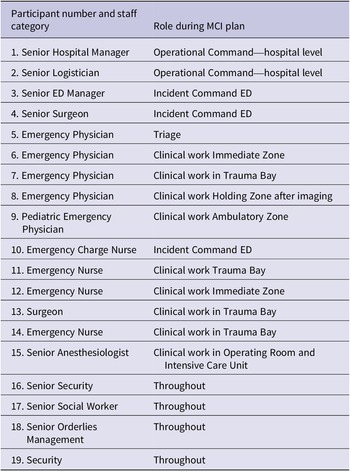
The study included 19 participants, of whom 10 (53%) were women. Interviews ranged in duration from 26 to 47 minutes (Table 1).
Participant identity and role in the MCI plan

Table 1. Long description
19 participants are categorized according to profession and role in the Mass Casualty Incident plan.
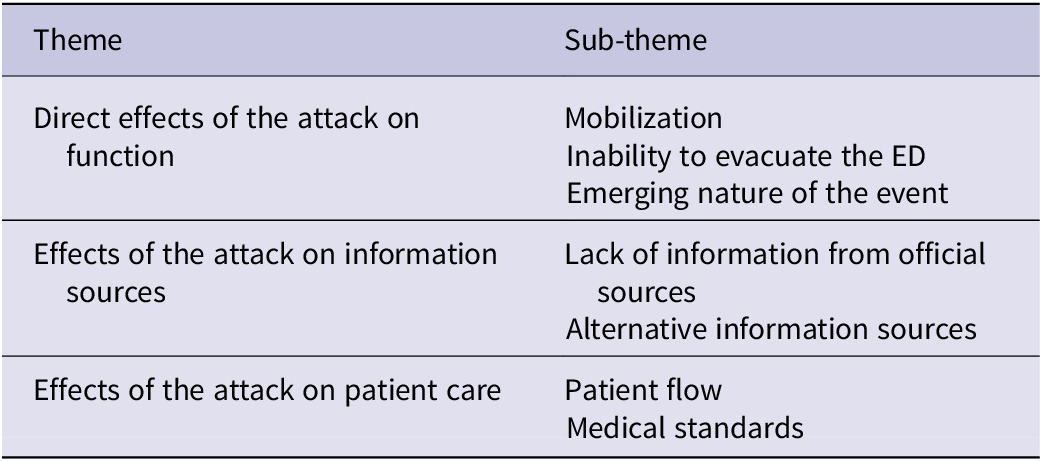
Three themes and seven sub-themes were identified (Table 2).
Themes and sub-themes
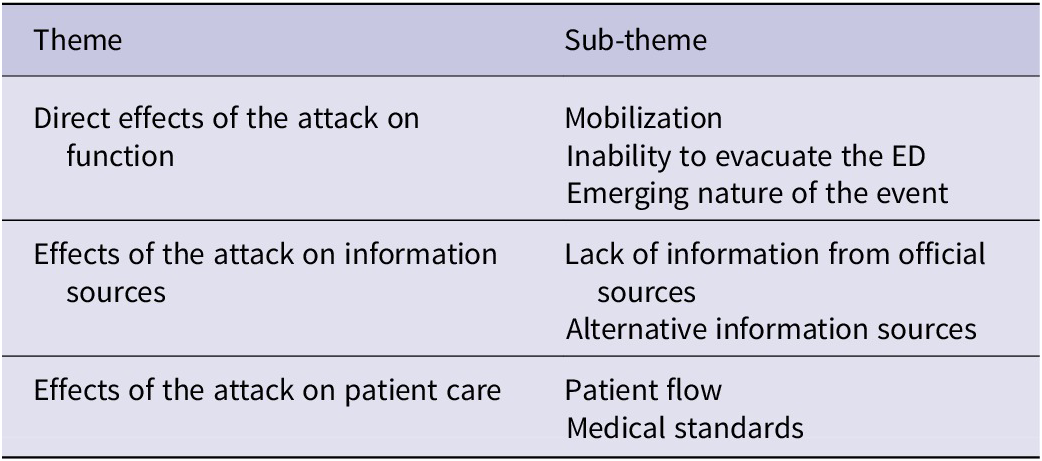
Table 2. Long description
Direct effects of the attack on function, effects of the attack on information sources, effects of the attack on patient care.
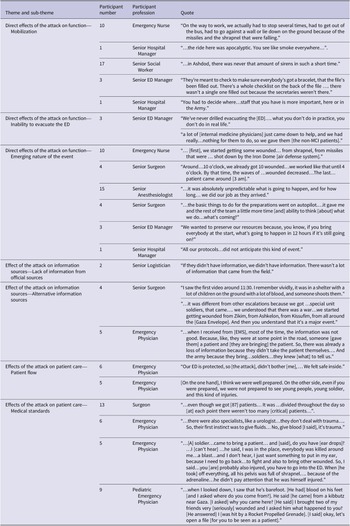
A total of 24 exemplar quotes were identified and are detailed below (Table 3).
Exemplar quotes

Table 3. Long description
Exemplar quotes that were uttered by the participants which highlight themes.
Direct Effects of the Attack on Function—Mobilization
Staff safety emerged as a major theme. Travel to hospital was perceived as hazardous because of ongoing rocket attacks and the presence of armed assailants in nearby communities. An ED nurse remarked that: “On the way to work, we actually had to stop several times, had to get out of the bus, had to go against a wall or lie down on the ground because of the missiles and the shrapnel that were falling.” Some staff living close to the fighting were reluctant to leave home out of concern for their family. A senior hospital manager described that “…the ride here was apocalyptic. You see like smoke everywhere…”. Concerns regarding staff safety led Incident Command to deviate from standard MCI protocol and refrain from recalling off-duty personnel. The magnitude of the rocket attack was described as unprecedented and suggested that an extraordinary event was unfolding. A senior social worker remarked that “…in Ashdod, there was never that amount of sirens in such a short time.” Thus, recognizing that a major event was unfolding, personnel independently presented to the hospital to assist. This spontaneous mobilization compensated for much of the reduced formal staff recall.
A shortage of administrative staff occurred during the MCI, as many of these were mothers with caregiving responsibilities for young children who decided to remain with their families. As these staff were responsible for patient identification, registration, tracking, and documentation of transfers, their absence resulted in significant gaps in these functions. A senior ED manager remarked that “They’re meant to check to make sure everybody’s got a bracelet, that the file’s been filled out. There’s a whole checklist on the back of the file …. there wasn’t a single one filled out because the secretaries weren’t there.”
The nationwide activation of military reserve forces created competing demands for personnel as some health care workers were simultaneously required to report for military service. This forced hospital Command to balance the staffing needs of the hospital against those of the military. A senior hospital manager observed that “you had to decide where…staff that you have is more important, here or in the Army.”
Direct Effects of the Attack on Function—Inability to Evacuate the ED
Under the MCI plan, all non-MCI patients are to be evacuated from the ED and transferred to inpatient medical wards to create capacity for incoming casualties. The senior ED manager identified this as a shortcoming of MCI plan drills: “We’ve never drilled evacuating the [ED]… what you don’t do in practice, you don’t do in real life.” However, on October 7, evacuating patients from the ED was not possible. While much of the hospital is protected against rocket strikes, the medical wards were outside this protective zone. Therefore, the ED was divided into 2 zones, with internists managing non-MCI patients in one of them. The senior ED manager remarked that “a lot of [internists] just came down to help, and we had really…nothing for them to do, so we gave them [the non-MCI patients].”
Direct Effects of the Attack on Function—Emerging Nature of the Event
Due to the emerging nature of October 7, patient influx was unpredictable. An ED nurse observed that “… [first], we started getting some wounded… from shrapnel, from missiles that were … shot down by the Iron Dome [air defense system].” A senior surgeon stated that “Around…10 o’clock, we already got 10 wounded…we worked like that until 4 o’clock. By that time, the waves of …wounded decreased…The last…patient came around [3am].” A senior anesthesiologist remarked that “…it was absolutely unpredictable what is going to happen, and for how long… we did our job as they arrived.”
The senior surgeon felt that the frequent drills allowed Incident Command to be so accustomed to the MCI plan that they could divert attention to monitoring the situation and anticipating emerging needs: “…the basic things to do for the preparations went on autopilot.…it gave me and the rest of the team a little more time [and] ability to think [about] what we do…what’s coming?”
The unpredictability of the situation contributed to the decision to not recall all staff. A senior ED manager observed that “We wanted to preserve our resources because, you know, if you bring everybody at the start, what’s going to happen in 12 hours if it’s still going on?”. A senior hospital manager remarked that “all our protocols…did not anticipate this kind of event.”
Effect of the Attack on Information Sources—Lack of Information from Official Sources
At the national level, the scale of the attack was only gradually understood, and the MCI plan operated in a significant information vacuum. Incident Command maintained communication with the Ministry of Health, EMS, the military, and the police. However, these agencies had only limited situational information available. A senior logistician mentioned that “If they didn’t have information, we didn’t have information. There wasn’t a lot of information that came from the field,” while a senior hospital manager remarked that “I think the general problem was lack of information to establish the big picture.” Further, an emergency physician working in triage noted that “…no one told me…there is a war… I didn’t know…what kind of patient I’m going to see from now.”
Effect of the Attack on Information Sources—Alternative Information Sources
Limited situational information from official sources was partially compensated for through the use of alternative information channels. Videos of the attacks were widely circulated on social media, allowing for advance warning. A surgeon stated that “I saw the first video around 11:30. I remember vividly, it was in a shelter with a lot of children on the ground with a lot of blood, and someone shoots them.” The military, police, and EMS who brought patients provided information from the field. Patients provided information by relating events, and through their identity and place of injury. The surgeon observed that ”…it was different from other escalations because we got …special unit soldiers, that came…. we understood that there was a war…we started getting wounded from Zikim, from Ashkelon, from Kissufim, from all around the [Gaza Envelope]. And then you understand that it’s a major event.”
Effects of the Attack on Patient Care—Patient Flow
Despite the ongoing attacks, staff working in the ED reported feeling safe and able to focus on patient care. Participants attributed this to the hospital’s protected infrastructure, which had been designed to withstand rocket attacks. An emergency physician remarked that “Our ED is protected, so [the attack], didn’t bother [me], … We felt safe inside.” Staff worked automatically, knew what to do, and attributed this flow to frequent drills. Another emergency physician remarked that “[On the one hand], I think we were well prepared. On the other [hand], even if you were prepared, we were not prepared to see young people [with these kinds of] injuries,” highlighting the value of frequent drills, but also describing an emotional toll echoed by many other participants.
Effects of the Attack on Patient Care—Medical Standards
Although participants believed that standards of care were preserved, they noted that the system was not tested to its maximum capacity. A progressive arrival of casualties enabled the timely delivery of treatment. A surgeon remarked that “…even though we got [87] patients… It was …divided throughout the day so [at] each point there weren’t too many [critical] patients…”.
In MCI plan drills, the surge capacity consists primarily of junior doctors. However, on October 7, the staff who self-mobilized were mainly specialists, some of whom were unaccustomed to the MCI protocols and trauma care. An emergency physician who was zone lead mentioned that “…there were also specialists, like a urologist…they don’t deal with trauma…. So, their first instinct was to give fluids… No, give blood [I said], it’s trauma.” However, participants felt that they could supervise non-ED peers to maintain patient safety.
Some participants reported encountering individuals whose injuries were seemingly minor or were at risk of being overlooked but who were subsequently found to have potentially life-threatening conditions. An emergency physician recalled that “…[A] soldier…came to bring a patient… and [said], do you have [ear drops]? …I [can’t hear] …he said, I was in the place, everybody was killed around me…a blast…and I don’t hear, I just want something to put in my ear, because I need to go back…to fight and also to bring other wounded. So, I said…you [are] probably also injured, you have to go into the ED. When [he took] off everything, all his pelvis was full of shrapnel…. because of the adrenaline…he didn’t pay attention that he was himself injured.”
When EMS were unable to access affected areas, military personnel undertook casualty evacuation and either handed patients over to EMS or transported them directly to hospital. Participants reported that information degradation occasionally occurred during these handovers, resulting in more complete information being available from military sources than subsequent EMS reports. An emergency physician working in triage remarked that “…when I received from [EMS], most of the time, the information was not good. Because, like, they were at some point in the road, someone [gave them] a patient and [they are bringing] the patient. So, there was already a loss of information because they didn’t take the patient themselves…. And the Army because they bring…soldiers…they knew [what] to tell us.”
Discussion
Direct Effects of the Attack on Function—Mobilization
One of the immediate operational challenges identified was the impact of the ongoing threat on staff mobilization. During armed conflict, threats to personnel traveling to the hospital may create a critical operational vulnerability. Staff safety considerations prevented full-scale MCI plan activation. While self-mobilized staff helped fill gaps, the absence of administrative staff proved disruptive to function. Had the attacks completely prevented additional staff from reaching the hospital, it is unlikely that the MCI plan could have functioned as intended. In the U.S., safety considerations in MCI planning have largely focused on terror attacks directed at the health care facilities themselves, particularly active shooter scenarios, rather than threats to staff traveling to hospital or the challenges posed by wartime rocket attacks.Reference Tin, Hart and Ciottone15–Reference Halpern, Goldberg and Keng18 Our findings suggest that staff mobilization should be incorporated into wartime MCI preparedness plans. Contingency measures, including protected transportation and security escorts, may help to maintain workforce availability when routine access to hospital is disrupted. While civilian-military cooperation in wartime patient care has been identified as a gap in U.S. preparedness, the observations from this study suggest that such cooperation may also need to extend to ensuring the safe transport of health care workers to hospital during active conflict.Reference Goralnick, Holcomb and Elster2 The self-mobilization observed in this study reflects the experience of a single center. As self-mobilization is likely to vary according to cultural, geographic, and organizational factors, it should not be routinely relied upon to ensure MCI plan functionality. This study also highlighted the essential role of administrative staff in MCI operations and the importance of explicitly including them in staff mobilization plans.
The military obligations of some staff created competing demands between hospital workforce requirements and military service. In the event of war, similar conflicts between civilian and military obligations may also emerge in other countries, including the U.S. One potential solution is the pre-assignment of health care workers to either civilian health care roles or military service by governmental authorities, thereby avoiding the need for hospital leaders to balance competing staffing priorities during a crisis. Such a model is currently employed in Sweden.19
Direct Effects of the Attack on Function—Inability to Evacuate the ED
The planned evacuation of non-MCI patients from the ED was not implemented because ongoing rocket attacks threatened the unprotected hospital areas designated to receive these patients. Furthermore, ED evacuation had never been incorporated into disaster drills, as it was considered excessively disruptive to routine hospital operations. As a result, staff were required to manage a mass casualty response while simultaneously continuing to care for non-MCI patients within the ED. MCI drills must be conducted in a manner that is minimally disruptive and does not compromise patient safety.Reference Waxman, Chan and Pillemer20 Consequently, planners may be reluctant to include complex processes such as ED patient relocation in full-scale exercises. However, the findings of this study highlight how armed conflict can create unexpected operational challenges that require the rapid execution of complex processes. Although logistical requirements will vary between institutions and health care systems, preparedness programs should consider exercising these high-complexity tasks rather than assuming they will be manageable without prior practice.
Although assigning the internal medicine physicians to care for non-MCI patients within the ED was an improvised measure at Assuta, the use of internal medicine staff to support MCI operations has also been described in the U.S. At Massachusetts General Hospital in Boston, internists are assigned responsibility for a subset of ED patients during MCIs, allowing more experienced providers to focus on casualty management.Reference DeLuca, Greenwald and Manners21 The authors note that this role is particularly appropriate as the remaining non-MCI ED population tends to be predominantly composed of medical patients.Reference Elixhauser and Owens22, Reference Persoff, Ornoff and Little23
Direct Effects of the Attack on Function—Emerging Nature of the Event
The multi-front and prolonged nature of the October 7 attack differed from many commonly described MCI scenarios which are typically characterized by a single discrete event. Following the 2013 Boston Marathon bombing, 78% of casualties arrived within the first 90 minutes, while the 2015 Paris attacks generated two waves of admissions at 150 and 240 minutes.Reference Raux, Carli and Lapostolle24, Reference Gates, Arabian and Biddinger25 In contrast, October 7 involved a sustained influx of casualties over several hours within the context of an evolving regional conflict. As many MCI plans in the U.S. and other developed health care systems are designed around a single event model, they may be insufficient for managing the prolonged operational demands associated with wartime MCIs.Reference Waxman, Chan and Pillemer20, Reference Biswas, Bahouth and Solomonov26–Reference Yánez Benítez, Tilsed and Weinstein33 A wartime MCI plan requires staying power that allows it to function over days and weeks. Decision makers should consider mechanisms for staff rotation to ensure adequate rest and recovery during prolonged incidents. In addition, personnel in command roles must be familiar with the MCI plan and its operational status to maintain situational awareness and support effective decision-making. Apart from resulting in an unpredictable influx of patients, armed conflict also carries the inherent, and unpredictable, risk of posing direct threats to hospitals themselves. Thus, protecting hospitals from unforeseen direct attacks may also need to be part of preparedness planning.Reference Granholm, Tin and Ciottone34
Effect of the Attack on Information Sources—Lack of Information from Official Sources
The information vacuum encountered on October 7 is characteristic of surprise attacks and has been recognized in MCI planning in the U.S. and elsewhere.Reference Raux, Carli and Lapostolle24, Reference Gates, Arabian and Biddinger25, Reference Tallach and Brohi35 The multi-front nature of October 7 further increased uncertainty as the full extent of the attack was only gradually understood. This was compounded by the targeting of police stations and military command centers, as well as the occupation of entire communities which disrupted established communication channels and impeded the flow of information. The decision to attack on a Jewish holiday, when military staffing levels were reduced and many religiously observant individuals avoided telephone use, contributed to delays in information relay and reduced situational awareness. Comparable vulnerabilities may be encountered in healthcare systems in the U.S. and Europe during weekends and holidays.Reference Bell and Redelmeier36–Reference Magid, Wang and Herrin38 These findings highlight the importance of considering predictable temporal vulnerabilities in emergency preparedness planning.
Effect of the Attack on Information Sources—Alternative Information Sources
This study demonstrates how situational awareness can be obtained through alternative information sources. Social media can convey important, albeit unverified, information faster than conventional media outlets. When preparing MCI plans, decision makers can assign staff to systematically gather information from a variety of sources including patients, EMS, police, and military as well as monitoring social media to inform command groups. This also allows the rapid escalation of critical information regarding the development of an incident to the national command level.
Effects of the Attack on Patient Care—Patient Flow
Few medical institutions in the U.S. and other developed nations possess the level of physical protection required to withstand military ordnance.Reference Chipley39 In our setting, the hospital’s protected infrastructure not only safeguarded patients and staff but also supported operational continuity by allowing health care workers to focus on clinical care despite the ongoing rocket attacks. This represents an important, yet often overlooked, aspect of preparedness. Protected health care infrastructure should be viewed as an important measure to maintain clinical operations, patient safety, and staff performance during wartime. These observations suggest that considerations of physical protection should be incorporated into future health care infrastructure and preparedness projects, especially in regions at risk of armed conflict. Participants valued the frequent drills and training exercises. While the benefits of drills are well documented, most published studies have been conducted in peacetime settings and do not consider the unique operational and psychological stressors associated with armed conflict.Reference Biswas, Bahouth and Solomonov26, Reference Jacobson, Severin and Rumoro27, Reference Martin-Ibañez, Roman and Diaz-Córtes30, Reference Robaina, Crawford and Huerta31 At Assuta, MCI drills are carried out every 3 months; by comparison, a survey of 46 institutions globally revealed that only 47.8% performed MCI drills at all, and 28.3% performed these once a year.Reference Ben-Ishay, Mitaritonno and Catena40 The particular value of frequent drills to maintain function during the stress of war that was observed in this study may be relevant to other health care systems preparing for conflict. Many participants described the emotional toll associated with treating young patients with severe injuries. While drills cannot fully prepare health care workers for the psychological impact of such encounters, familiarity with clinical workflows and pre-defined roles may help staff remain functional and maintain performance despite the emotional burden.
Effects of the Attack on Patient Care—Medical Standards
While participants felt that medical standards of care were maintained, this may partly reflect the fact that the system was never required to operate at its maximum capacity. In wartime settings, trauma demands may exceed the capacity of Emergency Medicine and trauma surgical services alone, necessitating the redeployment of clinicians from other specialties to support the response.Reference Ugelvik, Thomassen and Braut41 This study demonstrated how clinicians who do not routinely manage trauma patients can be integrated into the response effort while patient safety can be maintained through supervision by experienced emergency physicians. While the feasibility of this approach may differ across hospitals and health care systems, the inclusion of physicians from non-trauma specialties in MCI preparedness should be considered a potential strategy to expand clinical capacity during major incidents.
Under-triage of patients with occult but life-threatening injuries is a recognized problem in MCIs.Reference Frykberg42 The wartime context may further exacerbate this risk. In this study the inability of EMS to reach many casualties resulted in patients arriving at the hospital by informal means, including transport by civilians and other wounded individuals. As these individuals bypassed prehospital assessment by health care professionals, injuries could potentially go unrecognized. In an armed conflict, every individual entering the ED, including those accompanying the wounded, may be injured and must be assessed. This requires appropriate screening mechanisms and targeted staff training to reduce the risk of missed injuries and to ensure timely identification and management.
Unlike most MCIs where EMS personnel are able to reach patients quickly once the threat is removed, the loss of territorial control on October 7 limited EMS access.Reference Raux, Carli and Lapostolle24, Reference Gates, Arabian and Biddinger25 As a result, military forces were required to evacuate casualties and transfer care to EMS personnel once access was possible. This introduced an additional handover step which created opportunities for information loss and degradation of situational awareness. In the U.S., civilian-military cooperation has been identified as augmenting disaster response but is an area in need of expansion.Reference Goralnick, Holcomb and Elster2, Reference Clemens, Callaway and Klemann43, Reference Licina44 Our findings support the critical need to enhance civilian-military cooperation through joint training exercises, coordinated management of large-scale events, and a unified reporting system.
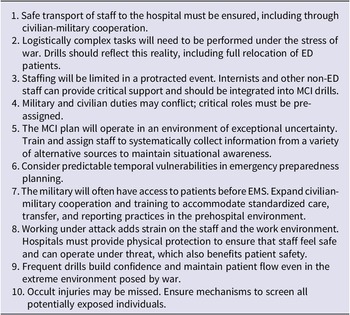
The key insights attained by this study are summarized in Table 4.
Summary of insights
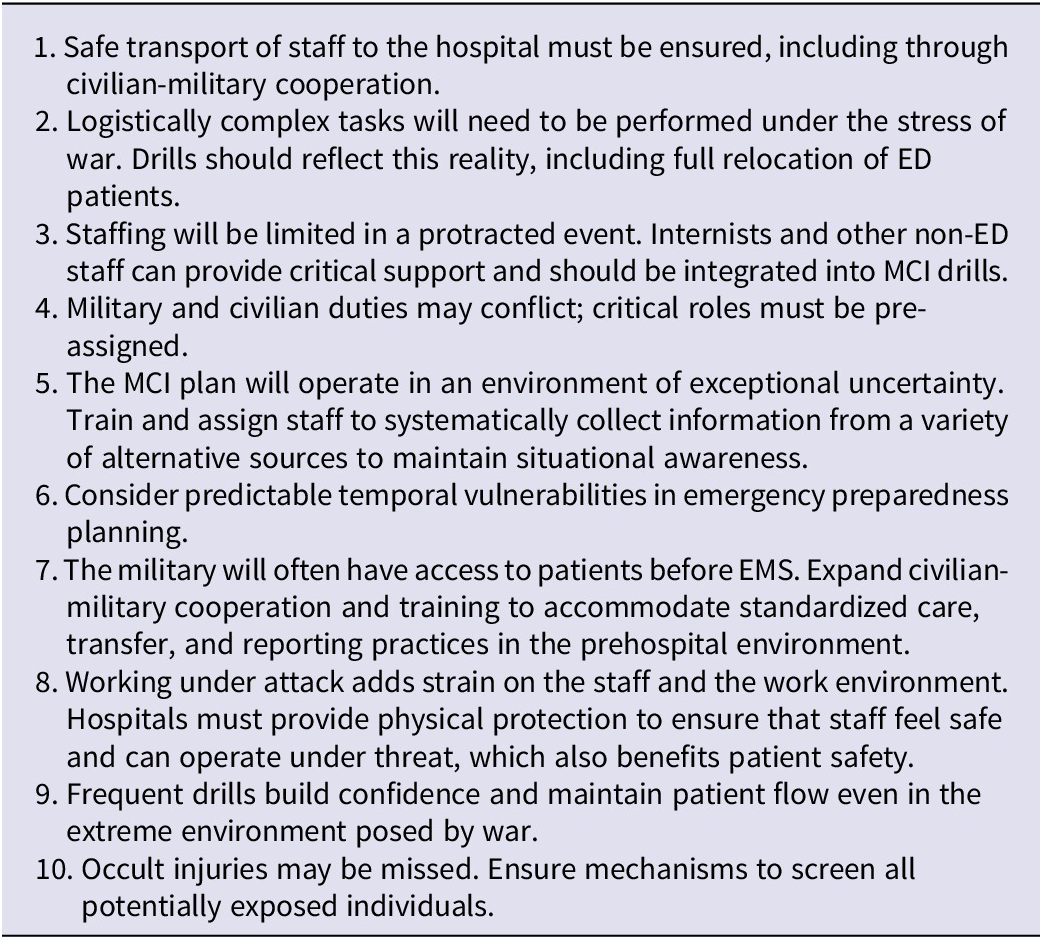
Table 4. Long description
List of key insights generated by the study.
This study has several limitations. First, as a single-center study, the findings may not be fully generalizable to other hospitals or health care systems. Second, although the Israeli health care system is similar in resources to those of other high-income countries, differences in its organization and infrastructure may limit the transferability of some findings. Third, due to the security situation in Israel, interviews were conducted 9 months after October 7, introducing the potential for recall bias. However, participants did not report difficulty remembering details, likely owing to the emotional resonance of that day. Fourth, the traumatic nature of the event may have induced emotional reinterpretation bias. Fifth, selection bias may be present. Since many different staff categories were selected, only a limited number of participants from each profession were interviewed. Sixth, as the interviewers were medical professionals, there is potential for similarity and social desirability bias. Participants may have modified their responses, consciously or unconsciously, based on their understanding of the type of answers that might be expected from them. Finally, given the ongoing security situation and inherent challenges associated with work in the ED, it was not feasible to return transcripts to participants for review and correction.
Conclusion
This study provides insights from the experience of a single center in Israel that may inform hospitals preparing their MCI plans for armed conflict elsewhere. Specifically, the findings highlighted the importance of staff support and management, including ensuring their safety and the integration of specialties other than those accustomed to trauma into the response effort. Additionally, the findings emphasize the unique challenges posed by protracted conflicts including the need to prevent staff burnout, and to establish systematic mechanisms for the collection of information from a variety of sources to maintain situational awareness. The study also underscores the value of frequent drills in enhancing staff confidence and patient safety; however, such training needs to be realistic and include logistically complex tasks that are likely to be encountered during major incidents. The study also provides insight into how MCI response operates across military and civilian systems. The findings support efforts to strengthen civilian-military cooperation in order to increase staff safety, improve the flow of clinical and operational information, and ensure the reliable and predictive staffing to both sectors in the event of an external crisis.
Supplementary material
The supplementary material for this article can be http://doi.org/10.1017/dmp.2026.10407.
Acknowledgments
The authors would like to extend our sincere gratitude to the participants in this study, who agreed to be interviewed about what was an emotionally very challenging day in their careers.
Author contribution
Maximilian P. Nerlander: Study design, data collection, data analysis, data interpretation, and manuscript preparation. Approved final version. Agrees to accountability for all aspects of the work. Debra Gershov West: Study design, data collection, data analysis, data interpretation, and reviewed the manuscript critically for content. Approved final version. Agrees to accountability for all aspects of the work. Adam J. Rose: Study design, data analysis, data interpretation, and reviewed the manuscript critically for content. Approved final version. Agrees to accountability for all aspects of the work.
Competing interests
Maximilian P. Nerlander declares no conflict of interest. Debra Gershov West declares no conflict of interest. Adam J. Rose declares no conflict of interest.
Ethical approval
This study was exempt from ethical review by the Assuta Ashdod Helsinki Committee, and ethical approval was granted by the Swedish Ethical Review Authority (2024-06955-01).
Use of AI Technology
No artificial intelligence technology was used in the preparation of the manuscript.


 Open access

