




Introduction
An early Muslim tradition of ascetic or renunciant piety (zuhd), inspired in some respects by Christian monks, has recently become the object of renewed scholarly interest. It appears to have flourished until about the middle of the ninth century, when it was overshadowed by more mystical and legal forms of piety.Footnote 1 The many pious hadith that it produced were soon denounced by critics as forgeries,Footnote 2 but it left behind a modest literary record, and was remembered with qualified respect in later literature on zuhd and Sufism. To the materials available for the study of this tradition may now be added a fragmentary but important literary papyrus: P.Vindob. AP 1854a–b at the Austrian National Library in Vienna. Its two incomplete and damaged leaves contain four texts that constitute a small anthology of meditations on the imminence of death and judgment: psalms 7–13 of the Islamic ‘Psalms of David’ (Zabūr Dāwūd); a collection of narratives surrounding the death of the Prophet; a collection of material about grief over the deaths of the Prophet and Fāṭima and over the slaughter of al-Ḥusayn's party at Karbala; and a dialogue about the rewards of the afterlife between God and the prophet David, who was a favourite model of repentant devotional piety. The Vienna papyrus establishes beyond doubt that the long Muslim tradition of rewriting the Zabūr had its origin in early renunciant circles. It also illustrates how much the still-underdeveloped study of early Islamic piety stands to benefit from the even less-studied resource of Arabic literary papyri. Most of our knowledge of early Muslim piety comes from later literary sources that preserve accounts of pious early Muslims, but Arabic literary papyri—which constitute only 5 per cent out of the mere 4 per cent of Arabic papyri that have been published—give us a more direct window into the materials that were circulating in the eighth and ninth centuries. This papyrus shows that a preacher of that era could draw material for his sermons from a wide range of pietistic materials, including an apocryphal Muslim scripture and a rich array of hadith (without isnād) that were already circulating in written form.
The context
Zuhd
The Islamic tradition of zuhd has been studied most extensively by Christopher Melchert, who has shown that sayings which are credibly related from pious figures of the late eighth to early ninth centuries tend to be predominantly ascetical in tone, whereas more mystical sayings start to appear in the later ninth century.Footnote 3 A study of the many extant versions of the Islamic Zabūr reveals that, in its earliest form, it reflected the earlier renunciant strand of piety,Footnote 4 which was characterised not only by disdain for the material world, but also by tearful repentance and a deliberately cultivated and highly exaggerated fearfulness at the prospect of death and judgment.Footnote 5 Mālik b. Dīnār (d. circa 747), for example, was reported to have said: ‘If I were capable of not sleeping, I would not sleep for fear that the Punishment should come down while I slept.’Footnote 6 In the context of such fearful and other-worldly piety, it is not hard to understand why an Egyptian preacher of the late ninth century (tentatively identified below as a student of one Khālid b. Yazīd) would have collected four texts on grief, death, and the afterlife in hisFootnote 7 small papyrus codex. Indeed, such piety is a common feature of Arabic literary papyri, which often contain prayers and supplications (duʿāʾ), some of which reflect a great fear of death and judgment. One, P.Vind.inv. AP 10126+10134, includes a prayer spoken by Jesus, who was particularly associated with an ascetic lifestyle, and another, P.Utah.inv. 118, relates a long dialogue between the Prophet and ʿUthmān b. Maẓʿūn—a figure who is often associated with ascetic tendencies, who expresses a desire to renounce his wealth, divorce his wife, give up meat, and adopt other practices that are characteristic of Christian monksFootnote 8—practices of which Muslims were clearly aware between the seventh and ninth centuries, and which some viewed positively even if others felt they were exaggerated.Footnote 9
Chronology
According to Nimrod Hurvitz, it was in the early ninth century that the kind of mild asceticism that is found in the Islamic Zabūr—urging disdain for this world and dependence on God without entirely rejecting private property or marriage—was first given literary expression in the form of biographies of moral exemplars such as the Prophet Muḥammad.Footnote 10 Vienna Papyrus AP 1854a–b constitutes evidence of a roughly contemporaneous literary articulation of that same renunciant tradition. As the Vienna papyrus came probably from a trash heap in Upper Egypt and not from a major urban intellectual centre, it most likely reproduces texts that were already widespread before it was written. The fourth text in this collection, David's Dialogue with God, could conceivably be an original composition on the model of other human–divine dialogues, but the Death and Grief narratives contain hadith and poetry that are well known from other Islamic literature, and comparison of the Zabūr material with later manuscripts shows that the papyrus preserves a slightly corrupted copy of a Zabūr that had been composed earlier. The papyrus itself may be dated, on purely palaeographical grounds, to sometime between the late eighth century and (more likely, as we indicate below) the late ninth century, but the material that it preserves and the piety that it exemplifies almost certainly go back to the eighth or early ninth century.
The contents
Islamic psalms (Zabūr Dāwūd)
Of the six folios of the codex to which our two papyrus leaves originally belonged (as described below), 4.5 folios were devoted to 13 psalms (each called a sura) from the Islamic ‘Psalms of David’ (Zabūr Dāwūd). What remains of them are a few words from psalms 4 and 5, the last two lines of psalm 7, and psalms 8–13. They present words that are addressed by God to the prophet David, full of practical wisdom, rebukes for sin and exhortations to righteousness, condemnations of sexual immorality and appeals for trust in God, and warnings about death and judgment balanced by descriptions of the rewards God has in store for his ascetic servants.
These Islamic psalms (which have almost no textual relation to the biblical Book of Psalms) are known from dozens of much later manuscripts, which preserve at least 10 different redactions that stem mainly from a single early compilation of 100 psalms (the Core text). A critical edition and English translation of the full Core text are being prepared by David Vishanoff. The text of the papyrus matches closely, though not perfectly, with what the later manuscripts indicate must have been in psalms 5 and 7–13 of the original Core text. The papyrus therefore constitutes an important witness, some four centuries older than the earliest dated manuscript, to the original content and context of the Core text of the Zabūr. Although the scribe ended with psalm 13, there is no reason to doubt that all 100 psalms of the Core text were already in existence. For one thing, there is no obvious discontinuity in style or content which would suggest that psalms 1–13 were composed by one person and psalms 14–100 added later. Moreover, the scribe who copied psalms 1–13 into the papyrus codex gave no indication that the text was complete; as we will see below, he stopped only because he ran out of room.
Several later recensions of the Zabūr, which expand, rearrange, and sometimes dramatically rewrite the 100 psalms of the Core text, have been described elsewhere.Footnote 11 There is no need to repeat that description here, but it is worth stating briefly how the original Core text of the Zabūr came about. It was not based on direct acquaintance with the text of the biblical Psalms, but evinces a general knowledge of the themes and character of the Psalms, and it echoes famous passages from several parts of the Bible, drawing on paraphrases that were circulating widely among Muslims by the eighth century.Footnote 12 Those echoes of biblical material serve to cement the conceptual identification of the Zabūr with the Psalms of the Bible (which were likewise associated with David), even though, in form and content, the Zabūr much more closely resembles the Qur'an: divine address to a prophet, and through him to his people, warning of a coming judgment and urging righteous behaviour and wholehearted devotion to God.
That the concept of ‘the Psalms of David’ should have been seized upon by a Muslim preacher as a literary vehicle for such pious exhortations is not surprising. David was already known for his Psalms in the Qur'an, where he was depicted as reciting them so beautifully that the birds and the hills joined in his praises.Footnote 13 The Qur'an refers to David's Psalms as the Zabūr, and even gives one brief and fairly accurate quotation from the biblical Psalms.Footnote 14 Yet, at the end of the eighth century, Arabic translations of whole biblical books were still only just starting to become accessible to MuslimsFootnote 15 and the idea that the Bibles of the Jews and Christians might anyway be textually corrupt had already been proposed on the basis of vague hints in the Qur'an.Footnote 16 So David's Zabūr became for Muslims a scripture without a text, a concept, and a mostly empty symbol that was waiting to be filled with content. David himself also became a paradigm of repentance, as his sins of adultery and murder, though not spelled out in the Qur'an,Footnote 17 were known from Jewish and Christian lore; they were soon minimised or denied in Qur'anic exegesis,Footnote 18 but not before David had become known for weeping so profusely over his sin that his tears caused grass to grow beneath him.Footnote 19 As Muslim renunciants were quite fond of appealing to pre-Qur'anic scriptures,Footnote 20 it was only natural that one such pious preacher should have decided to cast his exhortations in the form of God's words to David, thus furnishing the imagined but empty Zabūr with a suitable text that fitted the Qur'anic model of what a scripture should be.
Who first composed these psalms is unknown—he did not attach his name to the composition, as it was supposed to be from David—but we can guess certain things. He was probably a man, given the androcentric and sometimes even misogynistic outlook of the Zabūr. He was certainly sympathetic to the fearful and ascetical tradition of Islamic piety that flourished in the eighth century. He was also probably, among other things, a preacher, given the form of the Zabūr material, which consists mostly of warnings, admonitions, and exhortations, and given its themes of piety, other-worldliness, and imminent death, which were staples of formal oration (khuṭba) and less formal sermonising (waʿẓ, qaṣaṣ).Footnote 21 Indeed, he could probably be counted among those early sermonisers, called quṣṣāṣ, who delivered eloquent and moving exhortations that were composed from a wide range of materials including the lives and scriptures of past prophets.Footnote 22 He certainly had some indirect knowledge of Jewish and especially Christian traditions because many echoes of the Psalms and other biblical passages appear in the Zabūr;Footnote 23 that is doubtless why he was later identified in one manuscript as Wahb b. Munabbih (d. circa 728),Footnote 24 who was known both for his piety and for his knowledge of biblical traditions, and to whom many texts on isrāʾīliyyāt topics were consequently ascribed by later biographers. For the composition of the Zabūr, its original author was inspired by a range of material—biblical paraphrases, Qur'an, hadith, stories of past prophets, wise maxims, and even the example of Christian monks—without drawing a sharp distinction between Islamic and non-Islamic sources. Rather than simply copying from these sources, he appears to have drawn on them selectively to create his own collection of exhortations and admonitions for use in preaching. He framed his composition as God's words to David, and peppered it with allusions to David's life and, especially, his sin. Thus identified with the formerly textless concept of the Zabūr Dāwūd, this original Core text circulated widely and was eventually expanded and embellished by multiple redactors. Manuscripts of at least 10 different versions were dispersed across much of the Muslim world, from the Caucasus and Iran to al-Andalus and West Africa. In many copies, the text was presented like a scripture, based on the model of a Qur'anic muṣḥaf, with a heading for each ‘sura’, the basmala, and sometimes the number of verses, recitation marks, or beautiful illumination. It also served as a resource for pious exhortation and preaching: some copies appear in manuscripts that contain sermons or treatises on waraʿ (scrupulous piety) and one version is still used in West Africa today for the training of preachers.Footnote 25
It was both as a scripture and as an anthology of sermon material that the Core Zabūr text was circulated in Egypt and partially copied down by the compiler of the Vienna papyrus. Like the original author of the Zabūr, he, too, collected material from multiple sources, all of it emphasising the imminence of death and the coming judgment. He recognised that the Zabūr, as a scripture, had a special status: he gave it clear and full consonantal pointing, and labelled each psalm with a heading that occupied only a small part of an otherwise blank line—a luxurious waste of writing surface that is not seen elsewhere in the papyrus. At the same time, the scribe must have regarded the Zabūr, like the other texts in his little codex, as a resource for preaching. Indeed, it was not uncommon for quotes and anecdotes about the prophets to be used and invented by preachers. There is no contradiction between these two views of the text: preachers appealed to other scriptures, real or imagined, just as they did to the Qur'an. To combine ‘biblical’ material with Qur'anic phrases and hadith would not have been surprising at the time of the composition of the Zabūr, when Islamic piety may not yet have been strictly differentiated from other Near Eastern monotheistic pieties. By the time the Zabūr had reached the Egyptian preacher who compiled the papyrus codex, its ascetic form of piety would have been regarded as thoroughly Islamic, which only heightened the hortatory value of the text.
The version of the Zabūr that reached our Egyptian scribe was not any of the expanded and more polished versions that are preserved in most other manuscripts of the Islamic psalms. He appears to have copied from a manuscript of the Core text itself. Yet, a reconstruction of what the Core text must have said in psalms 7–13, based on a comparison of numerous later manuscripts, reveals that the papyrus contains some variants and corruptions (indicated in the line commentary below) that are not in any of the later recensions. As several of these recensions were derived from the Core text independently of one another, and are therefore unlikely to agree on anything that was not in the Core text, when the papyrus departs from the near-consensus of later versions, it must be supposed to reflect a modification of the original Core text that was introduced either by the Egyptian scribe or by one of the sources through which the text reached him. These modifications are generally minor and many are corruptions of the sort that would most easily occur in copying from a written source (rather than in writing from dictation). Several of these variations are strikingly similar to the text of the ‘Sufi’ recension of the Zabūr (MS Florence, Laurentian Library, Orient. Palat. 267), so it is possible that the Vienna papyrus and the Sufi recension stem from a common branch of the manuscript tradition. Most of the variants of the Vienna papyrus, however, did not survive anywhere else; this cheap papyrus codex was produced for personal use and ended its useful life in a trash heap in the Fayum, where it remained until it was discovered in the late nineteenth century and brought to Vienna by Theodor Graf.
Death
What we call the ‘Death narrative’ in this collection of texts describes several events and conversations that take place at around the time of the Prophet Muḥammad's passing. It starts at the bottom of folio 4a, continues on 4b, and then skips to the middle of 6a, where the last part was inserted into the space that remained between the end of the Zabūr and the end of David's Dialogue with God (which was written from the other end of the papyrus and thus appears upside down in the image of 6a below). The Death narrative material that is present in the papyrus begins in mid-sentence near the beginning of a story (which must have begun on some other piece of papyrus) in which the angel Gabriel comes to the Prophet, accompanied by the Angel of Death. The angels inform Muḥammad about his approaching death, which is not quite imminent, yet cannot be postponed. Thereupon, the Prophet withdraws to the house of ʿĀʾisha and engages in tearful conversations with ʿĀʾisha, ʿAlī b. Abī Ṭālib, Māriya the Copt, and finally with Fāṭima, to whom he explains where she will be able to find him on the Day of Resurrection and what reward is in store for her mother Khadīja. Then, the Prophet speaks to Bilāl, apparently entrusting congregational prayer to him, and he announces his approaching death to the whole community, who raise a cry of lamentation. This sequence of anecdotes seems likely to have been pieced together from multiple sources and several sections parallel accounts that are preserved in other literature, but the differences are too great to have arisen from direct copying or straightforward text reuse, and most of the parallels are not extensive enough for the illegible or missing parts of the papyrus to be reconstructed from later literature.
One long hadith that is recorded elsewhere (generally classified as weak and not worthy of transmission) tells the story of Gabriel's visiting the Prophet and telling him extensively about the torments of hellfire.Footnote 26 In that hadith, it is Gabriel who weeps at the description of Hell and is asked by Muḥammad why, whereas, in the papyrus, Muḥammad weeps and his family ask him why. The words that remain on the papyrus do not suggest a close textual parallel with the hadith, but only a general similarity of literary topos and storyline, with some corresponding phrases that are scattered over lines 5–17 on folio 4b.
The longest anecdote that follows a literary parallel in a linear sequence is the dialogue between the dying Muḥammad and Fāṭima, in which several aspects of the Day of Judgment are described. A close but not identical parallel is preserved in Ḥillī's Kashf al-Yaqīn,Footnote 27 which is not surprising, as the description of Fāṭima as the Prophet's major trustee neatly fits into Shiite literature but has arguably little relevance for the Sunni tradition. Some major Sunni works have preserved parts of this long dialogue as separate accounts, but with other persons in place of Fāṭima as the Prophet's interlocutor. One short passage occurs in Suyūṭī's commentary on Sūrat al-Zumar (Q 39) in the section that explains al-ṣūr (the trumpet blown at Judgment, verse 68).Footnote 28 The passage about where to find the Prophet on Judgment Day is reflected in Tirmidhī's Sunan but, there, it is Anas b. Mālik who asks Muḥammad where they will meet, and the sequence of places differs (ṣirāṭ - mīzān - ḥawḍ in Tirmidhī, mīzān - ḥawḍ - ṣirāṭ in the papyrus).Footnote 29
Another sentence from the papyrus reappears in the Muṣannaf of Ibn Abī Shayba: a conversation between the Prophet and Bilāl after the latter had called him to prayer.Footnote 30 In Ibn Abī Shayba's hadith, the Prophet makes Abū Bakr lead the community in prayer, which he can no longer carry out due to his illness. It cannot be verified from the corresponding parts of the papyrus, which are heavily damaged, whether it reproduces the full account from the hadith.
Grief
This section begins with a blank space and the basmala at the top of what was, at the time of writing, a fresh blank bifolio, though now it is the back page of the codex and the writing is upside down relative to the rest of it. Grief at the loss of a beloved person is the main topos in this passage, which contains poetry from the classical Arabic tradition as well as rhymed prose. The opening lines are spoken by ʿAlī over the loss of Fāṭima, and resemble verses that were recorded by the ninth-century litterateur al-Zubayr b. Bakkār (d. 870) as follows:


The papyrus seems to give the same report (fol. 6b, lines 1–5↑ counting from the bottom of the image), though the wording is not all the same. There are some now unreadable words after the basmala (possibly beginning with qāla or […]nā) that lead into qāla on line 2↑ and thus probably mention the transmission background of the text. The first part of the first verse is preserved on line 4↑, but the second part differs from that recorded by al-Zubayr b. Bakkār; though largely effaced, it can be reconstructed as  . Some later versions have instead
  or
or  . Some versions begin the second verse with
  ; this hemistich would have been on the missing edge of folio 6b, line 4↑. The last hemistich is preserved on line 5↑.
Line 6↑ begins with poetry that is often attributed to ʿAlī and that remains important in popular Muslim piety today.Footnote 32 One version reads:


Al-Khaṭīb al-Baghdādī (d. 1071) attributes a slightly different version to an unnamed old Bedouin of 120 years, who entreats death to finally come and bring him relief:


The damaged page makes a decision about which version is mirrored in the papyrus difficult. The beginning of the first verse can be clearly seen up through the beginning of alladhī, and the following alif could be the end of ātiyan, which would point to al-Khaṭīb al-Baghdādī's version. The unclear word that follows in the papyrus cannot be reconciled with either literary version, but some traces of the second hemistich are present. The second verse would not have fitted into the remaining blank space and missing left edge of the papyrus.
The Grief material goes on to mourn the slaughter of al-Ḥusayn's party at Karbala. As visible on lines 17–18↑ of folio 6b and 1–6↑ of folio 6a, part of the text is constructed in rhymed prose in units that are divided by crossed circles. The use of poetry and rhymed prose is another clear expression of the overall oral character of the collection and its suitability for sermonising.Footnote 35
Dialogue
This small part of our document—the only passage of the papyrus that bears a title, namely Munājāt Dāwūd li-Rabbihi—belongs to a genre known as munājāt literature. Numerous accounts of intimate conversations between God and various prophets exist as independent works and in larger works of hadith, Qur'an commentary, Stories of the Prophets, Sufism, and other subjects.Footnote 36 Some of the dialogues between God and Moses that were studied by Omar Ali de Unzaga resemble our text in form and content, containing ‘descriptions of believers and sinners and their respective rewards and punishments’.Footnote 37 However, we find even closer resemblance elsewhere. Ibn al-Mubārak gives a dialogue between God and David in his Kitāb al-Zuhd in a chapter that is entitled ‘Chapter on the repentance of David and mention of the prophets’ (Bāb tawbat Dāwūd wa-dhikr al-anbiyāʾ), in which David is related to have questioned God on the rewards of specific acts of piety and kindness.Footnote 38 Both the format and the themes of this dialogue resemble the one in the papyrus, but Ibn al-Mubārak gives only four question–answer pairs, of which two appear at least in part among the 13 or so question–answer pairs in the papyrus.
Another parallel with the papyrus can be found on two occasions in ʿAsqalānī's al-Āmālī al-Muṭallaqa, in which two dialogues, between Moses and God and David and God, are recorded.Footnote 39 While their respective first parts differ—Moses asks God what reward is due for whoever consoles a woman who is deprived of a child, whereas David asks about the reward for someone who takes care of a widow or an orphan—the answer is the same in both stories and identical to line 10↑ of the dialogue in the papyrus, in which God says: ‘I will shade him with my shade on a day when there is no shade but my shade’ ( ). The shared dialogue setting in which these identical phrases occur establishes a clear parallel between the papyrus and the later versions to which ʿAsqalānī had access.
Another such quotation from David's dialogues with God is related by Abū Bakr al-Dīnawarī (d. circa 942):


The papyrus does not contain this particular question and answer, as far as can be discerned, but it deals with a similar theme in a similar format. In Dīnawarī's dialogue, the first transmitter after the Prophet Muḥammad is ʿAbd Allāh b. Masʿūd, whose name also appears as the first transmitter after the Prophet in asānīd in at least two other hadith papyri (P.Vind.inv. AP 10126+10134, P.Vind.inv. AP 10128), so it seems likely that some such dialogue was among the material from ʿAbd Allāh b. Masʿūd that was circulating in Egypt at around the time at which our papyrus was written.
It is not surprising to find such a concern with the heavenly consequences of earthly deeds placed in the mouth of David, who was a famously repentant sinner and a model of other-worldly piety. The only surprising feature of the dialogue in the papyrus is the introduction of God's answers with the phrase ‘qāl al-rabb’—a formula that is not typically Islamic and that we have not found in the dialogues that were discussed in the limited previous scholarship on the genre of Munājāt.Footnote 41
The surprising combination of hadith and Zabūr
Although it may seem surprising that this collection should juxtapose distinctly Islamic hadith material about the Prophet Muḥammad, ʿAlī, and Fāṭima, with material ascribed to David and associated with Christians, it must be remembered that this Davidic material was in fact of Islamic origin, and was expressed with Islamic concepts and vocabulary. The scribe did regard his Zabūr material as distinct from his hadith: the hadith material is presented without any scholarly apparatus such as chains of transmission and is not only unvowelled, but in great part unpointed, whereas the Zabūr is presented as befits a scripture that is worthy of careful preservation and ritual recitation: it is fully pointed and each psalm is set off by an entire line of mostly blank space that contains only the number of the sura. Yet, the Zabūr, the dialogue, and the other sections of the papyrus all deal with similar themes and seem intended for reflection or preaching. Moreover, as previous scholarship has shown, it would be a mistake to think of the Islamic Zabūr as a form of interreligious polemic or as an attempt to replace the Psalms of the Jewish and Christian Bibles; its main purpose was to admonish worldly Muslims.Footnote 42 Although the whole Zabūr does contain a few passing instances of polemic against Christians’ corruption of their scriptures and their deification of Christ,Footnote 43 it too, like all the material in the papyrus, is primarily a collection of material for meditation or preaching. That Islamic piety should be articulated not only through hadith from the Prophet and his Companions, but also through a scripture that the Muslim psalmist associated primarily with Christians is unsurprising given Muslim renunciants’ fondness for quoting (accurately or not) from the scriptures of non-Muslims.Footnote 44 Indeed, some early Muslims regarded Christian monks as models for their own ascetic piety.Footnote 45 The Zabūr preserves echoes of a time at which some Muslims’ piety was not yet fully and sharply distinguished from that of Christians, so that rewriting the Psalms of David was not so much an interreligious act as an articulation of a broadly shared monotheistic Near Eastern piety, expressed by means of a shared conceptual, narrative, moral, and spiritual vocabulary. By the time our scribe had copied it into his small papyrus codex in the late ninth century, however, he probably did not view the Zabūr as anything but Islamic piety that was expressed in an Islamic idiom.
The papyrus
Physical description
The papyrus consists of two leaves in the papyrus collection of the Austrian National Library in Vienna under inventory numbers P.Vindob. AP 1854a (23.5 × 42.0 centimetres) and P.Vindob. AP 1854b (circa 24 × 23 centimetres). (The library put it on Raif Georges Khoury's list of reserved papyri in the 1980s, but he never published it; shortly before his death, he gave his blessing to Ursula Hammed's request to publish it.) It comes from a trash heap in Upper Egypt. It may be dated, on palaeographical grounds, to between the late eighth and (more likely, as we suggest below) the late ninth centuries. The two leaves are of lower quality, with coarse dark fibres of uneven colour, and bear evidence of having been creased in at least one place before being written on (near the left edge in 1854b image 1, which is folio 4a in our reconstruction of the codex below). Both are now somewhat damaged and the ink has been worn off in places. The larger leaf (1854a) has one visible kollesis (near the left edge in 1854a image 1, fol. 6a).Footnote 46 Two pairs of holes are visible on either side of the inner margin (gutter) of 1854a (a third pair would have been in a damaged portion), which suggests that it was bound into a codex. On 1854b image 1 (fol. 4a), two flaps are folded over from the other side: one in the middle of the left edge and another larger one in the upper right-hand corner, which shows part of the text from what was folio 3a.
Images
The papyrus was digitised in 2017 as part of the project ‘Arabic Papyri Online’ that was supported by the A. W. Mellon Foundation. It can be viewed in colour at http://data.onb.ac.at/rec/RZ00018026. The black-and-white images that appear in Figures 1 to 4, with enhanced contrast for legibility, are printed with permission from the Austrian National Library.
P.Vindob. AP 1854b image 1 = fol. 4a (inside of Q2, verso, horizontal fibres, with flap of 3a folded over upper right corner). © Austrian National Library, Collection of Papyri.

P.Vindob. AP 1854b image 2 = fol. 4b (outside of Q2, recto, vertical fibres). © Austrian National Library, Collection of Papyri.

P.Vindob. AP 1854a image 2 = fols 5a (left) and b6 (right) (outside of Q3, recto, vertical fibres). © Austrian National Library, Collection of Papyri.

P.Vindob. AP 1854a image 1 = fols 6a (left) and 5b (right) (inside of Q3, verso, horizontal fibres). © Austrian National Library, Collection of Papyri.

The codex
Determination of the relationship between the two leaves is complicated by the fact that the four texts are not written sequentially, but are broken into sections that are interspersed with each other, and also by the fact that most of folio 6a and all of folio 6b are written upside down relative to the rest of the papyrus. The jumbled state of the text suggests that it was produced as a notebook for personal use rather than for written distribution—as was the case with most religious writing in the eighth century, according to Gregor Schoeler, who calls such private notebooks and mnemonic aids for lecturing ‘hypomnēmata’.Footnote 47 We believe that the two leaves were part of a small notebook that consisted of three bifolios that were not nested, but sewn together sequentially, as three singletons (quires consisting of one bifolio each), as illustrated in Figure 5.Footnote 48
Arrangement of the codex. Illustration by David Vishanoff.

The first bifolio is missing, but it can be inferred from the length of psalms 1–7 of the Core Zabūr text, which is known from later copies of several different recensions of the Zabūr. If the three supposed bifolios were arranged as illustrated, psalms 1–7 would have fit perfectly on folios 1–3, and indeed the few words that are visible on the flap of folio 3 that is folded over the upper right corner of folio 4a are from the beginning of psalm 5, which is precisely what one would expect to find near the top of folio 3a. That these bifolios were sewn together seems likely given the two pairs of holes that straddle the inner margin or gutter of Q3; a third pair of holes would have been in a damaged portion. The inner margin of Q2 is partly missing and too damaged for us to be sure of whether or not it had similar pairs of holes.
For the sake of precision in referring to the parts of this small but jumbled codex, we will refer to its three singleton quires as Q1 (missing), Q2 (1854b), and Q3 (1854a). We will use the terms recto and verso only when referring to the whole bifolios as depicted in the images, not when referring to the folios as arranged in the codex. Recto designates the side of each bifolio with vertical papyrus fibres (which in this case is the outside of each singleton) and verso designates the side with horizontal fibres (the inside). When referring to the contexts of the codex, and considering them page by page as they would have been used by its owner, we will refer to folios 1–6 and to their sides as 1a, 1b, etc., following their physical arrangement, as indicated in Figure 5—even though they were not written upon in precisely this order.
The sequence in which the scribe filled up his little notebook with his four types of material was, to us, the cause of some bewilderment. The codex was written from both ends and most of the Death narrative appears in the middle of the Zabūr. We believe that we have arrived at a plausible scenario that not only explains the jumbled state of the codex, but also sheds light on how a scholar and preacher worked in the ninth century. This was clearly a private notebook—an aide-mémoire—and not a text that was intended for publication or distribution. Its structure can be explained most simply if we assume that the three leaves were not yet sewn together when the scribe began to write on them. He began to record the Zabūr (either from a written source or from dictation) on a fresh leaf, Q1, and continued on Q2, but was interrupted partway through psalm 8 near the bottom of folio 4a. When he had the opportunity to resume the copying of the Zabūr (or when the next dictation session began), he did not have Q2 ready to hand so he used Q3, on which he had already, on some previous occasion, written the Grief and Dialogue material on what are now folios 6b and 6a. He took this partly used Q3, flipped it over, and resumed copying (or taking dictation) from the point at which he (or the person dictating) had left off in psalm 8, writing first on 5a, then 5b, then the top of 6a. He realised that he was running out of room and would not have enough space for another psalm, so he stopped at the end of psalm 13. (We can only guess whether he ever had the opportunity to record elsewhere psalms 14–100, which were almost certainly already in circulation.) Perhaps it was at this point that he sewed the three leaves together to form a little codex, following the sequence of psalms 1–13. Then, at some later point, he had the opportunity to record for himself, in his private collection of aides-mémoires, some material about the Prophet's death. He must have started on some other piece of papyrus and then continued, picking up in the middle of a story, in the remaining blank space at the end of folio 4a, where he marked the change of material with a ϴ in the left margin. He continued on 4b, which was still blank, and then filled in the little gap on 6a between the end of psalm 13 and the now upside-down end of the dialogue. Other such scenarios might be imagined, but we can think of none that would not require even more unlikely convolutions to account for the jumbled state of the two surviving papyrus leaves.
The scribe
In addition to explaining the state of the papyrus, this scenario illustrates several things about the habits of a scholar and preacher in ninth-century Egypt. First, even poor-quality papyrus was expensive and sometimes hard to come by, so every bit of it had to be used. Second, it reveals something about the process by which the scribe acquired his material. This process appears to have been both eclectic and rather fragmentary; rather than following the flow of one text, the papyrus follows the order that was dictated by the scholar's learning process. As we note below, some mistakes indicate that his process involved copying from written texts but others appear to have involved oral dictation. Third, the ad hoc organisation of the papyrus illustrates Gregor Schoeler's thesis that most writing in the eighth century (and surely much of it in the ninth as well) was for personal use as a notebook or aide-mémoire rather than for distribution, publication, or sale.Footnote 49 This is also indicated by the poor quality of the papyrus, by the absence of consonantal pointing in some sections, by the presence of crossed-out words, and by the writing over a fold on folio 4a. Like others in the Vienna papyrus collection, this one comes from a trash heap; it was not regarded as valuable by other scholars.
With regard to the particular scribe who compiled this little notebook, we can say that he was an advanced scholar: he had good Arabic (with some features of middle Arabic), he had access to multiple sources, and his presentation of texts followed certain conventions such as the use of signs for separating texts and a more generous layout for the scriptural material of the Zabūr. He was not writing for an audience who was interested in the technical aspects of hadith transmission, because he did not provide chains of transmission, but only what appears to have been one short statement of authority, now illegible, at the beginning of the Grief material. The exhortative nature of the material that he compiled suggests that he intended to quote from it piecemeal, as needed, in preaching or teaching. The distinct focus of his material on death, the afterlife, and asceticism (zuhd, mentioned in psalm 8) indicates that he was at least sympathetic to the early Muslim strand of fearful renunciant piety. This is not surprising, as many of the early quṣṣāṣ (sermonisers) were known to have ascetic tendencies and loved to expound on the imminence of death and judgment.Footnote 50
In addition to this internal textual evidence about the scribe, there is now some external evidence to suggest who this particular scribe might have been. Mathieu Tillier and Naïm Vanthieghem recently published another papyrus (P. Dubl. Chest. Beatty Inv. Isl. Pap. 4–6) that was written not long after 880 by an Egyptian scribe named Khayr, who compiled material on supplication (duʿāʾ) that he had learned via a minor transmitter named Khālid b. Yazīd from a mid-ninth-century scholar, also otherwise unknown, named Mājid b. Bishr al-Khurāsānī.Footnote 51 The handwriting in that papyrus is so similar, in so many respects, to the handwriting in the Vienna papyrus P.Vindob. AP 1854a–b that we believe it may well have been written by the same individual, or at least by a person of similar training in the same region at around the same time. Almost all of the several dozen handwriting features noted by Tillier and VanthieghemFootnote 52 characterise the Vienna papyrus as well; in particular, we note the sometimes angular and elongated shape of ḍāḍ and ṣāḍ, the final hook of alif that descends below the line, the large initial hāʾ, and the presentation of headings (e.g., compare plate 4 of the Chester Beatty papyrus with the Zabūr headings in the Vienna papyrus). While we cannot be certain of the precise identity of the scribe, this striking similarity provides sufficient grounds for dating the Vienna papyrus to the late ninth century. This, in turn, indicates that the material it contains, having been reproduced by a preacher in a provincial setting that was somewhat removed from any major city, must have been in circulation by the mid-ninth century.
Scribal practice
Regardless of the precise identity of the scribe, the form of his writing is of interest for the study of ninth-century scribal practice. This scribe presented his different materials in different styles. His presentation of the Zabūr passages is especially conspicuous. The text parts are well organised in paragraphs and written in clear, regular, and rather large handwriting with full diacritical dots. Furthermore, although the compiler had issues with a lack of space elsewhere on the papyrus, he gave each psalm a numbered heading (al-sūra al-thāmina, etc.) that occupied a separate line (except for the heading for sura 12, which is on the same line as the tail end of sura 11). This suggests that the visual layout and written form of the Zabūr material, like its content, were intended to be reminiscent of the Qur'an, or at least of a certain notion of scripture.
Given the different styles used for different parts of the papyrus, the question arises as to whether more than one hand might have been at work. A personal notebook such as this, however, would more likely have been compiled by a single scholar for his own use, and the altered writing style may be accounted for by the different kinds of content and the multiple stages in which the writing took place. The use of different unit markers throughout the papyrus could be an indication of multiple writers, but this is not decisive. Such markers are very common in Arabic literary papyri; they separate paragraphs, hadith accounts, or other textual units from each other and appear mostly as variants of circles. Grohmann lists some of their most frequent shapesFootnote 53 and Abbott states that elaborate signs point to (double) collation of a text or textual unit, whereas a sequence of signs is used to separate text passages from one another.Footnote 54 Generally speaking, a simple circle is most frequently used and, although some documents clearly show sequences with different signs that may or may not serve different purposes, practice seems to follow individual preference more than a system—another indication of the personal, private uses for which most Arabic literary papyri were written. Our text contains three kinds of marker:
• A simple circle or oval (represented in our edition by 0) separates two subsections of psalm 13 (fol. 5b, line 18).
• A crossed-through circle (ϴ, perhaps a stylised medial hāʾ standing for
 ) marks the ends of verses of poetry and sentences of rhymed prose in the Grief material, the ends of question–answer pairs in the dialogue, the end of at least one psalm (12, on fol. 5b, line 14), and the switch from Zabūr to Death material (fol. 4a at the beginning of line 17, though the Death material only starts on line 18).
• A series of five crossed-through circles separates the Grief and Dialogue material (fol. 6a, line 6↑).
 ) marks the ends of verses of poetry and sentences of rhymed prose in the Grief material, the ends of question–answer pairs in the dialogue, the end of at least one psalm (12, on fol. 5b, line 14), and the switch from Zabūr to Death material (fol. 4a at the beginning of line 17, though the Death material only starts on line 18).
For a private notebook such as this, intended for the scribe's personal use in giving lessons and sermons, the form of the text and of the division markers did not need to be standardised, as only the scribe needed to be able to navigate the text.
Among other formal features, we note that consonants are generally pointed in everything except the Death narrative, which is entirely unpointed. Two orthographic peculiarities are that the scribe occasionally omits alif and does not dot tāʾ marbūṭa.
Another interesting question is how our writer received the materials that he incorporated into his collection. For the most part, it is hard to tell whether he got them through oral or written transmission, but at least one mistake points to writing from dictation: in sura 8 of the Zabūr, on folio 4a, line 5, where later manuscripts have minhāj, this scribe wrote m[a]n hāja (the one who gets angry instead of the way)—a mistake that could hardly occur in copying but is conceivable in dictation, as an inattentive scribe, having little time to focus on meaning, might initially hear the min of minhāj as the preposition min. Some other mistakes, however, are more plausibly explained by copying from a written source. On folio 4a, line 15, for example,  is apparently a mistake for
  —a change that would not have happened with dictation. On folio 5a, line 5, the scribe omitted
  before
  due to the visually similar endings of the two words. Also, on folio 5a, line 8,
  is apparently a mistake for
  —an error that is difficult to imagine as having occurred with dictation. Another indication that the scribe obtained some of his material by copying is that he used two different orthographies for ṣalāh, representing the long vowel with a waw in the Zabūr (in psalm 12 on fol. 5b, line 12) and with an alif in the Death material (fol. 4b, line 27; fol. 6a, line 4).Footnote 55 However, we cannot say exactly when every peculiarity entered the text: some could conceivably have been already present in the sources from which the scribe copied or took dictation.Footnote 56
The edition
About the edition and translation
We do not supply vowels, hamza, or other diacritics (except occasionally in text supplied by us). We do give full consonantal pointing; as this is sometimes partially absent (entirely so in the Death material) or illegible in the papyrus, we underline letters whose pointing is uncertain. We employ the following bracket system:
• [ ] a break or illegible section in the text; any text in brackets is supplied by us
• […] illegible or missing letters (one dot for the approximate space of one letter)
• [±12] illegible or missing letters (approximate number of letters)
• [- - -] approximate number of illegible or missing words
• < > a mistaken omission by the scribe, supplied by us
• { } superfluous letters written by mistake
• [[ ]] letters written and then deleted by the scribe
• \ / insertion above (or / \ below) the line
• ___ uncertain readings supplied by us are underlined
• (vacat) a deliberate blank space left in the text
• () an explanatory addition supplied by us
• ↑ after line numbers counted from the bottom of the image
Though we present the text ad sensum, by following the sequence of each set of material rather than the sequence of text page by page, the lines have been numbered according to their sequence on the papyrus.
Throughout the Zabūr material, gaps in the text have been supplied in brackets from David Vishanoff's forthcoming edition of the complete text of the original Core version of the Zabūr, which will be based on a comparison of 16 other manuscripts:
• Berlin, State Library, Spr. 466 (abbreviated Spr below).
• Florence, Laurentian Library, Orient. Palat. 267 (Flo).
• Istanbul, Süleymaniye: Ayasofya 30 (Aya), Carullah 5 (Car), Damat İbrahim Paşa 5 (Dam), Fatih 28 (Fat), Fatih 29 (F29), Halet Efendi ve Eki 11 (Hal), Hüsrev Paşa 4 (Hüs).
• Leiden, Leiden University, Or. 6129 (Leid).
• London, British Library, Add MS 7212 (Lon).
• Madrid, National Library, MSS/5146 (Mad).
• Oxford, Bodleian Library, Hunt. 515 (Hunt).
• Paris, Bibliothèque nationale de France, Ar. 4519 followed by Ar. 1397 (Par).
• Princeton, Princeton University Library, Garrett 108B (Prin).
• St. Petersburg, National Library of Russia, Dorn 51 (StP).
The forthcoming edition will provide a full critical apparatus for the Core text and will be accompanied by a more idiomatic translation than the rather literal one that is provided here.
A few words from psalms 4 and 5
On 1854b image 1 (verso, fol. 4a), there is a flap of folio 3 that is folded over and obscures the upper right-hand corner of 4a. Visible on the flap are parts of the first few words of the first eight lines of folio 3a. On line 1, only parts of a few illegible letters can be discerned, but the line presumably contained the very end of psalm 4, which is known from other manuscripts to end as follows:


David, tell the Children of Israel that they should feel (too) ashamed before me (to do evil), whether in secret or in public, and should ask forgiveness for (every) obscenity and refrain from talking (too) much. For whoever draws near to me, and is loved by me, speaks little. I am the Compassionate Lord.
Line 2 is blank on the flap, but must have contained the centred heading of psalm 5. Lines 3–8 are from psalm 5. Folio 3a–b thus contained the end of psalm 4, all of psalms 5 and 6, and most of psalm 7, which ends on folio 4a.
Edition


Translation
3a.1 [……….]
2 [The Fifth Sura]
3 [David, who]ever turn[s wholeheartedly to me, I receive; whoever asks of me, I satisfy; whoever prays to me, I answer; and whoever draws near to me finds my favours precious in his sight.]
4 [David,] keep company with [scholars and you will grow still further in wisdom. And tell the Children of Israel not to disobey me or I will strip the dignity from their faces;]
5 I will let my displeasure engulf those [adulterers, who go about defiling the wives of believing men. Son of Adam, do I not provide for you and meet your every need? Am I not the one who gave you all you have]
6 [and rais]ed you? As for those who go [about spreading slanderous gossip among the people, I will surely curse them with a disastrous curse and punish them with a humiliating punishment. And those who make it their ambition to defile]
7 [the wives of be]lievers, and then [keep at it until the day they die, I will roast over my Fire. But for those who preserve their private parts from the wives of believers, I will multiply their spouses in]
8 [the Garden. Such is the reward I] have in [store for of the righteous.]
Psalm 7
Most of psalm 7 was on folio 3b, which is missing (though its upper left corner would be visible if the flap that is folded over the upper right corner of folio 4a were unfolded). The last two lines of psalm 7 are mostly visible at the top of folio 4a (1854b image 1, verso, lines 1–2).
Edition


Line commentary
4a.1 The Vienna papyrus (henceforward Vien) appears to have something like  where all other manuscripts (henceforward abbreviated MSS) have
  . Solomon's name is unclear, but is attested in most other MSS.
4a.2 All other MSS put  in the second person, but Vien makes this the outcome of Solomon's training, which may well have been the originally intended meaning. All other MSS have the plural
  , which was probably the original intent; Vien is unclear, but too condensed to accommodate the plural form. Most other MSS have
  . No other MS has
  ; most have instead
  .
.
Translation
A complete translation of psalm 7 will be published in David Vishanoff's forthcoming translation of the entire Zabūr. The psalm ends as follows:
[Call upon me morning and evening, for I swear by my own might and glory that no one has ever turned to me in his distress but that I was for him everything]
4a.1 [he knew me to be] capable [of.] You should comport yourself with charity and dignity, and teach Solomon to behave properly [and to leave] off joking, [cussing],
2 [and laughing much with]out astonishment, that he might walk [in the] way of the Prophet. My blessings be upon you and upon your son. Gl[ory] to me! I am Exalted and Worthy [of Praise].
Psalm 8
Psalm 8 begins on folio 4a (1854b image 1, verso), line 3, and runs through line 17, which is marked on the right with a unit division marker (ϴ). Lines 18–24 on folio 4a and all of folio 4b contain parts of the Death narrative that is reproduced below. The end of psalm 8 is on folio 5a, lines 1–3 (1854a image 2, recto, left).
On folio 4a, there is a flap that is folded over the upper right corner, concealing the beginnings of lines 1–9. Two vertical creases that run down most of the length of the page, about six to eight centimetres from the right edge, conceal a few letters on each line. About five centimetres from the left edge is a vertical blank strip that runs down most of the length of the page, where the papyrus appears to have been folded at the time of writing, so that the text skips over it.
Edition


Line commentary
4a.4 Only Vien has  ; all others except the Hüs / Leid family of MSS have
  . Most of
  is missing due to a fold in the papyrus, but clearly a word was there, and most MSS have
  , though several omit it. The
  between lines 4 and 5 appears to have been added after line 5, and presumably belongs there; but possibly it belongs on line 4:
  , as in the Hunt / Car / Prin family.
4a.5 The nūn in  is mistakenly written in final form. No other MS has
  after
after  ; it is written above line 5, but may belong to line 4.
4a.6 The fold near the left edge of 4a (which was apparently folded when the scribe was writing but is now unfolded, leaving a vertical blank strip down most of the length of the page) breaks up  ; possibly there was another word there, but no other MS has one.
4a.8 Other MSS except Lon and Hüs have  instead of
  . The Core text had
  , but Vien negates this compound phrase, adding لا above the line before
  , and appears to put
  in the jussive. Like several other copyists, Vien apparently thought that the sequence of three verbs should be a negative imperative, though this makes less sense in context; but Vien failed to put
  in the jussive.
4a.12 Other MSS indicate that the Core text had  ; Vien read
  as
as  , concluding the previous sentence, and rearranged the opening of the next sentence.
4a.13 All other MSS except Hüs have  before
  .
.
4a.14 Other MSS indicate that the Core text had  , though several copyists (Mad, the F29 / Hal / StP family, and the Hunt / Car / Prin family) disliked the image of a river full of flowers (ward); Vien appears to have first copied
  but then changed it to
  , changed
  to
to  to be the subject of the next clause, and read this clause as being about flocks who were coming to drink (wird rather than ward).
  is presumably a mistake for
  (most MSS have
  ).
).  is presumably a mistake for
  , which is in all other MSS.
4a.15 Where Vien has  , other MSS have
  is presumably a mistake for
  . Most MSS have
  before
  .
.
4a.16 Where Vien has  , most other MSS have
  .
.
4a.17 Vien is unclear and may have insufficient space for  , which is supported by all other MSS.
5a.1 Most other MSS have  before
  .
.
5a.2 Where Vien has  , most other MSS have
  . The original Core text had
  ; Vien reordered this, and appears to have added an extra
  that is barely visible at the end of line 2.
5a.3 All other MSS have  .
.
Translation
4a.3 The Eighth Sura
4 [One who knows] me ought to dread my [chas]tisements, continually beg my forgiveness, hold me in awe, [magnify me], and constantly invoke [my name].
5 [And if you have touched women, then wash] yourselves; and if you [speak], do not lie, but stick to the way of the truth[ful]. Make fr[iends]
6 [and choose them (well), for] a wholesome [frien]d draw[s] his comrade near to the Garden and keeps [him] far from the Fi[re], while a [bad] friend [draws]
7 [his comrade near to the Fire and] drives him away from the Garden. [D]avid, do not keep company with mean people or you will be count[ed one of them, but make frien]ds with good [people even if you are not]
8 [one of them, for whoever takes hold of] musk takes [on] its fragrance. David, do not neglect t[o invoke my name, or preoccupy yourselve]s with anything other than [me, or gossip about]
9 [each other.] If people would only surrender their af[fairs] to me, realising that it all comes from me, they would [receive it all back in abundance. I will summon my ascetic servants]
10 [on the Day of Resur]rection and I will say to them: ‘My servants, [tru]ly I [did] not [withdraw] this worl[d from] you [because you were insignificant to me. Rather, I wanted you to receive your full portion]
11 [in abundance.] So pa[ss through] the ranks, and any[one whom you loved in the world, o]r who [provided] for one of your need[s, o]r who [protected you from sland]er [or ga]v[e you a bite to eat]
12 [for my sake,] take him by the hand and br[ing him into the Gard]en by my command.’ O David, and what is the Garden? It is a home whose inhabitants never die [and]
13 [whose bliss is never spoiled. It]s roof is my throne, its [wal]ls are of gold, and its doors are of fragrant aloeswood. In it are birds made [of]
14 [musk] and camphor. Am[ong] its st[rea]ms range [freely] the flocks come to drink. The birds sha{k}e off their feathers over my frien<d>s, saying ‘Gl[ory]
15 to him who cr[eated] me and [[….]] set me [free] to roam [i]n the Garden and inspired (me) to prai[se him], g[ra]zing the[r]e on saffron and ros[es]
16 and breathing in light from the light of the [thro]ne [so that I] glorify (God) more and more.’ O David, describe th[ese] things to the Children of Isra[el],
17 ϴ and tell them that I have prepared it for those who [renounce foul dee]ds, who do not come clo[se] to adultery with their e[ye], [with] their hand, or with their private [parts],
5a.1 [who con]sider the wives of believers [as] they do their own wives, and who are to others the best of neighbours. David, whoever [relates falsehoods against me and] my prophets, o[r fabricates]
2 against them things they never said about me, has brought upon himself my anger and is besieged by my curse. Truly my book and spee[ch is the boo]k and spe[ech] {s[pee]ch}
3 well formed. I will put up with the excuses of liars, and I will repay those who give alms, and reward them with Gardens of bliss, for I am Magnanimous and Generou[s].
Psalm 9
Folio 5a (1854a image 2, recto, left), lines 4–12.
Edition


Line commentary
5a.5 Vien omitted  , which is in all other MSS and is necessary for the syntax.
5a.6 Vien and Fat have  where all other MSS (except the Hunt / Car / Prin family) have
  .
.
5a.8  is presumably a mistake for
  , which is in most other MSS. Vien appears to have
  where other MSS have
  .
.
5a.10 Vien has  where other MSS have
  ; Dam has
  .
.
5a.11 Vien has  where other MSS have
  .
.
5a.12 Vien and the Hunt / Car / Prin family have  where other MSS have
  .
.
Translation
5a.4 The Ninth Sura
5 Glory to me! Nothing darkens the hearts of the disobedient <like sin>, and nothing brightens the hearts of the obedient like right conduct! Do you expect
6 to draw near me while wrongfully consuming the wealth of orphans? David, say to those who presume to have my [l]ove: ‘Do you reproach me
7 at your morning and evening meals? Have you ever seen a lover be stingy toward his beloved? Who is more just than I to my creatures? I created and [for]med
8 and pro[vi]ded and gave, then told \them/ to give [alm]s to the poor from what I have provided for you; for [one Dirham] I will pay you [te]n, [i]f you
9 donate ten I will make them for you a hundred, and i[f you] donate a hundred I will make them for you a thousand, yet my coffers will never be depleted. I do [not fail to pay the wages]
10 of the righteous.’ David, lower your [g]aze and guard your tongue, and do not harbour enmity toward anyone but only good. As[k] me and I will [forgi]ve [you and]
11 those who persist in sin. Have you not considered the birds soaring in the sky, their wings out straight? They [know where their] liveli[hood]
12 is f[ound, the place] I have assigned for them to roam freely. All this is my provision and my gift. But I do not love li[centious] sin[ner]s.
Psalm 10
Folio 5a (1854a image 2, recto, left), lines 13–19; and folio 5b (1854a image 1, verso, right), line 1.
Edition


Line commentary
5a.14 Vien has  where most MSS have
  . Although the dots of the yāʾ are mostly missing, Vien appears to have
  (as also in the Hüs / Leid family) where other MSS have
  . Vien has
  where most MSS have simply
  , though Flo has
  .
.
5a.15 Vien and Flo have  where other MSS have
  .
.  is unpointed and could be (mistakenly)
  .
.
5a.16 Vien has  (with a dot missing,
  ) where all other MSS have
  .
.
5a.17 Vien has  where most other MSS have
  . Flo has
  .
.
5a.18 Vien has  where all other MSS have
  . All other versions except Flo omit
  . Flo ends
  , which seems to be the original behind both Vien's corrupted text and the other recensions (which are all based on something like
  ).
).
5a.19 Vien (along with Dam and Car) has  where most other MSS have ألا . Most MSS have
  , but Vien (like Spr and Fat) probably did not have
  (although there is possibly enough space for it at the end of the line) because
  in the next line seems to refer back to
  .
.
5b.1. All other MSS have  . Vien has
  where most others have
  .
.
Translation
5a.13 The Tenth Sura
14 Children of Adam, do not forge[t] the next world, and let not the splendour of this world delude you or its radiance bring you to harm. O Children of Isr[ael, if you reflected]
15 on your journey's end and final destination, and if you called to mind the Resurrection and what I have prepared on that Day for the disobedient, y[ou] would laugh little [and weep much.]
16 But you are forgetful of death; you cast my [co]venant behind your backs and make light of what is due me, as though y[ou were never to die]
17 or be held to account. How often you say but do not d[o; how often] you pro[m]ise but break your promise; and how often you promise me that you will \not/ break [my covenant]!
18 If only you would think how hard the ground and how desolate th[e gr]aves; then you would speak little in this world, and [……] much with remembrance of me.
19 Beauty is found only in the next life; the beauty of th[is] world is fick[l]e and fleeting. \Will/ you not reflect on the creation of the [heavens],
5b.1 and [the signs] and omens I have <p>lac[ed there]in? For there I hold the birds in the air, singing my praises and freely enjoying what I provide. I am Forgiv<i>ng and Compassionate.
Psalm 11
Folio 5b (1854a image 1, verso, right), lines 2–7.
Edition


Line commentary
5b.3 Other MSS have  after
after  . Vien has
  (the dot on the dhāl is missing) where others have
  or various corruptions thereof.
5b.4 Vien has  where most MSS have
  .
.
5b.5 Vien (like Dam) has  , which is clearly a mistake for
  . Vien appears to have
  , which is clearly a mistake; most later manuscripts have either
  or
or  , but Fat and Par have
  , which was probably original and explains all the variants; Vien probably dropped the lām, resulting in
  , from which one dot is now effaced.
5b.6 Vien has singular  where most other MSS have the plural of the synonym
  . Vien has the singular
  where all other MSS have the plural. Flo also preserves
  , which Vien spells defectively; most later MSS have simply
  or
or  .
.
Translation
5b.2 Sura Eleven
3 What would it cost you if you responded \to/ every blessing with thanksgiving and profuse appreciation toward me, rather than turning up your nose at my blessing with haughtiness and ingratitude, and if you remembered me
4 as you enjoy (my blessings)? For remembrance of me enlivens hearts, but disparaging o[thers] blinds and darkens the heart. If you would only reflect
5 on your own sins {and} remedy them by tea<r>ing yourself away from them, and then consider your own shortcomings and amend them, that would be better for you.
6 And give to my creatures whatever is due each one, with a [p]ur[e] heart. [And if] you assume responsibility for a trust, then <m>ak<e> every effort to
7 fulfil it, that you might receive prai[se] in my sight. I do not fail to pay the wag[es] of the [righ]teous. (Heading of psalm 12)
Psalm 12
Folio 5b (1854a image 1, verso, right), lines 7–14.
This psalm is missing from many recensions and manuscripts of the Islamic psalms, presumably because the identical endings of psalms 11 and 12 led several copyists to skip psalm 12 accidentally.
Edition


Line commentary
5b.9 The Hüs / Leid family has  , which is presumably correct; the F29 / Hal / StP family and Flo modify this slightly. In Vien, this phrase is partly effaced, but parts of letters are still clear enough to leave no space for a definite article before the problematic
  . Where Vien has
  , other MSS have the singular pronoun. Other MSS do not have
  .
.
5b.14 Vien's  is unusual but might be original. The Hüs / Leid family rewords this as
  ; the closely related F29 / Hal / StP family largely supports Hüs / Leid, but preserves Vien's
  . Other elements of Vien are supported by Flo, which has
  .
.
Translation
5b.7 (End of psalm 11) Sur[a Tw]elve
8 David, I have taught you tidings of truth, I have established for you a decisive proof, and I have sworn that I will not let adulterers taste the sweetness
9 of [com]munion with me as long as [they are dis]obeying me; so blessed are they who are ashamed to let me witness their disobedience! David, truly I am the Lord
10 to whom belong [the treasures] of heaven and earth; whoever [ob]eys me [[……]] for the sake of turning back to me in repentance will prosper, but
11 [who]ever [ob]eys me for the sake of show and power will come to [nothing]. David, do not kee[p] on crying out in the Holy Temple, but <h>onour it
12 in keeping with [my] glory, for whoever [honours] my House honours me. The least that I will do for you, O Davi[d], i<f> you pray often
13 in the dar[k of night, and rise] from inter[cou]rse with your wives and wash yourself to seek my face, will be to gra<n>t you a learned son [from] tha[t] en[count]er.
14 And if you h[ear some slander]ous lie, be a coverlet and conceal [it], for I am near to all that conceals, and I do not fail to pay the wages of the righteous. ϴ
Psalm 13
Folio 5b (1854a image 1, verso, right), lines 15–19; and folio 6a (1854a image 1, verso, left), lines 1–4 from the top. This is the last psalm in the papyrus and it ends four words into line 4, just before a gap in which there must have been some ending marker such as ϴ; the rest of the line after the gap picks up with the third part of the Death narrative.
Edition


Line commentary
5b.17 Vien and Flo have  where other MSS have
  . Other MSS have
  .
.
6a.2  should be read as
  , as in Fat, so as to accord with the nominative
  ; many copyists read it as
  and then had to solve the resulting grammatical problem, often by dropping
  or by changing
  to
to  .
.
Translation
5b.15 Sura Thirteen
16 [David, if someone is devo]ted to me, I suffice him; if someone asks of me, I give to him; if someone [p]rays to me, I answer him, and do not postpone his re[qu]est. Sometimes, however,
17 [some]one [prays to me] when the Decree has not yet been carried out, so that his request rem<ai>ns pending (though I have granted it) until my Decree comes to pass; then, once [my Decree] comes to pass,
18 I [do] for him what he asked. 0 David, I have <s>worn [by my]self and have declared (and what I say is true): I will surely prolong your
19 [standing, because you take] pleasure in the gossip of slanderers—unless [you] repent. All you descendants of Adam, how you weary my recording angels
6a.1 [with all your slan]der against Muslims—th[ough the] angels never weary (of writing it down)! David, [who]ever does [business with me is the most prosperous of merchants, but whoever falls victim to]
2 this world is the greatest of lo[ser]s. Blessed are the sincere, for whom it is as if l[oss were gain, death were]
3 life, and good health were [like] an affliction; who are satisfied with me and with [what I decree. I will give them their reward.]
4 For I know all things. [ϴ] (Beginning of part 3 of Death material)
Death
The Death narrative begins on folio 4a (1854b image 1, verso), lines 18–24, continues on folio 4b (1854b image 2, recto), and ends on folio 6a (1854a image 1, verso, left), lines 4–8, in the space left between the end of psalm 13 and the upside-down end of David's Dialogue with God.
Edition


Line commentary
4b.5–17 Cf. generally al-Ḥalabī, al-Qaysī, and Murād, Mawsūʿat al-aḥādīth, iv, 81–82, hadith 8802 and 8803 (discussed in the ‘Death’ contents section above).
4b.9–11 The beginnings of lines 9–11 are on a flap that is folded over onto folio 4a (Figure 1, P.Vindob. AP 1854b image 1), where they appear at an angle and upside down.
4b.17–22 From  : cf. al-Ḥillī, Kashf al-yaqīn, pp. 317–318; al-Suyūṭī, al-Durr al-manthūr, vii, p. 253; and al-Tirmidhī, al-Jāmiʿ al-Kabīr, iv, p. 228, hadith 2433 (see the ‘Death’ contents section above). Al-Ḥillī's parallel report would lead us to expect line 22 to say that all other prophets are devoted to (or concerned with) themselves while only the Prophet Muḥammad is devoted to his community, yet the papyrus does not appear to mention other prophets; it may represent a different version of the narrative in which the Prophet's devotion to his community is contrasted with everyone else's concern for himself alone on Judgment Day.
4b.25 From  to the end of the line: cf. Ibn Abī Shayba, al-Muṣannaf, iii, pp. 294–295, hadith 7232 (discussed in the ‘Death’ contents section above). Unlike the editor of the Muṣannaf, we read
  as a first-form second-person verb meaning ‘you (Bilāl) have made the announcement’.
6a.6 The series of three yā …-āh expressions could be taken as expressions of grief rather than an address, in the sense of wā …-āh, so that  might be translated as ‘Alas for Qāsim!’, grieving the early death (in 601) of the Prophet's first son. But
  (if that is the correct reading, meaning ‘O my uncle’ as an affectionate form of address to an older man) seems to be addressed, like
  , to the Prophet himself, so it is more likely that the scribe intended to write
  , having Bilāl address the Prophet as the father of Qāsim, but forgot to write the second
  ; the papyrus is damaged where the second
  should be, but the gap is too narrow for it to have fitted there naturally.
Translation
4a.18 [….] and the Angel of Death was with him, so the Proph[et] said: ‘[… and wh]o is this angel?’ He said: ‘This is [the Angel of] Death.’ The [Prophet],
19 peace be upon him, said: ‘Have the two of you come to me to seize my soul?’ The angel said: ‘[…] more merciful, you will remain some time among [[.]] your community, so come down [….]’
20 […] for his [..] and victory over enemies from […. … …] for the […] and for [……] the people of my strife […]
21 Egypt and the Yemen […….] the religion of God is Is[lam … … …] guarantor [….] and he had called you to enter t[he …]
22 patience and destroy […. …. …] conquered [……. … … the religion] of God is Islam, and you have been sent to him […..]
23 God says [… Muḥamma]d your [..] says [- - - - - - - -]
24 [- - - - - - - - - - - - -]
4b.1 [……] the Messenge[r of God,] peace be [up]on him [.. ….. ….] his Lord concerning [… .. ……. …….] Go[d] upon it […]
2 […… …] O Gabriel, […] for my community after me […..] from the sky, O Gabri[el] postpone (the death of) my beloved. It was said ‘W[e] have only brought […. …]
3 […. ….] from him and [… …..] and ‘every soul will taste death’ (Q 3:185), and I do not postpone for any of them the tast{.}ing of it, and such is the Messenger [of God …]’
4 […..] something to you, changed and weeping; he turned his face away for three days, and water […], and here [y]ou are in the house of ʿ[Āʾi]sha, when he went [….]
5 [… th]e one who […..]. So she said: ‘[O] my beloved, why do I see you weeping, your expression changed?’ He said: Have I no[t] asked you, O ʿĀ[ʾi]sha? This is the last parting.
6 […] of Muḥammad's recitation in your [house] forever until you catch up with me. The wive[s of the] Prophet, pea[ce] be upon him, heard of this and shrieked, [wee]p[ing …]
7 […] ʿAlī b. [Ab]ī Ṭālib called you, and came to the house of <the> Messenger, peace be upon him. The Prophet [raise]d [[his head]] h[is h]ead and said O […]
8 [……] my bedcover […] and when […] his bed, and spread out [his bed]cover and God's [Proph]et lay down on his couch, then [….] upon it [….]
9 [… ….] so he s[aid ‘… …] why do I see you weeping, your expression changed […..] God has forgiven you since […]
10 [… ..’] So the [Prophet,] peace [be upon] him, said: ‘[… - - -]’ She [said]: ‘What is it that makes you weep and what is [it tha]t makes you sad?’ He said: ‘I only [weep for …]
11 [… … .. - - - - - …..] testifies [that you] [….. …] th[at] she [.. ……… …]
12 […] from [my place - - - - ….] By the One who sent me with the Truth, [I fi]nd you [….. - -’]
13 […..] me my beloved and [… - - Māriya] the Copt [- - - - - - - - - ….] her.
14 […. - - - She said] ‘Why are you sitting while your beloved […. …] and undergoes the p[angs of death - -?’]
15 […] Fāṭima [s]tood up [and] came to the hou[s]e of her father, who was undergoing the pangs of death and […] to his Lord [- - - -]
16 […..] her with weeping and with […] and […..] for your grief with patience and [……] for your sorrow [….. …. - - - -]
17 [… Fā]ṭima, he raised his [h]and and wiped the tears from her cheek, then said: ‘O Fāṭima, do not wee[p ….] for I have [- - ….]
18 [- - ….] from my family on the D[ay] of Resurrection.’ She said: ‘O my father, where will be the meeting place?’ He sa[id ‘You will find me at] the Balan[ce - - ….’]
19 [….. ‘And i]f I do not find you at the Balance?’ He said ‘You will find me standing [at] the Basin [givin]g my [c]ommuni[ty] a drink to [quench their] thirst.’ She said ‘O my fath[er, and if I do] not f[ind you?’]
20 [He said: ‘You will find m]e standing a[t] the Bridge with Gabriel on my right and Mikāʾīl [on my left and I]srāfīl starting <to> summon […. ….. …]
21 […..] the […].’ He said: ‘He [… …].’ She said: ‘He summoned with his [……], sayin[g …], don't you wonder about […] Muḥammad […. …]
22 [… ….] this day is preoccu[pied with h]imself while Muḥammad is preoccupied with his community, […..] to me, if Aḥmad's community were […….. … …]
23 […..] in them that which did not […. …] anything.’ She said ‘O my Father, what will there be for my mother?’ He said: ‘For Khadīja there is a garden [- - -’]
24 [….. pr]aise be to God, who […. ….], and I found so[lace … … the Messenger] of God, p[eace] be upon him, […. - - -]
25 [… d]ies with [….. …] peace […… … the Messenger], pea[ce be upon him, said] ‘O Bilāl, you have made the announcement, so [let] whoever [so wishes pray, and let whoever so wishes skip it.’]
26 [… …. …..] preoccupied, [so] Bilāl went out [±15] his [g]uest, saying: ‘What […. - -]
27 […..] laudable, then […] I did not come across the prayer [±20] his hand up[on .. his] he[ad - - -]
28 [… …’] He said, […] peac[e], ‘O Bilāl [- - - - - - - - - - - - -’]
6a.4 (End of psalm 13) [ϴ…] to prayer. Whoever praises God [… - - - - -]
5 I am going, O people of the Muhājirī[n and the An]ṣār, to a peaceful death, and I will rise [….. - - - - -]
6 and he was saying ‘O Muḥammad! O <Abū> al-Qāsim! O my uncle!’ [.] he heard [….. - - - - -]
7 [.] and he could not speak the takbīr, on account of what he saw, [so] the Messenger of God stood up, standing, and said [‘- - - - -’]
8 [….] God on his heart, and stillness; then the people raised a cry [of] lamentation and the Prophet, peace [be upon him], heard [- -]
Grief
The Grief narrative begins on folio 6b (1854a image 2, recto, right), appearing upside down in the image because the scribe started from what is now the back of Q3 and of the codex. It continues on folio 6a (1854a image 1, verso, left), lines 1–6↑ from the bottom (also upside down in the image) and ends with the divider ϴϴϴϴϴ, after which follows David's Dialogue with God.
Edition








Line commentary
6b.1–5↑ Cf. al-Zubayr b. Bakkār, al-Akhbār al-Muwaffaqiyyāt, pp. 193–194, ¶106 (discussed in the ‘Grief’ contents section above).
6b.6↑ Cf. the poetry cited in the ‘Grief' contents section above from Cheikho, Majānī al-adab fī ḥadāʾiq al-ʿArab, ii, p. 25, and from al-Khaṭīb al-Baghdādī, Tārīkh Baghdād, vi, p. 372, ¶3396.
6b.8↑ After the first word (which is repeated at the start of the next line), this line appears to have been left intentionally blank; if it had been written on, some slight traces would almost certainly remain, as on the lines above and below it.
Translation
6b.1↑ (vacat) In the name of God, the Compassionate, the Merciful. Said [- - - - - - - - -]
2 he said: When ʿA[lī] b. A[b]ī Ṭālib, may God be content [with him,] returned fr[om bury]ing his wi[fe], from […] Fāṭi[ma - - - - - -]
3 the [Mes]senger of God, peace be upon him, from his family, then ʿA[lī b. Ab]ī [Ṭā]li[b, may God be con]tent [with him], entered [- - - - - -]
4 and he composed (poetry), saying: ‘Every union of t[wo close companions] has a separation, and indeed my own [dea]th will follow after both of you s[oon; ϴ truly my losing one after another]
5 is proof th[at no] close companion [la]sts long.’ ϴ Your house has […]; you will [not] remain after me and Muḥammad [- - - - - -]
6 Verily, O death, w[ho ……………….], you have destro[y]ed eve[ry close companion ϴ - - - - -]
7 from the servant my de[ath], and if he cri[es … .] verses [- - - - - - - - - - -]
8 O Fāṭima (vacat)
9 O Fāṭima, if [.. … … …] they [….] are all [f]rom you [- - - - - - - - - -]
10 so how I wish I had been of [… .. ..] dea[th], not after; did [- - - - - - - - - -]
11 my day and my {.}night, it overwhelms [… … …]. He said [- - - - - - - - - - -]
12 and has he excused that my poetry [.] your condition, and whatever […] the saying [- - - - - - - - - -]
13 If the people feel after my death [… … ….] it, when [- - - - - - - - - -]
14 is innocent concerning your […..] curse, […. ….. …..] sin [….. …. ….. - - - - - - -]
15 when […….] went outside their house, along with the dawn there c[a]me upon them the sword […. … - - - - - - - -]
16 O Karbala, distress and […….], so wild beasts eat them [……… ……. - - - - - - -]
17 [….] they did not answe[r] their [proph]et to [……….] and so act nobly. ϴ And he said [… …….. - - - - - -]
18 But I have the love of the Muslims, and their [..] [[……]] their chief [….. …..] they caused distress. ϴ [..] God [- - - - - -]
19 what was among them, what happened and [……….] among them on that day they [sur]rendered. [ϴ - - - - - - - - -]
20 [……] to him, they are the best of [……..] from them, how [[…]] did not [±11] they [… - - - - - -]
21 [……….] al-Ḥusayn and […….] they were abandoned on Friday [±14 ….. - - - - -]
22 they [……….] that they drink or [±11] colour […… …… ….. …. - - - - -]
6a.1↑ [- - - - - - - -] and you did not surrender. ϴ And they stayed the night [….] in al-Baqīʿ, for several nights you could see them, there were wild animals there, and they distributed ϴ
2 [- - - - - - - let] them smear. ϴ And […..] she is bereaved of her father and her […] and she cried out; and let them blacken the tears of the eye and the chee/k. ϴ\
3 [- - - - - - - - - he] weeps on account of his bitter loss, as we call the Messenger of God; and they slapped their cheeks in lamentation. ϴ
4 [- - - - - - -] and they […ed] ϴ [[…]] {with} with sharp swords as if they were beasts slaughtered for a feast whose flesh they divide amongst themselves. ϴ
5 [- - - - - - -] and they compose poetry, ϴ […..] ‘O our Father, as a backbiter destroys men so (have they) wrongfully (destroyed) us by the spear, /every one.’\
6 [- - - - - - -] the bereaved [they …..ed] ϴ ϴ ϴ ϴ ϴ (Heading of Dialogue material)
Dialogue
David's Dialogue with God follows the Grief narrative on folio 6a (1854a image 1, verso, left), lines 6–18↑ from the bottom (upside down in the image). Only the left two-fifths of each line are legible, as about seven centimetres of the original papyrus folio is missing along the right edge of the text (the left side in the image) and the rightmost seven centimetres of the remaining text are almost completely effaced.
Edition


Line commentary
6a.7–8↑ We supply the text that is missing from this question–answer pair from Ibn al-Mubārak, Kitāb al-Zuhd, pp. 165–166, ¶477 (discussed in the ‘Dialogue’ contents section above), though the question there is worded a bit differently.
6a.10↑ Cf. Ibn al-Mubārak, Kitāb al-Zuhd, pp. 165–166, ¶477, and Ibn Ḥajar al-ʿAsqalānī, al-Amālī al-Muṭallaqa, pp. 116, 205 (both discussed in the ‘Dialogue’ contents section above). Since both sources give the phrase  in answer to a question about those who care for orphans and widows, we tentatively supply similar wording to fit the illegible part of the line in the papyrus.
6a.13↑ David's interest in the fate of those who are unjustly killed recalls the story of his sin against Uriah, for which the Bible and some early Muslim accounts held David responsible.
6a.15↑ God's response here appears to promise safe passage over the narrow bridge above Hell, the ṣirāṭ, over which it is said that the pious will pass ‘like a flash of lightning’ (ka-l-barq al-khāṭif).
Translation
6a.6↑ (End of Grief material.) ϴ ϴ ϴ ϴ ϴ David's intimate conversation with his Lord, [p]eace be upon him.
7 [- - - - - -] w[ays and - - - to what] concerns him my mercy. ϴ He said: My God and my Master, what will there be for someone who accompanies
8 [funeral processions seeking thy good pleasure? The Lord said: The angels will accompany him on the day] he [dies, and I] will bless [his soul am]ong the souls. ϴ He said: My God and my Master,
9 [what will there be for someone who - - -? The Lord said: - - -. ϴ He said:] My God and [my] Master, [what will] there be [for someone] who shrouds a dead person? The Lord said: I will clothe [him]
10 [- - -. ϴ He said: My God and my Master, what will there be for someone who satisfies an orphan's hunger?] The [L]ord [s]aid: I will shade him [with my shade on a day when] there is no shade but my [sh]ade. ϴ
11 [He said: My God and my Master, what will there be for someone who - -? The Lord said: - - - -.] ϴ He said: My God and my Master, what will there be for someone who relieves the fasting of a […..]?
12 [The Lord said: - - -. ϴ He said: My God and my Master, what will there be for someone who cloth]es the nak[e]d? The Lord said: His people will be for him a shield against the Fire. ϴ
13 [He said: My God and my Master, what will there be for someone who - -? The Lord said: - -] my Ga[rden]. ϴ [H]e said: [My] God and my Mast[er], what will there be for some[one who is kill]ed unju<s>tly?
14 [The Lord said: - - -. ϴ He said: My God and my Master, what will there be for someone who - - -?] The Lord [said]: [I will co]ver [him] with my mercy on the day he is in need of me. /ϴ\
15 [He said: My God and my Master, what will there be for someone who - - -? The Lord said: - .. will pass] over it [like a b]olt of lightning on the Day of Resurrection. ϴ
16 [He said: My God and my Master, what will there be for someone who - - - - - - - - -] [[He said: My God]] attacking
17 [- - - -. ϴ He said: My G]o[d and my Master, what will there be for] someone who [- his b]rother [-]? The Lord said: I will make him enter [my] Ga[rden -].
18 [- - - - - - - -] they are [the] unbelievers.
The significance of the papyrus
The different texts that this scribe obviously had at his disposal, the thematic composition of his pious florilegium, his use of different unit markers and Qur'anic phrases, and his treatment of the Zabūr text identify him as a fairly advanced scholar. Most probably by attending lectures with various scholars, he had acquired a thematically coherent corpus that he could use fully or in parts for exhortative instruction in the context of a sermon or private teaching. If we assume that this scribe is the same student of Khālid b. Yazīd who wrote P. Dubl. Chest. Beatty Inv. Isl. Pap. 4–6,Footnote 57 then he was well aware of the emerging methods of transmitting hadith and presenting and collating texts, but he did not display those skills in this small codex, which was evidently intended as a personal notebook of materials for his own use in preaching and teaching.
Though the notebook as a physical object was certainly meant for the scholar's private use, the texts themselves were not an individual invention. The prior existence of a larger Core Zabūr text is attested by a rich manuscript tradition and various other passages in the papyrus are known from works of zuhd or hadith. All this material is part of a broader scholarly tradition that was preserved from its inception in notebooks such as the one we see here. This codex is but one of many literary (as opposed to documentary) papyri that have so far received relatively little scholarly attention but can serve as a mirror of the intellectual life of their time. Collectively, these papyri open a window into the development of Islamic religion and scholarship (at least in their Egyptian forms) during the first few Islamic centuries, when many of the scholarly traditions that we know today from later works were still taking shape and being consolidated. They reflect a wide variety of intellectual activity, with a range of complexity and specialisation that start from simple school exercises (e.g. P.Heid.Arab.inv. 49) and go up to legal handbooks (P.Vind.inv. AP 10132) and illuminated duʿāʾ manuals (P.Vind.inv. AP 1603). They are a rich source of evidence for early variations and developments in hadith, Prophetic biography, and compositions such as the Zabūr, and they bear witness to the early popularity of ascetic devotion and of piety-oriented hadith that eventually came to be considered ‘weak’. The Prophet's imputed declaration that ‘there is no monasticism in Islam’ eventually came to represent the supposed incompatibility of asceticism with Islam, but Vienna papyrus P.Vindob. AP 1854a–b demonstrates that the fearful, other-worldly, and death-conscious renunciant piety of the Islamic Zabūr was alive and well in the preaching of the ninth century.
Acknowledgements
We wish to thank the director Prof. Bernhard Palme and his staff of the Department of Papyri at the Austrian National Library in Vienna for their generous hospitality during our study of the papyrus in August 2018. David Vishanoff's work on this article was funded in part by an NEH Fellowship from the National Endowment for the Humanities and an ACLS Fellowship from the American Council of Learned Societies. Any views, findings, conclusions, or recommendations in this article do not necessarily represent those of the National Endowment for the Humanities or the American Council of Learned Societies.
Conflicts of interest
None.
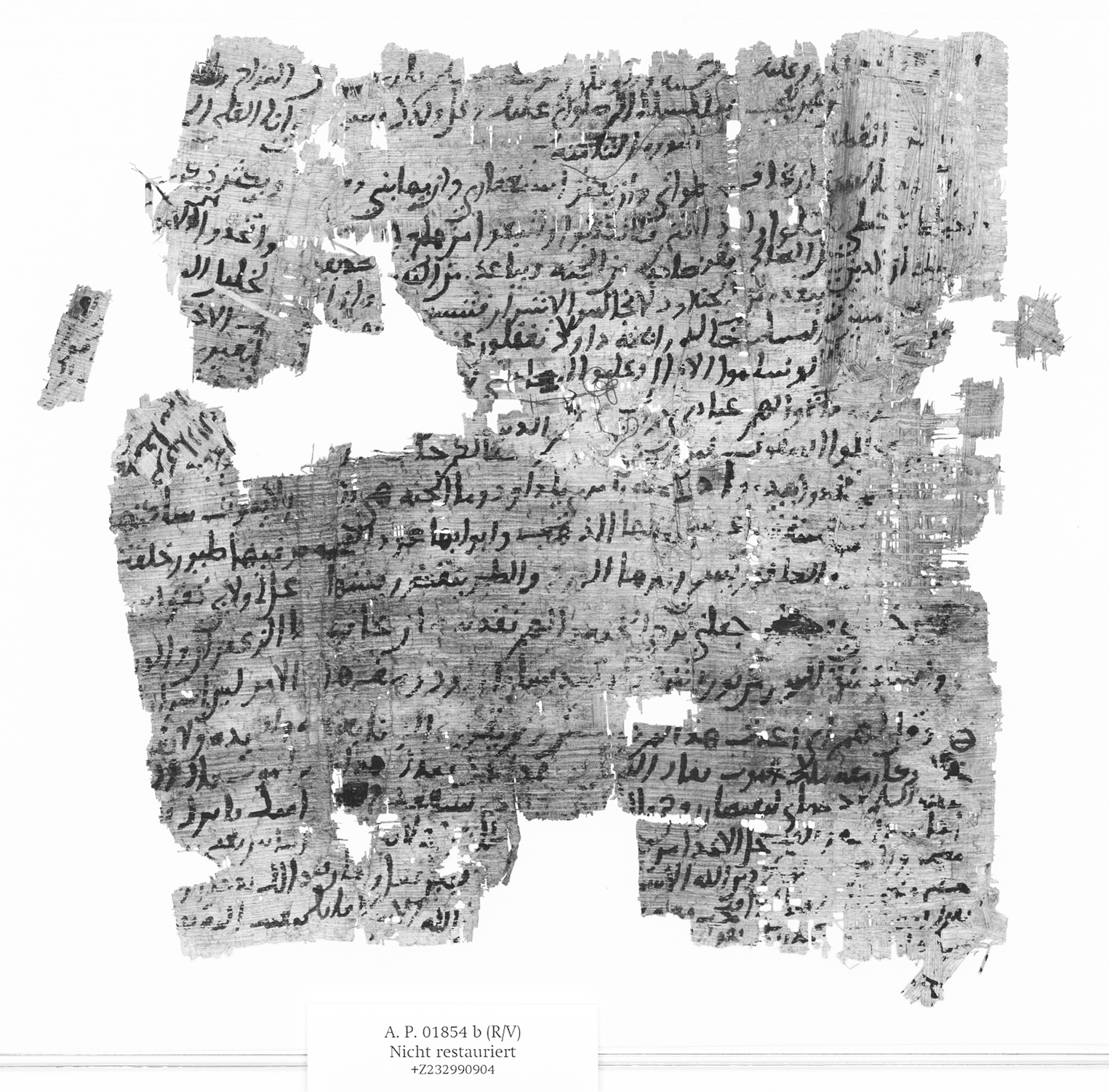
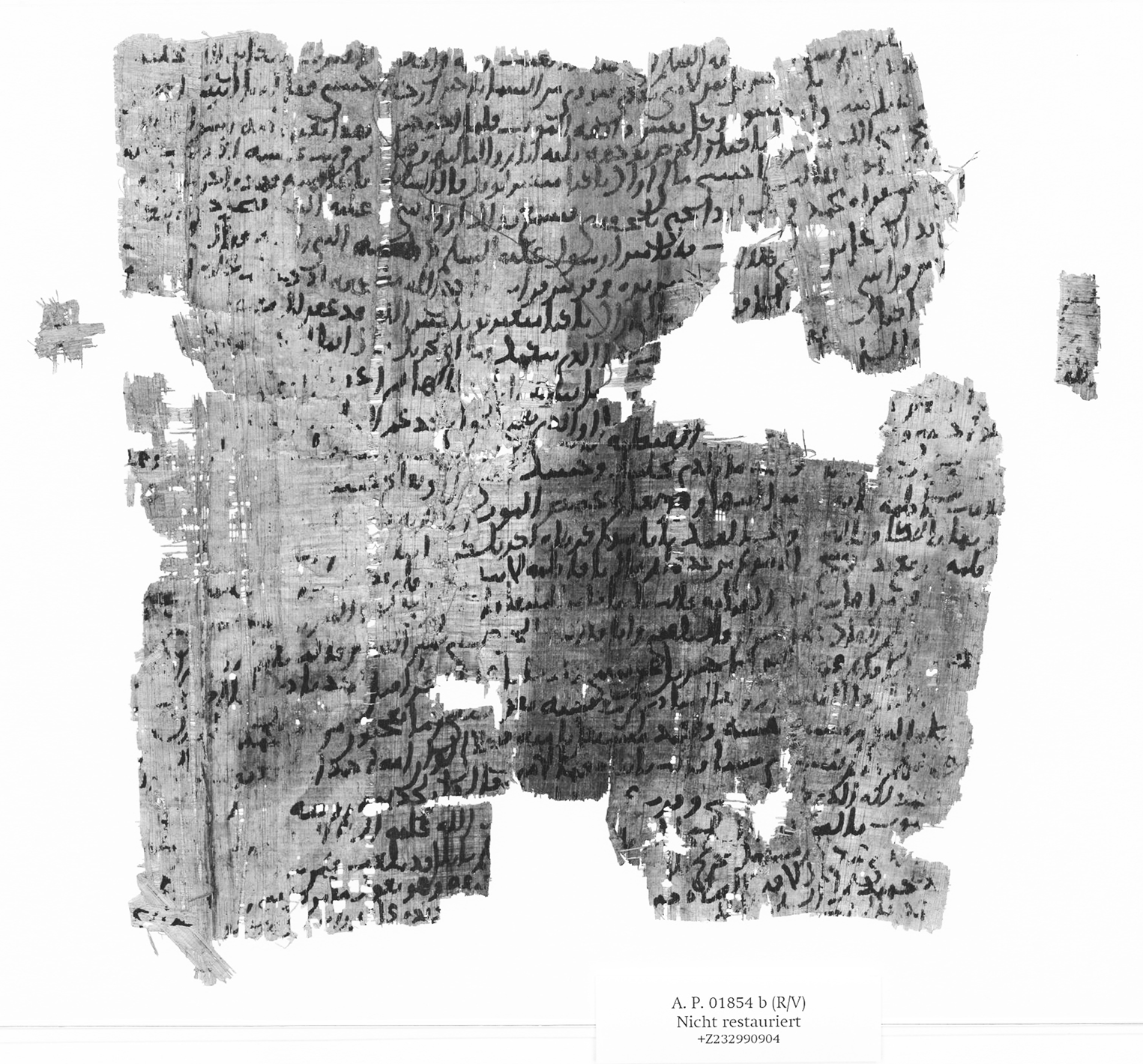
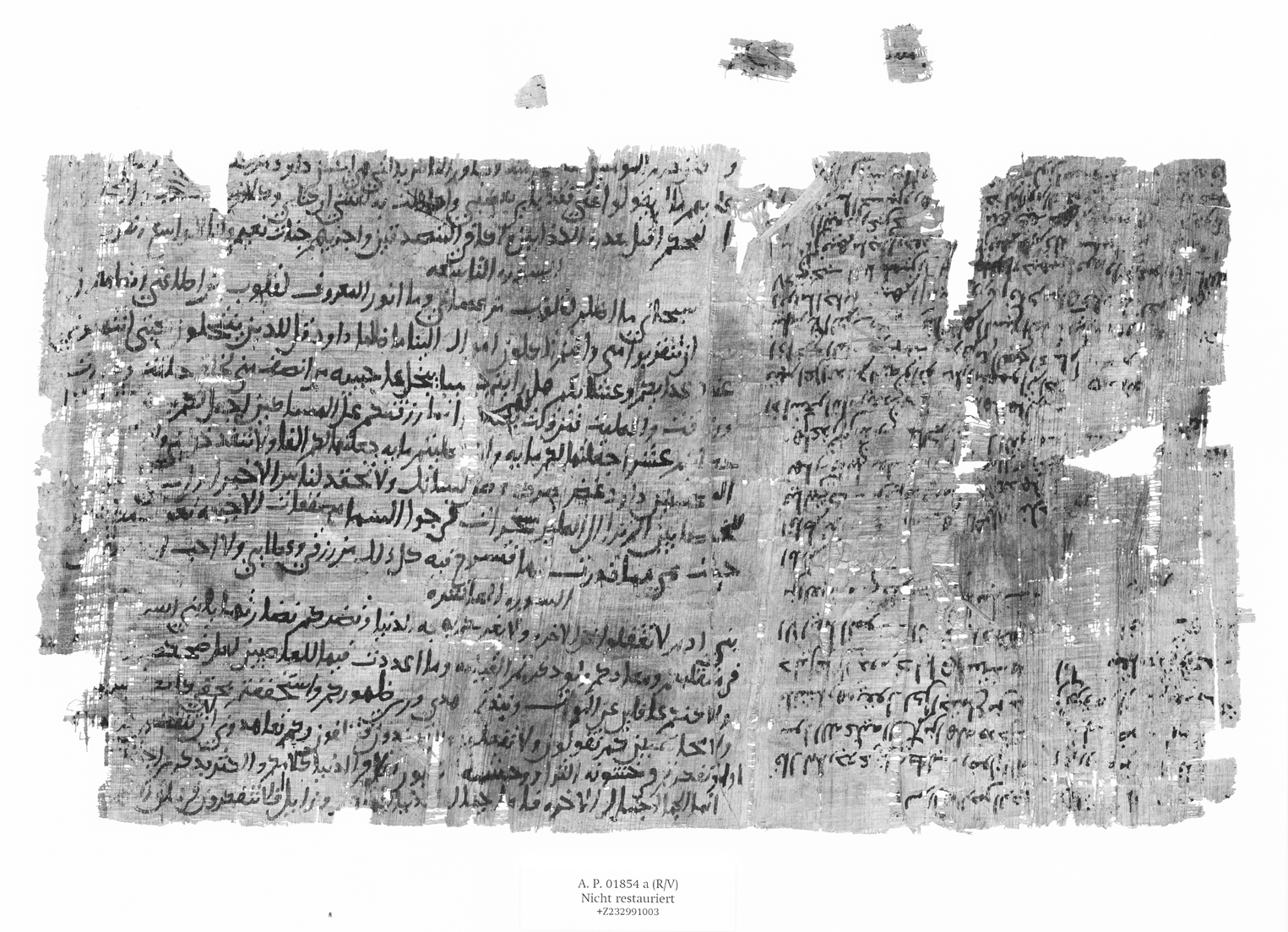
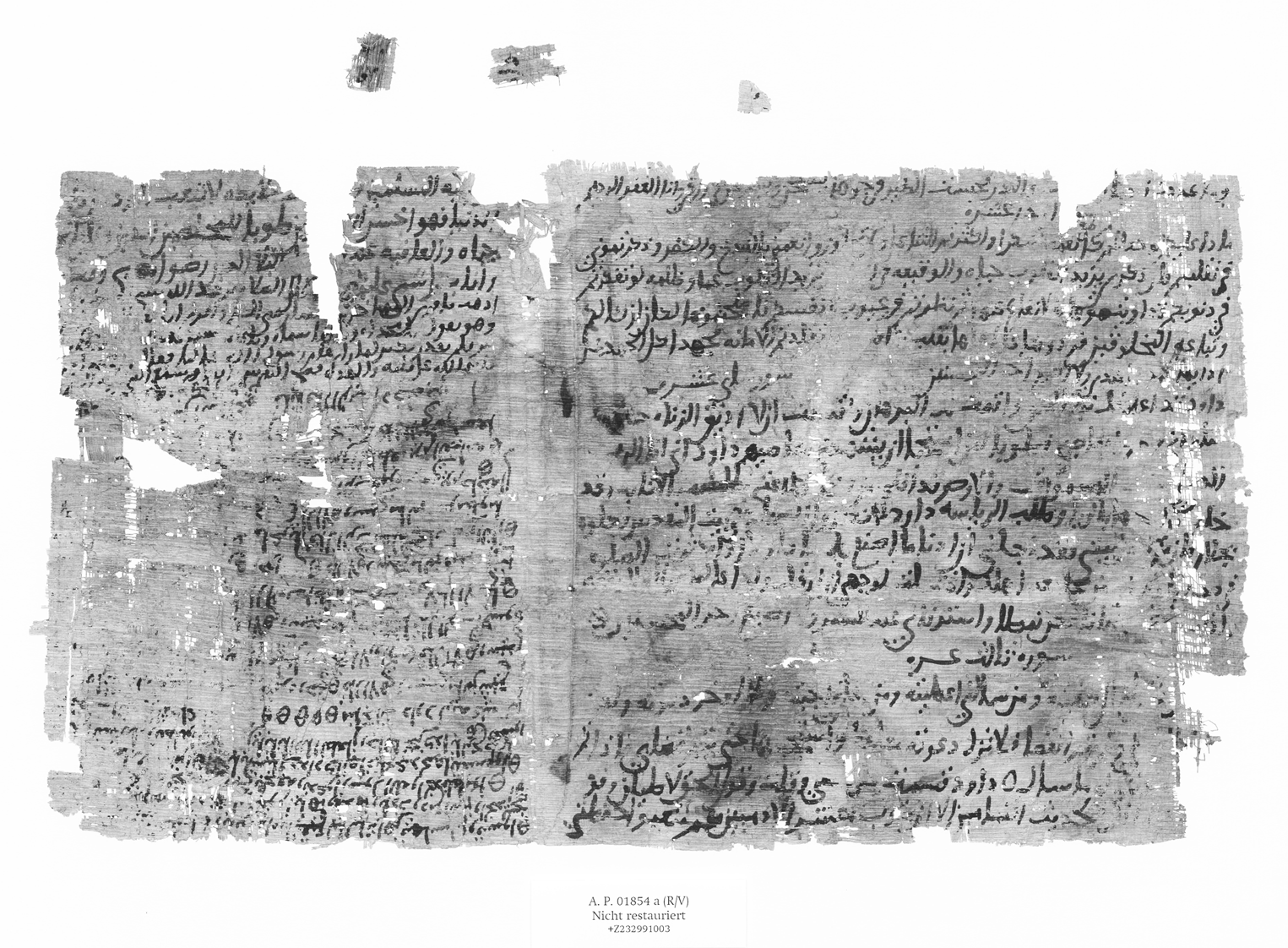
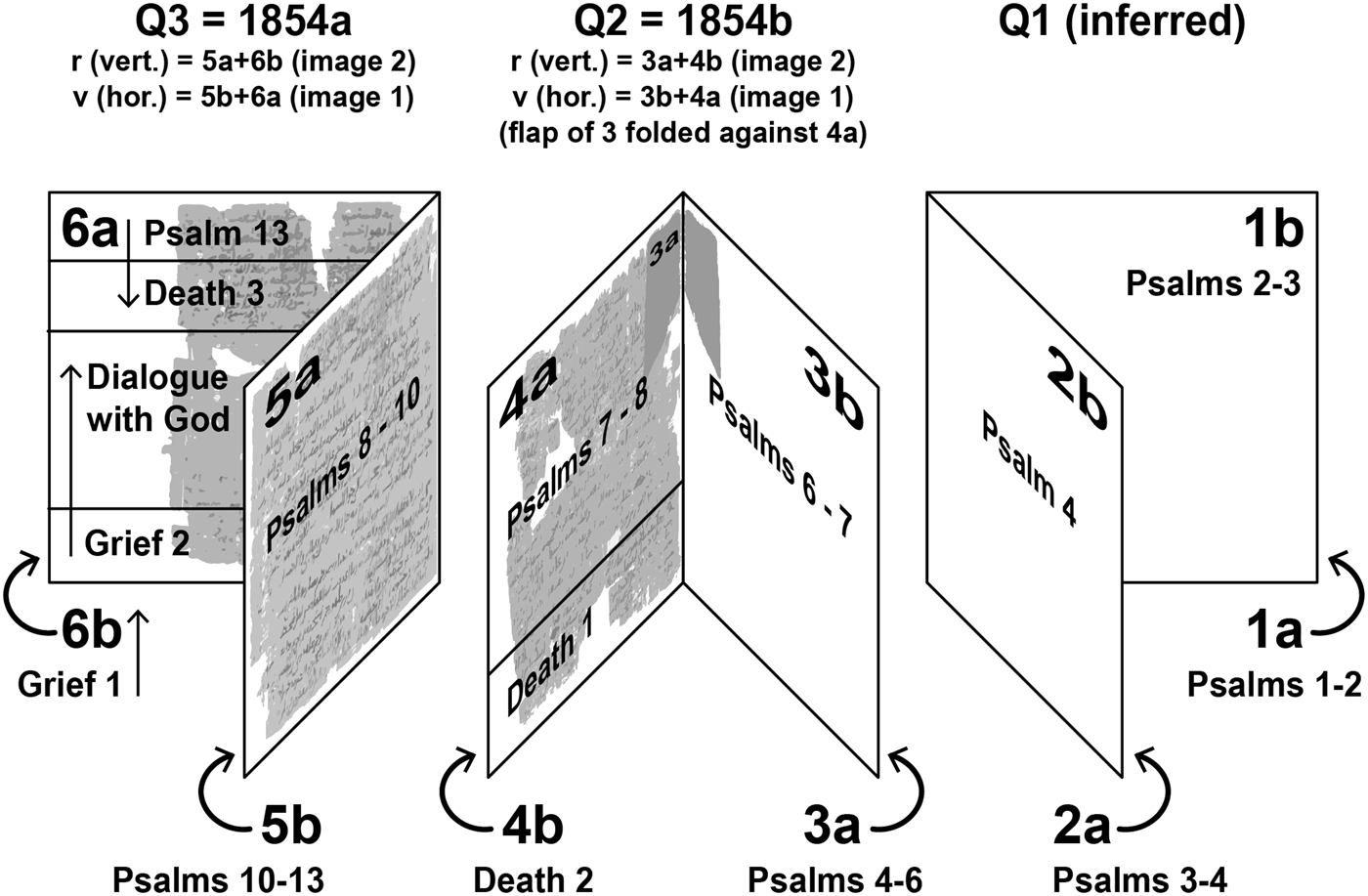

 Open access

