


1. Introduction
Design thinking is widely used as a human-centred approach to innovation and innovative problem solving across diverse domains, from product development to societal transformation (Reference BrownBrown, 2008; Reference DorstDorst, 2011; Reference LiedtkaLiedtka, 2018). It combines analysis, intuition, user empathy, and iterative experimentation to address complex design tasks (Reference CrossCross, 2011). Beyond its methodological structure, design thinking has been positioned as a means of improving decision quality by encouraging hypothesis testing, reframing, and the surfacing of assumptions (Reference LiedtkaLiedtka, 2018). Yet, despite its reflective nature, design thinking remains vulnerable to cognitive biases, systemic distortions in reasoning that arise from the reliance on heuristics under uncertainty (Reference KahnemanKahneman, 2011; Reference LiedtkaLiedtka, 2015; Reference Tversky and KahnemanTversky & Kahneman, 1974). Design decisions are frequently shaped by intuitive judgments, making them especially prone to biases such as fixation, confirmation, and anchoring (Reference Ball and ChristensenBall & Christensen, 2009; Reference Dorst and CrossDorst & Cross, 2001). These biases can distort how designers frame problems, interpret evidence, and prioritise ideas without conscious awareness (Reference Hallihan and ShuHallihan & Shu, 2013; Reference Holguin Jimenez, Godot, Petronijevic, Lassagne and Daille-LefevreHolguin Jimenez et al., 2024).
Traditional debiasing methods, such as awareness training, checklists and structured reflection, provide some support, but they struggle to integrate the fast-moving, context-sensitive nature of design tasks (Reference Croskerry, Singhal and MamedeCroskerry et al., 2013; Reference Larrick, Koehler and HarveyLarrick, 2004). These approaches are typically applied before or after an activity, whereas biased interpretations often emerge dynamically during ongoing sense making (Reference KahnemanKahneman, 2011; Reference Larrick, Koehler and HarveyLarrick, 2004). In design contexts, this occurs as designers interpret information, frame problems, and converge on ideas in real time (Reference Ball and ChristensenBall & Christensen, 2009; Reference Dorst and CrossDorst & Cross, 2001). Recent work further shows that checklist-style interventions yield only modest improvements in practice, with many bias indicators persisting even after training (Reference Morewedge, Yoon, Scopelliti, Symborski, Korris and KassamMorewedge et al., 2015; Reference Schauer, Afolabi and FuSchauer et al., 2025). Because biased interpretations often stabilise early and guide subsequent reasoning (Reference Ball and ChristensenBall & Christensen, 2009; Reference KahnemanKahneman, 2011), interventions that occur retrospectively may arrive too late to meaningfully reshape the design trajectory. These limitations suggest the need for adaptive cognitive scaffolds capable of supporting real-time reflective reasoning, rather than retrospective evaluation, during design work.
Advances in large language models (LLMs) offer a new opportunity to meet this need. Models such as GPT-4 can interpret nuanced prompts, sustain reflective dialogue, and externalise reasoning in ways that can complement designers’ intuitive processes (Reference Brown, Mann, Ryder, Subbiah, Kaplan, Dhariwal, Neelakantan, Shyam, Sastry, Askell, Agarwal, Herbert-Voss, Krueger, Henighan, Child, Ramesh, Ziegler, Wu, Winter, Amodei, Larochelle, Ranzato, Hadsell, Balcan and LinBrown et al., 2020; Reference Kojima, Gu, Reid, Matsuo and IwasawaKojima et al., 2022). Crucially, LLMs can operate interactively and responsively within ongoing reasoning processes, enabling reflective prompts to be introduced at the moment when interpretations are forming rather than after decisions have already stabilised (Reference Prystawski and GoodmanPrystawski & Goodman, 2023). Emerging research suggests that LLMs can function as reflective collaborators, helping designers articulate, question and reframe assumptions rather than automate creative work (Reference D’Incà, Peruzzo, Mancini, Xu, Goe, Xu, Wang, Shi and SebeD’Incà et al., 2024; Reference HarwoodHarwood, 2023). Importantly, this line of work positions LLMs not as agents that replace human judgement, but as tools that can scaffold reflective awareness within complex cognitive activities (Reference HarwoodHarwood, 2023).
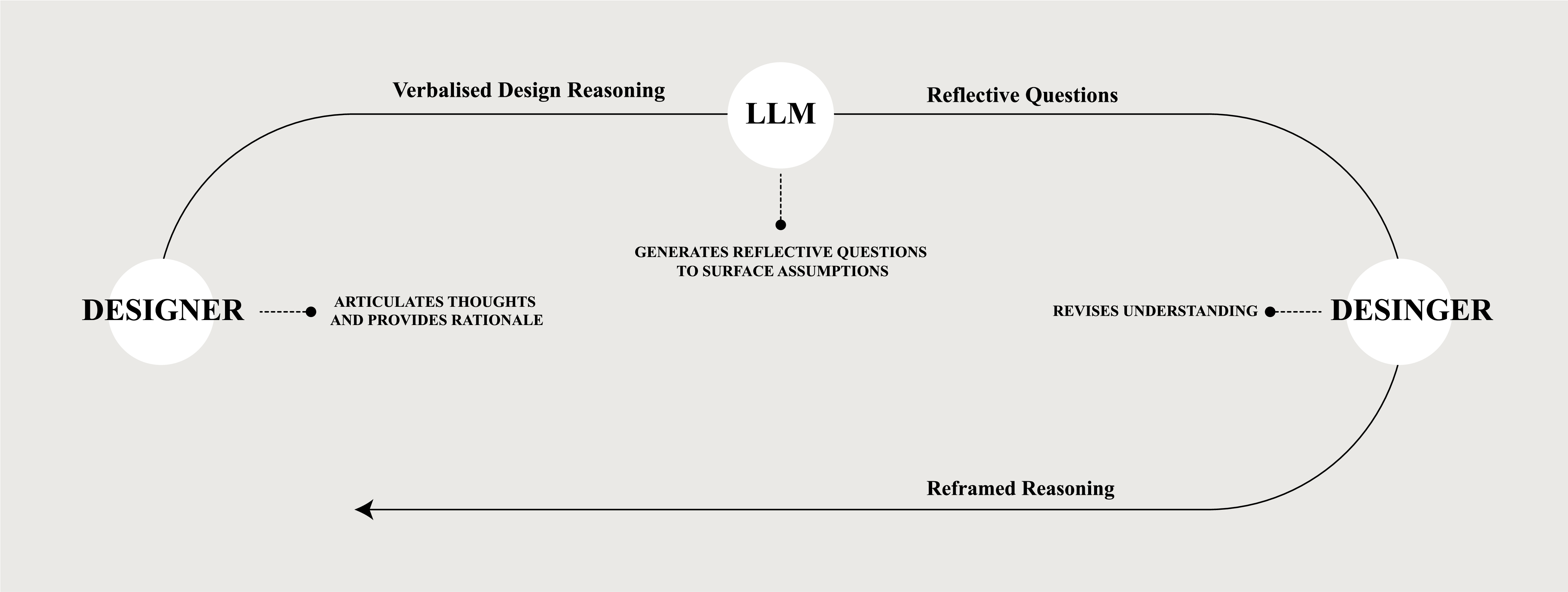
Building on these insights, this paper proposes a prompt-reflection-reframe loop as a cognitive-computational method for supporting bias-aware reflection in design thinking, integrating LLM-based reasoning with principles from cognitive psychology. The framework is grounded in verbalised design reasoning, such as articulated interpretations, decisions, and reflections expressed in natural language, as a methodological starting point. Extension to visual and artefact-based representations identified as a coherent next step. The proposed loop is designed to surface and invite reflection on potential bias mechanisms as they emerge in designers’ verbalised reasoning. As illustrated in (Figure 1), the interaction unfolds through a straightforward loop: the designer articulates ideas, the LLM responds with prompts that surface underlying assumptions, and the designer reassesses and reframes their comprehension. In this interaction, the LLM functions as a metacognitive partner that supports awareness and critical reflection, while allowing creative flow to continue uninterrupted.
The paper’s contribution is twofold. First, it reframes bias mitigation in design as a form of AI-assisted metacognition, demonstrating how LLMs can operationalise cognitive bias theory into reflective interventions during verbalised design reasoning. Second, it introduces a structured, prompt-based method that translates theoretical debiasing principles into a practical interaction mechanism. This method illustrates how prompt engineering and chain-of-thought reasoning can foster more reflective and evidence-aware thinking in design practice. The paper is organised as follows: Section 2 outlines the theoretical foundations of cognitive bias and debiasing, Section 3, presents the methodological framework, Section 4 presents a theory-driven evaluation and Section 5 discusses conclusions and future directions.
The prompt-reflection-reframe loop

2. Theoretical foundations
Cognitive biases are systematic deviations from rational judgment that arise when individuals rely on heuristics to make decisions under uncertainty (Reference Tversky and KahnemanTversky & Kahneman, 1974). Heuristics like availability, anchoring, and confirmation allow a quick judgement to be made, but can disrupt evidence weighting and comparison among alternatives (Reference Croskerry, Singhal and MamedeCroskerry et al., 2013; Reference DrorDror, 2020; Reference Larrick, Koehler and HarveyLarrick, 2004). Research in medicine and behavioural decision-making consistently shows that simple awareness of bias is insufficient; debiasing requires metacognitive regulation, mechanisms for monitoring one’s reasoning and actively correcting it (Reference Croskerry, Singhal and MamedeCroskerry et al., 2013; Reference DrorDror, 2020; Reference Morewedge, Yoon, Scopelliti, Symborski, Korris and KassamMorewedge et al., 2015).
Design cognition is similarly affected. Designers tend to rely on experiential intuition, visual analogy, and precedent-based reasoning, which encourages creativity but also introduce fixation and selective interpretation (Reference Ball and ChristensenBall & Christensen, 2009; Reference Hallihan and ShuHallihan & Shu, 2013). Biases emerge at different stages of the design process: confirmation and anchoring during problem framing, fixation and availability during idea generation, and ownership or framing effects during concept evaluation (Reference Holguin Jimenez, Godot, Petronijevic, Lassagne and Daille-LefevreHolguin Jimenez et al., 2024; Reference LiedtkaLiedtka, 2015). These patterns align with dual-process theory of intuitive and analytic reasoning (Reference KahnemanKahneman, 2011). Because the early stages of design work often involve rapid interpretation, intuitive judgments, such as forming an initial view of the problem or sketching early solution ideas (Reference Ball and ChristensenBall & Christensen, 2009; Reference CrossCross, 2011), they are especially open to bias.
Importantly, many of the cognitive biases identified in design cognition research become observable through designers’ verbalised reasoning. Designers routinely externalise their interpretations, assumptions, and evaluative judgments through spoken or written language during activities such as problem framing, design reviews, and collaborative sense making (Reference Ball and ChristensenBall & Christensen, 2009; Reference Dorst and CrossDorst & Cross, 2001). Prior studies show that biases such as confirmation, anchoring, and fixation are often reflected linguistically in recurring reasoning patterns in design discourse, including selective justification of supporting evidence, premature expressions of confidence, resistance to counterarguments, and early commitment framed as constraint (Reference Hallihan and ShuHallihan & Shu, 2013; Reference Holguin Jimenez, Godot, Petronijevic, Lassagne and Daille-LefevreHolguin Jimenez et al., 2024). Typical verbal formulations reflecting these patterns include statements such as ‘we’ve already tested this’ or ‘users clearly prefer this option’, which exemplify well-documented cognitive mechanisms of overconfidence and commitment described in the broader judgment and decision-making literature (Reference KahnemanKahneman, 2011). These verbal expressions actively shape how problems are framed, alternatives are explored, and design trajectories stabilise. As a result, natural-language reasoning traces offer a theoretically grounded and accessible entry point for identifying and supporting reflection on bias during design work.
Traditional debiasing techniques, whether awareness training, checklists or structured reflection, address aspects of this challenge but often function as external add-ons rather than as integrated components of design practice (Reference Hallihan and ShuHallihan & Shu, 2013; Reference Morewedge, Yoon, Scopelliti, Symborski, Korris and KassamMorewedge et al., 2015). Their retrospective or static nature makes them difficult to apply in iterative design processes, and they rely heavily on self-regulation, which bias itself tends to undermine (Reference Croskerry, Singhal and MamedeCroskerry et al., 2013). More effective approaches emphasise metacognitive cycles of awareness, monitoring and regulation (Reference FlavellFlavell, 1979) and reflection-in-action within the flow of design work (Reference SchönSchön, 1983).
3. Operationalising cognitive debiasing in design thinking
3.1. Framework overview
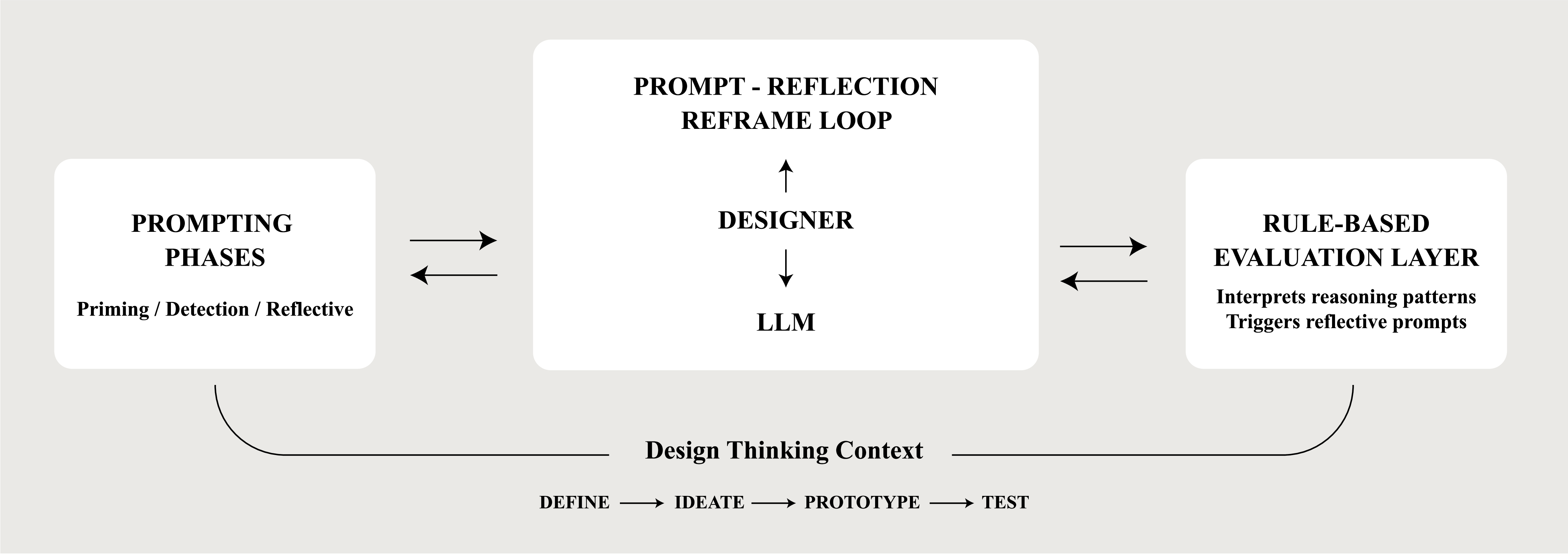
The framework proposed below operationalises the theoretical premise outlined in Section 2, by specifying an interaction structure for supporting bias-aware reflection within design thinking. It establishes a set of interaction principles that operationalise how designers surface, examine, and reframe intuitive judgments during design activity. Its architecture consists of three components. At its core lies the prompt-reflection-reframe Loop, which structures conversational interactions between designer and model, a set of prompt phases that organise how reflective questions are introduced across the design process (Define, Ideate, Prototype, Test), and a rule-based interpretive layer that maps bias mechanisms to observable reasoning cues within dialogue. Together, these components form a coherent method for integrating real-time metacognition into the flow of design activity.
The framework is not meant to replace human judgment or creative intuition. Accordingly, reflective prompts are intentionally framed as open-ended questions that invite reconsideration rather than prescribe corrective action. This positions the LLM as a reflective collaborator that supports designers in articulating assumptions, considering alternative interpretations, and exploring possibilities they might otherwise overlook, without interrupting the flow of their creative process. (Figure 2) illustrates the interaction architecture, showing how rule-based interpretation informs prompting within the conversational loop. The prompt-reflection-reframe loop
Cognitive-computational framework for bias-aware reflective prompting in design thinking

3.2. The prompt-reflection-reframe loop
At the centre of the framework is the prompt-reflection-reframe loop, which structures how designers and the model interact as reasoning unfolds. The loop begins when the designer articulates an emerging idea, interpretation, or concern in natural language. This articulation provides an explicit reasoning trace that the system can respond to within the interaction loop, rather than relying on implicit or inaccessible cognitive processes.
The model interprets this input through the rule-based evaluation layer, analysing whether the reasoning exhibits patterns mapped to specific bias mechanisms defined in Section 2, such as narrowing of interpretation, fixation on early cues, or selective use of evidence. Rather than drawing from a set of pre-prepared responses, the model generates a prompt specifically tailored to the designer’s reasoning at that moment, based on the activation of theory-derived rules, which are described in detail in Section 3.4. These prompts are phrased as open questions, designed to widen the designer’s perspective without enforcing a particular solution. For example, when a designer suggests that “users seem comfortable with this layout, so we should keep it unchanged,” the model may respond: “Is there anything in the feedback that might point to friction or confusion? Could the way the task flows be influencing this impression?”
The designer then reflects on the question, revises or elaborates the original idea, and the loop continues. Through this iterative movement, articulation, prompting, reframing, the dialogue introduces moments of reflection within the design activity. The aim is not to slow or override intuitive creativity, but to offer well-timed invitations to consider alternative explanations, broaden the problem frame, or reflect on unspoken assumptions. Over time, this structure supports the development of reflective habits, helping designers internalise the questioning pattern and engage more deliberately with their own reasoning. In this sense, the prompt-reflection-reframe loop implements Reference SchönSchön’s (1983) notion of reflection-in-action by providing a conversational partner capable of noticing patterns, posing timely questions, and supporting the designer’s ongoing sense making in situ. While the framework specifies how prompts are generated in response to designers’ reasoning, evaluation procedures may introduce additional scaffolding to ensure consistent enactment of this logic during testing.
3.3. Prompting phases across design thinking
While the prompt-reflection-reframe Loop describes the micro-level pattern of interaction between designers and model, its effectiveness depends on how reflective prompts are aligned with evolving cognitive demands of the design process. Design Thinking unfolds through phases that vary in ambiguity, commitment, and evidential grounding, requiring different forms of reflective support as designers move from problem framing to decision consolidation. Accordingly, the framework organises prompting into three functions models, Priming, Detection, and Reflective Prompting, which are dynamically applied across Define, Ideate, Prototype and Test stages. (Figure 2) illustrates how these prompting modes are applied across the design process as cognitive demands shift.
Research in design cognition characterises early stages of design as periods of exploratory sense making under high ambiguity, followed by increasing convergence and commitment as solutions take shape (Reference DorstDorst, 2011). As outlined in Section 2, bias mechanisms tend to manifest differently across these stages, requiring stage-sensitive forms of intervention. For example, anchoring and confirmation bias are particularly prevalent during problem framing, when early interpretations begin to stabilise, while fixation is well documented during ideation and early prototyping as designers repeatedly reuse initial concepts or representations (Reference Ball and ChristensenBall & Christensen, 2009; Reference Jansson and SmithJansson & Smith, 1991). Ownership bias may intensify in later stages as attachment to preferred solutions grows (Reference Hallihan and ShuHallihan & Shu, 2013). The prompting modes therefore function as adaptive interactions patterns rather than uniform intervention.
In the Define stage, Priming prompts encourage designers to articulate assumptions, constraints, and initial interpretations explicitly. By foregrounding implicit framing choices early on, these prompts support broader problem exploration without imposing evaluative judgement. During Ideation, when designers generate and elaborate solution directions, Detection prompts surface emerging patterns of interpretive narrowing, such as selective evidence use or premature fixation, inviting reconsideration without interrupting creative flow. As ideas are externalised through early prototypes, Detection prompts continue to play a role by highlighting whether emerging evidence is being interpreted in ways that reinforce prior commitments.
In later stages, as designs are tested and refined, Reflective prompts support consolidation and sense making by encouraging designers to examine how feedback, interpretation, and design intentions align. These prompts are particularly relevant when decisions begin to stabilise, helping designers revisit assumptions and interpretations before final commitment. Across stages, prompts arise in direct response to designers’ expressed reasoning, ensuring that reflective support is integrated into ongoing activity rather than imposed as a separate evaluative step.
The intensity and form of reflective prompting may also vary with designer expertise. Studies of expert–novice differences in design suggest that novices often benefit from more explicit scaffolding, while experienced designers require lighter, less intrusive cues that respect established reflective habits (Reference CrossCross, 2011). The framework accommodates this variability by treating prompting modes as adaptable interaction patterns rather than fixed prescriptions.
By aligning prompting modes with both the temporal structure of design thinking and the cognitive characteristics of different stages, the framework supports bias-aware reflection while preserving designer agency and creative autonomy. This stage-sensitive integration ensures that reflective interventions remain timely, context-aware, and responsive to the dynamics of professional design practice.
3.4. Rule-based evaluation layer
The rule-based evaluation layer forms the analytical foundation of the framework. Its purpose is to translate cognitive mechanisms identified in Section 2 into patterns that can be recognised within natural-language design discourse. Rather than relying on opaque computational detection, an approach that can obscure how conclusions are drawn (Reference HarwoodHarwood, 2023), the framework uses transparent, human-auditable rules that articulate how specific biases tend to appear in designers’ reasoning.
The rules are constructed through a theory-driven, symptom-based operationalisation of cognitive bias. Each rule originates from a well-established bias mechanism in judgment and decision-making research and is translated into documented manifestations in design cognition, such as selective reference use, early commitment, or persistent reuse of initial representations. These manifestations are operationalised not as properties of individual artefacts, but as observable patterns that persist across iterations of externalised reasoning. Rule activation therefore does not indicate the presence of bias but signals the appropriateness of reflective intervention at a given moment. This construction logic preserves theoretical grounding while avoiding prescriptive evaluation, aligning with accounts of reflective practice that treat design artefacts as active carriers of thought rather than passive outputs.
Operationally, this construction was implemented through a structured literature-mechanism-evaluation approach, drawing on practices for rigorous qualitative synthesis and AI-assisted analysis (Reference Carrera-Rivera, Ochoa, Larrinaga and LasaCarrera-Rivera et al., 2022; Reference Kitchenham, Brereton, Budgen, Turner, Bailey and LinkmanKitchenham et al., 2009; Reference Petersen, Vakkalanka and KuzniarzPetersen et al., 2015). First, key bias mechanisms identified in the literature, including selective evidence use, anchoring on early ideas, fixation, resistance to feedback, and ownership effects, were mapped to recurring reasoning patterns observable in designers’ verbalised thinking (Reference Hallihan and ShuHallihan & Shu, 2013; Reference Holguin Jimenez, Godot, Petronijevic, Lassagne and Daille-LefevreHolguin Jimenez et al., 2024; Reference Jansson and SmithJansson & Smith, 1991; Reference KahnemanKahneman, 2011). These patterns were then formalised into rule statements that specify the linguistic and interactional conditions under which reflective prompts should be triggered.
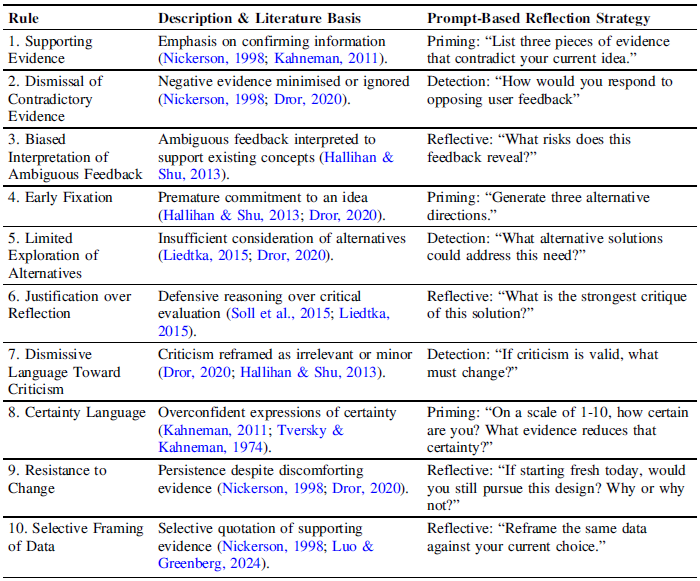
As an illustrative case, confirmation bias manifests in design reasoning as selective reference use and justificatory language (Reference Hallihan and ShuHallihan & Shu, 2013; Reference KahnemanKahneman, 2011; Reference NickersonNickerson, 1998). In practice, this often appears in designers’ verbalised reasoning through statements such as “Most users liked this idea,” while critical or ambiguous feedback receives little attention. This pattern is operationalised in Rule 1 (“Focus on Supporting Evidence”, Table 1), which detects repeated emphasis on confirming feedback across successive reasoning turns and triggers a reflective prompt inviting consideration of disconfirming evidence.
Rule-based confirmation bias detection framework

To operationalise these mechanisms, the authors constructed short design scenarios grounded in professional design experience. These scenarios, expressed in natural language, illustrated both biased and unbiased reasoning in situations typical of early-stage design, such as premature commitment to an initial idea, selective interpretation of positive client feedback, or reluctance to explore alternatives. Although distortions may also arise in visual or artefact-based reasoning, they were represented textually to enable controlled evaluation within the language-based scope of this framework, extending the approach to visual artefact remains future work. Candidate rules were first constructed through a cross-disciplinary literature review in cognitive psychology, decision science, and design cognition. These rules were then tested using an LLM (ChatGPT-4), which received the designer’s scenario together with the explicit natural-language formulation of the relevant rule and an instruction to analyse the reasoning and generate a reflective prompt aligned with that rule. This process allowed evaluation of the rules’ interpretability and alignment with intended cognitive mechanisms. This ‘consider-the-opposite’ style prompting, which mirrors established reflective-challenge techniques in design and debiasing research (Reference CrossCross, 2011; Reference Soll, Milkman, Payne, Keren and WuSoll et al., 2015), enabled evaluation of whether each rule activated in suitable contexts and whether the prompt it generated reflected the correct underlying bias mechanism.
Each rule is formulated as an if-then schema, for example, if a statement interprets mixed feedback only in ways that support an existing preference, then the system triggers a prompt encouraging consideration of disconfirming evidence. A rule was retained only if it satisfied three criteria: (1) recognisability, meaning the reasoning pattern appears in real design discourse, (2) multi-source grounding, requiring theoretical support from at least two independent literatures, and (3) promptability, ensuring the mechanism can be expressed as an open reflective question aligned with the prompt-reflection-reframe loop and with metacognitive principles of awareness, monitoring, and regulation (Reference Croskerry, Singhal and MamedeCroskerry et al., 2013; Reference FlavellFlavell, 1979).
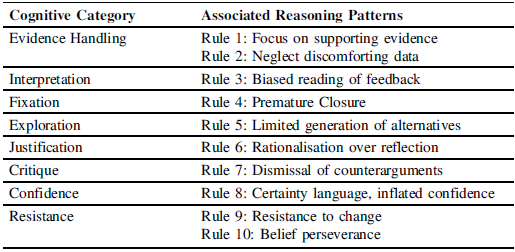
Confirmation bias served as the initial validation case due to its prominence in design reasoning and well-documented cognitive mechanisms. Ten rules capturing its characteristic distortions were developed and tested using this method (Table 1). Once validated, the same derivation process was extended to additional bias families, including anchoring, fixation, ownership bias, and group-level tendencies such as groupthink, producing a generalisable and interpretable rule base. To maintain coherence across these diverse mechanisms, the rules were organised into eight broader categories of reasoning distortion: Evidence Handling, Interpretation, Fixation, Exploration, Justification, Critique, Confidence, and Resistance (Table 2). These categories serve as a conceptual bridge connecting cognitive theory, prompting phases, and the operational structure of the framework. The operational layer remains deliberately simple: rules are explicit and interpretable, prompts are expressed in accessible natural language, and outputs encourage judgement rather than prescribe solutions. This aligns with principles of human-centred AI, favouring transparency, interpretability, and designer agency (Reference HarwoodHarwood, 2023), and ensures that the reflective support offered by the framework augments, rather than replaces, creative reasoning.
Taxonomy of confirmation bias manifestations

4. Evaluation
The evaluation followed a formative approach based on structured scenario testing, designed to assess whether the prompt-reflection-reframe loop behaves in accordance with its theoretical grounding, generating reflective prompts aligned with underlying cognitive mechanisms associated with bias in design reasoning. Because the aim of this work is to articulate and validate a methodological mechanism for bias-aware reflection, rather than assess user performance or outcome-level debiasing effects at scale, the evaluation focuses on construct validity, whether the system’s behaviour aligns with theoretical expectations and on functional coherence across multiple bias families.
Evaluation began with a single-bias prototype centred on confirmation bias, chosen due to its prevalence in design reasoning and its well-documented cognitive structure. Ten rules derived from cross-disciplinary literature were applied to a corpus of short design scenarios grounded in common reasoning patterns reported in professional design practice and empirical studies. Each scenario was expressed in natural language to allow the LLM to analyse the explicit reasoning trace.
Few-shot prompting and step-by-step guidance were employed as part of the evaluation setup to ensure consistent enactment of the rule logic defined in Section 3. These scaffolding elements constrained only the procedural structure of the task (e.g., analysis followed by generation of a reflective question aligned with the activated rule) and did not predefine or constrain the semantic content of the prompts. Although the model generated prompts in response to rule-conditioned instructions rather than pre-written templates, the authors reviewed outputs to assess their interpretive accuracy and theoretical alignment with the intended cognitive constructs.
The evaluation proceeded iteratively. For each scenario, outputs were analysed along three dimensions: (1) Interpretive coherence, whether the model’s response plausibly matched the reasoning pattern to the intended rule, (2) Prompt quality, whether the generated question reflected “consider-the-opposite” logic without prescribing solutions, and (3) Theoretical alignment, whether the prompt corresponded to the cognitive mechanisms described in the literature underlying each rule.
Once tested for confirmation bias, the same evaluation procedure was extended to additional bias families, including anchoring, fixation, and ownership bias. This allowed assessment of whether the rule grammar generalised across mechanisms with different cognitive signatures, and whether prompt formulation remained flexible, interpretable and consistent with the reflective intent of the framework.
Across the evaluated scenarios, the model consistently generated reflective prompts that aligned with the rule logic when linguistic cues matched the defined conditions. For confirmation bias, the LLM distinguished between selective evidence use, justificatory reasoning, and premature fixation, producing prompts that encourage reconsideration of alternative interpretations rather than directing solutions. In anchoring and fixation cases, the model generated exploratory prompts (“What alternative directions could address the same need?”) or framing prompts that questioned early commitment to ideas. Ownership-related reasoning patterns similarly triggered prompts that invited designers to reassess attachment to prior decisions without assuming their preservation.
These results provide initial evidence of construct validity, the system behaves in ways consistent with theoretical grounding, and the rule-based interpretive layer effectively structures the model’s reflective output across multiple bias mechanisms. They further suggest that the framework can support different reflective interventions grounded in cognitive bias theory, while preserving designers’ agency.
The evaluation remains preliminary and carries several limitations. First, the scenarios used for validation were constructed rather than drawn from real design sessions, which limits ecological fidelity. Second, the evaluation relied on interaction with a single LLM (ChatGPT-4) and therefore reflects model-specific affordances, generalisation to other models requires further testing. Third, although the framework generalises across bias families at the mechanism level, the absence of a full user study means its impact on design outcomes or creative performance or long-term debiasing effects has yet to be empirically assessed.
5. Conclusions and future work
This paper has proposed a cognitive-computational framework intended to support bias-aware reflection during design thinking, integrating insights from cognitive psychology, design cognition, and LLM-mediated reasoning. Rather than treating debiasing as a separate analytic task, the framework embeds reflection within the unfolding activity of design, allowing reasoning to become inspectable and revisable as designers work. Through the prompt-reflection-reframe loop, a stage-aware prompting structure, and a transparent rule-based evaluation layer, the approach translates well-established cognitive mechanisms into context-sensitive reflective prompts that support more balanced judgement without constraining creative fluency.
A formative evaluation using scenario-based reasoning traces demonstrated the framework behaves in accordance with its theoretical grounding, generating reflective questions aligned with characteristic reasoning distortions such as selective evidence search, early fixation, or biased interpretation. These early results offer construct-level validation of the framework’s function as a metacognitive scaffold and suggest that its rule grammar generalises effectively across multiple bias families.
Though framed as bias mitigation, the framework deliberately adopts open-ended, non-directive prompting. This reflects design cognition, where prescriptive interventions risk disrupting creative flow, undermining agency, or narrowing the solution space (Reference CrossCross, 2011; Reference Dorst and CrossDorst & Cross, 2001). Instead of triggering correction, bias detection signals for reflective engagement, inviting designers to reconsider assumptions without external judgment. This aligns with metacognitive debiasing emphasising awareness and self-regulation over correction (Reference Croskerry, Singhal and MamedeCroskerry et al., 2013; Reference Larrick, Koehler and HarveyLarrick, 2004), as reflection-in-action, where questioning serves as a productive mechanism for reframing practice (Reference SchönSchön, 1983). At the same time, reflective interventions necessarily involve a reallocation of cognitive effort toward awareness and self-regulation. In design contexts, this effort is not introduced as an additional task but is integrated into ongoing sense making, consistent with accounts of expert reflective practice (Reference CrossCross, 2011; Reference SchönSchön, 1983). Nonetheless, different design situations, such as time-critical or highly constrained contexts, may benefit from alternative balances between open-ended reflection and more scaffolded forms of guidance. Exploring how such balances can be adapted to task demands and designer expertise therefore represents an important direction for future work.
Building on the framework’s grounding in verbalised reasoning, many of the cognitive tendencies examined here also known to manifest through visual and material representations. Design research has long shown that sketches, drawings, and other externalisations are not merely illustrations but active forms of reasoning that reveal interpretive moves, biases, and fixation patterns (Reference CrossCross, 2011; Reference Dorst and CrossDorst & Cross, 2001). Sketching enables the ‘reflective conversation with the situation’ in which designers oscillate between interpreting what they see and making new moves, often reinforcing early preferences or narrowing attention (Reference Ball and ChristensenBall & Christensen, 2009; Reference Dorst and CrossDorst & Cross, 2001). Recent analyses further demonstrate that biases such as anchoring, fixation, availability, and framing can emerge through visual cues as strongly as through verbal reasoning (Reference Holguin Jimenez, Godot, Petronijevic, Lassagne and Daille-LefevreHolguin Jimenez et al., 2024). Extending the framework to multimodal analysis is supported by recent work showing how vision-language models can interpret images and text within shared reasoning pipelines, enabling reflective analysis of visual artefacts as well as verbal reasoning (Reference D’Incà, Peruzzo, Mancini, Xu, Goe, Xu, Wang, Shi and SebeD’Incà et al., 2024).
At the same time, the work remains a methodological foundation; current evaluation relies on text-based scenarios and interactions with a single LLM. Future empirical studies with designers are required to assess effects on framing, evidence balance, and idea diversity. Research must also extend to team-based settings to examine group-level biases like groupthink during co-creation. Finally, extending the framework to incorporate visual and artefact-based reasoning remains a key direction for future development.
By making reasoning explicit and introducing structured opportunities for reconsideration, the proposed framework offers a pathway toward more reflective, evidence-aware, and cognitively resilient design practice. As generative AI continues to permeate design workflows, methods that support rather than override human judgement will become essential. This work establishes a conceptual and methodological foundation for future developments, with potential for expansion across modalities, design contexts, and collaborative scales.
Acknowledgement
The research is conducted in the operating framework of the University of Thessaly Innovation, Technology Transfer Unit and Entrepreneurship Center “One Planet Thessaly”, under the “University of Thessaly Grants for Scientific Publication Support” action and is funded by the Special Account of Research Grands of the University of Thessaly.

 Open access

