




1 Introduction
Temporal logic programming, introduced in the late 1980s (Abadi and Manna Reference Abadi and Manna1989), augments logic programming with temporal modal operators, primarily those from linear-time temporal logic (LTL; Pnueli Reference Pnueli1977). Although this field experienced substantial research activity throughout the 1980s and 1990s, its momentum eventually waned. More recently, the advent of answer set programming (ASP; Lifschitz Reference Lifschitz2019), and particularly its demonstrated efficacy in modeling and resolving temporal scenarios, has sparked renewed interest in these foundational approaches to temporal logic programming.
Early approaches to time representation in ASP (Gelfond and Lifschitz Reference Gelfond and Lifschitz1993) relied on variables ranging over finite subsets of the natural numbers. Although straightforward, this methodology lacked the dedicated language constructs and specialized inference mechanisms characteristic of LTL. Consequently, it remains infeasible to represent or reason about properties of reactive systems over infinite traces, such as safety (e.g., “Is a specific state reachable?”) or liveness (e.g., “Does a condition hold infinitely often?”). Furthermore, establishing the unsolvability of planning problems becomes substantially more difficult.
To overcome these limitations, several extensions of ASP with temporal operators have been investigated. For instance, Eiter and Šimkus (Reference Eiter and Šimkus2009) extended logic programs with function symbols to model both past and future temporal references. Other modal-inspired approaches typically adopt a temporal or dynamic modal logic (Pnueli Reference Pnueli1977; Harel et al. Reference Harel, Tiuryn and Kozen2000) as a monotonic basis, subsequently introducing nonmonotonicity via an established ASP semantics (Lifschitz Reference Lifschitz2010). As an example, Giordano et al. (Reference Giordano, Martelli and Dupré2013) generalized the traditional reduct-based semantics (Gelfond and Lifschitz Reference Gelfond and Lifschitz1988) to a logic programming fragment equipped with dynamic logic operators (Harel et al. Reference Harel, Tiuryn and Kozen2000). Similarly, Aguado et al. (Reference Aguado, Cabalar, Diéguez, Pérez and Vidal2013) integrated LTL with equilibrium logic (EL; Pearce Reference Pearce2006), the predominant logical characterization of stable models and answer sets. This latter framework was subsequently adapted to finite traces in (Aguado et al. Reference Aguado, Cabalar, Diéguez, Pérez, Schaub, Schuhmann and Vidal2023).
Equilibrium logic builds upon here-and-there logic (HT; Heyting Reference Heyting1930) by imposing a minimal model selection criterion to capture answer sets. In his seminal work, Pearce (Reference Pearce2006) provided an alternative formulation of equilibrium logic based on fixpoints. Analogous to the treatment of default and autoepistemic logics (Marek and Truszczyński Reference Marek and Truszczyński1993), this characterization relies on theory extensions, or completions, rather than direct semantic minimization.
A related fixpoint characterization, termed safe beliefs, was introduced by Osorio et al. (Reference Osorio, Pérez and Arrazola2005). Instead of HT, their approach employs intuitionistic logic (INT; Mints Reference Mints2000) as its monotonic foundation. Crucially, they demonstrated that INT can be substituted with any (intermediate) logic $X$
satisfying
$X$
satisfying $\textrm {INT} \subseteq \textrm {X} \subseteq {\textrm {HT}}$
without altering the resulting safe beliefs. Consequently, safe beliefs provide a robust framework for investigating properties of (temporal) logic programs from a broader logical standpoint, facilitating novel and insightful program transformations.
$\textrm {INT} \subseteq \textrm {X} \subseteq {\textrm {HT}}$
without altering the resulting safe beliefs. Consequently, safe beliefs provide a robust framework for investigating properties of (temporal) logic programs from a broader logical standpoint, facilitating novel and insightful program transformations.
In this paper, we extend both Pearce’s and Osorio’s fixpoint-based characterizations to the temporal domain. Regarding Pearce’s approach, we demonstrate that theory completions coincide with temporal equilibrium models when HT is superseded by Temporal Here-and-There logic (THT; Balbiani and Diéguez Reference Balbiani and Diéguez2016).
Extending Osorio’s approach to the temporal setting presents several notable challenges.
First, Osorio’s work heavily relies on fundamental properties of propositional intuitionistic and intermediate logics (Gabbay Reference Gabbay1981). One pivotal property is that satisfiability (or consistency) in INT is preserved across all intermediate logics. Furthermore, if a formula is satisfiable, it is guaranteed to hold in a finite model. Unfortunately, these properties generally fail in the temporal case. To circumvent this, we identify an intuitionistic temporal logic that preserves these characteristics, serving as the “weakest” intuitionistic base logic in our framework.
Second, Osorio’s approach depends on a syntactic consequence relation and Hilbert-style axiomatic systems for INT. However, to the best of our knowledge, no sound and complete axiomatic system currently exists for an intuitionistic version of LTL.Footnote 1 Alternative attempts introduce the co-implication connective (Rauszer Reference Rauszer1974) into the language (Fernández-Duque et al. Reference Fernández-Duque, McLean and Zenger2024; Aguilera et al., Reference Aguilera, Diéguez, Fernández-Duque and McLean2022, Reference Aguilera, Diéguez, Fernández-Duque and McLean2025). Additionally, Osorio’s method employs syntactic transformations to eliminate propositional variables. These transformations cannot be directly lifted to the temporal setting, as the truth values of propositional variables vary dynamically over time.
In light of these challenges, we adopt a strictly semantic approach. We reformulate Osorio’s fundamental results using a semantic entailment relation, which we subsequently generalize to the temporal case. A critical component of this strategy is the application of bisimulations for both intuitionistic (Patterson Reference Patterson1997) and intuitionistic temporal logics (Balbiani et al. Reference Balbiani, Boudou, Diéguez and Fernández-Duque2020).
Beyond reformulating Osorio’s results semantically, we formally define the notion of an $\textrm {X}$
-temporal safe belief set, where
$\textrm {X}$
-temporal safe belief set, where $\textrm {X}$
is any intermediate temporal logic. We establish two primary results: first, that THT-temporal safe belief sets exactly correspond to temporal equilibrium models; and second, that substituting THT with any weaker intermediate temporal logic yields the identical set of safe beliefs.
$\textrm {X}$
is any intermediate temporal logic. We establish two primary results: first, that THT-temporal safe belief sets exactly correspond to temporal equilibrium models; and second, that substituting THT with any weaker intermediate temporal logic yields the identical set of safe beliefs.
The remainder of this paper is organized as follows. Section 2 provides the background on propositional intuitionistic and equilibrium logics. Section 3 introduces Pearce’s theory completions alongside our semantic reformulation of Osorio’s safe beliefs. Section 4 reviews intuitionistic and intermediate temporal logics, detailing the specific technical results employed in our framework. Section 5 presents our primary contribution: lifting Pearce’s theory completions and Osorio’s safe beliefs to the temporal domain. Finally, we conclude the paper with a brief discussion and directions for future research.
2 Intuitionistic and intermediate logics
Given a countable, possibly infinite set $\mathbb{P}$
of atoms, also called the alphabet, our basic language
$\mathbb{P}$
of atoms, also called the alphabet, our basic language $\mathcal{L}_{p}$
consists of formulas generated by the following grammar:
$\mathcal{L}_{p}$
consists of formulas generated by the following grammar:
 \begin{align*} \varphi ::= {p}\in {\mathbb{P}} \mid \bot \mid \varphi \wedge \varphi \mid \varphi \vee \varphi \mid \varphi \to \varphi \end{align*}
The negation connective is defined in terms of implication as $\neg \varphi := \varphi \to \bot$
. A (propositional) theory is a possibly infinite set of propositional formulas.
$\neg \varphi := \varphi \to \bot$
. A (propositional) theory is a possibly infinite set of propositional formulas.
Formulas of $\mathcal{L}_{p}$
are interpreted over partially ordered sets. An intuitionistic frame is a tuple
$\mathcal{L}_{p}$
are interpreted over partially ordered sets. An intuitionistic frame is a tuple ${\mathfrak{F}}=(W,\preccurlyeq )$
, where
${\mathfrak{F}}=(W,\preccurlyeq )$
, where $W$
is a non-empty set of (Kripke) worlds and
$W$
is a non-empty set of (Kripke) worlds and ${\preccurlyeq }\subseteq {W\times W}$
is a partial order. Given a frame
${\preccurlyeq }\subseteq {W\times W}$
is a partial order. Given a frame ${\mathfrak{F}}=(W,\preccurlyeq )$
, a world
${\mathfrak{F}}=(W,\preccurlyeq )$
, a world $w\in W$
is
$w\in W$
is $\preccurlyeq$
-maximal if there is no
$\preccurlyeq$
-maximal if there is no $v\in W$
such that
$v\in W$
such that $w\not =v$
and
$w\not =v$
and $w \preccurlyeq v$
. Because maximality is exclusively associated with the relation
$w \preccurlyeq v$
. Because maximality is exclusively associated with the relation $\preccurlyeq$
throughout this work, we simply use the term maximal.
$\preccurlyeq$
throughout this work, we simply use the term maximal.
Given a frame ${\mathfrak{F}} = (W,\preccurlyeq )$
, we say that a subset
${\mathfrak{F}} = (W,\preccurlyeq )$
, we say that a subset $U\subseteq W$
is an upset of
$U\subseteq W$
is an upset of $\mathfrak{F}$
if for every
$\mathfrak{F}$
if for every $w,v\in W$
we have that if both
$w,v\in W$
we have that if both $w\in U$
and
$w\in U$
and $w \preccurlyeq v$
then
$w \preccurlyeq v$
then $v \in U$
. Moreover, a frame
$v \in U$
. Moreover, a frame ${\mathfrak{F}}^{\prime}=(U,\preccurlyeq ^{\prime})$
is called a generated subframe of
${\mathfrak{F}}^{\prime}=(U,\preccurlyeq ^{\prime})$
is called a generated subframe of $\mathfrak{F}$
if
$\mathfrak{F}$
if $U \subseteq W$
is an upset of
$U \subseteq W$
is an upset of $\mathfrak{F}$
and
$\mathfrak{F}$
and $\preccurlyeq ^{\prime}$
is the restriction of
$\preccurlyeq ^{\prime}$
is the restriction of $\preccurlyeq$
to
$\preccurlyeq$
to $U$
, that is,
$U$
, that is, ${\preccurlyeq ^{\prime}} = {{\preccurlyeq } \cap {(U \times U)}}$
. Finally, given
${\preccurlyeq ^{\prime}} = {{\preccurlyeq } \cap {(U \times U)}}$
. Finally, given $w \in W$
, we define the subframe generated by
$w \in W$
, we define the subframe generated by $w$
as the generated subframe
$w$
as the generated subframe ${\mathfrak{F}}^{\prime} = (\lbrace u \in W\mid w \preccurlyeq u \rbrace , \preccurlyeq ^{\prime})$
.
${\mathfrak{F}}^{\prime} = (\lbrace u \in W\mid w \preccurlyeq u \rbrace , \preccurlyeq ^{\prime})$
.
We say that an intuitionistic frame ${\mathfrak{F}} = (W,\preccurlyeq )$
is of depth
${\mathfrak{F}} = (W,\preccurlyeq )$
is of depth $n$
,
$n$
, ${\mathit{depth}({\mathfrak{F}})}=n$
in symbols, if there is a chain of
${\mathit{depth}({\mathfrak{F}})}=n$
in symbols, if there is a chain of $n$
worlds in
$n$
worlds in $\mathfrak{F}$
and no chain of more than
$\mathfrak{F}$
and no chain of more than $n$
worlds. Whenever
$n$
worlds. Whenever $\mathfrak{F}$
contains an
$\mathfrak{F}$
contains an $n$
-world chain for every
$n$
-world chain for every $n\lt \omega$
, we say that
$n\lt \omega$
, we say that $\mathfrak{F}$
is of infinite depth
$\mathfrak{F}$
is of infinite depth $\infty$
. Given a frame
$\infty$
. Given a frame ${\mathfrak{F}} =(W,\preccurlyeq )$
and
${\mathfrak{F}} =(W,\preccurlyeq )$
and $w \in W$
, we denote the depth of the subframe generated by
$w \in W$
, we denote the depth of the subframe generated by $w$
as
$w$
as $\mathit{depth}(({\mathfrak{F}},w))$
.
$\mathit{depth}(({\mathfrak{F}},w))$
.
An intuitionistic model, or simply model, is a tuple ${\mathfrak M}= {\langle (W,\preccurlyeq ),V \rangle }$
consisting of a frame
${\mathfrak M}= {\langle (W,\preccurlyeq ),V \rangle }$
consisting of a frame $(W,\preccurlyeq )$
equipped with a monotone valuation function
$(W,\preccurlyeq )$
equipped with a monotone valuation function $ V : \rightarrow W {{2^{{\mathbb{P}}}}}$
. That is, if
$ V : \rightarrow W {{2^{{\mathbb{P}}}}}$
. That is, if $w \preccurlyeq v$
, then
$w \preccurlyeq v$
, then $V(w) \subseteq V(v)$
for all
$V(w) \subseteq V(v)$
for all $w, v \in W$
. The satisfaction relation (denoted by
$w, v \in W$
. The satisfaction relation (denoted by $\models$
) of a formula
$\models$
) of a formula $\varphi$
at
$\varphi$
at $w \in W$
is defined inductively by:
$w \in W$
is defined inductively by:
-
1. ${\mathfrak M}, w \models p$
iff
$p \in V(w)$
${\mathfrak M}, w \models p$
iff
$p \in V(w)$
-
2.
${\mathfrak M}, w \not \models \bot$
-
3.
${\mathfrak M}, w \models \varphi \wedge \psi$
iff
$ {\mathfrak M}, w \models \varphi$
and
${\mathfrak M}, w \models \psi$
-
4.
${\mathfrak M}, w \models \varphi \vee \psi$
iff
$ {\mathfrak M}, w \models \varphi$
or
${\mathfrak M}, w \models \psi$
-
5.
${\mathfrak M}, w \models \varphi \rightarrow \psi$
iff for all
$v \succcurlyeq w$
, if
${\mathfrak M}, v \models \varphi$
, then
${\mathfrak M}, v \models \psi$





A formula $\varphi$
is satisfied in an intuitionistic model
$\varphi$
is satisfied in an intuitionistic model ${\mathfrak M} = {\langle {\mathfrak{F}},V \rangle }$
, in symbols
${\mathfrak M} = {\langle {\mathfrak{F}},V \rangle }$
, in symbols ${\mathfrak M} \models \varphi$
, if
${\mathfrak M} \models \varphi$
, if ${\mathfrak M}, w \models \varphi$
for some
${\mathfrak M}, w \models \varphi$
for some $w \in {\mathfrak{F}}$
. A formula
$w \in {\mathfrak{F}}$
. A formula $\varphi$
is satisfied on an intuitionistic frame
$\varphi$
is satisfied on an intuitionistic frame $\mathfrak{F}$
, if there exists a model
$\mathfrak{F}$
, if there exists a model ${\mathfrak M}={\langle {\mathfrak{F}},V \rangle }$
such that
${\mathfrak M}={\langle {\mathfrak{F}},V \rangle }$
such that ${\mathfrak M} \models \varphi$
. A formula
${\mathfrak M} \models \varphi$
. A formula $\varphi$
is valid on an intuitionistic frame
$\varphi$
is valid on an intuitionistic frame $\mathfrak{F}$
, in symbols
$\mathfrak{F}$
, in symbols ${\mathfrak{F}} \models \varphi$
, if for all models
${\mathfrak{F}} \models \varphi$
, if for all models ${\mathfrak M}={\langle {\mathfrak{F}},V \rangle }$
, we have
${\mathfrak M}={\langle {\mathfrak{F}},V \rangle }$
, we have ${\mathfrak M}\models \varphi$
. In the case of a theory
${\mathfrak M}\models \varphi$
. In the case of a theory $\Gamma$
, we say that
$\Gamma$
, we say that ${\mathfrak M}, w \models \Gamma$
if
${\mathfrak M}, w \models \Gamma$
if ${\mathfrak M}, w \models \varphi$
for all
${\mathfrak M}, w \models \varphi$
for all $\varphi \in \Gamma$
. Similarly,
$\varphi \in \Gamma$
. Similarly, $\Gamma$
is said to be consistent, if there is a model
$\Gamma$
is said to be consistent, if there is a model $\mathfrak M$
and a world
$\mathfrak M$
and a world $w$
such that
$w$
such that ${\mathfrak M}, w \models \Gamma$
. Finally we define the INT as
${\mathfrak M}, w \models \Gamma$
. Finally we define the INT as
 \begin{equation*} \textrm {INT} := \lbrace \varphi \in {\mathcal{L}_{p}} \mid {\mathfrak{F}}\models \varphi \rbrace , \end{equation*}
where $\mathfrak{F}$
is an intuitionistic frame.
$\mathfrak{F}$
is an intuitionistic frame.
2.1 Intermediate logics
An intermediate logic
Footnote
2
in the language $\mathcal{L}_{p}$
is any set of formulas
$\mathcal{L}_{p}$
is any set of formulas $\textrm {X}$
satisfying the following conditions:
$\textrm {X}$
satisfying the following conditions:
-
1.
$\textrm {INT} \subseteq \textrm {X}\subseteq \textrm {CL}$
, where
$\textrm {CL}$
stands for classical logic, -
2.
$\textrm {X}$
is closed under modus ponens, that is
$\varphi , \varphi \to \psi \in \textrm {X}$
implies
$\psi \in \textrm {X}$
, -
3.
$\textrm {X}$
is closed under uniform substitution, that is
$\varphi \in \textrm {X}$
implies
$\varphi \mathbf{s} \in \textrm {X}$
for any
$\varphi \in {\mathcal{L}_{p}}$
and substitution
$\mathbf{s}$
.Footnote
3



A proper intermediate logic is an intermediate logic different from $\textrm {CL}$
. Broadly speaking, intermediate logics are obtained by adding formulas (that are classically valid) to
$\textrm {CL}$
. Broadly speaking, intermediate logics are obtained by adding formulas (that are classically valid) to $\textrm {INT}$
as axiom schemas (Gabbay Reference Gabbay1981, Chapter 2). In this way, they impose restrictions on
$\textrm {INT}$
as axiom schemas (Gabbay Reference Gabbay1981, Chapter 2). In this way, they impose restrictions on $\preccurlyeq$
. Therefore, given an intermediate logic
$\preccurlyeq$
. Therefore, given an intermediate logic $\textrm {X}$
, we define the class of
$\textrm {X}$
, we define the class of $\textrm {X}$
-frames as the set of all intuitionistic frames
$\textrm {X}$
-frames as the set of all intuitionistic frames $(W,\preccurlyeq )$
where
$(W,\preccurlyeq )$
where $\preccurlyeq$
satisfies the restriction induced by the schemas used to generate
$\preccurlyeq$
satisfies the restriction induced by the schemas used to generate $\textrm {X}$
. As in the intuitionistic case, an intermediate logic
$\textrm {X}$
. As in the intuitionistic case, an intermediate logic $\textrm {X}$
can be defined as
$\textrm {X}$
can be defined as
 \begin{equation*} \textrm {X} := \lbrace \varphi \in {\mathcal{L}_{p}} \mid {\mathfrak{F}}\models \varphi \rbrace , \end{equation*}
where $\mathfrak{F}$
is an
$\mathfrak{F}$
is an $\textrm {X}$
-frame.
$\textrm {X}$
-frame.
To give an example, the logic of the weak exclude middle (Jankov Reference Jankov1968; Gabbay Reference Gabbay1981) ( $\textrm {KC}$
) is obtained by adding the axiom
$\textrm {KC}$
) is obtained by adding the axiom $\neg p \vee \neg \neg p$
to
$\neg p \vee \neg \neg p$
to $\textrm {INT}$
and it is characterized by intuitionistic frames
$\textrm {INT}$
and it is characterized by intuitionistic frames $(W,\preccurlyeq )$
satisfying the following frame condition: there exists
$(W,\preccurlyeq )$
satisfying the following frame condition: there exists $u\in W$
such that
$u\in W$
such that $v \preccurlyeq u$
for all
$v \preccurlyeq u$
for all $v\in W$
.Footnote
4
Another family of intermediate logics, denoted by
$v\in W$
.Footnote
4
Another family of intermediate logics, denoted by $\mathrm{BD_{n}}$
, are obtained by adding an instance of the axiom schema
$\mathrm{BD_{n}}$
, are obtained by adding an instance of the axiom schema $\boldsymbol{bd_{n}}$
to
$\boldsymbol{bd_{n}}$
to $\textrm {INT}$
. For a given
$\textrm {INT}$
. For a given $n \ge 1$
, such a family of axioms is recursively defined as follows:
$n \ge 1$
, such a family of axioms is recursively defined as follows:
 \begin{eqnarray*} {\boldsymbol{bd_{1}}} &:=& p_1\vee \neg p_1\\ {\boldsymbol{bd_{n+1}}} & := & p_{n+1}\vee \left (p_{n+1}\to {\boldsymbol{bd_{n}}}\right )\!. \end{eqnarray*}
The axiom $\boldsymbol{bd_{n}}$
induces the following property on intuitionistic frames.
$\boldsymbol{bd_{n}}$
induces the following property on intuitionistic frames.
Theorem 1 (Chagrov and Zakharyaschev Reference Chagrov and Zakharyaschev1997).An intuitionistic frame ${\mathfrak{F}}=(W,\preccurlyeq )$
validates
${\mathfrak{F}}=(W,\preccurlyeq )$
validates $\boldsymbol{bd_{n}}$
iff
$\boldsymbol{bd_{n}}$
iff ${\mathit{depth}({\mathfrak{F}})}\le n$
, i.e, iff
${\mathit{depth}({\mathfrak{F}})}\le n$
, i.e, iff $\mathfrak{F}$
satisfies the following condition
$\mathfrak{F}$
satisfies the following condition
 \begin{equation} \forall w_0,\cdots , \forall w_n \left ( \left (\bigwedge \limits _{i=0}^{n-1} w_i \preccurlyeq w_{i+1}\right ) \to \bigvee \limits _{i\not =j}\left (w_i = w_j\right )\right )\!. \end{equation}
The strongest proper intermediate logic is the logic of HT, which has been studied in the literature by different authors (Heyting Reference Heyting1930; Gödel Reference Gödel1932; Smetanich Reference Smetanich1960). This logic is obtained by adding the axiom schema (Hosoi Reference Hosoi1966)
 \begin{equation} p \vee \left (p \to q\right ) \vee \neg q \end{equation}
to INT and it is characterized by frames of the form $(\lbrace 0,1\rbrace ,\preccurlyeq )$
where
$(\lbrace 0,1\rbrace ,\preccurlyeq )$
where ${\preccurlyeq }=\lbrace (0,0), (1,1), (0,1)\rbrace$
. Broadly speaking, the world
${\preccurlyeq }=\lbrace (0,0), (1,1), (0,1)\rbrace$
. Broadly speaking, the world $0$
(resp.
$0$
(resp. $1$
) refers to the world “here” (resp. “there”).
$1$
) refers to the world “here” (resp. “there”).
We write $\models _{\scriptscriptstyle \textrm {X}}$
to specify the satisfaction relation in a concrete intermediate logic
$\models _{\scriptscriptstyle \textrm {X}}$
to specify the satisfaction relation in a concrete intermediate logic $\textrm {X}$
. When the underlying logic is clear from the context, we omit
$\textrm {X}$
. When the underlying logic is clear from the context, we omit $\textrm {X}$
from the satisfaction relation. The notions of satisfiability, validity and consistency are defined in an analogous way as with INT. However, we prefix them with the logic when necessary. For instance, when
$\textrm {X}$
from the satisfaction relation. The notions of satisfiability, validity and consistency are defined in an analogous way as with INT. However, we prefix them with the logic when necessary. For instance, when $\Gamma$
is consistent in the logic
$\Gamma$
is consistent in the logic $\textrm {X}$
, we say that
$\textrm {X}$
, we say that $\Gamma$
is
$\Gamma$
is $\textrm {X}$
-consistent.
$\textrm {X}$
-consistent.
Consistency in any intermediate logic $\textrm {X}$
is equivalent to consistency in classical logic. This is because, if a theory
$\textrm {X}$
is equivalent to consistency in classical logic. This is because, if a theory $\Gamma$
is classically satisfiable, it is trivially satisfiable in a one-world model; conversely, if
$\Gamma$
is classically satisfiable, it is trivially satisfiable in a one-world model; conversely, if $\Gamma$
is
$\Gamma$
is $\textrm {X}$
-consistent, there exists a finite model satisfying all formulas in
$\textrm {X}$
-consistent, there exists a finite model satisfying all formulas in $\Gamma$
at a world
$\Gamma$
at a world $x$
. Hence, a maximal world of the submodel generated by
$x$
. Hence, a maximal world of the submodel generated by $x$
is a classical world that, in addition, satisfies
$x$
is a classical world that, in addition, satisfies $\Gamma$
.
$\Gamma$
.
Lemma 1 (van Dalen Reference van Dalen1989; Osorio et al. Reference Osorio, Pérez and Arrazola2005). Let $\textrm {X}$
and
$\textrm {X}$
and $\textrm {Y}$
be two intermediate logics, and let
$\textrm {Y}$
be two intermediate logics, and let $\Gamma$
be a theory. Then
$\Gamma$
be a theory. Then $\Gamma$
is
$\Gamma$
is $\textrm {X}$
-consistent iff
$\textrm {X}$
-consistent iff $\Gamma$
is
$\Gamma$
is $\textrm {Y}$
-consistent.
$\textrm {Y}$
-consistent.
Definition 1 (Local semantic consequence).
Let $\textrm {X}$
be any intermediate logic and let
$\textrm {X}$
be any intermediate logic and let $\Gamma$
and
$\Gamma$
and $\psi$
be a propositional theory and a propositional formula, respectively. We define
$\psi$
be a propositional theory and a propositional formula, respectively. We define $\psi$
as a
$\psi$
as a $\mathrm{local\, semantic\, consequence}$
of
$\mathrm{local\, semantic\, consequence}$
of $\Gamma$
, written
$\Gamma$
, written $\Gamma \models _{\scriptscriptstyle \textrm {X}} \psi$
, if, for each
$\Gamma \models _{\scriptscriptstyle \textrm {X}} \psi$
, if, for each $\textrm {X}$
-model
$\textrm {X}$
-model ${\mathfrak M} = {\langle {\mathfrak{F}},V \rangle }$
and for each world
${\mathfrak M} = {\langle {\mathfrak{F}},V \rangle }$
and for each world $w \in {\mathfrak{F}}$
,
$w \in {\mathfrak{F}}$
,
 \begin{align*} \big ({\mathfrak M}, w \models \varphi \text{ for all } \varphi \in \Gamma \big ) \text{ implies } {\mathfrak M}, w \models \psi . \end{align*}
When $\psi$
is replaced by a theory
$\psi$
is replaced by a theory $\Delta$
, we say that
$\Delta$
, we say that $\Delta$
is local semantic consequence of
$\Delta$
is local semantic consequence of $\Gamma$
, written
$\Gamma$
, written $\Gamma \models _{\scriptscriptstyle \textrm {X}} \Delta$
, if for each model
$\Gamma \models _{\scriptscriptstyle \textrm {X}} \Delta$
, if for each model $\textrm {X}$
-model
$\textrm {X}$
-model ${\mathfrak M} = {\langle {\mathfrak{F}},V \rangle }$
and for each world
${\mathfrak M} = {\langle {\mathfrak{F}},V \rangle }$
and for each world $w \in {\mathfrak{F}}$
,
$w \in {\mathfrak{F}}$
,
 \begin{align*} \big ({\mathfrak M}, w \models \varphi \text{ for all } \varphi \in \Gamma \big ) \text{ implies } \left ( {\mathfrak M}, w \models \psi , \hbox{ for all } \psi \in \Delta \right )\!. \end{align*}
Proposition 1.
Let $\textrm {X} \subseteq {\textrm {Y}}$
be two intermediate logics. For all theories
$\textrm {X} \subseteq {\textrm {Y}}$
be two intermediate logics. For all theories $\Gamma$
and all formulas
$\Gamma$
and all formulas $\varphi$
,
$\varphi$
, $\Gamma \models _{\scriptscriptstyle \textrm {X}} \varphi$
implies
$\Gamma \models _{\scriptscriptstyle \textrm {X}} \varphi$
implies $\Gamma {\models _{\small {{\textrm {Y}}}}} \varphi$
.
$\Gamma {\models _{\small {{\textrm {Y}}}}} \varphi$
.
We denote by $ {Cn_{\textrm {X}}(\Gamma )} := \lbrace \varphi \in {\mathcal{L}_{p}} \mid \Gamma \models _{\scriptscriptstyle \textrm {X}} \varphi \rbrace$
the set of consequences obtained from
$ {Cn_{\textrm {X}}(\Gamma )} := \lbrace \varphi \in {\mathcal{L}_{p}} \mid \Gamma \models _{\scriptscriptstyle \textrm {X}} \varphi \rbrace$
the set of consequences obtained from $\Gamma$
within the intermediate logic
$\Gamma$
within the intermediate logic $\textrm {X}$
.
$\textrm {X}$
.
2.2 Bisimulations for intuitionistic logic
In intuitionistic and modal logic, a world $w$
in a model
$w$
in a model $\mathfrak M$
cannot see the entire Kripke model, it can only explore it locally, step by step, by means of the different accessibility relations (
$\mathfrak M$
cannot see the entire Kripke model, it can only explore it locally, step by step, by means of the different accessibility relations ( $\preccurlyeq$
in the case of INT). The concept of bisimulation states that, if two worlds
$\preccurlyeq$
in the case of INT). The concept of bisimulation states that, if two worlds $w$
and
$w$
and $w^{\prime}$
are bisimilar, it does not matter how one can try to explore from
$w^{\prime}$
are bisimilar, it does not matter how one can try to explore from $w$
and
$w$
and $w^{\prime}$
using modal formulas, since they are behaviorally indistinguishable with respect to their logical properties. Bisimulation in intuitionistic propositional logic was studied by Patterson (Reference Patterson1997). Formally, given two models
$w^{\prime}$
using modal formulas, since they are behaviorally indistinguishable with respect to their logical properties. Bisimulation in intuitionistic propositional logic was studied by Patterson (Reference Patterson1997). Formally, given two models ${\mathfrak M}_1 = {\langle (W_1,\preccurlyeq _1),V_1 \rangle }$
and
${\mathfrak M}_1 = {\langle (W_1,\preccurlyeq _1),V_1 \rangle }$
and ${\mathfrak M}_2= {\langle (W_2,\preccurlyeq _2),V_2 \rangle }$
, a bisimulation
${\mathfrak M}_2= {\langle (W_2,\preccurlyeq _2),V_2 \rangle }$
, a bisimulation $\mathcal{Z}$
is a relation on
$\mathcal{Z}$
is a relation on $W_1\times W_2$
that satisfies the following properties:
$W_1\times W_2$
that satisfies the following properties:
-
C1 if
$w_1 {\mathcal{Z}}{w_2}$
then
$V_1(w_1)= V_2(w_2)$
-
C2 if
$w_1 {\mathcal{Z}}{w_2}$
then for all
$v_1 \in W_1$
, if
$w_1 \preccurlyeq _1 v_1$
, then there exists
$v_2\in W_2$
such that
$w_2\preccurlyeq _2v_2$
and
$v_1 {\mathcal{Z}}{v_2}$
-
C3 if
$w_1 {\mathcal{Z}}{w_2}$
then for all
$v_2 \in W_2$
, if
$w_2 \preccurlyeq _2 v_2$
, then there exists
$v_1\in W_1$
such that
$w_1\preccurlyeq _1v_1$
and
$v_1 {\mathcal{Z}}{v_2}$




Condition C1 ensures that two bisimilar worlds satisfy the same atoms. Condition C2 expresses that if we move forward from $w_1$
to a new world
$w_1$
to a new world $v_1$
, we can find a matching move from
$v_1$
, we can find a matching move from $w_2$
to a world
$w_2$
to a world $v_2$
that is (logically) indistinguishable from
$v_2$
that is (logically) indistinguishable from $v_1$
. In other words, the second model can imitate the movements of the first. Condition C3 is the mirror image of C2: now the second model makes a move and the first one must be able to imitate it.
$v_1$
. In other words, the second model can imitate the movements of the first. Condition C3 is the mirror image of C2: now the second model makes a move and the first one must be able to imitate it.
Given two models ${\mathfrak M}_1 = {\langle (W_1,\preccurlyeq _1),V_1 \rangle }$
and
${\mathfrak M}_1 = {\langle (W_1,\preccurlyeq _1),V_1 \rangle }$
and ${\mathfrak M}_2= {\langle (W_2,\preccurlyeq _2),V_2 \rangle }$
with
${\mathfrak M}_2= {\langle (W_2,\preccurlyeq _2),V_2 \rangle }$
with $w_1\in W_1$
and
$w_1\in W_1$
and $w_2 \in W_2$
, we say that
$w_2 \in W_2$
, we say that ${\mathfrak M}_1$
and
${\mathfrak M}_1$
and ${\mathfrak M}_2$
are bisimilar, if there exists a bisimulation
${\mathfrak M}_2$
are bisimilar, if there exists a bisimulation $\mathcal{Z}$
between
$\mathcal{Z}$
between $W_1$
and
$W_1$
and $W_2$
such that
$W_2$
such that $w_1 {\mathcal{Z}}{w_2}$
. The following lemma states that two bisimilar Kripke worlds satisfy the same formulas.
$w_1 {\mathcal{Z}}{w_2}$
. The following lemma states that two bisimilar Kripke worlds satisfy the same formulas.
Lemma 2 (Patterson Reference Patterson1997). Given two models ${\mathfrak M}_1 = {\langle (W_1,\preccurlyeq _1),V_1 \rangle }$
and
${\mathfrak M}_1 = {\langle (W_1,\preccurlyeq _1),V_1 \rangle }$
and ${\mathfrak M}_2= {\langle (W_2,\preccurlyeq _2),V_2 \rangle }$
and a bisimulation
${\mathfrak M}_2= {\langle (W_2,\preccurlyeq _2),V_2 \rangle }$
and a bisimulation $\mathcal{Z}$
on
$\mathcal{Z}$
on $W_1\times W_2$
, then for all
$W_1\times W_2$
, then for all $w_1\in W_1$
and for all
$w_1\in W_1$
and for all $w_2 \in W_2$
, if
$w_2 \in W_2$
, if $w_1{\mathcal{Z}}{w_2}$
then for all
$w_1{\mathcal{Z}}{w_2}$
then for all $\varphi \in {\mathcal{L}_{p}}$
,
$\varphi \in {\mathcal{L}_{p}}$
, ${\mathfrak M}_1,w_1 \models \varphi$
iff
${\mathfrak M}_1,w_1 \models \varphi$
iff ${\mathfrak M}_2, w_2 \models \varphi$
.
${\mathfrak M}_2, w_2 \models \varphi$
.
The proof of the lemma is done by structural induction and it uses C1 to prove the case of the propositional variables while conditions C2 and C3 are used to prove the case of implication.
Osorio et al. (Reference Osorio, Pérez and Arrazola2005) show that the notion of $\textrm {X}$
-safe beliefs is independent of the intermediate logic
$\textrm {X}$
-safe beliefs is independent of the intermediate logic $\textrm {X}$
; replacing
$\textrm {X}$
; replacing $\textrm {X}$
with any proper intermediate logic leaves the set of safe beliefs unchanged. Their approach, however, relies on a syntactic entailment relation and a Hilbert-style axiomatization of INT. Here, we establish the same result semantically via bisimulations. Our first lemma demonstrates that if a world
$\textrm {X}$
with any proper intermediate logic leaves the set of safe beliefs unchanged. Their approach, however, relies on a syntactic entailment relation and a Hilbert-style axiomatization of INT. Here, we establish the same result semantically via bisimulations. Our first lemma demonstrates that if a world $w$
in an intuitionistic model
$w$
in an intuitionistic model $\mathfrak M$
satisfies all instances of the axiom
$\mathfrak M$
satisfies all instances of the axiom $\neg p \vee \neg \neg p$
, then all maximal worlds in the subframe generated by
$\neg p \vee \neg \neg p$
, then all maximal worlds in the subframe generated by $w$
can be merged into a single world.
$w$
can be merged into a single world.
Proposition 2.
Let ${\mathfrak M} = {\langle (W,\preccurlyeq ), V \rangle }$
be an intuitionistic model and let
${\mathfrak M} = {\langle (W,\preccurlyeq ), V \rangle }$
be an intuitionistic model and let $w \in W$
be such that
$w \in W$
be such that ${\mathfrak M}, w \models $ $\lbrace \neg p \vee \neg \neg p\mid p \in {\mathbb{P}} \rbrace$
. It follows that all maximal
$\lbrace \neg p \vee \neg \neg p\mid p \in {\mathbb{P}} \rbrace$
. It follows that all maximal $\preccurlyeq$
-worlds in the subframe generated by
$\preccurlyeq$
-worlds in the subframe generated by $x$
satisfy the same propositional variables.
$x$
satisfy the same propositional variables.
Lemma 3.
Let ${\mathfrak M}={\langle (W,\preccurlyeq ),V \rangle }$
an intuitionistic model and let
${\mathfrak M}={\langle (W,\preccurlyeq ),V \rangle }$
an intuitionistic model and let $w \in W$
be such that
$w \in W$
be such that ${\mathfrak M}, w \models \lbrace \neg p \vee \neg \neg p\mid p \in {\mathbb{P}} \rbrace$
. There exists a model
${\mathfrak M}, w \models \lbrace \neg p \vee \neg \neg p\mid p \in {\mathbb{P}} \rbrace$
. There exists a model ${\mathfrak M}^{\prime}={\langle (W^{\prime},\preccurlyeq ^{\prime}),V^{\prime} \rangle }$
,
${\mathfrak M}^{\prime}={\langle (W^{\prime},\preccurlyeq ^{\prime}),V^{\prime} \rangle }$
, $w^{\prime}\in W^{\prime}$
and a bisimulation
$w^{\prime}\in W^{\prime}$
and a bisimulation ${\mathcal{Z}} W\times W^{\prime}$
such that
${\mathcal{Z}} W\times W^{\prime}$
such that $w {\mathcal{Z}}^{\prime}$
and the subframe generated by
$w {\mathcal{Z}}^{\prime}$
and the subframe generated by $w^{\prime}$
has a unique maximal world with respect to
$w^{\prime}$
has a unique maximal world with respect to $\preccurlyeq ^{\prime}$
.
$\preccurlyeq ^{\prime}$
.
Proof.
From ${\mathfrak M}, w \models \lbrace \neg p \vee \neg \neg p\mid p \in {\mathbb{P}} \rbrace$
and Proposition2, all maximal worlds in the subframe generated by
${\mathfrak M}, w \models \lbrace \neg p \vee \neg \neg p\mid p \in {\mathbb{P}} \rbrace$
and Proposition2, all maximal worlds in the subframe generated by $w$
satisfy the same propositional variables. Let us define now the model
$w$
satisfy the same propositional variables. Let us define now the model ${\mathfrak M}^{\prime} := {\langle (W^{\prime},\preccurlyeq ^{\prime}),V^{\prime} \rangle }$
as follows:
${\mathfrak M}^{\prime} := {\langle (W^{\prime},\preccurlyeq ^{\prime}),V^{\prime} \rangle }$
as follows:
-
•
$W^{\prime} = \lbrace v\in W, u \mid w \preccurlyeq v \hbox{ and } v \hbox{ is not } \preccurlyeq \hbox{-maximal }\rbrace$
, where
$u\not \in W$
is a fresh world. -
•
$v \preccurlyeq ^{\prime} v^{\prime}$
if
$v, v^{\prime}\in W$
and
$v\preccurlyeq v^{\prime}$
or
$v^{\prime} = u$
;
$u \preccurlyeq ^{\prime} u$
. -
•
$V^{\prime}(u) := V(x)$
, where
$x\in W$
,
$w \preccurlyeq x$
and
$x$
is
$\preccurlyeq$
-maximal;
$V^{\prime}(v):=V(v)$
, for all
$v\in W^{\prime}$
with
$v \not =u$
.



It can be checked that ${\mathfrak M}^{\prime}$
is an intuitionistic model and, moreover, that there exists a relation
${\mathfrak M}^{\prime}$
is an intuitionistic model and, moreover, that there exists a relation ${\mathcal{Z}} W\times W^{\prime}$
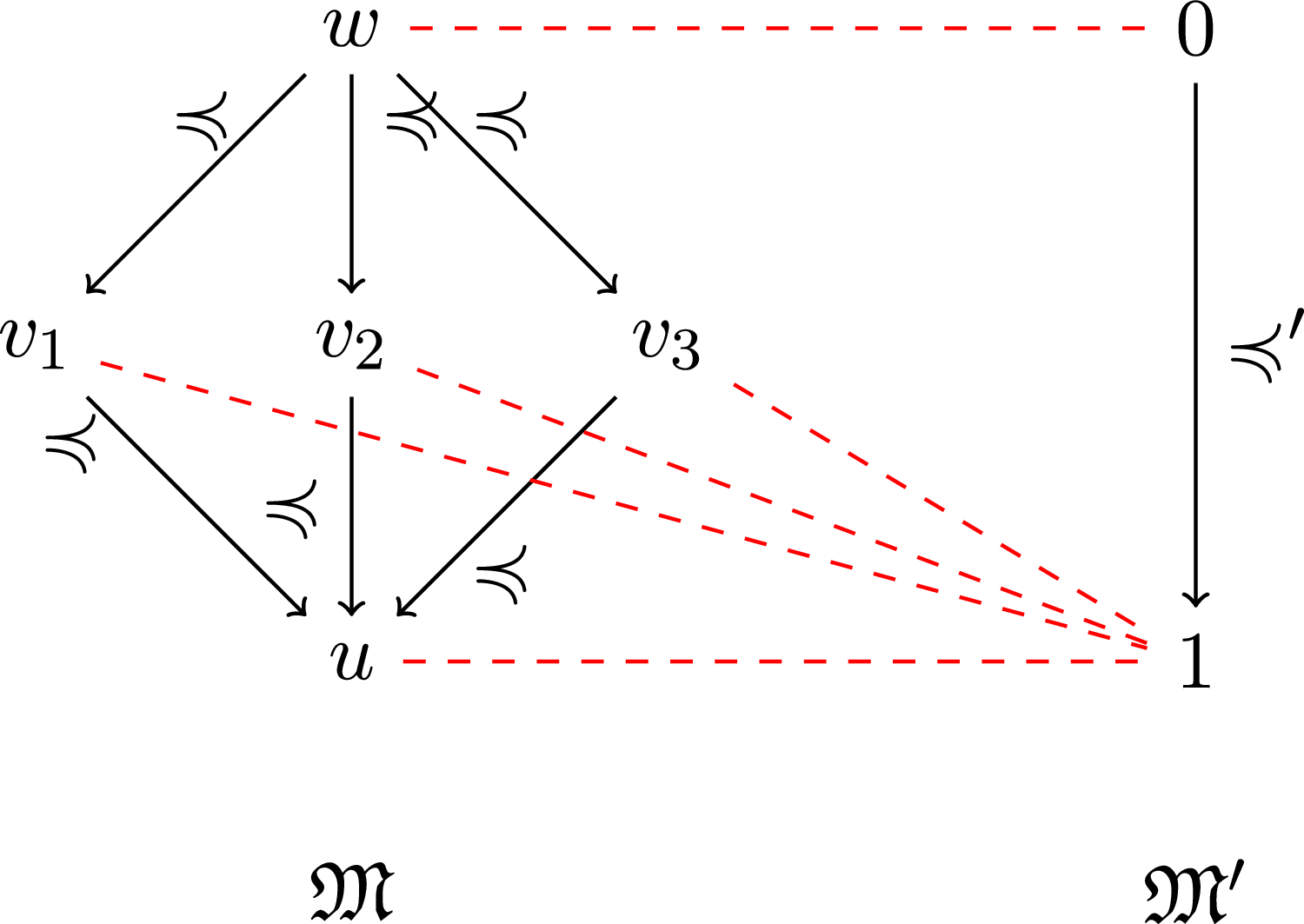
, displayed in red dashed lines in Figure 1. In general, we map maximal worlds in
${\mathcal{Z}} W\times W^{\prime}$
, displayed in red dashed lines in Figure 1. In general, we map maximal worlds in $W$
to
$W$
to $u\in W^{\prime}$
while the remaining worlds
$u\in W^{\prime}$
while the remaining worlds $v \in W$
that belong to the subframe generated by
$v \in W$
that belong to the subframe generated by $w$
are mapped to themselves in
$w$
are mapped to themselves in $W^{\prime}$
(where they also belong by construction). The reader can easily check that
$W^{\prime}$
(where they also belong by construction). The reader can easily check that $\mathcal{Z}$
is a bisimulation.
$\mathcal{Z}$
is a bisimulation.
A bisimulation relation, represented in red dashed lines, among two intuitionistic models $\mathfrak M$
(on the left) and
$\mathfrak M$
(on the left) and ${\mathfrak M}^{\prime}$
(with a unique maximal world, on the right). We assume that,
${\mathfrak M}^{\prime}$
(with a unique maximal world, on the right). We assume that, ${\mathfrak M}, w \models \lbrace \neg p \vee \neg \neg p\mid p \in {\mathbb{P}} \rbrace$
and we define
${\mathfrak M}, w \models \lbrace \neg p \vee \neg \neg p\mid p \in {\mathbb{P}} \rbrace$
and we define $V^{\prime}$
as
$V^{\prime}$
as $V^{\prime}(w):=V(w)$
,
$V^{\prime}(w):=V(w)$
, $V^{\prime}(v_i):= V(v_i)$
for all
$V^{\prime}(v_i):= V(v_i)$
for all $i \in \lbrace 1,2,3\rbrace$
and
$i \in \lbrace 1,2,3\rbrace$
and $V^{\prime}(u)$
can be set (for instance) to
$V^{\prime}(u)$
can be set (for instance) to $V(u_1)$
. Reflexivity and transitivity of
$V(u_1)$
. Reflexivity and transitivity of $\preccurlyeq$
and
$\preccurlyeq$
and $\preccurlyeq ^{\prime}$
is not represented for the sake of readability.
$\preccurlyeq ^{\prime}$
is not represented for the sake of readability.

The notion of bisimulation can also be used to contract intuitionistic models to HT models. In the following lemma, we identify the condition under which such contraction is possible. Before presenting our result, we introduce the following notation.
Definition 2.
Let ${\mathfrak M} = {\langle (W,\preccurlyeq ),V \rangle }$
be an intuitionistic model and let
${\mathfrak M} = {\langle (W,\preccurlyeq ),V \rangle }$
be an intuitionistic model and let $w\in W$
. We define the sets
$w\in W$
. We define the sets
 \begin{align*} {\preccurlyeq }(w) &:= \lbrace v \in W \mid w \preccurlyeq v\rbrace \\ {\prec }(w) &:= \lbrace v \in W \mid w \preccurlyeq v \hbox{ and } v \not = w\rbrace . \end{align*}
Clearly, $w \in {\preccurlyeq (w)}$
while
$w \in {\preccurlyeq (w)}$
while $w \notin {\prec (w})$
.
$w \notin {\prec (w})$
.
Lemma 4 (Contraction lemma).
Let ${\mathfrak M} = {\langle (W,\preccurlyeq ),V \rangle }$
be an intuitionistic model, let
${\mathfrak M} = {\langle (W,\preccurlyeq ),V \rangle }$
be an intuitionistic model, let $T\subseteq {\mathbb{P}}$
and let
$T\subseteq {\mathbb{P}}$
and let $w \in W$
satisfying the following conditions:
$w \in W$
satisfying the following conditions:
-
1.
${\preccurlyeq }(w)$
has a unique maximal world, denoted by
$u$
, and
-
2.
$V(v)=T$
, for all
$v \in {\prec }(w)$
.


Then, there exists a HT model ${\mathfrak M}^{\prime} = {\langle (\lbrace 0,1 \rbrace ,\preccurlyeq ^{\prime}),V^{\prime} \rangle }$
and a bisimulation
${\mathfrak M}^{\prime} = {\langle (\lbrace 0,1 \rbrace ,\preccurlyeq ^{\prime}),V^{\prime} \rangle }$
and a bisimulation ${\mathcal{Z}} W\times \lbrace 0,1\rbrace$
such that
${\mathcal{Z}} W\times \lbrace 0,1\rbrace$
such that $w {\mathcal{Z}}$
.
$w {\mathcal{Z}}$
.
Proof.
Let us define ${\mathfrak M}^{\prime} = {\langle (\lbrace 0,1\rbrace , \preccurlyeq ^{\prime}),V^{\prime} \rangle }$
as
${\mathfrak M}^{\prime} = {\langle (\lbrace 0,1\rbrace , \preccurlyeq ^{\prime}),V^{\prime} \rangle }$
as $V^{\prime}(0) := V(w)$
and
$V^{\prime}(0) := V(w)$
and $V^{\prime}(1):=V(u)$
. Let us define the relation
$V^{\prime}(1):=V(u)$
. Let us define the relation ${\mathcal{Z}} W\times \lbrace 0,1\rbrace$
as
${\mathcal{Z}} W\times \lbrace 0,1\rbrace$
as ${\mathcal{Z}}= \lbrace ((w,0),(v,1))\mid v \in {\prec }(w)\rbrace$
. It can be checked that
${\mathcal{Z}}= \lbrace ((w,0),(v,1))\mid v \in {\prec }(w)\rbrace$
. It can be checked that $\mathcal{Z}$
is a bisimulation among
$\mathcal{Z}$
is a bisimulation among $\mathfrak M$
and
$\mathfrak M$
and ${\mathfrak M}^{\prime}$
. Figure 2 shows both
${\mathfrak M}^{\prime}$
. Figure 2 shows both $\mathfrak M$
and
$\mathfrak M$
and ${\mathfrak M}^{\prime}$
together with
${\mathfrak M}^{\prime}$
together with $\mathcal{Z}$
(in red dashed lines).
$\mathcal{Z}$
(in red dashed lines).
An intuitionistic model $\mathfrak M$
, a HT model
$\mathfrak M$
, a HT model ${\mathfrak M}^{\prime}$
and a bisimulations
${\mathfrak M}^{\prime}$
and a bisimulations $\mathcal{Z}$
(in red dashed lines) among them. As preconditions,
$\mathcal{Z}$
(in red dashed lines) among them. As preconditions, $V(v) = T$
for all
$V(v) = T$
for all $v \in W$
with
$v \in W$
with $v \not = w$
,
$v \not = w$
, $V^{\prime}(0) = V(w)$
and
$V^{\prime}(0) = V(w)$
and $V^{\prime}(1) = V(u)$
. Reflexivity and transitivity of
$V^{\prime}(1) = V(u)$
. Reflexivity and transitivity of $\preccurlyeq$
and
$\preccurlyeq$
and $\preccurlyeq ^{\prime}$
are not represented for the sake of readability.
$\preccurlyeq ^{\prime}$
are not represented for the sake of readability.
2.3 Equilibrium logic
The logic of here-and-there (HT; Heyting Reference Heyting1930) is fundamental in logic programming, since it serves as the basis for equilibrium logic (EL; Pearce, 1997, Reference Pearce2006), the most prominent logical characterization of stable models and answer sets (Gelfond and Lifschitz Reference Gelfond and Lifschitz1988). EL extends HT via a model selection criterion that induces nonmonotonicity. For any two HT models ${\mathfrak M}_1 = ({\mathfrak{F}},V_1)$
and
${\mathfrak M}_1 = ({\mathfrak{F}},V_1)$
and ${\mathfrak M}_2 = ({\mathfrak{F}},V_2)$
, we define a partial order
${\mathfrak M}_2 = ({\mathfrak{F}},V_2)$
, we define a partial order ${\mathfrak M}_1\le {\mathfrak M}_2$
holding when
${\mathfrak M}_1\le {\mathfrak M}_2$
holding when $V_1(1) = V_2(1)$
and
$V_1(1) = V_2(1)$
and $V_1(0)\subseteq V_2(0)$
. Strict inequality
$V_1(0)\subseteq V_2(0)$
. Strict inequality ${\mathfrak M}_1 \lt {\mathfrak M}_2$
holds if
${\mathfrak M}_1 \lt {\mathfrak M}_2$
holds if ${\mathfrak M}_1 \le {\mathfrak M}_2$
and
${\mathfrak M}_1 \le {\mathfrak M}_2$
and $V_1 \neq V_2$
. A model
$V_1 \neq V_2$
. A model ${\mathfrak M} = ({\mathfrak{F}},V)$
is called total if
${\mathfrak M} = ({\mathfrak{F}},V)$
is called total if $V(0) = V(1)$
.
$V(0) = V(1)$
.
Equilibrium models are then defined as follows.
Definition 3 (Pearce Reference Pearce2006). A total HT model ${\mathfrak M} = {\langle {\mathfrak{F}},V \rangle }$
is an equilibrium model of a formula
${\mathfrak M} = {\langle {\mathfrak{F}},V \rangle }$
is an equilibrium model of a formula $\varphi$
if
$\varphi$
if
-
1.
${\mathfrak M}, 0 {\models _{\small {{\textrm {HT}}}}} \varphi$
, and
-
2.
$\mathfrak M$
is
$\le$
-minimal, that is there is no
${\mathfrak M}^{\prime} \lt {\mathfrak M}$
such that
${\mathfrak M}^{\prime}, 0 {\models _{\small {{\textrm {HT}}}}} \varphi$
.


3 Two fixpoint characterizations of propositional equilibrium logic
This section presents two characterizations of equilibrium models (and, consequently, answer sets) that we extend to the temporal setting in Section 5. The first characterization, originally defined by Pearce (Reference Pearce2006), is based on the concept of $\mathrm{theory\, completions}$
, which has also been used in autoepistemic and default logic (Besnard Reference Besnard1989; Marek and Truszczyński Reference Marek and Truszczyński1993).
$\mathrm{theory\, completions}$
, which has also been used in autoepistemic and default logic (Besnard Reference Besnard1989; Marek and Truszczyński Reference Marek and Truszczyński1993).
3.1 Pearce’s fixpoint characterization
Definition 4 (Pearce Reference Pearce2006).Let $\Gamma$
be a theory. A set
$\Gamma$
be a theory. A set $E$
of formulas extending
$E$
of formulas extending $\Gamma$
is said to be a
$\Gamma$
is said to be a $\mathrm{completion}$
of
$\mathrm{completion}$
of $\Gamma$
iff
$\Gamma$
iff
 \begin{align*} E & = {Cn_{{\textrm {HT}}}(\Gamma \cup \lbrace \neg \psi \mid \psi \not \in E \rbrace )}. \end{align*}
Equilibrium models correspond precisely to completions in the propositional case. For any model $\mathfrak M$
, we define
$\mathfrak M$
, we define
 \begin{equation*} {\mathit{Th}({\mathfrak M})}:= \lbrace \psi \mid {\mathfrak M}, 0 {\models _{\small {{\textrm {HT}}}}} \psi \rbrace . \end{equation*}
The relation between equilibrium models and theory completions is made precise next.
Proposition 3 (Pearce Reference Pearce1999b).For any theory $\Gamma$
, there is a one-to-one correspondence between the equilibrium models of
$\Gamma$
, there is a one-to-one correspondence between the equilibrium models of $\Gamma$
and the completions of
$\Gamma$
and the completions of $\Gamma$
. In particular,
$\Gamma$
. In particular, $E = {\mathit{Th}({\mathfrak M})}$
for some equilibrium model
$E = {\mathit{Th}({\mathfrak M})}$
for some equilibrium model $\mathfrak M$
of
$\mathfrak M$
of $\Gamma$
. Similarly, any total HT model
$\Gamma$
. Similarly, any total HT model ${\mathfrak M}={\langle {\mathfrak{F}}, V \rangle }$
is an equilibrium model of
${\mathfrak M}={\langle {\mathfrak{F}}, V \rangle }$
is an equilibrium model of $\Gamma$
iff
$\Gamma$
iff $V(0) =V(1)= E\cap {\mathbb{P}}$
for some completion
$V(0) =V(1)= E\cap {\mathbb{P}}$
for some completion $E$
of
$E$
of $\Gamma$
.
$\Gamma$
.
3.2 INT-safe beliefs
A slightly different fixpoint characterization of equilibrium logic can be given in terms of INT-safe beliefs (Osorio et al. Reference Osorio, Pérez and Arrazola2005), which are typically defined in terms of entailment in intuitionistic and intermediate logics. In this section, we provide a semantic reformulation of INT-safe beliefs, offering a different perspective that is useful for our subsequent development of temporal safe beliefs.
Definition 5.
A set $T$
of atoms is said to be an INT-
$T$
of atoms is said to be an INT- $\mathrm{safe\, belief\, set}$
of a theory
$\mathrm{safe\, belief\, set}$
of a theory $\Gamma$
if
$\Gamma$
if
-
•
$\Gamma \cup \lbrace \neg \neg p \mid p \in T \rbrace \cup \lbrace \neg p \mid p \not \in T\rbrace$
is
$\textrm {INT}$
-consistent and
-
•
$\Gamma \cup \lbrace \neg \neg p \mid p \in T \rbrace \cup \lbrace \neg p \mid p \not \in T\rbrace {\models _{\small {\textrm {INT}}}} T$
.



Analogous definitions can be reproduced for intermediate logics by replacing INT by any intermediate logic $\textrm {X}$
. In fact,
$\textrm {X}$
. In fact, $\textrm {HT}$
-safe beliefs correspond to equilibrium models, as stated in the following lemma.
$\textrm {HT}$
-safe beliefs correspond to equilibrium models, as stated in the following lemma.
Lemma 5 (Osorio et al. Reference Osorio, Pérez and Arrazola2005; Pearce Reference Pearce2006).There is a one-to-one correspondence between both the $\textrm {HT}$
-safe beliefs sets of a theory
$\textrm {HT}$
-safe beliefs sets of a theory $\Gamma$
and its equilibrium models. That is, for each HT-safe belief set
$\Gamma$
and its equilibrium models. That is, for each HT-safe belief set $T$
, we can construct an equilibrium model
$T$
, we can construct an equilibrium model ${\mathfrak M}={\langle {\mathfrak{F}}, V \rangle }$
where
${\mathfrak M}={\langle {\mathfrak{F}}, V \rangle }$
where $V(0)=V(1)=T$
. Conversely, given
$V(0)=V(1)=T$
. Conversely, given $\mathfrak M$
, we can extract the
$\mathfrak M$
, we can extract the $\textrm {HT}$
-safe belief set
$\textrm {HT}$
-safe belief set $T=V(0)$
.
$T=V(0)$
.
Osorio et al. (Reference Osorio, Pérez and Arrazola2005) show that safe beliefs are independent of the chosen intermediate logic, as stated in Lemmas 6 (below) and 7.
Lemma 6 (Osorio et al. Reference Osorio, Pérez and Arrazola2005).Let $T$
be a set of atoms and let
$T$
be a set of atoms and let $\textrm {X}$
and
$\textrm {X}$
and $\textrm {Y}$
be two proper intermediate logics such that
$\textrm {Y}$
be two proper intermediate logics such that $\textrm {X} \subseteq {\textrm {Y}}$
. For any propositional theory
$\textrm {X} \subseteq {\textrm {Y}}$
. For any propositional theory $\Gamma$
, if
$\Gamma$
, if $T$
is a
$T$
is a $\textrm {X}$
-safe belief set of
$\textrm {X}$
-safe belief set of $\Gamma$
, then
$\Gamma$
, then $T$
is a
$T$
is a $\textrm {Y}$
-safe belief set of
$\textrm {Y}$
-safe belief set of $\Gamma$
.
$\Gamma$
.
In Osorio et al. (Reference Osorio, Pérez and Arrazola2005), Lemma7 is proved by using arguments from proof theory. We provide a model-theoretic proof based on Lemma4, which is easier to extend to temporal equilibrium logic.
Lemma 7.
Let $T$
be a set of atoms and let
$T$
be a set of atoms and let $\textrm {X}$
and
$\textrm {X}$
and $\textrm {Y}$
be two proper intermediate logics satisfying
$\textrm {Y}$
be two proper intermediate logics satisfying $\textrm {X} \subseteq {\textrm {Y}}$
. For any propositional theory
$\textrm {X} \subseteq {\textrm {Y}}$
. For any propositional theory $\Gamma$
, if
$\Gamma$
, if $T$
is a
$T$
is a $\textrm {Y}$
-safe belief set of
$\textrm {Y}$
-safe belief set of $\Gamma$
then
$\Gamma$
then $T$
is a
$T$
is a $\textrm {X}$
-safe belief set of
$\textrm {X}$
-safe belief set of $\Gamma$
.
$\Gamma$
.
Proof.
Let us assume that $T$
is a
$T$
is a $\textrm {Y}$
-safe belief of
$\textrm {Y}$
-safe belief of $\Gamma$
. It holds that
$\Gamma$
. It holds that
-
(a)
$\Gamma \cup \lbrace \neg \neg p \mid p \in T \rbrace \cup \lbrace \neg p \mid p \not \in T\rbrace$
is
$\textrm {Y}$
-consistent and -
(b)
$\Gamma \cup \lbrace \neg \neg p \mid p \in T \rbrace \cup \lbrace \neg p \mid p \not \in T\rbrace {\models _{\small {{\textrm {Y}}}}} T$
.



From
 \begin{equation} \Gamma \cup \lbrace \neg \neg p \mid p \in T \rbrace \cup \lbrace \neg p \mid p \not \in T\rbrace \end{equation}
being $\textrm {Y}$
-consistent and Lemma1, it follows that (3) is both
$\textrm {Y}$
-consistent and Lemma1, it follows that (3) is both $\textrm {X}$
-consistent and
$\textrm {X}$
-consistent and $\textrm {INT}$
-consistent. From the second item, the fact that
$\textrm {INT}$
-consistent. From the second item, the fact that ${\textrm {Y}}\subseteq {\textrm {HT}}$
and Proposition1 it follows
${\textrm {Y}}\subseteq {\textrm {HT}}$
and Proposition1 it follows
 \begin{equation} \Gamma \cup \lbrace \neg \neg p \mid p \in T \rbrace \cup \lbrace \neg p \mid p \not \in T\rbrace {\models _{\small {{\textrm {HT}}}}} T. \end{equation}
Let ${\mathfrak M}={\langle (W,\preccurlyeq ),V \rangle }$
be any intuitionistic model and
${\mathfrak M}={\langle (W,\preccurlyeq ),V \rangle }$
be any intuitionistic model and $w \in W$
satisfying
$w \in W$
satisfying
-
(c)
${\mathfrak M}, w {\models _{\small {\textrm {INT}}}} \Gamma$
, -
(d)
${\mathfrak M}, w {\models _{\small {\textrm {INT}}}} \lbrace \neg \neg p \mid p \in T \rbrace$
and -
(e)
${\mathfrak M}, w {\models _{\small {\textrm {INT}}}} \lbrace \neg p \mid p \not \in T\rbrace$
.



Items (d) and (e) imply that ${\mathfrak M}, w {\models _{\small {\textrm {INT}}}} \lbrace \neg p \vee \neg \neg p\mid p \in {\mathbb{P}}\rbrace$
. By Lemma3 there exists an intuitionistic
${\mathfrak M}, w {\models _{\small {\textrm {INT}}}} \lbrace \neg p \vee \neg \neg p\mid p \in {\mathbb{P}}\rbrace$
. By Lemma3 there exists an intuitionistic ${\mathfrak M}^{\prime} = {\langle (W^{\prime},\preccurlyeq ^{\prime}),V^{\prime} \rangle }$
,
${\mathfrak M}^{\prime} = {\langle (W^{\prime},\preccurlyeq ^{\prime}),V^{\prime} \rangle }$
, $w^{\prime}\in W^{\prime}$
and a bisimulation
$w^{\prime}\in W^{\prime}$
and a bisimulation ${\mathcal{Z}} W\times W^{\prime}$
such that
${\mathcal{Z}} W\times W^{\prime}$
such that $w{\mathcal{Z}}^{\prime}$
and the subframe generated by
$w{\mathcal{Z}}^{\prime}$
and the subframe generated by $w^{\prime}$
has an unique maximal world. By Lemma2,
$w^{\prime}$
has an unique maximal world. By Lemma2, ${\mathfrak M}^{\prime},w^{\prime} {\models _{\small {\textrm {INT}}}} \Gamma$
,
${\mathfrak M}^{\prime},w^{\prime} {\models _{\small {\textrm {INT}}}} \Gamma$
, ${\mathfrak M}^{\prime}, w^{\prime} {\models _{\small {\textrm {INT}}}} \lbrace \neg \neg p \mid p \in T \rbrace$
and
${\mathfrak M}^{\prime}, w^{\prime} {\models _{\small {\textrm {INT}}}} \lbrace \neg \neg p \mid p \in T \rbrace$
and ${\mathfrak M}^{\prime}, w^{\prime}{\models _{\small {\textrm {INT}}}} \lbrace \neg p \mid p \not \in T\rbrace$
.
${\mathfrak M}^{\prime}, w^{\prime}{\models _{\small {\textrm {INT}}}} \lbrace \neg p \mid p \not \in T\rbrace$
.
Let us denote by $u^{\prime}\in W^{\prime}$
the (unique) maximal world in the subframe generated by
$u^{\prime}\in W^{\prime}$
the (unique) maximal world in the subframe generated by $w^{\prime}$
. By the monotonicity property of INT,
$w^{\prime}$
. By the monotonicity property of INT, ${\mathfrak M}^{\prime},u^{\prime}{\models _{\small {\textrm {INT}}}} \lbrace \neg \neg p \mid p \in T \rbrace$
and
${\mathfrak M}^{\prime},u^{\prime}{\models _{\small {\textrm {INT}}}} \lbrace \neg \neg p \mid p \in T \rbrace$
and ${\mathfrak M}^{\prime}, u^{\prime}{\models _{\small {\textrm {INT}}}} \lbrace \neg p \mid p \not \in T\rbrace$
. Since
${\mathfrak M}^{\prime}, u^{\prime}{\models _{\small {\textrm {INT}}}} \lbrace \neg p \mid p \not \in T\rbrace$
. Since $u^{\prime}$
is maximal
$u^{\prime}$
is maximal $V^{\prime}(u^{\prime}) = T$
. In addition, we prove by induction on
$V^{\prime}(u^{\prime}) = T$
. In addition, we prove by induction on $\mathit{depth}(((W^{\prime},\preccurlyeq ^{\prime}),v^{\prime}))$
, that for all
$\mathit{depth}(((W^{\prime},\preccurlyeq ^{\prime}),v^{\prime}))$
, that for all $v^{\prime} \in {\preccurlyeq ^{\prime}}(w^{\prime})$
(which includes the case
$v^{\prime} \in {\preccurlyeq ^{\prime}}(w^{\prime})$
(which includes the case $w^{\prime}$
as well),
$w^{\prime}$
as well), ${\mathfrak M}^{\prime}, v^{\prime} {\models _{\small {\textrm {INT}}}}T$
.
${\mathfrak M}^{\prime}, v^{\prime} {\models _{\small {\textrm {INT}}}}T$
.
-
1. If
$depth((W^{\prime},v^{\prime}))=1$
then
$v^{\prime}$
is maximal so
$v^{\prime}=u^{\prime}$
(and we reason as in the base case). -
2. For the inductive step, let us assume that
${\mathit{depth}(((W^{\prime},\preccurlyeq ^{\prime}),v^{\prime}))} = n+1$
and the claim holds for every
$x\in {\prec ^{\prime}}(v^{\prime})$
, that is,
${\mathit{depth}(((W^{\prime},\preccurlyeq ^{\prime}),x))} \le n$
.-
(a) If
${\prec ^{\prime}}(v^{\prime})=\emptyset$
,
$v^{\prime}$
is maximal so
$V^{\prime}(v^{\prime})=V^{\prime}(u^{\prime})=T$
. -
(b) If
${\prec ^{\prime}}(v^{\prime})\not =\emptyset$
then, by induction hypothesis,
${\mathfrak M}^{\prime}, x \models T$
for all
$x\in {\prec ^{\prime}}(v^{\prime})$
. From
${\mathfrak M}^{\prime}, w^{\prime} {\models _{\small {\textrm {INT}}}} \lbrace \neg p \mid p \not \in T\rbrace$
and
$w^{\prime} \preccurlyeq ^{\prime} v^{\prime}$
,
${\mathfrak M}^{\prime}, x \not \models p$
for all
$x\in {\prec ^{\prime}}(v^{\prime})$
and all
$p \in {\mathbb{P}}\setminus T$
. Therefore,
$V^{\prime}(x) = T$
for all for all
$x\in {\prec ^{\prime}}(v^{\prime})$
. By Lemma4, there exists a HT model
${\mathfrak M}^{\prime\prime} = {\langle (\lbrace 0,1\rbrace ,\preccurlyeq ^{\prime\prime}),V^{\prime\prime} \rangle }$
and a bisimulation
${\mathcal{Z}} \subseteq W^{\prime} \times \lbrace 0,1 \rbrace$
such that
$v^{\prime} {\mathcal{Z}} 0$
. By Lemma2,
${\mathfrak M}^{\prime\prime},0 {\models _{\small {{\textrm {HT}}}}} \Gamma$
,
${\mathfrak M}^{\prime\prime}, 0 {\models _{\small {{\textrm {HT}}}}} \lbrace \neg \neg p \mid p \in T \rbrace$
and
${\mathfrak M}^{\prime\prime}, 0{\models _{\small {{\textrm {HT}}}}} \lbrace \neg p \mid p \not \in T\rbrace$
. Thank to (4) it follows
${\mathfrak M}^{\prime\prime}, 0 {\models _{\small {{\textrm {HT}}}}} T$
. From
$v^{\prime} {\mathcal{Z}} 0$
and Lemma2,
${\mathfrak M}^{\prime}, v^{\prime} {\models _{\small {\textrm {INT}}}} T$
.
-






















Therefore, ${\mathfrak M}^{\prime}, w^{\prime} {\models _{\small {\textrm {INT}}}} T$
. Since
${\mathfrak M}^{\prime}, w^{\prime} {\models _{\small {\textrm {INT}}}} T$
. Since $w {\mathcal{Z}}^{\prime}$
,
$w {\mathcal{Z}}^{\prime}$
, ${\mathfrak M}, w {\models _{\small {\textrm {INT}}}}T$
. Since
${\mathfrak M}, w {\models _{\small {\textrm {INT}}}}T$
. Since $\mathfrak M$
was chosen arbitrarily, it follows that
$\mathfrak M$
was chosen arbitrarily, it follows that $\Gamma \cup \lbrace \neg \neg p \mid p \in T \rbrace \cup \lbrace \neg p \mid p \not \in T\rbrace {\models _{\small {\textrm {INT}}}} T$
. By Proposition1,
$\Gamma \cup \lbrace \neg \neg p \mid p \in T \rbrace \cup \lbrace \neg p \mid p \not \in T\rbrace {\models _{\small {\textrm {INT}}}} T$
. By Proposition1, $\Gamma \cup \lbrace \neg \neg p \mid p \in T \rbrace \cup$ $\lbrace \neg p \mid p \not \in T\rbrace \models _{\scriptscriptstyle \textrm {X}} T$
. Therefore,
$\lbrace \neg p \mid p \not \in T\rbrace \models _{\scriptscriptstyle \textrm {X}} T$
. Therefore, $T$
is a
$T$
is a $\textrm {X}$
-safe belief of
$\textrm {X}$
-safe belief of $\Gamma$
.
$\Gamma$
.
Note that the combination of Lemmas6 and 7 allows us to replace HT by any proper intermediate logic without altering the set of equilibrium models.
4 Temporal intuitionistic and intermediate logics
Our temporal language $\mathcal{L}_{t}$
consists of formulas generated by the following grammar:
$\mathcal{L}_{t}$
consists of formulas generated by the following grammar:

This extends our basic language with temporal modal operators $\boldsymbol\circ$
,
$\boldsymbol\circ$
,  and
and  . The intended meaning of these operators is the following: ${\boldsymbol\circ} \varphi$
means that
${\boldsymbol\circ} \varphi$
means that $\varphi$
is true at the next time point.
$\varphi$
is true at the next time point. 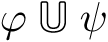 means that $\varphi$
is true until
$\varphi$
is true until $\psi$
is true. For
$\psi$
is true. For 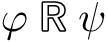 the meaning is not as direct as for the previous operators. That is,
 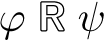 means that $\psi$
is true until both
$\psi$
is true until both $\varphi$
and
$\varphi$
and $\psi$
become true simultaneously or
$\psi$
become true simultaneously or $\psi$
is true forever. We also define several common derived operators like the Boolean connectives
$\psi$
is true forever. We also define several common derived operators like the Boolean connectives $ \top := \neg \bot$
,
$ \top := \neg \bot$
, $ \neg \varphi := \varphi \to \bot$
,
$ \neg \varphi := \varphi \to \bot$
, $ \varphi \leftrightarrow \psi := (\varphi \to \psi ) \wedge (\psi \to \varphi )$
, and the unary temporal operators
$ \varphi \leftrightarrow \psi := (\varphi \to \psi ) \wedge (\psi \to \varphi )$
, and the unary temporal operators  (always afterwards) and
 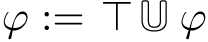 (eventually afterwards). A (temporal) theory is a possibly infinite set of temporal formulas.
Formulas of $\mathcal{L}_{t}$
are interpreted over intuitionistic temporal frames. An intuitionistic temporal frame is a tuple
$\mathcal{L}_{t}$
are interpreted over intuitionistic temporal frames. An intuitionistic temporal frame is a tuple ${\mathfrak{D}} = (W,\preccurlyeq ,S)$
, where
${\mathfrak{D}} = (W,\preccurlyeq ,S)$
, where $W$
is a non-empty set of (Kripke) worlds,
$W$
is a non-empty set of (Kripke) worlds, $\preccurlyeq$
is a partial order, and
$\preccurlyeq$
is a partial order, and $S$
is a function from
$S$
is a function from $W$
to
$W$
to $W$
satisfying the forward confluence condition: If
$W$
satisfying the forward confluence condition: If $w \preccurlyeq v$
then
$w \preccurlyeq v$
then $ S(w) \preccurlyeq S(v)$
for all
$ S(w) \preccurlyeq S(v)$
for all $w, v \in W$
. Conversely, the backward confluence condition stipulates that if
$w, v \in W$
. Conversely, the backward confluence condition stipulates that if $S(w) = v$
and
$S(w) = v$
and $v\preccurlyeq u$
, then there exists
$v\preccurlyeq u$
, then there exists $t \in W$
such that
$t \in W$
such that $w \preccurlyeq t$
and
$w \preccurlyeq t$
and $S(t)=u$
for all
$S(t)=u$
for all $w, v, u \in W$
. If
$w, v, u \in W$
. If $\mathfrak{D}$
satisfies both confluence conditions, we call
$\mathfrak{D}$
satisfies both confluence conditions, we call $\mathfrak{D}$
a persistent intuitionistic temporal frame. Figure 3a (resp. Figure 3b) shows a graphical version of the forward (resp. backward) confluence condition.
$\mathfrak{D}$
a persistent intuitionistic temporal frame. Figure 3a (resp. Figure 3b) shows a graphical version of the forward (resp. backward) confluence condition.
Diagrams associated to forward and backward confluence. The above diagrams can always be completed if $S$
is forward or backward confluent (represented by means of dashed arrows).
$S$
is forward or backward confluent (represented by means of dashed arrows).

An intuitionistic temporal model, or simply model, is a tuple ${\mathfrak M}={\langle {\mathfrak{D}}, V \rangle }$
consisting of an intuitionistic temporal frame
${\mathfrak M}={\langle {\mathfrak{D}}, V \rangle }$
consisting of an intuitionistic temporal frame ${\mathfrak{D}}=(W,\preccurlyeq ,S)$
equipped with a valuation function
${\mathfrak{D}}=(W,\preccurlyeq ,S)$
equipped with a valuation function $V : \rightarrow W {{2^{{\mathbb{P}}}}}$
that is monotone in the sense that if
$V : \rightarrow W {{2^{{\mathbb{P}}}}}$
that is monotone in the sense that if $w \preccurlyeq v$
then
$w \preccurlyeq v$
then $ V(w) \subseteq V(v)$
for all
$ V(w) \subseteq V(v)$
for all $ w, v \in W$
. In the standard way, we define
$ w, v \in W$
. In the standard way, we define $S^0(w) := w$
and
$S^0(w) := w$
and $S^{k+1}(w) := S\left (S^{k}(w)\right )$
for
$S^{k+1}(w) := S\left (S^{k}(w)\right )$
for $k \geq 0$
. Regarding the satisfaction relation, the propositional connectives are satisfied as in INT (see Section 2). The satisfaction of the temporal connectives is presented below.
$k \geq 0$
. Regarding the satisfaction relation, the propositional connectives are satisfied as in INT (see Section 2). The satisfaction of the temporal connectives is presented below.
-
6.
${\mathfrak M}, w \models {\boldsymbol\circ} \varphi$
iff
$ {\mathfrak M}, S(w) \models \varphi$
-
7.
iff there exists
$k \ge 0$
such that
$ {\mathfrak M}, S^k(w) \models \psi$
and
${\mathfrak M}, S^i(w) \models \varphi$
for all
$i \in {[0..k)}$
-
8.
iff for all
$k \ge 0$
, either
${\mathfrak M}, S^k(w) \models \psi$
or
${\mathfrak M}, S^i(w) \models \varphi$
for some
$i \in {[0..k)}$
.


 iff there exists



 iff for all



Example of an $\mathrm{ITL^e}$
model
$\mathrm{ITL^e}$
model ${\mathfrak M} = ((W,{\preccurlyeq },S),V)$
, where reflexivity and transitivity for
${\mathfrak M} = ((W,{\preccurlyeq },S),V)$
, where reflexivity and transitivity for $\preccurlyeq$
are not represented.
$\preccurlyeq$
are not represented.

Figure 4 illustrates the satisfaction relation ‘ $\models$
’ (Balbiani et al. Reference Balbiani, Boudou, Diéguez and Fernández-Duque2020). Note that
$\models$
’ (Balbiani et al. Reference Balbiani, Boudou, Diéguez and Fernández-Duque2020). Note that ${\mathfrak M}, x\models {\boldsymbol\circ} p$
but
${\mathfrak M}, x\models {\boldsymbol\circ} p$
but ${\mathfrak M}, x \not \models p$
, while
${\mathfrak M}, x \not \models p$
, while ${\mathfrak M}, y \models p$
but
${\mathfrak M}, y \models p$
but ${\mathfrak M}, y \not \models {\boldsymbol\circ} p$
. From this, it follows that
${\mathfrak M}, y \not \models {\boldsymbol\circ} p$
. From this, it follows that ${\mathfrak M}, w \not \models ({\boldsymbol\circ} p\rightarrow p)\vee (p \rightarrow {\boldsymbol\circ} p)$
. We refer to the intuitionistic temporal logic interpreted over the class of intuitionistic temporal frames as intuitionistic temporal logic (
${\mathfrak M}, w \not \models ({\boldsymbol\circ} p\rightarrow p)\vee (p \rightarrow {\boldsymbol\circ} p)$
. We refer to the intuitionistic temporal logic interpreted over the class of intuitionistic temporal frames as intuitionistic temporal logic ( $\mathrm{ITL^e}$
). Formally, defined as
$\mathrm{ITL^e}$
). Formally, defined as
 \begin{align*} {\mathrm{ITL^e}} := \lbrace \varphi \in {\mathcal{L}_{t}} \mid {\mathfrak{D}}\models \varphi \rbrace , \end{align*}
where $\mathfrak{D}$
is an intuitionistic temporal frame. If in addition
$\mathfrak{D}$
is an intuitionistic temporal frame. If in addition $\mathfrak{D}$
is persistent, we denote by
$\mathfrak{D}$
is persistent, we denote by
 \begin{align*} {\mathrm{ITL^p}} := \lbrace \varphi \in {\mathcal{L}_{t}} \mid {\mathfrak{D}}\models \varphi \rbrace \end{align*}
the persistent intuitionistic temporal logic ( $\mathrm{ITL^p}$
), i.e., the intuitionistic temporal logic interpreted over the class of the intuitionistic persistent frames.
$\mathrm{ITL^p}$
), i.e., the intuitionistic temporal logic interpreted over the class of the intuitionistic persistent frames.
The following proposition shows that ${\mathrm{ITL^e}}\not ={\mathrm{ITL^p}}$
.
${\mathrm{ITL^e}}\not ={\mathrm{ITL^p}}$
.
Proposition 4 (Balbiani et al. Reference Balbiani, Boudou, Diéguez and Fernández-Duque2020).The formulas $\left ({\boldsymbol\circ} p \to {\boldsymbol\circ} q\right ) \to {\boldsymbol\circ}\left (p \to q\right )$
and
$\left ({\boldsymbol\circ} p \to {\boldsymbol\circ} q\right ) \to {\boldsymbol\circ}\left (p \to q\right )$
and $\left ({\Diamond } p \to {\square } q\right ) \to {\square }\left (p \to q\right )$
are valid over the class of persistent intuitionistic temporal frames.
$\left ({\Diamond } p \to {\square } q\right ) \to {\square }\left (p \to q\right )$
are valid over the class of persistent intuitionistic temporal frames.
The formulas presented in the proposition above are valid in $\mathrm{ITL^p}$
but not in
$\mathrm{ITL^p}$
but not in $\mathrm{ITL^e}$
. This leads to the following result.
$\mathrm{ITL^e}$
. This leads to the following result.
Corollary 1 (Balbiani et al. Reference Balbiani, Boudou, Diéguez and Fernández-Duque2020). ${\mathrm{ITL^e}} \not = {\mathrm{ITL^p}}$
.
${\mathrm{ITL^e}} \not = {\mathrm{ITL^p}}$
.
We remark that intuitionistic temporal frames impose minimal conditions on $S$
and
$S$
and $\preccurlyeq$
in order to preserve the monotonicity of truth of formulas, in the sense that if
$\preccurlyeq$
in order to preserve the monotonicity of truth of formulas, in the sense that if ${\mathfrak M}, w {\models _{\small {{\mathrm{ITL^e}}}}} \varphi$
and
${\mathfrak M}, w {\models _{\small {{\mathrm{ITL^e}}}}} \varphi$
and $w\preccurlyeq v$
then
$w\preccurlyeq v$
then ${\mathfrak M}, v {\models _{\small {{\mathrm{ITL^e}}}}} \varphi$
. In the propositional case, the monotonicity property is guaranteed by the use of a monotone valuation. In the temporal case, we additionally require the forward confluence property, which relates
${\mathfrak M}, v {\models _{\small {{\mathrm{ITL^e}}}}} \varphi$
. In the propositional case, the monotonicity property is guaranteed by the use of a monotone valuation. In the temporal case, we additionally require the forward confluence property, which relates $\preccurlyeq$
and
$\preccurlyeq$
and $S$
. Forward confluence ensures the satisfaction of temporal formulas is also monotone with respect to
$S$
. Forward confluence ensures the satisfaction of temporal formulas is also monotone with respect to $\preccurlyeq$
. The backward confluence property, while not required for monotonicity, allows us to show that maximal points are preserved under the temporal successor relation: if
$\preccurlyeq$
. The backward confluence property, while not required for monotonicity, allows us to show that maximal points are preserved under the temporal successor relation: if $w$
is a
$w$
is a $\preccurlyeq$
-maximal point, then
$\preccurlyeq$
-maximal point, then $S(w)$
is also maximal (see Proposition7).
$S(w)$
is also maximal (see Proposition7).
Proposition 5 (monotonicity; Balbiani et al. Reference Balbiani, Boudou, Diéguez and Fernández-Duque2020).Let ${\mathfrak M}={\langle ( W,\preccurlyeq ,S),V \rangle }$
be an intuitionistic temporal model. For any
${\mathfrak M}={\langle ( W,\preccurlyeq ,S),V \rangle }$
be an intuitionistic temporal model. For any $w,v \in W$
, if
$w,v \in W$
, if $w \preccurlyeq v$
then for any temporal formula
$w \preccurlyeq v$
then for any temporal formula $\varphi$
,
$\varphi$
, ${\mathfrak M}, w \models \varphi$
implies
${\mathfrak M}, w \models \varphi$
implies ${\mathfrak M}, v \models \varphi$
.
${\mathfrak M}, v \models \varphi$
.
Contrary to the non-temporal case (see Section 2), consistency in $\mathrm{ITL^e}$
cannot be reduced to consistency in plain LTL. We provide here the counterexample proposed by Balbiani et al. (Reference Balbiani, Boudou, Diéguez and Fernández-Duque2020): consider
$\mathrm{ITL^e}$
cannot be reduced to consistency in plain LTL. We provide here the counterexample proposed by Balbiani et al. (Reference Balbiani, Boudou, Diéguez and Fernández-Duque2020): consider $\Gamma :=\lbrace \neg {\boldsymbol\circ} p, \neg {\boldsymbol\circ}\neg p \rbrace$
. In LTL, this theory is equivalent to
$\Gamma :=\lbrace \neg {\boldsymbol\circ} p, \neg {\boldsymbol\circ}\neg p \rbrace$
. In LTL, this theory is equivalent to $\lbrace {\boldsymbol\circ} \neg p , {\boldsymbol\circ} p\rbrace$
and it is inconsistent. However, the
$\lbrace {\boldsymbol\circ} \neg p , {\boldsymbol\circ} p\rbrace$
and it is inconsistent. However, the $\mathrm{ITL^e}$
model
$\mathrm{ITL^e}$
model $\mathfrak M$
shown in Figure 5 satisfies
$\mathfrak M$
shown in Figure 5 satisfies $\Gamma$
at the world
$\Gamma$
at the world $w$
(in symbols,
$w$
(in symbols, ${\mathfrak M}, w \models \Gamma$
). Note that, in this case,
${\mathfrak M}, w \models \Gamma$
). Note that, in this case, $S$
is forward, but not backward, confluent. Hence, the decidability of the satisfiability problem in
$S$
is forward, but not backward, confluent. Hence, the decidability of the satisfiability problem in $\mathrm{ITL^e}$
is not a corollary of the LTL case. When adding the backward confluence property,
$\mathrm{ITL^e}$
is not a corollary of the LTL case. When adding the backward confluence property, $\Gamma$
becomes inconsistent. However, adding such condition (i.e. replacing
$\Gamma$
becomes inconsistent. However, adding such condition (i.e. replacing $\mathrm{ITL^e}$
by
$\mathrm{ITL^e}$
by $\mathrm{ITL^p}$
) does not allow us to reduce
$\mathrm{ITL^p}$
) does not allow us to reduce $\mathrm{ITL^p}$
-consistency to LTL-consistency either. To show this, we consider the theory
$\mathrm{ITL^p}$
-consistency to LTL-consistency either. To show this, we consider the theory $\Gamma := \lbrace {\square } \neg \neg p, \neg {\square } p \rbrace$
. In
$\Gamma := \lbrace {\square } \neg \neg p, \neg {\square } p \rbrace$
. In $\textrm {LTL}$
,
$\textrm {LTL}$
, $\Gamma$
is equivalent to
$\Gamma$
is equivalent to $\lbrace {\square } p, \neg {\square } p\rbrace$
and it is clearly inconsistent. Now, consider the model
$\lbrace {\square } p, \neg {\square } p\rbrace$
and it is clearly inconsistent. Now, consider the model ${\mathfrak M} = {\langle (\mathbb{N}\times \mathbb{N},\preccurlyeq ,S),V \rangle }$
shown in Figure 6. In this case, the valuation
${\mathfrak M} = {\langle (\mathbb{N}\times \mathbb{N},\preccurlyeq ,S),V \rangle }$
shown in Figure 6. In this case, the valuation $V$
is defined as
$V$
is defined as $V((i,j)) := \lbrace p \rbrace$
if
$V((i,j)) := \lbrace p \rbrace$
if $ i \lt j$
and
$ i \lt j$
and $\emptyset$
otherwise. In fact,
$\emptyset$
otherwise. In fact, $\mathfrak M$
is a
$\mathfrak M$
is a $\mathrm{ITL^p}$
model since it possesses both forward and backward confluence properties. Moreover,
$\mathrm{ITL^p}$
model since it possesses both forward and backward confluence properties. Moreover,
-
1. For every
$i \ge 0$
there exist
$j \gt 0$
such that
${\mathfrak M}, (i,j) \models p$
, so
${\mathfrak M}, (i,0)\models \neg \neg p$
, for every
$i \ge 0$
. Consequently,
${\mathfrak M}, (0,0) \models {\square } \neg \neg p$
. -
2. For every
$j \ge 0$
there exist
$i \ge 0$
such that
${\mathfrak M}, (i,j) \not \models p$
. Therefore,
${\mathfrak M}, (0,j) \not \models {\square } p$
, for every
$j \ge 0$
. Consequently,
${\mathfrak M}, (0,0) \models \neg {\square } p$
.










As a consequence, ${\mathbf{M}}, (0,0) \models \Gamma$
. We remark that the depth of
${\mathbf{M}}, (0,0) \models \Gamma$
. We remark that the depth of $\preccurlyeq$
is not finite in
$\preccurlyeq$
is not finite in $\mathfrak M$
.
$\mathfrak M$
.
Example of an $\mathrm{ITL^e}$
model satisfying
$\mathrm{ITL^e}$
model satisfying $\Gamma :=\lbrace \neg {\boldsymbol\circ} p, \neg {\boldsymbol\circ} \neg p\rbrace$
. Reflexivity and transitivity of
$\Gamma :=\lbrace \neg {\boldsymbol\circ} p, \neg {\boldsymbol\circ} \neg p\rbrace$
. Reflexivity and transitivity of $\preccurlyeq$
are omitted for the sake of clarity.
$\preccurlyeq$
are omitted for the sake of clarity.

A $\mathrm{ITL^p}$
model
$\mathrm{ITL^p}$
model $\mathfrak M$
satisfying
$\mathfrak M$
satisfying $\Gamma :=\lbrace \lbrace {\square } \neg \neg p, \neg {\square } p \rbrace \rbrace$
at
$\Gamma :=\lbrace \lbrace {\square } \neg \neg p, \neg {\square } p \rbrace \rbrace$
at $(0,0)$
. The proposition
$(0,0)$
. The proposition $p$
is true in the worlds displayed boldface while false in those that are not. Reflexivity and transitivity of
$p$
is true in the worlds displayed boldface while false in those that are not. Reflexivity and transitivity of $\preccurlyeq$
are not represented for the sake of readability.
$\preccurlyeq$
are not represented for the sake of readability.

Such a counterexample leads to the following result.
Proposition 6. $\mathrm{ITL^p}$
-consistency cannot be reduced to
$\mathrm{ITL^p}$
-consistency cannot be reduced to $\textrm {LTL}$
-consistency.
$\textrm {LTL}$
-consistency.
4.1 Intermediate temporal logics
As we have shown in the previous section, intermediate temporal logics defined extending $\mathrm{ITL^p}$
with new axioms may not preserve consistency. There is one extra condition that we need to impose on the intuitionistic temporal frames: the intuitionistic depth (
$\mathrm{ITL^p}$
with new axioms may not preserve consistency. There is one extra condition that we need to impose on the intuitionistic temporal frames: the intuitionistic depth ( $\preccurlyeq$
-depth, for short) must be finite. Finite depth can be achieved by forcing
$\preccurlyeq$
-depth, for short) must be finite. Finite depth can be achieved by forcing $\mathrm{ITL^p}$
to validate the schema
$\mathrm{ITL^p}$
to validate the schema $\boldsymbol{bd_{n}}$
, for some
$\boldsymbol{bd_{n}}$
, for some $n\ge 1$
, as shown in Lemma1. We define the family
$n\ge 1$
, as shown in Lemma1. We define the family $\mathrm{ITL^{{\mathrm{BD_{n}}}}}$
of intuitionistic temporal logics as
$\mathrm{ITL^{{\mathrm{BD_{n}}}}}$
of intuitionistic temporal logics as
 \begin{equation*} \mathrm{ITL^{{\mathrm{BD_{n}}}}} := \lbrace \varphi \in {\mathcal{L}_{t}} \mid {\mathfrak{D}} \models \varphi \rbrace , \end{equation*}
where ${\mathfrak{D}}=(W,\preccurlyeq ,S)$
is a
${\mathfrak{D}}=(W,\preccurlyeq ,S)$
is a $\mathrm{ITL^p}$
frame with
$\mathrm{ITL^p}$
frame with ${\mathit{depth}((W,\preccurlyeq ))}\le n$
.
${\mathit{depth}((W,\preccurlyeq ))}\le n$
.
Observation 1. $\mathrm{ITL^{{\mathrm{BD_{1}}}}}$
corresponds to LTL, that is,
$\mathrm{ITL^{{\mathrm{BD_{1}}}}}$
corresponds to LTL, that is, $\mathrm{ITL^{{\mathrm{BD_{1}}}}}$
frames
$\mathrm{ITL^{{\mathrm{BD_{1}}}}}$
frames ${\mathfrak{D}}=(W,\preccurlyeq ,S)$
such that
${\mathfrak{D}}=(W,\preccurlyeq ,S)$
such that ${\mathit{depth}((W,\preccurlyeq ))}= 1$
.Footnote
5
${\mathit{depth}((W,\preccurlyeq ))}= 1$
.Footnote
5
Proposition 7.
For all $\mathrm{ITL^{{\mathrm{BD_{n}}}}}$
frame
$\mathrm{ITL^{{\mathrm{BD_{n}}}}}$
frame ${\mathfrak{D}}=(W,\preccurlyeq ,S)$
and for all
${\mathfrak{D}}=(W,\preccurlyeq ,S)$
and for all $w \in W$
, if
$w \in W$
, if $w$
is maximal w.r.t.
$w$
is maximal w.r.t. $\preccurlyeq$
then
$\preccurlyeq$
then $S(w)$
is maximal.
$S(w)$
is maximal.
Note that the proposition above can be proved only if the backward-confluence property holds. In addition, using the result above, we can prove that $\mathrm{ITL^{{\mathrm{BD_{n}}}}}$
-consistency can be reduced to LTL-consistency.
$\mathrm{ITL^{{\mathrm{BD_{n}}}}}$
-consistency can be reduced to LTL-consistency.
Lemma 8.
Any temporal theory $\Gamma$
is
$\Gamma$
is $\mathrm{ITL^{{\mathrm{BD_{n}}}}}$
-consistent iff
$\mathrm{ITL^{{\mathrm{BD_{n}}}}}$
-consistent iff $\Gamma$
is LTL-consistent.
$\Gamma$
is LTL-consistent.
To the best of our knowledge, the family of intermediate temporal logics has not been defined in the literature. We define those logics as extensions of $\mathrm{ITL^{{\mathrm{BD_{n}}}}}$
.Footnote
6
$\mathrm{ITL^{{\mathrm{BD_{n}}}}}$
.Footnote
6
Definition 6 (Intermediate temporal logic).
An $\mathrm{intermediate\, temporal\, logic}$
in the language
$\mathrm{intermediate\, temporal\, logic}$
in the language $\mathcal{L}_{t}$
is any set of formulas
$\mathcal{L}_{t}$
is any set of formulas $\textrm {X}$
satisfying the following conditions:
$\textrm {X}$
satisfying the following conditions:
-
1.
$\mathrm{ITL^{{\mathrm{BD_{n}}}}} \subseteq \textrm {X} \subseteq {\textrm {LTL}}$
-
2.
$\textrm {X}$
is closed under
$\mathrm{modus\, ponens}$
, that is
$\varphi , \varphi \to \psi \in \textrm {X}$
implies
$\psi \in \textrm {X}$
-
3.
$\textrm {X}$
is closed under
$\mathrm{necessitation}$
, that is
$\psi \in \textrm {X}$
implies
${\boldsymbol\circ} \psi \in \textrm {X}$
and
${\square } \psi \in \textrm {X}$
-
4.
$\textrm {X}$
is closed under
$\mathrm{uniform\, substitution}$
, that is
$\varphi \in \textrm {X}$
implies
$\varphi \mathbf{s} \in \textrm {X}$
for any
$\varphi \in {\mathcal{L}_{t}}$
and a substitution
$\mathbf{s}$






As in the propositional case, an intermediate temporal logic is said to be proper if it is different from $\textrm {LTL}$
. Assuming that any intermediate temporal logic extends
$\textrm {LTL}$
. Assuming that any intermediate temporal logic extends $\mathrm{ITL^{{\mathrm{BD_{n}}}}}$
, the following result directly follows from Lemma8.
$\mathrm{ITL^{{\mathrm{BD_{n}}}}}$
, the following result directly follows from Lemma8.
Corollary 2.
Let $\textrm {X}$
be any intermediate temporal logic. Any temporal theory
$\textrm {X}$
be any intermediate temporal logic. Any temporal theory $\Gamma$
is
$\Gamma$
is $\textrm {X}$
-consistent iff
$\textrm {X}$
-consistent iff $\Gamma$
is
$\Gamma$
is $\textrm {LTL}$
-consistent.
$\textrm {LTL}$
-consistent.
The following proposition shows that the depth of a generated (intuitionistic) subframe does not increase between two worlds $x$
and
$x$
and $S(x)$
.
$S(x)$
.
Proposition 8.
For any intuitionistic temporal frame ${\mathfrak{D}} = (W,\preccurlyeq ,S)$
and for an
${\mathfrak{D}} = (W,\preccurlyeq ,S)$
and for an $w\in W$
and for any
$w\in W$
and for any $n\ge 1$
, if
$n\ge 1$
, if ${\mathit{depth}(((W,\preccurlyeq ),w))}\le n$
then
${\mathit{depth}(((W,\preccurlyeq ),w))}\le n$
then ${\mathit{depth}(((W,\preccurlyeq ),S(w)))}\le n$
.
${\mathit{depth}(((W,\preccurlyeq ),S(w)))}\le n$
.
Similar to the propositional case, intermediate temporal logics defined as extensions of $\mathrm{ITL^{{\mathrm{BD_{n}}}}}$
satisfy the following proposition.
$\mathrm{ITL^{{\mathrm{BD_{n}}}}}$
satisfy the following proposition.
Proposition 9.
Let $\textrm {X}$
and
$\textrm {X}$
and $\textrm {Y}$
be two intermediate temporal logics satisfying
$\textrm {Y}$
be two intermediate temporal logics satisfying $\textrm {X} \subseteq {\textrm {Y}}$
. A theory
$\textrm {X} \subseteq {\textrm {Y}}$
. A theory $\Gamma$
is
$\Gamma$
is $\textrm {X}$
-consistent iff
$\textrm {X}$
-consistent iff $\Gamma$
is
$\Gamma$
is $\textrm {Y}$
-consistent.
$\textrm {Y}$
-consistent.
Furthermore, semantic entailment is preserved when strengthening the logic.
Proposition 10.
Let $\textrm {X}$
and
$\textrm {X}$
and $\textrm {Y}$
be two intermediate temporal logics satisfying
$\textrm {Y}$
be two intermediate temporal logics satisfying $\textrm {X} \subseteq {\textrm {Y}}$
. For any theories
$\textrm {X} \subseteq {\textrm {Y}}$
. For any theories $\Gamma$
and
$\Gamma$
and $\Delta$
,
$\Delta$
,
 \begin{align*} \Gamma \models _{\scriptscriptstyle \textrm {X}} \Delta \hbox{ implies } \Gamma {\models _{\small {{\textrm {Y}}}}} \Delta . \end{align*}
The strongest proper intermediate temporal logic is the logic of here-and-there (THT; Balbiani and Diéguez Reference Balbiani and Diéguez2016). In our setting, this logic is obtained by adding Axiom (2) to $\mathrm{ITL^{{\mathrm{BD_{2}}}}}$
.Footnote
7
THT frames are of the form
$\mathrm{ITL^{{\mathrm{BD_{2}}}}}$
.Footnote
7
THT frames are of the form $(W,\preccurlyeq ,S)$
where
$(W,\preccurlyeq ,S)$
where
 \begin{eqnarray*} W &=& \mathbb{N}\times \lbrace 0,1\rbrace ,\\ \preccurlyeq &=& \lbrace ((i,h),(i,t)) \mid ((i,h),(i,t)) \in W \times W \hbox{ such that } h \le t \rbrace \hbox{ and }\\ S &=& \lbrace ((i,k),(i+1,k)) \mid ((i,k),(i+1,k)) \in W \times W\rbrace . \end{eqnarray*}
In the definition above, pairs of the form $(i,0)$
(resp.
$(i,0)$
(resp. $(i,1)$
) represent the “here” (resp. “there”) world at each time point
$(i,1)$
) represent the “here” (resp. “there”) world at each time point $i$
.
$i$
.
4.2 Bisimulations for intuitionistic temporal logics
The notion of intuitionistic temporal bisimulation was introduced in Balbiani et al. (Reference Balbiani, Boudou, Diéguez and Fernández-Duque2020) and we use it in what follows to contract intuitionistic temporal models into THT. Given two intuitionistic temporal models ${\mathfrak M}_1={\langle (W_1,\preccurlyeq _1,S_1),V_1 \rangle }$
and
${\mathfrak M}_1={\langle (W_1,\preccurlyeq _1,S_1),V_1 \rangle }$
and ${\mathfrak M}_2={\langle (W_2,\preccurlyeq _2,S_2),V_2 \rangle }$
, a relation
${\mathfrak M}_2={\langle (W_2,\preccurlyeq _2,S_2),V_2 \rangle }$
, a relation ${\mathcal{Z}} W_1\times W_2$
is an intuitionistic temporal bisimulation, if it satisfies Conditions C1-C3 together with the following ones:
${\mathcal{Z}} W_1\times W_2$
is an intuitionistic temporal bisimulation, if it satisfies Conditions C1-C3 together with the following ones:
-
C5 If
$w_1 {\mathcal{Z}}{w_2}$
then
$S(w_1) {\mathcal{Z}}(w_2)$
; -
C6 If
$w_1 {\mathcal{Z}}{w_2}$
then for all
$k_1\ge 0$
there exists
$k_2\ge 0$
and
$(v_1,v_2) \in W_1 \times W_2$
such that-
(a)
$v_2 \preccurlyeq S^{k_2}(w_2)$
,
$S^{k_1}(w_1)\preccurlyeq v_1$
and
$v_1 {\mathcal{Z}}{w_2}$
and -
(b) for all
$j_2 \in {[0..k_2)}$
there exists
$j_1 \in {[0..k_1)}$
and
$(u_1,u_2)\in W_1\times W_2$
such that
$S^{j_1}(w_1) \preccurlyeq u_1$
,
$u_2 \preccurlyeq S^{j_2}(w_2)$
and
$u_1 {\mathcal{Z}}{v_2}$
.
-
-
C7 If
$w_1 {\mathcal{Z}}{w_2}$
then for all
$k_2\ge 0$
there exists
$k_1\ge 0$
and
$(v_1,v_2) \in W_1 \times W_2$
such that-
(a)
$v_1 \preccurlyeq S^{k_1}(w_1)$
,
$S^{k_2}(w_2)\preccurlyeq v_2$
and
$v_1 {\mathcal{Z}}{w_2}$
and -
(b) for all
$j_1 \in {[0..k_1)}$
there exists
$j_2 \in {[0..k_2)}$
and
$(u_1,u_2)\in W_1\times W_2$
such that
$S^{j_2}(w_2)\preccurlyeq u_2$
,
$u_1 \preccurlyeq S^{j_1}(w_1)$
and
$u_1 {\mathcal{Z}}{v_2}$
.
-
-
C8 If
$w_1 {\mathcal{Z}}{w_2}$
then for all
$k_2\ge 0$
there exists
$k_1\ge 0$
and
$(v_1,v_2) \in W_1 \times W_2$
such that-
(a)
$v_2 \preccurlyeq S^{k_2}(w_2)$
,
$S^{k_1}(w_1)\preccurlyeq v_1$
and
$v_1 {\mathcal{Z}}{w_2}$
and -
(b) for all
$j_1 \in {[0..k_1)}$
there exists
$j_2 \in {[0..k_2)}$
and
$(u_1,u_2)\in W_1\times W_2$
such that
$S^{j_1}(w_1) \preccurlyeq u_1$
,
$u_2 \preccurlyeq S^{j_2}(w_2)$
and
$u_1 {\mathcal{Z}}{v_2}$
.
-
-
C9 If
$w_1 {\mathcal{Z}}{w_2}$
then for all
$k_1\ge 0$
there exists
$k_2\ge 0$
and
$(v_1,v_2) \in W_1 \times W_2$
such that-
(a)
$v_1 \preccurlyeq S^{k_1}(w_1)$
,
$S^{k_2}(w_2)\preccurlyeq v_2$
and
$v_1 {\mathcal{Z}}{w_2}$
and -
(b) for all
$j_2 \in {[0..k_2)}$
there exists
$j_1 \in {[0..k_1)}$
and
$(u_1,u_2)\in W_1\times W_2$
such that
$S^{j_2}(w_2) \preccurlyeq u_2$
,
$u_1 \preccurlyeq S^{j_1}(w_1)$
, and
$u_1 {\mathcal{Z}}{v_2}$
.
-


























Conditions C5–C9 play the same role as conditions C2–C3 in the case of INT but they affect the temporal modalities. More precisely, Conditions C6 and C7 (resp. conditions C8 and C9) simulate the behavior of the until (resp. release) operator. Note that, due confluence of both $\preccurlyeq$
and
$\preccurlyeq$
and $S$
, the forth and back conditions for the binary temporal modalities involve both relations. Condition C5, which is used to simulate the next modality, is not divided into two conditions because the next operator is interpreted in terms of a function.
$S$
, the forth and back conditions for the binary temporal modalities involve both relations. Condition C5, which is used to simulate the next modality, is not divided into two conditions because the next operator is interpreted in terms of a function.
Given two intuitionistic temporal models ${\mathfrak M}_1 = {\langle (W_1,\preccurlyeq _1, S_1),V_1 \rangle }$
and
${\mathfrak M}_1 = {\langle (W_1,\preccurlyeq _1, S_1),V_1 \rangle }$
and ${\mathfrak M}_2= {\langle (W_2,\preccurlyeq _2, S_2),V_2 \rangle }$
with
${\mathfrak M}_2= {\langle (W_2,\preccurlyeq _2, S_2),V_2 \rangle }$
with $w_1\in W_1$
and
$w_1\in W_1$
and $w_2 \in W_2$
, we say that
$w_2 \in W_2$
, we say that ${\mathfrak M}_1$
and
${\mathfrak M}_1$
and ${\mathfrak M}_2$
are bisimilar, if there exists an intuitionistic temporal bisimulation
${\mathfrak M}_2$
are bisimilar, if there exists an intuitionistic temporal bisimulation $\mathcal{Z}$
between
$\mathcal{Z}$
between $W_1$
and
$W_1$
and $W_2$
such that
$W_2$
such that $w_1 {\mathcal{Z}}{w_2}$
. The following lemma states that two bisimilar Kripke worlds satisfy the same temporal formulas.
$w_1 {\mathcal{Z}}{w_2}$
. The following lemma states that two bisimilar Kripke worlds satisfy the same temporal formulas.
Lemma 9 (Balbiani et al. Reference Balbiani, Boudou, Diéguez and Fernández-Duque2020).Given two models ${\mathfrak M}_1 = {\langle (W_1,\preccurlyeq _1,S_1),V_1 \rangle }$
and
${\mathfrak M}_1 = {\langle (W_1,\preccurlyeq _1,S_1),V_1 \rangle }$
and ${\mathfrak M}_2= {\langle (W_2,\preccurlyeq _2,S_2),V_2 \rangle }$
and a bisimulation
${\mathfrak M}_2= {\langle (W_2,\preccurlyeq _2,S_2),V_2 \rangle }$
and a bisimulation $\mathcal{Z}$
on
$\mathcal{Z}$
on $W_1\times W_2$
, we have for all
$W_1\times W_2$
, we have for all $w_1\in W_1$
and for all
$w_1\in W_1$
and for all $w_2 \in W_2$
, if
$w_2 \in W_2$
, if $w_1{\mathcal{Z}}{w_2}$
then for all
$w_1{\mathcal{Z}}{w_2}$
then for all $\varphi \in {\mathcal{L}_{t}}$
,
$\varphi \in {\mathcal{L}_{t}}$
, ${\mathfrak M}_1,w_1 \models \varphi$
iff
${\mathfrak M}_1,w_1 \models \varphi$
iff ${\mathfrak M}_2, w_2 \models \varphi$
.
${\mathfrak M}_2, w_2 \models \varphi$
.
In the proof of the previous lemma, Condition C1 is used to establish the case of propositional variables. Conditions C3 and C2 are used to handle the case of implication. Conditions C7 and C6 are employed for the  operator, while Conditions C9 and C8 are used for the
  operator. Finally, Condition C5 is used in the proof of the case of the $\boldsymbol\circ$
connective.
$\boldsymbol\circ$
connective.
In Balbiani et al. (Reference Balbiani, Boudou, Diéguez and Fernández-Duque2020), where $\mathrm{ITL^e}$
and
$\mathrm{ITL^e}$
and $\mathrm{ITL^p}$
are studied in detail, the authors proved that both satisfiability (resp. validity) on arbitrary
$\mathrm{ITL^p}$
are studied in detail, the authors proved that both satisfiability (resp. validity) on arbitrary $\mathrm{ITL^e}$
models is equivalent to satisfiability (resp. validity) on the so-called expanding models, defined in the following theorem.
$\mathrm{ITL^e}$
models is equivalent to satisfiability (resp. validity) on the so-called expanding models, defined in the following theorem.
Theorem 2 (Boudou et al. Reference Boudou, Diéguez and Fernández-Duque2017; Balbiani et al. Reference Balbiani, Boudou, Diéguez and Fernández-Duque2020).Every $\mathrm{ITL^e}$
model
$\mathrm{ITL^e}$
model $\mathfrak M$
can be unfolded into an expanding model
$\mathfrak M$
can be unfolded into an expanding model ${\mathfrak M}^{\prime} = {\langle (W^{\prime},\preccurlyeq ^{\prime},S^{\prime}),V^{\prime} \rangle }$
, which satisfies the following properties:
${\mathfrak M}^{\prime} = {\langle (W^{\prime},\preccurlyeq ^{\prime},S^{\prime}),V^{\prime} \rangle }$
, which satisfies the following properties:
-
1. For all
$i \ge 0$
and
$w^{\prime}\in W^{\prime}$
, the intuitionistic subframe generated by each
$S^{^{\prime} i}(w^{\prime})$
is a tree,
-
2. the sequence of trees induced by
$S^{^{\prime} i}(w^{\prime})$
is a sequence of disjoint trees, and
-
3. for all
$v^{\prime} \in W^{\prime}$
and for all
$i\ge 0$
, if
$S^{^{\prime} i}(w^{\prime}) \preccurlyeq v^{\prime}$
then
$S^{^{\prime} i+1}(w^{\prime}) \preccurlyeq S^{\prime}(v^{\prime})$
, that is,
$S^{\prime}(v^{\prime})$
falls in the tree generated by
$S^{^{\prime} i+1}(w^{\prime})$
.





We refer the reader to Balbiani et al. (Reference Balbiani, Boudou, Diéguez and Fernández-Duque2020) for more details about such unfolding. Since $\mathrm{ITL^{{\mathrm{BD_{n}}}}}$
is contained in
$\mathrm{ITL^{{\mathrm{BD_{n}}}}}$
is contained in $\mathrm{ITL^e}$
then the construction above can be also applied to models of finite
$\mathrm{ITL^e}$
then the construction above can be also applied to models of finite $\preccurlyeq$
-depth. From now on, when displaying the
$\preccurlyeq$
-depth. From now on, when displaying the $\mathrm{ITL^{{\mathrm{BD_{n}}}}}$
models, we consider expanding models.
$\mathrm{ITL^{{\mathrm{BD_{n}}}}}$
models, we consider expanding models.
Bisimulations for intuitionistic temporal logics allow us to extend Lemmas3 and 4 to the temporal case.
Lemma 10.
Let ${\mathfrak M}={\langle (W,\preccurlyeq ,S),V \rangle }$
be an
${\mathfrak M}={\langle (W,\preccurlyeq ,S),V \rangle }$
be an $\mathrm{ITL^{{\mathrm{BD_{n}}}}}$
model and let
$\mathrm{ITL^{{\mathrm{BD_{n}}}}}$
model and let $w \in W$
be such that
$w \in W$
be such that ${\mathfrak M}, w \models$ $\lbrace {\square }(\neg p \vee \neg \neg p) \mid p \in {\mathbb{P}} \rbrace$
. Then, there exists an
$\lbrace {\square }(\neg p \vee \neg \neg p) \mid p \in {\mathbb{P}} \rbrace$
. Then, there exists an $\mathrm{ITL^{{\mathrm{BD_{n}}}}}$
model
$\mathrm{ITL^{{\mathrm{BD_{n}}}}}$
model ${\mathfrak M}^{\prime}={\langle (W^{\prime},\preccurlyeq ^{\prime},S^{\prime}),V^{\prime} \rangle }$
,
${\mathfrak M}^{\prime}={\langle (W^{\prime},\preccurlyeq ^{\prime},S^{\prime}),V^{\prime} \rangle }$
, $w^{\prime}\in W^{\prime}$
and a bisimulation
$w^{\prime}\in W^{\prime}$
and a bisimulation ${\mathcal{Z}} W \times W^{\prime}$
such that, for all
${\mathcal{Z}} W \times W^{\prime}$
such that, for all $i\ge 0$
both
$i\ge 0$
both $S^i(w) {\mathcal{Z}}^{^{\prime} i}(w^{\prime})$
and each (intuitionistic) subframe generated by each
$S^i(w) {\mathcal{Z}}^{^{\prime} i}(w^{\prime})$
and each (intuitionistic) subframe generated by each $S^{^{\prime} i}(w^{\prime})$
has an unique maximal world,
$S^{^{\prime} i}(w^{\prime})$
has an unique maximal world, $u_i$
, w.r.t.
$u_i$
, w.r.t. $\preccurlyeq ^{\prime}$
.
$\preccurlyeq ^{\prime}$
.
Proof.
Since ${\mathfrak M}, w \models \lbrace {\square }(\neg p \vee \neg \neg p) \mid p \in {\mathbb{P}} \rbrace$
implies
${\mathfrak M}, w \models \lbrace {\square }(\neg p \vee \neg \neg p) \mid p \in {\mathbb{P}} \rbrace$
implies ${\mathfrak M}, S^i(w) \models \lbrace \neg p \vee \neg \neg p \mid p \in {\mathbb{P}} \rbrace$
, for all
${\mathfrak M}, S^i(w) \models \lbrace \neg p \vee \neg \neg p \mid p \in {\mathbb{P}} \rbrace$
, for all $i \ge 0$
. Since
$i \ge 0$
. Since $\mathfrak M$
is an
$\mathfrak M$
is an $\mathrm{ITL^{{\mathrm{BD_{n}}}}}$
model, the intuitionistic depth of
$\mathrm{ITL^{{\mathrm{BD_{n}}}}}$
model, the intuitionistic depth of $(W,\preccurlyeq )$
is finite and, because of Proposition2, all maximal worlds in
$(W,\preccurlyeq )$
is finite and, because of Proposition2, all maximal worlds in ${\preccurlyeq }(S^i(w))$
satisfy the same propositional variables.
${\preccurlyeq }(S^i(w))$
satisfy the same propositional variables.
Let us define the $\mathrm{ITL^{{\mathrm{BD_{n}}}}}$
model
$\mathrm{ITL^{{\mathrm{BD_{n}}}}}$
model ${\mathfrak M}^{\prime} := {\langle (W^{\prime},\preccurlyeq ^{\prime},S^{\prime}),V^{\prime} \rangle }$
, where its corresponding frame is defined as:
${\mathfrak M}^{\prime} := {\langle (W^{\prime},\preccurlyeq ^{\prime},S^{\prime}),V^{\prime} \rangle }$
, where its corresponding frame is defined as:
 \begin{align*} W^{\prime} & := \lbrace v, u_i \mid i \ge 0 \hbox{, } v \hbox{ is } \preccurlyeq -\hbox{maximal in} {\preccurlyeq }(S^i(w)) \hbox{ and } u_i \not \in W \hbox{ is a fresh world}\rbrace ; \\ \preccurlyeq ^{\prime} &: = \lbrace (u_i,u_i), (v,u_i) \mid i \ge 0,\; v, u_i \in W^{\prime} \hbox{ and } S^i(w) \preccurlyeq v \rbrace \\ & \cup \lbrace (v,v^{\prime}) \mid v,v^{\prime} \in W^{\prime}\hbox{ and } v \preccurlyeq v^{\prime}\rbrace ;\\ S^{\prime} & := \lbrace (u_i,u_{i+1}), (v,u_{i+1}) \mid i \ge 0,\; S^i(w)\preccurlyeq v \hbox{ and } S(v)=x \hbox{, with } x \preccurlyeq -\hbox{maximal}\rbrace \\ & \cup \lbrace (v,v^{\prime}) \mid (v,v^{\prime})\in W^{\prime} \times W^{\prime} \hbox{ and } v S v^{\prime} \rbrace . \end{align*}
We verify that it $(W^{\prime},\preccurlyeq ^{\prime},S^{\prime})$
is an
$(W^{\prime},\preccurlyeq ^{\prime},S^{\prime})$
is an $\mathrm{ITL^{{\mathrm{BD_{n}}}}}$
frame. Since
$\mathrm{ITL^{{\mathrm{BD_{n}}}}}$
frame. Since $\preccurlyeq$
is a partial order relation, by construction,
$\preccurlyeq$
is a partial order relation, by construction, $\preccurlyeq ^{\prime}$
is. Since
$\preccurlyeq ^{\prime}$
is. Since $S$
is a function, it can be verified that
$S$
is a function, it can be verified that $S^{\prime}$
is a function as well. Also by construction,
$S^{\prime}$
is a function as well. Also by construction, $(W^{\prime},\preccurlyeq ^{\prime})$
is of finite depth. We readily check that
$(W^{\prime},\preccurlyeq ^{\prime})$
is of finite depth. We readily check that $S^{\prime}$
and
$S^{\prime}$
and $\preccurlyeq ^{\prime}$
are forward and backward confluent. For the forward confluence let us consider
$\preccurlyeq ^{\prime}$
are forward and backward confluent. For the forward confluence let us consider $v,v^{\prime}\in W$
satisfying
$v,v^{\prime}\in W$
satisfying $v\preccurlyeq ^{\prime} v^{\prime}$
. In order to prove that
$v\preccurlyeq ^{\prime} v^{\prime}$
. In order to prove that $S^{\prime}(v) \preccurlyeq ^{\prime} S^{\prime}(v^{\prime})$
we need to consider several cases.
$S^{\prime}(v) \preccurlyeq ^{\prime} S^{\prime}(v^{\prime})$
we need to consider several cases.
-
1. If
$v = u_i$
, for some
$i \ge 0$
, by construction,
$v^{\prime}=u_i$
too. Therefore,
$u_{i+1} = S^{\prime}(v) \preccurlyeq ^{\prime} S^{\prime}(v^{\prime}) = u_{i+1}$
. -
2. If
$v \not = u_i$
but
$v^{\prime}=u_i$
then
$S^{\prime}(v^{\prime}) = u_{i+1}$
and
$v \in W$
. If
$S(v)$
is maximal then
$u_{i+1}=S^{\prime}(v)\preccurlyeq S^{\prime}(v^{\prime}) =u_{i+1}$
by definition. If not, take
$S^{\prime}(v) := S(v)\in W^{\prime}$
. By construction,
$S^{\prime}(v)\preccurlyeq u_{i+1}$
. -
3. If
$v \not = u_i$
and
$v^{\prime}\not =u_i$
it follows that
$v \preccurlyeq v^{\prime}$
. Since
$\preccurlyeq$
and
$S$
are forward confluent then
$S(v) \preccurlyeq S(v^{\prime})$
. If either
$S(v)$
or
$S(v^{\prime})$
are maximal w.r.t.
$\preccurlyeq$
, we follow a similar reasoning as in the previous two items in order to check
$S^{\prime}(v) \preccurlyeq ^{\prime} S^{\prime}(v^{\prime})$
. If neither
$S(v)$
nor
$S(v^{\prime})$
are maximal then
$S^{\prime}(v)=S(v)$
and
$S^{\prime}(v^{\prime}) = S(v^{\prime})$
so
$S^{\prime}(v) \preccurlyeq ^{\prime} S^{\prime}(v^{\prime})$
by construction.













In any case we conclude that, if $v \preccurlyeq ^{\prime} v^{\prime}$
then
$v \preccurlyeq ^{\prime} v^{\prime}$
then $S^{\prime}(v) \preccurlyeq S^{\prime}(v^{\prime})$
as requested.
$S^{\prime}(v) \preccurlyeq S^{\prime}(v^{\prime})$
as requested.
For the backward confluence, let us take three arbitrary worlds $v, y,z \in W^{\prime}$
satisfying
$v, y,z \in W^{\prime}$
satisfying $S^{\prime}(v) = y \preccurlyeq ^{\prime} z$
. We show that there exists
$S^{\prime}(v) = y \preccurlyeq ^{\prime} z$
. We show that there exists $t \in W^{\prime}$
such
$t \in W^{\prime}$
such $v \preccurlyeq ^{\prime} t$
and
$v \preccurlyeq ^{\prime} t$
and $S^{\prime}(t) = z$
. As for the forward case, we proceed by cases.
$S^{\prime}(t) = z$
. As for the forward case, we proceed by cases.
-
1. If
$ y = u_{i+1}$
then
$z = u_{i+1}$
by construction. Since
$S^{\prime}(v)= u_{i+1}$
then take
$t:=u_i$
. By definition,
$v\preccurlyeq ^{\prime} u_i$
and
$S^{\prime}(u_i) = u_{i+1} = z$
. -
2. If
$ y \not = u_{i+1}$
and
$z=u_{i+1}$
then take
$t:= u_i$
.
$v\preccurlyeq ^{\prime} t$
by construction and
$S^{\prime}(u_i) = u_{i+1} = z$
. -
3. If
$ y \not = u_{i+1}$
and
$z\not =u_{i+1}$
then
$y,z \in W$
,
$y \preccurlyeq z$
and
$z$
is not maximal w.r.t.
$\preccurlyeq$
. Since
$y \not = u_{i+1}$
then
$S^{\prime}(v) = y\not = u_{i+1}$
. Therefore,
$v\in W$
. By construction,
$S(v) = y$
. Because of the backward confluence property, there exist
$x \in W$
such that
$v\preccurlyeq x$
and
$S(x) = z$
. The world
$x$
cannot be maximal, otherwise
$z$
would be maximal in view of Proposition7 and it would not belong to
$W^{\prime}$
. By construction,
$x \in W^{\prime}$
and
$S^{\prime}(x) = z$
. Set
$t:=x$
so we would get
$v \preccurlyeq ^{\prime} x$
and
$S^{\prime}(x)= z$
.











As a consequence, $(W^{\prime},\preccurlyeq ^{\prime},S)$
is an
$(W^{\prime},\preccurlyeq ^{\prime},S)$
is an $\mathrm{ITL^{{\mathrm{BD_{n}}}}}$
frame.
$\mathrm{ITL^{{\mathrm{BD_{n}}}}}$
frame.
Let us define $V^{\prime}$
as
$V^{\prime}$
as $V^{\prime}(v):= V(v)$
if
$V^{\prime}(v):= V(v)$
if $v \not = u_i$
and
$v \not = u_i$
and $V^{\prime}(u_i) := V(x)$
with
$V^{\prime}(u_i) := V(x)$
with $x$
being any maximal world in
$x$
being any maximal world in ${\preccurlyeq }(S^i(w))$
,Footnote
8
for all
${\preccurlyeq }(S^i(w))$
,Footnote
8
for all $i \ge 0$
. We define the relation
$i \ge 0$
. We define the relation ${\mathcal{Z}} W\times W^{\prime}$
as follows:
${\mathcal{Z}} W\times W^{\prime}$
as follows:
 \begin{align*} {\mathcal{Z}} &:= \lbrace (v,v) \mid v\in W \hbox{ and } v \in W^{\prime}\rbrace \\ & \cup \lbrace (v,u_i) \mid v \in W, S^i(w)\preccurlyeq v \hbox{ and } v \hbox{ is maximal w.r.t.} \preccurlyeq \rbrace . \end{align*}
It can be checked that $\mathcal{Z}$
is a bisimulation. Figure 7 provides an example of an
$\mathcal{Z}$
is a bisimulation. Figure 7 provides an example of an $\mathrm{ITL^{{\mathrm{BD_{n}}}}}$
model
$\mathrm{ITL^{{\mathrm{BD_{n}}}}}$
model $\mathfrak M$
and its bisimilar model
$\mathfrak M$
and its bisimilar model ${\mathfrak M}^{\prime}$
owning an unique
${\mathfrak M}^{\prime}$
owning an unique $\preccurlyeq ^{\prime}$
-maximal world
$\preccurlyeq ^{\prime}$
-maximal world $u_i$
per time instant.
$u_i$
per time instant.
Lemma 11 (Contraction lemma for $\mathrm{ITL^{{\mathrm{BD_{n}}}}}$
).Let
$\mathrm{ITL^{{\mathrm{BD_{n}}}}}$
).Let ${\mathfrak M} = {\langle (W,\preccurlyeq , S),V \rangle }$
be an
${\mathfrak M} = {\langle (W,\preccurlyeq , S),V \rangle }$
be an $\mathrm{ITL^{{\mathrm{BD_{n}}}}}$
model and let
$\mathrm{ITL^{{\mathrm{BD_{n}}}}}$
model and let $w\in W$
. If for all
$w\in W$
. If for all $i\ge 0$
-
1. there exists an unique maximal world, denoted by
$u_i$
, in
${\preccurlyeq }(S^i(w))$
and
-
2.
$V(v) = T_i \subseteq {\mathbb{P}}$
for all
$S^i(w) \prec v$


then there exists a THT model ${\mathfrak M}^{\prime}={\langle (\mathbb{N}\times \lbrace 0,1\rbrace ,\preccurlyeq ^{\prime},S^{\prime}),V^{\prime} \rangle }$
and a bisimulation
${\mathfrak M}^{\prime}={\langle (\mathbb{N}\times \lbrace 0,1\rbrace ,\preccurlyeq ^{\prime},S^{\prime}),V^{\prime} \rangle }$
and a bisimulation ${\mathcal{Z}} W \times (\mathbb{N}\times \lbrace 0,1\rbrace )$
such that, for all
${\mathcal{Z}} W \times (\mathbb{N}\times \lbrace 0,1\rbrace )$
such that, for all $i\ge 0$
,
$i\ge 0$
, $S^i(w) {\mathcal{Z}}^{^{\prime} i}((0,0))$
and
$S^i(w) {\mathcal{Z}}^{^{\prime} i}((0,0))$
and $S^i(u_0) {\mathcal{Z}}^{^{\prime} i}((0,1))$
.
$S^i(u_0) {\mathcal{Z}}^{^{\prime} i}((0,1))$
.
Proof.
Let us define the THT model ${\mathfrak M}^{\prime}={\langle (\mathbb{N}\times \lbrace 0,1\rbrace ,\preccurlyeq ^{\prime},S^{\prime}),V^{\prime} \rangle }$
where
${\mathfrak M}^{\prime}={\langle (\mathbb{N}\times \lbrace 0,1\rbrace ,\preccurlyeq ^{\prime},S^{\prime}),V^{\prime} \rangle }$
where $V^{\prime}$
is defined as
$V^{\prime}$
is defined as $V^{\prime}((i,0)) := V(S^i(w))$
and
$V^{\prime}((i,0)) := V(S^i(w))$
and $V^{\prime}((i,1)) := V(u_i)$
, for all
$V^{\prime}((i,1)) := V(u_i)$
, for all $i \ge 0$
.Footnote
9
Let us define now the relation
$i \ge 0$
.Footnote
9
Let us define now the relation ${\mathcal{Z}} {{W} \times (\mathbb{N}\times \lbrace 0,1\rbrace )}$
as
${\mathcal{Z}} {{W} \times (\mathbb{N}\times \lbrace 0,1\rbrace )}$
as
 \begin{equation} {\mathcal{Z}}= \lbrace (S^i(w),(i,0)), (v, (i,1)) \mid i \ge 0 \hbox{ and } v \in {\prec }(S^i(w)) \rbrace . \end{equation}
Two $\mathrm{ITL^{{\mathrm{BD_{n}}}}}$
models
$\mathrm{ITL^{{\mathrm{BD_{n}}}}}$
models ${\mathfrak M}={\langle (W,\preccurlyeq ,S),V \rangle }$
and
${\mathfrak M}={\langle (W,\preccurlyeq ,S),V \rangle }$
and ${\mathfrak M}^{\prime}={\langle (W^{\prime},\preccurlyeq ^{\prime},S^{\prime}),V^{\prime} \rangle }$
. Under the assumption that
${\mathfrak M}^{\prime}={\langle (W^{\prime},\preccurlyeq ^{\prime},S^{\prime}),V^{\prime} \rangle }$
. Under the assumption that ${\mathfrak M}, w \models \lbrace {\square }(\neg p \vee \neg \neg p) \mid p \in {\mathbb{P}} \rbrace$
, for all
${\mathfrak M}, w \models \lbrace {\square }(\neg p \vee \neg \neg p) \mid p \in {\mathbb{P}} \rbrace$
, for all $i\ge 0$
, all maximal worlds in
$i\ge 0$
, all maximal worlds in ${\preccurlyeq }(S^i(w))$
satisfy the same atoms. By setting
${\preccurlyeq }(S^i(w))$
satisfy the same atoms. By setting $V^{\prime}(v):=V(v)$
for every world
$V^{\prime}(v):=V(v)$
for every world $v\in W\cap W^{\prime}$
and, for all
$v\in W\cap W^{\prime}$
and, for all $i \ge 0$
,
$i \ge 0$
, $V^{\prime}(u_i):=V(x)$
, with
$V^{\prime}(u_i):=V(x)$
, with $x$
a maximal world in
$x$
a maximal world in ${\preccurlyeq }(S^i(w))$
, it can be verified that the relation
${\preccurlyeq }(S^i(w))$
, it can be verified that the relation $\mathcal{Z}$
displayed in terms of red dashed lines is a bisimulation between
$\mathcal{Z}$
displayed in terms of red dashed lines is a bisimulation between $\mathfrak M$
and
$\mathfrak M$
and ${\mathfrak M}^{\prime}$
. The reflexivity and transitivity of
${\mathfrak M}^{\prime}$
. The reflexivity and transitivity of $\preccurlyeq$
and
$\preccurlyeq$
and $\preccurlyeq ^{\prime}$
is not represented for the sake of readability.
$\preccurlyeq ^{\prime}$
is not represented for the sake of readability.

It can be checked that $\mathcal{Z}$
is an intuitionistic temporal bisimulation between
$\mathcal{Z}$
is an intuitionistic temporal bisimulation between $\mathfrak M$
and
$\mathfrak M$
and ${\mathfrak M}^{\prime}$
. The condition for the propositional variables is satisfied because of Condition 2. The other conditions can be easily checked. Figure 8 shows an example of how a bisimulation between an
${\mathfrak M}^{\prime}$
. The condition for the propositional variables is satisfied because of Condition 2. The other conditions can be easily checked. Figure 8 shows an example of how a bisimulation between an $\mathrm{ITL^{{\mathrm{BD_{n}}}}}$
model
$\mathrm{ITL^{{\mathrm{BD_{n}}}}}$
model $\mathfrak M$
and a
$\mathfrak M$
and a $\textrm {THT}$
model
$\textrm {THT}$
model ${\mathfrak M}^{\prime}$
, which can be constructed whenever
${\mathfrak M}^{\prime}$
, which can be constructed whenever $\mathfrak M$
satisfies the preconditions 1 and 2 stated in this lemma.
$\mathfrak M$
satisfies the preconditions 1 and 2 stated in this lemma.
Example of model contraction. ${\mathfrak M}={\langle (W,\preccurlyeq ,S),V \rangle }$
is an
${\mathfrak M}={\langle (W,\preccurlyeq ,S),V \rangle }$
is an $\mathrm{ITL^{{\mathrm{BD_{n}}}}}$
model and
$\mathrm{ITL^{{\mathrm{BD_{n}}}}}$
model and ${\mathfrak M}^{\prime}={\langle (\mathbb{N}\times \lbrace 0,1\rbrace ,\preccurlyeq ^{\prime},S^{\prime}),V^{\prime} \rangle }$
is a THT model. Under the assumption that every world
${\mathfrak M}^{\prime}={\langle (\mathbb{N}\times \lbrace 0,1\rbrace ,\preccurlyeq ^{\prime},S^{\prime}),V^{\prime} \rangle }$
is a THT model. Under the assumption that every world $v\in {\prec }(S^i(w))$
satisfies exactly the same set of propositional variables, we can set
$v\in {\prec }(S^i(w))$
satisfies exactly the same set of propositional variables, we can set $V^{\prime}((i,0)):= V(w_i)$
and
$V^{\prime}((i,0)):= V(w_i)$
and $V^{\prime}((i,1)) := V(u_i)$
, for all
$V^{\prime}((i,1)) := V(u_i)$
, for all $i \ge 0$
. The relation
$i \ge 0$
. The relation $\mathcal{Z}$
, displayed in red dashed lines, is a bisimulation between
$\mathcal{Z}$
, displayed in red dashed lines, is a bisimulation between $\mathfrak M$
and
$\mathfrak M$
and ${\mathfrak M}^{\prime}$
. The reflexivity and transitivity of
${\mathfrak M}^{\prime}$
. The reflexivity and transitivity of $\preccurlyeq ^{\prime}$
and
$\preccurlyeq ^{\prime}$
and $\preccurlyeq$
is not represented for the sake of readability.
$\preccurlyeq$
is not represented for the sake of readability.

4.3 Temporal equilibrium logic
Given two THT models ${\mathfrak M}^{\prime} = {\langle (W,\preccurlyeq ,S),V^{\prime} \rangle }$
and
${\mathfrak M}^{\prime} = {\langle (W,\preccurlyeq ,S),V^{\prime} \rangle }$
and ${\mathfrak M} = {\langle (W,\preccurlyeq ,S),V \rangle }$
, we define
${\mathfrak M} = {\langle (W,\preccurlyeq ,S),V \rangle }$
, we define ${\mathfrak M}^{\prime} \le {\mathfrak M}$
if
${\mathfrak M}^{\prime} \le {\mathfrak M}$
if $V^{\prime}((i,1)) = V((i,1))$
and
$V^{\prime}((i,1)) = V((i,1))$
and $V^{\prime}((i,0)) \subseteq V((i,0))$
for all
$V^{\prime}((i,0)) \subseteq V((i,0))$
for all $i \ge 0$
, and
$i \ge 0$
, and ${\mathfrak M}^{\prime} = {\mathfrak M}$
if
${\mathfrak M}^{\prime} = {\mathfrak M}$
if $V^{\prime}((i,x)) = V((i,x))$
for all
$V^{\prime}((i,x)) = V((i,x))$
for all $i\ge 0$
and
$i\ge 0$
and $x \in \lbrace 0,1\rbrace$
. Strict inequality
$x \in \lbrace 0,1\rbrace$
. Strict inequality ${\mathfrak M}^{\prime} \lt {\mathfrak M}$
is defined as
${\mathfrak M}^{\prime} \lt {\mathfrak M}$
is defined as ${\mathfrak M}^{\prime} \le {\mathfrak M}$
and
${\mathfrak M}^{\prime} \le {\mathfrak M}$
and ${\mathfrak M}^{\prime} \neq {\mathfrak M}$
. Finally, we also say that
${\mathfrak M}^{\prime} \neq {\mathfrak M}$
. Finally, we also say that $\mathfrak M$
is total if
$\mathfrak M$
is total if $V((i,0))=V((i,1))$
, for all
$V((i,0))=V((i,1))$
, for all $i \ge 0$
.
$i \ge 0$
.
The following result is a corollary of Proposition5.
Corollary 3 (Satisfaction of negation).
For any THT model ${\mathfrak M} = {\langle (W,\preccurlyeq ,S),V \rangle }$
, for any
${\mathfrak M} = {\langle (W,\preccurlyeq ,S),V \rangle }$
, for any $i \ge 0$
and for all
$i \ge 0$
and for all $\varphi \in {\mathcal{L}_{t}}$
,
$\varphi \in {\mathcal{L}_{t}}$
, ${\mathfrak M},(i,0) \models \neg \varphi$
iff
${\mathfrak M},(i,0) \models \neg \varphi$
iff ${\mathfrak M}, (i,1) \not \models \varphi$
Definition 7.
We say that a total THT model ${\mathfrak M}={\langle (W,\preccurlyeq ,S),V \rangle }$
is an equilibrium logic of a temporal formula
${\mathfrak M}={\langle (W,\preccurlyeq ,S),V \rangle }$
is an equilibrium logic of a temporal formula $\varphi$
if
$\varphi$
if
-
1.
${\mathfrak M}, (0,0) \models \varphi$
and
-
2. there is no THT model
${\mathfrak M}^{\prime}$
such that
${\mathfrak M}^{\prime} \lt {\mathfrak M}$
and
${\mathfrak M}^{\prime}, (0,0) \models \varphi$
.


Temporal Equilibrium Logic (TEL for short) is the nonmonotonic logic induced by the temporal equilibrium models.
5 Two fixpoint characterizations of temporal equilibrium logic
In this section, we extend the fixpoint characterizations presented in Section 3 to the temporal case. In order to extend Pearce’s characterization to the TEL case, we need to reformulate some of his definitions. In this section, given a THT model $\mathfrak M$
, we redefine
$\mathfrak M$
, we redefine
 \begin{align*} {\mathit{Th}({\mathfrak M})} := \lbrace \varphi \mid {\mathfrak M}, (0,0) \models _{\small {{\textrm {THT}}}} \varphi \rbrace . \end{align*}
Proposition 11.
Let ${\mathfrak M}= {\langle (W,\preccurlyeq , S), V \rangle }$
be a temporal equilibrium model of
${\mathfrak M}= {\langle (W,\preccurlyeq , S), V \rangle }$
be a temporal equilibrium model of $\Gamma$
. For every THT model
$\Gamma$
. For every THT model ${\mathfrak M}^{\prime}={\langle (W,\preccurlyeq ,S),V^{\prime} \rangle }$
, if
${\mathfrak M}^{\prime}={\langle (W,\preccurlyeq ,S),V^{\prime} \rangle }$
, if ${\mathfrak M}^{\prime}, (0,0) \models \Gamma \cup \lbrace \neg \varphi \mid \varphi \not \in {\mathit{Th}({\mathfrak M})}\rbrace$
, then
${\mathfrak M}^{\prime}, (0,0) \models \Gamma \cup \lbrace \neg \varphi \mid \varphi \not \in {\mathit{Th}({\mathfrak M})}\rbrace$
, then $V((i,1))=V^{\prime}((i,1))=V^{\prime}((i,0))$
for all
$V((i,1))=V^{\prime}((i,1))=V^{\prime}((i,0))$
for all $i \ge 0$
.
$i \ge 0$
.
Proof.
Assume towards a contradiction that ${\mathfrak M}^{\prime}, (0,0) \models \Gamma \cup \lbrace \neg \varphi \mid \varphi \not \in {\mathit{Th}({\mathfrak M})}\rbrace$
but there exists
${\mathfrak M}^{\prime}, (0,0) \models \Gamma \cup \lbrace \neg \varphi \mid \varphi \not \in {\mathit{Th}({\mathfrak M})}\rbrace$
but there exists $i\ge 0$
such that not
$i\ge 0$
such that not $V((i,1))=V^{\prime}((i,1))=V^{\prime}((i,0))$
. We first consider the case where
$V((i,1))=V^{\prime}((i,1))=V^{\prime}((i,0))$
. We first consider the case where $V((i,1)) \not = V^{\prime}((i,1))$
. There are two cases:
$V((i,1)) \not = V^{\prime}((i,1))$
. There are two cases:
-
• If
$V((i,1)) \not \subseteq V^{\prime}((i,1))$
, there exists some
$p \in V((i,1))$
such that
$p \not \in V^{\prime}((i,1))$
. Since
$p \in V((i,1))$
, then
${\mathfrak M}, (0,1)\models {\boldsymbol\circ}^i p$
. Since
$\mathfrak M$
is a total model, it follows that
${\mathfrak M}, (0,0)\models {\boldsymbol\circ}^i p$
and
${\mathfrak M}, (0,0)\not \models \neg {\boldsymbol\circ}^i p$
. Therefore,
$\neg {\boldsymbol\circ}^i p \not \in {\mathit{Th}({\mathfrak M})}$
. Since
${\mathfrak M}^{\prime}, (0,0) \models \Gamma \cup \lbrace \neg \varphi \mid \varphi \not \in {\mathit{Th}({\mathfrak M})}\rbrace$
, then
${\mathfrak M}^{\prime},(0,0)\models \neg \neg {\boldsymbol\circ}^i p$
. By Proposition5,
${\mathfrak M}^{\prime}, (0,1) \models \neg \neg {\boldsymbol\circ}^i p$
. Since the world
$(0,1)$
is a classical world,
${\mathfrak M}^{\prime}, (0,1) \models {\boldsymbol\circ}^i p$
so
$p \in V^{\prime}((i,1))$
: a contradiction. -
• If
$V((i,1)) \not \supseteq V^{\prime}((i,1))$
, there exists some
$p \in V^{\prime}((i,1))$
such that
$p \not \in V((i,1))$
. Since
$p \not \in V((i,1))$
, then
${\mathfrak M}, (0,1) \not \models {\boldsymbol\circ}^i p$
. By Proposition5,
${\mathfrak M},(0,0) \not \models {\boldsymbol\circ}^i p$
. Therefore,
${\boldsymbol\circ}^i p \not \in {\mathit{Th}({\mathfrak M})}$
. Since
${\mathfrak M}^{\prime}, (0,0) \models \Gamma \cup \lbrace \neg \varphi \mid \varphi \not \in {\mathit{Th}({\mathfrak M})} \rbrace$
then
${\mathfrak M}^{\prime},(0,0)\models \neg {\boldsymbol\circ}^i p$
. By the satisfaction relation it follows that
${\mathfrak M}^{\prime}, (0,1) \not \models {\boldsymbol\circ}^i p$
, so
$p \not \in V^{\prime}((i,1))$
: a contradiction.






















Therefore, we can assume that $V((i,1)) = V^{\prime}((i,1))$
, for all
$V((i,1)) = V^{\prime}((i,1))$
, for all $i \ge 0$
. For the case,
$i \ge 0$
. For the case, $V^{\prime}((i,0)) \not = V^{\prime}((i,1))$
, we can conclude that
$V^{\prime}((i,0)) \not = V^{\prime}((i,1))$
, we can conclude that $V^{\prime}((i,0)) \subset V^{\prime}((i,1))$
. Therefore,
$V^{\prime}((i,0)) \subset V^{\prime}((i,1))$
. Therefore, ${\mathfrak M}^{\prime} \lt {\mathfrak M}$
. Since
${\mathfrak M}^{\prime} \lt {\mathfrak M}$
. Since $\mathfrak M$
is a temporal equilibrium model of
$\mathfrak M$
is a temporal equilibrium model of $\Gamma$
then,
$\Gamma$
then, ${\mathfrak M}^{\prime}, (0,0)\not \models \Gamma$
, so
${\mathfrak M}^{\prime}, (0,0)\not \models \Gamma$
, so ${\mathfrak M}^{\prime},(0,0) \not \models \Gamma \cup \lbrace \neg \varphi \mid \varphi \not \in {\mathit{Th}({\mathfrak M})}\rbrace$
: a contradiction.
${\mathfrak M}^{\prime},(0,0) \not \models \Gamma \cup \lbrace \neg \varphi \mid \varphi \not \in {\mathit{Th}({\mathfrak M})}\rbrace$
: a contradiction.
In the temporal case, we can obtain the same result by replacing HT for THT as underlying logic, as stated in the following proposition.
Lemma 12.
For any theory $\Gamma$
and any total THT model
$\Gamma$
and any total THT model $\mathfrak M$
, the following items are equivalent:
$\mathfrak M$
, the following items are equivalent:
-
1.
$\mathfrak M$
is a temporal equilibrium model of
$\Gamma$
-
2.
$\Gamma \cup \lbrace \neg \varphi \mid \varphi \not \in {\mathit{Th}({\mathfrak M})}\rbrace \models _{\small {{\textrm {THT}}}} \varphi$
iff
$\varphi \in {\mathit{Th}({\mathfrak M})}$
for all
$\varphi \in {\mathcal{L}_{t}}$
.





Proof.
To prove that Item 1 implies Item 2 we assume that Item 1 holds but 2 does not. Then, $\mathfrak M$
is a temporal equilibrium model of
$\mathfrak M$
is a temporal equilibrium model of $\Gamma$
but there exists a formula
$\Gamma$
but there exists a formula $\varphi \in {\mathcal{L}_{t}}$
for which one of the following two cases hold:
$\varphi \in {\mathcal{L}_{t}}$
for which one of the following two cases hold:
-
•
$\Gamma \cup \lbrace \neg \varphi \mid \varphi \not \in {\mathit{Th}({\mathfrak M})}\rbrace \models _{\small {{\textrm {THT}}}} \varphi$
but
$\varphi \not \in {\mathit{Th}({\mathfrak M})}$
: in this case, since
$\mathfrak M$
is a temporal equilibrium model of
$\Gamma$
then
$\mathfrak M$
is total and, in addition,
${\mathfrak M},(0,0) \models \Gamma$
. We can easily check that
${\mathfrak M}, (0,0) \models \lbrace \neg \varphi \mid \varphi \not \in {\mathit{Th}({\mathfrak M})}\rbrace$
. Therefore,
${\mathfrak M},(0,0) \models \varphi$
which contradicts
$\varphi \not \in {\mathit{Th}({\mathfrak M})}$
. -
•
$\varphi \in {\mathit{Th}({\mathfrak M})}$
but
$\Gamma \cup \lbrace \neg \varphi \mid \varphi \not \in {\mathit{Th}({\mathfrak M})}\rbrace \not \models _{\small {{\textrm {THT}}}} \varphi$
: in this case, there exists
${\mathfrak M}^{\prime} = {\langle (W,\preccurlyeq ,S),V^{\prime} \rangle }$
such that
${\mathfrak M}^{\prime}, (0,0) \models \Gamma \cup \lbrace \neg \varphi \mid \varphi \not \in {\mathit{Th}({\mathfrak M})}\rbrace$
but
${\mathfrak M}^{\prime}, (0,0) \not \models \varphi$
. From
${\mathfrak M}^{\prime}, (0,0) \models \Gamma \cup \lbrace \neg \varphi \mid \varphi \not \in {\mathit{Th}({\mathfrak M})}\rbrace$
and Proposition11 it follows
$V^{\prime} = V$
. Therefore,
${\mathfrak M}, (0,0) \not \models \varphi$
, which means that
$\varphi \not \in {\mathit{Th}({\mathfrak M})}$
: a contradiction.













For the converse direction, let us assume towards a contradiction that $\mathfrak M$
is not an equilibrium model of
$\mathfrak M$
is not an equilibrium model of $\Gamma$
. We assume without loss of generality that
$\Gamma$
. We assume without loss of generality that $\mathfrak M$
is total but one of the following conditions fails.
$\mathfrak M$
is total but one of the following conditions fails.
-
•
${\mathfrak M}, (0,0) \not \models \Gamma$
. Assume that
$\Gamma \not = \emptyset$
so there exists
$\varphi \in \Gamma$
such that
${\mathfrak M} , (0,0) \not \models \varphi$
. This means that
$\varphi \not \in {\mathit{Th}({\mathfrak M})}$
. Since item 2 holds,
$\Gamma \cup \lbrace \neg \varphi \mid \varphi \not \in {\mathit{Th}({\mathfrak M})}\rbrace \not \models _{\small {{\textrm {THT}}}} \varphi$
. It follows that there exists
${\mathfrak M}^{\prime}={\langle (W,\preccurlyeq ,S),V^{\prime} \rangle }$
such that
${\mathfrak M}^{\prime},(0,0) \models \Gamma \cup \lbrace \neg \varphi \mid \varphi \not \in {\mathit{Th}({\mathfrak M})}\rbrace$
but
${\mathfrak M}^{\prime}, (0,0) \not \models \varphi$
. Since
${\mathfrak M}^{\prime}, (0,0) \models \Gamma$
and
$\varphi \in \Gamma$
then
${\mathfrak M}^{\prime},(0,0) \models \varphi$
. Since,
$\varphi \not \in {\mathit{Th}({\mathfrak M})}$
then
${\mathfrak M}^{\prime}, (0,0)\models \neg \varphi$
. From the two previous points we conclude that
${\mathfrak M}^{\prime}, (0,0)\models \bot$
: a contradiction. -
•
${\mathfrak M}, (0,0) \models \Gamma$
but there exists
${\mathfrak M}^{\prime} = {\langle (W,\preccurlyeq ,S),V^{\prime} \rangle }$
such that
${\mathfrak M}^{\prime} \lt {\mathfrak M}$
and
${\mathfrak M}^{\prime}, (0,0) \models \Gamma$
. From
${\mathfrak M}^{\prime} \lt {\mathfrak M}$
follows that there exists
$i \ge 0$
and
${\boldsymbol\circ}^i p \in {\mathcal{L}_{t}}$
such that
${\mathfrak M}^{\prime}, (0,0) \not \models {\boldsymbol\circ}^i p$
, but
${\mathfrak M}, (0,0) \models {\boldsymbol\circ}^i p$
. Since
${\boldsymbol\circ}^i p \in {\mathit{Th}({\mathfrak M})}$
then
$\Gamma \cup \lbrace \neg \varphi \mid \varphi \not \in {\mathit{Th}({\mathfrak M})}\rbrace \models _{\small {{\textrm {THT}}}} {\boldsymbol\circ}^i p$
. It can be checked that
${\mathfrak M}^{\prime},(0,0) \models \lbrace \neg \varphi \mid \varphi \not \in {\mathit{Th}({\mathfrak M})}\rbrace$
. Therefore,
${\mathfrak M}^{\prime}, (0,0) \models {\boldsymbol\circ}^i p$
, a contradiction.



















5.1 Temporal safe beliefs
For extending Definition5 to the temporal case, we need some extra definitions. Since in the temporal case the truth of an atom may vary along time, we define the so-called set of temporal atoms associated with a signature $\mathbb{P}$
(in symbols,
$\mathbb{P}$
(in symbols, ${\mathbb{P}}^{{\boldsymbol\circ}}$
) as
${\mathbb{P}}^{{\boldsymbol\circ}}$
) as
 \begin{align*} {{\mathbb{P}}^{{\boldsymbol\circ}}} := \lbrace {\boldsymbol\circ}^i p \mid p \in {\mathbb{P}} \hbox{ and } i \ge 0 \rbrace . \end{align*}
Clearly, for any $p \in {\mathbb{P}}$
,
$p \in {\mathbb{P}}$
, ${\boldsymbol\circ}^0 p := p$
, so
${\boldsymbol\circ}^0 p := p$
, so ${\mathbb{P}}\subseteq {{\mathbb{P}}^{{\boldsymbol\circ}}}$
.
${\mathbb{P}}\subseteq {{\mathbb{P}}^{{\boldsymbol\circ}}}$
.
Definition 8 ( $\mathrm{ITL^{{\mathrm{BD_{n}}}}}$
-temporal safe belief).Let
$\mathrm{ITL^{{\mathrm{BD_{n}}}}}$
-temporal safe belief).Let $\Gamma$
be a temporal theory. The set
$\Gamma$
be a temporal theory. The set $T \subseteq {{\mathbb{P}}^{{\boldsymbol\circ}}}$
is said to be a
$T \subseteq {{\mathbb{P}}^{{\boldsymbol\circ}}}$
is said to be a $\mathrm{ITL^{{\mathrm{BD_{n}}}}}$
-
$\mathrm{ITL^{{\mathrm{BD_{n}}}}}$
- $\mathrm{temporal\, safe\, belief\, set}$
with respect to
$\mathrm{temporal\, safe\, belief\, set}$
with respect to $\Gamma$
if
$\Gamma$
if
-
1.
$\Gamma \cup \lbrace {\boldsymbol\circ}^i \neg \neg p \mid {\boldsymbol\circ}^i p \in T \rbrace \cup \lbrace {\boldsymbol\circ}^i \neg p \mid {\boldsymbol\circ}^i p \not \in T\rbrace$
is
$\mathrm{ITL^{{\mathrm{BD_{n}}}}}$
-consistent and
-
2.
$\Gamma \cup \lbrace {\boldsymbol\circ}^i \neg \neg p \mid {\boldsymbol\circ}^i p \in T \rbrace \cup \lbrace {\boldsymbol\circ}^i \neg p \mid {\boldsymbol\circ}^i p \not \in T \rbrace \models _{\small {\mathrm{ITL^{{\mathrm{BD_{n}}}}}}} T$
.



In the definition above, $\mathrm{ITL^{{\mathrm{BD_{n}}}}}$
can be exchanged by any other proper intermediate temporal logic
$\mathrm{ITL^{{\mathrm{BD_{n}}}}}$
can be exchanged by any other proper intermediate temporal logic $\textrm {X}$
. In the particular case of THT, we can prove a correspondence between THT-temporal safe beliefs and temporal equilibrium models.
$\textrm {X}$
. In the particular case of THT, we can prove a correspondence between THT-temporal safe beliefs and temporal equilibrium models.
Definition 9.
Given a total THT model ${\mathfrak M}={\langle (W,\preccurlyeq ,S),V \rangle }$
we define
${\mathfrak M}={\langle (W,\preccurlyeq ,S),V \rangle }$
we define
 \begin{align*} T := \lbrace {\boldsymbol\circ}^i p \mid p \in V((i,0)) \hbox{ and } i \ge 0 \rbrace . \end{align*}
Clearly, $T \subseteq {{\mathbb{P}}^{{\boldsymbol\circ}}}$
. Conversely, given
$T \subseteq {{\mathbb{P}}^{{\boldsymbol\circ}}}$
. Conversely, given $T$
we retrieve
$T$
we retrieve ${\mathfrak M}={\langle (W,\preccurlyeq ,S),V \rangle }$
by setting
${\mathfrak M}={\langle (W,\preccurlyeq ,S),V \rangle }$
by setting
 \begin{align*} V((i,0)),V((i,1)):=\lbrace p \mid {\boldsymbol\circ}^i p \in T\rbrace , \text{ for all } i \ge 0. \end{align*}
Proposition 12.
For any temporal theory $\Gamma$
, any total THT model
$\Gamma$
, any total THT model ${\mathfrak M}= {\langle (W,\preccurlyeq ,S),V \rangle }$
and set
${\mathfrak M}= {\langle (W,\preccurlyeq ,S),V \rangle }$
and set $T \subseteq {{\mathbb{P}}^{{\boldsymbol\circ}}}$
related as described in Definition
9
, the following items are equivalent:
$T \subseteq {{\mathbb{P}}^{{\boldsymbol\circ}}}$
related as described in Definition
9
, the following items are equivalent:
-
1.
$\mathfrak M$
is a temporal equilibrium model of
$\Gamma$
. -
2.
$T$
is a THT-temporal safe belief of
$\Gamma$
.


Proof.
To prove that (1) implies (2), let us assume that $T$
is not a THT-temporal safe belief of
$T$
is not a THT-temporal safe belief of $\Gamma$
. Let us assume that
$\Gamma$
. Let us assume that
 \begin{equation*} \Gamma \cup \lbrace \neg \neg {\boldsymbol\circ}^i p \mid {\boldsymbol\circ}^i p \in T \rbrace \cup \lbrace \neg {\boldsymbol\circ}^i p \mid {\boldsymbol\circ}^i p \not \in T \rbrace \end{equation*}
is consistent but
 \begin{equation*} \Gamma \cup \lbrace \neg \neg {\boldsymbol\circ}^i p \mid {\boldsymbol\circ}^i p \in T\rbrace \cup \lbrace \neg {\boldsymbol\circ}^i p \mid {\boldsymbol\circ}^i p \not \in T \rbrace \not \models _{\small {{\textrm {THT}}}} T. \end{equation*}
This means that there exists a THT model ${\mathfrak M}^{\prime} = {\langle (W, \preccurlyeq ,S), V^{\prime} \rangle }$
such that
${\mathfrak M}^{\prime} = {\langle (W, \preccurlyeq ,S), V^{\prime} \rangle }$
such that ${\mathfrak M}^{\prime}, (0,0) \models \Gamma$
,
${\mathfrak M}^{\prime}, (0,0) \models \Gamma$
, ${\mathfrak M}^{\prime}, (0,0) \models \lbrace \neg \neg {\boldsymbol\circ}^i p \mid {\boldsymbol\circ}^i p \in T\rbrace$
,
${\mathfrak M}^{\prime}, (0,0) \models \lbrace \neg \neg {\boldsymbol\circ}^i p \mid {\boldsymbol\circ}^i p \in T\rbrace$
, ${\mathfrak M}^{\prime}, (0,0) \models \lbrace \neg {\boldsymbol\circ}^i p \mid {\boldsymbol\circ}^i p \not \in T\rbrace$
but
${\mathfrak M}^{\prime}, (0,0) \models \lbrace \neg {\boldsymbol\circ}^i p \mid {\boldsymbol\circ}^i p \not \in T\rbrace$
but ${\mathfrak M}^{\prime}, (0,0) \not \models T$
. From
${\mathfrak M}^{\prime}, (0,0) \not \models T$
. From ${\mathfrak M}^{\prime}, (0,0) \models \lbrace \neg \neg {\boldsymbol\circ}^i p \mid {\boldsymbol\circ}^i p \in T\rbrace$
and
${\mathfrak M}^{\prime}, (0,0) \models \lbrace \neg \neg {\boldsymbol\circ}^i p \mid {\boldsymbol\circ}^i p \in T\rbrace$
and ${\mathfrak M}^{\prime}, (0,0) \models \lbrace \neg {\boldsymbol\circ}^i p \mid {\boldsymbol\circ}^i p \not \in T\rbrace$
we can conclude that
${\mathfrak M}^{\prime}, (0,0) \models \lbrace \neg {\boldsymbol\circ}^i p \mid {\boldsymbol\circ}^i p \not \in T\rbrace$
we can conclude that $V((i,1)) = V^{\prime}((i,1))$
, for all
$V((i,1)) = V^{\prime}((i,1))$
, for all $i \ge 0$
.
$i \ge 0$
.
From ${\mathfrak M}^{\prime}, (0,0) \not \models T$
it follows that
${\mathfrak M}^{\prime}, (0,0) \not \models T$
it follows that ${\mathfrak M}^{\prime}, (0,0)\not \models {\boldsymbol\circ}^i p$
for some
${\mathfrak M}^{\prime}, (0,0)\not \models {\boldsymbol\circ}^i p$
for some $ {\boldsymbol\circ}^i p \in T$
, with
$ {\boldsymbol\circ}^i p \in T$
, with $i \ge 0$
. This means that
$i \ge 0$
. This means that ${\mathfrak M}^{\prime}, (i,0) \not \models p$
. From
${\mathfrak M}^{\prime}, (i,0) \not \models p$
. From ${\mathfrak M}^{\prime}, (0,0) \models \lbrace \neg \neg {\boldsymbol\circ}^i p \mid {\boldsymbol\circ}^i p \in T\rbrace$
we conclude that
${\mathfrak M}^{\prime}, (0,0) \models \lbrace \neg \neg {\boldsymbol\circ}^i p \mid {\boldsymbol\circ}^i p \in T\rbrace$
we conclude that ${\mathfrak M}^{\prime}, (0,0) \models \neg \neg {\boldsymbol\circ}^i p$
, so
${\mathfrak M}^{\prime}, (0,0) \models \neg \neg {\boldsymbol\circ}^i p$
, so ${\mathfrak M}^{\prime}, (i,1) \models p$
. Therefore,
${\mathfrak M}^{\prime}, (i,1) \models p$
. Therefore, ${\mathfrak M}^{\prime} \lt {\mathfrak M}$
. Since
${\mathfrak M}^{\prime} \lt {\mathfrak M}$
. Since ${\mathfrak M}^{\prime}, (0,0) \models \Gamma$
,
${\mathfrak M}^{\prime}, (0,0) \models \Gamma$
, $\mathfrak M$
is not an equilibrium model of
$\mathfrak M$
is not an equilibrium model of $\Gamma$
: a contradiction.
$\Gamma$
: a contradiction.
Conversely, let us assume towards a contradiction that $T$
is a THT-temporal safe belief of
$T$
is a THT-temporal safe belief of $\Gamma$
but
$\Gamma$
but ${\mathfrak M} = {\langle (W,\preccurlyeq ,S), V \rangle }$
is not a temporal equilibrium model of
${\mathfrak M} = {\langle (W,\preccurlyeq ,S), V \rangle }$
is not a temporal equilibrium model of $\Gamma$
. Assume, without loss a contradiction that
$\Gamma$
. Assume, without loss a contradiction that $\mathfrak M$
is total. Since
$\mathfrak M$
is total. Since $T$
is a THT-temporal safe belief of
$T$
is a THT-temporal safe belief of $\Gamma$
then
$\Gamma$
then $\Gamma \cup \lbrace \neg \neg {\boldsymbol\circ}^i p \mid {\boldsymbol\circ}^i p \in T \rbrace \cup \lbrace \neg {\boldsymbol\circ}^i p \mid {\boldsymbol\circ}^i p \not \in T \rbrace$
is consistent. Let
$\Gamma \cup \lbrace \neg \neg {\boldsymbol\circ}^i p \mid {\boldsymbol\circ}^i p \in T \rbrace \cup \lbrace \neg {\boldsymbol\circ}^i p \mid {\boldsymbol\circ}^i p \not \in T \rbrace$
is consistent. Let ${\mathfrak M}^{\prime}={\langle (W,\preccurlyeq ,S),V^{\prime} \rangle }$
be such that
${\mathfrak M}^{\prime}={\langle (W,\preccurlyeq ,S),V^{\prime} \rangle }$
be such that ${\mathfrak M}^{\prime}, (0,0) \models \Gamma \cup \lbrace \neg \neg {\boldsymbol\circ}^i p \mid {\boldsymbol\circ}^i p \in T \rbrace \cup \lbrace \neg {\boldsymbol\circ}^i p \mid {\boldsymbol\circ}^i p \not \in T \rbrace$
. Since
${\mathfrak M}^{\prime}, (0,0) \models \Gamma \cup \lbrace \neg \neg {\boldsymbol\circ}^i p \mid {\boldsymbol\circ}^i p \in T \rbrace \cup \lbrace \neg {\boldsymbol\circ}^i p \mid {\boldsymbol\circ}^i p \not \in T \rbrace$
. Since ${\mathfrak M}^{\prime}, (0,0) \models \lbrace \neg \neg {\boldsymbol\circ}^i p \mid {\boldsymbol\circ}^i p \in T \rbrace \cup \lbrace \neg {\boldsymbol\circ}^i p \mid {\boldsymbol\circ}^i p \not \in T\rbrace$
then
${\mathfrak M}^{\prime}, (0,0) \models \lbrace \neg \neg {\boldsymbol\circ}^i p \mid {\boldsymbol\circ}^i p \in T \rbrace \cup \lbrace \neg {\boldsymbol\circ}^i p \mid {\boldsymbol\circ}^i p \not \in T\rbrace$
then $V^{\prime}(i,1)=V(i,1)$
, for all
$V^{\prime}(i,1)=V(i,1)$
, for all $i \ge 0$
. Since
$i \ge 0$
. Since ${\mathfrak M}^{\prime}, (0,0) \models \Gamma$
then
${\mathfrak M}^{\prime}, (0,0) \models \Gamma$
then ${\mathfrak M}^{\prime},(0,1)\models \Gamma$
. Since
${\mathfrak M}^{\prime},(0,1)\models \Gamma$
. Since $\mathfrak M$
is total and
$\mathfrak M$
is total and $V^{\prime}(i,1)=V(i,1)$
, for all
$V^{\prime}(i,1)=V(i,1)$
, for all $i \ge 0$
then
$i \ge 0$
then ${\mathfrak M}, (0,0)\models \Gamma$
. Since
${\mathfrak M}, (0,0)\models \Gamma$
. Since $\mathfrak M$
is not an equilibrium model of
$\mathfrak M$
is not an equilibrium model of $\Gamma$
, there exists
$\Gamma$
, there exists ${\mathfrak M}^{\prime\prime}={\langle (W,\preccurlyeq ,S),V^{\prime\prime} \rangle }$
such that
${\mathfrak M}^{\prime\prime}={\langle (W,\preccurlyeq ,S),V^{\prime\prime} \rangle }$
such that ${\mathfrak M}^{\prime\prime}\lt {\mathfrak M}$
and
${\mathfrak M}^{\prime\prime}\lt {\mathfrak M}$
and ${\mathfrak M}^{\prime\prime},(0,0)\models \Gamma$
. However, this contradicts Condition 2 of Definition8.
${\mathfrak M}^{\prime\prime},(0,0)\models \Gamma$
. However, this contradicts Condition 2 of Definition8.
To conclude this section, we show that temporal safe belief sets are preserved when changing the underlying logic. In this case, we extend the results shown in Section 3.
Lemma 13.
Let us consider $T\subseteq {{\mathbb{P}}^{{\boldsymbol\circ}}}$
and let
$T\subseteq {{\mathbb{P}}^{{\boldsymbol\circ}}}$
and let $\textrm {X}$
and
$\textrm {X}$
and $\textrm {Y}$
be two proper intermediate temporal logics satisfying
$\textrm {Y}$
be two proper intermediate temporal logics satisfying $\textrm {X}\subseteq {\textrm {Y}}$
. For any temporal theory
$\textrm {X}\subseteq {\textrm {Y}}$
. For any temporal theory $\Gamma$
, if
$\Gamma$
, if $T$
is a
$T$
is a $\textrm {X}$
-temporal safe belief of
$\textrm {X}$
-temporal safe belief of $\Gamma$
, then
$\Gamma$
, then $T$
is a
$T$
is a $\textrm {Y}$
-temporal safe belief of
$\textrm {Y}$
-temporal safe belief of $\Gamma$
.
$\Gamma$
.
Proof.
If $T$
is a
$T$
is a $\textrm {X}$
-temporal safe belief of
$\textrm {X}$
-temporal safe belief of $\Gamma$
, it follows that
$\Gamma$
, it follows that
-
1.
$\Gamma \cup \lbrace {\boldsymbol\circ}^i \neg \neg p \mid {\boldsymbol\circ}^i p \in T \rbrace \cup \lbrace {\boldsymbol\circ}^i \neg p \mid {\boldsymbol\circ}^i p \not \in T\rbrace$
is
$\textrm {X}$
-consistent and -
2.
$\Gamma \cup \lbrace {\boldsymbol\circ}^i \neg \neg p \mid {\boldsymbol\circ}^i p \in T \rbrace \cup \lbrace {\boldsymbol\circ}^i \neg p \mid {\boldsymbol\circ}^i p \not \in T\rbrace \models _{\scriptscriptstyle \textrm {X}} T$



From the first item and Proposition9 it follows that
 \begin{align*} \Gamma \cup \lbrace {\boldsymbol\circ}^i \neg \neg p \mid {\boldsymbol\circ}^i p \in T \rbrace \cup \lbrace {\boldsymbol\circ}^i \neg p \mid {\boldsymbol\circ}^i p \not \in T\rbrace \end{align*}
is $\textrm {Y}$
-consistent. From the second item and Proposition10 we conclude that
$\textrm {Y}$
-consistent. From the second item and Proposition10 we conclude that
 \begin{align*} \Gamma \cup \lbrace {\boldsymbol\circ}^i \neg \neg p \mid {\boldsymbol\circ}^i p \in T \rbrace \cup \lbrace {\boldsymbol\circ}^i \neg p \mid {\boldsymbol\circ}^i p \not \in T\rbrace {\models _{\small {{\textrm {Y}}}}} T. \end{align*}
As a consequence, $T$
is a
$T$
is a $\textrm {Y}$
-safe belief of
$\textrm {Y}$
-safe belief of $\Gamma$
.
$\Gamma$
.
We prove the converse of Lemma13 below.
Lemma 14.
Let us consider $T\subseteq {{\mathbb{P}}^{{\boldsymbol\circ}}}$
and let
$T\subseteq {{\mathbb{P}}^{{\boldsymbol\circ}}}$
and let $\textrm {X}$
and
$\textrm {X}$
and $\textrm {Y}$
be two proper intermediate temporal logics satisfying
$\textrm {Y}$
be two proper intermediate temporal logics satisfying $\textrm {X}\subseteq {\textrm {Y}}$
. For any temporal theory
$\textrm {X}\subseteq {\textrm {Y}}$
. For any temporal theory $\Gamma$
, if
$\Gamma$
, if $T$
is a
$T$
is a $\textrm {Y}$
-temporal safe belief set of
$\textrm {Y}$
-temporal safe belief set of $\Gamma$
, then
$\Gamma$
, then $T$
is a
$T$
is a $\textrm {X}$
-temporal safe belief set of
$\textrm {X}$
-temporal safe belief set of $\Gamma$
.
$\Gamma$
.
Proof.
Let us assume that $T$
is a
$T$
is a $\textrm {Y}$
-temporal safe belief of
$\textrm {Y}$
-temporal safe belief of $\Gamma$
. It holds that
$\Gamma$
. It holds that
-
(a)
$\Gamma \cup \lbrace {\boldsymbol\circ}^i \neg \neg p \mid {\boldsymbol\circ}^i p \in T \rbrace \cup \lbrace {\boldsymbol\circ}^i \neg p \mid {\boldsymbol\circ}^i p \not \in T\rbrace$
is
$\textrm {Y}$
-consistent and -
(b)
$\Gamma \cup \lbrace {\boldsymbol\circ}^i \neg \neg p \mid {\boldsymbol\circ}^i p \in T \rbrace \cup \lbrace {\boldsymbol\circ}^i \neg p \mid {\boldsymbol\circ}^i p \not \in T\rbrace {\models _{\small {{\textrm {Y}}}}} T$
.



From item (a) and Proposition9 it follows that
 \begin{align*} \Gamma \cup \lbrace {\boldsymbol\circ}^i \neg \neg p \mid p \in T \rbrace \cup \lbrace {\boldsymbol\circ}^i \neg p \mid p \not \in T\rbrace \end{align*}
is both $\textrm {X}$
-consistent and
$\textrm {X}$
-consistent and $\mathrm{ITL^{{\mathrm{BD_{n}}}}}$
-consistent. From
$\mathrm{ITL^{{\mathrm{BD_{n}}}}}$
-consistent. From ${\textrm {Y}}\subseteq {\textrm {{{THT}}}}$
, the second item and Proposition10
${\textrm {Y}}\subseteq {\textrm {{{THT}}}}$
, the second item and Proposition10
 \begin{equation} \Gamma \cup \lbrace {\boldsymbol\circ}^i \neg \neg p \mid {\boldsymbol\circ}^i p \in T \rbrace \cup \lbrace {\boldsymbol\circ}^i \neg p \mid {\boldsymbol\circ}^i p \not \in T\rbrace \models _{\small {{\textrm {THT}}}} T. \end{equation}
Let ${\mathfrak M}={\langle (W,\preccurlyeq ,S),V \rangle }$
be an
${\mathfrak M}={\langle (W,\preccurlyeq ,S),V \rangle }$
be an $\mathrm{ITL^{{\mathrm{BD_{n}}}}}$
model and
$\mathrm{ITL^{{\mathrm{BD_{n}}}}}$
model and $w \in W$
satisfying
$w \in W$
satisfying
-
(c)
${\mathfrak M}, w \models _{\small {\mathrm{ITL^{{\mathrm{BD_{n}}}}}}} \Gamma$
, -
(d)
${\mathfrak M}, w \models _{\small {\mathrm{ITL^{{\mathrm{BD_{n}}}}}}} \lbrace {\boldsymbol\circ}^i \neg \neg p \mid {\boldsymbol\circ}^i p \in T \rbrace$
and -
(e)
${\mathfrak M}, w \models _{\small {\mathrm{ITL^{{\mathrm{BD_{n}}}}}}} \lbrace {\boldsymbol\circ}^i \neg p \mid {\boldsymbol\circ}^i p \not \in T\rbrace$
.



From items (d) and (e) it follows that ${\mathfrak M}, w \models \lbrace {\square }(\neg \neg p \vee \neg p) \mid p \in {\mathbb{P}} \rbrace$
.
${\mathfrak M}, w \models \lbrace {\square }(\neg \neg p \vee \neg p) \mid p \in {\mathbb{P}} \rbrace$
.
In view of Lemma10, there exists an $\mathrm{ITL^{{\mathrm{BD_{n}}}}}$
model
$\mathrm{ITL^{{\mathrm{BD_{n}}}}}$
model ${\mathfrak M}^{\prime} = {\langle (W^{\prime},\preccurlyeq ^{\prime},S^{\prime}),V^{\prime} \rangle }$
,
${\mathfrak M}^{\prime} = {\langle (W^{\prime},\preccurlyeq ^{\prime},S^{\prime}),V^{\prime} \rangle }$
, $w^{\prime} \in W^{\prime}$
and a bisimulation
$w^{\prime} \in W^{\prime}$
and a bisimulation ${\mathcal{Z}} W \times W^{\prime}$
such that,
${\mathcal{Z}} W \times W^{\prime}$
such that, $w{\mathcal{Z}}^{\prime}$
and for each
$w{\mathcal{Z}}^{\prime}$
and for each $i \ge 0$
, the intuitionistic subframe generated by
$i \ge 0$
, the intuitionistic subframe generated by $S^{^{\prime} i}(w^{\prime})$
contains an unique maximal point that we name
$S^{^{\prime} i}(w^{\prime})$
contains an unique maximal point that we name $u^{\prime}_i$
. By Lemma9,
$u^{\prime}_i$
. By Lemma9, ${\mathfrak M}^{\prime}, w^{\prime} \models _{\small {\mathrm{ITL^{{\mathrm{BD_{n}}}}}}} \Gamma$
,
${\mathfrak M}^{\prime}, w^{\prime} \models _{\small {\mathrm{ITL^{{\mathrm{BD_{n}}}}}}} \Gamma$
, ${\mathfrak M}^{\prime}, w^{\prime} \models _{\small {\mathrm{ITL^{{\mathrm{BD_{n}}}}}}} \lbrace {\boldsymbol\circ}^i \neg \neg p \mid {\boldsymbol\circ}^i p \in T \rbrace$
and
${\mathfrak M}^{\prime}, w^{\prime} \models _{\small {\mathrm{ITL^{{\mathrm{BD_{n}}}}}}} \lbrace {\boldsymbol\circ}^i \neg \neg p \mid {\boldsymbol\circ}^i p \in T \rbrace$
and ${\mathfrak M}^{\prime}, w^{\prime} \models _{\small {\mathrm{ITL^{{\mathrm{BD_{n}}}}}}} \lbrace {\boldsymbol\circ}^i \neg p \mid {\boldsymbol\circ}^i p \not \in T\rbrace$
. We prove the following claim:
${\mathfrak M}^{\prime}, w^{\prime} \models _{\small {\mathrm{ITL^{{\mathrm{BD_{n}}}}}}} \lbrace {\boldsymbol\circ}^i \neg p \mid {\boldsymbol\circ}^i p \not \in T\rbrace$
. We prove the following claim:
 \begin{equation} \hbox{For all $v^{\prime} \in W^{\prime}$, if $w^{\prime}\preccurlyeq v^{\prime}$ then } {\mathfrak M}^{\prime}, v^{\prime} \models T. \end{equation}
The proof is done by induction in $\mathit{depth}(((W^{\prime},\preccurlyeq ^{\prime}),v^{\prime}))$
.
$\mathit{depth}(((W^{\prime},\preccurlyeq ^{\prime}),v^{\prime}))$
.
-
1. If
${\mathit{depth}(((W^{\prime},\preccurlyeq ^{\prime}),v^{\prime}))}=1$
then
$v^{\prime}$
is maximal, so
$v^{\prime}=u^{\prime}_0$
. By monotonicity,Because of Proposition7,
\begin{align*} {\mathfrak M}^{\prime}, u^{\prime}_0 \models \lbrace {\boldsymbol\circ}^i \neg \neg p \mid {\boldsymbol\circ}^i p \in T \hbox{ and } i\ge 0 \rbrace \cup \lbrace {\boldsymbol\circ}^i \neg p \mid {\boldsymbol\circ}^i p \not \in T \hbox{ and } i\ge 0\rbrace . \end{align*}
$S^i(u^{\prime}_0)$
is
$\preccurlyeq$
-maximal, for all
$i \ge 0$
. Therefore,for all
\begin{align*} {\mathfrak M}^{\prime}, S^{^{\prime} i}(u^{\prime}_0) \models \lbrace p \mid {\boldsymbol\circ}^i p \in T \rbrace \cup \lbrace \neg p \mid {\boldsymbol\circ}^i p \not \in T\rbrace , \end{align*}
$i\ge 0$
. Hence,
$V^{\prime}(S^{^{\prime} i}(u^{\prime}_0)) = \lbrace p \mid {\boldsymbol\circ}^i p \in T\rbrace$
, for all
$i\ge 0$
so
${\mathfrak M}^{\prime}, u^{\prime}_0 \models T$
.
-
2. For the inductive step, let us assume that
$\mathit{depth}(((W,\preccurlyeq ^{\prime}),v^{\prime})) = n+1$
and the claim holds for every
$x \in W^{\prime}$
satisfying
$v^{\prime}\preccurlyeq x$
and
${\mathit{depth}(((W,\preccurlyeq ^{\prime}),x))} \le n$
(so
$v^{\prime} \prec x$
). By Proposition8,
${\mathit{depth}(((W,\preccurlyeq ),S^{^{\prime} i}(v^{\prime})))} \le n+1$
, for all
$i\ge 0$
.By induction hypothesis, for all
$x \in {\prec ^{\prime}}(v^{\prime})$
,
${\mathfrak M}^{\prime}, x \models T$
. Moreover, by monotonicity, for all
$x \in {\preccurlyeq ^{\prime}}(v^{\prime})$
(including
$v^{\prime}$
itself),
${\mathfrak M}^{\prime}, x \models \lbrace {\boldsymbol\circ}^i \neg p \mid {\boldsymbol\circ}^i p \not \in T\rbrace$
.By the semantics, for all
$i\ge 0$
and for all
$y \preccurlyeq ^{\prime}(S^{^{\prime} i}(v^{\prime}))$
,
${\mathfrak M}^{\prime}, y \models \lbrace \neg p \mid {\boldsymbol\circ}^i p \not \in T\rbrace$
.By the semantics, for all
$i\ge 0$
and for all
$y {\prec ^{\prime}}(S^{^{\prime} i}(v^{\prime}))$
,
${\mathfrak M}^{\prime}, y \models \lbrace p \mid {\boldsymbol\circ}^i p \in T\rbrace$
. From the two previous results, it follows that for all
$i\ge 0$
and for all
$y \in {\prec ^{\prime}}(S^{^{\prime} i}(v^{\prime}))$
,
$V^{\prime}(y) = \lbrace p \mid {\boldsymbol\circ}^i p \in T \rbrace$
. Therefore, every point
$y \in {\prec ^{\prime}}(S^{^{\prime} i}(v^{\prime}))$
satisfies exactly the set
$\lbrace p \mid {\boldsymbol\circ}^i p \in T\rbrace$
. By Lemma11 there exists a THT model
${\mathfrak M}^{\prime\prime}={\langle (\mathbb{N}\times \lbrace 0,1\rbrace ,\preccurlyeq ^{\prime\prime},S^{\prime\prime}),V^{\prime\prime} \rangle }$
and a bisimulation
${\mathcal{Z}}\subseteq W^{\prime}\times (\mathbb{N}\times \lbrace 0,1\rbrace )$
such that
$v^{\prime} {\mathcal{Z}} (0,0)$
. Because of items (c)–(e), the monotonicity property and Lemma9,Since
\begin{align*} {\mathfrak M}^{\prime\prime}, (0,0) \models _{\small {{\textrm {THT}}}} \Gamma \cup \lbrace {\boldsymbol\circ}^i \neg \neg p \mid {\boldsymbol\circ}^i p \in T \rbrace \cup \lbrace {\boldsymbol\circ}^i \neg p \mid {\boldsymbol\circ}^i p \not \in T\rbrace . \end{align*}
${\mathfrak M}^{\prime\prime}$
is a THT model,
${\mathfrak M}^{\prime\prime},(0,0) \models _{\small {{\textrm {THT}}}} T$
because of (6). From
$v^{\prime} {\mathcal{Z}} (0,0)$
and Lemma9 it follows
${\mathfrak M}^{\prime}, v^{\prime} \models _{\small {\mathrm{ITL^{{\mathrm{BD_{n}}}}}}} T$
.

































As a consequence, ${\mathfrak M}^{\prime}, w^{\prime} \models _{\small {\mathrm{ITL^{{\mathrm{BD_{n}}}}}}} T$
. From
${\mathfrak M}^{\prime}, w^{\prime} \models _{\small {\mathrm{ITL^{{\mathrm{BD_{n}}}}}}} T$
. From $w {\mathcal{Z}}^{\prime}$
and Lemma9,
$w {\mathcal{Z}}^{\prime}$
and Lemma9, ${\mathfrak M},w \models _{\small {\mathrm{ITL^{{\mathrm{BD_{n}}}}}}} T$
. Since
${\mathfrak M},w \models _{\small {\mathrm{ITL^{{\mathrm{BD_{n}}}}}}} T$
. Since $\mathfrak M$
was chosen arbitrary it follows that
$\mathfrak M$
was chosen arbitrary it follows that
 \begin{equation*} \Gamma \cup \lbrace {\boldsymbol\circ}^i \neg \neg p \mid {\boldsymbol\circ}^i p \in T \rbrace \cup \lbrace {\boldsymbol\circ}^i \neg p \mid {\boldsymbol\circ}^i p \not \in T\rbrace \models _{\small {\mathrm{ITL^{{\mathrm{BD_{n}}}}}}} T, \end{equation*}
so $T$
is a
$T$
is a $\mathrm{ITL^{{\mathrm{BD_{n}}}}}$
-safe belief of
$\mathrm{ITL^{{\mathrm{BD_{n}}}}}$
-safe belief of $\Gamma$
. By Lemma13 and the fact that
$\Gamma$
. By Lemma13 and the fact that $\mathrm{ITL^{{\mathrm{BD_{n}}}}}\subseteq \textrm {X}$
,
$\mathrm{ITL^{{\mathrm{BD_{n}}}}}\subseteq \textrm {X}$
,
 \begin{equation*} \Gamma \cup \lbrace {\boldsymbol\circ}^i \neg \neg p \mid {\boldsymbol\circ}^i p \in T \rbrace \cup \lbrace {\boldsymbol\circ}^i \neg p \mid {\boldsymbol\circ}^i p \not \in T\rbrace \models _{\scriptscriptstyle \textrm {X}} T. \end{equation*}
Lemmas13 and 14 state that THT can be replaced by any proper intermediate temporal logic extending $\mathrm{ITL^{{\mathrm{BD_{n}}}}}$
without affecting the resulting safe beliefs.
$\mathrm{ITL^{{\mathrm{BD_{n}}}}}$
without affecting the resulting safe beliefs.
Theorem 3.
For any intermediate temporal logic $\textrm {X}$
satisfying
$\textrm {X}$
satisfying $\mathrm{ITL^{{\mathrm{BD_{n}}}}} \subseteq \textrm {X} \subseteq {\textrm {THT}}$
and for any theory
$\mathrm{ITL^{{\mathrm{BD_{n}}}}} \subseteq \textrm {X} \subseteq {\textrm {THT}}$
and for any theory $\Gamma$
, the set of
$\Gamma$
, the set of $\textrm {X}$
-temporal safe beliefs of
$\textrm {X}$
-temporal safe beliefs of $\Gamma$
coincide.
$\Gamma$
coincide.
6 Conclusions
In this paper, we revisited two well-known fixpoint characterizations of propositional equilibrium logic and answer sets. The first characterization, originally defined by Pearce (Reference Pearce1999b, Reference Pearce2006) is based on the concept of theory completions, which has also been used in autoepistemic and default logic (Besnard Reference Besnard1989; Marek and Truszczyński Reference Marek and Truszczyński1993). We extended this characterization to the case of TEL.
The second characterization, introduced by Osorio et al. (Reference Osorio, Pérez and Arrazola2005) and known as safe belief sets, relates the equilibrium logic of arbitrary theories to syntactic entailment in INT.Footnote 10 The authors proved that INT can be replaced by any proper intermediate logic without changing the set of safe beliefs. Their results rely on syntactic transformations that cannot be easily reproduced in the temporal case. Therefore, as a first contribution, we reformulated Osorio et al.’s approach in terms of semantic consequence in INT.
We have identified a family of intuitionistic temporal logics, $\mathrm{ITL^{{\mathrm{BD_{n}}}}}$
, for which we have defined a temporal extension of safe beliefs. We first show that any proper intermediate temporal logic extending
$\mathrm{ITL^{{\mathrm{BD_{n}}}}}$
, for which we have defined a temporal extension of safe beliefs. We first show that any proper intermediate temporal logic extending $\mathrm{ITL^{{\mathrm{BD_{n}}}}}$
can be used instead, without affecting the resulting set of temporal safe beliefs. Moreover, we show that in the case of THT, temporal safe beliefs correspond to temporal equilibrium models.
$\mathrm{ITL^{{\mathrm{BD_{n}}}}}$
can be used instead, without affecting the resulting set of temporal safe beliefs. Moreover, we show that in the case of THT, temporal safe beliefs correspond to temporal equilibrium models.
We believe our results have fostered connections between temporal answer set programming and constructive modal logic, while also enhancing the visibility of THT within the field of constructive temporal logics. In future work, we plan to investigate intermediate logics not covered here, such as $\mathrm{ITL^e}$
,
$\mathrm{ITL^e}$
, $\mathrm{ITL^p}$
, and real-valued Gödel temporal logics (Aguilera et al. Reference Aguilera, Diéguez, Fernández-Duque and McLean2025). Since consistency is not always preserved across these logics, it remains unclear whether the set of safe beliefs is preserved when using one of them as the monotonic basis for temporal equilibrium logic.
$\mathrm{ITL^p}$
, and real-valued Gödel temporal logics (Aguilera et al. Reference Aguilera, Diéguez, Fernández-Duque and McLean2025). Since consistency is not always preserved across these logics, it remains unclear whether the set of safe beliefs is preserved when using one of them as the monotonic basis for temporal equilibrium logic.
Funding statement
David Fernández-Duque’s research was partially supported by MICINN grant PID2023-149556NB-I00. François Laferrière and Torsten Schaub were partially supported by DFG grant SCHA 550/15. Pedro Cabalar was partially supported by the MICIU/AEI/ 10.13039/501100011033 grant PID2023-148531NB-I00.
Competing interests
The authors declare none.









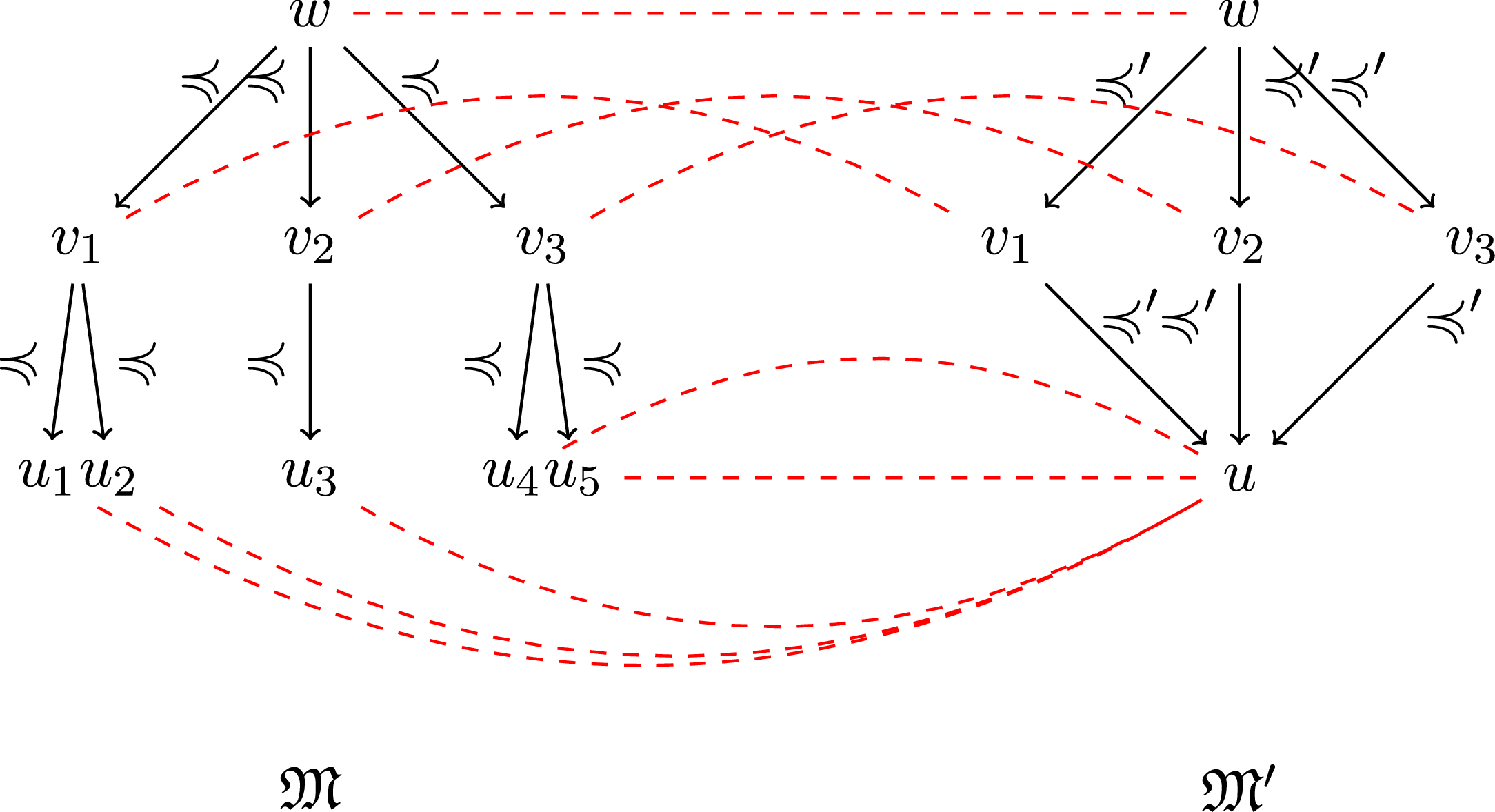


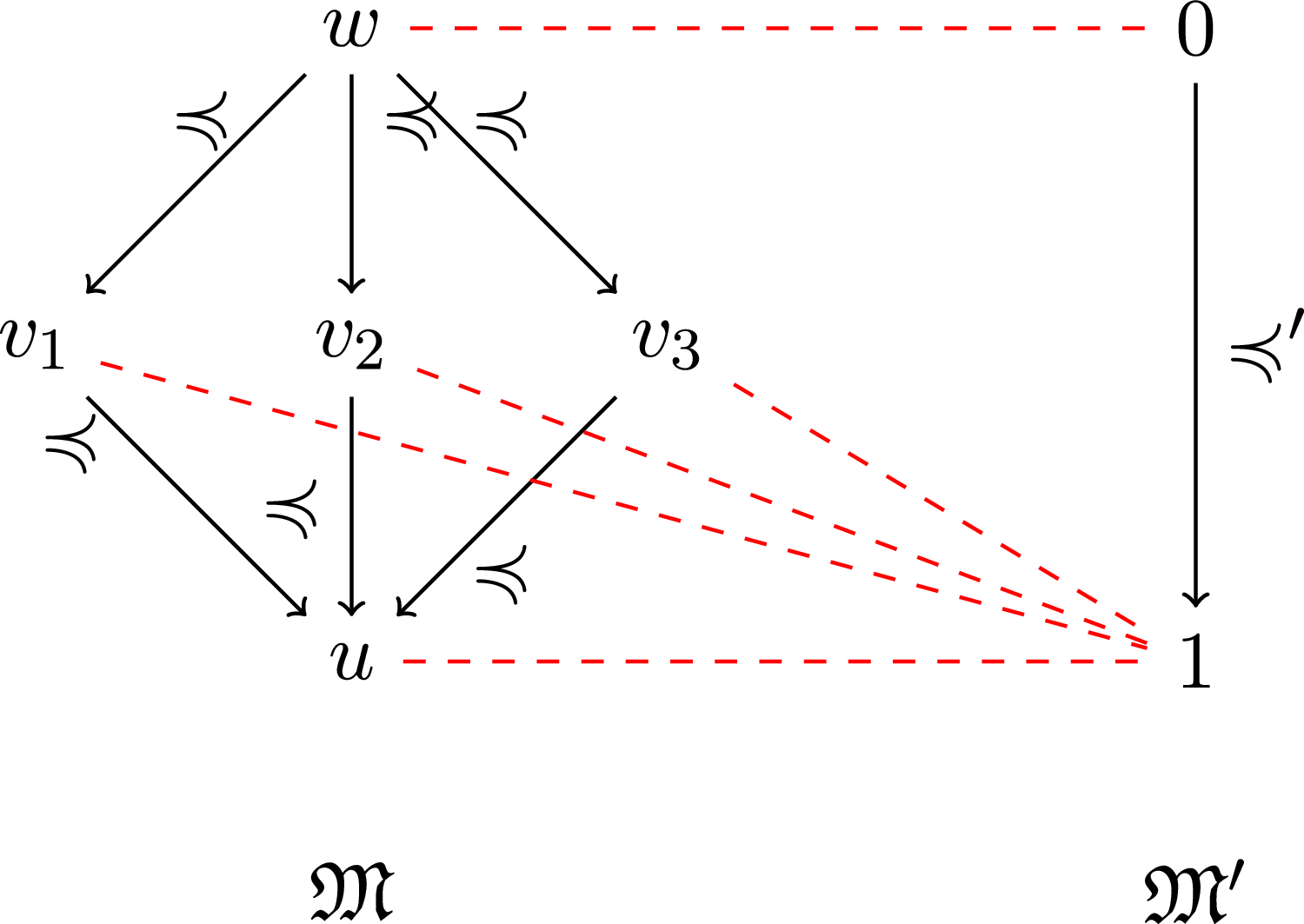


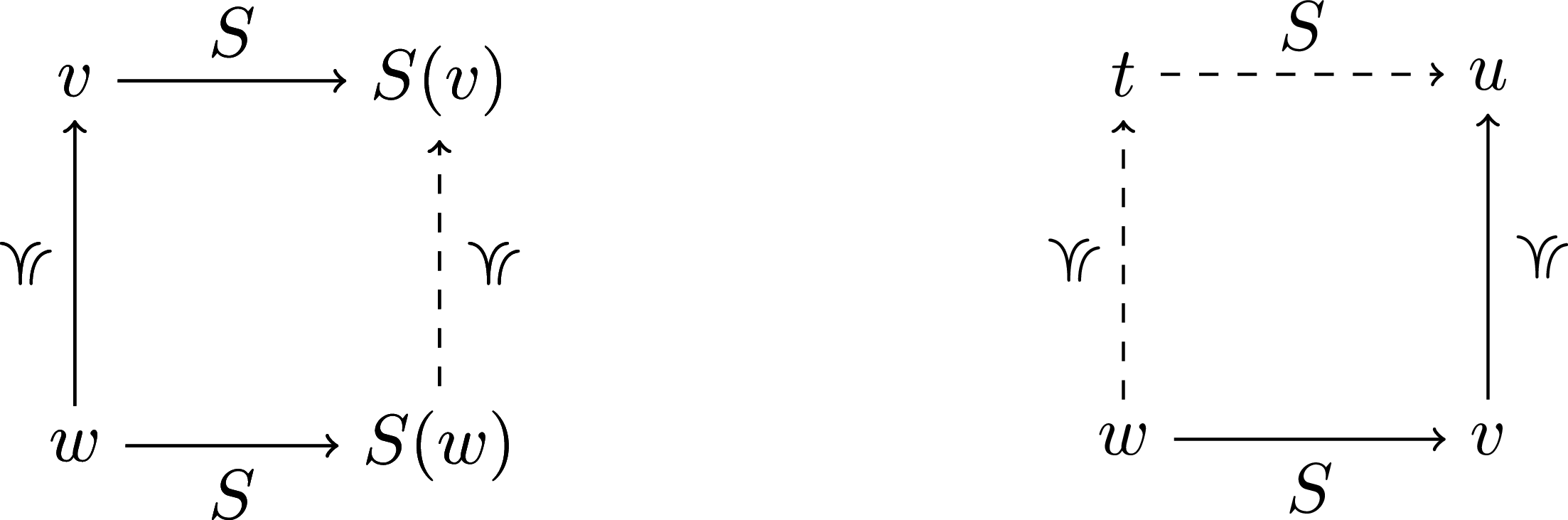

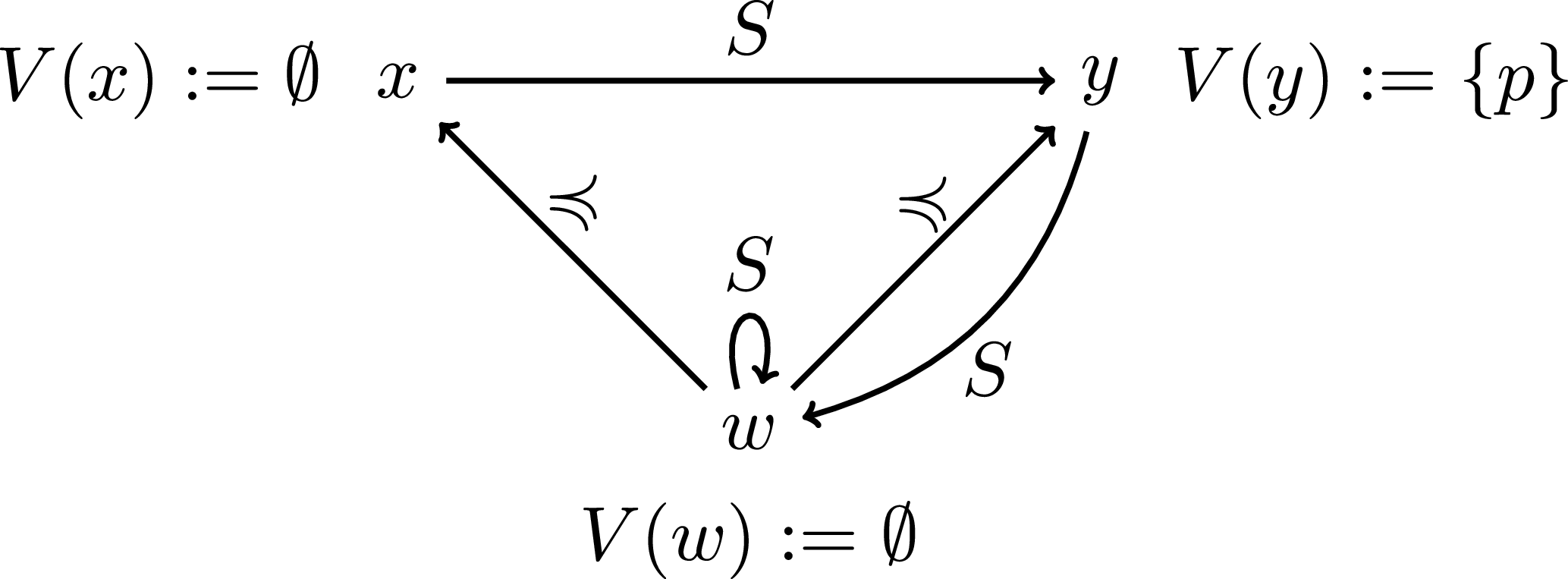


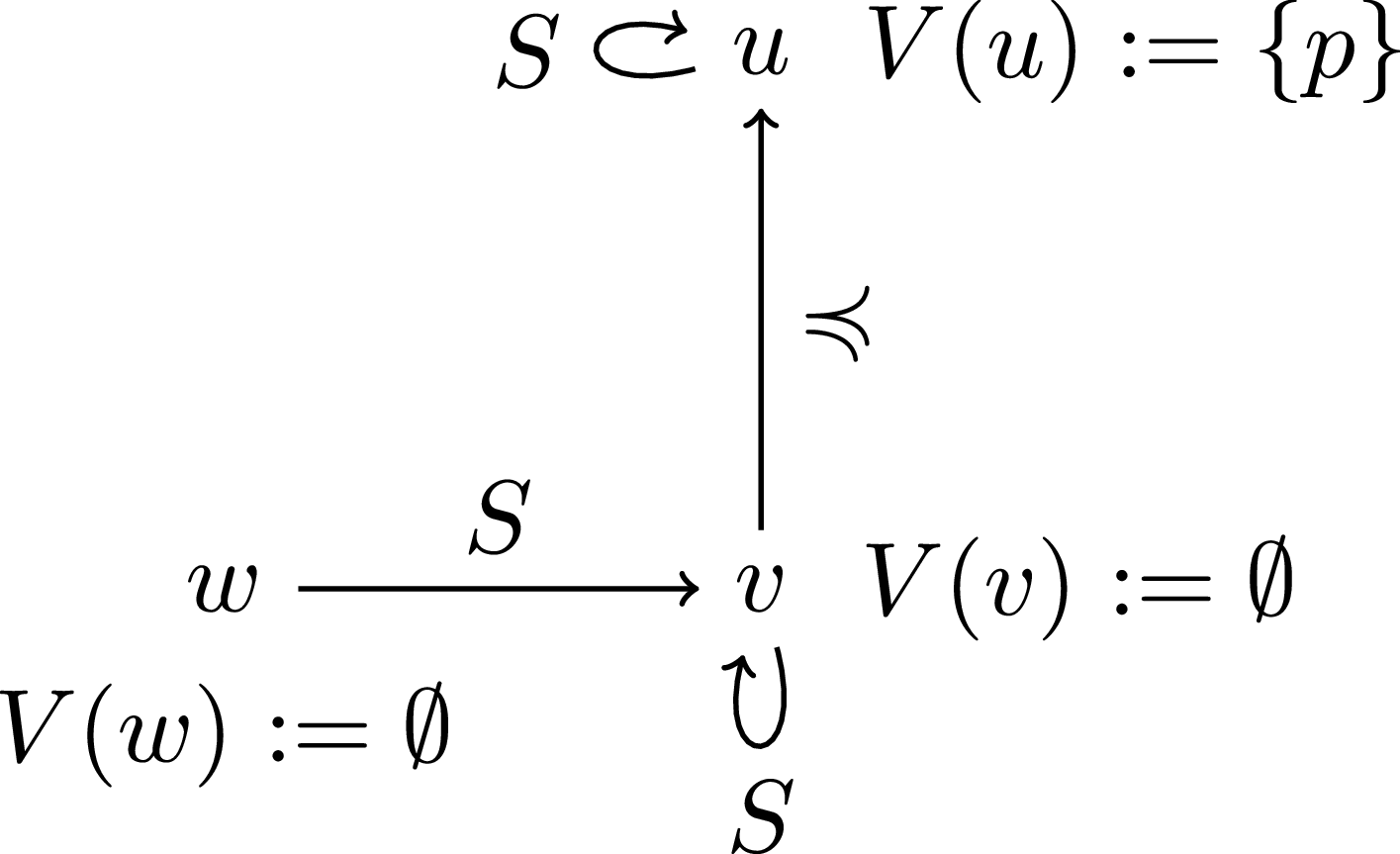


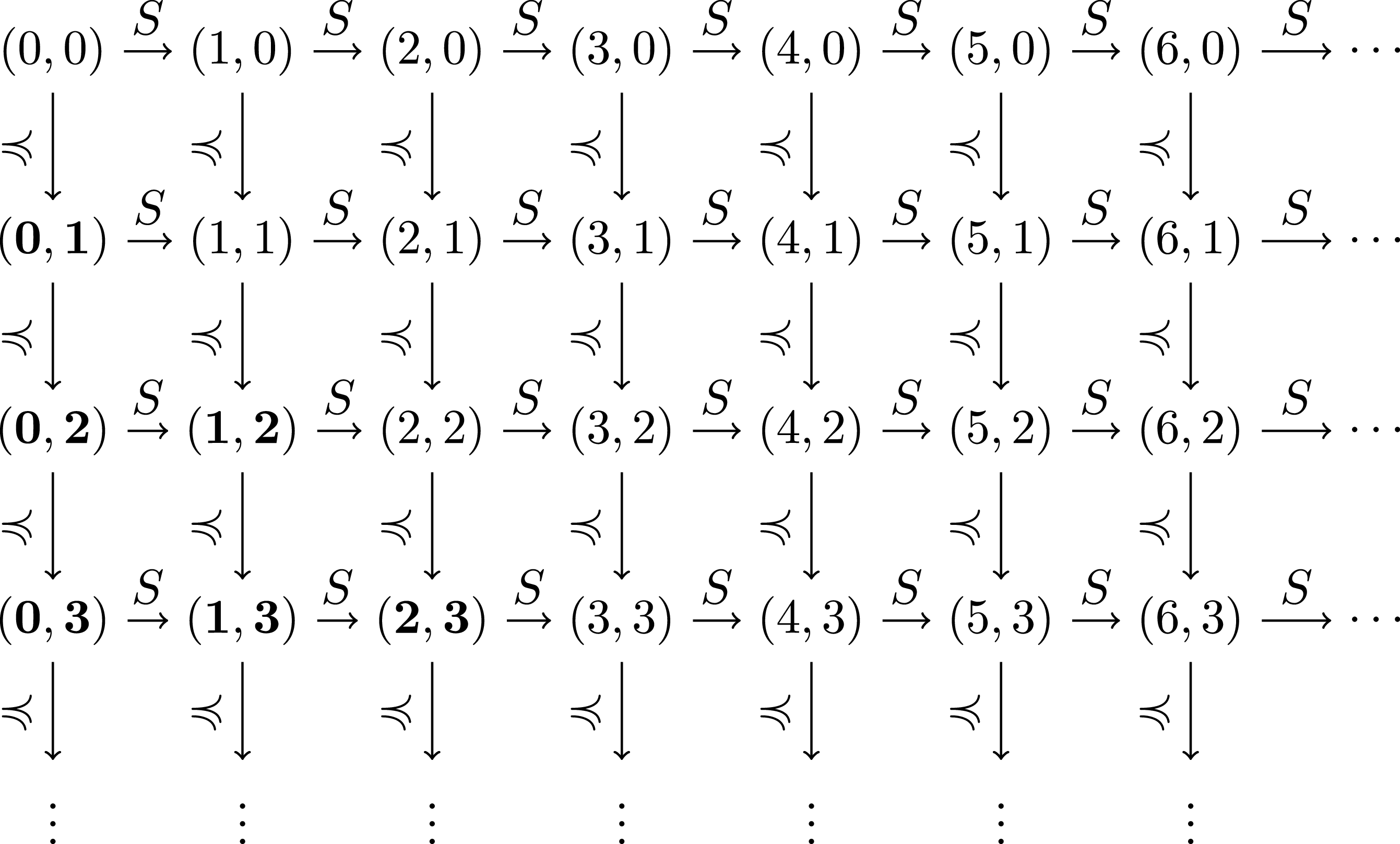


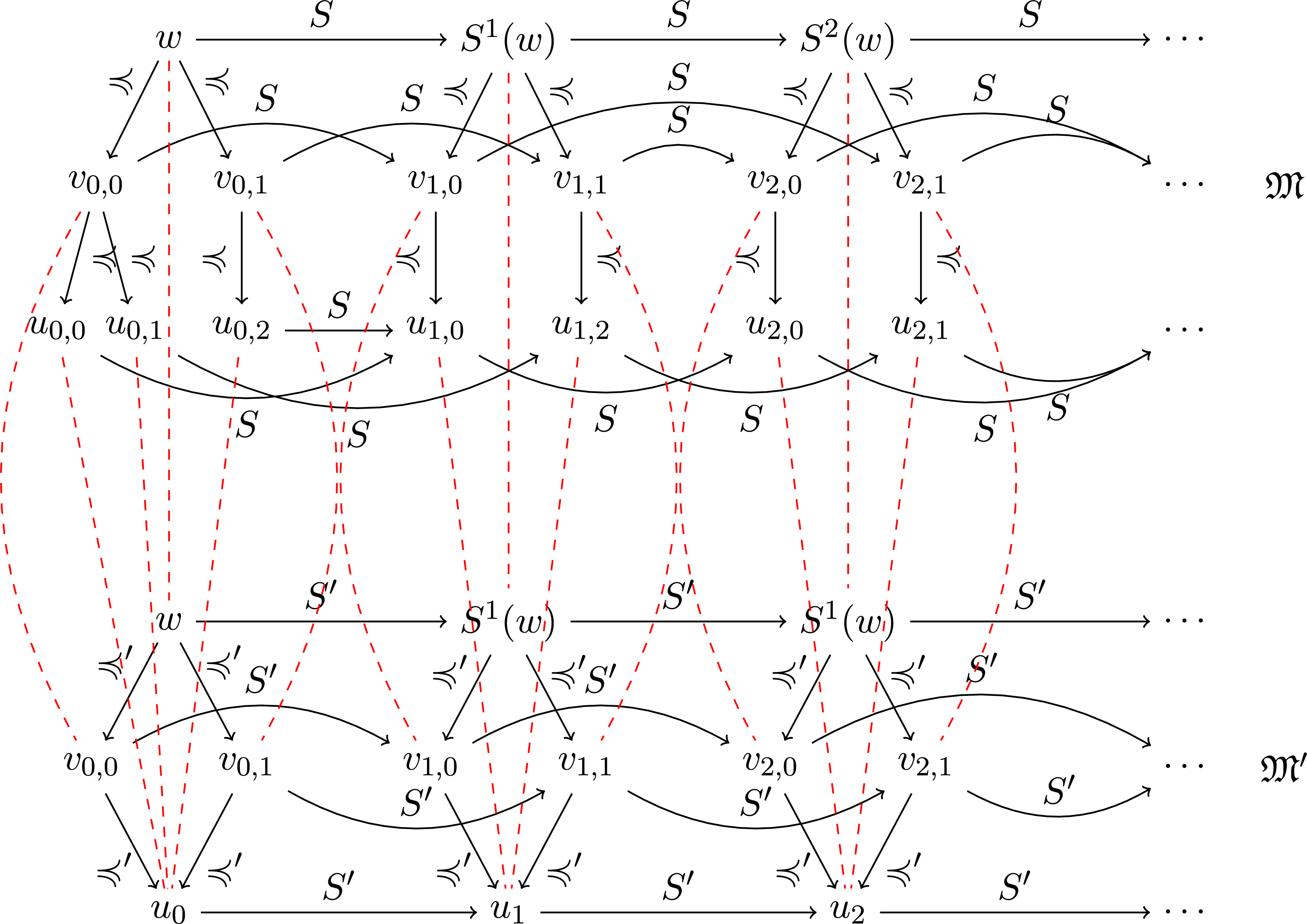


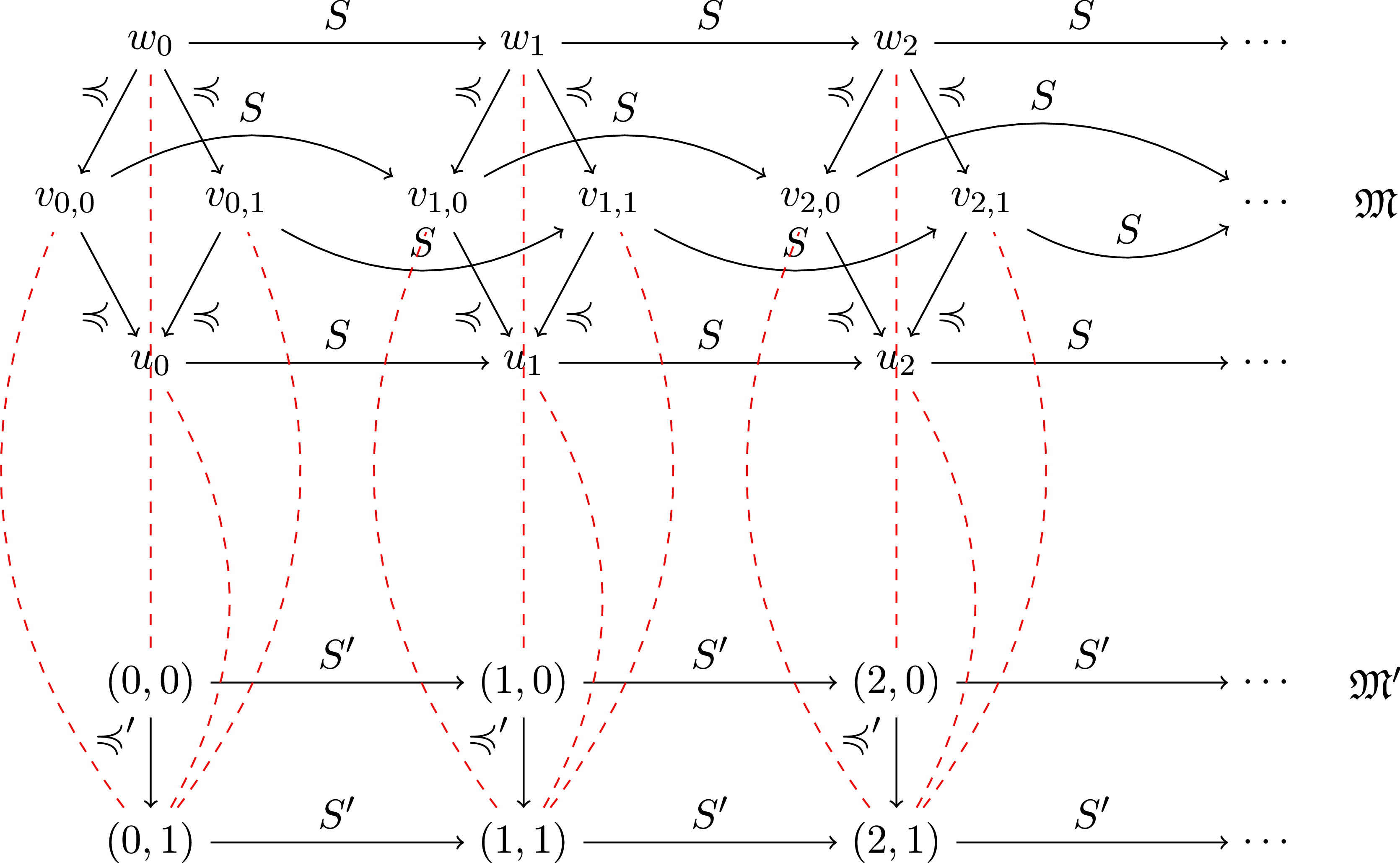


 Open access

