


Introduction
Rewards in general, and compensation in particular, depend on career advancement patterns (Bidwell & Mollick, Reference Bidwell and Mollick2015). Early career experiences have a lasting effect on subsequent job performance and long-term career progress (Merluzzi & Sterling, Reference Merluzzi and Sterling2017), particularly among women (Ayoko, Reference Ayoko2020; Sterling & Fernandez, Reference Sterling and Fernandez2018) and more so in fields with cultures that favor young professionals such as finance or law (Blair-Loy, Reference Blair-Loy1999; Radl, Reference Radl2012). Early advancement also impacts earnings, as research reveals that the speed of promotion affects pay growth, at least for middle managers (Bognanno, Reference Bognanno2001; Gibbs, Reference Gibbs1995). Given recurrent evidence that the gender pay gap within firms and occupations remains substantial (Penner, Petersen, & Hermansen, Reference Penner, Petersen, Hermansen, Rainey, Boza, Elvira and Tufail2023; Tomaskovic-Devey & Avent-Holt, Reference Tomaskovic-Devey and Avent-Holt2019) and largely unexplained (Perales, Reference Perales2013), especially among executives (Magnusson, Reference Magnusson2010), we explore the impact of age on executives' employment outcomes in technology industries. Importantly, large gender gaps exist in the attainment of upper-level positions and proportionate career rewards among highly educated employees and skilled occupations (Anthony & Soontiens, Reference Anthony and Soontiens2019; Magnusson, Reference Magnusson2010). Bringing together the various facets explored in extant research, we examine how the age factor related to career advancement impacts gender pay inequality.
Focusing specifically on executives, the pay gap between men and women is often estimated to be 15% in the United States (US) (Maume, Heymann, & Ruppanner, Reference Maume, Heymann and Ruppanner2019; Muñoz-Bullón, 2010). While much of the gap is due to women's segregation into different occupations (England, Reference England2010; Magnusson, Reference Magnusson2010; Perales, Reference Perales2013) or organizations (Blevins, Sauerwald, Hoobler, & Robertson, Reference Blevins, Sauerwald, Hoobler and Robertson2019), a sizeable portion of the pay differential remains unexplained (Elkinawy & Stater, Reference Elkinawy and Stater2011). In contrast, a few studies have identified a pay premium among high-potential female managers (Gayle, Golan, & Miller, Reference Gayle, Golan and Miller2012; Leslie, Manchester, & Dahm, Reference Leslie, Manchester and Dahm2017; Malladi & Mean, Reference Malladi and Mean2021). Although the drivers of this premium remain unclear, these can be found in organizations that seek to establish diversity and place value on having a greater representation of women in their workforce. Our research question concerns the extent to which the age (Kumar, Reference Kumar2020) and career advancement of executives impact the gender pay gap in top organizational positions.
We rely on signaling theory (Connelly, Certo, Ireland, & Reutzel, Reference Connelly, Certo, Ireland and Reutzel2011) to propose that early promotion to a top management position is an observable characteristic that may signal outstanding performance and lead to higher earnings. Specifically, we hypothesize that the age at attainment of a top management position is inversely related to an executive's compensation (i.e., the younger the executive reaches a top management job, the higher their salary). Moreover, this relationship should be stronger among women than men because it could help female executives highlight their abilities in the face of gender biases. Finally, we propose that most of the age-related compensation advantage of female executives is associated with variable pay, a discretionary reward frequently based on performance assessments (Elvira & Graham, Reference Elvira and Graham2002; Petersen & Saporta, Reference Petersen and Saporta2004).
We use biographical, career, and compensation data of 803 executives in high-technology firms in the US to explore the intersectionality of age and gender on executive compensation. By examining the demographics of top executives across different positions, our study advances previous work that has focused on the gender pay gap for specific groups such as CEOs (Bugeja et al., 2013; Custódio et al., 2015; Falato, Li, & Milbourn, Reference Falato, Li and Milbourn2015; Gupta et al., 2016). We select the technology sector as the research setting because the industry is known to have a diversity and climate problem and is culturally inclined toward youth and displays of ageism (U.S. Equal Employment Opportunity Commission [EEOC], 2016). Thus, the empirical setting should help unveil patterns that are more difficult to observe in other contexts. Further, we analyze individuals' entire careers and observe how age differentially impacts the fixed and variable components of their total compensation. Our study contributes to the understanding of how age influences gender differences in compensation and career advancement among top executives, thereby also responding to calls for research on the intersectionality of demographic characteristics in this context (Ford, Atkinson, Harding, & Collinson, Reference Ford, Atkinson, Harding and Collinson2021; Jyrkinen & McKie, Reference Jyrkinen and McKie2012).
Theoretical background
Empirical studies based on various theoretical perspectives have highlighted the importance of early career advancement for professional achievement. Researchers have found that employees and executives who are promoted within the first years of their careers were more likely to receive subsequent promotions (e.g., Baker, Gibbs, & Holmstrom, Reference Baker, Gibbs and Holmstrom1994; Falato, Li, & Milbourn, Reference Falato, Li and Milbourn2015; Rosenfeld & Jones, Reference Rosenfeld and Jones1986). Rapid career progress and attaining executive positions at a young age could be considered a signal of good performance, and this appears to be even more relevant for women (Bonet, Cappelli, & Hamori, Reference Bonet, Cappelli and Hamori2020; Chênevert & Tremblay, Reference Chênevert and Tremblay2002). Attaining top management positions at a young age might indicate high ability, enhanced learning, and prompt relative accumulation of human capital (Castilla & Rissing, Reference Castilla and Rissing2018). From a gender perspective, Bonet, Cappelli, and Hamori (Reference Bonet, Cappelli and Hamori2020) find that women tend to have an advantage in terms of speed of advancement to top positions, which can be partially explained by the fact that female executives have better qualifications than their male counterparts (e.g., number of years of education, faster promotion from their first job, and greater experience in various industries). Over time, this early advantage could lead to the Matthew effect: according to which more resources in terms of performance and social capital are provided to those who display early achievement signals, thereby accelerating the upward trajectory of these individuals within organizations (Merton, Reference Merton1968).
In addition, evidence exists that rapid promotions have significant consequences for wage growth (Bognanno, Reference Bognanno2001; Custódio, Ferreira, & Matos, Reference Custódio, Ferreira and Matos2013; Del Bono & Vuri, Reference Del Bono and Vuri2011; Falato, Li, & Milbourn, Reference Falato, Li and Milbourn2015; Gibbs, Reference Gibbs1995). A pay premium arises because better credentials (such as experiencing a fast-track career) are expected to result in more positive outcomes, such as improved career opportunities that feed a virtuous circle of advancement. Given that women, particularly those of child-bearing age, are perceived to have lower levels of work commitment (Rivera & Tilcsik, Reference Rivera and Tilcsik2016; Weisshaar, Reference Weisshaar2018), moving into top positions early on might help overcome such perceptions and reduce the potential for compensation differentials at the beginning of their careers. However, going beyond these perceptions, women who become executives at a young age might break the pattern of men acquiring complex jobs earlier after graduation, a difference that contributes to early career gender gaps in wages (Anthony & Soontiens, Reference Anthony and Soontiens2019; Ford et al., Reference Ford, Atkinson, Harding and Collinson2021; Jyrkinen & McKie, Reference Jyrkinen and McKie2012).
Relationship between age at attainment and executive compensation
Promotion to a top management position at an early age is typically correlated with high levels of human capital (Becker, Reference Becker1964; Sullivan & Baruch, Reference Sullivan and Baruch2009). Specifically, in upper management, pay premiums represent compensation for unique and valuable skills and reflect expectations regarding an executive's ability to deliver superior performance (Combs & Skill, Reference Combs and Skill2003). Individuals who attain top management positions at a relatively young age send signals that reduce uncertainty regarding the quality of their work and indicate their outstanding performance. These individuals are judged as having the potential for high achievement (Rosenfeld, Reference Rosenfeld1992), which further increases their opportunities for advancement (Chen, Veiga, & Powell, Reference Chen, Veiga and Powell2011). In contrast, employee age is often negatively correlated with upward mobility and salary (Hurley & Giannantonio, Reference Hurley and Giannantonio1999).
Previous research suggests that the speed of promotion among top executives is perceived as a signal of exceptional past performance (Baker, Gibbs, & Holmstrom, Reference Baker, Gibbs and Holmstrom1994; Cappelli & Hamori, Reference Cappelli and Hamori2004; Chen, Veiga, & Powell, Reference Chen, Veiga and Powell2011). An individual's pace in advancing along a career path is important, with negative outcomes being associated with dilettantes (Leung, Reference Leung2014), while those employees who have been promoted more rapidly throughout their entire career are consistently high performers. Thus, the age at attainment of an executive position may serve as an observable indicator of the speed of career advancement, which signals high employee quality.
We surmise that ageism could impact upper management in particular, as there is evidence that in prestigious occupations, such as accounting and law, age impressions are of significance when pleasing clients or employers (Radl, Reference Radl2012; Wellington & Bryson, Reference Wellington and Bryson2001). Consequently, observable indicators such as a younger age can signal top performance by conveying that the executive has attained an upper management position in a short time due to early promotions. Previous research has found that such observable indicators are typically related to higher pay and faster pay growth (Bidwell, Reference Bidwell2011; Falato, Li, & Milbourn, Reference Falato, Li and Milbourn2015). The attainment of executive positions at lower-than-average ages implies that employees have received favorable assessments that enable them to progress quickly and translate into higher pay. In contrast, examining executive pay, Bognanno (Reference Bognanno2001) finds that slow promotion patterns lead to lower promotions and fewer pay increases.
In summary, if the age at attainment of an executive position signals high abilities and performance, which, in turn, affect compensation, our baseline hypothesis can be expressed in the following manner:
Hypothesis 1: The age at attainment of executive positions is negatively related to the compensation of top executives.
Gender differences in the effect of age at attainment on executive compensation
The general effects of age on executives' career progression may not be uniform across demographic groups. Age intersects with gender and determines how different outcomes that accrue similar levels of human capital are valued in different occupations (Bowman, McGann, Kimberley, & Biggs, Reference Bowman, McGann, Kimberley and Biggs2017). Managers are expected to have experience and knowledge – both characteristics that are usually related to a relatively mature age. However, older female managers are not necessarily valued in the same manner as their male counterparts (Jyrkinen & McKie, Reference Jyrkinen and McKie2012). Research reveals that women in management have more negative experiences than men and even harassment due to age and aging (Duncan & Loretto, Reference Duncan and Loretto2004). On the one hand, when valuing women managers, companies may be more interested in young talent and ‘aesthetic labor’ or physical appearance to improve their competitive advantage (Warhurst & Nickson, Reference Warhurst and Nickson2009). A qualitative study in academia (Granleese & Sayer, Reference Granleese and Sayer2006) suggests that older women encounter ageism, and their experience is undervalued. Moreover, their valuable contributions to the organization are attributed to others who are perceived as more visible because of their youth or productivity. On the other hand, younger women are perceived as less desirable employees because they are expected to leave the workforce intermittently to start families and take care of domestic responsibilities (Rosenfeld, Reference Rosenfeld1992). Thus, women experience a double whammy of age and gender biases.
From a career advancement perspective, bias against women and the negative impact that gender biases have on women's career advancement have been extensively documented (Kossek, Su, & Wu, Reference Kossek, Su and Wu2017). Decision-makers tend to view women as less competent and less capable of leading organizations as compared to men (Cook & Glass, Reference Cook and Glass2014a). These biases are associated with normative role expectations and explain why women are perceived as less appropriate for occupying top management positions. In contrast, studies reveal that men are routinely rated more favorably than women for male-dominated jobs, particularly when men are the evaluators (Allen, French, & Poteet, Reference Allen, French and Poteet2016). Consequently, women are less likely to attain upper organizational positions and receive compensation that is equal to that of their male counterparts upon their promotion to executive positions (Hill, Upadhyay, & Beekun, Reference Hill, Upadhyay and Beekun2015).
Further, there is an abundance of opportunities for biases to arise against women and, thus, place them at a disadvantage (Reskin, Reference Reskin2000), particularly when information is incomplete. For example, newly hired women are particularly vulnerable to differential treatment because limited information regarding their employment quality might be available (Kronberg, Reference Kronberg2013; Petersen & Saporta, Reference Petersen and Saporta2004). A few years after graduation, and despite higher educational investments, women fall behind in most labor market outcomes. Men are more likely than women to acquire complex jobs, and this difference contributes to early career gender gaps in wages and employee bargaining power (Boye & Grönlund, Reference Boye and Grönlund2018). However, as women advance through the ranks, differences in the treatment of men and women that arise from imperfect information regarding women's abilities appear to narrow (Bell, Reference Bell2005). For example, evidence indicates that once female executives break the glass ceiling to become CEOs, there is no clear gender gap in compensation (Bugeja, Matolcsy, & Spiropoulos, Reference Bugeja, Matolcsy and Spiropoulos2012; Geiler & Renneboog, Reference Geiler and Renneboog2015; Gupta, Mortal, & Guo, Reference Gupta, Mortal and Guo2018).
In contrast to the well-established gender pay gap, a few studies have found that under certain conditions, women may receive a premium relative to their equally qualified male counterparts (Groysberg, Healy, & Lin, Reference Groysberg, Healy and Lin2022; Leslie, Manchester, & Dahm, Reference Leslie, Manchester and Dahm2017; Malladi & Mean, Reference Malladi and Mean2021). For example, focusing on CEOs and CFOs of US public firms, Malladi and Mean (Reference Malladi and Mean2021) find that, at the aggregate level, women are compensated slightly higher than men. Similarly, analyzing the cash components of compensation, Groysberg, Healy, and Lin (Reference Groysberg, Healy and Lin2022) observed that, among job-switching executives, women receive higher raises than their male counterparts, despite evaluators' tendency to discount women's abilities, biases decrease in organizations seeking to achieve diversity goals, especially toward high-ability, high-potential women (Leslie, Manchester, & Dahm, Reference Leslie, Manchester and Dahm2017).
Nevertheless, the effects of signals that convey high capability differ by gender. Employees who attain executive positions at relatively young ages may be perceived as having a strong commitment to development, a high investment in human capital, and outstanding job performance. In the case of women, these perceptions could offset biased evaluations along the career path. Recent research reveals that while highly capable job candidates are generally perceived as less committed to a firm and, thus, less likely to be hired, the high-ability signal does not penalize women to the same extent as men (Galperin, Hahl, Sterling, & Guo, Reference Galperin, Hahl, Sterling and Guo2020). The reason for this is that information regarding their high capability overcomes pre-existing biases toward women who are initially assumed to have a lower commitment to their work and career due to family commitments (Galperin et al., Reference Galperin, Hahl, Sterling and Guo2020). Thus, biases against women, who are considered to have a high propensity to quit, may be overcome by their fast and early advancement, which indicates career commitment and defies age norms for managerial positions. Specifically, Adams, Gupta, Haughton, and Leeth (Reference Adams, Gupta, Haughton and Leeth2007) find that, among CEOs in US corporations, for the few women that reach such positions, the climb has been quicker on average than for men, and almost no difference exists between men's and women's total compensation.
Therefore, the high-ability signal sent by being relatively young may favor women over men if the former are perceived as highly committed to their careers because they have attained executive positions quickly. For example, a recent study finds that women CEOs reached top positions faster – not by outperforming their male counterparts but by moving through lower positions faster and skipping steps in job ladders (Bonet, Cappelli, & Hamori, Reference Bonet, Cappelli and Hamori2020). Thus, women who are able to attain a top management position at a younger age should benefit the most from this bias-reducing mechanism.
In summary, young women who have attained top management positions can be considered to have high potential, be highly committed to work, and could overcome gender biases. We expect that such women are rewarded for their early achievements with higher pay. Therefore, we propose the following hypothesis:
Hypothesis 2: The age at attainment of executive positions has a stronger negative effect on executive compensation among women than men.
Age at attainment impacts executive compensation components by gender
In addition to each individual's career trajectory, different organizational structures offer different opportunities for biases to impact compensation and produce different employee outcomes (Petersen & Saporta, Reference Petersen and Saporta2004). Executive compensation does not depend only on individual performance but also on firm-level factors, including firm pay norms and firm size and performance (Gomez-Mejia, Berrone, & Franco-Santos, Reference Gomez-Mejia, Berrone and Franco-Santos2014; Hilger, Mankel, & Richter, Reference Hilger, Mankel and Richter2013). While CEO bonuses and other variable compensation are assumed to be systematically tied to firm performance (Tosi, Werner, Katz, & Gomez-Mejia, Reference Tosi, Werner, Katz and Gomez-Mejia2000), the bonuses and variable compensation of other executive committee members might be related to firm performance to a lesser extent.
Specifically, job rank largely determines base pay – that is, the fixed component of compensation. However, variable compensation, which presumably depends on employees' performance, is subject to uncertainty, reduced transparency, and subjective understanding of merit, thereby resulting in unexplained gender pay differentials (Castilla & Rissing, Reference Castilla and Rissing2018). If the effect of age functions through performance signaling, the performance-based compensation components should mainly reflect the advantages accrued to women.
Notably, the performance-based proportion of compensation increases as individuals advance to top management. Bonuses and stock options have become an increasingly large proportion of executives' pay, particularly in the US, where these aspects often account for over 60% of the total compensation (Berrone & Otten, Reference Berrone, Otten, Gomez-Mejia and Warner2008; Conyon, Reference Conyon2006). The faster employees attain top management positions and the stronger the perception of their high performance, the earlier they begin accumulating variable compensation. Examining listed UK companies, Geiler and Renneboog (Reference Geiler and Renneboog2015) find that younger executives are offered proportionally higher long-term pay. Similarly, a study focused on CEOs (Custódio, Ferreira, & Matos, Reference Custódio, Ferreira and Matos2013) indicates that a fast-track career increases their equity pay. Therefore, variable pay should be more sensitive to age than the base salary, which in turn depends more strongly on the job position. This leads to our next hypothesis:
Hypothesis 3: The age at attainment of executive positions has a stronger negative effect on executives' variable pay than their base salary.
Given that the structural opportunity to differentiate among employees emerges specifically with variable pay (Petersen & Saporta, Reference Petersen and Saporta2004), the gender earnings gap is greater in incentives than in base salary (Chauvin & Ash, Reference Chauvin and Ash1994; Elvira & Graham, Reference Elvira and Graham2002), particularly among top executives (Castilla & Benard, Reference Castilla and Benard2010; Elkinawy & Stater, Reference Elkinawy and Stater2011; Muñoz-Bullón, 2010; Quintana-Garcia & Elvira, Reference Quintana-Garcia and Elvira2017). Previous empirical evidence indicates that pay-for-performance for female executives is more tightly associated with the firm's performance than that of male executives (Carter, Franco, & Gine, Reference Carter, Franco and Gine2017) and that the average career compensation of female executives is lower than that of male executives (Gayle, Golan, & Miller, Reference Gayle, Golan and Miller2012). However, their compensation is higher than that of men if the women are assigned the initial job roles of men, have the initial rank assignment, or have the same male career experience distribution (Gayle, Golan, & Miller, Reference Gayle, Golan and Miller2012). Thus, women receive higher rewards when displaying career paths similar to those of men partially because such unusual cases reinforce the signal of top performance.
Recent research has even noted a gender pay premium in top levels of organizations that seek to increase diversity in their executive ranks (Leslie, Manchester, & Dahm, Reference Leslie, Manchester and Dahm2017). The scarcity of women in high-level positions (Lyness & Grotto, Reference Lyness and Grotto2018) likely creates greater demand for high-potential women than high-potential men, thereby placing an upward pressure on their pay. Further, based on supervisor ratings of employees' potential and performance, Leslie, Manchester, and Dahm (Reference Leslie, Manchester and Dahm2017) find that low-potential women experience a pay penalty, while high-potential women indeed receive a pay premium. These findings have been confirmed in a replication study of MBA graduates employed across a wide range of industries (Dreher, Carter, & Dworkin, Reference Dreher, Carter and Dworkin2019). Given that the age at attainment of executive positions may signal outstanding performance and that performance is linked to the variable portion of executive compensation, which accounts for a large percentage of executive pay, the positive impact of attaining top management positions at a younger age may be stronger among female executives.
In summary, even though variable compensation creates added room for biases, if being promoted to top management at a relatively young age serves as a strong indicator of being a high performer, we propose the following hypothesis:
Hypothesis 4: The negative effect of the age at attainment on executives' variable pay is greater among women than men.
Methods
Study design and empirical setting
We tested our hypotheses using complete professional data of 803 executives. The sample of executives was identified from the ExecuComp database, focusing on a set of public high-technology manufacturing firms in the US. These sectors are most appropriate for our research question for several reasons. First, diversity challenges abound, with a strong inclination toward youth and ageism (Orser, Riding, & Stanley, Reference Orser, Riding and Stanley2012). For example, the US Equal Employment Opportunity Commission recently concluded that there is notable gender and racial bias in employment in this sector, with substantial attrition of women in tech firms and high turnover rates after hire (U.S. Equal Employment Opportunity Commission [EEOC], 2016). Additionally, the sector is characterized by a flatter wage-tenure profile for more highly educated workers (DiPrete, Goux, & Maurin, Reference DiPrete, Goux and Maurin2002). Most executives in the sector have substantial performance and human capital achievements, so mechanisms of pay differentials may not be as closely related to skills as to potential biases: managerial positions in the technology field tend to be male-dominated; thus, based on meta-analytical work (Joshi, Son, & Roh, Reference Joshi, Son and Roh2015), we expect more biases toward women in this field than in female-dominated, low-prestige occupations (Reskin & Roos, Reference Reskin and Roos1990).
In sum, although perhaps extreme, high technology is an appropriate field to test our hypotheses by facilitating the study of how young age at attainment as a proxy for good performance and high achievement may counter gender bias in executive compensation.
Data sources
Executive compensation
We obtained information on executive compensation from the ExecuComp database. For directors and officers of US public companies, this database contains comprehensive information regarding compensation, as reported in Annual Meeting Proxy Statements or Forms 10-K filed with the Securities and Exchange Commission.
We identified high-technology manufacturing firms in ExecuComp based on the definitions of the Organisation for Economic Cooperation and Development (OECD) (2011), which include aircraft and spacecraft; pharmaceuticals; computing machinery; radio, television, and communications equipment; and medical, precision, and optical instruments. We then cross-referenced the International Standard of Industrial Classification (ISIC) and North American Industrial Classification System (NAICS) codes to identify high-technology manufacturing firms in ExecuComp.
Biographical information
The complete professional information of each high-tech executive was obtained from the following three sources: Marquis Who's Who, LinkedIn, and Bloomberg. From these databases, we extracted the demographic characteristics, education, experience, job tenure, organizational tenure, time in the current position, complete career information (including companies where they have worked, positions they have held, and tenure in each business/position), as well as external and internal promotions of each executive.
We eliminated observations with missing data for one or more variables. We also excluded four outliers whose total direct compensation was zero (i.e., symbolic pay). Thus, the final sample is based on complete professional information of 803 unique executives belonging to 279 high-technology manufacturing firms.
Measures
Dependent variables
Our first dependent variable, total direct compensation, was the measure reported by ExecuComp 2014 as Total Direct Compensation (TDC1) in thousands of US dollars. TDC1 represents the total compensation, including salary, bonus, other annual compensation; the total value of restricted stock granted; long-term incentive payouts; and other compensation.
To calculate the two dependent variables used to test hypotheses 3 and 4, we disaggregated the total direct compensation into two pay variables: base salary, which is the part of TDC1 that does not depend on the individual's job performance, and variable pay, which comprises the remaining components of TDC1 (e.g., bonus, other annual compensation, and the total value of restricted stock granted) expressed in thousands of dollars based on ExecuComp 2014 categories.
Independent variables
Age at attainment, which is the first independent variable, was measured as an executive's age upon attaining a top management position. The second independent variable – that is, Female, was dichotomous and took the value of 1 for women executives.
Control variables
We controlled for several individual-level variables that may influence executives' compensation. Our first control is occupation, which defines the position within a top management team. This is a set of categorical variables based on the annual title of each executive in ExecuComp 2014. Following previous studies (Bertrand & Hallock, Reference Bertrand and Hallock2001; Muñoz-Bullón, 2010), we constructed 11 broad occupational titles measured as dummy variables: CEO/chair, vice chair, president, chief financial officer (CFO), chief operating officer (COO), other chief officer, executive vice president, senior vice president, group vice president, vice president, and other positions.
Next, we included a control variable to measure career progression through the external labor market (ELM), given prior evidence that indicates that ELM moves affect the gender gap among executives (Lam & Dreher, Reference Lam and Dreher2004; Quintana-Garcia & Elvira, Reference Quintana-Garcia and Elvira2017). We coded reaching the top through the ELM as a dummy variable that takes the value of 1 if an executive was hired externally for the TMT, and 0 otherwise.
Thereafter, two attributes concerning human capital were considered: (a) graduate degree, a dummy variable that equals one if an executive held a master's, MBA, or PhD degree, and 0 otherwise, and (b) organizational tenure represents the number of years for which an executive was employed at the firm.
Finally, the firm-level controls included performance, size, and TMT diversity. First, we employed the variable return on assets (ROA) to control for firm performance, as managerial compensation often increases as firm profitability rises (Muñoz-Bullón, 2010). Moreover, bonuses, stock options, and other long-term components of compensation are more often performance-based, an effect that we captured with ROA. Second, we controlled for differences in firm size, which tend to drive pay outcomes. Specifically, we used the number of employees (logarithmic transformation) to control for firm size, which is an important determinant of executive pay (Groysberg, Healy, & Lin, Reference Groysberg, Healy and Lin2022; Peng, Sun, & Markóczy, Reference Peng, Sun and Markóczy2015; Renner, Rives, & Bowlin, Reference Renner, Rives and Bowlin2002; Tosi et al., Reference Tosi, Werner, Katz and Gomez-Mejia2000). Finally, because female representation in TMTs tends to mitigate the gender pay gap (Carter, Franco, & Gine, Reference Carter, Franco and Gine2017; Elkinawy & Stater, Reference Elkinawy and Stater2011), we controlled for diversity of the TMT, which was measured as the percentage of female executives on the TMT present in ExecuComp. We also added Female CEO, a dummy variable that equals 1 if the CEO is a woman, and 0 otherwise, because having a female CEO is associated with smaller gender gaps (Cohen & Huffman, Reference Cohen and Huffman2007; Kunze & Miller, Reference Kunze and Miller2017).
Results
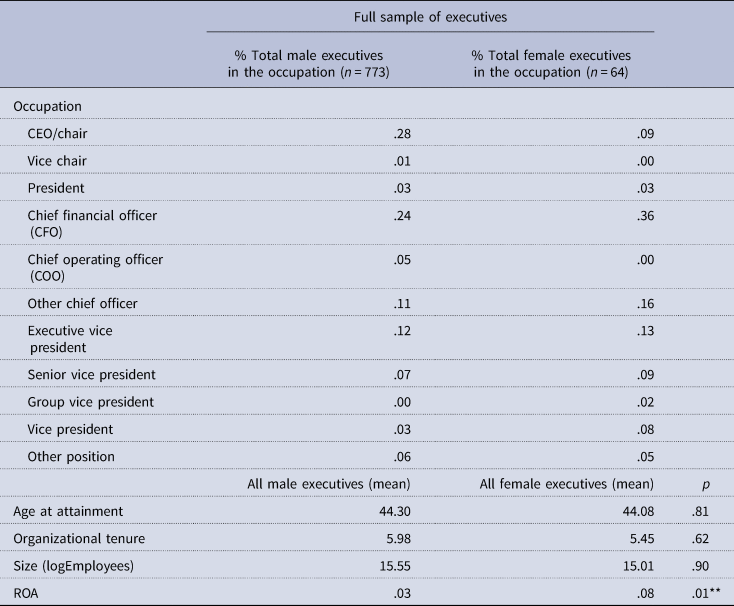
This section describes the key descriptive statistics of all variables used in the analyses (complete information available upon request). Regarding the independent variables in our study, the total compensation averages $4,196,430, with an average base salary of $534,220 and average variable pay of $3,662,200. Thus, the variable portion of compensation was almost eight times greater than the fixed component, as is expected in the technology sector. With regard to women's representation in executive positions, 64 of the 803 (7.64%) executives in the sample were female. Only six women in this sample were CEOs, which is 3% of the sample. Furthermore, the average age at which women reached executive positions was 44.08 years, which is slightly lower but not significantly different from that of men – that is, 44.35 years. The women had a lower average organizational tenure (5.45 years) than the men (5.98 years). However, both groups had a similar percentage of higher education graduates: 67.18% of the women and 67.14% of the men had a graduate degree. The ELM was used to reach the top management position by 42.18% of all female executives and 46.83% of all male executives. Finally, regarding firm characteristics, female executives tended to work in companies with lower ROA and smaller sizes but slightly higher percentages of women in the executive teams, which is all consistent with prior research.
Concerning the share of women in each executive occupation (Table 1), the low proportion of women in the top three occupational categories (CEO/chair, vice chair, and president) was remarkable but unsurprising due to occupational segregation patterns.
Comparison of human capital and firm variables by gender

Note. The means of the men and women significantly differ at the following levels: ***p < .001; **p < .01; *p < .05.
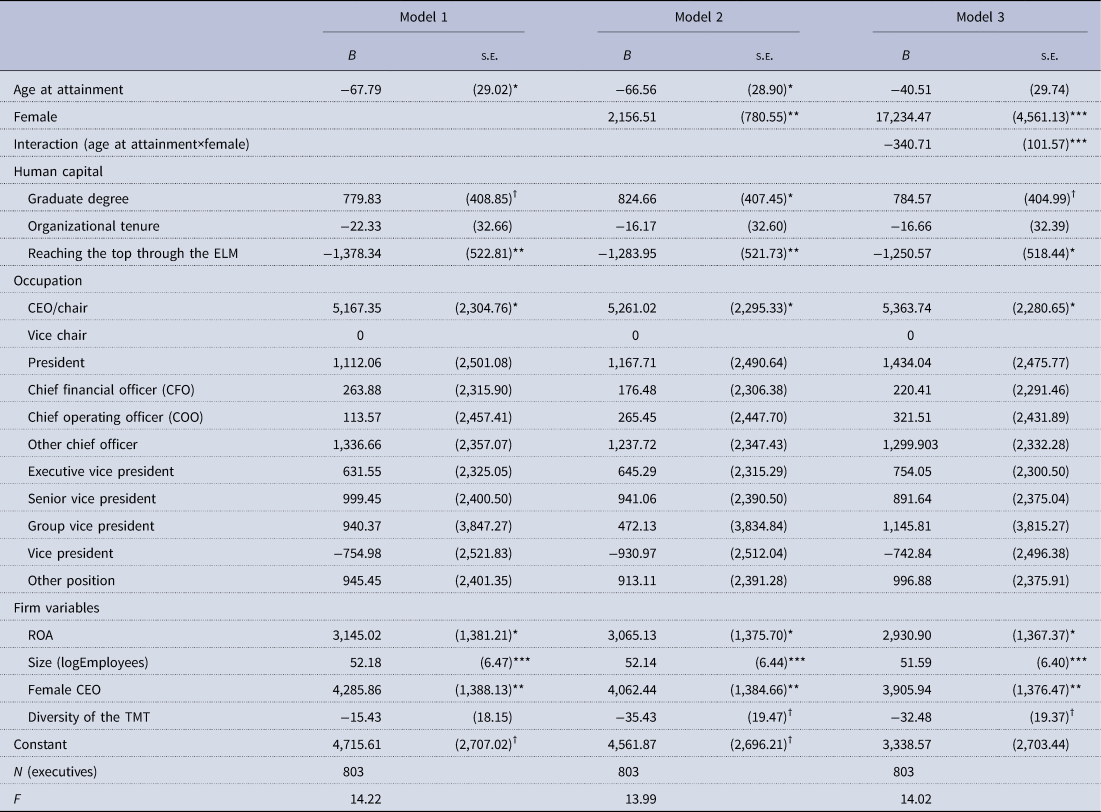
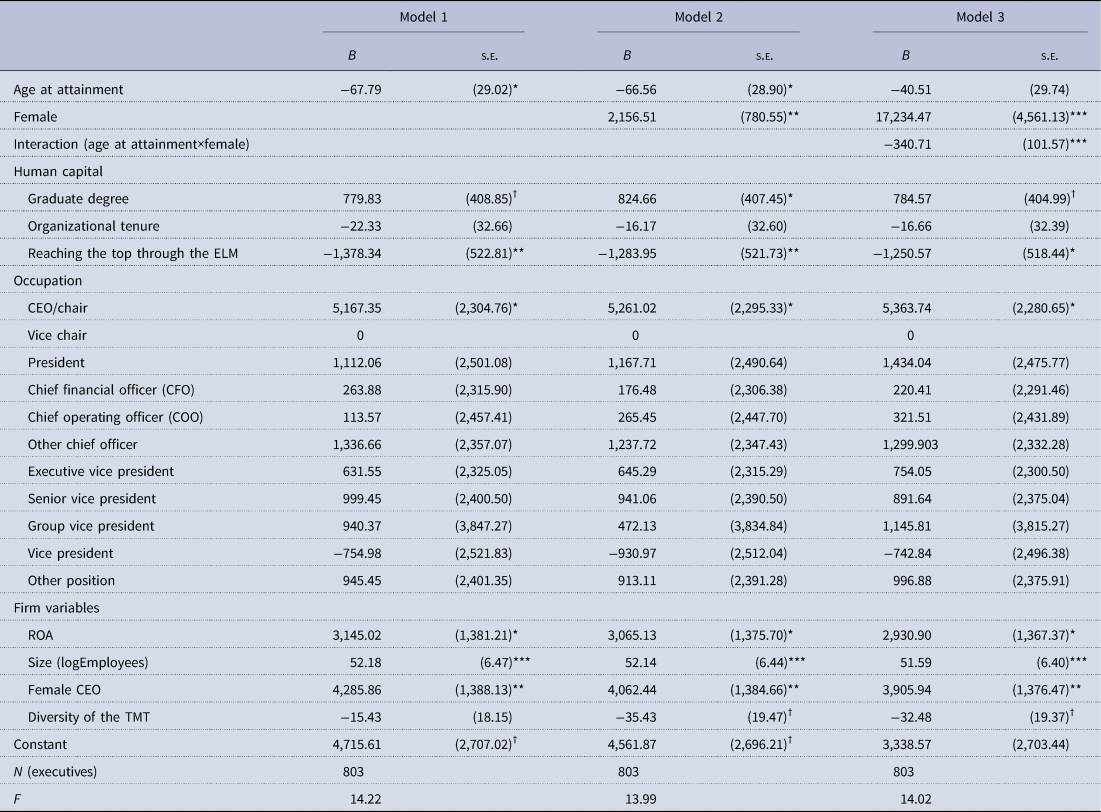
As seen in Table 2, our results support that the age at attainment of executive positions is negatively related to compensation among top executives (hypothesis 1) and that this effect is higher among women than men (hypothesis 2). We tested these hypotheses using ordinary least squares (OLS) regression analysis for the effect of age at attainment of executive positions on the total compensation. The coefficient of age at attainment was negative and significant in model 2 (b = −66.56, p < .05). Moreover, the effect of the interaction between age at attainment and being a female on total pay was negative and significant (b = −340.71, p < .001), thereby confirming both hypotheses 1 and 2. Thus, attaining executive positions at a relatively young age appears to improve compensation, particularly among female managers.
OLS regression results of total direct compensation
Note. Standard errors are shown in parentheses. ***p < .001; **p < .01; *p < .05; †p < .10.
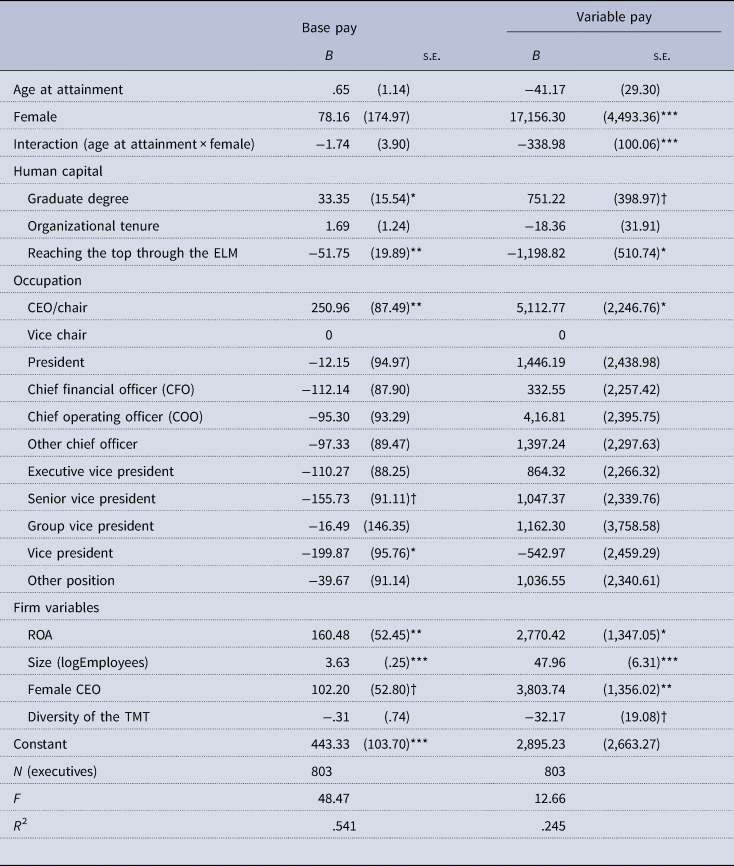
Regarding the control variables, having a graduate degree had a significant positive impact on pay, while reaching the TMT through the ELM had a significant negative impact. As expected, firm ROA and size had a significant positive effect on compensation (Renner, Rives, & Bowlin, Reference Renner, Rives and Bowlin2002), and this effect was particularly large in the variable pay component. Finally, being a female CEO had a significant positive effect on the total compensation.
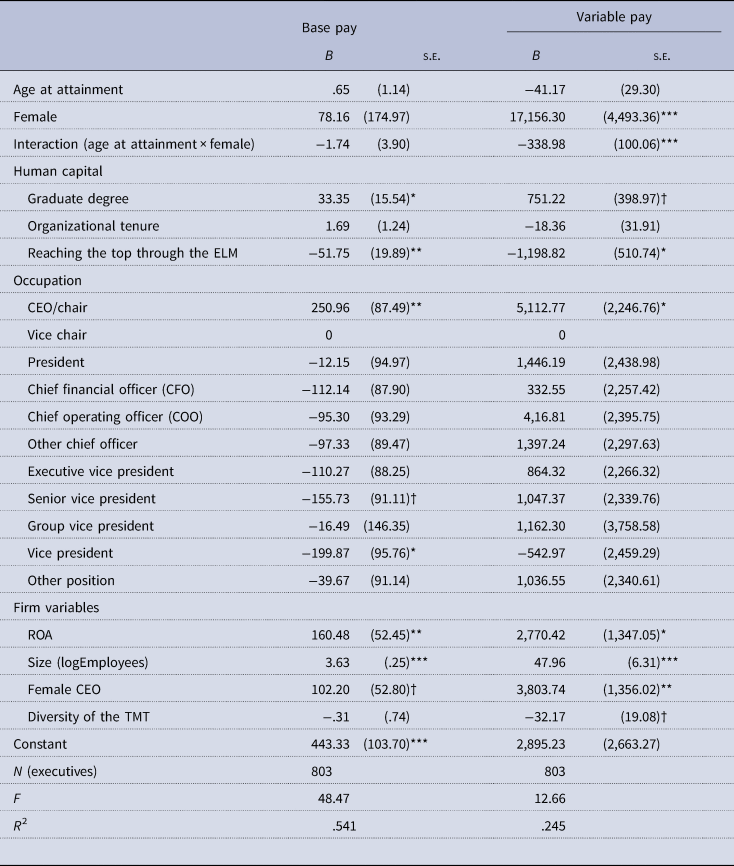
Then, we tested whether the age at attainment of executive positions has a stronger negative effect on executives' variable pay than their base salary (hypothesis 3) by separating compensation components. Thus, we performed an OLS regression analysis of the effect of age at attainment of executive positions on the two separate components of earnings – that is, base salary and variable pay. The results presented in Table 3 indicated that the age at which the executives reached the top management position had different pay consequences depending on gender. The coefficient of age at attainment was not significant, thereby indicating a lack of support for hypothesis 3, but the interaction effect between age at attainment and being a female on variable compensation was negative and significant (b = −338.98, p < .001), supporting hypothesis 4.
OLS regression results of base and variable pay
Note. Standard errors are shown in parentheses. ***p < .001; **p < .01; *p < .05; †p < .10.
In additional analyses, we explored how the results vary using a different specification of our main independent variable. Instead of considering the age at attainment, we performed the same regressions with an alternative independent variable: fast-track executive. The results (available upon request) were consistent with our main findings and showed similar levels of statistical significance. This additional analysis confirms that fast-track executives earn higher compensation than executives promoted at an average age and that this effect was stronger among women than men, deriving mainly from variable pay.
Discussion and conclusion
We explored the effects of age at attainment of executive positions on compensation and specifically on the gender pay gap among executives. Our findings suggest that age is recognized as a signal of ability and performance and has a significant positive effect on the total compensation of both male and female executives who occupy similar managerial positions. Exhibiting such a signal through early career advancement appears to enable female executives to overcome biases that often penalize them. In addition, when we distinguish between types of earnings, we find that the effects of attaining executive positions at a younger age are particularly strong with respect to variable pay. We surmise that most of the advantage accrued to female executives due to early advancement was derived from bonuses and other variable pay, as this dimension of compensation is associated with more subjective information despite comprising the largest proportion of executive pay.
Thus, we contribute to the understanding of how age affects gender differences in compensation among top executives in several ways. First, we respond to recent calls for studying the intersectionality of demographic characteristics in this context (Ford et al., Reference Ford, Atkinson, Harding and Collinson2021; Jyrkinen & McKie, Reference Jyrkinen and McKie2012; Kumar, Reference Kumar2020). Gender pay gaps in top management remain substantial and often unexplained, despite decades of research and policy attempting to redress pay differentials (Beirne & Wilson, Reference Beirne and Wilson2016; Elkinawy & Stater, Reference Elkinawy and Stater2011; Maume, Heymann, & Ruppanner, Reference Maume, Heymann and Ruppanner2019). Our findings suggest that the time taken to reach top management positions plays a critical role in determining the total compensation of both men and women and can mitigate existing gaps, above and beyond the type of position or functions occupied within top management teams. Attaining top management positions at a relatively young age possibly signals ability and acquisition of skills, exceptional previous performance, and high future potential.
Second, our findings that early managerial appointment is particularly relevant for women are consistent with prior incomplete information research that suggests that women need higher credentials and higher objective performance to reach the top levels of organizations (Cook & Glass, Reference Cook and Glass2014b). If biases against women are mitigated when more information regarding quality is available, a young age at promotion to executive positions appears to serve as a proxy for high performance and career potential that helps women mitigate the potential negative bias against them due to incomplete information. Nevertheless, these findings ought to be interpreted with caution, given that men and women tend to work in different roles and that the higher the proportion of women in a job, the lower the earnings for both women and men in that job (Sorensen, Reference Sorensen1990).
Third, our study also addresses calls in the signaling theory to explore the ‘types of different signals signallers use’ (Connelly et al., Reference Connelly, Certo, Ireland and Reutzel2011) by focusing on age as an often-overlooked employee characteristic that nevertheless determines career outcomes (Jyrkinen & McKie, Reference Jyrkinen and McKie2012). A plausible signal of better qualifications is experiencing a fast-track career (Bonet, Cappelli, & Hamori, Reference Bonet, Cappelli and Hamori2020) that leads to an increase in compensation (Custódio, Ferreira, & Matos, Reference Custódio, Ferreira and Matos2013; Falato, Li, & Milbourn, Reference Falato, Li and Milbourn2015). Apart from corroborating the existence of a pay premium among high-potential women (i.e., age of attaining top management positions has a greater positive impact on female executives than male executives), the results suggest that age signals high performance and work commitment, thereby mitigating biases.
Finally, our empirical findings are consistent with and could help explain recent evidence indicating that, despite the persistence of pay inequality, women who are perceived as high-potential employees occasionally experience a pay premium in organizations that actively pursue diversity (Groysberg, Healy, & Lin, Reference Groysberg, Healy and Lin2022; Leslie, Manchester, & Dahm, Reference Leslie, Manchester and Dahm2017; Malladi & Mean, Reference Malladi and Mean2021). Because younger advancement has a particularly beneficial effect on variable pay (i.e., the discretionary compensation component where gender gaps tend to be larger), we highlight areas of opportunity for policymakers to redress compensation differentials and reduce gender inequality (Abraham, Reference Abraham2017; Castilla & Benard, Reference Castilla and Benard2010).
Beyond academic research, our findings also have important practical implications. The largest study on the state of women in corporate America, McKinsey and LeanIn's Women in the Workplace (2022), suggests that the unfixed ‘broken rung’ phenomenon (which implies that women in entry-level positions are promoted to managerial positions at much lower rates than men) is one of the key reasons why the gender gap remains unfixed. From the viewpoint of organizations, our results suggest that leaders should pay special attention to any potential biases or discrimination in early career promotion decisions, given the important long-term consequences for the gender pay gap in their organizations. Relatedly, to guarantee equal opportunities for all employees, human resource policies should warrant that promotion decisions across the organization rely on objective evaluations that minimize evaluators' personal biases while ensuring that all employees are subject to the same objective criteria. Furthermore, these results reinforce the importance of successfully supporting women from their early days in an organization to making sure they are on track for an early promotion, with support in the form of mentorship or sponsorships. For female leaders, our findings suggest that leaning in for early promotion is vital. Positioning oneself for advancement signals outstanding performance and leads to pay increases, particularly in the variable component of executive compensation.
One limitation of this study is the sector scope, although the study was based on a comprehensive database encompassing firms from multiple high-tech industries. While this sector is an ideal research setting for examining the consequences of age at attainment, particularly among women, it is worth examining other sectors to further generalize our conclusions. Additionally, the number of women in top managerial positions in the sample is limited, which is a common occurrence across numerous industries (Cook & Glass, Reference Cook and Glass2014a; Dezsö & Ross, Reference Dezsö and Ross2012). Further, certain effect differences that appeared statistically insignificant may be due to the reduced female sample size. Further research could find settings to mitigate such limitations.
This study opens new avenues for future research. Promising research directions that could contribute to a better understanding of the speed of professional advancement in executive careers and compensation include (1) additional drivers of career advancement, such as initiating one's career in a specific industry or company type, or receiving international assignments; (2) the salary negotiation process (Wade, Reference Wade2001) and the role of a headhunter and other labor market intermediaries in reaching top positions – that is, factors regarding which we lacked information; (3) the impact of motherhood or family responsibilities on the speed of advancement of women, a type of information that was unavailable in our data set; and (4) firm characteristics related to younger talent (e.g., investing in younger employees may pay off at different rates in larger or better performing organizations than in smaller firms).
Our results confirm that advancement to executive positions at a younger age has a positive impact on executive compensation and that the effect is stronger among female than male executives. Because attaining a top management position at a comparatively early age may signal outstanding performance and mitigate information asymmetry, the age at attainment benefits women most and does so through variable pay, the component of compensation more closely related to performance and where discrimination occurs frequently.
Acknowledgements
We gratefully acknowledge the helpful feedback received from participants at research seminars in IESE Business School, Academy of Management Meetings, Strategic Management Society's 1st conference on Human Capital Strategy in Milan, and the Wharton People and Organizations Conference. We are grateful for the feedback of the anonymous reviewers as well as the input of Rocio Bonet, Lisa Cohen, Isabel Fernandez-Mateo, and Adina Sterling. Marta Villamor provided helpful research assistance. The study has been partially supported by the Santander Center for Corporate Social Responsibility at the University of Malaga (Spain) and the Chair in Family Owned Business at IESE Business School.
Conflict of interest
None.
Marta M. Elvira is a professor in the Departments of Strategic Management and Managing People in Organizations at IESE Business School, University of Navarra (Spain), where she is a holder of the chair in family-owned business. She earned her PhD in organizational behavior and industrial relations at U.C. Berkeley. Prior to joining IESE, she was the academic dean at Lexington College (Chicago), a tenured associate professor at the University of California, Irvine, and an associate professor of organizational behavior at INSEAD (France). She has been a visiting scholar in institutions including MIT Sloan School of Management and TEC de Monterrey. Her research examines the political and economic processes involved in designing organizational reward structures, and their resulting effects on employee earnings and careers with a particular focus on inequality. She has co-edited three books and her articles have been published in Academy of Management Journal, Organization Science, Work and Occupations, ILR Review, and Nature Human Behavior among other journals.
Cristina Quintana-García is a professor of management in the School of Economics and Business Studies at the University of Malaga (Spain). She is the director of Santander Center for Corporate Social Responsibility in the mentioned university, and the director of the Research Group ‘Technological Innovation, Quality and Corporate Social Responsibility’ (SEJ-414). She has been a visiting scholar at Harvard University (2001), University of Pennsylvania (2004), Massachusetts Institute of Technology (2009), London Business School (2016), and Stanford University (2018). Her research focuses on the social and environmental dimensions of social responsibility, particularly on gender inequality in the workplace and how gender diversity may promote inclusive and technological innovation. She has published her research in Corporate Social Responsibility and Environmental Management, ILR Review, Industrial Marketing Management, Long Range Planning, Research Policy, Small Business Economics, among other journals.
Isabel Villamor is an assistant professor in the Department of Managing People in Organizations at IESE Business School (Spain). She earned her PhD in management at George Washington University. Her research focuses on virtual work, diversity, and leadership and has been published in Academy of Management Annals, Journal of Management, Organizational Research Methods, and elsewhere. She obtained a Master of Business Administration from IESE Business School and a degree in international business from the University of Navarra. Before entering academia, she was a senior consultant at Monitor Deloitte, working for Global Fortune 100 companies in Europe and Latin America.

 Open access

