

7.1 Introduction
Bangladesh is often regarded as a role model in disaster reduction and preparedness (Government of Bangladesh 2022a; Kazi Reference Kazi2020), especially in reducing deaths and injuries from rapid onset disasters (Government of Bangladesh 2021a). However, the country still faces tremendous losses and damages. These are increasing as climate change intensifies the severity and frequency of rapid onset events, such as cyclones and floods (IPCC 2023). Similarly, the emergence and intensification of slow onset events (SOEs), such as salinity intrusion, rising sea levels, and changing precipitation patterns, further impact life in Bangladesh (Huq Reference Huq2001; Mallick et al. Reference Mallick, Rogers and Sultana2022). Bangladesh is part of the Least Developed Countries Group on Climate Change (LDC Group) and was ranked as the seventh most affected country in terms of loss and damage from extreme weather events between 2000 and 2020 in the Climate Risk Index of 2021 (Eckstein et al. Reference Eckstein, Künzel and Schäfer2021).
In response, the government has introduced a wide-ranging portfolio of plans, funds, actions, and specific ministries to address disaster impacts and mainstream climate action into existing policies, including: the Cyclone Protection Programme (CPP), which ensures rapid dissemination of early warning systems, the availability of cyclone shelters, and post-disaster rehabilitation; the Bangladesh Climate Change Strategy and Action Plan (BCCSAP), which was formulated to enhance strategic planning and to build the country’s capacity and resilience to address climate change; the Climate Change Gender Action Plan (ccGAP), which seeks to mainstream gender in climate change; and the Mujib Climate Prosperity Plan (MCPP), which focuses on socioeconomic development that integrates climate resilience and low-carbon growth. The national budget allocated to managing climate and disaster risks between 2020 and 2021 was estimated at approximately USD 2.91 billion. The government is gradually increasing the amount of funding to cope with disaster risk (Government of Bangladesh 2021a, 2023). These significant allocations to respond to the impacts of climate change divert funding from other governmental purposes, such as increasing innovation, education, and socioeconomic development (Interview 2, see also Government of Bangladesh 2021a, 2023).
However, the government’s efforts do not meet the scope of on-the-ground needs connected to the impacts of rapid and slow onset hazards, such as rebuilding infrastructure after cyclones (Bianchi & Malki-Epshtein Reference Bianchi and Malki-Epshtein2021), relocation due to sea-level rise (Magnan et al. Reference Magnan, Schipper, Burkett and Ziervogel2016), and increasing healthcare costs after flooding (Kabir et al. Reference Kabir, Rahman, Smith, Lusha and Milton2016). Consequentially, Bangladeshi households bear the brunt of significant impacts and must spend parts of their incomes to minimize and address losses and damages (Interview 2, see also van Schie et al. Reference van Schie, Ranon, Mirza and Anderson2022, Reference van Schie, Mirza, Ranon, Malek, Hossain, Naushin and Anderson2023b). Additional funding is needed to thoroughly address on-the-ground needs and ensure that the climate-related costs do not impede the wellbeing of Bangladesh’s citizens nor the country’s development. Nongovernmental organizations (NGOs) in Bangladesh push the government to adopt the terminology of loss and damage and encourage them to advocate for finance for loss and damage on an international level. Although the government is vocal on climate change issues and loss and damage at the international level, it has not integrated the terminology “loss and damage” within its own policies.
This chapter draws on a review of relevant policy documents of national plans by the government and semi-structured interviews with key public and civil society actors to analyze national-level engagement with loss and damage from climate change in Bangladesh. Section 7.2 shows how Bangladesh’s exposure to various rapid and slow onset hazards and vulnerability causes an increasing range of loss and damage. It illustrates that large-scale responses to climate-related hazards can inflict further harm. Section 7.3 outlines the climate change-related policy landscape in Bangladesh by focusing on different ministries and national funds. It finds that virtually all ministries in Bangladesh have a role in averting, minimizing, or addressing loss and damage, especially the Ministry of Environment, Forest, and Climate Change (MoEFCC) and the Ministry of Disaster Management and Relief (MoDMR), yet the concept “loss and damage” is not integrated in national policy. Section 7.4 shows that the government actively engages with the global climate policy arena, specifically acknowledging the need for loss and damage action at the international level. However, the government does not always have the capacity to fully interact with international regimes, such as the Sendai Framework for Disaster Risk Reduction (SFDRR). Section 7.5 demonstrates how, besides the government, various other actors and institutions in Bangladesh engage with loss and damage. NGOs and the private sector can play different roles regarding advocacy and implementation of loss and damage-related activities. This section further highlights the role of MoEFCC and MoDMR and how political will is crucial in establishing national-level loss and damage policy. Section 7.6 explores the potential ideas for shaping loss and damage policy responses at the domestic level, focusing on improved data collection and a national mechanism for loss and damage.
7.2 National Circumstances
Bangladesh is primarily situated in the Ganges–Brahmaputra–Meghna delta. Most of the water from the Himalayan mountain range and Indian Meghalaya hills is transported through innumerable rivers to the Bay of Bengal (van Schendel Reference van Schendel2020), which demarcates the southern border of Bangladesh (Government of Bangladesh 2018). Most Bangladeshis rely heavily on these rivers, in particular for agriculture – a sector in which a significant share of the total population is employed (Rahman Reference Rahman2017). The country’s overall size is 147,570 square kilometers; this land is shared by over 170 million people, making Bangladesh one of the most densely populated countries in the world (Government of Bangladesh 2018; United Nations 2022).
The southern coast of Bangladesh is subject to SOEs, including sea-level rise, a significant driver of displacement, as well as riverbank erosion (Kaiser Reference Kaiser2023; Mallick & Mallick Reference Mallick and Mallick2021). The country is also subject to increasingly frequent rapid onset disasters, such as cyclones and floods, which displace an estimated 700,000 Bangladeshis per year (Smith & Henly-Shepard Reference Smith and Henly-Shepard2021). Over the past twenty years, the country has experienced a series of devastating cyclones, including Cyclone Sidr in 2007, Cyclone Aila in 2009, and Cyclone Amphan in 2020 (Amin & Shammin Reference Amin, Shammin, Haque, Mukhopadhyay, Nepal and Shammin2022; Government of Bangladesh 2008), which all made landfall in the coastal south and resulted in significant loss of lives and mental health impacts among local residents (Amin & Shammin Reference Amin, Shammin, Haque, Mukhopadhyay, Nepal and Shammin2022; van Schie et al. Reference van Schie, Ranon, Mirza and Anderson2022).
Historically, floods have also been part of everyday life in Bangladesh (van Schendel Reference van Schendel2020). Twenty to thirty percent of the country is inundated during a year with typical flood patterns (Government of Bangladesh 2018). This is reflected in the Bangla language, where the word borsha refers to the monsoon season and the rains that it brings, which can be essential for the growth of crops such as rice, jute, or sugarcane, and the term bonna, which refers to floods that people cannot easily adapt to (Hofer & Messerli Reference Hofer and Messerli2006; Paprocki Reference Paprocki2021). These floods can be abnormal in magnitude, depth, timing, or duration, resulting in widespread devastation (Hofer & Messerli Reference Hofer and Messerli2006). Even societies in regions with low exposure to cyclones and floods are affected by climate change, as precipitation and temperature patterns change. This profoundly impacts rice cultivation, an agricultural practice that has traditionally been closely tied to Bangladesh’s distinct seasons (Salim et al. Reference Salim, Hassan and Rahman2020).
Impacts from climate-related hazards differ per household, as inequality and marginalization affect the scale of vulnerability of people in Bangladesh (Kuran et al. Reference Kuran, Morsut, Kruke and Torpan2020; Reggers Reference Reggers, Huq, Chow, Fenton, Stott, Taub and Wright2019). For example, preexisting cultural and patriarchal norms in Bangladesh make girls and women more vulnerable to the impacts of climate change than boys and men (Ferdous & Mallick Reference Ferdous and Mallick2019), and the marginalization of lower-caste Hindus has reduced their adaptive capacities (Pender Reference Pender2010). Loss and damage impedes the economic development potential of poor households trying to break generational poverty cycles, setting them back further disaster by disaster (Government of Bangladesh 2021a; Otto et al. Reference Otto, Reckien, Reyer and Serdeczny2017).
Bangladesh’s history of poverty and environmental disasters has received vast attention from the national government, NGOs, civil society organizations (CSOs), and international development agencies (Paprocki Reference Paprocki2021), resulting in large-scale adaptation projects that aim to reduce people’s vulnerability to climate change. An early project is the CPP, established in 1972 by the Bangladeshi government, the United Nations, the International Red Cross, and the Bangladesh Red Crescent Society (Habib et al. Reference Habib, Shahidullah, Ahmed and Golnaraghi2012), which instigated early warning systems, search and rescue, evacuation, sheltering, first aid, relief distribution, and rehabilitation activities. Large-scale adaptation projects, however, are mostly engineered, and structural solutions can overlook local dynamics and rebound local climate vulnerability (Rahman & Hickey Reference Rahman and Hickey2019). For example, thousands of kilometers of embankments were constructed to confine river flows and permit intensified agriculture under plans such as the Flood Action Plan of 1990 (Government of Bangladesh 2018; Hofer & Messerli Reference Hofer and Messerli2006). These embankments, which create a false sense of security for the people who are dependent on them, are however often poorly maintained, leading to further waterlogging (Dewan Reference Dewan2022; Paprocki Reference Paprocki2021).
Magnan et al. (Reference Magnan, Schipper, Burkett and Ziervogel2016) state that increasing climate resilience by upgrading roads, bridges, culverts, and markets can effectively increase resilience and reduce out-migration in coastal regions. However, encouraging the resident population to stay in a hazardous area can cause additional harm (Magnan et al. Reference Magnan, Schipper, Burkett and Ziervogel2016). One example of maladaptation – creating conditions that worsen vulnerability to climate change impacts – is the intensification of shrimp farming, promoted by international agencies as a livelihood option in the face of increasing salinity levels (Paprocki Reference Paprocki2021). This practice has resulted in an inability to cultivate vegetables and has increased incidences of skin diseases (Sen Reference Sen2023; van Schie et al. Reference van Schie, Ranon, Mirza and Anderson2022). These examples show that even if there are resources to minimize or address loss and damage, doing so without accounting for complex socioeconomic and environmental dynamics and long-term implications can be ineffective or even cause additional harm.
7.3 Policy Landscape
Initial environmental development plans, such as the Flood Action Plan, have grown into a wide range of policies and legal instruments for disaster management and which overlap with endeavors to deal with loss and damage. Virtually all ministries are involved in climate change, but few focus entirely on climate change and disasters (Haque et al. Reference Haque, Pervin, Sultana, Huq, Mechler, Bouwer, Schinko, Surminski and Linnerooth-Bayer2019). This section gives a broad overview of how different ministries are involved with climate change and looks at climate change-related activities under the two ministries that are in theory most responsible for responding to loss and damage: the MoEFCC (which was called the Ministry of Environment and Forest until 2017), which in climate-related activities mostly focuses on adaptation, and the MoDMR, which focuses on disaster risk reduction. The term “loss and damage” does not feature in plans, funds, or policies initiated by the MoEFCC or MoDMR, indicating that the topic has not been mainstreamed, leaving a gap between international and national policymaking. However, we do find some evidence that this is changing. For example, the term has been integrated in the recent MCPP, where the national government emphasizes the need to avert and minimize loss and damage.
7.3.1 The Ministerial Level
The all-encompassing impact of climate change in Bangladesh means that all nation-building ministries respond to loss and damage. As one interviewee noted, “Schools are destroyed, so now we have to build schools with open ground floors due to flood[s] … so even education is involved” (Interview 3). The Climate Finance for Sustainable Development Budget Report 2021–22, published by the Ministry of Finance (MoF; Government of Bangladesh 2021a), shows that 7.26 percent of the annual budget of twenty-five ministries and divisions in Bangladesh is allocated to climate-relevant activities (see Table 7.1). Most of these allocated funds are spent on food security, social protection, health and infrastructure, and mitigation and low-carbon development to avert and minimize loss and damage. The budget report uses the term “damages and losses” to describe the impacts of climate-related disasters.
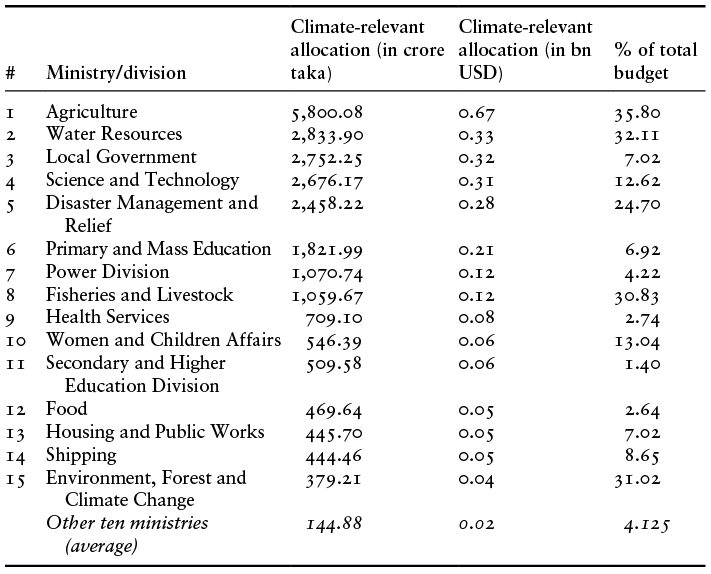
Table 7.1 shows how the Ministry of Agriculture has allocated a significant share of its budget to climate change-relevant activities, which include research, education, training, and irrigation programs (Government of Bangladesh 2021a). It developed the Climate Resilient Crop Variety and Technology Development Policy in 2010 and the National Agriculture Policy in 2018, which includes a dedicated section on developing climate stress-tolerant crop varieties. A similar percentage of the Ministry of Water Resources budget is relevant to climate change, including flood control and warning; preventing river erosion, waterlogging, salinity intrusion, and desertification; and research (Government of Bangladesh 2021a). It adopted the Master Plan of Haor Areas in 2012, highlighting climate change as a significant concern for Haor regions and recognizing the need for further study on the impacts of climate change in that area.Footnote 1 The climate change-related activities of the Local Government Division, which aims to strengthen local government systems, largely revolve around flood control and irrigation and include the development of rural infrastructure (Government of Bangladesh 2021a). Besides these, various other ministries focus on social protection, for example, ensuring education during disasters and increasing healthcare for those extremely vulnerable to climate change (Government of Bangladesh 2021a). These are often part of the so-called social safety net programs undertaken by various ministries to assist the poor and the disadvantaged (World Food Programme 2022).
The MoF published the Climate Fiscal Framework (CFF) in 2014, which followed a recommendation in the 2012 Climate Public Expenditure and Institutional Review. The policy provides “principles and tools for climate fiscal policy-making, helping to identify the demand and supply sides of climate fiscal funds” (Government of Bangladesh 2014, p. 1). It also recommends a set of codes to monitor climate-related expenses to (a) facilitate policy analysis and reporting on climate change expenditures and (b) identify potential climate-related public expenditures across different government ministries to assess long-term climate finance needs (Government of Bangladesh 2014, p. 1). The CFF was updated in 2020 in an attempt to be more citizen-centric and highlight the role of the private sector, NGOs, and CSOs. It includes fiscal policies such as tax, subsidy, pricing, lending, and insurance policies. The updated CFF focuses on the supply side of climate finance, considering the country’s vulnerability to climate change and the risks of loss and damage (Government of Bangladesh 2020a).
7.3.2 The MoEFCC
The MoEFCC leads Bangladesh’s climate change policy discourse. The ministry adopted the National Adaptation Programme of Action (NAPA) in 2005, the first dedicated governmental policy document to address climate change (Government of Bangladesh 2005). Bangladesh was one of the first nations to develop a NAPA, largely because it was a requirement to access funds from the Least Developed Countries Fund. The initial version of the NAPA consisted of fifteen project ideas to meet urgent and immediate adaptation needs. When the NAPA was revised in 2009, its focus shifted to addressing more comprehensive adaptation needs in the medium and long term, recognizing the longevity of climate impacts (Government of Bangladesh 2009b).
In 2008, the MoEFCC formulated the BCCSAP, which builds on the revised NAPA (Government of Bangladesh 2009a). This overarching strategic document still guides climate change governance in Bangladesh and includes the following six themes: (a) food security, social protection, and health; (b) disaster management; (c) infrastructure; (d) research and knowledge management; (e) mitigation and low-carbon development; and (f) capacity-building and institutional strengthening. It is comprised of forty-four programs to be executed in the short, medium, and long term. Twenty-four government ministries, agencies, and NGOs were made responsible for implementing these programs (Government of Bangladesh 2009a).
The primary focus of the BCCSAP is adaptation to climate change. However, it does encompass elements of loss and damage, such as a program to manage the risk of loss of income and property within the theme of comprehensive disaster management. This program aims to establish an efficient insurance system for risk management by collaborating with NGOs and insurance companies (Government of Bangladesh 2009a). The process of updating the BCCSAP started in 2018, but an interviewee mentioned that it will likely not explicitly mention loss and damage: “I have got the opportunity to go through an initial version of the updated action plan; in this version, loss and damage was not fairly captured” (Interview 4).
The MoEFCC developed the ccGAP in 2013, recognizing Bangladesh’s vulnerability to climate change impacts, the unique vulnerability of girls and women, and the potential for women to participate in decision-making and implementation processes related to building a climate-resilient future (Government of Bangladesh 2013). However, a review by the International Centre for Climate Change and Development shows that ministries have not aligned their work with the ccGAP and that no practical guidance exists for sectors to be able to take up the actions (ICCCAD n.d.). Similarly, gender equality is prioritized in the NAPA, but the plan does not include women as stakeholders in the proposed adaptation measures (Alston Reference Alston2015). An analysis of national policies by UN Women and the International Union for Conservation of Nature (2022, p. 80) draws a similar conclusion, highlighting that “most activities only managed to become gender-sensitive from being gender-blind … integration of gender into climate-specific policies and in relevant sectoral policies remains inconsistent.” Moreover, the analysis shows that an intersectional perspective is almost entirely absent across policy documents; women are referred to as a homogenous group with no analysis of income and religious or ethnic minorities (UN Women & IUCN 2022).
In 2022, the MoEFCC adopted the National Adaptation Plan (NAP) of Bangladesh (2023–2050) (Government of Bangladesh 2022c). The primary aim of the NAP is to build a climate-resilient nation through adaptation strategies. The first goal of the NAP includes a reference to loss and damage, but it is aimed at minimizing loss and damage instead of addressing it: “enhancing overall climate resilience through effective adaptation measures that minimize losses and damages and support natural resources management” (Government of Bangladesh 2022c, p. 8).
7.3.3 The MoDMR
The MoDMR oversees disaster management activities in Bangladesh. The ministry has adopted several plans, policies, and laws to address climate change’s impacts, the cornerstone being the Disaster Management Act of 2012. The Act aims to coordinate and improve disaster management activities and create infrastructure to respond to not only climate-related disasters, such as cyclones and floods, but also non-climate-related disasters, including earthquakes. It acknowledges the effects of climate change in the purview of the definition of disasters. It provides guidelines for setting up an institutional mechanism for disaster management, reducing vulnerabilities, providing aid to those affected by disasters, and rehabilitation. The Act also calls for establishing the Disaster Management Research and Training Institute to research disaster and climate change effects and increase capabilities.
The MoDMR implemented the National Disaster Management Policy in 2015 and the National Plan for Disaster Management (NPDM) (2021–2025) in 2020 to achieve the objectives of the Disaster Management Act (Government of Bangladesh 2020b). The NPDM builds upon previous plans from 2010 to 2015 and 2016 to 2020. It aims to improve the following five stages of disaster risk management: disaster risk reduction, disaster preparedness, early warning, emergency response, and recovery, rehabilitation, and reconstruction. It was formulated in accordance with international frameworks, such as the SFDDR, the Paris Agreement, the Sustainable Development Goals, the Asia-Pacific Regional Action Plan for Disaster Risk Reduction (2016–2030), and national policies, such as the Bangladesh Delta Plan 2100, the Perspective Plan of Bangladesh 2021–2041, the Eighth Five-Year Plan, and the BCCSAP 2009 (Government of Bangladesh 2020b).
Policies developed by the MoEFCC and MoDMR rarely include actions on addressing internal displacement. The NAPA, for example, contains no measures to address displacement (Government of Bangladesh 2005, 2009b); the BCCSAP has not prescribed any action plans for the issue other than monitoring (Government of Bangladesh 2009a); the Disaster Management Act of 2012 does refer to resettlement and to planned relocation in the context of rehabilitation but provides no clear guidance on how to do so; and the Standing Orders on Disaster, a policy document by the MoDMR which outlines the roles and responsibilities of institutions concerning disasters, primarily focuses on emergency shelters (Government of Bangladesh 2020b, n.d.-a).
The MoDMR has recognized the inadequacy of existing policy and legal frameworks to address internal displacement. In 2015, it formulated the National Strategy on the Management of Disaster and Climate-Induced Internal Displacement, which was updated in 2020 (Government of Bangladesh 2020b). This strategy sets out how the government will handle the increasing internal displacement caused by disasters, intending to provide a complete and organized response to the needs of displaced individuals and communities to reduce their vulnerability and enhance their quality of life. Plans such as the BCCSAP, NAPA, ccGAP, and the NPDM often cover climate impacts from both rapid and slow onset events. However, there is a disproportionate focus on economic loss and damage, such as losses of livestock or agriculture (Haque et al. Reference Haque, Pervin, Sultana, Huq, Mechler, Bouwer, Schinko, Surminski and Linnerooth-Bayer2019). Only some noneconomic loss and damage, such as harms to human health or biodiversity, are considered. However, others – such as negative impacts on religion, culture, or education – only commonly feature in disaster-related plans and policies. Moreover, the MoDMR does not always account for SOEs (Haque et al. Reference Haque, Pervin, Sultana, Huq, Mechler, Bouwer, Schinko, Surminski and Linnerooth-Bayer2019), resulting in incomplete responses to loss and damage.
7.3.4 National Climate Funds and the MCPP
The government and international actors have recognized the growing costs of climate-related hazards and the lack of support from international agencies in Bangladesh. Consequentially, two climate change funds were established in 2010: the Bangladesh Climate Change Resilience Fund (BCCRF), which was closed after June 2017, and the Bangladesh Climate Change Trust Fund (BCCTF), which was established through the Climate Change Trust Act of 2010 to redress the adverse impacts of climate change (Government of Bangladesh 2016). The national revenue budget fully funds the BCCTF through an annual allocation block, which is approximately USD 100 million annually (Khan et al. Reference Khan, Huq and Shamsuddoha2012). The Climate Change Trust Act specifies how 66 percent of the BCCTF resources is used for implementing projects and programs in line with the BCCSAP; the remaining 34 percent is kept as an interest-bearing deposit (Government of Bangladesh 2016).
The MCPP, published in 2021, aims to shift Bangladesh’s climate trajectory from “one of vulnerability to resilience to prosperity” (Government of Bangladesh 2021b, p. 8). It mentions loss and damage explicitly: 2.6 percent of a USD 80 billion investment to reach climate resilience is allocated to loss and damage. Moreover, in the prosperity plan, the government mentions the importance of “planetary justice and climate equity where vulnerable countries like Bangladesh are assisted with requisite finance and technology to meet development aspirations” (Government of Bangladesh 2021b, p. 6) and recognizes that to effectively avert and minimize impacts from climate-related disasters a dedicated financing mechanism for loss and damage is needed. However, the focus on loss and damage is on averting and minimizing loss and damage, with little attention paid to addressing impacts that have already occurred: “Minimizing and averting loss and damage is at the heart of this plan” (Government of Bangladesh 2021b, p. 6).
7.4 International Engagement
Bangladesh has engaged extensively with climate change policy at the international level, partly by positioning itself as a leader in climate adaptation and also by advocating for loss and damage support and finance through its involvement in the United Nations Framework Convention on Climate Change (UNFCCC) processes and the Climate Vulnerable Forum (CVF). The country signed the UNFCCC when it was adopted in 1992. Over the years, Bangladesh has proactively engaged with various other international bodies, such as the SFDRR and the Green Climate Fund (GCF).
7.4.1 UNFCCC Involvement
Bangladesh submitted its original Nationally Determined Contribution (NDC) in 2015 (Government of Bangladesh 2015) and a revised version in late 2021 (Government of Bangladesh 2021c). The NDC largely reflects the government’s approach to climate change mitigation. While it outlines fourteen priorities for adaptation in ten key areas (Government of Bangladesh 2015), loss and damage, or any additionality concerning adaptation, was not mentioned in the first version of the updated NDC submitted in 2021 (Government of Bangladesh 2021c). As one interviewee noted, this was potentially due to a fear of diverting attention from adaptation action (Interview 4). More recently, the government made a submission regarding the Glasgow Dialogue (Government of Bangladesh n.d.-b).
The MoEFCC serves as Bangladesh’s institutional focal point for the UNFCCC process, and it leads the international negotiations for the country as part of its remit. Bangladesh has consistently played an important role in advocating for addressing loss and damage over the years, but there is some ambivalence in the approach in terms of whether the country wants to present itself as a “victim” or whether it wants to emphasize its long experience with disaster risk management and resilience-building. For example, Bangladesh has regularly used the term “compensation” in its submissions to the UNFCCC. At the eleventh Conference of the Parties (COP11) in Montreal in 2005, Bangladesh, on behalf of the LDC Group, called for compensation for damages caused by climate change (Vanhala & Hestbaek Reference Vanhala and Hestbaek2016). In 2009, the country asked for a “rapid financing window for addressing resource needs to cope with the aftermath of extreme climate events, including [a] compensation mechanism” in a UNFCCC submission for the Bali Action Plan (UNFCCC 2009, p. 28). The country endorsed a proposal for incorporating a loss and damage mechanism in adaptation texts at COP15 in Copenhagen and added that loss and damage should be separate from adaptation (Vanhala & Hestbaek Reference Vanhala and Hestbaek2016).
Bangladesh showcased its pavilion for the first time at COP25 in Madrid, which helped represent its narrative as an “adaptation capital” (Khan Reference Khan2019), further solidifying the country’s position as a role model in terms of disaster reduction and preparedness (Government of Bangladesh 2022a). The Ministry of Foreign Affairs is also engaged in loss and damage conversations at the international level (Islam Reference Islam2018). For example, the foreign minister attended COP27 in Sharm el-Sheikh, urging the international community to take action on climate-induced migration and to mainstream the issue in the negotiations (Government of Bangladesh 2022b). Despite this strong presence in the negotiations, one interviewee repeatedly emphasized that Bangladesh’s influence on negotiations largely rests on individual personalities rather than an institutional approach: “Individual Bangladeshi negotiators and politicians have played a key role in the negotiations at the UNFCCC level at different times” (Interview 1).
7.4.2 Other International Regimes
7.4.2.1 The Sendai Framework for Disaster Risk Reduction
The SFDRR was initiated in 2015 to understand disaster risk and improve risk governance. Bangladesh, like other countries, committed to introducing interventions according to the framework’s goals, objectives, and priorities to enhance disaster risk reduction locally. The MoDMR serves as the focal ministry for implementing the policies related to the SFDRR. The framework includes four priority areas, but only the fourth concerns addressing loss and damage: enhancing disaster preparedness for effective response and to “Build Back Better” in recovery, rehabilitation, and reconstruction (UNDRR 2015). Bangladesh has made substantial progress in aligning disaster responses with the SFDRR priority areas, but there is scope for improvement, especially “in regards to operations and accountability” (Chisty et al. Reference Chisty, Muhtasim, Biva, Dola and Khan2022, p. 7). Chisty et al. (Reference Chisty, Muhtasim, Biva, Dola and Khan2022) show, concerning the fourth priority area, strengths in Bangladeshi policies and regulations are the inclusion of marginalized populations and the collection of damage and needs data. Weaknesses include a strong dependency on international aid and a lack of authoritative officials for disaster rehabilitation at the local level.
7.4.2.2 The Green Climate Fund
Under the MoF, the Economic Relations Division is the National Designated Authority, which serves as the interface between Bangladesh and the GCF. The year 2018 saw the creation of the GCF Country Programme for Bangladesh, which outlined the country’s priorities for projects and programs related to climate change adaptation and mitigation. Two organizations – the Palli Karma-Sahayak Foundation (PKSF) and Infrastructure Development Company Limited (IDCOL) – received accreditation as National Implementing Entities of the GCF. PKSF focuses on adaptation while IDCOL is more specialized on mitigation. Other public and private entities in Bangladesh, BCCTF and BRAC (previously Bangladesh Rehabilitation Assistance Committee), are currently in the process of applying for GCF accreditation. Bangladesh is equipped to access GCF finance through several policies and strategies dedicated to climate action, such as the NAPA in 2005 (revised in 2009); the BCCSAP 2009; the Third National Communication under the UNFCCC and the NDC under the Paris Agreement; and the GCF Country Programme. The GCF has enabled finance for projects in Bangladesh, such as a grant awarded to the German Development Bank to build climate-resilient infrastructure (KfW 2018; Schalatek et al. Reference Schalatek, Nakhooda and Watson2016).
Despite having policy-related and institutional advantages, Bangladesh faces substantial challenges in terms of accessing the GCF (Ahmed & Uzzaman Reference Ahmed and Uzzaman2020; Yusuf Reference Yusuf2022). The GCF has complex evaluation processes and little sensitivity to country contexts (Kumar Reference Kumar2015). A lack of technical and financial capacities by least developed countries (LDCs) and Bangladesh’s inadequate fiduciary standards (Yusuf Reference Yusuf2022) all act as a barrier to accessing the fund. Bangladesh also lacks historical data and statistics on climate parameters, which makes it difficult to substantiate whether an incident is caused by climate change or is a regular phenomenon. Hence, developing the systems and capacities to substantiate Bangladesh’s claims and tap into international climate finance is essential.
7.4.2.3 The Climate Vulnerable Forum
The CVF is an international partnership of highly climate-vulnerable countries founded in 2009 (V20 2022). Composed of over fifty members, it aims to build cooperation, knowledge, and awareness of climate change issues (V20 2022). Bangladesh held the presidency of the CVF from 2011 to 2013 and 2020 to 2022, with Bangladeshi Prime Minister Sheikh Hasina chairing the international coalition. Under Bangladesh’s presidency, one of the priorities of the CVF was “scaling-up efforts to address loss and damage and to support people displaced by climate threats and establish international responsibility for displaced communities” (V20 2022, p. 17). Moreover, before COP26, it called for the operationalization of the Santiago Network and a dedicated finance facility to address loss and damage (Climate Vulnerable Forum 2021). In response to minimal progress on these goals at COP26, the coalition initiated a “payment overdue” campaign ahead of COP27 in 2022. Eventually, the finance facility for loss and damage was established in the final days of the negotiations in Sharm el-Sheikh (UNFCCC 2022). The importance of Bangladesh’s involvement with the CVF was highlighted by an interviewee, who noted that the “CVF presidency is another big important factor at the higher political level; as Prime Minister Sheikh Hasina got to understand loss and damage, she became a champion for loss and damage” (Interview 1). The national government also published the MCPP during its second tenure as the president of the CVF, stating that it is part of a wider climate prosperity program to advance CVF and V20 in reaching climate resilience and prosperity (Government of Bangladesh 2021b).
7.5 Institutions
Besides government ministries, NGOs, CSOs, and the private sector also play significant roles in addressing climate change in Bangladesh. NGOs perform a key role in implementation, knowledge-building, advocacy, and engaging youth. The latter is an increasing voice in climate advocacy in Bangladesh. For their activities, NGOs are partly dependent on international funding streams. Consequentially, their involvement with loss and damage will increase as the global discourse grows. For loss and damage to be mainstreamed in national policy, either the MoEFCC or MoDMR should adopt the concept. However, and as shown here, several obstacles have obstructed this from happening.
7.5.1 NGOs
In Bangladesh, NGOs substantially influence disaster-related activities locally and nationally. At least 90 percent of Bangladeshi villages have an NGO present (Siddiquee & Faroqi Reference Siddiquee, Faroqi and Ahmed2016). The most prominent organizations are Grameen Bank, historically a microlending organization (Tanbir & Somani Reference Tanbir and Somani2020), and BRAC, the world’s largest NGO (Paprocki Reference Paprocki2021). Historically, NGOs in Bangladesh mainly focused on poverty alleviation, socioeconomic development, and climate adaptation and mostly served rural women (Ayers et al. Reference Ayers, Huq, Faisal and Hussain2013; Qayum Reference Qayum2021; Siddiquee & Faroqi Reference Siddiquee, Faroqi and Ahmed2016). Loss and damage-related activities are relatively absent from NGO programs, which one interviewee indicated is due to a lack of international attention: “You will not find a good number of organizations in our region who directly work on loss and damage, because internationally we do not talk about loss and damage, we talk about adaptation” (Interview 3). They later explained that local organizations are vital in transferring information and actions from the international debate to the local level. In other words, NGOs’ significant presence and dependency on international donors mean that on-the-ground action is more likely if the global policy and funding landscapes change.
Partnerships with NGOs have helped to shape the discussion around loss and damage in Bangladesh and other LDCs and significantly advance knowledge on the subject. The government initiated the Loss and Damage in Vulnerable Countries Initiative, which involved bringing together various stakeholders, including researchers, practitioners, legal experts, and policymakers, to promote a better understanding of loss and damage. Under this initiative, an early series of working papers addressed various conceptual and operational topics regarding loss and damage, including the role of the climate regime in handling loss and damage (Verheyen Reference Verheyen2012), various approaches to addressing loss and damage in Bangladesh (Faruque & Khan Reference Faruque and Khan2013; Nishat et al. Reference Nishat, Mikherjee, Hasemann and Roberts2013), noneconomic loss and damage perspectives (Morrissey & Oliver-Smith Reference Morrissey and Oliver-Smith2013), and gender (Neelormi & Ahmed Reference Neelormi and Ahmed2013; von Ritter Figueres Reference von Ritter Figueres2013). These partnerships also produced early thinking on disaster risk reduction and adaptation in the context of loss and damage (Shamsuddoha et al. Reference Shamsuddoha, Roberts, Hasemann and Roddick2013).
NGOs have also played an important role in advocacy. An interviewee outlined how their organization advocated for over ten years to establish the Disaster Management Act of 2012 by, for example, hosting workshops and mobilizing national media (Interview 2). This type of advocacy has also been pursued on loss and damage by several NGOs and research organizations. Activities include the hosting of a workshop with participation by members from the MoDMR and holding stakeholder consultations to devise a loss and damage strategy (Interview 1). Another initiative is the national mechanism for loss and damage, for which NGOs and research organizations have advocated since at least 2016 (Khan & Hadi Reference Khan and Hadi2016). An interviewee remembered the proposal phase:
We had proposed a two-year action program on exploring all the different aspects of loss and damage. There would be research, examples of insurance, and private sector involvement, and there would be ministry dialogues with relevant ministries. … At the end of these two years, we would examine what we learned and determine the next step in setting up a national mechanism.
However, advocacy efforts never materialized, partly as key ministerial actors took up new roles and because of considerable resistance from various angles (Interview 1). One interviewee noted that the new political leaders “did not have any knowledge, no awareness of loss and damage. So, we had to work from scratch again” (Interview 1). Nonetheless, there is still political will for establishing a national mechanism. The same interviewee observed that “it has not disappeared, but we need to revive it” (Interview 1).
Another interviewee indicated that the MoEFCC and MoDMR are still “both planning to develop a national mechanism for loss and damage” (Interview 4). They both noted that the establishment of the loss and damage fund at COP27 could act as a further incentive for the revival of the concept of a national mechanism for loss and damage in Bangladesh (Interviews 1, 4). Moreover, in a recent UNFCCC submission on the Glasgow Dialogue, the government highlights the need for international funding for the preparation of national action plans and strategies (Government of Bangladesh n.d.-b). One of the interviewees also noted that a mechanism should be drafted soon: “Now there is a financial institution to address loss and damage, so now the commitment is serious, and I think that at this time, they will come up with a draft mechanism within short period of time” (Interview 4).
Young people in Bangladesh are playing a significant role in lobbying for climate-related loss and damage policy at the national and international levels. A report by the United Nations Children’s Fund states that 91 percent of young people in Bangladesh are eager for their government to take significant climate action, which is significantly higher than the studies’ average (UNICEF 2021). Youth-led organizations, such as Fridays for Future Bangladesh and YouthNet for Climate Justice, mobilize thousands of young people to be first responders to climate impacts when they occur (Arannya Reference Arannya2022). They also organize demonstrations, in which they call for the national government to increase its mitigation efforts and express the need for rapid decision-making at the UNFCCC, and prior to COP27 and COP28, they explicitly called for loss and damage finance from historically high-polluting nations (Dhaka Tribune 2023; Jhumu Reference Jhumu2022; Rahman Reference Rahman2022). The youth-led organizations receive support from national and international NGOs and have spoken on international podia, such as COP27 (UNICEF 2022).
7.5.2 The Private Sector
In Bangladesh, the private sector, as one interviewee pointed out, is very much impacted by climate change: “Loss and damage happens in the private sector. Small and medium enterprises, cottage industries, poultry, all of these are owned by the private sector, and loss and damage is caused to them” (Interview 3). The private sector is affected not only by direct losses from climate impacts but also by the need to comply with governmental regulations regarding emission reduction and renewable energy (Interview 2). Yet the private sector can also play a role in addressing loss and damage through insurance. Two interviewees mentioned that there were several pilots with climate-related insurance in Bangladesh (Interview 1) and that the private banking sector has shown interest (Interview 4). Examples are flood insurance initiated by the Green Delta Insurance Company together with Oxfam Bangladesh, the World Food Programme, and Weather Risk Management Services (Eram Reference Eram2021). The Green Delta Insurance Company also offers weather-index-based crop insurance, using mechanisms to determine a threshold (e.g., wind speed) and pay damages based on these metrics (Interview 1, see also Hasan Reference Hasan2019). However, an analysis of a similar pilot by a state-owned insurance company and the Bangladesh Meteorological Department shows a wide range of challenges, such as limited weather data, a costly business operations system, complications with designing insurance products, recruiting qualified personnel, and distrust among farmers (Al-Maruf et al. Reference Al-Maruf, Mira, Rida, Rahman, Sarker and Jenkins2021). An interviewee confirmed this, saying that “they try to solve problems with an insurance-based policy for crops, but they have not succeeded” (Interview 4). They later noted, “If we can remove some of the complexities and administrative procedures, then insurance policies can be improved” (Interview 4). Still, several interviewees stressed the importance of engaging insurance in addressing loss and damage in Bangladesh (Interviews 1, 3, 4).
Besides insurance, entry points for the private sector into climate change in Bangladesh, particularly in the loss and damage discourse, could be providing health and population services (World Health Organization 2008), risk assessments and knowledge generation (Surminski & Eldridge Reference Surminski and Eldridge2013), and enhancing infrastructural resilience (Izumi & Shaw Reference Izumi and Shaw2014).
7.5.3 Interministerial Dynamics
Our research shows that interministerial dynamics is a key reason why loss and damage as a concept has not been explicitly integrated into national plans. An interviewee noted that “in terms of addressing loss and damage in its totality, the MoEFCC and MoDMR are responsible. They are working separately, so they have different pre- and post-disaster mandates” (Interview 4). Another interviewee mentioned that for loss and damage to be taken up in Bangladesh the bottleneck is “the specific activity and who does it. So, who should lead on behalf of the government? And then, what is that they should do?” (Interview 1). Even though it is a prominent aspect of disaster management, climate change lies in the domain of the MoEFCC (Interview 1), so traditionally, the MoEFCC holds more power regarding international climate change policy. When the MoDMR was interested in working on loss and damage after a workshop hosted by civil society actors, the at the time more influential MoEFCC stated that loss and damage is part of its portfolio alone (Interview 1).
Another obstacle is that a wide range of actors, including ministerial officials, fear that loss and damage will divert attention from adaptation (Interviews 1, 4). This is also a common obstacle in promoting loss and damage worldwide (Calliari et al. Reference Calliari, Serdeczny and Vanhala2020). One interviewee observed that a focus on loss and damage might undermine existing resilience efforts:
Some of our national experts in climate change have a strong reservation about putting loss and damage on the top. They want to be careful about the prospects of loss and damage without undermining the potential funding possibilities for adaptation. When we are seeking support on loss and damage, it should be on top of adaptation support. It should be new and additional and should not compromise adaptation. Some of our national experts raised this issue during conversations at the national level. We need support and are trying to mobilize our domestic and international resources to address loss and damage, but if we fully devote our time and resources, our climate resilience pathway, which we have been pursuing for many years, can be compromised, or affected.
Lastly, as outlined in Section 7.5.1, key actors within the government moved to other positions, which made them lose their support base for loss and damage. However, even if a ministry decides to integrate loss and damage within its programs and plans, a mechanism to systematically collect or manage data is yet to be established in Bangladesh.
7.6 Ideas
The integration of loss and damage within national policies in Bangladesh is likely, especially given the increase in political will resulting from establishing the loss and damage fund at COP27 and the integration of loss and damage with the MCPP by the national government. However, even if there is sufficient political will and funding to address loss and damage, substantial progress is to be made to do this in an effective and fair manner.
7.6.1 The National Mechanism
The current vision for a national mechanism for loss and damage in Bangladesh is a well-coordinated partnership between governmental institutions, the private sector, NGOs, and other relevant actors. Where policymakers working on food security, protecting lives, and adaptation all work next to each other in separate silos, with little collaboration or cooperation (Haque et al. Reference Haque, Pervin, Sultana, Huq, Mechler, Bouwer, Schinko, Surminski and Linnerooth-Bayer2019), the national mechanism could convene these activities for loss and damage. One interviewee noted the lack of coordination between bodies and the need for a holistic mechanism: “[There are] implications for the health ministry, youth ministry, women and children’s ministry, transport ministry, and so on. Unless there is a convening body which would come under a nationally coordinated mechanism, we will see major lags” (Interview 2). A scoping study was conducted in 2016 for developing a national mechanism for loss and damage in Bangladesh by Huq et al. (Reference Huq, Kabir, Khan and Mahid2016). In order to ensure coordination, it suggested the establishment of a national steering committee comprising the highest-level policymakers and experts to provide oversight and guidance to a technical working group in charge of leading thematic works. The study also outlined various functions for the national mechanism including developing sectoral policies, plans, and legislations for loss and damage; research and capacity-building frameworks; tools and methodologies for loss and damage assessment; and nationally appropriate approaches for addressing noneconomic loss and damage, among others (Huq et al. Reference Huq, Kabir, Khan and Mahid2016). A successful national mechanism could also serve as a model for other developing countries, bolstering Bangladesh’s position as a global leader in climate response while recognizing that the government does not have enough financial resources to carry out its vision on its own.
When discussing establishing a national mechanism for loss and damage in Bangladesh, an interviewee noted that potential funding from the UNFCCC will be slow (Interview 4), meaning that the government would have to fund the mechanism. Another interviewee described how there briefly was the idea of using the remaining 34 percent from the BCCTF to set up a pilot mechanism addressing loss and damage: “We have 300 to 400 million sitting in the bank untouched. … We have the money, we can start [a loss and damage fund] ourselves. … We [can] develop a mechanism to demonstrate that we know what we are doing” (Interview 1). However, an increase in funds or establishing the mechanism itself does not mean that loss and damage will be addressed effectively and fairly. Bangladesh has made great strides in disaster risk reduction and adaptation, but the often large-scale and technocratic interventions initiated by the government and NGOs have also inflicted further harm on already vulnerable populations (Magnan et al. Reference Magnan, Schipper, Burkett and Ziervogel2016; Paprocki Reference Paprocki2021). Moreover, climate-related policies in Bangladesh do not always analyze gender and lack an intersectional perspective on vulnerability (UN Women & IUCN 2022). Thus, an increase in climate-related interventions could result in additional harm if they do not account for relevant complex socioeconomic and environmental dynamics and long-term implications. Moreover, meaningful participation from particularly vulnerable and marginalized groups is needed to reach fair outcomes.
Therefore, it is essential for Bangladesh to learn from inaccuracies and missteps made in past interventions in the name of adaptation. An interviewee suggested that lessons from social safety net programs could be used to shape activities under a national mechanism: “We can learn lessons from social safety net measures and can put some elements in our national mechanism for loss and damage” (Interview 4). This aligns with findings by Aleksandrova and Costella (Reference Aleksandrova and Costella2021), who suggest that social protection helps address loss and damage as it reduces socioeconomic vulnerability and increases resilience of the poor and most vulnerable. Moreover, they emphasize that it helps address impacts from SOEs (Aleksandrova & Costella Reference Aleksandrova and Costella2021); these impacts are currently overlooked by many governmental interventions in Bangladesh (Haque et al. Reference Haque, Pervin, Sultana, Huq, Mechler, Bouwer, Schinko, Surminski and Linnerooth-Bayer2019).
7.6.2 Data
Bangladesh’s vast experience in coping with and adapting to loss and damage has resulted not only in various policies, studies, responses, and plans across scales but also in a vast amount of data on climate impacts and responses. However, no central database exists for disaster statistics and impacts (Chisty et al. Reference Chisty, Muhtasim, Biva, Dola and Khan2022). The annual budget report by the MoF only includes ministerial expenditures concerning climate change; it does not account for on-the-ground costs arising from climate-related disasters borne by the private sector or households. The latter have developed a wide range of coping responses, such as buying chemical fertilizers due to decreased soil fertility or medicines to combat water-borne diseases from floods, which puts a further financial burden on people already living in subsistence conditions (van Schie et al. Reference van Schie, Ranon, Mirza and Anderson2022, Reference van Schie, Mirza, Ranon, Malek, Hossain, Naushin and Anderson2023b). The MoF does indicate that there is flexibility in their methodology to include private sector financing (Government of Bangladesh 2021a).
Reports rarely include comprehensive data regarding the potentially infinite noneconomic losses (Boyd et al. Reference Boyd, Chaffin, Dorkenoo and Stuart-Smith2021) people face from climate change, which are too complicated to quantify: “There are some losses and damages, particularly noneconomic loss and damage, which cannot be quantified. How can we put value on these noneconomic losses? Especially as each country has different national circumstances and different contexts” (Interview 4). Collecting and analyzing data will help assess the current climate change costs and formulate funds and interventions required to address loss and damage. Moreover, a detailed but holistic dataset will be crucial in applying for loss and damage-related grants, both from current funds, such as the GCF, and potential funding for the loss and damage fund established during COP27. Accurate and comprehensive assessments and valuations of loss and damage are crucial as the absence of more invisible loss and damage, such as noneconomic loss and damage or impacts from SOEs, will result in incomplete response strategies. An interviewee indicated that Bangladesh needs external support with such comprehensive assessments: “In terms of valuing the costs attached to losses and damages, this is an area where researchers and the scientific community should assist” (Interview 4).
An unprecedented number of loss and damage studies and assessments have been conducted in Bangladesh, including studies on noneconomic loss and damages (Andrei et al. Reference Andrei, Rabbani and Khan2014; Chiba et al. Reference Chiba, Shaw and Prabhakar2017; van Schie et al. Reference van Schie, Ranon, Mirza and Anderson2022, Reference van Schie, McNamara, Yee, Mirza, Westoby, Nand, Ranon, Clissold, Anderson and Huq2023a), loss and damage from specific events (Rabbani et al. Reference Rabbani, Rahman and Mainuddin2013), gender-specific experiences (Ayeb-Karlsson et al. Reference Ayeb-Karlsson, Chandra and McNamara2023), and ways to address loss and damage (Chiba et al. Reference Chiba, Prabhakar and Islam2019; Nishat et al. Reference Nishat, Mikherjee, Hasemann and Roberts2013). The data and findings from these reports and assessments could be used in designing a potential national database, given the wide range and dynamics connected to loss and damage they reveal.
7.7 Conclusion
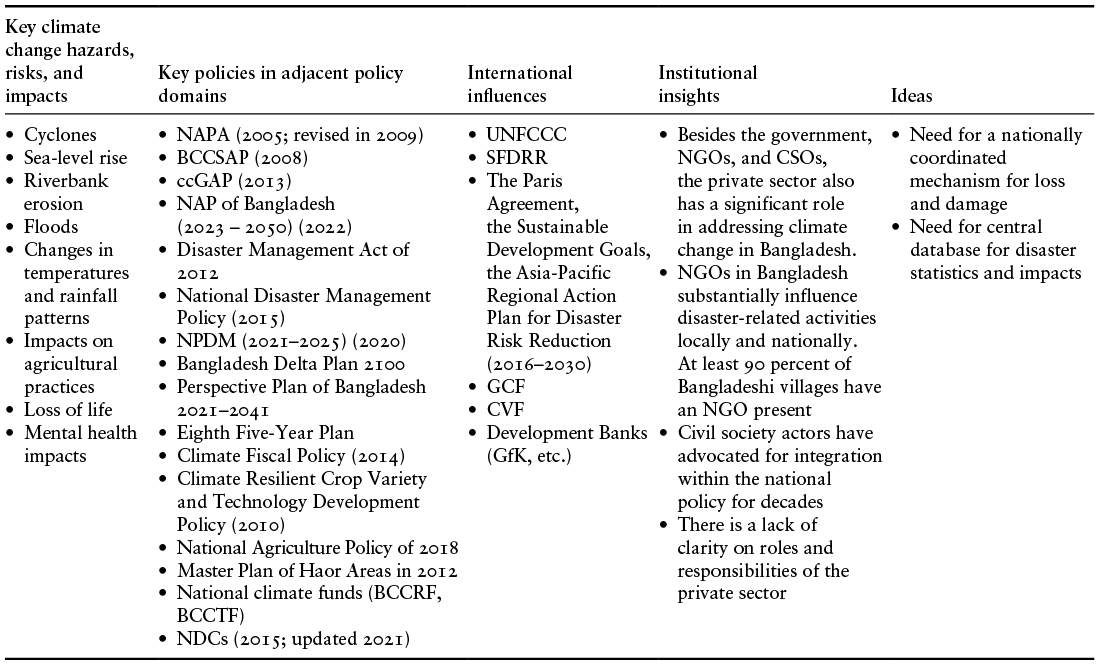
Table 7.2 synthetizes the main results from our analysis along the four dimensions of the analytical framework we developed in Chapter 2. This chapter shows that it is currently the national government, the private sector, and the affected households that are bearing the costs of climate change in Bangladesh, one of the world’s countries most heavily burdened by severe weather impacts. The government has actively advocated for the issue in UNFCCC negotiations, developed new policies domestically, and devised a great range of institutions aiming to avert, minimize, and address loss and damage. These institutions include the MoEFCC and MoDMR, two separate ministries that focus on climate change and disasters and are particularly responsible for developing a wide variety of plans and policies, which mostly revolve around mitigation and adaptation. Measures concerning post-disaster impacts, such as post-disaster compensation, are often undertaken in the name of adaptation or disaster management instead of explicitly referring to loss and damage. These measures tend to focus on economic loss and damage and rapid onset events, such as damage to buildings and infrastructure after cyclones or floods, and overlook noneconomic impacts, such as loss of culture or biodiversity and impacts from SOEs, such as changes in rainfall and temperature.
NGOs have advocated for the government and ministries to integrate the concept of loss and damage more widely into their policymaking, arguing that this would better connect the Bangladeshi discourse with the global climate change debate. This partly succeeded given the integration of loss and damage in the MCPP. However, in the plan, the government emphasizes the need to avert and minimize loss and damage and avoids addressing impacts that have already occurred. Moreover, loss and damage is still absent in the plans of the MoEFCC and MoDMR. Changes in key ministerial posts and interministerial conflicts at least partly explain this disconnect, as well as the fear that a focus on addressing loss and damage diverts attention from adaptation.
Bangladesh has advocated for loss and damage internationally through its CVF presidency and active role in the negotiations. Here, they are accompanied by NGOs and youth groups who advocate for loss and damage action across scales. For example, NGOs have advocated, again relatively unsuccessfully, for the establishment of a national platform for loss and damage. They argue that this could serve as the bridge between national- and international-level loss and damage activities. However, the agreement on a loss and damage fund at COP27 and the operationalization of the Fund at COP28 could have increased the political will within the MoEFCC and MoDMR for a national mechanism. The realization of a national mechanism alone, however, will not effectively and fairly address loss and damage in Bangladesh. To do so will require thorough learning from inaccuracies and unexpected outcomes from past interventions in the name of adaptation and meaningful involvement of particularly vulnerable and marginalized groups. Moreover, the long history of responding to climatic impacts has resulted in vast loss and damage-related data, from estimations of costs on buildings and infrastructures to potential ways of addressing loss and damage. However, there is currently no overarching system for holding, processing, and analyzing data on loss and damage.
Bangladesh’s extensive history and experience in adaptation and disaster risk management position the country as a leader in climate change response. However, as an LDC with a significant portion of the population living below the poverty line, it faces challenges. The increasing frequency and severity of climate-related hazards place additional strain on national resources and the livelihoods of affected communities. Integrating loss and damage into national policies, establishing a fair national mechanism, and creating a comprehensive database of loss and damage data would strengthen Bangladesh’s role as both an advocate for loss and damage response and a leader in climate response.


 Open access