

The processes through which identities, objects, and practices traversed ancient physical and social boundaries are of interest to archaeologists because they seemingly track the movement and negotiations between cultural groups and document the web of past interactions. Investigations into the specific ways that these interactions occurred, however, has proved challenging for archaeologists. Patterned remains have the potential to signal the directional nature of cultural interactions as a result of social agents navigating their experiences within and between social, economic, and political networks and realities (Dietler Reference Dietler2010; Lightfoot et al. Reference Lightfoot, Martinez and Schiff1998). In recent decades, archaeological approaches to culture contact have been carefully designed to recognize the complicated trajectories of people, things, and practices that take place in such scenarios (e.g., Boozer et al. Reference Boozer, Düring and Parker2020; Green and Costion Reference Green, Costion and Beaule2017, Reference Green, Costion, Green and Costion2018; Hu and Quave Reference Hu, Quave, Panich and Gonzalez2021; Noe Reference Noe2023; Silliman Reference Silliman2005). Adopting practice-based approaches to culture contact situations (e.g., Bardolph Reference Bardolph2014; Panich Reference Panich2020; Silliman Reference Silliman2009) has been especially useful to more critically assess the creative and often multifaceted ways in which identities, materials, and practices were transformed through cultural encounters and negotiations over space and time.
Archaeological research on Middle Horizon (AD 600–1000) cultural exchanges between Indigenous groups and affiliated agents of Wari, a pre-Inkan empire, has demonstrated a wide range of interactions that took place as the Wari political sphere expanded, which we review briefly in the following text. There are no written records for the cross-cultural encounters that occurred, leaving many questions unresolved regarding the nature of exchanges with local populations as the Wari polity expanded. How did Indigenous groups experience and negotiate the appearance of colonial populations and traditions at Wari provincial centers and the surrounding areas? How can we evaluate multidirectional cultural exchanges between colonists and Indigenous groups? Finally, how might local populations have influenced or directed the nature of contact between the groups?
For example, archaeologists argue that the Nazca region was tightly connected to the Wari sphere (Conlee Reference Conlee2021; Jennings et al. Reference Jennings, Biwer and Conlee2022). These interactions produced a variety of local responses and outcomes to Wari presence in the region, including settlement abandonment in the north, population aggregation in the south, changes to mortuary treatment, increases in highland materials like obsidian and copper, emulation of Wari style at some settlements, and direct incorporation of local communities into the Wari sphere (Conlee Reference Conlee and Jennings2010:98). Nasca culture also had important reciprocal impacts on the Wari. Wari-affiliated communities increasingly utilized Nasca ceramic technology and iconography and possibly increased their use of flexed burial positioning as well as using trophy heads for sociopolitical and religious ritual (Conlee Reference Conlee2021).
Elsewhere, Wari-affiliated colonists created large systems of canals and terraces in the Sondondo Valley not previously extant in the region and restructured local settlement patterns (Schreiber Reference Schreiber1992), suggesting heavy investment and engagement in the region. Wari interaction with local groups in Cusco is less clear. Wari colonists, likely aided by local peoples, constructed the site of Pikillacta, a massive, planned settlement in the Lucre Basin (McEwan Reference McEwan2005). However, the lack of Wari ceramics at local sites, continuation of local settlement patterns, and the lack of integration of local groups within Wari material exchange networks are taken by some (e.g., Bélisle Reference Bélisle2015) to suggest there was little substantial Wari contact with or influence over Indigenous communities in Cusco. Similarly, others working in both southern regions such as the Cotahuasi Valley (e.g., Jennings Reference Jennings and Jennings2010) and northern regions such as Humachuco (e.g., Topic and Topic Reference Topic, Topic and Jennings2010) argue that there was little to no direct Wari imperial presence and Wari styles and traditions were emulated, often imperfectly, by local populations. This demonstrated pattern of colonialism is not only what Schreiber (Reference Schreiber1992:267) refers to as a “mosaic of control” but also acknowledges a wide variation in how Wari colonists and local groups engaged socially, politically, and economically over space and time (Jennings et al. Reference Jennings, Biwer and Conlee2022; Williams et al. Reference Williams, Reid, Grávalos, Marsh, Bélisle, Conlee, Kerchusky and McEwan2024).
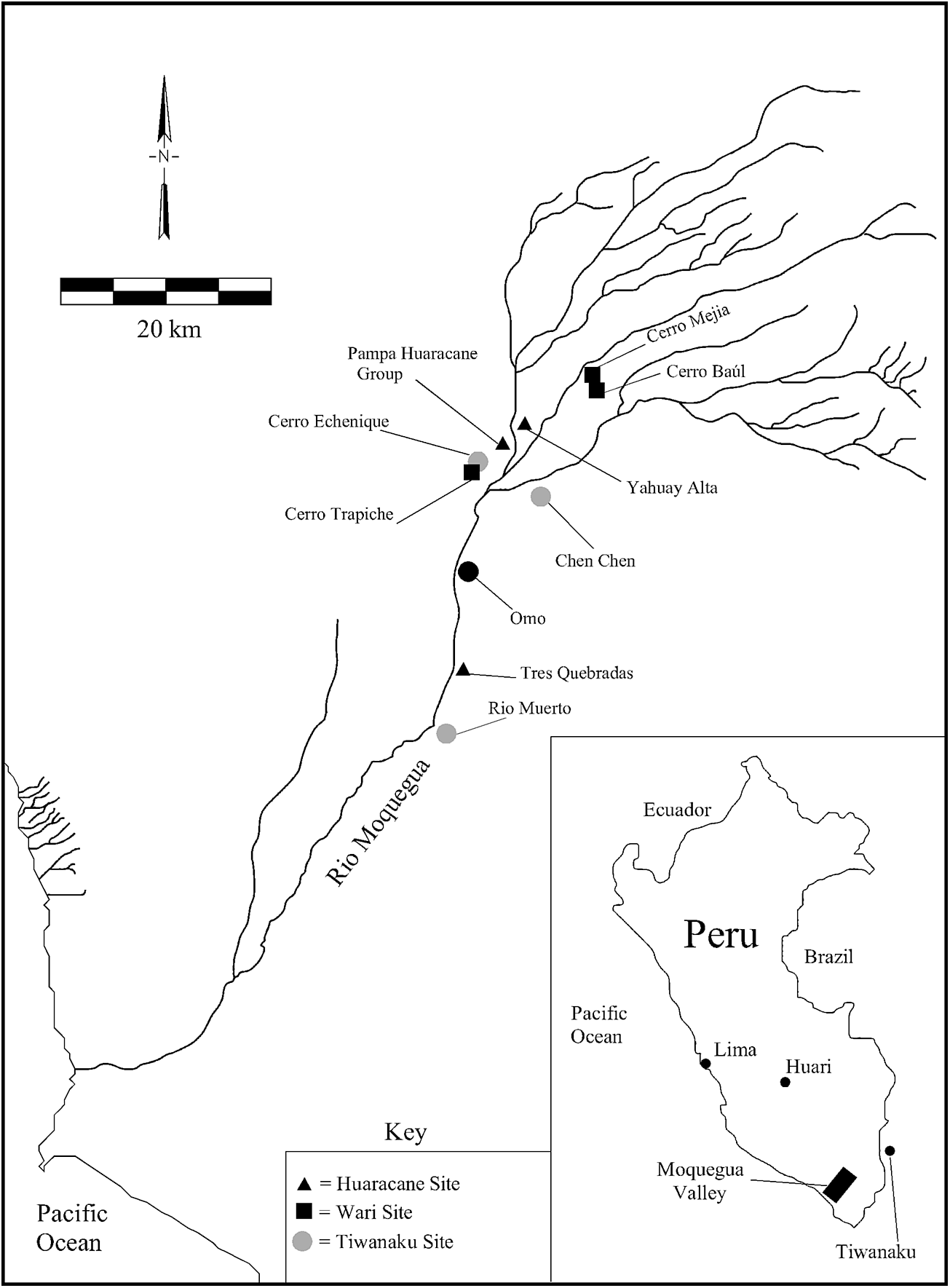
The case study presented here focuses on the far southern frontier of the Wari Empire where in the upper Moquegua Valley (Figure 1) Wari colonists constructed an administrative outpost on the summit of Cerro Baúl, a conspicuous sheer-sided mesa (Nash and Williams Reference Nash, Williams, Vaughn, Ogburn and Christina2004; Williams Reference Williams2001). Wari colonization of the upper Moquegua Valley entailed the extensive terracing of steep valley slopes and the construction of a network of canals to irrigate the fields (Williams Reference Williams2001). These efforts enabled the successful colonization of a previously mostly uninhabited section of the valley. In part because the Wari colonial endeavors in Moquegua focused on the uninhabited upper valley section of the drainage there is little to no evidence at most upper valley Wari sites indicating how Wari colonists interacted with their Huaracane neighbors who occupied the more easily irrigable middle valley.
Map of Moquegua Valley noting locations of archaeological sites.

In the middle Moquegua Valley, there is evidence for relatively limited Wari interactions with the local Huaracane at the site of Yahuay Alta and at Cerro Trapiche, the Wari’s only major middle Moquegua Valley settlement (see Green and Costion Reference Green, Costion and Beaule2017; Green and Goldstein Reference Green, Goldstein and Jennings2010). Very few Wari-style ceramics have been recovered from Huaracane sites and none have been found in excavated contexts. Wari colonists heavily terraced the upper valley, yet current evidence suggests that they did not reorganize or directly impact local Huaracane settlements in the middle valley. Wari irrigation infrastructure in the upper valley likely reduced river flow in the middle valley, impacting the simple floodplain irrigation systems used by Huaracane communities (Williams Reference Williams2002). Further, there is little evidence of Huaracane cultural material at Cerro Baúl or other Wari colonial settlements beyond Cerro Trapiche (Costion Reference Costion2009; Green and Costion Reference Green, Costion and Beaule2017). However, Nash (Reference Nash2022) uses the presence of a small number of distinctive ceramics to suggest that some Huaracane possibly lived in and/or interacted with the polyethnic community living on the slopes of Cerro Mejía directly adjacent to Cerro Baúl. Given the scarcity of evidence for interaction on the Moquegua frontier, a comparison of Wari and Huaracane foodways offers a window through which to examine the expression of daily practice as these communities navigated intercultural contact.
Here, we present the results of our analysis of macrobotanical remains from Yahuay Alta. We examine how the Huaracane negotiated interactions with Wari colonists, and ultimately how Wari commensal political feasting incorporating chicha de molle became entangled with Huaracane community politics. We argue that the Huaracane residents at Yahuay Alta selectively incorporated chicha de molle by producing it near open public spaces, possibly for highly visible spectacle or ceremonies, as opposed to the Wari pattern of feasting in spaces enclosed by high walls mainly for elite-driven political, economic, and social interactions (see Biwer et al. Reference Biwer, Yépez Álvarez, Bautista and Jennings2022; Cook and Glowacki Reference Cook, Glowacki and Bray2003; Jennings et al. Reference Jennings, Alaica and Biwer2023; Nash and deFrance Reference Nash and deFrance2019; Nash et al. Reference Nash, Biwer and Witte2023; Sayre et al. Reference Sayre, Goldstein, White and Williams2012). The differences in the location of production and use of molle (Schinus molle) for chicha at Yahuay Alta represents a fundamental shift in how the beverage was politically used and consumed, suggesting that while Huaracane residents interacted with Wari colonists and adopted an aspect of Wari foodways, they did so on their own terms.
Frontiers, Culture Contact, and Foodways
All colonial encounters are complex multidirectional cultural exchanges whereby entirely new, or compound identities and practices may be formed or modified (Boozer et al. Reference Boozer, Düring and Parker2020; Dietler Reference Dietler2010; Lightfoot et al. Reference Lightfoot, Martinez and Schiff1998; Voss Reference Voss2008). Recent studies have examined the roles of colonizer and Indigenous groups in creating new identities and practices as a result of local entanglements (Deagan Reference Deagan2004; Jaffe et al. Reference Jaffe, Wei and Zhao2017; Silliman Reference Silliman2005; Voss Reference Voss2005). This perspective recognizes the multiple imperial and local agendas at play in a range of colonial encounters and acknowledges both foreign and Indigenous groups as participants in the cultural exchange through sharing and negotiating identity and material culture through daily practice.
Frontiers are unique contexts of cultural contact. Archaeologists situate frontiers as zones of innovation and recombination of ethnically diverse communities, providing excellent contexts for examining the process of consumption, appropriation, or rejection of cultural traits and ideas (Beaule Reference Beaule2017; Dietler Reference Dietler2010; Green and Costion Reference Green, Costion and Beaule2017, Reference Green, Costion, Green and Costion2018; Lightfoot and Martinez Reference Lightfoot and Martinez1995; Silliman Reference Silliman2005). They are often borderless, having unclear boundaries and fluid transmission of cultural material and ideas, and are frequently devoid of a dominant authority (Green and Costion Reference Green, Costion and Beaule2017, Reference Green, Costion, Green and Costion2018; Parker Reference Parker2002). Importantly, negotiation of political, economic, and social boundaries in the past would have been up to both foreign and local agents (Boozer et al. Reference Boozer, Düring and Parker2020; Silliman Reference Silliman2005). In these regions, boundaries and colonial policies are negotiated and articulated at the local level, making frontiers highly variable within a suite of circumstances and characteristics, leaving room for novel interactions.
A consideration of frontiers within the context of culture contact and colonial encounters offers a nuanced perspective as their very nature makes them zones of negotiation. Jordan (Reference Jordan, David Gaimster and Teresita Majewski2009) suggests we must be cautious when investigating power relations in culture contact scenarios, pointing out that not all intercultural exchanges can be characterized as colonialism without adequate analysis of the political, economic, and social structures present. Archaeologists studying culture contact and frontiers must consider the microhistories, or the study of individuals or small groups at a local scale, of individuals and events over one or several generations, as well as the long-term macrohistorical processes (e.g., Boozer et al. Reference Boozer, Düring and Parker2020; Hu and Quave Reference Hu, Quave, Panich and Gonzalez2021; Lightfoot and Martinez Reference Lightfoot and Martinez1995:477–478; Parker Reference Parker2002; Silliman Reference Silliman2005, Reference Silliman2015). This type of multiscalar approach is important for addressing how agents respond to cultural encounters and cultural others and how new cultural structures are created, maintained, and transformed. However, the macrohistorical processes, such as the history of the encounter, are critical for characterizing the long-term effects of culture contact and providing chronological resolution for the microhistories.
Foodways refer to the entirety of social practices associated with the acquisition, production, processing, cooking, consumption, and discard of food (Hastorf Reference Hastorf2017). As a fundamental component of social reproduction and solidarity, food is one of the most enduring aspects of cultural identity, being resistant to change and relatively conservative (Atalay and Hastorf Reference Atalay and Hastorf2006; Weismantel Reference Weismantel1988). In culture contact settings, foodways may be actively borrowed, exchanged, rejected, transformed, or repurposed within and between groups who encounter one another (see Bardolph Reference Bardolph2014; Hunter and Huáman Mesía Reference Hunter and Huamán Mesía2023; Jaffe et al. Reference Jaffe, Wei and Zhao2017; Noe Reference Noe2023; Quave et al. Reference Quave, Kennedy and Covey2019), resulting in a spectrum of cultural exchange ranging from significant to little (or no) change. For example, in her study of Chimú expansion, Cutright (Reference Cutright2015) found that because of the establishment of Chimú political control in the Jequetepeque Valley, alongside intensified agricultural production, the economies of provincial households changed little. Indeed, in the face of Chimú expansion around AD 1320 the household activities of local peoples in the Jequetepeque Valley didn’t change in scope and daily diet remained similar (Cutright Reference Cutright2015). Cutright explains this apparent lack of change was due to the resiliency of the household to resist political conquest and economic reorganization.
Responses to policies, affiliations, and interactions are reflected in daily practice (Bourdieu Reference Bourdieu1977) through foodways (see Atalay and Hastorf Reference Atalay and Hastorf2006; Cutright Reference Cutright2015; Dietler Reference Dietler2010; Hunter and Huáman Mesía Reference Hunter and Huamán Mesía2023; Kennedy and VanValkenburgh Reference Kennedy and VanValkenburgh2016; Quave et al. Reference Quave, Kennedy and Covey2019). For example, during the colonial period at El Presidio de San Francisco, Voss (Reference Voss2005) uses food remains to show how early European colonists in California created a distinct “Californio” identity. Despite the early heterogeneity of ethnic backgrounds within the colony, by consolidating differences in material culture, foodways, and architecture among colonists at El Presidio de San Francisco, the military settlers simultaneously minimized social diversity among themselves and heightened differences between themselves and local Indigenous groups. The colonial residents appear to have prepared and consumed the same plants (beans [Phaseolus vulgaris], buckwheat [Fagopyrum tataricum], and wheat [Triticum sp.]) and animals (cow [Bos torus]) uniformly while concurrently avoiding foods associated with Native Americans, such as deer (Odocoileus virginianus) and acorns (Quercus sp.). In this case, food was actively used to differentiate colonists and Indigenous peoples to construct a more cohesive colonial identity (Voss Reference Voss2005:466). This approach highlights food as a salient representation of identity that can be shared, rejected, and appropriated by communities.
It can be difficult, however, to determine where one cultural practice originated and was subsequently adopted. Indeed, “Culture is not a fixed, static, homogeneous system of shared beliefs, rules, and traits, but rather sets of embodied categorical perceptions, analogical understanding, and values that structure ways of reasoning, solving problems, and acting on opportunities” (Dietler Reference Dietler2010:59). Entangled objects, behaviors, and ideas are wrapped up in continuous processes of selective appropriation and creative assimilation grounded in local practice. Entanglement represents a creative process of long-term, gradual, and nondirected interaction whereby both colonizer and local Indigenous groups are active participants in becoming entangled (Dietler Reference Dietler2010; Hodder Reference Hodder2012; Jaffe et al. Reference Jaffe, Wei and Zhao2017; Silliman Reference Silliman2005, Reference Silliman2009, Reference Silliman2015; Thomas Reference Thomas1991). The degree to which entanglement takes place and the nature of how culturally novel objects or behaviors were appropriated into local systems allows us to highlight how entangled phenomena connected formerly separate entities, as well as the roles that said phenomena may have had in influencing shifts in worldview vis-à-vis practice (Stockhammer Reference Stockhammer2013).
Wari, Huaracane, and the Moquegua Valley
Wari
Wari expanded from Ayacucho in the south-central Peruvian Andes during the late sixth century AD, establishing dispersed colonial centers and outposts throughout the northern, central, and southern highlands and coastal areas of Peru, with the largest and most formal of these centers being regularly spaced out at 200 km intervals (Williams et al. Reference Williams, Nash, Chacaltana, Boozer, Düring and Parker2020). In the upper Moquegua Valley, Wari established a colony administered from Cerro Baúl around AD 600 (Moseley et al. Reference Moseley, Nash, Williams, deFrance, Miranda and Ruales2005; Williams Reference Williams2001). Wari constructed secondary sites in the vicinity of Cerro Baúl, including Cerro Mejía (Nash Reference Nash2022), and established a single major settlement in the middle Moquegua Valley, Cerro Trapiche, which was adjacent to traditional Huaracane territory (Goldstein Reference Goldstein2000) and closer to Middle Horizon Tiwanaku settlements (Green and Goldstein Reference Green, Goldstein and Jennings2010). At the summit of Cerro Baúl, high-walled and inwardly oriented compounds demark a high degree of social separation (Moseley et al. Reference Moseley, Nash, Williams, deFrance, Miranda and Ruales2005; Nash Reference Nash2022). Excavations at Cerro Baúl have revealed the existence of a range of domestic and monumental structures, ceremonial D-shaped temples, and a variety of quotidian and luxury goods (Moseley et al. Reference Moseley, Nash, Williams, deFrance, Miranda and Ruales2005; Nash and deFrance Reference Nash and deFrance2019). The architectural structure at the site most relevant to our case study was the brewery where archaeologists identified rooms designed specifically for brewing chicha (Moseley et al. Reference Moseley, Nash, Williams, deFrance, Miranda and Ruales2005); high densities of fermentables such as molle, maize (Zea mays), and quinoa (Chenopodium quinoa; Goldstein et al. Reference Goldstein, Goldstein, Williams, Jennings and Bowser2009; Nash et al. Reference Nash, Biwer and Witte2023); and pairs of ritually broken keros (drinking cups; Williams and Nash Reference Williams and Nash2021). When use of the brewery was terminated, it was ritually closed, signaling the end of feasting-related activities and a shift in culinary practice toward the end of the Middle Horizon (Moseley et al. Reference Moseley, Nash, Williams, deFrance, Miranda and Ruales2005). Wari colonists and affiliated communities abandoned the site around AD 1100 (Nash and Williams Reference Nash, Williams and Murphy2022).
Huaracane
Prior to the establishment of the Wari colonial settlements and the contemporary Tiwanaku colonization of the region (see Goldstein Reference Goldstein2005), the middle Moquegua Valley was inhabited by small-scale agriculturalists known to archaeologists as the Huaracane. This name is derived from a group of settlements located on the Pampa Huaracane, which are associated with a simple but distinctive ceramic assemblage consisting of round neckless and short-necked utilitarian ollas tempered with vegetable fiber or sand and shallow rounded fineware serving bowls known as Huaracane Fino bowls that have been found only in the middle Moquegua Valley (Feldman Reference Feldman, Rice, Stanish and Scarr1989; Goldstein Reference Goldstein2000:341, Reference Goldstein2005). The earliest radiocarbon date for a Huaracane context is 385 cal BC (Goldstein Reference Goldstein2000, Reference Goldstein2005), though it is possible that the Huaracane had earlier origins; based on ceramic evidence, Feldman (Reference Feldman, Rice, Stanish and Scarr1989:209) hypothesized that the Huaracane ceramic style emerged as early as 850 BC.
The Huaracane settlement pattern consists of small residential villages associated with their distinctively local ceramic style situated on virtually every hilltop along the margins of the middle Moquegua Valley (Feldman Reference Feldman, Rice, Stanish and Scarr1989; Goldstein Reference Goldstein2000, Reference Goldstein2005). The proximity of these settlements to the floodplain suggests a reliance upon valley-edge canals to irrigate agricultural fields (Goldstein Reference Goldstein2000:343). Analysis of Huaracane settlement sizes, which are generally <0.5 ha, indicates that this was not an economically or politically centralized society. Instead, each village was likely relatively autonomous (Goldstein Reference Goldstein2000:344). Evidence from the culturally distinctive Huaracane boot tomb cemeteries, however, suggests the emergence of a chiefly class in Huaracane society during the late Formative period (170 cal BC–340 cal AD; Goldstein Reference Goldstein2000:355).
Excavations of domestic contexts at the Huaracane site of Yahuay Alta (Figure 1) demonstrated no evidence for the types of conspicuous displays of wealth visible in the boot tomb cemeteries suggesting that visible displays of wealth were limited (Costion Reference Costion2009). The Huaracane tradition did not end with Wari and Tiwanaku Middle Horizon incursion. Instead, it persisted materially in the middle valley at a small number of confirmed sites until as late as around AD 965, after which all Huaracane settlements dated so far were abandoned.
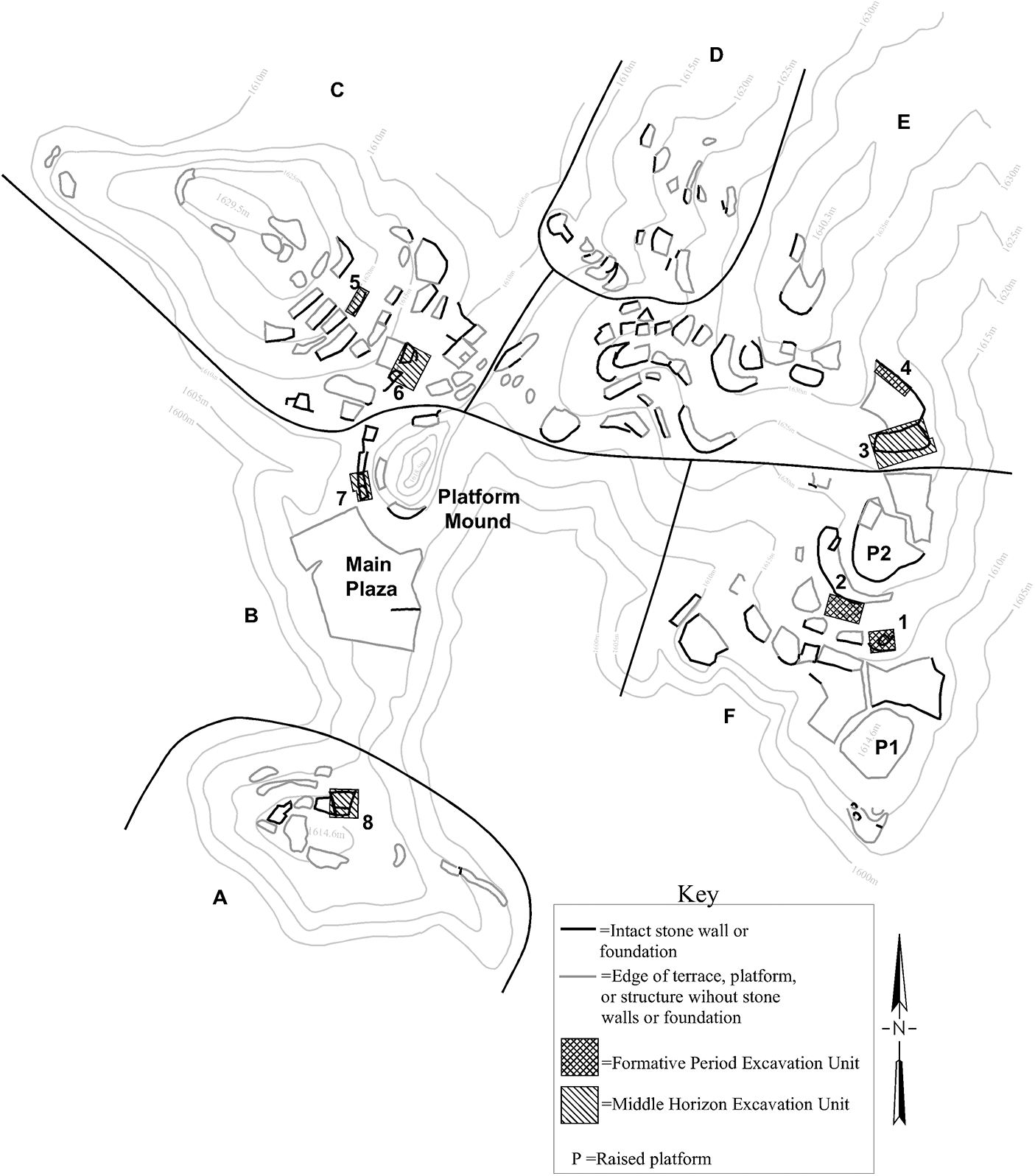
Yahuay Alta has both Formative period and Middle Horizon occupations and is unique among Huaracane settlements for several reasons. First, covering approximately 4 ha, this settlement is substantially larger than the typical Huaracane settlement. Second, it is located on steep slopes approximately 140 m above the Rio Huaracane floodplain, making it more inaccessible than most other Huaracane settlements. Third, this is the only known Huaracane site with documented occupation contemporary with the Middle Horizon.Footnote 1 Finally, and most importantly, Yahuay Alta is the only Huaracane settlement with large-scale public ceremonial architecture identifiable on its surface (Costion Reference Costion2013; see Figure 2:Sector B).
Site plan of Yahuay Alta.

Yahuay Alta, located high up on the southwestern slopes of Cerro Estuquiña, consists of primarily small domestic terraces with low fieldstone foundations spread over a series of six narrow ridges separated from one another by steep-sided quebradas (Figure 2). The two western ridges of the site are divided into six spatial sectors, five of which (A, C, D, E, and F) consist primarily of residential terraces of varying sizes and shapes (Costion Reference Costion2013). Two sectors at Yahuay Alta (Figure 2:Sectors B and F) contain public architecture; Sector F has two relatively low elevated platforms (Figure 2:P1 and P2), and Sector B consists of a large platform mound-plaza complex. This architecture has not been securely dated, although ground-penetrating radar evidence suggests they were constructed in single events (Costion and Vining Reference Costion and Vining2014). The platform mound is approximately 700 m2 at its base and approximately 8 m in height. The results of ground-penetrating radar suggests that this feature is a modified natural rise and thus was not constructed from the ground up (Costion and Vining Reference Costion and Vining2014). The platform mound is located directly in front of a large, approximately 930 m2, artificially leveled, open plaza delimited on its eastern and western sides by steep, nearly vertical slopes that allowed unobstructed visual access to activities taking place within this complex from elsewhere in the community. Halfway up the platform mound there is a narrow terrace that directly faces the plaza. The mound is flanked on its west side by three small contiguous rectangular structures with fieldstone foundations and walls; the southernmost of these structures (Figure 2: Unit 7) is one of the key contexts in our botanical analysis.
Yahuay Alta’s late Formative period occupation is represented by excavation Units 1, 2, and 4 (Figure 2), which all consist of small circular or semicircular structures in which low densities of Huaracane-style ceramic sherds and locally sourced lithic debitage were found (Costion Reference Costion2013). These structures date to between 125 cal AD and 361 cal AD at the 2σ range (Costion Reference Costion2013:Table 1)Footnote 2 and are all domestic contexts. The Middle Horizon occupation is represented by excavation Units 3, 5, 6, 7, and 8 (Figure 2), which all consist of rectangular structures with stone foundations that are similar to structures found at the Wari site of Cerro Trapiche (Green and Goldstein Reference Green, Goldstein and Jennings2010). These contexts are associated with both typical Huaracane artifacts and small quantities of atypical artifacts such as biotite tempered ceramics and nonlocal obsidian (Costion Reference Costion2009, Reference Costion2013; Williams et al. Reference Williams, Reid, Nash, Chacaltana, Costion, Goldstein, Sharratt, Feinman and Riebe2022) and date to between cal AD 692 and cal AD 965 at the 2σ range (Costion Reference Costion2013:Table 1). Units 3, 5, 6, and 8 were all domestic structures.Footnote 3 Notably Units 3 and 8 were domestic contexts that were possibly associated with elite community members, although the artifact patterns in the contexts do not reflect overtly conspicuous displays of wealth like those found in Huaracane mortuary contexts (Costion Reference Costion2009:264–269).
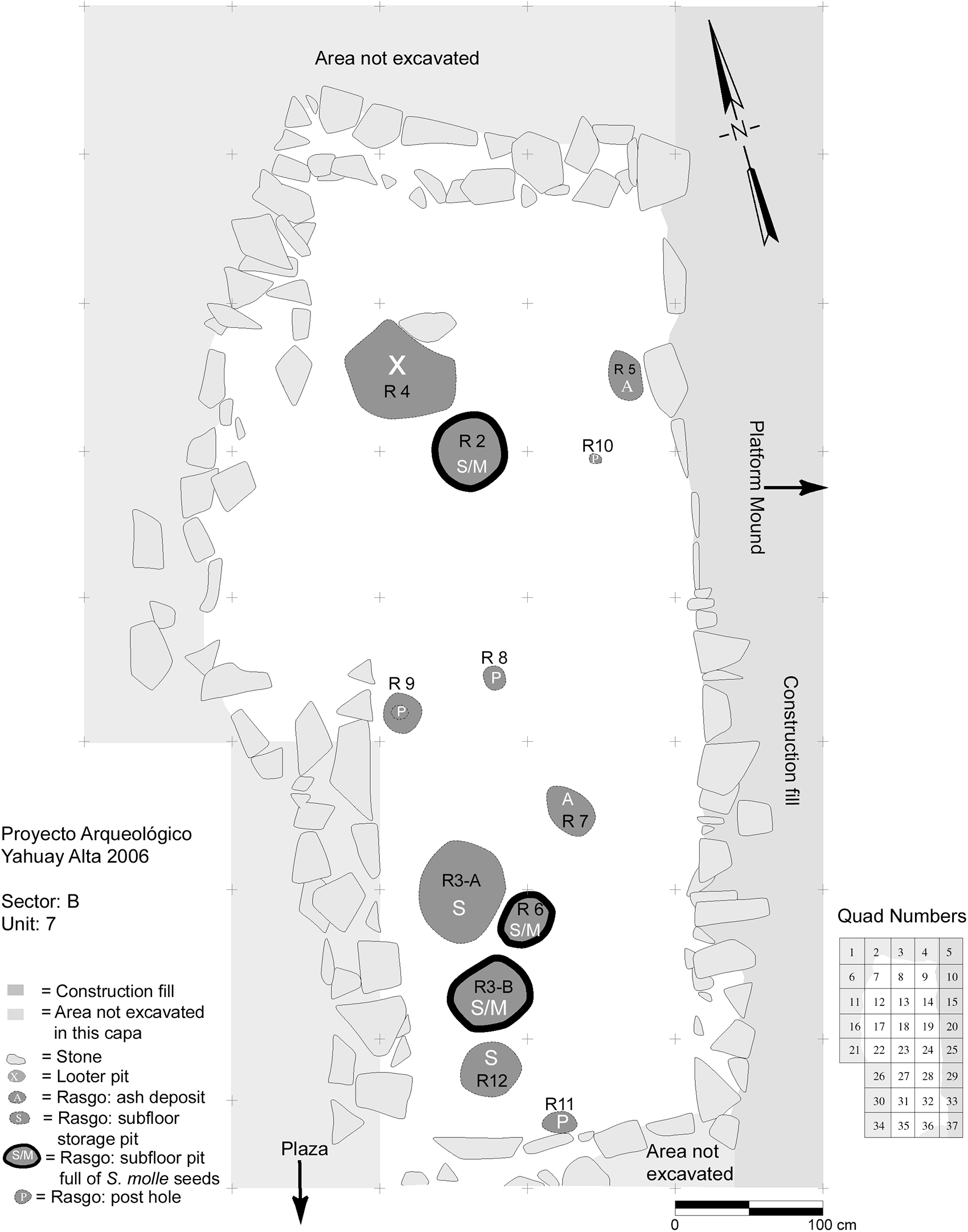
Unit plan of Yahuay Alta Unit 7.

Situated directly to the west of the platform mound at its base, Unit 7 is the only nondomestic context excavated at Yahuay Alta and is part of the site’s platform mound/plaza complex (Figure 3). The roughly rectangular structure in Unit 7 had well-preserved stone wall foundations and was both surrounded and filled by fieldstone wall fall suggesting it had stone walls in addition to a stone foundation. These walls are one of the unique characteristics that differentiate this context from most domestic structures at Yahuay Alta. This structure also appears, in its southern and narrower half, to have been roofed based on the identification of three well-preserved postholes (Costion Reference Costion2013). Five subfloor storage pits, all located on the interior of the structure, excavated into the natural subsurface were found in this structure ranging from 19 to 32 cm deep and 32 to 82 cm in diameter. One of these pits, Rasgo 3A, was a large, rounded bottom pit that appears to have been shaped to hold a large, rounded olla. Unit 7 is interpreted as a nondomestic context because it is built directly into the base of the platform mound and thus integrated into the public-ceremonial platform mound-plaza complex; the stone walls of this structure were taller than the other investigated structures at the site dating to the Middle Horizon that in contrast only had stone wall foundations; and as will be detailed in the text that follows the botanical assemblage in this context was unique including highly desirable food products not found in domestic contexts (Costion Reference Costion2009).
Macrobotanical Methods and Analysis
Systematic soil samples were collected during the excavation of Yahuay Alta. The samples selected for analysis come from domestic and public ceremonial contexts and include all excavated rooms within a compound when possible. A 1 × 1 m grid was created within each excavation unit for spatial control. The soil samples were collected using a standardized blanket sampling strategy (Pearsall Reference Pearsall2015:75–76); a 1 or 2 L pinch soil sample was taken from each 1 × 1 m grid square and excavation layer, and features were collected in their entirety. Soil samples selected for analysis include as many feature and floor contexts as possible from each unit to provide a representative sample of activities. Archaeobotanical remains were recovered using the dry-sieve technique because water flotation would destroy fragile desiccated remains. Soil samples were placed into a geologic sieve stack (2 mm, 1.4 mm, 0.71 mm) and agitated to separate the material into size categories and then scanned using a stereoscopic microscope to recover botanical remains. Seeds were counted and weighed, and wood was only weighed. Our analysis includes plant remains from (1) systematically collected soil samples and (2) those nonsystematically collected, mostly from pit features, during excavation (Units 3 and 8) and features composed almost entirely of plant remains (Unit 7; see preceding text). These data are presented separately due to their distinct recovery strategies.
Macrobotanical Results Recovered from Soil Samples
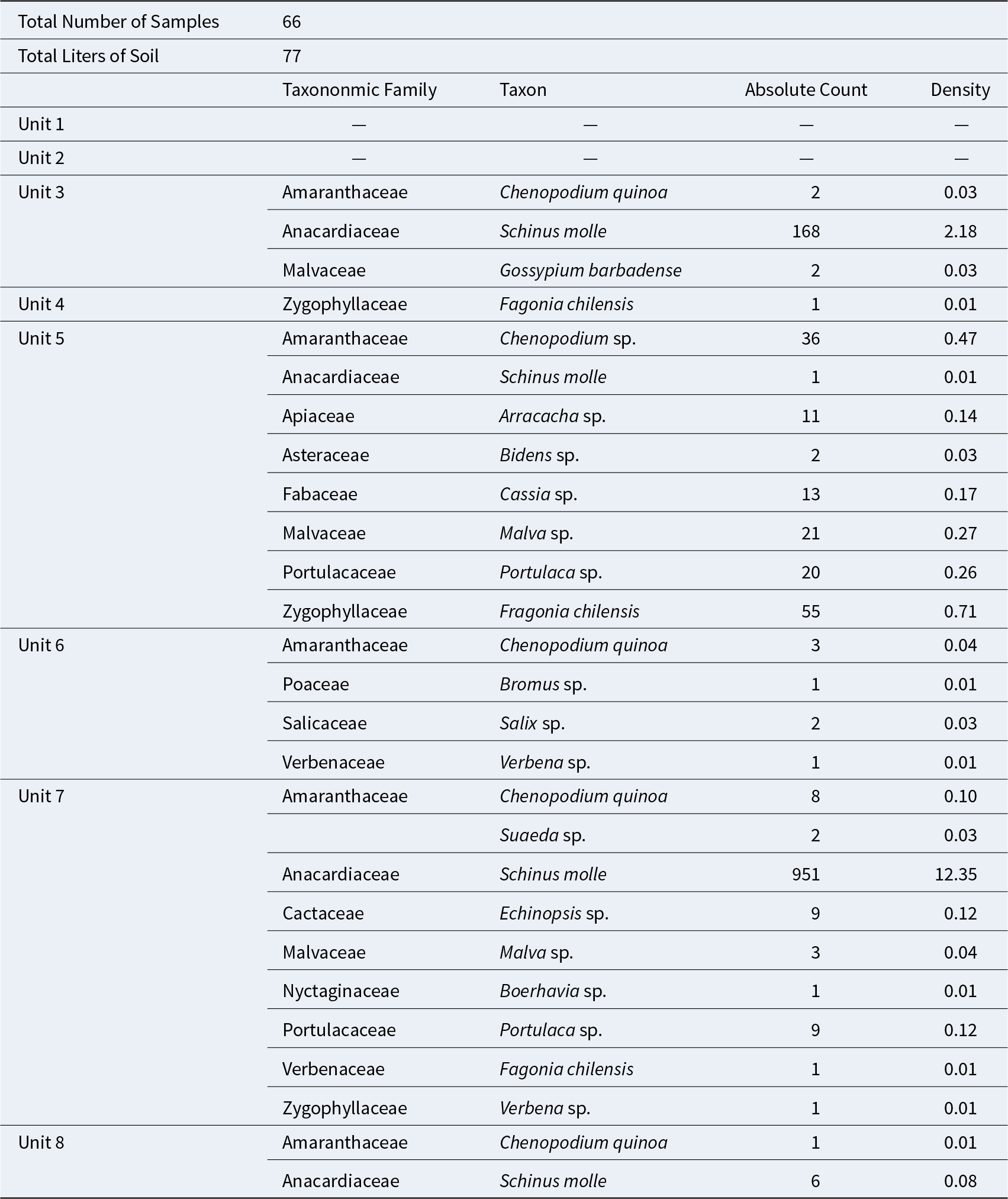
A total of 66 systematically collected soil samples were analyzed, from which 1,409 individual seeds representing 15 genera were recovered and identified from eight excavation units (Table 1). Schinus molle was the densest of the recovered seeds. Weedy companion species, such as Fagonia chilensis, Portulaca sp., Bidens sp., Bromus sp., and Verbena sp., were likely brought to the settlement from nearby fields alongside cultivated plants and may represent on-site processing activities. Arracacha (Arracacia xanthorrhiza) is an edible tuber that is still grown in the Moquegua Valley today. The cactus seeds (Echinopsis sp.) are from a locally available cactus with edible fruit commonly found at other sites in the valley (Goldstein et al. Reference Goldstein, Goldstein, Williams, Jennings and Bowser2009), which could have been tended or gathered. No seeds were recovered from Units 1 and 2; notably these two units also had lower densities of artifacts indicating that domestic refuse was less dense here in comparison to other excavated contexts at the site (Costion Reference Costion2009) suggesting the lack of macrobotanical remains from these units is not likely the result of sampling error.
Archaeobotanical Remains Recovered from Systematically Collected Soil Samples.

Macrobotanical Remains from Pit Features
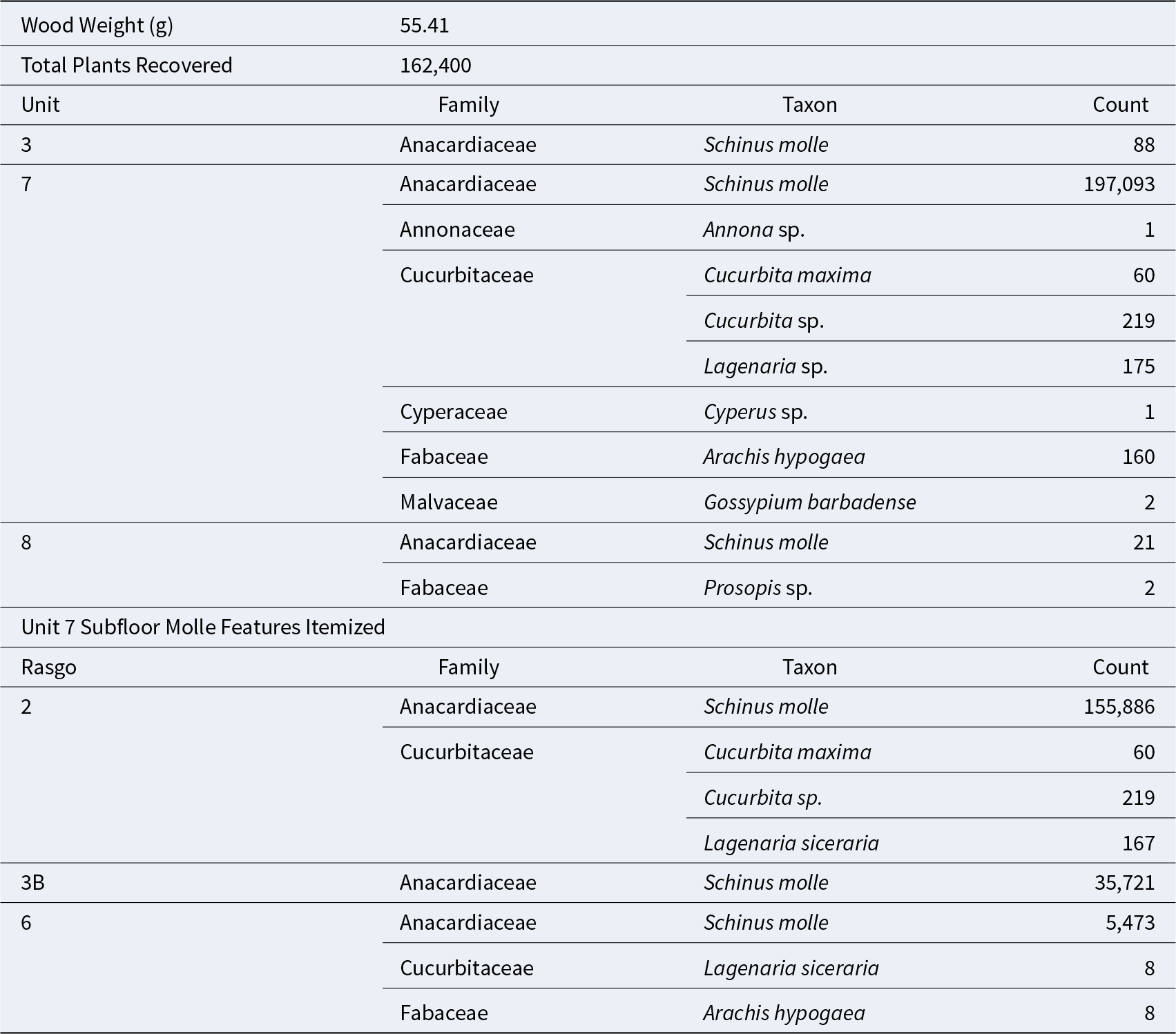
Overall, there was a greater abundance of plant remains, largely from discrete pit features, that were hand-collected during excavation (see Table 2). Wood charcoal was present in all eight units, but seeds were recovered solely from Units 3, 7, and 8. The most numerous hand-collected seeds include molle (n = 197,202), squash (Cucurbita sp.; n = 219), gourd (Lagenaria siceraria; n = 175), and peanut (Arachis hypogaea; n = 160), all of which can be grown locally. Algarrobo (Prosopis sp.) is a tree that could have been used as construction material and fuel, and the seeds can be consumed as food. Cotton (Gossypium barbadense), also locally available, is an economically important cultigen used for clothing, cordage, and bags, all of which have been found in Huaracane burials (see Goldstein Reference Goldstein2000) but not at Yahuay Alta. The Cyperus sp. seeds recovered likely represent riverine cane used for constructing woven walls or roof structures at the site. Maize was not identified macrobotanically at Yahuay Alta, which is noteworthy as maize is very common at nearby Tiwanaku and Tiwanaku-affiliated sites in the Moquegua Valley during the Middle Horizon for brewing chicha de maíz and culinary dishes (Goldstein Reference Goldstein and Tamara2003).Footnote 4
Nonsystematically Collected Archaeobotanical Remains Handpicked from Screened Excavation Sediment (Units 3, 7, and 8) and from Dense Discrete Deposits (Unit 7) by Excavation Unit.

Chicha de molle Production and Use
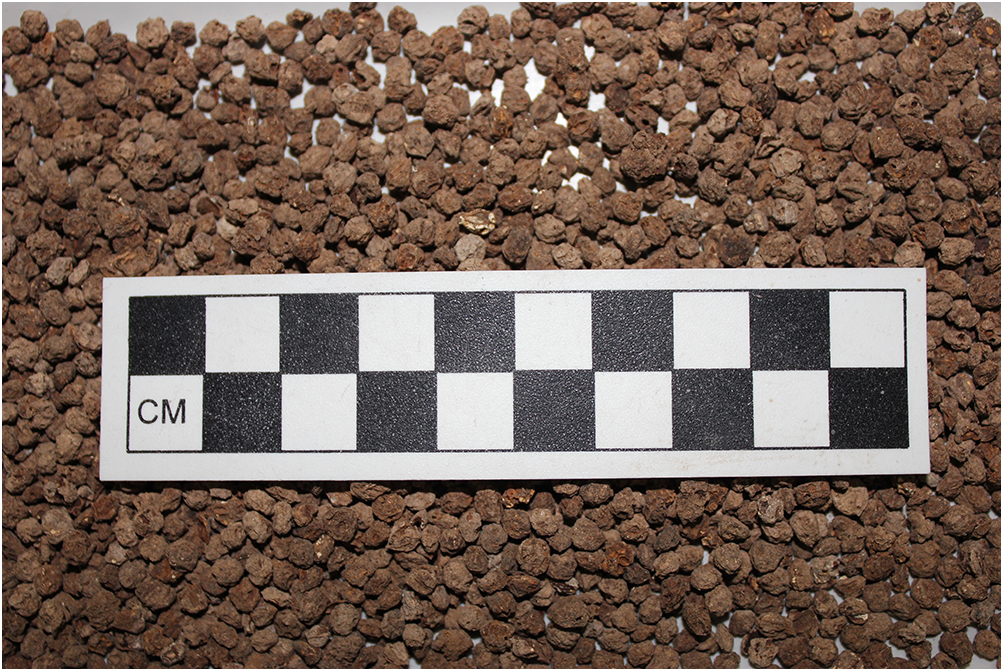
Perhaps the most notable plant recovered from Yahuay Alta are the large number of Schinus molle seeds (Figure 4), which are an ingredient for making chicha de molle, an alcoholic beverage. There are various methods for brewing chicha de molle, but generally the molle fruits are soaked or boiled in water to remove sugars and oils (see Nash et al. Reference Nash, Biwer and Witte2023; Valdez Reference Valdez2012). The result is a pepper-flavored liquid that is fermented for several days and consumed fresh.
Schinus molle drupes recovered from Yahuay Alta Unit 7. (Color online)

Molle Recovery at Yahuay Alta
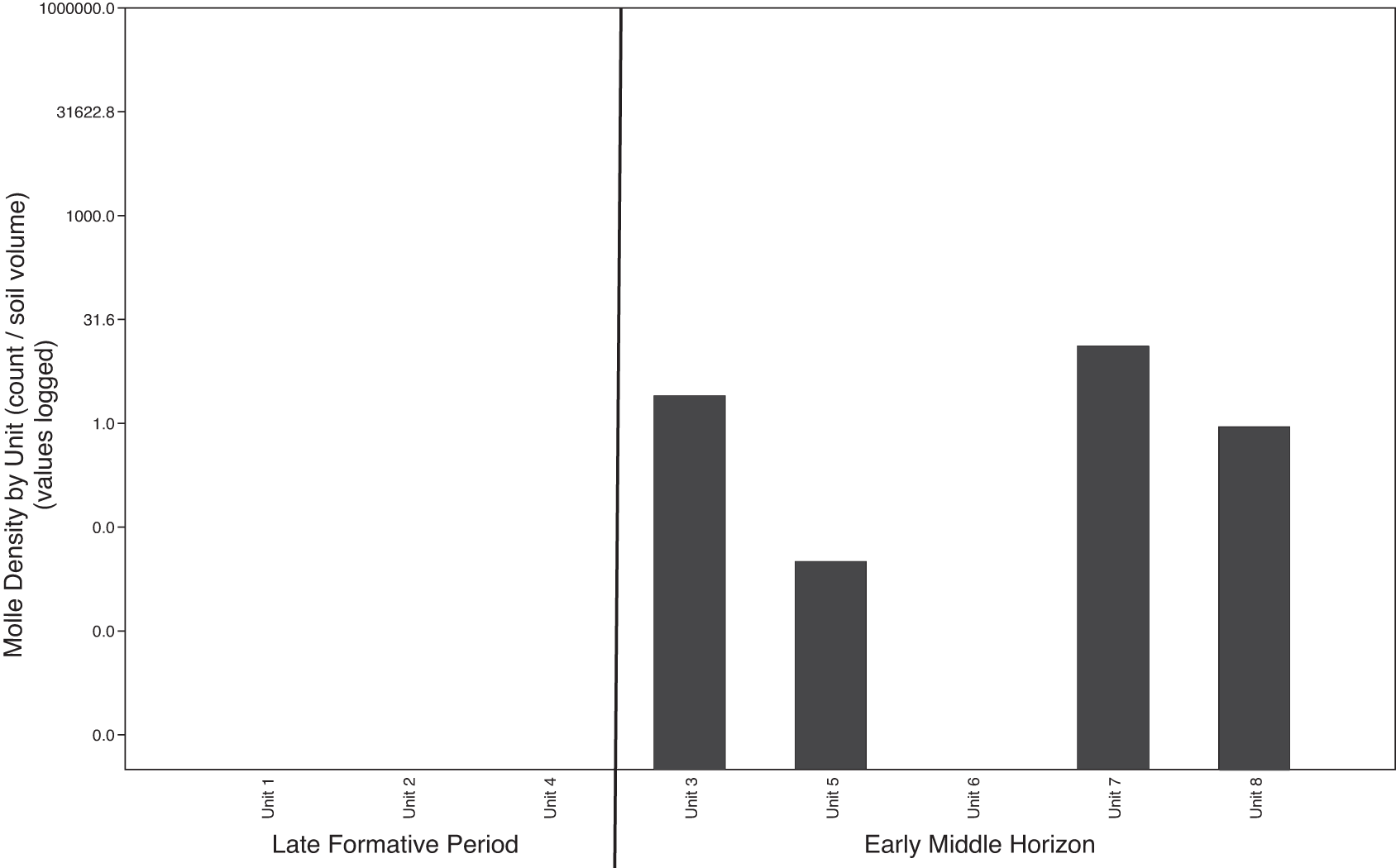
In total, 1,126 molle seeds were recovered from soil samples (Table 1) and 197,202 from pit features and the excavation screen (Table 2). The hand-collected molle seeds from Unit 7 came from three discrete dense deposits found in subfloor pits described in more detail in the following text. Morphological changes, such as a pinched or compacted shape, present in all the molle seeds from Yahuay Alta are consistent with molle from Wari sites cited as evidence for soaking or boiling during chicha production (see Sayre et al. Reference Sayre, Goldstein, White and Williams2012). There is a clear chronological element to molle presence at Yahuay Alta (Figure 5). Molle was not recovered from any context preceding the Middle Horizon, including late Formative period domestic Units 1, 2, and 4, as well as the Middle Horizon Unit 6. Instead, molle was recovered solely in Units 3, 5, 7, and 8, which all date to the Middle Horizon and span domestic and public-ceremonial contexts.
Molle density at Yahuay Alta.

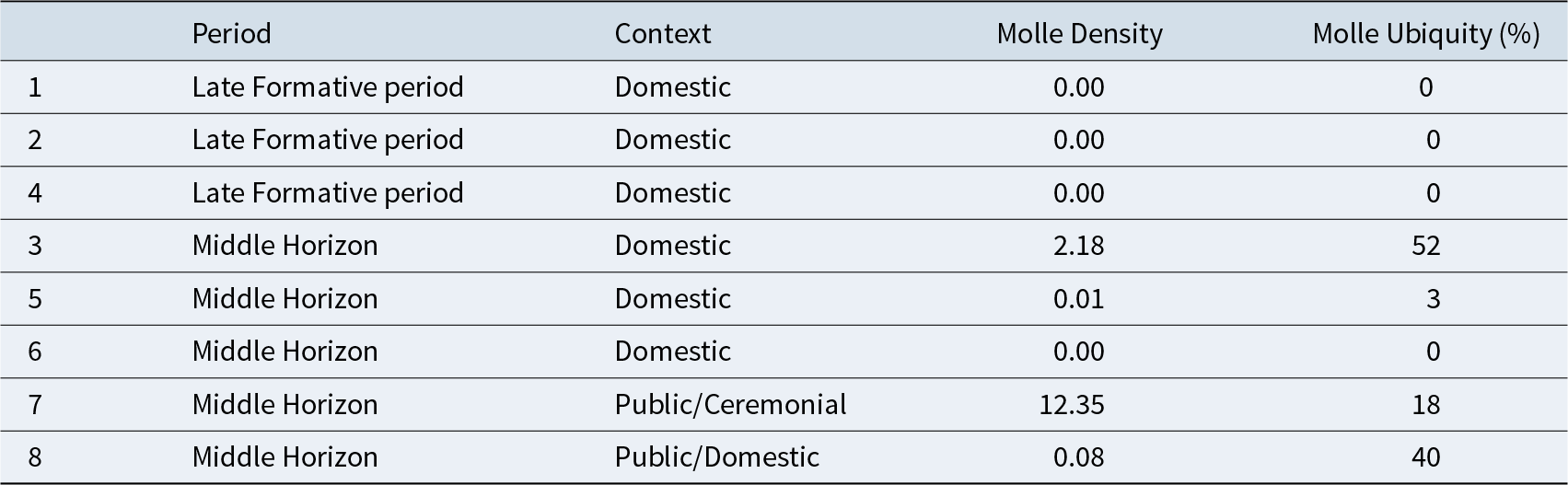
Molle ubiquity, which provides a sense of how widespread a taxon is at a site, is relatively low at Yahuay Alta (Table 3). Based on the recovery of molle from soil samples, Unit 3 exhibits the highest molle ubiquity (52%), and all other units are considerably lower ranging from 40% to 3%. While there is a range in molle ubiquity, in general it is quite low at the site in comparison to the pattern of recovery at Cerro Baúl (see Goldstein et al. Reference Goldstein, Goldstein, Williams, Jennings and Bowser2009; Nash et al. Reference Nash, Biwer and Witte2023).
Molle Density and Ubiquity Values.

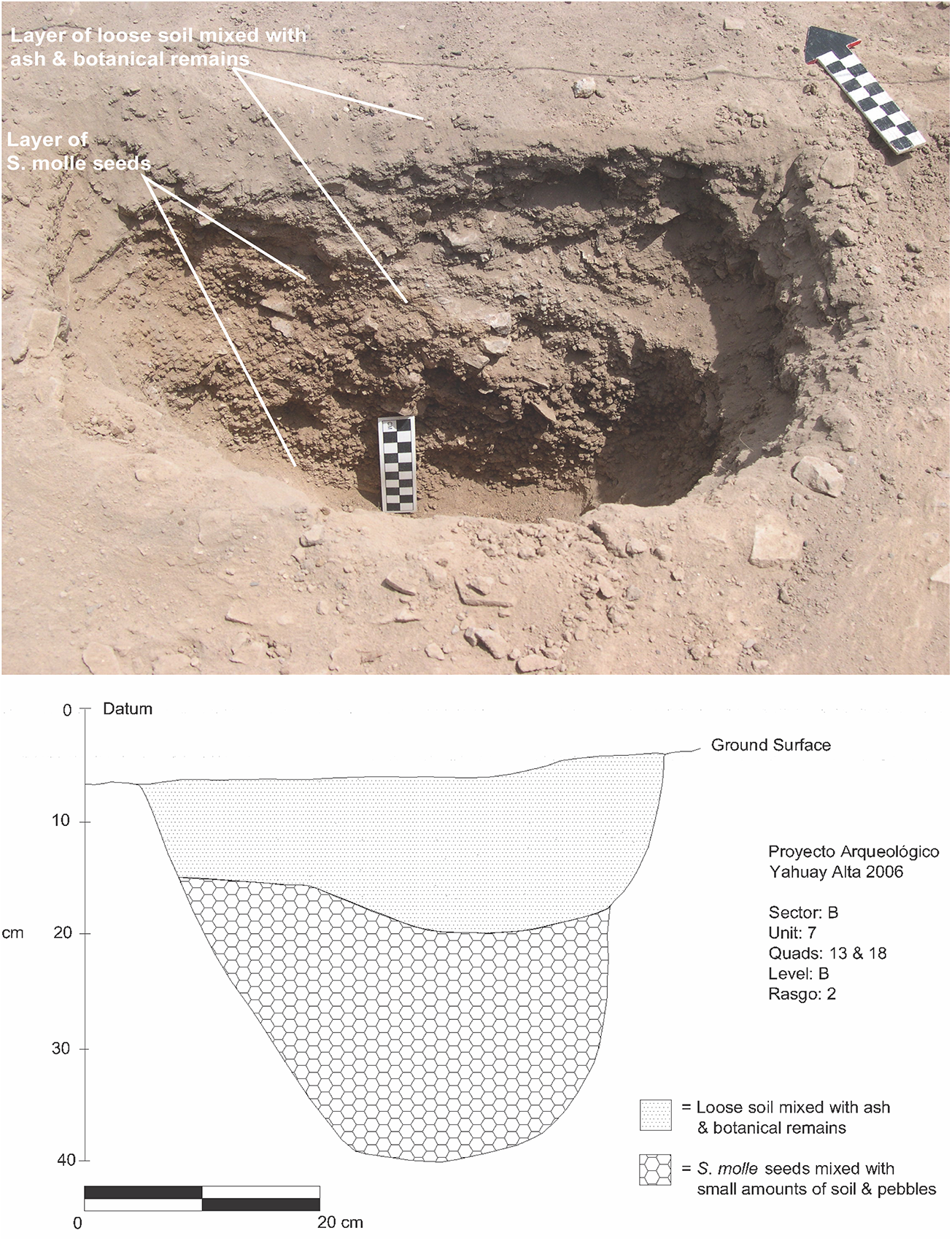
Qualitatively comparing the molle density (seed count / total soil volume) from soil samples (Table 1) and absolute count from the discrete pit features and excavation screen contexts (Table 2), we find molle remains to be profoundly greater in Unit 7, one of the structures situated directly west of the platform mound in Sector B. This is due to three discrete pit features filled with 197,080 individual molle seeds that were hand-collected from the unit. These three pits, designated as Rasgos 2, 3B, and 6 (Table 2), each consisted of two distinct layers. The upper layer was composed of dark loose soil and ash mixed with unburned botanical remains (notably peanut, squash, and gourd) and charcoal that averaged approximately 10 cm thick. Below this layer was a much thicker layer that consisted almost entirely of densely packed desiccated molle seeds that extended to the base of each pit (Figure 6). It is from the lower layer in each of these pits where the majority of hand-collected molle remains were recovered. Due to these pit features, Unit 7 has a considerably higher abundance of molle seeds than the next highest context at the site, Unit 3. Notably, Unit 7 also had a unique botanical assemblage, including squash and peanuts, that were not found in any other excavated context or recovered from systemically collected soil samples. These food remains were found in the upper layer of the molle pit features. Despite the presence of ash and charcoal in the upper layer of the subfloor pits containing molle there was no indication of burning in these features; additionally, no identifiable hearths or burning features were found in Unit 7 although two small shallow ash deposits without evidence of burning were encountered (Costion Reference Costion2009). The staggering amount of soaked molle seeds and the lack of carbonization suggests these subfloor pits reflect brewing event(s) that took place in another presumably nearby context, perhaps one of the rooms adjacent to Unit 7.
Profile photograph and drawing of feature/rasgo 2 subfloor molle pit from Unit 7. (Color online)

Finally, dividing the excavated units into public/ceremonial and private/domestic contexts we find molle density to be highest in public/ceremonial space, most notably Unit 7 (see Table 3). The centrally located platform mound-plaza complex associated with Unit 7 occupies a prominent position at the site and would have been visible and accessible to all residents. Further, molle seeds are most associated with Unit 7, evidenced by the large amounts of these seeds discarded in the pits discussed above as well as the presence of a large olla-shaped pit in this unit (Costion Reference Costion2009:222). Unit 7 possibly represents a room used for the preparation of public ritual ceremonies involving food and alcoholic beverages during the Middle Horizon occupation. At the very least this room appears to be a context where some of the refuse resulting from such preparations was deposited.
Discussion
In sum, three patterns of molle recovery at Yahuay Alta have become clear: (1) molle is present in four units at Yahuay Alta dating to the Middle Horizon but absent in earlier Formative period contexts; (2) molle ubiquity throughout the site is relatively low, but molle density and absolute count are high in Unit 7; and (3) molle is most associated with Unit 7, which is part of a monumental public-ceremonial space with an open design ideal for collective gatherings/events. While molle could have been used for other purposes, the (1) large amount of molle, (2) evidence of soaking or pressing of the fruit to extract fermentable sugars, (3) the absence of burnt molle seeds indicative of fuel use at the site, (4) recovery of molle in Unit 7 from large pits in association with desirable food products, and (5) the presence of ash and charcoal in the upper layer of the molle dreg pits and a large olla-shaped pit, all in Unit 7, together suggest that the large number of molle seeds recovered from Yahuay Alta were used to brew chicha de molle.
In contrast, tens of thousands of molle seeds litter virtually all contexts on the summit of Cerro Baúl; Biwer (Reference Biwer2019:129) found molle to have 90% ubiquity within sampled contexts. However, the presence of molle in a feature does not necessarily mean that brewing occurred in that context (see Nash et al. Reference Nash, Biwer and Witte2023). Indeed, there are clear differences in the patterns of molle remains at Cerro Baúl. The Palace (Units 9 and 24) is an elite household reserved for the highest-ranking individuals at the colony (Nash and deFrance Reference Nash and deFrance2019). Goldstein and colleagues (Reference Goldstein, Goldstein, Williams, Jennings and Bowser2009:Figure 6.2) recovered 33,854 molle seeds from inside the Palace, including the associated kitchen, internal courtyard, storerooms, and other features. A range of molle absolute counts were recovered from features in rooms within these structures ranging from 12,278 seeds to some with less than 100 (Goldstein et al. Reference Goldstein, Goldstein, Williams, Jennings and Bowser2009:Table 6.5).
The Brewery (Unit 1 and 42) also contained a high absolute count of molle. Goldstein and colleagues (Reference Goldstein, Goldstein, Williams, Jennings and Bowser2009:Table 6.5) recovered 9,857 molle seeds from Unit 1. The presence of a grinding room, boiling room, and fermenting room (Moseley et al. Reference Moseley, Nash, Williams, deFrance, Miranda and Ruales2005; Nash et al. Reference Nash, Biwer and Witte2023) all point to large-scale production of chicha de molle, among other chichas. These distinct areas of production of the beer are unique to other Wari sites and reflect large-scale production for state-sponsored feasts and other special occasions.
Similar patterns of chicha de molle use have been recovered from Wari sites in Ayacucho. For example, Sayre and colleagues (Reference Sayre, Goldstein, White and Williams2012:246) recovered molle from a variety of contexts at Conchopata. Molle is the second most ubiquitous (42%) and third most dense (0.55) plant recovered from the site, suggesting widespread production of chicha de molle, but perhaps not as intensive as the volume of chicha brewed at Cerro Baúl (Sayre and Whitehead Reference Sayre, Whitehead, Matthew and Bruno2017:Table 1). Sayre and Whitehead (Reference Sayre, Whitehead, Matthew and Bruno2017:131) note that molle was recovered slightly more frequently from ritual deposits at the site yet was likely a regularly brewed beverage at Conchopata that was an essential component in religious ritual and commensal politics. Further, at Quilcapampa, Biwer and colleagues (Reference Biwer, Yépez Álvarez, Bautista and Jennings2022) recovered approximately 1.4 million molle seeds. Molle has a high ubiquity (84%) but low density within most structures at the site (Biwer Reference Biwer2019:Figure 5.8). One feature in Sector A, the central area of the site, is unique. This midden contained more than 1.2 million molle seeds exhibiting similar morphological changes to the molle recovered from Cerro Baúl, Conchopata, and Yahuay Alta (Biwer et al. Reference Biwer, Yépez Álvarez, Bautista and Jennings2022). While this was not a dedicated brewery, the location of the midden within the central portion of the site suggests an inward focus of events that supported a collective experience (Biwer et al. Reference Biwer, Yépez Álvarez, Bautista and Jennings2022:152).
The pattern of high molle density and ubiquity at Cerro Baúl and other Wari sites stands in contrast to the pattern identified at Yahuay Alta. There is no identifiable dedicated brewery at Yahuay Alta comparable to the example from Cerro Baúl, although Unit 7 and the structures adjacent may have been the location of comparatively smaller-scale brewing. In fact, sitewide molle recovery at Yahuay Alta has relatively low ubiquity (30%) compared to Wari sites. There are also no domestic contexts at Yahuay Alta with features containing high densities of molle like those within the Palace at Cerro Baúl or in Sector A of Quilcapampa. Instead, we find molle is largely associated with a few high-density features located adjacent to the platform mound-plaza complex where residents could have participated in public ceremonies and community-wide feasting events. The wide-open, visually unrestrictive design of Yahuay Alta’s platform mound-plaza complex was ideal for large-scale, seemingly inclusive, communal gatherings that could have been witnessed by much of this settlement’s community. This contrasts with the smaller-scale and presumably exclusive elite gatherings that took place in the more confined open spaces typical of elite Wari patio group architecture (e.g., Cook and Glowacki Reference Cook, Glowacki and Bray2003:184–192). Even larger-scale Wari plazas that could have accommodated large gatherings, such as those in Sector C at Cerro Baúl near the site’s brewery facility, are typically bound by walls restricting visual access to the activities taking place within and were thus by design exclusive spaces (Nash and Williams Reference Nash, Williams, Vaughn, Ogburn and Christina2004:167). The lack of high densities of molle remains suggestive of elite feasting within compounds or domestic contexts at Yahuay Alta indicates that chicha de molle was not part of private elite feasting, as it was at Wari-affiliated sites representing a clear departure from Wari commensal chicha drinking practices. Additionally, the visually open layout of Yahuay Alta’s platform mound-plaza complex differs from the walled design of large-scale Wari plazas suggesting an inherently different social context associated with the activities in this complex.
Conclusions
The integration of chicha de molle brewing and presumed consumption into communal feasting practice by the Huaracane at Yahuay Alta highlights a case of frontier culture contact in which a particular aspect of colonizer foodways became entangled through interactions with an Indigenous group. As a result, it is important for us to consider how the entanglement of chicha de molle potentially impacted the Huaracane community at Yahuay Alta; as Dietler (Reference Dietler1990:378) emphasizes, “Borrowed forms of drink . . . must be understood primarily with the framework of practices, institutions, and ideology existing within the recipient society.” Feasts involving alcoholic beverages are especially effective for ambitious individuals to subtly create social obligations in their favor (Dietler Reference Dietler1990:372). In such cases feasts featuring alcoholic beverages can conceal the self-interested motives of ambitious leaders because of their inherent atmosphere of generosity and hospitality (Dietler Reference Dietler and Cusick1998:303, Reference Dietler, Dietler and Hayden2001). Additionally, feasts can serve as arenas for the transformation of long held cultural values and the acceptance of exotic practices (Dietler Reference Dietler, Dietler and Hayden2001, Reference Dietler and Twiss2007:227). Following this logic, the strategy of feasting with chicha de molle possibly allowed ambitious Huaracane community leaders at Yahuay Alta to enhance their status and power without radically deviating from their cultural traditions that discouraged conspicuous displays of wealth in everyday community settings. Thus, after the arrival of Wari colonists on the Moquegua frontier, the Wari practice of brewing chicha de molle became known to the Huaracane people and was subsequently incorporated into selected highly visible ceremonial activities that took place in the platform mound-plaza complex.
Wari leadership is theorized to have spent a great deal of resources on feasting and spectacle as components of commensal politics (e.g., Biwer et al. Reference Biwer, Yépez Álvarez, Bautista and Jennings2022; Cook and Glowacki Reference Cook, Glowacki and Bray2003; Jennings et al. Reference Jennings, Alaica and Biwer2023; Nash Reference Nash2022; Nash and deFrance Reference Nash and deFrance2019; Nash et al. Reference Nash, Biwer and Witte2023; Sayre and Whitehead Reference Sayre, Whitehead, Matthew and Bruno2017; Williams Reference Williams and Nash2021). At Wari sites molle seeds that represent the dregs of chicha de molle brewing, while ubiquitous and dense, often correlate closely with elite domestic contexts. These were the locations of more intimate political negotiations, such as the interior courtyards and rooms of patio groups and may have been part of regular Wari elite activities designed to forge relationships with locals (Biwer et al. Reference Biwer, Yépez Álvarez, Bautista and Jennings2022; Nash and deFrance Reference Nash and deFrance2019; Nash et al. Reference Nash, Biwer and Witte2023; Williams and Nash Reference Williams and Nash2021). In contrast, once chicha de molle brewing and feasting was practiced at Yahuay Alta, the evidence from domestic contexts indicates Huaracane leaders likely did not produce or consume chicha de molle at the household level in structures such as those represented by Unit 3 and Unit 8, suggesting a distinct valuation of this beverage between these two cultures.
Consequently, the practice of feasting with chicha de molle became entangled on the Wari-Huaracane frontier. Huaracane leaders learned about and adopted a food practice of the colonizer and integrated it in ways distinct from Wari that made sense to their cultural context. Huaracane leaders appear to have integrated chicha de molle into community politics in a distinctly public way, combining the new with the familiar, that departed from political feasting within interior patios and households and walled plazas common in the Wari political economy. This was in part because on the frontier Wari colonists in Moquegua may have lacked the authority, power, resources, or even the desire to force widespread change in local foodways. This is not to say that the Wari had no agency in this interaction; they would have recognized that feasting with chicha offered a particularly powerful and attractive pathway to power for ambitious individuals or families among the less politically complex Huaracane. In the Moquegua Valley feasting appears to have been an effective and rather diplomatic colonial strategy employed by the Wari to recruit local leaders to their cause, perhaps to gain the laborers for the construction of the infrastructure necessary for the successful colonization of the upper valley. At the same time Huaracane leaders at Yahuay Alta, and possibly other settlements as well, seemingly altered this newly introduced feasting practice to their own advantage to gain a socially acceptable path for establishing and legitimizing sociopolitical differences within their communities. This case highlights the complex social nature of the Wari frontier in the Moquegua region, which furthers archaeological investigations of culture contact by demonstrating how evidence related to foodways speaks to the unique and creative cross-cultural colonial negotiations in frontier contexts. We suggest the utility of investigating foodways is widely applicable in frontier culture contact settings because of its ability to offer nuanced perspectives of the dynamic and situationally unique processes of cultural entanglements and associated culture changes in the past.
Acknowledgments
The 2006 excavations at Yahuay Alta were conducted by Costion under an official permit (#1739) issued by the Peruvian Istituto Nacional de Cultura and the botanical remains were analyzed by Biwer under an official permit (#000026-2016/DGM/VMPCIC/MC) issued by the Peruvian Ministerio de Cultura. We are grateful for Eloy Calizaya assisting with the processing of the soil samples. David Goldstein and Lizette Muñoz Rojas conducted the initial sorting of the Yahuay Alta botanical remains. We thank Amber VanDerwarker, Katherine Chiou, and Christine Hastorf for their comments on an early draft of this article and four anonymous reviewers for their comments on the article manuscript. Finally, we would like to thank the staff at the Museo Contisuyo in Moquegua for their help in managing the collections and being so welcoming to researchers.
Funding Statement
The authors thank the Wenner-Gren Foundation (9225 Biwer), the National Science Foundation (BCS #0628963 Costion and BCS #1634065 Biwer), and the University of California, Santa Barbara (Biwer) for funding the excavations and paleoethnobotanical analysis, without which this research could not have been conducted.
Data Availability Statement
All data from Costion’s 2006 excavations at Yahuay Alta are available through the University of Pittsburgh’s Comparative Archaeology Database: https://www.cadb.pitt.edu/costion/index.html. All materials from the 2006 excavations are housed at the Museo Contisuyo in Moquegua, Peru.
Competing Interests
The authors declare none.

 Open access

