


1 Introduction
Older adults are engaged in many risky assessments regarding critical issues such as health, finances, and social relationships, yet little consensus exists regarding the nature of age related changes in risk taking. Dual-process models predict that affective and deliberative abilities have important but distinct functions in risk taking behavior across the lifespan and that aging may differentially affect deliberative systems (Reference Peters, Hess, Va¨stfja¨ll and AumanPeters, Hess, Västfjäll, & Auman, 2007; Reference Peters, Bruine de Bruin, Dhami, Schlottmann and WaldmannPeters & Bruine de Bruine, 2012). An implication is that risk assessment in older adults may differ depending upon the affective versus deliberative nature of the task at hand.
1.1 Risk taking in older versus younger adults:
Overall, the literature on risk and aging has been mixed. On the one hand we have a range of studies arguing that older adults are risk-averse. Reference OkunOkun (1976), for instance, showed that older adults are more likely to choose less risky options, and Reference Bakshi and ChenBakshi and Chen (1994) found a negative relationship between age and risky investment behavior. Reference Vroom and PahlVroom and Pahl’s (1971) examination of risk taking among managers revealed similar trends: Younger (vs. older) managers were found to be more risk-seeking. Similarly, Reference Schooley and WordenSchooley and Worden (1999) showed a decline in financial risk tolerance among those over 65 years old, manifested in their decisions to invest more conservatively. An analysis by Reference Bellante and GreenBellante and Green (2004) of investment portfolio allocations found that older adults picked more risk-averse options. Similarly, older (vs. younger) university staff took less risk when developing retirement plans (Reference DulebohnDulebohn, 2002). Finally, using the Decision-Gamble Task, Reference Deakin, Aitken, Robbins and SahakianDeakin, Altken, Robbins, and Sakakian (2004) found that older adults were less willing to take risks than their younger counterparts.
In contrast, a number of laboratory studies and survey data suggest that in some circumstances older adults demonstrated increased risk seeing. Reference GrableGrable (2000) found a positive relationship between age and risk taking, such that older individuals reported greater financial risk tolerance (Reference Hope and HavirHope & Havir, 2002; Reference Mather, Carstensen and HartelMather, 2006; Reference Vander, Dodge, Pandav, Shaffer and GanguliVander Bilt, Dodge, Pandav, Shaffer, & Ganguli, 2004). However, Reference Dror, Katona and MungurDror, Katona, and Mungur (1998) found that younger and older adults exhibited similar risk taking behavior on a gambling task.
A number of researchers have used the Iowa Gambling Task (IGT; Reference Bechara, Damasio, Tranel and AndersonBechara, Damasio, Tranel, & Anderson, 1998) and the Balloon Analogue Risk Task (BART; Reference Lejuez, Read, Kahler, Richards, Ramsey and StuartLejuz, Read, Kahler, Richards, Ramsey, & Stuart, et al., 2002) to examine age difference in risk taking. Reference Kovalchik, Camerer, Grether, Plott and AllmanKovalchik, Camerer, Grether, Plott, and Allman (2005) found no behavioral differences on the IGT between young and older adults. Reference Wood, Busemeyer, Koling, Cox and DavisWood, Busemeyer, Koling, Cox, and Davis (2005) revealed that, while older and younger adults both demonstrated effective strategies, older adults employed an affective rather than a deliberative strategy, by attending less to losses. Reference Denburg, Tranel, Bechara and DamasioDenburg, Tranel, Bechara, and Damasio (2001), however, presented an even more complex picture. They found that, while the majority of older adults behaved similarly to their younger counterparts, a subsample of the older population showed a higher risk taking tendency. Reference Rolison, Hanoch and WoodRolison, Hanoch and Wood (2012) demonstrated that, while the initial behavior of older adults was more conservative on the BART, their overall behavior was similar to that of their younger counterparts, indicating that experience with a task was related to risk behavior. Finally, a study by Reference Henninger, Madden and HuettelHenninger, Madden and Huettel (2010), using the BART and the IGT, nicely illustrates the complexity of age effects on risk taking. On the IGT, older adults made worse decisions and tended to take more risks. On the BART, however, older adults were more risk-averse. The authors discuss different cognitive underpinnings to account for these findings. Taken together, these studies highlight the importance of task context in understanding risk taking across the lifespan.
In a meta-analysis of 27 risk and aging studies, Reference Mata, Josef, Samanez-Larkin and HertwigMata, Josef, Samanez-Larkin and Hertwig (2011) reported that age differences in risk behavior can be best understood in the context of task characteristics. That is, tasks that are greatly influenced by task experience (e.g., IGT) often show age differences secondary to learning components. Older adults look relatively risk averse when a task rewards risk seeking, but risk seeking when a task rewards conservative strategies. However, tasks that provided probability-type information did not necessarily show age differences. Further, there were no consistent age differences for gain/loss frame information. The authors noted several limitations of the current literature including a lack of lifespan samples, a lack of studies that examine life time learning and experience, studies of other risk domains (e.g., recreational), and a paucity of studies that specifically manipulate the magnitude of probability information and gain/loss information.
Only a handful of studies have considered how emotion might affect older adults’ risky decisions. Reference Chen and MaChen and Ma (2009) examined the role of emotions—positive, negative, or neutral—in risky decision among older and younger adults. Chen and Ma found that older adults tended to be more risk-averse than the younger adults. More importantly, their study reveals that older adults’ decisions were more likely to be influenced by positive emotions while younger individuals were more likely to be influenced by negative emotions. A study by Reference Chou, Lee and HoChou, Lee and Ho (2007) offered a similar pattern of results. In this study, younger and older adults completed a risk taking task after they watched positive, negative, or neutral films. Chou et al. failed to find a main effect of age. They did, however, find a main effect for mood, as well as an age by mood interaction. In the positive mood condition, older adults were greater risk takers; in contrast, in the negative mood condition, the younger adults exhibited more risk taking behavior. Clearly more work examining the interaction of risk, emotion, and aging needs to be done.
In sum, the literature provides a complex picture with regard to the relationship between age and risk taking. Task characteristics and emotional manipulations can drive the presence and the nature of these effects.
1.2 Dual-process models
Dual-process models have provided a useful framework for considering the role of affective and deliberative processes in decision-making across the lifespan. (For a recent review of theoretical frameworks, see Reference Peters, Bruine de Bruin, Dhami, Schlottmann and WaldmannPeters & Bruine de Bruine, 2012.) Emotional regulation has been found to improve with aging across a large number of studies (e.g., Reference Charles, Carstensen and GrossCharles & Carstensen, 2007; Reference Fung and CarstensenFung & Carstensen 2003; Reference Mather and CarstensenMather & Carstensen, 2005; Reference Spaniol, Voss and GradySpaniol, Voss, & Grady, 2008). However, certain aspects of cognitive functioning, including working memory, decline with age (Reference Park, Lautenschlager, Hedden, Davidson, Smith and SmithPark, Lautenschlager, Hedden, Davidson, Smith & Smith, 2002). Recent studies found older adults considered fewer pieces of information in their decision-making even while studying the information for longer periods of time, perhaps secondary to cognitive constraints (e.g., Reference Hanoch, Rice, Cummings and WoodHanoch et al., 2009; Reference Mata and NunesMata & Nunes, 2010; Reference Mata, Schooler and RieskampMata, Schooler, & Rieskamp, 2007).
1.3 The Columbia Card Task (CCT)
The current study used the Columbia Card Task (CCT; Reference Figner, Mackinlay, Wilkening and WeberFigner, Mackinlay, Wilkening, & Weber, 2009; Reference Figner and WeberFigner & Weber, 2011), a task that was initially developed to evaluate risk seeking in teenagers. Teenagers are known to demonstrate increased risk seeking under conditions of emotional arousal, but may be rationale decision-makers under more deliberative conditions. The CCT includes a “hot” and a “cold” version: the hot version is designed to trigger affective processes, whereas the cold version is aimed at initiating deliberative processes. In both versions, participants decide whether or not to turn over cards, where each card indicates a gain or a loss. Both versions have 32 cards for each of 24 trials, with three pieces of information that are relevant to making their decisions: (i) the probability of losing on each card (either 1/32 or 3/32), (ii) amount each card can gain (either 10 or 30 points), and (ii) amount each card can lose (either 250 or 750 points). Participants are also told that “within a given trial, cards can be turned over as long as gain cards are encountered” and when a “loss card is encountered … no more cards can be turned over and the specified loss amount is subtracted from the previous payoff” (Reference Figner, Mackinlay, Wilkening and WeberFigner et al., 2009, p. 712). Risk is conceptualized simply as the number of cards one is willing to turn over. In the hot version, feedback is given after each card is turned over, and the participant decides whether to turn over another card until the trial ends either with the participant deciding to stop or turning a loss card. In the cold version the participant indicates how many cards will be turned over for each trial in turn, and feedback is given only after all trials are completed. However, there is a confound with the “hot” version. Because a trial ends when a loss card is encountered, the true risk tolerance is underestimated if the participant would have been willing to turn more cards. This confound has been addressed with the addition of a “warm” version of the task. The warm version, which was used in the current research, allows the participant to identify at the beginning of a trial all the cards they would like to play on that trial, and then feedback is given as the outcome of that trial at the end of the trial. As such, the participants get feedback at the trial by trial level, rather than the card by card level (hot) (http://www.columbiacardtask.org).
1.4 Numeracy
Numeracy—the ability to understand basic mathematical concepts (Reference Schwartz, Woloshin, Black and WelchSchwartz, Woloshin, Black, & Welch, 1997)—has attracted much attention in recent years. There is evidence that older adults as a group exhibit lower levels of numeracy and that lower numerate adults are less adept decision-makers (Reference Banks and OldfieldBanks & Oldfield, 2007; Reference Tanius, Wood, Hanoch and RiceTanius, Wood, Hanoch, & Rice, 2009; Reference Peters, Hess, Va¨stfja¨ll and AumanPeters et al., 2007). Reference Galesic, Gigerenzer and StraubingerGalesic, Gigerenzer, and Straubinger (2009) found that older adults fared worse on both numeracy and on interpreting medical risk information and insurance information (see also Reference Wood, Hanoch, Barnes, Liu, Cummings, Bhattacharya and RiceWood et al, 2011). Numeracy may be important in understanding risk taking behavior among older adults as it may mediate the relationship between age and use of numerical information in risky situations, accounting for some of the mixed findings regarding age and risk taking behavior.
1.5 The current study
The current study evaluated risk taking for younger and older adults in two different contexts, one designed to trigger affective processes (i.e., the warm CCT) and one designed to trigger deliberative processes (i.e., the cold CCT). Working memory and numeracy were assessed as potential mediators and moderators of the relationship between age and risk taking. The following specific hypotheses were tested:
-
Risk taking: Most previous studies using risk tasks showed no overall age differences (Reference Mata, Josef, Samanez-Larkin and HertwigMata et al., 2011), so we did not predict a main effect for age per se. However, we predicted an interaction such that older and younger adults demonstrate similar risk seeking behavior in the affective condition, but older adults demonstrate greater risk seeking in the deliberative condition than younger adults (Reference Chou, Lee and HoChou et al., 2007).
-
To assess whether the warm and cold CCT evoked different aspects of the dual system in decision-making, the study applied the questionnaire Self-Reported Decision Strategies (Reference Figner, Mackinlay, Wilkening and WeberFigner et al., 2009) as a manipulation check. We expected all participants to employ more affect-based strategies in the warm condition and a more deliberative strategy in the cold condition.
2 Method
2.1 Participants
One hundred and fifty-eight participants were recruited from the Claremont, California area to participate in this study. Participants ranging from 18 to 93 years of age were randomly assigned to either the warm (n=80) or the cold condition (n = 78) and were compensated with a flat payment of 10 dollars. Education level was coded into five categories: 1 = high school diploma (35%), 2 = occupational or academic associate degree (21%), 3 = bachelor’s degree (18%), 4 = master’s degree (13%) and 5 = professional or doctoral degree (13%).
2.2 Material and procedure
All participants were tested individually at the Wood Neuropsychology of Decision-Making Lab at Scripps College. After signing the approved IRB consent form, participants completed the following materials.
2.3 Cognitive screening.
Participants were required to reach the minimum score of 26 out of 30 on the Mini-Mental State Exam (MMSE; Reference Folstein, Folstein and McHughFolstein, Folstein, & McHugh, 1975).
Working Memory.
Working memory was measured using the digit span forward and backward tests (Reference WechslerWechsler, 1991). The digit span tests have been found to have high reliability with adults (Cronbach’s alpha > .90, Reference WechslerWechsler, 2008). Forward digit span primarily measures the capacity to maintain information, whereas the backward digit span measures the ability to maintain and manipulate information (Reference Figner, Mackinlay, Wilkening and WeberFigner et al., 2009). The digits were presented orally by an experimenter at the rate of one digit per second. Each participant was asked to repeat the digits in the same order in the digit span forward test, and in reversed order in the digit span backward test. Following correct responses on two successive trials, the number of digits was increased by one digit. Both tests ended when participants made errors on two successive trials.
Numeracy.
Each participant was asked to fill out an 11-item numeracy scale (Cronbach’s alpha =.78, Reference Reyna, Nelson, Han and DieckmannReyna et al., 2009) to assess understanding of probabilistic information (e.g., Imagine that we roll a fair, six-sided die 1,000 times. Out of 1,000 rolls, how many times do you think the die would come up even (2, 4, or 6)? (Reference Lipkus, Samsa and RimerLipkus, Samsa, & Rimer, 2001).
Columbia Card Task.
Each participant was given 24 trials with 32 cards in each trial and asked how many cards they would like to turn over based on three factors: probability of loss (1 versus 3 loss cards out of a field of 32), gain amount (10 or 30 points per gain card), and loss amount (250 or 750 points). Feedback was given after each trial (warm condition) or only at the end of all 24 trials (cold condition). The 24 trials represented three replications of each of the eight possible combinations of the three factors. The data were collected from an online portal hosted athttp://www.columbiacardtask.org. The CCT measures not only the level of risk taking, but also how participants use information to decide how much risk they are going to take.
Self-reported decision strategies.
After completing the study, participants were asked to complete a self-reported decision strategies questionnaire. The questionnaire was designed to assess the extent to which participants used deliberative or affective strategies (Reference Figner, Mackinlay, Wilkening and WeberFigner et al., 2009) in either the warm or the cold condition. For example, “I tried to solve the task mathematically” was designed to measure the use of a deliberative strategy, and “I solved the task on a gut level” was used to assess the affect-based strategy. In addition, the item “At times during the game I felt a thrill” was used to assess emotional arousal. For each item, participants were asked to mark their agreement on a 0-100 millimeter scale (ranging from “doesn’t apply at all” to “strongly apply”). Finally, the presentation order of working memory span, numeracy, and CCT task with questionnaire was counterbalanced, such that approximately equal numbers of participants were assigned to each of eight possible orders.
3 Results
Of the original 159 participants, one older participant was excluded because of failing the cognitive screening task (MMSE). An examination of distributions revealed no outliers or missing data.Footnote 1
3.1 Risk taking
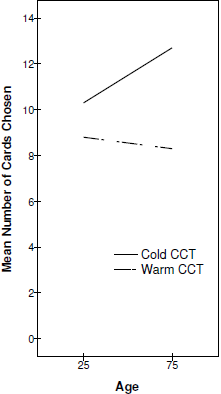
A hierarchical linear regression was used to test the significance of age, CCT condition (warm or cold), and interaction of age and CCT condition (cold = 0, warm = 1) in predicting risk taking (i.e., average number of cards chosen). The age effect on the first step of the hierarchical analysis was not significant, R 2 =.012, F(1, 156) = 1.94, p =. 165, suggesting that age overall did not significantly account for risk taking. Next, the CCT condition in the second step accounted for 10% of the variance in the measure of risk taking ΔR 2 = .094, F(1, 155) = 16.28, p < .001, where participants took more risks (i.e., turned over more cards) in the cold CCT than in the warm CCT, β = −.306, t(155) = −4.04, p < .001. There was a significant interaction between age and CCT condition (Figure 1) in the third step of the hierarchical analysis, Δ R 2 = .030, F(1, 154) = 5.29, p = .025. Simple effects tests showed age was a significant predictor of risk taking in the cold condition, β = .300, t(76) = 2.75, p =.008, but not in the warm condition, β = −.058, t(78) = .054, p =.589. Risk taking increased with age in the cold CCT but did not differ significantly across age in the warm CCT. This finding supported our first hypothesis that compared to younger adults, older adults would take more risk in a deliberative risk taking condition but not in a more emotional condition.
The interaction plot between age and CCT condition in risk taking (N= 158).
3.2 Mediating relationships
Because the original numeracy scale had substantial skew and kurtosis (skew = −1.57; kurtosis = 2.87), a log transformation was used on the reversed measure, and the result was reversed back to create the measure of numeracy used for further analyses. As expected, numeracy was negatively related to age, but positively related to each of the digit span measures (see Table 1). The two digit span measures of working memory were strongly correlated with each other, r(156) = .50, p < .001, but neither was significantly correlated with age. No mediation analyses were conducted for the relationship between age and risk taking because neither age nor any of the potential mediators were significantly related to risk taking.
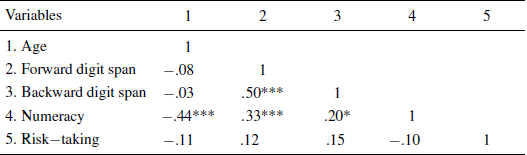
The two working memory measures, forward and backward span, were not significantly related to age, and so these variables were not analyzed further as mediators. Age also was a significant predictor of numeracy, β = −.437, p < .001.
No mediation analyses were conducted for the relationship between age and risk taking because neither age nor any of the potential mediators were significantly related to risk taking.
3.3 Self-Reported decision strategies
As a manipulation check, emotional arousal was assessed with the item “At times during the game I felt a thrill.” The extent to which participants felt they used affect based (gut) strategies and deliberative (mathematical) strategies was also assessed with ratings on 1 to 100 scales of agreement with “I solved the task on a gut level” and “I tried to solve the task mathematically.” Mean ratings for these items are shown in Figure 2.
Means and standard errors of self-ratings of agreement for emotional arousal (i.e., the item of Thrill), affect-based strategy (i.e., the item of Gut), and deliberative strategy (i.e., the item of Math) between the cold and warm CCT. Thrill = the item “At times during the game I felt a thrill”; Gut = the item “I solved the task on a gut level”; Math = the item “I tried to solve the task mathematically.”
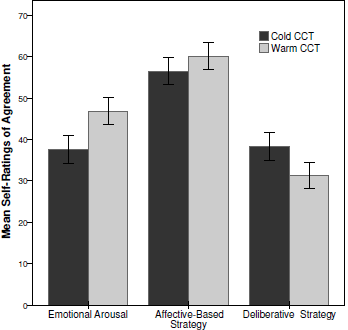
A mixed model ANOVA was used to compare strategies across the two CCT conditions. The dependent variable was strategy use in a 2 × 2 ANOVA (gut vs. math strategy × warm vs. cold CCT condition) with strategy as a within-subjects factor and CCT condition as a between-subjects factor. The main effect for strategy (gut vs. math) was significant F(1, 156) = 43.18, p < .001, ηp2= .217, with participants in both cold and warm CCT conditions indicating greater use of the ‘gut’ strategy. There was no significant main effect for CCT condition F(1, 156) = 0.35, p = .557, ηp2= .002 or the interaction, F(1,156) = 2.31, p = .130, ηp2= .015. Although the interaction patterns were in the expected directions, the differences between warm and cold CCT did not attain statistical significance for either strategy (see Figure 2).
Hierarchical linear regressions were used to test the significance of age, CCT condition and the interaction of age and CCT condition in predicting emotional arousal and use of the two strategies (gut and mathematical). Age was not significantly related to the rating of emotional arousal, R 2 =.009, F(1,156) = 1.34, p = .249. However, controlling for age, the arousal level did differ by CCT condition, ΔR 2 = .025, F(1,155) = 3.99, p = .048. As expected, the rating of emotional arousal was significantly higher in the warm CCT (M = 46.9, SD = 28.5) than in the cold CCT (M = 37.5, SD = 29.7), t(156) = 2.02, p = .045 (two-tailed), d = 0.32 (See Figure 5). There was no significant interaction between age and CCT condition in the third step of the hierarchical analysis (see the first panel in Figure 3).
The interaction plot between age and CCT condition in emotional arousal, affective-based, and deliberative strategies (N = 158).
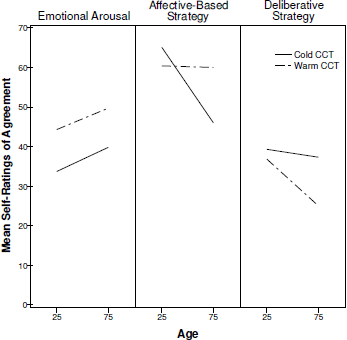
The use of affective-based gut strategies showed a main effect of age, R 2 =.036, F(1, 156) = 5.89, p =. 016, reflecting an average of less endorsement of the gut strategy among older participants. The CCT condition did not account for additional variance, ΔR 2 = .005, F(1, 155) = 0.75, p = .388. However, there was a significant interaction between age and CCT condition (second panel of Figure 3), ΔR 2 = .033, F(1, 154) = 5.42, p = .021. Simple slopes analysis showed that age was a significant predictor of gut level decision making in the cold condition, β = −.382, t(76) = −3.60, p =.008, but not in the warm condition, β = −.008, t(78) = −0.07, p =.994. Older participants did not think they used the affective strategy much as much as the younger adults did in the cold CCT.
The main effect of age was not significant for use of the deliberative mathematical strategy, R 2 =.018, F(1,156) = 2..81, p =. 096. Nor was the CCT condition significant, ΔR 2 = .015, F(1,155) = 2.34, p = .128. Although the interaction between age and CCT condition did not attain significance, ΔR 2 = .009, F(1,154) = 1.43, p = .234, simple slopes analyses were conducted based on a priori hypotheses. Age was a significant predictor of math level in the warm condition, β = -.382, t(78) = −2.10, p =.039, but not in the cold condition, β = −.038, t(76) = −0.33, p =.742 (third panel of Figure 3). The older participants did not think they used a deliberative strategy as much younger participants did in the warm CCT condition. Taken together, these findings show that the warm CCT condition did elicit a higher level of emotional arousal than the cold CCT condition. Participants in all conditions reported greater use the affective “gut” strategies than the deliberative “math” strategies. However, older participants were less likely than younger participants to use the “gut” strategies in the cold CCT condition or the “mathematical” strategy in the warm CCT condition.
4 Discussion
Overall risk taking was not different between younger and older adults across conditions, a finding consistent with previous studies (Reference Kovalchik, Camerer, Grether, Plott and AllmanKovalchik et al., 2005; Reference Mather, Carstensen and HartelMather, 2006; Reference Wood, Busemeyer, Koling, Cox and DavisWood et al., 2005). However, only older adults showed significantly greater risk taking in the cold CCT compared to the warm CCT. These results suggest that, in the absence of emotional information, older adults were more risk seeking. From a practical point of view, our results illustrate that the context in which risk information is presented can have an important effect on older adults decision making.
Only numeracy was significantly different between younger and older adults, whereas forward and backward digit span did not. In addition, neither digits forwards nor digits backwards were mediators for age and risk-taking for the warm and cold CCT.
The self-reported decision strategies failed to replicate the findings of Reference Figner, Mackinlay, Wilkening and WeberFigner et al. (2009). Although trends were in the expected direction, participants did not report employing significantly more affect-based strategies in the warm CCT than in the cold CCT, and did not report employing more deliberative strategies in the cold CCT than in warm CCT. However, participants reported stronger thrills in the warm CCT than they did in the cold CCT, suggesting the warm CCT aroused stronger emotions and therefore provoked greater affective processing. The nonsignificant findings for strategies (gut vs. math) may be due to limitations of the self-report measures used here. Further research is needed to develop measures that can be used to examine deliberative and affective strategies in decision-making.
5 Conclusions
In summary, this study found no substantial overall age differences in risky decision-making. Of course, any laboratory based study may provide limited insight into real-world risk behavior where older adults may rely on others in their decision-making. Older adults demonstrated relatively greater risk-taking in the cold versus the warm condition. Older adults benefited from the emotional information provided in the warm condition to mitigate risk seeking. Furthermore, numeracy, but not working memory, showed differences between younger and older adults. In terms of everyday decision-making, context matters, and risk propensity may very well shift within older adults depending upon the context.


 Open access

