

Introduction
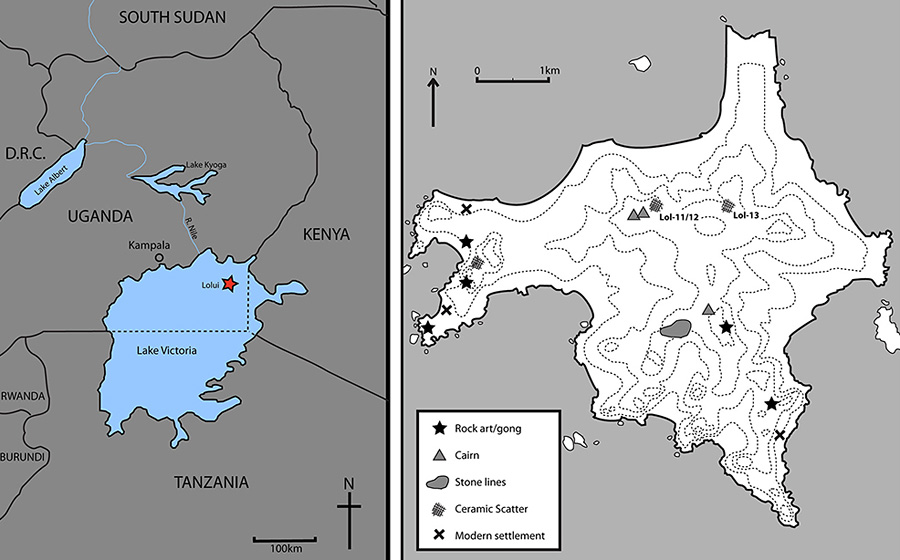
Map of Lolui Island showing the main locations mentioned in the text. The 'grinding hollows' are not shown due to their ubiquity.

In 1964, survey and excavation by Merrick Posnansky and Paul Temple revealed a diverse archaeological landscape on Lolui Island (also known as Lolwe or Dolwe; Figure 1), yet little further study has since been undertaken. Indeed, it is only recently that the results of that initial work have been published (see Posnansky et al. 2005). For much of the intervening period, Lolui has been off-limits for academic research; its remote location on Lake Victoria—30km from the shore, in Ugandan waters but close to the Kenyan mainland—coupled with rich local fish stocks and recently introduced refrigeration facilities, have nurtured a thriving economy based on fishing, smuggling and, allegedly, piracy. Recently, however, the introduction of mobile phone coverage, establishment of a police presence, and greater efforts on the part of the Ugandan border control to combat illicit trade across the lake have created a more stable environment for researchers.
The work presented here was undertaken with the aim of revisiting and reassessing Lolui's archaeological resource and to draw attention to the significant threats that it faces. When Posnansky and Temple first visited, besides the occasional camps of itinerant fishing groups, the island was largely uninhabited. Today, however, the burgeoning and unregulated fishing economy has drawn a population which fluctuates around 10 000 persons. Though mostly confined to three large settlements on the coast, the continuing expansion of the population is a cause for concern in terms of the island's archaeological heritage.
Posnansky and Temple's work identified a number of key locations: a cairn complex; erosion gullies exposing Middle Stone Age material; stone lines and earthworks; and 'grinding hollows' carved into rock surfaces across the island. A number of rock art and rock gong sites were also identified, and subjected to specific investigation (e.g. Jackson et al. 1965). Recent fieldwork comprised a survey undertaken during two trips to Lolui between April and July 2011, which aimed to locate and assess the condition of the sites recorded in the 1960s, and to produce a revised map of the archaeological landscape. Several sites were also chosen for test excavation.
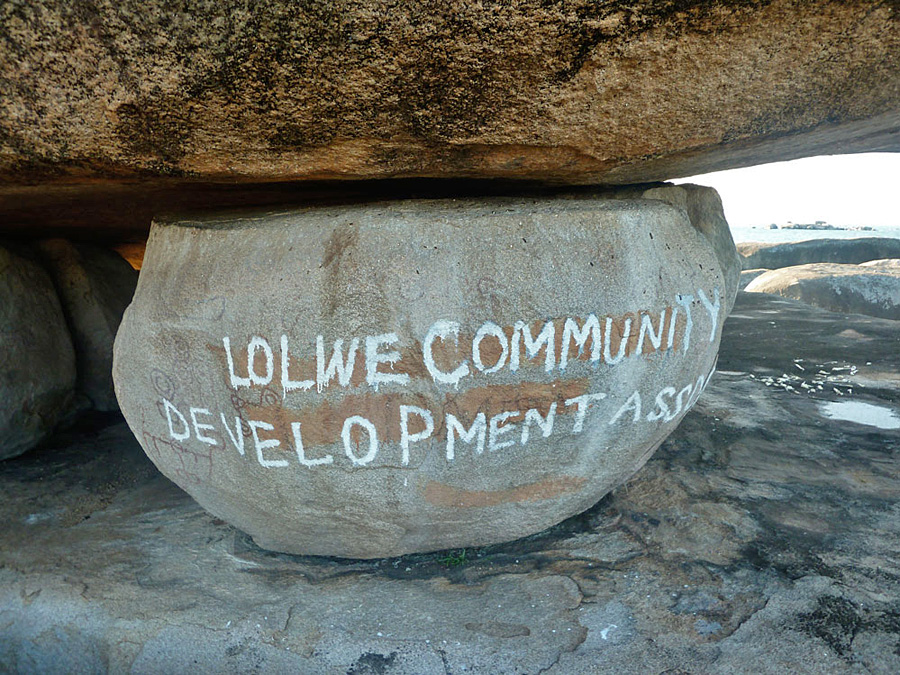
Graffiti and 'counter-graffiti' at the 'Sanctuary' rock art site, near the Gorofa settlement. The original red ochre paintings are visible to the bottom-right of the panel.

Rock art and other rock features
Most of the rock art sites had been recently visited by a fellow researcher, Catherine Namono, and were thus easily relocated. The sites are generally positioned within granite tors, and are characterised by geometric and linear designs. Namono (2010: 243) has argued, on the basis of potentially phallic representations and the womb-like shelter provided by the tors, that the paintings may have been associated with fertility rituals. Most sites bear only one or two designs while others are more densely covered. Rock gongs with up to 39 striking facets are noted in several locations, though apparently not in direct association with rock art. Some locations including the 'Sanctuary' rock shelter close to the modern settlement at Gorofa—one of the largest and most impressive of the rock art sites in the Great Lakes region—have been exposed to recent human damage (Figure 2). While this has mainly been in the form of graffiti, we were informed that one of the nearby rock gong complexes, identified by Posnansky et al. (2005: 76–77) as 'site 3', was destroyed during the construction of a fish-processing facility.
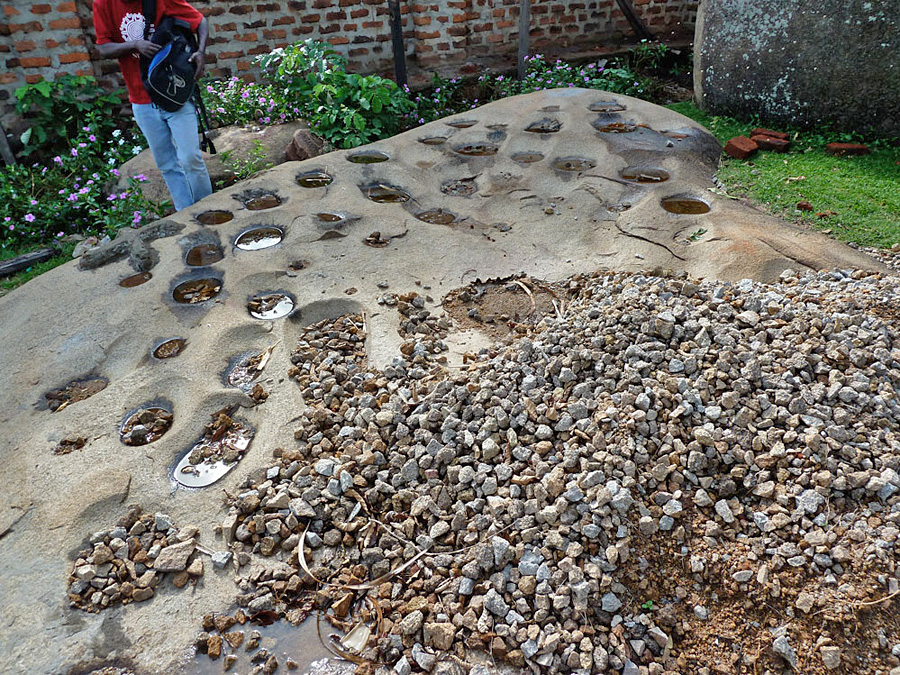
'Grinding hollows' and building material on the site of a new church at Gorofa.

The recent survey demonstrated that the so-called 'grinding hollows' are far more numerous and ubiquitous than was suggested in earlier studies. Thousands of these features were noted, particularly across the north of the island. Their extent and density is so great that grain-processing seems to be an insufficient explanation for their function. Moreover, they often do not appear in contexts that would be practical for grinding grain (cf. Posnansky et al. 2005: 96) or, indeed, ochre for painting as suggested by Namono (2010: 257–58); they are frequently found in inaccessible locations and in very tight clusters, in preference to more practical positions. It is also common to find such hollows on sloping surfaces upon which grinding activity would have been extremely difficult. As yet, however, an alternative explanation remains elusive. While perhaps not an immediate concern from a conservation perspective, especially when compared to some other sites, these features too are under threat from the growing human population. Figure 3, for instance, shows the construction of a church in the Gorofa settlement, with the hollows located under the planned altar.
Cairn complex and possible field systems
The cairn complex comprises two large stone cairns, and remains remarkably intact. Encroachment of the surrounding forest has yet to impact on the two larger structures, though much of the area described by Posnansky et al. (2005) as exhibiting small piles of stones is now covered. There is some modern cultivation of the ridge-top in this area, but this seems to be restricted to the northern side while the cairns are slightly to the south. There are large pottery scatters of varying density around the cairns themselves and stretching eastward along the plateau.
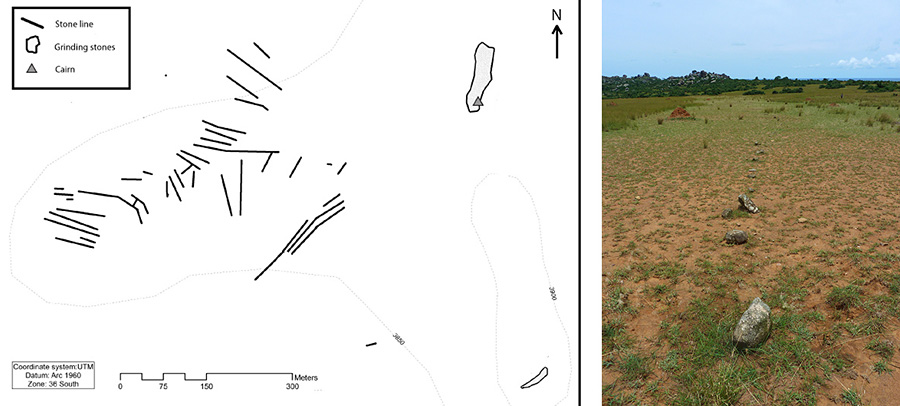
left: plan of the area of suggested field systems, based on GPS survey of lines of stones. The shaded area to the top-right indicates a dense concentration of (mainly broken) 'grinding stones' and a possible cairn; right: one of the lines of stones.

The 1964 survey identified apparent field demarcations across the north-west promontory in the form of stone alignments. While our survey could not relocate these features, a concentration of comparable alignments was recorded towards the centre of the island, covering a similarly large area (Figure 4). This most likely represents a second set of previously unrecorded field systems. At present these sites are not immediately under threat—the cairns, for instance, are still locally identified as burial sites and thus respected—though there is a concern that the stone may become a desirable commodity as construction continues to intensify.
Excavation
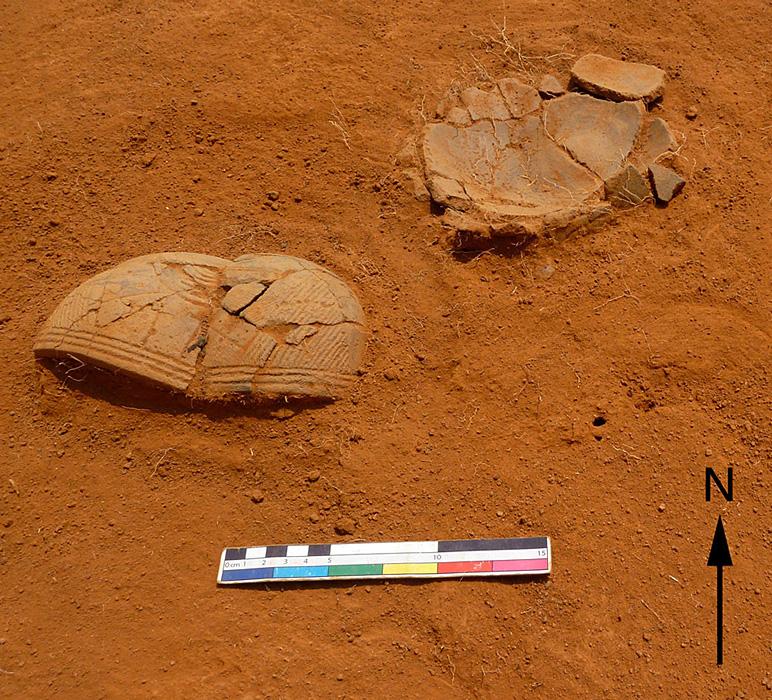
Urewe ceramics in situ at LOL-13: hemispherical bowl and dimple-base (bottom right of picture)

Limited excavation was undertaken in July 2011, with 1m x 1m and 1m x 2m test pits made at two sites (LOL-11 and LOL-12). The focus for excavation was the area surrounding a large erosion gully to the north-east of the telecommunications mast, where the survey recorded a dense scatter of Urewe ware (site LOL-13). Here, a 2m x 2m test pit generated nearly 1000 sherds, almost entirely within the top 20cm of soil. Two near-complete Urewe vessels were recovered from just below the ground surface (Figure 5). Urewe ceramics are associated with the earliest farming traditions in the Great Lakes region, and their presence indicates that early agricultural communities were present on Lolui. Surface material at the cairn complex suggests that these features were constructed in the early to mid second millennium AD (Posnansky et al. 2005: 97), a period indicated by the presence of Entebbe and Transitional Urewe wares that are associated with the Middle, or Transitional, Iron Age (see Reference AshleyAshley 2010: 149–53). Excavation has produced much more of this ceramic material, confirming the importance of the island during the key transitional period prior to the emergence of complex states in the region.
Prospects
Though still in its early stages, our recent work has demonstrated that the archaeological landscape on Lolui is significantly richer than previously thought and that through sustained investigation it may be possible to assess regional interactions across Lake Victoria over several millennia. While perhaps not the pristine environment it was half a century ago, the island still offers the increasingly rare opportunity to consider not only individual sites but also to explore an extant archaeological landscape in the Great Lakes region.
As the modern population continues to grow, the need to register and protect these sites as archaeological monuments and to implement a system of mandatory impact assessment for construction projects becomes more pressing. The number of recorded sites across Uganda, however, remains troublingly small; there is still only a single Sites and Monuments Officer (Dismas Ongwen) with responsibility for the entire country. Though not so inaccessible as it once was, Lolui remains marginal in contemporary political contexts, and continued championing of its archaeological as well as economic value will be vital if its potential as a heritage resource is to be realised.
Acknowledgements
We would like to thank Ceri Ashley, Julius Lejju and Andrew Reid for their invaluable support; the British Institute in Eastern Africa (particularly Benson Kimeu and Matthew Davies); the Uganda Museum; and our team in the field: Jack Ssebuyungo, Adolf Ssempera, Lillian Onyango and Mary Kariuki. The project has been supported financially by the British Academy, under the Lakescape Histories Project.