


1. Introduction
Artificial intelligence is rapidly making its way into the design field while communication and narrative are produced, interpreted, and shared across various disciplines. Tools such as large language models (LLMs), image generation systems, and adaptive video generators are introducing new workflows that emphasize iteration, reflection, and storytelling. While these technologies are being widely adopted in the design industry, the integration of design studio education remains uneven and not fully embedded. This study examines how AI can serve as a tool, not only as a finalized product creator, but also as a communicative and reflective ecosystem that facilitates detailed learning, project storytelling, and adaptive AI thinking in design practice.
Instead of producing entirely new design artifacts, this creative research explores how designers utilize artificial intelligence tools to create impactful narratives by revisiting and reinterpreting existing work. As part of this study, 20 participants utilized artificial intelligence to convey design intent, clarify user needs, and articulate the creative and functional impact through platform-specific and project-specific narratives. Student narrative and AI tool workflows involved planning, scripting, strategizing, prompt engineering, visual generation, editing, and uploading content to social platforms, as well as real-time sequencing via mobile and wearable interfaces, with daily updates in the field of AI and design. Tools such as ChatGPT, Midjourney, Sora, Runway, and Eleven Labs were used not in isolation but as part of structured cycles of iteration and workflow engineering with refinement. Over a 15-week studio sequence, participants created 29 short, artificial intelligence-assisted visual narratives, over 88 short-form videos, and more than 70 narrative images, both within the same department and across interdepartmental collaborations. These outcomes were developed from existing social platform content and a layered storytelling approach, combining scripting, image generation, animation, and audio production. The use of wearable technologies, including Meta’s smart glasses, enabled hands-free capture of daily experiences, first-person narration, and situational storytelling, enriching the narrative depth and supporting reflection in context.
Students developed a structured plan to define, tone, sequence, and clarify the message. Prompt workflow and engineering became a critical design activity. The inputs to AI models were not treated as commands but as part of narration, requiring attention to the audience, emotional resonance, and communicative precision about various industrial design, life sciences, and architectural projects. These positions involve creative tasks, where prompt writing serves as a form of metacognitive design behavior, requiring ethical judgment and user awareness (Reference von Thienen, Weinstein and Meinelvon Thienen et al., 2023). The resulting workflows reflected the theory of reflection-in-action, now extended into a multimodal space of iterative scripting, interpretation, and synthesis (Reference SchönSchön, 1983).
Narratives in still images and videos were submitted through weekly voice briefings and data uploads to digital whiteboards, as well as through structured weekly releases, where reflection and critique were used to showcase their narratives on media platforms. Submissions were delivered in a timely manner, with more than 90% of projects submitted on time or ahead of schedule, and over 70% extended voluntarily following critique. and started planning student projects and gave advice on how the next projects should be structured. These patterns align with studies suggesting that artificial intelligence, when utilized as a storytelling and authorship tool, increases engagement, expressive perfection, and student involvement in design education (Reference Sterman, Nicholas, Vivrekar, Mindel and PaulosSterman et al., 2023). Interdisciplinary collaboration in the course also facilitated the creation of narratives by other scholars across the university, encouraging curiosity about what life sciences, engineering, and other disciplines entail and what their needs are for expressing their narratives. Participants mapped and shared tools and techniques with peers in the college of life sciences, marketing, journalism, engineering, and graphic design. Additionally, Meta’s wearable glasses provided a platform for experimentation from a wearable perspective, and the Meta AI component enhanced digital storytelling and real-time design integration. These experiences suggest a growing need for using devices that provide live insights into lighting and the environment in which narratives should be captured, and for engineering narrative structure, as well as for artificial intelligence-supported communication, which are valuable skills applicable to both academic and industry settings.
2. Background: storytelling as design reflection
2.1. Reflection and visual thinking in design education
Digital and physical reflections and pitches for design education have long served as a foundation of design learning, shaping how students interpret intent, meaning, and human connection through their work. (Reference KolbKolb, 1984) experiential learning cycle similarly positions reflection as the bridge between experience and conceptual understanding, transforming iterative making into knowledge. In design studios, sketches, diagrams, and early prototypes serve as reflective mirrors, enabling designers to see how their perceptions, assumptions, facts, and values take shape on the page or surface, following how described design as a conversation with materials in which thinking develops through action and reinterpretation (Reference SchönSchön, 1983).
Digital storytelling deepens this reflective process by framing design as a sequence of experiences rather than a collection of isolated outputs. (Reference SchönSchön, 1983) argued that narrative is a core human process for making sense of change and intention. Within design education, storytelling provides structure to exploration, enabling students to articulate not only what they have created but also why it matters and how it relates to its users. As (Reference Lee, Kang and ParkLee et al., 2023) note, narrative reflection supports the recognition of emotional and ethical dimensions that may be overlooked when students focus solely on technical adequacy. By retelling their design decisions, students identify gaps, reinterpret user needs, and surface insights that inform the next stages of development.
Animation, simulation, and dynamic visualization tools allow designers to depict the sensory and temporal dimensions of use, while digital media on social platforms has expanded reflective and narrative practices, enabling students to reference and express context, details, and speculative futures in ways that traditional storytelling techniques cannot. The integration of generative artificial intelligence into these tools further extends these possibilities as AI engines such as ChatGPT, Midjourney, Sora, Runway ML, and Meta AI translate linguistic prompts into images, videos, and multimodal narratives, enabling students to rapidly and iteratively explore atmosphere, tone, and human experience. (Reference FleischmannFleischmann, 2024) emphasizes that when used critically, artificial intelligence can support cognitive and emotional exploration, while (Reference SongSong, 2024) highlights the need for maintaining authorship and material dialogue within human-AI collaboration.
In the context of this study, artificial intelligence served as a reflective and creative partner, enabling students to make their ideas visible, communicable, and emotionally resonant. Rather than serving as a shortcut for generating final visuals, generative tools and AI workflows supported students in revisiting their work, clarifying narrative intention, and exploring alternative ways of communicating impact through an iterative and repetitive process, and allowed them to understand the details that go into photography and videography, for which they are never trained. This digital dialogue allowed participants to articulate what they sensed but could not fully express through earlier traditional documentation, and consequently made the invisible dimensions of design, such as tone, purpose, and user meaning, newly more accessible. Through iterative prompt engineering, multimodal workflows, and cross-platform adaptation, students developed narratives that reveal the evolving relationship between design intent, reflective practice, and emerging artificial intelligence technologies.
2.2. Designing the invisible
During this study, AI is treated as a creative and reflective partner, rather than a shortcut to visual output, with respect to 20 students and their daily hands-on use of generative AI tools. Through prompt engineering and generative workflow management, students engage in an ongoing dialogue with artificial intelligence systems, continually updating their approaches in response to new developments and tools, and receive a constant stream of narratives created by experienced creators on social platforms. This dynamic interaction parallels (Reference SchönSchön, 1983) concept of “a conversation with the materials of a situation,” in which practitioners reflect and act simultaneously within evolving design contexts. But in this case, the material is digital, interpretive, and linguistic. The traditional strategy, combined with generative AI images and videos, serves as a visual essay, allowing students to articulate what they sense but cannot yet fully explain. While completing the project, they are given the option to revisit and utilize AI to enhance the narrative with new-age tools that they never thought they would become proficient in, thereby streamlining their professional development.
3. Method: visual narrative analysis of student projects
3.1. Context and course setting
This study was conducted in a course titled “Concept to Spotlight: AI-Enhanced Digital Narratives,” where the course was offered in the Iowa State University College of Design during the Spring 2025 semester. The course was developed to assist students with a problem they face in design learning: narrating the final story, pitch, or narrative, and to explore how generative artificial intelligence can support digital storytelling and communication within a design studio context. Students utilized artificial intelligence tools to enhance the elaboration, reinterpretation, and communication of the stories associated with projects they had already developed through traditional design processes; they did not use artificial intelligence to create new design projects.
The course was structured around a single, clear objective: to help participants utilize artificial intelligence to craft compelling digital narratives for projects they had already developed through traditional design methods, as part of a survey and industry requirement to exist on social platforms to gain exposure. Rather than creating new design concepts, participants selected an existing or personal project and focused on how to communicate its purpose, value, and emotion more effectively using generative AI tools, which further prompted them to understand the workflows.
The impact of this course extended across the entire campus, with students from engineering, marketing, journalism, and human-computer interaction expressing interest in participating because of its focus on artificial intelligence literacy and digital communication skills, particularly those related to digital storytelling. Several interdisciplinary collaborations emerged naturally during the semester. Based on its demonstration of student engagement and relevance to emerging industry practices, the course was selected for inclusion in the university’s Artificial Intelligence minor and being a part of the STEM curriculum, College of Life Sciences, students learnt about various different professions and research while creating narratives for other departments as a part of becoming an agency making narratives of renowned scholars across campuses. The course now functions as an interdisciplinary elective that prepares students for the increasing presence of artificial intelligence, enabling them to display any concept with impact.
Participants represented advanced undergraduate and graduate students in design-related disciplines. Prior to the course, most had experience with traditional design tools such as sketching, digital rendering, and presentation software, but fewer than one-third had used generative artificial intelligence tools in a structured academic context. None had received formal training in prompt engineering, and only a small subset reported prior experience with video editing or audio production. This uneven baseline of technical preparation provided an opportunity to observe how participants constructed workflows from varying levels of familiarity and how artificial intelligence tools functioned as scaffolds for narrative development rather than replacements for design expertise.
3.2. Data sources
This study examined four categories of material to understand how participants transitioned from traditional documentation to narrative construction supported by artificial intelligence.
-
1. The first category consisted of pre-artificial intelligence project documentation, including sketches, renderings, journey maps, presentation boards, and physical prototypes developed through conventional design methods. These materials served as the analytical baseline against which later narrative reinterpretations were compared.
-
2. The second category included artificial intelligence-assisted visual and video outputs. Participants used tools such as ChatGPT for strategic scripting and prompt development, Midjourney for image generation, Sora and Runway for motion sequences, and ElevenLabs for voice and sound production. These materials represented narrative layers constructed around previously developed design projects rather than newly generated design concepts.
-
3. The third category involved process documentation. This included prompt transcripts, iterative prompt revisions, Instagram drafts, digital whiteboard maps, Canva layouts, mobile screenshots, and exported editing timelines. These artifacts captured workflow construction, tool selection, sequencing decisions, and iterative refinement across platforms.
-
4. The fourth category comprised written reflections and critique notes. Participants documented why specific tools were selected, how prompts were structured, what challenges emerged during workflow construction, and how narrative clarity evolved over time. These reflections were used to triangulate visual analysis and support interpretive conclusions.
The complete dataset included 88 short-form videos and 70 narrative images produced over a 15-week semester. These outputs were compared with baseline documentation to identify shifts in narrative structure, media adaptation, and communication clarity.
3.3. Analytical approach
A generative, qualitative, and interpretive methodology was employed in this study, with analysis grounded in visual narrative inquiry, focusing on how students reconstructed stories that conveyed the meaning and context of their design projects from start to finish. The evaluation did not prioritize technical polish to facilitate fast-paced production, once students had gained a handle on the software and trained the AI agents. Instead, it focused on how effectively students used generative tools and mobile platforms to express the intent and value of their design ideas. Attention was paid to documented instances in which participants switched tools, revised prompts, or abandoned outputs, as these transitions revealed evaluative reasoning in workflow construction.
The comparison below (Figure 1) showcases how students translated traditional speaker designs into AI-enhanced visual narratives, demonstrating shifts in presentation strategy, contextual framing, and storytelling clarity when artificial intelligence tools were used to reframe existing design outcomes for enhanced communication impact. The right-hand image was generated using a prompt such as: ‘Futuristic portable speaker, sleek angular design, sharp edges with soft contrast, dual tone finish in blue and white, soft studio lighting, placed on an orange promotional background with bold typography, high-resolution render, product design showcase.’
Three interpretive categories guided the analysis:
-
1. Narrative structure, which examined how students introduced strategy, context, reframed users, and sequenced their concepts.
-
2. Media adaptation that emphasized how students integrated mobile AI tools and generative workflows in flexible, improvised ways.
-
3. Design communication, which examined how clearly students conveyed the purpose, relevance, or user experience of their concept compared to when they had not used the AI tools. Student reflections, critique notes, and co-creation with peers were reviewed to confirm the reasoning behind visual and narrative decisions.
Speaker designs comparing traditional methods and AI-assisted workflows

3.4. Researcher position and reflexivity
The researcher also served as the course instructor, providing direct access to student engagement, critique discourse, and evolving project work. This position offered valuable contextual insight into the pedagogical goals and creative challenges students encountered. However, this dual role also introduced the possibility of interpretive bias, and to address this, the analysis focused on student-authored reflections, publicly shared visual outputs, and documented feedback on critique. Observations and examples were selected based on recurring patterns across the cohort rather than exceptional performance or aesthetic preference. Emphasis was placed on process transparency, tool adoption strategies, and narrative framing decisions, as evident in the documented project trajectories.
3.5. Limitations digital
This study was conducted over a single semester in a studio course at a research-intensive public university. The analysis is qualitative and interpretive and does not include controlled comparison groups or quantitative measurement of learning outcomes. Findings are based on visual narrative outputs, documented workflows, and participant reflections within this cohort of twenty students. While the depth of material provides insight into emerging AI-supported storytelling practices, the results should be interpreted as exploratory rather than generalizable across all design education contexts. Project maturation over time may also contribute to observed narrative development, and the study does not claim that AI workflows are superior to traditional studio critique.
In addition, the study does not isolate artificial intelligence as the sole variable influencing narrative development. Project maturation, repeated critique, and increased familiarity with media production may also have contributed to observed shifts in storytelling clarity. However, the timing of workflow restructuring and documented changes in prompt construction, media sequencing, and reflective language suggest that artificial intelligence tools functioned as catalytic elements within the learning process. Future comparative studies may further distinguish between maturation effects and tool-mediated shifts in reflective practice.
4. Findings: transforming design communication through narrative structure, communication clarity, and media adaptation
This section presents the detailed findings from the analysis of work produced in the course. The course is intended to encourage participants to use artificial intelligence tools and social platforms to reinterpret previously developed projects through digital storytelling. Artificial intelligence supported participants as they refined narrative intention, clarified message, and constructed emotionally coherent stories.
4.1. Reframing design through narrative structure
A significant shift occurred when participants transitioned from static presentations to structured narrative communication. Early project materials consisted of renderings, diagrams, and image sets that emphasized form and technical attributes. These project stories often lacked a human presence, a sequence of events, or a sense of emotional connection.
With the introduction of tools powered by artificial intelligence, participants began crafting stories for their design work to make it industry-ready. Students organized their ideas into sequences and strategies that introduced a user, a scenario, and a design intervention, followed by a closing moment that illustrated the intended impact on people’s daily lives in this global economy. These sequences were strengthened through visual pacing, voiceover, sound, short, impactful videography, and contextual imagery generated with generative tools.
One participant wrote,
“I used to think of my project as a collection of images. Once I started building a story around it, I finally understood what the project meant and how I wanted people to experience it.” - Participant 3
Through this digital narrative reframing, projects were presented not as a collection of features but as a purposeful response to human needs and business opportunities.
This visual comparison below shows how an initial architectural sketch was transformed into a photorealistic concept using AI with a prompt such as “futuristic public building with organic curves, glass facade, beige concrete, Zaha Hadid style, clear sky, photorealistic rendering,” illustrating how generative tools enhance form exploration and presentation clarity (Figure 2).
Architectural form from concept sketch to AI-generated visualization

4.2. Communication clarity through prompt-based workflows
Prompt construction emerged as a central factor influencing the effective adoption of AI tools in professional design contexts. The use of AI in design, as some people think, would take over jobs; however, understanding the workflow is another key aspect that people often overlook and do not utilize when using AI tools. The clarity of a prompt affected the emotional tone, promotional strategy, visual accuracy, and narrative weight of each generated scene. This was followed by Sora and Runway to animate transitions and movement. Creating a proper narrative video requires repetitive iterations and training an AI engine. Eleven Labs was used to add custom voice and sound.
One participant reflected: “At first, I felt lost because I had 5-7 tools open in my browser. After some trial and error, I realized that each tool helps me communicate something different. I just had to learn what to ask and when to ask it.”- Participant 13.
Participants reported selecting tools based on functional alignment with narrative goals rather than novelty. For example, Midjourney was chosen when atmospheric image construction or environmental context was needed, while Runway and Sora were preferred for sequencing motion and simulating user interaction. ElevenLabs was selected when vocal tone and pacing were central to emotional framing. Tool choice was therefore guided by criteria such as output controllability, iteration speed, aesthetic consistency, and compatibility with mobile editing platforms. Several participants described abandoning certain tools when outputs lacked precision or required excessive post-processing, indicating evaluative judgment rather than passive acceptance of generated content.
This process enhanced message clarity and helped participants become more intentional in their use of language and started creating custom APIs as their customer agents to effectively create the whole narrative. Those who previously struggled with visual storytelling expressed that artificial intelligence enabled them to communicate with greater confidence.
4.3. Adaptive storytelling through platform native workflows
Practicing with AI tools became more advanced, as students transitioned from frustrating linear production to adaptive and platform-aware storytelling. They even saw changes in software like Vizcom and Weavy, which brought multimodal availability of using AI agents on a whiteboard, from prompt structuring to image generation and adding motion. Instead of preparing materials exclusively for traditional presentation formats, participants used mobile apps and co-created story sequences in teams on collaborative platforms to develop and test them.
Students edited clips directly on their phones, captured additional high-resolution footage through their phone cameras, and layered text and audio within app interfaces like CapCut, which offered a huge variety of templates that connected to their concepts or brands. They adjusted timing and pacing by repeatedly watching and revising short sequences, making it an art in their daily lives. Storyboarding evolved into an active and fluid practice, rather than a preliminary phase.
One participant observed:
“I stopped thinking about storyboards or strategy as something to finish before making the video, as it’s embedded in my mind. I was building, testing, and changing the story while creating it. It feels like I am being trained myself, and it makes me curious and confident about using so many tools efficiently altogether.” Participant 6.
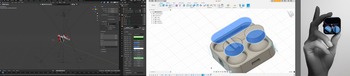
The images below capture the evolution of a product from parametric modeling to photorealistic AI-enhanced storytelling, revealing how students moved beyond form and function to craft emotionally resonant, platform-ready visual narratives (Figure 3).
Product evolution from 3D modeling to AI-enhanced storytelling and visual presentation

Figure 3 Long description
The image contains three separate elements: one screenshot, one 3D model, and one photo. Panel A shows a screenshot of a 3D modeling software interface with various tools and a 3D model of a product. Panel B displays a 3D model of a product with blue and gray components. Panel C features a hand holding a virtual reality headset, with the headset displaying a 3D model of the same product seen in Panel B. The images together illustrate the process of product evolution from 3D modeling to AI-enhanced storytelling and visual presentation.
4.4. Reflections on workflow construction and future concerns
Students noted the complexity and frustration of working across multiple artificial intelligence tools and non-intuitive user interfaces. Moving between Sora, ElevenLabs, ChatGPT, Midjourney, and various editing platforms required constant attention to ensure compatibility, manage files effectively, and adapt to changing software features. The limitations of the free tool added another layer of difficulty. However, they managed with the support of existing education versions, as AI companies want to integrate them into education. These challenges prompted critical reflection on how future design workflows might evolve.
As participants examined these difficulties, many became interested in creating their own unified environments that combined writing, prompting, visual generation, and collaboration. Platforms such as Weavy offered examples of integrated creative spaces. Participants who experimented with Weavy reported that the unified interface helped them maintain focus and reduced the burden of shifting between applications.
One participant observed:
“Having writing, prompting, and visual tools in one place made the entire process smoother, and Vizcom is the one that the industry wants people to be trained on, as we can design aesthetic languages for our next versions of the products to be launched. I was able to stay within the story without jumping from one application to another.” Participant 2.
Emerging artificial intelligence features in platforms like Figma and Canva were also recognized as promising because they encourage more cohesive storytelling.
4.5. Summary of shifts and implications
Three consistent patterns emerged across the analyzed work.
First, participants moved from isolated description toward contextual storytelling. Rather than presenting visual features alone, they constructed sequences that clarified purpose, user context, and experiential relevance. Artificial intelligence tools supported this reframing by enabling rapid visualization of environments, scenarios, and narrative tone.
Second, visual and audio decisions became more closely aligned with communicative intention. Prompt construction required participants to articulate tone, audience, and message explicitly before generating output. This process appeared to support greater awareness of how narrative framing influences interpretation.
Third, storytelling evolved from a final presentation step into an ongoing design activity. Narrative construction occurred iteratively alongside editing, prompting, and media sequencing. Participants engaged in repeated refinement cycles, treating generative tools as dialogue partners rather than production shortcuts.
These observations suggest that artificial intelligence workflows may support reflective engagement and communicative clarity when intentionally integrated into studio learning. The tools did not replace design reasoning; rather, they provided additional surfaces for testing language, framing context, and refining meaning across media environments.
5. Discussion: artificial intelligence as a pedagogical catalyst for reflective storytelling and design communication
5.1. Artificial intelligence as a reflective design partner
The findings from this research demonstrate that artificial intelligence-supported storytelling and co-creation, combined with traditional learning tools, can serve as a powerful pedagogical strategy within design education. By integrating progressive prompt engineering and adaptive generative media workflows into the education design studio process, the course enabled students to move beyond traditional documentation towards the construction of purposeful narratives. This approach facilitated clear communication, reflection in practice, and cross-platform authorship across disciplines. More importantly, it prepared students with the skills and mindset needed to navigate contemporary design environments where storytelling is key, along with impactful design solutions. As the industry increasingly values designers who can think narratively, adapt to evolving tools, and communicate across diverse formats, this model offers a relevant and transferable foundation. Artificial intelligence did not replace peer critique or collaborative studio exchange. Rather, it extended reflective dialogue beyond scheduled critique sessions by enabling immediate iteration, rapid visualization testing, and self-directed refinement. Participants were able to experiment with framing, tone, and sequencing between studio meetings, using generative systems as interim feedback environments that complemented rather than substituted traditional discussion.
5.2. Instructional design using artificial intelligence
Students responded with high levels of interest and participation, and asked the instructor about each week, showing curiosity and excitement to learn more. Many checked the course platform multiple times a day to see if new content had been posted. Assignment releases became anticipated events, and in-person meetings became a showcase where students were eager to dynamically transform concepts, and the course began to feel more like a serialized experience than a static syllabus. Students resubmitted their work multiple times as they advanced their skills daily. Students described the structure as immersive and motivating, perceiving themselves not as passive recipients of tasks, but as active participants in an unfolding narrative.
AI tools were designed and integrated into the instructional design of the course to enhance engagement and create a dynamic learning environment, serving as a pedagogical tool to engage students more effectively in hybrid courses. Concept videos, project briefings, and module transitions were delivered weekly, using AI-generated voices with video variations and narrative structures inspired by social platforms and entertainment formats.
Beyond the unconventionality of co-creating with emerging AI tools, students developed a strong sense of authorship and narrative control, becoming confident in every detail of their concepts. Their outputs reflected more than just task completion; they became expressions of personal perspectives, values, and speculative thinking. Prompt engineering allowed students to shape tone, identity, and message. Storyboarding provided structure and pacing. More than 80% of students continued to refine and expand their projects beyond the scope of the assignments, applying them to all other courses, as narration is a component of every design course. Often, they would remix sequences or explore alternative visual approaches through new prompts. These behaviors did not reflect gamification. These behaviors did not reflect gamification; they reflected a genuine commitment to the craft of storytelling, rooted in a sense of ownership and a desire to convey meaning through design thinking, utilizing advanced AI tools.
5.3. Institutional impact and cross-disciplinary demand
The successful integration of the course led to its demand in the university’s Artificial Intelligence Minor and recognition as a cross-disciplinary elective. Faculty across engineering, HCI, user experience, and marketing identified the course as a model for using artificial intelligence to support structured communication for marketing university excellence. The Marketing department has already begun incorporating outcomes and workflows from the course into its own curriculum to strengthen digital storytelling and prompt-based strategy. This course continues to serve as a case study for how design education can lead to the integration of artificial intelligence across higher education with industry exposure and skill readiness.
5.4. Toward a pedagogy of performance, narrative, and strategic communication
The integration of AI workflows into the design studio signals a new stage in curriculum development, as this design-learning pedagogy bridges strategic thinking, media performance, and reflective authorship. Students did not simply use artificial intelligence; they learned to frame problems, test language, adjust tone, and evaluate the narrative impact of their intellectually developed design decisions and solutions. They became curators and creators of how their work was seen, understood, and remembered.
The results suggest that design education must now address storytelling not as a final communication step but as a continuous design process. When artificial intelligence tools are used critically and creatively, and planned in conjunction with traditional design methodologies, they help students develop the ability to make meaning across modalities.
In this expanded model, education becomes a space for narrative strategy, digital literacy, and public expression, which is highly neglected in every stream of education. Artificial intelligence is not the end of creativity, as many might believe; it is the beginning of a more collaborative, reflective, and communicative approach to learning.
6. Conclusion
Generative artificial intelligence is reshaping how design ideas are communicated, interpreted, and positioned across media environments. This study examined how prompt engineering and adaptive AI workflows were integrated into studio practice, not to generate new artifacts, but to reinterpret and narrate existing design work with greater clarity and intention.
Across twenty participants, narrative construction shifted from static documentation toward structured, multimodal storytelling. Prompt writing functioned as a metacognitive design strategy, requiring participants to articulate tone, audience, and experiential intent before visual production. Generative systems served as iterative feedback environments through which language, imagery, and sequencing were continuously refined. The findings do not claim that artificial intelligence is superior to traditional studio critique. Rather, they suggest that when critically framed, AI-supported workflows may extend reflective dialogue beyond scheduled studio time and provide additional surfaces for testing communicative clarity. Artificial intelligence did not replace design reasoning; it made narrative framing more explicit and iterative.
Future work may include comparative studies examining AI-mediated storytelling alongside traditional visualization workflows, as well as longitudinal research measuring changes in communication skills and reflective capacity over time. Expanding this model across disciplines such as engineering, marketing, architecture, and journalism may further clarify how artificial intelligence can function as a structured communicative scaffold within higher education.
As design practice increasingly demands narrative fluency and cross-platform literacy, prompt engineering and adaptive AI workflows represent emerging competencies. The integration of these tools into design education suggests a shift not toward automation, but toward intentional meaning construction in technologically mediated environments.



 Open access

