

Introduction
Following Russia’s full-scale invasion of Ukraine in 2022, many European citizens opened their homes to host Ukrainian people. The homestay policy, which relies on the hospitality of established residents, became one of the main mechanisms for housing displaced Ukrainians, an approach that differed markedly from the UNHCR’s conventional refugee protection solutions. Such a policy is seen as having considerable potential for future responses to displacement because it is co-produced with citizens (Bassoli and Campomori, Reference Bassoli and Campomori2024), highlighting the importance of welfare policy mix (Powell and Barrientos, Reference Powell and Barrientos2004), particularly articulated in the face of shrinking welfare states and different forms of welfare policy opposition (Eick and Leruth, Reference Eick and Leruth2024). Despite possible challenges and precarities related to the welfare mix (Bode, Reference Bode2006), which simultaneously offers opportunities for social and policy innovations (Oosterlynck and Cools, Reference Oosterlynck, Cools, Oosterlynck, Novy and Kazepov2021), homestays provide crucial housing capacity in areas of housing shortages. While policy responses supporting the reception of Ukrainian forced migrants have been framed as racially privileged (Barhoush, Reference Barhoush2022), extensive public engagement in the homestay approaches utilised suggests this new approach may have utility for other displaced migrants arriving in Europe. If the homestay policy is to be adopted more widely, we must understand how it functions for home providers and the role of hospitality in shaping the relations between those offering accommodation and those hosted (Dikeç, Reference Dikeç2002).
This article asks how hospitality shapes relations between displaced migrantsFootnote 1 and individuals hosting them in refugee homestays and what policies can be learned from homestay experiences in Poland and the United Kingdom? Over 5 million, mainly women and children, fled Ukraine after the Russian full-scale invasion as estimated on 19 April (UNHCR, 2022). In Poland, the government began to refund individuals, organisations, and businesses for accommodating Ukrainians. The UK Government quickly introduced a policy to fund households to host Ukrainian displaced people. These policies facilitated hospitality by households rather than providing accommodation, as is usually the case by Governments engaged in refugee resettlement. This approach to refugee hosting relies on hospitality, itself founded on reciprocity between the host and the hosted person. Reciprocity is a complex social and cultural phenomenon (Falk and Fischbacher, Reference Falk and Fischbacher2006) that is shaped by and can produce power imbalances in host-hosted relations. Drawing on interviews with hosts in Poland and the United Kingdom, we examine the ways that hospitality was played out in homestays with a view to understanding the potential for such approaches to play a role in future refugee hosting policy.
The article proceeds with an outline of the nature of homestay policy and practice in Poland and the United Kingdom. It then examines the state of knowledge around homestay, hospitality, and reciprocity. After presenting our methods, we set out our findings around three dimensions of hospitality: selectivity of hosted refugees, forms of reciprocity, and power relations. We conclude with a discussion of how the homestay policy offers a new approach for the admission and support of refugees, but requires developments to support the optimal host-hosted relations needed to expand the policy to other refugee groups.
The Ukrainian displaced migrants and their reception in Poland and the United Kingdom
After Russia’s full-scale invasion of Ukraine in February 2022, the European Union and the United Kingdom moved quickly to provide Ukrainians fast, large-scale pathways to safety with rights to live, work, access to healthcare, and education. However, these initiatives were implemented under different long-term residency arrangements, at very different scales, with different housing models and funding mechanisms. The European Union’s response to Ukrainian forced migrants was based on the principle of “Temporary Protection Directive” (TPD), which produced a harmonised set of baseline rights wherein the displaced were permitted to enjoy, for an initially limited period, harmonised rights concerning residence and access to the labour market, healthcare, education, housing, and social welfare (European Council, 2023). In the United Kingdom, comparable core rights were granted to Ukrainian refugees. However, as migration policy and administration were established by British legislation rather than by an EU directive, the UK government introduced a set of bespoke, time-limited visa schemes, initially valid for up to 3 years, with subsequent extensions available.
In terms of scale, ~4 million Ukrainians have benefited from the European Union’s temporary protection arrangements by mid-September 2022 (OECD, 2022; European Commission, 2025), whereas the United Kingdom had issued around 270,000 visas by 2025 (Home Office, 2025b). Ukrainian refugees arriving almost overnight placed significant pressure on European refugee reception capacities. Across the EU, Member States accommodated refugees in different ways. Some countries, such as Germany, France, and Spain, accommodated Ukrainians in centres; others, such as Poland, used a mix of civic society initiatives (mainly based on private housing) and collective shelters, while the United Kingdom primarily relied on a private sponsorship model. Funding within the EU was channelled through humanitarian and cohesion instruments to Member States, supplemented by emergency aid (European Council, 2025), whereas in the United Kingdom, resources were centrally managed by the government and distributed to sponsors and local authorities (Home Office, 2023).
The practice of using citizen housing to accommodate refugees has been termed “homestay.” Such initiatives have expanded since the 2010s, where they were framed as a civil society practice focusing on the reception of people seeking asylum labelled as “home accommodation” (Merikoski, Reference Merikoski2021), “domestic hospitality” (Bassoli and Oggioni, Reference Bassoli, Oggioni, Zardini, Virili and Za2017), “private hospitality” (Monforte et al., Reference Monforte, Maestri and d’Halluin2021), “family hosting” (Ran and Join-Lambert, Reference Ran and Join-Lambert2020), or “homestay accommodation for refugees” (Hebbani et al., Reference Hebbani, Khawaja and Famularo2016; Bassoli and Luccioni, Reference Bassoli and Luccioni2024). These initiatives were far smaller in scale. The response introduced in response to the displacement of Ukrainians represented the first time that governments introduced policies to enable large-scale homestay provision.
In this article, we focus on Poland and the United Kingdom as these countries offered homestays on a large scale underpinned by markedly different policies. In Poland, which borders Ukraine, a new approach emerged wherein people were offered small payments in return for hosting Ukrainians in their homes. This civil society response was essential to quickly accommodate large numbers of displaced people. Poland granted temporary protection to 1.7 million Ukrainians (UNHCR, 2023), with over 950,000 individuals registered as residents in Poland at the end of 2023 (Eurostat, 2023). The United Kingdom, which did not enjoy the same proximity and could apply visa selection and a control system, offered protection to 211,300 Ukrainians as of July 2024 (UK Government, 2024).
Support for Ukrainian war refugees in Poland
Initial approaches to supporting those displaced from Ukraine were driven by Polish citizens and other residents of Poland, especially those of Ukrainian origin, with estimates suggesting households hosted 1.4 million Ukrainian displaced migrants (AW, 2023). Support was organised by Catholic and Greek Catholic parishes and orders across Poland (Organek and Sadlon, Reference Organek and Sadlon2022), a so-called “Resource Group,” wherein volunteers linked Ukrainian fleeing the war with hosts (Bienkowski et al., Reference Bienkowski, Angulska, Jaworowska, Malko, Nowakowski and Telezynski2022) and many other voluntary efforts, sometimes utilising a website set up by the Polish government, “I help Ukraine” (“Pomagam Ukrainie”), linking those seeking assistance with help.
This initial grassroots action gave the Polish authorities time to develop policy and activate aid, first at the local level and later by the central government and its institutions, and thus policy intervention might be framed as somewhat reactive since the Government response followed in the wake of the actions of other actors and was aimed at Ukrainians already in the country. In this case, the ruling Law and Justice Party (PiS), characterised by its right-wing, national-conservative, and Christian-democratic orientation, adopted a completely different approach than previously manifested in its anti-immigrant stance and rhetoric towards other asylum seekers. NGOs and ordinary citizens forming a large-scale, spontaneous grassroots coalition in a way lobbied the government to implement legal protections and allocate public resources for refugees. This civic engagement was pivotal in delivering a quick humanitarian response, especially before the relevant legislation was introduced (Jasiewicz and Jasiewicz-Betkiewicz, Reference Jasiewicz and Jasiewicz-Betkiewicz2023). The admission and support of displaced Ukrainians in Poland required the extension of the local government’s functions (Magdziarz, Reference Magdziarz2024), with the unprecedented crisis-related increase in multisectoral cooperation found to be one of the major social resilience factors (Podgórska et al., Reference Podgórska, Jaketerynczuk, Yarosh, Kuzmuk and Liubchuk2024). There was a consensus across society and major political parties about admitting and supporting displaced Ukrainians.
The Special Act on Assistance for Ukrainian Nationals Fleeing the War provided financial support to companies, organisations, and individuals offering accommodation and meals to refugees at a rate of PLN 40 (~EUR 8.5) per hosted person per day for up to 120 days. Extensions were possible for older individuals, those with a certificate of disability, pregnant women, and some women with childcare responsibilities. To receive a refund, hosts were required to complete a short refund form during or after hosting, which included information about the applicant, those hosted, and the dates support was provided. Hosts identified Ukrainians through social networks, social media, or the Pomagam Ukrainie website. Alternatively, Ukrainians could stay in collective accommodation, contributing to its costs over time. The Polish Government’s homestay policy enabled reimbursement of hosts, the dispersal of one-off funds to displaced Ukrainians, and permitted access to work, healthcare, education, and welfare benefits.
Homestay for displaced Ukrainians in the United Kingdom
In post-Brexit Europe, the United Kingdom was not subject to the Temporary Protection Direction and its island geography also meant that it did not have the same proximity to the conflict as Poland. Thus, unlike Poland, British citizens were unable to act spontaneously and instead awaited Government action. Opinion polls in the United Kingdom in 2022, alongside extensive media coverage, demonstrated strong support for increased government action to assist Ukrainian refugees, underscoring the need for a swift policy response (Smith, Reference Smith2022). After weeks of lobbying by civil society and high-profile politicians across all parties and extensive media attention in both populist and broadsheet outlets, all calling for the introduction of a scheme to allow displaced Ukrainians to enter the United Kingdom, the UK Government introduced three programmes. Two focused on supporting Ukrainians to remain or join their family, while the other, called Homes for Ukraine, introduced homestay (UK Home Office, 2023), the first time such a policy was introduced in the United Kingdom. The UK’s policy could be framed as more proactive since it established mechanisms to actively support displaced Ukrainians to come to the United Kingdom. While launching the Homes for Ukraine scheme and other targeted visa programmes, the UK government provided substantial financial and humanitarian support, including a £2.5 billion allocation within the UK aid budget to help offset the costs associated with hosting refugees (Loft and Brien, Reference Loft and Brien2025).
The Ukraine Sponsorship Scheme, commonly known as Homes for Ukraine (H4U), allowed entry to Ukrainian nationals sponsored by a named host, who was responsible for completing their visa applications and providing housing. Many identified potential hosted refugees via social media, with the government mandating local municipalities to undertake a safeguarding check to assess the suitability of hosting arrangements. H4U granted 3 years leave to remain in the United Kingdom (Department for Levelling Up, Housing and Communities, 2023) with hosts committed to providing accommodation for a minimum of 6 months. The government established no post-hosting policy, but hosts were permitted to make their own arrangements. At the end of the 6 months, hosted individuals could remain, seek new hosts, or find independent accommodation. The government offered hosts a £350 monthly “thank you” payment regardless of the number of individuals hosted (Home Office, 2023). Hosts could also request an unspecified “reasonable” additional sum from those staying at their home to cover costs.
The participants of the H4U programme could access most UK welfare benefits and education, and, where available, apply for social housing. Although centrally funded, H4U was administered by local government, with authorities allocated £10,500 per arrival to establish local integration programmes, including language lessons. The breakdown of hosting arrangements was not uncommon, with over 5,000 people becoming homeless by May 2023 (Machin, Reference Machin2023). Local authorities had the responsibility to house people experiencing homelessness, often in short-term accommodations such as hotels, while they sought better solutions. As the conflict continued, the Government extended the period for which “thank you” payments were offered and increased payments to £500 in a bid to encourage continuance (Home Office, 2023) but reduced it again in April 2025. Some months into the scheme, the government supported the charities RESET, Refugees at Home, and Communities for Ukraine to help match hosts and those needing accommodation, although hosts could continue to match independently.
Homestay: The nexus of hospitality and reciprocity
Bassoli and Lucconi (Reference Bassoli and Luccioni2022) note that although homestay encompasses diverse practices, it always involves citizens hosting displaced persons who were previously unconnected to them. Homestay involves sharing space, time, and daily life for a few nights, weeks, months, or even years, as is the case in the United Kingdom and Poland. Homestay can be initiated by individuals, informal groups of volunteers, and nonprofit organisations (Bassoli and Luccioni, Reference Bassoli and Luccioni2024: 5), and has been described as a form of grassroots refugee hospitality, remaining an underinvestigated practice (Boccagni and Giudici, Reference Boccagni and Giudici2022).
While homestay for Ukrainians functions as a form of policy introduced by the national government, it operates at the household level, relying on the provision of hospitality and incorporating some form of reciprocity between the host and the hosted (Boccagni and Giudici, Reference Boccagni and Giudici2022; Harney and Boccagni, Reference Harney and Boccagni2023). Hospitality therein is the domestic practice of private (individual) hospitality underpinned by public (state) hospitality operating as a form of policy. In this article, we refer to three dimensions of hospitality distinguished by Komter and van Leer (Reference Komter and van Leer2012): the selectivity/relativity of hospitality, hospitality as regulated by the principle of reciprocity, and the endangerment of hospitality by power and dependency.
Selectivity
Komter and van Leer (Reference Komter and van Leer2012) emphasise that hospitality is characterised by selectivity and relativity, necessitating trust between the host and those hosted and involving an element of risk for both parties (Jeffery, Reference Jeffery and Baker2013). Hospitality generally involves hosts, as givers, taking responsibility for hosted’s welfare (Telfer, Reference Telfer, Lashley and Morrison2000). Hosts must believe those provided accommodation are deserving of hospitality and will not take advantage of or outstay their welcome (Lashley, Reference Lashley2008) and are thus selective about who they host. The selection of those supported is shaped by a perception of closeness, for example, the cultural and social proximity of hosted and hosts, as well as similarities related to socio-economic characteristics or beliefs and values. Hospitality motivations are often connected to relatedness. Hospitable behaviour is easier to display when the recipients are family or friends than when they are unknown forced migrants (Komter, Reference Komter2005). Polish and UK hosts could enact some degree of selectivity because the homestay policy allowed them to select assisted Ukrainians. The sustainability of hosting relations might be strengthened or undermined by degrees of relativity once those hosted are in residence.
Power and dependency
Hospitality involves inequality and power dynamics, potentially facilitating both inclusion and exclusion (Derrida, Reference Derrida1999), given that only hosts can decide who deserves hospitality. Derrida identified two types of hospitality. Conditional hospitality asserts that rights should be given to guests under certain conditions, with hosts determining who is admitted and maintaining authority and control. Unconditional hospitality has no requirement for authorisation or expectation of reciprocity (Derrida, Reference Derrida2000). The positionalities and agency of hosts and those accommodated are influenced by differences in legal and social statuses and racialised inequalities (Komter and van Leer, Reference Komter and van Leer2012), with hospitality potentially reinforcing social cleavages, and operating as a way of insider – hosts exercising power against outsider – those being hosted. The sustainability of homestay arrangements may depend on the extent to which hosts and those provided support are at ease with the power dynamics in their arrangement.
Reciprocity
Hospitality is dependent on reciprocity, with hosting often linked to rituals determining the nature of social exchange and expectations of resource exchange. Gouldner (Reference Gouldner1973) highlights the role of reciprocity in establishing and maintaining social ties, community, and a shared culture. Resource exchange contributes to the development of trust and bonds between hosts and those given hospitality, helping to enable relativeness and generate belief in the deservingness of those supported (Komter, Reference Komter2007), potentially underpinning homestay arrangements. However, reciprocity can act as a mechanism of asymmetry, generating power imbalances and dependency, if one party is rich in resources and the other not (Gouldner, Reference Gouldner1973). By “englobing the visitor” with hospitality, the host may render the person given hospitality non-agential and morally indebted (Herzfeld, Reference Herzfeld and Gilmore1987: 77). Those hosted may encounter paternalistic interference and, perhaps, even exploitation exposing them to risks.
Several different types of reciprocity have been identified. Direct reciprocity, characterised by Trivers (Reference Trivers1971), involves direct and almost immediate repayment of others’ cooperation (Phillimore et al., Reference Phillimore, Humphris and Khan2018). Engaging in such reciprocity offers the potential to reduce stress in host-displaced person relations and helps underpin homestay arrangements as host, and those hosted develop closeness, and power imbalances are minimised. Indirect reciprocity has been characterised by Bernard et al. (Reference Bernard, Charafeddine, Frohlich, Daniel, Kestens and Potvin2007) as an unspecified resource exchange with undetermined others. The expectation of returns is indefinite, and not stipulated by time, quantity, or quality, or exchange between the same parties. Hosts may engage in homestay to repay some form of hospitality that they or their significant others have received or anticipate, and may be satisfied with the hosting relationship regardless of the extent of reciprocation by hosted refugees.
Under-reciprocity, or negative reciprocity, is framed as the “attempt to get something for nothing” or a little (Sahlins, Reference Sahlins1974: 195) and could occur in homestay if hosts’ expectations of hosted individuals’ reciprocation are not satisfied. Under-reciprocity may undermine relations and the sustainability of homestay if individuals feel their generosity is exploited (Phillimore et al., Reference Phillimore, Humphris and Khan2018). Finally, over-reciprocity involves that magnanimity is repaid with a disproportionate level of resources (Fehr and Gächter, Reference Fehr and Gächter2000). Phillimore et al. (Reference Phillimore, Humphris and Khan2018) found that such reciprocity can negatively impact the recipient’s identity. Hosts might feel uncomfortable if those offered accommodation are over-reciprocating, perhaps feeling obliged to repay the reciprocity with resources, such as continued residence, which they prefer not to offer. Refugees’ ability to reciprocate may be constrained, so exchange may be possible only via non-material goods, such as offers of assistance or emotional support. Such reciprocity may be perceived as insufficient or as over-familiarity and contribute to imbalanced power relations.
So, while homestay schemes in the United Kingdom and Poland are a form of policy-determined macro-hospitality, they depend on the efficacy of micro-hospitality over which policymakers have scant control. To understand the extent to which micro-hospitality can deliver the desired policy outcomes of hosting Ukrainian refugees, we draw on the above hospitality dimensions in our analysis.
Method
In this article, we draw on data from semi-structured interviews conducted as part of the Anonymised project with individual hosts in Poland and the United Kingdom. The selection of the countries was based on their key institutional and socio-cultural differences, which enabled the development of understanding around differential policy effects. Poland neighbours Ukraine, and its proximity has generated similarities around cultural, linguistic, historical, and social factors. Poland immediately opened its borders to displaced Ukrainians, extending the EU temporary protection directive and providing both state-funded shelters and supporting accommodation offered by individuals, social organisations, and businesses. The United Kingdom constituted an example of a non-EU country that responded with a policy based on a visa-based programme admitting selected displaced persons, drawing on the capacity of civil society. The interviews focused on motivations for helping, the relationship between hosts and those hosted, the use of resources to support displaced individuals, and meanings attributed to involvement in support.
The research conducted in Poland had a longitudinal character and included three waves of interviews with people hosting Ukrainians for over 3 months: (1) April–July 2022 = 29 interviews, (2) November 2022–February 2023 = 20 interviews, and (3) June–August 2023 = 8 interviews. Participants were recruited through our social networks, social media advertisements, and websites, as well as the snowball method.
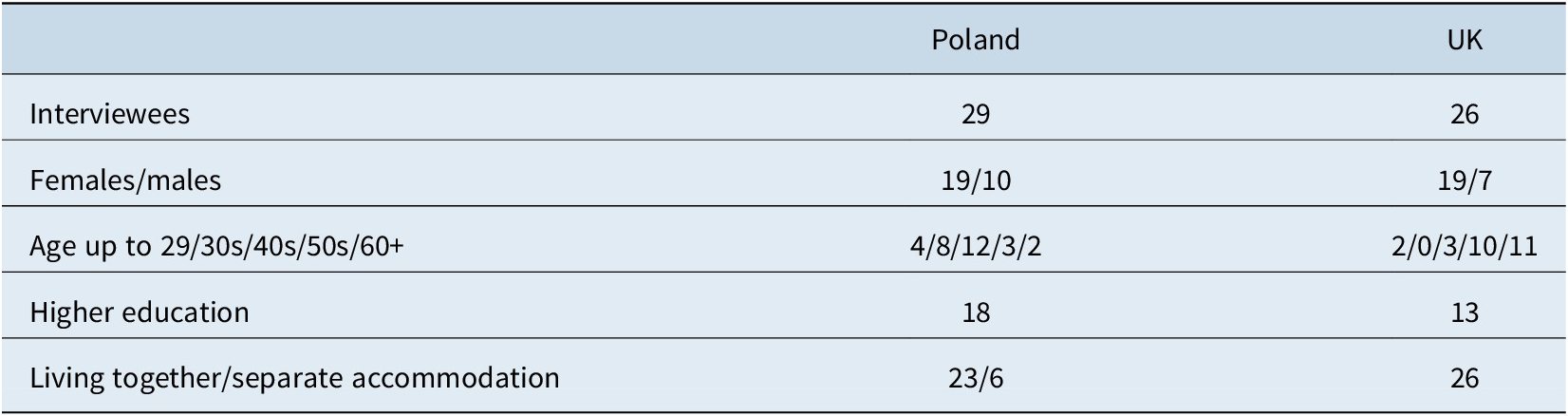
Interviews were conducted by Sociology students trained and supervised by Author One. In total, 29 participants, all born in Poland, were interviewed, including 19 females and 10 males, mostly between 30 and 49 years and with higher education (see Table 1), reflecting the characteristics of those involved in assistance in Poland. Eighteen lived in Warsaw, others resided in different places in the Masovian Voivodeship; 21 lived in apartments. The sample consisted of 23 individuals who hosted displaced Ukrainians and 6 who provided separate accommodations. The initial topic guide focused on motivations for helping, the relationship between hosts and those hosted, the different resources utilised to support displaced migrants, and the meaning of the participants’ engagement. The follow-ups explored changes in the assistance provided and in relationships, and reflections on hosts’ experiences in the short- and long-term.
Characteristics of the participants in Poland and the United Kingdom

Table 1. Long description
From top to bottom, the first column lists characteristics. The second column is Poland, the third is UK. Interviewees: Poland 29, UK 26. Females/males: Poland 19/10, UK 19/7. Age up to 29/30s/40s/50s/60 plus: Poland 4/8/12/3/2, UK 2/0/3/10/11. Higher education: Poland 18, UK 13. Living together/separate accommodation: Poland 23/6, UK 26.
Resource constraints meant only one round of interviews was undertaken in the United Kingdom, concurrent with the second wave of interviews in Poland. Twenty-six hosts were interviewed by Author Three, comprising 19 women and 7 men. Nineteen were 50 years or older (see Table 1), and three were born outside the United Kingdom (South African, Ukrainian, and Czech Republic nationals). Five said their parents/grandparents were born overseas. Most hosts were qualified professionals, and the majority lived in houses. All shared their home with those provided accommodation. The UK topic guide included key questions from the first and second waves in Poland to allow for comparisons.
The average duration of the interviews in Poland was 53 minutes, and 65 minutes in the UK. All interviews were recorded and transcribed. A thematic analysis of relevant theoretical and empirical categories was performed (Gibbs, Reference Gibbs2007), manually and using ATLAS.ti coding. The quotes used in the articles were selected based on their relevance, significance, and succinctness. All quotations utilise pseudonyms.
The project was granted ethical approval from (anonymised name) and was conducted in accordance with social science ethical guidelines, including obtaining informed consent from participants, ensuring their right to withdraw from the research, maintaining confidentiality, and pseudonymising the data.
Findings
The selective nature of hospitality
In line with hospitality theory, relatedness was a core feature that encouraged people to decide to host Ukrainians. In general, UK and Polish hosts anticipated relating to Ukrainians as they expected them to be culturally and “morally” similar. In Poland, decisions to support displaced Ukrainians were more spontaneous, given that so many had already arrived in the country prior to the special act on assistance. In the United Kingdom, the absence of a clear policy framework to support the matching of Ukrainians seeking to come to the United Kingdom and join those willing to host meant households had a high degree of selectivity when identifying those to be supported, although all hosted strangers. Following UK Government rhetoric, which framed Ukrainians as potential contributors to society and the economy, hosts were also convinced of their deservingness.
Both sets of interviewees manifested racialised perceptions of refugee backgrounds and identity, which led them to be open to hosting Ukrainians. Some British hosts also recognised the need to help “other” refugees, such as those from Syria and Afghanistan. One of the participants, Ann, even questioned why similar schemes had not been introduced for others, but then explained that she would not have been “comfortable with the fit” and would not have participated:
I wouldn’t have stepped up for homes for Afghanistan because I think that the cultural differences would have been so great that sharing with someone would be really, really difficult. (UKF68)
Katy also thought that she would not support “other” refugees “because the culture is so different” (UKF72). In Poland, Renata went so far as to express “fear” of other refugees because their skin colour and religion were different (PLW1F43).
Similarly, as Zogata-Kusz et al. (Reference Zogata-Kusz, Öbrink Hobzová and Cekiera2025) finds, some interviewees questioned the deservingness of refugees from other regions. The participants argued that Ukrainian women and children were deserving, as their men stayed behind to fight. Perceptions of deservingness appeared gendered as Lisa (UKF66) and the below-quoted Julia contested that male refugees from other countries did not deserve support because they should remain to defend their countries:
When we see a gang of screaming men on the border, we don’t want them because we know that, because in our culture, women are helped, because let them fight there, just like Ukrainians do (PLW1F35)
Renata also claimed that “other” refugees do not attempt to participate in host societies and felt this would not be a problem with Ukrainians (PLW1F43). Polish participants particularly underscored similarities in language, culture, and religion, and a common experience of prior Russian imperialism with Ukrainians. They were familiar with Ukrainian nationals, as there was a long history of labour migration to Poland from Ukraine. This was coupled with geographical proximity and a shared fear of a common enemy who might progress into Poland if Ukraine were not helped, which demonstrates the significance of time, space, and place in hosting:
I think that such great proximity, I won’t say direct experiences, but historical experiences, that is, this Russian bear that torments neighbours, made it so obvious to us, this situation was black and white, yes, you know who the victim is here, what is happening and who needs help. And at the beginning, there was also this feeling that it is still, in a sense, our common cause, yes, because now Ukraine has been attacked, but if Ukraine falls, I think that many Poles, including me, have a feeling that we could be the next ones. (PLW3M49)
These dimensions of affinity and closeness were also identified by Kalinowska and co-researchers (Reference Kalinowska, Kuczyński, Bukraba-Rylska, Krakowska and Sałkowska2023).
The Polish and British hosts anticipated they could live harmoniously with Ukrainians because of imagined similarity. However, especially UK hosts like Katy, who said, “you hope that would work” because “European is going to be more similar,” were surprised at the extent of the difference, especially around lifestyle factors, for example, the level of organisation and dining times (UKF68). Different approaches to parenting were considered particularly problematic and generated tensions because UK parents wanted their children to sleep at structured times, while some Ukrainian parents allowed their children to stay up later.
On the whole, Polish interviewees pointed to fewer cultural differences, instead highlighting similarities as illustrated in this quote:
Well, it seemed to me that this distance would be greater, and here not only in relation to Olena, but also with all the other people I talked to, as if it was completely absent, just people like me. (PLW3F45)
Much of the perceived affinity between the Polish hosts and those hosted was thus the product of time, space, and place-related factors such as geopolitical position, similar language or culture, as well as the common goal to help defeat the aggressive neighbouring country (Russia). In the United Kingdom, participants appeared to more strategically facilitate affinity, which appeared to result from the efforts that hosts, and at a later stage, RESET, invested in making sustainable matches. For example, Lily used a matching site to identify war refugees who would be “like them.” She described carefully curating photos to identify the right people:
So, I put up some pictures of my house and the room that was going to be available. And I also put a picture of my piano up, because that’s like an international symbol of music. And my cat, because I didn’t want someone coming to stay who’s allergic to cats. (UKF53).
Her approach facilitated a match with a young language student whom she deemed suitable. Thus, hosts sought and sometimes facilitated relatedness, with this being a key factor in their engagement in homestay, with almost no policy interventions in this sphere, beyond providing the conditions to allow and resource hosting. Arguably, the policy decision to allow hosts to select those supported, almost unheard of in refugee support in Europe, was an essential factor in enabling hosts to at least feel that they could achieve relativity.
The role of reciprocity in hospitality practice and policy
Hospitality involves a propensity to give, but an inner calculus is made about the respective participants’ position on the “debt balance” (Schwartz, Reference Schwartz1967), with reciprocity an inherent, often unspoken, part of the hospitality contract. Interviewees in the United Kingdom more openly expressed that reciprocity was the basis of a good relationship:
The more you give, the more you get back. It’s a reciprocal arrangement; the more you are prepared to put into the situation, the more the Ukrainians will trust you, accept you and treat you as a hero. (UKM50).
Polish participants tended to underplay the expectation of reciprocity from those hosted by them, instead highlighting their own philanthropic attitudes. Nevertheless, the interviews revealed different types of reciprocity reflecting those identified by Komter (Reference Komter2007) and (Phillimore et al. Reference Phillimore, Humphris and Khan2018). Exchanges operated within structures of inequalities and dependence, wherein the two parties did not have equal positions and resources (Molm et al., Reference Molm, Collett and Schaefer2007), given that Ukrainians were dependent on their hosts for housing and potentially other resources.
Direct and indirect reciprocity
Direct reciprocity was evident through exchanges perceived as refugees “paying back” for support received, with the most common resource being help with chores such as washing up, cleaning, help with DIY, gardening, or pet care:
I travel quite a lot anyway. And that’s been nice for me since I don’t have to worry about my cats being looked after because they love cats. So that’s good. So, the kitchen is clean, and the house is clean. (UKF46)
Interviewees underscored the contribution of Ukrainian refugees to household cleanness, comfort, and orderliness, which for Ewa included coming home to “a warm dinner,” a degree of thoughtfulness and consideration, indicating that “they’re very nice in that they try to return the favour” (PLW1F38). Reciprocity also involved symbolic and emotional exchange, sometimes the only exchange that refugees could offer in the absence of material resources. Several participants, like Adam, talked of emotional connections and the value of hosted migrants’ sharing their stories and company:
Because in one evening over tea, a person simply, well, the only thing that is able to give you in return, at least those that I met, had the need to give something in return, and when you flee from war, you kind of have nothing to take and you have nothing to give. So, what I got in return were the stories and tales of these people, so when you sit over tea and someone tells you their story in such detail, it very quickly allows you to establish a very strong emotional relationship, too. (PLW1M20)
The above quote illustrates the processes of building closeness with strangers based on emotion sharing and empathy in the context of the particular encounter marked by time, space, and place. Adam recognised the “need” for those supported to repay resources, albeit symbolically. In a similar vein, in other studies, hosts’ identified the importance of direct reciprocity for assisted refugees and accepted resources that they neither wanted nor needed to reduce the power imbalances of under-reciprocity, known to impact individuals’ well-being (Author Two et al., Reference Phillimore, Humphris and Khan2018). In our research, Ellie, based in the United Kingdom, told of allowing hosted migrants to make a financial contribution:
They offered us money, which is something that they were very keen to do. We weren’t bothered, not because we’re incredibly affluent, but I think we’d be lucky because we can afford our basic expenses. But they’ve offered me that, so we said ‘Well, look, yeah, okay, I think that makes them happy. (UKF56)
Lucy recognised that it was “disempowering” for those hosted not to exchange resources in these words, “which I think makes a big difference for them to feel they are pulling their own weight” (UKF46). Yet both examples signal the presence of power imbalances since the decision to “allow” a contribution is in the hands of the host. Nonetheless, as Molm et al. (Reference Molm, Collett and Schaefer2007) find, the exchange of time, effort, and resources established trust, affection, and a sense of solidarity, which help to build strong relationships supporting the sustainability of homestay arrangements.
Reciprocity may refer to repayment of the gift at a different time. We found several examples of anticipated reciprocity wherein hosts understood that those provided accommodation were unable to give at present but offered future resource exchange. Piotr recalled an invitation to future hospitality in Ukraine, promising both forthcoming resource exchange while implying their situation is temporary and suggesting hope for a resumption of normal relations in which the currently displaced migrants are able to host (PLW1M44).
There were also cases of future reciprocity concerning unknown others. For example, hosts made their resources available as they were “banking” resources for some future need, should they or their loved ones be in a similar situation. Alice’s statement suggests some degree of relativity when she recognises that she may find herself in a similar situation:
“So no, I did it merely because there’s somebody out there that I felt was less fortunate than myself. And if I were in that situation, I would want somebody to help me.” (UKF62)
The most prevalent forms of indirect reciprocity came from the state’s compensation policy, wherein the government paid hosts in exchange for offering hospitality. The “thank you” payment policy in the United Kingdom left the below-cited Mark feeling that he received adequate resources for his hospitality:
There is the government’s financial incentive as well. You know, I’m getting very, very, very well compensated for having my guest here. So that’s certainly helped give me a push. (UKM51)
This indirect reciprocity morphed into direct reciprocity when the above-hosted person found employment and partially reciprocated with his income. Mark also viewed his enjoyment of the accommodated person’s company as direct repayment. It should be stressed, though, that the reimbursement paid in Poland represented a more complex and contentious case, discussed below.
Under-reciprocity
As Blau (Reference Blau1964) pointed out, in social exchange, terms are not specified, so potential for non-reciprocity or under-reciprocity always exists, especially for indirect exchanges between strangers. This was particularly relevant in homestay, given that the hosts’ and accommodated refugees’ expectations of exchange might be different and unclear, and displaced migrants’ situations evolved. Balanced direct reciprocity was difficult to achieve, given the limited resources available to many hosted individuals.
While the UK state’s “thank you” payment was considered sufficient, the situation was different in Poland. Hosts were only compensated for 120 days, but they generally provided accommodation for much longer periods. Arrangements were also less formalised, with both parties unclear about the purpose of the funds. This situation was exacerbated by a lack of agreement about arrangements before or at the beginning of hosting. Delays in reimbursement left hosts feeling that the state was not upholding their side of the bargain, and thus, even indirect reciprocity was not achieved:
(…) also, those 40 PLN plus something, I filled out this application about a month ago and they still haven’t received the money…. Because there are posts on Facebook from my shitty [the name of a town in the Warsaw agglomeration] that people haven’t received the money yet, so probably not. And it’s a shame because they probably would have really used it for their needs. (PLW1F35)
Even in the United Kingdom, the hosts did not wish to feel that they were merely offering a state-resourced service and wanted to receive something additional from those provided accommodation to indicate that relations were something more. Maria explained she felt something was missing in her relationship since those hosted seemed to treat her home as if they were merely tenants. In addition, she began to question their deservingness:
We don’t feel like we actually got anything from it. We felt like we were a government agency, and probably, for our guests, we were just a service. Our family was primarily economic migrants who were seizing an opportunity rather than escaping from conflict, and I suspect they saw the opportunity for their son to get a UK education. We were some sort of unpaid resettlement service concierge service or something like that. (UKF55)
Some hosts articulated the desire for gratitude as the repayment in the unarticulated terms of the exchange. Sometimes they felt that those who provided support did not acknowledge the extent of the sacrifices they made. Igor, who moved into a friend’s flat to make his Warsaw home available to two young Ukrainians, felt that they did not appreciate his efforts and was unhappy they did not return his generosity by treating him and his property with respect:
I had to sacrifice a lot of my own comfort to help someone, which is kind of a good deal in my opinion, of course, because let’s not exaggerate, it’s just my comfort, but (…) So, I lost a lot of it. And I developed more anxiety, and I’m closer to the depression that I used to suffer from, in the sense that it’s very stressful for me, and I’ve also lost that basic sense of security (…) And that I hear my neighbour calling me there at two, three in the morning, saying that she couldn’t sleep and complained to me, well, it was hard for me here, emotionally, it was work for me. (PLW1M35)
In this and other cases, participants wanted more than money, and without these often-unspoken expectations, felt taken advantage of. These feelings could undermine homestay arrangements and contribute to a breakdown in relationships. The flexibility of the homestay policy, in not determining what exactly is expected from the host and those hosted, or in instructing hosts to make their expectations clear, may have exacerbated these problems and, in so doing, undermined the sustainability of homestay. This was particularly noticeable in Poland, where the length of support, household rules, and expectations tended to remain unarticulated.
Over-reciprocity
We could also observe examples of over-reciprocity. Some participants presented the accommodated migrants’ attempts to engage in household chores as excessive, finding these offers psychologically uncomfortable. Lena explained how her household functioned somewhat chaotically, and became embarrassed when the hosted refugees undertook the housework without being asked:
So, they were ahead of us in everything. Well, we tried to do something over the weekend, like wash the bathroom or something like that, but in the end, I don’t know, somehow it just worked out. Well, no special rules were necessary; we told them that we felt embarrassed that they were doing so much, and the old lady said that she sat at home all day anyway, so we left it to her for a while. (PLW1F20)
Pawel feared feeling guilty and worried about being seen as exploitative if the person hosted undertook all the cleaning as she requested. Instead, he hired a cleaner to complete the work, subsequently realising he had placed the accommodated refugee in a position where she felt she was under-reciprocated. To address this situation, he allocated tasks:
But I told her, for example: ‘Listen, if you want to help me, for example, I always had flowers nicely planted on the balcony here, but I don’t have time to really take care of them, and if you would like to do it.’ And she said: ‘I would like to, but if I touch anything, as far as flowers go, it dies immediately’…. And now I will ask her, for example, because I’m going on vacation, I will ask her to water these flowers for me for, say, 1.5 weeks. (PLW1M49)
Pawel retained control by deciding which tasks the hosted person could complete, thereby avoiding psychological discomfort; however, in doing so, he displayed his power over the supported refugee by signalling that, in his home, he decided how tasks would be undertaken.
Inequalities, power, and dependency
Loss of power and resources is inevitable for refugees who must leave their homes and enter another country where their right to remain is conditional. This situation may be exacerbated when depending on the generosity of hosts for a home and sustenance. In a homestay, as in hospitality generally, the resources possessed by giver and receiver were usually unequally distributed. The result was uneven power dynamics with one party having the right to give and the other to receive (Gouldner, Reference Gouldner1973). Becoming a refugee inevitably affected hosted migrants’ status, producing vulnerabilities and impacting refugees’ self-esteem and agency, as Katy noted:
Before she got to university, she was much more dependent on me. She was at home all the time; she was definitely a refugee. And it was a bit horrid. And she had much less agency. (UKF72).
As we have seen, hosts exercised power over those provided accommodation in several ways. Their ability to select those helped, often based on assumed relativity, and then invite them into their home for an undetermined length of time represented an exercise of power. The absence of rules, predetermined by the state or negotiated between hosts and hosted refugees, potentially exacerbated power imbalances. To feel psychologically safe, hosts sought to retain control of their homes and decide what displaced migrants could offer in return. Hosts also had the power to provide opportunities for reciprocity by agreeing to accept exchanges, again maintaining control but also feeling aggrieved at under-reciprocity, even when it was not always clear what additional resources they desired, and only they had the power to hold these expectations.
Through uneven exchanges, stratification and inequality are produced (Blau, Reference Blau1964), although we found no direct evidence of intent to generate or exploit such imbalances. One Polish host suggested that a combination of state resources and the absence of clear rules and oversight by the state could sometimes lead to exploitation:
But it turns out that Poles take advantage of it because formally, when you apply for it, it says that because you get this money, you should provide some maintenance or something like that, some help to the Ukrainians you host. But it turns out that the lady she lives with and her whole family take this money for themselves. No, she doesn’t provide any food, and what’s more, she eats what they buy. (PLW2M49)
The above-cited Lena believed that to lessen inequality and prevent advantage being taken was to ensure state payments went directly to refugees so they could remunerate hosts appropriately (PLW2F20). However, without guidance about how hosted migrants’ remuneration should occur, this could generate concerns about under-reciprocity, potentially undermining hosts’ willingness to share their homes. Although no UK participants raised concerns about exploitation, there is evidence that it has taken place (García Vázquez et al., Reference García Vázquez, Cockbain, Roberts and Fisher2024). As Machin (Reference Machin2023) points out, adequate safeguarding mechanisms must also be provided, with the key role of local authorities and NGOs in supporting refugees and hosts, monitoring safety, and facilitating exchanges through the provision of initiatives.
Discussion and conclusion
To the best of our knowledge, this article is the first comparative study of the functioning of refugee homestay policy. We offer three contributions: conceptualising hospitality as policy; extending understanding of reciprocity in hospitality theory and policy; and providing policy recommendations concerning the reliance on hospitality in policy.
Homestay has been studied as a civil society act of micro-hospitality (Bassoli and Luccioni, Reference Bassoli and Luccioni2022). We contend that following the full-scale invasion of Ukraine, homestay was adopted by states as a new policy approach, harnessing a combination of available housing and citizen goodwill, and operating as a form of macro-hospitality facilitated by policy. The Polish and the UK states, in their own ways, implemented policies to permit micro-hospitality and enable selectivity while funding financial reciprocity. This was the first time such a policy had been implemented, enabling the provision of urgent support to Ukrainian refugees on an unprecedented scale.
The approaches adopted in both countries were quite different, with the Polish government reacting to their citizens’ actions and, to a minimal extent, formalising what was already taking place while offering financial support. The UK Government, on the other hand, could choose how it reacted to the “crisis” and adopted a highly individualised, arguably neoliberal approach, wherein almost all responsibility for resettling Ukrainians was placed in the hands of residents, albeit with some local authority support. In the United Kingdom, the numbers who arrived, where they were located, and the nature of host/the hosted relations, were entirely at the discretion of hosts, whereas in Poland, those who fled Ukraine could stay in Poland and resided in either private homes or the collective accommodation usually operated by state institutions or established NGOs and religious entities.
We highlight the presence of three dimensions of hospitality, as indicated by Komter and van Leer (Reference Komter and van Leer2012). We demonstrated the selectivity of hospitality towards refugees, including a preference for Ukrainian displaced migrants over other refugee groups, as well as policy-facilitated selectivity in allowing hosts to choose those supported and realise their preferences in terms of age and educational level. This was especially so in the United Kingdom, where matching was eventually institutionally supported.
Our analysis demonstrated how hospitality was generally impacted by reciprocity in both countries, despite substantive contextual differences, with more institutionalised and formalised arrangements within the H4U and less in Poland, where hosting decisions were more individualistic, ad-hoc, and spontaneous, based on those already in-country. The notion of reciprocity provided a useful tool for analysing hospitality towards refugees. It links the different dynamics of giving and receiving, highlighting the importance of resource exchange, by which displaced migrants benefit from shared accommodation and develop and sustain social connections with the host to acquire resources.
Our article underscores the ambivalence of hospitality and reciprocity, which are multidimensional, culturally grounded in time, space and place, dynamic, and embedded in social relations and disparities. We highlight the importance of considering reciprocity in the development of homestay policy. In the United Kingdom, such a policy enabled a degree of indirect reciprocity through economic compensation, with UK hosts generally satisfied with the framework and financial support. The Polish participants generally started home hosting before the benefits for assistance were introduced, demonstrating less reliance on this support and certain confusion about its role. However, in both cases, the sole financial mechanism was seen as insufficient while some hosts did not see attempts for reciprocity (e.g., even symbolic or emotional), with some others showing avoidance of the over-reciprocity of hosted migrants suggesting that provision of financial incentives without policy guidance around how relations and reciprocity between hosts and those supported might be managed may potentially undermine the sustainability and scalability of homestay approaches.
We also demonstrate the almost inevitability of inequalities in homestay, resulting in uneven power dynamics. The “home” is a critical site for interpreting hospitality as it locates in time and space asymmetrical social relationships between host and accommodated refugees that constitute hospitality on which homestay depends. Hosting can emphasise solidarity with refugees through the creation of friendships. Yet, it often reinforces inequalities and produces tensions over the need to reciprocate, as control is asserted over the those provided accommodation. We evidenced how power and dependency were inherent in hospitality policy, demonstrating how hosts controlled what was reciprocated. Relations and interactions among our participants provided evidence of the conditional nature of hosting, in which the displaced migrants’ vulnerability and neediness were evident through the expectation of gratitude. To be perceived as a “good guest” also involved assuming the role and expectations of adjustment and activism in becoming independent (Grzymala-Kazlowska et al., Reference Grzymała-Kazłowska, Skiba and Ostrowska2026).
Our study helps to understand different forms of reciprocity and how hospitality is influenced by policy, and how reciprocity might shape homestay policies. Individual acts of hosting manifested the capacity and willingness of communities to support refugees. Such actions challenged narratives of refugee burden on resources and may potentially lead policymakers to consider extending the use of homestays in responses to refugee emergencies.
Homestays demonstrated the potential for hospitality to play an important role in refugee reception and accommodation, which has much potential for future policy initiatives. Our findings enable us to make five recommendations to help better facilitate the sustainability of the micro-hospitality on which homestays depend.
-
1. Our findings around the importance of perceptions of cultural similarity indicate that when there is an urgent need to respond to a crisis, facilitating host and someone supported matching within groups viewed as having common characteristics is likely to increase individual hosts’ willingness to host, enabling them to select potentially accommodated individuals on the basis on relative closeness, for example, around age, gender, professional background, or education.
-
2. Given the importance of reciprocity in our findings, there is a clear need for states to provide some of the resources that refugees do not possess for exchange. Future homestay policy might remunerate hosts for their costs, time, and inconvenience in a timely manner, while simultaneously reducing opportunities for the exploitation of state resources and of refugees, and ensuring mechanisms that are not so administratively onerous as to deter potential hosts.
-
3. Local authorities and NGOs have a crucial role in supporting refugees and hosts, monitoring safety, and facilitating exchanges through the provision of initiatives. In Poland, this role should be further developed alongside multisectoral cooperation to provide an appropriate environment for homestays to function.
-
4. As our findings and Luczaj’s study (Reference Luczaj2024) confirm, unclear expectations undermine positive relationships and potentially lead to breakdowns in hosting. Given that financial reciprocity alone is insufficient, the somewhat laissez-faire approach to facilitating homestay may be inadequate. Policy might need to ensure the provision of resources to help hosts and those hosted to agree on reasonable exchange rules in advance of committing to arrangements, perhaps providing materials that outline key areas to address. Resources might support the review of rules as relationships and situations evolve. This approach may help reduce power asymmetries and insecurities.
-
5. Finally, the state’s contract with hosts needs to be clear from the outset, with a pathway beyond hosting elaborated. The absence of a follow-on dimension to policy left hosts stressed and confused, and is likely to have a similar effect on those provided accommodation. Hosts may be unlikely to repeat the experience in these circumstances.
Funding statement
This work was supported by the University of Warsaw under the Priority Research Area V of the "Excellence Initiative – Research University" programme under Grant No IDUB-622-183/2022 (within the project ‘Private admission and support of refugees from Ukraine’) and the National Science Centre Poland under Grant No 2021/41/B/HS5/04071 (within the project “Challenges, opportunities and prospects of community sponsorship – multimethod and mulitperspective analysis”, COPOCS).
Ethical approval and informed consent statements
The studies received ethical approval from the Research Ethics Committee at the Faculty of Sociology, University of Warsaw (KE-1/2022 and KE-3/2022). All participants gave informed consent.

 Open access

