





1 Introduction
Cognitive Diagnostic Models (CDMs), or Diagnostic Classification Models (Rupp and Templin, Reference Rupp and Templin2008; von Davier and Lee, Reference von Davier and Lee2019), are popular discrete latent variable models widely used in educational and psychological measurement. Based on test respondents’ multivariate categorical item responses, one can use a CDM to infer their fine-grained discrete latent attributes, such as cognitive abilities, personality traits, or mental disorders. One key structure in a CDM is the Q-matrix (Tatsuoka, Reference Tatsuoka1983), which is a $J\times K$
binary matrix describing how the J items depend on the K latent attributes. Various CDMs have been proposed with different modeling assumptions. Popular examples include the conjunctive Deterministic Input Noisy Output “And” gate model (DINA; Junker and Sijtsma, Reference Junker and Sijtsma2001), the disjunctive Deterministic Input Noisy Output “Or” gate model (DINO; Templin and Henson, Reference Templin and Henson2006), the main-effect diagnostic models including the linear logistic models (LLM; Maris, Reference Maris1999), the reduced Reparameterized Unified Model (reduced-RUM; DiBello et al., Reference DiBello, Stout and Roussos2012), and the additive CDM (ACDM; de la Torre, Reference de la Torre2011), and all-saturated-effect diagnostic models including the general diagnostic models (GDM; von Davier, Reference von Davier2008), the log-linear CDM (LCDM; Henson et al., Reference Henson, Templin and Willse2009), and the generalized DINA model (GDINA; de la Torre, Reference de la Torre2011).
$J\times K$
binary matrix describing how the J items depend on the K latent attributes. Various CDMs have been proposed with different modeling assumptions. Popular examples include the conjunctive Deterministic Input Noisy Output “And” gate model (DINA; Junker and Sijtsma, Reference Junker and Sijtsma2001), the disjunctive Deterministic Input Noisy Output “Or” gate model (DINO; Templin and Henson, Reference Templin and Henson2006), the main-effect diagnostic models including the linear logistic models (LLM; Maris, Reference Maris1999), the reduced Reparameterized Unified Model (reduced-RUM; DiBello et al., Reference DiBello, Stout and Roussos2012), and the additive CDM (ACDM; de la Torre, Reference de la Torre2011), and all-saturated-effect diagnostic models including the general diagnostic models (GDM; von Davier, Reference von Davier2008), the log-linear CDM (LCDM; Henson et al., Reference Henson, Templin and Willse2009), and the generalized DINA model (GDINA; de la Torre, Reference de la Torre2011).
The identifiability of CDMs is crucial to ensuring the validity of their statistical analysis. Especially in exploratory CDMs where the Q-matrix is unknown, uniquely identifying Q is a fundamental prerequisite for reliably estimating it using any method. In the past decade, the identifiability problems of CDMs and Q-matrix have attracted increasing interest. Regarding the proof techniques, the existing identifiability studies fall into two categories. The first category (Chen et al., Reference Chen, Culpepper and Liang2020; Culpepper, Reference Culpepper2019,2; Fang et al., Reference Fang, Liu and Ying2019; Liu and Culpepper, Reference Liu and Culpepper2024) leveraged Kruskal’s Theorem on the uniqueness of three-way tensor factorizations (Kruskal, Reference Kruskal1976,7) to establish identifiability. These approaches share a similar spirit to the general proof framework popularized by Allman et al. (Reference Allman, Matias and Rhodes2009). The second category (Chen et al., Reference Chen, Liu, Xu and Ying2015; Gu and Xu, Reference Gu and Xu2021; Liu et al., Reference Liu, Xu and Ying2013; Xu and Shang, Reference Xu and Shang2018) exploited the marginal moments of the binary responses and investigated the uniqueness of roots to the polynomial equations defined by these moments. This fine-grained proof technique can sometimes deliver sharper identifiability conditions compared to directly invoking Kruskal’s Theorem.
In contrast to all of the above existing work, we adopt a fundamentally different proof strategy based on tensor unfolding. Unfolding or flattening a tensor (third-order or higher-order array) means reshaping it into a lower-order tensor or a matrix (Kolda and Bader, Reference Kolda and Bader2009). In a CDM, the population distribution of the J observed categorical variables can be represented by a Jth-order tensor, whose entries are elements in the joint probability mass function of the J-dimensional response vector. Our key proof idea is to strategically unfold this tensor to a matrix in various ways and use the rank properties of these resulting matrices to uniquely identify the Q-matrix. Our identifiability proof is a constructive proof for the first time in the literature: the proof itself is a population-level procedure and algorithm to reconstruct the Q-matrix from the population distribution in a restricted identifiable Q-matrix space. This identifiable space contains all Q-matrices that have at least two “pure” items solely measuring each latent attribute. Our proof’s constructive nature departs from all existing identifiability analyses of the Q-matrix: previous works adopt existence proofs, by proving that if two Q-matrices lead to the same population distribution of observed responses, the two Q-matrices must be identical, without indicating how the Q-matrix can be reconstructed from the population distribution.
Our identifiability result enjoys three additional features. First, it can directly and constructively identify the number of latent attributes K together with the Q-matrix. Second, it is broadly applicable to various flexible CDMs, including all main-effect CDMs (such as reduced-RUM, LLM, and ACDM) and all-saturated-effect CDMs (such as GDM, LCDM, and GDINA). Third, it applies to CDMs with polytomous responses, in addition to traditional CDMs with binary responses. Recently, variants of CDMs with polytomous responses (Culpepper, Reference Culpepper2019; Fang et al., Reference Fang, Liu and Ying2019; Liu and Culpepper, Reference Liu and Culpepper2024; Ma and de la Torre, Reference Ma and de la Torre2016; Wayman et al., Reference Wayman, Culpepper, Douglas and Bowers2025) have attracted increasing interest due to their flexibility. Our theory offers a unified identifiability result for all these CDMs with general categorical responses. Compared to existing identifiability conditions for binary- or polytomous-response CDMs, our new condition is weaker because it only requires the Q-matrix to contain two identity matrices $I_K$
without any additional assumption. Specifically, this implies that if there are exactly
$I_K$
without any additional assumption. Specifically, this implies that if there are exactly $J=2K$
items and the Q-matrix contains just two
$J=2K$
items and the Q-matrix contains just two $I_K$
, then this Q is still identifiable; whereas to our best knowledge, such a Q-matrix does not satisfy previous identifiability conditions for general CDMs.
$I_K$
, then this Q is still identifiable; whereas to our best knowledge, such a Q-matrix does not satisfy previous identifiability conditions for general CDMs.
In the rest of this article, Section 2 introduces the unfoldings of the probability tensor in CDMs and gives a detailed illustrative example. Section 3 presents the new identifiability theory for both binary CDMs and polytomous CDMs. Section 4 concludes and discusses a future direction. The proofs of the theoretical results are included in the Appendix.
2 Unfolding Population Distribution Tensors in a CDM
2.1 Model Setup of CDMs with Binary Responses and Attributes
Consider a CDM where each subject is associated with J observed variables ${\mathbf {R}} = (R_1,\ldots ,R_J)$
as responses to J test items and K latent attributes
${\mathbf {R}} = (R_1,\ldots ,R_J)$
as responses to J test items and K latent attributes ${\mathbf {A}}=(A_1,\ldots ,A_K)$
. We start by considering the most commonly used CDMs with binary responses
${\mathbf {A}}=(A_1,\ldots ,A_K)$
. We start by considering the most commonly used CDMs with binary responses ${\mathbf {R}}\in \{0,1\}^J$
and binary attributes
${\mathbf {R}}\in \{0,1\}^J$
and binary attributes ${\mathbf {A}}\in \{0,1\}^K$
, and later will generalize our result to polytomous responses and attributes. A key structure in a CDM is the Q-matrix introduced in Tatsuoka (Reference Tatsuoka1983), which specifies the relationship between the observed responses and the latent attributes. The Q-matrix is a
${\mathbf {A}}\in \{0,1\}^K$
, and later will generalize our result to polytomous responses and attributes. A key structure in a CDM is the Q-matrix introduced in Tatsuoka (Reference Tatsuoka1983), which specifies the relationship between the observed responses and the latent attributes. The Q-matrix is a $J\times K$
matrix
$J\times K$
matrix ${\mathbf {Q}}=(q_{jk})$
with binary entries, with rows indexed by the J items and columns by the K attributes. The entry
${\mathbf {Q}}=(q_{jk})$
with binary entries, with rows indexed by the J items and columns by the K attributes. The entry $q_{jk}=1$
or
$q_{jk}=1$
or $0$
indicates whether or not the jth item requires/measures the kth latent attribute. The row vectors of the Q-matrix are also called the
$0$
indicates whether or not the jth item requires/measures the kth latent attribute. The row vectors of the Q-matrix are also called the $\mathbf q$
-vectors and denoted by
$\mathbf q$
-vectors and denoted by ${\mathbf {q}}_j$
for each
${\mathbf {q}}_j$
for each $j\in [J]$
. Here, for any positive integer M, we denote
$j\in [J]$
. Here, for any positive integer M, we denote $[M]=\{1,2,\ldots ,M\}$
.
$[M]=\{1,2,\ldots ,M\}$
.
To model the conditional distribution of the observed ${\mathbf {R}}$
given the latent
${\mathbf {R}}$
given the latent ${\mathbf {A}}$
, we use the general notation of the item parameters
${\mathbf {A}}$
, we use the general notation of the item parameters
 $$ \begin{align*} \theta_{j,\boldsymbol{\alpha}} = {\mathbb{P}}(R_j=1\mid {\mathbf{A}}=\boldsymbol{\alpha}),\quad j=1,\ldots,J;\quad\boldsymbol{\alpha}\in\{0,1\}^K, \end{align*} $$
and denote the collection of them by $\boldsymbol \Theta $
. These item parameters are subject to certain equality constraints imposed by the Q-matrix in different ways under different models; see Examples 1 and 2 for concrete examples. For the latent attributes, we consider the most commonly adopted saturated attribute model with proportion parameters
$\boldsymbol \Theta $
. These item parameters are subject to certain equality constraints imposed by the Q-matrix in different ways under different models; see Examples 1 and 2 for concrete examples. For the latent attributes, we consider the most commonly adopted saturated attribute model with proportion parameters ${\mathbf {p}}=(p_{\boldsymbol {\alpha }}; \boldsymbol {\alpha }\in \{0,1\}^K)$
, where
${\mathbf {p}}=(p_{\boldsymbol {\alpha }}; \boldsymbol {\alpha }\in \{0,1\}^K)$
, where
 $$ \begin{align*} p_{\boldsymbol{\alpha}} = {\mathbb{P}}({\mathbf{A}}=\boldsymbol{\alpha}),\quad \forall\boldsymbol{\alpha}\in\{0,1\}^K. \end{align*} $$
The proportion parameters ${\mathbf {p}}$
satisfy that
${\mathbf {p}}$
satisfy that $p_{\boldsymbol {\alpha }}\geq 0$
for all
$p_{\boldsymbol {\alpha }}\geq 0$
for all $\boldsymbol {\alpha }$
and
$\boldsymbol {\alpha }$
and $\sum _{\boldsymbol {\alpha }\in \{0,1\}^K} p_{\boldsymbol {\alpha }}=1$
. We use
$\sum _{\boldsymbol {\alpha }\in \{0,1\}^K} p_{\boldsymbol {\alpha }}=1$
. We use $\mathbf e_k$
to denote the K-dimensional canonical basis vector with an “1” in the kth entry and “0” in all other entries.
$\mathbf e_k$
to denote the K-dimensional canonical basis vector with an “1” in the kth entry and “0” in all other entries.
Under the above general setup, various CDMs were proposed with different diagnostic modeling assumptions and different link functions. In this work, we focus on the flexible main-effect or all-saturated-effect CDMs, which are also called the multi-parameter restricted latent class models in Gu and Xu (Reference Gu and Xu2021) and encompass a wide range of diagnostic models.
Remark 1. The Boolean-product-based DINA and DINO models (also called two-parameter restricted latent class models) exhibit very different algebraic structures from the multi-parameter CDMs. Such distinctive properties make the marginal-moment-based proof technique (Gu and Xu, Reference Gu and Xu2021; Xu and Zhang, Reference Xu and Zhang2016) optimal for deriving the minimal identifiability conditions for the DINA and DINO models. Necessary and sufficient identifiability conditions for the Q-matrix in these models are already well understood in the literature (Gu, Reference Gu2023; Gu and Xu, Reference Gu and Xu2021). Therefore, we do not consider the DINA and DINO models in this work and instead focus on the general and flexible main-effect or all-saturated-effect CDMs.
In the following, we review concrete examples of multi-parameter CDMs in the following.
Example 1 (Main-Effect Cognitive Diagnosis Models).
An important family of cognitive diagnosis models assumes that the $\theta _{j,\boldsymbol {\alpha }}$
depends on the main effects of those attributes required by item j, but not their interactions. This family includes the popular reduced Reparameterized Unified Model (rRUM; DiBello et al., Reference DiBello, Stout and Roussos2012), Additive Cognitive Diagnosis Models (ACDM; de la Torre, Reference de la Torre2011), the Linear Logistic Model (LLM; Maris, Reference Maris1999), and the General Diagnostic Model (GDM; von Davier, Reference von Davier2008). We call them the Main-Effect Cognitive Diagnosis Models. In particular, under the rRUM,
$\theta _{j,\boldsymbol {\alpha }}$
depends on the main effects of those attributes required by item j, but not their interactions. This family includes the popular reduced Reparameterized Unified Model (rRUM; DiBello et al., Reference DiBello, Stout and Roussos2012), Additive Cognitive Diagnosis Models (ACDM; de la Torre, Reference de la Torre2011), the Linear Logistic Model (LLM; Maris, Reference Maris1999), and the General Diagnostic Model (GDM; von Davier, Reference von Davier2008). We call them the Main-Effect Cognitive Diagnosis Models. In particular, under the rRUM,
 $$ \begin{align*}{\mathbb{P}}^{\,\mathrm{rRUM}}(R_j = 1\mid {\mathbf{A}}=\boldsymbol{\alpha},Q)= \theta^+_j \prod_{k=1}^K r_{jk}^{q_{jk}(1-\alpha_k)}, \end{align*} $$
where $\theta ^+_j={\mathbb {P}}(R_j=1 \mid A_k\geq q_{jk} \text { for all }k=1,\ldots ,K)$
represents the positive response probability of a capable subject of item j (i.e., a subject mastering all required skills of item j), and
$\theta ^+_j={\mathbb {P}}(R_j=1 \mid A_k\geq q_{jk} \text { for all }k=1,\ldots ,K)$
represents the positive response probability of a capable subject of item j (i.e., a subject mastering all required skills of item j), and $r_{jk}\in (0,1)$
is the parameter penalizing not mastering attribute k required by item j. Equivalently, the item parameter in the rRUM can be written as
$r_{jk}\in (0,1)$
is the parameter penalizing not mastering attribute k required by item j. Equivalently, the item parameter in the rRUM can be written as $\log \theta ^{\,rRUM}_{j,\boldsymbol {\alpha }} = \beta _{j0} + \sum _{k=1}^K\beta _{jk}q_{jk}\alpha _k$
. Similarly, the ACDM assumes the parameter
$\log \theta ^{\,rRUM}_{j,\boldsymbol {\alpha }} = \beta _{j0} + \sum _{k=1}^K\beta _{jk}q_{jk}\alpha _k$
. Similarly, the ACDM assumes the parameter $\theta _{j,\boldsymbol {\alpha }}$
can be written as a linear combination of the main effects of the required attributes:
$\theta _{j,\boldsymbol {\alpha }}$
can be written as a linear combination of the main effects of the required attributes:
 $$ \begin{align*}{\mathbb{P}}^{\,\mathrm{ACDM}}(R_j = 1\mid {\mathbf{A}}=\boldsymbol{\alpha},Q) = \beta_{j0} + \sum_{k=1}^K \beta_{jk}q_{jk}\alpha_k. \end{align*} $$
The Linear Logistic Model assumes a logistic link function with
 $$ \begin{align*}{\mathbb{P}}^{\,\mathrm{LLM}}(R_j = 1\mid {\mathbf{A}}=\boldsymbol{\alpha},Q) = \sigma\Big(\beta_{j0} + \sum_{k=1}^K\beta_{jk} q_{jk}\alpha_k\Big), \end{align*} $$
where $\sigma (x) = 1/(1+e^{-x})$
is the logistic function.
$\sigma (x) = 1/(1+e^{-x})$
is the logistic function.
Example 2 (All-saturated-effect Cognitive Diagnosis Models).
Another popular type of cognitive diagnostic model assumes that the positive response probability depends on the main effects and all of the interaction effects of the required attributes of the item. We call these models all-saturated-effect cognitive diagnosis models. The GDINA model (de la Torre, Reference de la Torre2011), the log-linear cognitive diagnosis models (LCDM; Henson et al., Reference Henson, Templin and Willse2009), and the general diagnostic model (GDM; von Davier, Reference von Davier2008) are popular examples of all-saturated-effect models. The item parameters (conditional positive response probabilities) under these models are
 $$ \begin{align} {\mathbb{P}}^{\,\mathrm{All-Effect}} (R_j = 1\mid {\mathbf{A}}=\boldsymbol{\alpha}) =&~ f\Big(\beta_{j0} + \sum_{k=1}^K\beta_{jk} q_{jk}\alpha_k + \sum_{1\leq k_1<k_2 \leq K} \beta_{j,\{k_1,k_2\}} q_{j,k_1} q_{j,k_2} \alpha_{k_1} \alpha_{k_2} \\ &~ + \cdots + \beta_{j,\{1,2,\cdots, K\}} \prod_{k=1}^K q_{jk} \prod_{k=1}^K \alpha_{k}\Big).\nonumber \end{align} $$
When f is the identity link $f(x)=x$
, the above gives the GDINA model, and when f is the inverse logit link
$f(x)=x$
, the above gives the GDINA model, and when f is the inverse logit link $f(x) = \sigma (x) = 1/(1+e^{-x})$
, the above gives the LCDM. von Davier (Reference von Davier2014) showed that the GDINA and LCDM can be rewritten as GDMs with an extended skill space.
$f(x) = \sigma (x) = 1/(1+e^{-x})$
, the above gives the LCDM. von Davier (Reference von Davier2014) showed that the GDINA and LCDM can be rewritten as GDMs with an extended skill space.
The local independence assumption is usually imposed in CDMs, meaning that the observed responses $R_1,\ldots ,R_J$
are conditionally independent given the latent attributes
$R_1,\ldots ,R_J$
are conditionally independent given the latent attributes ${\mathbf {A}}$
. With this assumption, we can write the joint distribution of the observed
${\mathbf {A}}$
. With this assumption, we can write the joint distribution of the observed ${\mathbf {R}}$
by marginalizing out the latent
${\mathbf {R}}$
by marginalizing out the latent ${\mathbf {A}}$
in a CDM with binary responses and binary attributes:
${\mathbf {A}}$
in a CDM with binary responses and binary attributes:
 $$ \begin{align} {\mathbb{P}}(R_1 = r_1, \ldots, R_J = r_J\mid Q,\boldsymbol \Theta,{\mathbf{p}}) &= \sum_{\boldsymbol{\alpha}\in\{0,1\}^K} {\mathbb{P}}({\mathbf{A}} = \boldsymbol{\alpha}) \prod_{j=1}^J {\mathbb{P}}(R_j = r_j\mid {\mathbf{A}}=\boldsymbol{\alpha},Q)\\ &= \sum_{\boldsymbol{\alpha}\in\{0,1\}^K} p_{\boldsymbol{\alpha}} \prod_{j=1}^J \theta_{j,\boldsymbol{\alpha}}^{r_j} (1-\theta_{j,\boldsymbol{\alpha}})^{1-r_j}, \nonumber \end{align} $$
for any response pattern $\mathbf r=(r_1,\ldots ,r_J)\in \{0,1\}^J$
, where the Q-matrix-induced constraints on parameters
$\mathbf r=(r_1,\ldots ,r_J)\in \{0,1\}^J$
, where the Q-matrix-induced constraints on parameters $\theta _{j,\boldsymbol {\alpha }}$
are made implicit. The Q-matrix is said to be identifiable, if it can be uniquely identified from the population distribution of
$\theta _{j,\boldsymbol {\alpha }}$
are made implicit. The Q-matrix is said to be identifiable, if it can be uniquely identified from the population distribution of ${\mathbf {R}}$
in (2) up to the column permutation of Q (Liu et al., Reference Liu, Xu and Ying2013).
${\mathbf {R}}$
in (2) up to the column permutation of Q (Liu et al., Reference Liu, Xu and Ying2013).
2.2 Population Distribution Tensor under a CDM
Studying the identifiability in CDMs often requires one to take the tensor perspective. This subsection introduces the population tensor under a CDM and explains its importance in studying model identifiability.
We first introduce the notation of the population distribution tensor summarizing the population distribution of the observed response vector $\mathbf R$
. The distribution of
$\mathbf R$
. The distribution of ${\mathbf {R}}$
in (2) can be characterized by a Jth-order tensor
${\mathbf {R}}$
in (2) can be characterized by a Jth-order tensor $\mathcal T = (t_{r_1,r_2,\ldots ,r_J})$
of size
$\mathcal T = (t_{r_1,r_2,\ldots ,r_J})$
of size $2\times 2 \times \cdots \times 2$
with entries
$2\times 2 \times \cdots \times 2$
with entries
 $$ \begin{align} t_{r_1,r_2,\ldots,r_J} = {\mathbb{P}}(R_1 = r_1, \ldots, R_J = r_J\mid Q,\boldsymbol \Theta,{\mathbf{p}}),\quad \forall r_1,r_2,\ldots,r_J\in\{0,1\} \end{align} $$
denotes the marginal probability of the response pattern $\mathbf r = (r_1,r_2,\ldots ,r_J)$
under the specified CDM. Tensor
$\mathbf r = (r_1,r_2,\ldots ,r_J)$
under the specified CDM. Tensor $\mathcal T$
is said to have J modes indexed by the items
$\mathcal T$
is said to have J modes indexed by the items $j=1,\ldots ,J$
. We call
$j=1,\ldots ,J$
. We call $\mathcal T$
the population distribution tensor of
$\mathcal T$
the population distribution tensor of ${\mathbf {R}}$
. For a vector
${\mathbf {R}}$
. For a vector ${\mathbf {R}}=(R_1,\ldots , R_M)$
and a subset
${\mathbf {R}}=(R_1,\ldots , R_M)$
and a subset $S\subseteq [M]$
, denote
$S\subseteq [M]$
, denote ${\mathbf {R}}_S = (R_j; j\in S)$
as a
${\mathbf {R}}_S = (R_j; j\in S)$
as a $|S|$
-dimensional subvector of
$|S|$
-dimensional subvector of ${\mathbf {R}}$
that collects all entries indexed by S.
${\mathbf {R}}$
that collects all entries indexed by S.
When establishing the identifiability of the Q-matrix or continuous parameters in main-effect or all-saturated-effect CDMs, previous proof approaches based on Kruskal’s Theorem often involve a step of rewriting this Jth-order tensor $\mathcal T$
into a three-way tensor (third-order tensor) by concatenating certain modes together (see, e.g. Culpepper, Reference Culpepper2019; Fang et al., Reference Fang, Liu and Ying2019). Even for studies that do not explicitly invoke Kruskal’s Theorem (see, e.g. Gu and Xu, Reference Gu and Xu2020; Xu, Reference Xu2017; Xu and Shang, Reference Xu and Shang2018), the identifiability proofs still implicitly partition the J binary responses into three subsets and investigate the polynomial moment equations arising from this partitioning. In this work, we take a fundamentally different approach but still investigates the population tensor
$\mathcal T$
into a three-way tensor (third-order tensor) by concatenating certain modes together (see, e.g. Culpepper, Reference Culpepper2019; Fang et al., Reference Fang, Liu and Ying2019). Even for studies that do not explicitly invoke Kruskal’s Theorem (see, e.g. Gu and Xu, Reference Gu and Xu2020; Xu, Reference Xu2017; Xu and Shang, Reference Xu and Shang2018), the identifiability proofs still implicitly partition the J binary responses into three subsets and investigate the polynomial moment equations arising from this partitioning. In this work, we take a fundamentally different approach but still investigates the population tensor $\mathcal T$
. Our approach avoids looking at three-way tensor decompositions but examines two-way tensor unfoldings and hence delivers a strictly more relaxed identifiability condition for multiparameter CDMs than existing studies; the next subsection presents details of the tensor unfolding.
$\mathcal T$
. Our approach avoids looking at three-way tensor decompositions but examines two-way tensor unfoldings and hence delivers a strictly more relaxed identifiability condition for multiparameter CDMs than existing studies; the next subsection presents details of the tensor unfolding.
2.3 Tensor Unfoldings
This subsection introduces the key tensor unfolding idea behind our new identifiability proof. Unfolding or flattening a tensor (third-order or higher-order array) means reshaping it into a lower-order tensor or a matrix (Kolda and Bader, Reference Kolda and Bader2009). To prove the identifiability result for the Q-matrix, we show that it suffices to consider unfolding the Jth-order tensor ${\mathcal {T}}$
to various matrices. For this purpose, define the row group of indices as
${\mathcal {T}}$
to various matrices. For this purpose, define the row group of indices as $S\subseteq [J]$
and the column group as
$S\subseteq [J]$
and the column group as $[J]\setminus S$
. We denote the matrix resulting from the unfolded tensor as
$[J]\setminus S$
. We denote the matrix resulting from the unfolded tensor as
 $$ \begin{align} \texttt{unfold}(\mathcal T;~S,~[J]\setminus S) =:[{\mathcal{T}}]_{S,:}, \end{align} $$
which is a $2^{|S|}\times 2^{J-|S|}$
matrix with rows indexed by the
$2^{|S|}\times 2^{J-|S|}$
matrix with rows indexed by the $2^{|S|}$
configurations of
$2^{|S|}$
configurations of ${\mathbf {R}}_{S} \in \{0,1\}^{|S|}$
and columns by the
${\mathbf {R}}_{S} \in \{0,1\}^{|S|}$
and columns by the $2^{J-|S|}$
configurations of
$2^{J-|S|}$
configurations of ${\mathbf {R}}_{[J]\setminus S}\in \{0,1\}^{J-|S|}$
. The entries in
${\mathbf {R}}_{[J]\setminus S}\in \{0,1\}^{J-|S|}$
. The entries in $[{\mathcal {T}}]_{S,:}$
are still those marginal response probabilities
$[{\mathcal {T}}]_{S,:}$
are still those marginal response probabilities $t_{r_1,\ldots ,r_J}$
in (3). A rather surprising fact that we will uncover shortly is that the ranks of such matrices (4) contain rich information about the unknown Q-matrix. For example, when S contains two items, the rank of
$t_{r_1,\ldots ,r_J}$
in (3). A rather surprising fact that we will uncover shortly is that the ranks of such matrices (4) contain rich information about the unknown Q-matrix. For example, when S contains two items, the rank of $[\mathcal T]_{S,:}$
reflects whether these two items solely measure the same latent attribute; see Section 2.4 for details. So, we will strategically unfold the tensor
$[\mathcal T]_{S,:}$
reflects whether these two items solely measure the same latent attribute; see Section 2.4 for details. So, we will strategically unfold the tensor ${\mathcal {T}}$
and use the rank properties of the resulting matrices as certificates to identify and recover the unknown Q-matrix.
${\mathcal {T}}$
and use the rank properties of the resulting matrices as certificates to identify and recover the unknown Q-matrix.
We also introduce the notion of marginal tensor and marginal unfolding. Given a subset $S\subseteq [J]$
, define the marginal probability tensor for
$S\subseteq [J]$
, define the marginal probability tensor for ${\mathbf {R}}_S$
as a
${\mathbf {R}}_S$
as a $|S|$
-way tensor
$|S|$
-way tensor $\texttt {marginal}(\mathcal T, S)$
with entries specifying the joint PMF of the random vector
$\texttt {marginal}(\mathcal T, S)$
with entries specifying the joint PMF of the random vector ${\mathbf {R}}_S$
. This marginal tensor can be obtained from the aforementioned full tensor
${\mathbf {R}}_S$
. This marginal tensor can be obtained from the aforementioned full tensor $\mathcal T$
by appropriately summing up its entries: each new entry in
$\mathcal T$
by appropriately summing up its entries: each new entry in $[\mathcal T]_{S}$
takes the form of
$[\mathcal T]_{S}$
takes the form of $\sum _{j\not \in S}\sum _{r_j=0,1}t_{r_1,\ldots ,r_J}$
. So,
$\sum _{j\not \in S}\sum _{r_j=0,1}t_{r_1,\ldots ,r_J}$
. So, $\mathcal T$
and S uniquely defines the marginal probability tensor for
$\mathcal T$
and S uniquely defines the marginal probability tensor for ${\mathbf {R}}_S$
and we denote it by
${\mathbf {R}}_S$
and we denote it by $\texttt {marginal}(\mathcal T, S).$
For two disjoint index sets
$\texttt {marginal}(\mathcal T, S).$
For two disjoint index sets $S_1, S_2\subseteq [J]$
whose union does not equal
$S_1, S_2\subseteq [J]$
whose union does not equal $[J]$
, we define a marginal unfolding
$[J]$
, we define a marginal unfolding
 $$ \begin{align*}\texttt{unfold}(\texttt{marginal}(\mathcal T, S_1\cup S_2),\; S_1,\; S_2) =: [\mathcal T]_{S_1, S_2}, \end{align*} $$
which characterizes the joint probability table between random vectors ${\mathbf {R}}_{S_1}$
and
${\mathbf {R}}_{S_1}$
and ${\mathbf {R}}_{S_2}$
. The entries in
${\mathbf {R}}_{S_2}$
. The entries in $[\mathcal T]_{S_1, S_2}$
are summations of
$[\mathcal T]_{S_1, S_2}$
are summations of $t_{r_1,\ldots ,r_J}$
in the form of
$t_{r_1,\ldots ,r_J}$
in the form of $\sum _{j\not \in S_1\cup S_2}\sum _{r_j=0,1}t_{r_1,\ldots ,r_J}$
, corresponding to the PMF of
$\sum _{j\not \in S_1\cup S_2}\sum _{r_j=0,1}t_{r_1,\ldots ,r_J}$
, corresponding to the PMF of ${\mathbf {R}}_{S_1\cup S_2}$
by marginalizing out other random variables
${\mathbf {R}}_{S_1\cup S_2}$
by marginalizing out other random variables ${\mathbf {R}}_{[J]\setminus (S_1\cup S_2)}$
. We introduce the marginal tensor
${\mathbf {R}}_{[J]\setminus (S_1\cup S_2)}$
. We introduce the marginal tensor $[{\mathcal {T}}]_{S_1, S_2}$
in order to focus on the items belonging to
$[{\mathcal {T}}]_{S_1, S_2}$
in order to focus on the items belonging to $S_1\cup S_2$
and exclude the effects of latent attributes not manifested in
$S_1\cup S_2$
and exclude the effects of latent attributes not manifested in $S_1\cup S_2$
.
$S_1\cup S_2$
.
We introduce the definition of a conditional probability table (CPT). Let ${\mathbb {P}}(R_j\mid {\mathbf {A}}_{L})$
denote the CPT that specifies the conditional distribution of
${\mathbb {P}}(R_j\mid {\mathbf {A}}_{L})$
denote the CPT that specifies the conditional distribution of $R_j$
given the latent attributes
$R_j$
given the latent attributes $A_k$
for
$A_k$
for $k\in L$
. In the general case where each observed
$k\in L$
. In the general case where each observed $R_j$
has C categories, the CPT
$R_j$
has C categories, the CPT ${\mathbb {P}}(R_j\mid {\mathbf {A}}_{L})$
is a matrix with size
${\mathbb {P}}(R_j\mid {\mathbf {A}}_{L})$
is a matrix with size $C\times 2^{|L|}$
. Its
$C\times 2^{|L|}$
. Its $2^{|L|}$
columns are indexed by all possible configurations of the latent vector
$2^{|L|}$
columns are indexed by all possible configurations of the latent vector ${\mathbf {A}}_{L}$
ranging in
${\mathbf {A}}_{L}$
ranging in $\{0,1\}^{|L|}$
, and its C rows are indexed by the C categories of
$\{0,1\}^{|L|}$
, and its C rows are indexed by the C categories of $R_j$
in
$R_j$
in $\{0,1,\ldots ,C-1\}$
.
$\{0,1,\ldots ,C-1\}$
.
Finally, we introduce a useful notation of the joint probability table between two random vectors. Consider general categorical latent $A_1,\ldots ,A_K\in \{0,1\}$
. For two sets
$A_1,\ldots ,A_K\in \{0,1\}$
. For two sets $S_1, S_2\subseteq [K]$
, we describe the joint distribution of
$S_1, S_2\subseteq [K]$
, we describe the joint distribution of ${\mathbf {A}}_{S_1}=(A_k)_{k\in S_1}$
and
${\mathbf {A}}_{S_1}=(A_k)_{k\in S_1}$
and ${\mathbf {A}}_{S_2}=(A_k)_{k\in S_2}$
using
${\mathbf {A}}_{S_2}=(A_k)_{k\in S_2}$
using
 $$ \begin{align*}{\mathbb{P}}({\mathbf{A}}_{S_1}, {\mathbf{A}}_{S_2}): \text{ a } 2^{|S_1|} \times 2^{|S_2|} \text{ matrix}. \end{align*} $$
The rows of ${\mathbb {P}}({\mathbf {A}}_{S_1}, {\mathbf {A}}_{S_2})$
are indexed by the configurations of
${\mathbb {P}}({\mathbf {A}}_{S_1}, {\mathbf {A}}_{S_2})$
are indexed by the configurations of ${\mathbf {A}}_{S_1}\in \{0,1\}^{|S_1|}$
, and columns by those of
${\mathbf {A}}_{S_1}\in \{0,1\}^{|S_1|}$
, and columns by those of ${\mathbf {A}}_{S_2}\in \{0,1\}^{|S_2|}$
. Importantly, we emphasize that
${\mathbf {A}}_{S_2}\in \{0,1\}^{|S_2|}$
. Importantly, we emphasize that $S_1$
and
$S_1$
and $S_2$
do not need to be disjoint and can overlap. At a high level, allowing overlapping sets will enable us to study the rank properties of unfoldings potentially involving multi-attribute items. When
$S_2$
do not need to be disjoint and can overlap. At a high level, allowing overlapping sets will enable us to study the rank properties of unfoldings potentially involving multi-attribute items. When $S_1\cap S_2\neq \varnothing $
,
$S_1\cap S_2\neq \varnothing $
, ${\mathbb {P}}({\mathbf {A}}_{S_1}, {\mathbf {A}}_{S_2})$
has some zero entries corresponding to impossible configurations of
${\mathbb {P}}({\mathbf {A}}_{S_1}, {\mathbf {A}}_{S_2})$
has some zero entries corresponding to impossible configurations of ${\mathbf {A}}_{S_1\cup S_2}$
. An extreme example is if
${\mathbf {A}}_{S_1\cup S_2}$
. An extreme example is if $S_1=S_2$
, then
$S_1=S_2$
, then ${\mathbb {P}}({\mathbf {A}}_{S_1}, {\mathbf {A}}_{S_1})$
is a
${\mathbb {P}}({\mathbf {A}}_{S_1}, {\mathbf {A}}_{S_1})$
is a $2^{|S_1|} \times 2^{|S_1|}$
diagonal matrix, because
$2^{|S_1|} \times 2^{|S_1|}$
diagonal matrix, because ${\mathbb {P}}({\mathbf {A}}_{S_1}=\mathbf a, {\mathbf {A}}_{S_1}=\mathbf b) = 0$
for any
${\mathbb {P}}({\mathbf {A}}_{S_1}=\mathbf a, {\mathbf {A}}_{S_1}=\mathbf b) = 0$
for any $\mathbf a\neq \mathbf b$
. In this case, the diagonal entries of
$\mathbf a\neq \mathbf b$
. In this case, the diagonal entries of ${\mathbb {P}}({\mathbf {A}}_{S_1}, {\mathbf {A}}_{S_1})$
are given by the PMF of
${\mathbb {P}}({\mathbf {A}}_{S_1}, {\mathbf {A}}_{S_1})$
are given by the PMF of ${\mathbf {A}}_{S_1}$
. Another example is when
${\mathbf {A}}_{S_1}$
. Another example is when $S_1 \subseteq S_2$
, then the matrix
$S_1 \subseteq S_2$
, then the matrix ${\mathbb {P}}({\mathbf {A}}_{S_1}, {\mathbf {A}}_{S_2})$
has orthogonal row vectors because
${\mathbb {P}}({\mathbf {A}}_{S_1}, {\mathbf {A}}_{S_2})$
has orthogonal row vectors because ${\mathbb {P}}({\mathbf {A}}_{S_1}=\mathbf a, {\mathbf {A}}_{S_2}=\mathbf b) \neq 0$
only if
${\mathbb {P}}({\mathbf {A}}_{S_1}=\mathbf a, {\mathbf {A}}_{S_2}=\mathbf b) \neq 0$
only if $\mathbf a$
is a subvector of
$\mathbf a$
is a subvector of $\mathbf b$
indexed by integers in
$\mathbf b$
indexed by integers in $S_1$
. This general matrix notation of
$S_1$
. This general matrix notation of ${\mathbb {P}}({\mathbf {A}}_{S_1}, {\mathbf {A}}_{S_2})$
for potentially overlapping sets
${\mathbb {P}}({\mathbf {A}}_{S_1}, {\mathbf {A}}_{S_2})$
for potentially overlapping sets $S_1$
and
$S_1$
and $S_2$
turns out to be very useful to facilitate our identifiability proofs.
$S_2$
turns out to be very useful to facilitate our identifiability proofs.
2.4 A Toy Example Illustrating the Tensor Unfolding Insight
The next toy example illustrates the tensor unfolding idea and reveals useful insights on how to utilize unfoldings to identify and recover the Q-matrix.
Consider $J=5$
,
$J=5$
, $K=2$
, and the following Q-matrix
$K=2$
, and the following Q-matrix
 $$ \begin{align*}Q\ {=}\ \begin{pmatrix} 1 & 0 \\ 1 & 0 \\ 0 & 1 \\ 0 & 1 \\ 1 & 1 \end{pmatrix}. \end{align*} $$
If considering binary responses ${\mathbf {R}}\in \{0,1\}^5$
, then the population distribution tensor
${\mathbf {R}}\in \{0,1\}^5$
, then the population distribution tensor ${\mathcal {T}}$
has size
${\mathcal {T}}$
has size $2\times 2\times 2\times 2\times 2$
. Following the definition of CDMs in Section 2.1, we can write
$2\times 2\times 2\times 2\times 2$
. Following the definition of CDMs in Section 2.1, we can write
 $$ \begin{align} &{\mathbb{P}}(R_1=r_1, R_2=r_2, R_3=r_3, R_4=r_4, R_5=r_5) \nonumber \\ &\quad=\sum_{(a_1,a_2)\in\{0,1\}^2} {\mathbb{P}}({\mathbf{A}}=(a_1,a_2)) \prod_{j=1}^5 {\mathbb{P}}(R_j=r_j\mid {\mathbf{A}}=(a_1,a_2)) \nonumber\\ &\quad=\quad \sum_{(a_1,a_2)\in\{0,1\}^2} {\mathbb{P}}({\mathbf{A}} = (a_1,a_2)) {\mathbb{P}}({\mathbf{R}}_{1,2} = {\mathbf{r}}_{1,2}\mid A_1=a_1) {\mathbb{P}}({\mathbf{R}}_{3,4,5} = {\mathbf{r}}_{3,4,5}\mid A_1=a_1,A_2=a_2) \nonumber \\ &\quad=\quad \sum_{(a_1,a_2)\in\{0,1\}^2} \sum_{a_3\in\{0,1\}} {\mathbb{P}}({\mathbf{A}} = (a_1,a_2), A_1=a_3) {\mathbb{P}}({\mathbf{R}}_{1,2} = {\mathbf{r}}_{1,2}\mid A_1=a_3) \nonumber \\ & \qquad \times{\mathbb{P}}({\mathbf{R}}_{3,4,5} = {\mathbf{r}}_{3,4,5}\mid A_1=a_1,A_2=a_2), \end{align} $$
where we have purposefully introduced the term ${\mathbb {P}}({\mathbf {A}} = (a_1,a_2), A_1=a_3)$
to facilitate the following matrix factorization perspective for the unfolded tensor. To be more specific, the last equality in the above expression holds because although
${\mathbb {P}}({\mathbf {A}} = (a_1,a_2), A_1=a_3)$
to facilitate the following matrix factorization perspective for the unfolded tensor. To be more specific, the last equality in the above expression holds because although $a_3$
can freely range in
$a_3$
can freely range in $\{0,1\}$
, the probability
$\{0,1\}$
, the probability ${\mathbb {P}}({\mathbf {A}} = (a_1,a_2), A_1=a_3)$
will be zero for any
${\mathbb {P}}({\mathbf {A}} = (a_1,a_2), A_1=a_3)$
will be zero for any $a_3 \neq a_1$
.
$a_3 \neq a_1$
.
First, we unfold the tensor ${\mathcal {T}}$
so that the row group contains item indices
${\mathcal {T}}$
so that the row group contains item indices $\{1,2\}$
, and the column group contains item indices
$\{1,2\}$
, and the column group contains item indices $\{3,4,5\}$
. Let
$\{3,4,5\}$
. Let $t_{ab,cde} = {\mathbb {P}}(R_1=a, R_2=b, R_3=c, R_4=d, R_5=e)$
denote entries from the joint distribution of the five observed variables, where
$t_{ab,cde} = {\mathbb {P}}(R_1=a, R_2=b, R_3=c, R_4=d, R_5=e)$
denote entries from the joint distribution of the five observed variables, where $a,b,c,d,e\in \{0,1\}$
. With the row group
$a,b,c,d,e\in \{0,1\}$
. With the row group $S=\{1,2\}$
and column group
$S=\{1,2\}$
and column group $[J]\setminus S=\{3,4,5\}$
, the unfolded tensor is a
$[J]\setminus S=\{3,4,5\}$
, the unfolded tensor is a $2^2 \times 2^3$
joint probability table of
$2^2 \times 2^3$
joint probability table of ${\mathbf {R}}_{1,2} = (R_1,R_2)$
and
${\mathbf {R}}_{1,2} = (R_1,R_2)$
and ${\mathbf {R}}_{3,4,5} = (R_3, R_4, R_5)$
:
${\mathbf {R}}_{3,4,5} = (R_3, R_4, R_5)$
:
 $$ \begin{align} & \texttt{unfold}(\mathcal T;~S,~[J]\setminus S)=[{\mathcal{T}}]_{\{1,2\},\; :} \\ &\quad= \begin{pmatrix} t_{00, 000} &~ t_{00, 001} &~ t_{00, 010} &~ t_{00, 011} &~ t_{00, 100} &~ t_{00, 101} &~ t_{00, 110} &~ t_{00, 111} \\ t_{01, 000} &~ t_{01, 001} &~ t_{01, 010} &~ t_{01, 011} &~ t_{01, 100} &~ t_{01, 101} &~ t_{01, 110} &~ t_{01, 111} \\ t_{10, 000} &~ t_{10, 001} &~ t_{10, 010} &~ t_{10, 011} &~ t_{10, 100} &~ t_{10, 101} &~ t_{10, 110} &~ t_{10, 111} \\ t_{11, 000} &~ t_{11, 001} &~ t_{11, 010} &~ t_{11, 011} &~ t_{11, 100} &~ t_{11, 101} &~ t_{11, 110} &~ t_{11, 111} \end{pmatrix} \nonumber \\ &\quad= \underbrace{\mathbb P({\mathbf{R}}_{1,2}\mid A_1)}_{2^2 \times 2} \cdot \underbrace{\mathbb P(A_1, {\mathbf{A}}_{1,2})}_{2\times 2^2} \cdot \underbrace{\mathbb P({\mathbf{R}}_{3,4,5}\mid {\mathbf{A}}_{1,2})^\top}_{2^2\times 2^3},\quad \text{(following from the decomposition}\ (2)) \nonumber \\ &\quad \Longrightarrow \mathrm{{rank}}([{\mathcal{T}}]_{\{1,2\},\; :} ) \leq 2. \nonumber \end{align} $$
Specifically, $\mathbb P({\mathbf {R}}_{1,2}\mid A_1)$
is a
$\mathbb P({\mathbf {R}}_{1,2}\mid A_1)$
is a $2^2\times 2$
matrix that collects the following conditional probabilities:
$2^2\times 2$
matrix that collects the following conditional probabilities:
 $$ \begin{align*} \mathbb P({\mathbf{R}}_{1,2}\mid A_1) = \begin{pmatrix} {\mathbb{P}}({\mathbf{R}}_{1,2} = (0,0)\mid A_1 = 0) & {\mathbb{P}}({\mathbf{R}}_{1,2} = (0,0)\mid A_1 = 1) \\ {\mathbb{P}}({\mathbf{R}}_{1,2} = (0,1)\mid A_1 = 0) & {\mathbb{P}}({\mathbf{R}}_{1,2} = (0,1)\mid A_1 = 1) \\ {\mathbb{P}}({\mathbf{R}}_{1,2} = (1,0)\mid A_1 = 0) & {\mathbb{P}}({\mathbf{R}}_{1,2} = (1,0)\mid A_1 = 1) \\ {\mathbb{P}}({\mathbf{R}}_{1,2} = (1,1)\mid A_1 = 0) & {\mathbb{P}}({\mathbf{R}}_{1,2} = (1,1)\mid A_1 = 1) \end{pmatrix}_{4\times 2}, \end{align*} $$
and the $2^3\times 2^2$
matrix
$2^3\times 2^2$
matrix $\mathbb P({\mathbf {R}}_{3,4,5}\mid {\mathbf {A}}_{1,2})$
is defined similarly. In summary, the above derivation shows that we can factorize
$\mathbb P({\mathbf {R}}_{3,4,5}\mid {\mathbf {A}}_{1,2})$
is defined similarly. In summary, the above derivation shows that we can factorize $\texttt {unfold}(\mathcal T;~\{1,2\},~\{3,4,5\})$
into the product of three matrices, which have size
$\texttt {unfold}(\mathcal T;~\{1,2\},~\{3,4,5\})$
into the product of three matrices, which have size $4\times 2$
,
$4\times 2$
, $2\times 4$
, and
$2\times 4$
, and $4\times 8$
, respectively. Therefore, the rank of the
$4\times 8$
, respectively. Therefore, the rank of the $4\times 8$
matrix
$4\times 8$
matrix $\texttt {unfold}(\mathcal T;~\{1,2\},~\{3,4,5\})$
is at most 2. Similarly,
$\texttt {unfold}(\mathcal T;~\{1,2\},~\{3,4,5\})$
is at most 2. Similarly, $\text {{rank}}(\texttt {unfold}(\mathcal T;~\{3,4\},~\{1,2,5\})) \leq 2$
also holds due to symmetry because items 3 and 4 both solely measure the second attribute.
$\text {{rank}}(\texttt {unfold}(\mathcal T;~\{3,4\},~\{1,2,5\})) \leq 2$
also holds due to symmetry because items 3 and 4 both solely measure the second attribute.
In contrast, if two items $j_1,j_2$
do not solely measure the same latent attribute, the unfolding
$j_1,j_2$
do not solely measure the same latent attribute, the unfolding $[{\mathcal {T}}]_{\{j_1,j_2\},:}$
will show distinct rank behavior. Specifically, if we unfold the tensor
$[{\mathcal {T}}]_{\{j_1,j_2\},:}$
will show distinct rank behavior. Specifically, if we unfold the tensor ${\mathcal {T}}$
with the row group being
${\mathcal {T}}$
with the row group being $\{1,3\}$
and the column group being
$\{1,3\}$
and the column group being $\{2,4,5\}$
, then as will be shown rigorously in the proof of the main theorem, the unfolding
$\{2,4,5\}$
, then as will be shown rigorously in the proof of the main theorem, the unfolding $\texttt {unfold}(\mathcal T;~\{1,3\},~\{2,4,5\})$
has rank strictly larger than 2; more generally,
$\texttt {unfold}(\mathcal T;~\{1,3\},~\{2,4,5\})$
has rank strictly larger than 2; more generally, $\text {{rank}}(\texttt {unfold}(\{j_1,j_2\},\; [J]\setminus \{j_1,j_2\} ))>2$
holds as long as items
$\text {{rank}}(\texttt {unfold}(\{j_1,j_2\},\; [J]\setminus \{j_1,j_2\} ))>2$
holds as long as items $j_1$
and
$j_1$
and $j_2$
are not solely measuring the same attribute. In other words, whether the rank of
$j_2$
are not solely measuring the same attribute. In other words, whether the rank of $\texttt {unfold}(\{j_1,j_2\},\; [J]\setminus \{j_1,j_2\} )$
exceeds two is a perfect certificate that reveals whether
$\texttt {unfold}(\{j_1,j_2\},\; [J]\setminus \{j_1,j_2\} )$
exceeds two is a perfect certificate that reveals whether $j_1$
and
$j_1$
and $j_2$
are measuring the same latent attribute. By exhaustively examining the rank of the unfoldings with the row group consisting of every pair of items, we can exactly tell which items are solely measuring the same attribute as well as the number of latent attributes: items
$j_2$
are measuring the same latent attribute. By exhaustively examining the rank of the unfoldings with the row group consisting of every pair of items, we can exactly tell which items are solely measuring the same attribute as well as the number of latent attributes: items $1,2$
solely measure one latent attribute, items
$1,2$
solely measure one latent attribute, items $3,4$
solely measure the other latent attribute, and there are two latent attributes. Note that if there is an additional item 6 that solely measures the first latent attribute, then
$3,4$
solely measure the other latent attribute, and there are two latent attributes. Note that if there is an additional item 6 that solely measures the first latent attribute, then $\texttt {unfold}(\{1,2\},\; [J]\setminus \{1,2\} )$
,
$\texttt {unfold}(\{1,2\},\; [J]\setminus \{1,2\} )$
, $\texttt {unfold}(\{1,6\},\; [J]\setminus \{1,6\} )$
, and
$\texttt {unfold}(\{1,6\},\; [J]\setminus \{1,6\} )$
, and $\texttt {unfold}(\{2,6\},\; [J]\setminus \{2,6\} )$
all have ranks at most two, so all three items 1, 2, and 6 will be correctly assigned as solely measuring the same latent attribute.
$\texttt {unfold}(\{2,6\},\; [J]\setminus \{2,6\} )$
all have ranks at most two, so all three items 1, 2, and 6 will be correctly assigned as solely measuring the same latent attribute.
Since item 5 with ${\mathbf {q}}_5=(1,1)$
measures both latent attributes, identifying such
${\mathbf {q}}_5=(1,1)$
measures both latent attributes, identifying such ${\mathbf {q}}$
-vectors calls for a more challenging analysis than the pairwise unfolding illustrated in the previous paragraph. But surprisingly and fortunately, we rigorously prove (in Theorems 1 and 2 in Section 3) that examining strategically constructed unfolded matrices’ ranks can still identify the
${\mathbf {q}}$
-vectors calls for a more challenging analysis than the pairwise unfolding illustrated in the previous paragraph. But surprisingly and fortunately, we rigorously prove (in Theorems 1 and 2 in Section 3) that examining strategically constructed unfolded matrices’ ranks can still identify the ${\mathbf {q}}$
-vectors that vary arbitrarily in
${\mathbf {q}}$
-vectors that vary arbitrarily in $\{0,1\}^K$
. The proof for these multi-attribute items is much more technical than the single-attribute items described above, so we omit the details here and refer interested readers to the proof of the theorems.
$\{0,1\}^K$
. The proof for these multi-attribute items is much more technical than the single-attribute items described above, so we omit the details here and refer interested readers to the proof of the theorems.
In summary, the toy example above illustrates that the ranks of unfolded tensors can help reveal the underlying Q-matrix. Our theorem applies to general Q-matrix dimensions and structures far beyond this toy example, as will be laid out in the next section.
3 Identifiability Theory
3.1 CDMs with Binary Responses
We next rigorously formalize the mild technical assumptions we impose for identifiability. If an item j solely measures attribute k (that is, $\mathbf q_j= \mathbf e_k$
where
$\mathbf q_j= \mathbf e_k$
where $\mathbf e_k$
is the kth canonical basis vector), then we call it a single-attribute item.
$\mathbf e_k$
is the kth canonical basis vector), then we call it a single-attribute item.
Definition 1 (Non-degenerate Single-attribute Items: Binary-CDMs).
A single-attribute item j measuring attribute k is non-degenerate if the CPT ${\mathbb {P}}(R_j\mid A_k)$
has full rank 2.
${\mathbb {P}}(R_j\mid A_k)$
has full rank 2.
Requiring an item to satisfy Definition 1 is a mild assumption. Mathematically, if item j solely requires attribute k, then ${\mathbb {P}}(R_j\mid \mathbf A) \equiv {\mathbb {P}}(R_j\mid A_k)$
and the
${\mathbb {P}}(R_j\mid \mathbf A) \equiv {\mathbb {P}}(R_j\mid A_k)$
and the $2\times 2$
conditional probability table is:
$2\times 2$
conditional probability table is:
 $$ \begin{align*}\begin{pmatrix} {\mathbb{P}}(R_j=0\mid A_k=0) & {\mathbb{P}}(R_j=0\mid A_k=1) \\ {\mathbb{P}}(R_j=1\mid A_k=0) & {\mathbb{P}}(R_j=1\mid A_k=1) \end{pmatrix}. \end{align*} $$
In this case, requiring ${\mathbb {P}}(R_j\mid A_k)$
to have full rank 2 as specified in Definition 1 is equivalent to requiring
${\mathbb {P}}(R_j\mid A_k)$
to have full rank 2 as specified in Definition 1 is equivalent to requiring $R_j$
not to be independent of
$R_j$
not to be independent of $A_k$
. We next present the first main theorem.
$A_k$
. We next present the first main theorem.
Theorem 1. Consider any CDM in Examples 1 and 2 with binary responses. Consider the following identifiable parameter space for the Q-matrix:
 $$ \begin{align} \mathcal Q = \{Q\in\{0,1\}^{J\times K}: P Q = (I_K,I_K,Q^{*\top})^\top\text{ for some }J\times J \text{ permutation matrix }P\}, \end{align} $$
where $I_K$
is the
$I_K$
is the $K\times K$
identity matrix and
$K\times K$
identity matrix and $Q^*$
is an arbitrary binary matrix or an empty matrix (meaning
$Q^*$
is an arbitrary binary matrix or an empty matrix (meaning $J=2K$
). Assume all single-attribute items are non-degenerate and
$J=2K$
). Assume all single-attribute items are non-degenerate and $p_{\boldsymbol {\alpha }}> 0$
for all
$p_{\boldsymbol {\alpha }}> 0$
for all $\boldsymbol {\alpha }\in \{0,1\}^K$
. If the true and alternative Q-matrices
$\boldsymbol {\alpha }\in \{0,1\}^K$
. If the true and alternative Q-matrices $Q_{\text {true}}, Q_{\text {alternative}}\in \mathcal Q$
lead to the same marginal distribution of the observed response vector
$Q_{\text {true}}, Q_{\text {alternative}}\in \mathcal Q$
lead to the same marginal distribution of the observed response vector $\mathbf R$
, then
$\mathbf R$
, then $Q_{\text {true}}$
is identifiable and
$Q_{\text {true}}$
is identifiable and $Q_{\text {alternative}}$
must be identical to
$Q_{\text {alternative}}$
must be identical to $Q_{\text {true}}$
up to a column permutation. Moreover,
$Q_{\text {true}}$
up to a column permutation. Moreover, $Q_{\text {true}}$
can be constructively identified from the population distribution tensor
$Q_{\text {true}}$
can be constructively identified from the population distribution tensor ${\mathcal {T}}$
via strategically unfolding it and examining the ranks.
${\mathcal {T}}$
via strategically unfolding it and examining the ranks.
The identifiable Q-matrix space in (7) includes all $J\times K$
binary matrices that contain at least two identity submatrices after some column and row permutation. Specifically, we prove Theorem 1 by establishing the following two key technical propositions, which explicitly lay out the tensor unfolding procedures along with the corresponding rank certificates to identify and recover the Q-matrix.
$J\times K$
binary matrices that contain at least two identity submatrices after some column and row permutation. Specifically, we prove Theorem 1 by establishing the following two key technical propositions, which explicitly lay out the tensor unfolding procedures along with the corresponding rank certificates to identify and recover the Q-matrix.
Proposition 1. Under the condition in Theorem 1, for arbitrary $j_1\neq j_2\in [J]$
, it holds that
$j_1\neq j_2\in [J]$
, it holds that
 $$ \begin{align*}\mathrm{{rank}}(\underbrace{[{\mathcal{T}}]_{\{j_1,j_2\},\; :}}_{2^2\times 2^{J-2}}) \leq 2 \quad\text{if and only if}\quad \mathbf q_{j_1} = \mathbf q_{j_2} = \mathbf e_k\text{ for some } k\in[K].\end{align*} $$
Proposition 1 formalizes the intuition explained in the toy example in Section 2.4, and precisely characterizes how to identify the ${\mathbf {q}}$
-vectors for all single-attribute items in the Q-matrix. In words, Proposition 1 states that the rank of
${\mathbf {q}}$
-vectors for all single-attribute items in the Q-matrix. In words, Proposition 1 states that the rank of $[\mathcal T]_{\{j_1,j_2\},:}$
reflects whether the two items
$[\mathcal T]_{\{j_1,j_2\},:}$
reflects whether the two items $j_1$
and
$j_1$
and $j_2$
solely measure the same latent attribute. Interestingly, Proposition 1 also implies we can constructively identify K, the number of latent attributes: K is equal to the maximum number of mutually disjoint item sets
$j_2$
solely measure the same latent attribute. Interestingly, Proposition 1 also implies we can constructively identify K, the number of latent attributes: K is equal to the maximum number of mutually disjoint item sets $S_1, S_2, \ldots \subseteq [J]$
such that the rank of the unfoldings
$S_1, S_2, \ldots \subseteq [J]$
such that the rank of the unfoldings $[{\mathcal {T}}]_{\{j_1,j_2\},:}$
is at most two when considering all
$[{\mathcal {T}}]_{\{j_1,j_2\},:}$
is at most two when considering all $j_1,j_2\in S_k$
for each k.
$j_1,j_2\in S_k$
for each k.
Remark 2. In principle, the tensor unfolding techniques can also be applied to the DINA and DINO models, but the Boolean product structure in these two models (i.e., the conjunctive assumption in DINA and the disjunctive assumption in DINO) makes the rank properties of the unfolded tensor different from those under the main-effect and all-saturated-effect CDMs. More specifically, take Proposition 1 for example, which states that for arbitrary $j_1\neq j_2$
it holds that
$j_1\neq j_2$
it holds that $\text {{rank}}([\mathcal T]_{\{j_1,j_2\},\; :}) \leq 2$
if and only if
$\text {{rank}}([\mathcal T]_{\{j_1,j_2\},\; :}) \leq 2$
if and only if $\mathbf q_{j_1} = \mathbf q_{j_2} = \mathbf e_k\text { for some } k\in [K]$
. Actually, under the DINA and DINO models, the “if” part in the above statement still holds (that is, the single-attribute items still lead to low-rank unfoldings), but the “only if” part no longer holds because of the Boolean-product structure (that is, the low-rank unfoldings are not necessarily caused by those single-attribute items). Therefore, under the DINA or DINO model, the rank of
$\mathbf q_{j_1} = \mathbf q_{j_2} = \mathbf e_k\text { for some } k\in [K]$
. Actually, under the DINA and DINO models, the “if” part in the above statement still holds (that is, the single-attribute items still lead to low-rank unfoldings), but the “only if” part no longer holds because of the Boolean-product structure (that is, the low-rank unfoldings are not necessarily caused by those single-attribute items). Therefore, under the DINA or DINO model, the rank of $[\mathcal T]_{\{j_1,j_2\},\; :}$
being at most 2 is not a valid “certificate” for concluding that items
$[\mathcal T]_{\{j_1,j_2\},\; :}$
being at most 2 is not a valid “certificate” for concluding that items $j_1$
and
$j_1$
and $j_2$
both only measure the same latent attribute. Based on the above reason, we focus on the non-DINA/DINO CDMs, for which the tensor unfolding technique can weaken the existing identifiability conditions of the Q-matrix and provide new theoretical understanding.
$j_2$
both only measure the same latent attribute. Based on the above reason, we focus on the non-DINA/DINO CDMs, for which the tensor unfolding technique can weaken the existing identifiability conditions of the Q-matrix and provide new theoretical understanding.
Having identified K and all single-attribute items, the next proposition characterizes a more nuanced tensor unfolding strategy along with their rank certificates to identify the challenging multi-attribute items. These items can have arbitrary corresponding ${\mathbf {q}}$
-vectors ranging in
${\mathbf {q}}$
-vectors ranging in $\{0,1\}^K\setminus \{{\mathbf {e}}_1,\ldots ,{\mathbf {e}}_K\}$
.
$\{0,1\}^K\setminus \{{\mathbf {e}}_1,\ldots ,{\mathbf {e}}_K\}$
.
Proposition 2. Under the condition in Theorem 1, assume without loss of generality that the first $2K$
rows of the Q-matrix are identified to be
$2K$
rows of the Q-matrix are identified to be $( I_K;~ I_K)^\top $
. The following holds for any attribute
$( I_K;~ I_K)^\top $
. The following holds for any attribute $k\in [K]$
and any item j that requires at least two attributes (i.e., with
$k\in [K]$
and any item j that requires at least two attributes (i.e., with $\sum _{k=1}^K q_{jk} \geq 2$
):
$\sum _{k=1}^K q_{jk} \geq 2$
):
 $$ \begin{align*} \mathrm{{rank}}(\underbrace{[\mathcal T]_{([K]\setminus\{k\}) \cup \{j\},~ \{K+1,\ldots,2K\}}}_{2^K \times 2^K})> 2^{K-1} \quad\text{if and only if}\quad q_{jk}=1. \end{align*} $$
The proof of Proposition 2 is challenging. The difficulties include: first, to come up with an appropriate row group $S_1$
and a corresponding column group
$S_1$
and a corresponding column group $S_2$
of variables from
$S_2$
of variables from $R_1,\ldots , R_J$
such that the marginal unfolding
$R_1,\ldots , R_J$
such that the marginal unfolding $[\mathcal T]_{S_1,S_2}$
contains as much as possible useful information about the multi-attribute
$[\mathcal T]_{S_1,S_2}$
contains as much as possible useful information about the multi-attribute ${\mathbf {q}}$
-vectors; and second, to carefully investigate the rank of these unfoldings to establish the certificate for recovering those
${\mathbf {q}}$
-vectors; and second, to carefully investigate the rank of these unfoldings to establish the certificate for recovering those ${\mathbf {q}}$
-vectors.
${\mathbf {q}}$
-vectors.
The identifiability condition in Theorem 1 is weaker than existing strict identifiability conditions on the Q-matrix for main-effect or all-saturated-effect, binary-response or polytomous response CDMs (e.g., Culpepper, Reference Culpepper2019; Fang et al., Reference Fang, Liu and Ying2019; Xu and Shang, Reference Xu and Shang2018). Specifically, the condition in Theorem 1 is satisfied if, after some row permutation, Q takes the form of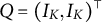 $Q = (I_K, I_K)^\top $
with exactly
$Q = (I_K, I_K)^\top $
with exactly $J=2K$
items; that is, when each latent attribute is exactly measured by two pure items, and there are no additional items in the test. To our best knowledge, such a Q-matrix does not satisfy the identifiability condition in the existing studies for general CDMs. The high-level intuition behind why our condition relaxes existing conditions in the literature is that, existing studies either explicitly or implicitly leverage the three-way decompositions of the population distribution tensor to establish identifiability. In contrast, we work with the rank of matrices to establish identifiability despite starting with tensors, and these matrices essentially describe the joint distributions of two random vectors instead of three random vectors. This intuitively explains why our approach delivers a weaker identifiability condition that only requires each latent attribute to be measured twice in the Q-matrix.
$J=2K$
items; that is, when each latent attribute is exactly measured by two pure items, and there are no additional items in the test. To our best knowledge, such a Q-matrix does not satisfy the identifiability condition in the existing studies for general CDMs. The high-level intuition behind why our condition relaxes existing conditions in the literature is that, existing studies either explicitly or implicitly leverage the three-way decompositions of the population distribution tensor to establish identifiability. In contrast, we work with the rank of matrices to establish identifiability despite starting with tensors, and these matrices essentially describe the joint distributions of two random vectors instead of three random vectors. This intuitively explains why our approach delivers a weaker identifiability condition that only requires each latent attribute to be measured twice in the Q-matrix.
It is worth noting that Culpepper (Reference Culpepper2023) relaxed the condition that Q needs to contain identity submatrices by introducing and studying the notion of “dyads”, which consist of pairs of items. Specifically, the identifiability theorem in Culpepper (Reference Culpepper2023) applies even if no single-attribute items exist by allowing saturated dyads. This significantly broadens the applicability of the identifiability theory to practical cognitive diagnostic assessment settings. However, that work still leverages Kruskal’s Theorem on the uniqueness of three-way tensor decompositions to establish identifiability with the dyad structure and requires $J>2K$
. So, the theorem in Culpepper (Reference Culpepper2023) does not apply to the case where the Q-matrix contains exactly
$J>2K$
. So, the theorem in Culpepper (Reference Culpepper2023) does not apply to the case where the Q-matrix contains exactly $2K$
rows; moreover, the proof of that theorem is still an existence proof, instead of a constructive proof like our tensor unfolding approach.
$2K$
rows; moreover, the proof of that theorem is still an existence proof, instead of a constructive proof like our tensor unfolding approach.
3.2 CDMs with Polytomous Responses
In this section, we consider CDMs with polytomous item responses. Suppose item $R_j\in \{0,1,\ldots ,C_j-1\}$
has
$R_j\in \{0,1,\ldots ,C_j-1\}$
has $C_j$
categories for each
$C_j$
categories for each $j\in \{1,\ldots ,J\}$
, where
$j\in \{1,\ldots ,J\}$
, where $C_j\geq 2$
is a general integer. Here, we allow different items to have different numbers of response categories (i.e.,
$C_j\geq 2$
is a general integer. Here, we allow different items to have different numbers of response categories (i.e., $C_j$
across different j can be different), similar to the setting considered in Liu and Culpepper (Reference Liu and Culpepper2024) and Wayman et al. (Reference Wayman, Culpepper, Douglas and Bowers2025). We still use the same notation for the proportion parameters
$C_j$
across different j can be different), similar to the setting considered in Liu and Culpepper (Reference Liu and Culpepper2024) and Wayman et al. (Reference Wayman, Culpepper, Douglas and Bowers2025). We still use the same notation for the proportion parameters ${\mathbf {p}} = (p_{\boldsymbol {\alpha }})_{\boldsymbol {\alpha }\in \{0,1\}^K}$
to describe the joint distribution of the binary latent attributes. To describe the conditional distribution of the responses
${\mathbf {p}} = (p_{\boldsymbol {\alpha }})_{\boldsymbol {\alpha }\in \{0,1\}^K}$
to describe the joint distribution of the binary latent attributes. To describe the conditional distribution of the responses ${\mathbf {R}}$
given the latent attributes
${\mathbf {R}}$
given the latent attributes ${\mathbf {A}}$
, we introduce item parameters
${\mathbf {A}}$
, we introduce item parameters $\boldsymbol \Lambda =(\lambda _{j,c,\boldsymbol {\alpha }})$
:
$\boldsymbol \Lambda =(\lambda _{j,c,\boldsymbol {\alpha }})$
:
 $$ \begin{align*} \lambda_{j,c,\boldsymbol{\alpha}} = {\mathbb{P}}(R_j = r_j\mid {\mathbf{A}}=\boldsymbol{\alpha}),\quad j\in[J],~~ r_j\in\{0,1,\ldots,C_j-1\}, ~~ \boldsymbol{\alpha}\in\{0,1\}^K. \end{align*} $$
The Q-matrix induces constraints on the $\boldsymbol \Lambda $
parameters similar to the binary CDM case; here,
$\boldsymbol \Lambda $
parameters similar to the binary CDM case; here, $\lambda _{j,c,\boldsymbol {\alpha }}$
depends only on those attributes that are measured by the jth item according to the Q-matrix. Mathematically, this means
$\lambda _{j,c,\boldsymbol {\alpha }}$
depends only on those attributes that are measured by the jth item according to the Q-matrix. Mathematically, this means
 $$ \begin{align*} {\mathbb{P}}(R_j = r_j\mid {\mathbf{A}} = \boldsymbol{\alpha}) \equiv {\mathbb{P}}(R_j = r_j\mid \{A_k=\alpha_k\}_{q_{jk}=1}),\quad \forall j\in[J],~ \boldsymbol{\alpha}\in\{0,1\}^K. \end{align*} $$
The above general assumption summarizes the key property shared by many polytomous-response CDMs. Our considered setting hence covers existing models for polytomous responses, such as Chen and de la Torre (Reference Chen and de la Torre2018), Fang et al. (Reference Fang, Liu and Ying2019), Culpepper (Reference Culpepper2019), and Liu and Culpepper (Reference Liu and Culpepper2024).
The population distribution of the observed response vector ${\mathbf {R}}$
can be written as
${\mathbf {R}}$
can be written as
 $$ \begin{align*} {\mathbb{P}}(R_1 = r_1, \ldots, R_J = r_J\mid Q, \boldsymbol \Lambda, {\mathbf{p}}) &= \sum_{\boldsymbol{\alpha}\in\{0,1\}^K} {\mathbb{P}}({\mathbf{A}}=\boldsymbol{\alpha}) \prod_{j=1}^J {\mathbb{P}}(R_j = r_j\mid {\mathbf{A}} = \boldsymbol{\alpha}) \\ &= \sum_{\boldsymbol{\alpha}\in\{0,1\}^K} p_{\boldsymbol{\alpha}} \prod_{j=1}^J \prod_{c=0}^{C_j-1} \lambda_{j,c,\boldsymbol{\alpha}}^{\mathbb{1}(r_j=c)}, \end{align*} $$
for any multivariate polytomous response pattern ${\mathbf {r}} = (r_1,\ldots ,r_J)$
with
${\mathbf {r}} = (r_1,\ldots ,r_J)$
with $r_j\in \{0,\ldots ,C-1\}$
for each j. The J-way population distribution tensor
$r_j\in \{0,\ldots ,C-1\}$
for each j. The J-way population distribution tensor $\mathcal T=(t_{r_1,r_2,\ldots ,r_J})$
characterizing the distribution of
$\mathcal T=(t_{r_1,r_2,\ldots ,r_J})$
characterizing the distribution of ${\mathbf {R}}$
has size
${\mathbf {R}}$
has size $C_1 \times C_2\times \cdots \times C_J$
, with entries
$C_1 \times C_2\times \cdots \times C_J$
, with entries
 $$ \begin{align*} t_{r_1,r_2,\ldots,r_J} = {\mathbb{P}}(R_1 = r_1, \ldots, R_J = r_J\mid Q,\boldsymbol \Lambda, {\mathbf{p}}),\quad \forall r_j\in\{0,1,\ldots,C_j-1\},\ j=1,\ldots,J. \end{align*} $$
We will unfold this tensor similarly to the binary CDM case. Consider the row group of indices as $S\subseteq [J]$
and the column group as
$S\subseteq [J]$
and the column group as $[J]\setminus S$
, then the matrix resulting from the unfolded tensor is
$[J]\setminus S$
, then the matrix resulting from the unfolded tensor is
 $$ \begin{align*} [{\mathcal{T}}]_{S,:}=\texttt{unfold}(\mathcal T;~S,~[J]\setminus S): \text{ size } \prod_{j\in S} C_j \times \prod_{j\in [J]\setminus S} C_j, \end{align*} $$
The notations of marginal tensors and marginal unfoldings are defined similarly.
To formalize the requirements on the polytomous CDMs, we introduce the following two definitions.
Definition 2 (Non-degenerate Single-attribute Items in Polytomous-CDMs).
A single-attribute item j solely measuring attribute k is said to be non-degenerate if the following conditional probability table, denoted by ${\mathbb {P}}(R_j\mid A_k)$
, has full column rank 2:
${\mathbb {P}}(R_j\mid A_k)$
, has full column rank 2:
 $$ \begin{align*} \begin{pmatrix} {\mathbb{P}}(R_j=0\mid A_k=0) & {\mathbb{P}}(R_j=0\mid A_k=1) \\ \vdots & \vdots \\ {\mathbb{P}}(R_j=C_j-1\mid A_k=0) & {\mathbb{P}}(R_j=C_j-1\mid A_k=1) \end{pmatrix} \end{align*} $$
Definition 2 is a direct extension of the earlier Definition 1 to the polytomous CDMs and covers that as a special case.
As mentioned earlier in Section 2.1, we do not consider the Boolean-product-based CDMs (e.g., DINA or DINO models) in this work. We next formalize the non-DINA/DINO assumption in the polytomous CDM.
Definition 3 (Non-DINA/DINO Assumption).
For any response category $c\in \{0,1,\ldots , C_j-1\}$
and any latent attributes configuration
$c\in \{0,1,\ldots , C_j-1\}$
and any latent attributes configuration $\boldsymbol {\alpha }\in \{0,1\}^K$
, the conditional probability
$\boldsymbol {\alpha }\in \{0,1\}^K$
, the conditional probability ${\mathbb {P}}(R_j= c\mid {\mathbf {A}}=\boldsymbol {\alpha })$
does not conform to the Boolean-product-based DINA or DINO model, but rather conforms to any linear or nonlinear main-effect or all-saturated-effect-based CDM.
${\mathbb {P}}(R_j= c\mid {\mathbf {A}}=\boldsymbol {\alpha })$
does not conform to the Boolean-product-based DINA or DINO model, but rather conforms to any linear or nonlinear main-effect or all-saturated-effect-based CDM.
We have the following main theorem for polytomous CDMs with essentially the same identifiability condition as the binary CDMs, again proved via tensor unfoldings.
Theorem 2 (Polytomous-response CDMs).
Consider a polytomous-response CDM under Definitions 2 and 3. Still consider the restricted identifiable Q-matrix space $\mathcal Q$
defined in (7). Assume all single-attribute items are non-degenerate and
$\mathcal Q$
defined in (7). Assume all single-attribute items are non-degenerate and $p_{\boldsymbol {\alpha }}> 0$
for all
$p_{\boldsymbol {\alpha }}> 0$
for all $\boldsymbol {\alpha }\in \{0,1\}^K$
. If the true and alternative Q-matrices
$\boldsymbol {\alpha }\in \{0,1\}^K$
. If the true and alternative Q-matrices $Q,\bar Q\in \mathcal Q$
lead to the same distribution of the observed polytomous response vector
$Q,\bar Q\in \mathcal Q$
lead to the same distribution of the observed polytomous response vector $\mathbf R\in \times _{j=1}^J \{0,\ldots , C_j-1\}$
, then the Q-matrix is identifiable and can be constructively identified from the population distribution tensor
$\mathbf R\in \times _{j=1}^J \{0,\ldots , C_j-1\}$
, then the Q-matrix is identifiable and can be constructively identified from the population distribution tensor ${\mathcal {T}}$
via unfoldings.
${\mathcal {T}}$
via unfoldings.
Theorem 2 is proved by establishing the following proposition on the ranks of the unfolded tensors in polytomous CDMs.
Proposition 3. Under the condition in Theorem 1, the following rank statements hold.
-
(a) For arbitrary $j_1\neq j_2\in [J]$
, it holds that
$$ \begin{align*}\mathrm{{rank}}(\underbrace{[{\mathcal{T}}]_{\{j_1,j_2\},\; :}}_{C_{j_1} C_{j_2} \times \prod_{j\neq j_1,j_2} C_j}) \leq 2 \quad\text{if and only if}\quad \mathbf q_{j_1} = \mathbf q_{j_2} = \mathbf e_k\text{ for some } k\in[K].\end{align*} $$
$j_1\neq j_2\in [J]$
, it holds that
$$ \begin{align*}\mathrm{{rank}}(\underbrace{[{\mathcal{T}}]_{\{j_1,j_2\},\; :}}_{C_{j_1} C_{j_2} \times \prod_{j\neq j_1,j_2} C_j}) \leq 2 \quad\text{if and only if}\quad \mathbf q_{j_1} = \mathbf q_{j_2} = \mathbf e_k\text{ for some } k\in[K].\end{align*} $$
-
(b) Assume without loss of generality that the first
$2K$
rows of the Q-matrix are identified to be
$( I_K;~ I_K)^\top $
. The following holds for any attribute
$k\in [K]$
and any item
$j\in \{2K+1,\ldots ,J\}$
that requires at least two attributes (i.e., with
$\sum _{k=1}^K q_{jk}\geq 2$
):
$$ \begin{align*} \mathrm{{rank}}([\mathcal T]_{([K]\setminus\{k\}) \cup \{j\},~ \{K+1,\ldots,2K\}})> 2^{K-1} \quad\text{if and only if}\quad q_{jk}=1. \end{align*} $$


The above proposition generalizes Proposition 1 from the binary setting to the general polytomous setting. The two scenarios (a) and (b) in Proposition 3 give explicit and precise characterizations of the ${\mathbf {q}}$
-vectors of single-attribute items and multiple-attribute items, respectively. These conditions are simple rank constraints of the matrices resulting from unfolding the
${\mathbf {q}}$
-vectors of single-attribute items and multiple-attribute items, respectively. These conditions are simple rank constraints of the matrices resulting from unfolding the $C_1\times C_2\times \cdots \times C_J$
tensor
$C_1\times C_2\times \cdots \times C_J$
tensor $\mathcal T$
, and they serve as certificates to reveal the unknown
$\mathcal T$
, and they serve as certificates to reveal the unknown $\mathbf q$
-vectors for all J items.
$\mathbf q$
-vectors for all J items.
It is worth mentioning that prior works have studied generic identifiability in CDMs, which is a slightly weaker notion than strict identifiability studied in this work. Generic identifiability means the parameters are almost everywhere identifiable in the parameter space, possibly excluding a Lebesgue mesasure zero set where identifiability breaks down. For main-effect or all-saturated-effect CDMs, generic identifiablity has been established under weaker conditions on the Q-matrix (e.g., Chen et al., Reference Chen, Culpepper and Liang2020; Gu and Xu, Reference Gu and Xu2020), without requiring Q to contain two identity submatrices $I_K$
. We remark that it is not technically straightforward to establish generic identifiability using the tensor unfolding technique. To clarify, most previous studies that established generic identifiability for CDMs mainly utilized Kruskal’s Theorem by adapting the technique popularized by Allman et al. (Reference Allman, Matias and Rhodes2009). Roughly speaking, in those works, generic identifiability is often proved by finding one possible configuration of the parameters and showing that identifiability holds under this configuration using Kruskal’s Theorem; then, generic identifiability follows by concluding that the identifiable parameter configuration is “generic” in the parameter space, so that non-identifiability occurs only in a negligible subset of the parameter space. Therefore, generic identifiability is inherently tied to the Kruskal Theorem-based existence proofs, while not entirely aligned with the tensor-unfolding-based constructive proofs. Relaxing the condition of “Q contains at least two
$I_K$
. We remark that it is not technically straightforward to establish generic identifiability using the tensor unfolding technique. To clarify, most previous studies that established generic identifiability for CDMs mainly utilized Kruskal’s Theorem by adapting the technique popularized by Allman et al. (Reference Allman, Matias and Rhodes2009). Roughly speaking, in those works, generic identifiability is often proved by finding one possible configuration of the parameters and showing that identifiability holds under this configuration using Kruskal’s Theorem; then, generic identifiability follows by concluding that the identifiable parameter configuration is “generic” in the parameter space, so that non-identifiability occurs only in a negligible subset of the parameter space. Therefore, generic identifiability is inherently tied to the Kruskal Theorem-based existence proofs, while not entirely aligned with the tensor-unfolding-based constructive proofs. Relaxing the condition of “Q contains at least two $I_K$
matrices” would distort the rank properties of the unfolded tensor, which are important certificates to recover the Q-matrix in our proof.
$I_K$
matrices” would distort the rank properties of the unfolded tensor, which are important certificates to recover the Q-matrix in our proof.
4 Discussion
We have established a new identifiability theory of the Q-matrix for various main-effect and all-saturated-effect, binary and polytomous-response CDMs. Our proof exploits a novel tensor unfolding technique and is the first constructive identifiability proof in the literature.
Previous studies such as Chen et al. (Reference Chen, Culpepper and Liang2020) and Liu and Culpepper (Reference Liu and Culpepper2024) leveraged Kruskal’s Theorem to study the “ $\Delta $
-matrix” in diagnostic models, which has size
$\Delta $
-matrix” in diagnostic models, which has size $J\times 2^K$
, with columns corresponding to both main-effects and all possible higher-order interaction effects of latent attributes. Compared to the Q-matrix, the
$J\times 2^K$
, with columns corresponding to both main-effects and all possible higher-order interaction effects of latent attributes. Compared to the Q-matrix, the $\Delta $
-matrix provides a more fine-grained summary of the measurement model structure and distinguishes the main-effect models (such as the ACDM and reduced-RUM) from the all-saturated-effect models (such as the GDINA and LCDM). On the other hand, however, the Q-matrix can be viewed as a more general and high-level summary of the statistical dependence relationship between the observed item responses and the latent attributes. In the language of probabilistic graphical models, the Q-matrix encodes the bipartite graph structure between the observed variables and the latent ones, where
$\Delta $
-matrix provides a more fine-grained summary of the measurement model structure and distinguishes the main-effect models (such as the ACDM and reduced-RUM) from the all-saturated-effect models (such as the GDINA and LCDM). On the other hand, however, the Q-matrix can be viewed as a more general and high-level summary of the statistical dependence relationship between the observed item responses and the latent attributes. In the language of probabilistic graphical models, the Q-matrix encodes the bipartite graph structure between the observed variables and the latent ones, where $q_{jk}=1$
or 0 indicates whether or not the jth observed response directly depends on (has a directed arrow from) the kth latent attribute. One interesting property of our tensor-unfolding-based identifiability result is that the proof is agnostic to the measurement model structure, regardless of whether the model is main-effect or all-saturated-effect, and always recovers the fundamental dependence relationship between the observed and latent variables encoded by the Q-matrix. More specifically, the rank properties of the unfolded tensor reflect whether each observed variable depends on each latent variable, rather than the detailed form of this dependence (i.e., being main-effect only or involving interaction effects). With that said, we believe that it may be possible to adapt the tensor unfolding technique to study the identifiability of the
$q_{jk}=1$
or 0 indicates whether or not the jth observed response directly depends on (has a directed arrow from) the kth latent attribute. One interesting property of our tensor-unfolding-based identifiability result is that the proof is agnostic to the measurement model structure, regardless of whether the model is main-effect or all-saturated-effect, and always recovers the fundamental dependence relationship between the observed and latent variables encoded by the Q-matrix. More specifically, the rank properties of the unfolded tensor reflect whether each observed variable depends on each latent variable, rather than the detailed form of this dependence (i.e., being main-effect only or involving interaction effects). With that said, we believe that it may be possible to adapt the tensor unfolding technique to study the identifiability of the $\Delta $
-matrix in the future.
$\Delta $
-matrix in the future.
To facilitate understanding the constructive proof, we next provide a summary of how we leverage tensor unfolding to uniquely identify and recover the Q-matrix entries based on the probabilities of the response patterns. This proof outline follows from Propositions 1 and 2 for binary-response CDMs, and Proposition 3 for polytomous-response CDMs. First, we identify all single-attribute items by exhaustively considering all pairs of items $j_1,j_2$
ranging in the item set
$j_1,j_2$
ranging in the item set $\{1,\ldots ,J\}$
and examining the rank of the unfolding
$\{1,\ldots ,J\}$
and examining the rank of the unfolding $[\mathcal T]_{\{j_1,j_2\},:}$
. If the rank is smaller than or equal to
$[\mathcal T]_{\{j_1,j_2\},:}$
. If the rank is smaller than or equal to $2$
, then items
$2$
, then items $j_1,j_2$
must be measuring the same latent attribute. After this first step, all
$j_1,j_2$
must be measuring the same latent attribute. After this first step, all $\mathbf q$
-vectors corresponding to single-attribute items have been recovered, giving K item sets
$\mathbf q$
-vectors corresponding to single-attribute items have been recovered, giving K item sets $S_1,\ldots ,S_K \subseteq \{1,\ldots ,J\}$
, where each set
$S_1,\ldots ,S_K \subseteq \{1,\ldots ,J\}$
, where each set $S_k$
contains items that solely measure latent attribute k. Our identifiability condition ensures that each
$S_k$
contains items that solely measure latent attribute k. Our identifiability condition ensures that each $S_k$
contains at least two items, and we denote these two item indices by
$S_k$
contains at least two items, and we denote these two item indices by $j_{k1}$
and
$j_{k1}$
and $j_{k2}$
. Second, for any other item j that does not belong to
$j_{k2}$
. Second, for any other item j that does not belong to $\cup _{k=1}^K S_k$
and for any
$\cup _{k=1}^K S_k$
and for any $k\in [K]$
, we recover the entry
$k\in [K]$
, we recover the entry $q_{jk}$
by considering the unfolding
$q_{jk}$
by considering the unfolding $[\mathcal T]_{(\{j_{11},\ldots ,j_{K1}\}\setminus \{j_{k1}\})\cup \{j\},~\{j_{12},\ldots ,j_{K2}\}}$
. If the rank of this unfolding is larger than
$[\mathcal T]_{(\{j_{11},\ldots ,j_{K1}\}\setminus \{j_{k1}\})\cup \{j\},~\{j_{12},\ldots ,j_{K2}\}}$
. If the rank of this unfolding is larger than $2^{K-1}$
, then we conclude
$2^{K-1}$
, then we conclude $q_{jk}=1$
; otherwise, conclude
$q_{jk}=1$
; otherwise, conclude $q_{jk}=0$
. After this second step, all
$q_{jk}=0$
. After this second step, all $\mathbf q$
-vectors corresponding to multi-attribute items have also been recovered. This completes the constructive proof strategy for identifying and recovering the whole Q-matrix.
$\mathbf q$
-vectors corresponding to multi-attribute items have also been recovered. This completes the constructive proof strategy for identifying and recovering the whole Q-matrix.
Our proof indicates an interesting future direction toward practically estimating the Q-matrix via tensor unfolding. To clarify, the identifiability proof in this paper operates on the population distribution tensor summarizing the population distribution of $\mathbf R$
; this identifiability notion is the same as the classical notion of population identifiability in all existing studies of CDMs and the Q-matrix (e.g., Chen et al., Reference Chen, Culpepper and Liang2020,1; Culpepper, Reference Culpepper2019; Gu and Xu, Reference Gu and Xu2021; Liu et al., Reference Liu, Xu and Ying2013; Xu and Shang, Reference Xu and Shang2018). In practice, the available data are a finite sample, and one needs to use the samples to estimate the Q-matrix. Previous identifiability results are inherently disconnected from the estimation methods due to their existence proof nature: after proposing the identifiability conditions for CDMs, existing studies often proceed to estimate the Q-matrix and parameters using likelihood-based or Bayesian procedures. More specifically, frequentist methods often impose a sparsity-inducing penalty on continuous parameters and let the estimated sparsity pattern inform the Q-matrix structure (Chen et al., Reference Chen, Liu, Xu and Ying2015; Xu and Shang, Reference Xu and Shang2018), while Bayesian methods incorporate carefully designed MCMC sampling steps to sample only from the identifiable space of Q-matrices (Chen et al., Reference Chen, Culpepper and Liang2020,1; Culpepper, Reference Culpepper2019). Although identifiability conditions serve as a guideline for navigating Q-matrix estimation in these studies, the identifiability theory itself does not directly imply any specific estimation procedure.
$\mathbf R$
; this identifiability notion is the same as the classical notion of population identifiability in all existing studies of CDMs and the Q-matrix (e.g., Chen et al., Reference Chen, Culpepper and Liang2020,1; Culpepper, Reference Culpepper2019; Gu and Xu, Reference Gu and Xu2021; Liu et al., Reference Liu, Xu and Ying2013; Xu and Shang, Reference Xu and Shang2018). In practice, the available data are a finite sample, and one needs to use the samples to estimate the Q-matrix. Previous identifiability results are inherently disconnected from the estimation methods due to their existence proof nature: after proposing the identifiability conditions for CDMs, existing studies often proceed to estimate the Q-matrix and parameters using likelihood-based or Bayesian procedures. More specifically, frequentist methods often impose a sparsity-inducing penalty on continuous parameters and let the estimated sparsity pattern inform the Q-matrix structure (Chen et al., Reference Chen, Liu, Xu and Ying2015; Xu and Shang, Reference Xu and Shang2018), while Bayesian methods incorporate carefully designed MCMC sampling steps to sample only from the identifiable space of Q-matrices (Chen et al., Reference Chen, Culpepper and Liang2020,1; Culpepper, Reference Culpepper2019). Although identifiability conditions serve as a guideline for navigating Q-matrix estimation in these studies, the identifiability theory itself does not directly imply any specific estimation procedure.
In contrast, our constructive proof implies the possibility of developing a practical algorithm that takes the empirical distribution tensor $\widehat {\mathcal {T}}$
(constructed from sample proportions of observed response patterns) as input and leverages and generalizes Proposition 3 to directly estimate the Q-matrix. Specifically,
$\widehat {\mathcal {T}}$
(constructed from sample proportions of observed response patterns) as input and leverages and generalizes Proposition 3 to directly estimate the Q-matrix. Specifically, $\widehat {\mathcal {T}}$
has the same size as its population counterpart
$\widehat {\mathcal {T}}$
has the same size as its population counterpart ${\mathcal {T}}$
, but its entries are empirical proportions of each response pattern in the sample, instead of the population probabilities of the response patterns
${\mathcal {T}}$
, but its entries are empirical proportions of each response pattern in the sample, instead of the population probabilities of the response patterns ${\mathbb {P}}(R_1=r_1, \ldots , R_J=r_J)$
. To this end, important modifications must be made to replace the rank constraints of the unfolded population tensor with surrogate singular value conditions on the unfolded empirical tensor. Developing this procedure is out of the scope of this article, which focuses on the highly nontrivial identifiability theory as a crucial first step. We will study this direction in the future to fully realize the potential of tensor unfolding and enrich the Q-matrix estimation literature with efficient tensor-based methods.
${\mathbb {P}}(R_1=r_1, \ldots , R_J=r_J)$
. To this end, important modifications must be made to replace the rank constraints of the unfolded population tensor with surrogate singular value conditions on the unfolded empirical tensor. Developing this procedure is out of the scope of this article, which focuses on the highly nontrivial identifiability theory as a crucial first step. We will study this direction in the future to fully realize the potential of tensor unfolding and enrich the Q-matrix estimation literature with efficient tensor-based methods.
Financial support
The author is partially supported by the NSF Grant DMS-2210796.
Competing interest
None to declare.
Appendix
In this Appendix, Section A provides the proofs of the main theoretical results, and Section B provides additional proofs of supporting lemmas and corollaries. Since Theorem 1 (along with Propositions 1 and 2) for the binary CDM is essentially a special case of Theorem 2 (along with Proposition 3) for the polytomous-response CDM, we focus on proving Theorem 2 and Proposition 3.
For each item $j\in [J]$
, introduce a notation
$j\in [J]$
, introduce a notation $\text {{pa}}(j):=\{k\in [K]: q_{jk}=1\}$
, which denotes the set of attributes required/measured by item j. Here, “pa” is short for “parent”, which reflects the fact that the CDM can be viewed from a directed graphical model perspective, and the set of attributes required by an item j can be viewed as the “parent” variables of this item that have directed edges pointing to it.
$\text {{pa}}(j):=\{k\in [K]: q_{jk}=1\}$
, which denotes the set of attributes required/measured by item j. Here, “pa” is short for “parent”, which reflects the fact that the CDM can be viewed from a directed graphical model perspective, and the set of attributes required by an item j can be viewed as the “parent” variables of this item that have directed edges pointing to it.
A Proofs of the Main Results
We will need to frequently use the matrix Kronecker product “ $\bigotimes $
” and matrix Khatri-Rao product “
$\bigotimes $
” and matrix Khatri-Rao product “ $\bigodot $
” in the proofs. The Khatri-Rao product of matrices is the column-wise Kronecker product (Kolda and Bader, Reference Kolda and Bader2009). In particular, consider matrices
$\bigodot $
” in the proofs. The Khatri-Rao product of matrices is the column-wise Kronecker product (Kolda and Bader, Reference Kolda and Bader2009). In particular, consider matrices $\mathbf A=(a_{i,j})\in \mathbb R^{m\times r}$
,
$\mathbf A=(a_{i,j})\in \mathbb R^{m\times r}$
, $\mathbf B=(b_{i,j})\in \mathbb R^{s\times t}$
; and matrices
$\mathbf B=(b_{i,j})\in \mathbb R^{s\times t}$
; and matrices $\mathbf C=(c_{i,j})=(\boldsymbol c_{\boldsymbol {:},1}\mid \cdots \mid \boldsymbol c_{\boldsymbol {:},k})\in \mathbb R^{n\times k}$
,
$\mathbf C=(c_{i,j})=(\boldsymbol c_{\boldsymbol {:},1}\mid \cdots \mid \boldsymbol c_{\boldsymbol {:},k})\in \mathbb R^{n\times k}$
, $\mathbf D=(d_{i,j})=(\boldsymbol d_{\boldsymbol {:},1}\mid \cdots \mid \boldsymbol d_{\boldsymbol {:},k})\in \mathbb R^{\ell \times k}$
, then
$\mathbf D=(d_{i,j})=(\boldsymbol d_{\boldsymbol {:},1}\mid \cdots \mid \boldsymbol d_{\boldsymbol {:},k})\in \mathbb R^{\ell \times k}$
, then $\mathbf A\bigotimes \mathbf B \in \mathbb R^{ms\times rt}$
and
$\mathbf A\bigotimes \mathbf B \in \mathbb R^{ms\times rt}$
and $\mathbf C\bigodot \mathbf D \in \mathbb R^{n \ell \times k}$
:
$\mathbf C\bigodot \mathbf D \in \mathbb R^{n \ell \times k}$
:
 $$ \begin{align*} \mathbf A\bigotimes \mathbf B = \begin{pmatrix} a_{1,1}\mathbf B & \cdots & a_{1,r}\mathbf B\\ \vdots & \vdots & \vdots \\ a_{m,1}\mathbf B & \cdots & a_{m,r}\mathbf B \end{pmatrix}, \qquad \mathbf C\bigodot \mathbf D = \begin{pmatrix} \boldsymbol c_{\boldsymbol{:},1}\bigotimes\boldsymbol d_{\boldsymbol{:},1} \mid \cdots \mid \boldsymbol c_{\boldsymbol{:},k}\bigotimes\boldsymbol d_{\boldsymbol{:},k} \end{pmatrix}. \end{align*} $$
For technical convenience, we will slightly abuse notations when writing the Kronecker product and Khatri-Rao product, in that columns and rows in those products could be subject to permutations. Any of such permutations will not impact the rank properties of a matrix, so they do not affect any proof argument in this paper. Furthermore, we next state the proof of the theoretical results under the special case where all items have the same number of response categories $C_1=C_2=\cdots =C_J \geq 2$
. We emphasize that this is only for notational simplicity, and all proof arguments in the following indeed remain exactly the same when the
$C_1=C_2=\cdots =C_J \geq 2$
. We emphasize that this is only for notational simplicity, and all proof arguments in the following indeed remain exactly the same when the $C_j$
’s are allowed to differ across different j.
$C_j$
’s are allowed to differ across different j.
We first state three useful lemmas.
Lemma A.1. Suppose $M\subseteq [J]$
is an index set satisfying that when j ranges in M, the M sets
$M\subseteq [J]$
is an index set satisfying that when j ranges in M, the M sets $\text {{pa}}(j)$
are mutually disjoint. Then, we have
$\text {{pa}}(j)$
are mutually disjoint. Then, we have
 $$ \begin{align} {\mathbb{P}}({\mathbf{R}}_{M}\mid {\mathbf{A}}_{\mathrm{{pa}}(M)}) = \bigotimes_{j\in M} {\mathbb{P}}(R_j\mid A_{\mathrm{{pa}}(j)}). \end{align} $$
Now consider an arbitrary set $M\subseteq [p]$
. For any set
$M\subseteq [p]$
. For any set ${S}$
such that
${S}$
such that $\mathrm{{pa}}(M) \subseteq {S} \subseteq [K]$
with
$\mathrm{{pa}}(M) \subseteq {S} \subseteq [K]$
with $\mathrm{{pa}}(M) \neq {S}$
, we have
$\mathrm{{pa}}(M) \neq {S}$
, we have
 $$ \begin{align} {\mathbb{P}}({\mathbf{R}}_{M}\mid {\mathbf{A}}_{{S}}) = {\mathbf{1}}_{C^{|{S}|-|\mathrm{{pa}}(M)|}}^\top \bigotimes {\mathbb{P}}({\mathbf{R}}_{M}\mid {\mathbf{A}}_{\mathrm{{pa}}(M)}). \end{align} $$
Moreover, for any $M_1,M_2\subseteq [J]$
and
$M_1,M_2\subseteq [J]$
and $M_1\cap M_2=\varnothing $
and any
$M_1\cap M_2=\varnothing $
and any $S\supseteq \mathrm{{pa}}(M_1) \cup \mathrm{{pa}}(M_2)$
, we have
$S\supseteq \mathrm{{pa}}(M_1) \cup \mathrm{{pa}}(M_2)$
, we have
 $$ \begin{align} {\mathbb{P}}({\mathbf{R}}_{M_1\cup M_2}\mid {\mathbf{A}}_S) = {\mathbb{P}}({\mathbf{R}}_{M_1}\mid {\mathbf{A}}_S) \bigodot {\mathbb{P}}({\mathbf{R}}_{M_2}\mid {\mathbf{A}}_S). \end{align} $$
Lemma A.2. Suppose $S_1, S_2\subseteq [J]$
are two disjoint sets that satisfy
$S_1, S_2\subseteq [J]$
are two disjoint sets that satisfy $\mathrm{{pa}}(S_1) \subseteq \mathrm{{pa}}(S_2)$
,
$\mathrm{{pa}}(S_1) \subseteq \mathrm{{pa}}(S_2)$
, $\mathrm{{pa}}(S_1) \neq \mathrm{{pa}}(S_2)$
and
$\mathrm{{pa}}(S_1) \neq \mathrm{{pa}}(S_2)$
and ${\mathbb {P}}({\mathbf {R}}_{S_1} \mid {\mathbf {A}}_{\mathrm{{pa}}(S_1)})$
has full column rank
${\mathbb {P}}({\mathbf {R}}_{S_1} \mid {\mathbf {A}}_{\mathrm{{pa}}(S_1)})$
has full column rank $2^{|\mathrm{{pa}}(S_1)|}$
. Then
$2^{|\mathrm{{pa}}(S_1)|}$
. Then
 $$ \begin{align} \mathrm{{rank}}({\mathbb{P}}({\mathbf{R}}_{S_1\cup S_2}\mid {\mathbf{A}}_{\mathrm{{pa}}(S_2)}))> 2^{|\mathrm{{pa}}(S_1)|}. \end{align} $$
Lemma A.3. For $j_1\neq j_2\in [J]$
with
$j_1\neq j_2\in [J]$
with $|{\mathrm{pa}}(j_1) \cup \mathrm{{pa}}(j_2)|> 1$
, the following holds for generic parameters:
$|{\mathrm{pa}}(j_1) \cup \mathrm{{pa}}(j_2)|> 1$
, the following holds for generic parameters:
 $$ \begin{align*}\mathrm{{rank}}({\mathbb{P}}(R_{\{j_1,j_2\}}\mid {\mathbf{A}}_{\mathrm{{pa}}(j_1)\cup\mathrm{{pa}}(j_2)}))> 2.\end{align*} $$
Lemma A.4 (Lemma 3.3 in Stegeman and Sidiropoulos (Reference Stegeman and Sidiropoulos2007)).
Consider two matrices ${\mathbf {A}}$
of size
${\mathbf {A}}$
of size $I\times R$
and
$I\times R$
and ${\mathbf {B}}$
of size
${\mathbf {B}}$
of size $J\times R$
.
$J\times R$
.
-
(a) If
$\text {krank}({\mathbf {A}})=0$
or
$\text {krank}(B)=0$
, then
$\text {krank}({\mathbf {A}} \bigodot {\mathbf {B}}) = 0$
. -
(b) If
$\text {krank}({\mathbf {A}})\geq 1$
and
$\text {krank}(B)\geq 1$
, then
$$ \begin{align*}\text{krank}({\mathbf{A}} \bigodot {\mathbf{B}}) \geq \min(\text{krank}({\mathbf{A}}) + \text{krank}({\mathbf{B}}) - 1, ~ R).\end{align*} $$


A.1 Proof of Proposition 3(a) (and Proposition 1)
The size of the unfolding $[{\mathcal {T}}]_{\{j_1,j_2\},\; :}$
is
$[{\mathcal {T}}]_{\{j_1,j_2\},\; :}$
is $C^2 \times C^{J-2}$
. If
$C^2 \times C^{J-2}$
. If $\text {{pa}}(j_1) = \text {{pa}}(j_2) = \{k\}$
(that is,
$\text {{pa}}(j_1) = \text {{pa}}(j_2) = \{k\}$
(that is, $q_{j_1,k} = q_{j_2,k} = 1$
and
$q_{j_1,k} = q_{j_2,k} = 1$
and $q_{j_1,m} = q_{j_2,m} = 0$
for all
$q_{j_1,m} = q_{j_2,m} = 0$
for all $m\in [K]\setminus \{k\}$
), then we can write
$m\in [K]\setminus \{k\}$
), then we can write $[{\mathcal {T}}]_{\{j_1,j_2\},\; :}$
as
$[{\mathcal {T}}]_{\{j_1,j_2\},\; :}$
as
 $$ \begin{align*} [{\mathcal{T}}]_{\{j_1,j_2\},\; :} = \underbrace{{\mathbb{P}}({\mathbf{R}}_{\{j_1,j_2\}}\mid A_k)}_{C^2 \times 2} \cdot \underbrace{{\mathbb{P}}(A_k,\; {\mathbf{A}})}_{2 \times 2^K} \cdot \underbrace{{\mathbb{P}}({\mathbf{R}}_{-\{j_1,j_2\}} \mid {\mathbf{A}})^\top}_{2^K \times C^{J-2}}. \end{align*} $$
Due to the above matrix factorization of the unfolded tensor, $\text {{rank}}([{\mathcal {T}}]_{\{j_1,j_2\},\; :}) \leq D$
must hold, which proves the “if” part of Proposition 1. Next consider the “only if” part. Suppose
$\text {{rank}}([{\mathcal {T}}]_{\{j_1,j_2\},\; :}) \leq D$
must hold, which proves the “if” part of Proposition 1. Next consider the “only if” part. Suppose $\text {{pa}}(j_1) = \text {{pa}}(j_2) = \{k\}$
does not hold for any
$\text {{pa}}(j_1) = \text {{pa}}(j_2) = \{k\}$
does not hold for any $k\in [K]$
, then
$k\in [K]$
, then $\text {{pa}}(j_1) \cup \text {{pa}}(j_2)$
is not a singleton set, so
$\text {{pa}}(j_1) \cup \text {{pa}}(j_2)$
is not a singleton set, so $|\text {{pa}}(j_1) \cup \text {{pa}}(j_2)| \geq 2$
. In this case,
$|\text {{pa}}(j_1) \cup \text {{pa}}(j_2)| \geq 2$
. In this case,
 $$ \begin{align} [{\mathcal{T}}]_{\{j_1,j_2\},\; :} &= \underbrace{{\mathbb{P}}({\mathbf{R}}_{\{j_1,j_2\}}\mid {\mathbf{A}}_{\mathrm{{pa}}(j_1) \cup \mathrm{{pa}}(j_2)})}_{{\mathbf{P}}_1:~ C^2\times 2^{|\mathrm{{pa}}(j_1) \cup \mathrm{{pa}}(j_2)|}} \cdot \underbrace{{\mathbb{P}}({\mathbf{A}}_{\mathrm{{pa}}(j_1) \cup \mathrm{{pa}}(j_2)},\; {\mathbf{A}})}_{{\mathbf{P}}_2: ~2^{\mathrm{{pa}}(j_1) \cup \mathrm{{pa}}(j_2)} \times 2^K} \cdot \underbrace{{\mathbb{P}}({\mathbf{R}}_{[J]\setminus\{j_1,j_2\}} \mid {\mathbf{A}})^\top}_{{\mathbf{P}}_3: ~2^K \times C^{J-2}} \\ &= {\mathbf{P}}_1 \cdot {\mathbf{P}}_2 \cdot {\mathbf{P}}_3 \nonumber \end{align} $$
We next examine the rank of each of the three matrices ${\mathbf {P}}_1$
,
${\mathbf {P}}_1$
, ${\mathbf {P}}_2$
, and
${\mathbf {P}}_2$
, and ${\mathbf {P}}_3$
on the right-hand side of the above expression.
${\mathbf {P}}_3$
on the right-hand side of the above expression.
First, consider ${\mathbf {P}}_1 = {\mathbb {P}}({\mathbf {R}}_{\{j_1,j_2\}}\mid {\mathbf {A}}_{\text {{pa}}(j_1) \cup \text {{pa}}(j_2)})$
, which is a
${\mathbf {P}}_1 = {\mathbb {P}}({\mathbf {R}}_{\{j_1,j_2\}}\mid {\mathbf {A}}_{\text {{pa}}(j_1) \cup \text {{pa}}(j_2)})$
, which is a $C^2 \times 2^{|\text {{pa}}(j_1) \cup \text {{pa}}(j_2)|}$
matrix. We apply Lemma A.3 to obtain
$C^2 \times 2^{|\text {{pa}}(j_1) \cup \text {{pa}}(j_2)|}$
matrix. We apply Lemma A.3 to obtain $\text {{rank}}({\mathbf {P}}_1)> H$
holds for generic parameters.
$\text {{rank}}({\mathbf {P}}_1)> H$
holds for generic parameters.
Second, consider ${\mathbf {P}}_2= {\mathbb {P}}({\mathbf {A}}_{\text {{pa}}(j_1) \cup \text {{pa}}(j_2)},\; {\mathbf {A}})$
. For generic distribution of the latent variables
${\mathbf {P}}_2= {\mathbb {P}}({\mathbf {A}}_{\text {{pa}}(j_1) \cup \text {{pa}}(j_2)},\; {\mathbf {A}})$
. For generic distribution of the latent variables ${\mathbf {A}}$
, the matrix
${\mathbf {A}}$
, the matrix ${\mathbf {P}}_2$
has rank
${\mathbf {P}}_2$
has rank $2^{|\text {{pa}}(j_1) \cup \text {{pa}}(j_2)|} \geq 2^2> 2$
. That is,
$2^{|\text {{pa}}(j_1) \cup \text {{pa}}(j_2)|} \geq 2^2> 2$
. That is, ${\mathbf {P}}_2$
in (A.5) generically has full rank
${\mathbf {P}}_2$
in (A.5) generically has full rank $2^2$
, which is greater than
$2^2$
, which is greater than $2$
.
$2$
.
Third, consider ${\mathbf {P}}_3$
. we have an important observation that when
${\mathbf {P}}_3$
. we have an important observation that when $ Q$
contains two disjoint copies of
$ Q$
contains two disjoint copies of $ I_K$
and
$ I_K$
and $|\text {{pa}}(j_1) \cup \text {{pa}}(j_2)| \geq 2$
, the
$|\text {{pa}}(j_1) \cup \text {{pa}}(j_2)| \geq 2$
, the $(J-2) \times K$
submatrix
$(J-2) \times K$
submatrix $ Q_{[J]\setminus \{j_1,j_2\},:}$
contains at least one submatrix of
$ Q_{[J]\setminus \{j_1,j_2\},:}$
contains at least one submatrix of $ I_K$
after some row permutation. To see this, note that if
$ I_K$
after some row permutation. To see this, note that if $|\text {{pa}}(j_1) \cup \text {{pa}}(j_2)| \geq 2$
, then either
$|\text {{pa}}(j_1) \cup \text {{pa}}(j_2)| \geq 2$
, then either $\text {{pa}}(j_1)$
and
$\text {{pa}}(j_1)$
and $\text {{pa}}(j_2)$
are both singleton sets with
$\text {{pa}}(j_2)$
are both singleton sets with $\text {{pa}}(j_1)\neq \text {{pa}}(j_2)$
, or at least one of
$\text {{pa}}(j_1)\neq \text {{pa}}(j_2)$
, or at least one of $\text {{pa}}(j_1)$
and
$\text {{pa}}(j_1)$
and $\text {{pa}}(j_2)$
is not a singleton set. In either of these two cases, there exists a set
$\text {{pa}}(j_2)$
is not a singleton set. In either of these two cases, there exists a set $S \subseteq [J]\setminus \{j_1,j_2\}$
such that
$S \subseteq [J]\setminus \{j_1,j_2\}$
such that $|S|=K$
and
$|S|=K$
and $ Q_{S,:} = I_K$
. Applying Lemma A.1 gives
$ Q_{S,:} = I_K$
. Applying Lemma A.1 gives
 $$ \begin{align*}{\mathbb{P}}({\mathbf{R}}_{S} \mid {\mathbf{A}}) = \bigotimes_{j\in S} {\mathbb{P}}(R_j\mid A_{\mathrm{{pa}}(j)}), \end{align*} $$
so ${\mathbb {P}}({\mathbf {R}}_{S} \mid {\mathbf {A}})$
generically has full column rank
${\mathbb {P}}({\mathbf {R}}_{S} \mid {\mathbf {A}})$
generically has full column rank $2^K$
. Since
$2^K$
. Since $S \subseteq [J]\setminus \{j_1,j_2\}$
, we can write
$S \subseteq [J]\setminus \{j_1,j_2\}$
, we can write
 $$ \begin{align*}{\mathbb{P}}({\mathbf{R}}_{[J]\setminus\{j_1,j_2\}} \mid {\mathbf{A}}) = {\mathbb{P}}({\mathbf{R}}_{S} \mid {\mathbf{A}}) \bigodot {\mathbb{P}}({\mathbf{R}}_{[J]\setminus(S\cup \{j_1,j_2\})} \mid {\mathbf{A}}). \end{align*} $$
Next, we will use Lemma A.4 to proceed with the proof. One implication of Lemma A.4(b) is that for two matrices ${\mathbf {A}}$
and
${\mathbf {A}}$
and ${\mathbf {B}}$
with the same number of columns, if
${\mathbf {B}}$
with the same number of columns, if ${\mathbf {A}}$
has full column rank and
${\mathbf {A}}$
has full column rank and ${\mathbf {B}}$
does not contain any zero columns, then
${\mathbf {B}}$
does not contain any zero columns, then $\text {krank}({\mathbf {A}} \bigodot {\mathbf {B}}) \geq \min (R+1-1,~ R) = R$
, so
$\text {krank}({\mathbf {A}} \bigodot {\mathbf {B}}) \geq \min (R+1-1,~ R) = R$
, so ${\mathbf {A}}\bigodot {\mathbf {B}}$
has full column rank. Note that
${\mathbf {A}}\bigodot {\mathbf {B}}$
has full column rank. Note that ${\mathbb {P}}({\mathbf {R}}_{S} \mid {\mathbf {A}})$
has full column rank and
${\mathbb {P}}({\mathbf {R}}_{S} \mid {\mathbf {A}})$
has full column rank and ${\mathbb {P}}({\mathbf {R}}_{[J]\setminus (S\cup \{j_1,j_2\})} \mid {\mathbf {A}})$
does not contain any zero column vectors since each column of it is a conditional probability vector. So by Lemma A.4, we obtain that
${\mathbb {P}}({\mathbf {R}}_{[J]\setminus (S\cup \{j_1,j_2\})} \mid {\mathbf {A}})$
does not contain any zero column vectors since each column of it is a conditional probability vector. So by Lemma A.4, we obtain that ${\mathbb {P}}({\mathbf {R}}_{[J]\setminus \{j_1,j_2\}} \mid {\mathbf {A}})$
has full column rank
${\mathbb {P}}({\mathbf {R}}_{[J]\setminus \{j_1,j_2\}} \mid {\mathbf {A}})$
has full column rank $2^K$
generically. So,
$2^K$
generically. So, ${\mathbf {P}}_3$
in (A.5) has full row rank
${\mathbf {P}}_3$
in (A.5) has full row rank $2^K$
generically.
$2^K$
generically.
Going back to (A.5), since both ${\mathbf {P}}_2$
and
${\mathbf {P}}_2$
and ${\mathbf {P}}_3$
have full rank, the rank of
${\mathbf {P}}_3$
have full rank, the rank of $[\mathcal T]_{\{j_1,j_2\}, :}$
equals the rank of
$[\mathcal T]_{\{j_1,j_2\}, :}$
equals the rank of ${\mathbf {P}}_1$
, which is greater than
${\mathbf {P}}_1$
, which is greater than $2$
. Now we have proved the “only if” part of the proposition that
$2$
. Now we have proved the “only if” part of the proposition that $\text {{rank}}([\mathcal T]_{\{j_1,j_2\}, :})> 2$
generically if
$\text {{rank}}([\mathcal T]_{\{j_1,j_2\}, :})> 2$
generically if $\text {{pa}}(j_1)\cup \text {{pa}}(j_2)$
is not a singleton set. The proof of Proposition 3(a) and Proposition 1 is complete.
$\text {{pa}}(j_1)\cup \text {{pa}}(j_2)$
is not a singleton set. The proof of Proposition 3(a) and Proposition 1 is complete.
A.2 Proof of Proposition 3(b) (and Proposition 2)
Define notations $B_j$
and D:
$B_j$
and D:
 $$ \begin{align*}B_j = ([K]\setminus\{k\}) \cup \{j\},\quad D = \{K+1,\ldots,2K\}. \end{align*} $$
We first prove the “only if” part of Proposition 3(b) (and Proposition 2). It suffices to show that if $k\not \in \text {{pa}}(j)$
, then
$k\not \in \text {{pa}}(j)$
, then $\text {{rank}}([\mathcal T]_{B_j, D}) \leq 2^{K-1}$
. Suppose
$\text {{rank}}([\mathcal T]_{B_j, D}) \leq 2^{K-1}$
. Suppose $k\not \in \text {{pa}}(j)$
, then
$k\not \in \text {{pa}}(j)$
, then $\text {{pa}}(j) \subseteq \{1,\ldots ,k-1,k+1,\ldots ,K\}$
and hence
$\text {{pa}}(j) \subseteq \{1,\ldots ,k-1,k+1,\ldots ,K\}$
and hence $B_j = \{1,\ldots ,k-1,k+1,\ldots ,K\}$
. In this case, we have the following decomposition,
$B_j = \{1,\ldots ,k-1,k+1,\ldots ,K\}$
. In this case, we have the following decomposition,
 $$ \begin{align*} [\mathcal T]_{B_j, D} = \underbrace{{\mathbb{P}}({\mathbf{R}}_{B_j}\mid {\mathbf{A}}_{[K]\setminus\{k\}})}_{C^{|B_j|} \times 2^{K-1}} \cdot \underbrace{{\mathbb{P}}({\mathbf{A}}_{[K]\setminus\{k\}},~ {\mathbf{A}}_{[K]})}_{2^{K-1}\times 2^K} \cdot \underbrace{{\mathbb{P}}({\mathbf{R}}_{C}\mid {\mathbf{A}}_{[K]})^\top}_{2^K\times C^{|D|}}. \end{align*} $$
Since the first matrix factor above has $2^{K-1}$
columns, the above decomposition clearly shows that
$2^{K-1}$
columns, the above decomposition clearly shows that $\text {{rank}}([\mathcal T]_{B_j, D}) \leq 2^{K-1}$
.
$\text {{rank}}([\mathcal T]_{B_j, D}) \leq 2^{K-1}$
.
We next prove the “if” part of Proposition 3(b) (and Proposition 2). Since $B_j = ([K]\setminus \{k\})\cup \{j\}$
and
$B_j = ([K]\setminus \{k\})\cup \{j\}$
and $k\in \text {{pa}}(j)$
, we can rewrite
$k\in \text {{pa}}(j)$
, we can rewrite $B_j = \big \{[K]\setminus \text {{pa}}(j)\big \} \bigcup \big \{(\text {{pa}}(j)\setminus \{k\})\cup \{j\})\big \}$
. So we have
$B_j = \big \{[K]\setminus \text {{pa}}(j)\big \} \bigcup \big \{(\text {{pa}}(j)\setminus \{k\})\cup \{j\})\big \}$
. So we have
 $$ \begin{align} [\mathcal T]_{B_j, D} &= \underbrace{{\mathbb{P}}({\mathbf{R}}_{B_j}\mid {\mathbf{A}}_{1:K})}_{\text{denoted as }{\mathbf{P}}_1} \cdot \underbrace{\mathrm{{diag}}({\mathbb{P}}({\mathbf{A}}_{1:K}))}_{\text{denoted as }{\mathbf{P}}_2} \cdot \underbrace{{\mathbb{P}}({\mathbf{R}}_{D}\mid {\mathbf{A}}_{1:K})^\top}_{\text{denoted as }{\mathbf{P}}_3}, \\ \text{where }~ {\mathbf{P}}_1 &= {\mathbb{P}}({\mathbf{R}}_{[K]\setminus\mathrm{{pa}}(j)}\mid {\mathbf{A}}_{[K]\setminus\mathrm{{pa}}(j)}) \bigotimes {\mathbb{P}}({\mathbf{R}}_{(\mathrm{{pa}}(j)\setminus\{k\})\cup \{j\})}\mid {\mathbf{A}}_{\mathrm{{pa}}(j)}) \nonumber \\ &= \underbrace{\Big(\bigotimes_{m\in[K]\setminus\mathrm{{pa}}(j)} {\mathbb{P}}(R_m\mid A_m) \Big)}_{\text{denoted as }{\mathbf{P}}_{1,1}} \bigotimes \underbrace{{\mathbb{P}}({\mathbf{R}}_{(\mathrm{{pa}}(j)\setminus\{k\})\cup \{j\})}\mid {\mathbf{A}}_{\mathrm{{pa}}(j)})}_{\text{denoted as }{\mathbf{P}}_{1,2}}. \nonumber \end{align} $$
First, the matrix factor ${\mathbf {P}}_{1,1}$
is a Kronecker product of
${\mathbf {P}}_{1,1}$
is a Kronecker product of $K-|\text {{pa}}(j)|$
matrices, each of which has size
$K-|\text {{pa}}(j)|$
matrices, each of which has size $C\times H$
and has full column rank H for generic parameters. So,
$C\times H$
and has full column rank H for generic parameters. So, ${\mathbf {P}}_{1,1}$
has full rank
${\mathbf {P}}_{1,1}$
has full rank $2^{K-|\text {{pa}}(j)|}$
generically. Since
$2^{K-|\text {{pa}}(j)|}$
generically. Since $\text {{rank}}({\mathbf {P}}_1) = \text {{rank}}({\mathbf {P}}_{1,1}) \cdot \text {{rank}}({\mathbf {P}}_{1,2})$
, we next will prove
$\text {{rank}}({\mathbf {P}}_1) = \text {{rank}}({\mathbf {P}}_{1,1}) \cdot \text {{rank}}({\mathbf {P}}_{1,2})$
, we next will prove
 $$ \begin{align} \mathrm{{rank}}({\mathbf{P}}_{1,2})> 2^{|\mathrm{{pa}}(j)|-1} \end{align} $$
in order to show $\text {{rank}}({\mathbf {P}}_1)> 2^{K-|\text {{pa}}(j)|} \cdot 2^{|\text {{pa}}(j)|-1} = 2^{K-1}$
in Proposition 2. Denote by
$\text {{rank}}({\mathbf {P}}_1)> 2^{K-|\text {{pa}}(j)|} \cdot 2^{|\text {{pa}}(j)|-1} = 2^{K-1}$
in Proposition 2. Denote by $Q_{\text {{pa}}(j)\cup \{j\},\; \text {{pa}}(j)}$
the submatrix of Q with row indices ranging in
$Q_{\text {{pa}}(j)\cup \{j\},\; \text {{pa}}(j)}$
the submatrix of Q with row indices ranging in $\text {{pa}}(j)\cup \{j\}$
and column indices ranging in
$\text {{pa}}(j)\cup \{j\}$
and column indices ranging in $\text {{pa}}(j)$
. Without loss of generality, after some column permutation
$\text {{pa}}(j)$
. Without loss of generality, after some column permutation $Q_{\text {{pa}}(j)\cup \{j\},\; \text {{pa}}(j)}$
can be written as follows and we denote it as
$Q_{\text {{pa}}(j)\cup \{j\},\; \text {{pa}}(j)}$
can be written as follows and we denote it as $\widetilde Q$
for convenience:
$\widetilde Q$
for convenience:
 $$ \begin{align*} \widetilde Q= Q_{\mathrm{{pa}}(j)\cup \{j\},\; \mathrm{{pa}}(j)} = \begin{pmatrix} 0 & 1 & 0 & \cdots & 0 \\ 0 & 0 & 1 & \cdots & 0 \\ \vdots & \vdots & \vdots & \ddots & \vdots \\ 0 & 0 & 0 & \cdots & 1 \\ 1 & 1 & 1 & \cdots & 1 \end{pmatrix}; \end{align*} $$
in other words, after some column permutation we can always write $ Q_{\text {{pa}}(j)\cup \{j\},\; \text {{pa}}(j)}$
such that its first column corresponds to the latent variable
$ Q_{\text {{pa}}(j)\cup \{j\},\; \text {{pa}}(j)}$
such that its first column corresponds to the latent variable $A_k$
under our current consideration, and its remaining columns correspond to all the other parent latent variables of
$A_k$
under our current consideration, and its remaining columns correspond to all the other parent latent variables of $R_j$
. Write
$R_j$
. Write ${\mathbf {P}}_{1,2}$
as
${\mathbf {P}}_{1,2}$
as
 $$ \begin{align*}{\mathbf{P}}_{1,2} = {\mathbb{P}}({\mathbf{R}}_{\mathrm{{pa}}(j)\setminus\{k\}} \mid {\mathbf{A}}_{\mathrm{{pa}}(j)}) \bigodot {\mathbb{P}}({\mathbf{R}}_j \mid {\mathbf{A}}_{\mathrm{{pa}}(j)}),\end{align*} $$
where the second matrix factor above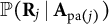 ${\mathbb {P}}({\mathbf {R}}_j \mid {\mathbf {A}}_{\text {{pa}}(j)})$
has size
${\mathbb {P}}({\mathbf {R}}_j \mid {\mathbf {A}}_{\text {{pa}}(j)})$
has size $C \times 2^{|\text {{pa}}(j)|}$
. We next use Lemma A.3 to lower bound the rank of
$C \times 2^{|\text {{pa}}(j)|}$
. We next use Lemma A.3 to lower bound the rank of ${\mathbf {P}}_{1,2}$
. Recall that
${\mathbf {P}}_{1,2}$
. Recall that $ Q_{1:K,:} = I_K$
. Define
$ Q_{1:K,:} = I_K$
. Define $S_1 = \text {{pa}}(j) \setminus \{k\}$
and
$S_1 = \text {{pa}}(j) \setminus \{k\}$
and $S_2 = \{j\}$
, then
$S_2 = \{j\}$
, then $\text {{pa}}(S_1) = \text {{pa}}(j) \setminus \{k\}$
and
$\text {{pa}}(S_1) = \text {{pa}}(j) \setminus \{k\}$
and $\text {{pa}}(S_2) = \text {{pa}}(j)$
. The sets
$\text {{pa}}(S_2) = \text {{pa}}(j)$
. The sets $S_1$
and
$S_1$
and $S_2$
satisfy that
$S_2$
satisfy that $\text {{pa}}(S_1) \subseteq \text {{pa}}(S_2)$
and
$\text {{pa}}(S_1) \subseteq \text {{pa}}(S_2)$
and $\text {{pa}}(S_2) \setminus \text {{pa}}(S_1)$
is a singleton set
$\text {{pa}}(S_2) \setminus \text {{pa}}(S_1)$
is a singleton set $\{k\}$
; additionally,
$\{k\}$
; additionally,
 $$ \begin{align*}{\mathbb{P}}({\mathbf{R}}_{S_1} \mid {\mathbf{A}}_{\mathrm{{pa}}(S_1)}) = \bigotimes_{\ell\in \mathrm{{pa}}(j) \setminus \{k\}} {\mathbb{P}}(R_\ell\mid A_{\ell})\end{align*} $$
has full column rank $2^{|\text {{pa}}(S_1)|}$
. Therefore, we can use Lemma A.3 to obtain
$2^{|\text {{pa}}(S_1)|}$
. Therefore, we can use Lemma A.3 to obtain $ \text {{rank}}({\mathbf {P}}_{1,2})> 2^{|\text {{pa}}(S_1)|}. $
According to the argument right after (A.7), it holds that
$ \text {{rank}}({\mathbf {P}}_{1,2})> 2^{|\text {{pa}}(S_1)|}. $
According to the argument right after (A.7), it holds that
 $$ \begin{align*}\mathrm{{rank}}({\mathbf{P}}_1)> 2^{K-1}. \end{align*} $$
We now go back to the decomposition in (A.6) that $[\mathcal T]_{B_j, D} = {\mathbf {P}}_1 {\mathbf {P}}_2 {\mathbf {P}}_3$
. The rank of the
$[\mathcal T]_{B_j, D} = {\mathbf {P}}_1 {\mathbf {P}}_2 {\mathbf {P}}_3$
. The rank of the $2^K \times 2^K$
diagonal matrix
$2^K \times 2^K$
diagonal matrix ${\mathbf {P}}_2 = \text {{diag}}({\mathbb {P}}({\mathbf {A}}_{1:K}))$
is equal to
${\mathbf {P}}_2 = \text {{diag}}({\mathbb {P}}({\mathbf {A}}_{1:K}))$
is equal to $2^K$
for generic parameters. The rank of the
$2^K$
for generic parameters. The rank of the $2^K \times C^K$
matrix
$2^K \times C^K$
matrix ${\mathbf {P}}_3$
is also equal to
${\mathbf {P}}_3$
is also equal to $2^K$
for generic parameters, because
$2^K$
for generic parameters, because ${\mathbf {P}}_3 = \bigotimes _{j=K+1}^{2K} {\mathbb {P}}(R_j\mid {\mathbf {A}}_{j-K})^\top $
. Both
${\mathbf {P}}_3 = \bigotimes _{j=K+1}^{2K} {\mathbb {P}}(R_j\mid {\mathbf {A}}_{j-K})^\top $
. Both ${\mathbf {P}}_2$
and
${\mathbf {P}}_2$
and ${\mathbf {P}}_3$
have full rank generically by Assumption 2. Therefore,
${\mathbf {P}}_3$
have full rank generically by Assumption 2. Therefore, $\text {{rank}}([\mathcal T]_{B_j, D}) = \text {{rank}}({\mathbf {P}}_1 {\mathbf {P}}_2 {\mathbf {P}}_3) = \text {{rank}}({\mathbf {P}}_1)> 2^{K-1}$
generically. This proves the “if” part of Proposition 3(b) (and Proposition 2).
$\text {{rank}}([\mathcal T]_{B_j, D}) = \text {{rank}}({\mathbf {P}}_1 {\mathbf {P}}_2 {\mathbf {P}}_3) = \text {{rank}}({\mathbf {P}}_1)> 2^{K-1}$
generically. This proves the “if” part of Proposition 3(b) (and Proposition 2).
Proof of Theorems 1 and 2.
It suffices to prove Theorem 2 for the polytomous CDMs because the binary CDMs in Theorem 1 are special cases of the former. Proposition 3 has the following implications. If one exhaustively investigate all pairs of items indexed by $j_1, j_2\in [J]$
, then we can exactly obtain K disjoint sets of item indices
$j_1, j_2\in [J]$
, then we can exactly obtain K disjoint sets of item indices $S_1,\ldots , S_{K}\subseteq [J]$
with the following property: For any
$S_1,\ldots , S_{K}\subseteq [J]$
with the following property: For any $k\in [K]$
, it holds that
$k\in [K]$
, it holds that
 $$ \begin{align*} \mathrm{{rank}}([{\mathcal{T}}]_{\{j_1,j_2\},\; :}) \leq H,\quad \text{for any } j_1, ~ j_2\in S_k. \end{align*} $$
The above argument can also uniquely identify the maximum number of latent variables K. This is because K is equal to the number of all the nonoverlapping sets $S_1, S_2,\ldots \subseteq [J]$
such that for any
$S_1, S_2,\ldots \subseteq [J]$
such that for any $j_1,j_2\in S_k$
for each k, it holds that
$j_1,j_2\in S_k$
for each k, it holds that $\text {{rank}}([\mathcal T]_{\{j_1,j_2\},:}) \leq 2$
. After exhaustively inspecting
$\text {{rank}}([\mathcal T]_{\{j_1,j_2\},:}) \leq 2$
. After exhaustively inspecting $\text {{rank}}([\mathcal T]_{\{j_1,j_2\},:})$
for all pairs of item indices
$\text {{rank}}([\mathcal T]_{\{j_1,j_2\},:})$
for all pairs of item indices $j_1,j_2\in [J]$
, the number of such nonoverlapping sets is uniquely determined and K is uniquely determined constructively. Thus far, we have identified all the row vectors indexed by
$j_1,j_2\in [J]$
, the number of such nonoverlapping sets is uniquely determined and K is uniquely determined constructively. Thus far, we have identified all the row vectors indexed by $j\in \bigcup _{k=1}^K S_k$
. This is exactly the set of all single-attribute items among the J items. Now, using the assumption that the true Q-matrix contains at least two single-attribute items for each attribute, we can permute the already identified row vectors in Q so that it can be written as
$j\in \bigcup _{k=1}^K S_k$
. This is exactly the set of all single-attribute items among the J items. Now, using the assumption that the true Q-matrix contains at least two single-attribute items for each attribute, we can permute the already identified row vectors in Q so that it can be written as $Q=(I_K; I_K, Q^{*\top })^\top $
.
$Q=(I_K; I_K, Q^{*\top })^\top $
.
Further, for any item j that is not a single-attribute item, in order to determine whether $q_{jk}=1$
for each
$q_{jk}=1$
for each $k\in [K]$
, we consider the following marginalized unfolding
$k\in [K]$
, we consider the following marginalized unfolding
 $$ \begin{align*} [\mathcal T]_{B, D},~\text{ where } B := ([K]\setminus\{k\}) \cup \{j\},\quad C := \{K+1,\ldots,2K\}. \end{align*} $$
Here both B and D are non-overlapping sets with cardinality K, so $[\mathcal T]_{B, D}$
is a
$[\mathcal T]_{B, D}$
is a $2^K \times 2^{K}$
matrix. Since
$2^K \times 2^{K}$
matrix. Since $\sum _{k=1}^K q_{jk} \geq 2$
, part (b) of Proposition 1 implies that
$\sum _{k=1}^K q_{jk} \geq 2$
, part (b) of Proposition 1 implies that $\text {{rank}}([\mathcal T]_{B, D})> 2^{K-1}$
holds if and only if
$\text {{rank}}([\mathcal T]_{B, D})> 2^{K-1}$
holds if and only if $q_{jk}=1$
. Therefore, examining whether the rank of
$q_{jk}=1$
. Therefore, examining whether the rank of $[\mathcal T]_{B, D}$
exceeds
$[\mathcal T]_{B, D}$
exceeds $2^{K-1}$
exhaustively for all non-single-attribute items j and all
$2^{K-1}$
exhaustively for all non-single-attribute items j and all $k\in [K]$
will identify those row vectors of the Q-matrix corresponding to these items. Now, we have identified all quantities, including K and the Q-matrix, and the proof is complete.
$k\in [K]$
will identify those row vectors of the Q-matrix corresponding to these items. Now, we have identified all quantities, including K and the Q-matrix, and the proof is complete.
B Proof of Supporting Results
B.1 Proof of Lemma A.1
We first prove (A.1). By the conditional independence of the observed variables given the latent parents, we have
 $$ \begin{align*} {\mathbb{P}}({\mathbf{R}}_M\mid {\mathbf{A}}_{\mathrm{{pa}}(M)}) = \prod_{j=1}^M {\mathbb{P}}(R_j\mid A_{\mathrm{{pa}}(M)}) = \prod_{j=1}^M {\mathbb{P}}(R_j\mid A_{\mathrm{{pa}}(j)}), \end{align*} $$
which implies for any observed pattern $\mathbf r_M\in \{0,\ldots ,V-1\}^{|M|}$
and any latent pattern
$\mathbf r_M\in \{0,\ldots ,V-1\}^{|M|}$
and any latent pattern $\mathbf a_{\text {{pa}}(M)} \in \{0,\ldots ,H-1\}^{|\text {{pa}}(M)|}$
, it holds that
$\mathbf a_{\text {{pa}}(M)} \in \{0,\ldots ,H-1\}^{|\text {{pa}}(M)|}$
, it holds that
 $$ \begin{align*} {\mathbb{P}}({\mathbf{R}}_M = \mathbf r_M\mid {\mathbf{A}}_{\mathrm{{pa}}(M)} = \boldsymbol{\alpha}_{\mathrm{{pa}}(M)}) = \prod_{j=1}^M {\mathbb{P}}(R_j = y_j\mid A_{\mathrm{{pa}}(j)} = \alpha_{\mathrm{{pa}}(j)}). \end{align*} $$
Since $\text {{pa}}(j)$
for
$\text {{pa}}(j)$
for $j\in M$
are disjoint singleton sets, by following the definition of the Kronecker product of matrices, the above factorization implies
$j\in M$
are disjoint singleton sets, by following the definition of the Kronecker product of matrices, the above factorization implies ${\mathbb {P}}({\mathbf {R}}_{M}\mid {\mathbf {A}}_{\text {{pa}}(M)}) = \bigotimes _{j\in M} {\mathbb {P}}(R_j\mid A_{\text {{pa}}(j)})$
and proves (A.1).
${\mathbb {P}}({\mathbf {R}}_{M}\mid {\mathbf {A}}_{\text {{pa}}(M)}) = \bigotimes _{j\in M} {\mathbb {P}}(R_j\mid A_{\text {{pa}}(j)})$
and proves (A.1).
We next prove (A.2). First, note that ${\mathbb {P}}({\mathbf {R}}_{M}\mid {\mathbf {A}}_{{S}})$
has size
${\mathbb {P}}({\mathbf {R}}_{M}\mid {\mathbf {A}}_{{S}})$
has size $ C^{|M|} \times 2^{|{S}|}$
, while
$ C^{|M|} \times 2^{|{S}|}$
, while ${\mathbf {1}}_{2^{|{S}|-|\text {{pa}}(M)|}}^\top $
has size
${\mathbf {1}}_{2^{|{S}|-|\text {{pa}}(M)|}}^\top $
has size $1\times 2^{|S|-|\text {{pa}}(M)|}$
and
$1\times 2^{|S|-|\text {{pa}}(M)|}$
and ${\mathbb {P}}({\mathbf {R}}_{M}\mid {\mathbf {A}}_{\text {{pa}}(M)})$
has size
${\mathbb {P}}({\mathbf {R}}_{M}\mid {\mathbf {A}}_{\text {{pa}}(M)})$
has size $C^{|M|} \times 2^{|\text {{pa}}(M)|}$
. So, the sizes of matrices on the left-hand side and the right-hand side of (A.2) match each other. Further, since
$C^{|M|} \times 2^{|\text {{pa}}(M)|}$
. So, the sizes of matrices on the left-hand side and the right-hand side of (A.2) match each other. Further, since $\text {{pa}}(M) \subsetneqq S$
, we know that the conditional distribution of
$\text {{pa}}(M) \subsetneqq S$
, we know that the conditional distribution of ${\mathbf {R}}_M$
given
${\mathbf {R}}_M$
given ${\mathbf {A}}_{S}$
only depends on those latent variables belonging to the index set
${\mathbf {A}}_{S}$
only depends on those latent variables belonging to the index set $\text {{pa}}(M)$
; in other words,
$\text {{pa}}(M)$
; in other words,
 $$ \begin{align*}{\mathbb{P}}({\mathbf{R}}_M\mid {\mathbf{A}}_{S}) = {\mathbb{P}}({\mathbf{R}}_{M}\mid {\mathbf{A}}_{\mathrm{{pa}}(M)}, {\mathbf{A}}_{S\setminus \mathrm{{pa}}(M)}) = {\mathbb{P}}({\mathbf{R}}_{M}\mid {\mathbf{A}}_{\mathrm{{pa}}(M)}), \end{align*} $$
where ${\mathbf {A}}_{\text {{pa}}(M)}$
and
${\mathbf {A}}_{\text {{pa}}(M)}$
and ${\mathbf {A}}_{S\setminus \text {{pa}}(M)}$
are a subvectors of
${\mathbf {A}}_{S\setminus \text {{pa}}(M)}$
are a subvectors of ${\mathbf {A}}_{S}$
. The above fact implies that, although
${\mathbf {A}}_{S}$
. The above fact implies that, although ${\mathbb {P}}({\mathbf {R}}_{M}\mid {\mathbf {A}}_{S})$
has
${\mathbb {P}}({\mathbf {R}}_{M}\mid {\mathbf {A}}_{S})$
has $2^{|S|}$
columns indexed by all possible configurations of
$2^{|S|}$
columns indexed by all possible configurations of ${\mathbf {A}}_{S}\in \{0,\ldots ,H-1\}^{|S|}$
, actually
${\mathbf {A}}_{S}\in \{0,\ldots ,H-1\}^{|S|}$
, actually ${\mathbb {P}}({\mathbf {R}}_{M}\mid {\mathbf {A}}_{S})$
contains only
${\mathbb {P}}({\mathbf {R}}_{M}\mid {\mathbf {A}}_{S})$
contains only $2^{|\text {{pa}}(M)|} (< 2^{|S|})$
unique columns. Each unique column is indexed by a unique pattern the subvector
$2^{|\text {{pa}}(M)|} (< 2^{|S|})$
unique columns. Each unique column is indexed by a unique pattern the subvector ${\mathbf {A}}_{\text {{pa}}(M)}$
takes in
${\mathbf {A}}_{\text {{pa}}(M)}$
takes in $\{0,\ldots ,H-1\}^{|\text {{pa}}(M)|}$
. So, the matrix
$\{0,\ldots ,H-1\}^{|\text {{pa}}(M)|}$
. So, the matrix ${\mathbb {P}}({\mathbf {R}}_M\mid {\mathbf {A}}_{S})$
horizontally stacks
${\mathbb {P}}({\mathbf {R}}_M\mid {\mathbf {A}}_{S})$
horizontally stacks $2^{|S|-|\text {{pa}}(M)|}$
repetitive blocks, each of which equals
$2^{|S|-|\text {{pa}}(M)|}$
repetitive blocks, each of which equals ${\mathbb {P}}({\mathbf {R}}_{M}\mid {\mathbf {A}}_{\text {{pa}}(M)})$
. So, we have
${\mathbb {P}}({\mathbf {R}}_{M}\mid {\mathbf {A}}_{\text {{pa}}(M)})$
. So, we have
 $$ \begin{align*} {\mathbb{P}}({\mathbf{R}}_{M}\mid {\mathbf{A}}_{S}) &= \underbrace{ \begin{pmatrix} {\mathbb{P}}({\mathbf{R}}_{M}\mid {\mathbf{A}}_{\mathrm{{pa}}(M)}), & \cdots, & {\mathbb{P}}({\mathbf{R}}_{M}\mid {\mathbf{A}}_{\mathrm{{pa}}(M)}) \end{pmatrix} }_{2^{|S|-|\mathrm{{pa}}(M)|}\text{ copies}} \\ &= {\mathbf{1}}_{2^{|S|-|\mathrm{{pa}}(M)|}}^\top \bigotimes {\mathbb{P}}({\mathbf{R}}_{M}\mid {\mathbf{A}}_S). \end{align*} $$
We next prove (A.3). Since $S\supseteq \text {{pa}}(M_1) \cup \text {{pa}}(M_2)$
holds,
$S\supseteq \text {{pa}}(M_1) \cup \text {{pa}}(M_2)$
holds, ${\mathbf {R}}_{M_1}$
and
${\mathbf {R}}_{M_1}$
and ${\mathbf {R}}_{M_2}$
are conditionally independent given
${\mathbf {R}}_{M_2}$
are conditionally independent given ${\mathbf {A}}_{S}$
. So, we can use Lemma 12 in Allman et al. (Reference Allman, Matias and Rhodes2009) to direct obtain the conclusion that
${\mathbf {A}}_{S}$
. So, we can use Lemma 12 in Allman et al. (Reference Allman, Matias and Rhodes2009) to direct obtain the conclusion that ${\mathbb {P}}({\mathbf {R}}_{M_1\cup M_2}\mid {\mathbf {A}}_S) = {\mathbb {P}}({\mathbf {R}}_{M_1}\mid {\mathbf {A}}_S) \bigodot {\mathbb {P}}({\mathbf {R}}_{M_2}\mid {\mathbf {A}}_S)$
. The proof of Lemma A.1 is complete.
${\mathbb {P}}({\mathbf {R}}_{M_1\cup M_2}\mid {\mathbf {A}}_S) = {\mathbb {P}}({\mathbf {R}}_{M_1}\mid {\mathbf {A}}_S) \bigodot {\mathbb {P}}({\mathbf {R}}_{M_2}\mid {\mathbf {A}}_S)$
. The proof of Lemma A.1 is complete.
B.2 Proof of Lemma A.2
Since $\text {{pa}}(S_1) \subsetneqq \text {{pa}}(S_2)$
, we use Lemma A.1 to write
$\text {{pa}}(S_1) \subsetneqq \text {{pa}}(S_2)$
, we use Lemma A.1 to write
 $$ \begin{align*} {\mathbb{P}}(R_{S_1} \mid {\mathbf{A}}_{\mathrm{{pa}}(S_2)}) = {\mathbf{1}}_{2^{|\mathrm{{pa}}(S_2)\setminus \mathrm{{pa}}(S_1)|}}^\top \bigotimes {\mathbb{P}}(R_{S_1} \mid {\mathbf{A}}_{\mathrm{{pa}}(S_2)}), \end{align*} $$
and
 $$ \begin{align} {\mathbb{P}}({\mathbf{R}}_{S_1\cup S_2}\mid {\mathbf{A}}_{\mathrm{{pa}}(S_2)}) = \Big({\mathbf{1}}_{2^{|\mathrm{{pa}}(S_2)\setminus \mathrm{{pa}}(S_1)|}}^\top \bigotimes {\mathbb{P}}(R_{S_1} \mid {\mathbf{A}}_{\mathrm{{pa}}(S_1)})\Big) \bigodot {\mathbb{P}}({\mathbf{R}}_{S_2}\mid {\mathbf{A}}_{\mathrm{{pa}}(S_2)}). \end{align} $$
Define notation
 $$ \begin{align*} {\mathbf{F}} &= {\mathbb{P}}(R_{S_1} \mid {\mathbf{A}}_{\mathrm{{pa}}(S_1)});\\ {\mathbf{E}}_{\boldsymbol{\alpha}_\ell} &= {\mathbb{P}}({\mathbf{R}}_{S_2}\mid {\mathbf{A}}_{\mathrm{{pa}}(S_1)}, {\mathbf{A}}_{\mathrm{{pa}}(S_2)\setminus \mathrm{{pa}}(S_1)} = \boldsymbol{\alpha}_\ell),\quad \boldsymbol{\alpha}_\ell\in\{0,1,\ldots,H-1\}^{|\mathrm{{pa}}(S_2)\setminus \mathrm{{pa}}(S_1)|}. \end{align*} $$
For each fixed pattern $\boldsymbol {\alpha }_\ell \in \{0,1\}^{|\text {{pa}}(S_2)\setminus \text {{pa}}(S_1)|}$
, the
$\boldsymbol {\alpha }_\ell \in \{0,1\}^{|\text {{pa}}(S_2)\setminus \text {{pa}}(S_1)|}$
, the ${\mathbf {E}}_{\boldsymbol {\alpha }_\ell }$
is a
${\mathbf {E}}_{\boldsymbol {\alpha }_\ell }$
is a $C^{|S_2|} \times 2^{|\text {{pa}}(S_1)|}$
matrix with rows indexed by all possible configurations of
$C^{|S_2|} \times 2^{|\text {{pa}}(S_1)|}$
matrix with rows indexed by all possible configurations of $R_{S_2}$
and columns by all possible configurations of
$R_{S_2}$
and columns by all possible configurations of ${\mathbf {A}}_{\text {{pa}}(S_1)}$
. By the condition in the lemma, matrix
${\mathbf {A}}_{\text {{pa}}(S_1)}$
. By the condition in the lemma, matrix ${\mathbf {F}}$
has full column rank
${\mathbf {F}}$
has full column rank $2^{|\text {{pa}}(S_1)|}$
. For notational simplicity, denote this number
$2^{|\text {{pa}}(S_1)|}$
. For notational simplicity, denote this number $2^{|\text {{pa}}(S_1)|} =: R$
. After possibly rearranging the columns of
$2^{|\text {{pa}}(S_1)|} =: R$
. After possibly rearranging the columns of ${\mathbf {1}}_{2^{\text {{pa}}(S_2)\setminus \text {{pa}}(S_1)}}^\top \bigotimes {\mathbb {P}}(R_{S_1} \mid {\mathbf {A}}_{\text {{pa}}(S_1)})$
and
${\mathbf {1}}_{2^{\text {{pa}}(S_2)\setminus \text {{pa}}(S_1)}}^\top \bigotimes {\mathbb {P}}(R_{S_1} \mid {\mathbf {A}}_{\text {{pa}}(S_1)})$
and ${\mathbb {P}}({\mathbf {R}}_{S_2}\mid {\mathbf {A}}_{\text {{pa}}(S_2)})$
via a common permutation, we can write
${\mathbb {P}}({\mathbf {R}}_{S_2}\mid {\mathbf {A}}_{\text {{pa}}(S_2)})$
via a common permutation, we can write
 $$ \begin{align*} {\mathbf{1}}_{2^{\mathrm{{pa}}(S_2)\setminus \mathrm{{pa}}(S_1)}}^\top \bigotimes {\mathbb{P}}(R_{S_1} \mid {\mathbf{A}}_{\mathrm{{pa}}(S_1)}) &= (\underbrace{{\mathbf{F}}, {\mathbf{F}}, \ldots, {\mathbf{F}}}_{R=2^{\mathrm{{pa}}(S_2)\setminus \mathrm{{pa}}(S_1)} \text{ copies}});\\ {\mathbb{P}}({\mathbf{R}}_{S_2}\mid {\mathbf{A}}_{\mathrm{{pa}}(S_2)}) &= ({\mathbf{E}}_{\boldsymbol{\alpha}_1}, {\mathbf{E}}_{\boldsymbol{\alpha}_2}, \ldots, {\mathbf{E}}_{\boldsymbol{\alpha}_R}). \end{align*} $$
Therefore, the matrix ${\mathbb {P}}({\mathbf {R}}_{S_1\cup S_2}\mid {\mathbf {A}}_{\text {{pa}}(S_2)})$
in (B.1) can be written as
${\mathbb {P}}({\mathbf {R}}_{S_1\cup S_2}\mid {\mathbf {A}}_{\text {{pa}}(S_2)})$
in (B.1) can be written as
 $$ \begin{align} {\mathbb{P}}({\mathbf{R}}_{S_1\cup S_2}\mid {\mathbf{A}}_{\mathrm{{pa}}(S_2)}) = \Big({\mathbf{F}} \bigodot {\mathbf{E}}_{\boldsymbol{\alpha}_1},~ {\mathbf{F}} \bigodot {\mathbf{E}}_0,~ \ldots,~ {\mathbf{F}} \bigodot {\mathbf{E}}_{\boldsymbol{\alpha}_R} \Big). \end{align} $$
Next, we will prove that the matrix ${\mathbb {P}}({\mathbf {R}}_{S_1\cup S_2}\mid {\mathbf {A}}_{\text {{pa}}(S_2)})$
has rank at least
${\mathbb {P}}({\mathbf {R}}_{S_1\cup S_2}\mid {\mathbf {A}}_{\text {{pa}}(S_2)})$
has rank at least $R + 1$
under Assumption 2. Denote the columns of
$R + 1$
under Assumption 2. Denote the columns of ${\mathbf {F}}$
by
${\mathbf {F}}$
by ${\mathbf {F}}_1,\ldots ,{\mathbf {F}}_R$
, and the columns of
${\mathbf {F}}_1,\ldots ,{\mathbf {F}}_R$
, and the columns of ${\mathbf {E}}_{\boldsymbol {\alpha }_h}$
by
${\mathbf {E}}_{\boldsymbol {\alpha }_h}$
by ${\mathbf {E}}_{\boldsymbol {\alpha }_h,1},\ldots ,{\mathbf {E}}_{\boldsymbol {\alpha }_h,R}$
. Note that by definition, each
${\mathbf {E}}_{\boldsymbol {\alpha }_h,1},\ldots ,{\mathbf {E}}_{\boldsymbol {\alpha }_h,R}$
. Note that by definition, each ${\mathbf {E}}_{\boldsymbol {\alpha }_h,m}$
is a vector describing the conditional distribution of
${\mathbf {E}}_{\boldsymbol {\alpha }_h,m}$
is a vector describing the conditional distribution of $R_{S_2}$
given a specific configuration of
$R_{S_2}$
given a specific configuration of ${\mathbf {A}}_{\text {{pa}}(S_2)}$
when
${\mathbf {A}}_{\text {{pa}}(S_2)}$
when ${\mathbf {A}}_{\text {{pa}}(S_2)\setminus \text {{pa}}(S_1)}$
is fixed to be
${\mathbf {A}}_{\text {{pa}}(S_2)\setminus \text {{pa}}(S_1)}$
is fixed to be $\boldsymbol {\alpha }_h$
. Since
$\boldsymbol {\alpha }_h$
. Since $\text {{pa}}(S_1) \subsetneqq \text {{pa}}(S_2)$
, there exists some
$\text {{pa}}(S_1) \subsetneqq \text {{pa}}(S_2)$
, there exists some $k\in \text {{pa}}(S_1)$
but
$k\in \text {{pa}}(S_1)$
but $k\not \in \text {{pa}}(S_2)$
. Under the non-DINA/DINO assumption in Definition 3, there exist
$k\not \in \text {{pa}}(S_2)$
. Under the non-DINA/DINO assumption in Definition 3, there exist $2$
different vectors
$2$
different vectors $\boldsymbol \beta _1,\boldsymbol \beta _2 \in \{\boldsymbol {\alpha }_1,\ldots ,\boldsymbol {\alpha }_R\}$
where
$\boldsymbol \beta _1,\boldsymbol \beta _2 \in \{\boldsymbol {\alpha }_1,\ldots ,\boldsymbol {\alpha }_R\}$
where $\boldsymbol \beta _1,\boldsymbol \beta _2$
differ only in the entry corresponding to
$\boldsymbol \beta _1,\boldsymbol \beta _2$
differ only in the entry corresponding to $A_k=0,1$
, in which there exist
$A_k=0,1$
, in which there exist $h_1\neq h_2 \in \{0,1\}$
and some
$h_1\neq h_2 \in \{0,1\}$
and some $r\in \{1,\ldots ,R\}$
such that
$r\in \{1,\ldots ,R\}$
such that
 $$ \begin{align} {\mathbf{E}}_{\boldsymbol \beta_{h_1},r} \neq {\mathbf{E}}_{\boldsymbol \beta_{h_2},r}. \end{align} $$
Suppose that there exists a vector $\mathbf x = (x_1,\ldots ,x_{R}, x_{R+1})^\top $
such that
$\mathbf x = (x_1,\ldots ,x_{R}, x_{R+1})^\top $
such that
 $$ \begin{align*} x_1 {\mathbf{F}}_1 \bigotimes {\mathbf{E}}_{\boldsymbol \beta_{h_1},1} + \cdots + x_R {\mathbf{F}}_R \bigotimes {\mathbf{E}}_{\boldsymbol \beta_{h_1},R} + x_{R+1} {\mathbf{F}}_{r} \bigotimes {\mathbf{E}}_{\boldsymbol \beta_{h_2}, r} &= {\mathbf{0}}. \end{align*} $$
Rearranging the terms above gives
 $$ \begin{align} \sum_{m\in[R]\setminus\{r\}} x_m {\mathbf{F}}_m \bigotimes {\mathbf{E}}_{\boldsymbol \beta_{h_1},m} + {\mathbf{F}}_r \bigotimes (x_r {\mathbf{E}}_{\boldsymbol \beta_{h_1},r} + x_{R+1}{\mathbf{E}}_{\boldsymbol \beta_{h_2},r}) = {\mathbf{0}}. \end{align} $$
Define a matrix $\widetilde {\mathbf {E}}$
whose r-th column vector is
$\widetilde {\mathbf {E}}$
whose r-th column vector is $x_r {\mathbf {E}}_{\boldsymbol \beta _{h_1},r} + x_{R+1}{\mathbf {E}}_{\boldsymbol \beta _{h_2},r}$
, and for any
$x_r {\mathbf {E}}_{\boldsymbol \beta _{h_1},r} + x_{R+1}{\mathbf {E}}_{\boldsymbol \beta _{h_2},r}$
, and for any $m\in [R]$
and
$m\in [R]$
and $m\neq r$
, the m-th column vector of
$m\neq r$
, the m-th column vector of $\widetilde {\mathbf {E}}$
is
$\widetilde {\mathbf {E}}$
is ${\mathbf {E}}_{\boldsymbol \beta _{h_1},m}$
. Define a R-dimensional vector
${\mathbf {E}}_{\boldsymbol \beta _{h_1},m}$
. Define a R-dimensional vector $\widetilde {\mathbf y}$
with
$\widetilde {\mathbf y}$
with $y_r = 1$
and
$y_r = 1$
and $y_m=x_m$
for any
$y_m=x_m$
for any $m\in [R]$
and
$m\in [R]$
and $m\neq r$
. Then (B.4) can be rewritten as
$m\neq r$
. Then (B.4) can be rewritten as
 $$ \begin{align} ({\mathbf{F}} \bigodot \widetilde{\mathbf{E}}) \mathbf y = {\mathbf{0}}. \end{align} $$
Since $\mathbf y$
above is not a zero vector, we have that
$\mathbf y$
above is not a zero vector, we have that $\text {{rank}}({\mathbf {F}} \bigodot \widetilde {\mathbf {E}}) < R$
. We next will show that this necessarily implies
$\text {{rank}}({\mathbf {F}} \bigodot \widetilde {\mathbf {E}}) < R$
. We next will show that this necessarily implies $x_r {\mathbf {E}}_{\boldsymbol \beta _{h_1},r} + x_{R+1}{\mathbf {E}}_{\boldsymbol \beta _{h_2},r} = {\mathbf {0}}$
.
$x_r {\mathbf {E}}_{\boldsymbol \beta _{h_1},r} + x_{R+1}{\mathbf {E}}_{\boldsymbol \beta _{h_2},r} = {\mathbf {0}}$
.
We introduce the definition of the Kruskal rank. The Kruskal rank of a matrix is the largest integer M such that every M columns of this matrix are linearly independent. Denote the Kruskal rank of any matrix ${\mathbf {B}}$
by
${\mathbf {B}}$
by $\text {krank}({\mathbf {B}})$
. It is easy to see that if a matrix has full column rank, then its Kruskal rank equals its rank. Also, a matrix
$\text {krank}({\mathbf {B}})$
. It is easy to see that if a matrix has full column rank, then its Kruskal rank equals its rank. Also, a matrix $\mathbf B$
contains a zero column vector if and only if
$\mathbf B$
contains a zero column vector if and only if $\text {krank}(\mathbf B)=0$
.
$\text {krank}(\mathbf B)=0$
.
Now consider the matrix ${\mathbf {F}} \bigodot \widetilde {\mathbf {E}}$
in (B.5). Since
${\mathbf {F}} \bigodot \widetilde {\mathbf {E}}$
in (B.5). Since ${\mathbf {F}}$
has full column rank R, then
${\mathbf {F}}$
has full column rank R, then $\text {krank}({\mathbf {F}}) = \text {{rank}}({\mathbf {F}}) = R$
. For any
$\text {krank}({\mathbf {F}}) = \text {{rank}}({\mathbf {F}}) = R$
. For any $m\in [R]\setminus \{r\}$
, the m-th column vector of
$m\in [R]\setminus \{r\}$
, the m-th column vector of $\widetilde {\mathbf {E}}$
is a conditional probability vector for
$\widetilde {\mathbf {E}}$
is a conditional probability vector for $R_j$
given a fixed pattern of
$R_j$
given a fixed pattern of ${\mathbf {A}}_{\text {{pa}}(j)}$
, therefore
${\mathbf {A}}_{\text {{pa}}(j)}$
, therefore ${\mathbf {E}}_{\boldsymbol \beta _{h_1},m}\neq {\mathbf {0}}$
. So, if
${\mathbf {E}}_{\boldsymbol \beta _{h_1},m}\neq {\mathbf {0}}$
. So, if $x_r {\mathbf {E}}_{\boldsymbol \beta _{h_1},r} + x_{R+1}{\mathbf {E}}_{\boldsymbol \beta _{h_2},r} \neq {\mathbf {0}}$
, then
$x_r {\mathbf {E}}_{\boldsymbol \beta _{h_1},r} + x_{R+1}{\mathbf {E}}_{\boldsymbol \beta _{h_2},r} \neq {\mathbf {0}}$
, then $\widetilde {\mathbf {E}}$
does not have any zero column vectors and
$\widetilde {\mathbf {E}}$
does not have any zero column vectors and $\text {krank}(\widetilde {\mathbf {E}}) \geq 1$
. In this case, the following holds by Lemma A.4(b),
$\text {krank}(\widetilde {\mathbf {E}}) \geq 1$
. In this case, the following holds by Lemma A.4(b),
 $$ \begin{align*} \text{krank}({\mathbf{F}} \bigodot \widetilde{\mathbf{E}}) &\geq \min(\text{krank}({\mathbf{F}}) + \text{krank}(\widetilde{\mathbf{E}}) - 1, ~ R)\\ &= \min(R + \text{krank}(\widetilde{\mathbf{E}}) - 1, ~ R) \\ &\geq \min(R + 1 - 1, ~ R) = R. \end{align*} $$
Then, $\text {{rank}}({\mathbf {F}} \bigodot \widetilde {\mathbf {E}}) = \text {krank}({\mathbf {F}} \bigodot \widetilde {\mathbf {E}}) = R$
, which contradicts with (B.5) because the vector
$\text {{rank}}({\mathbf {F}} \bigodot \widetilde {\mathbf {E}}) = \text {krank}({\mathbf {F}} \bigodot \widetilde {\mathbf {E}}) = R$
, which contradicts with (B.5) because the vector $\mathbf y$
there is not a zero vector with
$\mathbf y$
there is not a zero vector with $y_r=1$
and hence
$y_r=1$
and hence ${\mathbf {F}} \bigodot \widetilde {\mathbf {E}}$
should not have full column rank. This contradiction implies that
${\mathbf {F}} \bigodot \widetilde {\mathbf {E}}$
should not have full column rank. This contradiction implies that
 $$ \begin{align*}x_r {\mathbf{E}}_{\boldsymbol \beta_{h_1},r} + x_{R+1}{\mathbf{E}}_{\boldsymbol \beta_{h_2},r} = {\mathbf{0}}. \end{align*} $$
Now note that each of ${\mathbf {E}}_{\boldsymbol \beta _{h_1},r}$
and
${\mathbf {E}}_{\boldsymbol \beta _{h_1},r}$
and ${\mathbf {E}}_{\boldsymbol \beta _{h_2},r}$
is a conditional probability vector describing the distribution of
${\mathbf {E}}_{\boldsymbol \beta _{h_2},r}$
is a conditional probability vector describing the distribution of $R_{S_2}$
given a fixed pattern of
$R_{S_2}$
given a fixed pattern of ${\mathbf {A}}_{\text {{pa}}(S_2)}$
. Therefore,
${\mathbf {A}}_{\text {{pa}}(S_2)}$
. Therefore, ${\mathbf {1}}^\top {\mathbf {E}}_{\boldsymbol \beta _{h_1},r} = {\mathbf {1}}^\top {\mathbf {E}}_{\boldsymbol \beta _{h_1},r} = 0$
, and we further have
${\mathbf {1}}^\top {\mathbf {E}}_{\boldsymbol \beta _{h_1},r} = {\mathbf {1}}^\top {\mathbf {E}}_{\boldsymbol \beta _{h_1},r} = 0$
, and we further have $x_r + x_{R+1} = 0$
. Plugging the above expression
$x_r + x_{R+1} = 0$
. Plugging the above expression $x_r {\mathbf {E}}_{\boldsymbol \beta _{h_1},r} + x_{R+1}{\mathbf {E}}_{\boldsymbol \beta _{h_2},r} = {\mathbf {0}}$
back into (B.4) further gives
$x_r {\mathbf {E}}_{\boldsymbol \beta _{h_1},r} + x_{R+1}{\mathbf {E}}_{\boldsymbol \beta _{h_2},r} = {\mathbf {0}}$
back into (B.4) further gives
 $$ \begin{align} \sum_{m\in[R]\setminus\{r\}} x_m {\mathbf{F}}_m \bigotimes {\mathbf{E}}_{\boldsymbol \beta_{h_1},m} = {\mathbf{0}}. \end{align} $$
We next use Lemma A.4 to show that $\{{\mathbf {F}}_m \bigotimes {\mathbf {E}}_{\boldsymbol \beta _{h_1},m}:~ m\in [R] \setminus \{r\}\}$
are
$\{{\mathbf {F}}_m \bigotimes {\mathbf {E}}_{\boldsymbol \beta _{h_1},m}:~ m\in [R] \setminus \{r\}\}$
are $R-1$
linearly independent vectors. To show this, first note that (B.6) can be written as
$R-1$
linearly independent vectors. To show this, first note that (B.6) can be written as
 $$ \begin{align*}({\mathbf{F}}_{-r} \bigodot \widetilde {\mathbf{E}}_{-r}) \mathbf x_{-r} = {\mathbf{0}}, \end{align*} $$
where matrix ${\mathbf {F}}_{-r}$
contains all but the r-th column of matrix
${\mathbf {F}}_{-r}$
contains all but the r-th column of matrix ${\mathbf {F}}$
, matrix
${\mathbf {F}}$
, matrix $\widetilde {\mathbf {E}}_{-r}$
contains all but the r-th column of matrix
$\widetilde {\mathbf {E}}_{-r}$
contains all but the r-th column of matrix $\widetilde {\mathbf {E}}$
, and vector
$\widetilde {\mathbf {E}}$
, and vector $\mathbf x_{-r}$
contains all but the r-th entry of the vector
$\mathbf x_{-r}$
contains all but the r-th entry of the vector $\mathbf x$
. Now, because
$\mathbf x$
. Now, because $\text {krank}({\mathbf {F}}_{-r}) = \text {{rank}}({\mathbf {F}}_{-r}) = R-1$
and
$\text {krank}({\mathbf {F}}_{-r}) = \text {{rank}}({\mathbf {F}}_{-r}) = R-1$
and $\text {krank}(\widetilde {\mathbf {E}}_{-r}) \geq 1$
, Lemma A.4(b) implies that
$\text {krank}(\widetilde {\mathbf {E}}_{-r}) \geq 1$
, Lemma A.4(b) implies that
 $$ \begin{align*}\text{krank}({\mathbf{F}}_{-r} \bigodot \widetilde {\mathbf{E}}_{-r}) \geq \min(R-1 + \text{krank}(\widetilde {\mathbf{E}}_{-r})-1, ~R-1) \geq R-1. \end{align*} $$
Since ${\mathbf {F}}_{-r} \bigodot \widetilde {\mathbf {E}}_{-r}$
contains
${\mathbf {F}}_{-r} \bigodot \widetilde {\mathbf {E}}_{-r}$
contains $R-1$
columns, the above inequality gives that
$R-1$
columns, the above inequality gives that $\text {{rank}}({\mathbf {F}}_{-r} \bigodot \widetilde {\mathbf {E}}_{-r}) = \text {krank}({\mathbf {F}}_{-r} \bigodot \widetilde {\mathbf {E}}_{-r}) = R-1$
. In other words, the
$\text {{rank}}({\mathbf {F}}_{-r} \bigodot \widetilde {\mathbf {E}}_{-r}) = \text {krank}({\mathbf {F}}_{-r} \bigodot \widetilde {\mathbf {E}}_{-r}) = R-1$
. In other words, the $R-1$
vectors in
$R-1$
vectors in $\{{\mathbf {F}}_m \bigotimes {\mathbf {E}}_{\boldsymbol \beta _{h_1},m}:~ m\in [R]\setminus \{r\}\}$
are linearly independent. Therefore, from (B.6) we have that
$\{{\mathbf {F}}_m \bigotimes {\mathbf {E}}_{\boldsymbol \beta _{h_1},m}:~ m\in [R]\setminus \{r\}\}$
are linearly independent. Therefore, from (B.6) we have that $x_m = 0$
for all
$x_m = 0$
for all $m\in [R]\setminus \{r\}$
. Recall we aim to examine whether there exists a nonzero vector
$m\in [R]\setminus \{r\}$
. Recall we aim to examine whether there exists a nonzero vector $\mathbf x = (x_1,\ldots ,x_R,x_{R+1})$
such that (B.4) holds, and we have already shown that under (B.4), the only two potentially nonzero entries in the vector
$\mathbf x = (x_1,\ldots ,x_R,x_{R+1})$
such that (B.4) holds, and we have already shown that under (B.4), the only two potentially nonzero entries in the vector $\mathbf x$
are
$\mathbf x$
are $x_r$
and
$x_r$
and $x_{R+1}$
. If
$x_{R+1}$
. If $(x_r, x_{R+1}) \neq (0,0)$
, then
$(x_r, x_{R+1}) \neq (0,0)$
, then $x_r = - x_{R+1} \neq 0$
, and it indicates
$x_r = - x_{R+1} \neq 0$
, and it indicates
 $$ \begin{align*}{\mathbf{E}}_{\boldsymbol \beta_{h_1},m} = {\mathbf{E}}_{\boldsymbol \beta_{h_2},m}. \end{align*} $$
The above equality contradicts the earlier (B.3) that ${\mathbf {E}}_{\boldsymbol \beta _{h_1},m} \neq {\mathbf {E}}_{\boldsymbol \beta _{h_2},m}$
which follows from Assumption 2, therefore
${\mathbf {E}}_{\boldsymbol \beta _{h_1},m} \neq {\mathbf {E}}_{\boldsymbol \beta _{h_2},m}$
which follows from Assumption 2, therefore $x_r=x_{R+1}=0$
must hold. In summary, we have shown that the
$x_r=x_{R+1}=0$
must hold. In summary, we have shown that the $R+1$
vectors
$R+1$
vectors ${\mathbf {F}}_1 \bigotimes {\mathbf {E}}_{\boldsymbol \beta _{h_1},1},~ \ldots ,~ {\mathbf {F}}_R \bigotimes {\mathbf {E}}_{\boldsymbol \beta _{h_1},R},~ {\mathbf {F}}_{r} \bigotimes {\mathbf {E}}_{\boldsymbol \beta _{h_2}, r}$
are linearly independent, which means the matrix
${\mathbf {F}}_1 \bigotimes {\mathbf {E}}_{\boldsymbol \beta _{h_1},1},~ \ldots ,~ {\mathbf {F}}_R \bigotimes {\mathbf {E}}_{\boldsymbol \beta _{h_1},R},~ {\mathbf {F}}_{r} \bigotimes {\mathbf {E}}_{\boldsymbol \beta _{h_2}, r}$
are linearly independent, which means the matrix ${\mathbb {P}}(R_{S_1\cup S_2}\mid {\mathbf {A}}_{\text {{pa}}(S_2)})$
in (B.2) contains at least
${\mathbb {P}}(R_{S_1\cup S_2}\mid {\mathbf {A}}_{\text {{pa}}(S_2)})$
in (B.2) contains at least $R+1$
linearly independent column vectors and
$R+1$
linearly independent column vectors and $\text {{rank}}({\mathbb {P}}(R_{S_1\cup S_2}\mid {\mathbf {A}}_{\text {{pa}}(S_2)})) \geq R+1 = 2^{|\text {{pa}}(S_1)|} + 1$
. The proof of Lemma A.2 is complete.
$\text {{rank}}({\mathbb {P}}(R_{S_1\cup S_2}\mid {\mathbf {A}}_{\text {{pa}}(S_2)})) \geq R+1 = 2^{|\text {{pa}}(S_1)|} + 1$
. The proof of Lemma A.2 is complete.
B.3 Proof of Lemma A.3
Consider all possible cases: Case (a), $\text {{pa}}(j_1) \cap \text {{pa}}(j_2) = \varnothing $
; Case (b),
$\text {{pa}}(j_1) \cap \text {{pa}}(j_2) = \varnothing $
; Case (b), $\text {{pa}}(j_1) = \text {{pa}}(j_2)$
with
$\text {{pa}}(j_1) = \text {{pa}}(j_2)$
with $|\text {{pa}}(j_1)| = |\text {{pa}}(j_2)| \geq 2$
; Case (c),
$|\text {{pa}}(j_1)| = |\text {{pa}}(j_2)| \geq 2$
; Case (c), $\text {{pa}}(j_1) \subsetneqq \text {{pa}}(j_2)$
with
$\text {{pa}}(j_1) \subsetneqq \text {{pa}}(j_2)$
with $|\text {{pa}}(j_2)| \geq 2$
; and Case (d),
$|\text {{pa}}(j_2)| \geq 2$
; and Case (d), $\text {{pa}}(j_1) \not \subseteq \text {{pa}}(j_2)$
and
$\text {{pa}}(j_1) \not \subseteq \text {{pa}}(j_2)$
and $\text {{pa}}(j_2) \not \subseteq \text {{pa}}(j_1)$
with
$\text {{pa}}(j_2) \not \subseteq \text {{pa}}(j_1)$
with $|\text {{pa}}(j_1)|\geq 2$
,
$|\text {{pa}}(j_1)|\geq 2$
, $|\text {{pa}}(j_2)| \geq 2$
. Denote
$|\text {{pa}}(j_2)| \geq 2$
. Denote ${\mathbf {P}} = {\mathbb {P}}(R_{\{j_1,j_2\}}\mid {\mathbf {A}}_{\text {{pa}}(j_1)\cup \text {{pa}}(j_2)})$
.
${\mathbf {P}} = {\mathbb {P}}(R_{\{j_1,j_2\}}\mid {\mathbf {A}}_{\text {{pa}}(j_1)\cup \text {{pa}}(j_2)})$
.
Case (a): Since $\text {{pa}}(j_1) \cap \text {{pa}}(j_2) = \varnothing $
, we have
$\text {{pa}}(j_1) \cap \text {{pa}}(j_2) = \varnothing $
, we have
 $$ \begin{align*} {\mathbf{P}}= {\mathbb{P}}(R_{\{j_1,j_2\}}\mid {\mathbf{A}}_{\mathrm{{pa}}(j_1)\cup\mathrm{{pa}}(j_2)}) = {\mathbb{P}}({\mathbf{R}}_{j_1}\mid {\mathbf{A}}_{\mathrm{{pa}}(j_1)}) \bigotimes {\mathbb{P}}({\mathbf{R}}_{j_2}\mid {\mathbf{A}}_{\mathrm{{pa}}(j_2)}), \end{align*} $$
so $\text {{rank}}({\mathbf {P}}) = \text {{rank}}({\mathbb {P}}({\mathbf {R}}_{j_1}\mid {\mathbf {A}}_{\text {{pa}}(j_1)})) \cdot \text {{rank}}({\mathbb {P}}({\mathbf {R}}_{j_2}\mid {\mathbf {A}}_{\text {{pa}}(j_2)})) \geq 2^2> 2$
.
$\text {{rank}}({\mathbf {P}}) = \text {{rank}}({\mathbb {P}}({\mathbf {R}}_{j_1}\mid {\mathbf {A}}_{\text {{pa}}(j_1)})) \cdot \text {{rank}}({\mathbb {P}}({\mathbf {R}}_{j_2}\mid {\mathbf {A}}_{\text {{pa}}(j_2)})) \geq 2^2> 2$
.
Case (b): We have $\text {{pa}}(j_1) \cup \text {{pa}}(j_2) = \text {{pa}}(j_1) = \text {{pa}}(j_2)$
, so both
$\text {{pa}}(j_1) \cup \text {{pa}}(j_2) = \text {{pa}}(j_1) = \text {{pa}}(j_2)$
, so both ${\mathbb {P}}({\mathbf {R}}_{j_1}\mid {\mathbf {A}}_{\text {{pa}}(j_1)}) = {\mathbb {P}}({\mathbf {R}}_{j_1}\mid {\mathbf {A}}_{\text {{pa}}(j_1) \cup \text {{pa}}(j_2)})$
and
${\mathbb {P}}({\mathbf {R}}_{j_1}\mid {\mathbf {A}}_{\text {{pa}}(j_1)}) = {\mathbb {P}}({\mathbf {R}}_{j_1}\mid {\mathbf {A}}_{\text {{pa}}(j_1) \cup \text {{pa}}(j_2)})$
and ${\mathbb {P}}({\mathbf {R}}_{j_2}\mid {\mathbf {A}}_{\text {{pa}}(j_2)}) = {\mathbb {P}}({\mathbf {R}}_{j_2}\mid {\mathbf {A}}_{\text {{pa}}(j_1) \cup \text {{pa}}(j_2)})$
are generic conditional probability matrices without particular structures (i.e., without equality between certain columns). We can write
${\mathbb {P}}({\mathbf {R}}_{j_2}\mid {\mathbf {A}}_{\text {{pa}}(j_2)}) = {\mathbb {P}}({\mathbf {R}}_{j_2}\mid {\mathbf {A}}_{\text {{pa}}(j_1) \cup \text {{pa}}(j_2)})$
are generic conditional probability matrices without particular structures (i.e., without equality between certain columns). We can write
 $$ \begin{align*}{\mathbf{P}}= {\mathbb{P}}({\mathbf{R}}_{j_1}\mid {\mathbf{A}}_{\mathrm{{pa}}(j_1) \cup \mathrm{{pa}}(j_2)}) \bigodot {\mathbb{P}}({\mathbf{R}}_{j_2}\mid {\mathbf{A}}_{\mathrm{{pa}}(j_1) \cup \mathrm{{pa}}(j_2)}). \end{align*} $$
Under the non-DINA/DINO assumption in Definition 3, we apply Lemma 13 in Allman et al. (Reference Allman, Matias and Rhodes2009) to obtain that $\text {{rank}}({\mathbf {P}}) = \min (C^2, 2^{|\text {{pa}}(j_1) \cup \text {{pa}}(j_2)|}) = 2^{|\text {{pa}}(j_1) \cup \text {{pa}}(j_2)|}> 2$
holds for generic parameters.
$\text {{rank}}({\mathbf {P}}) = \min (C^2, 2^{|\text {{pa}}(j_1) \cup \text {{pa}}(j_2)|}) = 2^{|\text {{pa}}(j_1) \cup \text {{pa}}(j_2)|}> 2$
holds for generic parameters.
Case (c): $\text {{pa}}(j_1) \subsetneqq \text {{pa}}(j_2)$
with
$\text {{pa}}(j_1) \subsetneqq \text {{pa}}(j_2)$
with $|\text {{pa}}(j_2)| \geq 2$
. Denote
$|\text {{pa}}(j_2)| \geq 2$
. Denote $L = 2^{|\text {{pa}}(j_2)\setminus \text {{pa}}(j_1)|}$
. We can apply Lemma A.1 to write
$L = 2^{|\text {{pa}}(j_2)\setminus \text {{pa}}(j_1)|}$
. We can apply Lemma A.1 to write
 $$ \begin{align} {\mathbf{P}} &= {\mathbb{P}}({\mathbf{R}}_{j_1}\mid {\mathbf{A}}_{\mathrm{{pa}}(j_2)}) \bigodot {\mathbb{P}}({\mathbf{R}}_{j_2}\mid {\mathbf{A}}_{\mathrm{{pa}}(j_2)}) \nonumber\\ &= \Big({\mathbf{1}}_{2^{|\mathrm{{pa}}(j_2)\setminus\mathrm{{pa}}(j_1)|}}^\top \bigotimes {\mathbb{P}}({\mathbf{R}}_{j_1}\mid {\mathbf{A}}_{\mathrm{{pa}}(j_1)})\Big) \bigodot {\mathbb{P}}({\mathbf{R}}_{j_2}\mid {\mathbf{A}}_{\mathrm{{pa}}(j_2)}) \nonumber \\ &= \Big({\mathbb{P}}({\mathbf{R}}_{j_1}\mid {\mathbf{A}}_{\mathrm{{pa}}(j_1)}) \bigodot {\mathbf{E}}_{\boldsymbol{\alpha}_1},~ \ldots,~ {\mathbb{P}}({\mathbf{R}}_{j_1}\mid {\mathbf{A}}_{\mathrm{{pa}}(j_1)}) \bigodot {\mathbf{E}}_{\boldsymbol{\alpha}_L}\Big), \end{align} $$
where each ${\mathbf {E}}_{\boldsymbol {\alpha }_\ell }$
denotes a
${\mathbf {E}}_{\boldsymbol {\alpha }_\ell }$
denotes a $C \times 2^{|\text {{pa}}(j_1)|}$
submatrix of
$C \times 2^{|\text {{pa}}(j_1)|}$
submatrix of ${\mathbb {P}}({\mathbf {R}}_{j_2}\mid {\mathbf {A}}_{\text {{pa}}(j_2)})$
. Here,
${\mathbb {P}}({\mathbf {R}}_{j_2}\mid {\mathbf {A}}_{\text {{pa}}(j_2)})$
. Here, $\boldsymbol {\alpha }_\ell \in \{0,1\}^{|\text {{pa}}(j_2) \setminus \text {{pa}}(j_1)|}$
indexes a specific configuration of
$\boldsymbol {\alpha }_\ell \in \{0,1\}^{|\text {{pa}}(j_2) \setminus \text {{pa}}(j_1)|}$
indexes a specific configuration of ${\mathbf {A}}_{\text {{pa}}(j_2) \setminus \text {{pa}}(j_1)}$
, and the
${\mathbf {A}}_{\text {{pa}}(j_2) \setminus \text {{pa}}(j_1)}$
, and the $2^{|\text {{pa}}(j_1)|}$
columns of
$2^{|\text {{pa}}(j_1)|}$
columns of ${\mathbf {E}}_{\boldsymbol {\alpha }_\ell }$
are indexed by all possible configurations
${\mathbf {E}}_{\boldsymbol {\alpha }_\ell }$
are indexed by all possible configurations ${\mathbf {A}}_{\text {{pa}}(j_1)}$
can take. Therefore, each matrix
${\mathbf {A}}_{\text {{pa}}(j_1)}$
can take. Therefore, each matrix ${\mathbf {E}}_{\boldsymbol {\alpha }_\ell }$
collections the conditional probability vectors of
${\mathbf {E}}_{\boldsymbol {\alpha }_\ell }$
collections the conditional probability vectors of $R_{j_2}$
when fixing
$R_{j_2}$
when fixing ${\mathbf {A}}_{ \text {{pa}}(j_2) \setminus \text {{pa}}(j_1)} = \boldsymbol {\alpha }_\ell $
and varying
${\mathbf {A}}_{ \text {{pa}}(j_2) \setminus \text {{pa}}(j_1)} = \boldsymbol {\alpha }_\ell $
and varying ${\mathbf {A}}_{\text {{pa}}(j_1)}$
. Note that
${\mathbf {A}}_{\text {{pa}}(j_1)}$
. Note that ${\mathbf {E}}_{\boldsymbol {\alpha }_\ell }$
is a generic matrix without equality constraints between certain columns. Therefore, we apply Lemma 13 in Allman et al. (Reference Allman, Matias and Rhodes2009) to obtain that the following holds for generic parameters:
${\mathbf {E}}_{\boldsymbol {\alpha }_\ell }$
is a generic matrix without equality constraints between certain columns. Therefore, we apply Lemma 13 in Allman et al. (Reference Allman, Matias and Rhodes2009) to obtain that the following holds for generic parameters:
 $$ \begin{align*}\mathrm{{rank}}({\mathbb{P}}({\mathbf{R}}_{j_1}\mid {\mathbf{A}}_{\mathrm{{pa}}(j_1)}) \bigodot {\mathbf{E}}_{\boldsymbol{\alpha}_\ell}) = \min(C^2, 2^{|\mathrm{{pa}}(j_1)|}). \end{align*} $$
Now, if $|\text {{pa}}(j_1)|>1$
, then the above inequality gives
$|\text {{pa}}(j_1)|>1$
, then the above inequality gives $\text {{rank}}({\mathbb {P}}({\mathbf {R}}_{j_1}\mid {\mathbf {A}}_{\text {{pa}}(j_1)}) \bigodot {\mathbf {E}}_{\boldsymbol {\alpha }_\ell }) \geq 2^2> 2$
, which further implies
$\text {{rank}}({\mathbb {P}}({\mathbf {R}}_{j_1}\mid {\mathbf {A}}_{\text {{pa}}(j_1)}) \bigodot {\mathbf {E}}_{\boldsymbol {\alpha }_\ell }) \geq 2^2> 2$
, which further implies $\text {{rank}}({\mathbf {P}}) \geq \text {{rank}}({\mathbb {P}}({\mathbf {R}}_{j_1}\mid {\mathbf {A}}_{\text {{pa}}(j_1)})> 2$
. So, it remains to consider the case with
$\text {{rank}}({\mathbf {P}}) \geq \text {{rank}}({\mathbb {P}}({\mathbf {R}}_{j_1}\mid {\mathbf {A}}_{\text {{pa}}(j_1)})> 2$
. So, it remains to consider the case with $|\text {{pa}}(j_1)|=1$
. In this case,
$|\text {{pa}}(j_1)|=1$
. In this case, ${\mathbb {P}}({\mathbf {R}}_{j_1}\mid {\mathbf {A}}_{\text {{pa}}(j_1)})$
has full column rank
${\mathbb {P}}({\mathbf {R}}_{j_1}\mid {\mathbf {A}}_{\text {{pa}}(j_1)})$
has full column rank $2$
by Assumption 2. Define
$2$
by Assumption 2. Define $S_1=\{j_1\}$
and
$S_1=\{j_1\}$
and $S_2=\{j_2\}$
, then the conditions
$S_2=\{j_2\}$
, then the conditions $S_1\subsetneqq S_2$
and
$S_1\subsetneqq S_2$
and ${\mathbb {P}}({\mathbf {R}}_{S_1}\mid {\mathbf {A}}_{\text {{pa}}(S_1)})$
in Lemma A.2 are satisfied. So Lemma A.2 gives that the rank of
${\mathbb {P}}({\mathbf {R}}_{S_1}\mid {\mathbf {A}}_{\text {{pa}}(S_1)})$
in Lemma A.2 are satisfied. So Lemma A.2 gives that the rank of ${\mathbf {P}}$
is greater than
${\mathbf {P}}$
is greater than $2^{|\text {{pa}}(S_1)|} = 2$
. In summary, in Case (c),
$2^{|\text {{pa}}(S_1)|} = 2$
. In summary, in Case (c), $\text {{rank}}({\mathbf {P}})> 2$
.
$\text {{rank}}({\mathbf {P}})> 2$
.
Case (d): $\text {{pa}}(j_1) \not \subseteq \text {{pa}}(j_2)$
and
$\text {{pa}}(j_1) \not \subseteq \text {{pa}}(j_2)$
and $\text {{pa}}(j_2) \not \subseteq \text {{pa}}(j_1)$
with
$\text {{pa}}(j_2) \not \subseteq \text {{pa}}(j_1)$
with $|\text {{pa}}(j_1)|\geq 2$
,
$|\text {{pa}}(j_1)|\geq 2$
, $|\text {{pa}}(j_2)| \geq 2$
. Note that
$|\text {{pa}}(j_2)| \geq 2$
. Note that $\text {{pa}}(j_1)\subsetneqq \text {{pa}}(S_2)$
and
$\text {{pa}}(j_1)\subsetneqq \text {{pa}}(S_2)$
and $\text {{pa}}(j_2)\subsetneqq \text {{pa}}(S_1)$
imply that both
$\text {{pa}}(j_2)\subsetneqq \text {{pa}}(S_1)$
imply that both $\text {{pa}}(j_1)$
and
$\text {{pa}}(j_1)$
and $\text {{pa}}(j_2)$
contain at least two elements. First consider the
$\text {{pa}}(j_2)$
contain at least two elements. First consider the $C^{2} \times 2^{|\text {{pa}}(j_2)|}$
matrix
$C^{2} \times 2^{|\text {{pa}}(j_2)|}$
matrix
 $$ \begin{align*}{\mathbb{P}}({\mathbf{R}}_{\{j_1,j_2\}}\mid {\mathbf{A}}_{\mathrm{{pa}}(j_2)}) = {\mathbf{1}}_{2^{|\mathrm{{pa}}(j_2) \setminus \mathrm{{pa}}(j_1)|}}^\top \bigotimes {\mathbb{P}}({\mathbf{R}}_{j_1}\mid{\mathbf{A}}_{\mathrm{{pa}}(j_1) \cap \mathrm{{pa}}(j_2)}) \bigodot {\mathbb{P}}({\mathbf{R}}_{j_2}\mid{\mathbf{A}}_{\mathrm{{pa}}(j_2)}), \end{align*} $$
which takes the same form as (B.7) in case (c) and falls into the same setting considered in case (c). Therefore, we know that $\text {{rank}}({\mathbb {P}}({\mathbf {R}}_{\{j_1,j_2\}}\mid {\mathbf {A}}_{\text {{pa}}(j_2)}))> 2$
holds generically. Now, we claim that this matrix
$\text {{rank}}({\mathbb {P}}({\mathbf {R}}_{\{j_1,j_2\}}\mid {\mathbf {A}}_{\text {{pa}}(j_2)}))> 2$
holds generically. Now, we claim that this matrix ${\mathbb {P}}({\mathbf {R}}_{\{j_1,j_2\}}\mid {\mathbf {A}}_{\text {{pa}}(j_2)})$
has the following linear transformation relationship with the original matrix
${\mathbb {P}}({\mathbf {R}}_{\{j_1,j_2\}}\mid {\mathbf {A}}_{\text {{pa}}(j_2)})$
has the following linear transformation relationship with the original matrix ${\mathbf {P}} = {\mathbb {P}}({\mathbf {R}}_{\{j_1,j_2\}}\mid {\mathbf {A}}_{\text {{pa}}(j_1) \cup \text {{pa}}(j_2)})$
:
${\mathbf {P}} = {\mathbb {P}}({\mathbf {R}}_{\{j_1,j_2\}}\mid {\mathbf {A}}_{\text {{pa}}(j_1) \cup \text {{pa}}(j_2)})$
:
 $$ \begin{align} {\mathbb{P}}({\mathbf{R}}_{\{j_1,j_2\}}\mid {\mathbf{A}}_{\mathrm{{pa}}(j_2)}) = {\mathbb{P}}({\mathbf{R}}_{\{j_1,j_2\}}\mid {\mathbf{A}}_{\mathrm{{pa}}(j_1) \cup \mathrm{{pa}}(j_2)}) \cdot \mathbf S = {\mathbf{P}}\cdot \mathbf S, \end{align} $$
where $\mathbf S$
has mutually orthogonal columns and hence full column rank. To see that this claim is true, we only need to note that for any vectors
$\mathbf S$
has mutually orthogonal columns and hence full column rank. To see that this claim is true, we only need to note that for any vectors $\mathbf y_{\{j_1,j_2\}} \in \{0,\ldots ,C-1\}^{2}$
and
$\mathbf y_{\{j_1,j_2\}} \in \{0,\ldots ,C-1\}^{2}$
and $\boldsymbol {\alpha }_{\text {{pa}}(j_2)}\in \{0,1\}^{|\text {{pa}}(j_2)|}$
, it holds that
$\boldsymbol {\alpha }_{\text {{pa}}(j_2)}\in \{0,1\}^{|\text {{pa}}(j_2)|}$
, it holds that
 $$ \begin{align*} &~ {\mathbb{P}}({\mathbf{R}}_{\{j_1,j_2\}} = \mathbf y_{\{j_1,j_2\}} \mid {\mathbf{A}}_{\mathrm{{pa}}(j_2)} = \boldsymbol{\alpha}_{\mathrm{{pa}}(j_2)}) \\ =&~ \sum_{\boldsymbol{\alpha}_{\mathrm{{pa}}(j_1)} \in\{0,1\}^{|\mathrm{{pa}}(j_1)|}} {\mathbb{P}}({\mathbf{R}}_{\{j_1,j_2\}} = \mathbf y_{\{j_1,j_2\}} \mid {\mathbf{A}}_{\mathrm{{pa}}(j_2)} = \boldsymbol{\alpha}_{\mathrm{{pa}}(j_2)}, {\mathbf{A}}_{\mathrm{{pa}}(j_1)} = \boldsymbol{\alpha}_{\mathrm{{pa}}(j_1)}). \end{align*} $$
This equality means that to get the smaller conditional probability table ${\mathbb {P}}({\mathbf {R}}_{\{j_1,j_2\}}\mid {\mathbf {A}}_{\text {{pa}}(j_2)})$
, we can just sum up appropriate columns in the larger conditional probability table
${\mathbb {P}}({\mathbf {R}}_{\{j_1,j_2\}}\mid {\mathbf {A}}_{\text {{pa}}(j_2)})$
, we can just sum up appropriate columns in the larger conditional probability table ${\mathbb {P}}({\mathbf {R}}_{\{j_1,j_2\}}\mid {\mathbf {A}}_{\text {{pa}}(j_1) \cup \text {{pa}}(j_2)})$
, where the
${\mathbb {P}}({\mathbf {R}}_{\{j_1,j_2\}}\mid {\mathbf {A}}_{\text {{pa}}(j_1) \cup \text {{pa}}(j_2)})$
, where the $2^{|\text {{pa}}(j_1) \cup \text {{pa}}(j_2)|} \times 2^{|\text {{pa}}(j_2)|}$
matrix
$2^{|\text {{pa}}(j_1) \cup \text {{pa}}(j_2)|} \times 2^{|\text {{pa}}(j_2)|}$
matrix $\mathbf S$
has binary entries that reflect this summation. Specifically, for any
$\mathbf S$
has binary entries that reflect this summation. Specifically, for any $\boldsymbol {\alpha }_{\text {{pa}}(j_1)\cup \text {{pa}}(j_2)}$
and
$\boldsymbol {\alpha }_{\text {{pa}}(j_1)\cup \text {{pa}}(j_2)}$
and $\boldsymbol \beta _{\text {{pa}}(j_2)}$
, the corresponding entry in S is
$\boldsymbol \beta _{\text {{pa}}(j_2)}$
, the corresponding entry in S is
 $$ \begin{align*}S_{\boldsymbol{\alpha}_{\mathrm{{pa}}(j_1)\cup\mathrm{{pa}}(j_2)}, \boldsymbol \beta_{\mathrm{{pa}}(j_2)}} = \mathbb{1}(\boldsymbol{\alpha}_{\mathrm{{pa}}(j_1)\cup\mathrm{{pa}}(j_2)}\text{ restricted to }\mathrm{{pa}}(j_2)\text{ equals } \boldsymbol \beta_{\mathrm{{pa}}(j_2)}). \end{align*} $$
Since each column in $\mathbf S$
is indexed by a different configuration
$\mathbf S$
is indexed by a different configuration $\boldsymbol \beta _{\text {{pa}}(j_2)}$
, the column vectors of
$\boldsymbol \beta _{\text {{pa}}(j_2)}$
, the column vectors of $\mathbf S$
have mutually disjoint support and are orthogonal. Now we have shown that the claim about (B.8) is correct. Therefore, (B.8) implies that
$\mathbf S$
have mutually disjoint support and are orthogonal. Now we have shown that the claim about (B.8) is correct. Therefore, (B.8) implies that
 $$ \begin{align*}\mathrm{{rank}}({\mathbf{P}}) \geq \mathrm{{rank}}( {\mathbb{P}}({\mathbf{R}}_{\{j_1,j_2\}}\mid {\mathbf{A}}_{\mathrm{{pa}}(j_2)}))> 2.\end{align*} $$
Now we have proved the conclusion of Lemma A.3 for all possible cases (a), (b), (c), and (d). The proof is complete.


 Open access

