


Este artigo questiona se a eleição de mulheres para cargos políticos incentiva outras mulheres a concorrerem nas disputas eleitorais seguintes. A análise supõe um efeito contágio, desencadeado pelo impacto psicológico do sucesso de uma mulher nas urnas. O contágio atua sobre potenciais candidatas, levando-as a se lançarem em uma carreira política. A tese sobre o efeito contágio também se estende necessariamente aos partidos, os quais são responsáveis pela seleção das candidatas.
O texto dialoga com a literatura que avalia as causas da baixa presença de mulheres em cargos eletivos. Visto sob a óptica da sequência temporal, os trabalhos acadêmicos que analisam a questão da eleição de mulheres enfocam, primeiro, a socialização política e o recrutamento para carreiras políticas. Um dos argumentos importantes é que a distribuição de papéis sociais no mundo privado transborda para o universo político (Reference Burns, Schlozman and VerbaBurns, Schlozman e Verba 2001). A literatura aponta que os mecanismos causais responsáveis pela baixa presença de mulheres na política passam pelo acesso a redes sociais e habilidades pessoais, que são essenciais para avançar no mundo político, mas também pela capacidade de mobilizar tempo e dinheiro para fins políticos (Reference Schlozman, Burns and VerbaSchlozman, Burns e Verba 1994). Essas pesquisas concluem que a posição das mulheres na família e na sociedade influencia negativamente a sua entrada na política. Os trabalhos sobre o perfil da participação política de homens e mulheres mostram que mulheres e homens se inserem de forma diferente na política. Para as democracias consolidadas, Coffé e Bolzendahl (Reference Coffé and Bolzendahl2010) identificam que as mulheres dão preferência ao ativismo político individual enquanto os homens marcam mais presença em ações coletivas ou nos partidos políticos. Desposato e Norrander (Reference Desposato and Norrander2009) chegam a conclusões similares para os países da América Latina. Para o caso brasileiro, Sacchet (Reference Sacchet2009) argumenta que a inserção de mulheres e homens em diferentes redes associativas influencia a sua atuação no campo eleitoral. Na maioria das vezes essas diferenças sinalizam chances reduzidas de sucesso quando mulheres disputam cargos políticos com homens.
Além do acesso limitado aos recursos materiais ou imateriais necessários para campanhas eleitorais bem sucedidas, as mulheres também enfrentam os estereótipos sobre o seu papel na sociedade. Uma dessas visões é que elas não pertencem ao mundo da atividade política. As consequências são novamente a redução da ambição política de mulheres por autosseleção negativa, antecipando as dificuldades a serem enfrentadas nos partidos e no eleitorado. A presença de estereótipos na sociedade, os quais negam às mulheres um lugar na política, está amplamente documentada. Esses valores se refletem em padrões de comportamento dos eleitores (Reference Fox and LawlessFox e Lawless 2011; Reference Paul and SmithPaul e Smith 2008; Reference SanbonmatsuSanbonmatsu 2003; Reference Schneider and BosSchneider e Bos 2014). Várias pesquisas conectam esses preconceitos com as ambições reduzidas das mulheres para disputar um cargo eletivo (Reference Fox and LawlessFox e Lawless 2004, Reference Fox and Lawless2011; Reference LawlessLawless 2012; Reference Preece, Stoddard and FisherPreece, Stoddard e Fisher 2015; Reference SanbonmatsuSanbonmatsu 2006a; Reference Sanbonmatsu, Carroll and WalshSanbonmatsu, Carroll e Walsh 2009). Alguns trabalhos analisam possíveis efeitos positivos, como a expectativa de que mulheres votassem em mulheres (Reference Aguilar, Cunow and DesposatoAguilar, Cunow e Desposato 2015; Reference BriansBrians 2005). Para o caso brasileiro, Bohn (Reference Bohn2008) realizou uma análise sobre os preconceitos ainda presentes em grupos específicos do eleitorado contra mulheres que disputam cargos eletivos. Alves (Reference Alves, Diniz Alves, Jardim Pinto and Jordão2012) e Cavenaghi e Alves (Reference Cavenaghi, Alves, Diniz Alves, Jardim Pinto and Jordão2012) analisam o impacto do voto feminino sobre as eleições presidenciais em 2010, quando duas mulheres disputaram o cargo, mostrando que o efeito do voto solidário com o próprio gênero não se manifestou a favor das candidatas Marina Silva e Dilma Rousseff, que receberam menos votos de mulheres do que de homens.
Além do fator da inserção social das mulheres e do papel dos estereótipos para frear as ambições políticas das mulheres, os partidos políticos também têm um papel decisivo na seleção das candidatas. Em muitos países, como no Brasil, as organizações partidárias mantêm o monopólio sobre a apresentação de candidaturas para cargos eletivos. Um número crescente de trabalhos analisa o papel dos partidos nesse processo de recrutamento de lideranças femininas e seleção de candidatas para disputar eleições (Reference HinojosaHinojosa 2012; Reference KrookKrook 2010; Reference WilhiteWilhite 1988). Os estereótipos podem ser mais importantes que os fatos, pois a avaliação negativa que os líderes partidários fazem das chances eleitorais de candidatas afeta a política de seleção mesmo que não tenha embasamento na realidade (Reference SanbonmatsuSanbonmatsu 2006b). Para o caso brasileiro, os trabalhos disponíveis indicam processos similares de filtros de acesso que passam pela escassez de mulheres nos diretórios dos partidos (Reference Meneguello, Wilhelm Speck, Sacchet, Kubik Mano, dos Santos and GorskiMeneguello et al. 2012; Reference Wylie and SantosWylie e Santos 2016) e pelas regras de seleção de candidaturas (Reference ÁlvaresÁlvares 2008). Por outro lado, políticas afirmativas dentro dos partidos que garantem a presença de mulheres nos pleitos atuam na direção oposta (Reference GodinhoGodinho 1996; Reference SacchetSacchet 2008, Reference Sacchet and Paiva Ferreira2011).
No nosso trabalho olhamos para os efeitos desses processos complexos que levam mulheres a desenvolverem ambição política e partidos a selecionarem-nas como candidatas para cargos eletivos. O nosso argumento é que, além dos fatores já citados, como o papel da mulher na sociedade, os recursos materiais e imateriais, as máquinas partidárias na definição das candidaturas e, finalmente, os estereótipos dos eleitores contra mulheres, eventos singulares, como vitórias simbólicas de mulheres para cargos de alta visibilidade, podem produzir mudanças significativas nos padrões de seleção de candidatas pelos partidos. No âmbito da política nacional esses eventos singulares simbolicamente importantes são a eleição de mulheres chefes de estado (Reference Jalalzai and Lena KrookJalalzai e Krook 2010). No caso da política local são as eleições de mulheres para chefiar a prefeitura e governar o município.
Com os dados disponíveis não conseguimos desmembrar os elementos da oferta ou ambição do candidato da demanda ou seleção pelo partido. Mas o contexto da revisão da literatura nos permite sugerir que o impacto do efeito contágio se dá por meio da redução da estigmatização negativa da viabilidade eleitoral de mulheres tanto sobre a ambição de possíveis candidatas quanto sobre o processo seletivo dos partidos. Quando uma mulher eleita prefeita demonstra que pode ganhar uma disputa majoritária a ambição de outras potenciais candidatas cresce e os partidos políticos mudam a sua avaliação sobre a viabilidade eleitoral de candidaturas femininas.
O conceito do efeito contágio foi usado por Matland e Studlar (Reference Matland and Studlar1996) para se referir à imitação pelos partidos políticos estabelecidos da estratégia de postular mulheres para cargos legislativos por partidos menores. Eles argumentam que a eleição de mulheres por pequenos partidos de esquerda levou outros partidos a adotarem a mesma estratégia. O efeito se daria por dois mecanismos causais. Primeiro, porque os partidos perderiam o medo (infundado) de que mulheres não se elegessem e, segundo, porque, para não perder eleitores, as demais siglas se sentiriam pressionadas a lançar candidatas para demonstrar publicamente o seu compromisso com o principio da igualdade de gênero. Segundo os autores, esses processos ocorrem no âmbito nacional quando partidos lançam, em média, mais mulheres em resposta à prática de pequenos partidos de avant-garde, mas também no âmbito desagregado quando partidos respondem a mulheres que se candidatam por partidos concorrentes no mesmo distrito. Os autores testam as hipóteses sobre o efeito contágio com dados das eleições legislativas na Noruega e no Canadá.
A Tabela 1 mostra que Matland e Studar diferem do nosso desenho de pesquisa em relação à variável de tratamento e à medição do efeito. Matland e Studlar estudam o impacto de candidaturas enquanto nós avaliamos o impacto de vitórias eleitorais. Em relação aos resultados, os autores encontram um efeito significativo de contágio apenas para as eleições proporcionais na Noruega, mas não no Canadá, nas eleições majoritárias para o legislativo.
Comparação dos trabalhos sobre efeito contágio e gênero.

Outro trabalho sobre o efeito contágio é de Palmer e Simon (Reference Palmer and Simon2005). A questão para esses autores é se mulheres que concorrem à reeleição atraem mais competidores do que homens na mesma condição. Adicionalmente perguntam se essas candidatas atraem mais mulheres disputando com elas. As duas hipóteses são confirmadas para as eleições para o legislativo nos Estados Unidos. O trabalho segue o mesmo desenho da nossa análise, enfocando especificamente eleições majoritárias. No entanto, o estudo é limitado a situações onde deputados no cargo disputam a reeleição e não inclui o impacto defasado da eleição de mulheres em pleitos passados.
Outro trabalho sobre o efeito da eleição de mulheres explora uma situação experimental criada pela legislação na Índia, onde algumas circunscrições nas eleições municipais são reservadas somente para a candidatura de mulheres. Bhavnani (Reference Bhavnani2009) analisa se as mulheres desses distritos, quando as cotas são abolidas, mantêm uma maior taxa de eleição em comparação com outros distritos. À parte o desenho semiexperimental, a pergunta de Bhavnani se aproxima da nossa porque ele analisa o contágio pela eleição de uma mulher eleita sobre o próximo pleito para o mesmo cargo. No entanto as diferenças no detalhe são importantes. A eleição de uma mulher no contexto descrito não se deu em condições de competição com um homem, mas em um ambiente de reserva de mercado para as mulheres. Uma vez que as cotas sorteadas constituem uma reserva de mercado e as mulheres se elegeram sem concorrentes masculinos é difícil defender que um efeito psicológico seja responsável pelas maiores taxas de sucesso eleitoral após as cotas. Adicionalmente, o impacto não é medido pela análise da apresentação de candidatas, mas pela taxa de eleição de mulheres. Bhavnani conclui que o efeito positivo identificado se deve ao impacto mecânico das cotas que produzem um número maior de mulheres com experiência política nos distritos onde as cotas foram aplicadas. Foram essas mulheres beneficiadas pelas cotas, não terceiras, que disputaram e ganharam as próximas eleições. O efeito causal que liga a eleição de mulheres ao incremento de futuras taxas de sucesso eleitoral é bastante diferente da ideia do contágio analisado aqui.
Usando dados das eleições legislativas na Indonésia, Shair-Rosenfield (Reference Shair-Rosenfield2012) argumenta que a presença de mulheres que concorrem novamente para o mesmo cargo tem um impacto positivo sobre a taxa de votação de outras mulheres no mesmo distrito, bem como sobre distritos vizinhos. Aqui o efeito contagiante se daria sem defasagem no tempo. A questão para Shair-Rosenfield é o impacto da presença de mulheres incumbentes sobre a eleição atual que incentivariam outros partidos a lançarem candidatas para disputar na mesma circunscrição. Aqui a noção do efeito contagiante está próxima do nosso trabalho. Uma diferença decisiva é que a medição do impacto é realizada a partir das taxas de sucesso eleitoral das mulheres, não da apresentação de candidaturas. Esta opção, adotada em vários trabalhos aqui apresentados, dificulta ainda mais a identificação dos atores sobre os quais o efeito contagiante se dá. Se as candidaturas dependem dos candidatos e dos partidos, a medição do impacto a partir dos resultados eleitorais demanda incluir como terceiro fator o eleitorado necessariamente nesta conta. Em outro trabalho, Shair-Rosenfield e Hinojosa (Reference Shair-Rosenfield and Hinojosa2014) analisam a mesma questão do impacto psicológico de incumbentes sobre o processo de nomeação e eleição de incumbentes nos pleitos legislativos no Chile. Essa separação das etapas da seleção de candidatas e da eleição popular permite fazer afirmações mais claras sobre os mecanismos causais que estão por trás do efeito contágio.
Finalmente, Gilardi (Reference Gilardi2015) analisa o efeito da eleição de mulheres para cargos legislativos municipais sobre municípios vizinhos na Suíça nas eleições subsequentes. O trabalho está próximo do desenho da nossa análise porque o autor usa a mesma variável dependente (a eleição de uma mulher na eleição passada) e independente (as candidaturas de mulheres na próxima eleição). O desenho de análise também evita confundir o efeito mecânico do efeito psicológico de contágio por meio do deslocamento da medição do impacto para circunscrições vizinhas.
Desta pequena revisão de trabalhos específicos sobre efeitos contágio podemos depreender que, apesar da ideia do efeito contagiante estar presente em vários trabalhos, há grande variação em relação aos desenhos de pesquisa, às técnicas de análise, ao tipo de eleições analisadas, à definição do tratamento (variáveis independentes), ao impacto (variáveis dependentes) e aos mecanismos causais sugeridos. O desenho de pesquisa necessariamente deve se posicionar em relação a esses elementos. Em seguida detalharemos, à luz das experiências dessas outras pesquisas, as escolhas feitas para a realização da nossa análise.
Os estereótipos sobre mulheres na política em parte são self-fulfilling-prophecies, pois resultam em menos candidatas se apresentando para a seleção e partidos selecionando preferencialmente homens. O efeito contágio sugere que o sucesso de mulheres em eleições pode minar esses estereótipos. Essa foi a concepção proposta por Matland e Studlar (Reference Matland and Studlar1996) quando lançaram o termo do contágio. Diferentemente destes autores, esperamos que o impacto do contágio seja maior quanto mais importante for o cargo pretendido, quanto mais personalizada for a disputa e quanto mais expressiva for a vitória. Eleições majoritárias causam um impacto maior do que as proporcionais porque personalizam a disputa e ressaltam as características dos candidatos, como, por exemplo, o gênero.Footnote 1
Outra questão se refere ao tipo de evento político que pode desencadear o efeito contágio sobre mulheres e partidos. Apesar de a nomeação de uma mulher para disputar um cargo eletivo já representar uma vitória, somente o sucesso nas urnas poderá minar o preconceito contra a viabilidade eleitoral de suas candidaturas. Por isso, diferentemente de vários dos estudos, trabalhamos aqui com a variável sucesso eleitoral como desencadeadora, não com as candidaturas, como Matland e Studar (Reference Matland and Studlar1996). Apenas a apresentação de candidaturas de mulheres, no nosso entendimento, não é um sinal suficiente para mudar a visão das mulheres e dos partidos políticos sobre a força eleitoral delas. Pelo mesmo motivo, escolhemos eleições majoritárias para o executivo e não proporcionais para o legislativo. Essas eleições de maior competitividade e maior visibilidade têm maiores chances de desencadear efeitos contágio. A escolha das eleições para a prefeitura como evento que pode desencadear o efeito contágio no âmbito municipal se justifica a partir desses argumentos.
Outra condição que aumenta o impacto do contágio é quando o sucesso de uma mulher representa uma novidade. Nossa expectativa era de que o efeito da primeira mulher eleita para a prefeitura sobre o ambiente político local (a eleição de Luiza Erundina para a prefeitura de São Paulo, em 1988) fosse mais impactante do que eleições subsequentes (a eleição de Marta Suplicy para prefeita do mesmo município, em 2000). Também é importante que a disputa se dê contra um homem. Na maioria dos casos, essas duas últimas condições coincidem, mas é importante lembrar que o sistema de reserva de circunscrições, no caso da Índia, não produz esse efeito, porque mulheres disputam contra mulheres (Reference BhavnaniBhavnani 2009). Logo, as eleições de mulheres em condição de reserva de mercado na Índia não suscitam um efeito contágio no sentido aqui discutido. No caso dos dados sobre as candidaturas para prefeito nos mais de cinco mil municípios brasileiros, não foi possível identificar, com certeza, em quais casos a eleição de uma prefeita representa uma novidade. No entanto, essa imprecisão não representa um risco para a validade dos resultados, tanto por motivos metodológicos quanto por razões práticas.Footnote 2 Em razão da baixíssima presença de mulheres nas disputas eleitorais, a eleição de uma mulher para o cargo de prefeita representará, na maioria dos casos, uma novidade no âmbito daquele município. As mulheres são a minoria entre os candidatos disputando as prefeituras (11% dos candidatos, em 2008, e 13%, em 2012) e na maioria dos municípios as eleições ainda ocorrem sem nenhuma mulher disputando o cargo executivo (74%, em 2008, e 68%, em 2012). O número de mulheres eleitas é menor ainda. Em somente 7% e 9% dos municípios mulheres foram eleitas prefeitas em 2008 e 2012, respectivamente. Em muitos desses municípios, a eleição de uma mulher representou um evento inédito.
É importante lembrarmos também que o relevante para o efeito contágio é a eleição, não o desempenho da prefeita eleita no exercício do cargo. Um dos pressupostos do nosso desenho de pesquisa é que os sucessos e fracassos de homens ou mulheres no exercício do mandato são aleatoriamente distribuídos. Se as mulheres forem sistematicamente melhores ou piores gestoras da administração municipal o efeito contágio poderia ser decorrente desse desempenho, não do sucesso eleitoral. Assumimos que isso não seja o caso e que o desempenho no governo entra como ruído, mas não como viés no nosso modelo.Footnote 3
O caso da Índia aponta para uma diferença importante nos mecanismos causais que vinculam sucesso passado a candidaturas futuras. Em um ambiente com poucas mulheres, a disputa de cargos eletivos e o exercício de mandatos aumenta o capital político médio de candidaturas femininas. O efeito sobre a viabilidade de termos candidatas na próxima eleição poderia ser mecânico, sem que estereótipos sobre mulheres fossem revistos. Cada eleição de uma candidata para qualquer cargo politico significa que o número de mulheres politicamente experientes no município aumenta, levando os partidos políticos, sem revisar o seu cálculo utilitário, a nomear mais candidatas para disputarem cargos eletivos. Foi esse o efeito encontrado por Bhavnani (Reference Bhavnani2009) no caso das circunscrições onde as cotas foram retiradas. O efeito mecânico da presença de mulheres politicamente experientes sobre a taxa de candidatas nomeadas deve ser separado do efeito contágio aqui em questão, o qual instiga a ambição das candidatas e freia o preconceito dos partidos, independentemente do capital político das candidatas. Para isolar o efeito de contágio desse efeito mecânico da eleição de uma mulher, desenhamos uma forma específica de medir o impacto, ou seja, por meio da exclusão de mulheres que já tiveram algum envolvimento eleitoral e do foco exclusivamente nas mulheres que disputam a prefeitura pela primeira vez. Dessa forma garantimos a medição do impacto sobre potenciais candidatas que até então não participaram do processo eleitoral, evitando confundir o efeito mecânico do efeito contagiante do sucesso eleitoral de mulheres.Footnote 4
Dados e metodologia
Analisamos a participação das mulheres como candidatas nas disputas pela prefeitura nos municípios brasileiros. As unidades de análise são os municípios em cada eleição. Queremos saber se o fato de uma mulher vencer a eleição para a prefeitura terá impacto positivo sobre a apresentação de mulheres e nomeação como candidatas pelos partidos para o mesmo cargo na próxima eleição municipal.
Mobilizamos dados sobre as eleições municipais no Brasil de 2000 a 2012, analisando o impacto contagiante em dois momentos: na eleição das prefeitas eleitas em 2004 sobre as candidaturas de mulheres em 2008 e das prefeitas eleitas em 2008 sobre as candidatas em 2012.Footnote 5 Para identificar claramente o horizonte temporal das variáveis usamos [t] quando nos referimos à eleição atual e [t-4] para identificar a eleição quatro anos antes. As eleições referentes à variável independente (a eleição da prefeita) são identificadas no texto e nas Tabelas 3, 4, 6, 7 e A2 com o aditivo [t-4] enquanto as eleições referentes à variável dependente (a apresentação das novas candidaturas) são identificadas com o aditivo [t]. Introduzimos uma variável dummy (assumindo o valor 0 para 2008 e 1 para 2012 nos modelos de regressão) para avaliar se há diferenças significativas entre os dois anos.
Em 75% dos cerca de 5.500 municípios brasileiros analisados para cada eleição não houve mulheres candidatas nas eleições anteriores. A inclusão desses municípios na análise poderia influenciar a medição do efeito contágio nos municípios restantes. Nesse caso, não seria possível separar claramente o efeito de contágio a partir da eleição de uma prefeita na eleição passada do possível efeito contagiante da mera candidatura de mulheres, uma vez que em todos os municípios que elegeram mulheres houve candidatas mulheres (ver anexo 1 para a demonstração do risco de atribuir o efeito contágio erroneamente à vitória eleitoral). Para medir o impacto específico da eleição de uma prefeita excluímos os municípios sem candidatas do nosso universo de análise. A nossa base compreende somente municípios onde mulheres disputaram a prefeitura na última eleição [t-4], comparando municípios que elegeram homens com outros que elegeram mulheres. O Tabela 2 descreve os dados analisados no conjunto das eleições realizadas.
Municípios nas eleições 2008 e 2012 segundo presença e sucesso de mulheres disputando a prefeitura na eleição anterior.

a Em 2008, houve eleições em 5.556 municípios. Em alguns deles, os dados sobre o gênero dos candidatos estava incompleto e, por isso, foram excluídos da pesquisa.
b Em 2012, houve eleições em 5.567 municípios. Em alguns deles, os dados sobre o gênero dos candidatos estava incompleto e, por isso, foram excluídos da pesquisa.
c Nas tabelas 3 a 5, o universo analisado é de 2.726 candidatas. Nas tabelas 6 e 7, o número de casos analisados se reduz a 2.704 candidatas em razão da falta de dados sobre as variáveis de controle para alguns municípios.
A variável independente de interesse (mulher eleita prefeita) se refere à eleição municipal passada [t-4] (2004 e 2008, respectivamente). A variável é binária, codificada com 0 quando um homem foi eleito e com 1 para municípios onde mulheres foram eleitas prefeitas. A nossa variável capta os resultados das eleições, não os desdobramentos delas. Mais acima discutimos porque o desempenho das prefeitas no cargo não importa. Aqui explicamos porque, pelo mesmo motivo, eventuais imprecisões na identificação das trajetórias das prefeitas no cargo também não importam para a nossa análise.
Os prefeitos eleitos não estarão necessariamente no cargo no momento da próxima eleição. Eles podem ter disputado outra eleição para deputado, ou assumido um cargo no governo estadual ou municipal. Da mesma forma podem ter perdido o mandato em função de decisões da Câmara de Vereadores ou de uma decisão judicial. Outras possibilidades são a renúncia por outros motivos ou o falecimento. Para o propósito deste trabalho, a questão de a prefeita estar ou não no cargo no momento da disputa eleitoral é secundária. Como discutido anteriormente, partimos do pressuposto que o desenvolvimento da carreira das prefeitas não difere do desempenho dos homens após tomarem posse. Este raciocínio também se estende ao desempenho no exercício do cargo. As diferenças no exercício do cargo e no desempenho político entre prefeitas e prefeitos são ruídos. O sinal que queremos observar é o impacto do sucesso eleitoral.
A nossa principal variável dependente (frequência de candidaturas de mulheres nos respectivos municípios) se refere à eleição atual [t]. Ela permite várias operacionalizações. A escolha da solução adotada não é trivial e tem impacto sobre os resultados.
Para fins da nossa análise é importante separar diferentes tipos de candidaturas. Em primeiro lugar temos os prefeitos eleitos no passado disputando um segundo mandato (candidaturas à reeleição).Footnote 6 Um segundo grupo é composto por candidatos que disputaram sem sucesso a eleição passada e que resolvem se reapresentar (recandidaturas).Footnote 7 Finalmente temos o grupo de candidatos que aparecem pela primeira vez numa disputa pela prefeitura (novos candidatos). Este último grupo está no centro no nosso interesse, pois queremos saber se o efeito contágio alcança mulheres que até então não tinham entrado nas disputas eleitorais. O grupo das novatas inclui todas as mulheres que não disputaram a prefeitura na eleição anterior. Em todas as operacionalizações da variável dependente, detalhadas a seguir, usamos como base as candidaturas novas.
A razão para escolher este grupo é que queremos evitar um viés na medição da variável dependente. Uma prefeita eleita no passado tem grande chance de disputar a reeleição. Ao incluir este caso na contagem estaríamos medindo o fator reeleição, não o fator contágio. Ao excluí-la correríamos um risco do viés negativo, descartando uma candidata que provavelmente também se reapresentaria se tivesse perdido as eleições anteriores. A este motivo metodológico para excluir candidatas eleitas no último pleito e que disputaram as últimas eleições acrescentamos outro argumento vinculado ao objetivo da análise. Queremos captar o impacto do efeito contágio sobre potenciais candidatas debutantes que até então não tinham entrado no jogo político eleitoral, seja por autocensura, seja pelas barreiras erguidas pelos partidos políticos no processo de nomeação dos candidatos.
Para fins de comparação, uma variável para as candidaturas novas de homens foi construída seguindo o mesmo procedimento.
Separamos duas formas diferentes de medir a densidade de candidaturas novas. Uma primeira alternativa é medir a probabilidade de que nos municípios com candidatas eleitas prefeitas haja alguma nova candidata na próxima disputa pela prefeitura. O Tabela 3 mostra que, em relação a esse critério, a divisão é entre a maioria dos municípios que não têm nenhuma nova candidata disputando a eleição (79% deles) e os 21% restantes, onde houve novas candidatas se apresentando ao pleito. Entre os municípios restantes, 19% deles apresentaram uma nova candidata e apenas 2% mais de uma concorrente ao pleito. Juntando os poucos casos em que há mais de uma candidata com os municípios que contam com apenas uma, codificamos a variável dependente como binária, com valor 0 para municípios sem nenhuma nova candidata, e com valor 1, para municípios com uma ou mais novas candidatas na próxima eleição. A mesma variável binária foi criada para os novos candidatos que entram na disputa eleitoral. O Tabela 3 deixa claro que, no caso dos homens, os dados são bem diferentes. Na maioria dos municípios (em 85% deles), candidatos que não tinham disputado a prefeitura se apresentaram na eleição e em somente 15% dos municípios não houve nenhum novo candidato concorrendo.
Municípios nas eleições 2008 e 2012 segundo presença de novas candidatas e novos candidatos disputando a prefeitura.

Nota: Inclui somente municípios com candidatas na eleição anterior.
A segunda alternativa para aferir o impacto positivo sobre as novas candidaturas se baseia na comparação de duas eleições em relação ao número de candidatas debutantes. Essa comparação gera três resultados possíveis para a variável: municípios que tiveram mais candidatas estreantes no presente em comparação com a eleição passada (valor 1); municípios que têm o mesmo número de candidatas nas duas eleições (valor 0); e municípios que tiveram menos candidatas na eleição atual em relação à passada (valor –1). Novamente queremos saber se municípios com prefeitas eleitas tiveram resultados melhores do que municípios em que elas perderam. O Tabela 4 identifica a distribuição desta variável nas duas eleições. Para fins de comparação também incluímos a evolução da presença dos candidatos estreantes.
Municípios nas eleições 2008 e 2012 segundo aumento do número de candidatas e candidatos estreantes em relação à eleição passada.

Nota: Inclui somente municípios com candidatas na eleição anterior.
Outra variável importante diz respeito à diferença entre municípios nos quais os prefeitos disputam a reeleição e municípios em que não há recandidaturas. Os dois cenários alteram bastante a dinâmica da disputa eleitoral. A candidatura à reeleição muda o quadro competitivo, dependendo das razões institucionais ou políticas que condicionam a situação. A ausência de uma candidatura à reeleição pode ser consequência da vedação legal, que impede a reeleição para prefeitos que estão no segundo mandato. Outros motivos são o declínio político do prefeito, que, por temer uma derrota nas urnas, evita disputar um segundo mandato. Por outro lado, a ascensão política também pode levar à desistência de uma disputa pela reeleição. Um exemplo dessa situação é quando o prefeito já assumiu um cargo mais atrativo em outro campo de atuação. Também há outros motivos de desistência, como o impedimento legal decorrente de uma decisão da justiça eleitoral, questões pessoais alegadas pelo prefeito ou falecimento do candidato. Se, por um lado, nota-se uma variedade de situações que determinam ou não a entrada da atual prefeita ou prefeito na disputa eleitoral, por outro lado, o fato importante é que nos municípios com um candidato à reeleição o cálculo dos candidatos concorrentes muda bastante. A partir do Tabela 5 percebemos que nos municípios sem candidatos à reeleição o número médio de candidatos (agora contando todos, não somente os novos) é mais alto (2,3) enquanto nos municípios restantes essa taxa apresenta uma queda considerável (1,4). A tabela também indica que o impacto da presença do prefeito atual se dá igualmente entre candidatos homens e mulheres.
Número de novos candidatos e candidatas segundo a tentativa de reeleição pelo prefeito atual.

Nota: Inclui somente municípios com candidatas na eleição anterior.
Esses dados, referentes à importância da tentativa de reeleição do prefeito atual sobre a dinâmica da disputa pela prefeitura, sugerem que este fator deve ser incluído na nossa análise. Ao combinarmos a análise da eleição de uma prefeita da qual esperamos efeitos sobre candidaturas futuras com a questão da tentativa de reeleição, que igualmente influencia a dinâmica da disputa eleitoral, separamos quatro situações: (1) prefeito não disputando a reeleição, (2) prefeito disputando a reeleição, (3) prefeita não disputando a reeleição e (4) prefeita disputando a reeleição. Usamos a primeira situação como categoria de referência e codificamos as outras como variáveis binárias mutuamente excludentes, as quais serão usadas nas análises de regressão como dummies.
Para diminuir o risco de confundir o efeito contagiante de prefeitas eleitas com os efeitos de diferentes fatores contextuais, incluímos uma série de variáveis de controle. Entre elas está os tamanhos dos municípios, os quais, em várias outras pesquisas, mostraram impacto decisivo sobre a disputa eleitoral (Reference Avelar and de LimaAvelar e Lima 2000; Reference Avelar and WalterAvelar e Walter 2008). O tamanho de um município tem, no mínimo, dois efeitos importantes na disputa política. O primeiro efeito se refere ao número de candidatos à prefeitura. Nas disputas em municípios maiores, o número de candidatos tende a ser maior (Reference Speck and Pralon MancusoSpeck e Mancuso 2013, 116). Este efeito também se transfere à presença de mulheres nas disputas. O segundo efeito diz respeito à diferença entre os ambientes de sociabilidade e de comunicação em municípios pequenos e cidades grandes. As disputas eleitorais nos municípios pequenos seguem uma dinâmica diferente (Reference Speck and Urizzi CerviSpeck e Cervi 2016). Por serem menos midiatizados, deixam mais espaço para a comunicação direta entre candidato e eleitores. Isto poderia reduzir a influência do preconceito contra mulheres. Por outro lado, em ambientes mais paroquiais, o preconceito contra a participação das mulheres pode ser mais arraigado, estreitando o espaço para candidaturas de mulheres (Reference BohnBohn 2008). Não temos uma hipótese se ambientes mais paroquiais ou mais urbanos favorecem ou desfavorecem as candidaturas de mulheres. No entanto, devido à potencial importância da questão do tamanho dos municípios, incluímos essa variável de controle na nossa análise.
A localização geográfica dos municípios é um fator importante porque sabemos que as diferentes regiões no Brasil apresentam perfis diferentes quanto à presença da mulher na vida social e econômica e, consequentemente, também na política (Reference Araújo, Barsted and PitanguyAraújo 2011). Um dos resultados surpreendentes do caso brasileiro é que as diferenças que são acompanhadas por desníveis em relação ao desenvolvimento socioeconômico não confirmam as observações da literatura, a qual atribui espaço maior para as mulheres em contextos socioeconômicos mais desenvolvidos. No caso brasileiro, as regiões Norte e Nordeste, com índices mais baixos de desenvolvimento socioeconômico, apresentam melhores resultados em relação à presença das mulheres em comparação com as regiões Sul e Sudeste (Reference Barsted and PitanguyBarsted e Pitanguy 2011; Reference Miguel and de QueirozMiguel e Queiroz 2006).Footnote 8 Para controlar o fator região incluímos as cinco regiões na forma de dummies na análise, mantendo a região Nordeste como referência.
Além do fator regional, incluímos também indicadores para aferir o desenvolvimento econômico dos municípios. O indicador de desenvolvimento humano considera a longevidade, a educação, a renda e a qualidade de vida no município. Esses dados permitem avaliar se em municípios mais desenvolvidos, de acordo com essas categorias, a ascensão de mulheres é mais fácil do que em contextos com condições de vida mais precárias. Também avaliamos o tipo de município por meio de um indicador que considera a participação das atividades no primeiro setor no produto interno bruto (PIB) do município.
Enquanto as variáveis de localização e demografia, bem como as de desenvolvimento econômico e social configuram variáveis de controle para o objetivo principal, temos algumas variáveis políticas que poderiam explicar o aumento ou a diminuição da densidade das candidaturas. Uma delas é a eleição de mulheres para outros cargos políticos no Estado. Da mesma forma que a eleição de uma mulher para a prefeitura pode contagiar positivamente o ambiente da política municipal, a presença de mulheres em cargos eletivos estaduais tem o mesmo potencial de influenciar a política municipal. Usamos duas variáveis para aferir essa possibilidade. Por um lado, incluímos o resultado das eleições para dois cargos de alta visibilidade no estado: as eleições para governador e senador. Mesmo que sejam cargos com atribuições diferentes, as eleições majoritárias e personalizadas pelas quais esses cargos são escolhidos poderiam produzir o mesmo efeito contagiante que analisamos nos municípios.Footnote 9 Como as eleições para esses cargos são realizadas dois anos antes do pleito municipal, elas estão mais próximas do que as últimas eleições municipais. É importante incluir esta variável para poder descartar sua influência sobre as novas candidatas no âmbito municipal. A proporção de mulheres entre os governadores e senadores eleitos pelo Estado nas eleições anteriores é operacionalizada como variável contínua, com cinco valores possíveis.Footnote 10
Outra variável que pode produzir eventuais efeitos sobre a frequência das candidaturas de mulheres é a porcentagem de mulheres eleitas para as casas legislativas nacional e estaduais, pois as deputadas federais e estaduais eleitas nas últimas eleições são potenciais candidatas para o cargo de prefeita em cidades maiores. Carreiras políticas frequentemente passam por várias idas e vindas entre prefeitura e casas legislativas (Reference MiguelMiguel 2003). A presença das mulheres nos cargos legislativos é incluída como variável de controle pelo efeito mecânico, não psicológico, sobre a oferta de candidatos. Quanto mais deputadas, mais potenciais candidatas para disputar prefeituras maiores. Sem o controle dessa variável correríamos o risco de atribuir um possível efeito, a partir das deputadas, ao contágio pela eleição de prefeitas. A variável é calculada como média entre a porcentagem de mulheres entre os deputados da Assembleia Legislativa e a de deputados eleitos para a Câmara dos Deputados em cada estado.
Análise dos dados
Testamos a nossa hipótese sobre o efeito contagiante a partir de regressões logísticas. A densidade das candidaturas de novas candidatas, nas modalidades probabilidade de ocorrência e aumento da frequência, é a variável dependente. Usamos uma segunda versão para cada regressão com os novos candidatos homens como variável dependente para fins de controle e comparação. A principal variável independente de interesse é a eleição de uma mulher na eleição anterior. Ela é incluída em combinação com a principal variável de controle, a questão da apresentação do atual candidato para a reeleição. Outras variáveis de controle são incluídas. Como mencionado anteriormente, o universo dos casos incluídos na análise está limitado aos municípios que tiveram uma candidatura feminina na eleição anterior.
Quando analisamos a primeira modalidade de operacionalizar a nossa variável dependente, que consiste na variável binária “presença ou ausência de novas candidatas na próxima eleição,” usamos regressão logística binominal. A principal variável independente é o sexo do prefeito eleito na última eleição. Também incluímos uma variável relacionada à possibilidade de o prefeito se recandidatar na eleição em estudo. Combinamos as duas construindo três variáveis dummy. A categoria de referência são municípios que elegeram um prefeito sem que ele se recandidatasse. A primeira variável dummy representa municípios que elegeram um homem que se lança à reeleição. A segunda identifica a eleição de uma mulher que não se recandidata. A terceira variável inclui os municípios que elegeram mulheres que concorrem à reeleição.
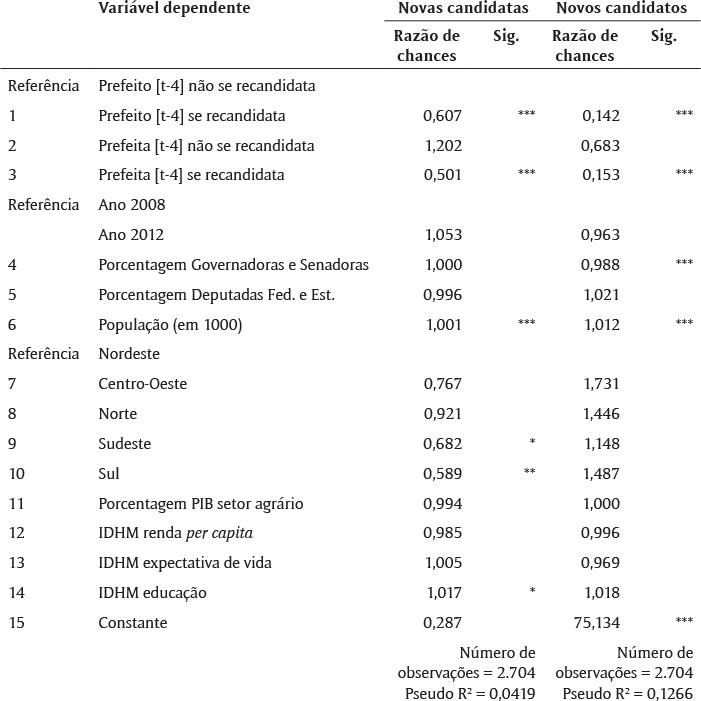
A Tabela 6 mostra que a probabilidade de ter uma nova candidata disputando a eleição [t] é 1,2 vezes superior nos municípios que elegeram uma prefeita na eleição [t-4] em comparação com um homem eleito para o mesmo cargo (ver Anexo 2 para a análise de colinearidade). Nesses dois cenários, os governantes não tentam a reeleição. Porém, apesar de apontar na direção esperada, essa correlação não é significativa. É possível que essa relação até mesmo não exista ou que o número reduzido de casos não permite identifica-la.
Regressão logística binária para prever a probabilidade de ter uma nova candidata ou um novo candidato na disputa pela prefeitura.
*p > 0,1. **p > 0,1. ***p > 0,01.
Uma constatação adicional da análise é que tanto as recandidaturas de homens quanto a de mulheres diminuem a probabilidade de candidaturas femininas. Quando um prefeito concorre à reeleição, a probabilidade de ter uma nova candidata é de 61%. No caso da recandidatura de prefeitas, a probabilidade cai para 50% em comparação com a situação de referência. Ambos os resultados são estatisticamente significativos.
Mesmo que as variáveis de controle não estejam no centro deste trabalho, elas merecem alguns comentários. As variáveis mais próximas da nossa investigação se referem à eleição de mulheres para cargos majoritários (governador, senador) e proporcionais (deputado estadual e federal) no estado. Contrariando a expectativa, não identificamos um impacto do número de deputadas, senadoras e governadoras eleitas sobre a probabilidade de ter candidaturas femininas nas eleições municipais. Uma das explicações possíveis é que somente municípios grandes se qualificam como um degrau na carreira de políticos que já entraram no âmbito da política estadual. No conjunto dos municípios analisados, estes representam uma fração pequena de casos.
Por outro lado, a tabela mostra que o tamanho do município influencia positivamente a probabilidade de ter novas candidatas na eleição. Essa influência era esperada em razão da maior competitividade das eleições em cidades grandes. Municípios maiores tendem a ter mais candidatos disputando a eleição para prefeito, o que aumenta a probabilidade de ter mulheres na disputa, como demonstrado no Tabela 5.
Também observamos diferenças significativas entre as regiões em relação à probabilidade de ter pelo menos uma mulher disputando a prefeitura. Quando comparadas com o Nordeste, região com a maior probabilidade de ter mulheres disputando as prefeituras, as regiões Sudeste e Sul têm, respectivamente, apenas 68% e 59% de probabilidade de contar com uma mulher entre as candidaturas novas em comparação com o Nordeste. Essas informações refletem as diferenças entre as regiões quanto à presença das mulheres na política, um dado esperado quando consideramos outras pesquisas sobre a mesma temática.
Outra variável que influencia positivamente a chance de ter novas candidatas concorrendo para a prefeitura é o grau de instrução. Novamente essa influência não surpreende. Esperamos que em municípios com maior grau de instrução haja menos preconceito contra o engajamento ativo das mulheres na política e, em razão disso, haja maior número de candidatas. No entanto, a significância estatística dessa conexão é fraca.
A participação do setor agrário na produção não influencia a probabilidade de termos mulheres disputando a prefeitura. A associação entre o setor agrário com ambientes sociais mais tradicionais, onde a visão do papel da mulher na família e no lar seria mais importante e uma rejeição de sua entrada na política maior, não se refletiu nos dados. Da mesma forma nem a renda per capita nos municípios nem a longevidade influenciam a probabilidade do lançamento de novas candidatas.
Entre as variáveis contextuais, a localização geográfica, o tamanho dos municípios e os indicadores de educação têm impacto significativo sobre a probabilidade de termos mulheres disputando a prefeitura.
Os resultados da análise a partir da primeira modalidade de medição da variável dependente apontaram na direção esperada, mas não revelaram relações estatisticamente significativas para as principais variáveis de interesse, o impacto de prefeitas eleitas na eleição passada. O impacto maior sobre a probabilidade de ter novas candidatas vem da entrada da atual prefeita ou prefeito na disputa eleitoral. Esse fato reduz pela metade a probabilidade de apresentação de novas candidatas.
Quando comparamos o comportamento das candidaturas novas de mulheres com as de homens na mesma situação, verificamos que os padrões de impacto são os mesmos, porém mais acentuados. Para os homens, a vitória de uma mulher para a prefeitura na última eleição não muda a apresentação de candidaturas de forma estatisticamente significativa. No entanto, se a atual prefeita ou prefeito se candidatarem à reeleição, a probabilidade de novos candidatos se apresentarem cai para uma probabilidade de 15% em relação à situação de referência.
Na segunda modalidade de operacionalizar a variável dependente, testamos a nossa hipótese do contágio, usando o número de novas candidatas disputando a eleição passada em comparação com o número na eleição atual. O resultado dessa comparação inclui três possibilidades em relação ao pleito anterior: na eleição atual há um número menor de novas candidatas, um número igual ou um número maior de candidatas.Footnote 11 A vantagem dessa modalidade de medição, que compara frequências de duas eleições, é que ela consegue captar mudanças para mais ou para menos que a análise binária referente a uma eleição não identifica.Footnote 12 Na segunda operacionalização, essas diferenças entre dois momentos são captadas.
Essa estrutura da variável dependente com três possíveis valores sugere uma análise logística multinominal. Tomamos o cenário de ter um número igual de candidatas nas duas eleições como categoria de referência e calculamos separadamente a probabilidade dos municípios terem menos ou mais candidatas estreantes, dependendo dos principais fatores de interesse: o sexo do prefeito eleito e a sua participação na disputa atual. Para fins de comparação também aplicamos a mesma análise aos novos candidatos masculinos. Os resultados dessa regressão estão reproduzidos na Tabela 7.
Regressão logística multinominal para prever a probabilidade de ter mais ou menos novas candidatas ou novos candidatos disputando a prefeitura.

*p > 0,1. **p > 0,1. ***p > 0,01.
A análise da Tabela 7 revela que em municípios nos quais os prefeitos (eleitos na eleição [t-4]) não disputam a reeleição (na eleição t), o fato de uma mulher ter sido eleita para o cargo aumenta a probabilidade de ter mais novas candidatas em 1,8 vezes em comparação com a situação de referência, ou seja, com um homem eleito para a prefeitura (novamente, ver anexo 2 para a questão a colinaridade). Nas outras situações, ambas envolvendo o prefeito ou a prefeita atual disputando a reeleição, o efeito é inverso. Nesses casos, a probabilidade de ter mais candidatos cai para a metade (para 52%, no caso de prefeitos disputando a reeleição, e para 56%, no caso de prefeitas na mesma situação).
No entanto, a probabilidade de ter menos novas candidatas na próxima eleição cai para 18% se a atual prefeita não disputar a reeleição. No caso das outras duas situações, com prefeitos e prefeitas tentando a reeleição, não há mudança significativa em relação ao cenário de referência, ou seja, com um prefeito eleito que não dispute a reeleição.
Olhando os mesmos cenários pela lente das candidaturas masculinas, a tentativa de reeleição por um prefeito mais que triplica (3,3 vezes) a probabilidade dos números de novos candidatos recuarem, lembrando que a categoria de referência continua sendo um cenário com um prefeito que não dispute a reeleição. A tentativa de reeleição por uma prefeita tem um efeito um pouco mais moderado (1,7 vezes) sobre a probabilidade de redução. A probabilidade de aumentar o número de candidaturas masculinas é reduzida para 23% se o prefeito se recandidatar. No caso de recandidaturas de prefeitas, a probabilidade vai para 29% e, se elas não se recandidatarem, há 63% de probabilidade de aumento de candidaturas, considerando sempre a situação na qual o prefeito atual não dispute a reeleição.
As variáveis de controle perderam significância nesse modelo. Este resultado era esperado, pois o modelo trabalha com as diferenças entre duas eleições. Nesse caso, as variáveis estruturais são menos importantes.Footnote 13
Os novos candidatos reagem de forma diferente às duas situações de candidaturas de mulheres e recandidaturas, em geral. A entrada do prefeito ou da prefeita atual na disputa aumenta a probabilidade de queda do número dos candidatos e candidatas em relação à situação de referência, ou seja, um prefeito que não dispute a reeleição. No caso das mulheres, a reação é diferente. Elas reagem fortemente a situações em que a prefeita atual não disputa a reeleição. Nesse contexto, a probabilidade de incremento do número de novas candidatas é de 1,8 vezes em comparação com prefeitos que não disputam a reeleição. Outros estudos mostraram que mulheres incumbentes que disputam um segundo mandato enfrentam mais adversários que seus concorrentes masculinos na mesma situação (Reference Palmer and SimonPalmer e Simon 2005). Os nossos dados não confirmam esses resultados, ou, para sermos mais precisos: se esta tendência existir, ela não tem origem nos candidatos e nas candidatas estreantes. Homens e mulheres interessados em concorrer pela primeira vez se afastam do pleito se o atual prefeito estiver na briga pelo voto também, seja ele homem ou mulher. As candidatas ao cargo se afastam um pouco menos; os homens, um pouco mais.
Há uma grande diferença entre essas disputas que envolvem o prefeito ou a prefeita atual e eleições “abertas,” sem o mandatário na briga. Em condições de disputa aberta, para as mulheres faz uma grande diferença se a última eleição foi vencida por uma mulher. Se uma prefeita deixa o cargo, a probabilidade de que novas candidatas entrarão na disputa aumenta (1,8 vezes) em comparação com um cenário em que um prefeito se retira do páreo. Os homens reagem de forma contrária. Para eles, a retirada de uma mulher diminui a probabilidade de aumento de novas candidaturas. As mulheres avançam fortemente quando uma prefeita em exercício não disputa a reeleição. Essa situação parece sinalizar que o contágio acontece quando outra mulher abriu o caminho na prefeitura, mas já não disputa o mesmo espaço político, proporcionando uma oportunidade para que outras mulheres tentem assumir o legado dela, candidatando-se a cargos eletivos.
Conclusão
As razões da baixa presença de mulheres na política no Brasil ainda são pouco conhecidas. Parte da discussão acadêmica recente tende a valorizar fatores institucionais, entre eles a questão de cotas para candidatas, modelos de financiamento das disputas eleitorais ou a distribuição de recursos pelos partidos, como o horário eleitoral. Para os ativistas, esses fatores gozam de grande atenção, parcialmente porque são passíveis de intervenções políticas. Outras abordagens apontam para fatores contextuais, como as condições socioeconômicas, a socialização ou a visão da sociedade sobre o papel da mulher na vida pública. A inserção da mulher na vida econômica e social da sociedade também cria condicionantes fortes para o seu ingresso na vida política.
Em contraste com essa linha de pesquisa que valoriza aspectos institucionais ou estruturais, a análise aqui aborda a influência de eventos singulares sobre a presença e o desempenho das mulheres nas eleições municipais brasileiras. Sem descartar a relevância das outras dimensões da baixa taxa de representação política das mulheres no Brasil, lançamos a hipótese de que a dinâmica de mudanças para a maior participação de mulheres na política local possa estar associada a mecanismos de retroalimentação positiva a partir das experiências locais com a eleição de mulheres no pleito anterior. Tanto as próprias mulheres quanto também os vários atores que promovem (ou inibem) a sua presença e o seu desempenho na disputa eleitoral reagem ao histórico das eleições locais.
Até o momento, vários autores apontaram para os mecanismos de retroalimentação negativa que desestimulam mulheres para uma carreira política e perpetuam os preconceitos dos partidos contra o recrutamento delas. Essa prática consolida a situação em que poucas mulheres têm capital político quando acumulam experiência em partidos políticos, disputas eleitorais ou cargos de gestão pública. Seguimos aqui uma linha incipiente de pesquisas que exploram o caminho inverso, questionando se conquistas simbólicas, como eleições majoritárias ganhas por mulheres, podem influenciar positivamente o ambiente das potenciais candidatas e dos partidos políticos para superar a estagnação e lançar mais mulheres na carreira política eleitoral.
O foco da análise está no momento inicial da carreira política de mulheres, nos mecanismos que viabilizam ou inibem suas candidaturas. Tanto a ambição de potenciais candidatos quanto os mecanismos de recrutamento e seleção pelos partidos políticos estão envolvidos nesse processo. A nossa análise se concentra na identificação de novas candidatas que entram na política eleitoral para disputar a prefeitura. Focamos em candidatas estreantes para isolar mais claramente a noção do contágio psicológico de outras dimensões de contágio. Mobilizamos diferentes modalidades para medir essa variável e testamos se elas são influenciadas pela eventual eleição de uma mulher para a prefeitura no pleito anterior. Essa análise confirmou a hipótese a respeito do efeito contágio a partir da eleição de prefeitas nos municípios brasileiros. O efeito contágio é mais forte onde a prefeita eleita no passado não disputa a sua reeleição. Onde mulheres foram eleitas para a prefeitura e elas não disputam um segundo mandato, a tendência é que a proporção de mulheres entre os candidatos estreantes cresça. Por outro lado, o efeito contágio é menos acentuado para as situações nas quais os prefeitos e as prefeitas eleitos se recandidatam para um segundo mandato. Para o caso da recandidatura de prefeitas, identificamos um forte efeito inibidor sobre o número de novas candidatas.
A partir desse achado é possível completar o debate estrutural e institucional por uma dimensão histórica e circunstancial. As duas barreiras que contribuem para a exclusão das mulheres de cargos políticos são o processo de recrutamento e seleção de candidatos, de um lado, e a disputa eleitoral e o voto popular, do outro lado. No primeiro caso, os atores chaves são os candidatos e os partidos políticos; no segundo, os eleitores têm um papel chave. A lenta erosão das duas barreiras passa pela normalização da experiência de ver e experimentar mulheres participando da vida política. A pergunta que colocamos no início do trabalho é se a ocupação por mulheres de cargos de maior visibilidade, como as prefeituras municipais, emite efeitos positivos, contagiando outras mulheres para cogitarem uma carreira política. A análise indica que esse é o caso. Outras questões para futuras pesquisas são se esse efeito também alcança o eleitorado, erodindo o preconceito contra o voto em mulheres. Somente superando esta segunda barreira as novas candidatas que decidem disputar eleições terão chance de competir em pé de igualdade com os seus concorrentes masculinos.
Também cabe analisar se há efeitos contagiantes laterais ou verticais. O primeiro compreende a influência mútua entre eleições para a câmara de vereadores e para a prefeitura no âmbito municipal; o segundo, a relação entre eleições municipais e eleições estaduais e nacionais. O trabalho aqui não detectou contágio de cima para baixo. Mas a eleição de prefeitas poderia levar mais mulheres a disputarem cargos estaduais ou nacionais, da mesma forma que o eleitorado que experimentou uma mulher na prefeitura poderia aumentar a disposição de votar em mulheres em outras eleições. Nesses termos, a análise do efeito contagiante, como parte de uma espécie mais ampla de pesquisas sobre efeitos de retroalimentação a partir de eventos históricos importantes, pode completar as análises estruturais e institucionais.
Anexo 1
Aqui desenvolvemos um cenário para mostrar como a inclusão dos municípios sem candidaturas femininas pode produzir um falso resultado positivo quando, na verdade (esse é o cenário hipotético), a causa do aumento de candidaturas é a apresentação de candidaturas (e não da vitória) de mulheres.
A Tabela A1 mostra as taxas de apresentação de novas candidatas na eleição [t] para tres configurações diferentes de apresentação e sucesso de candidatas na eleição [t-4]. No caso A com 5 mil municípios nenhuma mulher se candidatou em [t-4]. Em 10% destes municípios uma mulher disputou a próxima eleição [t] para prefeito. Este caso representa o crescimento vegetativo das candidaturas de mulheres, devido a diferentes fatores externos. O caso B com 400 municipios representa a situação na qual a candidatura de uma mulher na primeira eleição aumenta para 20% a taxa de crescimento do número de candidatas estreantes na próxima eleição. A candidatura de mulheres em [t-4] tem efeito marginal positivo sobre as candidaturas de mulheres em [t]. A constelação C com 100 municipios representa os casos nos quais as candidatas que disputaram a eleição e ganharam no pleito em [t-4]. Construimos este terceiro caso propositalmente de forma que a vitória eleitoral não influenciasse a taxa de crescimento de candidatas na eleição [t]. Ela continua em 20%. Resumindo: no nosso cenário hipotético a candidatura de mulheres na eleição [t-4] aumenta as taxas de novas candidaturas de mulheres na eleição [t], mas a vitória delas na eleição [t-4] não tem efeito marginal adicional sobre esta mesma taxa. Nas tabelas seguintes mostramos que o agrupamento dos casos pode levar a inferências incorretas.
Cenário em que candidaturas de mulheres na primeira eleição dobram número de novas candidatas na próxima eleição.

A Tabela A2 indica a comparação correta entre municípios com candidatas (B) e com candidatas eleitas (C). Por meio da análise dos dados, nota-se que a eleição de uma mulher não tem impacto sobre a taxa de novas candidatas na eleição seguinte. A Tabela A3 trata do efeito de inclusão dos municípios sem candidatas na avaliação (caso A). Uma vez que municípios sem candidatas não podem ter candidatas eleitas, esses casos A serão somados ao caso B. Por meio da comparação do grupo ampliado de municípios sem candidatas eleitas com o grupo com candidatas eleitas, chegaremos à conclusão (errônea) de que a vitória eleitoral tem um impacto positivo sobre a taxa de apresentação de novas candidaturas. Um dos caminhos mais fáceis para evitar esse equívoco (de omissão de uma variável relevante) é limitar a análise à comparação dos casos B e C. Foi este o caminho escolhido nas Tablelas 3 a 7 e A4.
Avaliação que exclui municípios sem candidaturas.

Avaliação que inclui municípios sem candidaturas.

Anexo 2: Tabelas de colinearidade
A Tabela A4 a seguir indica alta colinearidade (medida aqui por meio do variance inflation factor, ou VIF) entre as variáveis relacionadas ao Índice de Desenvolvimento Humano Municipal (IDHM). Esse resultado não surpreende, pois sabemos que as três variáveis são conectadas na realidade. Como nenhuma das três variáveis tem significância alta no modelo, a sua exclusão não muda os coeficientes de correlação das outras variáveis, uma das principais preocupações em relação à colinearidade. Por esse motivo deixamos essas variáveis nos modelos das Tabelas 6 e 7.
Análise de colinearidade entre variáveis.


 Open access

