

6.1 Introduction
Becoming a fossil-free welfare state requires broad societal participation and collaborative governance bears the promise that all of society can and will engage in reducing their greenhouse gas (GHG) emissions to zero. Fossil Free Sweden (FFS), for instance, the national initiative that epitomizes the Swedish government’s collaborative governance approach (see Chapters 1 and 4), speaks of a “journey” where “it is important that all of society participates” (FFS, 2022). The initiative echoes the global narrative promoted by the Paris Agreement where “all hands on deck” are necessary to implement global ambitions to halt climate change at 1.5°C (Reference HaleHale, 2016). Yet research into who and where actors take climate action suggests there are biases regarding whose hands are actually on deck. For example, climate actions recorded in the United Nations Framework Convention on Climate Change’s (UNFCCC) Global Climate Action Portal (GCAP) are primarily submitted by companies and countries in the Global North (Reference Chan, Falkner, Goldberg and van AsseltChan et al., 2018). Similar patterns are visible among transnational municipal networks working on climate change, in which cities in Europe and North America make up the lion’s share of participants (Reference Bansard, Pattberg and WiderbergBansard et al., 2017). Unequal representation in climate action is perhaps a timing issue – it takes time to engage all of society – but it also leads to questions about effectiveness, legitimacy, and justice (Reference Chan, Boran and van AsseltChan et al., 2019). For example, if primarily rich and densely populated urban areas engage in collaborative climate governance, which, in turn, attracts subsidies for decarbonizing their economies, it may disenfranchise rural communities, which then choose to resist the transformation (cf. Reference Bouzarovski and SimcockBouzarovski and Simcock, 2017). In this context, inclusiveness in collaborative governance becomes important. This chapter takes a macro-level perspective on Sweden and explores the cities that engage in various networks as part of collaborative governance depicted in Figure 2.1 in Chapter 2. The chapter demonstrates that city networks only involve a slight majority of municipalities and are lacking several key players, suggesting that the transformative capacity of such initiatives is limited. It also provides an important bridge for the subsequent Chapter 7 on net-zero emission targets in Swedish municipalities.
Cities are important as implementers of the transformation toward a fossil-free welfare state but also as governors in their own right (see Chapter 2; Government Bill 2019/20: 65, p. 69). The Swedish government acknowledges the role of local decision-makers, for instance in its first Climate Policy Action Plan from 2019, which contains several references to the work of municipalities and their role in mitigating GHG emissions using tools such as green public procurement, spatial planning, and public transport (Government Bill 2019/20: 65). We study inclusiveness in collaborative governance by assessing whether cities participate in city networks for climate change and multi-stakeholder partnerships. While our approach arguably provides an incomplete picture of every kind of climate action by municipalities, it is congruent with existing research for understanding the role of non-state and sub-national actors in climate governance (cf., Reference Chan, Falkner, Goldberg and van AsseltChan et al, 2018). Furthermore, we explore the connection between participation in climate networks to reduce GHG emissions, aiming to discover the type of municipalities that engage in collaborative governance. The chapter assesses the participation of municipalities in seven international and national city networks and one multi-stakeholder initiative and overlays the participation data with macro-economic data such as population and GHG emissions. The mapping in this chapter has three objectives: first, it presents the Swedish landscape of GHG emissions and the participation of Swedish municipalities in collaborative climate governance; second, it identifies and demonstrates the potential geographical differences in collaborative governance; and third, it illustrates the potential governance gaps among Swedish municipalities by asking: is everyone on board? The chapter is structured as follows. First, we introduce how municipalities play an important role in the transformation toward a fossil-free welfare state. Second, we describe the methodology. Third, we present the key result of our mapping exercise. Finally, we reflect on the implications of the results in the context of Sweden’s road to decarbonization.
6.2 How Municipalities Play a Role in Sweden’s Transformation toward a Fossil-Free Welfare State
Local authorities are key to implementing climate change goals taken at the national and international levels. In many countries, cities exercise control of some sectors that generate GHG emissions, for example local transport, housing, and spatial planning, but they also exercise political influence from the bottom up by advocacy, steering agendas, facilitating policymaking, providing expertise, raising awareness, and representing public opinion and marginalized voices (Reference Kousky and SchneiderKousky and Schneider, 2003; Reference Nasiritousi, Hjerpe and LinnérNasiritousi et al., 2016). Increasingly, municipalities are also becoming governors in their own right, engaging in transnational policymaking and even complementing the national reporting of commitments and progress (GCAP, 2022). Swedish municipalities enjoy a relatively high level of autonomy compared to their peers in other countries. The self-rule is stipulated by law and is motivated by local democratization of citizens, the benefits of contextualized decision-making based on local conditions, and the perceived ability to perform improvements (Swedish Association of Local and Regional Authorities, 2022). Consequently, the municipalities perform several key functions tied to a welfare system such as child and elderly care, primary and secondary education, and social services, while also assuming responsibility for housing and spatial planning within their borders (Reference LarssonLarsson, 2018). The latter, spatial planning, is a key element for implementing the climate change goals since it allows municipalities to steer parts of their energy use and energy efficiency. Since the aftermath of the first oil crisis in the 1970s, the national government has required municipalities to have a strategy for the supply, distribution, and use of energy within their borders. Because of these functions it is common for Swedish municipalities to own real estate companies that operate within the municipal borders. Almost half of all rented housing in Sweden is owned by such companies. They also operate, own, or co-own district heating and cooling plants (SOU, 2011). While municipalities lack the mandate to directly limit or control the GHG emissions of stakeholders such as industries or other private entities that operate in their jurisdiction, they can coordinate, inform, and incentivize citizens and companies to engage in climate change at the municipal level (see also Reference Vanhuyse, Piseddu and JokiahoVanhuyse et al., 2023, for an overview of city functions in the context of climate change).
While Swedish municipalities enjoy high de jure responsibility and autonomy, their capacity to mitigate climate change effectively de facto can vary substantially. Financial resources, geographic dependencies, public support, and sources of GHG emissions affect a city’s ability to develop, plan, implement, and/or evaluate measures. For instance, the transport sector, which generated approximately one-third of total national emissions in 2020 (SCPC, 2022), is a source of GHG emissions that requires large-scale transformations and a shift from fossil-fuel dependency to renewable energy sources, which can be challenging for municipalities to implement individually (Reference LarssonLarsson, 2018). Measures to govern such sectors may therefore rely on cross-municipal cooperation, regional authorities, or national schemes. In addition, in-house knowledge and ambition among municipal officials that inspire and drive action have been shown to be key factors in initiating climate actions and nudging decision-makers, for example local champions (Reference Kousky and SchneiderKousky and Schneider, 2003; Reference LarssonLarsson, 2018). For example, some municipalities use green agendas to create a comparative edge in attracting inhabitants, investments and companies, and some municipalities go as far as branding themselves “the Greenest city in Europe” (Reference Gustavsson and ElanderGustavsson and Elander, 2012, p. 771). The uneven capacities and opportunities have consequences for how and whether cities engage in climate change. Studies on the European level have found that large cities (more than 100,000 inhabitants) in several countries have initiated commitments and measures to reduce GHG emissions, while smaller cities (towns) are much less active (Reference KernKern, 2019). Similarly, Reference Reckien, Salvia and HeidrichReckien et al. (2018) explain that cities that join collaborative governance initiatives are often large, relatively rich, and possess a high capacity to adapt to the requirements associated with taking action. Also, green cities may be more successful in attracting additional funding for further actions such as the Swedish government’s programs for supporting the local implementation of the national climate goals, including the Climate Leap, which enables sub-state and non-state actors such as municipalities, companies, tenant organizations, and others to receive up to 70 percent of an investment deemed to have a substantial and long-lasting climate mitigating effect, which is paid for by the state (Reference Sandin, Donadi and HolmgrenSandin et al., 2020). The available resources are substantial as, in 2018, the policy constituted almost 14 percent of the government’s environmental budget, which is considered large compared to previous policies (Swedish National Audit Office, 2019), and the 2022 budget proposal suggested a further increase in state funding for the Climate Leap by SEK 800 million (Government Bill 2021/22, 2022). Another support mechanism is the FFS (see Chapters 1 and 2), in which municipalities are invited to help development of sectoral roadmaps for reducing GHG emissions. Both the Climate Leap and FFS demonstrate the national government’s approach to collaborative governance in nudging municipalities to support the implementation of the national climate targets.
6.2.1 Climate Networks as Collaborative Governance
This chapter studies the participation of municipalities in networks that are a kind of collaborative arrangement in which municipalities, cities, and sub-state regions join forces to address climate mitigation and, to a lesser but increasing extent, adaptation. Reference Kern and BulkeleyKern and Bulkeley (2009, p. 309) suggest that these networks have three defining characteristics: “First, member cities are autonomous and free to join or leave. Second, because they appear to be non‐hierarchical, horizontal and polycentric, such networks are often characterized as a form of self‐governance. Third, decisions taken within the network are directly implemented by its members.” Their definition concerned transnational municipal networks in particular but could also be extended to international (e.g., ICLEI) and national (e.g., Klimatkommunerna) networks. Being part of a city network is expected to yield a number of benefits for participating cities. Reference Mejía-Dugand, Kanda and HjelmMejía-Dugand and colleagues (2016) argue that “by becoming part of international city networks, cities can have access to knowledge that is collectively supported, maintained, nurtured, and shared” (Reference Mejía-Dugand, Kanda and HjelmMejía-Dugand et al., 2016, p. 62). Networks are thus places for sharing information, practical solutions, and good practices for addressing climate change, as well as other issues. Cities can also accrue other benefits such as capacity building, reputation building from initiatives (Reference HaleHale, 2018), and access to national and international policy venues (Reference Bulkeley, Andonova and BäckstrandBulkeley et al., 2012). Most often, cities could enjoy multiple benefits immediately as a single network tends to provide more than one function simultaneously (Reference Bulkeley, Andonova and BäckstrandBulkeley et al., 2012). Due to their varying functions, city networks can help fill existing governance gaps. For instance, FFS with its strong narrative and heavily engaged national coordinator Svante Axelsson could be considered to have played the role of a so-called climate leader or climate champion at a national level by creating positive mood music ahead of Conference of Parties (COP) 21 – and beyond. Similarly, the city network Klimatkommunerna has a specific and strong narrative around the local ability to realize the national transformation, providing the inspiration, capacity building, and information sharing to municipalities that lack such elements (Klimatkommunerna, 2022).
City networks that focus on reducing urban GHG emissions require their members to take actions that align with their functions and aims (Reference Bulkeley, Andonova and BäckstrandBulkeley et al., 2012; Reference Castán Broto and BulkeleyCastán Broto and Bulkeley, 2013). As indicated in Table 6.1, the city networks adopt different participation criteria and types of reduction targets (quantitative versus qualitative) that influence the commitments that sub-state actors are required to make. Some of the networks pose direct demands on their members to set quantified and time-bound emission reduction targets, deliver action plans to reach their targets, and report regularly (Reference Castán Broto and BulkeleyCastán Broto and Bulkeley, 2013). Other networks focus on advocacy and lobbying for cities at the international policy level (e.g., EU or UNFCCC) or simply function as knowledge-exchange platforms and can therefore be joined on a voluntary basis (e.g., FFS). In theory, cities that join networks could have an advantage in reducing their GHG emissions compared to cities that don’t. However, the scope of the final impact of their participation does also depend on the strength of the commitment made by the network. At the same time, the networks’ participation criteria could risk creating unequal opportunities that exclude certain sub-state actors. For instance, part of Klimatkommunerna’s entry requirements is to ask its members to set out their goals and strategies, regularly report on their work, and pay a member fee, which can be a direct obstacle or de-incentivize municipalities that do not have the resources or a suitable governance structure to achieve a specific goal. As a consequence, some municipalities and other types of sub-state actors may have difficulties accessing forums in which ideas, lessons, and solutions are being shared. In contrast, membership criteria could also be recognized as a quality standard that safeguards a certain level of engagement and commitment from members. This reduces the risk of attempts at greenwashing and so-called zombie initiatives that stagnate as members become inactive.
6.2.2 Research Approach
The methodological approach of this chapter centers around the mapping of participation by municipalities in seven city networks and one multi-stakeholder partnership. We also collect descriptive data, including population figures, GHG emission profiles, and municipality type (e.g., rural or urban) that capture the characteristics of all 290 Swedish municipalities. Data on the municipalities’ participation has been collected from the websites of the city networks and FFS, respectively (data collected in 2019). Since the networks and partnerships are about identifying actors and acting collectively, the websites in question usually include the most updated accounts of their members, and the membership lists have been scanned for Swedish municipalities. The initiatives listed in Table 6.1 include two networks that are global in nature (Global Covenant of Mayors for Climate and Energy (GCoM) and Local Governments for Sustainability (ICLEI)), three that are regional to the EU or the Baltic (Union of the Baltic Cities (UBC), Eurocities, and Energy Cities), and three that are national (Klimatkommunerna, the National Association of Swedish Eco-municipalities (SEKOM)), of which one (FFS) is a multi-stakeholder partnership that is included in our study due to the key role it plays in Swedish climate governance. The networks vary widely in size and nature with regard to aims, participation criteria, and functions. All of the city networks started over 10 years ago, while FFS was launched in 2015. The descriptive data reflects information about the geography, demographics, resources, and GHG emissions of these jurisdictions. Population and GHG emission data ranging from 2005 to 2020 have been collected from Kolada, an open database for data on regions and municipalities in Sweden.Footnote 1
6.3 The Landscape of Municipal Emissions and Voluntary Commitments in City Networks
This section presents the results of mapping the municipalities’ characteristics, GHG emission profiles, and participation in the selected city networks and the multi-stakeholder partnership FFS.
6.3.1 Participation by Municipalities in City Networks
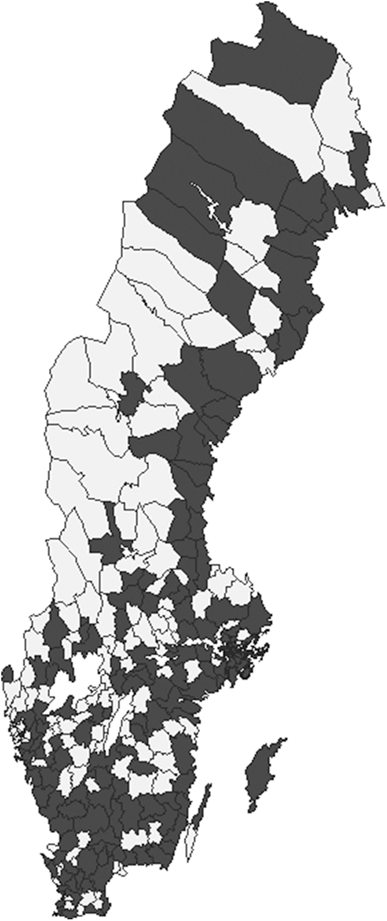
Out of Sweden’s 290 municipalities, around half (161 municipalities, 55 percent) participate in a city network or FFS. Figure 6.1 provides an overview of the municipalities that have registered their commitment to at least one network. Overall, the municipalities’ voluntary commitments to participate in networks differ due to various, perhaps interlinked, factors. The first factor is the geographical distribution of commitments, which is skewed toward Southern Sweden and the Baltic sea coast. Municipalities located along the Norwegian border in the east of the country, as well as in the border regions of Svealand and Götaland, are underrepresented. Moreover, municipalities that participate in networks tend to be geographically clustered together, suggesting that there might be spillover effects in terms of membership. Eighty-six municipalities belong to more than one network. Second, most participation is from municipalities with middle to high average incomes. The third factor is population size: larger cities in terms of number of inhabitants tend to join more initiatives. The data clearly indicates a correlation between municipality size in terms of population and how many initiatives a city joins. In the most extreme cases – Malmö, Växjö, and Stockholm – the municipalities participate in seven different initiatives. This trend is also supported when comparing network participation against the official categorization of municipalities based on population and proximity to urban areas: 77 percent (20 out of 26) of all urban municipalities and 67 percent (76 out of 114) in the densely populated areas participate in initiatives, compared to only 43 percent (64 out of 148) of rural municipalities.
Municipalities that participate in networks (in black)
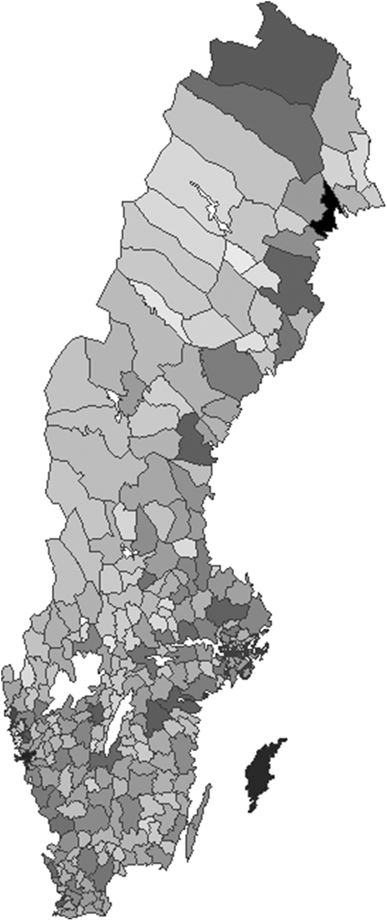
The two maps in Figures 6.1 and 6.2 present an overview of municipalities with registered commitments to networks and the GHG emissions (2020 data) per municipality. The municipalities with the highest GHG emissions are geographically dispersed. However, they are all home to large industries. Three of the highest emitters are Luleå (steel industry), Gotland (cement industry), and Lysekil (oil industry). While the first two municipalities participate in at least one network, Lysekil was not a member of any network at the time of our study. Since this time, it has joined FFS but is not part of the city networks. Similarly, the two most northern municipalities, Gällivare and Kiruna, are in the second and third highest category of GHG emissions due to the transport sector and their major mining industry (Energikontor Norr, 2019a, 2019b). Despite many similarities, Kiruna participates in climate networks while Gällivare does not. These examples illustrate how some of the largest emitters participate in networks, while some municipalities with significant industries that are dependent on industrial activity could still engage more.
Municipal GHG emissions in 2020. Dark equals high level of GHG emissions
In total, the municipalities that participate in networks were responsible for some 70 percent of all GHG emissions in 2020 and represent around 80 percent of the Swedish population. Of the individual networks, GCoM is the largest, representing 25 percent of all Swedish municipalities and responsible for 50 percent of Sweden’s GHG emissions and around 50 percent of the Swedish population. Ten percent of all Swedish municipalities have a commitment registered on the GCAP and are part of GCoM. The smallest network, Energy Cities, only has two participants from Sweden and represents around 1 percent of national GHG emissions.
6.3.2 Greenhouse Gas Emissions by Swedish Municipalities
The skewed distribution of municipalities that participate in city networks and FFS raises the following question: Why is there low participation? The extent of the participation resonates with the overall picture of how municipal GHG emissions have changed over time, as well as the challenges that remain. Municipalities have been relatively successful in lowering their total GHG emissions. As shown in Figure 6.3, total municipal GHG emissions per capita decreased from 2005 to 2020. This could be ascribed to their influence on governing energy use and efficiency, heating, transportation, and other areas. While outliers with high emissions still exist, the municipalities with the historically lowest emissions have further reduced their emissions over time. In general, however, a few high emitters appear to face challenges in lowering their emissions per capita. The GHG emissions per capita from the industry and transport sector, which constitute a significant proportion of total municipal GHG emissions, point to three key trends. First, industrial emissions have decreased more over time than transport emissions. Second, the reduction in industrial emissions by a proportion of the municipalities covers a wider distribution than in the transport sector. Third, outlier municipalities with high emissions in both sectors still exist, illustrating how key emitters with a disproportionally high level of GHG emissions per capita are lagging behind in terms of lowering their emissions.
Municipal GHG emissions per capita from 2005 to 2020
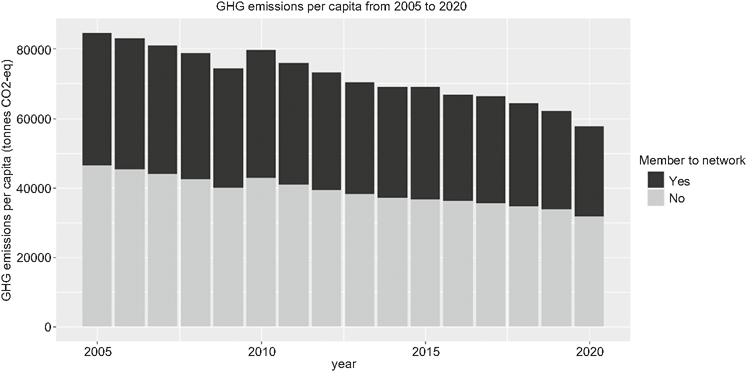
The trends in Figure 6.3 tie into how our mapping suggests that the industrial sector can be a key determinant for a municipality’s total performance in terms of lowering emissions. While a municipality’s operations or the average citizen’s emissions can be relatively low, industries may take longer to reduce or compensate for their emissions. In addition, municipal authorities do not have the same mechanisms to directly control private entities, such as private companies. Thus, whether an industry joins or leaves a municipality’s jurisdiction has a direct impact on its overall progress in mitigating climate change while also creating dependencies associated with its economic and social impacts on industries. The transport sector, however, poses a different type of challenge as both citizens and commercial stakeholders depend on transport on a daily basis. Challenges in mitigating the emissions from this sector particularly apply to rural areas, in which cars are common and the implementation of infrastructure for accessible biofuels is costly and sometimes inefficient due to the large distances, requiring cross-municipal cooperation. To understand whether municipalities that make voluntary commitments in networks are more likely to have reduced their GHG emissions compared to those municipalities that have not, we analyzed the emissions for members and non-members of networks. The data suggests that the municipalities that participate in networks have not significantly reduced their emissions compared to municipalities that do not participate in networks.
6.4 Swedish Municipalities’ Climate Action and Its Implication for Decarbonization
The mapping exercise carried out in this chapter shows that a slight majority of Swedish municipalities are members of city networks and/or FFS. This section reflects on the results of our mapping in the context of Sweden transitioning into a fossil-free welfare state through collaborative governance.
6.4.1 The Patchy Landscape of Municipal Climate Action
Both scholars and practitioners continuously emphasize that a system-wide transformation that includes reaching the Paris Agreement can only be accomplished if voluntary climate action is extended to all stakeholders in society, including those medium-and small-sized cities and towns that are lagging behind (Reference KernKern, 2019). Under the assumption adopted in this chapter, namely, that a fossil-free welfare society would need all municipalities to make commitments and take action, the current mobilization of municipal climate action in Sweden is insufficient. The results of our mapping suggest that a large part of emissions and the population are covered by the municipalities that participate in the surveyed city networks and FFS. Yet the participation is unevenly distributed across the country. First, we observe that the more densely populated areas in Southern Sweden or along the Baltic coast are more likely to join a network, revealing a geographical gap in the collective efforts toward decarbonization. Second, the emission trends suggest that although municipalities have been largely successful in lowering their emissions, a small number of municipalities would appear to have found it notoriously difficult to lower their GHG emissions per capita, particularly from industry actors that operate in the jurisdiction. This section therefore argues that there has been a bifurcation of climate action in Swedish municipalities over the past 30 years between those municipalities that are successfully lowering their emissions significantly and those municipalities that have a long way to go.
Having all stakeholders on board and aiming to more effectively achieve the national goal of net-zero emissions by 2045 would require greater engagement from municipalities – through participation in city networks and other means. Based on our mapping, greater engagement would mean an increase in voluntary commitments in northern municipalities, as well as small rural municipalities. In reality, however, the initial profiles and individual characteristics of these municipalities are different from their more ambitious counterparts. Human, monetary, and knowledge resources are not always readily available, making it more difficult to efficiently develop and adopt commitments and, more importantly, implement processes and measures that facilitate reaching those aims. It has been shown, however, that there is no correlation between a certain political composition and the mitigation of GHG emissions in Swedish municipalities in previous years (Reference LarssonLarsson, 2018). In terms of GHG emissions, the mapping shows that municipalities that make voluntary climate commitments are responsible for a high percentage of total GHG emissions. Ultimately, however, the sectoral emissions that are more difficult to mitigate require further action. For instance, the industrial and transport sectors are responsible for a high proportion of total GHG emissions nationwide, as well as in several individual municipalities. While the industrial sector has made advancements in terms of exploring innovative processes (e.g., the HYBRIT initiative exploring ways to create fossil-free steel production) and the transport sector gradually making a transition to increase the share of renewable energy and biofuels, some municipalities still need to get on board. The initiation of engagement could also ultimately inspire or pressure stakeholders that operate in the municipality to take action. It is important to recognize that municipalities that are dependent on one or more fossil-fuel-dependent or emission-heavy industry may perceive voluntary commitments as challenging in terms of both resources and responsibility. Not only does this depend on practical resources, but it derives from the level of support and acceptance received from municipal inhabitants that may be affected by large-scale changes and their socio-economic aftereffects.
While challenges remain, the 290 municipalities have the potential to advance their overall level of commitment to reducing emissions. For example, there is significant knowledge about how to mitigate GHG emissions on the local level that could be shared with those municipalities that are lagging behind. Thus, existing and new forms of collective or cooperative efforts, including and beyond networks, may be an important complement to individual municipal climate action (cf. Reference Shabb and McCormickShabb and McCormick, 2023). Local city-to-city cooperation, for example between small municipalities who share similar qualities, functions, and needs, is beneficial to tackling climate change as they can share the burden associated with planning, implementing, or maintaining measures. As Reference KernKern (2019) puts it, networks of networks may enable more actors to take action, similar to how Reference Jänicke and QuitzowJänicke and Quitzow (2017) illustrate that local-level cooperation can generate more action in small cities. These types of coordinated inter-municipal approaches are not new, for example in the context of infrastructure and transportation (Reference Lundqvist and von BorgstedeLundqvist and von Borgstede, 2008), but could be further extended to local climate action. A current example of this includes the co-created climate and energy strategy shared between the municipalities of Habo and Mullsjö (Habo Municipality and Mullsjö Municipality, 2018). These two municipalities are geographically close to each other as they share a border and consequently have similar geographical conditions for implementing measures. Beyond making use of similarities, recognizing and harnessing the dynamics between the municipal leaders and other municipalities through the use of horizontal and vertical scaling creates opportunities to effectively mitigate climate change (Reference KernKern, 2019). The concept of “embedded upscaling” (Reference KernKern, 2019) in which task-specific strategies are applied in a multi-functional governance setting has been acknowledged as something that provides opportunities to different stakeholders, similar to the benefits of polycentric governance arrangements identified on a global scale (Reference OstromOstrom, 2010). While this provides a positive outlook for Sweden’s decarbonization, a complete review of how such an approach can be implemented in Sweden must take place. In such a context, regional authorities could use their coordinating role to further connect local governments in order to facilitate co-benefits (Reference KernKern, 2019). Reference Castán Broto and BulkeleyCastán Broto and Bulkeley (2013) give a positive perspective to our mapping by stating that “whether a city is richer, or more populated or denser does not predict accurately whether we are more likely to find more experiments in such a city” (p.97). In theory, small cities have the potential to take action suited to their capacity and context. Effectively governing the national climate agenda in Sweden may therefore require us to recognize the different capacities of municipalities to tackle climate change and adjust our expectations, encouraging the larger southern resourceful municipalities with available resources to participate in national and international city networks, or other forms of networks with more demanding entry requirements, while small municipalities that would just be starting their climate strategy could organize themselves locally until they have the sufficient capacity to increase their engagement. From an economic perspective, however, experts have suggested that a full transition to green energy beyond the major catalytic shifts that have already been implemented would bring a very small marginal gain (Reference Gustavsson and ElanderGustavsson and Elander, 2012).
6.4.2 The Political Consequences of Unequal Contributions
The inconsistency of municipal emissions and whether municipalities participate in city networks also points to questions about what a just transformation to a decarbonized society entails (see Chapters 2 and 8). Given that the characteristics and GHG emissions profiles of municipalities differ, can small rural municipalities, as well as northern municipalities, be expected to make voluntary commitments for the climate? The question echoes the global debate about how the burden of governing climate change should be divided among industrialized and industrializing countries, which connects to the discourse on central justice such as distributive justice (the allocation of costs and benefits) and procedural justice (the recognition of power in decision-making) (Reference Bulkeley, Carmin, Castán Broto, Edwards and FullerBulkeley et al., 2013). Such questions are not new in the literature on non-state and sub-state climate governance in which the demand for non-state engagement has been based on the responsibility of state actors to deliver on their Nationally Determined Contributions (NDC) (Reference HaleHale, 2016). Similarly, this chapter raises the question of whether the notion of everyone contributing equally to the national fossil-free goal can be considered an equitable demand. On the one hand, the self-rule dimension of the governance of Swedish municipalities and the formal expectations on their performance relieve some of the expectations for the state to be directly responsible for mitigating the country’s GHG emissions. On the other hand, state-level institutions have the potential to orchestrate further top-down initiatives, networks, or measures, such as climate finance solutions (Reference Colenbrander, Dodman and MitlinColenbrander et al., 2018), that catalyze or support action in small municipalities regardless of whether or not capacities are insufficient. This would be especially interesting for rural communities that depend on base industries and elements such as transportation.
“Bringing the global to the local” paves the way for a more inclusive and just transition since different sub-state actors, including Swedish municipalities, have more direct ways of interacting with their citizens than state-level institutions. In practice, Swedish sub-state actors implement this opportunity by creating citizen dialogues and incentivizing their inhabitants to live a low-carbon life by means of campaigns and financial support packages (e.g., solar cell housing schemes). However, the elected municipal governments have to carefully consider the readiness of their citizens to change behavior and invest significant resources if they elect to impose demanding climate-related fiscal measures such as taxes (Reference Lundqvist and von BorgstedeLundqvist and von Borgstede, 2008). Thus, a political effect of the bifurcation could be that the readiness of citizens to agree with intrusive policies could be problematic, making climate change an increasingly polarizing societal issue. The relatively homogenous profile of Swedish municipalities that participate in climate networks corresponds to the type of sub-state actors characterized as leaders in the global climate governance literature according to their ability to reduce GHG emissions and make visible commitments – similar to how some Swedish municipalities have sought to brand themselves as green municipalities (Reference Gustavsson and ElanderGustavsson and Elander, 2012). However, in the context of legitimacy and a just transition, a reasonable application of this concept may need to take into account citizen representation and realistic expectations about an individual municipality’s capacity and speed of transition. The question of how a just transition is perceived and may be implemented will be further explored in Chapter 8.
6.5 Conclusion: Advancing Action and Capturing Momentum
This chapter has presented the commitments of Swedish municipalities to reducing GHG emissions by using participation in city networks and FFS as a means of understanding engagement in collaborative governance. The mapping of all 290 Swedish municipalities and their characteristics (including population size, GHG emissions, etc.) has sought to understand whether and to what extent municipalities are contributing to the country’s decarbonization. The results of our mapping suggest that there has been a bifurcation in Swedish climate action in municipalities: urban, southern, as well as municipalities with a relatively large population size make more voluntary commitments to networks than rural, northern, and less populated areas. In addition, several municipalities that are home to heavy-emitting industries are not part of any national or international climate networks. The bifurcation could impact on the country’s ability to reach its goal of becoming fossil-free by 2045, for instance by lowering the willingness of rural communities to accept climate policies and widening the rural – urban divide in climate change policy.
Our mapping results offer reflections that we argue warrant further attention. First, to what extent can and should the commitments of municipalities be expanded? To what extent should rural municipalities be expected to develop full-scale transformative climate governance strategies going forward? These questions address whether the national ambition sets reasonable demands on sub-state actors or whether a distinction should be made between responsibilities and expectations based on resources, knowledge, or other factors. Second, how would it be possible to effectively increase sub-state engagement in order to get everyone on board? How can the capacity of municipalities be strengthened to increase their commitment to reducing GHG emissions? What is the transformative potential of networks, seeing that the participants do not seem to lower their emissions more than non-participants? These questions require a multifaceted approach and a more evaluative lens that considers the socio-economic and geopolitical conditions of individual municipalities. Scholars could also examine the current efforts that aim to coordinate sub-state climate action effectively and legitimately. For instance, Reference KernKern’s (2019) interaction typology investigates the exchanges that take place among municipalities and regions. Thus, although an aggregate perspective gives relevant indications about the role of municipalities in Sweden’s decarbonization, and while continued tracking and reporting play a key role in assessing whether sub-state climate actions are increasing over time (Reference Hsu, Cheng and WeinfurterHsu et al., 2016), questions about effectiveness and legitimacy require more extensive evaluation of specific cases. Chapter 8 complements our mapping in this way by studying the city of Lysekil.
Observing the changes in the voluntary commitments of municipalities in the coming years will be particularly interesting following the implications of the COVID-19 pandemic, which required municipalities to pay significant attention and allocate resources to areas other than the environment. Furthermore, researching the climate governance of municipalities in the post-pandemic period could be interesting as GHG emission reductions have been identified in the past two years (for example, in the transport sector). At the same time, COP26 in Glasgow in November 2021 saw evidence of the capacity of sub-state actors and networks to reduce GHG emissions through voluntary commitments and actions. It included examples of practical schemes and measures to reduce GHG emissions that had been successfully implemented, as well as cities signing up to increased commitments in the realm of both mitigation and adaptation. Together, the municipalities’ potential, national efforts to coordinate non-state and sub-state climate action, and the international push for increased ambition provide an incentive for increased participation. While some municipalities can use this momentum to initiate commitments or participation in networks, other municipalities could use it to increase their ambitions. Ultimately, however, some Swedish municipalities still need to get on board if deep decarbonization is to be achieved.


 Open access