


Introduction
Despite efforts to combat discrimination against ethnic minorities, it remains widespread across societal domains and countries as documented in a large scientific literature (Dinesen et al., Reference Dinesen, Dahl and Schiøler2021; Hemker and Rink Reference Hemker and Rink2017; Lancee Reference Lancee2021; Olsen et al., Reference Olsen, Kyhse-Andersen and Moynihan2022; Zschirnt and Ruedin Reference Zschirnt and Ruedin2016). A potential first step in reducing discrimination against ethnic minorities is for majorities to acknowledge its existence, which might then, in turn, change behaviour and increase support for anti-discrimination policies. However, evidence indicates that ethnic majorities are significantly less likely to perceive discrimination against ethnic minorities than the group actually experiencing it. For example, work from the United States demonstrates large gaps between Black and White Americans’ perceptions of discrimination against Blacks (DeBell Reference DeBell2017; Mutz Reference Mutz2022; Pew Research Center 2016; see Haaland and Roth Reference Haaland and Roth2023 for a partial exception) as well as perceptions of racial inequality in health, income, and government treatment more generally (DeBell Reference DeBell2017). Studies also show that most White Americans now see reverse racism as a bigger problem than anti-Black racism (Norton and Sommers Reference Norton and Sommers2011; Peacock and Biernat Reference Peacock and Biernat2023). Such beliefs may, at least under certain circumstances, influence majorities’ support for anti-discrimination policies and candidates (DeBell Reference DeBell2017; Newkirk Reference Newkirk2017). Illustrating this, and the potential importance of perceptions of discrimination against ethnic minorities for political outcomes, Mutz (Reference Mutz2022) demonstrates that increased perceptions of discrimination against Black Americans following the rise of the Black Lives Matter movement in 2020 were accompanied by higher support for government help to minorities as well as vote switching towards Joe Biden in the 2020 presidential election.
What shapes ethnic majorities’ perceptions of discrimination experienced by ethnic minorities? We know little about this question, and beyond the aforementioned event-based study by Mutz (Reference Mutz2022), this has only been researched in a couple of recent studies. Of these, one study scrutinizes the role of national political discourse and finds that more exclusionary discourses are associated with lower perceptions of ethnic discrimination among ethnic majority members in Europe (Müller et al. Reference Müller, Blommaert, Savelkoul, Lubbers and Scheepers2023). Closer to our aims in this paper, another recent study investigated the role of information in the form of scientific evidence in shaping White majorities’ perceptions of discrimination against Blacks in the United States (Haaland and Roth Reference Haaland and Roth2023). Using results from a published audit study as a benchmark, the study found that misperceptions can be reduced by presenting evidence from the audit study. However, consistent with research on misperceptions of immigration (Hopkins et al. Reference Hopkins, Sides and Citrin2019; Jørgensen and Osmundsen Reference Jørgensen and Osmundsen2022), the study finds no evidence that such corrections result in changed attitudes. Another recent study replicates these findings in Denmark (Schaeffer et al., in press).
Acknowledging that ‘hard’ scientific evidence, such as that from an audit study, is only one of several ways to document ethnic discrimination, this paper theorizes and empirically investigates the efficacy of a wider range of evidence. Drawing on insights from political psychology and political communication, we argue that politically relevant evidence varies on at least two dimensions that may influence its efficacy: character (statistical versus personal) and ambiguity (manifest (‘objective’) versus ambiguous (‘subjective’)). We develop four treatments reflecting the combination of the two dimensions and hypothesize their relative efficacy. More specifically, we test treatments containing (i) statistics from a published audit study documenting discrimination against immigrants (statistical manifest) (that is, parallel to Haaland and Roth Reference Haaland and Roth2023), (ii) a personal story of explicit discrimination reported in a newspaper (personal/manifest), (iii) statistics from a public opinion survey documenting that immigrants feel discriminated against in various societal domains (statistical/ambiguous), and (iv) stories of ‘everyday racism’ (personal/ambiguous). Importantly, while coming at the cost of strict comparability, the treatments are (with one exception) actual evidence/stories that have been leveraged in the public debate, and as such hold high ecological validity.
We investigate the efficacy of these forms of evidence in two survey-experimental studies, conducted among ethnic majority members in Denmark, testing several pre-registered hypotheses. In Study 1, we find that the audit study and the personal story demonstrating manifest discrimination are the most effective in convincing majority members of discrimination experienced by ethnic minorities; both significantly raise perceptions of such discrimination. Informed by this result, Study 2 goes on to first replicate and then extend this finding by looking at attitudinal and behavioral downstream consequences of these two forms of evidence, as well as probing the underlying mechanisms through which they operate. While there is mixed evidence for the effectiveness of the audit study, we find strong evidence in favour of the effect of the personal story extending to more favourable attitudes toward anti-discrimination policies as well as higher donations to a minority NGO (a behavioural measure of out-group sentiments). Further, we find that the effect of the personal story is universally persuasive – that is, not moderated by respondents’ characteristics – and not distorted by accompanying rhetoric. We also show that the effect of both treatments is unlikely to be driven by demand effects or social desirability. Lastly, using open-ended responses from the two studies, we find suggestive evidence that the personal story is effective due to evoking strong affective responses (for example, empathy for the person experiencing discrimination).
Our study advances our understanding of majorities’ perceptions of the adversities facing minorities on several fronts. First, complementing existing work on discrimination against Black people in the United States (Haaland and Roth Reference Haaland and Roth2023), and replicating the findings by (Schaeffer et al., in press), we show that audit study-based information also shapes perceptions about discrimination experienced by ethnic minorities in a context (Denmark) with a different constellation of ethnic majorities and minorities, thereby speaking to the general effectiveness of this type of evidence. Second, by showing that putting a face to discrimination through personal stories can be at least as effective in raising awareness of discrimination (and altering concomitant attitudes) as statistical information, our study points to the – perhaps ironic or even troubling – role of idiosyncratic stories in shaping beliefs about social and political realities through affect. Third, this finding adds to an emerging line of work documenting the importance of personal narratives (Kalla and Broockman Reference Kalla and Broockman2020) and associated perspective-taking and empathy (Adida et al. Reference Adida, Lo and Platas2018; Simonovits et al. Reference Simonovits, Kezdi and Kardos2018) in shaping out-group sentiments by showing that such affective mechanisms likely also underpin the effectiveness of simple personal stories in shaping beliefs and concomitant attitudes about out-group discrimination. Fourth, and more substantively, our results indicate that vivid personal stories have the potential to bridge the minorities’ and majorities’ understanding of the adversities that minority groups experience, thereby potentially providing common ground for support for initiatives combating discrimination.
Perceptions of Ethnic Minority Discrimination: The Role of Different Forms of Evidence
Perceptions of social reality are important because they can, at least in some cases, form the basis for subsequent attitudes and behaviours (Fishbein and Ajzen Reference Fishbein and Ajzen1975). Correspondingly, majority members’ perception of ethnic minority discrimination matters because it influences their inclination to support initiatives that may combat such injustice. Despite its importance, we have very limited knowledge about what shapes perceptions of discrimination (among majorities and otherwise), as noticed earlier.
Drawing on insights from neighbouring fields, we argue that evidence varies on at least two core dimensions – character and ambiguity – which plausibly matter for their efficacy vis-à-vis convincing majorities of minority discrimination. First, paralleling the distinction between thematic and episodic frames from the political communication literature (Iyengar Reference Iyengar1991), a central distinction is between evidence that is statistical or personal in nature. Statistical evidence is rooted in numerical evidence from scientific studies – like those cited in the introduction – documenting discrimination in more abstract and general ways as is often done in thematic framing of societal issues (Iyengar Reference Iyengar1990, 22). By contrast, personal evidence is based on exemplars, i.e, minorities’ personal stories (testimonies) of experiences of discrimination as in episodic frames, where political issues are cast in terms of concrete events and cases (Borgida and Nisbett Reference Borgida and Nisbett1977; Brosius and Bathelt Reference Brosius and Bathelt1994; Iyengar Reference Iyengar1990).
Like thematic and episodic frames, the two types of evidence are likely to prompt different reactions on the part of the receiver (Aarøe Reference Aarøe2011; Graeber et al. Reference Graeber, Roth and Zimmermann2024; Gross Reference Gross2008). By presenting numerical ‘faceless’ facts, statistical evidence is conducive to cognitive processing (learning) of information that might lead majority receivers to update their perceptions of discrimination. Conversely, personal stories are more likely to elicit affective reactions, such as empathy or anger, which might in turn rub off on perceptions of discrimination on the part of the majority receiver. This prediction is supported by related work showing that perspective-taking among majority groups can increase inclusionary behaviour (Adida et al. Reference Adida, Lo and Platas2018), reduce prejudice, and activate positive affect (Simonovits et al. Reference Simonovits, Kezdi and Kardos2018) towards the minority group in question. Further, empathy is one central emotional pathway underlying such responses (Batson Reference Batson2011). The relative strength of each type of evidence vis-à-vis perceptions of discrimination is not obvious ex ante. On the one hand, statistical evidence is of a more generalized nature and hence more relevant for perceptions of minority discrimination in general terms. On the other hand, personal stories might evoke strong affective reactions, which in turn colour perceptions of minority discrimination despite their potential idiosyncrasy.
Second, independent of whether they are statistical or personal in nature, evidence for discrimination can differ in its ambiguity – to what extent it demonstrates discrimination in a manifest or more ambiguous way. The relevance of this distinction vis-à-vis perceptions of discrimination follows from the assumption that manifest information, all else being equal, will be viewed as more credible and therefore more persuasive. Multiple mechanisms might underlie this relationship. Perhaps most straightforwardly, from the perspective of Bayesian updating, more credible information increases the likelihood of updating perceptions in the direction of the provided information (Coppock Reference Coppock2023; Druckman and McGrath Reference Druckman and McGrath2019). A differential effect of evidence depending on ambiguity could also potentially be attributed to a motivational mechanism. Carpenter (Reference Carpenter2019) suggests that more unequivocal evidence can reduce directionally motivated reasoning and biased assimilation of evidence, which otherwise would lead people to stick to their prior beliefs (see also Druckman and McGrath Reference Druckman and McGrath2019; Keating and Fan Reference Keating and Fan2023). In short, we argue that manifest evidence of discrimination – whether in statistical or personal form – is more effective in increasing perceptions of discrimination than are more ambiguous evidence because the former is harder to ignore, counter-argue or reinterpret.
In sum, we argue that evidence for discrimination varies along two key dimensions: character (statistical versus personal) and ambiguity (manifest versus ambiguous). Whereas we are agnostic about whether statistical or personal evidence more strongly shapes perceptions of discrimination, we expect manifest evidence to be more effective than ambiguous evidence. Below, we describe our pre-registered hypotheses as well as the experimental treatments we developed to reflect the combination of the two dimensions of evidence in order to test the hypotheses.
Research Design
We investigate how different forms of evidence about ethnic minority discrimination shape majorities’ perceptions of discrimination and associated policy attitudes and behaviours in two between-subjects survey-experimental studies conducted in Denmark. We focus on discrimination against non-Western ethnic minorities – groups with roots outside of Europe, North America, or the Antipodes – which tend to be visible ethnic minorities, and arguably the most salient ethnic minority group (as a whole) in Denmark. As a setting, Denmark is roughly representative of Western Europe in terms of majorities’ perceptions of ethnic discrimination (Müller et al. Reference Müller, Blommaert, Savelkoul, Lubbers and Scheepers2023). The results from the first study informed the second one; we selected the two most promising forms of evidence in the first study (the audit results and the personal story; see below) for further scrutiny in the second study, which replicates and goes deeper into the extended consequences of those treatments.
Data
The data for both studies were collected via opt-in online survey panels, maintained by Epinion and YouGov, which are standard providers of representative survey samples for academic research in Denmark. Study 1 was fielded in December 2021 in wave 7 of a seven-wave panel study managed by Epinion and initiated in March 2020 (initial sample: $n = 2,\!457$
; remaining respondents in wave 7:
$n = 2,\!457$
; remaining respondents in wave 7: $n = 1,\!429$
). Given our interest in ethnic-majority reactions to evidence about ethnic minority discrimination, we excluded respondents of non-Western ethnic background (
$n = 1,\!429$
). Given our interest in ethnic-majority reactions to evidence about ethnic minority discrimination, we excluded respondents of non-Western ethnic background ( $n = 37$
), the primary immigrant group around which discussions revolve in Denmark, leading to a sample size of
$n = 37$
), the primary immigrant group around which discussions revolve in Denmark, leading to a sample size of $1,\!392$
.
$1,\!392$
.
The data for Study 2 were collected in June–August 2022 as part of a three-wave panel survey – specifically, wave 1 (controls and moderators) and wave 2 (treatment and outcomes) – conducted by YouGov Denmark. As in Study 1, individuals of non-Western origin (immigrants and descendants of immigrants) were excluded from this sample. The initial sample (wave 1) consisted of $4,\!039$
respondents, with
$4,\!039$
respondents, with $3,\!891$
participating in wave 2. The main analyses in this paper use
$3,\!891$
participating in wave 2. The main analyses in this paper use $2,\!348$
of those respondents, the remaining
$2,\!348$
of those respondents, the remaining $1,\!543$
respondents were used only to investigate the effect of adding ‘identitarian’ rhetoric to the treatments (see below). No respondents dropped out between the treatment and measurement of our key outcome variables (severity and extent of discrimination, see below) in either Study 1 or Study 2. Moreover, none of the secondary outcome measures used in Study 2 saw differential attrition by treatment group.
$1,\!543$
respondents were used only to investigate the effect of adding ‘identitarian’ rhetoric to the treatments (see below). No respondents dropped out between the treatment and measurement of our key outcome variables (severity and extent of discrimination, see below) in either Study 1 or Study 2. Moreover, none of the secondary outcome measures used in Study 2 saw differential attrition by treatment group.
In Online Appendix A, we evaluate the representativeness of the two samples and conclude that they appear to be reasonably representative of the general adult Danish population, at least on key sociodemographic characteristics. Here, we also discuss ethical considerations relating to our study. In addition, in Appendix G, we replicate all the main analyses using survey weights as a robustness check (an approach recommended by Solon et al. Reference Solon, Haider and Wooldridge2015), and find that the results are substantively similar.
Treatments
Our primary aim is to speak directly to the efficacy of evidence in the real world, and we therefore developed treatments based on actual evidence that has been used in public discourse to match the two theoretical dimensions of interest (with one exception, the personal/ambiguous treatment). This follows recent scholarship, which has put emphasis on examining the effects of arguments as they appear ‘in the wild’ (Blumenau and Lauderdale Reference Blumenau and Lauderdale2024; Coppock et al. Reference Coppock, Hill and Vavreck2020; Skytte Reference Skytte2024; see also Finlayson (Reference Finlayson2007) on this point). The emphasis on ecological validity comes at the cost of strict comparability between the treatments, as the real-world evidence will inevitably vary in different ways, including the specific content, the year it was published, etc., and the results should be read with this caveat in mind. Yet, this is a reflection of reality in the sense that so will different types of evidence employed in the real world, which is what we want to mirror with the treatments. That being said, we have tried to keep the different forms of evidence as comparable as possible. Importantly, they all concern discrimination against ethnic minorities in various forms, but they are also roughly equivalent in other ways, including pertaining to people with a non-Western (specifically, Middle Eastern/North African) background, as well as the timing of the evidence.
More specifically, in Study 1, participants were randomly assigned to one of five conditions (four treatments and a control condition), where the four treatments reflected the combination of the two dimensions – character (statistical vs. personal) and ambiguity (manifest vs. ambiguous) – presented above.
-
Control : No information.
-
Statistical/manifest: Audit study based on a scientific study (Dahl and Krog Reference Dahl and Krog2018):
‘A Danish study from 2018 examined differential treatment on the labour market through an experiment (a lottery experiment) based on fictitious applications for real jobs.
In the applications, the researchers randomly gave each fictitious applicant a Danish-sounding name (for example, “Peter”) or a Middle-Eastern-sounding name (for example, “Ali”). That means the applications were, on average, exactly the same, except for the names.
The study found that applicants with a Middle-Eastern-sounding name had to send 52 per cent more applications than applicants with a Danish-sounding name, in order to get invited for an interview. The difference is statistically significant – that means that it is unlikely to have happened by chance.’
-
Personal/manifest: Personal story reported in a newspaper article (Henriksen Reference Henriksen2020):
‘Below you will find an extract from an interview with a young, non-ethnic Dane, who was born in Denmark with Lebanese parents. The interview appeared in a Danish newspaper.
I was in ninth grade [age 14–16] and had applied for a part-time job in SuperBrugsen [supermarket chain]. Not everyone can see at first glance that I am not ethnically Danish, because I am relatively light-skinned, like many people from Lebanon. The boss said to me, “That sounds good, Jesper, you can start on Monday.”
I responded that my name is Jamil. He looked at me for a moment, hesitated, and then said that he would put my application in the pile with the other ones.
It was like a slap in the face. So I bowed my head and left the shop. He never called me back.’
-
Statistical/ambiguous: Survey about immigrants’ perceived discrimination reported in a government report (Ministry of Immigration and Integration 2020):
‘The Ministry of Immigration and Integration published a report in 2020, based on a study of the experiences and values of non-Western immigrants and descendants of immigrants. The study is based on a representative sample of non-Western immigrants and descendants [second-generation immigrants].
In the study, 17 per cent of immigrants and 26 per cent of descendants indicated that in the past year, they had been denied an application for a job, bank loan, housing or mobile phone subscription because of their ethnic background.’
-
Personal/ambiguous: Stories of ‘everyday racism’ inspired by a website dedicated to the topic (Psykologfagligt Netvark imod Diskrimination 2022):
‘Sometimes Danish people with non-Western backgrounds have experiences that could be referred to as “everyday racism”. These are small episodes that happen in daily life in the street, at workplaces, together with friends or on social media, and which can make people feel different, worth less, or excluded.
Sherine, a Danish woman with Middle-Eastern roots, gives an example from her life:
“I work at Netto [supermarket chain], and I often work at the cash register. It happens regularly that a customer tells me how nice it is that I don’t wear a headscarf.”
Touma, who has lived in Aarhus for eleven years, has another example:
“I had been in my current job for almost a year. For the Christmas lunch, I found out that a special menu without pork had been ordered for me. I was born in Egypt, but I am not Muslim.”’
The ambiguous treatments were chosen because they could be perceived as containing less clear-cut evidence that ethnic discrimination, defined as unjust treatment on the basis of ethnicity (American Psychological Association 2025), happened. Namely, in the Statistical/Ambiguous (immigration survey) treatment, the reader must trust the participants’ self-reports of discrimination; and in the Personal/Ambiguous (everyday racism) treatment, the reader must perceive what happened to the discrimination targets as unfair.
As noted, all treatments reflect actual information (evidence/stories) about discrimination against ethnic minorities in Denmark, with the exception of the stories about ‘everyday racism’ that are inspired by a website on the topic, as well as conversations with ethnic minority members more generally.
Informed by the results from Study 1, Study 2 contained the first two treatments (evidence from the audit study and the personal story) as well as the control condition. In addition to replicating the results for these treatments from Study 1, Study 2 also examines whether the two treatments are conditioned by ‘identitarian’ rhetoric (see below).
Outcome Measures
We focus on two outcome variables that measure perceptions of two distinct aspects of discrimination: its (i) severity (how big of a problem it is) and (ii) extent (how widespread it is).Footnote 1 To this end, we use the following survey items that were asked directly after the treatment and started with the clarifying introduction, ‘The next questions are about ethnic discrimination, understood as unreasonable/unjustified unequal treatment of ethnic minorities, which results in them receiving worse treatment than ethnic Danes.’
-
Severity: ‘How much do you agree with the following statement: ethnic discrimination is a big problem in Denmark’ [Measured on a scale from 1 (Completely disagree) to 5 (Completely agree)]
-
Extent: ‘In your opinion, how widespread is discrimination against people with a different ethnic background in Denmark?
Please answer on a scale from 0 to 10, where 0 means that discrimination against people with a different ethnic background never happens in Denmark, and 10 means that the large majority of people with a different ethnic background experience discrimination on a daily basis.’
Parallel to Mutz (Reference Mutz2022), we focus on general perceptions rather than asking about specific statistics, such as in the study by Haaland and Roth (Reference Haaland and Roth2023). While we recognize the value of understanding specific factual beliefs, we focus on more general perceptions for two reasons. First, as Kuklinski et al. (Reference Kuklinski, Quirk, Jerit, Schwieder and Rich2000) argue, citizens are more likely to hold general beliefs than knowledge about specific statistics, and the latter is likely to be inferred from the former. We are thus focusing on the general impressions about discrimination that might give rise to specific estimates regarding discrimination in a specific domain. Second, while a specific statistic offers a precise benchmark, it also puts high demands on the respondent’s numeracy, which is a well-known problem regarding aggregate statistics such as population demographics (for an overview, see Lawrence and Sides Reference Lawrence and Sides2014). As such, we prefer a coarser but easier to grasp measure.
In addition to our measures of perceptions of discrimination, we study two additional outcomes in analyses extending our primary results in Study 2 (see Appendix B for more information, including specific question wordings for both measures). First, to examine whether the potential effect of our treatments regarding immigrants experiencing discrimination extends beyond perceptions of discrimination to support for policies that might mitigate it, we analyze support for ethnic anti-discrimination/pro-inclusion policies gauged by a four-item battery (1–5 response scale; alpha $ = 0.85$
) of attitudes toward initiatives/policies seeking to reduce ethnic discrimination and increase inclusion (for example, ‘Applications for jobs in the public sector should be anonymized in order to reduce the risk of discrimination against people on the basis of their ethnic background’).
$ = 0.85$
) of attitudes toward initiatives/policies seeking to reduce ethnic discrimination and increase inclusion (for example, ‘Applications for jobs in the public sector should be anonymized in order to reduce the risk of discrimination against people on the basis of their ethnic background’).
Second, to gauge whether the potential effect of our treatment extends beyond self-reported perceptions and attitudes to more manifest actions, we study a behavioural measure of donations to a minority organization working to strengthen immigrants’ possibilities and participation in society. More specifically, all participants entered a lottery for a donation of 300 DKK (approx. 40 euros), which they were then asked to distribute – in case they were one of ten winners of the donation – between the minority organization and a general charity organization helping children who feel excluded. In other words, if they won in the lottery, their choice would have real consequences.
Lastly, we included an open-ended question inviting respondents to reflect on the evidence that they were presented with in order to probe one potential mechanism underlying their responses, specifically affect, in exploratory analyses. This enables us to gauge affective reactions unobtrusively and naturalistically through respondents’ own words, which complements existing approaches assessing them through direct questions (for example, asking people to report experiencing a given emotion). Appendix D contains descriptive statistics for all outcomes across treatments and studies.
Covariates and Moderators
We estimate the effects of the treatments on the outcomes using regression models and in order to increase statistical precision, all models include one covariate (specified in the pre-analysis plans) – prior immigration attitudes (measured in wave 2 in Study 1 and wave 1 in Study 2) – that we expected to be strongly predictive of discrimination perceptions and associated attitudes and behaviors. Immigration attitudes were measured using a widely used scale (from the European Social Survey) based on three survey items regarding whether Denmark’s economy, culture, and crime rates are influenced positively or negatively by immigrants (measured on a scale from 0 to 10). To avoid dropping respondents with missing immigration attitudes (15 per cent in Study 1 and 7 per cent in Study 2), we used imputation with dummy variable adjustment.Footnote 2
To explore whether the effect of the evidence on discrimination varies by pre-existing attitudes and individual predispositions (all measured in prior waves), we conducted heterogeneous effects analyses by immigration attitudes and political ideology (left-right self-placement) (Study 1 and 2) as well as Social Dominance Orientation, Just World Belief, Ethnocentrism, and Right-wing Authoritarianism (only Study 2) as stipulated in the pre-analysis plans.Footnote 3 See Appendix B for wordings and Appendix D for descriptive statistics regarding covariates and moderators.
Lastly, to explore to what extent the evidence regarding discrimination is influenced by further contextualization and interpretation linking it to contentious ‘identity politics’ – that is, political mobilization of members of historically disadvantaged groups based on their shared experiences and feelings of injustice (see, for example, Heyes Reference Heyes and Zalta2020) – Study 2 randomized whether the two types of evidence were accompanied by the following interpretation:
‘The [study/story] is an example of how many Danes with a non-Western background experience discriminatory treatment from majority Danes in everyday life. This “structural racism” gives them a feeling of being different, less valuable and outside of the community in Denmark.’
Because this interpretation uses relatively strong rhetoric, it might make it easier for some – especially those who are sceptical of the existence of discrimination – to engage in disconfirmation bias and discard the evidence. By implication, we hypothesized that this accompanying prompt would deflate the effect of evidence on discrimination perceptions and associated attitudes and behavior.
Pre-Registered Hypotheses
In Study 1, we pre-registered hypotheses about a positive effect (relative to the control condition) of the two manifest forms of evidence (the audit study-statistic and the personal story of being rejected for a job) on our indicator of perceptions of discrimination as a problem (that is, ‘severity’), whereas effects on the other perception outcome (‘extent’) were registered as exploratory analyses. We also hypothesized that the effect of the two manifest forms of evidence was stronger collectively than the two ambiguous forms of evidence. The hypotheses for the effects of the two ambiguous treatments were non-directional.
In Study 2, we pre-registered hypotheses about the two manifest forms of evidence collectively resulting in stronger perceptions of discrimination (both outcomes), as well as more support for anti-discrimination policies and higher donations to a minority-related NGO, relative to the control condition. Our analyses deviate somewhat from these hypotheses in that we analyze the effects of the two manifest evidence treatments separately rather than pooled, as the evidence pointed to their effects being significantly different. We also pre-registered hypotheses that effects would decrease when the evidence was combined with identity political rhetoric. The full wordings of these pre-registered hypotheses are listed in Appendix C, and the complete pre-analysis plans are available here (Study 1) and here (Study 2).
Results
Manifest versus ambiguous evidence (Study 1)
Figure 1 reports the findings from Study 1 regarding the effect of the four forms of evidence about ethnic minority discrimination – (i) the audit study-statistic, (ii) the personal story about rejection from a job in a supermarket, (iii) the survey-based estimates of immigrants’ self-reported experiences of discrimination, and (iv) the experiences of ‘everyday racism’ – on our two measures of majorities’ perceptions of discrimination against this group. The two manifest forms of evidence have statistically significant positive effects of roughly similar magnitude on perceptions of discrimination being a problem (audit study: $0.25$
, SE =
$0.25$
, SE = $0.08,p \lt 0.01$
; supermarket story:
$0.08,p \lt 0.01$
; supermarket story: $0.33$
, SE =
$0.33$
, SE = $0.08,p \lt 0.001$
). The same is true for perceptions of discrimination being widespread (audit study:
$0.08,p \lt 0.001$
). The same is true for perceptions of discrimination being widespread (audit study: $0.66$
, SE =
$0.66$
, SE = $0.17,p \lt 0.001$
; supermarket story:
$0.17,p \lt 0.001$
; supermarket story: $0.59$
, SE =
$0.59$
, SE = $0.17,p \lt 0.001$
).
$0.17,p \lt 0.001$
).
Effects of treatments on seeing discrimination as a problem (left, 1–5 scale) and as widespread (right, 0–10 scale) in Study 1.
Note: Full results are reported in Table E.1 in Appendix E. Audit study is manifest statistical evidence, supermarket story is manifest personal evidence, immigrant poll is ambiguous statistical evidence, and everyday racism is ambiguous personal evidence.

The evidence is more mixed for the two ambiguous treatments: the immigrant poll and the ‘everyday racism’ stories. For perception of discrimination as a problem, there is a weak, significant effect of the former type of evidence ( $0.16$
, SE =
$0.16$
, SE = $0.08,p \lt 0.05$
) and a very weak and insignificant effect of the latter (
$0.08,p \lt 0.05$
) and a very weak and insignificant effect of the latter ( $0.06$
, SE =
$0.06$
, SE = $0.08,p = 0.61$
). The pooled effect of the ambiguous treatments is substantively and significantly weaker than the pooled effect of the evidenced treatments (difference:
$0.08,p = 0.61$
). The pooled effect of the ambiguous treatments is substantively and significantly weaker than the pooled effect of the evidenced treatments (difference: $0.18$
, SE =
$0.18$
, SE = $0.06$
,
$0.06$
, $p \lt 0.01$
). Both ambiguous forms of evidence have negligible and statistically insignificant effects on perceptions of discrimination being widespread. Taken together, the results from Study 1 suggest, in line with our pre-registered hypotheses, that manifest forms of evidence are more effective in convincing majority members of discrimination experienced by ethnic minorities than are more ambiguous forms of evidence. Conversely, we see no clear pattern regarding the distinction between statistical and personal types of evidence. Based on this result, we decided to investigate the effect of the two most effective forms of evidence – the audit study-statistic and the personal story – further in Study 2.
$p \lt 0.01$
). Both ambiguous forms of evidence have negligible and statistically insignificant effects on perceptions of discrimination being widespread. Taken together, the results from Study 1 suggest, in line with our pre-registered hypotheses, that manifest forms of evidence are more effective in convincing majority members of discrimination experienced by ethnic minorities than are more ambiguous forms of evidence. Conversely, we see no clear pattern regarding the distinction between statistical and personal types of evidence. Based on this result, we decided to investigate the effect of the two most effective forms of evidence – the audit study-statistic and the personal story – further in Study 2.
Statistical Versus Personal Manifest Evidence (Studies 1 and 2)
Figure 2 reports the estimated effects of the audit study-statistic and the personal story in Study 1 (identitcal to those reported in Figure 1
) and Study 2, as well as the pooled effect from the two studies. Being presented with statistical evidence from the audit study increases average perceptions of discrimination as a problem by between $0.25$
(Study 1, SE =
$0.25$
(Study 1, SE = $[0.08,p \lt 0.001]$
) and
$[0.08,p \lt 0.001]$
) and $[0.14]$
(Study 2, SE =
$[0.14]$
(Study 2, SE = $[0.05,p \lt 0.01]$
) units on the 1–5 scale, with a pooled estimate of
$[0.05,p \lt 0.01]$
) units on the 1–5 scale, with a pooled estimate of $[0.17]$
(SE =
$[0.17]$
(SE = $[0.04]$
,
$[0.04]$
, $[p \lt 0.001]$
). Similarly, the audit study-statistic increases the perception that discrimination is widespread by between
$[p \lt 0.001]$
). Similarly, the audit study-statistic increases the perception that discrimination is widespread by between $0.66$
(Study 1, SE =
$0.66$
(Study 1, SE = $[0.17,p \lt 0.001]$
) and
$[0.17,p \lt 0.001]$
) and $[0.29]$
(Study 2, SE =
$[0.29]$
(Study 2, SE = $[0.11,p \lt 0.01]$
) units on the 0–10 scale (pooled estimate =
$[0.11,p \lt 0.01]$
) units on the 0–10 scale (pooled estimate = $[0.38]$
, SE =
$[0.38]$
, SE = $[0.09]$
,
$[0.09]$
, $[p \lt 0.001]$
).Footnote
4
Across studies and outcomes, the effect of the audit study amounts to 12 per cent–26 per cent of a standard deviation, which is, on average, slightly lower than Haaland and Roth’s (2023) findings from the US. This is a fairly substantial effect, especially given the simple nature of the treatment.
$[p \lt 0.001]$
).Footnote
4
Across studies and outcomes, the effect of the audit study amounts to 12 per cent–26 per cent of a standard deviation, which is, on average, slightly lower than Haaland and Roth’s (2023) findings from the US. This is a fairly substantial effect, especially given the simple nature of the treatment.
Effects of treatments on seeing discrimination as a problem (top panels, 1–5 scale) and as widespread (bottom panels, 1-10 scale) in Study 1 and 2.
Note: Full results are reported in Table E.1 (Study 1), Table E.2 (Study 2), and Table E.3 (Pooled) in Appendix E. Audit study is manifest statistical evidence, supermarket story is manifest personal evidence.

Exposure to the personal story also increases perceptions of the extent and severity of the problem of discrimination. The effect is similar across both studies, amounting to a $0.33$
-unit change (pooled estimate, SE
$0.33$
-unit change (pooled estimate, SE $ = 0.04$
,
$ = 0.04$
, $p \lt 0.001$
) on the 1–5 scale of perceptions of discrimination being a serious problem (Study 1:
$p \lt 0.001$
) on the 1–5 scale of perceptions of discrimination being a serious problem (Study 1: $0.33$
, SE
$0.33$
, SE $ = 0.08$
,
$ = 0.08$
, $p \lt 0.01$
; Study 2:
$p \lt 0.01$
; Study 2: $0.33$
, SE
$0.33$
, SE $ = 0.05$
,
$ = 0.05$
, $p \lt 0.001$
). For perceptions of discrimination being widespread, the pooled estimate is
$p \lt 0.001$
). For perceptions of discrimination being widespread, the pooled estimate is $0.43$
(SE =
$0.43$
(SE = $0.09$
,
$0.09$
, $p \lt 0.001$
; Study 1:
$p \lt 0.001$
; Study 1: $0.59$
, SE =
$0.59$
, SE = $0.17,p \lt 0.001$
; Study 2:
$0.17,p \lt 0.001$
; Study 2: $0.40$
, SE
$0.40$
, SE $ = 0.11$
,
$ = 0.11$
, $p \lt 0.001$
) on the scale from 0–10. Across both studies and outcomes, the effects of the personal story correspond to 17 per cent–30 per cent of a standard deviation. Again, these are quite noticeable effects given the relatively light nature of the intervention.
$p \lt 0.001$
) on the scale from 0–10. Across both studies and outcomes, the effects of the personal story correspond to 17 per cent–30 per cent of a standard deviation. Again, these are quite noticeable effects given the relatively light nature of the intervention.
Comparing the effect of the statistical evidence and the personal story, we observe that the effect of the latter is roughly double the size and statistically significantly stronger for perceptions of discrimination as a problem in the pooled sample (difference = $0.16$
, SE
$0.16$
, SE $ = 0.04$
,
$ = 0.04$
, $p \lt 0.001$
). The difference is negligible and statistically insignificant for the perception of how widespread discrimination is. One potential explanation for why the personal story is particularly effective – relative to the statistic from the audit study – in raising awareness of the severity of the problem of discrimination is that it serves as a vivid example of how damaging discrimination can be.
$p \lt 0.001$
). The difference is negligible and statistically insignificant for the perception of how widespread discrimination is. One potential explanation for why the personal story is particularly effective – relative to the statistic from the audit study – in raising awareness of the severity of the problem of discrimination is that it serves as a vivid example of how damaging discrimination can be.
These findings hold two larger points for the broader literature. First, our results corroborate recent studies’ findings regarding the efficacy of statistical information about discrimination vis-à-vis majorities’ perceptions of minority discrimination in the United States and Denmark (Haaland and Roth Reference Haaland and Roth2023; Schaeffer et al., in press). This speaks further in favour of the more general nature of this mechanism for increasing awareness about discrimination. Second, we also find that exposure to a personal story about discrimination raises majorities’ perceptions of the extent and severity of discrimination. While such individual stories are anecdotal, they still hold the potential to shape perceptions of the adversity experienced by ethnic out-groups. As we return to below, this result also hints at an alternative affective pathway – complementary to the cognitive one studied in previous work – shaping majorities’ perceptions of discrimination.
Who Reacts to the Evidence?
Having found that two forms of evidence about discrimination – an audit study-statistic and a personal story – increase perceptions of discrimination raises the question of whether all majority members are equally receptive to these forms of evidence. Given extant work on source credibility, partisan bias, and directional motivated reasoning in political perceptions (Druckman and McGrath Reference Druckman and McGrath2019; Flynn et al. Reference Flynn, Nyhan and Reifler2017), it is relevant to investigate how political ideology and related predispositions and attitudes potentially condition the effect of exposure to these forms of evidence in order to understand to whom they might be more or less effective. The results of all analyses of heterogeneous treatment effects by predispositions reported in this section, including conditional average treatment effects for low and high values of the moderators, can be found in Appendix H, where we also report significance levels based on Benjamini-Hochberg corrections to take into account that we are making multiple comparisons.
Based on the pooled data from Studies 1 and 2, we find no evidence for majority members responding differently to the statistical evidence depending on their political ideology, which is similar to previous findings from both the United States and the Danish context (Haaland and Roth Reference Haaland and Roth2023; Schaeffer et al., in press). We also find no evidence for differential responses to the personal story based on political ideology.Footnote 5 From a political polarization point of view, this is good news as it implies that people are persuaded ‘in parallel’ (Coppock Reference Coppock2023) – that is, independent of their political ideology – in the direction of the evidence by both relevant statistical information and a relevant personal story.
We also examined whether respondents react to the two forms of evidence based on their prior immigration attitudes (measured in earlier waves of both Study 1 and 2) in order to see whether people who are more or less sympathetic toward immigrants react differently to the evidence. We find that more pro-immigration individuals react more strongly – that is, acknowledge discrimination against immigrants to a higher extent – when exposed to the statistical evidence. However, this is only true for the outcome of perceiving discrimination as a problem ( $0.04$
, SE =
$0.04$
, SE = $0.02$
,
$0.02$
, $p \lt 0.05$
); seeing discrimination as widespread is not differentially affected. We find no indication that people responded differently to the personal story based on their prior immigration attitudes. Moreover, if we adjust for the multiple comparisons made here (using a Benjamini-Hochberg correction), none of the eight interaction term estimates are statistically significant at conventional levels.
$p \lt 0.05$
); seeing discrimination as widespread is not differentially affected. We find no indication that people responded differently to the personal story based on their prior immigration attitudes. Moreover, if we adjust for the multiple comparisons made here (using a Benjamini-Hochberg correction), none of the eight interaction term estimates are statistically significant at conventional levels.
To further explore heterogeneous treatment effects, we conducted similar analyses for several additional political predispositions (measured in Study 2 only) that are strongly connected to out-group attitudes and beliefs, and that might therefore dampen or accentuate the effect of the two types of evidence.Footnote
6
These are Social Dominance Orientation (SDO), Just World Belief (JWB), Ethnocentrism, and Right-Wing Authoritarianism (RWA) (all measures are scaled from 1–5). We find no differential effects of the audit study-statistic on seeing discrimination as widespread based on these predispositions. However, we find that individuals with a strong Social Dominance Orientation and Right-Wing Authoritarian predispositions, respectively, are significantly less receptive to the statistical information about ethnic minority discrimination stemming from the audit study when evaluating the extent to which discrimination is a problem (interaction with SDO: $ - 0.19$
, SE =
$ - 0.19$
, SE = $0.08$
,
$0.08$
, $p \lt 0.05$
; interaction with RWA:
$p \lt 0.05$
; interaction with RWA: $ - 0.15$
, SE =
$ - 0.15$
, SE = $0.08$
,
$0.08$
, $p \lt 0.05$
). Again, we find no evidence for differential response to the personal story based on any of these predispositions. And if we adjust for multiple testing, the sixteen interaction term estimates are all statistically insignificant.
$p \lt 0.05$
). Again, we find no evidence for differential response to the personal story based on any of these predispositions. And if we adjust for multiple testing, the sixteen interaction term estimates are all statistically insignificant.
In short, majority members generally respond in similar ways when presented with different types of evidence for ethnic minority discrimination. There are some indications that they are less likely to update their perceptions in the direction of statistical information about discrimination when it is uncongenial to their related political preconceptions, while the personal story appears to have a uniform effect. However, we note the suggestive nature of these heterogeneous effects given the statistical uncertainty (especially those using data from Study 2 only, and when correcting for multiple comparisons), and leave it to future studies for further exploration.
Does ‘Identitarian’ Rhetoric Deflate the Effect?
Our treatments regarding discrimination against immigrants are neutral in the sense that there is little additional framing of the issue. However, in a real-world news setting, such stories would sometimes be accompanied by commentary and rhetoric from proponents and opponents of an issue that facilitate readers or viewers’ interpretation of it. Most pertinent in this context, terms such as ‘structural racism’, ‘microaggressions’, ‘cultural appropriation’, and ‘privilege’ have come to be associated with young, progressive left-wing discourse about discrimination, and some observers have suggested that this language ultimately comes across as exclusionary to moderate and right-wing voters, who feel targeted and accused of bigotry (Chua Reference Chua2022; Fukuyama Reference Fukuyama2018). This raises the question of whether our treatments might work by themselves, but not when contextualized with such potentially polarizing rhetoric by groups involved with the topic, which might in turn prompt people to process such statements through the lens of political sympathies and antipathies that make them easier to discard.
To examine this possibility, we added the above-mentioned potentially divisive rhetoric associated with ‘identity politics’ to the treatments in Study 2 to examine whether this deflates (or accentuates) the efficacy of the evidence vis-à-vis raising awareness about discrimination. We find no evidence for this rhetoric deflating or accentuating the effect of either the statistical evidence or the personal story of discrimination on majorities’ perceptions of discrimination being a severe problem, and the pooled effect of both treatments ( $0.23$
, SE
$0.23$
, SE $ = 0.04,p \lt 0.001$
) are virtually the same when adding rhetoric (difference:
$ = 0.04,p \lt 0.001$
) are virtually the same when adding rhetoric (difference: $0.01$
, SE =
$0.01$
, SE = $0.04$
,
$0.04$
, $p = 0.73$
)Footnote
7
The same is true for perceiving discrimination as widespread (difference:
$p = 0.73$
)Footnote
7
The same is true for perceiving discrimination as widespread (difference: $0.12$
, SE =
$0.12$
, SE = $0.08$
,
$0.08$
, $p = 0.11$
) (as well as support for anti-discriminatory policy and donations to a minority NGO as per our pre-registration; see Appendix I). This speaks to the power of both of these forms of evidence; apparently, they are not affected by a rhetorical overlay. At the same time, we cannot rule out, of course, that even stronger rhetoric with clear moral connotations – for example, interpreting discrimination against ethnic minorities as intentional oppression by majority members – would have such an attenuating effect.
$p = 0.11$
) (as well as support for anti-discriminatory policy and donations to a minority NGO as per our pre-registration; see Appendix I). This speaks to the power of both of these forms of evidence; apparently, they are not affected by a rhetorical overlay. At the same time, we cannot rule out, of course, that even stronger rhetoric with clear moral connotations – for example, interpreting discrimination against ethnic minorities as intentional oppression by majority members – would have such an attenuating effect.
Effects Beyond Perceptions: Policy Attitudes and Behaviour
Having found that evidence showcasing discrimination against ethnic minorities increases majorities’ awareness of discrimination against this group, the logical next question is whether altered perceptions also translate into changed (i) attitudes toward policies targeting such discrimination as well as (ii) actual (altruistic) behaviour towards the group. Previous work gives us limited reason to think this applies in the case of statistical information. While statistical information does change perceptions, it appears to do little to change corresponding attitudes regarding discrimination or immigration more broadly – perhaps because such information is processed only through ‘cold cognition’ (Haaland and Roth Reference Haaland and Roth2023; Hopkins et al. Reference Hopkins, Sides and Citrin2019; Jorgensen and Osmundsen Reference Jørgensen and Osmundsen2022; Schaeffer et al., in press). By contrast, the potential attitude-altering effect of personal stories, which likely prompts affective processing (Gross Reference Gross2008), has not been studied. Given the importance of affect in attitude formation more generally (Brader et al. Reference Brader, Marcus, Miller, Shapiro and Jacobs2011; Webster and Albertson Reference Webster and Albertson2022), it is plausible that such affect-inducing stories might have more wide-ranging attitudinal effects.
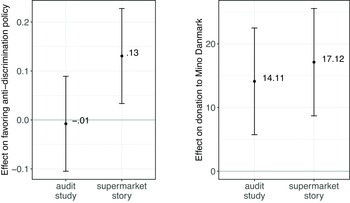
As noted earlier, we study the extended consequences of the two forms of evidence about discrimination through two outcomes in Study 2: (i) anti-discrimination/pro-inclusion policies and (ii) donations toward minority causes. The left panel of Figure 3 displays the effects of the statistical evidence and the personal story, respectively, on anti-discrimination policies toward ethnic minorities. Parallel to earlier work (Haaland and Roth Reference Haaland and Roth2023; Schaeffer et al., in press), we find no effects of providing statistical information about discrimination on support for anti-discrimination policy. By contrast, the personal story has a small positive effect – a 0.13-unit change ( $p \lt 0.05$
) on the 1–5 scale – on anti-discrimination policy support. Further, the difference in the effect between the two types of evidence is statistically significant (
$p \lt 0.05$
) on the 1–5 scale – on anti-discrimination policy support. Further, the difference in the effect between the two types of evidence is statistically significant ( $0.14$
, SE =
$0.14$
, SE = $0.05$
,
$0.05$
, $p \lt 0.01$
). This result highlights that personal stories of discrimination not only have the potential to move perceptions of discrimination more than statistical evidence does, but their effect can also extend to attitudes toward policies that can help reduce discrimination and further inclusion.
$p \lt 0.01$
). This result highlights that personal stories of discrimination not only have the potential to move perceptions of discrimination more than statistical evidence does, but their effect can also extend to attitudes toward policies that can help reduce discrimination and further inclusion.
Effects of treatments on discrimination policy attitudes (scale from 1 to 5) and donation to a minority organization (0–300 DKK) in Study 2.
Note: Full results are reported in Table E.2, Model 3 (policy) and Model 4 (donations) in Appendix E. Audit study is manifest statistical evidence, supermarket story is manifest personal evidence.

The second panel of Figure 3 reports the effect of the two treatments for the behavioural measure of support for immigrant causes in terms of the share of donation of a potential lottery win to a minority organization.Footnote 8 Both forms of evidence significantly increase the donation to the minority organization by about 15 DKK (approx. 2 euros). This corresponds to 1/20 of the potential donation amount (300 DKK) and 22 per cent of the average donation to the minority organization in the control condition (67 DKK). The result of the statistical evidence treatment corroborates the result by Schaeffer et al. (in press) using a different, but related measure. The observed effect of the personal story is a novel finding, speaking further to the efficacy of such evidence for changing not only self-reported perceptions of discrimination but also support for the wider cause of the minority group in question.
Concerns Over Demand Effects and Social Desirability
Our survey-experimental design might raise concerns that the observed effect of ethnic discrimination evidence on majorities’ perceptions of such discrimination could reflect methodological artefacts, specifically experimenter demand effects or social desirability. That is, rather than updating beliefs about the extent and severity of discrimination, might the observed effect reflect what respondents believe is the socially desirable response or what the researchers behind the study want them to respond? We believe that either alternative explanation is quite unlikely for a number of reasons.
First, there is limited evidence for the existence of demand effects in general – for instance, a recent study convincingly shows that even under very favourable conditions, demand effects do not emerge (Mummolo and Peterson Reference Mummolo and Peterson2019). Second, the fact that we observe near-null effects for some of the treatments on the outcomes in Study 1 shows that respondents are not mechanically responding to any evidence of discrimination. Instead, people respond differently to the evidence, suggesting that they do not find all evidence equally persuasive. Third, the fact that even respondents who hold strong anti-immigration attitudes update their beliefs in the direction of acknowledging discrimination when presented with evidence – and often not to a significantly different extent than their more pro-immigration peers – suggests that social desirability is not driving the results. If this were the case, those who are willing to express strong anti-immigration stances should also be less willing to update their perception in the direction of acknowledging discrimination against ethnic minorities (or even downgrade such perceptions). In short, while demand effects or social desirability concerns may be challenges to survey experiments under some circumstances, we believe that they are quite unlikely to apply in our case.
Why Does a Personal Story Change Perceptions of Discrimination?
The most striking finding of our analysis is arguably establishing that a personal story manifestly demonstrating discrimination can significantly alter majority members’ perceptions of minority discrimination as well as concomitant attitudes and behaviour. On the surface, this finding is counterintuitive. In contrast to an audit study-statistic, which conveys information about general patterns, a potentially idiosyncratic personal story provides little basis for broader generalization. Further, one particular story provides ample opportunity to rationalize away discrimination for those inclined to do so, but this is not what we observe either. This raises the question of why the personal story is relatively effective in changing perceptions of and attitudes toward discrimination. As alluded to earlier, we believe that affect is a likely mechanism underlying the effect of the personal story. As opposed to the ‘cold cognition’ taking place when presented with a faceless statistic, a vivid personal story might activate ‘hot cognition’ by evoking strong emotional reactions that rub off on perceptions of discrimination.
We can bolster this idea empirically by studying an open-ended question, encouraging participants to reflect on the evidence (treatment) they were assigned to, which we asked after the outcome variables in Study 2. The rate of meaningful responses was surprisingly high: 55 per cent.Footnote
9
An independent coder hand-coded the full set of responses, classifying whether a response included positive emotions towards the victims of discrimination and/or negative emotions towards their perpetrators (see Appendix J for coding instructions). By comparing respondents’ naturalistic reactions to the personal story of discrimination and the audit study-statistic, we can get an indication of whether the former induces affect (compared to the latter). Two of the authors jointly coded 200 responses in order to evaluate intercoder reliability. Pearson’s correlation between the independent coder and the authors’ joint annotations was $0.82$
(Cohen’s kappa:
$0.82$
(Cohen’s kappa: $0.81$
).
$0.81$
).
We find that the personal story elicits far more responses containing affect (15 per cent) than the audit study-statistic (3 per cent) (test of difference: $p \lt 0.001$
).Footnote
10
Typical responses toward the personal story contained emotions such as sadness (‘The story makes me sad’) or shock/outrage toward the manager rejecting the immigrant (‘It’s terrible that this can happen here in Denmark’). This analysis, therefore, tentatively suggests that affect is, at least partly, underlying the effect of the personal discrimination story on perceptions of discrimination as well as concomitant attitudes towards anti-discrimination policies and behaviour towards the affected groups.
$p \lt 0.001$
).Footnote
10
Typical responses toward the personal story contained emotions such as sadness (‘The story makes me sad’) or shock/outrage toward the manager rejecting the immigrant (‘It’s terrible that this can happen here in Denmark’). This analysis, therefore, tentatively suggests that affect is, at least partly, underlying the effect of the personal discrimination story on perceptions of discrimination as well as concomitant attitudes towards anti-discrimination policies and behaviour towards the affected groups.
Discussion and Conclusion
A potential first step in ameliorating discrimination and improving the situation of disadvantaged ethnic minorities is to convince majority members of the adversity experienced by these groups. In this paper, we have sought to understand which forms of evidence are effective in raising awareness of discrimination in terms of perceptions of its extent and severity. Our two survey-experimental studies conducted in Denmark yielded several important results. First, we found that manifest evidence of discrimination (as opposed to more ambiguous evidence) is particularly effective in increasing perceptions of discrimination. Second, confirming findings from recent studies, we find that majorities’ perceptions of ethnic minority discrimination change when they are exposed to an audit study-statistic documenting discrimination. Third, and more novel, we also show that a more qualitative form of evidence – a personal story of manifest discrimination – increases majorities’ perceptions of discrimination against ethnic minorities, and perhaps even with stronger attitudinal and behavioural implications, than the more general audit study-evidence. Fourth, through open-ended responses, we find that a likely reason that the personal story is relatively effective is that it evokes emotional responses, which colour perceptions of discrimination and concomitant attitudes and behaviours.
In theoretical terms, the overall insight generated by our study is that changing majorities’ perceptions of ethnic minority discrimination can come about by appealing to both their minds and hearts. Yet, not all appeals are effective, and ambiguity of the evidence appears to be a key factor in this regard, while its character (personal or statistical) is less so. Independent of its character, manifest evidence increases perceptions of discrimination, whereas ambiguous evidence is largely ineffective regardless. Further, by demonstrating that learning new information through an audit study-based statistic increases such perceptions, if not corresponding policy attitudes, in Denmark, our findings corroborate and replicate previous studies from the United States and Denmark, respectively (Haaland and Roth Reference Haaland and Roth2023; Schaeffer et al., in press), thereby speaking to the general efficacy of this form of evidence. More importantly, by finding that a single personal story that vividly exposes the injustice of discrimination can alter both perceptions of discrimination and concomitant attitudes and behaviors – and perhaps even more so than the generalized information embodied in the statistic from an audit study – we have demonstrated that perceptions are far from pure reflections of facts, but also to a significant extent rooted in affect prompted by these stories. This finding aligns with a growing body of work showing the power of personal narratives and associated mechanisms of perspective-taking and empathy in shaping out-group sentiments more broadly (Adida et al. Reference Adida, Lo and Platas2018; Broockman and Kalla Reference Broockman and Kalla2016; Kalla and Broockman Reference Kalla and Broockman2020; Simonovits et al. Reference Simonovits, Kezdi and Kardos2018).
More substantively, our finding regarding the personal story also speaks to how widely disseminated vivid episodes of unfair treatment might shape majorities’ perceptions of minority group disadvantage more broadly. To exemplify, in May of 2021, an immigrant family with two young children were verbally abused by a middle-aged native-born man shouting racist slurs and threatening them in a small fishing village near Copenhagen, Denmark. The immigrant family filmed the incident and posted it online on social media to raise awareness of racism experienced by ethnic minorities – especially of Middle-Eastern origin – in Denmark. The video went viral and the family received many expressions of sympathy (and the perpetrator widespread condemnation), including by the Danish prime minister and a high-profile then-member of the nationalist right-wing and immigration-sceptic Danish People’s Party (Madsen Reference Madsen2021). A few days after the episode, the national Danish TV channel TV2 conducted a survey, which found that 42 per cent of Danes – up from 32 per cent a year before – saw racism as a widespread problem (Christensen Reference Christensen2021). While causality cannot be demonstrated in a strict sense, it seems very likely that the vivid episode of abuse contributed to this substantial increase in perceptions of racism. Extrapolating from our results, the emergence of video-filmed violence against ethnic minorities (for example, the killings of Eric Garner and George Floyd in the United States) is likely an important catalyst for protests and social change.
Future work can corroborate and extend our work in several ways. First, parallel to our own replication for the audit-study evidence, it would be useful to replicate and extend our findings regarding the personal story of discrimination in other contexts, with other minority groups, and using multiple different stories and forms of delivery. This would help establish the generality of our claim that personal stories influence perceptions of ethnic minority discrimination as well as its scope conditions. For example, as alluded to in the previous paragraph, images or videos displaying abuse or disadvantage might be particularly powerful in changing majorities’ perceptions of minorities’ realities and associated attitudes (Sohlberg et al. Reference Sohlberg, Esaiasson and Martinsson2019). This implies that the observed effects of our text-based treatments may be lower-bound estimates, which could be increased when complemented by images or videos. To the extent real-world examples permit, such extensions could also explore the differential effects of statistical evidence and personal stories based on the same underlying situation – something we have not been able to fully control in this study. Second, another way to extend our work would be to investigate the longevity of the effect of both the audit study-statistic and the personal story. Based on work documenting relatively short-lived effects of information on attitudes more generally (Coppock Reference Coppock2023), we expect that neither form of evidence generates lasting perceptual changes, given their simple nature – they are essentially a few lines of text. However, this is, of course, an empirical question. If they turn out to have short-lived effects as we expect, this raises the question of which interventions – for example, which types of evidence, type of exposure (for example, singular versus repeated), or specific delivery (Broockman and Kalla Reference Broockman and Kalla2016; Kalla and Broockman Reference Kalla and Broockman2020) – that might durably change perceptions of discrimination and perhaps even associated attitudes. Third, ultimately, we are interested in understanding the effect of various types of evidence about discrimination on not only changes in perceptions of, or even attitudes about, discrimination, but also actual behaviour toward ethnic minority groups. In other words, do majorities discriminate less against ethnic minorities when they are presented with evidence showing that this group bears the burden of discrimination? While this is difficult to demonstrate, creative use of field experiments to study discrimination against immigrants (Choi et al. Reference Choi, Poertner and Sambanis2019) is a promising way forward in this regard.
While our finding regarding the effectiveness of the audit study-statistic is normatively desirable – people update perceptions about a societal phenomenon based on relevant information – this is less straightforward for the personal story. On the one hand, it is reassuring that majority members react with acknowledgement and empathy in response to minority members’ experiences of discrimination. Caring for out-groups is an important building block of social cohesion in society. On the other hand, there is also a potential dark side to the affect-evoking qualities of specific stories more generally. Stories might be idiosyncratic or orchestrated by issue entrepreneurs, and as such, abused for political gain. Using representative personal stories to illustrate more generalized statistical evidence (and vice versa), as is often done in news stories, is therefore a desirable combination in this regard.
Lastly, our results indicate that while minority and majority groups might not share experiences, the latter are willing to concede to the adverse experiences of the former, and even act on them in political terms, when they are conveyed through vivid personal stories. While this result should not be overstated, it does raise cautious optimism for the prospects of intergroup communication, empathy, and, ultimately, social cohesion.
Supplementary Material
To view supplementary material for this article, please visit https://doi.org/10.1017/S0007123425100525
Data Availability Statement
Replication data and code can be found Harvard Dataverse at: https://doi.org/10.7910/DVN/OPU9FT.
Acknowledgements
The authors would like to thank participants at the Departmental Seminar (University College London), the Political Behaviour Seminar (Aarhus University), the Danish and Comparative Politics Seminar (University of Copenhagen), as well as at APSA 2023, and Lene Aarøe and Lucy Barnes for valuable feedback on earlier drafts of this article.
Financial support
Peter Thisted Dinesen acknowledges support for this research from Independent Research Fund Denmark (grant number 9038-00123B). Kim Mannemar Sønderskov acknowledges support from the Danish National Research Foundation (grant number DNRF144).
Competing Interests
The authors declare no competing interests.




 Open access

