


Introduction
The Antarctic ice sheet is the largest body of ice on Earth, with an area of ~14 × 106 km2. Most of its area (>80%) is grounded, but along 74% of its margins large floating ice shelves buttress the ice sheet (Reference BindschadlerBindschadler and others, 2011). Ice shelves are mostly flat, but local ‘pinning points’ attach them to the ocean bed below (Reference HughesHughes, 1977; Reference Jezek and BentleyJezek and Bentley, 1983; Reference Alley, Blankenship, Rooney and BentleyAlley and others, 1989; Reference Horgan and AnandakrishnanHorgan and Anandakrishnan, 2006; Reference Fricker, Coleman, Padman, Scambos, Bohlander and BruntFricker and others, 2009; Reference JenkinsJenkins and others, 2010). If these features are surrounded entirely by the ice shelf, they are called ice rises; otherwise they are referred to as ice domes or promontories. In this paper we generalize all these features and refer to them as ice rises. These have a higher elevation (50–500 m) than the surrounding floating ice and are associated with locally very low ice velocities. Since the ice below some of these features can be thousands of years old (Reference Bindschadler, Roberts and IkenBindschadler and others, 1990; Reference Martín, Hindmarsh and NavarroMartín and others, 2006, Reference Martín, Gudmundsson and King2014; Reference Drews, Martín, Steinhage and EisenDrews and others, 2013), ice cores can provide long-term estimates of past climate and local surface mass-balance (SMB) variations. The SMB (mm w.e. a> 1) is defined as the difference between annual surface mass gain (precipitation, PR) and surface mass loss (surface runoff, RU, surface sublimation, SUs, drifting snow sublimation, SUds, and drifting snow erosion, ERds):

Note that ERds can be negative (drifting snow deposition) and thereby contribute to surface mass gain. Since ice rises are grounded features with topographic expression above the surrounding ice shelf, they act as local barriers to the prevalent atmospheric flow. In a similar way to grounded ice barriers elsewhere, such as southeastern Greenland (Reference MiègeMiège and others, 2013), the West Antarctic topographic ridge (Reference Nicolas and BromwichNicolas and Bromwich, 2011) and the Antarctic Peninsula (Reference Van Lipzig, King, Lachlan-Cope and Van den BroekeVan Lipzig and others, 2004; Reference Van den Broeke, Van As, Reijmer and Van de WalVan den Broeke and others, 2006), they could enhance orographic precipitation on the upwind side of the ridge, with a precipitation shadow on the downwind side (Reference Fernandoy, Meyer, Oerter, Wilhelms, Graf and SchwanderFernandoy and others, 2010). In addition, they might disturb the local wind field, which promotes the contribution of drifting snow processes to the local SMB (Reference Nereson and WaddingtonNereson and Waddington, 2002; Reference King, Anderson, Vaughan, Mann, Mobbs and VosperKing and others, 2004). In situ measurements on and around ice rises are extremely sparse and do not provide the spatial coverage needed to analyse the effect of ice-rise topography on SMB. Alternatively, remote sensing or regional climate modelling provide a gridded SMB field. However, commonly used Antarctic SMB maps (Reference Arthern, Winebrenner and VaughanArthern and others, 2006; Reference Van de Berg, Van den Broeke, Reijmer and Van MeijgaardVan de Berg and others, 2006; Reference Lenaerts, Van den Broeke, Van de Berg, Van Meijgaard and MunnekeLenaerts and others, 2012a) have a horizontal resolution (~25–50 km) that is too low to properly resolve most ice rises (typical radius <20 km). Ice-shelf SMB is therefore usually assumed homogeneous in ice-sheet models that study the dynamic behaviour of the Antarctic ice sheet and shelves (Reference Winkelmann, Levermann, Martin and FrielerWinkelmann and others, 2012; Reference WrightWright and others, 2013; Reference Kleiner and HumbertKleiner and Humbert, 2014) and the role of ice rises therein (Reference Matsuoka, Pattyn, Callens and ConwayMatsuoka and others, 2012; Reference PattynPattyn and others, 2012).
This study is the first attempt to focus on climate and SMB variability around ice rises. We present combined results from high-resolution regional climate modelling and recently obtained in situ meteorological data and SMB measurements, and describe the near-surface climate and SMB on and around ice rises in Dronning Maud Land (DML), East Antarctica, where many small ice rises are located. The following section describes the model set-up and presents the observational data. The next section describes the results and the final section presents the implications of this study and conclusions.
Methods
Regional atmospheric climate model
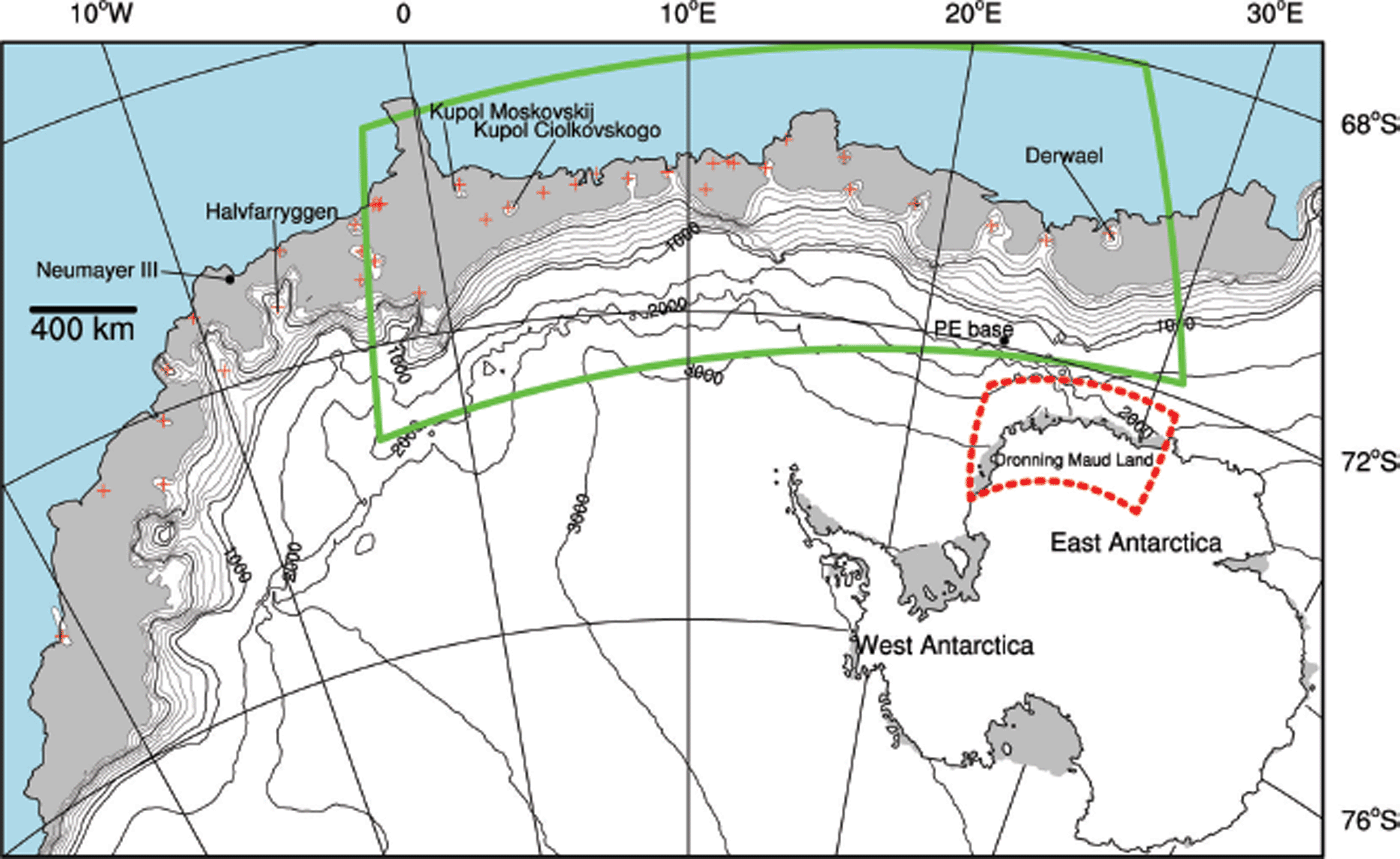
We use the output of the high-resolution (~5.5 km horizontal gridding) regional atmospheric climate model RACMO2, version 2.3 (Reference LenaertsLenaerts and others, 2014; Reference Van Wessem, Reijmer, Lenaerts, Van de Berg, Van den Broeke and Van MeijgaardVan Wessem and others, 2014), with its spatial domain focused on DML (~25° W to ~35° E) (Fig. 1). RACMO2 has been used before to map Antarctic SMB at a lower horizontal resolution (~27 km; Reference Lenaerts, Van den Broeke, Van de Berg, Van Meijgaard and MunnekeLenaerts and others, 2012a), but that resolution is insufficient to properly resolve the topography of an average-sized ice rise.
RACMO2 topography inside the model domain (Reference Bamber, Gomez-Dans and GriggsBamber and others, 2009), with 100 m vertical spacing from 0 to 1000 m a.s.l. and 500 m spacing from 1000 to 4000 m a.s.l. Blue represents the ocean, grey the ice shelf and white the grounded ice. The red crosses indicate locations of ice rises. The green box shows the extent of the maps presented in Figures 3, 5a and 7. The red box in the inset map shows the location of the domain on Antarctica. Locations discussed in the paper are indicated on the map.
RACMO2 is forced at its lateral boundaries by atmospheric profiles of the ERA-Interim reanalysis from the European Centre for Medium-range Weather Forecasts (ECMWF 2001–12; Reference Dee and UppalaDee and Uppala, 2009), and is free to evolve in its inner spatial domain. The relaxation zone, where the ERA-Interim fields are downscaled to RACMO2 resolution, is sufficiently wide (32 RACMO2 gridpoints, i.e. ~180 km) and located over the ocean where possible. Sea-surface temperature and sea-ice extent in RACMO2 are also prescribed by the ERA-Interim analysis. The snow model that is interactively coupled with RACMO2 includes physical descriptions and temporal evolution of snowmelting, percolation and runoff (Reference Ettema, Van den Broeke, Van Meijgaard, Van de Berg, Box and SteffenEttema and others, 2010), snow albedo (Reference Kuipers Munneke, Van den Broeke, Lenaerts, Flanner, Gardner and Van de BergKuipers Munneke and others, 2011) and drifting snow (Reference LenaertsLenaerts and others, 2012b). The snowpack is initialized with data from a previous RACMO2 simulation (Reference Lenaerts, Van den Broeke, Van de Berg, Van Meijgaard and MunnekeLenaerts and others, 2012a).
Elevation model
In this study, we use the digital elevation model (DEM) provided by Reference Bamber, Gomez-Dans and GriggsBamber and others (2009), which has been compiled from satellite-based laser and radar altimetry from the Ice, Cloud and land Elevation Satellite (ICESat) and European Remote-sensing Satellite (ERS), respectively. It covers the entire Antarctic continent and is gridded to 1 km postings. The ice rises in our sector of interest appear clearly in the DEM, even after regridding this DEM to the RACMO2 horizontal resolution (5.5 km; Fig. 1). However, ice rises have relatively steep surface slopes, which introduces errors into the DEM, since the altimeter reflections do not originate from the sub-satellite points. This may result in locally large elevation errors (e.g. Reference Drews, Rack, Wesche and HelmDrews and others, 2009; Reference Wesche, Riedel and SteinhageWesche and others, 2009). In the future, such problems will be overcome, for example, by using the interferometric capabilities of CryoSat-II (Reference Helm, Humbert and MillerHelm and others, 2014). In this study, however, we decide to use the DEM of Reference Bamber, Gomez-Dans and GriggsBamber and others (2009), because it provides a spatially continuous and consistent dataset. We keep in mind that errors in the applied elevation model will propagate to simulated absolute SMB values; however, we expect that the simulated SMB gradients will not alter dramatically with an improved DEM.
Meteorological data
To evaluate the temperature, precipitation and SMB simulated by RACMO2, we use data from three weather stations (Fig. 1). The permanently manned station, Neumayer III, is located on the flat Ekström Ice Shelf, ~20 km from the ice-shelf edge, and has provided quality-controlled, detailed meteorological observations since 1983. We use daily averaged data covering the period January 2011–December 2011 (König-Langlo, 2011). We also use daily averaged data for 2011 from an automatic weather station (AWS11; Reference Van den Broeke, Van As, Reijmer and Van de WalVan den Broeke and others, 2004) installed on the ridge of Halvfarryggen, an ice promontory located ~120 km southeast of Neumayer III (~700 m a.s.l.; Reference Drews, Martín, Steinhage and EisenDrews and others, 2013; Reference Van Wessem, Reijmer, Lenaerts, Van de Berg, Van den Broeke and Van MeijgaardVan Wessem and others, 2014). Finally, we use measurements of snowfall and snow height (2009–12) and snowfall rate (2011–12) available from the Princess Elisabeth base (PE base; Fig. 1). PE base is located on Utsteinen ridge (1390 m a.s.l.; 72° S, 23° E) just north of the Sør Rondane mountains in the escarpment area of eastern DML, ~200 km southwest of the ice-shelf edge. The snow height was measured by a sonic height ranger installed as part of AWS16, located in a valley 300 m east of PE base; annual SMB was inferred using an annual mean snow density measured on site (Reference Gorodetskaya, Van Lipzig, Van den Broeke, Mangold, Boot and ReijmerGorodetskaya and others, 2013). Snowfall rate is derived from a micro rain radar 2 (MRR) vertically profiling 24 GHz radar installed at PE (Reference GorodetskayaGorodetskaya and others, 2014a), hereafter referred to as snow radar. Here we use daily total snowfall rates, S, estimated based on the near-surface radar reflectivity, Ze. Uncertainty in snowfall rate estimates depending on snow-particle microphysical properties is considered by applying a range of Ze/S relationships for dry snow (Reference MatrosovMatrosov, 2007). Although PE base is not located on or near an ice rise, it retrieves the only direct measurements of snowfall in DML.
Snow stakes and firn cores
Along with the model evaluation using meteorological data, we compare the RACMO2 SMB with local SMB estimates derived from a combination of snow-stake and firn-core measurements. In January 2012, we placed a network of 73 aluminium stakes on Kupol Ciolkovskogo and 79 stakes on Kupol Moskovskij (Fig. 1) as part of a GPS occupation campaign. We placed 3 m long aluminium stakes ~1 m into the snow surface, measured the initial height of each stake from the snow surface, and reoccupied the measurement 1 year later. To ensure that the aluminium stakes were well anchored, they were manually driven into the snow to a hard layer at ~1 m depth. We assume that the magnitude of firn compaction is much smaller than the measured stake height difference related to SMB. We believe that this is a valid assumption in this case, since we are solely interested in the SMB pattern over the ice rises, rather than the absolute value of the single-year SMB values.
In order to determine the local SMB from the stake snow heights, we collected 3 m firn cores at six locations on Kupol Ciolkovskogo and 14 locations on Kupol Moskovskij in January 2013. We measured the length, diameter and mass of each core section. The cumulative length of the measured core sections does not correspond to the relative stake height differences at the locations; to estimate the density of the surface layer, we calculate the weighted mean density of multiple core sections to the depth of the accumulated snow. To estimate the error due to horizontal variability in near-surface density (the cores and the stakes are < 5 m apart), we drilled two separate cores close to one another. The resulting SMB error is assumed equal to three times the observed SMB difference between the cores, i.e. 15 mm w.e. a-1.
Ground-penetrating radar
Ground-penetrating radar (GPR) is a standard method to spatially extrapolate accumulation measurements from firn cores (e.g. Reference Spikes, Hamilton, Arcone, Kaspari and MayewskiSpikes and others, 2004; Reference EisenEisen and others, 2008). The underlying principle assumes that shallow, laterally continuous internal-reflection horizons in the radar data are isochrones that are not deformed significantly by ice dynamics (shallow-layer approximation; Reference Waddington, Neumann, Koutnik, Marshall and MorseWaddington and others, 2007). For data regarding Halvfarryggen and Derwael Ice Rise, only one firn core was available, which necessitates the additional assumption that the depth/density profile does not change laterally.
The radar profile on Derwael Ice Rise presented in Figure 2 was collected in 2012 and spatially extended by ~10 km towards the southeast in 2013. It was acquired using a commercial 400 MHz antenna. For the travel-time to depth conversion, we use a velocity/density model based on the mixing formula given by Reference LooyengaLooyenga (1965). The density/depth scale stems from a combination of discrete firn-core samples (Reference HubbardHubbard and others, 2013) and a semi-empirical firn-compaction model (Reference Arthern, Vaughan, Rankin, Mulvaney and ThomasArthern and others, 2010). For the latter, we assume steady state, with a surface subsidence rate equal to the SMB divided by the measured surface density, 400 kg m-3, and a surface temperature of –15°C. Both values are derived from the firn core drilled on the Derwael Ice Rise divide (Reference HubbardHubbard and others, 2013). The model is vertically integrated until ice density (917 kg m-3) is reached. We minimize the difference to the core samples by adjusting the activation energy for grain growth to E g = 41 kJ mol-1, which closely matches the values given by Reference Cuffey and PatersonCuffey and Paterson (2010).
GPR profile along Derwael Ice Rise. Note that the transect runs from the upwind slope (S) to the downwind slope (F), i.e. from east to west. The red curve denotes the selected reflector for the SMB estimation. The dashed black line is the position of the ridge and the firn core (Reference HubbardHubbard and others, 2013). The blue line denotes the separation between the data obtained in 2012 and in 2013.

After the travel-time to depth conversion, a single internal-reflection horizon was dated using the annual variability in stable isotopes (δ18O) measured in the firn core. Near the core site, the internal-reflection horizon is at 22 m depth and the corresponding age is 21 years before 2012. We pick the same isochrone in both datasets, using the characteristic pattern of internal-reflector packages, which is consistent in both datasets. Therefore the radar-derived SMB is a 21 year average for data collected in 2012 and a 22 year average for data collected in 2013. The relative depth of the reflection horizon varies on either side of the divide, which results in the SMB gradient depicted in Figure 2. However, the absolute values derived here are associated with a number of uncertainties: the error of the tentative age/depth scale is ±1 year; the root-mean-square error between the density/depth model and the firn-core data is ±18 kg m-3, which results in an additional uncertainty of 0.5 m in the conversion from travel time to depth. At the core site, the combined effect of the errors of age/depth scale and of the travel-time to depth conversion on the SMB is ~8% (i.e. ~40 mm w.e. a-1). We assume this error to be constant along the profile, since the age/depth estimate, which is vertically constant, involves the largest uncertainty. As the observed SMB gradient across Derwael Ice Rise greatly exceeds the associated error, we are confident that the pattern observed is realistic. Additional uncertainties, such as discontinuities between the 2012 and 2013 data, as well as the spatial separation between the radar profile and the core site (~400 m at the closest approach), are constant along the profile, which enhances robustness in the observed spatial gradient.
Results And Discussion
Temporal variability
DML is a region characterized by a strong interannual variability of SMB (Reference Reijmer and Van den BroekeReijmer and Van den Broeke, 2001; Reference Schlosser, Manning, Powers, Duda, Birnbaum and FujitaSchlosser and others, 2010; Reference Lenaerts, Van Meijgaard, Van den Broeke, Ligtenberg, Horwath and IsakssonLenaerts and others, 2013). Therefore, it is questionable whether 2001–12 is a representative period for the longer-term mean climate. However, when analysing the Antarctic-wide, long-term (1979–2013) RACMO2 simulation (27 km horizontal resolution; Reference Van Wessem, Reijmer, Lenaerts, Van de Berg, Van den Broeke and Van MeijgaardVan Wessem and others, 2014), the 2001–12 DML ice-shelf SMB (331 mm w.e. a-1) does not differ significantly from the 1979–2013 value (324 ± 48 mm w.e. a-1 (mean ± standard deviation)). Hence, it is justified to present 2001–12 mean RACMO2 results as a reliable proxy for the long-term, multi-decadal DML climate.
Near-surface climate
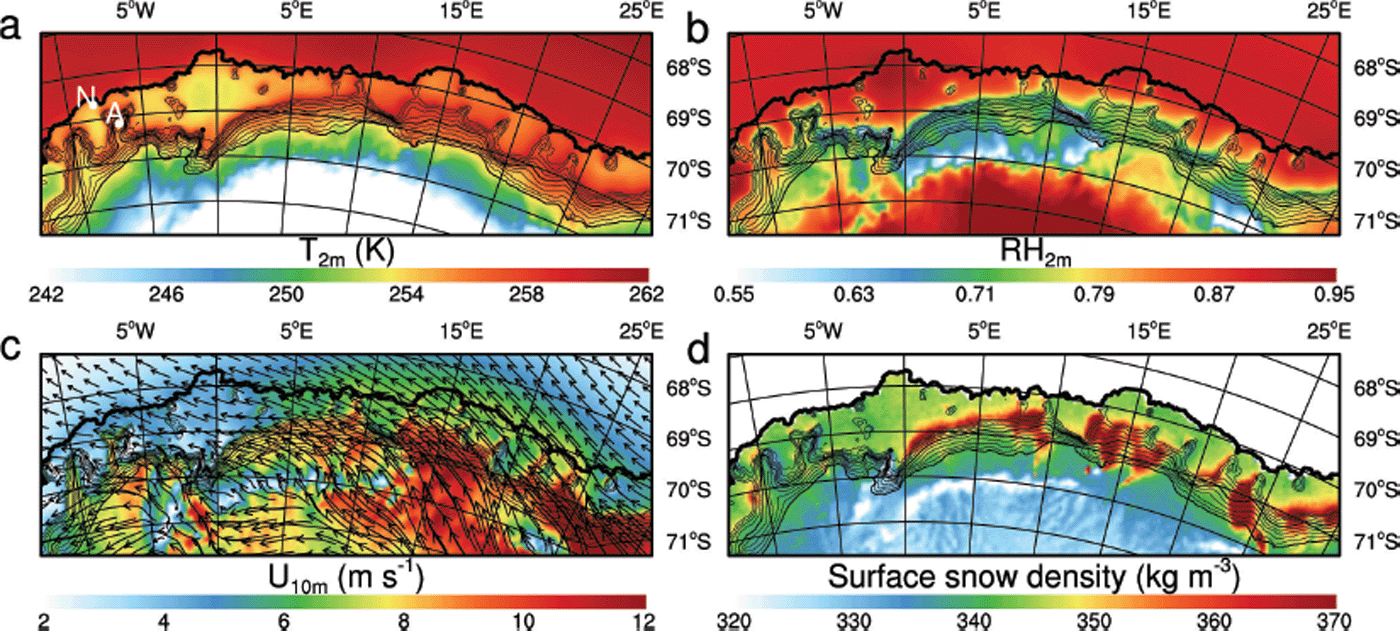
Figure 3 presents the simulated mean near-surface climate. Over the ice shelves, near-surface temperature is low (~254 K) and relative humidity high (~90%). They remain nearly uniform over the ice shelves, whereas higher temperatures and lower relative humidities are found over the lower escarpment region connecting the Antarctic plateau with the ice shelves, but also on the ice rises.
Simulated annual mean (2001–12) near-surface climate in the region 10° W–10° E. (a) 2 m temperature (K). (b) 2 m relative humidity (with respect to ice; unitless). (c) 10 m scalar wind speed (colours) and direction (arrows). (d) Snow density of the top 5 cm (kg m> 3). The locations of Neumayer III (N) and AWS11 (A) (Fig. 4) are shown in (a).
This is further illustrated by comparing daily mean temperature at two neighbouring weather stations (Fig. 4), Neu-mayer III and AWS11, the latter located ~650 m higher than Neumayer III. The difference in elevation results in higher temperatures at Neumayer III in summer (3–4 K), when the surface-based temperature inversion is rather weak. In winter, however, we see prolonged periods with comparable or even higher near-surface temperatures at AWS11. This mainly occurs during periods when the temperature at Neumayer III is very low (< 245 K), i.e. when a strong temperature inversion sets up above the ice-shelf surface, and the temperatures at AWS11 can be 5–10 K higher than at Neumayer III. In 2011, the annual mean temperature was observed to be 256.8 K at Neumayer III and 255.9 K at AWS11, i.e. only a small (0.9 K) temperature difference between an ice shelf and an ice-rise weather station, despite a significant elevation difference (~650 m). RACMO2 simulates this behaviour relatively well, but, despite a correct representation of the elevation difference between Neu-mayer III and AWS11, it overestimates the effect: the annual mean temperature at Neumayer III is underestimated by 1.4 K (255.4 K), with frequent large underestimations in winter (Fig. 4), but RACMO2 agrees with the observed AWS11 temperature within 0.1 K (256.0 K).
Ten-day running mean, 2 m temperature observed (solid) and modelled (dotted) at Neumayer III (red) and AWS11 (blue). Horizontal bars show the annual mean observed values. The bottom panel shows deviation of the modelled values from the observed values (RACMO2 – observations). Horizontal bars show the annual mean deviations at these two sites. (Fig. 3 shows the locations of these sites.)
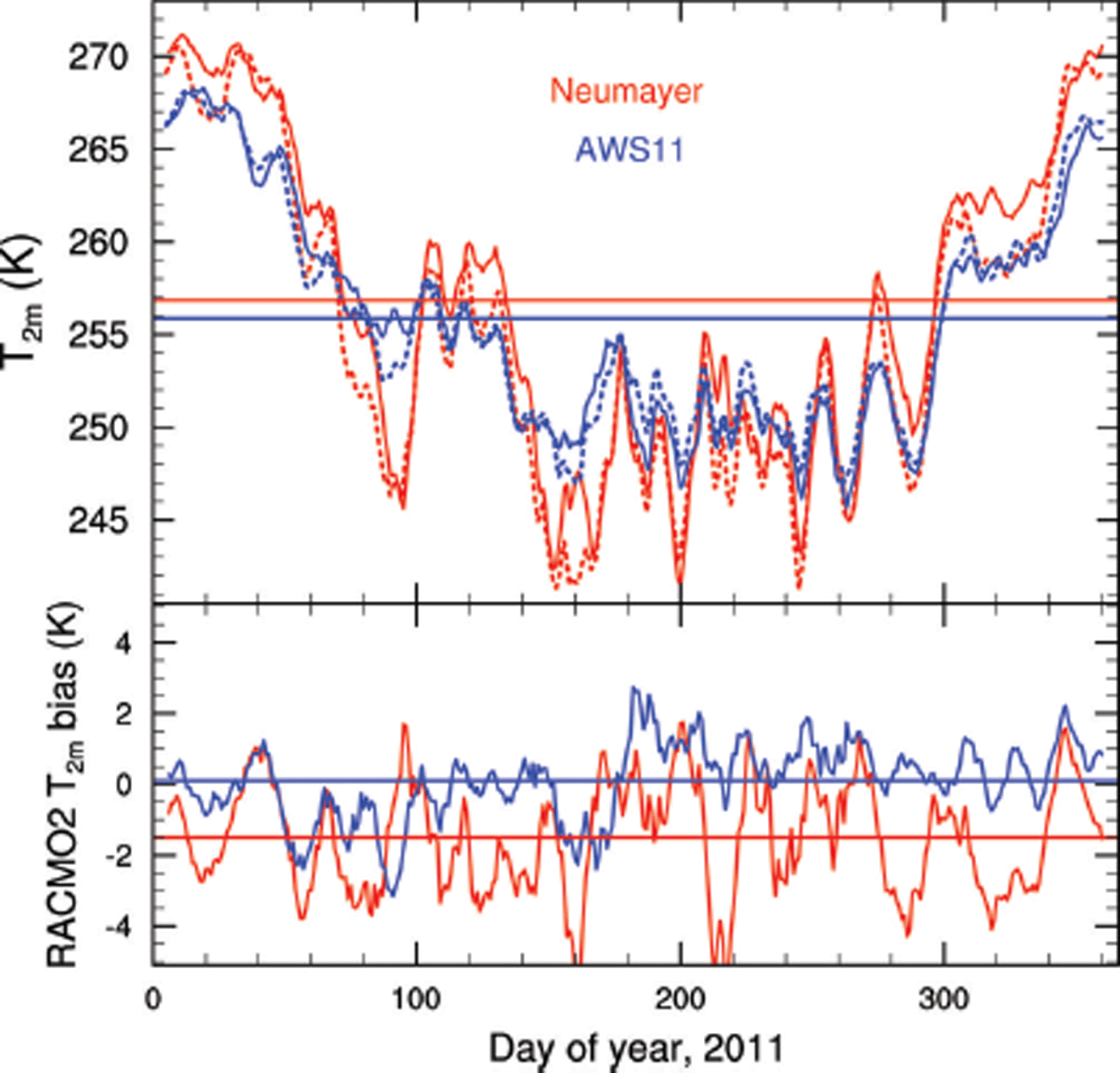
We argue that higher temperatures found over ice rises during cold periods are explained by two processes. Firstly, the ice rises are exposed to warmer surrounding air, because of the presence of a semi-permanent surface-based temperature inversion over the ice shelves (Connolley, 1996). Secondly, enhanced vertical mixing in the atmospheric surface layer in winter enhances the downward entrainment of warmer and drier air and partly breaks down the strong stably stratified atmosphere near the surface, which is supported by higher horizontal wind speeds over the ice rises (Fig. 3c), enhancing downward sensible heat flux. This implies that enhanced entrainment, through mechanical turbulence and exposure to warmer ambient air when a strong inversion forms over the surrounding ice shelf, is able to significantly raise near-surface temperatures of ice rises in winter.
Surface mass balance
Simulated mean (2001–12) SMB from RACMO2 in DML is displayed in Figure 5a. Simulated SMB on the ice shelves surrounding the ice rises is relatively homogeneously distributed (200–400 mm w.e. a-1), but strong spatial SMB variations are found in the vicinity of all ice rises. Annual mean SMB values >1000 mm w.e. a-1 are modelled on the northeastern (upwind) side of most topographic features, and a clear SMB minimum on the southwestern (downwind) sides. SMB of >2000 mm w.e. a-1 are simulated on some upwind slopes in western DML (e.g. east of Halvfarryggen).
RACMO2 mean (2001–12) annual SMB in (a) entire coastal DML; zoomed in (b) on Kupol Ciolkovskogo and Kupol Moskovskij (0–4° E). The red box in (a) displays the location of (b). SMB values estimated using firn-core derived densities and stake heights are shown with circles. Contours show the surface topography (Reference Bamber, Gomez-Dans and GriggsBamber and others, 2009) with a resolution of 200 m in (a) and 100 m in (b).
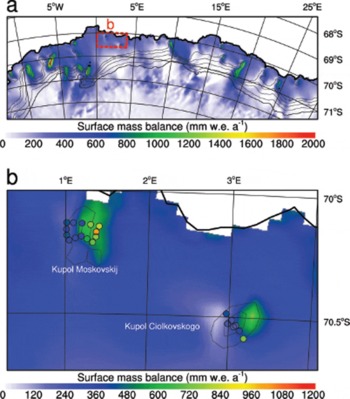
The 2012 DML ice shelves SMB in RACMO2 is insignificantly (< 5%) different from the 2001–12 mean (Reference Van Wessem, Reijmer, Lenaerts, Van de Berg, Van den Broeke and Van MeijgaardVan Wessem and others, 2014), which allows evaluation of RACMO2 SMB in more detail using single-year (2012) measurements around Kupol Ciolkovskogo and Kupol Moskovskij, located ~1–3° E (Fig. 1). On Kupol Ciolkovskogo, our measurements reveal that 2012 SMB ranges between 225 ± 15 and 734 ± 15 mm w.e. a-1 from the summit to the lowest-elevation site on the upwind side of the ice rise. On the downwind side of the ice rise, the observed SMB ranges from 225 ± 15 to 428 ± 15 mm w.e. a-1. On Kupol Moskovskij, our 14 SMB measurements show that the single-year SMB ranges between 302 ± 15 mm w.e. a-1 at the summit and 986 ± 15 mm w.e. a-1 at the lowest-elevation sites on the upwind side of the ice rise. Together, these measurements constitute a spatially consistent single-year SMB pattern over ice rises, with highest SMB occurring at the low elevation on the upwind side of the ice rises.
Figure 5b compares these local SMB measurements with the mean SMB from RACMO2. We find RACMO2 SMB values of 1000 and 700 mm w.e. a-1 on the northeastern side of Kupol Ciolkovskogo and Kupol Moskovskij, respectively, whereas a significant SMB minimum is found west of the ice rises, mainly in the case of Kupol Ciolkovskogo (<100 mm w.e. a-1). Although we have no evidence of this large SMB span from our observations, we find that the RACMO2 SMB compares relatively well with the in situ SMB observations, especially for Kupol Ciolkovskogo; in the case of Kupol Moskovskij, the location of the SMB maximum in RACMO2 is somewhat displaced to the west, which is probably influenced by a poor representation of the ice rise in the DEM. The DEM shows a small ice dome east of Kupol Moskovskij, which does not correspond to our observations.
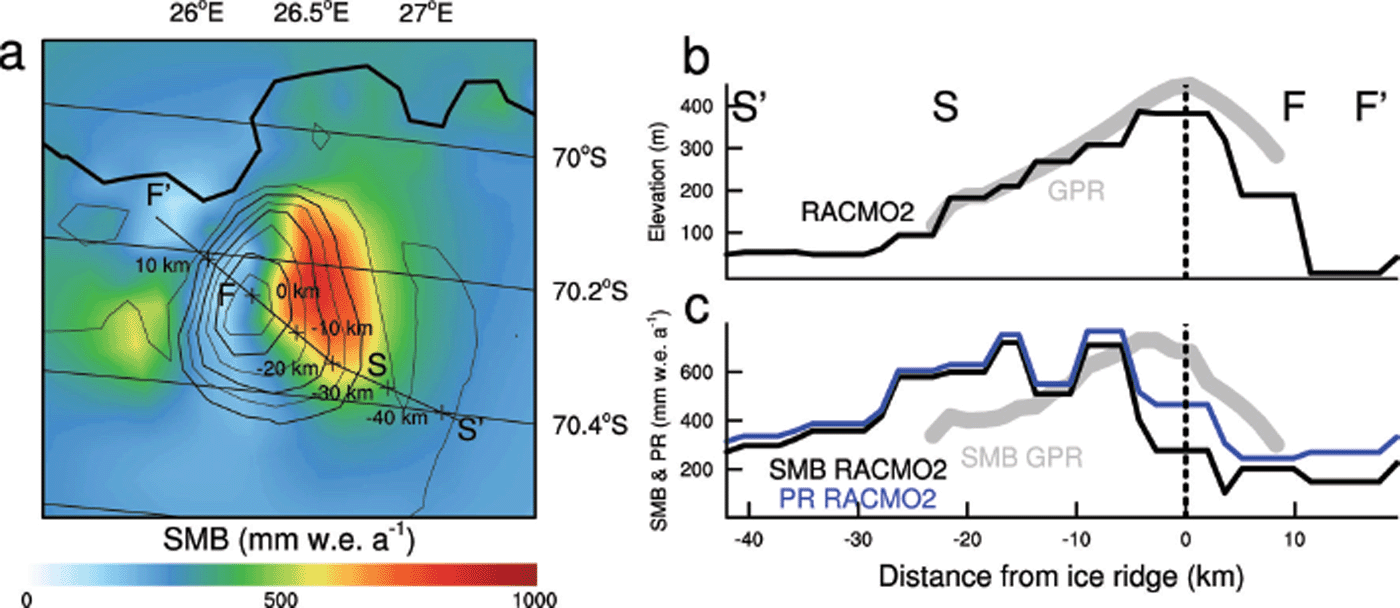
To understand this simulated SMB variability and compare it with observations in more detail, we zoom in further on the region around Derwael Ice Rise. Figure 6a shows the simulated SMB and the location of the GPR transect across the ice rise, which is parallel to the prevailing near-surface wind direction. The elevation of this transect, measured by kinematic GPS, is shown in Figure 6b. The elevation in RACMO2 (derived from Reference Bamber, Gomez-Dans and GriggsBamber and others, 2009) compares well with the observed elevation, despite an underestimation (~50 m) of the elevation of the divide. This allows for comparison between the observed and simulated SMB along the same transect in Figure 6c. The GPR-estimated SMB shows a gradual increase from 350 ± 40 to 750 ± 40 mm w.e. a-1 east of the divide; the maximum SMB is located ~15 km east of the divide. From there, SMB sharply decreases in a northwesterly direction. RACMO2 captures the SMB variability reasonably well, although the SMB maximum is displaced to the west by ~5 km. Possible reasons for the discrepancies between model and observations, apart from the inherent model uncertainty and erroneous topography of Derwael Ice Rise in RACMO2 (Fig. 6b), can be ascribed to (1) the assumption of a constant surface snow density in the conversion process from measured two-way travel time of the GPR reflection horizons to SMB and (2) false tracking of reflection horizons in the GPR.
(a) RACMO2 mean (2001–12) annual SMB around Derwael Ice Rise and location of transect. (b) Elevation profile and (c) mean SMB along the transect according to RACMO2 (black) and derived from the GPR observations (grey; Fig. 2). RACMO2 precipitation, PR, is shown in blue in (c). The vertical dotted line in (b, c) shows the location of the divide. The crosses and numbers in (a) correspond to the distance from the ice ridge, equivalent to the x –axis in (b, c).
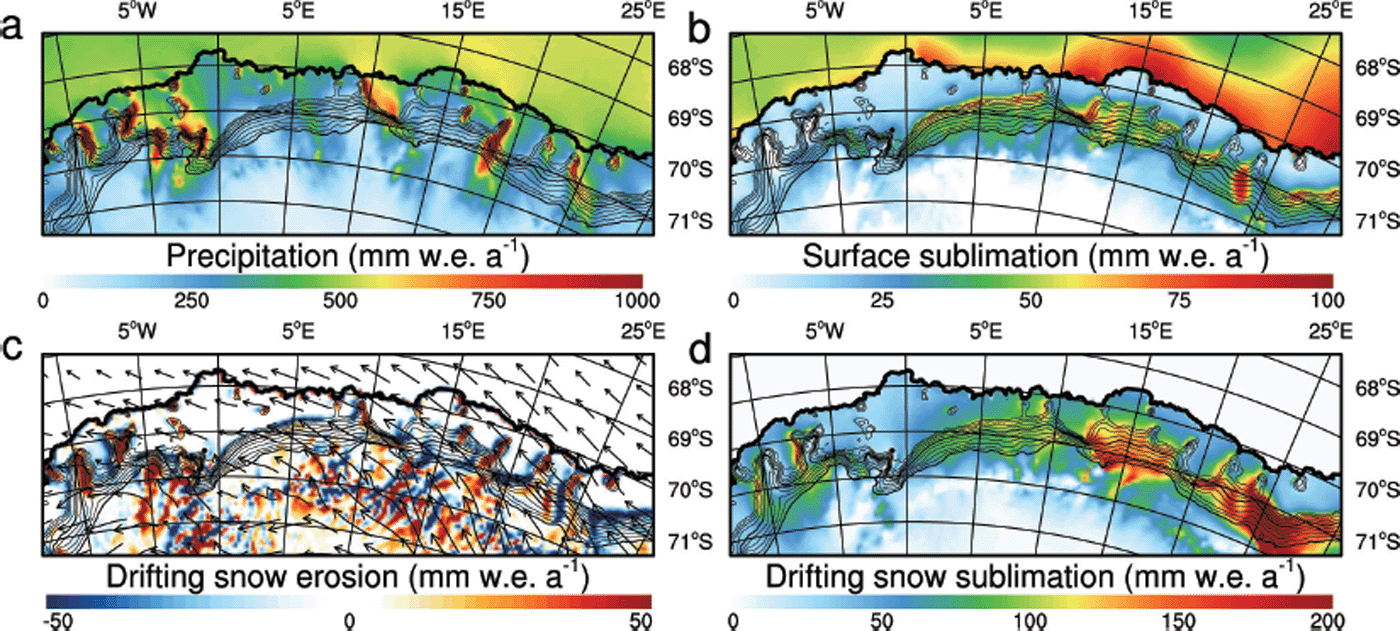
Next, we analyse which processes determine this significant spatial variability in SMB. Figure 7 shows the individual simulated SMB components. Precipitation clearly dominates the SMB variability, with large values on the northeastern flanks of the topographic features. This signal is primarily driven by orographic lifting of the relatively humid air that originates from the Southern Ocean. These synoptic precipitation events typically occur only a few (0–5) times per year at irregular intervals, and are related to an atmospheric net southward transport of (sub)tropical moisture (Reference Noone, Turner and MulvaneyNoone and others, 1999; Reference Reijmer and Van den BroekeReijmer and Van den Broeke, 2001; Reference Schlosser, Manning, Powers, Duda, Birnbaum and FujitaSchlosser and others, 2010; Reference Lenaerts, Van Meijgaard, Van den Broeke, Ligtenberg, Horwath and IsakssonLenaerts and others, 2013), sometimes organized in plumes or ‘atmospheric rivers’ (Reference Gorodetskaya, Tsukernik, Claes, Ralph, Neff and Van LipzigGorodetskaya and others, 2014b). This moist air is transported in a southwesterly direction over the flat sea ice and ice shelf, until the flow encounters an ice rise or promontory, leading to locally enhanced precipitation. Note that the direction of moisture flux, driven by synoptic forcing, is northeasterly, and therefore diverges from the mean wind direction (Fig. 3), the latter typically directed from the east to southeast. On the southwestern side of the ice rise, the atmospheric air column has lost part of its moisture, resulting in a precipitation shadow, where precipitation is an estimated factor of 3–10 lower than on the northeastern sides (Fig. 7a).
RACMO2 mean (2001–12) annual SMB components: (a) precipitation; (b) surface sublimation; (c) drifting snow erosion; (d) drifting snow sublimation. Topography is shown in black contours with a resolution of 100 m.
Such a strong but short-lived character of DML precipitation events is evident from the SMB and snowfall record at PE base from 2009 to 2012 (Fig. 8). The years 2009 and 2011 were characterized by several large accumulation events (Reference Lenaerts, Van Meijgaard, Van den Broeke, Ligtenberg, Horwath and IsakssonLenaerts and others, 2013; Reference Gorodetskaya, Tsukernik, Claes, Ralph, Neff and Van LipzigGorodetskaya and others, 2014b), whereas 2010 and 2012 had no such events. The timing of the two large accumulation events for which snowfall radar data are available (events 1 and 2 in Fig. 8) is very well captured by RACMO2. The model appears to simulate the amount of snowfall well during such events, with RACMO2 indicating 43 mm w.e. of snowfall during event 1 (36 ± 8 mm w.e. according to the radar, depending on the choice of the Ze/S relationship) and 91 mm w.e. during event 2 (69 ± 16 mm w.e. for the snowfall radar).
Cumulative SMB for 2009–12 at PE base according to RACMO2 (blue) and the observations (red). RACMO2 SMB components are depicted with the dashed line (PR), dotted line (total sublimation) and dash–dotted line (snow erosion). The green lines show the MRR-derived daily snowfall (right axis). Note that the MRR was offline for prolonged periods before and during 2011, shown by the horizontal green dots. ‘1’ and ‘2’ denote snowfall events 1 (14–18 February) and 2 (13–20 December 2011).
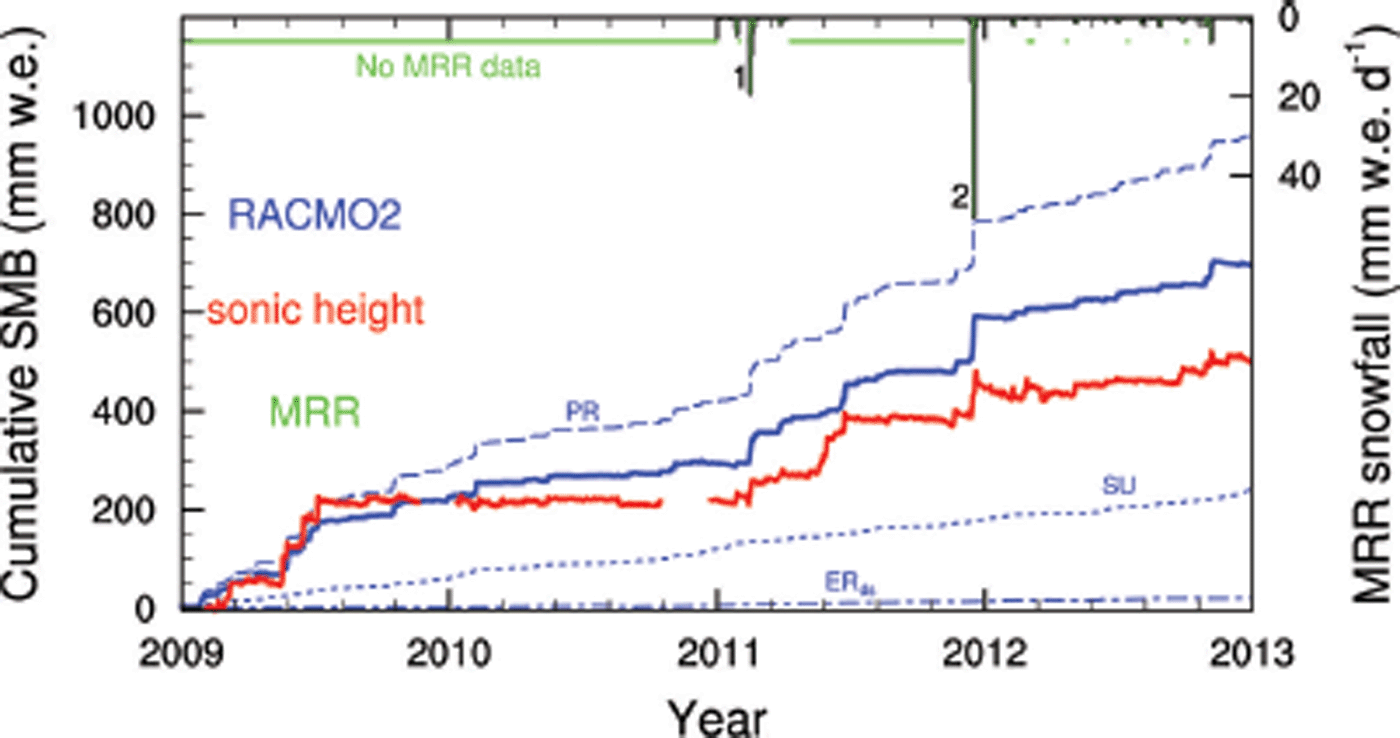
RACMO2 suggests higher SMB at PE than the observations, because the model underestimates surface lowering directly following strong snowfall events (Fig. 8); this is probably related to snow compaction (which cannot be corrected for in the observed accumulation record in the absence of continuous surface snow measurements) and/or to the model underestimating local snow erosion after accumulation events. The observed SMB was largest in 2009 (230 mm w.e.), followed by 2011 (227 mm w.e.). In contrast, 2010 (23 mm w.e.) and 2012 (52 mm w.e.) were much drier years. This is also simulated in RACMO2, with high SMB in 2011 (297 mm w.e.) and 2009 (225 mm w.e.), and much lower SMB in 2010 (69 mm w.e.) and 2012 (106 mm w.e.). The model output underscores the significant interannual variability of SMB in DML.
Apart from precipitation, RACMO2 suggests that drifting snow processes are also important for the ice-rise SMB (Figs 7c and d). Snow erosion (20–100 mm w.e. a-1) occurs just alee of ice-rise ridges, where near-surface winds pick up; the eroded snow is deposited (i.e. negative ERds) further down the ice rise, where winds slow down again (Fig. 7c). Drifting snow sublimation is largest (50–200 mm w.e. a-1) in the windy and dry ice-shelf areas leeward of the ice rises. Unlike drifting snow processes, surface sublimation is small around ice rises (< 20 mm w.e. a-1; Fig. 7b). Although the individual SMB components cannot be quantified, higher observed surface snow densities, the visual evidence of the presence of many more sastrugi, and larger surface snow grains in satellite products (Reference Scambos, Haran, Fahnestock, Painter and BohlanderScambos and others, 2007) confirm that snow erosion is significant on downwind slopes of Antarctic ice rises. Drifting snow sublimation, and drifting snow erosion even more so, show strong spatial variability, not only on the regional scale, which is resolved by RACMO2 (Fig. 7b and c), but also on much finer, subkilometre scales, related to small undulations in surface topography and wind field. This is especially true in low-precipitation regions, such as on the lee side of ice rises (Fig. 5). In light of the realistic simulation of snowfall by RACMO2 (Fig. 8), it is likely that small-scale drifting snow phenomena, which are not resolved by RACMO2, may explain, at least partly, the discrepancy between model and observations.
Conclusions
This paper presents the imprint of ice rises on the regional climate and SMB, with a focus on coastal DML. We use a combination of high-resolution regional climate model data (2001–12) and observational data from weather stations, snow stakes, firn cores, GPR and a snowfall radar. We demonstrate that, although ice-shelf climate and SMB are generally homogeneous, ice rises strongly enhance spatial climate and SMB variability. Despite their higher elevations, ice rises are not colder than ice shelves, as they protrude from the surface-based temperature inversion in winter. Although the near-surface winds are predominantly between east and southeast, induced by katabatic forcing, the mean moisture flux is directed from the northeast. Therefore we find highest orographic precipitation on the northeastern slopes, with a precipitation shadow on the other side. Drifting snow processes occur predominantly on the down-wind (western) sides of ice rises. The resulting SMB is significantly (2–6 times) higher on northeastern ice-rise slopes than on the ice shelf.
This study has three main implications for glaciological studies. Firstly, the SMB gradient across ice rises (which is shown here to be a generic feature) directly translates into variable annual layer thicknesses on both sides of the divide; older ice can be found in the low-SMB regime, a higher temporal resolution in the high-SMB regime. This is of interest for ice cores drilled, for example,. within the International Partnerships in Ice Core Sciences (IPICS) 2k/40k arrays (Reference Brook, Wolff, Jensen, Fischer, Steig and ConnolleyBrook and others, 2006).
Secondly, the basal mass balance of ice shelves has recently been determined in a mass-budget approach (Reference DepoorterDepoorter and others, 2013; Reference Rignot, Jacobs, Mouginot and ScheuchlRignot and others, 2013), using measured ice thickness and surface velocities combined with SMB from RACMO2. However, ice rises cause a precipitation shadow on ice shelves, a feature that is not resolved in RACMO2 with such a horizontal resolution (27 km; Reference Lenaerts, Van den Broeke, Van de Berg, Van Meijgaard and MunnekeLenaerts and others, 2012a). This results in an underestimation of the basal melt rates near the downwind side of ice rises using the mass-budget method.
Finally, the internal stratigraphy tends to arch upwards beneath the divide of some ice rises (‘Raymond bumps’). This feature can be used as a proxy for the regional palaeoice-flow dynamics (e.g. Reference Conway, Hall, Denton, Gades and WaddingtonConway and others, 1999; Reference Martín, Hindmarsh and NavarroMartín and others, 2006), by matching the arch amplitudes with various modelling scenarios. This study shows that the SMB gradient across ice rises is a topography-driven effect that persists over time, and which should be considered when interpreting the englacial stratigraphy of ice rises.
Author Contribution Statement
J.T.M.L. developed and led the study, performed the climate simulations with E.M. and analysed them with M.R.v.d.B., and wrote most of the paper. J.B., K.M., D.C., R.D., M.P. and F.P. assembled and analysed the firn-core and GPR data and contributed to the analysis of the combined results. C.H.R., I.V.G. and N.P.M.v.L. provided and analysed the weather station and radar data at PE base. All authors contributed to the writing of the manuscript.
Acknowledgements
The graphics in this paper are constructed using the NCAR Command Language (UCAR/NCAR/CISL/VETS, 2013). The idea for this study originated during the International Workshop on Antarctic Ice Rises, organized by K.M. with R. Hindmarsh in August 2013, with kind financial support of the Scientific Committee on Antarctic Research (SCAR), the Center for Ice, Climate and Ecosystems of the Norwegian Polar Institute (CICE), the Association of Polar Early Career Scientists (APECS), the Research Council of Norway, the British Antarctic Survey and the Climate and Cryosphere Project (CliC). This research is partly funded by the Netherlands Polar Program of the Netherlands Organization of Scientific Research (NWO). D.C. is funded through a FNRS–FRIA fellowship (Fonds National de la Recherche Scientifique, Belgium). Field data on Kupol Ciolkovskogo and Kupol Moskovskij were collected by the project IceRises, funded by the Norwegian Antarctic Research Expedition and CICE.



