





1 Introduction
A second-order theory T is complete if it decides, in the semantical sense, every second-order sentence $\phi $
in its own vocabulary i.e., if for every such
$\phi $
in its own vocabulary i.e., if for every such $\phi $
either
$\phi $
either $T\models \phi $
or
$T\models \phi $
or $T\models \neg \phi $
, or equivalently, all models of T are second-order equivalent. The question we investigate in this paper is whether every complete second-order theory is categorical in the sense that all of its models are isomorphic. Already in 1928 Fraenkel [Reference Fraenkel9] mentions this question as a question ‘calling for clarification’. Carnap [Reference Carnap, Bonk and Mosterin6] claimed a positive answer, but his proof had an error (see [Reference Awodey and Reck5]).
$T\models \neg \phi $
, or equivalently, all models of T are second-order equivalent. The question we investigate in this paper is whether every complete second-order theory is categorical in the sense that all of its models are isomorphic. Already in 1928 Fraenkel [Reference Fraenkel9] mentions this question as a question ‘calling for clarification’. Carnap [Reference Carnap, Bonk and Mosterin6] claimed a positive answer, but his proof had an error (see [Reference Awodey and Reck5]).
For mere cardinality reasons there are always complete non-categorical second-order theories. One needs only consider models of the empty vocabulary. Since there are only continuum many different second-order theories, there must be two such models of different cardinality with the same (a fortiori complete) second-order theory.
Categoricity of complete second-order theories would follow if all second-order equivalent models were isomorphic, which is not the case again for cardinality reasons. However, if $V =L$
, then countable second-order equivalent models are isomorphic [Reference Ajtai1] and, moreover, every complete finitely axiomatized second-order theory is categorical [Reference Solovay29]. But if a Cohen real is added to a model of
$V =L$
, then countable second-order equivalent models are isomorphic [Reference Ajtai1] and, moreover, every complete finitely axiomatized second-order theory is categorical [Reference Solovay29]. But if a Cohen real is added to a model of $V=L$
, then there are countable non-isomorphic second-order equivalent models [Reference Ajtai1], and if
$V=L$
, then there are countable non-isomorphic second-order equivalent models [Reference Ajtai1], and if $\aleph _1$
Cohen reals are added to a model of
$\aleph _1$
Cohen reals are added to a model of $V=L$
, there is a complete finitely axiomatized second-order theory (with a countable model) which is non-categorical [Reference Solovay29].
$V=L$
, there is a complete finitely axiomatized second-order theory (with a countable model) which is non-categorical [Reference Solovay29].
Fraïssé [Reference Fraïssé10, Reference Fraïssé11] conjectured that countable second-order equivalent ordinals are equal. Marek [Reference Marek20, Reference Marek21] showed that Fraïssé’s conjecture is true under the assumption $V=L$
, and false in a forcing extension obtained by collapsing an inaccessible cardinal to
$V=L$
, and false in a forcing extension obtained by collapsing an inaccessible cardinal to $\omega _1$
.
$\omega _1$
.
The ambitious goal in the area of this paper is to decide in a definitive way the status of categoricity of complete second-order theories. Since we are dealing with a question that cannot be decided in ZFC alone, it is natural to make an assumption such as PD, a consequence of the existence of large cardinals (e.g., infinitely many Woodin cardinals). We offer a partial solution to the full question by solving the case of second-order theories with countable models. We have also partial results about theories with uncountable models. In particular, we show that a non-categorical complete finitely axiomatized second-order theory can always be obtained by (set) forcing. This shows that large cardinal assumptions cannot imply, as $V=L$
does, the categoricity of all complete finitely axiomatized second-order theories.
$V=L$
does, the categoricity of all complete finitely axiomatized second-order theories.
Notation: We recall the usual definition of the beth hierarchy: $\beth _0=\omega $
,
$\beth _0=\omega $
, $\beth _{\alpha +1}=2^{\beth _\alpha }$
, and
$\beth _{\alpha +1}=2^{\beth _\alpha }$
, and $\beth _\nu =\sup _{\alpha <\nu }\beth _\alpha $
for limit
$\beth _\nu =\sup _{\alpha <\nu }\beth _\alpha $
for limit $\nu $
. An ordinal
$\nu $
. An ordinal $\alpha $
is called a beth fixed point if
$\alpha $
is called a beth fixed point if $\alpha =\beth _{\alpha }$
. If
$\alpha =\beth _{\alpha }$
. If $\mu $
is a cardinal, we use
$\mu $
is a cardinal, we use $\text {Fn}(I,J,\mu )$
to denote the poset of partial functions
$\text {Fn}(I,J,\mu )$
to denote the poset of partial functions $I\to J$
of cardinality
$I\to J$
of cardinality $<\mu $
, ordered by
$<\mu $
, ordered by $p\le q\iff q\subseteq p$
. The trivial poset
$p\le q\iff q\subseteq p$
. The trivial poset $\text {Fn}(\emptyset ,\emptyset ,1)$
is denoted
$\text {Fn}(\emptyset ,\emptyset ,1)$
is denoted $(\{0\},=)$
.
$(\{0\},=)$
.
We denote the second-order theory of a structure M by $\operatorname {\mathrm {Th}}_2(M)$
. A second-order theory T is complete if
$\operatorname {\mathrm {Th}}_2(M)$
. A second-order theory T is complete if $\operatorname {\mathrm {Th}}_2(M) = \operatorname {\mathrm {Th}}_2(N)$
for all
$\operatorname {\mathrm {Th}}_2(M) = \operatorname {\mathrm {Th}}_2(N)$
for all $M, N \models T$
, and T is categorical if
$M, N \models T$
, and T is categorical if $M \cong N$
for all
$M \cong N$
for all $M, N \models T$
. For second-order sentences
$M, N \models T$
. For second-order sentences $\phi , \psi $
we write
$\phi , \psi $
we write $\phi \models \psi $
to mean
$\phi \models \psi $
to mean $M \models \phi $
implies
$M \models \phi $
implies $M \models \psi $
for all M, and similarly
$M \models \psi $
for all M, and similarly $T \models T'$
for second-order theories
$T \models T'$
for second-order theories $T, T'$
, and we say T axiomatizes
$T, T'$
, and we say T axiomatizes $T'$
. If T is a finite (resp. recursive) set of sentences and
$T'$
. If T is a finite (resp. recursive) set of sentences and $T \models T'$
, we say
$T \models T'$
, we say $T'$
is finitely (resp. recursively) axiomatizable.
$T'$
is finitely (resp. recursively) axiomatizable.
A cardinal $\lambda $
is second-order characterizable if there is a second-order sentence
$\lambda $
is second-order characterizable if there is a second-order sentence $\phi $
in the empty vocabulary such that
$\phi $
in the empty vocabulary such that $N \models \phi $
if and only if
$N \models \phi $
if and only if  .
.
2 The case of $L[U]$

It is already known that if $V=L$
, then every complete finitely axiomatized second-order theory is categorical [Reference Solovay29]. We now show that this also holds if
$V=L$
, then every complete finitely axiomatized second-order theory is categorical [Reference Solovay29]. We now show that this also holds if $V = L[U]$
, and we show there are complete recursively axiomatized second-order theories that are non-categorical (with very large models).
$V = L[U]$
, and we show there are complete recursively axiomatized second-order theories that are non-categorical (with very large models).
Assuming $V=L[U]$
, we write
$V=L[U]$
, we write $\kappa $
for the sole measurable cardinal, U for the unique normal measure on
$\kappa $
for the sole measurable cardinal, U for the unique normal measure on $\kappa $
and
$\kappa $
and $<_{L[U]}$
for the canonical well-order. By a
$<_{L[U]}$
for the canonical well-order. By a $L[U]$
-premouse we mean a structure
$L[U]$
-premouse we mean a structure $(L_\alpha [W],\in ,W)$
where W is an
$(L_\alpha [W],\in ,W)$
where W is an $L_\alpha [W]$
-ultrafilter on some
$L_\alpha [W]$
-ultrafilter on some $\gamma < \alpha $
. Recall that a premouse
$\gamma < \alpha $
. Recall that a premouse $(L_\alpha [W], \in , W)$
is iterable (under taking iterated ultrapowers), i.e., that every iterate is well-founded, if and only if every iterate in an iteration of any countable length is well-founded. Observe that every iterate in an iteration of countable length has the same cardinality as the original premouse, so the iterability of a premouse is expressible in second-order logic. See for example [Reference Kanamori12, Chapter 20] for more details.
$(L_\alpha [W], \in , W)$
is iterable (under taking iterated ultrapowers), i.e., that every iterate is well-founded, if and only if every iterate in an iteration of any countable length is well-founded. Observe that every iterate in an iteration of countable length has the same cardinality as the original premouse, so the iterability of a premouse is expressible in second-order logic. See for example [Reference Kanamori12, Chapter 20] for more details.
We first make an observation requiring no assumptions beyond ZFC, already observed by Solovay in [Reference Solovay29].
Lemma 1. Suppose T is a complete finitely axiomatizable second-order theory. Then all models of T are of the same cardinality $\kappa $
, and thus
$\kappa $
, and thus $\kappa $
is second-order characterizable.
$\kappa $
is second-order characterizable.
Proof. Suppose the vocabulary of T is a single binary relation symbol R for simplicity, and suppose the second-order sentence $\phi $
axiomatizes T. Let N be a model of
$\phi $
axiomatizes T. Let N be a model of $\phi $
of least cardinality and assume, toward a contradiction, that
$\phi $
of least cardinality and assume, toward a contradiction, that $\phi $
also has a model M with
$\phi $
also has a model M with  . Let
. Let $\theta $
be the sentence
$\theta $
be the sentence
 $$\begin{align*}\exists P \exists R' (\theta'(P) \land \phi'(P, R')), \end{align*}$$
where
-
• P is a unary predicate, not occurring in
$\phi $
, and
$R'$
is a binary relation symbol not occurring in
$\phi $
. -
•
$\phi '(P,R')$
is a modification of the sentence
$\phi $
, where the first-order quantifiers
$\exists x \dots $
are relativised to P as
$\exists x (P(x) \land {\dots })$
, and each occurrence of R is replaced by
$R'$
. -
•
$\theta '(P)$
says that the cardinality of P is smaller than the ambient domain of the model (for example, that there is no injective function with range contained in P).


As $\phi $
is complete and
$\phi $
is complete and $M \models \theta $
(by taking
$M \models \theta $
(by taking $(P, R')$
isomorphic to N), also
$(P, R')$
isomorphic to N), also $N \models \theta $
, so there is a model of
$N \models \theta $
, so there is a model of $\phi $
of cardinality smaller than that of N, which is a contradiction. Thus all models of
$\phi $
of cardinality smaller than that of N, which is a contradiction. Thus all models of $\phi $
have the same cardinality
$\phi $
have the same cardinality $ \left \lvert {N} \right \rvert = \kappa $
.
$ \left \lvert {N} \right \rvert = \kappa $
.
Lastly, the observation that $\kappa $
is second-order characterizable follows from existentially quantifying all the symbols in the vocabulary of
$\kappa $
is second-order characterizable follows from existentially quantifying all the symbols in the vocabulary of $\phi $
to get a sentence in the empty vocabulary (for example,
$\phi $
to get a sentence in the empty vocabulary (for example, $\exists R \phi $
serves to characterize
$\exists R \phi $
serves to characterize $\kappa $
in this case).
$\kappa $
in this case).
Theorem 2. Assume $V = L[U]$
. Every complete finitely axiomatized second-order theory is categorical.
$V = L[U]$
. Every complete finitely axiomatized second-order theory is categorical.
Proof. Suppose $\phi $
is a complete second-order sentence in a vocabulary with a single binary relation symbol R (for simplicity), so
$\phi $
is a complete second-order sentence in a vocabulary with a single binary relation symbol R (for simplicity), so $\phi $
has models in only one cardinality by Lemma 1.
$\phi $
has models in only one cardinality by Lemma 1.
Now let $M_0$
be the
$M_0$
be the $<_{L[U]}$
-least model of
$<_{L[U]}$
-least model of $\phi $
. Suppose first that
$\phi $
. Suppose first that $ \left \lvert {M_0} \right \rvert> \kappa $
: in this case we can mimic the categoricity argument for L as follows. Let
$ \left \lvert {M_0} \right \rvert> \kappa $
: in this case we can mimic the categoricity argument for L as follows. Let $\theta $
be the sentence
$\theta $
be the sentence
 $$\begin{align*}\exists E \exists u \exists m \exists P \exists R'(\theta'(E,u) \land \phi'(P,R') \land \theta_{least}(E,u,m) \land \theta_{isom}(E,m,P,R')), \end{align*}$$
where
-
•
$E, R'$
are binary predicate symbols, P a unary predicate symbol and
$u, m$
are first-order variables, none occurring in
$\phi $
(the intuition is that E is
$\in $
, u is a normal ultrafilter, m is a structure in the vocabulary of
$\phi $
, P is the domain of m and
$R'$
is the single binary relation of m). -
•
$\theta '(E,u)$
states E is well-founded and extensional (so that E has a transitive collapse, and the domain of the model equipped with E can be thought of as a transitive set), and its collapse is a level of
$L[u]$
having a normal measure u as an element. -
•
$\phi '(P,R')$
is (as before) a modification of the sentence
$\phi $
where each first-order quantifier
$\exists x \dots $
is relativised to P as
$\exists x(P(x) \land \dots )$
, and each occurrence of R is replaced by
$R'$
. -
•
$\theta _{least}(E,u,m)$
says
$m <_{L[u]} m'$
for any other
$m' = (Q,S)$
also satisfying
$\phi '(Q,S)$
(using the formula defining the canonical well-order of
$L[u]$
with u as a parameter). -
•
$\theta _{isom}(E,m,P,R')$
states that
$m = (P,R')$
, and that
$(P,R')$
is isomorphic to the ambient model (so there is an injection F with range P such that
$R(x,y) \leftrightarrow R'(F(x),F(y))$
for all
$x,y$
).


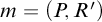


If $M \models \theta $
with witnesses E, u and
$M \models \theta $
with witnesses E, u and $m = (P,R')$
, and
$m = (P,R')$
, and $\pi \colon (M,E) \to (N,\in )$
is the transitive collapse, then
$\pi \colon (M,E) \to (N,\in )$
is the transitive collapse, then $\pi (u) = U$
is the unique normal measure U on
$\pi (u) = U$
is the unique normal measure U on $\kappa $
,
$\kappa $
, $N = L_\alpha [U]$
for some
$N = L_\alpha [U]$
for some $\alpha $
and
$\alpha $
and $\pi (m)$
is the
$\pi (m)$
is the $<_{L[U]}$
-least model
$<_{L[U]}$
-least model $M_0$
of
$M_0$
of $\phi $
, so M is isomorphic to
$\phi $
, so M is isomorphic to $M_0$
.
$M_0$
.
Conversely, let $\alpha $
be least such that
$\alpha $
be least such that $M_0 \in L_\alpha [U]$
. Then
$M_0 \in L_\alpha [U]$
. Then $\kappa < \alpha < \left \lvert {M_0} \right \rvert ^+$
and
$\kappa < \alpha < \left \lvert {M_0} \right \rvert ^+$
and $U \in L_\alpha [U]$
, so we may pick a bijection
$U \in L_\alpha [U]$
, so we may pick a bijection $\pi \colon M_0 \to L_\alpha [U]$
and let E, u and
$\pi \colon M_0 \to L_\alpha [U]$
and let E, u and $m = (P,R')$
be the preimages of
$m = (P,R')$
be the preimages of $\in $
, U and
$\in $
, U and $M_0$
under
$M_0$
under $\pi $
to witness
$\pi $
to witness $M_0 \models \theta $
.
$M_0 \models \theta $
.
Thus the above sentence $\theta $
is such that
$\theta $
is such that $M \models \theta $
if and only if M is isomorphic to the
$M \models \theta $
if and only if M is isomorphic to the $<_{L[U]}$
-least model of
$<_{L[U]}$
-least model of $\phi $
. Now if
$\phi $
. Now if $M \models \phi $
, also
$M \models \phi $
, also $M \models \theta $
by completeness of
$M \models \theta $
by completeness of $\phi $
, so M is isomorphic to
$\phi $
, so M is isomorphic to $M_0$
and
$M_0$
and $\phi $
is categorical.
$\phi $
is categorical.
Suppose now that $ \left \lvert {M_0} \right \rvert = \lambda < \kappa $
. In this case we cannot find a binary relation E on
$ \left \lvert {M_0} \right \rvert = \lambda < \kappa $
. In this case we cannot find a binary relation E on $M_0$
and
$M_0$
and $u \in M_0$
such that u is a normal measure in the transitive collapse of
$u \in M_0$
such that u is a normal measure in the transitive collapse of $(M_0,E)$
, so we modify the previously produced sentence
$(M_0,E)$
, so we modify the previously produced sentence $\theta $
. This argument relies on a straightforward modification of the
$\theta $
. This argument relies on a straightforward modification of the $\Delta ^1_3$
well-order of reals in
$\Delta ^1_3$
well-order of reals in $L[U]$
. We make the further assumption that the domain of
$L[U]$
. We make the further assumption that the domain of $M_0$
is a cardinal (and that
$M_0$
is a cardinal (and that $M_0$
is the
$M_0$
is the $<_{L[U]}$
-least among such models), and let
$<_{L[U]}$
-least among such models), and let $\theta $
be the sentence
$\theta $
be the sentence
 $$\begin{align*}\exists E \exists W \exists m \exists P \exists R'(\theta'(E,W) \land \phi'(E,P,R') \land \theta_{least}(E,W,m) \land \theta_{isom}(E,m,P,R')), \end{align*}$$
where
-
•
$E, R'$
are binary and
$W,P$
unary predicate symbols, and m a first-order variable, none occurring in
$\phi $
. -
•
$\theta '(E,W)$
states E is well-founded and extensional, whose transitive collapse is an iterable
$L[U]$
-premouse
$(L_\alpha [W],\in ,W)$
for some
$\alpha $
, where W is an
$L[W]$
-ultrafilter on some
$\gamma $
, where
$\gamma $
is an ordinal greater than the cardinality of the ambient model. -
•
$\phi '(E,P,R')$
is the sentence
$\phi '(P,R')$
from before, with the additional stipulation that the extent of the predicate P is a cardinal. -
•
$\theta _{least}(E,W,m)$
says
$m <_{L[W]} m'$
for any other
$m' = (Q,S)$
also satisfying
$\phi '(E,Q,S)$
(using the formula defining the canonical well-order of
$L[W]$
with W as a predicate). -
•
$\theta _{isom}(E,m,P,R')$
remains unchanged from earlier.


We claim that $\theta $
is a sentence such that
$\theta $
is a sentence such that $M \models \theta $
if and only if M is isomorphic to the
$M \models \theta $
if and only if M is isomorphic to the $<_{L[U]}$
-least model of
$<_{L[U]}$
-least model of $\phi $
(among models whose domain is a cardinal). So suppose
$\phi $
(among models whose domain is a cardinal). So suppose $M \models \theta $
with witnesses
$M \models \theta $
with witnesses $E, W$
and
$E, W$
and $m = (P,R')$
, and let
$m = (P,R')$
, and let $\pi \colon (M,E,W) \to (N,\in ,W')$
be the transitive collapse. Then
$\pi \colon (M,E,W) \to (N,\in ,W')$
be the transitive collapse. Then $W' = \pi " \, W$
is a N-ultrafilter on some
$W' = \pi " \, W$
is a N-ultrafilter on some $\gamma> \lambda $
and
$\gamma> \lambda $
and $N = L_\alpha [W']$
for some
$N = L_\alpha [W']$
for some $\alpha> \gamma $
, and
$\alpha> \gamma $
, and $\pi (m)$
is the
$\pi (m)$
is the $<_{L[W']}$
-least model of
$<_{L[W']}$
-least model of $\phi $
in
$\phi $
in $L_\alpha [W']$
, to which M is isomorphic.
$L_\alpha [W']$
, to which M is isomorphic.
To see why $\pi (m)$
is
$\pi (m)$
is $M_0$
, let
$M_0$
, let $j \colon L[U] \to L[F]$
and
$j \colon L[U] \to L[F]$
and $k \colon L_\alpha [W'] \to L_\delta [F]$
be long enough iterations of
$k \colon L_\alpha [W'] \to L_\delta [F]$
be long enough iterations of $L[U]$
and
$L[U]$
and $L_\alpha [W]$
respectively such that they become comparable. Then
$L_\alpha [W]$
respectively such that they become comparable. Then $\operatorname {\mathrm {crit}}(j) = \kappa> \lambda $
and
$\operatorname {\mathrm {crit}}(j) = \kappa> \lambda $
and $\operatorname {\mathrm {crit}}(k) = \gamma> \lambda $
, so
$\operatorname {\mathrm {crit}}(k) = \gamma> \lambda $
, so $j(M_0) = M_0$
and
$j(M_0) = M_0$
and $k(\pi (m)) = \pi (m)$
. By elementarity, both
$k(\pi (m)) = \pi (m)$
. By elementarity, both $M_0$
and
$M_0$
and $\pi (m)$
are now the
$\pi (m)$
are now the $<_{L[F]}$
-least model of
$<_{L[F]}$
-least model of $\phi $
among models whose domain is a cardinal, so
$\phi $
among models whose domain is a cardinal, so $\pi (m) = M_0$
and M is isomorphic to
$\pi (m) = M_0$
and M is isomorphic to $M_0$
.
$M_0$
.
Conversely, to see $M_0 \models \theta $
amounts to finding an appropriate premouse
$M_0 \models \theta $
amounts to finding an appropriate premouse $(L_\alpha [W], \in , W)$
. Let
$(L_\alpha [W], \in , W)$
. Let $\delta $
be a large enough cardinal such that
$\delta $
be a large enough cardinal such that $M_0, U \in L_\delta [U]$
, and that
$M_0, U \in L_\delta [U]$
, and that $(L_\delta [U],\in ,U)$
is an iterable premouse. Then let N be the Skolem hull of
$(L_\delta [U],\in ,U)$
is an iterable premouse. Then let N be the Skolem hull of $\lambda \cup \left \lbrace {M_0} \right \rbrace $
in
$\lambda \cup \left \lbrace {M_0} \right \rbrace $
in $L_\delta [U]$
of cardinality
$L_\delta [U]$
of cardinality $\lambda $
, and let
$\lambda $
, and let $\pi \colon (N,\in , U \cap N) \to (L_\alpha [W], \in , W)$
be the transitive collapse. Now
$\pi \colon (N,\in , U \cap N) \to (L_\alpha [W], \in , W)$
be the transitive collapse. Now $(L_\alpha [W],\in ,W)$
is also an iterable premouse with
$(L_\alpha [W],\in ,W)$
is also an iterable premouse with $ \left \lvert {L_\alpha [W]} \right \rvert = \lambda $
, W is a
$ \left \lvert {L_\alpha [W]} \right \rvert = \lambda $
, W is a $L_\alpha [W]$
-ultrafilter on some
$L_\alpha [W]$
-ultrafilter on some $\gamma = \pi (\kappa )> \lambda $
, and
$\gamma = \pi (\kappa )> \lambda $
, and $\pi (M_0) = M_0$
, so by elementarity
$\pi (M_0) = M_0$
, so by elementarity $M_0$
is the
$M_0$
is the $<_{L[W]}$
-least model of
$<_{L[W]}$
-least model of $\phi $
as required. So
$\phi $
as required. So $\theta $
is a sentence such that
$\theta $
is a sentence such that $M \models \theta $
if and only if M is isomorphic to
$M \models \theta $
if and only if M is isomorphic to $M_0$
, implying as before that
$M_0$
, implying as before that $\phi $
is categorical.
$\phi $
is categorical.
Finally, observe that the case $ \left \lvert {M_0} \right \rvert = \kappa $
is impossible, since the measurable cardinal
$ \left \lvert {M_0} \right \rvert = \kappa $
is impossible, since the measurable cardinal $\kappa $
is
$\kappa $
is $\Pi ^2_1$
-indescribable. Thus
$\Pi ^2_1$
-indescribable. Thus $\phi $
is categorical.
$\phi $
is categorical.
It turns out that finite axiomatizability is key for the preceding theorem. For every second-order characterizable cardinal $\lambda> \kappa $
, we produce a non-categorical recursively axiomatizable theory whose models have cardinality
$\lambda> \kappa $
, we produce a non-categorical recursively axiomatizable theory whose models have cardinality $\lambda $
.
$\lambda $
.
Theorem 3. Assume $V = L[U]$
. Suppose
$V = L[U]$
. Suppose $\kappa $
is measurable and
$\kappa $
is measurable and $\lambda $
is second-order characterizable with
$\lambda $
is second-order characterizable with $\lambda> \kappa $
. Then there is a complete recursively axiomatizable theory T with
$\lambda> \kappa $
. Then there is a complete recursively axiomatizable theory T with $\kappa $
many non-isomorphic models of cardinality
$\kappa $
many non-isomorphic models of cardinality $\lambda $
.
$\lambda $
.
Proof. For $\alpha < \kappa $
let
$\alpha < \kappa $
let $M_\alpha = (\lambda + \alpha , <)$
, so in a structure of cardinality
$M_\alpha = (\lambda + \alpha , <)$
, so in a structure of cardinality $\lambda $
,
$\lambda $
, $M_\alpha $
is straightforwardly definable from
$M_\alpha $
is straightforwardly definable from $\alpha $
(as
$\alpha $
(as $\lambda $
is second-order characterizable). These models have the property that
$\lambda $
is second-order characterizable). These models have the property that $M_\alpha \cong M_\beta $
implies
$M_\alpha \cong M_\beta $
implies $M_\alpha = M_\beta $
.
$M_\alpha = M_\beta $
.
For a second-order sentence $\phi $
in vocabulary
$\phi $
in vocabulary $(<)$
, let
$(<)$
, let
 $$\begin{align*}S_\phi = \left\lbrace {\alpha < \kappa : M_\alpha \models \phi} \right\rbrace , \end{align*}$$
and let $T_0$
be the set of sentences
$T_0$
be the set of sentences $\phi $
such that
$\phi $
such that $S_\phi \in U$
. As U is an ultrafilter,
$S_\phi \in U$
. As U is an ultrafilter, $T_0$
is a complete theory (so for any
$T_0$
is a complete theory (so for any $\phi $
, exactly one of
$\phi $
, exactly one of $\phi \in T_0$
or
$\phi \in T_0$
or $\lnot \phi \in T_0$
hold), and by the
$\lnot \phi \in T_0$
hold), and by the $\sigma $
-completeness of U the intersection
$\sigma $
-completeness of U the intersection $X = \bigcap \left \lbrace {S_\phi : \phi \in T_0} \right \rbrace \in U$
is nonempty. The set X is such that for any
$X = \bigcap \left \lbrace {S_\phi : \phi \in T_0} \right \rbrace \in U$
is nonempty. The set X is such that for any $\alpha , \beta \in X$
, the structures
$\alpha , \beta \in X$
, the structures $M_\alpha $
,
$M_\alpha $
, $M_\beta $
have the same second-order theory
$M_\beta $
have the same second-order theory $T_0$
, so it remains to see that the theory
$T_0$
, so it remains to see that the theory $T_0$
is recursively axiomatizable.
$T_0$
is recursively axiomatizable.
For a second-order sentence $\phi $
in vocabulary
$\phi $
in vocabulary $(<)$
, let E be a binary relation symbol and u a first-order variable, neither occurring in
$(<)$
, let E be a binary relation symbol and u a first-order variable, neither occurring in $\phi $
, and let
$\phi $
, and let $\phi ^+$
be the second-order sentence
$\phi ^+$
be the second-order sentence
 $$\begin{align*}\exists E \exists u (\theta'(E,u) \land (\exists x \in u)(\forall \alpha \in x) \, M_\alpha \models \phi), \end{align*}$$
where $\theta '(E,u)$
says E is well-founded and extensional, and its transitive collapse is a level of
$\theta '(E,u)$
says E is well-founded and extensional, and its transitive collapse is a level of $L[u]$
containing
$L[u]$
containing $\lambda $
and having a normal measure u as an element. Note that
$\lambda $
and having a normal measure u as an element. Note that $\phi ^+$
is a sentence in the empty vocabulary. Intuitively,
$\phi ^+$
is a sentence in the empty vocabulary. Intuitively, $\phi ^+$
states that
$\phi ^+$
states that $M_\alpha \models \phi $
for a U-big set of ordinals
$M_\alpha \models \phi $
for a U-big set of ordinals $\alpha < \kappa $
, so for any structure N with
$\alpha < \kappa $
, so for any structure N with  we have the equivalences
 $$ \begin{align*} N \models \phi^+ &\iff \left\lbrace {\alpha < \kappa : M_\alpha \models \phi} \right\rbrace = S_\phi \in U \\ &\iff M_\alpha \models \phi \text{ for some } \alpha \in X \\ &\iff \phi \in T_0. \end{align*} $$
The import of the vocabulary of $\phi ^+$
being empty is that for a structure N, the truth of
$\phi ^+$
being empty is that for a structure N, the truth of $N \models \phi ^+$
depends only on
$N \models \phi ^+$
depends only on  , so we get that for all structures N with
  ,
,
 $$\begin{align*}N \models \phi^+ \iff M_\alpha \models \phi^+ \text{ for some } \alpha \in X \iff \phi^+ \in T_0 \end{align*}$$
so also $\phi \leftrightarrow \phi ^+ \in T_0$
for all second-order sentences
$\phi \leftrightarrow \phi ^+ \in T_0$
for all second-order sentences $\phi $
in vocabulary
$\phi $
in vocabulary $(<)$
.
$(<)$
.
Now define the recursive set of sentences
 $$\begin{align*}T = \left\lbrace {\phi \leftrightarrow \phi^+ : \phi \text{ is a second-order sentence in vocabulary } (<)} \right\rbrace. \end{align*}$$
Observe that any model N of the theory T has cardinality $\lambda $
, since taking
$\lambda $
, since taking $\theta _\lambda $
to be the second-order characterization of
$\theta _\lambda $
to be the second-order characterization of $\lambda $
, we have
$\lambda $
, we have $M_\alpha \models \theta _\lambda $
for all
$M_\alpha \models \theta _\lambda $
for all $\alpha < \kappa $
, so
$\alpha < \kappa $
, so $N \models \theta _\lambda ^+$
and thus
$N \models \theta _\lambda ^+$
and thus $N \models \theta _\lambda $
since
$N \models \theta _\lambda $
since $\theta _\lambda ^+ \leftrightarrow \theta _\lambda \in T$
.
$\theta _\lambda ^+ \leftrightarrow \theta _\lambda \in T$
.
To see that T axiomatizes $T_0$
, suppose
$T_0$
, suppose $N \models T$
so
$N \models T$
so  , and that $\phi $
is a second-order sentence in the vocabulary
$\phi $
is a second-order sentence in the vocabulary $(<)$
, so either
$(<)$
, so either $\phi \in T_0$
or
$\phi \in T_0$
or $\lnot \phi \in T_0$
. In the former case we have
$\lnot \phi \in T_0$
. In the former case we have $S_\phi \in U$
so
$S_\phi \in U$
so $N \models \phi ^+$
, so
$N \models \phi ^+$
, so $N \models \phi $
, and in the latter case we have
$N \models \phi $
, and in the latter case we have $S_{\lnot \phi } \in U$
so
$S_{\lnot \phi } \in U$
so $N \models \lnot \phi $
. Thus
$N \models \lnot \phi $
. Thus $\operatorname {\mathrm {Th}}_2(N) = T_0$
, so T recursively axiomatizes
$\operatorname {\mathrm {Th}}_2(N) = T_0$
, so T recursively axiomatizes $T_0$
as desired.
$T_0$
as desired.
In conclusion, all complete finitely axiomatizable theories are categorical in $L[U]$
as in L, and in
$L[U]$
as in L, and in $L[U]$
there are complete recursively axiomatizable second-order theories that are non-categorical (whereas this is still unknown in L).
$L[U]$
there are complete recursively axiomatizable second-order theories that are non-categorical (whereas this is still unknown in L).
3 Countable models
We already remarked earlier that if $V=L$
, then every complete finitely axiomatized second-order theory is categorical [Reference Solovay29]. We now show that for theories with a countable model this is a consequence of PD, and therefore a consequence of large cardinals.
$V=L$
, then every complete finitely axiomatized second-order theory is categorical [Reference Solovay29]. We now show that for theories with a countable model this is a consequence of PD, and therefore a consequence of large cardinals.
Theorem 4. Assume PD. Every complete finitely axiomatized second-order theory with a countable model is categorical.
Proof. Suppose $\phi $
is a complete second-order sentence with a countable model. Then all models of
$\phi $
is a complete second-order sentence with a countable model. Then all models of $\phi $
are countable by Lemma 1. Suppose
$\phi $
are countable by Lemma 1. Suppose $\phi $
is on the level
$\phi $
is on the level $\Sigma ^1_n$
of second-order logic and its vocabulary is, for simplicity, just one binary predicate symbol P. Let R be the
$\Sigma ^1_n$
of second-order logic and its vocabulary is, for simplicity, just one binary predicate symbol P. Let R be the $\Sigma ^1_n$
(lightface) set of real numbers coding models of
$\Sigma ^1_n$
(lightface) set of real numbers coding models of $\phi $
. By PD and its consequence, the Projective Uniformization theorem [Reference Moschovakis24, Theorem 6C5], there is a
$\phi $
. By PD and its consequence, the Projective Uniformization theorem [Reference Moschovakis24, Theorem 6C5], there is a $\Sigma ^1_{n+1}$
(even
$\Sigma ^1_{n+1}$
(even $\Sigma ^1_n$
if n is even) element r in R. Suppose r codes the model M of
$\Sigma ^1_n$
if n is even) element r in R. Suppose r codes the model M of $\phi $
. We show that every model of
$\phi $
. We show that every model of $\phi $
is isomorphic to M. Suppose N is a model of
$\phi $
is isomorphic to M. Suppose N is a model of $\phi $
. Let
$\phi $
. Let $\theta $
be the following second-order sentence:
$\theta $
be the following second-order sentence:
 $$ \begin{align*}\begin{array}{l} \exists Q_+\exists Q_{\times}(\theta_1(Q_+,Q_{\times})\wedge\exists A (\theta_2(Q_+,Q_{\times},A)\wedge\\[4pt] \exists B(\theta_3(Q_+,Q_{\times},A,B)\wedge \exists F\theta_4(F,B)))), \end{array}\end{align*} $$
where
-
•
$\theta _1(Q_+,Q_{\times })$
is the standard second-order characterization of
$({\mathbb {N}},+,\times )$
. -
•
$\theta _2(Q_+,Q_{\times },A)$
says that the set A satisfies the
$\Sigma ^1_{n+1}$
definition of r in terms of
$Q_+$
and
$Q_{\times }$
. -
•
$\theta _3(Q_+,Q_{\times },A,B)$
says in a domain N that
$(N,B)$
is the binary structure coded by A in terms of
$Q_+$
and
$Q_{\times }$
. -
•
$\theta _4(F,B)$
is the second-order sentence which says that F is a bijection and
$$ \begin{align*}\forall x\forall y(P(x,y)\leftrightarrow B(F(x),F(y))).\end{align*} $$


Thus, $\theta $
essentially says “I am isomorphic to the model coded by r.” Trivially,
$\theta $
essentially says “I am isomorphic to the model coded by r.” Trivially, $M\models \theta $
. Recall that
$M\models \theta $
. Recall that $M\models \phi $
. Since
$M\models \phi $
. Since $\phi $
is complete,
$\phi $
is complete, $\phi \models \theta $
. Therefore our assumption
$\phi \models \theta $
. Therefore our assumption $N\models \phi $
implies
$N\models \phi $
implies $N\models \theta $
and therefore
$N\models \theta $
and therefore $N\cong M$
.
$N\cong M$
.
We make a few remarks about the proof. First, if $n=2$
, then we can use the Novikov–Kondo–Addison Uniformization theorem and PD is not needed. Thus we obtain:
$n=2$
, then we can use the Novikov–Kondo–Addison Uniformization theorem and PD is not needed. Thus we obtain:
Corollary 5. A complete $\Sigma ^1_2$
-sentence of second-order logic with a countable model is always categorical.
$\Sigma ^1_2$
-sentence of second-order logic with a countable model is always categorical.
Second, the above proof gives also the following more general result: Assume $\mathrm {Det}(\mathbf {\Delta }^1_{2n})$
. Suppose T is a recursively axiomatized theory on the
$\mathrm {Det}(\mathbf {\Delta }^1_{2n})$
. Suppose T is a recursively axiomatized theory on the $\Sigma ^1_{2n+2}$
-level of second-order logic, which is complete for sentences on this level of second-order logic. Then T is categorical.
$\Sigma ^1_{2n+2}$
-level of second-order logic, which is complete for sentences on this level of second-order logic. Then T is categorical.
An essential ingredient of the proof of Theorem 4 was the assumption that the complete second-order theory is finitely axiomatized. The following theorem shows that “finitely” cannot be replaced by “recursively”.
Theorem 6. Assume PD. There is a recursively axiomatized complete second-order theory with $2^\omega $
non-isomorphic countable models.
$2^\omega $
non-isomorphic countable models.
Proof. For any $x\subseteq \omega $
let
$x\subseteq \omega $
let
 $$ \begin{align*}M_x=(V_\omega\cup\{y\subseteq\omega : y\equiv_T x\},\in),\end{align*} $$
where $y\equiv _Tx$
means that y and x are Turing-equivalent. We denote the second-order theory of
$y\equiv _Tx$
means that y and x are Turing-equivalent. We denote the second-order theory of $M_x$
by
$M_x$
by $\operatorname {\mathrm {Th}}_2(M_x)$
. By construction,
$\operatorname {\mathrm {Th}}_2(M_x)$
. By construction, $x\equiv _Ty$
implies
$x\equiv _Ty$
implies $\operatorname {\mathrm {Th}}_2(M_x)=\operatorname {\mathrm {Th}}_2(M_y)$
. On the other hand, if
$\operatorname {\mathrm {Th}}_2(M_x)=\operatorname {\mathrm {Th}}_2(M_y)$
. On the other hand, if $x\not \equiv _T y$
, then clearly
$x\not \equiv _T y$
, then clearly $M_x\ncong M_y$
. If
$M_x\ncong M_y$
. If $\phi $
is a second-order sentence, then ‘
$\phi $
is a second-order sentence, then ‘ $M_x\models \phi $
’ is a projective property of x, closed under
$M_x\models \phi $
’ is a projective property of x, closed under $\equiv _T$
, and hence by Turing Determinacy for projective sets [Reference Martin22] has a constant truth value on a cone of reals x. By intersecting the cones we get a cone C of reals x on which
$\equiv _T$
, and hence by Turing Determinacy for projective sets [Reference Martin22] has a constant truth value on a cone of reals x. By intersecting the cones we get a cone C of reals x on which $\operatorname {\mathrm {Th}}_2(M_x)$
is constant. For any second-order
$\operatorname {\mathrm {Th}}_2(M_x)$
is constant. For any second-order $\phi $
let
$\phi $
let $\phi ^+$
be the second-order sentence
$\phi ^+$
be the second-order sentence
 $$ \begin{align*}"M_y\models\phi \text{ for a cone of} y"\end{align*} $$
and $\hat {\phi }$
the sentence
$\hat {\phi }$
the sentence $\phi \leftrightarrow \phi ^+$
. Let us consider the recursive second-order theory T consisting of
$\phi \leftrightarrow \phi ^+$
. Let us consider the recursive second-order theory T consisting of $\hat {\phi }$
, when
$\hat {\phi }$
, when $\phi $
ranges over second-order sentences in the vocabulary of the structures
$\phi $
ranges over second-order sentences in the vocabulary of the structures $M_x$
. We may immediately conclude that T is complete, for if a second-order sentence
$M_x$
. We may immediately conclude that T is complete, for if a second-order sentence $\phi $
is given, then by the choice of C either
$\phi $
is given, then by the choice of C either $M_x\models \phi $
for
$M_x\models \phi $
for $x\in C$
or
$x\in C$
or $M_x\models \neg \phi $
for
$M_x\models \neg \phi $
for $x\in C$
. In the first case
$x\in C$
. In the first case $\hat {\phi }\models \phi $
and in the second case
$\hat {\phi }\models \phi $
and in the second case $\hat {\phi }\models \neg \phi $
. Therefore,
$\hat {\phi }\models \neg \phi $
. Therefore, $T\models \phi $
or
$T\models \phi $
or $T\models \neg \phi $
. There are a continuum of non Turing equivalent reals in the cone C. Hence there are a continuum of non-isomorphic
$T\models \neg \phi $
. There are a continuum of non Turing equivalent reals in the cone C. Hence there are a continuum of non-isomorphic $M_x$
with
$M_x$
with $x\in C$
.
$x\in C$
.
4 Models of cardinality
$\aleph _1$

Next, we show that the $(*)$
axiom (see [Reference Woodin31, Definition 4.33]) has categoricity consequences for theories with a model of cardinality
$(*)$
axiom (see [Reference Woodin31, Definition 4.33]) has categoricity consequences for theories with a model of cardinality $\aleph _1$
. Thus these consequences can also be derived from forcing axioms, namely MM
$\aleph _1$
. Thus these consequences can also be derived from forcing axioms, namely MM $^{++}$
which implies the
$^{++}$
which implies the $(*)$
axiom (as shown in [Reference Asperó and Schindler4]). The following theorem answers a question of Veličković.
$(*)$
axiom (as shown in [Reference Asperó and Schindler4]). The following theorem answers a question of Veličković.
Theorem 7. Assume $(*)$
. Then there is a complete finitely axiomatizable second-order theory with
$(*)$
. Then there is a complete finitely axiomatizable second-order theory with $\omega _2 \,(=2^{\omega _1})$
non-isomorphic models of cardinality
$\omega _2 \,(=2^{\omega _1})$
non-isomorphic models of cardinality $\aleph _1$
.
$\aleph _1$
.
Proof. The pertinent consequence of $(*)$
is the quasihomogeneity of NS
$(*)$
is the quasihomogeneity of NS $_{\omega _1}$
, the nonstationary ideal on
$_{\omega _1}$
, the nonstationary ideal on $\omega _1$
(see [Reference Woodin31, Section 5.8], particularly Definition 5.102). We take “NS
$\omega _1$
(see [Reference Woodin31, Section 5.8], particularly Definition 5.102). We take “NS $_{\omega _1}$
is quasihomogeneous” to be the following statement: if
$_{\omega _1}$
is quasihomogeneous” to be the following statement: if $X \subseteq {\mathcal {P}}(\omega _1)$
is ordinal definable from parameters in
$X \subseteq {\mathcal {P}}(\omega _1)$
is ordinal definable from parameters in ${\mathbb {R}} \cup \{$
NS
${\mathbb {R}} \cup \{$
NS $_{\omega _1}\}$
, and X is closed under equality modulo NS
$_{\omega _1}\}$
, and X is closed under equality modulo NS $_{\omega _1}$
, and X contains one bistationary (i.e., stationary and co-stationary) subset of
$_{\omega _1}$
, and X contains one bistationary (i.e., stationary and co-stationary) subset of $\omega _1$
, then X contains every bistationary subset of
$\omega _1$
, then X contains every bistationary subset of $\omega _1$
.
$\omega _1$
.
We focus on the $\omega _1$
-like dense linear orders
$\omega _1$
-like dense linear orders $\Phi (A)$
classified by Conway in [Reference Conway7], see also [Reference Nadel and Stavi25, Section 3]. Recall that for
$\Phi (A)$
classified by Conway in [Reference Conway7], see also [Reference Nadel and Stavi25, Section 3]. Recall that for $A \subseteq \omega _1$
, the linear order
$A \subseteq \omega _1$
, the linear order $\Phi (A)$
is the concatenation
$\Phi (A)$
is the concatenation $\Phi (A) = 1+\eta + \sum _{\alpha < \omega _1} \eta _\alpha $
, where
$\Phi (A) = 1+\eta + \sum _{\alpha < \omega _1} \eta _\alpha $
, where $\eta $
denotes the order-type of the rationals, and
$\eta $
denotes the order-type of the rationals, and
 $$\begin{align*}\eta_\alpha = \begin{cases} \eta, & \alpha \notin A \\ 1+\eta, & \alpha \in A. \end{cases} \end{align*}$$
To wit, $\Phi (A)$
encodes the set A in that the initial segment
$\Phi (A)$
encodes the set A in that the initial segment $1 + \eta + \sum _{\alpha < \gamma } \eta _\alpha $
has a supremum in
$1 + \eta + \sum _{\alpha < \gamma } \eta _\alpha $
has a supremum in $\Phi (A)$
just in case
$\Phi (A)$
just in case $\gamma \in A$
(we add the initial
$\gamma \in A$
(we add the initial $1+\eta $
block so that
$1+\eta $
block so that $\Phi (A)$
has a left endpoint whether
$\Phi (A)$
has a left endpoint whether $0 \in A$
or not).
$0 \in A$
or not).
These linear orders have the property that $\Phi (A) \cong \Phi (B)$
if and only if
$\Phi (A) \cong \Phi (B)$
if and only if $A \mathrel {\triangle } B \in \text {NS}_{\omega _1}$
. To give a sketch of the proof, let
$A \mathrel {\triangle } B \in \text {NS}_{\omega _1}$
. To give a sketch of the proof, let $\Phi (A)_\gamma $
denote the initial segment
$\Phi (A)_\gamma $
denote the initial segment $1+\eta +\sum _{\alpha < \gamma } \eta _\alpha $
consisting of the first
$1+\eta +\sum _{\alpha < \gamma } \eta _\alpha $
consisting of the first $\gamma $
many blocks. Now if
$\gamma $
many blocks. Now if $f \colon \Phi (A) \to \Phi (B)$
is an isomorphism, the set
$f \colon \Phi (A) \to \Phi (B)$
is an isomorphism, the set
 $$\begin{align*}C = \left\lbrace {\gamma < \omega_1 : f" \, \Phi(A)_ \gamma = \Phi(B)_\gamma} \right\rbrace \end{align*}$$
is a club satisfying $A \cap C = B \cap C$
. Conversely, if
$A \cap C = B \cap C$
. Conversely, if $A \cap C = B \cap C$
for a club
$A \cap C = B \cap C$
for a club $C = \langle \gamma _\alpha : \alpha < \omega _1 \rangle $
enumerated in increasing order, we may choose isomorphisms between
$C = \langle \gamma _\alpha : \alpha < \omega _1 \rangle $
enumerated in increasing order, we may choose isomorphisms between $\Phi (A)_{\gamma _{\alpha +1}} \setminus \Phi (A)_{\gamma _\alpha }$
and
$\Phi (A)_{\gamma _{\alpha +1}} \setminus \Phi (A)_{\gamma _\alpha }$
and $\Phi (B)_{\gamma _{\alpha +1}} \setminus \Phi (B)_{\gamma _\alpha }$
for each
$\Phi (B)_{\gamma _{\alpha +1}} \setminus \Phi (B)_{\gamma _\alpha }$
for each $\alpha < \omega _1$
, which give a piecewise definition for an isomorphism between
$\alpha < \omega _1$
, which give a piecewise definition for an isomorphism between $\Phi (A)$
and
$\Phi (A)$
and $\Phi (B)$
(the role of the club C is to guarantee that either both, or neither, of the above pieces of
$\Phi (B)$
(the role of the club C is to guarantee that either both, or neither, of the above pieces of $\Phi (A)$
and
$\Phi (A)$
and $\Phi (B)$
have left endpoints).
$\Phi (B)$
have left endpoints).
Now for a second-order sentence $\phi $
in vocabulary
$\phi $
in vocabulary $(<)$
, the set
$(<)$
, the set
 $$\begin{align*}X_\phi = \left\lbrace {S \subseteq \omega_1 : S \text{ bistationary}, \Phi(S) \models \phi} \right\rbrace \end{align*}$$
is ordinal definable, and closed under equality modulo NS $_{\omega _1}$
, so the quasihomogeneity of NS
$_{\omega _1}$
, so the quasihomogeneity of NS $_{\omega _1}$
implies that
$_{\omega _1}$
implies that $X_\phi $
contains either every bistationary subset of
$X_\phi $
contains either every bistationary subset of $\omega _1$
, or none of them.
$\omega _1$
, or none of them.
This shows the models $\Phi (S)$
for bistationary
$\Phi (S)$
for bistationary $S \subseteq \omega _1$
all have the same complete second-order theory, which is thus non-categorical. This theory is axiomatized by the second-order sentence in vocabulary
$S \subseteq \omega _1$
all have the same complete second-order theory, which is thus non-categorical. This theory is axiomatized by the second-order sentence in vocabulary $(<)$
expressing “I am isomorphic to
$(<)$
expressing “I am isomorphic to $\Phi (S)$
for some bistationary
$\Phi (S)$
for some bistationary $S \subseteq \omega _1$
”, so it is finitely axiomatizable, as required.
$S \subseteq \omega _1$
”, so it is finitely axiomatizable, as required.
Some categoricity consequences of $(*)$
can already be derived from AD, the axiom of determinacy. As the axiom
$(*)$
can already be derived from AD, the axiom of determinacy. As the axiom $(*)$
states that
$(*)$
states that $L({\mathcal {P}}(\omega _1))$
is a homogeneous forcing extension of a model of AD by a forcing that does not add reals, the categoricity consequences of AD for theories with a model of cardinality
$L({\mathcal {P}}(\omega _1))$
is a homogeneous forcing extension of a model of AD by a forcing that does not add reals, the categoricity consequences of AD for theories with a model of cardinality $\leq \aleph _1$
also follow from
$\leq \aleph _1$
also follow from $(*)$
. (Of course, the existence of recursively axiomatized non-categorical theories under
$(*)$
. (Of course, the existence of recursively axiomatized non-categorical theories under $(*)$
is overshadowed by the existence of even finitely axiomatized such theories.)
$(*)$
is overshadowed by the existence of even finitely axiomatized such theories.)
Theorem 8. Assume AD. Then there is a complete recursively axiomatized second-order theory with at least $2^{\aleph _0}$
many models of cardinality
$2^{\aleph _0}$
many models of cardinality $\aleph _1$
.
$\aleph _1$
.
Proof. By Martin, AD implies $\omega _1 \to (\omega _1)^\omega $
, and moreover the homogeneous set given by
$\omega _1 \to (\omega _1)^\omega $
, and moreover the homogeneous set given by $\omega _1 \to (\omega _1)^\omega $
can be taken to be a club (see [Reference Kleinberg14]). We may then intersect
$\omega _1 \to (\omega _1)^\omega $
can be taken to be a club (see [Reference Kleinberg14]). We may then intersect $\omega $
many homogeneous clubs for
$\omega $
many homogeneous clubs for $\omega $
many colorings to obtain
$\omega $
many colorings to obtain $\omega _1 \to (\omega _1)^\omega _{2^\omega }$
, and the homogeneous subset can still be taken to be a club.
$\omega _1 \to (\omega _1)^\omega _{2^\omega }$
, and the homogeneous subset can still be taken to be a club.
We focus on models of the form $M_X = (\omega _1, <, X)$
for
$M_X = (\omega _1, <, X)$
for $X \in [\omega _1]^\omega $
. The second-order theory
$X \in [\omega _1]^\omega $
. The second-order theory $\operatorname {\mathrm {Th}}_2(M_X)$
in the vocabulary
$\operatorname {\mathrm {Th}}_2(M_X)$
in the vocabulary $(<,X)$
can be encoded by a real
$(<,X)$
can be encoded by a real $f(X) \in 2^\omega $
consisting of the Gödel numbers of the sentences true in
$f(X) \in 2^\omega $
consisting of the Gödel numbers of the sentences true in $M_X$
. This gives a coloring
$M_X$
. This gives a coloring $f \colon [\omega _1]^\omega \to 2^\omega $
, so we find a homogeneous club subset
$f \colon [\omega _1]^\omega \to 2^\omega $
, so we find a homogeneous club subset $H_0 \subseteq \omega _1$
such that
$H_0 \subseteq \omega _1$
such that $f(X)$
does not depend on
$f(X)$
does not depend on $X \in [H_0]^\omega $
. Hence the models
$X \in [H_0]^\omega $
. Hence the models $M_X$
with
$M_X$
with $X \in [H_0]^\omega $
all have the same complete second-order theory
$X \in [H_0]^\omega $
all have the same complete second-order theory $T_0$
, which is thus non-categorical.
$T_0$
, which is thus non-categorical.
The theory $T_0$
is axiomatized by
$T_0$
is axiomatized by
 $$\begin{align*}T = \left\lbrace {\phi \leftrightarrow \phi^+ : \phi \text{ is a second-order sentence}} \right\rbrace , \end{align*}$$
where for a given second-order sentence $\phi $
in vocabulary
$\phi $
in vocabulary $(<,X)$
, the sentence
$(<,X)$
, the sentence $\phi ^+$
expresses “there exists a club
$\phi ^+$
expresses “there exists a club $C \subseteq \omega _1$
such that
$C \subseteq \omega _1$
such that $M_X \models \phi $
for all
$M_X \models \phi $
for all $X \in [C]^\omega $
”.
$X \in [C]^\omega $
”.
For a given second-order sentence $\phi $
, if
$\phi $
, if $M_X \models \phi $
for each
$M_X \models \phi $
for each $X \in [H_0]^\omega $
, then
$X \in [H_0]^\omega $
, then $H_0$
serves to witness that
$H_0$
serves to witness that $\phi ^+$
holds, so
$\phi ^+$
holds, so $T \models \phi $
. Conversely, if
$T \models \phi $
. Conversely, if $\phi ^+$
holds, there is a club C such that
$\phi ^+$
holds, there is a club C such that $M_X \models \phi $
for every
$M_X \models \phi $
for every $X \in [C]^\omega $
, and taking
$X \in [C]^\omega $
, and taking $X \in [C \cap H_0]^\omega $
we see also that
$X \in [C \cap H_0]^\omega $
we see also that $M_X \models \phi $
for all
$M_X \models \phi $
for all $X \in [H_0]^\omega $
. Thus
$X \in [H_0]^\omega $
. Thus $T \models \phi $
for exactly those
$T \models \phi $
for exactly those $\phi $
such that
$\phi $
such that $M_X \models \phi $
for all
$M_X \models \phi $
for all $X \in [H_0]^\omega $
, so we see that T is a recursive axiomatization of the theory
$X \in [H_0]^\omega $
, so we see that T is a recursive axiomatization of the theory $T_0$
as desired.
$T_0$
as desired.
The same can be analogously derived from the $(*)$
axiom, as follows.
$(*)$
axiom, as follows.
Corollary 9. Assume $(*)$
. Then there is a complete recursively axiomatized second-order theory with
$(*)$
. Then there is a complete recursively axiomatized second-order theory with $\omega _2$
many models of cardinality
$\omega _2$
many models of cardinality $\aleph _1$
.
$\aleph _1$
.
Proof. Recall $(*)$
states that
$(*)$
states that $L({\mathcal {P}}(\omega _1)) = L({\mathbb {R}})^{{{\mathbb {P}}_{\text {max}}}}$
and AD holds in
$L({\mathcal {P}}(\omega _1)) = L({\mathbb {R}})^{{{\mathbb {P}}_{\text {max}}}}$
and AD holds in $L({\mathbb {R}})$
. As
$L({\mathbb {R}})$
. As ${{\mathbb {P}}_{\text {max}}}$
is homogeneous and does not add reals under AD (see [Reference Woodin31, Lemmas 4.40 and 4.43]),
${{\mathbb {P}}_{\text {max}}}$
is homogeneous and does not add reals under AD (see [Reference Woodin31, Lemmas 4.40 and 4.43]), $\omega _1 = \omega _1^{L({\mathbb {R}})}$
and
$\omega _1 = \omega _1^{L({\mathbb {R}})}$
and $[\omega _1]^\omega = ([\omega _1]^\omega )^{L({\mathbb {R}})}$
.
$[\omega _1]^\omega = ([\omega _1]^\omega )^{L({\mathbb {R}})}$
.
We again look at models $M_X = (\omega _1, <, X)$
for
$M_X = (\omega _1, <, X)$
for $X \in [\omega _1]^\omega $
, and working in
$X \in [\omega _1]^\omega $
, and working in $L({\mathbb {R}})$
, define a coloring
$L({\mathbb {R}})$
, define a coloring $f \colon [\omega _1]^\omega \to 2^\omega $
by
$f \colon [\omega _1]^\omega \to 2^\omega $
by
 $$\begin{align*}f(X) = r \quad \iff \quad L({\mathbb{R}}) \models {{\mathbb{P}}_{\text{max}}} \Vdash "\check r \text{ codes } \operatorname{\mathrm{Th}}_2(M_{\check X})". \end{align*}$$
That f is a well-defined total function follows from the homogeneity of ${{\mathbb {P}}_{\text {max}}}$
. By AD
${{\mathbb {P}}_{\text {max}}}$
. By AD $^{L({\mathbb {R}})}$
we find a club
$^{L({\mathbb {R}})}$
we find a club $H_0 \in L({\mathbb {R}})$
,
$H_0 \in L({\mathbb {R}})$
, $H_0 \subseteq \omega _1$
homogeneous for f. Stepping out of
$H_0 \subseteq \omega _1$
homogeneous for f. Stepping out of $L({\mathbb {R}})$
, we see that the models
$L({\mathbb {R}})$
, we see that the models $M_X$
,
$M_X$
, $X \in [H_0]^\omega $
all have the same complete second-order theory
$X \in [H_0]^\omega $
all have the same complete second-order theory $T_0$
(in
$T_0$
(in $L({\mathbb {R}})^{{\mathbb {P}}_{\text {max}}} = L({\mathcal {P}}(\omega _1))$
and in V both).
$L({\mathbb {R}})^{{\mathbb {P}}_{\text {max}}} = L({\mathcal {P}}(\omega _1))$
and in V both).
Working now in V, we again define
 $$\begin{align*}T = \left\lbrace {\phi \leftrightarrow \phi^+ : \phi \text{ is a second-order sentence}} \right\rbrace , \end{align*}$$
where for a given second-order sentence $\phi $
, the sentence
$\phi $
, the sentence $\phi ^+$
expresses “there exists a club
$\phi ^+$
expresses “there exists a club $C \subseteq \omega _1$
such that
$C \subseteq \omega _1$
such that $M_X \models \phi $
for all
$M_X \models \phi $
for all $X \in [C]^{\omega }$
”. The proof concludes analogously to the preceding theorem.
$X \in [C]^{\omega }$
”. The proof concludes analogously to the preceding theorem.
We note that $(*)$
implies
$(*)$
implies $ \left \lvert {\omega _1^\omega } \right \rvert $
to be
$ \left \lvert {\omega _1^\omega } \right \rvert $
to be $\omega _2$
, so
$\omega _2$
, so $T_0$
has
$T_0$
has $\omega _2$
many non-isomorphic models as claimed.
$\omega _2$
many non-isomorphic models as claimed.
Of course, we may also use the fact that the club filter on $\omega _1$
is an ultrafilter under AD to get another complete recursively axiomatized non-categorical second-order theory, the difference being that this theory has
$\omega _1$
is an ultrafilter under AD to get another complete recursively axiomatized non-categorical second-order theory, the difference being that this theory has $\omega _1$
many models instead. The proof, analogous to the proof of Theorem 3, is omitted.
$\omega _1$
many models instead. The proof, analogous to the proof of Theorem 3, is omitted.
Theorem 10. Assume AD. Then there is a complete recursively axiomatized second-order theory with $\omega _1$
many models of cardinality
$\omega _1$
many models of cardinality $\aleph _1$
.
$\aleph _1$
.
This proof is also easily modified to assume $(*)$
instead.
$(*)$
instead.
Corollary 11. Assume $(*)$
. Then there is a complete recursively axiomatized second-order theory with
$(*)$
. Then there is a complete recursively axiomatized second-order theory with $\omega _1$
many models of cardinality
$\omega _1$
many models of cardinality $\aleph _1$
.
$\aleph _1$
.
Thus, under $(*)$
, a complete non-categorical theory with a model of cardinality
$(*)$
, a complete non-categorical theory with a model of cardinality $\aleph _1$
may have either
$\aleph _1$
may have either $\omega _1$
or
$\omega _1$
or $\omega _2$
many non-isomorphic models. However, whether
$\omega _2$
many non-isomorphic models. However, whether $(*)$
also implies the existence of a complete non-categorical theory with a model of cardinality
$(*)$
also implies the existence of a complete non-categorical theory with a model of cardinality $\aleph _1$
but only countably many models up to isomorphism, is left open.
$\aleph _1$
but only countably many models up to isomorphism, is left open.
5 Forcing non-categoricity
We shall show (Theorem 14) that we can force, over any model of set theory, a complete finitely axiomatizable non-categorical second-order theory with a model of cardinality $\aleph _1$
. This shows that large cardinals cannot imply the categoricity of finitely axiomatizable complete second-order theories in general and, in particular, in the case that the theory has a model of cardinality
$\aleph _1$
. This shows that large cardinals cannot imply the categoricity of finitely axiomatizable complete second-order theories in general and, in particular, in the case that the theory has a model of cardinality $\aleph _1$
. This is in contrast to complete finitely axiomatizable second-order theories with a countable model, where PD implies categoricity (Theorem 4).
$\aleph _1$
. This is in contrast to complete finitely axiomatizable second-order theories with a countable model, where PD implies categoricity (Theorem 4).
Here is an outline of the proof. We start with a preparatory countably closed forcing ${\mathbb {P}}_{\omega _2}$
obtaining a generic extension
${\mathbb {P}}_{\omega _2}$
obtaining a generic extension $V[G]$
. Then we add
$V[G]$
. Then we add $\aleph _1$
Cohen reals obtaining a further generic extension
$\aleph _1$
Cohen reals obtaining a further generic extension $V[G][H]$
. In this model we consider for every
$V[G][H]$
. In this model we consider for every $x\subseteq \omega $
the model
$x\subseteq \omega $
the model
 $$ \begin{align} M_x=(HC^{V[x]},HC^V,\in). \end{align} $$
We show that if x is Cohen-generic over $V[G]$
, then the complete second-order theory of
$V[G]$
, then the complete second-order theory of $M_x$
is finitely axiomatizable (in second-order logic), and if x and y are mutually Cohen-generic over
$M_x$
is finitely axiomatizable (in second-order logic), and if x and y are mutually Cohen-generic over $V[G]$
, then
$V[G]$
, then $M_x$
and
$M_x$
and $M_y$
are second-order equivalent but non-isomorphic.
$M_y$
are second-order equivalent but non-isomorphic.
In order to use second-order logic over $\omega _1$
to define
$\omega _1$
to define $HC^V$
and express Cohen-genericity over V, we must be able to decide, by the means offered by second-order logic, which reals in
$HC^V$
and express Cohen-genericity over V, we must be able to decide, by the means offered by second-order logic, which reals in $V[G][H]$
are in V (or, equivalently, in
$V[G][H]$
are in V (or, equivalently, in $V[G]$
) and which are not. This is precisely the purpose of the preparatory forcing
$V[G]$
) and which are not. This is precisely the purpose of the preparatory forcing ${\mathbb {P}}_{\omega _2}$
. (In particular, we want this to be expressible in second-order logic over a structure of size
${\mathbb {P}}_{\omega _2}$
. (In particular, we want this to be expressible in second-order logic over a structure of size $\aleph _1$
, so we cannot simply code the ground model reals into the continuum function, or attempt to define the ground model from a relatively large parameter as shown by Laver [Reference Laver18].)
$\aleph _1$
, so we cannot simply code the ground model reals into the continuum function, or attempt to define the ground model from a relatively large parameter as shown by Laver [Reference Laver18].)
We begin by recalling the following fast club forcing ${\mathbb {P}}_{\scriptsize {\text {fast}}}$
, due to R. Jensen: Conditions are pairs
${\mathbb {P}}_{\scriptsize {\text {fast}}}$
, due to R. Jensen: Conditions are pairs $p=(c_p,E_p)$
where
$p=(c_p,E_p)$
where $c_p$
is a countable closed subset of
$c_p$
is a countable closed subset of $\omega _1$
and
$\omega _1$
and $E_p$
is club in
$E_p$
is club in $\omega _1$
. We define
$\omega _1$
. We define $(c_p,E_p) \le (c_q,E_q)$
if
$(c_p,E_p) \le (c_q,E_q)$
if $c_q$
is an initial segment of
$c_q$
is an initial segment of $c_p$
,
$c_p$
, $E_p \subseteq E_q$
, and
$E_p \subseteq E_q$
, and $c_p \setminus c_q \subseteq E_q$
. This forcing is countably closed. If we assume CH, this forcing has the
$c_p \setminus c_q \subseteq E_q$
. This forcing is countably closed. If we assume CH, this forcing has the $\aleph _2$
-c.c. It is called fast club forcing because of the following property: Suppose G is
$\aleph _2$
-c.c. It is called fast club forcing because of the following property: Suppose G is ${\mathbb {P}}_{{\scriptsize {\text {fast}}}}$
-generic. If
${\mathbb {P}}_{{\scriptsize {\text {fast}}}}$
-generic. If $C_G$
is the union of the sets
$C_G$
is the union of the sets $c_p$
such that
$c_p$
such that $p\in G$
, then the following holds: If D is any club in V, then there is
$p\in G$
, then the following holds: If D is any club in V, then there is $\alpha $
such that
$\alpha $
such that $C_G\setminus \alpha \subseteq D$
. The set
$C_G\setminus \alpha \subseteq D$
. The set $C_G$
is called a fast club (over V). We also let
$C_G$
is called a fast club (over V). We also let ${\mathbb {P}}_{\omega _2}$
denote the
${\mathbb {P}}_{\omega _2}$
denote the $\omega _2$
-length countable support iteration of
$\omega _2$
-length countable support iteration of ${\mathbb {P}}_{{\scriptsize {\text {fast}}}}$
.
${\mathbb {P}}_{{\scriptsize {\text {fast}}}}$
.
Let ${\mathbb {Q}}$
be the poset
${\mathbb {Q}}$
be the poset $\text {Fn}(\omega _1\times \omega ,2,\omega )$
for adding
$\text {Fn}(\omega _1\times \omega ,2,\omega )$
for adding $\aleph _1$
Cohen reals. We use fast club forcing to build a preparatory iterated forcing in such a way that after forcing with
$\aleph _1$
Cohen reals. We use fast club forcing to build a preparatory iterated forcing in such a way that after forcing with ${\mathbb {Q}}$
the ground model reals are second-order definable from any set
${\mathbb {Q}}$
the ground model reals are second-order definable from any set $A\subseteq \omega _1$
with a certain second-order property.
$A\subseteq \omega _1$
with a certain second-order property.
The following lemma is crucial. For technical reasons, we must force with ${\mathbb {P}}_{{\scriptsize {\text {fast}}}}$
followed by a
${\mathbb {P}}_{{\scriptsize {\text {fast}}}}$
followed by a $\sigma $
-closed forcing
$\sigma $
-closed forcing $\dot {\mathbb {R}}$
(which will be the tail of an iteration), but we will be interested in only the
$\dot {\mathbb {R}}$
(which will be the tail of an iteration), but we will be interested in only the ${\mathbb {P}}_{\scriptsize {\text {fast}}}$
components of the forcing conditions: thus, for
${\mathbb {P}}_{\scriptsize {\text {fast}}}$
components of the forcing conditions: thus, for $p = (p_0, \dot p_1) \in {\mathbb {P}}_{\scriptsize {\text {fast}}} * \dot {\mathbb {R}}$
let
$p = (p_0, \dot p_1) \in {\mathbb {P}}_{\scriptsize {\text {fast}}} * \dot {\mathbb {R}}$
let $c_p = c_{p_0}$
denote the stem of the first component of p, and let
$c_p = c_{p_0}$
denote the stem of the first component of p, and let $C_G = \bigcup \left \lbrace {c_p : p \in G} \right \rbrace $
denote the fast club added by the first component of the generic
$C_G = \bigcup \left \lbrace {c_p : p \in G} \right \rbrace $
denote the fast club added by the first component of the generic $G \subseteq {\mathbb {P}}_{\scriptsize {\text {fast}}} * \dot {\mathbb {R}}$
. As the notation suggests, the tail forcing
$G \subseteq {\mathbb {P}}_{\scriptsize {\text {fast}}} * \dot {\mathbb {R}}$
. As the notation suggests, the tail forcing $\dot {\mathbb {R}}$
plays little to no part in the below lemma, and we only require it to be
$\dot {\mathbb {R}}$
plays little to no part in the below lemma, and we only require it to be $\sigma $
-closed. We thank the referee for suggesting this correction to an earlier draft of this proof.
$\sigma $
-closed. We thank the referee for suggesting this correction to an earlier draft of this proof.
Say a set $A \subseteq \omega _1$
nearly constructs a club
$A \subseteq \omega _1$
nearly constructs a club $C \subseteq \omega _1$
if there is a club
$C \subseteq \omega _1$
if there is a club $D \subseteq C$
such that
$D \subseteq C$
such that $D \cap \alpha \in L[A]$
for all
$D \cap \alpha \in L[A]$
for all $\alpha < \omega _1$
.
$\alpha < \omega _1$
.
Lemma 12. Suppose ${\mathbb {P}} = {\mathbb {P}}_{\scriptsize {\text {fast}}} * \dot {\mathbb {R}}$
consists of fast club forcing
${\mathbb {P}} = {\mathbb {P}}_{\scriptsize {\text {fast}}} * \dot {\mathbb {R}}$
consists of fast club forcing ${\mathbb {P}}_{\scriptsize {\text {fast}}}$
and some
${\mathbb {P}}_{\scriptsize {\text {fast}}}$
and some $\sigma $
-closed forcing
$\sigma $
-closed forcing $\dot {\mathbb {R}} \in V^{{\mathbb {P}}_{\scriptsize {\text {fast}}}}$
, and
$\dot {\mathbb {R}} \in V^{{\mathbb {P}}_{\scriptsize {\text {fast}}}}$
, and ${\mathbb {Q}}$
adds
${\mathbb {Q}}$
adds $\aleph _1$
many Cohen reals. Suppose also
$\aleph _1$
many Cohen reals. Suppose also $G\times H$
is
$G\times H$
is ${\mathbb {P}}\times {\mathbb {Q}}$
-generic over V. Suppose
${\mathbb {P}}\times {\mathbb {Q}}$
-generic over V. Suppose $A\subseteq \omega _1$
is in
$A\subseteq \omega _1$
is in $V[H]$
and that in
$V[H]$
and that in $V[G \times H]$
, A nearly constructs
$V[G \times H]$
, A nearly constructs $C_G$
. Then
$C_G$
. Then ${\mathcal {P}}(\omega )^V\subseteq L[A]$
.
${\mathcal {P}}(\omega )^V\subseteq L[A]$
.
Proof. We modify a construction from the proof of [Reference Woodin33, Lemma 4.33] to our context. Let us call a pair $(A,B)$
of sets of ordinals an interlace, if
$(A,B)$
of sets of ordinals an interlace, if $A\cap B=\emptyset $
, above every element of A there is an element of B, and vice versa. Suppose we have disjoint sets
$A\cap B=\emptyset $
, above every element of A there is an element of B, and vice versa. Suppose we have disjoint sets $X, Y, Z\subseteq \omega _1$
such that
$X, Y, Z\subseteq \omega _1$
such that $(X\cup Y,Z)$
is an interlace. Let
$(X\cup Y,Z)$
is an interlace. Let $z\sim z'$
in Z if
$z\sim z'$
in Z if $(z,z')\cap (X\cup Y)=\emptyset $
. Let
$(z,z')\cap (X\cup Y)=\emptyset $
. Let $[z_n]$
,
$[z_n]$
, $n<\omega $
, be the
$n<\omega $
, be the $\omega $
first
$\omega $
first $\sim $
-equivalence classes in Z in increasing order. The triple
$\sim $
-equivalence classes in Z in increasing order. The triple $(X,Y,Z)$
is said to code the set
$(X,Y,Z)$
is said to code the set $a\subseteq \omega $
if for all
$a\subseteq \omega $
if for all $n<\omega $
:
$n<\omega $
:
 $$ \begin{align*}n\in a\iff \min\{\alpha\in X\cup Y:[z_n]<\alpha<[z_{n+1}]\}\in X.\end{align*} $$
It suffices to prove that for every $a\subseteq \omega $
in V there is a triple
$a\subseteq \omega $
in V there is a triple $(X,Y,Z)\in L[A]$
such that
$(X,Y,Z)\in L[A]$
such that $(X\cup Y,Z)$
is an interlace, and
$(X\cup Y,Z)$
is an interlace, and $(X,Y,Z)$
codes a. To this end, suppose
$(X,Y,Z)$
codes a. To this end, suppose $a\in {\mathcal {P}}(\omega )^V$
. We define three alternate generics
$a\in {\mathcal {P}}(\omega )^V$
. We define three alternate generics $G_0$
,
$G_0$
, $G_1$
,
$G_1$
, $G_2 \subseteq {\mathbb {P}}$
and an ordinal
$G_2 \subseteq {\mathbb {P}}$
and an ordinal $\delta < \omega _1$
so that the initial segments
$\delta < \omega _1$
so that the initial segments $C_{G_0} \cap \delta $
,
$C_{G_0} \cap \delta $
, $C_{G_1} \cap \delta $
and
$C_{G_1} \cap \delta $
and $C_{G_2} \cap \delta $
code a. Moreover, there is a club
$C_{G_2} \cap \delta $
code a. Moreover, there is a club $D \subseteq C_G$
such that
$D \subseteq C_G$
such that $D \cap \alpha \in L[A]$
for all
$D \cap \alpha \in L[A]$
for all $\alpha < \omega _1$
, and we ensure the initial segments
$\alpha < \omega _1$
, and we ensure the initial segments $D_{G_0} \cap \delta $
,
$D_{G_0} \cap \delta $
, $D_{G_1} \cap \delta $
and
$D_{G_1} \cap \delta $
and $D_{G_2} \cap \delta $
code a in the same manner as
$D_{G_2} \cap \delta $
code a in the same manner as $C_{G_0}$
,
$C_{G_0}$
, $C_{G_1}$
and
$C_{G_1}$
and $C_{G_2}$
do, whence
$C_{G_2}$
do, whence $a \in L[A]$
.
$a \in L[A]$
.
Suppose $\dot {A}$
is a
$\dot {A}$
is a ${\mathbb {Q}}$
-name for A in V,
${\mathbb {Q}}$
-name for A in V, $\dot {D}$
is a
$\dot {D}$
is a ${\mathbb {P}} \times {\mathbb {Q}}$
-name for D, and
${\mathbb {P}} \times {\mathbb {Q}}$
-name for D, and $\dot {F}$
a
$\dot {F}$
a ${\mathbb {P}} \times {\mathbb {Q}}$
-name for a function
${\mathbb {P}} \times {\mathbb {Q}}$
-name for a function $\omega _1\to \omega _1$
which lists the elements of
$\omega _1\to \omega _1$
which lists the elements of $\dot {D}$
in increasing order. In
$\dot {D}$
in increasing order. In $V[G]$
, we may choose a sequence
$V[G]$
, we may choose a sequence $\langle f_\alpha : \alpha <\omega _1 \rangle $
of countable partial functions from
$\langle f_\alpha : \alpha <\omega _1 \rangle $
of countable partial functions from ${\mathbb {Q}}$
to
${\mathbb {Q}}$
to $\omega _1$
such that
$\omega _1$
such that $\text {dom}(f_\alpha )$
is a maximal antichain in
$\text {dom}(f_\alpha )$
is a maximal antichain in ${\mathbb {Q}}$
and
${\mathbb {Q}}$
and $q \Vdash \dot {F}(\alpha ) = \check {f}_\alpha (q)$
for each
$q \Vdash \dot {F}(\alpha ) = \check {f}_\alpha (q)$
for each $\alpha < \omega _1$
and
$\alpha < \omega _1$
and $q \in \text {dom}(f_\alpha )$
. We then pick
$q \in \text {dom}(f_\alpha )$
. We then pick ${\mathbb {P}}$
-names
${\mathbb {P}}$
-names $\dot {f}_\alpha \in V$
for each
$\dot {f}_\alpha \in V$
for each $f_\alpha $
,
$f_\alpha $
, $\alpha < \omega _1$
.
$\alpha < \omega _1$
.
Suppose (without loss of generality) that the weakest condition in ${\mathbb {P}}\times {\mathbb {Q}}$
forces what is assumed about
${\mathbb {P}}\times {\mathbb {Q}}$
forces what is assumed about $\dot {A}$
,
$\dot {A}$
, $\dot {D}$
,
$\dot {D}$
, $\dot {F}$
and
$\dot {F}$
and $\dot {f}_\alpha $
,
$\dot {f}_\alpha $
, $\alpha < \omega _1$
. Since
$\alpha < \omega _1$
. Since $\Vdash \dot {D}\subseteq C_{\dot {G}}$
, we have
$\Vdash \dot {D}\subseteq C_{\dot {G}}$
, we have $\Vdash \operatorname {\mathrm {ran}}(\dot {f}_\alpha )\subseteq C_{\dot {G}}$
.
$\Vdash \operatorname {\mathrm {ran}}(\dot {f}_\alpha )\subseteq C_{\dot {G}}$
.
For $\delta <\omega _1$
, we say
$\delta <\omega _1$
, we say $p \in {\mathbb {P}}$
bounds
$p \in {\mathbb {P}}$
bounds $\operatorname {\mathrm {ran}}(\dot {f}_\delta )$
if
$\operatorname {\mathrm {ran}}(\dot {f}_\delta )$
if
 $$ \begin{align} p\Vdash \operatorname{\mathrm{ran}}(\dot{f}_\delta)\subseteq c_p\setminus\delta, \end{align} $$
and we let $W_\delta \subseteq {\mathbb {P}}$
be the set of such conditions p. It is easy to see that
$W_\delta \subseteq {\mathbb {P}}$
be the set of such conditions p. It is easy to see that $W_\delta $
is dense by first picking a condition p that decides
$W_\delta $
is dense by first picking a condition p that decides $\operatorname {\mathrm {ran}}(\dot {f}_\delta )$
, and then extending
$\operatorname {\mathrm {ran}}(\dot {f}_\delta )$
, and then extending $c_p$
by an ordinal greater than
$c_p$
by an ordinal greater than $\sup (\operatorname {\mathrm {ran}}(\dot {f}_\delta ))$
. It follows that if p bounds
$\sup (\operatorname {\mathrm {ran}}(\dot {f}_\delta ))$
. It follows that if p bounds $\operatorname {\mathrm {ran}}(\dot {f}_\delta )$
, then
$\operatorname {\mathrm {ran}}(\dot {f}_\delta )$
, then $p \Vdash \dot D \cap c_p \setminus \delta \neq \emptyset $
.
$p \Vdash \dot D \cap c_p \setminus \delta \neq \emptyset $
.
We construct descending $\omega $
-sequences
$\omega $
-sequences $(p_n), (q_n)$
and
$(p_n), (q_n)$
and $(r_n)$
in
$(r_n)$
in ${\mathbb {P}}$
as follows. We let
${\mathbb {P}}$
as follows. We let $p_0=q_0=r_0$
be the weakest condition in
$p_0=q_0=r_0$
be the weakest condition in ${\mathbb {P}}$
, and
${\mathbb {P}}$
, and $\delta _0 = 0$
. Suppose
$\delta _0 = 0$
. Suppose $p_n, q_n$
,
$p_n, q_n$
, $r_n$
and
$r_n$
and $\delta _n$
have been defined already. Let
$\delta _n$
have been defined already. Let $r_{n+1} \leq r_n$
be such that
$r_{n+1} \leq r_n$
be such that $\min (c_{r_{n+1}} \setminus c_{r_n})> \delta _n$
and
$\min (c_{r_{n+1}} \setminus c_{r_n})> \delta _n$
and $r_{n+1} \in W_{\delta _n}$
. Now there are two cases:
$r_{n+1} \in W_{\delta _n}$
. Now there are two cases:
-
1. Case
$n\in a$
:-
(a) Let
$p_{n+1}\le p_n$
be such that
$\min (c_{p_{n+1}}\setminus c_{p_n})>\max (c_{r_{n+1}})$
and
$p_{n+1}\in W_{\delta _n}$
. -
(b) Let
$q_{n+1}\le q_n$
be such that
$\min (c_{q_{n+1}}\setminus c_{q_n})>\max (c_{p_{n+1}})$
and
$q_{n+1}\in W_{\delta _n}$
.
-
-
2. Case
$n\notin a$
:-
(a) Let
$q_{n+1}\le q_n$
be such that
$\min (c_{q_{n+1}}\setminus c_{q_n})>\max (c_{r_{n+1}})$
and
$q_{n+1}\in W_{\delta _n}$
. -
(b) Let
$p_{n+1}\le p_n$
be such that
$\min (c_{p_{n+1}}\setminus c_{p_n})>\max (c_{q_{n+1}})$
and
$p_{n+1}\in W_{\delta _n}$
.
-





Lastly set $\delta _{n+1} = \max (c_{p_{n+1}} \cup c_{q_{n+1}})$
, which defines
$\delta _{n+1} = \max (c_{p_{n+1}} \cup c_{q_{n+1}})$
, which defines $p_{n+1}$
,
$p_{n+1}$
, $q_{n+1}$
,
$q_{n+1}$
, $r_{n+1}$
and
$r_{n+1}$
and $\delta _{n+1}$
.
$\delta _{n+1}$
.
Then, as $p_{n+1}$
(and thus also
$p_{n+1}$
(and thus also $p_{n+2} \leq p_{n+1}$
) bounds
$p_{n+2} \leq p_{n+1}$
) bounds $\operatorname {\mathrm {ran}}(\dot {f}_{\delta _n})$
, we have that
$\operatorname {\mathrm {ran}}(\dot {f}_{\delta _n})$
, we have that
 $$\begin{align*}p_{n+2} \Vdash \emptyset \neq \dot{D} \cap [\delta_n, \delta_{n+1}) \subseteq C_{\dot G} \cap [\delta_n, \delta_{n+1}) = \check{c}_{p_{n+1}} \setminus \check{c}_{p_n} \end{align*}$$
for all $n < \omega $
. Respectively,
$n < \omega $
. Respectively, $q_{n+2}$
and
$q_{n+2}$
and $r_{n+2}$
force the same with
$r_{n+2}$
force the same with $c_{q_{n+1}} \setminus c_{q_n}$
and
$c_{q_{n+1}} \setminus c_{q_n}$
and $c_{r_{n+1}} \setminus c_{r_n}$
in place of
$c_{r_{n+1}} \setminus c_{r_n}$
in place of $c_{p_{n+1}} \setminus c_{p_n}$
.
$c_{p_{n+1}} \setminus c_{p_n}$
.
Let $p_\omega =\inf _n p_n, q_\omega =\inf _n q_n, r_\omega =\inf _n r_n$
, and let
$p_\omega =\inf _n p_n, q_\omega =\inf _n q_n, r_\omega =\inf _n r_n$
, and let $\delta =\sup _n \delta _n$
. Let each of
$\delta =\sup _n \delta _n$
. Let each of $G_0, G_1, G_2 \subseteq {\mathbb {P}}$
be generic over
$G_0, G_1, G_2 \subseteq {\mathbb {P}}$
be generic over $V[H]$
with
$V[H]$
with $p_\omega \in G_0$
,
$p_\omega \in G_0$
, $q_\omega \in G_1$
, and
$q_\omega \in G_1$
, and $r_\omega \in G_2$
. Lastly, let
$r_\omega \in G_2$
. Lastly, let
 $$\begin{align*}X=\dot{D}_{G_0\times H}\cap\delta, \quad Y=\dot{D}_{G_1\times H}\cap\delta, \quad Z=\dot{D}_{G_2\times H}\cap\delta. \end{align*}$$
As $\Vdash _{{\mathbb {P}}\times {\mathbb {Q}}}\dot {D}\cap \delta \in L[\dot {A}]$
and
$\Vdash _{{\mathbb {P}}\times {\mathbb {Q}}}\dot {D}\cap \delta \in L[\dot {A}]$
and $\dot {A}_{G_0\times H}=\dot {A}_H$
, we have
$\dot {A}_{G_0\times H}=\dot {A}_H$
, we have $V[G_0\times H]\models X\in L[A]$
. By absoluteness,
$V[G_0\times H]\models X\in L[A]$
. By absoluteness, $V[H]\models X\in L[A]$
. Similarly,
$V[H]\models X\in L[A]$
. Similarly, $V[H]\models Y,Z\in L[A]$
. Now by construction,
$V[H]\models Y,Z\in L[A]$
. Now by construction, $(X\cup Y,Z)$
is an interlace and
$(X\cup Y,Z)$
is an interlace and $(X,Y,Z)$
codes a, so
$(X,Y,Z)$
codes a, so $a\in L[A]$
.
$a\in L[A]$
.
This lets us show how the ground model reals get encoded by iterating fast club forcing: the ground model reals are precisely those that are constructible (and thus second-order definable) from any set $A \subseteq \omega _1$
with a certain second-order property.
$A \subseteq \omega _1$
with a certain second-order property.
Lemma 13. Assume ${\mathbb {P}}_{\omega _2}$
is the
${\mathbb {P}}_{\omega _2}$
is the $\omega _2$
-length countable support iteration of
$\omega _2$
-length countable support iteration of ${\mathbb {P}}_{\scriptsize {\text {fast}}}$
and G is
${\mathbb {P}}_{\scriptsize {\text {fast}}}$
and G is ${\mathbb {P}}_{\omega _2}$
-generic over V,
${\mathbb {P}}_{\omega _2}$
-generic over V, ${\mathbb {Q}}$
adds
${\mathbb {Q}}$
adds $\aleph _1$
many Cohen reals and H is
$\aleph _1$
many Cohen reals and H is ${\mathbb {Q}}$
-generic over
${\mathbb {Q}}$
-generic over $V[G]$
, and in
$V[G]$
, and in $V[G][H]$
, there is a set
$V[G][H]$
, there is a set $A \subseteq \omega _1$
that nearly constructs every club on
$A \subseteq \omega _1$
that nearly constructs every club on $\omega _1$
. Then
$\omega _1$
. Then ${\mathcal {P}}(\omega ) \subseteq L[A]$
. Furthermore,
${\mathcal {P}}(\omega ) \subseteq L[A]$
. Furthermore,
 $$\begin{align*}{\mathcal{P}}(\omega)^V = \bigcap \left\lbrace {{\mathcal{P}}(\omega)^{V[G \times H]} \cap L[A] : A \in \mathcal A} \right\rbrace , \end{align*}$$
where $\mathcal A$
is the set of all
$\mathcal A$
is the set of all $A \subseteq \omega _1$
nearly constructing every club on
$A \subseteq \omega _1$
nearly constructing every club on $\omega _1$
.
$\omega _1$
.
Proof. Suppose first $A \subseteq \omega _1$
nearly constructs every club on
$A \subseteq \omega _1$
nearly constructs every club on $\omega _1$
. Let
$\omega _1$
. Let $\dot A \in V[G]$
be a
$\dot A \in V[G]$
be a ${\mathbb {Q}}$
-name for A, and let
${\mathbb {Q}}$
-name for A, and let $\beta < \omega _2$
be large enough that
$\beta < \omega _2$
be large enough that $\dot A \in V[G_{<\beta }]$
, where
$\dot A \in V[G_{<\beta }]$
, where $G_{<\beta }$
is the restriction of G to the
$G_{<\beta }$
is the restriction of G to the $\beta $
first factors of the iteration
$\beta $
first factors of the iteration ${\mathbb {P}}_{\omega _2}$
. Let also
${\mathbb {P}}_{\omega _2}$
. Let also $G_\beta $
and
$G_\beta $
and $G_{>\beta }$
denote the
$G_{>\beta }$
denote the $\beta $
th component and the rest of the generic respectively, so that
$\beta $
th component and the rest of the generic respectively, so that $G = G_{<\beta } * G_\beta * G_{> \beta }$
.
$G = G_{<\beta } * G_\beta * G_{> \beta }$
.
Now letting $W = V[G_{<\beta }]$
,
$W = V[G_{<\beta }]$
, $A \in W[H]$
nearly constructs
$A \in W[H]$
nearly constructs $C_{G_\beta }$
, the
$C_{G_\beta }$
, the $\beta $
th fast club added by the iteration over V, so applying Lemma 12 over W we get that
$\beta $
th fast club added by the iteration over V, so applying Lemma 12 over W we get that ${\mathcal {P}}(\omega )^V \subseteq {\mathcal {P}}(\omega )^W \subseteq L[A]$
.
${\mathcal {P}}(\omega )^V \subseteq {\mathcal {P}}(\omega )^W \subseteq L[A]$
.
The preceding shows that ${\mathcal {P}}(\omega )^V \subseteq \bigcap \left \lbrace {{\mathcal {P}}(\omega )^{V[G \times H]} \cap L[A] : A \in \mathcal A} \right \rbrace $
. To see the reverse inclusion holds, let
${\mathcal {P}}(\omega )^V \subseteq \bigcap \left \lbrace {{\mathcal {P}}(\omega )^{V[G \times H]} \cap L[A] : A \in \mathcal A} \right \rbrace $
. To see the reverse inclusion holds, let $A_0 \in {\mathcal {P}}(\omega _1)^V$
code the set
$A_0 \in {\mathcal {P}}(\omega _1)^V$
code the set $([\omega _1]^\omega )^V$
and we verify
$([\omega _1]^\omega )^V$
and we verify $A_0$
nearly constructs every club on
$A_0$
nearly constructs every club on $\omega _1$
. To wit, if
$\omega _1$
. To wit, if $C \subseteq \omega _1$
is a club in
$C \subseteq \omega _1$
is a club in $V[G \times H]$
, then as
$V[G \times H]$
, then as ${\mathbb {Q}}$
is a forcing with c.c.c., there is a club
${\mathbb {Q}}$
is a forcing with c.c.c., there is a club $D \in V[G]$
with
$D \in V[G]$
with $D \subseteq C$
. Since
$D \subseteq C$
. Since ${\mathbb {P}}_{\omega _2}$
does not add
${\mathbb {P}}_{\omega _2}$
does not add $\omega $
-sequences,
$\omega $
-sequences, $D \cap \alpha \in V$
for all
$D \cap \alpha \in V$
for all $\alpha < \omega _1$
. This shows
$\alpha < \omega _1$
. This shows $A_0 \in \mathcal A$
and that all reals constructed from
$A_0 \in \mathcal A$
and that all reals constructed from $A_0$
are in V, as desired.
$A_0$
are in V, as desired.
It only remains to verify that in the forcing extension, the second-order theory of the models $M_x$
, as defined in (1), is finitely axiomatizable and non-categorical.
$M_x$
, as defined in (1), is finitely axiomatizable and non-categorical.
Theorem 14. There is a set of forcing conditions that forces the existence of a complete non-categorical finitely axiomatizable second-order theory with a model of cardinality $\aleph _1$
.
$\aleph _1$
.
Proof. Assume CH, without loss of generality. As said above, we start with some preparatory countably closed forcing ${\mathbb {P}}_{\omega _2}$
obtaining a generic extension
${\mathbb {P}}_{\omega _2}$
obtaining a generic extension $V[G]$
. Then we add
$V[G]$
. Then we add $\aleph _1$
Cohen reals obtaining a further generic extension
$\aleph _1$
Cohen reals obtaining a further generic extension $V[G][H]$
. In this model we consider for every
$V[G][H]$
. In this model we consider for every $x\subseteq \omega $
the model
$x\subseteq \omega $
the model $M_x$
as defined in (1). Clearly, the cardinality of
$M_x$
as defined in (1). Clearly, the cardinality of $M_x$
is
$M_x$
is $\aleph _1$
. We shall now show that if x is Cohen-generic over
$\aleph _1$
. We shall now show that if x is Cohen-generic over $V[G]$
, e.g., one of the
$V[G]$
, e.g., one of the $\aleph _1$
many coded by H, then the complete second-order theory of
$\aleph _1$
many coded by H, then the complete second-order theory of $M_x$
is finitely axiomatizable (in second-order logic). To end the proof of the theorem, we show that if x and y are mutually Cohen-generic over
$M_x$
is finitely axiomatizable (in second-order logic). To end the proof of the theorem, we show that if x and y are mutually Cohen-generic over $V[G]$
, then
$V[G]$
, then $M_x$
and
$M_x$
and $M_y$
are second-order equivalent but non-isomorphic.
$M_y$
are second-order equivalent but non-isomorphic.
We let the preparatory forcing ${\mathbb {P}}_{\omega _2}=\langle {\mathbb {P}}_\alpha :\alpha <\omega _2\rangle $
be the countable support iteration of
${\mathbb {P}}_{\omega _2}=\langle {\mathbb {P}}_\alpha :\alpha <\omega _2\rangle $
be the countable support iteration of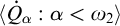 $\langle \dot {Q}_\alpha :\alpha <\omega _2\rangle $
, where
$\langle \dot {Q}_\alpha :\alpha <\omega _2\rangle $
, where ${\mathbb {P}}_\alpha \Vdash "\dot {Q}_\alpha $
is the fast club forcing
${\mathbb {P}}_\alpha \Vdash "\dot {Q}_\alpha $
is the fast club forcing ${\mathbb {P}}_{{\scriptsize {\text {fast}}}}"$
. Let G be
${\mathbb {P}}_{{\scriptsize {\text {fast}}}}"$
. Let G be ${\mathbb {P}}_{\omega _2}$
-generic over V and
${\mathbb {P}}_{\omega _2}$
-generic over V and $G_\alpha =G\cap {\mathbb {P}}_\alpha $
. In
$G_\alpha =G\cap {\mathbb {P}}_\alpha $
. In $V[G]$
we force with
$V[G]$
we force with ${\mathbb {Q}} = \text {Fn}(\omega _1 \times \omega , 2, \omega )$
adding a generic H. Note that
${\mathbb {Q}} = \text {Fn}(\omega _1 \times \omega , 2, \omega )$
adding a generic H. Note that $\aleph _1^{V[G][H]}=\aleph _1^V$
and
$\aleph _1^{V[G][H]}=\aleph _1^V$
and ${\mathcal {P}}(\omega )^{V[G]}={\mathcal {P}}(\omega )^V$
. Working in
${\mathcal {P}}(\omega )^{V[G]}={\mathcal {P}}(\omega )^V$
. Working in $V[G][H]$
, let the second-order sentence
$V[G][H]$
, let the second-order sentence $\phi (R,E)$
, where R is unary and E is binary, say in a model M:
$\phi (R,E)$
, where R is unary and E is binary, say in a model M:
-
(1)
$E^M$
is a well-founded relation satisfying
$ZFC^- +$
“every set is countable”. This should be also true when relativized to
$R^M$
. -
(2)
$|M|=\aleph _1$
. -
(3) If
$P'\in R^M$
denotes (in M) the set
$\text {Fn}(\omega ,2,\omega )$
of conditions for adding one Cohen real, then there is
$K\subseteq P'$
such that K is
$P'$
-generic over
$R^M$
and
$M\models "V=R[K]"$
. -
(4) If
$a\subseteq \omega $
and the transitive collapse of M is N, then the following conditions are equivalent:-
(a)
$a\in R^N$
. -
(b) If
$A\subseteq \omega _1$
nearly constructs every club on
$\omega _1$
, that is, for every club
$C\subseteq \omega _1$
there is a club
$D\subseteq C$
such that
$D\cap \alpha \in L[A]$
for every
$\alpha <\omega _1,$
then
$a\in L[A]$
.
-


Note that we can express $"D\cap \alpha \in L[A]"$
, or equivalently
$"D\cap \alpha \in L[A]"$
, or equivalently $"\exists \beta (|\beta |=\aleph _1\wedge D\cap \alpha \in L_\beta [A]"$
, in second-order logic on M since second-order logic gives us access to all structures of cardinality
$"\exists \beta (|\beta |=\aleph _1\wedge D\cap \alpha \in L_\beta [A]"$
, in second-order logic on M since second-order logic gives us access to all structures of cardinality $|M|$
(
$|M|$
( ${} = \aleph _1$
).
${} = \aleph _1$
).
Claim: The following conditions are equivalent in $V[G][H]$
:
$V[G][H]$
:
-
(i)
$M\models \phi (R,E)$
. -
(ii)
$M\cong M_x$
for some real x which is Cohen generic over V.


Proof. (i) implies (ii): Suppose $M\models \phi (R,E)$
. Let
$M\models \phi (R,E)$
. Let $(N,U,\in )$
be the transitive collapse of
$(N,U,\in )$
be the transitive collapse of $(M,R^M,E^M)$
. By (3), there is r which is Cohen-generic over U and
$(M,R^M,E^M)$
. By (3), there is r which is Cohen-generic over U and $N=HC^{U[r]}$
. By (4) and Lemma 13, the reals of U are exactly the reals of V. Hence,
$N=HC^{U[r]}$
. By (4) and Lemma 13, the reals of U are exactly the reals of V. Hence, $U=HC^V$
and r is Cohen-generic over V. We have proved (ii).
$U=HC^V$
and r is Cohen-generic over V. We have proved (ii).
(ii) implies (i): Suppose $(N,R^N,E^N)=(HC^{V[r]},HC^V,\in )$
, where r is
$(N,R^N,E^N)=(HC^{V[r]},HC^V,\in )$
, where r is $\text {Fn}(\omega ,2,\omega )$
-generic over V. We show that
$\text {Fn}(\omega ,2,\omega )$
-generic over V. We show that $(N,R^N,E^N)\models \phi (R,E)$
. Conditions (1) and (2) are trivially satisfied. Condition (3) holds by construction. To prove that condition (4) holds, suppose
$(N,R^N,E^N)\models \phi (R,E)$
. Conditions (1) and (2) are trivially satisfied. Condition (3) holds by construction. To prove that condition (4) holds, suppose $a\subseteq \omega $
and let A be as in (4). By Lemma 13,
$a\subseteq \omega $
and let A be as in (4). By Lemma 13, $a\in L[A]$
. Condition (4) and thereby the Claim is proved.
$a\in L[A]$
. Condition (4) and thereby the Claim is proved.
We continue the proof of Theorem 14. The sentence $\phi (R,E)$
is non-categorical in
$\phi (R,E)$
is non-categorical in $V[G][H]$
because if we take two mutually generic (over
$V[G][H]$
because if we take two mutually generic (over $V[G]$
) Cohen reals
$V[G]$
) Cohen reals $r_0$
and
$r_0$
and $r_1$
, then
$r_1$
, then $M_{r_0}$
and
$M_{r_0}$
and $M_{r_1}$
are non-isomorphic models of
$M_{r_1}$
are non-isomorphic models of $\phi (R,E)$
. To prove that
$\phi (R,E)$
. To prove that $\phi (R,E)$
is complete, suppose
$\phi (R,E)$
is complete, suppose $(M,R^M,E^M)$
and
$(M,R^M,E^M)$
and $(N,R^N,E^N)$
are two models of
$(N,R^N,E^N)$
are two models of $\phi (R,E)$
. Without loss of generality, they are of the form
$\phi (R,E)$
. Without loss of generality, they are of the form $(M,R^M,\in )$
and
$(M,R^M,\in )$
and $(N,R^N,\in )$
, where M and N are transitive sets. By construction, they are of the form
$(N,R^N,\in )$
, where M and N are transitive sets. By construction, they are of the form $M_{r_0}$
and
$M_{r_0}$
and $M_{r_1}$
where both
$M_{r_1}$
where both $r_0$
and
$r_0$
and $r_1$
are Cohen generic over
$r_1$
are Cohen generic over $HC^V$
, hence over
$HC^V$
, hence over $HC^{V[G]}$
. They are subsumed by the generic H. By homogeneity of Cohen forcing
$HC^{V[G]}$
. They are subsumed by the generic H. By homogeneity of Cohen forcing $\text {Fn}(\omega ,2,\omega )$
the models are second-order equivalent.
$\text {Fn}(\omega ,2,\omega )$
the models are second-order equivalent.
In fact the forcing gives something stronger. If $\kappa $
is a cardinal that is second-order characterizable in the forcing extension, we may replace the model
$\kappa $
is a cardinal that is second-order characterizable in the forcing extension, we may replace the model $M_x = (HC^{V[x]}, HC^V, \in )$
, where
$M_x = (HC^{V[x]}, HC^V, \in )$
, where $x \subseteq \omega $
is Cohen over V, with the model
$x \subseteq \omega $
is Cohen over V, with the model $(\kappa \cup HC^{V[x]}, HC^V, \in )$
, and the proof of Theorem 14 goes through mutatis mutandis.
$(\kappa \cup HC^{V[x]}, HC^V, \in )$
, and the proof of Theorem 14 goes through mutatis mutandis.
Corollary 15. There is a set of forcing conditions that forces the following: if $\kappa $
is any second-order characterizable cardinal, there is a complete non-categorical finitely axiomatizable second-order theory with a model of cardinality
$\kappa $
is any second-order characterizable cardinal, there is a complete non-categorical finitely axiomatizable second-order theory with a model of cardinality $\kappa $
.
$\kappa $
.
Since the non-isomorphic models above derive from mutually generic Cohen reals, it follows that the non-categorical theories in question have (at most) continuum many non-isomorphic models. We lastly mention how to get non-categorical theories with more models than this.
It is straightforward to see that in Theorem 14 and the constructions preceding it, the cardinal $\aleph _1$
may be replaced with any cardinal
$\aleph _1$
may be replaced with any cardinal $\mu ^+$
with
$\mu ^+$
with $\mu $
regular. That is, the
$\mu $
regular. That is, the $\omega _2$
-length countable support iteration of fast club forcing at
$\omega _2$
-length countable support iteration of fast club forcing at $\omega _1$
is replaced by a
$\omega _1$
is replaced by a $\mu ^{++}$
-length
$\mu ^{++}$
-length ${\leq }\, \mu $
-sized support iteration of fast club forcing at
${\leq }\, \mu $
-sized support iteration of fast club forcing at $\mu ^+$
, and the forcing to add
$\mu ^+$
, and the forcing to add $\aleph _1$
many Cohen subsets of
$\aleph _1$
many Cohen subsets of $\omega $
is replaced by
$\omega $
is replaced by $\text {Fn}(\mu ^+ \times \mu , 2, \mu )$
adding
$\text {Fn}(\mu ^+ \times \mu , 2, \mu )$
adding $\mu ^+$
many subsets of
$\mu ^+$
many subsets of $\mu $
(and these forcings behave well assuming
$\mu $
(and these forcings behave well assuming $2^{<\mu } = \mu $
and
$2^{<\mu } = \mu $
and $2^\mu = \mu ^+$
). The model
$2^\mu = \mu ^+$
). The model $M_x$
is then taken to be of the form
$M_x$
is then taken to be of the form $(H(\mu )^{V[x]}, H(\mu )^V, \in )$
, where
$(H(\mu )^{V[x]}, H(\mu )^V, \in )$
, where $x \subseteq \mu $
is
$x \subseteq \mu $
is $\text {Fn}(\mu , 2, \mu )$
-generic over V.
$\text {Fn}(\mu , 2, \mu )$
-generic over V.
From this variation, we then get the following corollary.
Corollary 16. Suppose $\mu $
is a regular cardinal. There is then a set of forcing conditions that forces the following: if
$\mu $
is a regular cardinal. There is then a set of forcing conditions that forces the following: if $\mu $
is second-order characterizable, and if
$\mu $
is second-order characterizable, and if $\kappa \geq \mu $
is any second-order characterizable cardinal, there is a complete non-categorical finitely axiomatized second-order theory T with a model of cardinality
$\kappa \geq \mu $
is any second-order characterizable cardinal, there is a complete non-categorical finitely axiomatized second-order theory T with a model of cardinality $\kappa $
. Also, the theory T has between
$\kappa $
. Also, the theory T has between $\mu ^+$
and
$\mu ^+$
and $2^\mu $
many models up to isomorphism.
$2^\mu $
many models up to isomorphism.
In conclusion we cannot hope to prove the categoricity of finitely axiomatizable complete second-order theories from large cardinals even if we restrict to theories which have a model of regular uncountable cardinality.
6 Forcing categoricity
In [Reference Asperó and Friedman2] (for $\kappa> \omega _1$
) and [Reference Asperó and Friedman3] (for
$\kappa> \omega _1$
) and [Reference Asperó and Friedman3] (for $\kappa = \omega _1$
), Asperó and Friedman proved the following.
$\kappa = \omega _1$
), Asperó and Friedman proved the following.
Theorem 17. Suppose $\kappa $
is the successor of a regular cardinal. Then there is a poset
$\kappa $
is the successor of a regular cardinal. Then there is a poset ${\mathbb {P}}$
such that in a generic extension by
${\mathbb {P}}$
such that in a generic extension by ${\mathbb {P}}$
, there is a lightface first-order definable well-order of
${\mathbb {P}}$
, there is a lightface first-order definable well-order of $H(\kappa ^+)$
.
$H(\kappa ^+)$
.
Since we can translate a first-order lightface definable well-order of $H(\kappa ^+)$
into a well-order of
$H(\kappa ^+)$
into a well-order of ${\mathcal {P}}(\kappa )$
that is second-order definable over any structure of cardinality
${\mathcal {P}}(\kappa )$
that is second-order definable over any structure of cardinality $\kappa $
, we obtain the following corollary. Its proof is entirely analogous to the proof in L or
$\kappa $
, we obtain the following corollary. Its proof is entirely analogous to the proof in L or $L[U]$
(see the first case of the proof of Theorem 2), where there is a definable well-order to refer to. The proof is thus omitted.
$L[U]$
(see the first case of the proof of Theorem 2), where there is a definable well-order to refer to. The proof is thus omitted.
Theorem 18. Suppose $\kappa $
is the successor of a regular cardinal. Then there is a poset
$\kappa $
is the successor of a regular cardinal. Then there is a poset ${\mathbb {P}}$
that forces the following: every complete finitely axiomatizable second-order theory with a model of cardinality
${\mathbb {P}}$
that forces the following: every complete finitely axiomatizable second-order theory with a model of cardinality $\kappa $
is categorical.
$\kappa $
is categorical.
In fact, Asperó and Friedman build a class-sized poset which adds a lightface first-order definable well-order of $H(\kappa ^+)$
for every regular cardinal
$H(\kappa ^+)$
for every regular cardinal $\kappa $
. Thus in the forcing extension, the following holds: if
$\kappa $
. Thus in the forcing extension, the following holds: if $\kappa $
is the successor of a regular cardinal and
$\kappa $
is the successor of a regular cardinal and $\kappa $
is second-order characterizable, then every complete finitely axiomatizable second-order theory with a model of cardinality
$\kappa $
is second-order characterizable, then every complete finitely axiomatizable second-order theory with a model of cardinality $\kappa $
is categorical.
$\kappa $
is categorical.
We are thus left to consider the case of theories with models of limit cardinality, whether regular or singular.
The following theorem shows that the categoricity of complete second-order theories with a model of singular cardinality is (relatively) consistent with large cardinals. We are indebted to Boban Veličković for suggesting how to improve an earlier weaker version of this result. The $\lhd $
and
$\lhd $
and $\prec $
orderings are adapted from [Reference Cummings, Friedman, Magidor, Sinapova and Rinot8].
$\prec $
orderings are adapted from [Reference Cummings, Friedman, Magidor, Sinapova and Rinot8].
Theorem 19. Suppose $\kappa $
is a singular beth-fixpoint with uncountable cofinality
$\kappa $
is a singular beth-fixpoint with uncountable cofinality $\lambda $
. Then there is a forcing notion
$\lambda $
. Then there is a forcing notion ${\mathbb {P}}$
of cardinality
${\mathbb {P}}$
of cardinality $\kappa $
such that
$\kappa $
such that
-
1.
${\mathbb {P}}$
preserves the fact that
$\kappa $
is a singular beth-fixpoint of uncountable cofinality
$\lambda $
. -
2.
${\mathbb {P}}$
forces the statement: Every finitely axiomatizable complete second-order theory with a model of cardinality
$\kappa $
is categorical.


Proof. Without loss of generality, we assume GCH up to $\kappa $
. We first force a second-order definable well-order of the bounded subsets of
$\kappa $
. We first force a second-order definable well-order of the bounded subsets of $\kappa $
with a reverse Easton type iteration of length
$\kappa $
with a reverse Easton type iteration of length $\kappa $
described in [Reference Menas23, Theorem 20].
$\kappa $
described in [Reference Menas23, Theorem 20].
Let $S=\langle \kappa _\xi : \xi <\lambda \rangle $
be a strictly increasing sequence of aleph-fixpoints cofinal in
$S=\langle \kappa _\xi : \xi <\lambda \rangle $
be a strictly increasing sequence of aleph-fixpoints cofinal in $\kappa $
such that
$\kappa $
such that $\kappa _0> \lambda $
. Let
$\kappa _0> \lambda $
. Let $\pi :\kappa \times \kappa \to \kappa $
be the Gödel pairing function, and W be a well-order of
$\pi :\kappa \times \kappa \to \kappa $
be the Gödel pairing function, and W be a well-order of $V_\kappa $
. Suppose
$V_\kappa $
. Suppose $A\subseteq \mu $
for a cardinal
$A\subseteq \mu $
for a cardinal $\mu $
. We write
$\mu $
. We write $A\sim V_\mu $
if
$A\sim V_\mu $
if
 $$\begin{align*}(V_\mu,\in)\cong(\mu,\{(\alpha,\beta):\pi(\alpha,\beta)\in A\}). \end{align*}$$
Let the poset $E(\mu ,A)$
be the iteration (product) of the posets
$E(\mu ,A)$
be the iteration (product) of the posets ${\mathbb {R}}_\alpha $
,
${\mathbb {R}}_\alpha $
, $\alpha <\mu $
, where
$\alpha <\mu $
, where
 $$\begin{align*}{\mathbb{R}}_\alpha= \left\{\begin{array}{@{}ll} \text{Fn}(\aleph_{\mu+\alpha+3}\times \aleph_{\mu+\alpha+1},2,\aleph_{\mu+\alpha+1}), &\text{if } \alpha=\omega\cdot\beta \text{ and } \beta\in A\\ \text{Fn}(\aleph_{\mu+4}\times \aleph_{\mu+2},2,\aleph_{\mu+2}), &\text{if } \alpha=1 \text{ and } \mu = \kappa_\xi, \xi<\lambda\\ (\{0\},=)&\text{ otherwise}\end{array}\right. \end{align*}$$
with Easton support; i.e., $E(\mu ,A)$
consists of functions
$E(\mu ,A)$
consists of functions $p\in \prod _{\alpha <\mu } {\mathbb {R}}_\alpha $
such that, denoting the support
$p\in \prod _{\alpha <\mu } {\mathbb {R}}_\alpha $
such that, denoting the support $\{\alpha : p(\alpha )\ne \emptyset \}$
of p by
$\{\alpha : p(\alpha )\ne \emptyset \}$
of p by $\text {supp}(p)$
,
$\text {supp}(p)$
, $|\text {supp}(p)\cap \gamma |<\gamma $
for all regular
$|\text {supp}(p)\cap \gamma |<\gamma $
for all regular $\gamma $
. (The first option for
$\gamma $
. (The first option for ${\mathbb {R}}_\alpha $
corresponds to encoding the set A into the continuum function in the interval
${\mathbb {R}}_\alpha $
corresponds to encoding the set A into the continuum function in the interval $(\aleph _\mu , \aleph _{\mu +\mu })$
, and the second option corresponds to encoding an element of the sequence
$(\aleph _\mu , \aleph _{\mu +\mu })$
, and the second option corresponds to encoding an element of the sequence $\kappa _\xi $
.)
$\kappa _\xi $
.)
We now define an iteration $\langle {\mathbb {P}}_\alpha :\alpha <\lambda \rangle $
with the property that
$\langle {\mathbb {P}}_\alpha :\alpha <\lambda \rangle $
with the property that ${\mathbb {P}}_\alpha $
does not change beth fixed points
${\mathbb {P}}_\alpha $
does not change beth fixed points $\beta =\beth _\beta $
for any
$\beta =\beth _\beta $
for any $\beta $
. We let
$\beta $
. We let ${\mathbb {P}}=\langle {\mathbb {P}}_\alpha :\alpha <\lambda \rangle $
be the following iteration: If
${\mathbb {P}}=\langle {\mathbb {P}}_\alpha :\alpha <\lambda \rangle $
be the following iteration: If $\alpha $
is a limit ordinal, we use direct limits for regular
$\alpha $
is a limit ordinal, we use direct limits for regular $\alpha $
and inverse limits for singular
$\alpha $
and inverse limits for singular $\alpha $
. Suppose then
$\alpha $
. Suppose then $\alpha =\beta +1$
. Let
$\alpha =\beta +1$
. Let $\dot {A}$
be the W-first
$\dot {A}$
be the W-first ${\mathbb {P}}_\beta $
-name
${\mathbb {P}}_\beta $
-name $\dot {A}$
in
$\dot {A}$
in $V_\kappa $
such that
$V_\kappa $
such that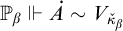 ${\mathbb {P}}_\beta \Vdash \dot {A}\sim V_{\check \kappa _\beta }$
. Then
${\mathbb {P}}_\beta \Vdash \dot {A}\sim V_{\check \kappa _\beta }$
. Then ${\mathbb {P}}_\alpha ={\mathbb {P}}_\beta \star E(\check {\kappa _\beta },\dot {A})$
. Let G be
${\mathbb {P}}_\alpha ={\mathbb {P}}_\beta \star E(\check {\kappa _\beta },\dot {A})$
. Let G be ${\mathbb {P}}$
-generic over V and
${\mathbb {P}}$
-generic over V and $G_\alpha =G\cap {\mathbb {P}}_\alpha $
.
$G_\alpha =G\cap {\mathbb {P}}_\alpha $
.
In the forcing extension $V[G]$
, the sequence
$V[G]$
, the sequence $\langle \kappa _\xi : \xi < \lambda \rangle $
satisfies the definition
$\langle \kappa _\xi : \xi < \lambda \rangle $
satisfies the definition
 $$\begin{align*}V[G] \models \left\lbrace {\kappa_\xi : \xi < \lambda} \right\rbrace = \left\lbrace {\mu < \kappa : \mu \text{ is an aleph-fixpoint and } 2^{\aleph_{\mu+2}} = \aleph_{\mu+4}} \right\rbrace. \end{align*}$$
Also, for every $\xi <\lambda $
there is a set
$\xi <\lambda $
there is a set $A\subseteq \kappa _\xi $
which codes a bijection
$A\subseteq \kappa _\xi $
which codes a bijection $f_A \colon \kappa _\xi \to (V_{\kappa _\xi })^{V[G]}$
. The set A itself satisfies
$f_A \colon \kappa _\xi \to (V_{\kappa _\xi })^{V[G]}$
. The set A itself satisfies
 $$\begin{align*}V[G]\models A=\{\alpha<\kappa_\xi: 2^{\aleph_{\kappa_\xi+\omega\cdot\alpha+1}}=\aleph_{\kappa_\xi+\omega\cdot\alpha+3}\}\text{:} \end{align*}$$
we remark that since $\kappa _\xi $
and
$\kappa _\xi $
and $\kappa _{\xi +1}$
were chosen to be aleph-fixpoints, the encoding intervals
$\kappa _{\xi +1}$
were chosen to be aleph-fixpoints, the encoding intervals $(\aleph _{\kappa _\xi }, \aleph _{\kappa _\xi +\kappa _\xi })$
and
$(\aleph _{\kappa _\xi }, \aleph _{\kappa _\xi +\kappa _\xi })$
and $(\aleph _{\kappa _{\xi +1}}, \aleph _{\kappa _{\xi +1}+\kappa _{\xi +1}})$
are disjoint. From A we can read off
$(\aleph _{\kappa _{\xi +1}}, \aleph _{\kappa _{\xi +1}+\kappa _{\xi +1}})$
are disjoint. From A we can read off $f_A$
as the transitive collapse of
$f_A$
as the transitive collapse of $(\kappa _\xi , \left \lbrace {(\alpha ,\beta ) : \pi (\alpha ,\beta ) \in A} \right \rbrace )$
, and a well-order
$(\kappa _\xi , \left \lbrace {(\alpha ,\beta ) : \pi (\alpha ,\beta ) \in A} \right \rbrace )$
, and a well-order $<_\xi ^*$
of
$<_\xi ^*$
of $(V_{\kappa _\xi })^{V[G]}$
:
$(V_{\kappa _\xi })^{V[G]}$
:
 $$\begin{align*}V[G]\models x_0 <_\xi^* x_1 \iff \alpha_0 < \alpha_1 < \kappa_\xi, \end{align*}$$
where $\alpha _i = \min \left \lbrace {\alpha : f_A(\alpha ) = x_i} \right \rbrace $
for
$\alpha _i = \min \left \lbrace {\alpha : f_A(\alpha ) = x_i} \right \rbrace $
for $i = 0,1$
.
$i = 0,1$
.
Now working in $V[G]$
, fix a collection
$V[G]$
, fix a collection $\mathcal F \subseteq {\mathcal {P}}(\kappa )$
, and we set out to define a well-order not on the whole of
$\mathcal F \subseteq {\mathcal {P}}(\kappa )$
, and we set out to define a well-order not on the whole of $\mathcal F$
but a certain subset of it. Define a relation
$\mathcal F$
but a certain subset of it. Define a relation $\lhd $
on
$\lhd $
on $\mathcal F$
by
$\mathcal F$
by
 $$\begin{align*}X \lhd Y \iff X \cap \kappa_\xi <^*_\xi Y \cap \kappa_\xi \text{ for all but boundedly many } \xi < \lambda. \end{align*}$$
As $\lambda $
is uncountable,
$\lambda $
is uncountable, $\lhd $
is well-founded, so the set
$\lhd $
is well-founded, so the set
 $$\begin{align*}\mathcal W = \left\lbrace {X \in \mathcal F : X \text{ is minimal in } \lhd} \right\rbrace \end{align*}$$
is nonempty, and if $X, Y \in \mathcal W$
with
$X, Y \in \mathcal W$
with $X \neq Y$
, then both
$X \neq Y$
, then both $X \cap \kappa _\xi <^*_\xi Y \cap \kappa _\xi $
and
$X \cap \kappa _\xi <^*_\xi Y \cap \kappa _\xi $
and $Y \cap \kappa _\xi <^*_\xi X \cap \kappa _\xi $
occur for unboundedly many
$Y \cap \kappa _\xi <^*_\xi X \cap \kappa _\xi $
occur for unboundedly many $\xi < \lambda $
.
$\xi < \lambda $
.
We claim that $ \left \lvert {\mathcal W} \right \rvert < \kappa $
. To see this, suppose to the contrary that
$ \left \lvert {\mathcal W} \right \rvert < \kappa $
. To see this, suppose to the contrary that $ \left \lvert {\mathcal W} \right \rvert \geq \kappa $
and define a coloring
$ \left \lvert {\mathcal W} \right \rvert \geq \kappa $
and define a coloring $c \colon [\mathcal W]^2 \to \lambda $
by
$c \colon [\mathcal W]^2 \to \lambda $
by $c( \left \lbrace {X,Y} \right \rbrace ) = \pi (\xi _1, \xi _2)$
where
$c( \left \lbrace {X,Y} \right \rbrace ) = \pi (\xi _1, \xi _2)$
where $\xi _1$
is the least
$\xi _1$
is the least $\xi < \lambda $
such that
$\xi < \lambda $
such that $X \cap \kappa _\xi <^*_\xi Y \cap \kappa _\xi $
, and
$X \cap \kappa _\xi <^*_\xi Y \cap \kappa _\xi $
, and $\xi _2$
is the least
$\xi _2$
is the least $\xi < \lambda $
such that
$\xi < \lambda $
such that $Y \cap \kappa _\xi <^*_\xi X \cap \kappa _\xi $
, and
$Y \cap \kappa _\xi <^*_\xi X \cap \kappa _\xi $
, and $\xi _1 < \xi _2$
. Since
$\xi _1 < \xi _2$
. Since $ \left \lvert {\mathcal W} \right \rvert \geq \kappa> (2^\lambda )^+$
, by the Erdős-Rado theorem there is a set
$ \left \lvert {\mathcal W} \right \rvert \geq \kappa> (2^\lambda )^+$
, by the Erdős-Rado theorem there is a set $H \subseteq \mathcal W$
homogeneous for c of color
$H \subseteq \mathcal W$
homogeneous for c of color $\pi (\xi _1, \xi _2)$
and cardinality
$\pi (\xi _1, \xi _2)$
and cardinality $\lambda ^+$
. But this is a contradiction, since ordering H in
$\lambda ^+$
. But this is a contradiction, since ordering H in $<^*_{\xi _1}$
-increasing order yields an infinite decreasing sequence in the well-order
$<^*_{\xi _1}$
-increasing order yields an infinite decreasing sequence in the well-order $<^*_{\xi _2}$
, so
$<^*_{\xi _2}$
, so $ \left \lvert {\mathcal W} \right \rvert < \kappa $
.
$ \left \lvert {\mathcal W} \right \rvert < \kappa $
.
Now for each $X \in \mathcal W$
, define
$X \in \mathcal W$
, define $g_X \colon \lambda \to \kappa $
such that
$g_X \colon \lambda \to \kappa $
such that $g_X(\xi )$
is the index of
$g_X(\xi )$
is the index of $X \cap \kappa _\xi $
in the well-order
$X \cap \kappa _\xi $
in the well-order $<^*_\xi $
. Then the set
$<^*_\xi $
. Then the set $\bigcup \left \lbrace {\operatorname {\mathrm {ran}}(g_X) : X \in \mathcal W} \right \rbrace $
has some order-type
$\bigcup \left \lbrace {\operatorname {\mathrm {ran}}(g_X) : X \in \mathcal W} \right \rbrace $
has some order-type $\gamma < \kappa $
(as its cardinal is also smaller than
$\gamma < \kappa $
(as its cardinal is also smaller than $\kappa $
), and we can let
$\kappa $
), and we can let $h \colon \bigcup \left \lbrace {\operatorname {\mathrm {ran}}(g_X) : X \in \mathcal W} \right \rbrace \to \gamma $
be the transitive collapse map.
$h \colon \bigcup \left \lbrace {\operatorname {\mathrm {ran}}(g_X) : X \in \mathcal W} \right \rbrace \to \gamma $
be the transitive collapse map.
Then for $X \in \mathcal W$
, the function
$X \in \mathcal W$
, the function $h \circ g_X \colon \lambda \to \gamma $
is an element of a large enough
$h \circ g_X \colon \lambda \to \gamma $
is an element of a large enough $V_{\kappa _\xi }^{V[G]}$
, and obviously
$V_{\kappa _\xi }^{V[G]}$
, and obviously $h \circ g_X \neq h \circ g_Y$
if
$h \circ g_X \neq h \circ g_Y$
if $X \neq Y$
, so we can well-order
$X \neq Y$
, so we can well-order $\mathcal W$
by
$\mathcal W$
by
 $$\begin{align*}X_0 \prec X_1 \iff \zeta_0 < \zeta_1, \text{ or } \zeta_0 = \zeta_1 \text{ and } \alpha_0 < \alpha_1, \end{align*}$$
where $\zeta _i = \min \left \lbrace {\zeta < \lambda : h \circ g_{X_i} \in V_{\kappa _\zeta }^{V[G]}} \right \rbrace $
,
$\zeta _i = \min \left \lbrace {\zeta < \lambda : h \circ g_{X_i} \in V_{\kappa _\zeta }^{V[G]}} \right \rbrace $
, $\alpha _i = \min \left \lbrace {\alpha : f_{A_i}(\alpha ) = h \circ g_{X_i}} \right \rbrace $
and
$\alpha _i = \min \left \lbrace {\alpha : f_{A_i}(\alpha ) = h \circ g_{X_i}} \right \rbrace $
and $A_i \subseteq \kappa _{\zeta _i}$
is the set encoding a well-order, for
$A_i \subseteq \kappa _{\zeta _i}$
is the set encoding a well-order, for $i = 0,1$
. All this is second-order definable in
$i = 0,1$
. All this is second-order definable in $V[G]$
in any structure of size
$V[G]$
in any structure of size $\kappa $
, if the collection
$\kappa $
, if the collection $\mathcal F$
is. This allows us to pick a distinguished element of
$\mathcal F$
is. This allows us to pick a distinguished element of $\mathcal F$
as the
$\mathcal F$
as the $\prec $
-least
$\prec $
-least $\lhd $
-minimal element.
$\lhd $
-minimal element.
Suppose now that $\phi $
is a complete second-order sentence with a model M of cardinality
$\phi $
is a complete second-order sentence with a model M of cardinality $\kappa $
, and let
$\kappa $
, and let $\mathcal F$
consist of the set of
$\mathcal F$
consist of the set of $X \subseteq \kappa $
encoding a model of
$X \subseteq \kappa $
encoding a model of $\phi $
. Note that over a model of cardinality
$\phi $
. Note that over a model of cardinality $\kappa $
we can write a formula
$\kappa $
we can write a formula $\phi _\lhd (X,Y)$
expressing
$\phi _\lhd (X,Y)$
expressing $X \lhd Y$
for
$X \lhd Y$
for $X, Y \in \mathcal F$
, a formula
$X, Y \in \mathcal F$
, a formula $\phi _{\mathcal W}(X)$
expressing
$\phi _{\mathcal W}(X)$
expressing $X \in \mathcal W$
, and a formula
$X \in \mathcal W$
, and a formula $\phi _\prec (X,Y)$
expressing
$\phi _\prec (X,Y)$
expressing $X \prec Y$
if X and Y are
$X \prec Y$
if X and Y are $\lhd $
-minimal.
$\lhd $
-minimal.
Let $M \models \Phi $
now say that
$M \models \Phi $
now say that $X \subseteq M$
encodes a model isomorphic to M (and thus satisfies
$X \subseteq M$
encodes a model isomorphic to M (and thus satisfies $\phi $
), and for any
$\phi $
), and for any $Y \subseteq M$
that also encodes a model of
$Y \subseteq M$
that also encodes a model of $\phi $
,
$\phi $
, $\lnot \phi _\lhd (Y,X)$
, and moreover if for all
$\lnot \phi _\lhd (Y,X)$
, and moreover if for all $Z \subseteq M$
that encode a model of
$Z \subseteq M$
that encode a model of $\phi $
also
$\phi $
also $\lnot \phi _\lhd (Z,Y)$
, then
$\lnot \phi _\lhd (Z,Y)$
, then $X = Y$
or
$X = Y$
or $\phi _\prec (X,Y)$
. That is,
$\phi _\prec (X,Y)$
. That is, $X \in \mathcal W$
and if also
$X \in \mathcal W$
and if also $Y \in \mathcal W$
then
$Y \in \mathcal W$
then $X = Y$
or
$X = Y$
or $X \prec Y$
, which uniquely specifies X. As the model of
$X \prec Y$
, which uniquely specifies X. As the model of $\phi $
with the least code in this sense satisfies
$\phi $
with the least code in this sense satisfies $\Phi $
and
$\Phi $
and $\phi $
is complete,
$\phi $
is complete, $\phi $
implies
$\phi $
implies $\Phi $
and thus that all models of
$\Phi $
and thus that all models of $\phi $
are isomorphic, so
$\phi $
are isomorphic, so $\phi $
is categorical.
$\phi $
is categorical.
The method of the preceding proof does not extend to the cases of the limit cardinal $\kappa $
being regular, or of countable cofinality, so these cases are left open.
$\kappa $
being regular, or of countable cofinality, so these cases are left open.
In conclusion, no known large cardinal axiom can decide whether all complete second-order theories with a model of singular cardinality are categorical. In particular, such axioms cannot imply that all finitely axiomatizable complete second-order theories are categorical.
7 Theories with only countably many models
Since under PD we have non-categorical complete recursively axiomatized second-order theories, we may ask: how badly can categoricity fail in those cases? Echoing Vaught’s conjecture, we may ask whether the number of countable non-isomorphic models of a complete recursively axiomatized second-order theory is always countable or $2^\omega $
. Leaving this question unresolved, we have the following result which demonstrates the ability of categorical theories to ‘capture’ (in the sense of [Reference Rabin26]) the models of non-categorical theories.
$2^\omega $
. Leaving this question unresolved, we have the following result which demonstrates the ability of categorical theories to ‘capture’ (in the sense of [Reference Rabin26]) the models of non-categorical theories.
Theorem 20. Assume $AD^{L({\mathbb {R}})}$
.
$AD^{L({\mathbb {R}})}$
.
If T is a recursively axiomatized complete second-order theory with only countably many non-isomorphic countable models, then there is a recursively axiomatized categorical second-order theory S the unique model of which interprets all the countable models of T.
Proof. Let T be a recursively axiomatized second-order theory with only countably many non-isomorphic countable models. Let A be the $\Pi ^1_\omega $
(i.e., an intersection of a recursively coded family of sets each of which is
$\Pi ^1_\omega $
(i.e., an intersection of a recursively coded family of sets each of which is $\Pi ^1_n$
for some n) set of reals that code a model of T. Since A is a countable union of equivalence classes of the
$\Pi ^1_n$
for some n) set of reals that code a model of T. Since A is a countable union of equivalence classes of the $\Sigma ^1_1$
-equivalence relation of isomorphism, we may conclude that A is
$\Sigma ^1_1$
-equivalence relation of isomorphism, we may conclude that A is $\mathbf {\Sigma }^1_1$
.
$\mathbf {\Sigma }^1_1$
.
We wish to show that A is $\Pi ^1_2(r_0)$
in a parameter
$\Pi ^1_2(r_0)$
in a parameter $r_0$
which is a
$r_0$
which is a $\Pi ^1_\omega $
singleton. For this, we mimic a proof of Louveau ([Reference Louveau and Stern19, Theorem 1]) to show:
$\Pi ^1_\omega $
singleton. For this, we mimic a proof of Louveau ([Reference Louveau and Stern19, Theorem 1]) to show:
Theorem 21. Assume $AD^{L({\mathbb {R}})}$
. Every
$AD^{L({\mathbb {R}})}$
. Every $\mathbf {\Sigma }^1_1$
set which is
$\mathbf {\Sigma }^1_1$
set which is $\Pi ^1_\omega $
is
$\Pi ^1_\omega $
is $\Pi ^1_2(r_0)$
for some real
$\Pi ^1_2(r_0)$
for some real $r_0$
such that
$r_0$
such that $\{r_0\}$
is a
$\{r_0\}$
is a $\Delta ^1_{\omega +1}$
-singleton.
$\Delta ^1_{\omega +1}$
-singleton.
Proof. Let A be a $\mathbf {\Sigma }^1_1$
set that is also
$\mathbf {\Sigma }^1_1$
set that is also $\Pi ^1_\omega $
, say
$\Pi ^1_\omega $
, say $A = \bigcap _n A_n$
with each
$A = \bigcap _n A_n$
with each $A_n$
being
$A_n$
being $\Pi ^1_n$
. Let also
$\Pi ^1_n$
. Let also $U \subseteq (\omega ^\omega )^2$
be a universal
$U \subseteq (\omega ^\omega )^2$
be a universal $\Sigma ^1_1$
set.
$\Sigma ^1_1$
set.
We define for each n a game $G_n$
on
$G_n$
on $\omega $
where players I and II take turns to play the digits of reals
$\omega $
where players I and II take turns to play the digits of reals $\alpha $
and
$\alpha $
and $\gamma $
respectively (there is no need to let II pass turns here). Then II wins a play of
$\gamma $
respectively (there is no need to let II pass turns here). Then II wins a play of $G_n$
if
$G_n$
if $\alpha \in A \implies \gamma \in U$
and
$\alpha \in A \implies \gamma \in U$
and $\alpha \notin A_n \implies \gamma \notin U$
.
$\alpha \notin A_n \implies \gamma \notin U$
.
 $$\begin{align*}\begin{array}{c|ccccc} \text{I} & n_0 & & n_1 & & \cdots \\ \hline \text{II} & & m_0 & & m_1 & \cdots \end{array} \quad \begin{matrix} \alpha \\ \gamma \end{matrix} \end{align*}$$
As in Louveau’s proof, II has a winning strategy as follows: since A is $\mathbf {\Sigma }^1_1$
, we have
$\mathbf {\Sigma }^1_1$
, we have $A(x) \iff U(y,x)$
for some y, so II wins by playing the digits of
$A(x) \iff U(y,x)$
for some y, so II wins by playing the digits of $\langle y, \alpha \rangle $
(as I is playing the digits of
$\langle y, \alpha \rangle $
(as I is playing the digits of $\alpha $
). The complexity of the winning set for II in
$\alpha $
). The complexity of the winning set for II in $G_n$
is
$G_n$
is $\Sigma ^1_\omega $
, so by Moschovakis’s strategic basis theorem ([Reference Moschovakis24, Theorem 6E.2]), II has a winning strategy
$\Sigma ^1_\omega $
, so by Moschovakis’s strategic basis theorem ([Reference Moschovakis24, Theorem 6E.2]), II has a winning strategy $\sigma _n$
that is a
$\sigma _n$
that is a $\Delta ^1_{\omega +1}$
-singleton. Note that the pointclass
$\Delta ^1_{\omega +1}$
-singleton. Note that the pointclass $\Sigma ^1_\omega $
, i.e., the collection of countable unions of recursively coded families of projective sets, is both adequate and scaled (see [Reference Rudominer27, Remark 2.2], essentially [Reference Steel30, Theorem 2.1]).
$\Sigma ^1_\omega $
, i.e., the collection of countable unions of recursively coded families of projective sets, is both adequate and scaled (see [Reference Rudominer27, Remark 2.2], essentially [Reference Steel30, Theorem 2.1]).
Then the set $B_n = \left \lbrace {y : (y * \sigma _n)_{\text {II}} \in U} \right \rbrace $
is a
$B_n = \left \lbrace {y : (y * \sigma _n)_{\text {II}} \in U} \right \rbrace $
is a $\Sigma ^1_1(\sigma _n)$
set with
$\Sigma ^1_1(\sigma _n)$
set with $A \subseteq B_n \subseteq A_n$
(where
$A \subseteq B_n \subseteq A_n$
(where $(y * \sigma _n)_{\text {II}}$
denotes the real
$(y * \sigma _n)_{\text {II}}$
denotes the real $\gamma $
the strategy
$\gamma $
the strategy $\sigma _n$
produces as I plays
$\sigma _n$
produces as I plays $\alpha = y$
), so altogether
$\alpha = y$
), so altogether $A = \bigcap _n B_n$
is a
$A = \bigcap _n B_n$
is a $\Pi ^1_2(s_0)$
set where
$\Pi ^1_2(s_0)$
set where $s_0 = \langle \sigma _n : n < \omega \rangle $
is a
$s_0 = \langle \sigma _n : n < \omega \rangle $
is a $\Delta ^1_{\omega +1}$
-singleton.
$\Delta ^1_{\omega +1}$
-singleton.
We may reduce the complexity of the parameter down to being a $\Pi ^1_\omega $
singleton by the following theorem of Rudominer.
$\Pi ^1_\omega $
singleton by the following theorem of Rudominer.
Theorem 22 (Rudominer [Reference Rudominer27]).
Assume $AD^{L({\mathbb {R}})}$
. Then every real
$AD^{L({\mathbb {R}})}$
. Then every real $s_0$
which is a
$s_0$
which is a $\Sigma ^1_{\omega +1}$
singleton is recursive in a real
$\Sigma ^1_{\omega +1}$
singleton is recursive in a real $r_0$
which is a
$r_0$
which is a $\Pi ^1_\omega $
singleton.
$\Pi ^1_\omega $
singleton.
Therefore the set A is a $\Pi ^1_2(r_0)$
set where
$\Pi ^1_2(r_0)$
set where $r_0$
is a
$r_0$
is a $\Pi ^1_\omega $
singleton. Let
$\Pi ^1_\omega $
singleton. Let $\eta (r,s)$
be a second-order
$\eta (r,s)$
be a second-order $\Pi ^1_2$
formula which defines the predicate
$\Pi ^1_2$
formula which defines the predicate $s\in A$
on
$s\in A$
on $({\mathbb {N}},+,\times ,r_0)$
. Let
$({\mathbb {N}},+,\times ,r_0)$
. Let $\theta _1(Q_+,Q_{\times })$
be the standard second-order characterization of
$\theta _1(Q_+,Q_{\times })$
be the standard second-order characterization of $({\mathbb {N}},+,\times )$
, as above in the proof of Theorem 4. Let
$({\mathbb {N}},+,\times )$
, as above in the proof of Theorem 4. Let $\psi _n(Q_+,Q_{\times },s)$
,
$\psi _n(Q_+,Q_{\times },s)$
, $n<\omega $
, be second-order formulas such that if
$n<\omega $
, be second-order formulas such that if $X_n$
is the set of reals s satisfying
$X_n$
is the set of reals s satisfying $\psi _n(Q_+,Q_{\times },s)$
in
$\psi _n(Q_+,Q_{\times },s)$
in $({\mathbb {N}},+,\times )$
, then
$({\mathbb {N}},+,\times )$
, then $\{r_0\}=\bigcap _nX_n$
. Let P be a new unary predicate symbol and
$\{r_0\}=\bigcap _nX_n$
. Let P be a new unary predicate symbol and
 $$ \begin{align*}S=\{\theta_1(Q_+,Q_{\times})\}\cup\{\psi_n(Q_+,Q_{\times},P) : n<\omega\}.\end{align*} $$
Suppose M is a model of S. Without loss of generality, the arithmetic part of M consists of the standard $+$
and
$+$
and $\times $
on
$\times $
on ${\mathbb {N}}$
. Let s be the interpretation of P in M. Then
${\mathbb {N}}$
. Let s be the interpretation of P in M. Then $s=r_0$
. Thus S is categorical. The theory S is recursive because the proofs of Theorems 21 and 22 are sufficiently uniform. In conclusion, M is categorically characterized by the recursive second-order theory S.
$s=r_0$
. Thus S is categorical. The theory S is recursive because the proofs of Theorems 21 and 22 are sufficiently uniform. In conclusion, M is categorically characterized by the recursive second-order theory S.
Now the countable models of T are interpretable in S in the following sense: a real s codes a model of T if and only if $M\models \eta (r_0,s)$
. We also get a translation of sentences: if
$M\models \eta (r_0,s)$
. We also get a translation of sentences: if $\phi $
is a second-order sentence in the vocabulary of T, letting
$\phi $
is a second-order sentence in the vocabulary of T, letting $\hat \phi $
be the sentence
$\hat \phi $
be the sentence $\exists X (\eta (r_0,X) \land X \models \phi )$
, we have that
$\exists X (\eta (r_0,X) \land X \models \phi )$
, we have that $\phi \in T$
if and only if
$\phi \in T$
if and only if $\hat \phi \in S$
.
$\hat \phi \in S$
.
8 Definable models of categorical theories
Suppose we are given a categorical second-order theory T. Naturally, we assume that T has a model, otherwise categoricity is vacuous. But what can be said about the models of T apart from their isomorphism with each other? In particular, can we always find a model which is definable in some reasonable sense, e.g., hereditarily ordinal definable? To emphasize this point, consider the second-order sentence which characterizes the structure $({\mathbb {N}},+,\cdot ,0^\sharp )$
. This categorical sentence has no models in L. We ask, can we have a categorical sentence with no models in
$({\mathbb {N}},+,\cdot ,0^\sharp )$
. This categorical sentence has no models in L. We ask, can we have a categorical sentence with no models in $\mathop {\text {HOD}}$
? Since it could be that
$\mathop {\text {HOD}}$
? Since it could be that $V=\mathop {\text {HOD}}$
, we are looking at this question under assumptions stronger than ZFC.
$V=\mathop {\text {HOD}}$
, we are looking at this question under assumptions stronger than ZFC.
The following result of Kaplan and Shelah is useful for us.
Theorem 23 (Kaplan-Shelah [Reference Kaplan and Shelah13]).
If ${\mathbb {P}}$
forces the collapse of
${\mathbb {P}}$
forces the collapse of $|\omega _2|$
to
$|\omega _2|$
to $\omega $
, then there is a
$\omega $
, then there is a ${\mathbb {P}}$
-term
${\mathbb {P}}$
-term $\tau $
for a countable model such that
$\tau $
for a countable model such that
-
1. If
$G_1\times G_2$
is generic for
${\mathbb {P}} \times {\mathbb {P}}$
then where
$$ \begin{align*}V[G_1][G_2] \models M_1\cong M_2,\end{align*} $$
$M_1$
is the interpretation
$\tau ^{G_1}$
of
$\tau $
by
$G_1$
and
$M_2$
is
$\tau ^{G_2}$
.
-
2.
${\mathbb {P}} \Vdash "\tau $
is not isomorphic to
$\check {M}$
”, for any M in V.


We make some observations about the proof. It involves a construction of Laskowski and Shelah.
Theorem 24 (Laskowski–Shelah [Reference Laskowski and Shelah17]).
There is a countable consistent first-order theory T, with a predicate V in its vocabulary, having the following property. For any model $M \models T$
and any
$M \models T$
and any $A \subseteq V^M$
, isolated types are dense over A but the theory
$A \subseteq V^M$
, isolated types are dense over A but the theory $T(A) = \operatorname {\mathrm {Th}}(M,a)_{a \in A}$
has an atomic model if and only if
$T(A) = \operatorname {\mathrm {Th}}(M,a)_{a \in A}$
has an atomic model if and only if $ \left \lvert {A} \right \rvert < \omega _2$
.
$ \left \lvert {A} \right \rvert < \omega _2$
.
The theory T is as follows. Let L be a countable vocabulary consisting of two unary predicates $U, V$
, one unary function symbol p, as well as binary relations
$U, V$
, one unary function symbol p, as well as binary relations $R_n$
and binary functions
$R_n$
and binary functions $f_n$
for
$f_n$
for $n < \omega $
(the functions will not be total, but instead have domain U). Let K be the collection of all finite L-structures satisfying a certain finite list of first-order axioms (see [Reference Laskowski and Shelah17]). Let
$n < \omega $
(the functions will not be total, but instead have domain U). Let K be the collection of all finite L-structures satisfying a certain finite list of first-order axioms (see [Reference Laskowski and Shelah17]). Let $\mathcal B$
be the Fraïsse limit of K and let
$\mathcal B$
be the Fraïsse limit of K and let $T = \operatorname {\mathrm {Th}}(\mathcal B)$
. The theory T is well defined since
$T = \operatorname {\mathrm {Th}}(\mathcal B)$
. The theory T is well defined since $\mathcal B$
is unique up to isomorphism.
$\mathcal B$
is unique up to isomorphism.
We then form an uncountable model of the theory T as follows. For an ordinal $\alpha $
let
$\alpha $
let $L_\alpha $
be the vocabulary L together with
$L_\alpha $
be the vocabulary L together with $\alpha $
many new constant symbols
$\alpha $
many new constant symbols $c_\beta $
,
$c_\beta $
, $\beta <\alpha $
. Using a standard Henkin construction, we form a term model for the theory T together with the additional axioms stating that the new constant symbols name distinct elements. We let
$\beta <\alpha $
. Using a standard Henkin construction, we form a term model for the theory T together with the additional axioms stating that the new constant symbols name distinct elements. We let $T(A_\alpha )$
be the theory of this term model in the vocabulary
$T(A_\alpha )$
be the theory of this term model in the vocabulary $L_\alpha $
. (Although the Henkin construction involves forming the completion of a theory, we can make the choice of which completion to use definable by referring to the well-ordering of the sentences.)
$L_\alpha $
. (Although the Henkin construction involves forming the completion of a theory, we can make the choice of which completion to use definable by referring to the well-ordering of the sentences.)
We can also observe that for a countable ordinal $\alpha $
, the class of countable atomic models of
$\alpha $
, the class of countable atomic models of $T(A_\alpha )$
is definable from
$T(A_\alpha )$
is definable from $T(A_\alpha )$
, which itself is definable from
$T(A_\alpha )$
, which itself is definable from $\alpha $
, and the definitions can be carried out in
$\alpha $
, and the definitions can be carried out in $H(\omega _1)$
. Using these two observations, the following obtains.
$H(\omega _1)$
. Using these two observations, the following obtains.
Theorem 25 (ZF).
Assume $\omega _2^{\scriptsize \mathop {\text {HOD}}}$
is countable. Then there is a countable model M such that
$\omega _2^{\scriptsize \mathop {\text {HOD}}}$
is countable. Then there is a countable model M such that
-
1. The isomorphism class of M is ordinal definable.
-
2. There is no model in
$\mathop {\text {HOD}}$
which is isomorphic to M.

Moreover, if the property of a linear order of being of order-type $\omega _2^{\scriptsize \mathop {\text {HOD}}}$
is second-order definable in the countably infinite structure of the empty vocabulary, then the second-order theory of M is finitely axiomatizable.
$\omega _2^{\scriptsize \mathop {\text {HOD}}}$
is second-order definable in the countably infinite structure of the empty vocabulary, then the second-order theory of M is finitely axiomatizable.
Proof. Let $\alpha = \omega _2^{\text {HOD}}$
. Let
$\alpha = \omega _2^{\text {HOD}}$
. Let $T(A_\alpha )$
be the theory constructed above. Finally, let M be a countable atomic model of
$T(A_\alpha )$
be the theory constructed above. Finally, let M be a countable atomic model of $T(A_\alpha )$
. Since
$T(A_\alpha )$
. Since $\mathop {\text {HOD}}$
satisfies
$\mathop {\text {HOD}}$
satisfies $ \left \lvert {T(A_\alpha )} \right \rvert = \omega _2$
, the theory
$ \left \lvert {T(A_\alpha )} \right \rvert = \omega _2$
, the theory $T(A_\alpha )$
has no atomic model in
$T(A_\alpha )$
has no atomic model in $\mathop {\text {HOD}}$
, but as being an atomic model is absolute, this shows that there is no model in
$\mathop {\text {HOD}}$
, but as being an atomic model is absolute, this shows that there is no model in $\mathop {\text {HOD}}$
isomorphic to M.
$\mathop {\text {HOD}}$
isomorphic to M.
The isomorphism class of M is ordinal definable as the class of countable atomic models of $T(A_\alpha )$
, which is definable from
$T(A_\alpha )$
, which is definable from $\alpha $
. Additionally, if
$\alpha $
. Additionally, if $\alpha $
is second-order definable in the countably infinite structure of the empty vocabulary, we can define the theories T and
$\alpha $
is second-order definable in the countably infinite structure of the empty vocabulary, we can define the theories T and $T(A_\alpha )$
in second-order logic expressing “I am isomorphic to a countable atomic model of
$T(A_\alpha )$
in second-order logic expressing “I am isomorphic to a countable atomic model of $T(A_\alpha )$
” with a single second-order sentence. This finitely axiomatizes the second-order theory of M.
$T(A_\alpha )$
” with a single second-order sentence. This finitely axiomatizes the second-order theory of M.
Of course, the assumption that $\omega _2^{\scriptsize \mathop {\text {HOD}}}$
is second-order definable in the countably infinite structure of the empty vocabulary is somewhat ad hoc. However, it holds, for example, in
$\omega _2^{\scriptsize \mathop {\text {HOD}}}$
is second-order definable in the countably infinite structure of the empty vocabulary is somewhat ad hoc. However, it holds, for example, in $L[G]$
, where G is P-generic over L for
$L[G]$
, where G is P-generic over L for $P = \operatorname {\mathrm {Coll}}(\omega , <\omega _3)^L$
. This is because the poset P is weakly homogeneous, so
$P = \operatorname {\mathrm {Coll}}(\omega , <\omega _3)^L$
. This is because the poset P is weakly homogeneous, so $\mathop {\text {HOD}}^{L[G]} = \mathop {\text {HOD}}^L(P) = L$
, whence
$\mathop {\text {HOD}}^{L[G]} = \mathop {\text {HOD}}^L(P) = L$
, whence $\omega _2^{\scriptsize \mathop {\text {HOD}}} = \omega _2^L$
is countable and second-order definable in any countable model in
$\omega _2^{\scriptsize \mathop {\text {HOD}}} = \omega _2^L$
is countable and second-order definable in any countable model in $L[G]$
.
$L[G]$
.
We also obtain the following variation.
Corollary 26. Assume $ZFC + AD^{L({\mathbb {R}})} + "\mathop {\text {HOD}} \hspace {2pt}\cap \hspace {2pt} {\mathbb {R}} = \mathop {\text {HOD}}^{L({\mathbb {R}})} \cap \hspace {2pt} {\mathbb {R}}"$
and that
$ZFC + AD^{L({\mathbb {R}})} + "\mathop {\text {HOD}} \hspace {2pt}\cap \hspace {2pt} {\mathbb {R}} = \mathop {\text {HOD}}^{L({\mathbb {R}})} \cap \hspace {2pt} {\mathbb {R}}"$
and that $\omega _2^{\scriptsize \mathop {\text {HOD}}}$
is definable in
$\omega _2^{\scriptsize \mathop {\text {HOD}}}$
is definable in $\mathop {\text {HOD}}^{L({\mathbb {R}})} \restriction \Theta ^{L({\mathbb {R}})}$
and countable. Let M be the countable model of Theorem 25. Let
$\mathop {\text {HOD}}^{L({\mathbb {R}})} \restriction \Theta ^{L({\mathbb {R}})}$
and countable. Let M be the countable model of Theorem 25. Let $N = (\Theta ^{L({\mathbb {R}})},<,M)$
(without loss of generality, the domain of M is
$N = (\Theta ^{L({\mathbb {R}})},<,M)$
(without loss of generality, the domain of M is $\omega $
). Then the second-order theory of N is finitely axiomatizable and categorical but has no model which belongs to
$\omega $
). Then the second-order theory of N is finitely axiomatizable and categorical but has no model which belongs to $\mathop {\text {HOD}}$
.
$\mathop {\text {HOD}}$
.
Proof. We can use [Reference Koellner, Woodin, Foreman and Kanamori15, Theorem 3.10, Chapter 23]) to define $\mathop {\text {HOD}}^{L({\mathbb {R}})} \restriction \Theta ^{L({\mathbb {R}})}$
and
$\mathop {\text {HOD}}^{L({\mathbb {R}})} \restriction \Theta ^{L({\mathbb {R}})}$
and $L_{\Theta ^{L({\mathbb {R}})}}({\mathbb {R}})$
from
$L_{\Theta ^{L({\mathbb {R}})}}({\mathbb {R}})$
from $\Theta ^{L({\mathbb {R}})}$
in second-order logic, which then allows us to define
$\Theta ^{L({\mathbb {R}})}$
in second-order logic, which then allows us to define $\omega _2^{\scriptsize \mathop {\text {HOD}}}$
and M as in Theorem 25.
$\omega _2^{\scriptsize \mathop {\text {HOD}}}$
and M as in Theorem 25.
The assumptions of Corollary 26 follow, for example, from $ZFC + AD^{L({\mathbb {R}})} + V = L({\mathbb {R}})[G]$
, where G is
$ZFC + AD^{L({\mathbb {R}})} + V = L({\mathbb {R}})[G]$
, where G is ${{\mathbb {P}}_{\text {max}}}$
-generic, as then
${{\mathbb {P}}_{\text {max}}}$
-generic, as then $\mathop {\text {HOD}}^{L({\mathbb {R}})} = \mathop {\text {HOD}}^{L({\mathbb {R}})[G]}$
and
$\mathop {\text {HOD}}^{L({\mathbb {R}})} = \mathop {\text {HOD}}^{L({\mathbb {R}})[G]}$
and $\omega _2^{\scriptsize \mathop {\text {HOD}}}$
is countable.
$\omega _2^{\scriptsize \mathop {\text {HOD}}}$
is countable.
9 Open questions
The following question was raised by Solovay [Reference Solovay29].
Open Problem 1. Assuming $V=L$
, is every recursively axiomatized complete second-order theory categorical?
$V=L$
, is every recursively axiomatized complete second-order theory categorical?
Our results do not solve this one way or another, and it remains an interesting open question. In $L[U]$
there are recursively axiomatized complete non-categorical second-order theories, but we do not know if such theories necessarily have only large models.
$L[U]$
there are recursively axiomatized complete non-categorical second-order theories, but we do not know if such theories necessarily have only large models.
Open Problem 2. Suppose $V = L[U]$
,
$V = L[U]$
, $\kappa $
is the sole measurable cardinal of
$\kappa $
is the sole measurable cardinal of $L[U]$
, and T is a complete recursively axiomatized second-order theory that has a model of cardinality
$L[U]$
, and T is a complete recursively axiomatized second-order theory that has a model of cardinality $\lambda < \kappa $
such that
$\lambda < \kappa $
such that $\lambda $
is second-order characterizable. Is T categorical?
$\lambda $
is second-order characterizable. Is T categorical?
The following was left unresolved.
Open Problem 3. Assume $(*)$
. Is there a complete recursively axiomatized theory with exactly
$(*)$
. Is there a complete recursively axiomatized theory with exactly $\omega $
many models of cardinality
$\omega $
many models of cardinality $\aleph _1$
?
$\aleph _1$
?
There are many other open questions related to finitely or recursively axiomatized complete second-order theories with uncountable models. We showed that we can force categoricity for successor cardinals of regular cardinals, and some singular limit cardinals, but the following two cases were left open.
Open Problem 4. Can we always force the categoricity of all finitely axiomatizable complete second-order theories with a model of cardinality $\kappa $
, where
$\kappa $
, where $\kappa $
is either a regular (non-measurable) limit cardinal, or singular of cofinality
$\kappa $
is either a regular (non-measurable) limit cardinal, or singular of cofinality $\omega $
?
$\omega $
?
An $I_0$
-cardinal is a cardinal
$I_0$
-cardinal is a cardinal $\lambda $
such that there is
$\lambda $
such that there is $j \colon L(V_{\lambda +1})\to L(V_{\lambda +1})$
with critical point below
$j \colon L(V_{\lambda +1})\to L(V_{\lambda +1})$
with critical point below $\lambda $
. Note that then
$\lambda $
. Note that then $\lambda $
is singular of cofinality
$\lambda $
is singular of cofinality $\omega $
,
$\omega $
, $\lambda ^+$
is measurable in
$\lambda ^+$
is measurable in $L(V_{\lambda +1})$
[Reference Woodin32], and the Axiom of Choice fails in
$L(V_{\lambda +1})$
[Reference Woodin32], and the Axiom of Choice fails in $L(V_{\lambda +1})$
[Reference Kunen16]. This is in sharp contrast to the result of Shelah that if
$L(V_{\lambda +1})$
[Reference Kunen16]. This is in sharp contrast to the result of Shelah that if $\lambda $
is a singular strong limit cardinal of uncountable cofinality, then
$\lambda $
is a singular strong limit cardinal of uncountable cofinality, then $L({\mathcal {P}}(\lambda ))$
satisfies the Axiom of Choice [Reference Shelah28]. Since the Axiom of Choice fails in
$L({\mathcal {P}}(\lambda ))$
satisfies the Axiom of Choice [Reference Shelah28]. Since the Axiom of Choice fails in $L(V_{\lambda +1})$
, there can be no well-order of
$L(V_{\lambda +1})$
, there can be no well-order of ${\mathcal {P}}(\lambda )$
which is second-order definable on
${\mathcal {P}}(\lambda )$
which is second-order definable on $\lambda $
. This raises the following question.
$\lambda $
. This raises the following question.
Open Problem 5. Is every finitely axiomatizable complete second-order theory with a model of cardinality an $I_0$
-cardinal categorical (or, at least categorical among all models of that cardinality)?
$I_0$
-cardinal categorical (or, at least categorical among all models of that cardinality)?
Funding
The first and second author would like to thank the Academy of Finland, grant no: 322795. This project has received funding from the European Research Council (ERC) under the European Union’s Horizon 2020 research and innovation programme (Grant Agreement No. 101020762).


 Open access

