

Introduction
The role of a company’s corporate headquarters is well established in business history and international business scholarship. Headquarters shape access to capital,Footnote 1 position firms within tax and regulatory regimes,Footnote 2 and locate them in proximity to political decision makers.Footnote 3 While firms often seek to consolidate these functions in a single place, research shows that multinational corporations must prioritize among competing demands or disperse headquarters functions across jurisdictions.Footnote 4 As a result, a shift in corporate domicile is rarely a straightforward strategic choice: it is a contested process shaped by competing interests, institutional constraints, and political bargaining.
Map showing the interests of Tanganyika Concessions Limited.
Source: Assemblées générales: rapports annuels, bilans et budgets. 1954–1965, 1 liasse,303. Serie: Archives d’André de Spirlet: mandate d’administrateur dans la société T.C.L. (Tanganyika Concessions Ltd), Archival Fonds: Société Générale de Belgique, 3 versement, National Archives 2–Joseph Cuvelier repository.

Figure 1 Long description
Assemblées générales: rapports annuels, bilans et budgets. 1954-1965, 1 liasse,303. Serie: Archives d’André de Spirlet: mandat d’administrateur dans la société T.C.L. (Tanganyika Concessions Ltd), Archival Fonds: Société Générale de Belgique, 3 versement, National Archives 2 - Joseph Cuvelier repository.
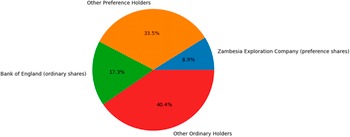
Ownership structure of Tanganyika Concessions: ordinary and preference shareholdings.
Source: Created by Author from the following—Letter from H.L. Jenkyns, Treasury, to K.G. Morrison, Colonial Office, 15 March 1952, DO 35/3691 (1952), The National Archives; Mr. Terence Donovan, KC, “Tanganyika Concessions Ltd, Ex Parte the Company – Case for the Opinion of Counsel, Rio Tinto Collection,” 28 February 1950, London Metropolitan Archives, Rio Tinto Collection; Financial Times, “Manoeuvrings in the “Tanks” Deal.” 6 July 1950.

Figure 2 Long description
Created by Author from the following - Letter from H.L. Jenkyns, Treasury, to K.G. Morrison, Colonial Office, 15th March, 1952, DO 35/3691 (1952), The National Archives; Mr. Terence Donovan, KC, “Tanganyika Concessions Ltd, Ex Parte the Company – Case for the Opinion of Counsel, Rio Tinto Collection,” 28th February 1950, London Metropolitan Archives, Rio Tinto Collection; Financial Times, “Manoeuvrings in the “Tanks” Deal.” 6th July 1950.
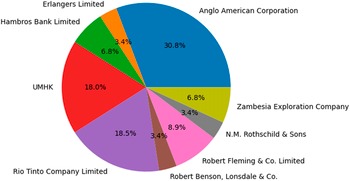
Allocation of the Bank of England’s ordinary shares within the Anglo Belgian Group.
Source: Created by Author from the following—The Governor and Company of the Bank of England, and Anglo American Corporation of South Africa Limited and Others, “Agreement relating to Ordinary stock units of Tanganyika Concessions, Limited and the pooling of certain units”. Reference Code: LMA/4543/03/03/07/001. Date 16 Nov 1949–6 Jul 1950.

Figure 3 Long description
Created by Author from the following - The Governor and Company of the Bank of England, and Anglo American Corporation of South Africa Limited and Others, “Agreement relating to Ordinary stock units of Tanganyika Concessions, Limited and the pooling of certain units”. Reference Code: LMA/4543/03/03/07/001. Date 16 Nov 1949 – 6 Jul 1950.
Existing studies of corporate relocation, however, focus primarily on outcomes rather than on the micropolitical processes through which relocation is negotiated and contested.Footnote 5 This paper contributes to this gap by analyzing the relocation of Tanganyika Concessions’ headquarters from the United Kingdom to Southern Rhodesia (present-day Zimbabwe). Tanganyika Concessions was a free-standing company, legally headquartered in Britain and listed on the London Stock Exchange, but established specifically to conduct operations overseas, with activities concentrated in Central and Southern Africa.Footnote 6 It was the principal British investor in the Belgian Congo (present-day Democratic Republic of Congo), through its holding in Union Minière du Haut-Katanga (UMHK), and it held a majority stake in the Benguela Railway in Angola. Its significance extended beyond its portfolio. During the interwar and postwar decades, British investment in the Congo formed part of a broader effort to project and preserve economic influence beyond the boundaries of formal colonial administration.Footnote 7
The case is distinctive because the British government was itself an internal corporate actor. In 1946 a thirty percent stake in the Tanganyika Concessions was transferred to the Bank of England, which held it on behalf of the British government as part of a postwar settlement with France. These shares, previously requisitioned from French holders, made the Bank both a shareholder and an instrument of state policy, since any transfer of corporate residence required Treasury approval.Footnote 8 In this paper, internal actors refer to shareholders and organizational insiders such as Anglo American Corporation (AAC), Rio Tinto, Union Minière, and the Bank of England, while external actors refer to influential stakeholders outside the firm, in this case the “American Group” of investors that the British government and the company sought to attract.
The central question guiding this paper is how these competing internal and external actors assessed and negotiated the shift of Tanganyika Concessions’ corporate domicile. The analysis shows that relocation was not simply a response to taxation or regulation but a negotiated process shaped by the distribution of power within and around the firm. The American Group, representing capital from an ascendant postwar hegemon, exerted disproportionate influence over the negotiations. Their involvement illuminates broader transformations in the postwar global economy: the growing centrality of US capital, the declining fiscal and political leverage of Britain, and the limits of imperial authority over companies operating across multiple jurisdictions.
By situating this case in debates on imperial decline, the rise of multinational capital, and the political economy of the postwar order, the article shows how corporate relocation became a site where shifting geopolitical and economic hierarchies were enacted. In doing so, it highlights how micropolitics, defined here as the everyday negotiation of power and interests within organizations, was fundamental to corporate strategy during a moment of imperial contraction and global realignment.Footnote 9
Review of the Literature
The location and nationality of a corporate headquarters have long been recognized as significant in international business and business history, with extensive research examining why MNCs relocate their headquarters.Footnote 10 One factor that has consistently emerged as a major determinant is corporate taxation. Studies across different contexts show that high home-country taxes can push companies to relocate to lower-tax jurisdictions,Footnote 11 and that MNCs based in the US, Japan, and parts of Europe face comparatively higher tax burdens.Footnote 12 This fiscal competition has prompted host-country incentives, such as concessions in Australia, Singapore, and Thailand.Footnote 13 Historical research has highlighted how firms relocated within Europe to avoid political hostility and punitive taxation during the interwar period.Footnote 14
Capital and financial market considerations constitute a second influential factor, though results are mixed.Footnote 15 Shareholder demands, mergers and acquisitions, and ownership changes often drive relocation decisions.Footnote 16 However, patterns vary depending on the level of analysis. In the US, corporate clustering and its subsequent decentralization reduced New York’s dominance between the 1950s and 1980s,Footnote 17 despite the city consistently accounting for around sixteen percent of Fortune 500 headquarters over the long term.Footnote 18 Much of this scholarship adopts macro-level or outcome-driven approaches that leave internal decision processes underexplored.
Other studies show that proximity to political power, customers, and key inputs can strongly motivate relocation.Footnote 19 Moves to political capitals have been linked to rent-seeking advantages in Asia and the US.Footnote 20 Firms may also relocate to facilitate growth strategies, reorganize operations, or adjust to intensified competition and resource constraints.Footnote 21 Conversely, high labor and production costs can push companies to relocate.Footnote 22
Despite the significance of the British Empire in global corporate development, historical research on corporate relocation within imperial structures remains limited.Footnote 23 Some studies show that British firms shifted headquarters within the Empire to avoid double taxation and align with host-country elites. For example, Rhodesian Selection Trust (RST) moved from Britain to Northern Rhodesia for political advantage and fiscal relief.Footnote 24 Double taxation was widely viewed as a political risk, leading some companies to retain profits abroad rather than remit dividends.Footnote 25 Similar patterns occurred in the Portuguese Empire, where firms benefited from being legally domiciled in Portugal.Footnote 26
More broadly, Britain illustrates a further distinction relevant to corporate domicile determination, namely that between the registered office and the head office. Under the Companies Act 1948, the registered office is the company’s statutory address for the receipt of communications and notices, while the head office denotes the place of central administration or place with the principal business activity.Footnote 27 The two need not be located in the same place.Footnote 28 This reflects the long-standing separation in English law between the statutory seat of incorporation and the factual seat of management.Footnote 29 Such dynamics help explain what business historians have described as the “nationality paradox,” namely that corporate nationality, though legally anchored in incorporation, has in practice proved flexible, relational, and responsive to changing commercial environments.Footnote 30
Benguela Railway, majority-owned by Tanganyika Concessions, exemplified this “nationality paradox” by operating across multiple jurisdictions.Footnote 31 However, despite Tanganyika Concessions’ importance as a corporate actor in Central and Southern Africa, there has been very limited research on the company. While there has been research on the company’s early establishment yearsFootnote 32 and other aspects such as return on investment,Footnote 33 the issues that are in focus in this paper—the transfer of the company’s corporate domicile—have not been presented or examined anywhere. This paper thus contributes new empirical insights on the relocation and the micropolitical processes that shaped it.
Micropolitics provides a useful framework for analyzing decision-making inside firms when interests diverge. It views organizations as political arenas in which actors pursue their own objectives, with conflict and power struggles being normal features of corporate life.Footnote 34 Decisions emerge from shifting coalitions of actors whose authority may derive from hierarchy, network position, or scarce resources.Footnote 35 The framework has been widely applied in international business to examine relations between headquarters and subsidiaries or managerial hierarchies,Footnote 36 but has not previously been applied to corporate relocation.
Micropolitics also complements business history’s long-standing focus on power, which has often been addressed indirectly.Footnote 37 Historians have examined power in areas such as lobbying, regulatory influence, and relations between firms and governments.Footnote 38 This framework highlights that power alone is insufficient; outcomes depend on how it is deployed.Footnote 39 Accordingly, micropolitics illuminates the internal power dynamics and strategic maneuvering that shape corporate relocation decisions, a dimension often missing from prior macro-level analyses.
In sum, this paper addresses three interrelated gaps. First, it prioritizes process over outcomes—unlike prior studies that fixate on the economic and logistical results of relocation, it highlights the micropolitical processes underlying these decisions. Second, it challenges colonial blind spots in the literature, which have typically examined corporate relocations through imperial or host-state frameworks while neglecting transnational investor influence (e.g., US capital in British Africa). Third, it examines power dynamics, particularly the role of informal networks in shaping corporate strategy within declining empires, where external actors exploit institutional fragmentation. The paper bridges micropolitical theory and decolonization scholarship, offering a dynamic lens to analyze corporate strategy amid geopolitical shifts.
Sources and Methods
This paper employs a qualitative case study approach to provide a detailed and context-rich narrative of Tanganyika Concessions’ relocation. Case studies are particularly well-suited to historical research because they reveal the internal dynamics of complex, actor-driven processes that often fall outside general theoretical models.Footnote 40 In this study, the micropolitics framework is used not only to structure the analysis but also to interpret the empirical material by tracing how power, interests, and strategic maneuvering shaped decisions inside the firm. This approach highlights the limits of macro-level generalizations and foregrounds the political negotiation of corporate choices during the late colonial era.
The analysis draws on a wide range of primary sources, including corporate correspondence, government documents, policy reports, and contemporary press accounts. These materials were triangulated to reconstruct decision-making processes and interactions among key actors, allowing the micropolitical lens to illuminate how interests were articulated, contested, and recalibrated over time.
A significant portion of the evidence derives from the Rio Tinto Collection at the London Metropolitan Archives, which contains private correspondence, board memos, articles of association, and legal opinions. As a major shareholder in Tanganyika Concessions, Rio Tinto played a central role in shaping the relocation, and these documents provide unique insight into internal deliberations, shifting coalitions, and the influence of external stakeholders such as the US “American Group.” Complementary material from the National Archives at Kew, particularly Colonial Office (CO) and Dominion Office (DO) records, reveals how government officials framed the relocation, including Treasury reasoning for engaging US investors and the conditions attached to the transfer. The collection of Union Minière du Haut Katanga (UMHK) at the National Archives of Belgium in Brussels further documents the involvement of another influential actor in early negotiations, albeit in very partial way.
Additional corporate context is provided by the London Archives, which houses Tanganyika Concessions’ annual reports. While useful in outlining the company’s strategic direction and performance, these sources offer limited insight into the internal bargaining and power dynamics that the micropolitical approach brings to light. Further context comes from the Tanks Group Archive at the University of Manchester, which includes policy documents and reports on colonial mining, helping situate the company within its broader operating environment.
Contemporary interpretations and market reactions are traced through financial press coverage from outlets such as The Financial Times, The Economist, and The Times. Digital searches yielded 587 relevant items, whose analysis helped identify recurring themes, turning points, and public sentiment surrounding the relocation. Together, these sources enable a reconstruction of the micropolitical processes behind Tanganyika Concessions’ relocation, demonstrating how corporate actors used authority, influence, and resource control to shape outcomes within and beyond the firm.
Historical Context
Tanganyika Concessions Limited, founded in 1899 by Sir Robert Williams, became a major vehicle for British foreign investment in Central and Southern Africa.Footnote 41 Its influence rested on two assets: a substantial stake in Union Minière du Haut-Katanga (UMHK) in the Belgian Congo, and near-monopoly ownership of the Benguela Railway in Angola.Footnote 42 While these two represented the company’s most significant interests, it also controlled a subsidiary, Tanganyika Properties, in Southern Africa, as well as a stake in Tanganyika Holdings Limited, which in turn held interests in Kentan Gold Areas Limited, Geita Gold Mining Co., and Uruwira Limited. Through UMHK, Tanganyika Concessions channeled the majority of British capital into the mineral-rich Belgian Congo, consolidating its role as a linchpin of imperial economic influence.Footnote 43 In Angola, the company’s ninety percent ownership of the Benguela Railway—a critical artery linking the copper belts of the Belgian Congo and Northern Rhodesia—underscored its regional dominance. These holdings placed the company at the intersection of British, Belgian, and Portuguese economic interests, turning it into a focal point of imperial economic power.
The firm operated as a free-standing company, legally domiciled in Britain but conducting business almost entirely abroad.Footnote 44 Such companies relied heavily on metropolitan advantages, including access to London capital markets by typically listing on the stock exchange, diplomatic protection, and legal certainty in politically fragmented territories.Footnote 45 Corporate domicile therefore carried political weight and became a site of contestation once fiscal conditions changed.
The interwar and postwar fiscal environment challenged this model. Double taxation had been a persistent challenge since the end of World War I when tax rates rose across multiple jurisdictions.Footnote 46 Partial relief existed within the British Empire under the 1920 Finance Act, but companies investing outside it remained exposed. These constraints were reinforced by the 1940 announcement that a company could not change its country of residence without the Chancellor of the Exchequer’s approval.Footnote 47 The problem intensified that by 1944, corporate and dividend taxes in the United States and United Kingdom exceeded forty percent, and the cumulative burden began to shape corporate strategy.Footnote 48
Even though the above generated political struggles over fiscal authority, Britain resisted comprehensive tax treaties before 1945 because shifting the taxing right to a firm’s country of residence implied a loss of revenue.Footnote 49 The eventual United Kingdom–United States tax treaty of 1945 was a milestone and departure by extending the taxing right beyond residence and signaled Britain’s recognition that it no longer held sufficient financial leverage to maintain unilateral control.
The aforementioned accounts for why the post-World War II period was challenging for firms like Tanganyika Concessions as it was characterized by constraints at a moment when access to international capital was critical. The firm’s cross-border investments left it vulnerable to overlapping tax claims, exchange controls, and the political bargaining that governed corporate residence. These conditions form the backdrop to the negotiations examined in this article, where fiscal pressures, state authority, and divergent shareholder interests converged to shape the micropolitics of economic power within the company.
Empirical Evidence: The Dynamics and Intricacies of Tanganyika Concessions’ Corporate Relocation Process
The postwar World War II fiscal landscape amplified the vulnerabilities of Tanganyika Concessions, due to its operations spanning jurisdictions without double taxation agreements. While the company’s stakes in UMHK (25 percent) and the Benguela Railway (90 percent) had long anchored its influence in Central Africa, the lack of tax treaties with Belgium and Portugal now critically impaired its financial agility.Footnote 50 This represented more than mere administrative friction—it fundamentally constrained the company’s ability to mobilize capital when it needed it most.
The negotiations over relocation unfolded within an ownership structure shaped by the intertwined origins of Tanganyika Concessions and the Zambesia Exploration Company. Tanganyika Concessions had been created to develop the mineral concessions first sought by Zambesia Exploration Company, both companies established under Robert Williams during the early exploration of Northern Rhodesia.Footnote 51 At incorporation, share allocation ensured that Zambesia Exploration Company held a considerable stake in Tanganyika Concessions, but the two companies had different board of directors and hence positioned Zambesia Exploration Company as a dominant institutional influence inside Tanganyika Concessions.Footnote 52
The above historical arrangement mattered profoundly in 1946 because Zambesia Exploration Company represented the principal bloc of preference shareholders, who held stock that was “preferential as to dividend but pari passu with the ordinary shares as to capital in the event of liquidation.”Footnote 53 Their statutory rights, especially the power to intervene in any alteration of capital, became a central constraint. A change of corporate headquarters required a three-to-one majority, and with 484,000 preference shares (roughly one-quarter of the class), Zambesia Exploration Company could block any resolution alone.Footnote 54
The following four principal actor groups, situated both within and beyond the formal shareholder structure, shaped the relocation debate:
-
a) Zambesia Exploration Company and the preference shareholders: Zambesia Exploration Company served as the institutional leader of the preference class, its stance treated by others as decisive. Directors acknowledged that without Zambesia Exploration Company’s concurrence, no alteration of the seat could be contemplated.Footnote 55 Their overriding concern was the preservation of preference protections, which they feared might be weakened either under a Southern Rhodesia domicile or through any restructuring aimed at admitting foreign capital.
-
b) International corporate shareholders: Anglo American Corporation, Rio Tinto, and UMHK: These firms held substantial equity and possessed long-standing operational interests in Central African mining. However, their strategies diverged. Rio Tinto, for instance, explored acquiring the Bank of England stake but concluded that the purchase was beyond their means individually, despite regarding it as strategically desirable.Footnote 56 UMHK’s concerns centered on maintaining stable governance to protect its cross-border industrial linkages.
-
c) The British Government, via the Bank of England: The Bank held 1,667,961 ordinary shares (representing thirty percent of the ordinary shares) in Tanganyika Concessions, making it one of the company’s largest single shareholders.Footnote 57 This position brought Whitehall’s postwar financial priorities into corporate politics. Treasury officials repeatedly stressed the need to avoid complicating any question of exchange control and the importance of maintaining British influence over African resource firms at a time of capital scarcity and geopolitical reordering.Footnote 58
-
d) The American Group: A sought-after coalition of US investors, co-led by Ladenburg, Thalmann & Co. and Lazard Frères, whose potential participation was widely discussed despite the fluidity of its exact composition. The Group was consistently identified in correspondence: Rio Tinto referred to negotiations with the “American Group,” and both the Bank of England and Treasury used the same term, reflecting its recognized collective identity. Their entry promised substantial capital but also introduced anxieties about shifting control.
Interest in the Bank of England’s stake had long existed, but Rio Tinto considered the full purchase beyond their means.Footnote 59 The Bank of England was similarly reluctant to sell, partly to maintain a British presence in companies like Union Minière. The situation shifted only when the British Treasury reassessed the strategic value of US capital, particularly in relation to President Truman’s Point Four Program. Treasury officials stressed they did not wish to be seen as “discouraging US investment in the Sterling Area,” and described American participation as opening “an important channel for the investment of US capital in Africa.”Footnote 60 As one treasury official put it, “it would be most unwise to slam” that door.Footnote 61
The American Group made its conditions clear. As Hambros Bank relayed in 1948, US investors required a “change in domicile to reduce the consequences of triplicate taxation” spanning Belgian, British, and US jurisdictions.Footnote 62 A Bank of England officer summarized their position: the domicile should shift from the UK, and investors must receive a license to liquidate and “transfer the proceeds to America.”Footnote 63 Further US capital would only be forthcoming on terms that allowed it “to become liquid at the will of the holder.”Footnote 64 Treasury officials acknowledged that Tanganyika Concessions was facing “double taxation” and that the Americans wished to “avoid triple taxation” by moving the company “from the UK to the Bahamas (or alternatively to Southern Rhodesia).”Footnote 65 However, the Treasury regarded the Bahamas as unsuitable because a move there would appear to be a purely nominal shift in residence and the territory was perceived to have “notoriously weak exchange control.”Footnote 66 At a time when Britain had not restored convertibility and continued to rely on tight direct controls and discriminatory measures to defend its balance of payments, such a relocation was viewed as incompatible with postwar economic policy.Footnote 67
The presence of the Bank of England as shareholder complicated matters. Rio Tinto concluded that a shift in domicile would be difficult “as long as the Bank of England or Treasury remained a shareholder.”Footnote 68 When Rio Tinto offered to take 650,000 shares and brought in Rothschilds for another 200,000, it simultaneously emphasized the need for representation on the Tanganyika Concessions board and for other syndicate members to follow its lead.Footnote 69
The American Group of investors recognized this strategy. Ladenburg, Thalmann & Co. noted that Rio Tinto’s managing director, Sir Mark Turner, expected syndicate members to hold shares for two years and to “vote in support of policies advocated by the nominee director” appointed by Rio Tinto.Footnote 70 While this did not amount to full control, board representation was going to put Rio Tinto in good stead to influence Tanganyika Concessions and guide American investor relations.Footnote 71
In December 1949, Hambros Bank informed the Bank of England of a new “Anglo Belgian Group,” comprising Anglo American Corporation, Rio Tinto, Union Minière, Robert Fleming & Co., Erlangers, and Hambros.Footnote 72 The Group proposed purchasing the Bank of England’s shares and holding a portion for the American Group for six months.Footnote 73 However, they cautioned that the American Group’s participation required assurance that the British Government would not object should Tanganyika Concessions request permission to relocate its domicile within the British Commonwealth.Footnote 74 The Bank of England’s response was cautious: such a shift would raise “substantial difficulties,” and would not be acceptable if it meant establishing a mere “‘brass plate’ company.”Footnote 75 A move “to or near to the seat of its operations” might, however, be considered.Footnote 76
Preference shareholders posed an additional obstacle. A February 1950 Tanganyika Concessions memo noted that although “all stockholders would benefit indirectly” from relocating to a lower-tax jurisdiction, preference shareholders had “more to lose than to gain.”Footnote 77 Mostly UK-based entities, they received dividends as “franked income” and would lose this tax-free status.Footnote 78 Zambesia Exploration Company, holding about one-quarter of preference shares (484,000), was especially important. Many preference shareholders also sought to maintain their influence, which would diminish if the company moved abroad.Footnote 79
On 4 April 1950, the Anglo Belgian Group formally offered to buy 1,500,000 of the Bank of England’s shares, with 600,000 reserved for the American Group.Footnote 80 They emphasized that American participation depended on clarity regarding “the future transfer of dividends across the exchanges and also on the repatriation of capital.”Footnote 81 Without this, the Americans were not prepared “to commit.”Footnote 82 To sway the Treasury, the Group offered to vote for a ten-year guarantee that Tanganyika Concessions would not dispose of its interests in Union Minière or Benguela Railway.Footnote 83
The Bank of England agreed to sell but required a price above market value.Footnote 84 By late April, discussions identified Southern Rhodesia as the “best place” for relocation, promising “very great” tax benefits of “at least £200,000 a year,” according to Tanganyika Concessions chairman, Maurice Hely Hutchinson.Footnote 85 The agreement to purchase the shares still required ratification by all sub-parties by 6 July 1950.Footnote 86
Treasury conditions stipulated a two-year holding period for both the Anglo Belgian and American Groups and a ten-year prohibition on selling core assets, with the Treasury retaining the right of first refusal.Footnote 87 The syndicate expanded to include Consolidated Mines Selection Trust, Rhokana Corporation, and others.
Unexpectedly, Zambesia Exploration Company then refused to sign unless paid a “very substantial sum,” prompting concerns within the Anglo Belgian Group about appearing in “a very invidious position vis-a-vis the Governor of the Bank England.”Footnote 88 They feared charges of bad faith. Rio Tinto responded by reviving an earlier legal argument that transferring control abroad required eliminating preference shares by converting them into ordinary stock.Footnote 89 This aligned with Hutchinson’s long-standing view that capital reorganization should precede any relocation. Tanganyika Concessions’ stock, estimated at £20 million, traded for less than £6 million in 1944, underscoring the need for structural reform.Footnote 90 But both classes of shareholders needed to approve any reorganization.
Rio Tinto, however, saw reorganization as a means to the end of corporate relocation and US investment. Hutchinson, by contrast, was seen as obstructive in the long term; Turner described serving under him as undesirable but necessary to ensure decisions were executed.Footnote 91 Hutchinson defended preference shareholders, arguing that Zambesia Exploration Company’s 21 percent preference stake would lose about £15,000 annually if headquarters moved to Africa.Footnote 92
The Anglo Belgian Group also worked to build coalitions. Union Minière director Mr. Van der Straeten supported eliminating preference shares, and Turner sought private discussions to use him as an intermediary with Zambesia Exploration Company. Adding another Union Minière nominee, Mr. Sengier, to the board was seen as strategically advantageous. However, the Rio Tinto chairman warned, “Sengier of Union Miniere is not a man to go tiger hunting with,” concluding that he could be “handled easier inside the Tanganyika Concessions Board.”Footnote 93
Ultimately, the Anglo Belgian Group prioritized relocation before reorganization. To placate preference shareholders, they proposed debentures and a share of assets in liquidation, subject to lengthy court approval. Zambesia Exploration Company was also granted 113,997 ordinary shares, reducible by half if the Americans exercised their option.Footnote 94
On 4 October 1950, an Extraordinary General Meeting approved the reorganization and relocation of Tanganyika Concessions domicile to Salisbury, Southern Rhodesia, by large majorities. Court approval followed on 30 October 1950, and the American Group exercised its option, buying 600,000 ordinary shares after the management seat shifted in November 1950.Footnote 95
The entire process was regarded as a significant postwar infusion of US capital. The Americans required written assurance that proceeds could be remitted to the United States, that conversion into US dollars would be possible, and that American certificates could be used to facilitate trading and arbitrage between London and New York.Footnote 96 That the British Treasury agreed to this, despite Inland Revenue reservations, illustrated the importance of US capital in shaping the relocation and strengthening the syndicate’s bargaining position.
As part of the new settlement, six new directors joined the Tanganyika Concessions board: two from Union Minière, one from the British South Africa Company, one from Portugal, and two Americans (American Anglo Transvaal and American Steel Foundries/International Products Corporation).Footnote 97 Press commentary highlighted tensions between old and new directors, and although Hutchinson was granted a five-year contract after the move, board changes ultimately led to his removal in 1952.Footnote 98 The Tanganyika Concession annual report stated only that he “differed from the rest of the board” and that his resignation was mutually agreed.Footnote 99 This was an account that obscured the deeper conflicts that had rendered him unacceptable to the new coalition.
Concluding Discussion
This paper has presented the case of a British company—Tanganyika Concessions—moving its corporate headquarters from the United Kingdom to Southern Rhodesia. Using the micropolitics framework, the paper shows the roles played by various actors and their respective power influences on the processes that led to the relocation. While it is acknowledged that there are micropolitical processes in other companies as well, the result of this process happened to be a strange conundrum. According to most theories, the outcome of Tanganyika Concessions’ relocation was not that obvious.Footnote 100 In other cases, the results of the micropolitical process might be more straightforward. That is, a company would have relocated to a state which might have been obvious, i.e., to a place of operations, where the political elites are based, or where the capital is sought. In the Tanganyika Concessions’ case, it was not straightforward because it did not move to the aforementioned places but where external actors stipulated.
While other studies using micropolitics have generally focused on the interaction between a company’s headquarters and subsidiary or managerial hierarchy,Footnote 101 this paper has examined the micropolitical processes of decision-making and power distribution within the company when it comes to shifting corporate headquarters.
It has illustrated the dynamic relationship between power and authority among different stakeholders. The relationship between the two is particularly complicated when there is considerable heterogeneity of interests and different strategic choices. The case has explicitly shown that there was a lack of goal coherenceFootnote 102 among the shareholders as to whether capital reorganization had to take place before the relocation of corporate headquarters. The Tanganyika Concessions’ hierarchy, particularly the Chairman, favored the former, while other stockholders like the Anglo Belgian Group, largely led by Rio Tinto, preferred a switch in corporate headquarters. The Anglo Belgian Group was influenced by the strategic priority of bringing in American investors, while the Tanganyika Concessions Chairman prioritized corporate reorganization. The power of the Chairman became weaker as the other parties, such as Rio Tinto, were able to build coalitions and eventually drive the agenda on terms aligned with the US investors. Thus, consistent with the micropolitics framework, even though Mr. Maurice Hely-Hutchinson had a position of authority as the Chairman of Tanganyika Concessions, this did not necessarily grant him the power to single-handedly have his way.Footnote 103
In line with the theory of micropolitics, there was a tacit recognition by the Anglo Belgian Group of the need to develop coalitions in order to meet their strategic goal of bringing in the American Group. This accounts for the inclusion of Zambesia Exploration Company into the Anglo Belgian Group, as it was understood that Zambesia Exploration Company could easily block the interests of key players. However, as it is acknowledged in micropolitics, company interests can change depending on their place or understanding of their position in the network.Footnote 104 This is evident from the maneuvers of the Zambesia Exploration Company and their request for payment in exchange for endorsing a shift from the Anglo Belgian Group they were part of. As members of the Anglo Belgian Group and Tanganyika Concessions corporate structure, the Zambesia Exploration Company had a good grasp of the interests of different camps and strategically positioned themselves to make the most of this.
This paper adds to studies that have broadly focused on outcomes in corporate relocation to underline the need for examining processes and power. Outcome-based studies on corporate relocation have been the most dominant.Footnote 105 Specifically, this unusual case contributes to empirical studies on colonial economies that have presented corporate relocation in regions like Southern Africa. The empirical case reveals findings that are largely in keeping with the broad literature of moving to where the political elites are, avoiding double taxation, or being based in the primary state of operation.Footnote 106 In the Tanganyika Concessions’ case, the factors that drove relocation are the same, but it is the struggles and interaction between different interest groups that are important to understanding corporate domicile determination.
Thus, this paper further contributes with a case that is interesting because it is not easily explainable by the core literature. While investor considerations and the need for capital are well acknowledged in corporate relocation considerations, the general outcome and theoretical expectation is that a company relocates to a major financial center or where the desired investors or capital markets are located.Footnote 107 The processes in this paper show that the company was fundamentally in need of capital but did not move to the major financial center or country of the investors it sought, i.e., the United States. Rather, it moved to a location that the American Group of investors stipulated as a precondition for investing—Southern Rhodesia. Southern Rhodesia was not the host state of the company’s main economic interests and it was not even the neighboring state of countries in which the main economic activities took place, i.e., the Belgium Congo or Angola. However, Southern Rhodesia was a British colony that offered the pull factor of avoiding a substantial tax burden. Consistent with the Companies Act 1948,Footnote 108 Southern Rhodesia became the settled management seat, or head office, while the registered office remained in London through Tanganyika Holdings Limited. Accordingly, statutory notices and communications continued to be received in London, whereas central management was exercised from Southern Rhodesia.
Nonetheless, other locations were considered that offered tax benefits, such as the Bahamas, but they did not fit the preferences of the Bank of England. Crucially, the American Group was fixated on securing a favorable return on investment and both the UK and the US were unappealing centers for corporate domicile for a company that was engaged in activities outside the two territories. As an external actor, the American Group had a preponderant influence on the bargaining of the internal actors. Thus, a focus on the micropolitical processes has facilitated the presentation of competing interests and the role of power by internal and external actors. The processes show the importance of an actor-centered view to understanding corporate relocation and the importance of considering the company as a complex configuration of different interests.
By bridging macroeconomic and actor-centered perspectives, this paper not only enriches our understanding of corporate relocation but also extends its analysis to colonial contexts. In doing so, it demonstrates how imperial authority was waning and the rise of global capital reconfigured corporate strategy in the mid-twentieth century. Future research might further explore how similar micropolitical dynamics operate in other (post)colonial corporate transitions, shedding light on the interplay between corporate strategy and geopolitical transformation.
Acknowledgments
I am grateful to the University of Gothenburg’s Unit for Economic History, which laid the initial groundwork for the development of this paper. I have benefited greatly from the comments of Oskar Broberg, Klas Rönnbäck, Susanna Fellman, Stephanie Decker, Teresa da Silva Lopes, and Stefania Galli, who each provided thoughtful feedback and helped improve the article at various stages. I am particularly appreciative of the Enterprise & Society editor, Andrew Popp, whose support throughout the process was invaluable and who skillfully synthesized the reviewers’ feedback. I also extend my sincere thanks to the anonymous reviewers, whose comments significantly strengthened the article. Finally, I gratefully acknowledge the Stockholm School of Economics’ Center for Statecraft and Strategic Communication for its support and for providing additional funding to carry out supplementary archival research. Any remaining errors are entirely my own.
Disclosure Statement
There are no potential conflicts of interest to disclose.


 Open access

