


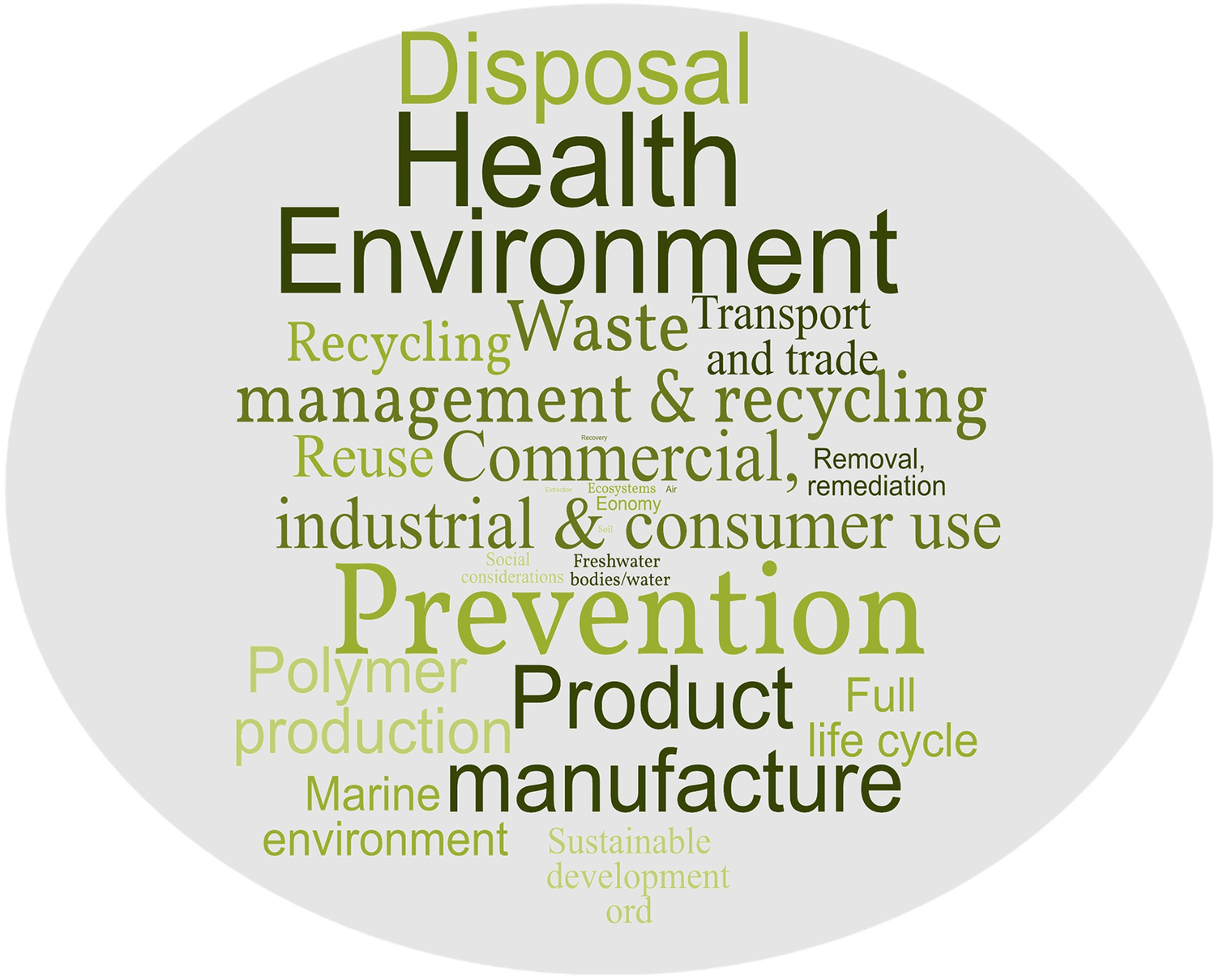


Impact statement
Plastic pollution represents one of the most pressing environmental challenges of our time, drawing increasing concern from both the public and policymakers worldwide. This research provides a critical analysis of the first zero draft of the proposed international legally binding instrument on plastic pollution, offering valuable insights for policymakers, environmental advocates and the wider global community. Our analysis reveals that the draft lacks a clear problem definition for addressing the entire life cycle and the ambitious waste hierarchy steps. Despite a strong emphasis on prevention, this approach does not cover the environmental and social impacts at the extraction stage, raising concerns about its effectiveness in addressing plastic pollution comprehensively. Notably, the zero draft’s focus on marine environments, particularly on fishing gear, with downstream measures is insufficient when considering the scientific consensus on the criticality of upstream actions. This is because enhancing waste management, advancing removal technologies and increasing circularity alone are inadequate for effectively reducing plastic pollution in the short, medium and long terms. Moreover, up to 90% of greenhouse gas emissions linked to the plastics sector occur during polymer and product production. Primary plastics production therefore also poses a risk to meet global climate targets.
By dissecting the draft’s approach to problem definition and its balance between addressing marine and terrestrial plastic pollution, our findings illuminate the complexities and challenges in forging an effective and comprehensive global treaty. This work not only contributes to academic discourse but also has practical implications for international negotiations, helping to shape strategies that are more inclusive, effective and environmentally sustainable. The analysis can inform ongoing debates, assist in aligning diverse international perspectives and support the development of measures that effectively tackle the multifaceted issue of plastic pollution.
Introduction
Already in 2016, the United Nations General Assembly described “marine debris and plastics in particular, [as] some of the greatest environmental concerns of our time, along with climate change, ocean acidification and loss of biodiversity” (United Nations General Assembly, 2016), and the UNEP called marine plastic pollution a “planetary boundary threat” in a report back in 2019 (UNEP, 2019, 31). Nevertheless, it still took another three years until the United Nations Environment Assembly (UNEA) passed a resolution in March 2022 that called for the establishment of an Intergovernmental Negotiating Committee (INC) to develop an international legally binding instrument on plastic pollution, including in the marine environment (UNEP, 2022). The INC began its work in the second half of 2022 with a target to complete its work by the end of 2024. The INCs-1 and -2 focused a lot on procedural matters. Nonetheless, at INC-2, discussions on substantive and material aspects of the treaty could start in two contact groups, with the major outcome being that committee members provided the mandate to develop a zero draft for discussion at INC-3 (Stöfen-O’Brien, Reference Stöfen-O’Brien2023; Cowan et al., Reference Cowan, Holmberg, Nøklebye, Rognerud and Tiller2024). The “zero draft text of the international legally binding instrument on plastic pollution, including in the marine environment” (UNEP/PP/INC.3/4) (UNEP, 2023) was then prepared by the INC-3 Chair with the support of the INC Secretariat, guided by the views expressed at the committee’s first and second sessions and presenting a range of views through various options. The overall aim was to come up with a comprehensive approach to address the full life cycle of plastic, taking into consideration the principles of the Rio Declaration on Environment and Development, as well as national circumstances and capabilities (UNEP, 2023). The zero draft was supposed to serve as the basis for moving toward text-based negotiations at INC-3 (Stöfen-O’Brien, Reference Stöfen-O’Brien2023). However, INC-3 was unable to achieve a single draft as its outcome. Instead, delegates put forward new textual submissions to be included in a “revised zero draft” (IISD, 2023). This revised draft was published at the end of December 2023 and is about twice as long as the version before (UNEP, 2023). Since the first zero draft marks the beginning of the more substantial negotiations that started during INC-3 and was also the reason for frustration among some negotiating delegates, we focus our analysis on this draft.
When the INC commenced its work, it became clear that defining the problem of plastic pollution within the treaty’s scope would be a critical task. This is because UNEA resolution 5/14 leaves room for different problem definitions, as it emphasizes addressing “plastic pollution, including in the marine environment” with the international legally binding instrument while also calling for a “comprehensive approach that addresses the full life cycle of plastic” (UNEP, 2022, 3). This dual focus raises significant questions about the scope and direction of the proposed treaty, for example, those parties aiming for a high level of ambition of the treaty fear the risk of diluting the focus and effectiveness of the treaty. On the one hand, there is the focus of mitigating plastic pollution, particularly in marine environments. On the other hand, the resolution calls for a broader approach encompassing the entire lifecycle of plastics, which would include upstream, midstream and downstream measures. This distinction is pivotal, as it opens room for differing interpretations and priorities among the negotiating countries – some advocate for strategies focused on the end-of-life stage of plastics, while others push for measures addressing upstream processes like plastics production (IISD, 2023). We would expect this ambivalence also to be present in the zero draft; however, it is interesting to examine to what extent the zero draft conveys a clear problem definition as the basis for an internationally legally binding instrument on plastic pollution.
The ambiguity in the UNEA resolution’s language reflects the complex nature of plastic pollution, which is not confined to marine environments but extends to terrestrial environments as well. Nevertheless, the issue of plastic pollution is often perceived as predominantly a marine problem (Cowan and Tiller, Reference Cowan and Tiller2021, 2), despite clear evidence that this pollution largely stems from land-based sources (Jambeck et al., Reference Jambeck, Geyer, Wilcox, Siegler, Perryman, Andrady, Narayan and Law2015). Therefore, scientific articles discussing a potential future plastics treaty argue for a treaty design that extends well beyond the pollution of marine environments and addresses both land and sea (Dauvergne, Reference Dauvergne2018; Raubenheimer and McIlgorm, Reference Raubenheimer and McIlgorm2018; Vince and Hardesty, Reference Vince and Hardesty2018; Tessnow-von Wysocki and Le Billon, Reference Tessnow-von Wysocki and Le Billon2019; Ferraro and Failler, Reference Ferraro and Failler2020; Maes et al., Reference Maes, Wienrich, Weiand and Cowan2023). The diverse origin of pollution, which is also varying across regions and socioeconomic groups, suggests the need for comprehensive governance strategies in the zero draft that encompass various environmental contexts and life stages of plastic. Thus, the following question arises: How does the zero draft balance the focus on marine environments with other affected areas, and what are the implications for governance strategies, including the focus on life stages and specific instruments?
Alongside understanding the treaty’s potential scope, it is equally important to explore the motivations behind the international efforts, particularly in light of possibly contrasting regional focuses. Mederake and Knoblauch’s (Reference Mederake and Knoblauch2019) study on motivations for EU plastic policies indicates a strong environmental emphasis in EU debates, often interlinked with economic considerations. In contrast, the UNEA resolution 5/14, initiating the negotiation process for a potential plastics treaty, paints a multifaceted picture encompassing environmental, social and economic aspects under the umbrella of sustainable development as well as mentioning human health aspects (Cowan et al., Reference Cowan, Holmberg, Nøklebye, Rognerud and Tiller2024). However, environmental concerns, including concerns about plastic pollution’s impact on marine environments are highlighted similar to the EU (UNEP, 2022, 2–3). Exploring the underlying motivations included in the zero draft is crucial for understanding various national and regional perspectives on shaping effective global plastic pollution strategies. It is also essential for the potential plastics treaty, as it must navigate and harmonize these diverse perspectives and priorities. This led us to the following research questions: What are the key motivations driving the treaty negotiations? Are there differences in motivations at the international level compared to regional initiatives like those in the EU?
The analysis reveals that the zero draft lacks a clear definition for addressing the entire life cycle and waste hierarchy steps, affirming our initial assumption of ambiguity. Despite its strong emphasis on prevention, the zero draft neglects the significant environmental and social impacts of the extraction stage, casting doubts on its effectiveness in addressing plastic pollution comprehensively. Furthermore, its focus on marine environments, particularly fishing gear, with downstream measures is insufficient, when considering the scientific consensus that enhancing waste management, advancing removal technologies and increasing circularity alone are inadequate for effectively reducing plastic pollution in the short, medium and long term, (Baztan et al., Reference Baztan, Jorgensen, Almroth, Bergmann, Farrelly, Muncke, Syberg, Thompson, Boucher, Olsen, Álava, Aragaw, Bailly, Jain, Bartolotta, Castillo, Collins, Cordier, De-Falco, Deeney, Fernandez, Gall, Gammage, Ghiglione, Gündoğdu, Hansen, Issifu, Knoblauch, Wang, Kvale, Monsaingeon, Moon, Morales-Caselles, Reynaud, Rodríguez-Seijo, Stoett, Varea, Velis, Villarrubia-Gómez and Wagner2024; Scientists’ Coalition for an Effective Plastics Treaty, 2024). Moreover, upstream actions are crucial to achieve global climate targets, as up to 90% of greenhouse gas emissions occur during polymer and product production (OECD, 2022; cf. also Karali et al., Reference Karali, Khanna and Shah2024 for similar results).
This article is structured as follows: ‘Methods’ section explains the methodology used for the content structuring qualitative content analysis of the zero draft and introduces the coding frame. ‘Results’ section presents the results. The Discussion section provides a critical analysis of the findings and relates them to the existing literature. The ‘Conclusion’ section summarizes the main findings, highlighting their significance for the ongoing discussions within the INC. In addition, areas for future research are identified.
Methods
We used content structuring qualitative content analysis to study the “first zero draft text of the international legally binding instrument on plastic pollution, including in the marine environment” (UNEP/PP/INC.3/4) (UNEP, 2023). Qualitative content analysis is particularly useful for systematically transforming large amounts of textual information into a structured, summarized format that can be further analyzed and interpreted with regard to the underlying research question(s). To do so, the content structuring qualitative content analysis follows a mixed-methods approach containing both qualitative and quantitative steps: The assignment of categories to text passages is a qualitative step, while working through many text passages and analyzing the frequencies of categories is a quantitative step (Kuckartz, Reference Kuckartz2014; Mayring, Reference Mayring2014).
The analysis is based on a category system used for coding that reflects the main aspects of the zero draft, we want to analyze. These main aspects or categories together build the structure of the category system (Schreier, Reference Schreier2014, 5; Stamann et al., Reference Stamann, Janssen and Schreier2016, 3):
-
1. Option
-
2. Environmental medium
-
3. Motivation
-
4. Life stage
-
5. Waste hierarchy
-
6. Policy instruments
The main categories (two nominal, the others ordinal) were developed deductively from the research questions. Thus, the categories are based on existing research and the policy processes that led to the development of the zero draft, including UNEA resolution 5/14 and the discussions at INCs 1-3. The subcategories for environmental media were taken from Bertling et al. (Reference Bertling, Bannick, Barkmann, Braun, Knoblauch, Kraas, Mederake, Nosić, Philipp, Sartorius, Schritt, Stein, Wencki, Wendt-Potthoff and Woidasky2022) and the initial selection of motivations from Mederake and Knoblauch (Reference Mederake and Knoblauch2019). The subcategories for stages in the plastics life cycle were taken from Scientists’ Coalition for an Effective Plastics Treaty (2023) and the stages of the waste hierarchy from EU waste policy (European Union, 2024). For the main category ‘Life stage’, an additional subcategory ‘life cycle’ was added. The coding frame was then pilot tested with approximately 10% of the zero draft text. Subsequently, the category system was modified to include additional subcategories for the main categories ‘waste hierarchy’ and ‘life stage’, which are used to code statements that are ‘open to interpretation’ with regard to the respective categories. During the main coding, additional subcategories were inductively added to the main categories ‘motivation’ as well as ‘environmental medium’, as several issues only appeared in the rear part of the draft. The final coding frame can be found in Annex A.
We used MAXQDA 10 (by VERBI Software GmbH in Berlin, Germany) for data coding. The content analytical unit consists of (at least) a word or short segment and up to a paragraph for coding the options. The same text segment could be coded with different subcategories. To enhance inter-coder reliability, the first and second authors independently coded 15% of the material, the results were compared and discrepancies discussed. Where necessary, the coding was adjusted, and the category descriptions and coding rules were specified. Since the text was quite dense, we coded small segments, sometimes only one or two words and sometimes two segments of the same category per paragraph, but not within a single sentence.
To analyze the coding for patterns and outstanding issues and to identify any gaps of inconsistencies in the zero draft’s approach to fighting plastic pollution, we look at frequencies as well as code relations. The latter were generated with the Code-Relations-Browser of MAXQDA, which visualizes code co-occurrence. We used the proximity function and chose the distance between paragraphs ‘0’ to identify the number of mentions of different subcategories in ‘motivation’, ‘life stage’ and ‘waste hierarchy’ in the different options.
Results
In examining to what extent the zero draft conveys a clear problem definition as the basis for an internationally legally binding instrument on plastic pollution, our analysis is focused on the coding of explicitly mentioned life stages along the plastics life cycle and stages in the waste hierarchy. This approach aims to determine whether the zero draft indicates an encompassing approach across the entire life cycle of plastic or places emphasis on specific parts of it (upstream, midstream or downstream).
The results reveal a certain pattern of frequencies across the Options 1 and 2 (see Figure 1). It is important to note that Option 3 is only present in the initial sections of the zero draft and thus cannot be evaluated in the same comprehensive manner as Options 1 and 2. Therefore, our comparison and analysis are primarily concentrated on these two options.Footnote 1 When examining life stages, we observed a differential focus in Options 1 and 2. In Option 1, ‘Polymer production’ (11 mentions vs. 6 mentions in Option 2), ‘Product manufacture’ (19 vs. 14) and ‘Transport and trade’ (12 vs. 8) are more prominently featured. This suggests a stronger focus in the direction of upstream and midstream measures than in Option 2. However, also ‘Waste management & recycling’ was more often mentioned. On the other hand, Option 2 gives more attention to ‘Commercial, industrial and consumer use’ than Option one (12 vs. 7). In addition, the life cycle wording is found nearly twice as often in Option 2, if compared with Option 1 (7 mentions vs. 4 mentions), pointing toward a more balanced approach across the life cycle in this option. ‘Extraction’ did not appear in any of the options.
Frequencies of coded segments for stages in the waste hierarchy and stages along the life cycle of plastics per option in the zero draft. Data derived from authors’ own analysis.

In the main category ‘waste hierarchy’, ‘prevention’ was mentioned 23 times in both Options 1 and 2, suggesting a strong focus on preventive measures in the zero draft. Second, ‘recycling’ was consistently mentioned throughout the draft with 11 times in Option 1 and 12 times in Option 2. In contrast, ‘recovery’ received very few (2 in Option 1) and ‘reuse’ and ‘disposal’ few mentions (5/6 vs. 6/7 for Options 1 and 2) throughout the zero draft, indicating less emphasis on these stages.
When looking at the overall numbers of coded segments for stages in the waste hierarchy and stages along the life cycle of plastics (see Figure 2), the overall picture slightly changes toward a bit more of a downstream focus. While ‘prevention’ still stands out as the most frequently coded waste hierarchy stage, ‘disposal’ is now mentioned almost as often as ‘recycling’ throughout the zero draft. For the stages of the life cycle, the picture changes even more: The stage of product manufacture with 37 mentions does not stand out as much as in the analysis of specific options, and the usage stage as well as the waste management and recycling stages follow with 31 mentions before the polymer production phase with 27 mentions. Overall, this suggests a more balanced approach between the life cycle stages throughout the zero draft than might be inferred from the individual options. However, the picture for ‘extraction’ is confirmed; it is scarcely mentioned across the draft.
Frequencies of coded segments for stages in the waste hierarchy and stages along the life cycle of plastics in the zero draft. Data derived from authors’ own analysis.

With regard to the second research question: How does the zero draft balance the focus on marine environments with other affected areas? What are the implications for governance strategies, including the focus on life stages and specific instruments? We coded how often and in which context environmental media (air, soil, water) were mentioned. We distinguished ‘water’ from freshwater bodies/water and marine environments and added the category ‘ecosystems’ because they were explicitly mentioned.
Overall, ‘air’ and ‘soil’ were mentioned twice, ‘ecosystems’ three times, ‘freshwater bodies/water’ four times and ‘marine environment’ 10 times (see Figure 3).
Frequencies of coded segments for environmental media in the zero draft. Data derived from authors’ own analysis.

Environmental media are mostly mentioned independent of the different options in the zero draft. The exemption is the ‘marine environment’, that is mentioned twice in Option 1 and twice in Option 2. When it comes to governance instruments, ‘marine environment’ was coded several times together with instruments, for instance, “Each Party should make publicly available information on common plastic pollution types and practices and behaviors that lead to plastic pollution, to raise awareness and prevent further plastic pollution, including littering in coastal and freshwater areas” (UNEP, 2023, 19). Here, ‘littering in coastal […] areas’ was coded as referring to the marine environment. The second source reads as follows: “The national plans […] shall include at least relevant elements related to […] Existing plastic pollution, including in the marine environment” (UNEP, 2023, 22). The third segment reads: “Parties shall, within their capabilities, at the national, regional and international levels, cooperate in promoting and/or undertake relevant research, development, exchange of information and cooperation to improve understanding of the impacts of plastic pollution and advance scientific knowledge and promote technological innovation to reduce plastic pollution, including in the marine environment” (UNEP, 2023, 27). Another passage states: “Each Party shall take the necessary measures to prevent open dumping, ocean dumping, littering and open burning” (UNEP, 2023, 15). Examples or definitions of what ‘necessary measures’ could be are not provided. The paragraphs on fishing gear do not refer to the ‘marine environment’ (UNEP, 2023, 15).
In terms of life stages, the term ‘marine environment’ was only referenced twice and both times in conjunction with the final stage of ‘removal, remediation’. The first instance appears in the section discussing national plans already quoted above: “The national plans […] shall include at least relevant elements related to […] Existing plastic pollution, including in the marine environment” (UNEP, 2023, 22). The second occurrence emphasizes scientific and technological innovation: “Parties are encouraged to promote scientific and technical innovation to prevent and capture the releases of plastics and plastic products, including microplastics, into the marine environment” (UNEP, 2023, 14).
To answer the third research question ‘What are the key motivations driving the treaty negotiations?’ we analyzed the frequency of mentions across different motivational categories (environment, economy, health, social considerations, sustainable development) in the zero draft. The data reveal a consistent emphasis on certain motivations, regardless of the option considered.
‘Health’ emerged as the most frequently cited motivation across the draft (overall 55 mentions), with the highest number of mentions in Option 1 (19 times) and a strong presence in Option 2 (16 times). This indicates that health concerns are the dominant driver in the treaty’s negotiations.
The ‘environment’ was the second most cited factor (overall 50 mentions), with 14 mentions in Option 1 and 15 in Option 2, suggesting that environmental considerations are also integral to the treaty’s objectives. Specifying environmental considerations, on three occasions, the zero draft made specific references to biodiversity. In two cases, this was related to plastic pollution mitigation and remediation measures/clean-up measures that should “tak[e] into account the provisions in the existing international agreements including those relevant to the conservation and sustainable use of marine biological diversity” (UNEP, 2023, 18) and that should “not have potential for negative impacts on the environment, biodiversity and human health” (UNEP, 2023, 19). In the third case, a reference to fauna and flora exposure to plastic pollution was made in relation to existing indigenous knowledge (UNEP, 2023, 26).
The motivations of ‘economy’, ‘social considerations’ and ‘sustainable development’ each received similar attention in Options 1 and 2. However, when looking at the overall numbers of mentions, it stands out that ‘sustainable development’ (16) was mentioned much more often than ‘economy’ (4) and ‘social considerations’ (4).
Option 3, with its limited presence in the zero draft, showed a markedly lower number of mentions across all categories, suggesting that it does not significantly influence the overall motivational narrative of the draft (see Figure 4).
Frequencies of coded motivational factors per option in the zero draft. Data derived from authors’ own analysis.

Discussion
The analysis of the zero draft’s approach regarding a coherent problem definition, potentially revealed through a clear focus on the entire life cycle and the more ambitious steps in the waste hierarchy, indicates the absence of such a clear definition, thus confirming our initial assumption. While the draft extends well beyond ‘end of pipe’ solutions, it lacks a clear focus that encompasses all stages of the life cycle. This finding is in line with Dreyer et al. (Reference Dreyer, Hansen, Holmberg, Olsen and Stripple2024, 15) who state the lack of a common definition as well as a comparative neglect of upstream measures. Also, while Options 1 and 2 reveal slight differences in emphasis, they remain open-ended, indicating that the direction of the negotiations is still malleable. The final text could also become a mix of both options and even completely a new text, depending on the ongoing negotiation process.
Nevertheless, several aspects of the results warrant particular attention: The zero draft’s considerable attention to prevention might explain the coming together of a group of ‘like-minded countries’ (including, among others, Iran, Russia, Saudi Arabia, Cuba, Bahrain, Iraq and India) at INC-3 that advocated for a downstream focus on waste management to “limit the damage on plastic-producing countries” (Singh, Reference Singh2023; cf. also Dreyer et al., Reference Dreyer, Hansen, Holmberg, Olsen and Stripple2024) and a revision of the first zero draft, which was ultimately successful (IISD, 2023). However, the apparent strong emphasis on prevention in the zero draft could also be questioned. In fact, what our coding revealed (not only for prevention, but in general), is that it is not only about the mentioning of words but also the concrete phrasing/framing that makes a difference, or, in other words, simple frequency analysis cannot reveal the subtle differences between options. Instead, it would be necessary to examine the precise wording and context to distinguish the level of ambition among the various options. For instance, regarding the use of recycled plastic content, Option 1 states:
“1. Each Party shall require plastics and plastic products produced within its territory and those available on its market to contain minimum percentages of safe and environmentally sound postconsumer recycled plastic, as set out in part III of Annex C, within the timeframe specified in that annex” (UNEP, 2023, 12).
Option 2 for comparison:
“1. Each Party should take the necessary measures for plastics and plastic products produced within its territory and those available on its market to achieve minimum percentages of safe and environmentally sound postconsumer recycled plastic contents, based on the elements contained in part III of Annex C. The measures taken to implement this provision shall be reflected in the national plan communicated pursuant to [part IV.1 on national plans]” (UNEP, 2023, 12).
Both options are coded with the same categories according to the coding system. However, Option 1 “shall require” is much more binding than Option 2 “should take the necessary measures”.
Although the coding indicated a strong focus on prevention, the zero draft nevertheless scarcely addresses the extraction stage. This omission points to a potential gap in the draft’s current approach, which may overlook the significant environmental and social impacts associated with the extraction of raw materials for plastic production. In contrast to the current lack in the draft, NGOs and scientists have been vocal on the problem of growing primary plastic production, the power of petrochemical companies (Mah, Reference Mah2021; Tilsted et al., Reference Tilsted, Bauer, Deere Birkbeck, Skovgaard and Rootzén2023) and the negative consequences of extraction (e.g., CIEL, 2019; European Environment Agency, 2021), leading to calls for a global cap on plastic production (for instance, Simon et al., Reference Simon, Raubenheimer, Urho, Unger, Azoulay, Farrelly, Sousa, Van Asselt, Carlini, Sekomo, Schulte, Busch, Wienrich and Weiand2021; Bergmann et al., Reference Bergmann, Almroth, Brander, Dey, Green, Gundogdu, Krieger, Wagner and Walker2022; Tilsted et al., Reference Tilsted, Bauer, Deere Birkbeck, Skovgaard and Rootzén2023; Baztan et al., Reference Baztan, Jorgensen, Almroth, Bergmann, Farrelly, Muncke, Syberg, Thompson, Boucher, Olsen, Álava, Aragaw, Bailly, Jain, Bartolotta, Castillo, Collins, Cordier, De-Falco, Deeney, Fernandez, Gall, Gammage, Ghiglione, Gündoğdu, Hansen, Issifu, Knoblauch, Wang, Kvale, Monsaingeon, Moon, Morales-Caselles, Reynaud, Rodríguez-Seijo, Stoett, Varea, Velis, Villarrubia-Gómez and Wagner2024). Yet, an analysis of statements by state delegates during negotiation sessions at INC-3 as well as official submissions from states on the different parts of the zero draft text reveals major disagreement on whether the production and supply of primary plastic polymers should be limited and reduced (SWITCH-Asia, 2024, 6).
The absence of a definitive stance within the zero draft on the problem definition may serve as a strategic placeholder, providing negotiators the flexibility to adapt as discussions progress. However, this ambiguity also underscores the necessity for greater precision in future drafts to ensure that the policy instruments proposed and selected are robust and comprehensive enough to confront the multifaceted nature of plastic pollution. The current broad range of instruments mentioned in the draft (see Annex B) does not yet indicate a specific direction for the treaty. The suite of instruments ultimately adopted—whether they foresee production caps, design and manufacturing changes or waste management solutions—will decisively shape the treaty’s capacity to catalyze real change. A recent analysis of INC submissions found that “[r]elatively few economic measures have been proposed overall so far, [while] most [instruments] are of a soft or regulatory type. The uneven distribution of proposed measure types could weaken the effectiveness of the instrument by impeding its ability to address the issue of plastic pollution in all its complexity” (Dreyer et al., Reference Dreyer, Hansen, Holmberg, Olsen and Stripple2024, 4).
With regard to the second research question, the analysis of the zero draft shows that the treaty text puts an emphasis on ‘marine environment’. This is not unexpected since the title “zero draft text of the international legally binding instrument on plastic pollution, including in the marine environment” (UNEP/PP/INC.3/4) (UNEP, 2023) already suggests this focus. As mentioned earlier, plastic pollution is often perceived as predominantly a marine problem (Cowan and Tiller, Reference Cowan and Tiller2021, 2). However, given that models focusing on the total plastic mass in the environment suggest that an equal amount of plastics accumulate in soil (41%) as in the ocean (40%), with hotspots in urban soils (33%) and ocean coasts (25%) (Hoseini and Bond, Reference Hoseini and Bond2022, 8), it is surprising how little attention is given to the other nonmarine environment media, with ‘soil’ and ‘air’ being mentioned only twice, respectively. Since several studies suggests hotspots in cities (Hoseini and Bond, Reference Hoseini and Bond2022), for example, also regarding the air, which is more polluted with microplastics in urban areas than in the countryside (Kernchen et al., Reference Kernchen, Löder, Fischer, Fischer, Moses, Georgi, Nölscher, Held and Laforsch2022), it is interesting to note that neither cities nor municipalities are mentioned in the draft text. Interesting in this regard: At INC-4, a new coalition of cities and local governments formed since they want to be more included in the treaty-making process. “Subregional bodies” are mentioned twice (UNEP, 2023, 25) when it comes to international cooperation, mentioning that such cooperation should also be strengthened with other legal frameworks, including subregional bodies. Furthermore, to “promote ambitious action and cooperation at the local, national, regional and global levels” (UNEP, 2023, 27) is also mentioned as one of several purposes of the multi-stakeholder action agenda.
What implications does this focus on the marine environment have for governance strategies? As previously noted, the list of potential governance or policy instruments mentioned throughout the treaty text is quite long, encompassing market-based instruments (including financial instruments), regulatory instruments, plans and strategies, as well as information and cooperative instruments (see Annex B). In addition, the text frequently calls for “necessary” or “effective measures” without further specifying them. Notably, fishing gear is uniquely highlighted in the zero draft with its own section and headline under the issue of waste management, aiming to “to prevent, reduce and eliminate, abandoned, lost or otherwise discarded fishing gear” (UNEP, 2023, 16). Hence, the marine environment receives particular attention in the zero draft, but with a focus on downstream measures. Such an approach is concerning, given the scientific consensus that downstream measures are insufficient for effectively addressing plastic pollution (Jambeck et al., Reference Jambeck, Geyer, Wilcox, Siegler, Perryman, Andrady, Narayan and Law2015; Borrelle et al., Reference Borrelle, Ringma, Law, Monnahan, Lebreton, McGivern, Murphy, Jambeck, Leonard, Hilleary, Eriksen, Possingham, De Frond, Gerber, Polidoro, Tahir, Bernard, Mallos, Barnes and Rochman2020; Lau et al., Reference Lau, Shiran, Bailey, Cook, Stuchtey, Koskella, Velis, Godfrey, Boucher, Murphy, Thompson, Jankowska, Castillo, Pilditch, Dixon, Koerselman, Kosior, Favoino, Gutberlet, Baulch, Atreya, Fischer, He, Petit, Sumaila, Neil, Bernhofen, Lawrence and Palardy2020; Simon et al., Reference Simon, Raubenheimer, Urho, Unger, Azoulay, Farrelly, Sousa, Van Asselt, Carlini, Sekomo, Schulte, Busch, Wienrich and Weiand2021; Bergmann et al., Reference Bergmann, Almroth, Brander, Dey, Green, Gundogdu, Krieger, Wagner and Walker2022, Reference Bergmann, Arp, Almroth, Cowger, Eriksen, Dey, Gündoğdu, Helm, Krieger, Syberg, Tekman, Thompson, Villarrubia-Gómez, Warrier and Farrelly2023; Cowan et al., Reference Cowan, Tiller, Oftebro, Throne-Holst and Normann2023; Erdle and Eriksen, Reference Erdle and Eriksen2023). Additionally, this focus becomes even more critical considering that up to 90% of greenhouse gas emissions from plastics occur upstream, namely during polymer production and the manufacturing of plastic products (OECD, 2022).
With regard to the motivations underlying the international negotiations, we found that health and environmental concerns to dominate in the zero draft. This is again in line with the findings of Dreyer et al. (Reference Dreyer, Hansen, Holmberg, Olsen and Stripple2024, 14), who report that 76% of the coded INC submissions mentioned the protection of human health, and even more, namely, 87%, mentioned the protection of biodiversity and the (marine) environment. We were also interested in potential differences in motivations at the international level compared to supranational, regional discussions such as those in the EU. In contrasting the motivations driving plastic regulation in the EU, based on the European Parliament (EP) plenary debates in 2018/19 (Mederake and Knoblauch, Reference Mederake and Knoblauch2019), with those in the international negotiations of the zero draft, notable differences emerge. The analysis of the zero draft reveals a predominant emphasis on health, with 55 mentions, suggesting a global prioritization of health concerns in the international negotiations. This stands in contrast to the EU debates, in which environmental reasons overwhelmingly led the discourse, mentioned more than twice as often as health concerns. Economic arguments, while less prominent in the zero draft with only four mentions (in Options 1 and 2, two mentions each), featured more significantly in the EU context, even surpassing the frequency of health-related arguments (Mederake and Knoblauch, Reference Mederake and Knoblauch2019, 5).
The international negotiations also bring to the forefront ‘social considerations’ as a motivational factor that was not present in the EU debates. In addition, the ‘just transition’ (cf. O’Hare and Nøklebye, Reference O’Hare and Nøklebye2023) did received an own headline in the draft and was overall mentioned in twelve instances, highlighting the drafts attempt to ensure social equity and the fair treatment of all stakeholders in the fight against plastic pollution. Cowan et al. (Reference Cowan, Holmberg, Nøklebye, Rognerud and Tiller2024, 432), who report on the discussions at INC-2 also highlight that a broad consensus among states appeared regarding just transition matters (cf. also Stöfen-O’Brien, Reference Stöfen-O’Brien2023, 827). These aspects were absent from the EU debates, pointing to a broader, more inclusive approach at the international level, taking into account the reality of the Global South.
Additionally, Mederake and Knoblauch (Reference Mederake and Knoblauch2019, Reference Bergmann, Almroth, Brander, Dey, Green, Gundogdu, Krieger, Wagner and Walker2) identify a moral or ethical dimension to the preservation of ecosystems subsumed in a category as ‘non-use values’. This aligns to a certain extent with the attention given to biodiversity and the preservation of ecosystems in the zero draft. It demonstrates an awareness in both debates of the importance of preserving ecosystems for their own sake, beyond direct human use and benefit. However, other motivations are clearly dominating the discussions and the wording in the zero draft is not yet ecosystem-centered (Tessnow-von Wysocki et al., Reference Tessnow-von Wysocki, Wang, Morales-Caselles, Woodall, Syberg, Carney Almroth, Fernandez, Monclús, Wilson, Warren, Knoblauch and Helm2023). Therefore, leading scientists are calling for the treaty text to center ecosystems (Tessnow-von Wysocki et al., Reference Tessnow-von Wysocki, Wang, Morales-Caselles, Woodall, Syberg, Carney Almroth, Fernandez, Monclús, Wilson, Warren, Knoblauch and Helm2023) and tackle high-seas plastic pollution to protect and restore ecosystems (Helm, Reference Helm2022). Furthermore, the International Union for Conservation of Nature proposed a specific article on biodiversity for the treaty text (Siegwart et al., Reference Siegwart, Harrington and Sorrentino2024).
The disparities revealed by the content analyses of EP plenary debates and the zero draft underscore a divergence in focus between the debates at EU and international levels. While environmental considerations are a central concern in both contexts, the intensity of the focus on health and economic arguments differs. This reflects distinct approaches and perceived priorities in addressing plastic pollution across the political spheres. The significant emphasis on health arguments at the international level resonates with recent scholarly calls, such as those by O’Meara (Reference O’Meara2023), who advocates for a human rights-based approach to plastic pollution, emphasizing health. The perspective is also supported by observations that health concerns have been key factors for plastics policies across different jurisdictions in Northern America, Asia, Africa and the Caribbean (Shipton and Dauvergne, Reference Shipton and Dauvergne2022).
Conclusion
In this article, we set out to critically analyze the first zero draft of the proposed international legally binding instrument on plastic pollution. Utilizing a content structuring qualitative content analysis, we examined the draft’s approach to defining the problem of plastic pollution and its emphasis on different life cycle stages and waste hierarchy steps. Our methodology involved dissecting the text to understand its focus on marine versus terrestrial environments and to identify the key motivations driving the treaty negotiations. The following conclusions draw upon this analysis, summarizing our key findings and their implications for global efforts to combat plastic pollution.
The zero draft’s analysis highlights a lack of a clear problem definition, particularly in addressing the entire life cycle and ambitious waste hierarchy steps. While it extends beyond ‘end of pipe’ solutions, it lacks a comprehensive focus across all life cycle stages, thus confirming the initial assumption of an unclear definition. These insights underscore the need for a more defined approach in the zero draft. It is crucial for the INC to consider these findings as opportunities to enhance the treaty’s scope and depth, particularly in terms of the life cycle and waste hierarchy considerations.
Despite the draft’s strong focus on prevention, as identified in the coding, it inadequately addresses the extraction stage. This oversight neglects the significant environmental and social impacts associated with raw material extraction for plastics production. This omission points to a gap in the current approach, raising concerns about the draft’s overall effectiveness in addressing plastic pollution comprehensively.
The zero draft emphasizes the marine environment, specifically fishing gear, but predominantly with downstream measures. However, the scientific consensus indicates that these measures alone are insufficient to address plastic pollution effectively. This underscores the necessity for a more balanced approach in the treaty. In other words, addressing the existing disparities is essential for the INC to develop a treaty that is both comprehensive and effective.
The disparities between EP plenary debates and the zero draft further highlight a divergence in focus between EU and international levels, with varying intensities in addressing health and economic arguments, reflecting distinct approaches and priorities in combating plastic pollution across political levels.
In light of our findings, it is evident that the INC needs to address the observed ambiguities in the zero draft to secure the chance for an ambitious and thus effective treaty. The lack of a clear problem definition, especially regarding the entire life cycle of plastics, suggests the need for a more holistic approach in future research. The INC should consider a more robust emphasis on upstream measures given the impossibility to end plastic pollution with midstream and downstream measures only and considering the climate impacts of primary plastic polymer and plastic product production. Future treaty drafts should aim for a clearer delineation of environmental, health and economic priorities, ensuring that all aspects of plastic pollution are comprehensively addressed.
Subsequent research should focus on a detailed analysis of each option within the zero draft, with particular focus on the phrasing and framing of the text. This would provide a clearer understanding of the nuances and potential implications of each option. Examining the differences in approach and priorities between global and regional policies, such as those in the EU, on plastic pollution could offer insights into the challenges of harmonizing international efforts. Furthermore, future research should explore the perspectives and influences of different stakeholders, including countries, NGOs, industry groups and scientists, in the treaty negotiations. Understanding these dynamics could provide valuable insights into the negotiation process and the shaping of the negotiations.
Ultimately, comparing the original and revised zero drafts could offer valuable insights into the evolution of the treaty’s focus and priorities. Such an understanding is crucial for aligning global efforts and ensuring the effectiveness of the final instrument in combating the multifaceted issue of plastic pollution.
Open peer review
To view the open peer review materials for this article, please visit http://doi.org/10.1017/plc.2024.29.
Data availability statement
The data that support the findings of this study are available from the corresponding author, D.K., upon reasonable request.
Acknowledgments
The authors thank Sus Sama and Felix Nütz for their support in literature research (Sus Sama) and data visualization (Felix Nütz). Furthermore, the authors would like to thank Tara Olsen for her valuable comments on an earlier version of the manuscript, as well as two anonymous reviewers for their helpful comments.
Author contribution
Conceptualization: D.K. and L.M. Methodology: D.K. and L.M. Investigation: D.K. and L.M. Formal analysis: D.K. and L.M. Writing – original draft: D.K. and L.M. Writing – review & editing: D.K. and L.M. Visualization: D.K. and L.M.
Financial support
This research received no specific grant from any funding agency, commercial or not-for-profit sectors.
Competing interest
D.K. in an unpaid cochair of a working group of the Scientists’ Coalition for an Effective Plastics Treaty.
Annex A: Coding frame

Annex B: List of policy or governance instruments mentions in the zero draft text


 Open access


Comments
Dear Sir or Madam,
With a focus on the zero draft text, the article deals with an issue that has not been researched extensively by social scientists, while it addresses a very timely and crucial subject: the text under negotiation for an international legally binding instrument to combat plastic pollution. Plastic pollution represents one of the most pressing environmental challenges of our time, drawing increasing concern from both the public and policy makers worldwide. This research provides a critical analysis of the first zero draft of the proposed international legally binding instrument on plastic pollution, offering valuable insights for policymakers, environmental advocates, and the wider global community. Our analysis reveals that the draft lacks a clear problem definition for addressing the entire life cycle and ambitious waste hierarchy steps. Despite a strong emphasis on prevention, it does not cover the environmental and social impacts at the extraction stage, raising concerns about its effectiveness in addressing plastic pollution comprehensively. Notably, the zero draft’s focus on marine environments, particularly on fishing gear, with downstream measures is insufficient when considering the scientific consensus on the criticality of upstream actions. This is because up to 90% of greenhouse gas emissions occur during polymer and product production. Furthermore, disparities between European Parliament plenary debates and the zero draft highlight a divergence in focus at EU and international levels, particularly in addressing health and economic arguments. This reflects distinct approaches and priorities in combating plastic pollution across political spheres.
Thus, by dissecting the draft’s approach to problem definition and its balance between addressing marine and terrestrial plastic pollution, our findings illuminate the complexities and challenges in forging an effective and comprehensive global treaty. This work not only contributes to academic discourse but also has practical implications for international negotiations, helping to shape strategies that are more inclusive, effective, and environmentally sustainable. The analysis can inform ongoing debates, assist in aligning diverse international perspectives, and support the development of measures that effectively tackle the multifaceted issue of plastic pollution.
The manuscript fits the scope of the journal and particularly the special issue because it analyses the object of concern: the plastics treaty, and in a novel and insightful manner.
We confirm that neither the manuscript nor any parts of its content are currently under consideration or published in another journal.
Doris Knoblauch and Linda Mederake
Berlin, 31.01.2024