




Introduction
River deltas, despite covering only about 0.3% of the global ocean surface, play a central role in the biogeochemical carbon cycle (Burdige et al. Reference Burdige2007). These zones account for 40% of all carbon buried in oceanic sediments (Berner Reference Berner1982). They are also active biogeochemical reactors that constitute sources of CO2 to the atmosphere, representing around a quarter of the anthropogenic CO₂ absorbed by the entire ocean (Cai Reference Cai2011; Laruelle et al. Reference Laruelle, Cai and Hu2018). This critical role in carbon storage stems from their high sedimentation and organic matter (OM) mineralization rates, making deltas “hot spots” for carbon storage and transformation. Understanding the characteristics of OM deposited in these sediments, including its origin (terrestrial, fluvial, or marine), nature (vegetation, phytoplankton, soils), age, and reactivity, is therefore essential for better assessing their contribution to coastal carbon budgets.
In deltas and estuaries, sediments receive OM from multiple sources: terrestrial inputs, autochthonous fluvial or estuarine production, and marine inputs (Bianchi and Allison Reference Bianchi and Allison2009; Bianchi et al. Reference Bianchi, Mayer and Amaral2024). These diverse origins induce variable reactivity of organic matter depending on its nature and residence time in soils or aquatic systems (Bauer et al. Reference Bauer, Cai, Raymond, Bianchi, Hopkinson and Regnier2013). Stable and radiogenic carbon isotopes (δ13C and Δ14C) have proven valuable for characterizing OM sources in fluvial and deltaic sediments (Blair and Aller Reference Blair and Aller2012; Cathalot et al. Reference Cathalot, Rabouille, Tisnerat-Laborde, Toussaint, Kerherve, Buscail, Loftis, Sun, Tronczynski, Azoury, Lansard, Treignier, Pastor and Tesi2013; Goni et al. Reference Goni, Ruttenberg and Eglinton1997, Reference Goni, Ruttenberg and Eglinton1998, Reference Goni, Monacci, Gisewhite, Crockett, Nittrouer, Ogston, Alin and Aalto2008; Raymond and Bauer Reference Raymond and Bauer2001). Near river mouths, sediments are predominantly of terrestrial origin, whereas marine-derived OM generally becomes more dominant on continental shelves (Goni et al. Reference Goni, Ruttenberg and Eglinton1997). The presence of geological refractory carbon besides the dominant biospheric fraction may play a significant role in organic carbon preservation (Galy et al. Reference Galy, Beyssac, France-Lanord and Eglinton2008; Copard et al. Reference Copard, Eyrolle-Boyer, Radakovitch, Poirel, Raimbault, Gairoard and Di-Giovanni2018; Cathalot et al. Reference Cathalot, Rabouille, Tisnerat-Laborde, Toussaint, Kerherve, Buscail, Loftis, Sun, Tronczynski, Azoury, Lansard, Treignier, Pastor and Tesi2013).
The Rhône River delta is a privileged study site for exploring these dynamics, particularly due to its status as one of Europe’s most “nuclearized” rivers. The periodic discharge of cooling waters from its nuclear power plants, enriched in dissolved inorganic radiocarbon (Δ14C-DIC), directly influences autochthonous OM through photosynthesis (Bodereau et al. Reference Bodereau, Eyrolle, Copard, Dumoulin, Lepage, Raimbault, Giner, Mourier and Gurriaran2024; Dumoulin et al. Reference Dumoulin, Pozzato, Rassman, Toussaint, Fontugne, Tisnérat-Laborde, Beck, Caffy, Delqué-Količ, Moreau and Rabouille2018; Eyrolle et al. Reference Eyrolle, Antonelli, Renaud and Tournieux2015; Jean-Baptiste et al. Reference Jean-Baptiste, Fontugne, Fourré, Marang, Antonelli, Charmasson and Siclet2018a). These 14C-enriched isotopic signatures make it possible to trace recent inputs of freshly produced OM within the river, particularly in the prodelta and adjacent continental shelf (Cathalot et al. Reference Cathalot, Rabouille, Tisnerat-Laborde, Toussaint, Kerherve, Buscail, Loftis, Sun, Tronczynski, Azoury, Lansard, Treignier, Pastor and Tesi2013).
Previous studies (Aller et al. Reference Aller, Blair and Brunskill2008; Dumoulin et al. Reference Dumoulin, Pozzato, Rassman, Toussaint, Fontugne, Tisnérat-Laborde, Beck, Caffy, Delqué-Količ, Moreau and Rabouille2018; Pozatto et al. Reference Pozzato, Rassmann, Lansard, Dumoulin, van Brugel and Rabouille2018) have suggested that fresh OM possibly of riverine origin is rapidly mineralized in river deltas, making these areas major CO₂ sources. At the same time, particles of different origins and various carbon contents are buried in the prograding delta. The interplay and quantification of these processes require further investigation, particularly through coupled analyses of carbon isotopes in the solid phase organic carbon and its remineralization counterpart DIC in sediment porewaters. This coupled approach may provide insights into the fate of labile and recent OM fractions (Aller and Blair Reference Aller and Blair2006; Zetsche et al. Reference Zetsche, Thornton, Midwood and Witte2011), as well as that of the more refractory organic carbon.
This article compiles more than 10 years of studies in the Rhone delta in order to better understand the origin and fate of the different fractions of OM in the complex system of the watershed and up to the Rhône prodelta. For this, isotopic signatures (δ13C and Δ14C) were studied in porewaters and sediments. New data from the MissRhoDia II campaign (Rabouille Reference Rabouille2018) will be presented and compared with those from previous studies (CarboRhone, Rabouille Reference Rabouille2013; DICASE, Lansard Reference Lansard2014) to better understand the complex interactions between terrestrial, river and marine inputs.
Materials and methods
Study site
The Rhône River is the largest river in France in terms of discharge and contributes significantly to the input of freshwater and organic matter (OM) into the western Mediterranean Sea. Its hydrological regime is highly variable, ranging from 700 m3 s−1 during low flow periods to over 3000 m3 s−1 (up to 11000 m3 s−1) during flood events. This variability influences the composition of riverine inputs to the delta, which include soils of various ages, vegetation debris, riverine phytoplankton and ancient carbon, i.e. petrogenic and kerogen containing no radiocarbon (Cathalot et al. Reference Cathalot, Rabouille, Tisnerat-Laborde, Toussaint, Kerherve, Buscail, Loftis, Sun, Tronczynski, Azoury, Lansard, Treignier, Pastor and Tesi2013; Copard et al. Reference Copard, Eyrolle-Boyer, Radakovitch, Poirel, Raimbault, Gairoard and Di-Giovanni2018; Harmelin-Vivien et al. Reference Harmelin-Vivien, Dierking, Banaru, Fontaine and Arlhac2010). The Rhône River’s freshwater plume, driven westward by the Liguro-Provençal Current, primarily spreads at the sea surface and mixes with seawater in the upper water column. At depths of 20 m and below, bottom waters are typically marine, with salinities around 38‰. Sediment transport and deposition occur rapidly at the river mouth, called the proximal zone (Rassmann et al. Reference Rassmann, Eitel, Cathalot, Brandily, Lansard, Taillefert and Rabouille2020; depths 0–20 m), with redistribution to the prodelta (20–60 m depth) driven by wave action. The sedimentation rates reach approximately 30–40 cm y−1 in the proximal zone (Charmasson et al. Reference Charmasson, Bouisset, Radakovitch, Pruchon and Arnaud1998). Further offshore, sedimentation rates decrease significantly to 5–10 cm y−1 in the prodelta area and to less than 0.3 cm y−1 on the continental shelf (Miralles et al. Reference Miralles, Radakovitch and Aloisi2005).
This study focuses on new data collected in 2018 at four sampling stations along a transect crossing the Rhône freshwater plume (Figure 1). Two stations (A and Z) are located in the proximal zone at a depth of 20 m, a third station (E), located 17 km offshore, is on the continental shelf at a depth of 75 m. Between these two, station K is located at 60 m depth in the prodelta. Station K allows us to see how the transition between the proximal zone and the continental shelf takes place.
Map of the Rhône River mouth, prodelta and adjacent continental shelf. Stations are described for the different areas with their sedimentation rates.

The Rhône River’s inputs have been influenced by anthropogenic activity over the past century, with two major periods defining radiocarbon activity trends (Dumoulin et al. 2018).
During the pre-nuclear era, the river exhibited a freshwater reservoir effect (FRE) for dissolved inorganic carbon (DIC), caused by contributions from tributaries and carbonate dissolution in the watershed. This FRE was measured at Δ14C = –114‰, closely mirroring values from the tributary Durance River with Δ14C= –138‰ (Jean-Baptiste et al. Reference Jean-Baptiste, Fontugne, Fourré, Marang, Antonelli, Charmasson and Siclet2018) and more recently –146‰ (Bodereau et al. Reference Bodereau, Eyrolle, Copard, Dumoulin, Lepage, Raimbault, Giner, Mourier and Gurriaran2024). In the Mediterranean coastal waters before the 1950s, marine DIC and phytoplankton were affected by the marine reservoir effect, with values of Δ14C = –50‰ to Δ14C = –60‰ (Siani et al. Reference Siani, Paterne, Arnold, Bard, Métivier, Tisnérat and Bassinot2000; Tisnérat-Laborde et al. Reference Tisnérat-Laborde, Montagna, Frank, Siani, Silenzi and Paterne2013).
During the nuclear era, beginning in 1955 with atmospheric thermonuclear tests, Δ14C activity in the atmosphere doubled in 1963. This enrichment spread to river and marine systems. Mediterranean surface waters reached Δ14C = +90‰ in 1970, before decreasing to Δ14C = +60‰ in 2010 (Tisnérat-Laborde et al. Reference Tisnérat-Laborde, Montagna, Frank, Siani, Silenzi and Paterne2013; Ayache et al. Reference Ayache, Dutay, Mouchet, Tisnérat-Laborde, Montagna, Tanhua, Siani and Jean-Baptiste2017). Since 1980, nuclear power plants located along the Rhône have introduced significant anthropogenic inputs. In the riverine DIC, the 14C values induced by anthropogenic activity are evidenced by a median close to +42‰ and a maximum of +629‰ (Bodereau et al. Reference Bodereau, Eyrolle, Copard, Dumoulin, Lepage, Raimbault, Giner, Mourier and Gurriaran2024) which clearly shows the impact of nuclear release. For particulate organic carbon (POC), the seasonal variability of algal production mixed with inputs of OM of various types and radiocarbon ages led to significant fluctuations in the values of Δ14C. Between 2010 and 2013, samples collected in the Rhone River, in Arles near the mouth, presented Δ14C values ranging from –172‰ to +908‰ (Jean-Baptiste et al. Reference Jean-Baptiste, Fontugne, Fourré, Marang, Antonelli, Charmasson and Siclet2018). More recently Bodereau et al. (Reference Bodereau, Eyrolle, Copard, Dumoulin, Lepage, Raimbault, Giner, Mourier and Gurriaran2024) reported also a large range of results for the OC associated to suspended particulate matter (SPM) collected on the Rhône in Arles with a median Δ14C +142‰ and occasional values >1000‰.
These trends underscore the influence of anthropogenic factors on OM isotopic composition within the Rhône delta, and its subsequent deposition and mineralization, emphasizing the need for isotopic analysis to differentiate between pre-nuclear and present contributions.
Sampling
Sampling was conducted in May 2018. Interface sediment cores approximately 40 cm in length were collected using a gravity corer (Uwitec) fitted with transparent PVC tubes. At Station E, where the sedimentation rate is about 0.3 cm y−1, a core represents approximately 100 to 150 years of deposition (Miralles et al. Reference Miralles, Radakovitch and Aloisi2005) whereas at stations A and Z with an average sedimentation rate between 30–40 cm y−1 a core represents nearly one year (Charmasson et al. Reference Charmasson, Bouisset, Radakovitch, Pruchon and Arnaud1998). Porewaters were extracted using 0.2 µm rhizons (Rhizosphere Research Products) in combination with a 20 mL rubber-free syringe (Seeberg-Elverfeldt et al. Reference Seeberg-Elverfeldt, Schlüter, Feseker and Kölling2005), ensuring the removal of particles from the porewaters. The extracted porewater samples were sealed in 15 mL Pyrex glass ampoules which were stored frozen at −20°C until radiocarbon analysis (Δ14C). For δ13C analysis, a 2 mL aliquot was transferred to a separate vial and preserved with mercuric chloride (HgCl₂). A second core was taken to allow for precise DIC measurements on which porewater samples extracted with rhizons were preserved with HgCl₂.
Bottom water samples were collected approximately 1 meter above the seafloor using a Niskin bottle. These were similarly preserved with HgCl₂ and stored under refrigeration until analysis.
DIC analysis
Dissolved inorganic carbon (DIC) was quantified in both porewaters and bottom waters. DIC concentrations were measured using an Apollo Scitech Dissolved Inorganic Carbon Analyzer equipped with a LICOR CO₂ detector (Rassmann et al. Reference Rassmann, Lansard, Pozzato and Rabouille2016). The analytical uncertainty was ±6 µmol L−1, corresponding to approximately 0.3%. Dissolved inorganic carbon (DIC) was also quantified with a lower precision using a calibrated gas pressure gauge on completion of the CO₂ extraction process and purification process.
δ13C analysis
The δ13C aliquots were analyzed at GEOTOP-UQAM using an Isoprime 100-DI mass spectrometer with a microgas system in continuous flow mode. Porewater and bottom water samples were acidified and heated to 60 °C for 1 hour to ensure complete CO₂ separation, after which the CO₂ was introduced into the IRMS for isotopic ratio measurements with a precision of ±0.1‰.
Δ14C analysis
The CO₂ extraction from porewater and bottom water DIC was performed at the LMC14 laboratory using the CO₂ extraction line described by Dumoulin et al. (Reference Dumoulin, Caffy, Comby-Zerbino, Delque-Kolic, Hain, Massault, Moreau, Quiles, Setti, Souprayen, Tannau, Thellier and Vincent2013). Water samples were injected into the airtight system, and 2 mL of 85% phosphoric acid (H3PO4) was added to liberate CO₂ from the DIC. Helium gas was used to transport the CO₂ through the extraction line, passing through two water traps at −78°C to remove moisture. A liquid nitrogen trap at −190°C then collected the CO₂ in a sealed tube, preparing it for graphitization.
Radiocarbon (Δ14C) activities were calculated using the oxalic acid II standard, following the methodology of Mook and van der Plicht (Reference Mook and van der Plicht1999). Background corrections were performed using C1 AIEA samples. The uncertainty for Δ14C measurements was ±3‰ at a 1σ confidence level. All 14C results are expressed in Δ14C and were recalibrated to 1950 to account for the time elapsed between sampling and measurement (Mook and van der Plicht Reference Mook and van der Plicht1999).
Graphitization and AMS measurements
The extracted CO₂ was reduced to graphite at LMC14 using hydrogen and iron powder at 600°C (Vogel et al. Reference Vogel, Southon, Nelson and Brown1984; Dumoulin et al. Reference Dumoulin, Comby-Zerbino, Delqué-Količ, Moreau, Caffy, Hain, Perron, Thellier, Setti, Berthier and Beck2017). The resulting graphite was pressed into aluminium cathodes and loaded into the ion source of the ARTEMIS facility for accelerator mass spectrometry (AMS) measurements (Moreau et al. Reference Moreau, Caffy, Comby, Delqué-Količ, Dumoulin, Hain, Quiles, Setti, Souprayen and Thellier2013, Reference Moreau, Messager and Berthier2020).
Mixing models for porewaters DIC
To determine the original isotopic signature of the organic matter undergoing mineralization in the sediment, a mixing model based on Bauer et al. (Reference Bauer, Reimers, Druffel and Williams1995) and developed by Aller et al. (Reference Aller, Blair and Brunskill2008) was employed. The details of these calculations have been previously outlined in our earlier works (Pozzato et al. Reference Pozzato, Rassmann, Lansard, Dumoulin, van Brugel and Rabouille2018; Dumoulin et al. Reference Dumoulin, Pozzato, Rassman, Toussaint, Fontugne, Tisnérat-Laborde, Beck, Caffy, Delqué-Količ, Moreau and Rabouille2018; Dumoulin et al. Reference Dumoulin, Rabouille and Pourtout2022). ${\delta ^{{\rm{13}}}}{{\rm{C}}_{{\rm{pore}}}}{\rm{ = }}\;{\rm{x * }}{\delta ^{{\rm{13}}}}{{\rm{C}}_{{\rm{BW}}}}{\rm{ + (1 - x) * }}{\delta ^{{\rm{13}}}}{{\rm{C}}_{{\rm{OM}}}}\,\,\,\,\,\,\,{\rm{ with \,\,\,\,\,\,\,x = DI}}{{\rm{C}}_{{\rm{BW}}}}{\rm{/DI}}{{\rm{C}}_{{\rm{pore}}}}$
⇩ ${\delta ^{{\rm{13}}}}{{\rm{C}}_{{\rm{pore}}}}{\rm{* DI}}{{\rm{C}}_{{\rm{pore}}}}{\rm{ = }}{\delta ^{{\rm{13}}}}{{\rm{C}}_{{\rm{OM}}}}{\rm{* DI}}{{\rm{C}}_{{\rm{pore}}}}{\rm{ + }}\;{\rm{DI}}{{\rm{C}}_{{\rm{BW}}}}{\rm{* }}{\delta ^{{\rm{13}}}}{{\rm{C}}_{{\rm{BW}}}}{\rm{ - DI}}{{\rm{C}}_{{\rm{BW}}}}{\rm{*}}{\delta ^{{\rm{13}}}}{{\rm{C}}_{{\rm{OM}}}}$
And similarly: ${\Delta ^{{\rm{14}}}}{{\rm{C}}_{{\rm{pore}}}}{\rm{* DI}}{{\rm{C}}_{{\rm{pore}}}}{\rm{ = }}{\Delta ^{{\rm{14}}}}{{\rm{C}}_{{\rm{OM}}}}{\rm{* DI}}{{\rm{C}}_{{\rm{pore}}}}{\rm{ + DI}}{{\rm{C}}_{{\rm{BW}}}}{\rm{* }}{\Delta ^{{\rm{14}}}}{{\rm{C}}_{{\rm{BW}}}}{\rm{ - DI}}{{\rm{C}}_{{\rm{BW}}}}{\rm{*}}{\Delta ^{{\rm{14}}}}{{\rm{C}}_{{\rm{OM}}}}$
Using this approach, the slope of the Δ14Cpore⋅DICpore versus DICpore relationship provides the isotopic signature of the mineralized OM (Δ14COM; Aller et al. Reference Aller, Blair and Brunskill2008). Similarly, the slope of the δ13Cpore⋅DICpore versus DICpore plot yields the δ13COM. The uncertainty associated with the OM isotopic signature was calculated as the regression slope’s uncertainty based on linear regression analysis.
The mixing model assumes that the mineralized carbon source remains constant. Under these conditions, it performs very well in the proximal zone, where sedimentation rates are extremely high and sediment cores represent approximately one year of deposition, as observed at stations A and Z. However, for the continental shelf zone, as discussed in Dumoulin et al. (2022), this assumption does not hold true for the entire sediment core, which represents approximately 100 years of deposition and the shift between the pre- and post-nuclear era. In this case, it is necessary to consider two distinct periods to achieve acceptable regressions with our trend lines: the pre-nuclear period and the post-nuclear period. When these two periods are accounted for—one involving organic matter (OM) subjected to the reservoir effect (FRE) before 1950, and the other involving OM influenced by the bomb peak and anthropogenic nuclear activities—the mixing model also works very well for the continental shelf.
Mixing models for ancient OC (aOC)
Regarding the OC partition between ancient and biospheric carbon, we used the model developed by Galy et al. (Reference Galy, Beyssac, France-Lanord and Eglinton2008). The mixing model can be expressed as a binary mixing equation (Galy et al. Reference Galy, Beyssac, France-Lanord and Eglinton2008, equation 1). ${\rm{F}}{{\rm{m}}_{{\rm{OC}}}}{\rm{ = (aOC/OC) * F}}{{\rm{m}}_{{\rm{aOC}}}}{\rm{ + (bOC/OC) * F}}{{\rm{m}}_{{\rm{bOC}}}}$
where OC, aOC and bOC are, respectively, the total, ancient and biospheric concentration of particulate OC (expressed in mg kg−1); ancient organic carbon has no 14C, and biospheric organic carbon is younger than 60 kyrs. FmOC, FmaOC FmbOC are the radiocarbon fraction modern of total OC, aOC, and bOC respectively. As ancient OC is defined as radiocarbon-free, equation (1) can be rearranged and simplified by injecting FmaOC = 0, ${\rm{F}}{{\rm{m}}_{{\rm{OC}}}}{\rm{ = (bOC/OC) * F}}{{\rm{m}}_{{\rm{bOC}}}}$
and bOC = OC – aOC, ${\rm{OC}}{\rm{. F}}{{\rm{m}}_{{\rm{OC}}}}{\rm{ = F}}{{\rm{m}}_{{\rm{bOC}}}}{\rm{. OC - (aOC}}{\rm{. F}}{{\rm{m}}_{{\rm{bOC}}}}{\rm{)}}$
In order to use this equation and to calculate the aOC content, three criteria must be met (Galy et al. Reference Galy, Beyssac, France-Lanord and Eglinton2008): (i) OC in samples must be a binary mixture of ancient and biospheric OC, (ii) the aOC content should be relatively constant and (iii) radiocarbon activity of bOC (i.e. FmbOC) also relatively constant. With these three conditions, the data plotted must produce a perfect linear trend expressed by equation 3. Then, for each sample, an estimate of the contribution of aOC to OC can be calculated together with the FmbOC values and the Δ14CbOC. The Galy model was applied to station A whereas for the other stations which displayed a low correlation coefficient, we used a fixed value of FmbOC (from station A regression) to estimate the fraction of aOC for each sediment layer in which OC radiocarbon was measured (forward modeling; Copard et al. Reference Copard, Eyrolle-Boyer, Radakovitch, Poirel, Raimbault, Gairoard and Di-Giovanni2018). First, we used the equation (Eq. 2) which is rewritten as follows: ${\rm{bOC = (F}}{{\rm{m}}_{{\rm{OC}}}}{\rm{ /F}}{{\rm{m}}_{{\rm{bOC}}}}{\rm{)}}{\rm{. OC}}$ ${\rm{aOC/OC}}\;{\rm{ = }}\;{\rm{1 - (F}}{{\rm{m}}_{{\rm{OC}}}}{\rm{ /F}}{{\rm{m}}_{{\rm{bOC}}}}{\rm{)}}$
This model aims at calculating the fraction of ancient organic carbon present in the sediment after the early transformation visible in the isotopic signature of porewater DIC. To have a better understanding of the organic material initially deposited in the sediment, the results of the porewater DIC and ancient OC models should be combined.
Results
The DIC variation between the different stations
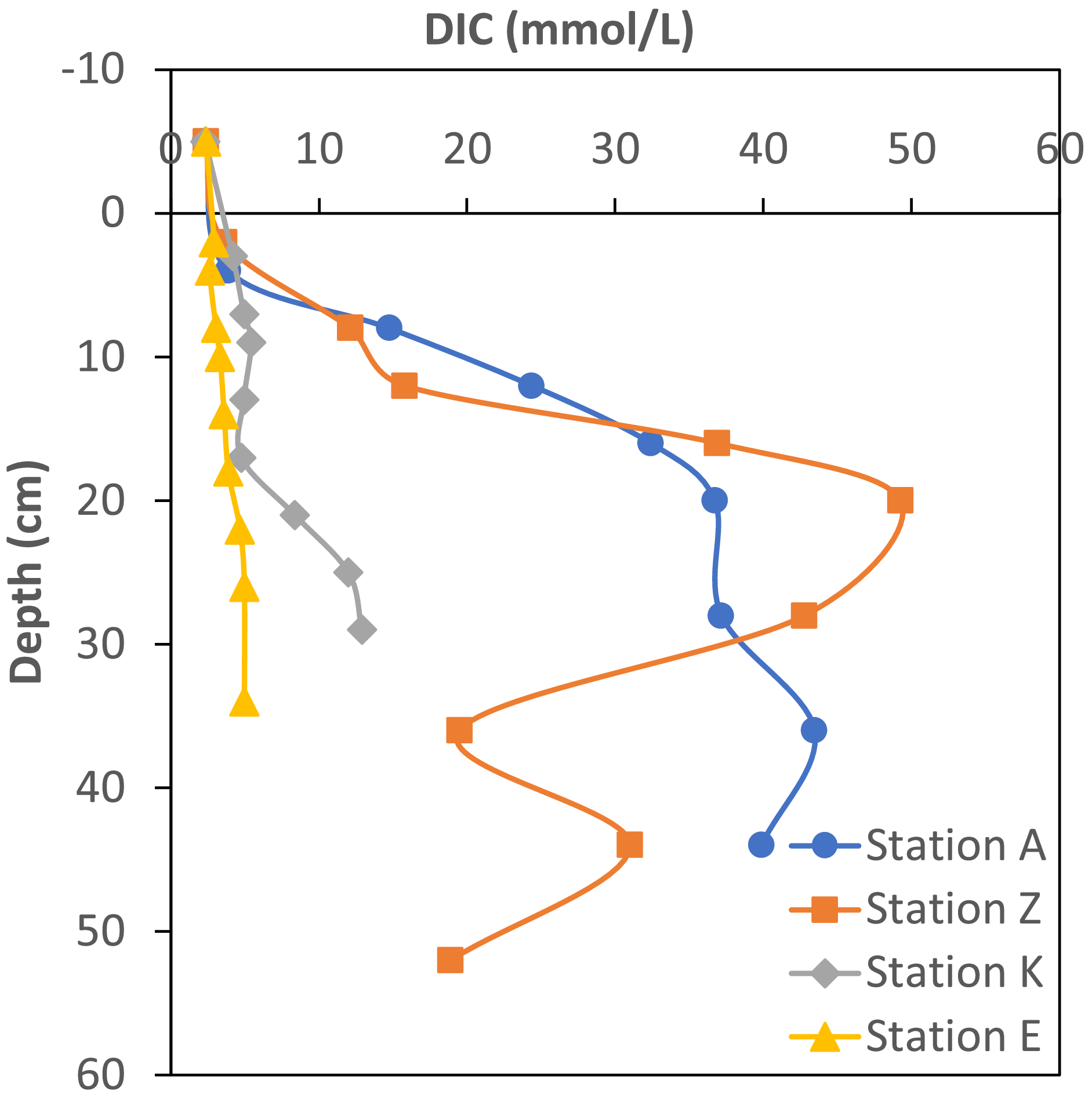
At stations A and Z, the increase in [DIC] concentration occurs from the first centimeters and reaches a maximum around 40 mmol L-1, which is almost 20 times more than the [DIC] concentration of seawater (around 2 mmol L-1). At station K further in the prodelta, the increase of the [DIC] is more gradual but reaches 10 mmol/L, or approximately 5 times the DIC concentration of seawater. For station E on the continental shelf the increase in [DIC] is much lower, reaching 4 mM/L, twice the DIC concentration in seawater.
13C and Δ14C of DIC
Stations A and Z of the proximal zone and station K of the prodelta show a δ13C-DIC which rapidly evolve towards very negative values between –20‰ and –28‰ while at station E on the continental shelf the values of δ13C are around –10‰.
The Δ14C of the porewaters DIC shows a large enrichment for the proximal zone, from 30‰ in the bottom water to 550‰ at station A and more than 600‰ at station Z. At station K in the prodelta, the Δ14C of the porewaters DIC increases until 300‰ whereas at station E on the continental shelf the Δ14C values do not exceed 50‰.
Comparison of Δ14C in the porewaters DIC with the sediment
The Δ14C activities of the porewaters DIC and the Δ14C of the solid phase sediment (OC) were measured at similar levels of the core. At the four stations, it is interesting to note that the sediment is always much older than the porewaters for each similar depth. In the sediment the Δ14C values are always negative between 0‰ and –600‰ while, as we have already pointed out, in porewaters the Δ14C values can be very high ranging from 0‰ to +600‰. At Station E, DIC with a Δ14C signature around +45‰ presents a value very close to that of bottom water (BW) and marine phytoplankton while sediments are heavily depleted in 14C (∆14C = –365 to –659‰) in agreement with previous measurements (Cathalot et al. Reference Cathalot, Rabouille, Tisnerat-Laborde, Toussaint, Kerherve, Buscail, Loftis, Sun, Tronczynski, Azoury, Lansard, Treignier, Pastor and Tesi2013; Toussaint Reference Toussaint2013). In the proximal zone (A and Z), sediments do not display enriched values like porewaters but contrarily the values are very variable and generally depleted but larger than shelf values with most values of Δ14C-OC between –250‰ and 0‰. In the prodelta (Station K) the Δ14C of the sediment evolves from 0‰ to –400‰ whereas the Δ14C-DIC is around +200‰.
Calculation of the source values for the mineralized OM
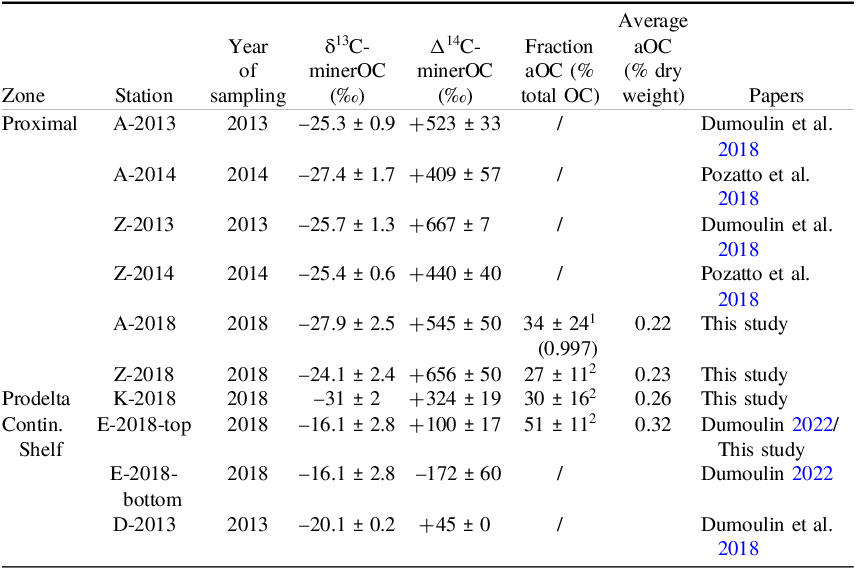
We used the mixing model to find the isotopic signatures (δ13C and Δ14C) of the OM originally mineralized in the porewaters for each station. The results are summarized in Table 1, where the new results as well as the results of our previous sampling campaigns are reported.
Compilation of δ 13C-minerOC, Δ14C-minerOC and Fraction aOC from this study and previously published papers. δ13C-minerOC and Δ14C-minerOC correspond respectively to the 13C and 14C signature of OM mineralized in the sediments at the station. Fraction of aOC corresponds to the calculated fraction of ancient organic carbon (radiocarbon-free) in % of the total sediment OC. 1indicates that the correlation method of Galy et al. (Reference Galy, Beyssac, France-Lanord and Eglinton2008) was used (r2 is given in parenthesis). 2indicates that the calculation was based on a prescribed FmbOC (see text for details). The average concentration of aOC in % dry weight is also provided.

It is interesting to note that our results for the proximal zone stations (A and Z) are close and reproducible for 3 different sea campaigns (in 2013, 2014 and 2018) and that the signature (δ13C and Δ14C) of mineralized organic matter is homogenous. Its Δ14C is between +409‰ and +667‰ and its δ13C between –27.9‰ and –24.1‰.
Contribution of ancient OC
As seen in Table 1, using linear modeling (Galy et al. Reference Galy, Beyssac, France-Lanord and Eglinton2008), station A exhibits a very good correlation. With the exception of a high value at 11 cm depth (Figure 5), the aOC contribution to the OC ranges between 0.17 to 0.26. From this station, we calculated a mean value of biospheric Fm (FmbOC) of 1.094.
Although a large variability is observed within the depth distributions, the average fractions of aOC are similar (Table 1) for the proximal and prodelta stations (A, Z, K). On the continental shelf at station E, however, the aOC proportion is higher. With the exception of the 2 stations Z and A, the profiles sampled in two other stations K and E exhibit a substantial increase in aOC contribution with depth (Figure 5).
Discussion
Mineralization of organic matter in sediments
The concentrations of DIC measured in the sediment porewaters increase at all stations from the surface to the bottom of the cores. The increase in DIC is particularly marked in the proximal zone (stations A and Z) which receives the largest input of organic matter from the Rhône River. Our previous studies (Dumoulin et al. 2018; Lansard et al. Reference Lansard, Rabouille, Denis and Grenz2009, 2010; Pastor et al. Reference Pastor, Deflandre, Viollier, Cathalot, Metzger, Rabouille, Escoubeyrou, Lloret, Pruski, Vetion, Desmalades, Buscail and Gremare2011) identified the sediments of the Rhône delta as a key depositional area where substantial quantities of OM transported by the river undergo mineralization, supported by diverse benthic communities of fauna, bacteria and archaea, which actively transform the organic carbon into DIC via the processes of oxic and anoxic remineralization (Cathalot et al. Reference Cathalot, Rabouille, Pastor, Deflandre, Viollier, Buscail, Gremare, Treignier and Pruski2010; Pastor et al. Reference Pastor, Deflandre, Viollier, Cathalot, Metzger, Rabouille, Escoubeyrou, Lloret, Pruski, Vetion, Desmalades, Buscail and Gremare2011; Rassmann et al. Reference Rassmann, Lansard, Pozzato and Rabouille2016). On the other hand, on the continental shelf, where the deposition of organic matter is much slower (with a sedimentation rate <0.3 cm.y−1) and therefore the organic substrate is much less abundant, the mineralization processes are less intense as indicated by less pronounced porewater DIC increases.
In proximal sediments, OM mineralization is dominated by sulphate reduction (Rassmann et al. 2020) whereas aerobic, nitrate reduction and metal oxide reduction are the main mineralization pathways in continental shelf sediments (Ait Ballagh et al. Reference Ait Ballagh, Rabouille, Andrieux-Loyer, Soetaert, Lansard, Bombled, Monvoisin, Elkalay and Khalil2021; Aller and Blair Reference Aller and Blair2004; Pastor et al. Reference Pastor, Deflandre, Viollier, Cathalot, Metzger, Rabouille, Escoubeyrou, Lloret, Pruski, Vetion, Desmalades, Buscail and Gremare2011). It is important to specify that in the anoxic layers of the sediment, the dissolution of carbonates does not contribute to the observed increase in DIC, as carbonate minerals, such as calcite and aragonite, are largely supersaturated at these depths at all stations and therefore cannot dissolve (Rassmann et al. Reference Rassmann, Lansard, Pozzato and Rabouille2016).
Sources of organic carbon buried or mineralized in deltaic sediments (δ13C and Δ14C)
To clarify the origins of remineralized and buried organic matter (OM) within the sediment, data from our former studies (Bodereau et al. Reference Bodereau, Eyrolle, Copard, Dumoulin, Lepage, Raimbault, Giner, Mourier and Gurriaran2024; Cathalot et al. Reference Cathalot, Rabouille, Tisnerat-Laborde, Toussaint, Kerherve, Buscail, Loftis, Sun, Tronczynski, Azoury, Lansard, Treignier, Pastor and Tesi2013; Dumoulin et al. 2018 and 2022; Pozzato et al. Reference Pozzato, Rassmann, Lansard, Dumoulin, van Brugel and Rabouille2018) are presented in a single graph plotting Δ14C versus δ13C. This allows comparison of the isotopic signatures of the different fractions of the organic carbon: the fraction that is mineralized and the fraction that is preserved temporarily or permanently in the sediments.
Mineralized organic matter
In the Rhône River watershed, terrestrial OC has a δ13C signature around –27‰ (Cathalot et al. Reference Cathalot, Rabouille, Tisnerat-Laborde, Toussaint, Kerherve, Buscail, Loftis, Sun, Tronczynski, Azoury, Lansard, Treignier, Pastor and Tesi2013; Higueras et al. Reference Higueras, Kerherve, Sanchez-Vidal, Calafat, Ludwig, Verdoit-Jarraya, Heussner and Canals2014; Bodereau et al. Reference Bodereau, Eyrolle, Copard, Dumoulin, Lepage, Raimbault, Giner, Mourier and Gurriaran2024), while the marine OC in the coastal Mediterranean Sea varies from –19‰ to –21‰ (Harmelin-Vivien et al. Reference Harmelin-Vivien, Dierking, Banaru, Fontaine and Arlhac2010). Over our 10-year study, recalculation of mineralized OC from our three campaigns in proximal sediments (stations A and Z) exhibits δ13C values for mineralized OM (squares) between –28‰ and –24‰, reflecting a significant remineralization of terrigenous material. Conversely, at stations D and E on the continental shelf, the δ13C values are respectively –20.0±0.2‰ and –16.0±2.8‰ and indicate a predominantly marine source. C4 plants with their less negative δ13C values can be ruled out in the area as demonstrated by 13C-lignin signatures published in Cathalot et al. (Reference Cathalot, Rabouille, Tisnerat-Laborde, Toussaint, Kerherve, Buscail, Loftis, Sun, Tronczynski, Azoury, Lansard, Treignier, Pastor and Tesi2013). The results for mineralized organic carbon agree with those of our previous studies (Pozzato et al. Reference Pozzato, Rassmann, Lansard, Dumoulin, van Brugel and Rabouille2018; Dumoulin et al. 2018) and confirm that the majority of labile riverine OM is rapidly mineralized in the pro-delta, while on the plateau, the mineralized OM is of marine origin.
At stations A, Z and K, the Δ14C signatures of the mineralized OM as calculated using the mixing model are very high, with values ranging between +400 and +650‰ (station A and Z) and +330‰ (station K). These levels are also comparable to the high Δ14C values observed during our previous sampling campaigns. The similarity of this result with previous results based on cruises in 2013 and 2014 (Dumoulin et al. 2018; Pozzato et al. Reference Pozzato, Rassmann, Lansard, Dumoulin, van Brugel and Rabouille2018) indicates a temporal consistency of the origin of mineralized organic matter in the proximal zone over several years despite changes in the hydrology of the river. Such elevated Δ14C signatures are in the same range as those observed in Rhône River SPM collected at Arles, which show numerous Δ14C values between +400‰ and > +1000‰ (Bodereau et al. Reference Bodereau, Eyrolle, Copard, Dumoulin, Lepage, Raimbault, Giner, Mourier and Gurriaran2024) and can be attributed to the presence of nuclear power plants along the river (Dumoulin et al. 2018; Pozzato et al. Reference Pozzato, Rassmann, Lansard, Dumoulin, van Brugel and Rabouille2018). In the proximal zone, the cores may represent one or two years of deposition (Charmasson et al. 1997), therefore constraining the input to the nuclear era, whereas the cores from the continental shelf represent nearly one hundred years of deposition (Miralles et al. Reference Miralles, Radakovitch and Aloisi2005) with both pre-nuclear and nuclear periods. Indeed, it was shown in Dumoulin et al. (2022) that at station E, the mineralized OM has two calculated Δ14C values for its origin corresponding to two distinct periods: (i) in the top core, the post-nuclear period (Δ14C = +100‰±17) when marine OM could have been marked by the bomb peak, and (ii) in the lower core, the pre-nuclear period (Δ14C = –172‰ ±60).
Buried organic matter
Concerning the solid phase of the sediment, the δ13C-OC data reported in Cathalot et al. (Reference Cathalot, Rabouille, Tisnerat-Laborde, Toussaint, Kerherve, Buscail, Loftis, Sun, Tronczynski, Azoury, Lansard, Treignier, Pastor and Tesi2013) and in this study (supplementary material Table S1) show values ranging from around –28‰ in the proximal zone to almost –24‰ on the continental shelf. This shows that in the proximal zone, the sedimentary OC is almost exclusively terrigenous. On the continental shelf, the higher δ13C signature of the sediment indicates a mixture of aged terrestrial and marine organic carbon and fossil carbon (Cathalot et al. Reference Cathalot, Rabouille, Tisnerat-Laborde, Toussaint, Kerherve, Buscail, Loftis, Sun, Tronczynski, Azoury, Lansard, Treignier, Pastor and Tesi2013) whose signature is around –24‰ as seen for type III fossil OM (Tyson Reference Tyson1995). The aOC data from this paper agree with these results and show an increasing proportion on the continental shelf compared to the proximal zone (27 to 51%, Table 1). The aOC concentration of deltaic sediments (Table 1) agrees with the rock-derived OC content estimated in SPM at the outlet of the Rhône River (0.31 wt.%, Copard et al. Reference Copard, Eyrolle-Boyer, Radakovitch, Poirel, Raimbault, Gairoard and Di-Giovanni2018). Previous studies have underlined the occurrence of rock-derived OC at the mouth of the Rhone River (Copard et al. Reference Copard, Eyrolle-Boyer, Radakovitch, Poirel, Raimbault, Gairoard and Di-Giovanni2018) and coal stored in deltaic sediment (Gadel and Ragot Reference Gadel, Ragot, Tissot and Bienner1973). In our case, the aOC fraction comprises two main components: rock-derived OC and ancient soil-derived OC stored in the catchment, which are transferred by the sedimentary cascade (Copard et al. Reference Copard, Eyrolle, Grosbois, Lepage, Ducros, Morereau, Bodereau, Cossonet and Desmet2022) mainly during flood events. This is suggested at station A where the aOC contribution abruptly jumps from 27% to 66% at 11 cm depth (Figure 5). The higher aOC contribution and lower Δ14C value (Figure 4) indicate a deposition of refractory organic carbon probably originating from the alpine watershed. As described above, the largely refractory nature of aOC accounts for its lack of reactivity in sediments. In prodelta environments, the preferential mineralization of very labile organic matter is evidenced by both the isotopic composition of porewater DIC and the strong increase in its concentration. The large amount of labile substrate delivered by the river in this zone likely limits the “priming” of older carbon. For carbon of intermediate reactivity, mineral protection may play a role, as dense sediment particles (aluminosilicates > 2.5) are generally associated with older carbon (< –200‰; Toussaint et al. Reference Toussaint, Tisnerat-Laborde, Cathalot, Buscail, Kerherve and Rabouille2013b). Further offshore on the shelf, evidence of a priming effect has been reported by Dumoulin et al. (2022).
Distribution of DIC in porewaters for the proximal zone (A and Z), prodelta (K) and continental shelf (E). Analytical uncertainties are smaller than the symbol size.

δ13C-DIC et Δ14C-DIC measured in the 4 stations: A and Z in the proximal zone, K in the prodelta, and E on the continental shelf. The value above the 0 line is the value in the bottom waters. Analytical uncertainties are smaller than the symbol size.

Distribution of Δ14C of OC (solid line) and DIC (dashed line) for the 4 stations. Analytical uncertainties are smaller than the symbol size.

Proportion of aOC in total OC (in %) with depth at the 4 stations (A, Z, K E).

Comparison of the Δ14C between porewaters and sediment:
There is a notable difference between the Δ14C values of the organic matter buried in the sediment and the mineralized OM whose signature is found in the porewaters. Figure 4 shows this difference within the cores as a function of depth and Figure 6 shows the average values of Δ14C as a function of δ13C for each station. Such Δ14C differences between porewaters and sediments are especially notable in proximal and prodelta sediments. This phenomenon can be explained by the hypothesis that the Rhône River delivers 3 distinct types of particulate OM, each with different properties. The first is labile and fresh, produced by photosynthesis in the river with the activity of phytoplankton and algae from spring to the beginning of autumn. This continental aquatic OM marked by enriched Δ14C from the nuclear power plants is rapidly mineralized in sediment porewaters, yielding the high Δ14C signature of the porewater DIC. The second originates from the terrestrial environment, from soil surface and river bank, and bears labile and semi-refractory OC, with turnover times of several years at least (Sales de Freitas et al. Reference Sales de Freitas, Pika, Kasten, Jorgensen, Rassmann, Rabouille, Thomas, Sass, Pancost and Arndt2021). The third, also terrestrial, is an OM devoid of radiocarbon, essentially rock-derived and/or surficial soil-derived (aOC). This latter type is by far the most refractory organic matter. For the continental OC from terrestrial and aquatic origins, mainly transported during floods and able to be stored in the watershed over different timescales, a continuum of refractory character can be drawn from organic soil horizons and river bank, and from labile to semi-refractory and ancient OC recalcitrant to remineralization processes. Hence, the preferential mineralization of young and labile organic carbon from aquatic and terrestrial origins to the porewaters and the burial of the older refractory material create an apparent aging of the sediment and explain the significant difference in Δ14C activities between the dissolved inorganic carbon and the solid organic phase (Aller et al. Reference Aller, Blair and Brunskill2008). In addition, the effect of decreasing sediment Δ14C caused by the deposition of aOC is clearly visible. In the distal part of the Rhône delta on the continental shelf, our calculations indicate a proportion of 50% of aOC in superficial sediment in fair agreement with measurements of black carbon by Cathalot et al. (Reference Cathalot, Rabouille, Tisnerat-Laborde, Toussaint, Kerherve, Buscail, Loftis, Sun, Tronczynski, Azoury, Lansard, Treignier, Pastor and Tesi2013).
Data and recalculated OC origin in the Rhône River prodelta. Dots indicate prodelta sediments from stations A, Z, K, E (see colors for stations) based on Cathalot et al. (Reference Cathalot, Rabouille, Tisnerat-Laborde, Toussaint, Kerherve, Buscail, Loftis, Sun, Tronczynski, Azoury, Lansard, Treignier, Pastor and Tesi2013), Toussaint et al. (Reference Toussaint, Tisnerat-Laborde, Cathalot, Buscail, Kerherve and Rabouille2013), and this study (averages for each cores). Crosses are suspended particulate organic OC from the Rhône River (Cathalot et al. Reference Cathalot, Rabouille, Tisnerat-Laborde, Toussaint, Kerherve, Buscail, Loftis, Sun, Tronczynski, Azoury, Lansard, Treignier, Pastor and Tesi2013; Bodereau et al. Reference Bodereau, Eyrolle, Copard, Dumoulin, Lepage, Raimbault, Giner, Mourier and Gurriaran2024). Squares are the recalculated origin of mineralized OC from different studies at the same stations A, Z, K and E (see colors for stations) from different spring cruises (Dumoulin et al. 2018 campaign 2013; Pozatto et al. Reference Pozzato, Rassmann, Lansard, Dumoulin, van Brugel and Rabouille2018 campaign 2014; this study – campaign 2018). For station E (top and bottom), they correspond to the post-nuclear and the pre-nuclear era in the Rhône valley (see Dumoulin et al. 2022 for details). Station D-2013 is located close to station E on the continental shelf. Values for higher-plant-derived kerogen (aOC) are given inTyson (Reference Tyson1995).

A synthetic view of organic carbon transfers in the Rhone watershed
Our studies over more than a decade help to better understand the carbon cycle in the Rhône River delta and the coastal zone of the NW Mediterranean Sea. The separate analyses of sediments and porewaters provide useful information about the different carbon sources and their transfer from the watershed to the coastal zone. The isotopic analysis of δ13C and Δ14C and the comparison with other studies carried out both on the Rhône and its tributaries and on the subaqueous delta, provide a unique opportunity to produce a conceptual diagram encompassing the processes responsible for carbon transfer in the land-ocean continuum of the Rhône River.
One important source of organic carbon in the Rhône River is the instream production of algae, microorganisms and phytoplankton which use fresh water DIC to produce organic matter. Knowledge of the different isotopic signatures (δ13C and Δ14C) of water DIC values is important for understanding the isotopic signatures of organic matter produced in the river. As shown in Figure 7, a first source of DIC is a 14C depleted DIC from the dissolution of ancient carbonates in the mountains or the watershed as well as groundwater. This input of DIC in freshwater can generate a freshwater reservoir effect (FRE), aging the DIC of continental water. The water DIC can also be marked by dissolved CO2 from the atmosphere with a Δ14C value directly linked to the time period. We have identified two distinct periods impacting Δ14C-DIC: the pre-nuclear period where the FRE played an important role with classic atmosphere and continental water 14C exchanges, and the post-nuclear period with the 14C bomb peak during the 1960s and the installation of the nuclear power plants on the Rhône River in the 1980s. The nuclear power plants periodically discharge their cooling water into the Rhône River. These discharges are done legally and in compliance with standards but may present significant Δ14C enriched DIC compared to natural radioactivity. This DIC is used by algae and phytoplankton during in-stream photosynthesis, producing 14C marked OM. After its deposition in prodelta sediments, this fresh OM is mainly mineralized to DIC.
A schematic representation of the processes affecting organic carbon in the Rhône watershed, river and delta. We distinguish between the three types of organic carbon with different labilities (green: labile; orange: semi-refractory; black: ancient and refractory). The influence of nuclear plant input is emphasized as well as the transfer of older DIC (from carbonate dissolution of groundwater input) that age river DIC (FRE).

In addition to aquatic production, organic carbon carried by the river can have multiple origins (Figure 7). It may originate from erosion and transport of (i) terrestrial plants constituting soil litters with leaves, wood remains, grass from grasslands (green arrow), (ii) subsoils showing variable biospheric OC ages (orange arrow), (iii) surficial sediments with OC depleted in radiocarbon and rock-derived carbon from sedimentary rocks (black arrows). This petrogenic fraction inherited from surface processes such as weathering and erosion of sedimentary rocks can contain land plant derived OC (marls, coalbed) and outcrop mainly along the alpine arc. The aOC is drained by major tributaries of the Rhône River such as the Durance, Isere and to a lesser extent the Gard River.
The contributions of particles to the river mouth of the Rhône depend greatly on the seasonality and flow rates of the river. During low water periods, particle transport is limited and the biological activity of the river is maximum, with sustained photosynthesis, significant production of fresh aquatic OM marked directly by the signature of the river radiocarbon-rich DIC. This production of radiocarbon-rich labile OC is either discharged to the delta or stored temporarily in river banks. In parallel, all detrital OC types are subjected to a series of transport and deposition forced by the continental hydrology along the sedimentary cascade in river corridors. About half of the OC flux from the Rhone River to the delta is carried during major floods from Mediterranean or Cevennol events (Bodereau et al. Reference Bodereau, Delaval, Lepage, Eyrolle, Raimbault and Copard2022; Copard et al. Reference Copard, Eyrolle-Boyer, Radakovitch, Poirel, Raimbault, Gairoard and Di-Giovanni2018) in a few weeks, as calculated for the years 2007 to 2014. During these short periods, all types of terrestrial and aquatic OC, from labile OC, soil OC, aOC to aged river sediments, are transferred and discharged into the delta.
These different terrestrial and aquatic OMs, which have a similar δ13C signature but with very different 14C activities, settle in delta sediments. In the proximal zone where turbid water dominates, the marine production is limited. The OM from the river is then deposited rapidly in the proximal zone with very high sedimentation rates. Under these conditions, marine organic matter represents a minor proportion of the total OM compared to the terrigenous contribution. On the shelf in the distal plume where turbidity is lower and nutrients are rather replete, marine OM is produced. On the continental shelf, the influence of the river is less marked, the fresh marine organic matter is remineralized and the sediment is a mixture of reworked terrigenous, ancient and marine organic carbon. Within the buried sediment, the strong mineralization of the young organic matter creates an apparent aging of the sediment because only the semi-refractory, low-energy and ancient OC devoid of radiocarbon remains in the sediment. This aOC contribution in sediment generates a strong difference between the 14C activity in the porewaters compared with the 14C activity of OC trapped in the sediment.
The methodology based on the dual isotopic composition of carbon in porewaters and sediments developed in this article can be a good basis for reflexion to study other worldwide deltas. It is important to understand that the combination of porewater signature which traces the mineralized fraction of OC and the solid fraction of OC allows a better understanding of carbon dynamics in deltas. Indeed, the analysis of porewater DIC within the sediment brings new insights on the anthropogenic impact on the environment and on the sources of carbon that feed these areas. Concurrently, a better estimate of the ancient OC concentration in sediments allows a more precise quantification of biospheric carbon burial in deltas. By studying the two pools (porewater and sediments), we provide a better picture of the origin and fate of the organic matter inputs in these highly reactive sediments from river deltas.
Supplementary material
To view supplementary material for this article, please visit https://doi.org/10.1017/RDC.2026.10205
Acknowledgments
We would like to thank the captain and the crew members of N.O. Tethys II (INSU/CNRS) for their assistance during sampling at sea. We are grateful to Laurie Brethous and Anouk Villedieu who provided help at sea during sampling and in the laboratory. We thank INSU-EC2CO/LEFE contract MissRhoDia (2017-2018) which provided funding for this project and the Master II fellowship for Solène Pourtout.



 Open access

