




Twentieth-century China witnessed one of the largest examples in history of one ruling class losing power and a new ruling class gaining power. In the early People's Republic of China (PRC, 1949–1965), the Chinese Communist Party (CCP) implemented a series of policies designed to reverse established social and economic inequalities. Beginning with the land reform (1946–1953), which targeted rural households classified as landlords and rich peasants, and continuing through the Cultural Revolution (1966–1976), which targeted urban political elites, CCP policies systematically revoked the power and privileges of former elite groups at every level of society.
Until recently, most understandings of this social revolution assume these policies were more or less successful at levelling or reversing the social hierarchy. Previous research has found widespread evidence that former elites were purged and discriminated against and new groups – poor peasants, factory workers, the military and CCP members – were socially, economically and politically privileged.Footnote 1 Recent comparative research continues to take the CCP's revolutionary narrative at face value, quoting Mao's hyperbolic characterization of land reform as “the most hideous class war” to show how violence is the only successful “leveller” of social inequalities.Footnote 2
At the same time, however, recent sociological research has found evidence of continuities in the socio-economic status of former elites across the 1949–1976 divide. Andrew Walder and Songhua Hu, and Donald Treiman and Walder find that the offspring of former middle-class elites continued to attain elite professional posts and higher incomes both before and after the Cultural Revolution, largely owing to their continued educational advantages.Footnote 3 Alberto Alesino and colleagues likewise find that, after 1976, the grandchildren of former elites were more likely than the grandchildren of non-elites to earn higher incomes and complete more years of schooling.Footnote 4 Cameron Campbell and James Lee, looking at a longer time span, similarly show how local elite administrators and professionals after 1978 were more likely to be descendants of the pre-1911 local elite.Footnote 5 Such evidence challenges the above revolutionary narratives and helps to bring 20th-century China into wider debates over how ruling elites adapt to changing times.Footnote 6 However, at least in the case of China, understandings of the actual mechanisms behind status preservation amid three decades of discriminatory policies remain limited to “culturalist” claims about human capital transmission within families, especially through continued advantages in educational opportunities.Footnote 7
In this paper, we present findings that suggest that former rural elites used migration to urban places as an effective means of preserving their socio-economic advantages. Elite migration can serve as a more concrete mechanism for explaining the intergenerational transmission of status across the socialist divide. Fleeing persecution has been a well-known strategy for elite preservation ever since the flight of French émigrés after 1789 and White Russians after 1917.Footnote 8 In China, too, there was a similar and widely known emigration of elites to Hong Kong and Taiwan around 1949. However, for all of these revolutions, much less attention has been paid to the internal migration of former elites. Such internal migration, more often called “escape” or “exile” in revolutionary narratives, played a prominent role from the very start of the Chinese Communist Revolution. In 1926, Mao Zedong described how in counties with well-developed peasant movements “almost all of the prominent local elites have run away … with the top elites fleeing to Shanghai, the second-tier fleeing to Hankou, the third-tier to Changsha, and the fourth-tier to the county seat town.”Footnote 9 Despite its prevalence, however, such internal migration is often mentioned as an afterthought and continues to be one of the least studied aspects of this revolution.Footnote 10
The novel data used in this article make it possible to begin analysing such movements at the lowest level – from the countryside to the nearest town. While the large socio-economic and institutional gaps between metropolises such as Beijing, Shanghai and Tianjin and the countryside are well-studied, few studies have explored the borders between urban and rural in China's thousands of small towns.Footnote 11 Such town populations are important because their population growth was three times faster than that in large cities over the period 1938–1958, and according to the 1953 census, more people were living in towns (over 4,000 urban places with a population between 2,000 and 50,000) than the combined population of the top 25 most populous cities (with populations over 500,000).Footnote 12 We focus on a population residing in and around a county-seat town located 300 kilometres west of Beijing to show that even here, where the barriers between town and country were the lowest, many politically disadvantaged households were able to both take refuge and find more opportunities than advantaged households who stayed in the nearby countryside.
Rural Class, Urban Status and Internal Migration in the Early PRC
The Chinese Communist Revolution can be broken down into a rural political revolution that began as early as the 1920s and an urban economic revolution that began in the 1950s. It was the first social revolution in modern history to focus on gaining the popular support of the rural population. Comparatively speaking, the French Revolution focused on the bourgeoisie, the Russian Revolution on the urban proletariat, and the Chinese Revolution on the peasantry.Footnote 13 These differences were not only a result of different social relations between aristocracy, bourgeoisie and peasants, but also differences in the relations between urban and rural development. In both 18th-century France and 20th-century Russia, economic development tended towards an accumulation of elite wealth and power in national capitals, and these places thus became the centres of social and political change. In contrast, “China stands out among traditional agrarian societies in having an elite that was by no means predominantly urban,” with little cultural cleavage between town and country, in part because of the civil service exam and the political/cultural, rather than economic, nature of power.Footnote 14 In France and Russia, therefore, the consonance of political and economic development meant that social revolution could focus on urban society, whereas in China, a basic contradiction emerged between relatively diffuse political power and the demands of modern industrialization, which required a concentration of capital in cities.
An important political goal of this revolution was to classify the rural population into allies and enemies by applying Marxist concepts of property ownership and exploitation to the rural economy. This classification was initially based on pre-land reform landholding and labour exploitation, resulting in the basic categories of landlord, rich peasant, middle peasant and poor peasant (which often included landless labourers).Footnote 15 Landlord households owned surplus land and exploited the labour of others; rich peasants owned surplus land and other capital but also engaged in farm labour; middle peasants were more or less self-sufficient in land and labour; and poor peasants were landless or land-poor and were often subject to labour exploitation.Footnote 16 Although official policies included detailed caveats related to the classification of exploited individuals resident in exploiting households, etc., these categories were generally assigned at the household level. For the three decades following land reform, individuals from landlord and rich peasant households were defined as class enemies and were the object of discriminatory policies, while poor peasants were defined as the main allies of the revolution.
A systematic classification of the urban population and urban class struggle was often neglected, at least until the Cultural Revolution. While the CCP issued several official policy documents outlining the standards of rural classification between 1933 and 1951, a similar policy for urban classification was never issued.Footnote 17 While there were periodic campaigns against urban enemies, including the “Suppression of counter-revolutionaries” campaign (1950–1951), the “Three-anti and five-anti” campaign (1951–1952), and the “Anti-rightist” campaign (1957), none involved a systematic classification of the entire urban population. Instead, prominent enemies who had escaped from land reform, business managers and intellectuals were all personally targeted, often by their immediate subordinates – employees and students.Footnote 18 Partly as a result of this lack of official guidelines, debates over classification standards became a major source of conflict among urban youth during the Cultural Revolution.Footnote 19
The revolution's economic goal of rapid industrialization in many ways precluded urban class struggle.Footnote 20 In this context, urban places and occupations were given a privileged status that set them apart from the neighbouring countryside. Recent research has acknowledged that “in terms of the distribution of basic goods and services such as food, clothing, housing or health care, class was actually less important than the urban/rural divide. The urban supply system ensured that a ‘capitalist’ in Beijing would eat better than a ‘poor peasant’ in central China, despite the latter's far more favorable class status.”Footnote 21 Moreover, land reform was an exclusively rural policy, and at least until 1953, urban property was protected against confiscation and villagers wishing to persecute any former elites residing in urban areas required the permission of local authorities.Footnote 22 In other words, the priorities of economic development often took precedence over ideological concerns, which created loopholes in state policies: “That the self-same evil landlord could become magically transformed into a legitimate merchant or entrepreneur by merely passing through the city gates was an incomprehensible subtlety of Marxist class analysis.”Footnote 23
Like most rapidly industrializing economies, the PRC attempted to restrict rural-to-urban migration. The hukou 户口 household registration system was the main institution for limiting internal migration. This system began as early as 1955, when the PRC introduced a nationwide state monopoly on grain and urban residents engaged in non-agricultural occupations at that time were given entitlements to state grain rations. Then, from 1963, households entitled to grain rations were classified as non-agricultural households, regardless of their current occupation and residence.Footnote 24 Nevertheless, during this period households and individuals frequently changed occupations and residences, especially during waves of demand for industrial labourers during the Great Leap Forward (GLF). In 1959, in response to urban overpopulation and rural labour shortages, the state implemented strict regulations to curb rural-to-urban migration and sent recent rural migrants back home. Despite these regulations, the agricultural crisis of the GLF spurred further rural out-migration. Few, however, secured urban residency, and the majority were forced to return to their villages, either during or immediately following the GLF.Footnote 25 By 1965, however, nationally over 20 per cent of urban residents were still classified as having an agricultural hukou, suggesting that they had migrated to cities sometime after the initial hukou classification in 1955.Footnote 26 In the county studied here, one-third of the county seat population was classified as agricultural in 1985.Footnote 27 The hukou status of the urban households analysed in this article is not recorded, but our results suggest that many of the households had moved to the county-seat town before 1955, and regardless of their official status, we demonstrate that in terms of income and educational opportunities, they still had a significant advantage over their rural counterparts.Footnote 28
This mixture of rural classes, urban privilege and internal migration created a world in which political discrimination depended more on where you lived rather than on how much wealth you had. The political policies that established a new status hierarchy that discriminated against former elites primarily affected the rural population. At the same time, economic policies to encourage industrialization privileged the urban population. In a social context where the boundaries between urban and rural were not as clear-cut as in early modern Europe, one would expect that many politically disadvantaged rural households would mitigate the stigma of their new status by taking advantage of new urban opportunities.
Data
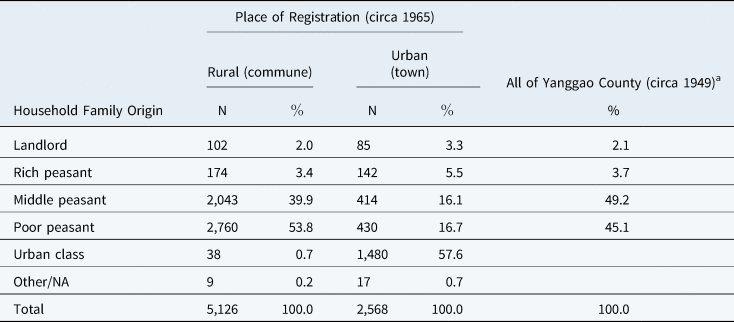
We use data from the China Rural Revolution Dataset – Siqing (CRRD-SQ), which contains complete transcriptions of the class status registration forms (jieji chengfen dengjibiao 阶级成份登记表) that were recorded community-wide in the mid-1960s for over 600 rural and urban communities (production team-level units), mostly in north China (See Data Appendix).Footnote 29 The CRRD-SQ Yanggao data used in this article contain over 2,500 urban households registered in the county-seat town (chengguan zhen 城关镇), and over 5,000 rural households registered in the adjacent rural commune (chengguan gongshe 城关公社) that surrounds the county seat of Yanggao 阳高, Shanxi province, located 300 kilometres west of Beijing (Table 1; Map A.1). These data comprise about half of the urban county seat population and all of the surrounding rural commune population circa 1965.Footnote 30 Table 1 compares the class distribution of the CRRD-SQ Yanggao data with official county statistics from the time of the land reform. The distribution of rural landlords and rich peasants around the county seat is similar to that for the county as a whole, but the lower proportion of middle peasants and higher proportion of poor peasants suggests that the rural economy around the county seat was more commercialized than the rest of the county. Among the urban population at that time, however, landlords and rich peasants are overrepresented, with much smaller relative proportions of middle and poor peasants.Footnote 31
Households in the CRRD-SQ Yanggao Data
Source: Authors’ calculations based on CRRD-SQ Yanggao data.
Notes: a From YGXZ Reference Hai1993, 199. Data only include households with rural class origins (N = 40,567). The total number of households in the county in 1949 is recorded elsewhere as 42,372 (YGXZ Reference Hai1993, 115).
Yanggao experienced rapid growth over the first half of the 20th century, facilitated by the Jing-Sui 京绥 railway, which opened in 1911 and connected the county seat town to Beijing and the port of Tianjin. The county seat became an important centre for trade and related service industries, and between 1949 and 1952 alone, the number of private businesses increased from 320 to over 1,000.Footnote 32 Between the 1920s and 1950s, the total county population more than doubled, from 22,000 to over 48,000 households, and the county-seat town grew even faster, from 1,000 to over 5,000 households.Footnote 33 According to occupational statistics from 1921, as much as 40 per cent of the county population was engaged, at least part-time, in commerce and manufacturing.Footnote 34 In the CRRD-SQ Yanggao data, likewise, 40 per cent of households with rural origins recorded non-agricultural occupations at the time of land reform in around 1949.Footnote 35 While most of these occupations would have been in trade and services, Yanggao was located in between two important industrial centres – Datong 大同 (50 kilometres away) and Zhangjiakou 张家口 (125 kilometres away) – and, by the late 1950s, common industrial (non-agricultural) jobs recorded in the data included working in mining, the railroad, steelworks and other manufacturing plants. Under such circumstances, we would expect large segments of the population, especially those near to the county seat, to have the opportunity to urbanize and/or move out of agriculture.
Our analysis focuses on the following key variables. The first, household family origin (jiating chushen 家庭出身), is a categorical variable coded based on the recorded family origin of the household head. The reference category is poor peasant, which applied to over 50 per cent of households. This family origin was assigned at the time of land reform in 1949 and was based on household property holdings and primary source of income. It therefore provides a reliable measure of socio-economic status before 1949.Footnote 36 We restrict our analysis to households with a rural family origin – landlords, rich peasants, middle peasants and poor peasants. Households with urban class family origins are assumed to have been established residents in the town at the time of the land reform.
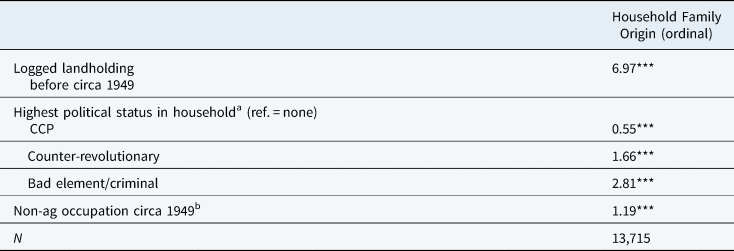
Previous studies have suggested that these family origins could be assigned based on the conflation of political and economic background characteristics during later political campaigns in the 1950s and 1960s. Since at least the 1957 “Anti-rightist” campaign (largely an urban campaign), the categories of “counter-revolutionary,” “bad element” and “rightist” were combined with landlord and rich peasant to form a group of class enemies called the “five bad/black elements.”Footnote 37 By the time of the Cultural Revolution, such labelling of class enemies had become more political than economic, and most later understandings of class categories have been coloured by such rhetoric. However, at least in the data analysed here, less than 50 of over 44,000 adults (0.1 per cent) recorded such political categories as their family origin, and landholding is highly correlated with family origin, demonstrating that in general, landlord and rich peasant labels were not assigned to political enemies regardless of their actual former economic circumstances.Footnote 38 Table 2 shows the results of an ordinal logistic regression comparing landholding with political status as determinants of household family origin in the complete CRRD-SQ. Because the class status registration forms record both family origin and the economic circumstances of each and every household at the time of the land reform, we can directly analyse the relationship between labels and landholding. The results suggest that while political status was significant, land ownership was by far the most important criterion used to determine family origin.Footnote 39 Good political status (having a CCP affiliation in the household) decreases the odds of being classified into a higher category (on a scale from 1: poor peasant to 6: landlord) by over 50 per cent, and bad political status increases the odds by as much as 2.8-fold, but a ten-fold increase in landholding increases the odds nearly seven-fold.Footnote 40
Ordinal Logistic Regression of Household Family Origin
Source: Authors’ calculations based on complete CRRD-SQ dataset. Restricted to households with non-missing land data.
Notes: a See explanation on page 9, c.; b see explanation on page 8, a. Coefficients shown as odds ratios. Controlled for Brigade address. Family Origin ranges from 1: Poor Peasant to 6: Landlord. Landholding uses a zero-inflated model (log(x+1)) to include landless households. p < .05; **p < .01; ***p < .001.
A second variable, urban residence, indicates whether the household was registered in the urban county seat or the rural commune in 1965, as recorded on each household form. Household income provides the best available proxy measure of the higher socio-economic status implied in this urban residence: in the Yanggao data, the median urban household incomes are more than twice that of rural households. The income inequality between Yanggao town and country, 2:1, therefore, was comparable to the overall urban–rural income inequality in China, which was about 2.5:1 in 1978.Footnote 41 Since this was a planned economy in which a household's position within various political and occupational hierarchies often entitled its members to many important goods and services that could not simply be bought on the market, we do not claim that household income is a direct measure of socio-economic status, but it can be considered a reliable proxy because at least in the case of state employees and probably in general, higher ranked positions came with higher wages.Footnote 42 As shown in the log linear regression results in Table 3, urban town residence was the most important determinant of higher household income, being six times stronger than household size and nearly ten times stronger than CCP status. The effect of family origin was slightly negative and not significant.
Log Linear Regression of Household Income circa 1965

Source: Authors’ calculations based on CRRD-SQ Yanggao data. Restricted to households with rural family origin and valid income. See Data Appendix Table A.2 for summary statistics.
Notes: a See explanation on page 8, a.; b see explanation on pages 8-9, b.; c see explanation on page 9, c.; d see explanation on page 9, d. Controlled for brigade address. *p < .05; **p < .01; ***p < .001.
The following retrospective household characteristics were used to gauge the time frame of urban migration:
a. Non-agricultural occupation circa 1949: this indicates whether or not the household recorded a non-agricultural occupation at the time of land reform. These records include everything from rural industries, such as doufu 豆腐 (tofu) production, to receiving income from a migrant family member engaged in commerce.
b. Joined agricultural collective circa 1956: this indicates whether or not the household recorded joining an advanced agricultural production collective. These collectives were set up in rural areas around 1956 as a precursor to people's communes, which were established in around 1958. In principle, once a household joined a rural collective or commune, they were defined as having a rural hukou and it became very difficult to permanently leave the commune.
Other important socio-political household characteristics, circa 1965, included:
c. Highest political status in the household: this indicates the highest-ranked individual political status within the household, with CCP affiliation (including both CCP members and CCP youth group) being the highest status, and bad element/criminal the lowest. Counter-revolutionary and bad element/criminal categories encompass any record of such behaviour in the household, past or present, as recorded under personal histories, punishments, and personal status (benren chengfen 本人成份). Counter-revolutionary status includes individuals with records of working for the KMT (Nationalists), collaborating with the Japanese, and/or joining religious sects before 1949. While it was possible to have conflicting high and low political statuses within the same household, this only applies to 0.5 per cent of households in the CRRD-SQ Yanggao data. In many of these cases, the parent(s) had records of joining religious sects and their child(ren) had CCP affiliations.
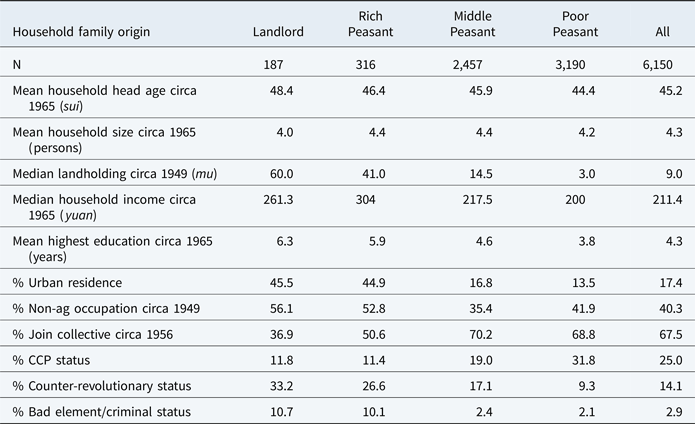
d. Highest educational attainment in the household: a continuous variable measuring the number of years of education of the most educated individual in the household. As summarized in Table A.2, landlord and rich peasant households had, on average, over two more years of education than poor peasant households, demonstrating the former's continued educational advantages into the 1960s.Footnote 43 Measuring highest education at the household level helps to average out intergenerational inequalities between parents and children, and old and young household heads. The relationship between higher education and urban migration does not appear to be significant in the present analysis (see Tables 3 and 4), in part because many student migrants continued to be registered in their rural places of origin. Until 1958, there was only one middle school in the county, located in the county seat.Footnote 44 Since all the households in our data were located within a five-kilometre radius of the county seat, most students would have been able to walk to school in the county seat and/or board with a relative living in town.
Binomial Logistic Regression of Urban Household Residence circa 1965

Source: Authors’ calculations based on CRRD-SQ Yanggao data. Restricted to households with rural family origin. See Data Appendix Table A.2 for summary statistics.
Note: Coefficients shown as odds ratios. *p < .05; **p < .01; ***p < .001.
We initially included other variables in our primary model to control for the age of the household head and household size, etc., but they were all insignificant or did not improve the model fit (see data appendix Table A.2 for more details).
Documenting the Urban Migration of Rural Elites
Before turning to the quantitative results, we first present a couple of examples from the thousands of diverse life histories spanning the first half of the 20th century that are recorded in the CRRD-SQ to give a better sense of the level of detail involved. A typical example of such a history from a rich peasant (Zhou, age 49 and living in the county seat in 1965) records how his grandfather originally owned over 20 mu of land and five rooms of housing and was a farmer his whole life in a nearby village. Zhou's father started working at an undertaker's shop (gang fang 杠房) in the county seat, while Zhou's second uncle farmed their land. Zhou's father later rented a town house, opened a grain mill and started selling flour. Business prospered, and he acquired 31 rooms of housing, three mules, a full set of milling equipment, and hired one employee. Zhou himself attended primary school for a year and a half and then, at age 12, in around 1928, he went to town to help his father run the mill. They later bought 40 mu of land in a nearby village. During land reform in around 1949, they were classified as rich peasants, and their 40 mu of newly acquired land was expropriated, but they retained their housing and mill in town and started processing grain for the state. Their family land and housing in their home village also remained with Zhou's second uncle, who was classified as a poor peasant. In 1950, Zhou started milling flour independently. In 1956, he received 300 yuan in capital shares when he joined an urban cooperative (lianying xiaozu 联营小组). Then, in 1958, he was transferred to the state-run grain processing plant. In 1962, he was caught stealing grain and imprisoned for a year and a half, but then returned to Yanggao in 1963 to work as a temporary contract worker on the railroad repair team. In 1965, Zhou's eldest son, then aged 25, was also a temporary contract worker with experience of apprenticing in a paper mill and working for the Beijing Railway Bureau; his second son, aged 19, worked for the Yanggao county state-run farm. Zhou also had one brother-in-law working at a state-run coal mine, another brother-in-law was a CCP member, and one son-in-law worked in the Yanggao transportation union.Footnote 45 Despite being classified as a rich peasant and losing his rural assets during land reform, Zhou and his immediate family appeared to be doing well, living in town and working in industrial jobs, in part because his father had given him a head start in town well before land reform.Footnote 46
The Yanggao town data also include records of families who had taken more distant and treacherous journeys, like one landlord, Li, whose family was originally from a neighbouring county and had migrated to Zhangjiakou (former capital of Chahar 察哈尔 province and the nearest provincial-level city) and Tianjin 天津 before settling in Yanggao in 1950. At the time of the land reform, Li's father owned over 100 mu of land and 11 rooms of housing but worked away from home as an accountant. Li himself also went to town around the age of 18 to work as a shop clerk in a general store in the early 1940s. From 1946 to 1947, he was a clerk in a grain shop in Zhangjiakou, and then from 1948–49, he worked at odd jobs in Tianjin and elsewhere. In late 1949, he was part of a militia group that surrendered to the People's Liberation Army (PLA), and then after serving in the PLA for a few days, he fled back to Zhangjiakou and then to Yanggao in 1950. In Yanggao, he worked in petty trade until 1953 and then in the Central Construction Company (Zhongyang jianzhu gongsi 中央建筑公司) from 1954 to 1956. After 1957, he sold meat independently and later joined the meat industry cooperative. Then, from 1964, he started working for the Yanggao county tobacco and alcohol cooperative store, where he earned 38 yuan per month.Footnote 47 From this account, we can imagine that Li had a turbulent first few years in the PRC, but despite his landlord origins, by the mid-1950s he was still able to settle down in Yanggao town with a stable job making twice the annual income of most rural households.
To assess whether or not these examples are exceptional or represent more general practices, we first use a binomial logistic regression to explore who in our data was more likely to urbanize. Our main results, shown in Table 4, suggest that the odds of residing in the county seat by 1965 were three to four times greater for landlord and rich peasant households than for poor peasant households. The only stronger determinant of urban residence was having a non-agricultural occupation in around 1949. The fact that a non-agricultural occupation at that time had a large positive effect on the odds of urban residence is in line with the observation mentioned above that before the land reform, the Yanggao countryside was already a mixed economy in which nearly half of rural households engaged in some non-agricultural work. As in the life history examples above, many such households sent family members to town to be apprentices and/or engage in trade and handicrafts, and some of the more successful family members may have moved to town permanently.Footnote 48 Land reform and collectivization beginning after 1949 effectively forced many of these people to make a choice between farming or town work, which meant that although these policies tied many households to the land, they also pushed many others into towns. And in the context of a rapidly industrializing economy, such urban migration was equivalent to upward social mobility.
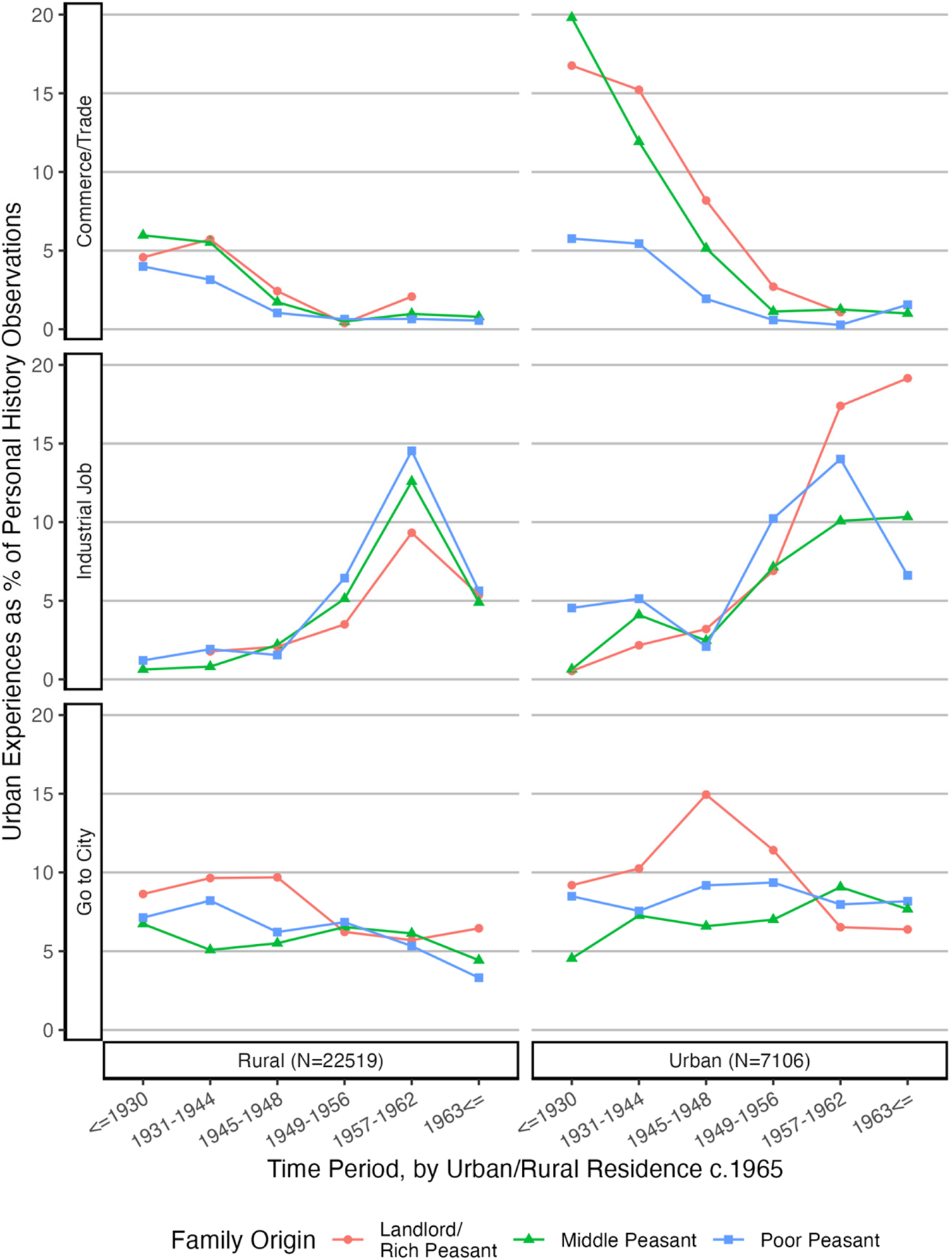
Although for many households we do not have direct records of former residential status or urban migration before 1965, information recorded in personal histories can provide a better sense of changes over time and the actual pathways of urbanization.Footnote 49 This lack of direct records is problematic, especially for urban (absentee) landlords in a small town like Yanggao who may have collected land rents and been classified as “landlord,” a typically “rural” class, despite already being established town residents from before the land reform. Many families, moreover, did not experience a one-way move from country to town, but often moved back and forth between town and country and operated across the divide. We compiled, cleaned and dated over 28,000 events recorded in the personal and family history fields of the Yanggao data and have identified three select categories of urban-related records: engaging in commerce/trade (2.9 per cent of all records); working in an industrial job (for example, in mining, steel and other manufacturing plants – 5 per cent); or simply going/moving to a city (including cities outside of the county – 6.8 per cent). We then tabulated by family origin and current residence at around 1965. These records suggest that both before and after 1949, landlord and rich peasant households continued to be more likely to take advantage of urban opportunities.
The descriptive findings of this exercise, as shown in Figure 1, appear to support our life history examples and regression results above. Landlord and rich peasant households with an urban address in 1965 were three times more likely than poor peasants to have records of engaging in commerce/trade before 1949, an important precursor to moving into town (upper right panel).Footnote 50 These urbanized landlord and rich peasant households were also more likely than other peasants to have records of going to a city before 1949, with a spike around the land reform in around 1945–1948 (bottom right panel). After 1949, while former elites who stayed in the countryside appear slightly disadvantaged in industrial jobs (middle left panel), their urban counterparts were more likely than other urbanized households to get industrial jobs after 1956 (middle right panel), thus demonstrating their preservation and transformation of status in the new society.Footnote 51
Urban Experiences Between 1900 and 1965 Recorded in the Personal Histories of Households with Rural Family Origins, by Residential Status circa 1965.
Source: Authors’ calculations based on CRRD-SQ Yanggao data.
Discussion
Despite the sustained efforts to reverse social and economic inequalities in the early PRC, recent studies have found evidence of the intergenerational transmission of socio-economic status across China's century of revolution. How did the former rural elite survive? Current hypotheses suggest a mix of subjective factors involving family cultural and human capital. In this paper, we use findings from historical microdata to suggest a more straightforward mechanism: former elites effectively took advantage of economic development and gaps in PRC policies. In particular, former rural elites were more likely to urbanize, and urban status was highly associated with socio-economic privileges in a rapidly developing economy, including both income and educational opportunities. We also found evidence that after 1949, former rural elites who did urbanize were more likely than their poor peasant counterparts to find industrial jobs after 1949. Using the terms of Ivan Szelényi's analysis of Hungary, the urbanized former rural elites described here are the most likely people to have entered “parking orbits” in which their “bad” rural class status ironically kept them away from both the “proletarianization” of the rural collectives and (urban) “positions of authority” within the CCP.Footnote 52 At the same time, they were able to find skilled urban jobs that allowed them to “hide” and maintain some autonomy.Footnote 53
The spatial–social mobility described in our results, which appears to have occurred mostly from the 1930s to 1950s, can be easily overlooked by retrospective survey data and other accounts collected after the Cultural Revolution. In the two most popular data sources used to study social stratification in the PRC – the “Life histories and social change in contemporary China survey”Footnote 54 and the China Family Panel Studies (CFPS)Footnote 55 – data on migration are limited to a few points in time: birth, age 14, and between father and son. In the former survey, only 500 out of over 6,000 respondents recorded migrating before 1965. In more recent research on intergenerational status transmission using the CFPS, Alberto Alesina and colleagues restrict their analysis to adults residing in rural counties in 2010.Footnote 56 Although Alesina and colleagues do consider the possibility of selective migration to high-wage places, they are only able to analyse interprovincial migration, which cannot capture rural-to-urban migration within provinces, let alone counties. Considering the rapid changes that characterized the past century of Chinese history, it should not be surprising that such retrospective survey data can miss many short-term dynamics, but their findings about intergenerational status transmission can still be used to motivate more fine-grained research on the early PRC, such as we have attempted to present in this article.
Since the data of the CRRD-SQ were collected on the eve of the Cultural Revolution, it is important to note in closing that we are presently unable to address the effects of what was perhaps the most radical of revolutionary policies.Footnote 57 However, historical data collected before 1966, like the data in the CRRD data series, consistently reveal new perspectives on the early PRC. In this and other studies using CRRD data, until 1965 class status was mutable, former elites preserved more socio-economic advantages and internal migration was more fluid than has been imagined based on post-Cultural Revolution narratives. On the one hand, these new perspectives lend support to the idea that, by 1966, more drastic action was indeed needed to curb persistent social inequalities. On the other hand, if more systematic discrimination was only enforced for less than a decade (1966–1976), instead of for three decades, that may also help to explain why status could persist over the long term.
Acknowledgements
A preliminary version of this article was presented at a session of the 2023 Annual Meeting of the Social Science History Association. We are grateful for all the comments and suggestions we have received from session participants, colleagues and reviewers over the course of revising the manuscript for publication. This work was supported by the Hong Kong Research Grant Council Project No. 16600017 and the JSPS (Japan Society for the Promotion of Science) KAKENHI Grant Number JP21K13332.
Competing interests
None.
Data Appendix
1. The China Rural Revolution Dataset – Siqing (CRRD-SQ)
The CRRD-SQ contains the complete contents of the double-sided household registration forms called jieji chengfen dengji biao 阶级成份登记表 (class status registration forms), which were originally recorded between 1965 and 1971 by investigation teams who conducted interviews and systematically gathered extant archival data recorded between circa 1946 and 1966 as part of the Socialist Education movement's concluding “Four cleanups” campaign (1963–1966). The “Four cleanups” campaign is known for its punishment of rural cadre corruption, but as early as 1964, political work in many provinces expanded to include a comprehensive re-evaluation of all rural class relations.Footnote 58 This work resulted in the compilation of systematic socio-economic information for each and every rural household, including property and income data for four points in time between circa 1946 and 1966, the household head's social relations, a three-generation family history and demographic details on every adult household member over 15 years old (sui 岁) at the time the forms were compiled.Footnote 59 Unlike other “Four cleanups” materials, which targeted specific individuals, these data are community-wide and provide systematic, longitudinal household and individual-level economic, social and political information covering the first two decades of the PRC.
The purpose of this comprehensive re-evaluation was largely educational and administrative, not punitive, since in reality only a small fraction of households were reclassified and the vast majority of those changes were to better/lower class statuses (for example, rich to middle peasant, middle to lower-middle peasant).Footnote 60 Educationally, household interviews and village meetings served to reinforce understandings of class status and make people reflect on the overall progress of the past two decades, especially for the majority of households from poor peasant origins. In this respect, the changes to better class statuses emphasized that, in the past, those households were even more disadvantaged than they had imagined, while at the same time recruiting more political supporters. Administratively, the class status registration forms were the rural counterpart to the personal files already maintained for employees of state work units, and therefore served as tools of increased administrative control over the rural population.Footnote 61
The data on the forms were recorded through a unique process that combined both administrative records and oral survey information, and therefore are distinct from either of these types of sources. The forms are the product of a political campaign, but in principle, their information is derived from multiple sources and underwent public audit at village meetings. So far, we have found the data to be objective and reliable and not subject to any serious recording biases.Footnote 62 The CRRD-SQ provides a cross-sectional snapshot describing individuals and households around 1965 and also contains retrospective longitudinal information about them and their ancestors and other family members going back to before the 1940s. Much of the data in the CRRD-SQ for the period between 1946 and 1966 was originally collected prospectively: when work teams compiled the registers between 1965 and 1966, they extracted much of the key information from other village government records that had been compiled contemporaneously. The data in the CRRD-SQ are accordingly much less prone to recall error than retrospective surveys.
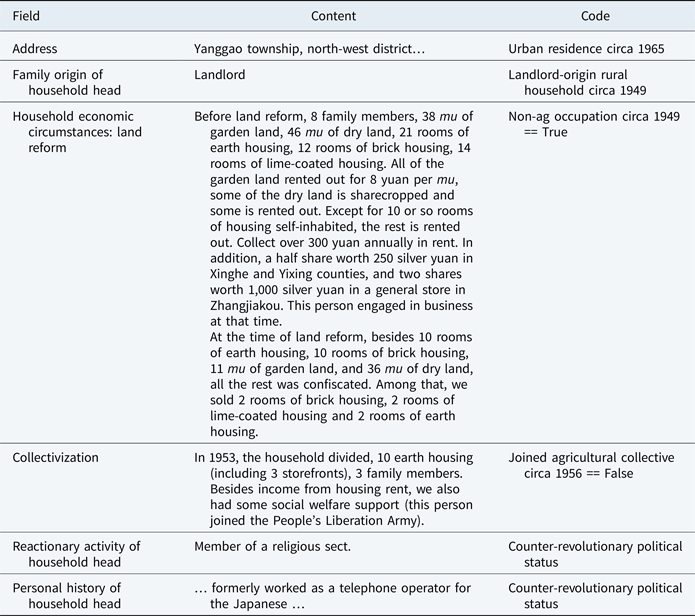
However, one limitation relevant to the present analysis is that the CRRD-SQ does not directly record the residential status of households at the time of the land reform. For the purposes of analysis here, we infer that a rural family origin classification meant that either the current household head or his/her primary family members resided in a rural area at the time of the land reform classification. We therefore rule out two other potential explanations for the change from rural origin to urban residence. One is that the household residence did not actually move, but the administrative boundaries changed between 1949 and 1965 in such a way that a rural locality in 1949 was incorporated into the town by 1965. However, the county gazetteer does not mention any physical expansion of the county seat until the 1970s, and if this was the main mechanism, then the effect should be evenly distributed across all classes.Footnote 63 Another possibility is that households that were already resident in the town in 1949 were assigned rural origins. This appears to have been likely for first-generation migrants who were at least semi-permanently settled in the town in 1949 but who still had primary family members engaged in farming in the countryside. Examples can be seen in the life history of Zhou, described in the main article, and in the sample form translated in Table A.1, which records that a household classified as “landlord” origin owned farmland and had also engaged in business before the land reform. On the one hand, since it sounds like all of the land was rented out, this household may have already been resident in the county seat as an absentee landlord; on the other hand, the household also kept a significant amount of land after the land reform, which, legally speaking, would have been difficult unless members of the household lived on and/or worked the land. The family history information also makes it clear that the grandfather and father were farmers who increasingly engaged in commerce. The descriptive analysis of personal history records shown in Figure 1 also supports a narrative of urbanization occurring mostly in the 1930s–1950s.
Another limitation is that the CRRD-SQ only includes households that still existed and were resident in any given community in 1965. Village households that emigrated or became extinct before that time are not registered. Estimates of the numbers of rural households that emigrated or became extinct between 1949 and 1965 vary. Yuesheng Wang (Reference Wang2006) estimated that in the south-west Hebei villages he studied, as many as 10 per cent of households left or otherwise disappeared between the land reform and the “Four cleanups,” when the forms were compiled.Footnote 64 However, for one of the CRRD-SQ villages for which it is possible to compare with extant archival records for an earlier period, Noellert estimated that only about 4 per cent of village households disappeared.Footnote 65 Given the nature of events after 1949, we would expect that the households that departed or became extinct by 1965 were especially likely to be landlords, rich peasants and other stigmatized groups.Footnote 66 For the purposes of this paper, however, the existence of such emigration that our data cannot cover suggests that our results underestimate the actual extent of spatial mobility of the former elite.
Translations and Coding Scheme for Select Fields of a Sample Class Status Registration Form*

2. Regression Variable Summary
Summary of Explanatory Variables, by Family Origin
Matthew NOELLERT is an associate professor in the Graduate School of Economics at Hitotsubashi University in Tokyo, Japan. He is the author of Power over Property: The Political Economy of Communist Land Reform in China (University of Michigan Press, 2020). His research uses quantitative and comparative methods to document the transformation of Chinese rural society in the 20th century.
Xiangning LI is a PhD candidate in the department of history at the University of Chicago, USA. She previously completed a PhD in sociology at The Hong Kong University of Science and Technology. Her current dissertation project focuses on gender and migration in modern China.


 Open access

