


Impact statement
This paper provides a comparative analysis of two key concepts in the future planning of integrated water systems (IWSs): resilience and adaptability. Although both resilience and adaptive planning aim to improve water system performance and manage uncertainties, they differ in their evaluation and application methods. To explore how combining these approaches can address the complexities inherent in IWSs, we propose an Adaptive Resilience Planning (ARP) framework. The ARP framework uses resilience metrics for IWS performance assessment and adaptive planning for flexible management pathways to navigate uncertain future scenarios. However, the implementation of the framework raises new research questions. We propose that holistic characterisation of uncertainties and options in IWSs is essential and requires further investigation. Additionally, the use of resilience metrics for IWS adaptation needs more exploration. Balancing trade-offs among management goals through optimal portfolio selection also needs to be addressed, and monitoring portfolio performance and uncertainties is vital for informed adaptation. Future research to address these challenges using the ARP framework will provide a structured approach to enhance the ability of IWSs to respond to evolving challenges, ensuring better management and preparedness for future uncertainties.
Introduction
The term integrated water systems (IWSs) can be used to describe flows of water, both quality and quantity, throughout the water cycle and its interactions with and management by humans (Liu et al., Reference Liu, Dobson and Mijic2022). In this paper, we conceptualise the terrestrial water cycle as a combination of the water cycle subsystems (i.e. components) and flows (i.e. links) that define its physical and operational connectivity (Figure 1). We assume that the water cycle is managed by introducing a range of interventions or options (Figure 1A) that can improve the system performance (Figure 1B). When decisions need to be made about the future of IWSs, we refer to this process as water system planning. The options shown in Figure 1 can alter many components or links in the system; for example, a new reservoir can be introduced in the system (+S) to increase the water resources for supply (Dobson and Mijic, Reference Dobson and Mijic2020). Our previous work has demonstrated that the interactions between different components of the IWSs result in complex behaviours that are difficult to anticipate without a joined-up view (Mijic et al., Reference Mijic, Liu, O’Keeffe, Dobson and Chun2023), which can be supported by visual inspection of the links between different components and options of the water cycle in Figure 1A.
A conceptualisation of the integrated water system, defined as a human-altered terrestrial water cycle. Key components of the water cycle are shown as circles with key flows between components as arrows. Common management options are indicated in red (A). Water system planning is defined as a process of improving the system's performance by introducing a range of management options (B). This figure is not intended to be exhaustive.

Planning of IWSs is complicated because each component (subsystem) within the water cycle has a range of competing management goals (Figure 1B), often requiring trade-offs between each other. Management goals can be measured by the performance of a component or a system; for example, we can set a management goal to achieve good water quality in rivers by measuring or modelling the river water quality (Liu et al., Reference Liu, Dobson and Mijic2023b). Because of the inherent complexity of IWSs, it is difficult for decision-makers to accurately assess the trade-offs between different goals due to their decisions. Long-term evidence in socio-hydrological studies supports the non-triviality of assessing IWS interventions by observing that they often create unintended outcomes such as overexploitation of water resources and increased damage from, and pollution of, water-environment systems (Di Baldassarre et al., Reference Di Baldassarre, Sivapalan, Rusca, Cudennec, Garcia, Kreibich, Konar, Mondino, Mård and Pande2019; Mijic et al., Reference Mijic, Liu, O’Keeffe, Dobson and Chun2023). These observations suggest that holistic modelling, performance assessment and management are required to provide evidence for the IWS planning in a way that mitigates against unintended consequences.
Two widely used approaches to design water systems are resilience and adaptive planning (AP). In this paper, we focus on the performance-based assessment of resilience (Roach et al., Reference Roach, Kapelan and Ledbetter2018b) and adaptability (Beh et al., Reference Beh, Maier and Dandy2015), which uses simulations of a water system to define its dynamic behaviour (i.e. system performance) through a selected state variable (e.g. flow in the river). Both approaches assess a set of options to improve the performance of a water system resulting from uncertain drivers of change. While we acknowledge that system performance is only one of the criteria for water planning, we argue that designing for resilience and adaptability benefits from, and indeed requires, the quantitative evidence provided by IWS performance assessments. For those interested in broader definitions, we suggest further reading on the social (Keck and Sakdapolrak, Reference Keck and Sakdapolrak2013) and ecological (Gunderson, Reference Gunderson2000) resilience, as well as the meaning of resilience in an interdisciplinary context (Brand and Jax, Reference Brand and Jax2007; Anderies et al., Reference Anderies, Folke, Walker and Ostrom2013). Readers might be also interested in governance aspects of water management (Bromwich et al., Reference Bromwich, Crilly and Banerjee2022), as well as role of actors in the socio-technical water systems (Manny, Reference Manny2022).
The resilience of water systems in the context of climate change, weather extremes, planning and operational decisions is crucial for water infrastructure service delivery (Sweetapple et al., Reference Sweetapple, Fu, Farmani and Butler2019) and environmental management (Li et al., Reference Li, Lin, Li and Nyerges2019). The performance-based resilience is typically defined as ‘the ability to prepare and plan for, absorb, recover from and more successfully adapt to adverse events’ (Tran et al., Reference Tran, Balchanos, Domerçant and Mavris2017). A resilience framework integrates drivers of change (stressors) with resilience metrics based on performance indicators, resulting in developing different interventions for resilience improvement (Juan-García et al., Reference Juan-García, Butler, Comas, Darch, Sweetapple, Thornton and Corominas2017). There is extensive literature focused on resilience assessment of specific subsystems of the water cycle, including water supply networks (Milman and Short, Reference Milman and Short2008) and wastewater systems (Sweetapple et al., Reference Sweetapple, Fu, Farmani and Butler2019), as well as analysis of water resources (Roach et al., Reference Roach, Kapelan and Ledbetter2018a), urban (An et al., Reference An, Song, He, Huang and Fang2023), rural (Behboudian and Kerachian, Reference Behboudian and Kerachian2021) and catchment management (Bouziotas et al., Reference Bouziotas, Stofberg, Frijns, Nikolopoulos and Makropoulos2023). In these studies, performance-based assessments were made with physically based simulation models (Roach et al., Reference Roach, Kapelan and Ledbetter2018a; Sweetapple et al., Reference Sweetapple, Fu, Farmani and Butler2019; Behboudian and Kerachian, Reference Behboudian and Kerachian2021; Bouziotas et al., Reference Bouziotas, Stofberg, Frijns, Nikolopoulos and Makropoulos2023).
Water systems AP aims to create a flexible implementation of water management options for achieving desired system performance under future uncertain conditions (Stanton and Roelich, Reference Stanton and Roelich2021). A general AP approach formulates scenarios that cover a range of future uncertainties, identifies system vulnerabilities based on simulated system performance and analyses if and when an option needs to be added to the system across a range of selected adaptive pathways. The general AP philosophy has been implemented through four different methods. The adaptation tipping points method identifies the critical changes in performance indicators that result in system failure; options that improve the system performance to avoid potential failures are then designed as part of the planning process (Kwadijk et al., Reference Kwadijk, Haasnoot, Mulder, Hoogvliet, Jeuken, van der Krogt, van Oostrom, Schelfhout, van Velzen and van Waveren2010). The adaptation pathways method aims to develop sequences of alternative option implementations over time that can overcome the critical changes in a system’s performance (Haasnoot et al., Reference Haasnoot, Middelkoop, Van Beek and Van Deursen2011). The adaptive policymaking or dynamic adaptive planning highlights the step to monitor a system’s performance, which can be used to predict vulnerabilities and prepare options for avoiding failures (Walker et al., Reference Walker, Rahman and Cave2001). Finally, dynamic adaptive policy pathway (DAPP) method combines dynamic AP and adaptation pathways to formulate a holistic modelling and monitoring process, guiding decision-making under deep uncertainty (Haasnoot et al., Reference Haasnoot, Kwakkel, Walker and Ter Maat2013). AP has been applied to a range of water subsystems, mainly in urban water supply (Herman et al., Reference Herman, Zeff, Reed and Characklis2014; Erfani et al., Reference Erfani, Pachos and Harou2018) and flood mitigation (Babovic and Mijic, Reference Babovic and Mijic2019a, Reference Babovic and Mijic2019b; Tebyanian et al., Reference Tebyanian, Fischbach, Lempert, Knopman, Wu, Iulo and Keller2023). Identifying plausible AP options requires the simulation of numerous scenarios, and thus the approach is typically implemented using integrated simulation-optimisation frameworks (Walker et al., Reference Walker, Haasnoot and Kwakkel2013; Kwakkel et al., Reference Kwakkel, Haasnoot and Walker2015; Mir et al., Reference Mir, Azizyan, Bavani and Gohari2022).
This paper reviews resilience and AP approaches in the context of IWSs from two main perspectives. First, both approaches can be used to assess options for water system planning. However, the different steps involved in each approach present an opportunity to explore an added value through their potential integration. Second, two approaches are typically applied to individual water subsystems, the components in Figure 1A, and are therefore untested for planning the IWSs. We first review how resilience and AP are currently used to inform water system planning, focusing on the conceptualisation of uncertainties, selection of performance indicators, and design and implementation of management options. We then discuss how these two approaches could complement each other to overcome the limitations arising from not considering interactions between management goals in different parts of the water cycle. This integration could pave the way for a novel, resilience-informed AP of IWSs.
The papers reviewed in this study were searched on an academic publication search engine using the keywords ‘water system AND resilience’ and ‘water system AND adaptive planning’. To enhance the understanding of processes in IWSs, we selected papers that involve performance assessment using physically based simulation models for detailed review. It is noted that the selected papers are not exhaustive but serve as materials for demonstrating the commonalities and differences between the two methods.
Resilience and AP steps in the context of water systems
To compare the resilience and AP approaches, we first disaggregate them into six steps typically used in water systems planning (Figure 2). Using this framework, we discuss the similarities and differences between the two approaches, drawing from examples of their application in individual water subsystems, including water supply, wastewater and catchment management.
Overview of approach steps for resilience (A) and adaptive planning (B) implementation. The approaches share two similarities: selecting drivers for stressors and long-term uncertainties (Step 1) and developing options for system improvement (3). They apply different methods to the development of performance metrics (2). Adaptive planning has two additional steps: optimisation of options (4) and development of adaptive pathways (5), with an optional monitoring and evaluation step (6).

Both approaches assess options to address future change
Two steps that are similarly implemented in both approaches include the selection of drivers that define the future change the plan is addressing (Step 1) and types of options that are used to mitigate the negative impacts of future changes (Step 3).
Most resilience planning applications follow the process of defining the range of stressors in the context of acute (e.g. component failure), chronic (e.g. climate change) drivers or a combination of the two. In AP, drivers are defined as uncertainties, either focusing on climate change or including other socioeconomic factors such as population growth and costs. Table 1 provides an overview of selected case studies that show the variety of drivers used and the water system applications. Both approaches consider adaptation to climate change, either as an acute problem (impact of flooding on components of the water system) or a long-term stressor (adaption to floods and droughts). They both consider the changes posed by development in general (resilience) or development implications such as increased water demand (AP). Examples of water planning using resilience and AP approaches can be found for both urban and catchment systems. While resilience assessments mainly focus on uncertainties that change the performance of a water system, the AP applications often explicitly include the consideration of costs and other socioeconomic drivers in the development of water management options.
Overview of drivers used in resilience and adaptive planning, with examples and references in water system applications

In the performance-based application of resilience and AP, options selected for both resilience improvement and adaptation primarily consider engineering solutions. Examples include infrastructure solutions (Kwakkel et al., Reference Kwakkel, Haasnoot and Walker2015; Erfani et al., Reference Erfani, Pachos and Harou2018), operational changes (Kasprzyk et al., Reference Kasprzyk, Reed, Characklis and Kirsch2012; Herman et al., Reference Herman, Zeff, Reed and Characklis2014; Su et al., Reference Su, Dong, Liu, Zou and Guo2017) or the combination of two set of interventions (Haasnoot et al., Reference Haasnoot, Kwakkel, Walker and Ter Maat2013; Pachos et al., Reference Pachos, Huskova, Matrosov, Erfani and Harou2022). Both approaches have often considered the same type of options, such as reservoir building and expansion for water supply (Erfani et al., Reference Erfani, Pachos and Harou2018; Daloğlu Çetinkaya et al., Reference Daloğlu Çetinkaya, Yazar, Kılınç and Güven2023), green infrastructure (e.g. green roof) for urban drainage (Tebyanian et al., Reference Tebyanian, Fischbach, Lempert, Knopman, Wu, Iulo and Keller2023) and embankments for river flood risk mitigation (Kwadijk et al., Reference Kwadijk, Haasnoot, Mulder, Hoogvliet, Jeuken, van der Krogt, van Oostrom, Schelfhout, van Velzen and van Waveren2010).
Resilience and AP differences: Performance assessment and implementation
The two approaches, however, differ in four distinct aspects when applied to water system planning as shown in Figure 2, including the selection of performance indicators and the steps for implementation. AP is a more comprehensive approach that includes optimisation and adaptability of options, and in some methods such as DAPP, the system monitoring and options review. We discuss these differences in more detail.
The AP studies typically apply indicators to assess the system performance under uncertainties and how options can improve it. The performance indicators vary across subsystems, including casualties and economic damages for flood management (Woodward et al., Reference Woodward, Kapelan and Gouldby2014; Kwakkel et al., Reference Kwakkel, Haasnoot and Walker2015) and demand deficit for water supply planning (Erfani et al., Reference Erfani, Pachos and Harou2018). Indicators are commonly monetised to measure the costs and benefits for better comparing and selecting among candidate options (Ren et al., Reference Ren, Huang, Huang, Wang, Leng and Wu2019b). In contrast, resilience studies process information from the performance indicators into metrics to measure the system behaviour under stressors. Resilience indicators could be based on the shape variables (e.g. duration, magnitude, slope and volume) that profile the dynamic behaviour (Roach et al., Reference Roach, Kapelan and Ledbetter2018b). Resilience is most commonly measured by the ‘4R’ metrics, which reflects different aspects of the system’s behavioural characteristics (Behboudian et al., Reference Behboudian, Kerachian and Pourmoghim2021): (1) robustness denotes the capability to endure stressors while maintaining normal functions, (2) rapidity refers to the capacity for timely recovery from a degraded state to the resumption of normal functions, (3) redundancy indicates the extent to which alternative resources are utilised to prevent loss of function and (4) resourcefulness encompasses the skills equipped to effectively cope with stressors.
The AP studies have widely adopted multi-objective optimisation algorithms to develop optimal sequences of options through adaptive pathways. Examples include options optimisation for adaptation to drought, which was used to assess the trade-off between the risk posed by climate change and expected financial return (Mir et al., Reference Mir, Azizyan, Bavani and Gohari2022) and multi-objective optimisation to evaluate flood management options under climate change (Woodward et al., Reference Woodward, Kapelan and Gouldby2014). There are also limited applications of using optimisation to improve the resilience of a system; the work on resilience by design (Brown et al., Reference Brown, Boltz, Freeman, Tront and Rodriguez2020) provides an example of the use of resilience metrics (e.g. robustness and recovery) in AP to search the options with a minimum total cost. Most resilience planning, instead, is based on modelling several scenarios with options with predefined sizes to examine their impacts on the metrics (Rezende et al., Reference Rezende, de Oliveira, Jacob and Miguez2019).
In AP studies, multiple pathways are explicitly designed to specify which options need to be implemented and when to achieve set management goals. The set of options is designed flexibly so that planning can be switched between pathways (i.e. adaptive tipping points) as more information becomes available (Babovic and Mijic, Reference Babovic and Mijic2019b. The triggers to adaptive tipping points are set as threshold values for indicators, beyond which options from another pathway should be implemented. For example, the study (Kwakkel et al., Reference Kwakkel, Haasnoot and Walker2015) has classified the severity of flood events into four categories from ‘no event’ to ‘extreme event’ based on the casualties and economic damages and set the trigger as the certain severity happening during the past five year, while (Babovic and Mijic, Reference Babovic and Mijic2019b) define the adaptation trigger as a function of an increase in the rainfall depth. In contrast, unless resilience metrics are explicitly incorporated as performance indicators, resilience planning tests a limited number of scenarios and is rarely observed to include options’ adaptation.
Monitoring has been proposed as a final step in the DAPP method (Haasnoot et al., Reference Haasnoot, Kwakkel, Walker and Ter Maat2013). In this work, the main tasks are defined as (1) monitoring the approaching of predetermined adaptive tipping points for implementing new options, (2) establishing new corrective and preparatory signposts for staying on track with existing pathways and (3) reassessing the new developments and options that have not been considered in the initial planning and redesigning the pathways if necessary. In resilience studies, although information on system performance was collected via historical monitoring and observations and evaluated for resilience assessment (Cubillo and Martínez-Codina, Reference Cubillo and Martínez-Codina2019; Sarkar and Chinnasamy, Reference Sarkar and Chinnasamy2023), the monitoring of future stressors has not yet been emphasised as a critical step that should be implemented to update the options in the resilience planning studies.
The above overview indicates that there is a potential to integrate two approaches in the context of IWSs, as both are based on assessing and improving the system behaviour in tackling future uncertainties. AP, in contrast to traditional planning, is likely to impact resilience; we argue that the better we characterise the uncertainties and use optimisation, the more likely the resilience will improve. Compared to resilience planning, the adaptive and monitoring aspects of AP provide more information for water system planning, considering the real conditions, long-term uncertainty and the need for flexibility in options implementation. However, the AP approach indicators are designed to address individual water subsystems. Finally, the complexity of IWSs has not been fully addressed in either AP or resilience studies, limiting the assessment of integrated management goals required for increased complexity in water planning (Boltz et al., Reference Boltz, Poff, Folke, Kete, Brown, Freeman, Matthews, Martinez and Rockström2019).
The adaptive resilience planning framework for IWSs
To integrate the strengths of both adaptation and resilience planning for application in IWSs, we propose an Adaptive Resilience Planning (ARP) framework (Figure 3A). The framework adapts the AP approach to conceptualising uncertainties (Step 1) and searching for optimal portfolios of options based on the set management goals (Step 4). The options are assessed (Step 3) based on the IWS resilience metrics (Step 2). After Step 4, the ARP framework modifies the existing AP process.
The Adaptive Resilience Planning (ARP) framework for Integrated Water Systems (A) and its implementation through a multi-stage approach (B). The approach uses resilience metrics to inform planning options (blue circles) and optimises portfolios for selected uncertainties (green); the ARP proposes a new step to select and implement the optimal portfolio for the next planning stage (grey), which is evaluated after implementation (orange).
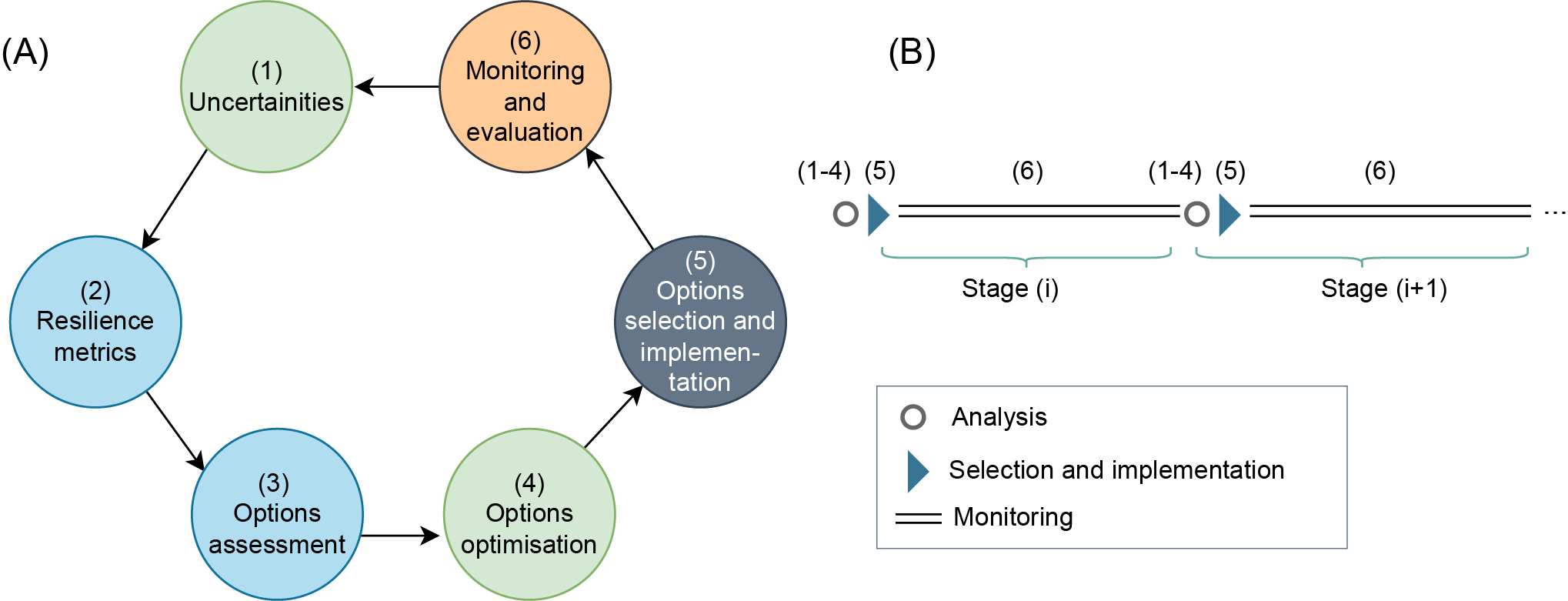
As the complex processes within IWSs make overall resilience highly susceptible to unforeseen uncertainties and reactive to options implementations in individual subsystems, we argue that scenarios used in long-term AP design (spanning 50–100 years) can deviate significantly from future realities, thereby undermining the efficacy of the designed pathways. Therefore, we propose the ARP implementation in a multistage manner (Figure 3B), with each stage spanning five or ten years to align with the IWS planning cycles (Beh et al., Reference Beh, Maier and Dandy2015). At the beginning of each planning stage, we assume that decision-makers select a preferred options portfolio based on the acceptable level of resilience (Step 5), which is then implemented. After implementation, monitoring is conducted to assess the actual situation (Step 6), including realised uncertainties, the portfolio’s effectiveness and the system’s resilience. This assessment provides evidence to inform the next stage of planning. We note that in Step 5, the decision may be to delay the implementation of new options if the assessments in Steps 3–4 show that the acceptable level of resilience is achieved for all selected uncertainty scenarios by the end of that planning stage.
The proposed ARP framework, while incorporating various methods from existing resilience and adaptation approaches, raises four scientific questions regarding IWS planning, which we discuss in more detail.
How to holistically characterise uncertainties and options in an IWS?
The complexity of IWSs is manifest in two ways. First, a vast number of components and processes are involved in an IWS (Figure 1), which significantly increases the number of uncertainties (Step 1) and options (Step 3) that could be considered. The uncertainties (Table 1) and options used to address them vary in temporal and spatial scales, and they have different impacts on the IWS subsystems. Chronic stressors such as climate change, population growth and urbanisation cause lasting, decadal pressures on nearly all IWS subsystems, including water supply, drainage and natural water bodies (Kwakkel et al., Reference Kwakkel, Haasnoot and Walker2015; Erfani et al., Reference Erfani, Pachos and Harou2018; Babovic and Mijic, Reference Babovic and Mijic2019b). Acute stressors such as pipe bursts, sewer blockages and wastewater treatment process failures only last several days, with typically local impacts (Pagano et al., Reference Pagano, Sweetapple, Farmani, Giordano and Butler2019; Sweetapple et al., Reference Sweetapple, Fu, Farmani and Butler2019). In terms of options, building and upgrading large infrastructural options, such as reservoirs, require years to become fully operational and have a long design lifespan (Dobson et al., Reference Dobson, Wagener and Pianosi2019a). Conversely, minor operational management measures such as pump repairs and pipe fixes take effect immediately. To accurately simulate these effects, it is crucial to integrate the processes directly influenced by uncertainties and options into a modelling tool that comprehensively represents the entire water cycle, such as the Water Systems Integration Modelling (WSIMOD) software (Dobson et al., Reference Dobson, Liu and Mijic2023, Reference Dobson, Liu and Mijic2024).
Second, the complexity of IWSs becomes evident when trying to achieve multiple management goals spanning water supply, drainage, flood control, drought mitigation and water quality management. Within the intricate processes of the water cycle, uncertainties and options implementation can have ripple effects across subsystems, leading to unforeseen outcomes as trade-offs between the set goals. For example, periods of reduced precipitation can degrade river water quality and aquatic habitats due to decreased natural runoff and baseflows, even as they mitigate flood risks (Liu et al., Reference Liu, Dobson and Mijic2022). Similarly, surface water abstraction upstream for supply purposes can significantly degrade downstream river water quality by limiting its dilution capacity (Dobson and Mijic, Reference Dobson and Mijic2020). Hence, it is crucial to understand the underlying causes of such trade-offs and identify potential synergies and co-benefits achievable through combinations of strategies at the IWS level. Integrated modelling could facilitate this exploration through sensitivity analysis, which evaluates the impacts of varying degrees of uncertainties and the scale of interventions on the system (Wagener and Pianosi, Reference Wagener and Pianosi2019). These insights could foster a deeper understanding of IWS dynamics, which is essential for formulating and selecting portfolios of options (Liu et al., Reference Liu, Dobson and Mijic2023a).
How to use resilience metrics for IWS adaptation?
Using the 4R resilience metrics indicators in Step 2 can enhance IWS adaptation in three ways. First, it can reveal the behavioural characteristics of a water subsystem’s performance during individual disruption events caused by a range of uncertainties (Roach et al., Reference Roach, Kapelan and Ledbetter2018b). Understanding how environmental systems respond to stressors, assessed for example by a magnitude of changes in river flows and water quality, enables decision-makers to effectively address uncertainties and tailor their responses accordingly. For example, following a minor discharge resulting from an accidental spill, a river system could quickly recover from a degradation in water quality (Giger, Reference Giger2009), while addressing significant accidental spills requires a prompt implementation of restoration measures for ecological recovery, such as the reintroduction of native vegetation (Lee et al., Reference Lee, Lee, Kim, Pi, Bae, Choi, Lee and Moon2020).
Furthermore, resilience metrics can enable decision-makers of individual subsystems to design more precise triggers for options implementation. Traditional triggers are based on design severity levels (e.g. design storm [Manocha and Babovic, Reference Manocha and Babovic2018) and performance indicators (e.g. a reservoir level [Kingsborough et al., Reference Kingsborough, Borgomeo and Hall2016), setting thresholds that, when exceeded, prompt action. Instead, triggers based on resilience metrics could be designed as ‘action is needed when robustness is below X, rapidity below Y, and redundancy below Z’, prioritising interventions for the low-resilience events. For example, strategies to address combined sewer overflow (CSO) spills could aim to mitigate events characterised by high frequency (low reliability), high volume and pollutant concentration (low robustness) and long duration (low rapidity) on average.
Finally, a challenge in IWS planning is identifying the least resilient subsystem that needs prioritised management. Drawing conclusions based solely on performance indicators is difficult due to their varied definitions, units and magnitudes across subsystems (Casal-Campos et al., Reference Casal-Campos, Sadr, Fu and Butler2018). Resilience metrics have the slight advantage of providing standardised values (Sadr et al., Reference Sadr, Casal-Campos, Fu, Farmani, Ward and Butler2020). However, the resilience metrics used in existing studies focus on individual subsystems and are designed based on various methods employing diverse mathematical expressions (Liu and Song, Reference Liu and Song2020). To enable resilience intercomparison between subsystems, a set of unified resilience metrics should be developed to uniformly evaluate the subsystem behaviour under uncertainties, potentially utilising shape variables in the performance-based assessment approach (Roach et al., Reference Roach, Kapelan and Ledbetter2018b). The development of such metrics should involve adequate stakeholder engagement to define operational threshold values (Sharifi, Reference Sharifi2016). Further investigation is needed into factors that could affect accurate 4R evaluation at a whole-water system level, such as data sources and weighting for information synthesis (Bertilsson et al., Reference Bertilsson, Wiklund, de Moura Tebaldi, Rezende, Veról and Miguez2019).
How can trade-offs among management goals be balanced through optimal portfolio selection?
The proposed selection and implementation of the optimal portfolio in ARP within an IWS (Step 5) is challenging for three reasons. The first challenge is due to the extensive search space during optimisation in Step 4. This is because the optimisation algorithm for IWSs needs to search for optimal solutions including options that can be implemented in multiple subsystems and a range of set management goals. For example, an integrated urban–rural regional planning analysis in Norfolk, UK, explored combinations of sizes for five nature-based solutions (NBSs) across 32 sub-catchments, resulting in 160 decision variables (Liu et al., Reference Liu, Dobson and Mijic2023a). Optimal NBS portfolios were then developed to achieve optimal performance across seven management goals, assessed by water resources, flood and water quality indicators.
A potential solution to balance such trade-offs is to distinguish management goals based on stakeholders’ shared and individual interests through extensive engagement (King et al., Reference King, Cavender-Bares, Balvanera, Mwampamba and Polasky2015). Management goals common to all stakeholders (e.g. economic costs and adaptivity of portfolios) could be formulated as objectives to be optimised, while those prioritised by individual stakeholders could be formulated as soft constraints (Dobson et al., Reference Dobson, Wagener and Pianosi2019b). Although this approach can help delineate a satisfactory state of the IWSs acceptable to most stakeholders (e.g. ensuring resilience metrics for subsystems above a certain threshold), thus reducing the search space, it is likely that a portfolio feasible for all stakeholders will still be difficult to achieve due to competing constraints. A structured decision-making tool used in complex and uncertain environments could support discussions around trade-offs in management goals (Gregory and Keeney, Reference Gregory and Keeney2002).
Second, the large search space creates significant computational demand for simulating numerous scenarios. Existing studies using detailed numerical models have reported substantial simulation time (e.g. around 6,000 scenarios running for several weeks [Babovic and Mijic, Reference Babovic and Mijic2019b). To address this, an integrated model that simulates physical processes in a parsimonious manner (e.g. WSIMOD [Dobson et al., Reference Dobson, Liu and Mijic2023) could serve as an effective tool. Emulators developed using artificial intelligence (AI) techniques may also be applied with optimisation algorithms to expedite the search process (Miro et al., Reference Miro, Groves, Tincher, Syme, Tanverakul and Catt2021).
Finally, current AP applications often conclude with performance evaluation of different portfolios and the identification of trade-offs between goals (Step 5 in Figure 1B). For example, uncertainty ranges where the system performs satisfactorily, with or without additional options, can be evaluated using global sensitivity analysis. However, selecting the portfolio for implementation is recommended to be done through a multi-stakeholder decision-making process (Poff et al., Reference Poff, Brown, Grantham, Matthews, Palmer, Spence, Wilby, Haasnoot, Mendoza and Dominique2016). While acknowledging the complexity of real-world decision-making processes, assessing a multi-objective portfolio under uncertainty is intrinsically difficult and more guidance on portfolio selection should be provided to stakeholders (Kasprzyk et al., Reference Kasprzyk, Nataraj, Reed and Lempert2013). We propose that Step 5 in ARP should include a Baseline Performance Confidence Index (BPCI) to assess the likelihood of system performance being satisfactory to involved stakeholders under perceived uncertainties without interventions. The BPCI can calculate the percentage of satisfactory scenarios among total uncertainty scenarios under business-as-usual conditions. A low BPCI would indicate a more fragile system needing substantial upgrades, prompting a preference for costlier portfolios and vice versa. This indicator can aid decision-makers by quantifying the current performance of an IWS, offering a meaningful benchmark for assessing portfolios.
How can monitoring of portfolio performance and uncertainty changes inform next-stage adaptation?
While adaptive approaches such as DAPP emphasise the need to monitor portfolio performance post-implementation, they lack clear guidance on the specific information to monitor for future adaptation, as well as methodologies for integrating this information. To understand how monitoring can inform ARP, we need to analyse why and when implemented options fail to meet the designed performance criteria (e.g. resilience falling below the defined threshold).
A common cause of a system failure is the disparity between the uncertainties considered during planning and the realised change of the system. Two prevalent types of unsatisfactory AP outcomes have been identified (Robinson and Herman, Reference Robinson and Herman2019): (1) underestimating vulnerability leading to options that fail to maintain system resilience and (2) overestimating vulnerability leading to oversized and costly options. We argue that both outcomes can coexist in an IWS due to its complexity and the presence of multiple uncertainties, management goals and options. For example, anticipating a future dry climate might lead to investments in enhanced wastewater treatment for water quality improvement, but if increased precipitation is observed post-implementation, those investments should have been directed towards flood mitigation, demonstrating over- and underestimated vulnerability, respectively. Furthermore, other reasons for not achieving the intended performance may include options not being implemented as designed, inaccuracies in simulation models and overlooked processes resulting in unintended outcomes (Ward and Pulido-Velazquez, Reference Ward and Pulido-Velazquez2008), re-emphasising the need to have adequate tools to accurately analyse what-if scenarios in IWSs.
Understanding the causes of system failure must be accompanied by a method to adjust the decision on options implementation as new observations become available. One potential approach could be the multistage implementation of the proposed ARP framework. Three aspects of the approach are worth considering. First, characteristics of uncertainties monitored in the previous stage can be used to inform next-stage selection of key drivers of change (e.g. climate and population change versus unexpected events such as pandemics [Dobson et al., Reference Dobson, Jovanovic, Chen, Paschalis, Butler and Mijic2021), their severities and probability distributions. Monitoring level of resilience both for subsystems and the IWSs will provide decision-makers with the information on the system’s ability to handle future uncertainties. For example, if a low IWS resilience is observed, planning for more severe uncertainties (e.g. design storms with higher return periods) should be considered. Including observed information to adapt planned options in subsequent stages will help the IWSs to better cope with future realities. Second, unlike adaptive pathways that are designed for an entire future period (usually 50–100 years), the multistage approach allows for regular refinement of the model used in resilience assessment AP. This leads to a more accurate representation of the system and the implemented options. Iterative refinement can improve the accuracy of performance estimates and enhance the model’s credibility for future stages, thereby increasing confidence in options planning compared to long-term adaptive pathways developed without model updates. Lastly, the multistage implementation enables early integration of options emerging from technological advancements (e.g. AI [Alam et al., Reference Alam, Ihsanullah, Naushad and Sillanpää2022]) and real-time operated NBSs [Brasil et al., Reference Brasil, Macedo, Lago, Oliveira, Júnior, Oliveira and Mendiondo2021), offering more opportunities to include innovative solutions for enhancing system resilience against the evolving challenges.
Conclusions
In this paper, we have examined the potential to integrate resilience and AP approaches for improving the management and planning of IWSs. We highlighted that both approaches share the common goal of developing options to address future uncertainties and improve system performance but differ in their methodologies for performance assessment and implementation of options. Resilience planning focuses on evaluating the system’s ability to prepare, absorb, recover and adapt to adverse events using resilience metrics, while AP aims to create flexible implementation pathways for management options based on performance indicators and optimisation techniques.
We suggest aligning the concepts of resilience and AP by introducing a multistage ARP framework for IWSs. This framework adapts the definition of uncertainties and use of optimisation from AP while proposing the use of resilience metrics for performance assessment. However, the ARP framework raises four research questions on (1) holistic characterisation of uncertainties and options in an IWS, (2) use of resilience metrics for IWS adaptation, (3) balancing trade-offs among management goals through optimal portfolio selection and (4) monitoring portfolio performance and uncertainty for informing next-stage adaptation. The multistage implementation allows for dynamic learning and adjustment of uncertainties, options and system representations, enabling prompt adaptation to address potential failures or emerging challenges.
Our use of performance-based resilience in this review primarily describes the ability of physical systems to withstand and recover from disturbances. However, the concept of resilience could be expanded to include other aspects, such as ecological and social resilience. Ecological resilience refers to the capacity of ecosystems to absorb and adapt to disturbances while maintaining their essential functions and structures. Social resilience, on the other hand, encompasses the ability of communities and societies to cope with and recover from adverse events, considering factors such as social networks, governance structures and cultural practices. Integrating these dimensions into the proposed ARP framework could provide a more comprehensive approach to sustainable water management, accounting for the interplay between physical, ecological and social systems.
Open peer review
To view the open peer review materials for this article, please visit http://doi.org/10.1017/wat.2024.9.
Author contribution
All authors contributed to the conceptualisation and development of the manuscript. A.M. wrote the initial draft, which all authors reviewed, edited and approved for the final manuscript.
Financial support
The work was supported by the DAFNI Centre of Excellence for Resilient Infrastructure Analysis within the UKRI Building a Secure and Resilient World programme (grant number ST/Y003810/1).
Competing interest
The authors declare none.


 Open access


Comments
Dear Editors,
Please find enclosed the invited manuscript by me and co-authors Barnaby Dobson and Leyang Liu for the publication in Cambridge Prisms: Water. In the paper, we focus on two interlinked concepts – water systems resilience and adaptive planning. Through extensive literature review, we showcase the application of the concepts in multiple water systems, as well as their similarities and differences. We then discuss the concepts in the context of integrated water systems, highlighting future research topics that could advance the future planning.
We hope that the review will be insightful for the water systems community who work on the topics of resilience, adaptive planning, and water management. We are grateful for the invitation to submit this article, and we hope that it will contribute to important research covered by the Cambridge Prisms: Water journal.
We declare that no potential conflicts of interest exist among the (co)authors.
Kind regards
Ana Mijic