

Introduction
The notion of Truth has different meanings, including factual truth (affirmation according to fact) and prescriptive truth (ethics, morals, etc.). It is important for gaining knowledge, in particular in the sciences. However, this notion has become controversial. For realists, truth is a crucial element in the quest for knowledge; a realist postulates that objective reality exists and can be known, while for anti-realists (e.g., instrumentalists) this notion is superfluous and devoid of any use.
I place myself on the side of realists and will here discuss in more detail the meaning of the notion of truth as well as the perils that science and medicine are facing when truth is jeopardized, becoming a toy in the hands of ideology-minded social forces.
The definition of truth is broad when one looks at the Merriam-Webster Dictionary. The list is quite long and includes the following items:
the body of real things, events, and facts; the state of being the case; a transcendent fundamental or spiritual reality; a judgment, proposition, or idea that is true or accepted as true; the body of true statements and propositions; the property (as of a statement) of being in accord with fact or reality; fidelity to an original or to a standard; sincerity in action, character, and utterance; in truth: in accordance with fact.
When one looks at these definitions, one can distinguish what is called factual truth and what is called the prescriptive and ethics-related notion of truth. Factual truth means that a statement is in accordance with the facts. In the empirical sciences, it means that one applies reasoning by using verification and falsification for testing hypotheses and to accept them (if true) or reject them (if false). Truth should be provisional, which means that it can be revised. There is also solidified truth which is more stable and which may constitute a framework for inquiry. Prescriptive and ethics-related truth refers to the value context and norms imposed by society, which regulate the space in which research can be done and to where it may lead. This corresponds to David Hume’s what is (IS) and what should be (OUGHT). I shall call this Truth 1.0 (IS) and Truth 2.0 (OUGHT). I will first briefly elaborate on truth 1.0 and then deal more extensively with truth 2.0.
Truth 1.0
What are the characteristics of truth 1.0.? Truth 1.0 can be acquired through observation and experimentation via hypothesis-driven or data-driven inquiry. Hypothesis-driven approaches have largely contributed to our current knowledge, but large-scale genomics/proteomics and metabolomics have come into fashion in recent years. In 2010, in the science journal Nature, Robert Weinberg and Todd Golub had an interesting debate about the hypothesis-first or data-first approaches (Weinberg Reference Weinberg2010; Golub Reference Golub2010). Weinberg noted that the hypothesis-driven approach was/is very successful in knowledge acquisition, and that large-scale approaches have not yet led to the promised outcome. Golub, on the contrary, maintained that data first will ultimately become mainstream, which it surely has over the past decade. However, even data-driven approaches will never escape hypothesis-formulation and even at the initial stage of the research, some hypothesis is already required. Thus, both are in fact complementary.
A number of ways (procedures or ‘methods’) have been described by philosophers of science for gaining knowledge and ultimately ‘truth’. These include: classical causal inference and induction, Bayesian statistics, error statistical approach, inference to the best explanation (IBE) and causal network building (Weber Reference Weber2017, Reference Weber and EN2018; Pearl Reference Pearl2013). I will not elaborate more in detail on these knowledge-gaining procedures, and the reader can refer to existing literature on the subject.
Another point is the notion of provisional truth in biomedicine and biomedical research. Thomas Kuhn formulated the concept of paradigm and scientific revolution, but he ultimately had a relativistic outlook since he did not hierarchize between more recent, better knowledge, which is closer to truth, and older knowledge that has been upset by the new knowledge (Kuhn Reference Kuhn, Neurath, Carnap and Morris1962). Equivalence of knowledge is postulated for a specific epistemic setting of human history and, thus, there is no accumulation and, in a sense, no improvement of knowledge. However, this cannot apply to the biomedical domain. For example, there is no equivalence in the truth value between Galen’s theory of blood vessel function and the circulatory theory that has been developed by Harvey. Many other examples of that sort can be given (e.g., cell theory versus protoplasm theory).
Another idea is the existence of fluctuation between provisional truth and solidified truth, since provisional truth can solidify (but may not). Examples of solidified truth are: the cell as functional unit of life (‘Cell Theory’, Schleiden Reference Schleiden1838; Schwann Reference Schwann and Smith1839), ‘germ theory’ (Louis Pasteur Reference Pasteur1878), blood circulatory system (William Harvey, Caldwell Lecture 1616, de moto cordis et sanguinis in animalibus (DMC) 1628), cellular respiration and energetics (Krebs and Kornberg Reference Krebs and Kornberg1957), DNA as the substance of heredity and its structure (Avery et al. Reference Avery, MacLeod and McCarty1944; Watson and Crick Reference Watson and Crick1953) or mRNA as unstable intermediate for protein synthesis (Jacob, Monod, Lwoff, Brenner, Nirenberg, 1965–1968; for a historical review see Nirenberg Reference Nirenberg2004). Provisional truth, however, is the norm. No claim should be made at the beginning of a research project that the discovery will lead to definitive truths.
Ignaz Semmelweis represents a case study of Truth 1.0. He used a mix of hypothetico-deductive and inductive reasoning by eliminating unsound hypotheses and by providing supportive data for the causes of puerperal fever in favour of the existence of a single septic agent (which anticipated the germ theory of Louis Pasteur). His case was extensively discussed by the German American philosopher Carl Hempel (Reference Hempel1966).
Truth 2.0
Truth 2.0 is related to a value system, and represents beliefs and assumptions shared by society, or a specific community (here physicians or biomedical researchers) and their impact on the scientific or medical practice.
Value-free or Value-laden Science
There are two positions which seem antagonistic: one in favour of value-free inquiry and the other in favour of value-laden inquiry. It is of course evident that a physician and biomedical researcher must have a personal minimal ethical framework, which for physicians is represented by the Hippocratic oath.
Bertrand Russell has argued that philosophical [‘scientific’, note by the author] inquiry must stay value-free (Russell Reference Russell1936, new edition by Routledge Reference Russell2004) and that introducing personal beliefs has and will harm the philosophical [‘scientific’, note by the author] enterprise. More recently, the value-laden viewpoint has gained prominence (for a comprehensive review see Elliott Reference Elliott2022). In particular, Helen Longino (Reference Longino1990) has argued that value-free science is a myth and that belief and assumptions guide research.
Longino coined the term ‘contextual empiricism’ to stress the presence of the value context or framework. This value-framework should be reinforced and enshrined in the scientific methodology to not allow, for instance, racist or sexist research (e.g., research that could potentially harm minority groups). This is problematic for a number of reasons. First, the value framework (also called the Overton window) is the range of ideas the public is willing to consider and accept, but which may shift or be extended when the value system of a society changes. This window may shift, and what was not problematic may become problematic over time. Second, who (a particular group of people, organizations, the state, etc.) is imposing these values? When one looks at historical events, ‘value’ systems may vary enormously and may have some good but also very negative impacts on research (e.g., ideologically-driven value systems such as in Nazism or in soviet communism, etc.). Furthermore, value-bound research impedes the autocorrective mechanisms that are built into science when science is done freely. Science that promotes racism can easily be debunked by better and freer science.
Finally, two historical examples can be given that contradict Longino’s value-laden science concept. The first is the discovery of the circulatory system by William Harvey. In Harvey’s time, the assumption/belief was that there is a unidirectional flow of the blood from the heart to the peripheral organs. This was based on Galen’s theory of the vasculature. Harvey broke with the belief system of his time by using the empirical method, and discovered by himself, through experiment, blood circulation (Bikfalvi Reference Bikfalvi2018). The second example is Ignaz Semmelweis, who was at odds with the explanation of childbed fever of his time. He broke with the current ‘theories’ of his time by applying the scientific method through experiment (Hempel Reference Hempel1966).
A problem arises when value systems become hypertrophic, rigid, self-righteous and do not relate to objective reality (see Figure 1). Science then becomes a toy in the hands of ideologues, and this will have dramatic consequences for scientific inquiry and society in general (such as Lysenkoism and famine in the USSR, etc.). Hypertrophic, not reality-bound value systems are not only a problem in authoritarian countries but also in Western democracies.
The IS and OUGHT in science. Values have, of course, a role, being the personal minimal value framework. However, when the OUGHT becomes hypertrophic, rigid, and self-righteous, projecting to a pseudo-reality construct, it transforms itself into ideology

Recent Emergence of Social Justice Ideology in STEMM
The recent emergence of social justice ideology (SJI) is a case in point. SJI is represented by three types of intellectual ‘currents’: Critical Race Theory (CRT), the decolonizing movement, and gender/queer theory (see Figure 2). These are derived from cultural Marxism (Gramsci, Lukacs) to a varying degree. CRT is a kind of Americanized and racialized critical theory built on the Frankfurt School’s critical theory (see Corradetti Reference Corradetti2013 for a comprehensive review), with K. Crenshaw’s intersectionality concept as an important appendix (Crenshaw Reference Crenshaw1991). Intersectionality refers to the ways in which systems of inequality based on gender, race, ethnicity, sexual orientation, disability and other forms of discrimination ‘intersect’. The present-day decolonization movement was and is promoted by scholars mostly of African, south-American or Indian origin, and the gender/queer branch is derived from radical neo-feminism, which then became radical intersectional neo-feminism when blended with Crenshaw’s intersectionality concept. Scholars at universities, and especially law schools, have played a significant role in laying the intellectual groundwork for these movements, which are widely diffused in many branches of the humanities and especially the social sciences. SJI has been largely amplified by social media corporations (Facebook, Twitter, etc.) and has penetrated all areas of society, the arts (e.g., antiracist Shakespeare), education, private or state-run corporations, cultural and scientific societies, scientific publishing, etc.
The origins of present-day ideological intrusion into science

Science, Technology, Engineering, Mathematics and Medicine (STEMM) were initially thought to be immune to SJI because of their scientific, rigorous methodology. But this turned out to not be true, as SJI now has a firm seat in many scientific and medical institutions (Royal Society of Chemistry (RSC), National Academy of Science (NAS), American Medical Association (AMA), American Psychological Association (APS), American Mathematical Society (AMS), etc.), and in STEMM university departments.
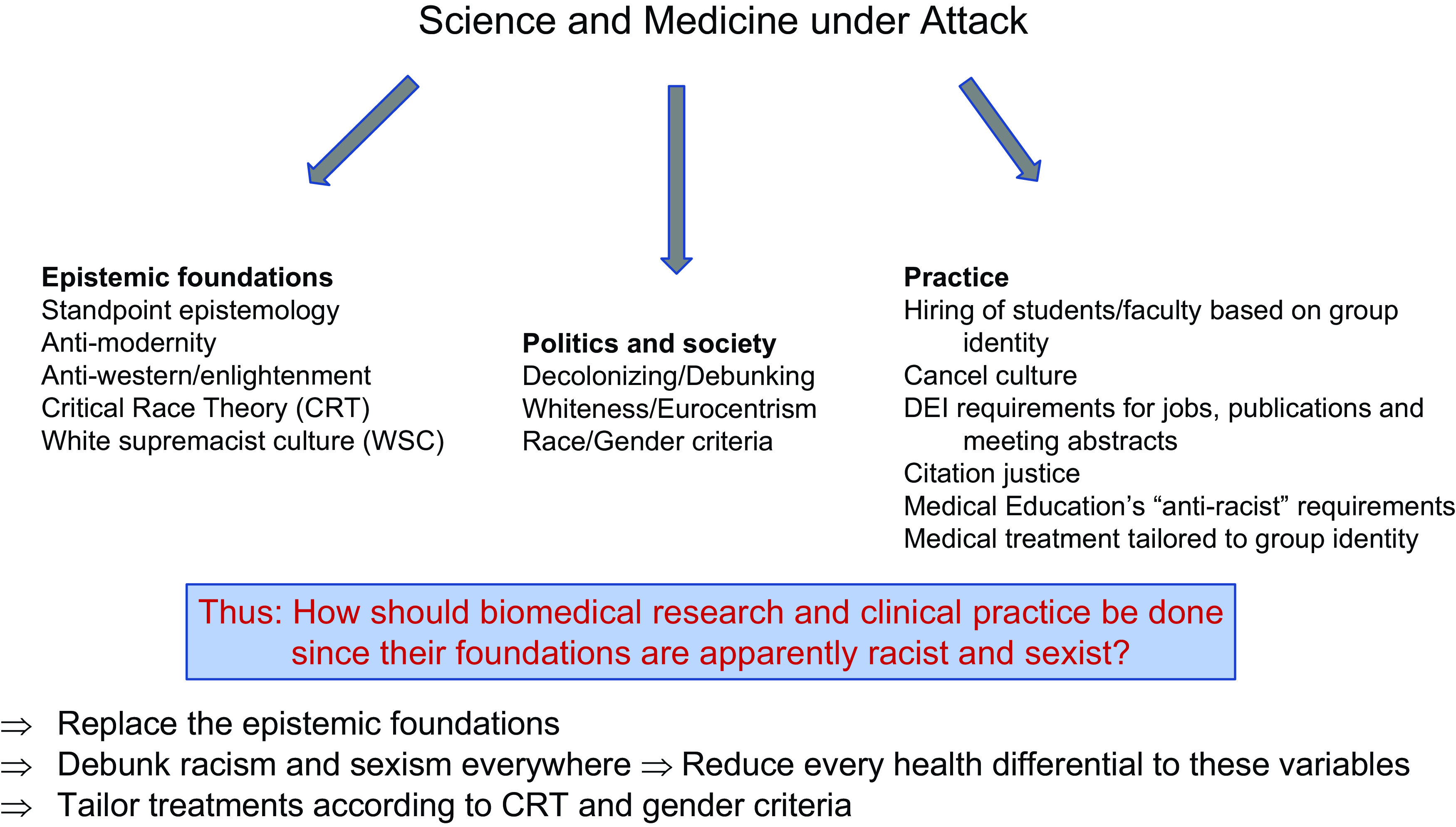
The characteristics of the attack on science, and in particular on biomedical research and clinical practice, is three-fold (see Figure 3) and includes its epistemic foundations, politics and society, and praxis. This has important consequences, which include: (1) the replacement of epistemic foundation by SJI scholarship; (2) the debunking of supposed racism and sexism everywhere in STEMM; (3) social conformity and obliteration of viewpoint diversity in STEMM; (4) reduction of every health differential to these variables (racism, sexism); (5) introduction of SJI and especially CRT into the syllabus for medical students; (6) tailoring treatments according to CRT and gender criteria; and (7) cancelling dissidents.
The characteristics of the attack on science and in particular on biomedical research
Social Justice Ideology in Scientific Publishing
Scientific publishing has also been overtaken by SJI. Many opinion pieces have been published with a flood of articles of mediocre quality in leading journals, such as Science, Nature, Cell, The Lancet, the New England Journal of Medicine, etc. In particular, DEI statements and citation justice statements (CJS) are recent significant developments (Dworkin et al. Reference Dworkin, Zurn and Bassett2020). Indeed, there has been a push in some sectors of STEMM for the promotion of DEI statements that are appended at the end of a publication. Authors declare, for example, that the work has a balanced sex ratio for non-human subjects, that some of the authors belong to specific minorities or are disabled, that support has been received to increase minority representation in science, that the list of authors include contributors from the location where research has been conducted etc. (Ray Reference Ray, Zurn, Dworkin, Bassett and Resnik2022).
As for the citation diversity statements, authors declare for example the following (Ray Reference Ray, Zurn, Dworkin, Bassett and Resnik2022):
We are committed to promoting intellectual and social diversity in science and academic scholarship and took this commitment into consideration while researching and writing this article. We actively worked to promote diversity in our reference list while ensuring all the references cited were relevant and appropriate. We have included some references to enhance diversity but have not omitted any references for this purpose. To assess the diversity of our references, we obtained the predicted gender of the first and last author of each reference by using a database that stores the probability of a first name being carried by a woman (gender-api.com). Using this measure and removing self-citations, our references contain 30% woman(first)/woman(last), 11% man/woman, 15% woman/man, and 44% man/man. This method is limited in that a) names, pronouns, and social media profiles used to construct the database may not, in every case, be indicative of gender identity and b) it cannot account for intersex, non-binary, or transgender people. We look forward to future work that could help us to better understand how to support equitable practices in science.
Thus, to achieve this, specific software is developed to screen citations for their gender/ethno-balance (Dworkin et al. Reference Dworkin, Zurn and Bassett2020). The causal explanation of these differences is always claimed to be bias, stereotypes, exclusion of minorities, hegemony (of white, cis-gendered heterosexual men), and systemic sexism and racism (Zurn et al. Reference Zurn, Teich and Simon2022). There are statements such as ‘the story of science as an objective hunt for inalienable truth performed by lone genius white men has pernicious effects for…,’ or ‘many efforts exist already to contextualize scientific progress outside the dominant narrative of white masculine European triumph…’. These statements reflect no gratitude to the men who have contributed so much to science, technology, and medicine, and thus to human flourishing (men such as Semmelweis, Pasteur, Koch, or Einstein).
A recent example of SJI in science publishing is the special issue on racism by the science journal Nature, which seeks to overcome Science’s toxic legacy (Nature Editors 2022). This issue, better called ‘Special Issue on Anti-Racism’, was coordinated by Melissa Nobles, a political scientist, chancellor of the Massachusetts Institute of Technology in Cambridge, USA. Nature, in its introductory page, displayed all we are accustomed to from the nova lingua of social justice in the line of many previously published articles by the same journal. In their own words: ‘Nature has played a part in creating this racist legacy. After the killing of George Floyd by police in Minneapolis, Minnesota, in 2020, Nature committed to becoming an agent of change, and helping to end discriminatory practices and systemic racism.’ It not only deals with self-accusations of deeds of the past but also of the present (without specifying any of the present day ‘racist’ articles they published). It is egregious self-loathing.
The introductory statement from the issue editors and co-editors reflects their full commitment to anti-racism and social justice ideology. The articles published in this issue range from subjective accounts of felt racism to systemic racism, racism in computer science or in medical practice, and racism in UK research institutions, such as in Imperial College, where Huxley (Darwin’s Bulldog) is displayed as a racist. This is a blatant example of presentism, which can also be applied to Paul Broca, the famous French physician and scientist who made important contributions to neurology and many other areas of biomedicine, and also founded anthropology. In his time, he was held a progressive but he is now seen as a racist and sexist. Furthermore, physiological differences are used as a proxy for racism, such as the measure of skin O2 levels, which of course is different in dark skin when compared with white. The omission of this fact in the past is interpreted as racism. Overall, the articles in this issue display what Carl Hempel would call the fallacy of affirming the consequent: a hypothesis is inferred as true when the test results support the hypothesis, which leads to confirmation bias.
Social Justice Ideology in Medical Practice
A final example is the intrusion of Critical Race theory (CRT) into clinical management. Michelle Morse, a chief medical officer at the New York City department of Health and Mental Hygiene, states in a tweet: ‘Racism is the risk factor not race. We should consider race in order to advance equity. Non-white race and Latinx ethnicity are social risk factors for severe covid because of longstanding structural racism.’ She thus promotes what she believes to be a true anti-racist approach to health management. In an article published in The Lancet magazine, Michelle Morse is cited as saying that ‘We will never get to health equity without taking a race-conscious approach’ (Samarasekera Reference Samarasekera2022). The American Medical Association (AMA) seems to endorse this approach (see webinars by the Center of Health Equity, e.g., American Medical Association on Health Equity 2021).
Importing CRT into clinical medicine is a blatant betrayal of the Telos of medical practice. No one should get near a hospital where this type of approach has been introduced.
Amplification Devices for Social Justice Ideology
The amplification devices of the SJI are three-fold: (1) concept creep, (2) psychogenic contamination and herd behaviour, and (3) the motte-and-bailey fallacy (strategical equivocation) (see Figure 4).
Amplification devices for Social Justice Ideology (SJI)

Concept creep relates to the extension of meaning of socially important harm-related concepts (Haslam Reference Haslam2016; Haslam et al. Reference Haslam, Tse and De Deyne2021). Expansive concepts of harm problematize previously tolerated behaviour and reflect a growing sensitivity to suffering and injustice. The expansion of the concepts may be horizontal or vertical. Horizontal expansion is, for example, the concept of micro-aggression (from the SJ textbook) and vertical expansion is ‘racism’ which encompasses racist attitudes, as well as systemic, structural, and institutional racism.
Classical psychogenic contamination can lead to a psychogenic epidemic, where neurological symptoms or other pathologic symptoms may appear. Recent Tourette-like syndrome cases in a young population have been described as being provoked through social media (Müller-Vahl Reference Müller-Vahl, Pisarenko, Jakubovski and Fremer2022). At the same time, SJI may lead to collective mass psychosis when targeting specific socially relevant phenomena in which group behaviour is reinforced. Carl Jung writes in Symbolic Life (Jung Reference Jung and Jung1977), on the dangers of psychogenic epidemics, the following:
Indeed, it is becoming ever more obvious that it is not famine, not earthquakes, not microbes, not cancer but man himself who is man’s greatest danger to man, for the simple reason that there is no adequate protection against psychic epidemics, which are infinitely more devastating than the worst of natural catastrophes.
The motte and bailey fallacy is used by activists to strategically misguide well-intentioned people where a concept (e.g., racism) is used as bait and subverted from its initial meaning. It is connected to some extent to concept creep.
Conclusion
The notion of truth is important for the progress of the sciences and medicine. It has led to innovation and to the development of technologies for the flourishing of mankind.
Science and medicine have come under attack, mainly from the left, by problematizing their legacy, epistemic foundations, and achievements. In the past, attacks on science came principally from the right and this may happen again. I have a clear non-partisan standpoint and I am critical of both the right and the left. I am very much in line with the critics of SJI coming from the left (see Neiman Reference Neiman2023).
In this article, after briefly describing the meaning of the notion of truth, I have tried to analyse the relation between value and science in detail and provide an explanation for the present-day hypertrophic, rigid, and not reality-bound value system and its ideological penetration into science and medicine. This value system is not only applied to the present day but also, in an act of presentism, to historical figures that have contributed much to science.
I leave the final word to Bertrand Russell who wrote the following:
… When any limits are placed, consciously or unconsciously upon the pursuit of truth, philosophy [and ‘science’, note by the author] becomes paralysed by fear and the ground is prepared for a government censorship punishing those who utter ‘dangerous thoughts’ – in fact the philosopher [‘scientist’, note by the author] has already placed such censorship over his own investigations.
More than 50 years after these sentences were written, these fears have again become reality.
About the Author
Andreas Bikfalvi is Professor at the University of Bordeaux. His main area of research is related to cancer and vascular biology. In addition, he has a keen interest in conceptual analysis and in the history and philosophy of science.


 Open access

