


The chikungunya (CHIK) fever epidemic in India during late 2005 spread to 17 states/union territories [1, Reference Ravi2]. Official estimates indicate that more than 1·5 million people have been affected to date [1, Reference Krishnamoorthy3]. Although no deaths attributable to CHIK fever were registered in the country, the CHIK fever case-fatality rate was 1/1000 on Reunion Island [1, Reference Krishnamoorthy3, Reference Josseran4]. The epidemiological observations in Mauritius as well as in Ahmedabad in India indicated that there was increased mortality during the CHIK fever epidemic [Reference Beesoon5, Reference Mavalankar6].
Port Blair, the capital city of the Andaman and Nicobar Islands situated in the Bay of Bengal, 1200 km distant from peninsular India, witnessed an outbreak of CHIK fever in 2006 [Reference Manimunda7, Reference Singh8]. The government surveillance programme registered 4469 suspected CHIK fever cases [Reference Krishnamoorthy3]. A household sample survey conducted by the Regional Medical Research Centre (RMRC), Port Blair and the Directorate of Health Services, Andaman and Nicobar Administration to assess the occurrence of illnesses such as joint pains associated with the fever estimated an attack rate of 60% (unpublished data). Based on this survey, we estimated that around 82 000 people out of a population of 136 000 (mid-year population of 2006) in the city suffered CHIK fever during the 2006 outbreak. Considering that the outbreak in Port Blair affected a large number of people and that there was documented evidence of increased mortality during CHIK fever outbreaks in other parts, we analysed the mortality data of Port Blair from 2002 to 2008 with the aim of verifying whether there was an increase in mortality over that expected during the CHIK epidemic period.
The data pertaining to monthly deaths registered in Port Blair for 2002–2008 were collected from the office of the Registrar of Births and Deaths, Andaman and Nicobar Administration. The average mortality rate for each month was calculated by dividing the average number of deaths per month by the average population, the average being taken over the years 2002–2008 (except for 2006). The expected number of deaths for each month in 2006 was calculated by multiplying the average mortality rate for each month with the monthly population in 2006. As there were 12 estimates of expected deaths (one for each month), we applied the more conservative simultaneous confidence interval (CI) using Bonferroni's method instead of a simple CI for each month separately [Reference Miller9]. The excess deaths total for each month in 2006 was calculated by taking the difference between the observed number of deaths and the expected number of deaths.
The number of fever cases reported each day to the five urban health centres (UHCs) of the city during 2005 and 2006 was obtained from the registry maintained at the UHCs. The number of fever cases reported to the UHCs each month during 2006 was calculated in order to obtain the trend in occurrence of fever cases. The rise in occurrence of fever cases was largely due to CHIK fever during 2006, as there was no other reported epidemic of fever in the city during that year.
The increase in the number of fever cases reported started in May 2006. It peaked during August–October, and began tailing off in November and December of that year. The number of expected deaths for the year 2006 based on the average mortality rates observed for 2002–2005 and 2007–2008 was 734, whereas the number of observed deaths was 812, resulting in 78 excess deaths during 2006. The actual deaths observed during August–October 2006 exceeded the 99% CI of expected deaths based on the average mortality rates for 2002–2005 and 2007–2008 (Table 1).
Fever cases, expected deaths, actual deaths, and excess deaths in Port Blair, India 2006
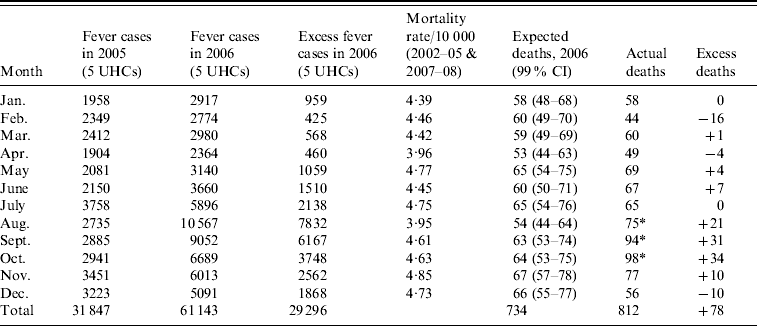
UHC, Urban health centre; CI, confidence interval.
* Significant excess deaths in 2006 as they are outside the 99% confidence limits of the expected deaths for 2006.
Our study shows that there was a significant increase in the number of deaths during some months of 2006. A substantial number of these excess deaths occurred during August–October 2006 which coincided with the peak of the CHIK fever epidemic in Port Blair. There was no other epidemic or health event reported in the city which could explain the increase in mortality during those months. This increase in deaths was not observed during the subsequent years, i.e. 2007 (n=752) and 2008 (n=752), when there was no CHIK fever epidemic. Few very sick patients from other places within the island province are regularly referred to the hospital in Port Blair, although this may have added some numbers to the deaths in Port Blair. However, this would not have affected our observation as it is a phenomenon that occurs every year. Moreover, the cumulative number of deaths registered in the rest of the 24 places in the island during 2006 was not less than expected for that year based on the average deaths registered for the previous 4 years. This indicated that there were no major additional deaths due to referrals from other parts of the island province to Port Blair during the epidemic year.
While the household sample survey carried out by RMRC indicated that about 82 000 people suffered from CHIK fever in Port Blair in 2006, the current study shows that the excess number of deaths was 78. This translates into a case-fatality ratio of 1/1000, which is the same as that observed in Reunion Island. The rise in mortality during the CHIK fever epidemic is perhaps attributable to the epidemic itself. Although this observation is in agreement with earlier studies [Reference Josseran4–Reference Mavalankar6], an investigation into the causes of deaths in the CHIK fever epidemic-affected areas is required in order to estimate the specific mortality rate attributable to CHIK virus infection.
ACKNOWLEDGEMENTS
We thank Mrs Prabhawati Raj, the Statistical Officer and Registrar of Births and Deaths, Port Blair, A&N Islands, for providing the monthly mortality data for the municipal area of Port Blair. We also thank Dr Subba Rao, Scientist, National Institute of Nutrition, Hyderabad, for reading the manuscript and suggesting corrections for English language. The study was supported by internal funds of the Indian Council of Medical Research (ICMR), New Delhi.
DECLARATION OF INTEREST
None.



