





Introduction
How can we best understand the shifting linkages between citizens and political parties in contemporary democratic representation? As societies grow more complex, individuals’ political identities become increasingly fragmented, weakening the once-stable alignments that tied voters to parties (Blühdorn Reference Blühdorn2020; Dalton Reference Dalton2018; Reckwitz Reference Reckwitz2010). Today, many citizens support a party on certain issues while opposing it on others, reflecting broader social trends in which personal identities are more multifaceted, individualized, and flexible. Yet, this movement toward individualized political preferences coexists with persistent desires for collective attachment and shared belonging (Bauman Reference Bauman2012; Beck, Giddens and Lash Reference Beck, Giddens and Lash1994; Sennett, Reference Sennett1999; Taylor Reference Taylor1992).
These dual processes, intensifying individualization and enduring demands for collective identity, manifest globally. In Western Europe, traditional parties grapple with newcomer formations that appeal to narrower or single-issue niches (Hooghe and Marks Reference Hooghe and Marks2018; Kriesi Reference Kriesi2010). In the United States, growing numbers of self-identified independents are driven by personalized policy concerns rather than stable partisan loyalties (Dalton Reference Dalton2018). Similarly, volatile party systems across Central and Eastern Europe (CEE) consistently struggle to aggregate increasingly heterogeneous voter demands (Haughton and Deegan-Krause Reference Haughton and Deegan-Krause2020; Mainwaring, Gervasoni and España-Najera Reference Mainwaring, Gervasoni and España-Najera2017). Such fragmentation generates a critical tension in the study of democratic representation, raising fundamental questions about how we conceptualize and measure voter-party alignment in increasingly fragmented political landscapes.Footnote 1 Furthermore, it renders the assumption that we can assess the quality of democracy and democratic representation through the representative fit between voters and parties more complex.
Existing scholarship has made important strides in measuring voter-party congruence, often focusing on ideological proximity (Blais and Bodet Reference Blais and Bodet2006; Carroll, Liao and Tang Reference Carroll, Liao and Tang2025) or the salience of issues as defined either by parties (Costello et al. Reference Costello, Toshkov, Bos and Krouwel2021) or voters (Giger and Lefkofridi Reference Giger and Lefkofridi2014). Yet these approaches typically isolate single dimensions and emphasize the voter’s relationship to a singular preferred party. This makes them less suited to capturing the layered and sometimes contradictory nature of contemporary voter-party relations, which a wide body of research has shown to be increasingly complex, flexible, and volatile (see, for instance, Bauman Reference Bauman2012; Butzlaff Reference Butzlaff2025; Dassonneville Reference Dassonneville2023).
In this paper, we move beyond existing literature to shed light on the nature of contemporary voter-party congruence by proposing a novel conceptual and methodological framework, multi-point congruence, that integrates insights from social theory diagnoses of modern societies with empirical approaches in political science. This way, we can better capture the representative fit between voters and parties under conditions of social modernity. In doing so, the framework also points toward a more nuanced understanding of democratic representation. Specifically, we conceptualize voter-party alignment through three complementary mechanisms derived from contemporary social theory diagnoses of changing political identities and voter expectations: (1) fragmentation operationalized via aggregate issue congruence; (2) alienation operationalized via party-defined issue salience; and (3) individualization operationalized via voter-defined issue salience. We implement our framework using a distance-based approachFootnote 2 that incorporates uncertainty in alignment estimates. Crucially, our framework evaluates alignment across all voter group-party combinations in three dimensions: aggregate congruence, party-defined salience, and voter-defined salience, rather than in a single dimension, thereby capturing both individualized voter preferences and the demands for collective belonging.
Empirically, we illustrate our framework using a uniquely detailed dataset from Volebný Kompas, a voting advice application (VAA) deployed in Slovakia’s highly fragmented and volatile 2023 parliamentary elections (Mintal et al. Reference Mintal, Borseková, Cicchi, Müller, Vancel, Šimková and Deegan-Krause2024). This dataset (N = 134,699) contains individual-level responses to 39 policy statements and expert-coded party positions. Notably, Volebný Kompas offers a rare publicly available source that enables fine-grained voter-party comparisons across multiple issues and includes information on both party- and voter-defined issue salience. Slovakia represents a particularly illustrative case, as its party system exemplifies broader comparative trends observed across post-industrial and post-communist European democracies: namely declining partisan attachments, rapid party system fragmentation, increasing electoral volatility, and the growing challenges parties face in effectively representing increasingly diverse electorates (Rohrschneider and Whitefield Reference Rohrschneider and Whitefield2012; van Biezen, Mair and Poguntke Reference van Biezen, Mair and Poguntke2012).
The multi-point congruence framework makes it possible to identify key tensions at the heart of contemporary democratic representation. First, we show that voters experience substantial ambiguity in their overall policy alignment, frequently finding themselves similarly close to multiple competing parties. Second, when representation is assessed based on issues voters themselves prioritize (voter salience), citizens appear to achieve the closest possible alignment with their chosen parties. Paradoxically, however, this individually tailored representation simultaneously fosters increased electoral fragmentation and volatility, as alignment becomes diffuse across several parties. Third, representation based on issues strategically defined by the parties (party salience) clarifies partisan differences, offering voters distinct political alternatives, but does so at the cost of increased ideological distance from voters’ own prioritized concerns. Through the lens of social theory diagnoses of modern societies, these findings highlight a fundamental paradox: greater personalization and an elevated individual fit of political representation, which would be understood as creating higher democratic legitimation, coincide with heightened electoral instability and weakened long-term political attachments. As representation becomes more precise for individuals in the fragmented societies of the contemporary world, it simultaneously grows less stable at the systemic level.
Our findings carry substantial practical and normative implications. Practically, focusing on a single salient issue can leave voters misaligned with their chosen parties on a host of other policy dimensions, heightening electoral volatility and generating partial or inconsistent representation outcomes (Anderson Reference Anderson, Dalton and Anderson2010; Bauman Reference Bauman2012; Sennett Reference Sennett1999; van Biezen, Mair and Poguntke Reference van Biezen, Mair and Poguntke2012). Normatively, persistent mismatches on multiple policy fronts may erode trust in political institutions, prompt greater partisan switching, or encourage disengagement (Anderson Reference Anderson, Dalton and Anderson2010; Kölln and Polk Reference Kölln and Polk2017). By providing a multidimensional view of alignment, we illuminate how growing fragmentation can coexist with, and indeed challenge, established patterns of collective political identity.
The remainder of the article proceeds as follows. First, we develop our theoretical framework, integrating insights from social theory and political science on voter-party alignment. Next, we introduce our case selection, highlighting the advantages of our multi-point congruence measure. We then present our empirical strategy, data, and methods, followed by our empirical results. Finally, we discuss the theoretical and normative implications of party-voter alignment under conditions of social modernity.
Theoretical framework: congruence, fragmented identities, and the dynamics of representation
In this article, we take as inspiration two key strands of research that structure our perspective and inform our empirical undertaking. First, we engage with the literature on party-voter congruence as a measure of representative quality of democracy and party systems. Second, we revisit social theory and party politics that shed light on the changing formation of political identities and their consequences for representative institutions such as political parties.
Drawing on the Downsian model (Downs Reference Downs1957), we can expect voters to choose the party that appears to be closest to them in terms of the policy issues they care most about. Notwithstanding the wide landscape of existing conceptualizations and understandings of representation, for this article we assume that democratic health is greatly improved if representatives or representative institutions like parties show congruence with voters’ preferences (Diamond and Morlino Reference Diamond and Morlino2004). Following a majority of research on representative linkages between voters and institutions, party systems that provide political parties that are close to citizens’ policy interests can be considered facilitating an elevated representativeness. Such systems may also be considered normatively more democratic, as they are more likely to channel citizen preferences into political decision-making (Dalton Reference Dalton1988; Thomassen Reference Thomassen2012). However, in light of the fragmentation diagnoses in social theory presented in the next section (Bauman Reference Bauman2012; Beck Reference Beck1992), representation grows increasingly more complex.
The question of how to measure and interpret this representative quality of political systems, democracies, and party systems has been intensively debated for several decades (Disch Reference Disch2021; Golder and Stramski Reference Golder and Stramski2010). In particular, the persistent separation between theoretical-philosophical debates and empirical approaches of scholars has been widely criticized – as without a normative grounding and connection to theory, empirical approaches measure ‘correlation’ without being able to indicate if something is normatively ‘better’ or ‘more representative’ (Achen Reference Achen1978). The focus on rather separated single policy issues has also been seen as leading to overly simplistic explanations: ‘empirical work on representativeness has been concerned with single issue dimensions, with no attempt made to relate dimensions or weight them according to their importance to the citizenry’ (Achen Reference Achen1978: 497). By taking inspiration from social theory of late-modern societies, we seek to establish a theoretical lens that informs and frames our empirical analysis – and which provides a fine-grained picture of the complexities of the representative fit between citizens and political parties. Existing work operationalizes representation using either (i) direct issue-position distances (eg survey/VAA item proximity) or (ii) latent-space approaches that estimate actors’ locations from observed choices and judgments (Armstrong et al. Reference Armstrong, Bakker, Carroll, Hare, Poole and Rosenthal2021; Carroll Reference Carroll2023). Closely related research summarizes party-party distances (eg polarization/coalition-relevant structure) using party-position estimates from expert or text-based measures and, in legislative settings, from roll-call scaling.
Since Achen’s critique, research has often aggregated preferences into broader measures, such as left-right scales (Blais and Bodet Reference Blais and Bodet2006; Lesschaeve and Padmos Reference Lesschaeve and Padmos2023). However, many scholars have argued that relying on such generalist constructs, whether left-right dimensions or other aggregated indicators, is insufficient and not reliable (Giger and Lefkofridi Reference Giger and Lefkofridi2014; Thomassen Reference Thomassen2012). In contrast, the overall fit and reliability of congruence measures improve when a greater number and variety of policy issues are considered. Including a diverse set of issues thus provides a much better picture of the representative quality of a political system or a party (Lesschaeve and Padmos Reference Lesschaeve and Padmos2023).
As Costello et al. (Reference Costello, Toshkov, Bos and Krouwel2021) emphasize, parties actively construct congruence through the issues they choose to highlight. Contrary to the assumption that voters select parties based on the issues they themselves find most important, Costello et al. (Reference Costello, Toshkov, Bos and Krouwel2021) find that voters often gravitate toward parties based on proximity to the party’s most salient issues. Others have echoed this, suggesting that such issues tend to have greater information availability, which may ‘increase (…) the internal consistency of voters’ attitudes’ (Lesschaeve and Padmos Reference Lesschaeve and Padmos2023: 313). Parties campaign on topics they prioritize, while voters tend to seek information on issues they personally care about. This alignment makes congruence measures using salient issues a more stable and informed reflection of voter-party stability (Costello et al. Reference Costello, Toshkov, Bos and Krouwel2021).
In contrast, citizen preferences on issues they do not consider important, and thus may know little about, or party positions on non-salient issues, might not be a stable and coherent expression of attitudes. This might lead to distorted or scattered congruence scores, although empirical evidence on this point remains mixed (see, for instance, Lesschaeve and Padmos Reference Lesschaeve and Padmos2023). Exploring how different measures of issue salience, whether from the perspective of voters or parties, affect party choice helps us better understand the wide range of expectations political parties must navigate.
Existing research has shown that party identification and voting can be considered strongly linked to identity and group association – and that voters do not only take rational interest-driven decisions but also, if not mainly, express their identities through voting (Ansolabehere and Puy Reference Ansolabehere and Puy2016; Chen and Urminsky Reference Chen and Urminsky2019; Dassonneville Reference Dassonneville2023; Greene Reference Greene1999). Furthermore, in the past, cleavage-based party systems had been conceptualized also as structured expression of the political identities of citizens, when social-structural patterns, which are underpinned by different ideologies, lead to different forms of political organization (Bartolini and Mair Reference Bartolini and Mair1990; Lipset and Rokkan Reference Lipset and Rokkan1967). However, we do not imply that identity is the sole determinant of vote choice, nor that voting is the only avenue through which individuals express their identities. Rather, voting and party choice are merely one possible expression of one’s group affiliation and political and social identity, with the latter being part of the wider personal identity composition. Accordingly, we must be cautious in overinterpreting this relationship, as the connection between identity and voting likely varies across societies, party families, and over time. Especially, taking into consideration that party identities are weakening (Dalton and Wattenberg Reference Dalton and Wattenberg2000; Garzia, Ferreira da Silva and De Angelis Reference Garzia, Ferreira da Silva and De Angelis2020; Mair Reference Mair2013), or at least that positive party identification appears to be shrinking and a negative party identification is growing (Abramowitz and Webster Reference Abramowitz and Webster2016; Russo Reference Russo2025), the relationship between decision-making at the voting booth and personal identity has become more flexible and less predictable (Meléndez and Rovira Kaltwasser Reference Meléndez and Rovira Kaltwasser2019) – very much in line with what social theory of late-modern societies conceptualizes. In this article, we assume that the issue and party preferences measured in VAAs, as well as the expressed party choices are but one possible expression of the voters’ identity. However, we treat results carefully and are aware of the dangers of assuming a direct and indestructible relationship between them.
In the second step, we turn to social theorists of late-modern societies to scrutinize existing diagnoses of how representation and political identity have evolved, and how these changes compel researchers to adapt how we measure these phenomena. Since the 1980s, leading sociologists and social theorists have diagnosed profound transformations in Western societies. Beck (Beck Reference Beck1992; Beck and Lau, Reference Beck and Lau2005) describes the dissolution of established certainties in the ‘risk society’, while Bauman (Reference Bauman2012) characterizes the erosion of solid social structures as a hallmark of ‘liquid modernity’. Sennett (Reference Sennett1999) links this decrease of traditional certainties and stability to the decline of stable identities and work patterns, Taylor (Reference Taylor1991) to the shifting moral and cultural frameworks of modern selfhood and Blühdorn (Reference Blühdorn2020) to the paradoxical hollowing out of democratic ideals. Together, these perspectives illuminate not just discrete social changes but a broader reconfiguration of the cultural and institutional foundations of collective life. This body of theory is highly instructive for understanding contemporary politics, we argue, as it shows how the destabilization of long-standing structures directly reshapes the conditions under which voter-party relations, political affiliations, and notions of representation can meaningfully operate. However, to the best of our knowledge, it has not yet been used to guide empirical research on how voter behavior, party preferences, and party-voter congruence have changed. Against this backdrop, we seek inspiration in this body of literature to guide an empirical perspective on how these broader transformations manifest specifically in the changing dynamics between voters and parties, and what this reveals about the evolving nature of political representation in late-modern societies.
According to Beck (Reference Beck1992), Bauman (Reference Bauman2012), or Sennett (Reference Sennett1999), processes of individualization have given rise to a pervasive imperative of flexibility and a growing reluctance to engage in long-term commitments to social groups, organizations, or even interpersonal relationships. It is widely accepted that concerns once regarded as collective responsibilities have been increasingly privatized. Navigating the challenges of modern life has become an individual rather than a collective undertaking (Bauman Reference Bauman2012). Consequently, social and collective organizations such as political parties are losing legitimacy to debate on matters of public interest (Bauman Reference Bauman2012; Beck Reference Beck1992; Taylor Reference Taylor1991). In turn, issue preferences and voting decisions are no longer firmly connected to social groups or stable political representations and have become more volatile (Dassonneville Reference Dassonneville2023). This phenomenon is particularly pronounced in new democracies with fragmented party systems, where the institutional landscape allows for the rapid emergence and often equally swift disappearance of political parties (Haughton and Deegan-Krause Reference Haughton and Deegan-Krause2020; Powell and Tucker Reference Powell and Tucker2014). These parties, frequently formed around charismatic leaders or specific short-term grievances, tend to adopt hybrid policy agendas that blend elements of traditional party platforms while lacking a clear ideological consistency or long-term commitment to governance. As a result, voters navigating these fluid political environments may experience heightened uncertainty in party attachment, reinforcing patterns of electoral volatility and strategic voting (Haughton and Deegan-Krause Reference Haughton and Deegan-Krause2020).
In empirical research on voter-party linkages, several scholars have highlighted the emergence of cross-pressured voters, individuals whose multiple, fragmented group affiliations and identities lead them to display ambivalence or volatility in their party choices (Dassonneville Reference Dassonneville2023). Lacking clear cues for preference formation and evaluation, such voters have less guidance in deciding which option to support. While the phenomenon of voters positioned between competing party choices is not new but has been observed for many decades, recent studies underscore its growing relevance in shaping contemporary electoral dynamics (Gidron Reference Gidron2022). This development resonates strongly with sociological diagnoses of late modernity: as Beck, Bauman, and others have argued, the dissolution of stable social structures and the proliferation of individualized life paths make it increasingly likely that voters find themselves caught between competing loyalties and shifting cultural reference points.
However, as we argue, going beyond the previous research on cross-pressured voters, the work of social theorists reveals three distinct tensions that shape how voters make choices for representation, each of which calls for a reconsideration of previously established measurement approaches. Drawing on these diagnoses, we zoom in on three parallel trends for our undertaking. To begin with, first, social theorists have pointed to the rise of a ‘fragmented subject’ (Gergen Reference Gergen1995; Kellner Reference Kellner and Lash1992; Reckwitz Reference Reckwitz2010: 125; Žižek Reference Žižek2000) in advanced modern societies. This concept highlights how contemporary individuals no longer pursue traditional notions of identity – centered, cohesive, and stable – but rather they host a dynamic patchwork of multiple identities that do not add up to a coherent and unified self (Blühdorn Reference Blühdorn2020). Bauman (Reference Bauman2012) characterizes this shift as a move toward ‘liquid’ self-construction, where personal goals and values become increasingly ambiguous. This development, he argues, complicates all forms of collective action and democratic representation. In the context of voting and representation, this fragmentation of identity suggests that voters increasingly find their issue preferences spread out between different parties or even party families. They may align with one party on a particular set of issues but find congruence on a different set of issues with a second or third party. And rather than being evidence of a unidirectional human development toward democracy, on the one hand, or a pathological deviation, a ‘corrosion of character’ (Sennett Reference Sennett1999), and failure to realize an aspired ideal of a coherent identity, on the other hand, this shift toward new notions of the self might, at least in part, be interpreted as a liberation from the boundaries and constraints imposed by the ideal of a coherent and stable identity. It creates new space for irrationality, for inconsistency, and incompatibility. It entails an emancipatory promise for the individual: the diverse opportunities of an increasingly differentiated and fast-changing society can be seized, if one gives up on the project of integrating values, behaviors and life perspectives into a unitary self (Blühdorn Reference Blühdorn2020).
Empirical research supports this interpretation. For instance, studies of party membership have shown that more emancipated members, who can be assumed to embody these broader value shifts, display higher levels of ideological incongruence with their parties (Kölln and Polk Reference Kölln and Polk2017). These individuals, often marked by higher political interest and more independent self-conceptions, exemplify how ‘emancipation [is] one of the factors behind incongruence’ (Kölln and Polk Reference Kölln and Polk2017: 24). From this perspective, and taking the assumption of increasing individualist and emancipatory values from social theory diagnoses (Bauman Reference Bauman2012), one might expect contemporary voters to display considerable incongruence with political parties, as different policy fields resonate with different facets of their fragmented identities, and multiple or even contradictory attachments. Consequently, we can suspect many voters to show proximity to more than one party when measured across a broad range of topics.
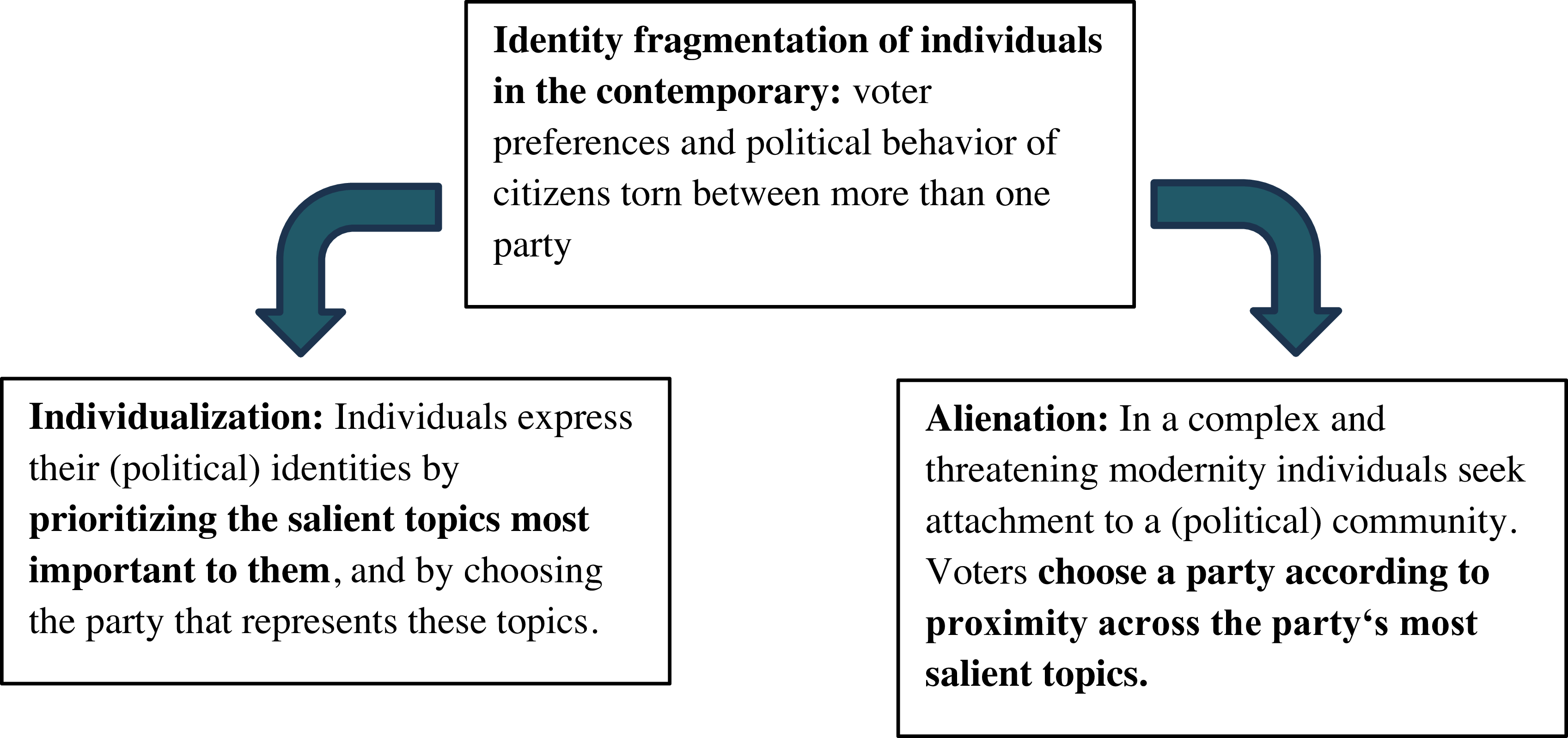
Furthermore, citizens can deal with their own identity fragmentation in two different ways – and both create different challenges for representation and political organization. Together with the fragmentation diagnosis, the next two steps form a triangle which informs the framework we suggest for depicting democratic representation in contemporary times (Figure 1). In a first step, as theorists of social modernization have argued, the long-held ideal of a stable and cohesive collective subjectivity attributed to modern society has dissolved (Blühdorn Reference Blühdorn2020). Personal identity has become ever less socially predetermined and increasingly turned into a matter of individual choice and self-construction (Beck Reference Beck1992; Cortois and Laermans Reference Cortois and Laermans2017; Giddens Reference Giddens1991) – including the perceived obligation to achieve a distinguished individuality (Reckwitz Reference Reckwitz2020). Aligned with these conceptualizations, issues of self-realization, self-expression and quality of life are becoming ever more prominent in contemporary societies, with citizens turning increasingly elite-challenging, participation-oriented and politically self-confident (Inglehart Reference Inglehart1977, Reference Inglehart1997). Following this line of thinking, and in response to the first observed trend, voter choices and political representation can be expected to follow the individual citizen’s issue preferences and saliency of topics. As such, voter salience-focused measures of representation might be the best approximation to understand this dimension of representation.
Theoretical framework.

Second, and reflecting a paradox characteristic of social modernity, despite widespread evidence of declining membership and political trust (van Biezen, Mair and Poguntke Reference van Biezen, Mair and Poguntke2012; van Biezen and Poguntke Reference van Biezen and Poguntke2014), social theorists such as Beck (Reference Beck1992), Bauman (Reference Bauman2017), Sennett (Reference Sennett1999), and Taylor (Reference Taylor1991) have emphasized that fragmented individuals continue to seek belonging. Even in the absence of stable identities, there remains a strong desire for a form of collective attachment, albeit one that is more flexible and less binding.
As individualization and the dissolution of social bonds might overburden people and leave them feeling exposed and atomized, to avoid the feeling of alienation and overwhelming complexity, new and provisional boundaries become all the more necessary (Beck and Lau Reference Beck and Lau2005). This might create opportunities for political organizations to draft new and less coherent political collectives for citizens seeking belonging and attachment. Therefore, members might join or followers might vote for a party even if they differ ideologically (Dalton Reference Dalton2017; Kölln and Polk Reference Kölln and Polk2017; van Haute and Carty Reference van Haute and Carty2012). Voters and members might prioritize process, ideological or material incentives. They can emphasize the community experience or political results as opposed to ideological or issue congruence (Klandermans Reference Klandermans, Snow, Soule and Kriesi2006). This perspective, which has been part of a constructivist turn in political representation (Disch Reference Disch2021), and which has empirically been found significant, inter alia by Costello et al. (Reference Costello, Toshkov, Bos and Krouwel2021), assigns a crucial role to party leaders, functionaries, and party organization in envisioning and articulating new forms of social and political communities and incentives to join or vote for a political party – yet different ones than the linkages in the traditional, solid and congruent party systems (Butzlaff Reference Butzlaff2025). Empirically, this diagnosis of citizens seeking attachment and belonging under conditions of crumbling milieus and a fragmentation of identities might also be found in the strand of research emphasizing a certain re-alignment between voters and parties (Evans and Tilley Reference Evans and Tilley2017; Hooghe and Marks Reference Hooghe and Marks2018). However, rather than a return to previous stabilities, this gradual re-alignment has been described as a transformation into new, more flexible and volatile, cross-pressured forms of attachment (Dassonneville Reference Dassonneville2023). It does not, in our understanding, point toward a re-stabilization of voter-party congruence. In this line of thinking, and in contrast to the previous two observed trends, contemporary citizens and voters can be expected to understand representation as joining political communities. Therefore, political parties drafting new communities and belonging can be considered as organizing successful representation. Consequently, and in addition to a fragmentation- or individualization-driven expectation, party-salient issues measurement might also explain which choices voters make.
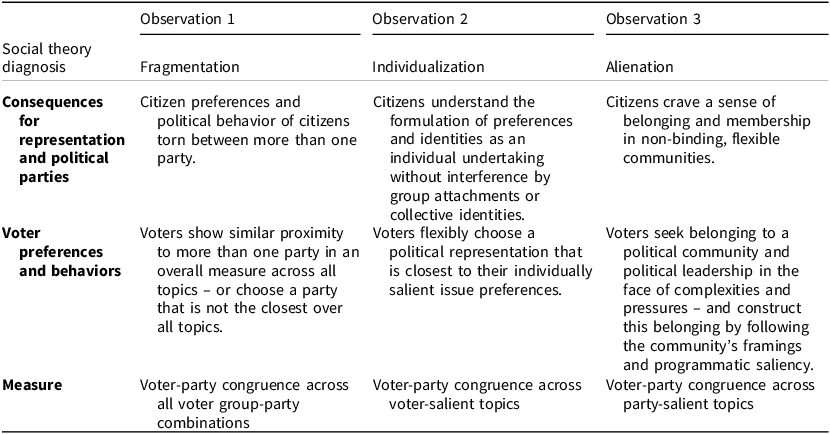
Thus, social theory suggests contradictory consequences for political parties: Rising expectations for self-determination, paired with declining confidence in collective institutions, lead to party-voter incongruence, fragmentation, and voters torn between different political parties. On the one hand, voters may place higher importance on their individual, volatile, and flexible preferences and make individualized party choices based on their individually salient topics. On the other, the increasing pressures on the individual also lead to new demands for collective belonging and political leadership. Taken together, these three perspectives on political subjectivity in modern societies provide, we argue, a highly instructive lens to interpret issue-based voting decisions and voter-party (in)congruence (Table 1). However, past research has overlooked the potential to seek inspiration from the social theory of late-modern societies for an empirical perspective on contemporary voting and has, as we argue, seldomly captured the complexity of this fragmentation. It has typically assessed overall congruence or focused on either party-defined or voter-defined salience in isolation, often seeking a single dominant dimension. This risks overlooking the multiple, often contradictory, attachments that structure contemporary political identities. It is important to emphasize that these processes are most likely present at the same time, as they are characteristic of the paradoxes modern individuals must cope with (Butzlaff Reference Butzlaff2025). We therefore propose a three-sided framework that uses VAA data as a window to observe party-voter (in)congruence on a granular level and thus establish a foundation for discussing the practical and normative consequences of these shifts.
Overview of theoretical perspectives

Illustrating the framework: a case from Slovakia
To test our theoretical expectations, we use the case of Slovakia, which represents a high-validity context for observing the dynamics of party-voter (in)congruence in fragmented and fluid party systems. As a ‘most likely’ case, Slovakia combines several conditions central to our theoretical framework: high party system volatility, weak partisan attachments, and a growing disconnection between institutional representation and individualized voter preferences (Haughton and Deegan-Krause Reference Haughton and Deegan-Krause2020; Tavits Reference Tavits2008). In such an environment, we would expect the contradictions we identify, between individualized political preferences and the continued desire for collective belonging, to manifest most clearly.
More broadly, post-communist democracies in CEE offer analytically useful conditions for understanding how voter-party linkages are reshaped in times of institutional flux and identity fragmentation. The collapse of state socialism in 1989 initiated a transition toward liberal democracy, accompanied by optimism about new political freedoms and alignment with Western norms (Elster, Offe and Preuss Reference Elster, Offe and Preuss1998). However, three decades on, many CEE countries continue to exhibit institutional weaknesses, growing disenchantment with political elites, and rising skepticism toward liberal democratic norms (Auerbach and Petrova Reference Auerbach and Petrova2022; Pop-Eleches and Tucker Reference Pop-Eleches and Tucker2017). These trends have been reinforced by rapid economic transformations and neoliberal reforms, which in Slovakia have deepened political volatility, fragmented party competition, and eroded trust in representative institutions (Bohle and Greskovits Reference Bohle and Greskovits2012).
The 2023 Slovak parliamentary elections underscore this dynamic: 25 parties registered, many of which lacked long-term viability, ideological coherence, or institutional organization. The election campaign was marked by sharp polarization, with socioeconomic issues and foreign policy at the forefront (Gyárfášová, Hlatky and Slosiarik Reference Gyárfášová, Hlatky and Slosiarik2024). Key themes included stability, economic security, and Slovakia’s stance on the war in Ukraine. Smer-SD, a populist party with nationalist and conservative sentiments, led by former prime minister Robert Fico, framed the election as a rejection of a chaotic 2020–2023 opposition government, promising ‘order’ while appealing to nationalist sentiments through opposition to military aid for Ukraine and anti-immigration rhetoric (Haughton et al. Reference Haughton, Pomorska, Malová and Deegan-Krause2024). This also entailed calls to end what Smer-SD described as the ‘politicized’ prosecution of its members and supporters on corruption charges. Similarly, building on nationalistic and pro-Russian sentiments, the Slovak National Party (SNS) emphasized a stop to what they saw as the liberal agenda, ranging from same-sex partnerships to support for Ukraine. Another nationalist party, Republika, founded in 2021 by former members of the neo-Nazi ĽSNS, positioned itself as a radical nationalist force combining Euroscepticism, social conservatism, and pro-Russian orientations, but ultimately struggled to rally enough voters.
The outgoing coalition parties, led by the populist OĽaNO movement, defended their anti-corruption agenda, emphasized pro-European themes and support for Ukraine, while also highlighting distinct party-specific priorities. OĽaNO focused on further anti-corruption efforts and welfare policies for families with children; SaS, a center-right and liberal party, highlighted its right-wing economic program; and Demokrati, a center-right party, placed even greater emphasis on supporting Ukraine. Meanwhile, Progressive Slovakia (PS), a center-left, liberal party, campaigned on pro-European and liberal principles but struggled to consolidate the anti-Fico vote. Similarly, SME Rodina, a conservative party which was part of the outgoing coalition, did not pass the required threshold to join the Slovak National Assembly. HLAS-SD, a newly formed party led by ex-SMER members, for its part, sought to position itself as a ‘moderate social democratic alternative to Smer-SD’, emphasizing social welfare policies but avoiding a decisive break from Smer-SD and PS (Gyárfášová, Hlatky and Slosiarik Reference Gyárfášová, Hlatky and Slosiarik2024). Other contenders projected to cross the mark to join the national assembly included KDH, a Christian conservative and pro-European party. Out of the 25 contending parties, seven passed the required threshold into the Slovak Parliament. Importantly, however, the Slovak case also shows that the link between parties and voters on salient issues is not one-directional. As Haughton, Rybář and Deegan-Krause (Reference Haughton, Rybář and Deegan-Krause2021) note, anti-corruption has long been a popular theme among voters, and new parties such as OĽaNO have strategically amplified it to mobilize support. In 2023, this dynamic persisted: while OĽaNO and its allies still leaned on anti-corruption appeals, albeit with weakened credibility, Smer-SD sought to defuse the issue by framing corruption prosecutions as politically motivated. This underlines that issue salience is often co-constructed, with parties both responding to and shaping voter priorities.
The volatility and fragmentation evident in the Slovak 2023 election reflects not merely a localized phenomenon, but a broader structural context of electoral instability that has been found to characterize CEE systems more broadly (Emanuele, Chiaramonte and Soare Reference Emanuele, Chiaramonte and Soare2020; Powell and Tucker Reference Powell and Tucker2014). These patterns of volatility and instability have been conceptualized as models and laboratories for understanding the development not only for CEE party systems and voter behavior but also for a convergence of Western European party systems (Haughton and Deegan-Krause Reference Haughton and Deegan-Krause2015). As such, Slovakia provides a compelling empirical setting for examining how voters respond in conditions of fragmentation, and how they reconcile multiple, and sometimes contradictory, issue alignments when making representational choices. In addition to its theoretical relevance, Slovakia also offers an empirical opportunity that is rare in studies of representation: access to detailed data linking voter-defined and party-defined issue salience with voter and party positions across a broad policy space. This allows for direct testing of our framework.
Although our empirical findings are grounded in the Slovak case, the framework we propose is intended to extend far beyond it. The multi-point congruence approach (integrating aggregate policy congruence with both voter- and party-defined salience across the full party-voter matrix) provides a powerful framework for analyzing contexts where growing individualization and enduring demands for collective identity fundamentally reshape party-voter dynamics.
Data and research design
To empirically illustrate how voter-party linkages are shaped in the context of social modernity, we implement our multi-point congruence framework using data from Volebný Kompas 2023 (Mintal et al. Reference Mintal, Borseková, Cicchi, Müller, Vancel, Šimková and Deegan-Krause2024). Volebný Kompas served as the leading, and uniquely academic, VAA in this electoral cycle, offering an expansive and detailed snapshot of voter preferences and party positions during a high-stakes political moment that ultimately altered the composition of government. To our knowledge, this is the only publicly available dataset that systematically captures both voter-defined and party-defined salience alongside detailed voter and party positions on a broad range of policy issues.
The dataset contains N = 134,699 valid responses to 39 policy statements, along with corresponding positions for 11 major political parties on the same items, with our analysis drawing on a cleansed dataset that excludes duplicates and aberrant entries (Mintal et al. Reference Mintal, Borseková, Cicchi, Müller, Vancel, Šimková and Deegan-Krause2024). The policy statements span a wide range of domains, including foreign and security policy, taxation, criminal justice, environmental regulation, civil rights, and broader social and cultural issues.
Originally designed to guide voters toward parties that match their policy preferences, VAAs have also evolved into powerful research instruments for understanding political behavior (eg Carson, Ratcliff and Dufresne Reference Carson, Ratcliff and Dufresne2018; Lahdelma Reference Lahdelma2023; Wheatley Reference Wheatley2016; Wurthmann et al. Reference Wurthmann, Marschall, Triga and Manavopoulos2021). Their large user base and direct issue-based measurements make them especially valuable for studying party-voter linkages in fragmented and volatile party systems (Ferreira Da Silva et al. Reference Ferreira Da Silva, Reiljan, Cicchi, Trechsel and Garzia2023).
Leveraging VAA data provides two major advantages for analyzing voter-party alignments in such contexts. First, it enables direct, item-by-item comparisons between voter and party positions, improving on traditional ideological self-placement or generalized proximity metrics. Second, the large sample ensures sufficient coverage of smaller or emerging parties, which are often poorly captured in conventional surveys.
Each respondent in the dataset is assigned a survey weight to correct for imbalances in age, gender, and education relative to population benchmarks. Respondents also indicated which party or parties they would consider voting for. Rather than restricting analysis to exclusive voter-party dyads, we construct non-exclusive groupings, aggregating respondents by each party they express willingness to support. This approach reflects the cross-pressured, multi-affiliated nature of voter identity in a fragmented, individualized, and alienated political environment.
To operationalize our multi-point congruence framework, we compute three complementary types of voter-party distance, each capturing a distinct aspect of representational alignment:
-
1. Aggregate Issue Congruence: This metric captures overall alignment by comparing voter group means and party positions across all 39 policy statements, providing a holistic view of congruence in the full issue space.
-
2. Voter-Salient Congruence: For each voter group, we identify its three most salient issues, based on the frequency with which respondents rank them as ‘most important’, and compute distances to all parties using only these items. This captures alignment on dimensions that voters themselves prioritize most.
-
3. Party-Salient Congruence: Drawing on validated expert-coded issue salience indicators, we use the identified three most prominent issues for each party and compute distances from all voter groups to the party on these high-salience items. This reflects alignment on the issues parties emphasize in their political messaging and agenda-setting.
Formally, in each case, we compute the Manhattan (or L1) distance for any voter group-party pairing: ${\rm{Distanc}}{{\rm{e}}_{\rm g,p}} = \rm \mathop \sum \limits_{i \in {\rm{I}}} \left| {{{{\rm{\overline {x}}}}_{g,i}} - {p_i}} \right|$
where ${{\rm{\overline x}}_{g,i}}$
is the weighted mean response of voter group
${{\rm{\overline x}}_{g,i}}$
is the weighted mean response of voter group $g$
on policy item
$g$
on policy item $i$
,
$i$
, ${p_i}$
is the party’s position on item
${p_i}$
is the party’s position on item $i$
, and
$i$
, and ${\rm{I}}$
is the set of items relevant to the specific congruence metric (ie all 39 items for aggregate congruence, the top three voter-salient issues for voter-salient congruence, or the top three party-salient issues for party-salient congruence).
${\rm{I}}$
is the set of items relevant to the specific congruence metric (ie all 39 items for aggregate congruence, the top three voter-salient issues for voter-salient congruence, or the top three party-salient issues for party-salient congruence).
The Manhattan (L1) distance is well suited to this analysis as it sums the absolute differences between group-level voter preferences and party positions across selected issues, treating each dimension independently. This yields a transparent additive structure that reflects cumulative divergence, reduces the influence of a single large deviation relative to L2, and is particularly appropriate for high-dimensional issue spaces. Equal weighting is used in the aggregate measure to capture broad programmatic proximity, while the voter-salient and party-salient measures incorporate issue importance by restricting the item set to those prioritized by voters or emphasized by parties. As noted in work on jointly scaled estimations of voter and party locations (eg Carroll, Liao and Tang Reference Carroll, Liao and Tang2025), different actors may, however, use identical scales in systematically different ways. In our setting, this concern is partly mitigated by the fact that parties and voters answer the same 39 policy statements using identical response options and by our focus on relative distances across parties and congruence dimensions. Nonetheless, we interpret Manhattan distances as approximate measures of ideological separation and view this non-equivalence as an important source of residual measurement uncertainty.
To help quantify uncertainty and account for variation in group composition, we implement a weighted bootstrap procedure, resampling respondents according to survey weights. Importantly, we compute these distances across all possible voter group-party pairings, not just stated dyads. This full matrix approach enables a more comprehensive and behaviorally realistic mapping of representation in Slovakia’s highly fragmented party system. These procedures are applied uniformly across all three dimensions of congruence.
In doing so, our framework captures not only where alignment is strongest but also the extent to which it is concentrated or dispersed across multiple parties, shedding light on the tension between individualized preferences and collective political attachment that defines contemporary democratic representation.
To enable comparability across distance types that differ in scale, such as full 39-item measures versus salience subsets, all voter-party distances were standardized by scaling to unit maximum. For each of the three congruence metrics (aggregate, voter-salient, and party-salient), we construct full voter-party distance matrices from the bootstrapped outputs, standardize distances by their respective maximum values (3900 for aggregate and 300 for salience-based measures), and extract both own-party distances and distances to each group’s closest alternative. This normalization allows us to place different congruence metrics on a common scale while preserving their internal variation and interpretability. As a result, all distances lie between 0 and 1 and can be interpreted as the average absolute disagreement per issue, expressed as a proportion of full-scale disagreement. For example, a value of 0.15 means that, on average, the party and voter group differ by 15 points on a 0–100 scale on each of the included issues, regardless of whether the metric is based on 3 or 39 items. We extract each group’s normalized distance to its own party under each metric and identify the closest alternative party. This enables a direct comparison of congruence across dimensions by evaluating, for each group, whether its preferred party or another is closer under a given metric. We then test which dimension (aggregate, voter-salient, or party-salient) yields the smallest own-party distance on average, providing an empirical basis for assessing which type of congruence most closely aligns voters with parties. To assess representational distinctiveness, we calculate the proportion of each voter group’s own-party confidence interval that is overlapped by other parties. Greater overlap indicates greater crowding in the issue space and thus lower distinctiveness of representation. These steps enable both granular inspection of congruence within each voter group and cross-group comparisons of party distinctiveness across all three congruence metrics. To enhance interpretability and offer accessible entry points into our framework, we present descriptive statistics and pairwise comparisons in the main text. These summary estimates provide an intuitive foundation for comparing voter-party congruence across dimensions. To assess the robustness of these results, we implemented a range of complementary estimation strategies, including hierarchical models that account for measurement uncertainty and alternative weighting schemes. Full details of our research design are provided in the Supplementary Materials.
Results
Our empirical findings underscore critical tensions in representational alignment under conditions of social modernity – and that the tensions that theorists of modern societies have diagnosed are visible in the ways voters navigate between competing options for representation. Consistent with the observation of voter fragmentation, aggregate issue congruence reveals substantial representational ambiguity. Voter groups frequently exhibit similar levels of proximity to multiple competing parties across the full spectrum of policy issues, with 7 out of 11 voter groups either having a party that is closer than their chosen one or exhibiting overlapping confidence intervals with another party (Figure 2 and online Appendix Table A1). This pattern supports the theoretical expectation of fragmented and cross-pressured voter identities, underscoring the multidimensional complexity of contemporary political alignments, and confirming the observations that scholars of cross-pressured voters made (see for instance Dassonneville Reference Dassonneville2023).
The standardized Manhattan distances between voter groups (panels), their party of choice (red diamond), and all other parties (gray circles), shown on the y-axis, for the aggregate issue distance dimension. Lower values on the x-axis indicate stronger alignment between a voter group and a party, while higher values suggest weaker fit.

When zooming in on how voters address this ambiguity and in which way they display the tensions identified by scholars of social modernity, we first turn to the dimension of individualization, that is, how close voters are to their parties of choice if we focus on voter-salient issues; second, we analyze the dimension of alienation and how close voters are to their party of choice when viewed through the topics the respective parties have identified as salient. Here, we find that voter-salient issues yield the smallest average distances between voter groups and their preferred parties: 0.153 (SD 0.064) compared to 0.245 (SD 0.030) for total issues and 0.249 (SD 0.091) for party-salient issues (Figure 3, also see online Appendix Table A6). This indicates closer alignment between voter groups and their preferred parties when congruence is measured on voter-salient issues compared to total or party-salient dimensions.
Compares the three congruence dimensions, revealing not only the absolute degree of congruence (distance) but also which theoretical perspective, aggregate, voter salient, or party salient, provides the closest ideological fit for each voter group.

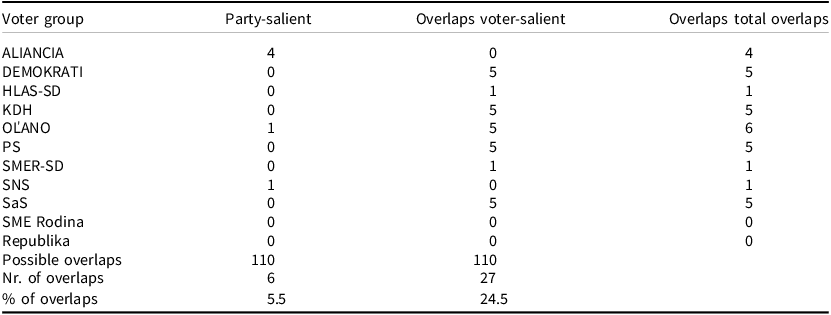
However, the individualized representational proximity also generates ambiguity and volatility (Table 2). The voter-salient issue space, while producing the closest alignment between voter groups and their parties, is also markedly more crowded: approximately 82% of all observed overlaps between voter groups and non-preferred parties occur in this space, compared to party-salient space. This reduced separation creates a more ambiguous and competitive environment, where multiple parties appear similarly responsive and electorally viable. Thus, while voters find parties closely aligned with their prioritized issues, they also confront intense electoral competition among multiple parties offering similarly attractive representational options.
Representational distinctiveness

The proportion of each voter group’s own-party confidence interval that is overlapped by other parties is given. Greater overlap indicates greater crowding in the issue space and thus lower distinctiveness of representation.
Finally, when assessing social alienation and turning to representation based on party-defined salience, our findings demonstrate a distinctly clearer differentiation among competing parties (Figure 3 and Table 2). While absolute standardized distances between voters and parties are larger than under voter-defined congruence, voters’ preferred parties clearly differentiate themselves by maintaining substantial positive distances relative to the closest alternatives. Under party-defined salience, overlaps between voter groups and non-preferred parties are comparatively rare: only approximately 18% of all overlaps occur in this space (Table 2), indicating that parties maintain greater separation from one another when representation is measured on the issues they themselves prioritize. This reduced crowding suggests that party-defined agendas help structure the representational field by reducing ambiguity in party positions. Voter-party distances are indeed larger on average for the party-defined type (0.249, SD = 0.091), but this greater distance coincides with clearer boundaries between preferred and competing parties. Parties thus articulate distinct representational identities through targeted issue emphasis, effectively structuring political competition even within fragmented electoral contexts. This clear differentiation indicates robust strategic positioning by parties, affirming the constructivist expectation that contemporary political elites might be able to craft coherent political communities despite ideological fragmentation (for this discussion, see Disch Reference Disch2021).
Overall, the results indicate that congruence patterns are substantively robust across alternative modeling strategies and weighting schemes (see Supplementary Materials). The findings reveal a central trade-off at the heart of democratic representation, one that traditional measures of policy congruence often obscure by assuming stable identities and one-to-one voter-party linkages. When citizens define which issues matter most, parties appear more responsive to public preferences. Yet this responsiveness comes at a cost: distinctions between parties blur, making it harder for voters to differentiate among alternatives. Conversely, when parties set the agenda, they articulate clearer options and identity cues but drift further from voters’ expressed priorities. In short, voter-salient priorities enhance representational proximity while reducing partisan clarity; party-salient priorities sharpen partisan boundaries but increase the distance between the represented and their representatives.Footnote 3 In the case of 2023 Slovakia, the data imply that voter-salient issue congruence yields closer alignment than party-salient congruence, consistent with an individualization-induced prioritization of issues over party-salient topics. Viewed through the lens of social theories of modernization, Slovak voters show cross-pressures and fragmentation – and that, in comparison, individualization of preferences seems to explain party preference more than an alienation-induced demand for belonging to a political community.
Discussion and conclusion
In this article, we introduced a social theory-inspired framework to depict and analyze representative fit between voters and parties under conditions of social modernity. Our point of departure was the notion that measuring identity fragmentation, a defining characteristic of contemporary Western democracies, offers essential diagnostic leverage for understanding the state of representation today. Through our empirical illustration of the Slovak context, a most-likely case, we found that voters often appear equally close to multiple parties when examining the full range of policy issues. Such findings indicate a pronounced representational ambiguity, suggesting challenges for party systems and potentially leading to higher voter volatility and growing perceptions of insufficient representation when voter-party fit weakens or becomes less discernible.
As suggested by our framework, the empirical findings reveal two interlinked mechanisms through which voters and parties respond to identity fragmentation. On the one hand, voters exhibit an individualization of political identities and vote choices. As our results indicate, the voters’ preferred party appears to offer the best alignment on their self-prioritized issues. This finding differs from some other studies on representative fit (see, for instance, Costello et al. Reference Costello, Toshkov, Bos and Krouwel2021), which suggest that voter-party proximity tends to be higher on issues that the party emphasizes. At the same time, multiple parties often compete for that same policy space, fueling voter volatility and weakening partisan loyalty. On the other hand, our findings suggest that party-salient topics render parties more distinctive, indicating that parties respond to a fragmenting voter landscape by articulating sharper alternatives of belonging to political identity communities. Yet this approach carries risks: it can leave some voters ideologically distant from the party they choose on the issues those voters care about most.
We contend that these dynamics can be more accurately captured by employing a ‘three-measurement triangle’, rather than relying on a single measure of congruence. In the Slovak case, this approach illuminates how, amid considerable identity fragmentation, voters ‘individualize’ strongly by focusing on the issues they themselves prioritize, while parties seek to draft or reinforce clearer identity markers to attract segments of the electorate seeking a sense of belonging. This tension embodies a fundamental contradiction: as representation becomes more precise for individuals, it simultaneously grows less stable at the systemic level, contributing to fluid, volatile party attachments. This paradox exemplifies a central dilemma of contemporary democratic representation: balancing responsiveness to individualized identities against the need for coherence in party systems that cater to large groups of alienated citizens seeking identity-based belonging.
In this light, the article offers several contributions to ongoing debates in comparative politics and the study of democratic representation. First, it integrates insights from social theory diagnoses of modern societies to enhance how we measure and understand voters’ pursuit of representation. Reflecting a more complex understanding of voter choices (Achen Reference Achen1978), our framework foregrounds the social transformations that unsettle once-stable alignments between voters and parties. Second, by integrating aggregate issue, party-salience, and voter-salience measures, we propose a means of assessing how fragmented voter landscapes in contemporary times connect to parties as democratic actors of representation. Rather than focusing on a single measure, such as the party with which voters hold the smallest ideological distance, we advocate a more multifaceted perspective on voter-party relations in increasingly fluid and fragmented systems. Third, we move beyond a narrow focus on voters’ proximity exclusively to their chosen party, instead evaluating congruence within the full voter-party matrix. By incorporating multi-party congruence, we are better able to capture the dynamics of modernity, where voters may see multiple plausible alternatives and parties must compete for increasingly individualized constituencies.
Like any study, ours is not without limitations. While policy-based congruence is central to representation, factors such as candidate charisma or personal appeal also shape vote choice. Nonetheless, our framework provides a valuable lens for capturing the complexities of modern vote choice and enhancing our understanding of representative fit, thereby casting light on the tensions and evolving challenges of democratic representation. Crucially, our framework extends beyond the Slovak empirical illustration, as similar conditions now typify many contemporary democracies. Future research could employ the framework to explore the nature of representative (mis)fit in democratic systems across different contexts, undertaking time-series or cross-national comparisons when data availability permits. The degree of voter individualization, the proximity of political alternatives, the fragmentation of party systems, and the extent to which voters seek identity and belonging through their votes will likely differ across contexts, each providing further insight into the vitality of democratic representation and legitimacy. Differing constellations of fragmentation, individualization- and alienation-induced voter choices can be understood either as result of different pathways of social modernization – or an effect of how the respective party system and its relationship with voters have developed in the past. With the multi-point congruence framework presented here, we believe scholars are better equipped to examine such issues in their complexity.
Supplementary material
The supplementary material for this article can be found at https://doi.org/10.1017/S1475676526101200
Data availability statement
Replication data and code can be found at https://doi.org/10.6084/m9.figshare.29046923
Acknowledgments
We thank the editor and three anonymous reviewers for their valuable comments and suggestions. We also thank Kevin Deegan-Krause, Radosław Markowski, and Mary Stegmaier for their comments on earlier versions of this paper, the participants at the 2024 ECPR and 2025 MPSA conferences, and the attendees of the European University Institute’s EU&I Data and Political Behavior in CEE workshops, for their helpful feedback and suggestions. We acknowledge the use of OpenAI’s GPT-5 and Anthropic’s Claude for assistance with grammar, language editing, and code and replication review.
Author contributions
Conceptualization: FB, JMM, and BH, with contributions from RV and KB. Methodology: JMM, BH, and FB. Formal analysis: JMM, with contributions from BH. Data Curation: JMM. Data Visualization: BH. Writing original draft: JMM, FB with contributions from BH, RV, and KB. JMM and FB share first authorship. All authors approved the final submitted draft.
Funding statement
Support for this research was provided by Horizon Europe (Award no. 101079219) and the EU NextGenerationEU through the Recovery and Resilience Plan for Slovakia (Award no. 09I01-03-V04-00063/2024/VA).
Competing interests
The authors declare no competing interests.




 Open access

