


Introduction
Age at first marriage is a fundamental demographic indicator that reflects not only the timing of family formation but also broader social, cultural, and economic transformations within societies (Pathak, Reference Pathak1980; Bhat and Zavier, Reference Bhat and Zavier2005; Subramanian, Reference Subramanian2009; Marphatia et al., Reference Marphatia, Ambale and Reid2017). In the South Asian context, and particularly in India, marriage is universal and continues to mark the primary transition into adulthood, shaping fertility behaviour, gender roles, and intergenerational relations (Rao and Sureendar, Reference Rao and Sureendar1988; Singh and Samara, Reference Singh and Samara1995; Bhat and Zavier, Reference Bhat and Zavier2005). The mean age at marriage for women has historically been low in South Asian countries (Siddiqi and Greene, Reference Siddiqi and Greene2022; Pourtaheri et al., Reference Pourtaheri, Tavakoly, Aghaee, Ahangari and Peyman2023), often occurring in the mid- to late teens, with strong ties to cultural norms, religious injunctions, and economic structures that have privileged early unions (United Nations, 1973; Pathak, Reference Pathak1980; Singh and Samara, Reference Singh and Samara1995; Subramanian, Reference Subramanian2009). Marriage laws in India have attempted to raise the age at first marriage for women since the enactment of the Child Marriage Restraint Act of 1929, followed by revisions in the Hindu Marriage Act of 1955 and the Special Marriage Act of 1954, which set the legal minimum age (Pathak, Reference Pathak1980). The legal minimum age at marriage was set at 18 years for women and 21 years for men, as stipulated under the Prohibition of Child Marriage Act, 2006 (United Nations, 1973; Pathak, Reference Pathak1980; Singh and Samara, Reference Singh and Samara1995; Subramanian, Reference Subramanian2009). Gender differentials in the legal marriage age threshold reflect deeply entrenched patriarchal norms that position women as marriage – and reproduction-ready at earlier ages, while men are expected to first achieve education, employment, and breadwinning responsibilities before marriage (Srinivasan and Bedi, Reference Srinivasan and Bedi2011; Marphatia et al., Reference Marphatia, Ambale and Reid2017; Vishwanath, Reference Vishwanath2019; Siddiqi and Greene, Reference Siddiqi and Greene2022). Despite the numerical measures, enforcement has been weak, especially in rural areas where dowry pressures, social customs, gender norms, and patriarchal authority have perpetuated the practice of early marriage (Subramanian, Reference Subramanian2009; Desai and Andrist, Reference Desai and Andrist2010). Ethnographic and demographic studies observed that, despite the criminalization of dowry transactions under the Dowry Prohibition Act, 1961, dowry demands often increase with a bride’s age and educational attainment, thereby incentivizing families to arrange marriages earlier in order to minimize the associated economic burden (DPA, 1961; PCMA, 2006). The persistence of this gap between law and practice underscores the complex interplay between institutional change and cultural reproduction, a theme central to demographic analysis (Bachrach, Reference Bachrach2013).
Studies show that women born before the 1970s often married very young, sometimes around puberty, shaped by religious sanction and the economic logic of agrarian joint families, compared to later-born generations (Pathak, Reference Pathak1980; Subramanian, Reference Subramanian2009; Desai and Andrist, Reference Desai and Andrist2010; Marphatia et al., Reference Marphatia, Wells, Reid, Poullas, Bhalerao, Yajnik and Yajnik2025). Sample Registration System figures show that the mean age at effective marriage for females in India has risen from 22.1 years in 2019 to 22.9 years in 2023 (RGI, 2024). However, West Bengal still records one of the lowest mean ages at first marriage among larger states (India Today, 2025). Studies based on the National Family Health Survey-5 (NFHS-5) (2019–2021) data also show that about 42% of women aged 20–24 in West Bengal were married before they turned 18 years, indicating that marriage at an early age remains substantially high in this state despite declines over the past years (UNFPA, 2022).
Early marriage truncates women’s education, restricts their autonomy, and contributes to high fertility and poor maternal health outcomes (Basu, Reference Basu2002; Banerji et al., Reference Banerji, Martin and Desai2008; Amin, Reference Amin2011; Siddiqi and Greene, Reference Siddiqi and Greene2022; Neil, Reference Neil2025). The influencing factors such as the spread of education, the rising pressure of dowry and exposure to state policies on family planning, women’s employment, and evolving aspirations significantly help in the delayed marriage (Pathak, Reference Pathak1980; Basu, Reference Basu2002; Subramanian, Reference Subramanian2009; Desai and Andrist, Reference Desai and Andrist2010). Studies found that higher parental education is associated with delayed marriage and improved educational progression for daughters (Ashok et al., Reference Ashok, Mughal and Javed2024). Educated parents are more likely to invest in and transmit human capital advantages that elevate daughters’ schooling and postpone early marital timing (Ashok et al., Reference Ashok, Mughal and Javed2024). Basu (Reference Basu2002) earlier highlighted that education is among the most consistent determinants of delayed marriage, although the underlying mechanisms are complex. Studies show that higher levels of female education significantly delay age at marriage by prolonging schooling and reducing the likelihood of early marital entry (Fitria et al., Reference Fitria, Laksono, Syahri, Wulandari, Matahari and Astuti2024). Schooling not only enhances women’s autonomy and decision-making power but also transforms their aspirations and opportunities (Basu, Reference Basu2002; Ashok et al., Reference Ashok, Mughal and Javed2024; Fitria et al., Reference Fitria, Laksono, Syahri, Wulandari, Matahari and Astuti2024). Religion also plays an important role in shaping age at marriage (Bhat and Zavier, Reference Bhat and Zavier2005). Studies of Hindu-Muslim differentials demonstrate that Muslim women, on average, marry slightly earlier than Hindu women (Bhat and Zavier, Reference Bhat and Zavier2005). Studies also found that living in an urban setting strongly influences marriage timing (Dyson and Moore, Reference Dyson and Moore1983; Malhotra, Reference Malhotra1997). Urban women generally marry later than rural women due to greater access to education, employment, exposure to modern values, and lesser kinship obligations compared to rural contexts (Dyson and Moore, Reference Dyson and Moore1983; Singh and Samara, Reference Singh and Samara1996; Malhotra, Reference Malhotra1997).
The persistence and transformation of marriage norms across generations can be understood as a process of negotiation between tradition and modernity (Marphatia et al., Reference Marphatia, Wells, Reid, Poullas, Bhalerao, Yajnik and Yajnik2025). Bachrach (Reference Bachrach2013) argues that culture must be viewed not as static but as a dynamic network of meanings and practices that evolve through interaction with structural changes across generations. In the Indian patriarchal social system, marriages are predominantly arranged, with parents and extended family playing a central role in selecting potential spouses. Marriage continues to be regarded not merely as a bond between two individuals but as an alliance between two families (Altekar, Reference Altekar1962; Karve, Reference Karve1965). The marriage decisions are typically made by families – particularly parents – rather than by daughters themselves (Banerji et al., Reference Banerji, Martin and Desai2008; Jejeebhoy et al., Reference Jejeebhoy, Santhya, Acharya and Prakash2012). Consequently, parental social mobility and awareness regarding the appropriate age at marriage can play a decisive role in shaping the timing of their daughters’ marriages (Paul et al., Reference Paul, Closson and Raj2023). This generational interplay is evident in how parental authority, kinship obligations, and gender norms continue to influence marriage timing, even as young people increasingly aspire to higher education, careers, and companionate marriage.
Studying intergenerational differentials in age at marriage thus provides a valuable lens to understand how demographic change interacts with law, culture, religion, and socio-economic development. Thus, the present study seeks to contribute to this field by systematically examining age at first marriage differentials across three generations. By doing so, the study addresses both structural and cultural determinants, drawing on anthropological-demographic data, legal frameworks, and ethnographic insights.
Materials and methods
Study design and setting
The present study was designed as a cross-sectional ethnographic study conducted in the Howrah district of West Bengal, India. Howrah was chosen through random selection from among the 23 districts of West Bengal to ensure representation at the district level. Within Howrah, two distinct settings were included: urban areas represented by wards of the Howrah Municipal Corporation and rural areas represented by the community development blocks of Uluberia. This dual-site selection allowed for comparative insights into marital age patterns across urban–rural contexts.
Study population and sampling
The study population comprised ever-married women belonging to different ages and Bengali speaking group. A random sampling procedure was employed, whereby only one eligible woman respondent was selected from each household to minimize clustering effects. In total, 695 women were approached during the survey process; of these, 665 provided complete responses, yielding a high response rate and forming the final sample of 665 women for analysis. The sample size was considered adequate to capture intergenerational differentials in age at marriage and marriage-related behaviour. Males were excluded from the study due to their limited availability and the nature of the study, and women undergoing neuro-psychological treatment were also excluded.
Data collection procedures
Data were collected using a structured household schedule that was pre-designed and pre-tested for validity and consistency. The schedules were administered through direct, face-to-face interviews to ensure the accuracy of reporting. Trained ethnographers with an anthropological background conducted household visits and interviews, which helped in building rapport with respondents and eliciting reliable responses. To complement the survey data, qualitative methods were incorporated. Specifically, six in-depth interviews (IDIs) – two from each generational cohort – and a series of semi-structured interviews (SSIs) were conducted to elicit detailed narratives on age at marriage, marital behaviour, and perceived social and economic transformations. In addition, three focus group discussions (FGDs) were conducted within each generation, enabling the exploration of shared experiences and collective perspectives. This mixed-methods design ensured both breadth and depth in understanding the changing trajectories.
Data management and analysis
All quantitative data were entered into Microsoft Excel and subsequently imported into STATA version 14 for statistical analysis. The software facilitated the estimation of intergenerational differentials in age at marriage through appropriate statistical models. Meanwhile, qualitative materials from IDIs and FGDs were carefully transcribed to contextualize and interpret the statistical findings. The integration of quantitative and qualitative approaches thus provided a holistic understanding of marital age and behaviour associated with marriage, highlighting not only measurable patterns but also the underlying cultural and social dynamics.
Variables
The outcome variable in the present study – age at first marriage – has been classified into three categories: 18 years and below (≤18 years), 19–24 years (19–24 years), and 25 years and above (≥25 years). The first category (≤18 years) corresponds to the legal minimum age of marriage for women in India and therefore captures all instances of early marriage, which remain highly relevant from both demographic and policy perspectives. The second category (19–24 years) represents the age range in which the majority of Indian women normally marry at present, as documented in national surveys such as the National Family Health Survey. The final category (≥25 years) reflects later-age marriages, which are typically associated with higher educational attainment, greater urban exposure, and improved economic opportunities.
The main explanatory variable in the study was generational cohort, indicating the generation to which the respondents belonged. The estimation of the generation cohort was carried out using the method proposed by Dublin and Spiegelman (Reference Dublin and Spiegelman1951) and later adopted by Glass et al. (Reference Glass, Sacks, Jahn and Hess1952), Srinivasan and Mukherjee (Reference Srinivasan and Mukherjee1976), and Mukherjee et al. (Reference Mukherjee, Das and Banik2007). The average age at first childbirth was calculated separately for men and women. Weighted means were used to determine the average age for both sexes, resulting in an identified generational span of 27 years. Based on this, three generational cohorts were defined for the study: Generation I (≥56 years), Generation II (28–55 years), and Generation III (≤27 years).
The other associated explanatory variables were multidimensional. Place of residence plays a key role in the occurrence of age at marriage. Place of residence of the respondents was grouped into rural and urban. Educational attainment was found to play a significant role in determining age at marriage. It was classified into three categories: primary (below Class 5), secondary (Classes 6–12), and higher education (beyond Class 12). Accordingly, the educational attainment of the respondents, their husbands, and their parents was included in the analysis. The occupation of the respondents, their husbands, and their parents was included and classified into distinct categories. For respondents and their mothers, occupations were grouped as blue collar, white collar, and not employed. For respondents’ husbands and fathers, occupations were categorized as either blue collar or white collar. Blue-collar jobs are defined as manual, non-skilled, or semi-skilled occupations, while white-collar jobs are professional, skilled occupations typically performed in an office setting rather than involving manual labour (Capita, Reference Capita2025). The number of siblings also has an important influence on the age at marriage of the girl in the family. Thus, this variable has been grouped into the number of brothers in the family and the number of sisters in the family, categorized into ‘0–1(≤1)’, 2, and ‘3 and more’. Household-level variables comprised the type of family, categorized into nuclear and joint families. Religion of the respondent was categorized into Hindu and Muslim. Caste of the respondent was categorized into General, OBC (Other Backward Class), SC (Schedule Caste), and ST (Schedule Tribe). Economic status was assessed using per capita monthly household expenditure, stratified into bottom, middle, and upper quintiles. Media exposure was categorized into No and Yes. Together, these variables provided a comprehensive framework for examining the multidimensional influences shaping the timing of first marriage.
Statistical analysis
One-way Analysis of Variance (ANOVA) has been carried out to understand the changing trajectory of age at marriage among the respondents of three generations.
Multinomial logistic regression (MLR) has been carried out to understand the level of the likelihood of age at marriage between three generations and other associated factors. The outcome variable, age at marriage, was coded into the following categories: ‘≤ 18 years’ = 0 (base category); ‘19–24 years’= 1; ‘≥ 25 years’ = 2.
All statistical analyses have been done using STATA software.
Results
Sample characteristics
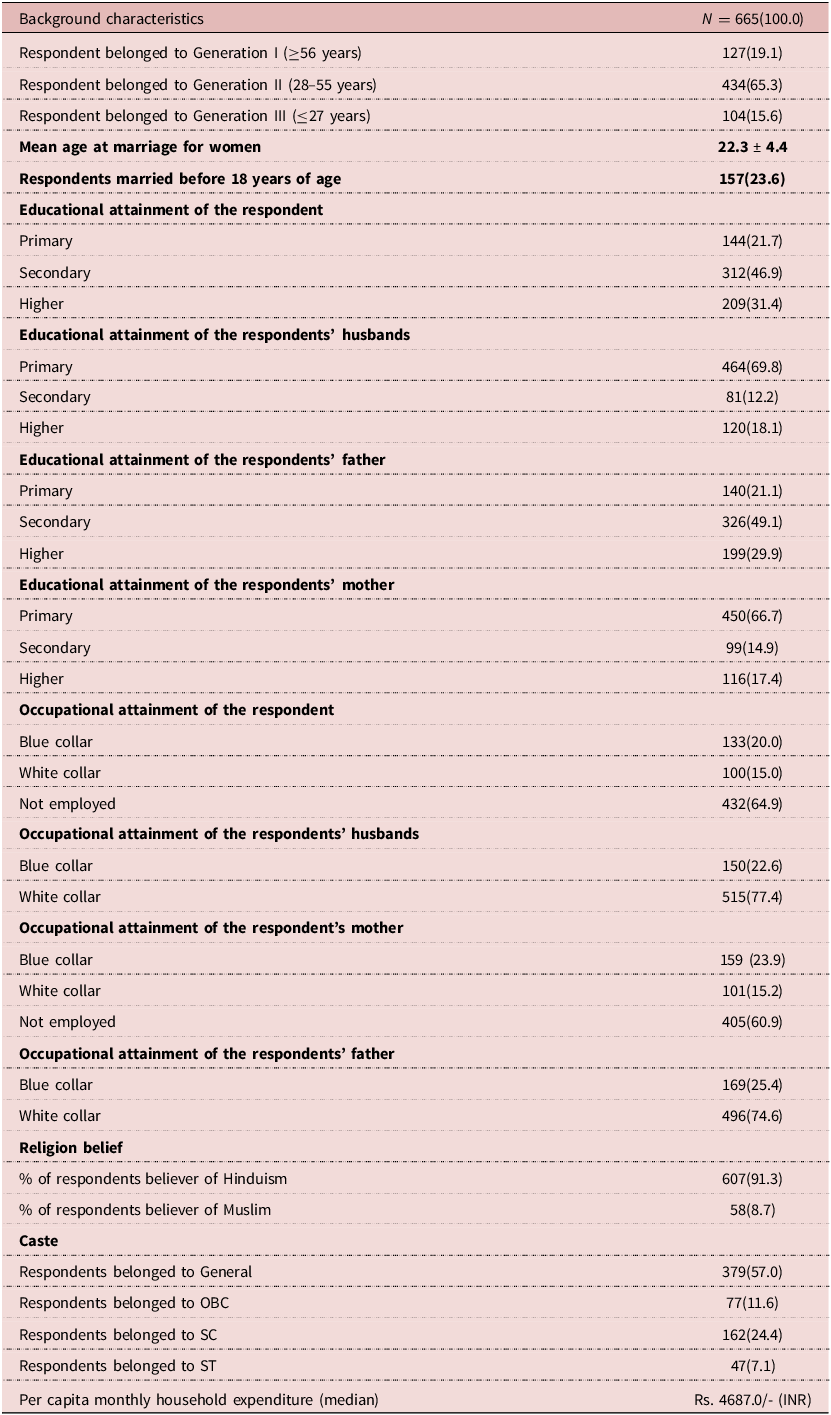
Table 1 presents the background characteristics of the study population comprising 665 respondents. The generation-wise distribution of the study population showed that 19.1% were from Generation I (≥56 years), 65.3% from Generation II (28–55 years), and 15.6% from Generation III (≤27 years). The mean age at marriage for women was 22.3 years (±4.4). The results showed that around 23.6% of the respondents were married before reaching the statutory age at marriage, that is, 18 years of age. Around 31.4% of respondents had higher-level education; 29.9% of their fathers had higher education, whereas only 17.4% of their mothers had higher education. Most respondents (64.9%) were not employed. The majority of fathers of the respondents were engaged in white-collar occupations (74.6%), while most mothers were unemployed (60.9%). The religious composition of the sample was predominantly Hindu (91.3%), with Muslims constituting 8.7%. The caste distribution showed that 57.0% belonged to the General category, followed by Scheduled Castes (24.4%), Other Backward Classes (11.6%), and Scheduled Tribes (7.1%). The median per capita monthly household expenditure was Rs. 4687.0/- (INR), indicating modest socio-economic conditions.
Sample Characteristics of the Study Population
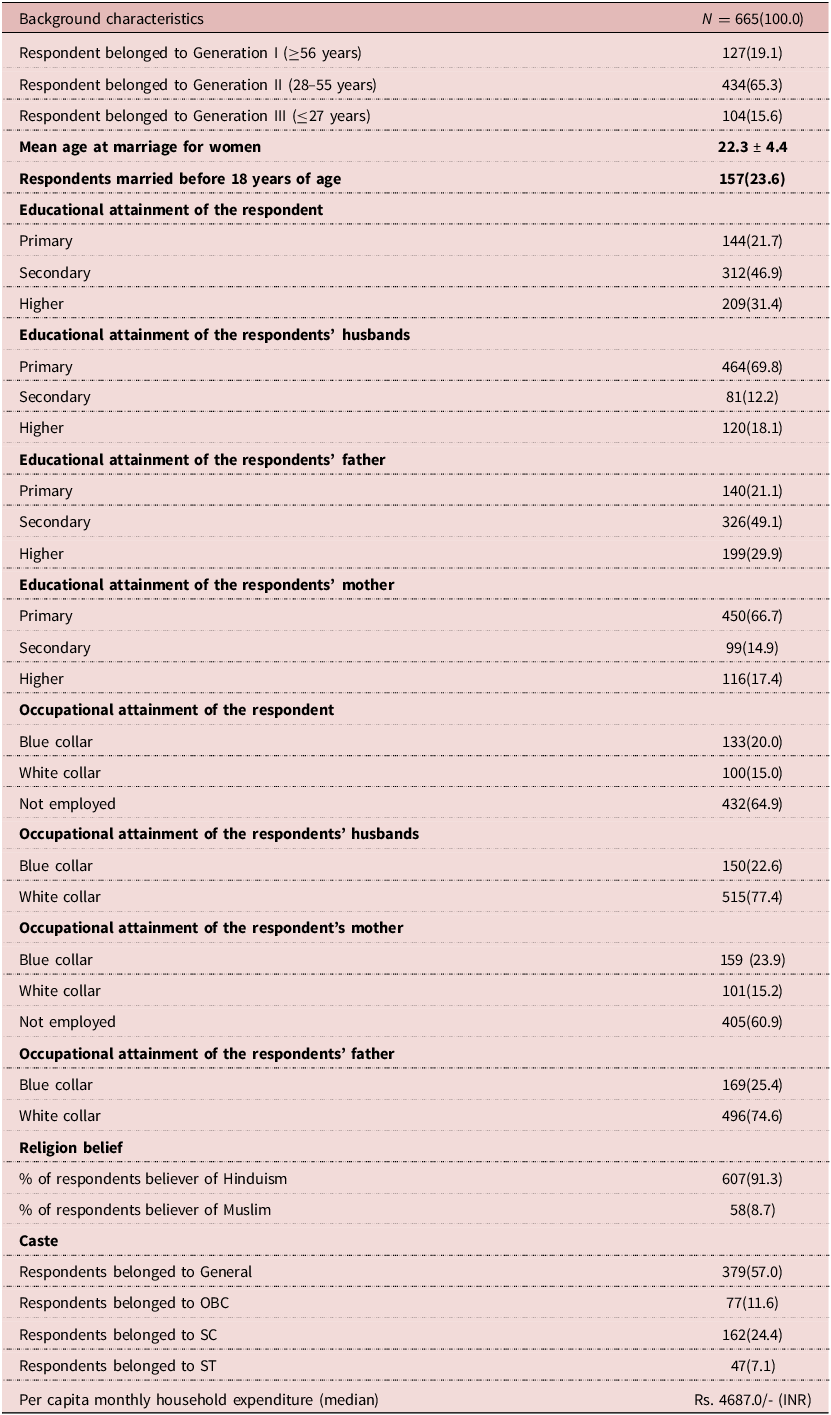
(Numbers in parentheses indicate percentage).
Table 2 presents the ANOVA results examining generational changing trajectories in the age at first marriage among the respondents. Respondents of Generation I (≥56 years) showed an age at marriage of 21.4 ± 4.4 years, while those of Generation II (28–55 years) tended to marry later, with a mean age of 23.2 ± 4.3 years. In contrast, the youngest cohort, Generation III (≤27 years), reported an earlier onset of marriage, with a mean age of 19.5 ± 3.8 years. ANOVA results showed that intergenerational differences were statistically significant (p < 0.001), pointing to a notable change in the age at marriage across cohorts.
Difference in the Mean Age at Marriage Between Different Generations of the Studied Population

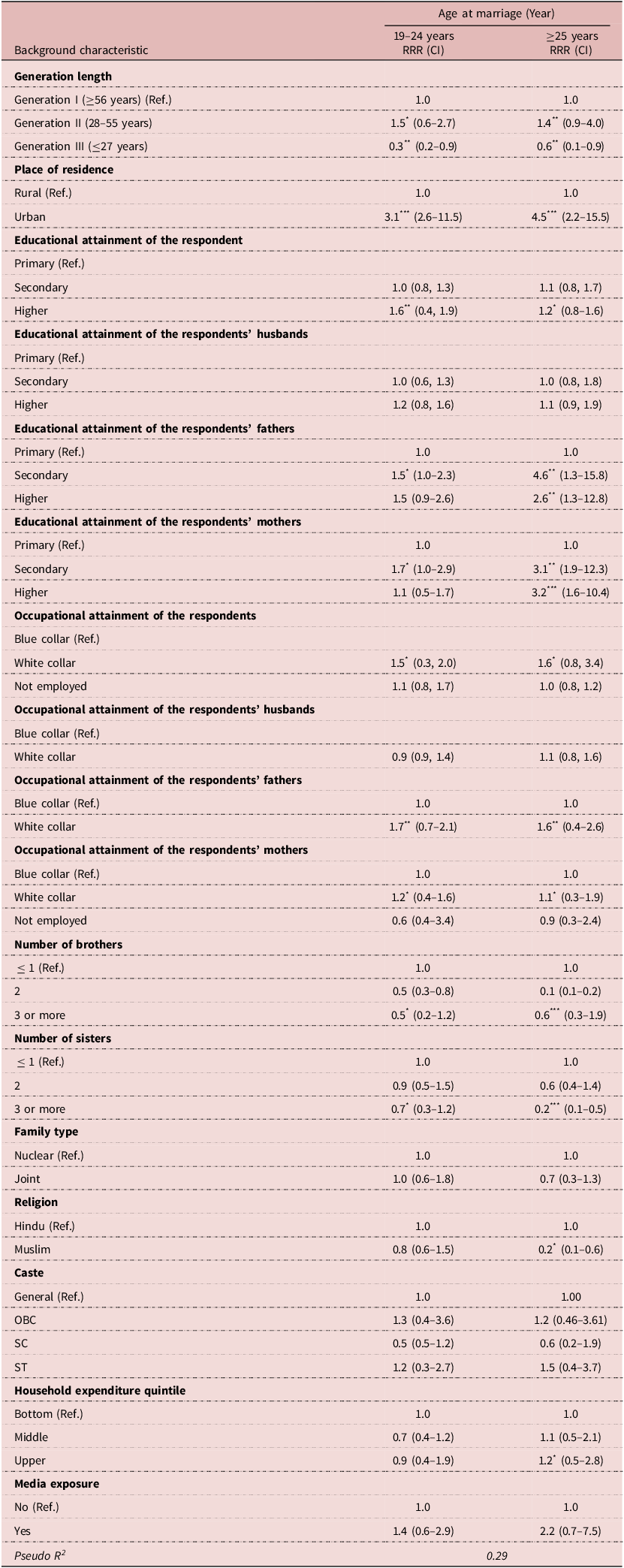
Table 3 presents the results of the MLR showing the relative risk ratios (RRRs) with 95% confidence intervals (CIs) for age at first marriage, using marriage at ≤18 years as the base outcome. Multinomial regression results showed that compared to Generation I, Generation II had significantly higher odds of marrying between 19 and 24 years (RRR = 1.5; CI: 0.6–2.7) and a higher likelihood of marrying at ≥25 years (RRR = 1.4; CI: 0.9–4.0). In contrast, respondents of Generation III were significantly less likely to postpone marriage, with reduced odds both for age at marriage at 19–24 years (RRR = 0.3; CI: 0.2–0.9) and for ≥25 years (RRR = 0.6; CI: 0.1–0.9). Place of residence emerged as a strong predictor, with urban respondents having higher odds of delayed marriage, both for age at marriage at 19–24 years (RRR = 3.1; CI: 2.6–11.5) and ≥25 years (RRR = 4.5; CI: 2.2–15.5), compared to those of rural areas. Respondents with higher education level showed significantly higher likelihood of delayed age at marriage occurring at ages 19–24 years (RRR = 1.6; CI: 0.4–1.9) and ages at ≥25 years (RRR = 1.2; CI: 0.8–1.6) compared to respondents educated up to the primary level. Parental education emerged as a significant predictor of delayed age at marriage among daughters, though with differential effects. Fathers educated up to the secondary level (RRR = 1.5, CI = 1.0–2.3) were significantly associated with an increased likelihood of daughters’ age at marriage between ages 19 and 24, compared to those educated up to the primary level. Furthermore, fathers with secondary education (RRR = 4.6, CI = 1.3–15.8) and higher education (RRR = 2.6, CI = 1.3–12.8) were strongly associated with delaying daughters’ marriage to age at ≥25 years, compared to fathers educated up to the primary level. Respondents whose mothers were educated up to the secondary level were more likely to marry between 19 and 24 years (RRR = 1.7, CI = 1.0–2.9) compared to those whose mothers were educated up to the primary level. Similarly, respondents whose mothers had secondary education (RRR = 3.1, CI = 1.9–12.4) and higher education (RRR = 3.2, CI = 1.6–10.4) were significantly more likely to marry at ≥25, compared to those whose mothers were educated up to the primary level. Respondents who were engaged in white-collar occupations were significantly more likely to delay age at marriage at 19–24 years (RRR = 1.5, CI = 0.3–2.0) and ≥25 years (RRR = 1.6, CI = 0.8–3.4) compared to those engaged in blue-collar occupations. Fathers engaged in white-collar occupations significantly raised the likelihood of later age at marriage for daughters compared to those engaged in blue-collar jobs, both at ages 19–24 years (RRR = 1.7, CI = 0.7–2.1) and ≥25 years (RRR = 1.6, CI = 0.4–2.6). Respondents whose mothers were engaged in white-collar occupations were significantly more likely to delay marriage, both at ages 19–24 years (RRR = 1.2, CI = 0.4–1.6) and ≥25 years (RRR = 1.1, CI = 0.3–1.9), compared to those whose mothers were engaged in blue-collar occupations. Respondents with more than three brothers were significantly less likely to experience delayed marriage, both at ages 19–24 years (RRR = 0.5, CI = 0.2–1.2) and ≥25 years (RRR = 0.6, CI = 0.3–0.1.9), compared to those having single or no brothers (≤1). Similarly, having more than three sisters also significantly reduced the likelihood of delayed marriage, with respondents being less likely to marry at 19–24 years (RRR = 0.7, CI = 0.3–1.2) and at ≥25 years (RRR = 0.2, CI = 0.1–0.5), compared to those having single or no sisters (≤1). Muslims respondents showed a lower likelihood of marrying at ≥25 years compared to Hindus (RRR = 0.2; CI: 0.1–0.6). Belonging to a wealthy household (upper quintile) significantly increases the likelihood of marriage of respondents at later ages compared to lower wealthy (Bottom quintile) family (RRR = 1.2, CI = 0.5–2.8).
Relative Risk Ratios (RRRs) Obtained from Multinomial Logistic Regression of Age at First Marriage by Background Characteristics
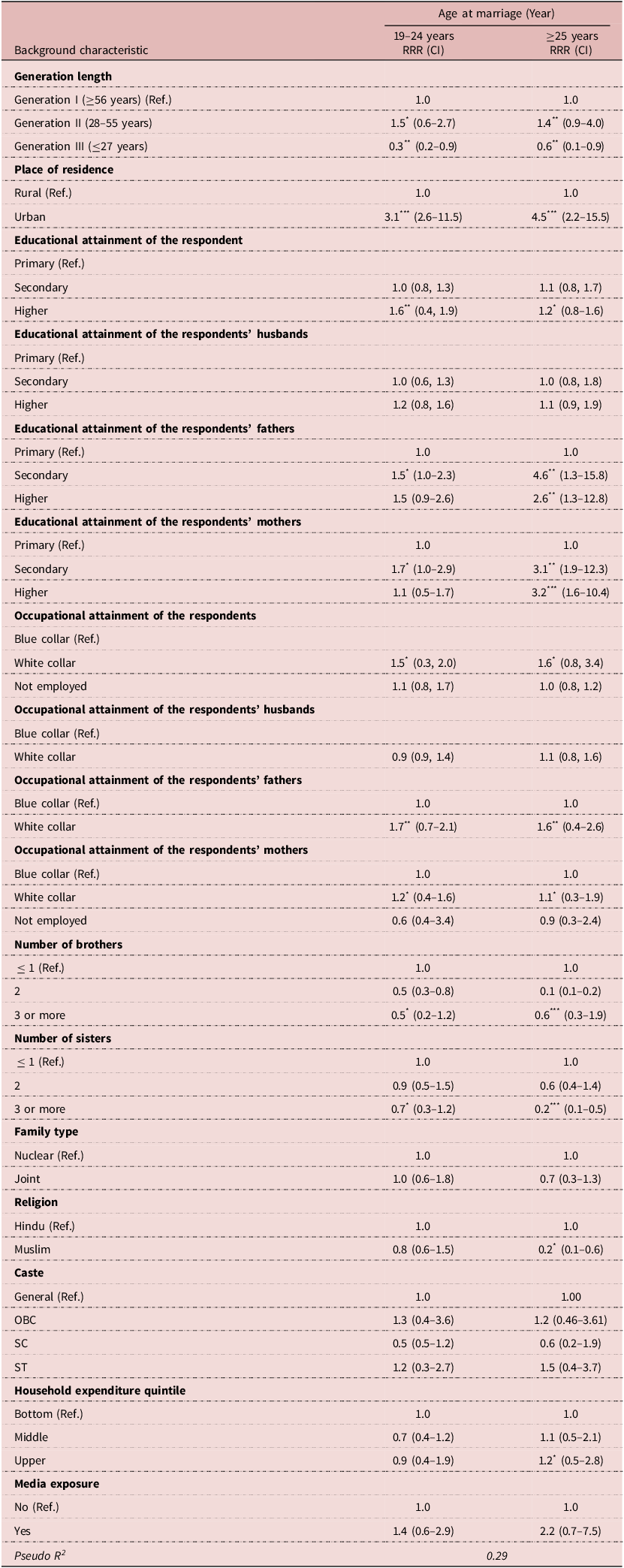
Notes: RRR = Relative Risk Ratio; CI = 95% Confidence Interval,
* p < 0.05,
** p < 0.01,
*** p < 0.001. Base outcome = ‘age at marriage ≤18 years’.
Voices from the field
During fieldwork, IDIs, FGDs, and a series of SSIs were conducted to explore the social nuances surrounding marriage and the determinants of age at marriage. Ethnographic voices revealed significant generational variations in perspectives on the changing trajectories. A respondent from Generation I, aged 62 years and a homemaker, said:
My parents were poor, and they neither had the money nor the interest to educate me. I always felt the pain of that deprivation. So, I decided that my daughter would study until she got a secure job. Today, she is a school teacher. In her success, I see my dream fulfilled.
A respondent from Generation II, aged 46 years and a school teacher, recalled:
During my time, my parents insisted that I pursue higher education. I completed my M.Sc, secured a job, and only then did I marry.
In contrast, a respondent from Generation III, aged 25 years old and a student-cum-homemaker, narrated:
My parents wanted me to study further, but they feared whether I would actually get a job. So, they decided to marry me early, with the hope that I could continue my studies later if my in-laws had no objection. My in-laws didn’t allow.
Age at marriage was also found to differ between urban and rural contexts. For instance, a respondent from Generation II, aged 40 years and a homemaker from the urban belt, remarked:
My parents were not highly educated, but they always encouraged me to pursue higher education. Over time, they never forced me into an early marriage.
At the same time, contrasting perspectives emerged from rural respondents. A respondent of Generation III, aged 26 years and a homemaker from the rural belt, explained:
We belonged to a large family with many siblings. My parents did not have the means to educate us, and therefore, they decided to marry us off at an early age. All of my sisters were married early.
Parental education played a crucial role in shaping marriage decisions. Highly educated parents consistently expressed the desire that their children should attain higher levels of education, regardless of immediate job opportunities. Such parents generally opposed early marriage for their children. A respondent from Generation II, aged 34 years and currently a PhD scholar, explained:
My father never forced me into marriage. I am pursuing my PhD only because of their constant support.
In contrast, a respondent of Generation I, aged 62 years and a homemaker, reflected on the missed opportunities that resulted from limited parental awareness of education. She observed:
If my parents had been educated and understood the importance of higher studies, I would have become a school teacher. Unfortunately, they never supported me in pursuing education, though other forms of support were obviously there.
Despite being educated, the parents of Generation III respondents expressed heightened anxieties regarding the social environment and institutional uncertainties. A respondent of Generation III, aged 26 years and a homemaker-cum-student, noted:
My parents are educated, but nowadays they are more anxious about society and the system. They want me to study, yet they also emphasize my marriage. Once my mother told me that I could continue my studies, but only after marriage, saying, ‘Look around at what is happening in society’.
Respondents with higher education often preferred to delay marriage until securing employment. A Generation II respondent, 43 years old and a school teacher, stated:
My parents wanted me to marry when I was 23 and pursuing a M.Sc, but they never forced me. When I did not obtain a job as professor as expected after completing my PhD, my parents became demoralized and often remarked sarcastically that I might have found a better husband had I married earlier.
Religion plays a pivotal role in determining age at marriage among the respondents. A Muslim respondent from Generation III, aged 24 years and a homemaker, remarked sadly:
Early marriage is common in our community. Unmarried daughters beyond the age of 17–18 years are often perceived as a burden, and to avoid any kind of uncertainties, families seek to transfer this responsibility to the in-laws at the earliest possible stage.
Being part of a wealthy household, respondents often enabled marriage at a later age, whereas poorer families could rarely afford such flexibility. For poor households, early marriage of daughters was perceived as an unavoidable choice. A respondent of Generation II, aged 32 years and a homemaker, shared her experience:
We were living in poor conditions. My maternal uncle chose a school teacher as my groom; my father agreed since the groom’s occupation was considered secure. I got married early, leaving behind my higher aspirations.
Respondents from Generation III experienced considerable anxiety regarding their family’s attitudes. A respondent of Generation III, aged 23 years and a student-cum-homemaker, remarked:
My parents were educated and had a successful business, yet they forced me to marry early, even though I wished to pursue higher education. They somehow came to believe that I was communicating with a male friend from another community, which was not true. Without giving it a second thought, they compelled me to marry.
Discussion
The study of generational differentials in age at marriage in the Howrah district of West Bengal underscores the multidimensional factors shaping nuptiality, while also raising questions about the uneven trajectory of demographic change in India. The results show that Generation II had the highest mean age at marriage, while Generation III exhibited a decline, marrying earlier than their immediate predecessors. This finding stands in partial contrast to the broader narrative of progressive delays in marriage age observed in national data (Basu, Reference Basu2002; Desai and Andrist, Reference Desai and Andrist2010). For example, NFHS-5 (2019–2021) shows a steady rise in median age at marriage across India, with national averages climbing above 22 years (UNFPA, 2022). Yet, the reversion to earlier marriage in Generation III within this study highlights a divergence that demands careful interpretation. Rather than a straightforward modernization trajectory, marriage timing in developing countries appears to be shaped by localized economic insecurities, kinship obligations, and the persistent rural–urban divide, illustrating the unevenness of demographic transition (Jeffery and Jeffery, Reference Jeffery and Jeffery1997; Malhotra, Reference Malhotra1997; Siddiqi and Greene, Reference Siddiqi and Greene2022). Studies show Kerala and Tamil Nadu have recorded consistent increases in age at first marriage closely linked to higher female literacy, matrilineal or bilateral kinship flexibility, and stronger state-led investments in health and education (Caldwell et al., Reference Caldwell, Reddy and Caldwell1983; Dyson and Moore, Reference Dyson and Moore1983; Shetty et al., Reference Shetty, Biradar, Prasad, Hegde, Sabhahit, Shetty and Mahagaonkar2024). By contrast, West Bengal, despite relatively high literacy, continues to report some of the highest child marriage prevalence (UNFPA, 2022), with NFHS-5 indicating that 42% of women aged 20–24 were married before 18 years. This paradox mirrors findings from northern states such as Bihar and Rajasthan, where structural poverty and entrenched patriarchal kinship systems override legal reforms (Singh and Samara, Reference Singh and Samara1995; Srinivasan and Bedi, Reference Srinivasan and Bedi2011). The implication is that education alone, unless supported by stable employment and social transformation, may not sustain higher marriage ages.
The findings of the study also affirm the decisive role of urban residence, higher education, and white-collar occupation in delaying marriage, aligning with Basu’s (Reference Basu2002) argument that schooling not only empowers women but also reshapes family aspirations. Urban areas of the state offer several advantages, including access to higher educational institutions, diverse job markets, and greater opportunities for women’s participation in local economies compared to rural regions. These conditions enable urban women to improve their socio-economic status and often postpone marriage to later ages (Malhotra, Reference Malhotra1997). Parents in urban settings also place a stronger emphasis on their children’s education, particularly as many of these areas are located in close proximity to the state capital, Kolkata. Maternal education was particularly influential, raising the odds of marriage at ≥25 years, which resonates with multi-state analyses showing that educated mothers invest more in daughters’ autonomy and educational continuity (Jensen and Thornton, Reference Jensen and Thornton2003; Neil, Reference Neil2025). Yet, the ethnographic narratives from younger respondents complicate this picture. Parents of the respondents of Generation III households expressed aspirations for their daughters’ education; however, anxieties over employment insecurity, growing concerns about premarital relationships, and the rising social stigma of elopement often prompted them to arrange early marriages despite their stated support for continued schooling. This tension illustrates the limits of structuralist explanations and highlights the importance of examining parental anxieties, social surveillance, and the desire to secure alliances as counterweights to the ‘education-delays-marriage’ thesis. Recent evidence in certain region have also been observed. For example, Gausman et al. (Reference Gausman, Kim, Kumar, Ravi and Subramanian2024) reported that, between 2016 and 2021, several states and Union Territories experienced a rise in child marriage prevalence among girls and boys, despite an overall decline at the national level.
Religious and caste-based differentials provide further comparative insight. Similar to the earlier studies (Bhat and Zavier, Reference Bhat and Zavier2005), Muslim respondents in the sample were less likely to delay marriage compared to Hindus, reflecting broader national patterns. However, unlike studies in Uttar Pradesh or Bihar, where Muslim women’s marriage timing is strongly tied to religious endogamy and dowry negotiations (Rao and Surendar, Reference Rao and Sureendar1988), the West Bengal case also demonstrates the overlay of economic vulnerability, as Muslim households in this study often cited poverty as the decisive factor. Muslims constitute a significant proportion of West Bengal’s population, almost one-third (Census of India, 2011), where poverty levels remain disproportionately high compared to the state average (Government of India, 2006). NFHS-5 (2019–2021) data indicate that Muslim women in the state are more likely to marry early than their Hindu counterparts (UNFPA, 2022). The findings of the present study align with studies (Caldwell et al., Reference Caldwell, Reddy and Caldwell1983; Jeffery and Jeffery, Reference Jeffery and Jeffery1997; Marphatia et al., Reference Marphatia, Ambale and Reid2017; Chakravorty et al., Reference Chakravorty, Goli and James2021), which argued that limited educational attainment and kinship pressures contribute to persistently lower ages at marriage among Muslims in India. The present study similarly observed that Muslims were significantly less likely to delay marriage compared to Hindus. Ethnographic narratives highlighted how parental anxieties around daughters’ social reputation, combined with weak employment opportunities, accelerated early marriage decisions despite aspirations for continued education. Compared with southern states such as Kerala and Tamil Nadu, where Muslim communities have benefited from higher literacy and mobility, West Bengal presents a more precarious picture, where poverty and patriarchal kinship systems reinforce early marriage norms (Bhat and Zavier, Reference Bhat and Zavier2005; Shetty et al., Reference Shetty, Biradar, Prasad, Hegde, Sabhahit, Shetty and Mahagaonkar2024). The study corroborates broader evidence that both religion and class-based marginalization intersect to sustain early marriage among Muslims in West Bengal, underscoring the need for targeted interventions in education, skill development, and employment to delay nuptiality. Regardless of religious belief, larger sibship sizes exert additional pressure on women to enter marriage at earlier ages (Pesando and Abufhele, Reference Pesando and Abufhele2019). The present study found that larger sibship size was associated with earlier marriage, supporting earlier anthropological-demographic research (Jeffery and Jeffery, Reference Jeffery and Jeffery1997; Pesando and Abufhele, Reference Pesando and Abufhele2019), but qualitative accounts stressed the role of brothers/sisters in accelerating nuptial arrangements, a detail underexplored in national surveys.
The declining trend in age at marriage among Generation III raises concerns and highlights the fragility of demographic gains, despite the presence of multiple government initiatives such as Kanyashree, Oikashree, Sabuj Sathi, and various educational scholarship schemes in West Bengal. While the demographic transition model (Notestein, Reference Notestein and Schultz1945; Coale, Reference Coale1974) posits a steady upward shift in marriage age linked to fertility decline, the present findings suggest a partial reversal under conditions of economic precocity and socio-cultural anxiety. The study showed several cases where women had married at an early age and continued their higher education, reflecting the socio-cultural complexities underlying the process of demographic transition. This resonates with anthropological critiques of linear transition models, which argue that society, culture, and demography must be understood as mutually constitutive, with parental authority, kinship networks, and gender norms continuously reshaping demographic behaviour (Bachrach, Reference Bachrach2013; Kalam et al., Reference Kalam, Mishra, Pal and Roy2020). The voices of rural women who lamented truncated educational aspirations due to early marriage echo similar findings from Bangladesh and Nepal, where legal reforms have failed to prevent child marriage because of persistent patriarchal logics and economic insecurities (Choe et al., Reference Choe, Thapa and Mishra2005; Amin, Reference Amin2011). The study highlights parental perceptions shaped by contemporary social circumstances and the pervasive influence of media, which are believed to increase daughters’ distractions and engagement in socially disapproved behaviours. To avoid such risks, parents preferred to marry off their daughters early, with the expectation that they could continue their education after marriage if the situation permitted. This strategy not only relieved parents of social anxieties but also created a sense of obligation among daughters towards their families. Such narratives highlight a shifting social behaviour that contributes to the change in age at marriage, a pattern that does not align with the straightforward model of demographic transition (Notenstein, Reference Notestein and Schultz1945).
The results of the study altogether demonstrate that while urban residence, self and parental education, and economic resources promote delayed marriage, these factors are not uniformly transformative. Instead, they operate within the constraints of kinship authority, dowry expectations, and community surveillance, producing a mosaic of trajectories rather than a singular path towards later marriage. From a policy perspective, this suggests that interventions must go beyond legal reforms and access to schooling, addressing the deeper anxieties of parents about employment, security, and social reputation. Without tackling these cultural-economic intersections, the persistence and even resurgence of early marriage among younger cohorts will remain a challenge for West Bengal and beyond.
Conclusion
Based on the ethnographic fieldwork, this study highlights the generational variations in age at marriage in Howrah district, West Bengal. While Generation II showed relatively delayed marriage age, reflecting the influence of education, occupational status, and urban exposure, Generation III experienced a decline in marriage age, indicating that economic insecurities, kinship obligations, cultural expectations, and social anxiety continue to exert a strong influence. Ethnographic evidence shows that early marriage limits girls’ education; although economic resources often enable delayed marriage, even well-off families may promote early marriage due to social anxiety and concerns over honour and social prestige. The findings suggest that the trajectory of change in age at marriage is not linear but shaped by the interplay of social and economic forces.
Limitations
The study acknowledges certain limitations arising from constraints of time and funding. First, its cross-sectional design limits the ability to capture individual life-course trajectories. Second, as the research is confined to a single district, the findings may not be fully generalizable to other regions of West Bengal or India. Third, the relatively limited representation of Muslim respondents may affect the precision of the results; increasing Muslim representation could enhance the robustness and accuracy of the findings. Finally, the exclusion of male respondents omits valuable perspectives on household decision-making and kinship negotiations surrounding age at marriage.
Future directions
The study underscores the need for future research to adopt longitudinal and multi-sited designs to capture temporal and regional variations in marital timing across Indian states to understand and explain the uneven progress in delaying marriage – a key target under Sustainable Development Goal (SDG) 5 (Gender Equality). It further highlights the importance of examining the intersections of education, migration, employment insecurity, and gender norms shaping marital decisions among younger-generation women, which are central to SDG 4 (Quality Education), SDG 8 (Decent Work and Economic Growth), SDG 3 (Good Health and Well-being), and SDG10 (Reduced Inequalities). From a policy perspective, achieving sustainable change in age at marriage – critical for advancing multiple SDGs – requires not only strengthening female education and legal enforcement but also addressing social circumstances, parental anxieties, economic vulnerabilities, and kinship obligations that continue to perpetuate early marriage.
Data availability statement
Due to ethical concerns and the sensitivity of the information shared by respondents, the data generated or analysed during this study – including transcripts and audio recordings – are not publicly available. This restriction is in place to protect the privacy and confidentiality of the respondents.
Acknowledgements
The author(s) would like to sincerely thank all the respondents for their valuable time and willingness to participate in this study. The author(s) are especially grateful for the warm hospitality during and after the interviews, which made the fieldwork experience both comfortable and memorable.
Funding statement
No fund has been received from any government or non-government organizations.
Competing interests
The authors declare no conflict of interest.
Ethical standard
Informed consent was obtained from all respondents and their family members prior to data collection.


 Open access

