


1. Introduction
Fix a graph F on k vertices and another graph G on $n{\,\gt\,}k$
vertices. Write I(F, G) for the number of k-subsets
$n{\,\gt\,}k$
vertices. Write I(F, G) for the number of k-subsets $S \subset V(G)$
such that
$S \subset V(G)$
such that $G[S] \cong F$
and let
$G[S] \cong F$
and let
 \begin{align*}\varrho (F, G) \;:\!=\; \frac{I(F, G) }{ \binom{n}{k}}.\end{align*}
Many foundational questions in extremal graph theory deal with estimating $\varrho (F, G)$
for various choices of F and G. One central question is to determine the minimum value when F is a clique and G has a specified edge density [
Reference Nikiforov13, Reference Razborov15, Reference Reiher16
], but there are also many fundamental questions about the maximum value regardless of edge density. This is the direction we take here.
$\varrho (F, G)$
for various choices of F and G. One central question is to determine the minimum value when F is a clique and G has a specified edge density [
Reference Nikiforov13, Reference Razborov15, Reference Reiher16
], but there are also many fundamental questions about the maximum value regardless of edge density. This is the direction we take here.
Let I(F, n) be the maximum of I(F, G) over all n vertex graphs G. A standard averaging argument implies that
 \begin{align*} \operatorname{ind}(F, n)\;:\!=\; \frac{I(F, n)}{{\binom nk}} \le \frac{I(F, n-1)}{{\binom{n-1}{k}}} =\operatorname{ind}(F, n-1).\end{align*}
Thus, $\operatorname{ind}(F,n)$
is a decreasing sequence bounded below by zero, so it has a limit. Define the inducibility of F to be
$\operatorname{ind}(F,n)$
is a decreasing sequence bounded below by zero, so it has a limit. Define the inducibility of F to be
 \begin{align*}\operatorname{ind} (F) \;:\!=\; \lim_{n\to \infty} \operatorname{ind}(F, n).\end{align*}
The iterated balanced blow-up of a graph F is a family $\mathcal{G}_F(n)$
of graphs on n vertices defined inductively as follows. Label V(F) with
$\mathcal{G}_F(n)$
of graphs on n vertices defined inductively as follows. Label V(F) with $[k]\;:\!=\;\{1, \ldots, k\}$
. For
$[k]\;:\!=\;\{1, \ldots, k\}$
. For $n {\,\lt\,} k$
, the family
$n {\,\lt\,} k$
, the family $\mathcal{G}_F(n)$
contains only the empty graph on n vertices. For
$\mathcal{G}_F(n)$
contains only the empty graph on n vertices. For $n \geq k$
, for any
$n \geq k$
, for any $G \in \mathcal{G}_F(n)$
, we have a partition
$G \in \mathcal{G}_F(n)$
, we have a partition $V(G) = V_1 \cup \cdots \cup V_k$
with the following properties:
$V(G) = V_1 \cup \cdots \cup V_k$
with the following properties:
-
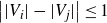
(1) for all $i,j \in [k]$
,
$\big| |V_i| - |V_j| \big| \leq 1$
;
$i,j \in [k]$
,
$\big| |V_i| - |V_j| \big| \leq 1$
; -
(2) for all
$i \in [k]$
, the induced subgraph
$G[V_i] \in \mathcal{G}_F(|V_i|)$
; -
(3) for all
$v \in V_i, w \in V_j$
with
$i \ne j$
, we have
$vw \in E(G)$
if and only if
$ij \in E(F)$
.





In many interesting cases, the construction above achieves the inducibility of F and we now define this formally (our definition is slightly different than that in [ Reference Lidický, Mattes and Pfender11 ]).
Definition 1·1. A graph F is a fractaliser if
 \[ \operatorname{ind} (F) = \lim_{n \to \infty} \max_{G \in \mathcal{G}_F(n)} \varrho \left(F,G\right). \]
In other words, the iterated balanced blow-up of F achieves the inducibility.
The subgraph induced by every k-set comprising exactly one vertex in each $V_i$
is isomorphic to F. Consequently, for every
$V_i$
is isomorphic to F. Consequently, for every $G \in \mathcal{G}_F(n)$
,
$G \in \mathcal{G}_F(n)$
,
 \begin{align*}I(F, G) \ge \sum_{i=1}^k I(F, G[V_i])+\prod_{i=1}^k|V_i|.\end{align*}
Together with a standard computation (see, e.g. [ Reference Mubayi and Razborov12 ]), this yields
 \begin{equation} \operatorname{ind} (F) \geq \lim_{n \to \infty} \max_{G \in \mathcal{G}_F(n)} \varrho \left( F, G \right) \ge \frac{k!}{k^k-k}.\end{equation}
In most cases we consider, the fact that F is a fractaliser will imply further that $\operatorname{ind}(F)=k!/(k^k-k)$
. Note that this is not always the case, for example
$\operatorname{ind}(F)=k!/(k^k-k)$
. Note that this is not always the case, for example $F = K_k$
is a fractaliser with
$F = K_k$
is a fractaliser with $\operatorname{ind}(K_k) = 1$
.
$\operatorname{ind}(K_k) = 1$
.
The fundamental conjecture in this area, due to Pippenger and Golumbic [
Reference Pippenger and Golumbic14
], states that for $k \ge 5$
, the cycle
$k \ge 5$
, the cycle $C_k$
is a fractaliser and satisfies
$C_k$
is a fractaliser and satisfies $\operatorname{ind}(C_k)=k!/(k^k-k)$
. This conjecture has been resolved for
$\operatorname{ind}(C_k)=k!/(k^k-k)$
. This conjecture has been resolved for $k=5$
by Balogh, Hu, Lidický, and Pfender [
Reference Balogh, Hu, Lidický and Pfender1
] (see also [
Reference Lidický, Mattes and Pfender11
]), but remains open for all
$k=5$
by Balogh, Hu, Lidický, and Pfender [
Reference Balogh, Hu, Lidický and Pfender1
] (see also [
Reference Lidický, Mattes and Pfender11
]), but remains open for all $k \geq 6$
. Král, Norin and Volec [
Reference Král, Norin and Volec10
] showed that
$k \geq 6$
. Král, Norin and Volec [
Reference Král, Norin and Volec10
] showed that $I(C_k,n)\le 2n^k/k^k$
. More generally, Fox, Huang and Lee [
Reference Fox, Huang and Lee6
] and Yuster [
Reference Yuster17
] independently proved that random graphs are fractalisers asymptotically almost surely. Fox, Sauermann and Wei [
Reference Fox, Sauermann and Wei7
] further proved that random Cayley graphs of abelian groups with small number of vertices removed are almost surely fractalisers.
$I(C_k,n)\le 2n^k/k^k$
. More generally, Fox, Huang and Lee [
Reference Fox, Huang and Lee6
] and Yuster [
Reference Yuster17
] independently proved that random graphs are fractalisers asymptotically almost surely. Fox, Sauermann and Wei [
Reference Fox, Sauermann and Wei7
] further proved that random Cayley graphs of abelian groups with small number of vertices removed are almost surely fractalisers.
We now consider these notions on coloured and directed structures. A tournament is an orientation of a complete graph. An edge-colouring of a graph or tournament G is a function $\chi \;:\; E(G) \to T$
where T is a set of colours; we say that G is T-coloured. A coloured graph or tournament G is rainbow if
$\chi \;:\; E(G) \to T$
where T is a set of colours; we say that G is T-coloured. A coloured graph or tournament G is rainbow if $\chi$
is injective. Two coloured graphs (or tournaments) G and H are isomorphic, written
$\chi$
is injective. Two coloured graphs (or tournaments) G and H are isomorphic, written $G \cong H$
, if there exists a bijection
$G \cong H$
, if there exists a bijection $\varphi \;:\; V(G) \to V(H)$
such that the colours (and orientations) of all edges are preserved under
$\varphi \;:\; V(G) \to V(H)$
such that the colours (and orientations) of all edges are preserved under $\varphi$
. If F is a coloured tournament or coloured complete graph, then
$\varphi$
. If F is a coloured tournament or coloured complete graph, then $\operatorname{ind} (F)$
is defined identically as in the graph case, but with these altered definitions of graph isomorphism; naturally, the underlying graph G should have the colours or orientations corresponding to F. If F is an arbitrary coloured graph, then we can colour all missing edges with a single new colour and view F as a coloured complete graph. Consequently, we can define fractaliser for all these structures.
$\operatorname{ind} (F)$
is defined identically as in the graph case, but with these altered definitions of graph isomorphism; naturally, the underlying graph G should have the colours or orientations corresponding to F. If F is an arbitrary coloured graph, then we can colour all missing edges with a single new colour and view F as a coloured complete graph. Consequently, we can define fractaliser for all these structures.
There are very few results on the inducibility of coloured, oriented or directed structures. The first exact result which involved an iterated construction was due to Huang [
Reference Huang8
] who determined the inducibility of the directed star. Later, in order to solve an old conjecture of Erdös and Hajnal [
Reference Erdős and Hajnal5
] in hypergraph Ramsey theory, the third author and Razborov [
Reference Mubayi and Razborov12
] proved the following result for $k \ge 4$
(the case
$k \ge 4$
(the case $k=3$
was proven earlier by Conlon, Fox and Sudakov [
Reference Conlon, Fox and Sudakov3
]).
$k=3$
was proven earlier by Conlon, Fox and Sudakov [
Reference Conlon, Fox and Sudakov3
]).
Theorem 1·2 ([
Reference Mubayi and Razborov12
]). All rainbow tournaments R on $k \ge 4$
vertices are fractalisers. In particular,
$k \ge 4$
vertices are fractalisers. In particular, $\mathrm{ind}(R) = k!/(k^k-k)$
.
$\mathrm{ind}(R) = k!/(k^k-k)$
.
In this paper, we consider the question addressed by Theorem 1·2 in the undirected setting. The first conjecture in this setting is due to Erdös and Sós from the 1970s (see [
Reference Erdős and Hajnal5
, equation (20)]), and implies, in particular, that a rainbow triangle is not a fractaliser. Their conjecture was proved by Balogh et. al. [
Reference Balogh, Hu, Lidický, Pfender, Volec and Young2
], who showed that a blow-up of a properly 3-edge-coloured $K_4$
(instead of a rainbow
$K_4$
(instead of a rainbow $K_3$
) achieves the inducibility of the rainbow triangle. See also [
Reference Chao and Yu4
] for similar computations, but in terms of the number of edges of each colour instead of the number of vertices.
$K_3$
) achieves the inducibility of the rainbow triangle. See also [
Reference Chao and Yu4
] for similar computations, but in terms of the number of edges of each colour instead of the number of vertices.
Huang [
Reference Huang9
] asked whether Theorem 1·2 can be extended to the undirected setting for cliques of size larger than three. This, in particular, would imply that the phenomenon conjectured by Erdös and Sós and proved in [
Reference Balogh, Hu, Lidický, Pfender, Volec and Young2
] (that $K_k$
is not a fractaliser for
$K_k$
is not a fractaliser for $k=3$
) fails to hold for larger k. Our first result addresses Huang’s question and proves that rainbow
$k=3$
) fails to hold for larger k. Our first result addresses Huang’s question and proves that rainbow $K_k$
are fractalisers for
$K_k$
are fractalisers for $k \geq 11$
. Note that the result below applies to a specific rainbow colouring of a clique. The corresponding problem for the collection of all rainbow colourings is discussed in Section 5.
$k \geq 11$
. Note that the result below applies to a specific rainbow colouring of a clique. The corresponding problem for the collection of all rainbow colourings is discussed in Section 5.
Theorem 1·3. All rainbow cliques R on $k \ge 11$
vertices are fractalisers. In particular,
$k \ge 11$
vertices are fractalisers. In particular,
 \[ \mathrm{ind}(R) = \frac{k!}{k^k-k}. \]
We make the following observations regarding Theorem 1·3.
-
(1) Theorem 1·3 implies Theorem 1·2 for
$k \geq 11$
, since any construction of a tournament inducing
$\ell$
rainbow copies of R yields a corresponding construction of a complete graph that induces at least
$\ell$
rainbow (undirected) copies of R by ignoring orientations. -
(2) Similarly, if a graph G on k vertices is known to have inducibility
$k! /( k^k - k)$
, then the rainbow k-clique is a fractaliser as well by the following argument. Let R be a rainbow k-clique and let
$e_1, e_2, \ldots, e_m \in E(R)$
such that
$(V(R), \{ e_1, \ldots, e_m \} )$
is a rainbow copy of G. Let
$c_1, \ldots, c_m$
be the colours assigned to
$e_1, \ldots, e_m$
, respectively. Then any construction of an edge-coloured graph inducing
$\ell$
rainbow copies of R induces at least
$\ell$
copies of G by deleting all edges except those coloured by
$c_1, \ldots, c_m$
and then ignoring the edge colours. It follows that
$\operatorname{ind} (R) \le \operatorname{ind}(G) = k!/ (k^k -k)$
, so R is a fractaliser. Thus, the result of [
Reference Balogh, Hu, Lidický and Pfender1
] that
$C_5$
is a fractaliser with
$\operatorname{ind} (C_5) = 5!/(5^5 - 5)$
implies that the rainbow 5-clique is a fractaliser, and the result of [
Reference Fox, Huang and Lee6
] that random graphs are almost surely fractalisers implies that the rainbow k-clique is a fractaliser for large k. -
(3) We believe our proof of Theorem 1·3 has been optimised and requires
$k \ge 11$
. As [
Reference Balogh, Hu, Lidický and Pfender1
] showed that rainbow 5-cliques are fractalisers, and [
Reference Balogh, Hu, Lidický, Pfender, Volec and Young2
] showed that rainbow 3-cliques are not fractalisers, it remains open to determine whether rainbow
$k_0$
-cliques are fractalisers only for
$k_0\in \{4,6,7,8,9,10\}$
.












Our proof of Theorem 1·3 follows the broad framework of the proof of Theorem 1·2 but there are several nontrivial technical difficulties that need to be addressed in the undirected setting. The difficulties arise due to the following reason: the role that each endpoint of an edge plays in a rainbow copy of a tournament is determined by the colour and orientation of the edge, but this is no longer true in the undirected setting. We overcome these obstacles by adding some new ideas, at the expense of requiring a slightly higher value of k. For example, our proof of Theorem 1·3 requires a bound on the colour degree of a vertex and this was not needed in [ Reference Mubayi and Razborov12 ].
For large values of k, we prove the following more general result which shows that the analog of Theorem 1·3 holds for much sparser graphs. The proof requires several major new ideas.
Theorem 1·4. There exists an absolute constant $C {\,\gt\,}0$
such that all connected rainbow graphs R with k vertices and minimum degree at least
$C {\,\gt\,}0$
such that all connected rainbow graphs R with k vertices and minimum degree at least $C \log k$
are fractalisers and satisfy
$C \log k$
are fractalisers and satisfy
 \[ \mathrm{ind}(R) = \frac{k!}{k^k-k}. \]
We make the following observations regarding Theorem 1·4.
-
(1) Theorem 1·4 implies Theorem 1·3 for large k, since R may be viewed as a rainbow k-clique with edges deleted. Let
$c_1, c_2, \dots, c_m$
be the colours assigned to the deleted edges. Any construction of a coloured complete graph inducing
$\ell$
rainbow copies of the rainbow k-clique yields at least
$\ell$
rainbow copies of R by deleting edges coloured
$c_1, \ldots, c_m$
. -
(2) The requirement that R is connected in the statement of Theorem 1·4 is necessary, as disconnected rainbow graphs without isolated vertices are not fractalisers (see Section 4).
-
(3) We are not able to show that our requirement on minimum degree is tight, and this remains open.


Theorem 1·3 is proven in Section 2 and Theorem 1·4 is proven in Section 3. In Section 4, we justify the second observation above. In Section 5, we discuss the problem of maximising the number of rainbow cliques on k vertices in a large graph, where the colouring of the clique is not specified.
2. Proof of Theorem 1·3
We give the proof of Theorem 1·3 in the following subsections.
2·1. Setup
Fix $k \ge 11$
and
$k \ge 11$
and $T = \binom{[k]}{2}$
. Let R be a T-coloured rainbow k-clique with colouring function
$T = \binom{[k]}{2}$
. Let R be a T-coloured rainbow k-clique with colouring function $\chi_R$
and for concreteness, put
$\chi_R$
and for concreteness, put $V(R)\;:\!=\;[k]$
and
$V(R)\;:\!=\;[k]$
and $\chi_R (ij) = \{i,j\}$
for all
$\chi_R (ij) = \{i,j\}$
for all $i,j \in [k]$
.
$i,j \in [k]$
.
Set
 \begin{align*}a \;:\!=\; \frac{k!}{k^k-k}.\end{align*}
Our aim is to prove that $\operatorname{ind}(R) \le a$
. To this end, fix
$\operatorname{ind}(R) \le a$
. To this end, fix $\gamma{\,\gt\,}0$
and assume for contradiction
$\gamma{\,\gt\,}0$
and assume for contradiction $\operatorname{ind}(R)=a+\gamma$
. Next choose
$\operatorname{ind}(R)=a+\gamma$
. Next choose $0 {\,\lt\,} {\varepsilon} {\,\lt\,} \min\{\gamma,\operatorname{ind}(R)\}/100$
. Let
$0 {\,\lt\,} {\varepsilon} {\,\lt\,} \min\{\gamma,\operatorname{ind}(R)\}/100$
. Let $c_0$
be chosen so that
$c_0$
be chosen so that $\operatorname{ind}(R, n) \le \operatorname{ind}(R)+\varepsilon$
for all
$\operatorname{ind}(R, n) \le \operatorname{ind}(R)+\varepsilon$
for all $n{\,\gt\,}c_0$
. Choose
$n{\,\gt\,}c_0$
. Choose $M \ge \left\lceil 2k!c_0/{\varepsilon} \right \rceil$
such that
$M \ge \left\lceil 2k!c_0/{\varepsilon} \right \rceil$
such that
 \begin{equation} \frac{n^k}{(n)_k} {\,\lt\,} 1 + {\varepsilon}\end{equation}
and
 \begin{equation} a \left( \frac{n^{k - 1}}{(k - 1)!} - \binom{n - 1}{k - 1} \right) {\,\lt\,} \gamma \binom{n - 1}{k - 1} - {\binom{n - 2}{k - 2}}\end{equation}
for all $n{\,\gt\,}M$
. This is possible since
$n{\,\gt\,}M$
. This is possible since $\lim_{n \to \infty} n^k/(n)_k = 1$
and
$\lim_{n \to \infty} n^k/(n)_k = 1$
and $n^{k - 1}/(k - 1)! - \binom{n - 1}{k - 1} = O(n^{k - 2})$
, while
$n^{k - 1}/(k - 1)! - \binom{n - 1}{k - 1} = O(n^{k - 2})$
, while $\gamma \binom{n - 1}{k - 1} - {\binom{n - 2}{k - 2}} = \Omega \left( n^{k - 1} \right)$
as
$\gamma \binom{n - 1}{k - 1} - {\binom{n - 2}{k - 2}} = \Omega \left( n^{k - 1} \right)$
as $n \rightarrow \infty$
. Suppose that
$n \rightarrow \infty$
. Suppose that $n{\,\gt\,}M$
is given and H is a T-coloured n-vertex graph with colouring function
$n{\,\gt\,}M$
is given and H is a T-coloured n-vertex graph with colouring function $\chi_H$
achieving I(R, n). This implies
$\chi_H$
achieving I(R, n). This implies
 \begin{align*}I(R, H) = I(R, n) = \operatorname{ind}(R,n){\binom nk},\end{align*}
where $a+\gamma =\operatorname{ind}(R) \le \operatorname{ind}(R,n) \le \operatorname{ind}(R) + \varepsilon = a+\gamma + \varepsilon$
.
$a+\gamma =\operatorname{ind}(R) \le \operatorname{ind}(R,n) \le \operatorname{ind}(R) + \varepsilon = a+\gamma + \varepsilon$
.
Definition 2·1. For $q\ge 0$
and
$q\ge 0$
and $t {\,\gt\,} 0$
, let p(q, t) be the maximum of
$t {\,\gt\,} 0$
, let p(q, t) be the maximum of $\prod_i q_i$
where
$\prod_i q_i$
where $q_1 + \cdots + q_t = q$
and each
$q_1 + \cdots + q_t = q$
and each $q_i \ge 0$
an integer.
$q_i \ge 0$
an integer.
The AMGM inequality yields $p(q,t) \le (q/t)^t$
and it is easy to see that
$p(q,t) \le (q/t)^t$
and it is easy to see that
 \begin{equation} p(q, t) p(q', t') \le p(q + q', t + t')\end{equation}
for all $q, q' \ge 0$
and
$q, q' \ge 0$
and $t, t'{\,\gt\,}0$
(see Appendix).
$t, t'{\,\gt\,}0$
(see Appendix).
For a vertex x in V(H) and $i \in [k]$
, write
$i \in [k]$
, write $d_i(x)$
for the number of copies of R containing x where x plays the role of vertex i in R. More formally,
$d_i(x)$
for the number of copies of R containing x where x plays the role of vertex i in R. More formally, $d_i(x)$
is the number of isomorphic embeddings
$d_i(x)$
is the number of isomorphic embeddings $\phi\;:\; R \to H$
such that
$\phi\;:\; R \to H$
such that $\phi(i) = x$
. Let
$\phi(i) = x$
. Let $d(x)=\sum_i d_i(x)$
be the number of copies of R containing x. We will refer to this as the degree of x in H. Similarly, let d(x, y) be the number of copies of R containing both x and y. For
$d(x)=\sum_i d_i(x)$
be the number of copies of R containing x. We will refer to this as the degree of x in H. Similarly, let d(x, y) be the number of copies of R containing both x and y. For $i \in [k]$
, let
$i \in [k]$
, let $N_i(x)$
be the set of
$N_i(x)$
be the set of $y \in V(H)\setminus \{x\}$
for which there is a copy of R in H containing both x and y in which x plays the role of vertex i in R. Note that we do not have
$y \in V(H)\setminus \{x\}$
for which there is a copy of R in H containing both x and y in which x plays the role of vertex i in R. Note that we do not have $N_j(x) \cap N_{j'}(x) =\emptyset$
for
$N_j(x) \cap N_{j'}(x) =\emptyset$
for $j \ne j'$
, but all edges between
$j \ne j'$
, but all edges between $N_j(x) \cap N_{j'}(x)$
and x have the same colour
$N_j(x) \cap N_{j'}(x)$
and x have the same colour $\{j,j'\}$
. However,
$\{j,j'\}$
. However, $N_i(x)$
has a (unique) partition
$N_i(x)$
has a (unique) partition $\cup_{j \ne i} N_i^j(x)$
where
$\cup_{j \ne i} N_i^j(x)$
where $N_i^j(x)$
comprises those y such that x, y lie in a copy of R with x playing the role of i and y playing the role of j. Indeed, the partition is obtained based on the colour of a vertex to x. This gives
$N_i^j(x)$
comprises those y such that x, y lie in a copy of R with x playing the role of i and y playing the role of j. Indeed, the partition is obtained based on the colour of a vertex to x. This gives
 \begin{equation} {}d(x) = \sum_{i=1}^k d_i(x) \le \sum_{i=1}^k \prod_{j \ne i} |N_i^j(x)| \le \sum_{i=1}^k p(|N_i(x)|, k-1).\end{equation}
We partition V(H) into $V_1 \cup \cdots \cup V_k$
, where
$V_1 \cup \cdots \cup V_k$
, where
 \begin{align*}V_i = \{x \in V(H)\;:\; |N_i(x)| \ge |N_j(x)| \hbox{ for all } j \ne i\}.\end{align*}
If there is a tie, we break it arbitrarily. Set $n_i=|V_i|$
for all
$n_i=|V_i|$
for all $i \in [k]$
.
$i \in [k]$
.
2·2. Minimum degree
Here we show that a standard technique in extremal graph theory can be used to prove that each vertex of H lies in at least the average number of copies of R (apart from a small error term).
Lemma 2·2. $d(x) \geq a n^{k-1} / (k-1)!$
for all
$d(x) \geq a n^{k-1} / (k-1)!$
for all $x \in V(H)$
.
$x \in V(H)$
.
Proof. We write $d=b\pm c$
for the inequalities
$d=b\pm c$
for the inequalities $b-c\le d \le b+c$
. Denote the average degree of H by
$b-c\le d \le b+c$
. Denote the average degree of H by
 \begin{align*}d(H) \;:\!=\; \frac{ k\cdot I(R,H)}{n} = \operatorname{ind}(R,n){\binom{n-1}{k-1}}.\end{align*}
We claim that for every $x \in V(H)$
 \begin{equation} d(x) = d(H) \pm {\binom{n-2}{k-2}}. \end{equation}
This follows from a standard application of Zykov symmetrisation. Indeed, if the degrees of two vertices x and y differ by more than ${\binom{n - 2}{k - 2}}$
, say
${\binom{n - 2}{k - 2}}$
, say $d(x) {\,\gt\,}d(y) + {\binom{n - 2}{k - 2}}$
, then we can delete y and duplicate x, meaning we add a new vertex x
′ with
$d(x) {\,\gt\,}d(y) + {\binom{n - 2}{k - 2}}$
, then we can delete y and duplicate x, meaning we add a new vertex x
′ with $\chi_H (x'z) = \chi_H (xz)$
for all other vertices z, and
$\chi_H (x'z) = \chi_H (xz)$
for all other vertices z, and $\chi_H (xx')$
can be arbitrary. This transformation increases the number of copies of R by at least
$\chi_H (xx')$
can be arbitrary. This transformation increases the number of copies of R by at least
 \begin{align*}d(x)-d(y) -d(x,y)\ge d(x)-d(y) - {\binom{n - 2}{k - 2}} {\,\gt\,}0, \end{align*}
contradicting the maximality $I(R,H) = I(R,n)$
. Hence all degrees lie in an interval of length at most
$I(R,H) = I(R,n)$
. Hence all degrees lie in an interval of length at most ${\binom{n - 2}{k - 2}}$
and (2·5) follows, since this interval must contain d(H). In particular, the minimum degree is at least
${\binom{n - 2}{k - 2}}$
and (2·5) follows, since this interval must contain d(H). In particular, the minimum degree is at least
 \begin{align*}d(H) - {\binom{n - 2}{k - 2}} = \operatorname{ind}(R,n){\binom{n - 1}{k - 1}} - {\binom{n - 2}{k - 2}}.\end{align*}
It follows from (2·2) that
 \begin{align*}\operatorname{ind}(R,n){\binom{n - 1}{k - 1}} - {\binom{n - 2}{k - 2}} \ge (a+\gamma){\binom{n - 1}{k - 1}} - {\binom{n - 2}{k - 2}}{\,\gt\,} a\frac{n^{k-1}}{(k-1)!}\end{align*}
for $n {\,\gt\,} M$
, completing the proof.
$n {\,\gt\,} M$
, completing the proof.
2·3. Maximum colour degree
Let
 \begin{align*}\alpha \;:\!=\; \frac{\max_{x,i,j} d_{\{i,j\}}(x)}{n},\end{align*}
where the maximum is taken over all vertices $x\in V(H)$
and all colours
$x\in V(H)$
and all colours $\{i,j\} \in T$
and
$\{i,j\} \in T$
and $d_{\{i,j\}}(x)$
is the number of edges in H incident with x in colour
$d_{\{i,j\}}(x)$
is the number of edges in H incident with x in colour $\{i,j\}$
. We upper bound this value.
$\{i,j\}$
. We upper bound this value.
Lemma 2·3. $\alpha \leq 0.4$
.
$\alpha \leq 0.4$
.
Proof. Let x, i, j achieve this maximum, so that $d_{\{i,j\}}(x) = \alpha n$
. Then
$d_{\{i,j\}}(x) = \alpha n$
. Then $|N_i^j(x)| \leq \alpha n$
and
$|N_i^j(x)| \leq \alpha n$
and $N_i(x)$
has a partition
$N_i(x)$
has a partition $N_{i}^j(x) \bigcup \cup_{\ell\ne j} N_i^{\ell}(x)$
where every copy of R containing x with x playing the role of i has exactly one vertex in each
$N_{i}^j(x) \bigcup \cup_{\ell\ne j} N_i^{\ell}(x)$
where every copy of R containing x with x playing the role of i has exactly one vertex in each $N_i^{\ell}(x)$
for all
$N_i^{\ell}(x)$
for all $\ell \in [k]\setminus\{i\}$
. Further,
$\ell \in [k]\setminus\{i\}$
. Further,
 \begin{align*}\left| \bigcup_{\ell\ne j} N_i^{\ell}(x) \right| \leq n-d_{\{i,j\}}(x)\end{align*}
since a vertex incident to an edge coloured $\{i, j \}$
cannot play the role of
$\{i, j \}$
cannot play the role of $\ell \neq i,j$
. Consequently,
$\ell \neq i,j$
. Consequently,
 \begin{align*}d_i(x) \le |N_{i}^j(x)| \cdot p \left( n- d_{\{i,j\}}(x), k-2 \right) \le \alpha\, n \cdot \left(\frac{(1-\alpha)n}{k-2}\right)^{k-2}.\end{align*}
The same upper bound holds for $d_j(x)$
. For
$d_j(x)$
. For $\ell \not\in \{i,j\}$
, we have
$\ell \not\in \{i,j\}$
, we have $N_{\ell} (x) \leq n-d_{\{i,j\}}(x)$
since x is playing the role of
$N_{\ell} (x) \leq n-d_{\{i,j\}}(x)$
since x is playing the role of $\ell$
, so we cannot include an edge incident to x of colour
$\ell$
, so we cannot include an edge incident to x of colour $\{i,j\}$
since the colour must include
$\{i,j\}$
since the colour must include $\ell$
. Hence
$\ell$
. Hence
 \begin{align*}d_{\ell}(x) \le p \left( n-d_{\{i,j\}}(x), k-1 \right) \le \left(\frac{(1-\alpha)n}{k-1}\right)^{k-1} \le \left(\frac{(1-\alpha)n}{k-2}\right)^{k-1}.\end{align*}
Altogether this yields
 \begin{align*} d(x) \le 2 \,\alpha\, n \left(\frac{(1-\alpha)n}{k-2}\right)^{k-2} + (k-2)\left(\frac{(1-\alpha)n}{k-2}\right)^{k-1} =(1 + \alpha)\left(\frac{1 - \alpha}{k-2}\right)^{k-2}n^{k-1}.\end{align*}
Suppose for contradiction that $\alpha{\,\gt\,}0.4$
. Since
$\alpha{\,\gt\,}0.4$
. Since $k \ge 3$
,
$k \ge 3$
, $(1+\alpha)(1-\alpha)^{k-2}$
is a decreasing function of
$(1+\alpha)(1-\alpha)^{k-2}$
is a decreasing function of $\alpha$
for
$\alpha$
for $\alpha \in (0.4, 1]$
, and
$\alpha \in (0.4, 1]$
, and $d(x) \geq an^{k-1}/(k-1)!$
by Lemma 2·2. Therefore
$d(x) \geq an^{k-1}/(k-1)!$
by Lemma 2·2. Therefore
 \begin{equation} \frac{1}{k^{k-1}-1}= \frac{a}{(k-1)!} \leq \frac{d(x)}{n^{k-1}} \le 1.4 \left(\frac{0.6}{k-2}\right)^{k-2}. \end{equation}
However, this fails to hold for $k \ge 11$
(see Appendix), and we conclude that
$k \ge 11$
(see Appendix), and we conclude that $\alpha \leq 0.4$
as desired.
$\alpha \leq 0.4$
as desired.
2·4. The second largest neighbourhood
For a vertex $x \in V(H)$
, let Z(x) be the second largest set in
$x \in V(H)$
, let Z(x) be the second largest set in $\{N_1(x), \ldots, N_k(x)\}$
and define
$\{N_1(x), \ldots, N_k(x)\}$
and define
 \begin{align*}z\;:\!=\; z_{k,n} = \max_{x \in V(H)} \frac{|Z(x)|}{n}.\end{align*}
Lemma 2·4. $z \leq 0.5$
.
$z \leq 0.5$
.
Proof. Let x be such that $z=|Z(x)|/n$
. Let
$z=|Z(x)|/n$
. Let $a_i=|N_i(x)|/n$
and assume by relabeling that
$a_i=|N_i(x)|/n$
and assume by relabeling that $a_1 \ge a_2=z \ge a_3 \ge \cdots \ge a_k$
. Since
$a_1 \ge a_2=z \ge a_3 \ge \cdots \ge a_k$
. Since $N_j(x) \cap N_{j'}(x) \cap N_{j''}(x) = \emptyset$
for any three distinct j, j
′, j
′ we have
$N_j(x) \cap N_{j'}(x) \cap N_{j''}(x) = \emptyset$
for any three distinct j, j
′, j
′ we have $\sum a_i \le 2$
. Let
$\sum a_i \le 2$
. Let $a_3+\cdots +a_k= s\le 2-(a_1+z)$
. Write
$a_3+\cdots +a_k= s\le 2-(a_1+z)$
. Write $s=qz+r$
where
$s=qz+r$
where $q \in \mathbb Z^{\ge 0}$
and
$q \in \mathbb Z^{\ge 0}$
and $0\le r{\,\lt\,}z$
. If
$0\le r{\,\lt\,}z$
. If $x \le y$
, then
$x \le y$
, then $x^{k-1}+y^{k-1} {\,\lt\,} (x-\rho)^{k-1}+(y+\rho)^{k-1}$
for
$x^{k-1}+y^{k-1} {\,\lt\,} (x-\rho)^{k-1}+(y+\rho)^{k-1}$
for $0{\,\lt\,}\rho{\,\lt\,}x$
by convexity of
$0{\,\lt\,}\rho{\,\lt\,}x$
by convexity of $x^{k-1}$
so successively increasing the largest
$x^{k-1}$
so successively increasing the largest $a_i$
to z and decreasing the smallest
$a_i$
to z and decreasing the smallest $a_j$
to 0 or r, we obtain
$a_j$
to 0 or r, we obtain
 \begin{align*}\sum_{i=3}^k a_i^{k-1} \le q z^{k-1} +r^{k-1}\le qz^{k-1} + \frac{r}{z} z^{k-1} = \frac{s}{z} z^{k-1} \le \frac{2-(a_1+z)}{z} z^{k-1}.\end{align*}
Consequently,
 \begin{align*}\sum_{i=1}^k a_i^{k-1} = a_1^{k-1} + z^{k-1} + \sum_{i=3}^k a_i^{k-1} \le a_1^{k-1} + z^{k-1} + \frac{2-(a_1+z)}{z} z^{k-1}.\end{align*}
Since $a_1 \geq z$
, taking the derivative shows that for any z, this expression is increasing with
$a_1 \geq z$
, taking the derivative shows that for any z, this expression is increasing with $a_1$
. Using Lemma 2·3, we note that
$a_1$
. Using Lemma 2·3, we note that $a_1 + z \le 1+\alpha \le 1.4$
since
$a_1 + z \le 1+\alpha \le 1.4$
since
 \begin{align*}|N_1(x)|+|Z(x)| =|N_1(x) \cup Z(x)|+|N_1(x) \cap Z(x)| \le n + d_{\left\{ 1,2 \right\}} (x),\end{align*}
where $d_{\left\{ 1,2 \right\}} (x) \leq \alpha n \leq 0.4 \cdot n$
. Thus
$d_{\left\{ 1,2 \right\}} (x) \leq \alpha n \leq 0.4 \cdot n$
. Thus $a_1 \leq 1.4-z$
and
$a_1 \leq 1.4-z$
and $a_1 \leq 1$
, so
$a_1 \leq 1$
, so
 \[ \sum_{i=1}^k a_i^{k-1} \leq a_1^{k-1} + z^{k-1} + \frac{2-(a_1+z)}{z} z^{k-1} \leq \min\{1.4-z,1\}^{k-1} + z^{k-1} + \frac{0.6}{z} z^{k-1}. \]
Using (2·4) and Lemma 2·2 yields
 \begin{align*}\frac{1}{k^{k-1}-1} \leq \frac{d(x)}{n^{k-1}} \le \sum_{i=1}^k \left(\frac{a_i}{k-1}\right)^{k-1} \le \frac{\min\{1.4-z,1\}^{k-1} + z^{k-1} + \frac{0.6}{z} z^{k-1}}{(k-1)^{k-1}}.\end{align*}
Multiplying by $(k-1)^{k-1}$
and using the fact that
$(k-1)^{k-1}$
and using the fact that
 \begin{equation} \frac{(k-1)^{k-1}}{k^{k-1}-1} \geq \frac{(k-1)^{k-1}}{k^{k-1}} = \left( 1-\frac1k \right)^{k-1}{\,\gt\,}\frac{1}{e} \end{equation}
for $k{\,\gt\,}1$
, we obtain
$k{\,\gt\,}1$
, we obtain
 \begin{align*}\frac1e {\,\lt\,} (\min\{1.4-z,1\})^{k - 1} + z^{k-1} + 0.6 \cdot z^{k-2}.\end{align*}
As $z \leq a_1$
and
$z \leq a_1$
and $z + a_1 {\,\lt\,} 1.4$
, we have
$z + a_1 {\,\lt\,} 1.4$
, we have $z {\,\lt\,} 0.7$
. Thus, the RHS is nonincreasing with k and we may consider only the
$z {\,\lt\,} 0.7$
. Thus, the RHS is nonincreasing with k and we may consider only the $k=11$
case. Numerical calculations show that for
$k=11$
case. Numerical calculations show that for $z \in [0.5,0.7]$
, we have
$z \in [0.5,0.7]$
, we have $(1.4-z)^{10} + z^{10} + 0.6z^9 {\,\lt\,} 1/e$
, so we conclude that
$(1.4-z)^{10} + z^{10} + 0.6z^9 {\,\lt\,} 1/e$
, so we conclude that $z {\,\lt\,} 0.5$
.
$z {\,\lt\,} 0.5$
.
2·5. One large part
We now take care of the situation when one of the $V_i$
’s is very large.
$V_i$
’s is very large.
Lemma 2·5. $|V_i| \le (1-1/3k)n$
for all
$|V_i| \le (1-1/3k)n$
for all $i \in [k]$
.
$i \in [k]$
.
Proof. By contradiction, w.l.o.g. suppose that $|V_1|{\,\gt\,}(1-1/3k)n$
. If
$|V_1|{\,\gt\,}(1-1/3k)n$
. If $x \in V_1$
, then
$x \in V_1$
, then $|N_1(x)|\ge |N_i(x)|$
for all
$|N_1(x)|\ge |N_i(x)|$
for all $i{\,\gt\,}1$
so
$i{\,\gt\,}1$
so $|N_2(x)| \le |Z(x)| \le z n$
. Using (2·4) we have
$|N_2(x)| \le |Z(x)| \le z n$
. Using (2·4) we have
 \begin{align*}a{\binom{n}{k}} \le I(R, H) = \sum_{x \in V(H)} d_2(x) \le |V_1|p(zn, k-1)+ \frac{n}{3k} p(n,k-1)\end{align*}
and we further see that
 \begin{align*}|V_1|p(zn, k-1)+ \frac{n}{3k} p(n,k-1){\,\lt\,}\left(z^{k-1}+\frac{1}{3k}\right) \frac{n^k}{(k-1)^{k-1}}.\end{align*}
Using our lower bound on M in (2·1), we get
 \begin{equation} \left( \frac{(k-1)^{k-1}}{k^k-k} \right) {\,\lt\,} (1+{\varepsilon}) \left( z^{k-1} + \frac{1}{3k} \right) . \end{equation}
This fails to hold for $k \ge 11$
(see Appendix). We conclude that
$k \ge 11$
(see Appendix). We conclude that $|V_i| \le (1-1/3k)n$
for all
$|V_i| \le (1-1/3k)n$
for all $i \in [k]$
.
$i \in [k]$
.
2·6. Counting the copies of R in H
Here we describe the broad framework we will use to count copies of R in H. This is the same as in [ Reference Mubayi and Razborov12 ], though there are subtle differences which arise since we are in the undirected setting.
Call a copy f of R in H transversal if it includes exactly one vertex in $V_i$
for all
$V_i$
for all $i \in [k]$
. We partition the copies of R in H as
$i \in [k]$
. We partition the copies of R in H as $H_m \cup H_g \cup H_b$
, where
$H_m \cup H_g \cup H_b$
, where $H_m$
comprises those copies that lie entirely inside some
$H_m$
comprises those copies that lie entirely inside some $V_i$
,
$V_i$
, $H_g$
comprises those copies that intersect every
$H_g$
comprises those copies that intersect every $V_i$
whose edge colouring coincides with the natural one given by the vertex partition (meaning the map from R to H takes vertex i to a vertex in
$V_i$
whose edge colouring coincides with the natural one given by the vertex partition (meaning the map from R to H takes vertex i to a vertex in $V_i$
), and
$V_i$
), and $H_b$
comprises all other copies of R (including those transversal copies where some vertex is in an inappropriate
$H_b$
comprises all other copies of R (including those transversal copies where some vertex is in an inappropriate $V_i$
). Let
$V_i$
). Let $h_m=|H_m|, h_g=|H_g|$
and
$h_m=|H_m|, h_g=|H_g|$
and $h_b=|H_b|$
so that
$h_b=|H_b|$
so that
 \begin{align*}I(R, H) = h_m+h_g+h_b.\end{align*}
We will bound each of these three terms separately. First, note that
 \begin{equation} {}h_m = \sum_j I(R, H[V_j]) \le \sum_j I(R, n_j).\end{equation}
Next we turn to $h_g$
. Let
$h_g$
. Let $\Delta$
denote the number of k-sets that intersect each
$\Delta$
denote the number of k-sets that intersect each $V_i$
but are not counted by
$V_i$
but are not counted by $h_g$
. So a k-set counted by
$h_g$
. So a k-set counted by $\Delta$
either does not form a copy of R, or forms a copy of R but its edge colouring does not coincide with the natural one given by the vertex partition
$\Delta$
either does not form a copy of R, or forms a copy of R but its edge colouring does not coincide with the natural one given by the vertex partition $V_1 \cup \ldots \cup V_k$
. Then
$V_1 \cup \ldots \cup V_k$
. Then
 \begin{equation} {}h_g =\prod_i n_i -\Delta\end{equation}
and we need to bound $\Delta$
from below.
$\Delta$
from below.
Note that the colour of some pair in every member of $\Delta$
does not align with the implicit one given by our partition. With this in mind, let
$\Delta$
does not align with the implicit one given by our partition. With this in mind, let $D_{ij}$
be the set of pairs of vertices
$D_{ij}$
be the set of pairs of vertices $\{v_i, v_j\}$
where
$\{v_i, v_j\}$
where $v_i \in V_i, v_j \in V_j$
,
$v_i \in V_i, v_j \in V_j$
, $i\ne j$
such that
$i\ne j$
such that $\chi_H (v_iv_j) \ne \chi_R (ij) = \{i,j\}$
. Let
$\chi_H (v_iv_j) \ne \chi_R (ij) = \{i,j\}$
. Let $\delta_{ij} =|D_{ij}|/{\binom{n}{2}}$
,
$\delta_{ij} =|D_{ij}|/{\binom{n}{2}}$
, $D = \cup_{ij} D_{ij}$
and
$D = \cup_{ij} D_{ij}$
and $\delta= |D|/{\binom{n}{2}}$
. Let us lower bound
$\delta= |D|/{\binom{n}{2}}$
. Let us lower bound $\Delta$
by counting the misaligned pairs from D and then choosing the remaining
$\Delta$
by counting the misaligned pairs from D and then choosing the remaining $k-2$
vertices, one from each of the remaining parts
$k-2$
vertices, one from each of the remaining parts $V_{\ell}$
. This gives, for each
$V_{\ell}$
. This gives, for each $i{\,\lt\,}j$
,
$i{\,\lt\,}j$
,
 \begin{align*}\Delta \ge |D_{ij}| \prod_{\ell \ne i,j} n_{\ell}= \delta_{ij} {\binom{n}{2}} \prod_{\ell \ne i,j} n_{\ell}= \delta_{ij} {\binom{n}{2}} \frac{\prod_{\ell=1}^k n_{\ell}}{n_in_j}.\end{align*}
Since $\sum_{ij} \delta_{ij} {\binom{n}{2}} = \sum_{ij}|D_{ij}|=|D|=\delta{\binom{n}{2}},$
we obtain by summing over i, j,
$\sum_{ij} \delta_{ij} {\binom{n}{2}} = \sum_{ij}|D_{ij}|=|D|=\delta{\binom{n}{2}},$
we obtain by summing over i, j,
 \begin{align*}\Delta\left(\sum_{1\le i{\,\lt\,}j\le k} n_in_j\right) \ge \delta {\binom{n}{2}} \prod_{\ell=1}^k n_{\ell}.\end{align*}
This with along with (2·10) gives
 \begin{equation} {}h_g \le\prod_{\ell=1}^k n_{\ell}\left(1-\frac{\delta{\binom{n}{2}}}{\sum_{1\le i{\,\lt\,}j\le k}n_in_j}\right) = \prod_{\ell=1}^k n_{\ell}\left(1-\frac{\delta{\binom{n}{2}}}{{\binom{n}{2}} - \sum_i {\binom{n_i}{2}}}\right).\end{equation}
Our next task is to upper bound $h_b$
. For a vertex x and
$h_b$
. For a vertex x and $j \in [k]$
, recall that
$j \in [k]$
, recall that $N_j(x) \subset V(H)$
is the set of y such that x, y lie in a copy of R with x playing the role of vertex j in R. Let us enumerate the set J of tuples (v, w, f) where
$N_j(x) \subset V(H)$
is the set of y such that x, y lie in a copy of R with x playing the role of vertex j in R. Let us enumerate the set J of tuples (v, w, f) where $e=\{v,w\}\in D, f \in H_b$
,
$e=\{v,w\}\in D, f \in H_b$
, $e \subset f$
, and
$e \subset f$
, and $v \in V_i$
, but
$v \in V_i$
, but $i \notin \chi_H (vw)$
. This means that v must play the role of i
′ in f for some
$i \notin \chi_H (vw)$
. This means that v must play the role of i
′ in f for some $i' \neq i$
, so the colours on all
$i' \neq i$
, so the colours on all $k-1$
pairs (v, x) with
$k-1$
pairs (v, x) with $x \in f$
contain i
′; in particular v is incident to
$x \in f$
contain i
′; in particular v is incident to $k-2$
pairs in f whose colour does not contain i. If
$k-2$
pairs in f whose colour does not contain i. If $v\in V_i$
and
$v\in V_i$
and $w \in V_j$
, then say that (v, w, f) is 1-sided if
$w \in V_j$
, then say that (v, w, f) is 1-sided if $|\chi_H (vw) \cap \{i,j\}|=1$
and (v, w, f) is 2-sided if
$|\chi_H (vw) \cap \{i,j\}|=1$
and (v, w, f) is 2-sided if $|\chi_H (vw) \cap \{i,j\}|=0$
.
$|\chi_H (vw) \cap \{i,j\}|=0$
.
Let $J_i$
be the set of i-sided tuples (
$J_i$
be the set of i-sided tuples ( $i=1,2$
). We consider the weighted sum
$i=1,2$
). We consider the weighted sum
 \begin{align*}S = 2|J_1| + |J_2|.\end{align*}
Observe that each $f \in H_b$
contains at least
$f \in H_b$
contains at least $k-2$
pairs from D. Indeed, if f is transversal, then it must contain a miscoloured vertex which yields at least
$k-2$
pairs from D. Indeed, if f is transversal, then it must contain a miscoloured vertex which yields at least $k-2$
pairs from D in f. If f is not transversal, choose
$k-2$
pairs from D in f. If f is not transversal, choose $j \in [k]$
such that
$j \in [k]$
such that $|f \cap V_j|$
is largest. Set
$|f \cap V_j|$
is largest. Set ${\mathcal{C}} \;:\!=\; f \cap V_j$
and observe that at least
${\mathcal{C}} \;:\!=\; f \cap V_j$
and observe that at least $|{\mathcal{C}}|-1$
of the vertices in
$|{\mathcal{C}}|-1$
of the vertices in ${\mathcal{C}}$
are miscoloured. Also, note that
${\mathcal{C}}$
are miscoloured. Also, note that $2 \leq |{\mathcal{C}}| \leq k-1$
since f is not contained in one colour class and we have assumed f is not transversal.
$2 \leq |{\mathcal{C}}| \leq k-1$
since f is not contained in one colour class and we have assumed f is not transversal.
If exactly $|{\mathcal{C}}|-1$
vertices in
$|{\mathcal{C}}|-1$
vertices in ${\mathcal{C}}$
are miscoloured, then every edge vw where
${\mathcal{C}}$
are miscoloured, then every edge vw where $v\in {\mathcal{C}}$
is miscoloured and
$v\in {\mathcal{C}}$
is miscoloured and $w\in f \setminus {\mathcal{C}}$
is in D. Since
$w\in f \setminus {\mathcal{C}}$
is in D. Since $|f \setminus {\mathcal{C}}| = k - |{\mathcal{C}}|$
, this yields at least
$|f \setminus {\mathcal{C}}| = k - |{\mathcal{C}}|$
, this yields at least $(|{\mathcal{C}}|-1)(k-|{\mathcal{C}}|) \ge k-2$
pairs from D in f. On the other hand, if all
$(|{\mathcal{C}}|-1)(k-|{\mathcal{C}}|) \ge k-2$
pairs from D in f. On the other hand, if all $|{\mathcal{C}}|$
vertices in
$|{\mathcal{C}}|$
vertices in ${\mathcal{C}}$
are miscoloured, then there is a unique vertex
${\mathcal{C}}$
are miscoloured, then there is a unique vertex $u \in f \setminus {\mathcal{C}}$
that plays the role of j in f. Every edge vw where
$u \in f \setminus {\mathcal{C}}$
that plays the role of j in f. Every edge vw where $v \in {\mathcal{C}}$
and
$v \in {\mathcal{C}}$
and $w \in f \setminus \left( {\mathcal{C}} \cup u \right)$
is in D, so if
$w \in f \setminus \left( {\mathcal{C}} \cup u \right)$
is in D, so if $|{\mathcal{C}}| \leq k-2$
, this yields at least
$|{\mathcal{C}}| \leq k-2$
, this yields at least $|{\mathcal{C}}| (k - |{\mathcal{C}}| - 1) \geq k-2$
pairs from D in f. If
$|{\mathcal{C}}| (k - |{\mathcal{C}}| - 1) \geq k-2$
pairs from D in f. If $|{\mathcal{C}}| = k-1$
, then
$|{\mathcal{C}}| = k-1$
, then $f = {\mathcal{C}} \cup u$
where u plays vertex j in f but is in a different colour class, say the colour class corresponding to colour
$f = {\mathcal{C}} \cup u$
where u plays vertex j in f but is in a different colour class, say the colour class corresponding to colour $\ell$
. There are
$\ell$
. There are $k-1$
edges between
$k-1$
edges between ${\mathcal{C}}$
and u, but only one can contain both k and
${\mathcal{C}}$
and u, but only one can contain both k and $\ell$
, so at least
$\ell$
, so at least $k-2$
edges from D are in f.
$k-2$
edges from D are in f.
We conclude that each $f \in H_b$
contributes at least
$f \in H_b$
contributes at least $2(k-2)$
to S since f contains at least
$2(k-2)$
to S since f contains at least $k-2$
pairs
$k-2$
pairs $e=\{v,w\}\in D$
and if (v, w, f) is 1-sided it contributes 2 to S while if it is 2-sided then it contributes 2 again since both (v, w, f) and (w, v, f) are counted with coefficient 1. This yields
$e=\{v,w\}\in D$
and if (v, w, f) is 1-sided it contributes 2 to S while if it is 2-sided then it contributes 2 again since both (v, w, f) and (w, v, f) are counted with coefficient 1. This yields
 \begin{equation} S \ge 2(k-2)h_b.\end{equation}
On the other hand, we can bound S from above by first choosing $e\in D$
and then
$e\in D$
and then $f \in H_b$
as follows. Call
$f \in H_b$
as follows. Call $v \in e =\{v,w\} \in D$
correct in e if
$v \in e =\{v,w\} \in D$
correct in e if $v \in V_i$
, and
$v \in V_i$
, and $i \in \chi_H (vw)$
; if v is not correct in e then
$i \in \chi_H (vw)$
; if v is not correct in e then $i \not\in \chi_H (vw)$
and say that v is wrong in e. The definition of D implies that every
$i \not\in \chi_H (vw)$
and say that v is wrong in e. The definition of D implies that every $e\in D$
has at least one wrong vertex in e (and possibly two wrong vertices). Let
$e\in D$
has at least one wrong vertex in e (and possibly two wrong vertices). Let
 \begin{align*}D_i = \{\{v, w\}\in D\;:\; \{v, w\}\ \hbox{contains exactly}\,\textit{i}\,\hbox{wrong vertices}\} \qquad \hbox{($i=1, 2$)}.\end{align*}
The crucial observation is that
 \begin{equation} ( v,w,f) \in J_i \qquad \Longrightarrow \qquad \{v,w\} \in D_i \qquad \qquad \hbox{($i=1, 2$)}.\end{equation}
To bound S from above, we use (2·13) and consider first $J_1$
and
$J_1$
and $D_1$
. We start by choosing vw in
$D_1$
. We start by choosing vw in $D_1$
with wrong vertex v. Note that w is correct in vw since
$D_1$
with wrong vertex v. Note that w is correct in vw since $vw \in D_1$
. Let
$vw \in D_1$
. Let $v \in V_i, w \in V_j$
. Then
$v \in V_i, w \in V_j$
. Then $\chi_H (vw) = \{j,\ell\}$
for some
$\chi_H (vw) = \{j,\ell\}$
for some $\ell \ne i$
since v is wrong in e but w is correct in e. Thus for each triple
$\ell \ne i$
since v is wrong in e but w is correct in e. Thus for each triple $(v,w,f) \in J_1$
, vertex v plays the role of j in f or v plays the role of
$(v,w,f) \in J_1$
, vertex v plays the role of j in f or v plays the role of $\ell$
in f; thus the total number of
$\ell$
in f; thus the total number of $(v,w, f) \in J_1$
for some f is at most
$(v,w, f) \in J_1$
for some f is at most $p(|N_j(v)|-1,k-2) + p(|N_\ell(v)|-1,k-2)$
. Summing over all
$p(|N_j(v)|-1,k-2) + p(|N_\ell(v)|-1,k-2)$
. Summing over all $vw \in D_1$
, we get
$vw \in D_1$
, we get
 \[ |J_1| \leq \sum_{vw \in D_1} p(|N_j(v)|-1,k-2) + p(|N_\ell(v)|-1,k-2) \leq 2|D_1| p(zn,k-2). \]
The bound for $J_2$
is similar. Choose
$J_2$
is similar. Choose $vw \in D_2$
with
$vw \in D_2$
with $v \in V_i, w \in V_j$
. Let
$v \in V_i, w \in V_j$
. Let $\chi_H (vw) = \{\ell_1,\ell_2\}$
where
$\chi_H (vw) = \{\ell_1,\ell_2\}$
where $\{\ell_1, \ell_2\} \cap \{i,j\} = \emptyset$
. Since vw is two-sided, we see that
$\{\ell_1, \ell_2\} \cap \{i,j\} = \emptyset$
. Since vw is two-sided, we see that $(v,w,f)\in J_2$
exactly when
$(v,w,f)\in J_2$
exactly when $(w,v,f) \in J_2$
. Consequently,
$(w,v,f) \in J_2$
. Consequently,
 \begin{align*} |J_2| & \leq \sum_{vw \in D_2} p(|N_{\ell_1}(v)|-1,k-2) + p(|N_{\ell_2}(v)|-1,k-2) \\ & + p(|N_{\ell_1}(w)|-1,k-2) + p(|N_{\ell_2}(w)|-1,k-2) \\[.2 cm] & \leq 4 |D_2| p(zn,k-2).\end{align*}
This gives
 \begin{equation} {} S = 2 |J_1| + |J_2|\le 4 \, |D| \, p(zn, k-2)\le 4 \, \delta{\binom{n}{2}}\left(\frac{z}{k-2}\right)^{k-2} n^{k-2}.\end{equation}
Finally, (2·12) and (2·14) give
 \begin{equation} h_b \le \frac{S}{2(k-2)} \leq \frac{ 2 \delta{\binom{n}{2}}}{k-2}\left(\frac{z}{k-2}\right)^{k-2}n^{k-2}.\end{equation}
Using (2·9), (2·11) and (2·15) we have that
 \begin{equation} I(R, n) \leq \sum_{i} I(R, n_i) + \prod_{\ell} n_{\ell}\left(1-\frac{\delta{\binom{n}{2}}}{{\binom{n}{2}} - \sum_i {\binom{n_i}{2}}}\right) + \frac{ 2\delta{\binom{n}{2}}}{k-2}\left(\frac{z}{k-2}\right)^{k-2}n^{k-2}.\end{equation}
Our final task is to upper bound the RHS.
Since $\delta{\binom{n}{2}} \le \sum_{i \neq j}n_in_j = {\binom{n}{2}} - \sum_i {\binom{n_i}{2}}$
, we have
$\delta{\binom{n}{2}} \le \sum_{i \neq j}n_in_j = {\binom{n}{2}} - \sum_i {\binom{n_i}{2}}$
, we have $\delta \in I\stackrel{\rm def}{=} \left[0, 1 - \sum_i {\binom{n_i}{2}}/{\binom{n}{2}} \right]$
. Viewing (2·16) as a linear function of
$\delta \in I\stackrel{\rm def}{=} \left[0, 1 - \sum_i {\binom{n_i}{2}}/{\binom{n}{2}} \right]$
. Viewing (2·16) as a linear function of $\delta$
, it suffices to check the endpoints of I.
$\delta$
, it suffices to check the endpoints of I.
2·7. The extremal case
Claim 2·6. If $\delta = 0$
, then
$\delta = 0$
, then $\operatorname{ind}(R) \le a$
.
$\operatorname{ind}(R) \le a$
.
Proof. If $\delta=0$
, then (2·16) implies that
$\delta=0$
, then (2·16) implies that
 \begin{equation} {}I(R, n) \le \sum_{i=1}^k I(R, n_i) + \prod_{i=1}^k n_i.\end{equation}
Let $p_i \;:\!=\; n_i/n$
. Using
$p_i \;:\!=\; n_i/n$
. Using $\max_i p_i \le 1-1/3k$
by Lemma 2·5, convexity of
$\max_i p_i \le 1-1/3k$
by Lemma 2·5, convexity of $x^k$
, and
$x^k$
, and $k \geq 11$
we obtain
$k \geq 11$
we obtain
 \begin{equation} \sum_{i=1}^k p_i^k \le \left(1-\frac{1}{3k}\right)^k + \left(\frac{1}{3k}\right)^k\le e^{-1/3} + 33^{-11} {\,\lt\,} 0.72. \end{equation}
We begin by bounding the summation in (2·17). By relabeling if necessary, let $n_1\le \cdots \le n_{\ell} \le c_0{\,\lt\,}n_{\ell+1}\le \cdots \le n_k$
where
$n_1\le \cdots \le n_{\ell} \le c_0{\,\lt\,}n_{\ell+1}\le \cdots \le n_k$
where $\ell \ge 0$
. We have that
$\ell \ge 0$
. We have that
 \begin{equation} \sum_{i=1}^k I(R, n_i)\leq \ell{\binom{c_0}{k}}+\sum_{i=\ell+1}^k I(R, n_i)\le \ell{\binom{c_0}{k}}+(\operatorname{ind}(R)+\varepsilon)\sum_{i=\ell+1}^k {\binom{n_i}{k}} .\end{equation}
Observe that ${\binom{n_i}{k}}={\binom{p_in}{k}} {\,\lt\,} p_i^k{\binom{n}{k}}$
since
${\binom{n_i}{k}}={\binom{p_in}{k}} {\,\lt\,} p_i^k{\binom{n}{k}}$
since $p_i{\,\lt\,}1$
. Dividing (2·19) by
$p_i{\,\lt\,}1$
. Dividing (2·19) by $\binom nk$
yields
$\binom nk$
yields
 \begin{equation} \frac{1}{\binom nk} \sum_{i=1}^k I(R,n_i) \leq \ell\frac{\binom{c_0}{k}}{\binom{n}{k}} + (\operatorname{ind}(R) + {\varepsilon}) \sum_{i=\ell+1}^k p_i^k. \end{equation}
Suppose $\ell \geq 1$
. Using our bounds on
$\ell \geq 1$
. Using our bounds on ${\varepsilon}$
and M and (2·18), we can further bound
${\varepsilon}$
and M and (2·18), we can further bound
 \begin{equation} \frac{1}{\binom nk} \sum_{i=1}^k I(R,n_i) \leq \ell\frac{\binom{c_0}{k}}{\binom{n}{k}} + (\operatorname{ind}(R) + {\varepsilon}) \sum_{i=\ell+1}^k p_i^k {\,\lt\,} 0.74\operatorname{ind}(R) \end{equation}
and bound the product term
 \[ \frac{1}{\binom nk} \prod_{i=1}^k n_i \leq \frac{1}{\binom nk} c_0 n^{k-1} {\,\lt\,} \frac{2k!c_0}{n} {\,\lt\,} {\varepsilon}. \]
This yields $\operatorname{ind}(R,n) \leq 0.74\operatorname{ind}(R) + {\varepsilon} {\,\lt\,} \operatorname{ind}(R)$
, a contradiction. Thus
$\operatorname{ind}(R,n) \leq 0.74\operatorname{ind}(R) + {\varepsilon} {\,\lt\,} \operatorname{ind}(R)$
, a contradiction. Thus $\ell = 0$
, so using (2·20) we may rewrite (2·17) as
$\ell = 0$
, so using (2·20) we may rewrite (2·17) as
 \begin{equation} \operatorname{ind}(R,n) \leq (\operatorname{ind}(R) + {\varepsilon}) \sum_{i=1}^k p_i^k + \frac{1}{\binom nk} \prod_{i=1}^k n_i. \end{equation}
Isolating the product term and recalling the definition of a, as well as our lower bound on M,
 \[ \frac{1}{\binom nk} \prod_{i=1}^k n_i = \frac{n^k}{\binom nk} \prod_{i=1}^k p_i \leq (a+{\varepsilon})(k^k-k) \prod_{i=1}^k p_i. \]
Plugging this into (2·22) and recalling $\operatorname{ind}(R) = a + \gamma$
,
$\operatorname{ind}(R) = a + \gamma$
,
 \[ \operatorname{ind}(R,n) \leq (a + {\varepsilon})\left( \sum_{i=1}^k p_i^k + (k^k-k) \prod_{i=1}^k p_i \right) + \gamma \sum_{i=1}^k p_i^k \leq (a + {\varepsilon} ) + 0.72\gamma. \]
The first bound $\sum p_i^k + (k^k-k) \prod p_i\le 1$
is well-known (see, e.g. (17) in [
Reference Mubayi and Razborov12
]) and the second bound comes from (2·18). This gives the contradiction
$\sum p_i^k + (k^k-k) \prod p_i\le 1$
is well-known (see, e.g. (17) in [
Reference Mubayi and Razborov12
]) and the second bound comes from (2·18). This gives the contradiction
 \[ a + \gamma = \operatorname{ind}(R) \leq \operatorname{ind}(R,n) \leq a + 0.72\gamma + {\varepsilon} \]
since ${\varepsilon} {\,\lt\,} \gamma/100$
.
${\varepsilon} {\,\lt\,} \gamma/100$
.
2·8. The absurd case
Now, we consider the other endpoint of I.
Claim 2·7. If $\delta = 1 - \sum_i {\binom{n_i}{2}}/{\binom{n}{2}}$
, then
$\delta = 1 - \sum_i {\binom{n_i}{2}}/{\binom{n}{2}}$
, then $\operatorname{ind}(R) \le a$
.
$\operatorname{ind}(R) \le a$
.
Proof. If $\delta=1 - \sum_i {\binom{n_i}{2}}/{\binom{n}{2}}$
, then (2·16) implies that
$\delta=1 - \sum_i {\binom{n_i}{2}}/{\binom{n}{2}}$
, then (2·16) implies that
 \begin{equation} I(R, n) \le \sum_{i=1}^k I(R, n_i) +\frac{2 \sum_{i \neq j} n_in_j}{k-2}\left(\frac{z}{k-2}\right)^{k-2}n^{k-2}.\end{equation}
We first bound the second term. Dividing by $\binom nk$
and again letting
$\binom nk$
and again letting $p_i \;:\!=\; n_i/n$
, we reorganise
$p_i \;:\!=\; n_i/n$
, we reorganise
 \[ \frac{2}{\binom nk} \cdot \frac{\sum n_in_j}{k-2}\left(\frac{z}{k-2}\right)^{k-2}n^{k-2} =2 \cdot \frac{k^k-k}{(k-2)^{k-1}} \cdot \frac{n^k}{(n)_k} \cdot \left( \sum_{i \ne j} p_i p_j \right) z^{k-2}a. \]
Observe that $(k^{k-1} - 1)/(k - 2)^{k - 1}$
decreases to
$(k^{k-1} - 1)/(k - 2)^{k - 1}$
decreases to $e^2$
. In particular, for
$e^2$
. In particular, for $k \geq 11$
, we have
$k \geq 11$
, we have $(k^k-k)/(k-2)^{k-1} \leq 7.5k$
. For
$(k^k-k)/(k-2)^{k-1} \leq 7.5k$
. For $n{\,\gt\,}M$
, we have
$n{\,\gt\,}M$
, we have $n^k/(n)_k {\,\lt\,} 1 + {\varepsilon}$
. Finally,
$n^k/(n)_k {\,\lt\,} 1 + {\varepsilon}$
. Finally, $\sum_{i \neq j} p_ip_j = (1-\sum p_i^2) / 2 \leq (1-1/k) / 2$
as
$\sum_{i \neq j} p_ip_j = (1-\sum p_i^2) / 2 \leq (1-1/k) / 2$
as $\sum p_i^2$
is minimised when
$\sum p_i^2$
is minimised when $p_i = 1/k$
for all i. Thus
$p_i = 1/k$
for all i. Thus
 \[ \frac{2}{\binom nk} \cdot \frac{\sum n_in_j}{k-2}\left(\frac{z}{k-2}\right)^{k-2}n^{k-2} \leq 7.5(1+{\varepsilon}) (k-1)z^{k-2}a {\,\lt\,} 0.25 a \]
for $k \geq 11$
as
$k \geq 11$
as $(k-1)z^{k-2}$
is decreasing in k and
$(k-1)z^{k-2}$
is decreasing in k and $(11-1)z^{11-2} {\,\lt\,} 10 \cdot 2^{-9} {\,\lt\,} 1/50$
. Using this and (2·21) in (2·23), and
$(11-1)z^{11-2} {\,\lt\,} 10 \cdot 2^{-9} {\,\lt\,} 1/50$
. Using this and (2·21) in (2·23), and $a{\,\lt\,}\operatorname{ind}(R)$
gives
$a{\,\lt\,}\operatorname{ind}(R)$
gives
 \[ \operatorname{ind}(R,n) \leq 0.74 \, \operatorname{ind}(R) + 0.25a {\,\lt\,} 0.99\, \operatorname{ind}(R).\]
This contradiction completes the proof of the claim and the theorem.
3. Proof of Theorem 1·4
We give the proof of Theorem 1·4 in the following subsections.
3·1. Setup
Fix k and $R = ([k],E)$
a rainbow coloured graph with minimum degree at least
$R = ([k],E)$
a rainbow coloured graph with minimum degree at least $\eta (k-1)$
where
$\eta (k-1)$
where $\eta {\,\gt\,} C \log k /(k-1)$
. We may assume that k is sufficiently large by making C sufficiently large so that the theorem is vacuous for small k. In particular, we will assume
$\eta {\,\gt\,} C \log k /(k-1)$
. We may assume that k is sufficiently large by making C sufficiently large so that the theorem is vacuous for small k. In particular, we will assume $k \geq 11$
so that we may use the same bounds as the previous section. It is notationally convenient to set
$k \geq 11$
so that we may use the same bounds as the previous section. It is notationally convenient to set $T = E \cup \{\emptyset\}$
and view R as a T-coloured complete graph
$T = E \cup \{\emptyset\}$
and view R as a T-coloured complete graph $([k], \binom{[k]}{2})$
with colouring function
$([k], \binom{[k]}{2})$
with colouring function $\chi_R$
defined as follows:
$\chi_R$
defined as follows:
 \[ \chi_R (ij) = \begin{cases} \{i,j\} & ij \in E \\ \emptyset & ij \not\in E. \end{cases} \]
Our goal is to prove that $\operatorname{ind}(R) \le a$
. To this end, fix
$\operatorname{ind}(R) \le a$
. To this end, fix $\gamma{\,\gt\,}0$
and assume for contradiction
$\gamma{\,\gt\,}0$
and assume for contradiction $\operatorname{ind}(R)=a+\gamma$
. Next choose
$\operatorname{ind}(R)=a+\gamma$
. Next choose ${\varepsilon}, c_0, M$
as in Section 2.1.
${\varepsilon}, c_0, M$
as in Section 2.1.
Suppose that $n{\,\gt\,}M$
is given and H is a T-coloured n-vertex graph with colouring function
$n{\,\gt\,}M$
is given and H is a T-coloured n-vertex graph with colouring function $\chi_H$
achieving I(R, n). This implies
$\chi_H$
achieving I(R, n). This implies
 \begin{align*}I(R, H) = I(R, n) = \operatorname{ind}(R,n){\binom nk},\end{align*}
where $a+\gamma =\operatorname{ind}(R) \le \operatorname{ind}(R,n) \le \operatorname{ind}(R) + \varepsilon = a+\gamma + \varepsilon$
.
$a+\gamma =\operatorname{ind}(R) \le \operatorname{ind}(R,n) \le \operatorname{ind}(R) + \varepsilon = a+\gamma + \varepsilon$
.
Let $d_i (x)$
, d(x), d(x, y),
$d_i (x)$
, d(x), d(x, y), $d_{\{i, j\}} (x)$
,
$d_{\{i, j\}} (x)$
, $N_i (x)$
, and
$N_i (x)$
, and $N_i^j (x)$
be defined as in Section 2. Note that we do not have that all vertices in
$N_i^j (x)$
be defined as in Section 2. Note that we do not have that all vertices in $N_j (x) \cap N_{j'}(x)$
for
$N_j (x) \cap N_{j'}(x)$
for $j \neq j'$
have the same colour to x as it may be the case that
$j \neq j'$
have the same colour to x as it may be the case that $\chi_H (xy) = \emptyset$
and
$\chi_H (xy) = \emptyset$
and $\chi_H (xy') = \{j,j'\}$
for distinct
$\chi_H (xy') = \{j,j'\}$
for distinct $y, y' \in N_j (x) \cap N_{j'}(x)$
. We also do not have that
$y, y' \in N_j (x) \cap N_{j'}(x)$
. We also do not have that $\cup_{j \ne i} N_i^j(x)$
is a partition of
$\cup_{j \ne i} N_i^j(x)$
is a partition of $N_i (x)$
as it may be the case that
$N_i (x)$
as it may be the case that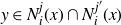 $y \in N_i^{j} (x) \cap N_i^{j'} (x)$
for some
$y \in N_i^{j} (x) \cap N_i^{j'} (x)$
for some $j \ne j'$
satisfying
$j \ne j'$
satisfying $\chi_R (ij) = \chi_R (ij') = \emptyset$
and
$\chi_R (ij) = \chi_R (ij') = \emptyset$
and $y \in V(H)$
satisfying
$y \in V(H)$
satisfying $\chi_H (xy) = \emptyset$
. Thus we must develop new techniques to prove a version of (2·4) from Section 2.1 to obtain bounds on
$\chi_H (xy) = \emptyset$
. Thus we must develop new techniques to prove a version of (2·4) from Section 2.1 to obtain bounds on $d_i(x)$
. This is the content of Section 3.2.
$d_i(x)$
. This is the content of Section 3.2.
As in Section 2.1, we partition V(H) into $V_1 \cup \cdots \cup V_k$
,
$V_1 \cup \cdots \cup V_k$
, $n_i=|V_i|$
, where
$n_i=|V_i|$
, where
 \begin{align*}V_i = \{x \in V(H)\;:\; |N_i(x)| \ge |N_j(x)| \hbox{ for all } j \ne i\}.\end{align*}
If there is a tie, we break it arbitrarily.
3·2. Partitioning argument
Let the distance between two vertices v and w in a graph G, denoted $\operatorname{dist}_G (v,w)$
, be the number of edges in the shortest path between v and w in G. In our setting, a path cannot use an edge e with
$\operatorname{dist}_G (v,w)$
, be the number of edges in the shortest path between v and w in G. In our setting, a path cannot use an edge e with $\chi(e) = \emptyset$
. Then, define
$\chi(e) = \emptyset$
. Then, define
 \[\epsilon_G (v) \;:\!=\; \max_{w\in V(G)} \operatorname{dist}_G (v,w),\]
the eccentricity of v in G. Note that the diameter $\operatorname{diam}(G) = \max_{v \in V(G)} \epsilon_G(v)$
. For convenience, let
$\operatorname{diam}(G) = \max_{v \in V(G)} \epsilon_G(v)$
. For convenience, let $\epsilon (i) \;:\!=\; \epsilon_R (i)$
for all
$\epsilon (i) \;:\!=\; \epsilon_R (i)$
for all $i\in [k]$
.
$i\in [k]$
.
Let B (x) be x in H. For $r \in \mathbb{N}$
, let
$r \in \mathbb{N}$
, let $k_r(i)$
be the number of vertices in R at distance r from i. Recall that
$k_r(i)$
be the number of vertices in R at distance r from i. Recall that $d_{\{i,j\}}(x)$
is the number of edges in H incident with x in colour
$d_{\{i,j\}}(x)$
is the number of edges in H incident with x in colour $\{i,j\}$
Lemma 3·1. Let $i,j \in [k]$
with
$i,j \in [k]$
with $\{i, j\} \in T$
and
$\{i, j\} \in T$
and $x \in V(H)$
. Then
$x \in V(H)$
. Then
 \begin{align*} {(a)} \;\;\; & d_i(x) \le \left( \frac{|B (x)|}{k_1(i)} \right)^{k_1(i)} \left( \frac{n - |B (x)|}{k - k_1(i) - 1} \right)^{k - k_1(i) - 1} \\ {(b)} \;\;\; & d_i(x) \le \left( \frac{|N_i (x)|}{k-1} \right)^{k-1} \\ {(c)} \;\;\; & d_i(x) \le d_{\{i, j\}} (x) \cdot \left( \frac{n - d_{\{i, j\}} (x)}{k-2} \right)^{k - 2}. \end{align*}
Further, the number of copies of R in H containing vertices $x,y \in V(H)$
such that
$x,y \in V(H)$
such that $x \in V(H)$
plays the role of vertex
$x \in V(H)$
plays the role of vertex $i \in [k]$
in R is at most
$i \in [k]$
in R is at most
 \[ \left( \frac{|N_i (x)|}{k-2} \right)^{k-2}. \]
Proof. We start by proving the three upper bounds on $d_i (x)$
. To count the number of copies of R in H where x plays the role of i, we will recursively partition
$d_i (x)$
. To count the number of copies of R in H where x plays the role of i, we will recursively partition $N_i (x)$
. First, we pick
$N_i (x)$
. First, we pick $k_1 (i)$
vertices from
$k_1 (i)$
vertices from $B(x) \cap N_i (x) \subset V(H)$
to play the role of the vertices adjacent to i in R. Notice that we may partition
$B(x) \cap N_i (x) \subset V(H)$
to play the role of the vertices adjacent to i in R. Notice that we may partition $B(x) \cap N_i (x)$
into
$B(x) \cap N_i (x)$
into $k_1 (i)$
parts based on the colour of each vertex to x as it uniquely determines its possible role in a copy of R. Set
$k_1 (i)$
parts based on the colour of each vertex to x as it uniquely determines its possible role in a copy of R. Set $B_1 \;:\!=\; B(x) \cap N_i (x)$
. We now recursively define
$B_1 \;:\!=\; B(x) \cap N_i (x)$
. We now recursively define $B_r$
for all
$B_r$
for all $r \in [\epsilon (i)]$
. Let
$r \in [\epsilon (i)]$
. Let $2\le r \le \epsilon (i)$
, let
$2\le r \le \epsilon (i)$
, let $m \;:\!=\; k_1 (i) + \cdots + k_{r-1} (i)$
, and suppose that we have chosen
$m \;:\!=\; k_1 (i) + \cdots + k_{r-1} (i)$
, and suppose that we have chosen $y_1, y_2, \ldots, y_m \in V(H)$
to play the roles of all vertices at distance
$y_1, y_2, \ldots, y_m \in V(H)$
to play the roles of all vertices at distance $r-1$
or less from i in R, where
$r-1$
or less from i in R, where $y_1,\ldots,y_{k_{r-1}(i)}$
play the roles of vertices at distance exactly
$y_1,\ldots,y_{k_{r-1}(i)}$
play the roles of vertices at distance exactly $r-1$
from i. Then
$r-1$
from i. Then
 \begin{align*} B_r \;:\!=\; & \, B_r (x, B_1, B_2, \ldots, B_{r-1}, y_1,\ldots, y_{k_{r-1} (i)}) \\[5pt] = & \, N_i (x) \cap \left( B (y_1) \cup \cdots \cup B (y_{k_{r-1} (i)}) \right) \setminus \left( x \cup B_1 \cup \cdots \cup B_{r-1} \right). \end{align*}
Here, $B_r$
is the set of vertices in H that can play the role of vertices at distance r from i in R, given that we have already selected all vertices at distance at most
$B_r$
is the set of vertices in H that can play the role of vertices at distance r from i in R, given that we have already selected all vertices at distance at most $r-1$
from i.
$r-1$
from i.
Note that by definition, $B_r \cap B_\ell = \emptyset$
for all
$B_r \cap B_\ell = \emptyset$
for all $r, \ell \in [\epsilon (i)]$
and
$r, \ell \in [\epsilon (i)]$
and $\bigcup B_r \subseteq N_i (x)$
. For the remainder of the proof, we write
$\bigcup B_r \subseteq N_i (x)$
. For the remainder of the proof, we write $k_r \;:\!=\; k_r (i)$
for all
$k_r \;:\!=\; k_r (i)$
for all $r \in [\epsilon (i)]$
for convenience.
$r \in [\epsilon (i)]$
for convenience.
Each vertex $v \in B_r$
has an edge to at least one of
$v \in B_r$
has an edge to at least one of $y_1, \ldots, y_{k_{r-1}}$
. The colour of this edge uniquely determines the role that v may play in a copy of R, so this allows us to uniquely partition
$y_1, \ldots, y_{k_{r-1}}$
. The colour of this edge uniquely determines the role that v may play in a copy of R, so this allows us to uniquely partition $B_{r}$
into
$B_{r}$
into $k_r$
parts. We note that it may be the case that v cannot legally play any role, but that only decreases the number of possible copies of R, so we may assume that this does not occur. Let
$k_r$
parts. We note that it may be the case that v cannot legally play any role, but that only decreases the number of possible copies of R, so we may assume that this does not occur. Let $P_r \;:\!=\; P (B_r, k_r)$
be the set of tuples
$P_r \;:\!=\; P (B_r, k_r)$
be the set of tuples $\vec{y} \in B_r^{k_r}$
with one vertex from each part of
$\vec{y} \in B_r^{k_r}$
with one vertex from each part of $B_r$
, so
$B_r$
, so
 \begin{align*}|P_r| \le p(|B_r|, k_r).\end{align*}
This gives
 \begin{align*} d_i (x) &\le \sum_{\vec{y}_1 \in P_1}\cdots \sum_{\vec{y}_{\epsilon (i) - 1} \in P_{\epsilon (i) - 1}} p(|B_{\epsilon (i)}|, k_{\epsilon (i)}) \\[5pt] &\le \sum_{\vec{y}_1 \in P_1}\cdots \sum_{\vec{y}_{\epsilon (i) - 1} \in P_{\epsilon (i) - 1}} p\left( |N_i (x)| - \sum_{r=1}^{\epsilon (i) - 1} |B_r|, k_{\epsilon (i)} \right). \end{align*}
Using (2·3) from Section 2.1 we see that
 \begin{align*} \sum_{\vec{y}_{\epsilon (i) - 1} \in P_{\epsilon (i) - 1}} \; p&\left( |N_i (x)| - \sum_{r=1}^{\epsilon (i) - 1} |B_r|, k_{\epsilon (i)} \right) \\[5pt] &\le p \left( |B_{\epsilon (i) - 1}|, k_{\epsilon (i) - 1} \right) \cdot p\left( |N_i (x)| - \sum_{r=1}^{\epsilon (i) - 1} |B_r| , k_{\epsilon (i)} \right) \\[5pt] &\le p\left( |N_i (x)| - \sum_{r=1}^{\epsilon (i) - 2} |B_r| , k_{\epsilon (i) - 1} (i) + k_{\epsilon (i)} \right). \end{align*}
Using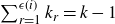 $\sum_{r = 1}^{\epsilon (i)} k_r = k-1$
, we obtain
$\sum_{r = 1}^{\epsilon (i)} k_r = k-1$
, we obtain
 \begin{align*}d_i(x) &\le \sum_{\vec{y}_1 \in P_1}\cdots \sum_{\vec{y}_{\epsilon (i) - 2} \in P_{\epsilon (i) - 2}} \; p\left( |N_i (x)| - \sum_{r=1}^{\epsilon (i) - 2} |B_r| , k_{\epsilon (i) - 1} + k_{\epsilon (i)} \right)\\&= \sum_{\vec{y}_1 \in P_1}\cdots \sum_{\vec{y}_{\epsilon (i) - 2} \in P_{\epsilon (i) - 2}} \; p\left( |N_i (x)| - \sum_{r=1}^{\epsilon (i) - 2} |B_r| , (k-1)-\sum_{r=1}^{\epsilon(i)-2} k_r \right).\end{align*}
Continuing this process, we obtain, for each $1 \le \ell \le \epsilon(i)-1$
,
$1 \le \ell \le \epsilon(i)-1$
,
 \begin{align*} d_i(x) \le \sum_{\vec{y}_1 \in P_1}\cdots \sum_{\vec{y}_{\ell} \in P_\ell} p\left( |N_i (x)| - \sum_{r=1}^{\ell} |B_r| , (k-1) - \sum_{r=1}^{\ell} k_r \right). \end{align*}
When $\ell=1$
this becomes
$\ell=1$
this becomes
 \begin{align} d_i (x) &\le \sum_{\vec{y}_1 \in P_1} p\left( |N_i (x)| - |B_1|, k -1- k_1 \right)\nonumber \\ &\le p(|B_1 |, k_1) \cdot p\left( |N_i (x)| - |B_1 |, k - k_1 - 1 \right). \end{align}
As $|B(x)| \ge |B_1|$
and
$|B(x)| \ge |B_1|$
and $n - |B(x)| \ge |N_i (x)| - |B_1 |$
for all
$n - |B(x)| \ge |N_i (x)| - |B_1 |$
for all $i \in [k]$
by definition,
$i \in [k]$
by definition,
 \[ p(|B_1|, k_1) \cdot p\left( |N_i (x)| - |B_1 |, k - k_1 - 1 \right) \le \left( \frac{|B (x)|}{k_1} \right)^{k_1} \left( \frac{n - |B (x)|}{k - k_1 - 1} \right)^{k - k_1 - 1}, \]
so (a) holds. Alternatively, (2·3) also yields
 \[ p(|B (x)|, k_1) \cdot p\left( |N_i (x)| - |B (x)|, k - k_1 - 1 \right) \leq p(|N_i(x)|, k-1) \leq \left( \frac{|N_i (x)|}{k-1} \right)^{k-1}, \]
so (b) holds.
For (c), let $j \in [k]$
such that
$j \in [k]$
such that $ij \in E$
. We bound
$ij \in E$
. We bound $d_i (x)$
as before, but we choose the vertex y that plays role j separately. We see that
$d_i (x)$
as before, but we choose the vertex y that plays role j separately. We see that
 \[ |P_1| \le d_{\{i, j\}} (x) \cdot p (|B_1| - d_{\{i,j\}}(x), k_1 -1). \]
This combined with (3·1) and (2·3) gives
 \begin{align*} d_i (x) &\le \sum_{\vec{y}_1 \in P_1} p\left( |N_i (x)| - |B_1|, k - k_1 - 1 \right) \\ &\le d_{\{i, j\}} (x) \cdot p (|B_1| - d_{\{i, j\}} (x), k_1 -1) \cdot p\left( |N_i (x)| - |B_1|, k - k_1 - 1 \right) \\ &\le d_{\{i, j\}} (x) \cdot p (n - d_{\{i, j\}} (x), k -2) \\ &\le d_{\{i, j\}} (x) \cdot \left( \frac{n - d_{\{i, j\}} (x)}{k-2} \right)^{k - 2}. \end{align*}
It remains to prove the last sentence of the lemma. We proceed as before except that, for $\ell \in [\epsilon (i)]$
such that
$\ell \in [\epsilon (i)]$
such that $y \in B_\ell$
, we require that y is chosen. This means that instead of choosing
$y \in B_\ell$
, we require that y is chosen. This means that instead of choosing $k_{\ell} (i)$
vertices from
$k_{\ell} (i)$
vertices from $B_{\ell}$
, we only need to choose
$B_{\ell}$
, we only need to choose $k_{\ell} (i)-1$
vertices from
$k_{\ell} (i)-1$
vertices from $B_{\ell}$
as we have already chosen y. Following the same procedure as before, we see that
$B_{\ell}$
as we have already chosen y. Following the same procedure as before, we see that
 \begin{align*} d_i (x)& \le \sum_{\vec{y}_1 \in P_1}\cdots \sum_{\vec{y}_{\ell} \in P_{\ell}} p \left( |B_{\ell}|, k_{\ell} - 1 \right) \cdot p\left( |N_i (x)| - \sum_{r=1}^{\ell + 1} |B_r| , (k-1) - \sum_{r=1}^{\ell + 1} k_r \right) \\ &\le \sum_{\vec{y}_1 \in P_1}\cdots \sum_{\vec{y}_{\ell} \in P_\ell} p\left( |N_i (x)| - \sum_{r=1}^{\ell} |B_r| , (k-2) - \sum_{r=1}^{\ell} k_r \right) \\ &\vdots \\ &\le \sum_{\vec{y}_1 \in P_1} p\left( |N_i (x)| - |B_1|, k - 2-k_1 \right) \\ &\le p(|B_1|, k_1) \cdot p(|N_i(x)| - |B_1|, k - 2 - k_1) \\ &\le p(|N_i (x)|, k - 2) \\ &\le \left( \frac{|N_i (x)|}{k-2} \right)^{k-2}. \end{align*}
This completes the proof.
3·3. Minimum degree
As in Section 2.2, we wish to show that each vertex of H lies in approximately the average number of copies of R.
Lemma 3·2. $d(x) \geq a n^{k-1} / (k-1)!$
for all
$d(x) \geq a n^{k-1} / (k-1)!$
for all $x \in V(H)$
.
$x \in V(H)$
.
This follows from an identical Zykov symmetrisation argument as used in the proof of Lemma 2·2. Note that we have assumed the same inequalities for M as we did in Section 2.1.
3·4. Maximum colour and non-edge degrees
The following two claims are used in the proof of Lemma 3·5 to bound the size of the second largest neighborhood.
Let
 \begin{align*}\alpha \;:\!=\; \frac{\max_{x,i,j} d_{\{i,j\}}(x)}{n}\end{align*}
where the maximum is taken over all vertices $x \in V(H)$
and all colours
$x \in V(H)$
and all colours $\{i,j\} \in T$
. We upper bound this value.
$\{i,j\} \in T$
. We upper bound this value.
Claim 3·3. $\alpha {\,\lt\,} \eta/4$
.
$\alpha {\,\lt\,} \eta/4$
.
Proof. Let x achieve this maximum, so that $d_{\{i,j\}}(x) = \alpha n$
for some
$d_{\{i,j\}}(x) = \alpha n$
for some $\{i,j\} \in T$
. By Lemma 3·1(c) and
$\{i,j\} \in T$
. By Lemma 3·1(c) and $\alpha \leq 1$
, we get
$\alpha \leq 1$
, we get
 \begin{align*} \max\{d_i(x), d_j(x)\} \leq \alpha n \left( \frac{(1-\alpha)n}{k-2} \right)^{k-2} \leq n^{k-1} \left( \frac{1-\alpha}{k-2} \right)^{k-2}. \end{align*}
For any other vertex $\ell \ne i,j$
, we have
$\ell \ne i,j$
, we have $|N_\ell(x)| \leq (1-\alpha)n$
, since
$|N_\ell(x)| \leq (1-\alpha)n$
, since $\ell$
is adjacent to no edges of colour
$\ell$
is adjacent to no edges of colour $\{i,j\}$
in R. Thus by Lemma 3·1(b), we get
$\{i,j\}$
in R. Thus by Lemma 3·1(b), we get
 \[ d_\ell(x) \leq \left( \frac{|N_\ell (x)|}{k-1} \right)^{k-1} \leq \left( \frac{(1-\alpha)n}{k-1} \right)^{k-1} \leq n^{k-1} \left( \frac{1-\alpha}{k-2} \right)^{k-2}. \]
The last inequality comes as decreasing the denominator increases the fraction, and the base is less than 1, so decreasing the exponent increases the result. Summing over all indices in [k] and using Lemma 3·2, we get
 \begin{equation*} \frac{1}{k^{k-1}-1} = \frac{a}{(k-1)!} \leq \frac{d(x)}{n^{k-1}} \leq k \left( \frac{1-\alpha}{k-2} \right)^{k-2}. \end{equation*}
Rearranging yields
 \[ \frac{1}{k} \cdot \frac{(k-2)^{k-2}}{k^{k-1}-1} \le (1-\alpha)^{k-2}. \]
We see that
 \[ \frac{(k-2)^{k-2}}{k^{k-1}-1} \geq \frac{(k-2)^{k-2}}{k^{k-1}} = \frac1k \left( 1-\frac2k \right)^{k-2} {\,\gt\,} \frac1{e^2k}, \]
so
 \[ \frac{1}{e^2k^2} {\,\lt\,} (1-\alpha)^{k-2} \leq \exp(-(k-2)\alpha). \]
Assume for contradiction that $\alpha \geq \eta/4 {\,\gt\,} C\log k/(4(k-1))$
. Then
$\alpha \geq \eta/4 {\,\gt\,} C\log k/(4(k-1))$
. Then
 \[ \frac{1}{e^2k^2} {\,\lt\,} k^{-C(1-1/(k-1))/4} {\,\lt\,} k^{-0.9C/4}, \]
since $k \geq 11$
. For
$k \geq 11$
. For $C {\,\gt\,} 10$
, this gives a contradiction for sufficiently large k.
$C {\,\gt\,} 10$
, this gives a contradiction for sufficiently large k.
Let
 \begin{align*}\beta \;:\!=\; \frac{\max_{x} d_\emptyset(x)}{n},\end{align*}
where the maximum is taken over all vertices $x \in V(H)$
and
$x \in V(H)$
and $d_\emptyset(x)$
is the number of edges in H incident with x in colour
$d_\emptyset(x)$
is the number of edges in H incident with x in colour $\emptyset$
(non-edges). Note that we may assume that R has at least one non-edge, since otherwise the proof from Section 2 suffices. Thus we may also assume that H has at least one non-edge, so
$\emptyset$
(non-edges). Note that we may assume that R has at least one non-edge, since otherwise the proof from Section 2 suffices. Thus we may also assume that H has at least one non-edge, so $\beta {\,\gt\,}0$
. We upper bound
$\beta {\,\gt\,}0$
. We upper bound $\beta$
.
$\beta$
.
Claim 3·4. $\beta {\,\lt\,} 1-\eta/2$
.
$\beta {\,\lt\,} 1-\eta/2$
.
Proof. Assume for contradiction that $\beta \geq 1 - \eta/2$
. Let x achieve this maximum so that
$\beta \geq 1 - \eta/2$
. Let x achieve this maximum so that $d_\emptyset (x) = \beta n$
. This implies that
$d_\emptyset (x) = \beta n$
. This implies that $B(x) = (1 - \beta) n$
. For any
$B(x) = (1 - \beta) n$
. For any $i \in V(R)$
, Lemma 3·1(a) gives
$i \in V(R)$
, Lemma 3·1(a) gives
 \begin{align*} d_i (x) &\le \left( \frac{B (x)}{k_1(i)} \right)^{k_1(i)} \left( \frac{n - B (x)}{k - k_1(i) - 1} \right)^{k - k_1(i) - 1} \\ &= \left( \frac{(1- \beta) n}{k_1(i)} \right)^{k_1(i)} \left( \frac{\beta n}{k - k_1(i) - 1} \right)^{k - k_1(i) - 1} \\ &= n^{k-1} \frac1{k_1 (i)^{k_1 (i)}} (1-\beta)^{k_1 (i)}\beta^{k- k_1 (i) -1} \left( \frac{1}{k-1-k_1 (i)} \right)^{k-1-k_1 (i)}. \end{align*}
For this section, we take the convention $0^0 = 1$
to handle the case that
$0^0 = 1$
to handle the case that $k_1(i) = k-1$
.
$k_1(i) = k-1$
.
Let $q = k_1(i)/(k-1) \in (0,1]$
. Then
$q = k_1(i)/(k-1) \in (0,1]$
. Then
 \begin{equation} d_i (x) \le \left( \frac{n}{k-1} \right)^{k-1} \left( \frac{(1-\beta)^q\beta^{1-q}}{q^q(1-q)^{1-q}} \right)^{k-1}. \end{equation}
We will first bound the term
 \begin{equation} \frac{(1-\beta)^q \beta^{1-q}}{q^q (1-q)^{1-q}}. \end{equation}
Regarding (3·3) as a function of $\beta$
, we see that the derivative
$\beta$
, we see that the derivative
 \[ \frac{\partial}{\partial \beta}\left( \frac{(1-\beta)^q \beta^{1-q}}{q^q (1-q)^{1-q}} \right) = \frac{(1-\beta)^{q-1}\beta^{-q}}{q^q(1-q)^{1-q}}((1-q)-\beta) \]
is negative for $\beta {\,\gt\,} 1-q$
since the fraction is nonnegative. Recall that
$\beta {\,\gt\,} 1-q$
since the fraction is nonnegative. Recall that $k_1(i) = \deg_R(i) \geq \eta (k-1)$
by assumption, so
$k_1(i) = \deg_R(i) \geq \eta (k-1)$
by assumption, so $q {\,\gt\,} \eta$
. We have also assumed for contradiction that
$q {\,\gt\,} \eta$
. We have also assumed for contradiction that $\beta \geq 1-\eta/2 {\,\gt\,} 1-\eta {\,\gt\,} 1-q$
. Thus decreasing
$\beta \geq 1-\eta/2 {\,\gt\,} 1-\eta {\,\gt\,} 1-q$
. Thus decreasing $\beta$
to
$\beta$
to $1 - \eta/2$
will only increase (3·3), i.e.
$1 - \eta/2$
will only increase (3·3), i.e.
 \begin{equation} \frac{(1-\beta)^q \beta^{1-q}}{q^q (1-q)^{1-q}} \leq \frac{(\eta/2)^q (1-\eta/2)^{1-q}}{q^q (1-q)^{1-q}}. \end{equation}
We now have a function purely of q. Taking the derivative, we get
 \[ \frac{\partial}{\partial q} \left( \frac{(\eta/2)^q (1-\eta/2)^{1-q}}{q^q (1-q)^{1-q}} \right) = \frac{1}{2} (1 - q)^{q - 1} q^{-q} (2 - \eta)^{1-q} \eta^q \log \left( \frac{\eta (1-q)}{q (2 - \eta)} \right), \]
where all terms are positive except the logarithm, which is negative for $q {\,\gt\,} \eta/2$
. Thus (3·4) is decreasing with q for
$q {\,\gt\,} \eta/2$
. Thus (3·4) is decreasing with q for $q {\,\gt\,} \eta/2$
, so we may take the further upper bound
$q {\,\gt\,} \eta/2$
, so we may take the further upper bound
 \begin{equation*} \frac{(1-\beta)^q \beta^{1-q}}{q^q (1-q)^{1-q}} \leq \frac{(\eta/2)^\eta (1-\eta/2)^{1-\eta}}{\eta^\eta (1-\eta)^{1-\eta}} = 2^{-\eta} \left( 1+\frac{\eta}{2(1-\eta)} \right)^{1-\eta}, \end{equation*}
where $2^{-\eta} \left( 1+\frac{\eta}{2(1-\eta)} \right)^{1-\eta} \leq \exp(-(\!\log 2 - 1/2)\eta)$
.
$2^{-\eta} \left( 1+\frac{\eta}{2(1-\eta)} \right)^{1-\eta} \leq \exp(-(\!\log 2 - 1/2)\eta)$
.
We now have an appropriate upper bound. Substituting into (3·2) and recalling that $\eta {\,\gt\,} C \log k / k$
, we see that
$\eta {\,\gt\,} C \log k / k$
, we see that
 \[ d_i(x) \leq \left( \frac{n}{k-1} \right)^{k-1} \exp(-(\!\log 2 - 1/2)(k-1)\eta) {\,\lt\,} \left( \frac{n}{k-1} \right)^{k-1} k^{-C(\!\log 2-1/2)}. \]
Using Lemma 3·2, we get
 \[ \frac{1}{k^{k-1}-1} = \frac{a}{(k-1)!} \leq \frac{d(x)}{n^{k-1}} \leq k \left( \frac{1}{k-1} \right)^{k-1} k^{-C(\!\log 2-1/2)}. \]
Rearranging terms and using the standard inequality (2·7) yields
 \[ \frac{1}{ek} \leq k^{-C(\!\log 2-1/2)}. \]
For $C {\,\gt\,} 1/(\!\log 2-1/2) \approx 5.18$
, this yields a contradiction for sufficiently large k.
$C {\,\gt\,} 1/(\!\log 2-1/2) \approx 5.18$
, this yields a contradiction for sufficiently large k.
3·5. The second largest neighborhood
For a vertex $x \in V(H)$
, let Z(x) be the second largest set in
$x \in V(H)$
, let Z(x) be the second largest set in $\{N_1(x), \ldots, N_k(x)\}$
and define
$\{N_1(x), \ldots, N_k(x)\}$
and define
 \begin{align*}z\;:\!=\; z_{k,n} = \max_{x \in V(H)} \frac{|Z(x)|}{n}.\end{align*}
Lemma 3·5. $z {\,\lt\,} 1-\eta/8$
.
$z {\,\lt\,} 1-\eta/8$
.
Proof. Let $x \in V(H)$
such that
$x \in V(H)$
such that $z=|Z(x)|/n$
. Suppose
$z=|Z(x)|/n$
. Suppose $x \in V_i$
and
$x \in V_i$
and $Z(x) = N_j(x)$
for distinct
$Z(x) = N_j(x)$
for distinct $i,j \in [k]$
. Then we want to bound
$i,j \in [k]$
. Then we want to bound $|N_i(x) \cap Z(x)|$
. Suppose
$|N_i(x) \cap Z(x)|$
. Suppose $y \in N_i(x) \cap Z(x)$
. If
$y \in N_i(x) \cap Z(x)$
. If $xy \in E$
, then
$xy \in E$
, then $i \in \chi_H(xy)$
and
$i \in \chi_H(xy)$
and $j \in \chi_H(xy)$
, so
$j \in \chi_H(xy)$
, so $\chi_H(xy) = \{i,j\}$
. Thus
$\chi_H(xy) = \{i,j\}$
. Thus $|N_1(x)\cap Z(x)| \leq d_{\{i,j\}}(x) + d_\emptyset(x)$
. It follows that
$|N_1(x)\cap Z(x)| \leq d_{\{i,j\}}(x) + d_\emptyset(x)$
. It follows that
 \begin{align*}|N_i(x)|+|Z(x)| =|N_i(x) \cup Z(x)|+|N_i(x) \cap Z(x)| \le n + d_{\{i,j\}} (x) + d_\emptyset(x),\end{align*}
where $d_{\{i,j\}} (x) \leq \alpha n$
and
$d_{\{i,j\}} (x) \leq \alpha n$
and $d_\emptyset(x) \leq \beta n$
. Thus,
$d_\emptyset(x) \leq \beta n$
. Thus, $|N_i(x)| + |Z(x)| {\,\lt\,} (2-\eta/4)n$
by Claims 3·3 and 3·4 Since
$|N_i(x)| + |Z(x)| {\,\lt\,} (2-\eta/4)n$
by Claims 3·3 and 3·4 Since $|Z(x)| \leq |N_i(x)|$
, this gives
$|Z(x)| \leq |N_i(x)|$
, this gives $z {\,\lt\,} 1-\eta/8$
.
$z {\,\lt\,} 1-\eta/8$
.
3·6. One large part
We now take care of the situation when one of the $V_i$
’s is very large.
$V_i$
’s is very large.
Lemma 3·6. $|V_i| \le (1-1/3k)n$
for all
$|V_i| \le (1-1/3k)n$
for all $i \in [k]$
.
$i \in [k]$
.
Proof. By contradiction, w.l.o.g. suppose that $|V_1|{\,\gt\,}(1-1/3k)n$
. If
$|V_1|{\,\gt\,}(1-1/3k)n$
. If $x \in V_1$
, then
$x \in V_1$
, then $|N_1(x)|\ge |N_i(x)|$
for all
$|N_1(x)|\ge |N_i(x)|$
for all $i{\,\gt\,}1$
so
$i{\,\gt\,}1$
so $|N_2(x)| \le |Z(x)| \le z n$
. Applying Lemma 3·1(b) to
$|N_2(x)| \le |Z(x)| \le z n$
. Applying Lemma 3·1(b) to $d_2 (x)$
gives
$d_2 (x)$
gives
 \begin{align*}a{\binom{n}{k}} \le I(R, H) = \sum_{x \in V(H)} d_2(x) \le |V_1| \left( \frac{zn}{k-1} \right)^{k-1} + \frac{n}{3k} \left( \frac{n}{k-1} \right)^{k-1}\end{align*}
and we further see that
 \begin{align*}|V_1| \left( \frac{zn}{k-1} \right)^{k-1} + \frac{n}{3k} \left( \frac{n}{k-1} \right)^{k-1} \leq \left(z^{k-1}+\frac{1}{3k}\right) \frac{n^k}{(k-1)^{k-1}}.\end{align*}
Rearranging and using $M^k/(M)_k {\,\lt\,} 1.01$
as assumed in (2·1), we get
$M^k/(M)_k {\,\lt\,} 1.01$
as assumed in (2·1), we get
 \begin{equation*} \frac{(k-1)^{k-1}}{k^k-k} \leq 1.01 \left( z^{k-1} + \frac{1}{3k} \right). \end{equation*}
Using the standard inequality (2·7) and then Lemma 3·5 gives
 \[ \left( \frac1{1.01e} - \frac13 \right)\frac1k {\,\lt\,} z^{k-1} {\,\lt\,} \left( 1-\frac\eta8 \right)^{k-1} \leq \exp(\!-C\log k/8 ) = k^{-C/8}. \]
For any $C{\,\gt\,}8$
this fails to hold for sufficiently large k.
$C{\,\gt\,}8$
this fails to hold for sufficiently large k.
3·7. Counting the copies of R in H
The way we count copies of R in H is very similar to the previous section and to [ Reference Mubayi and Razborov12 ]. While we do not have as much information in this case, without a focus on optimising for small k, we allow ourselves to be less strict with the counting arguments.
Call a copy f of R in H transversal if it includes exactly one vertex in $V_i$
for all
$V_i$
for all $i \in [k]$
. We partition the copies of R in H as
$i \in [k]$
. We partition the copies of R in H as $H_m \cup H_g \cup H_b$
where
$H_m \cup H_g \cup H_b$
where $H_m$
comprises those copies that lie entirely inside some
$H_m$
comprises those copies that lie entirely inside some $V_i$
,
$V_i$
, $H_g$
comprises those copies that intersect every
$H_g$
comprises those copies that intersect every $V_i$
whose edge colouring coincides with the natural one given by the vertex partition (meaning the map from R to H takes vertex i to a vertex in
$V_i$
whose edge colouring coincides with the natural one given by the vertex partition (meaning the map from R to H takes vertex i to a vertex in $V_i$
), and
$V_i$
), and $H_b$
comprises all other copies of R (including those transversal copies where some vertex is in an inappropriate
$H_b$
comprises all other copies of R (including those transversal copies where some vertex is in an inappropriate $V_i$
). Thus a transversal copy f is in
$V_i$
). Thus a transversal copy f is in $H_b$
if and only if the unique map
$H_b$
if and only if the unique map $\phi \;:\; [k] \to f$
with
$\phi \;:\; [k] \to f$
with $\phi(i) \in V_i$
for all i is not a graph isomorphism from
$\phi(i) \in V_i$
for all i is not a graph isomorphism from $R \to H[f]$
. Let
$R \to H[f]$
. Let $h_m=|H_m|, h_g=|H_g|$
and
$h_m=|H_m|, h_g=|H_g|$
and $h_b=|H_b|$
so that
$h_b=|H_b|$
so that
 \begin{align*}I(R, H) = h_m+h_g+h_b.\end{align*}
We will bound each of these three terms separately. As in Section 2.6, let D be the set of all pairs $\{v,w\}$
such that
$\{v,w\}$
such that $v \in V_i, w \in V_j,$
and
$v \in V_i, w \in V_j,$
and $\chi_H(vw) \ne \chi_R(ij)$
where
$\chi_H(vw) \ne \chi_R(ij)$
where $i \ne j$
. Let
$i \ne j$
. Let $\delta \;:\!=\; |D|/\binom n2$
. The identical reasoning as in Section 2.6 gives the first two bounds
$\delta \;:\!=\; |D|/\binom n2$
. The identical reasoning as in Section 2.6 gives the first two bounds
 \begin{equation} {}h_m = \sum_{j=1}^k I(R, H[V_j]) \le \sum_{j=1}^k I(R, n_j)\end{equation}
and
 \begin{equation} {}h_g \le\prod_{\ell=1}^k n_{\ell}\left(1-\frac{\delta{\binom{n}{2}}}{\sum_{1\le i{\,\lt\,}j\le k}n_in_j}\right) = \prod_{\ell=1}^k n_{\ell}\left(1-\frac{\delta{\binom{n}{2}}}{{\binom{n}{2}} - \sum_i {\binom{n_i}{2}}}\right).\end{equation}
Our next task is to upper bound $h_b$
. This argument must be carried out differently. For a vertex
$h_b$
. This argument must be carried out differently. For a vertex $x \in V(H)$
and
$x \in V(H)$
and $j \in [k]$
, recall that
$j \in [k]$
, recall that $N_j(x) \subset V(H)$
is the set of y such that x, y lie in a copy of R with x playing the role of vertex j in R. Let us enumerate the set J of ordered pairs (e, f) where
$N_j(x) \subset V(H)$
is the set of y such that x, y lie in a copy of R with x playing the role of vertex j in R. Let us enumerate the set J of ordered pairs (e, f) where $e\in D, f \in H_b$
, and
$e\in D, f \in H_b$
, and $e \subset f$
. To simplify the argument and notation, we count pairs instead of triples as in Section 2.
$e \subset f$
. To simplify the argument and notation, we count pairs instead of triples as in Section 2.
We must show that each $f \in H_b$
contains an edge in D. If f is transversal, then as we have noted, the natural map is not a graph isomorphism. Thus there is some incorrectly coloured edge which is in D. If f is not transversal, there is some
$f \in H_b$
contains an edge in D. If f is transversal, then as we have noted, the natural map is not a graph isomorphism. Thus there is some incorrectly coloured edge which is in D. If f is not transversal, there is some $i \in [k]$
such that
$i \in [k]$
such that $|f \cap V_i|\ge 2$
. Note that
$|f \cap V_i|\ge 2$
. Note that $f \notin H_m$
, so
$f \notin H_m$
, so $|f \cap V_i| {\,\lt\,} k$
. As R is connected, there exist
$|f \cap V_i| {\,\lt\,} k$
. As R is connected, there exist $v \in V_i,\;u \in V_j$
for some
$v \in V_i,\;u \in V_j$
for some $j \ne i$
such that vu is an edge in f. Since
$j \ne i$
such that vu is an edge in f. Since $|f \cap V_i| \geq 2$
, choose also
$|f \cap V_i| \geq 2$
, choose also $w \in f \cap V_i$
with
$w \in f \cap V_i$
with $w \ne v$
. If
$w \ne v$
. If $\chi_R (ij) = \emptyset$
then
$\chi_R (ij) = \emptyset$
then $vu \in D$
. If
$vu \in D$
. If $\chi_R (ij) = \{ i, j\},$
then as
$\chi_R (ij) = \{ i, j\},$
then as $\chi_H (vu) = \chi_H (wu) = \{ i, j\}$
would contradict that f is a copy of R in H, we must have that uv or uw in D. This gives us that
$\chi_H (vu) = \chi_H (wu) = \{ i, j\}$
would contradict that f is a copy of R in H, we must have that uv or uw in D. This gives us that
 \[ h_b \le |J| .\]
To bound $|J|$
from above, we start by choosing some bad edge
$|J|$
from above, we start by choosing some bad edge $vw \in D$
. Let
$vw \in D$
. Let $f \subset V(H)$
such that
$f \subset V(H)$
such that $(vw,f) \in J$
. Either
$(vw,f) \in J$
. Either $v \in V_i$
does not play the role of i or
$v \in V_i$
does not play the role of i or $w \in V_j$
does not play the role of j in f. Then
$w \in V_j$
does not play the role of j in f. Then $f \subset N_\ell (v) \cup \{ v \}$
for some
$f \subset N_\ell (v) \cup \{ v \}$
for some $\ell \neq i$
or
$\ell \neq i$
or $f \subset N_\ell(w) \cup \{w\}$
for some
$f \subset N_\ell(w) \cup \{w\}$
for some $\ell \neq j$
. We have
$\ell \neq j$
. We have $|N_\ell(v)|,|N_\ell(w)| \leq zn$
by the definition of z and the partition
$|N_\ell(v)|,|N_\ell(w)| \leq zn$
by the definition of z and the partition $V_1 \cup \cdots \cup V_k = V(H)$
. By the final statement of Lemma 3·1,
$V_1 \cup \cdots \cup V_k = V(H)$
. By the final statement of Lemma 3·1,
 \[ |J|\le \sum_{vw \in D} \left( \sum_{\ell \ne i} \left( \frac{|N_\ell(v)|}{k-2} \right)^{k-2} + \sum_{\ell \ne j} \left( \frac{|N_\ell(w)|}{k-2} \right)^{k-2} \right) \leq 2|D| (k-1) \left( \frac{zn}{k-2} \right)^{k-2} . \]
Thus, recalling that $\delta \;:\!=\; |D|/\binom n2$
, we obtain
$\delta \;:\!=\; |D|/\binom n2$
, we obtain
 \begin{equation} h_b \leq 2\delta (k-1) \binom{n}{2} \left( \frac{zn}{k-2} \right)^{k-2}.\end{equation}
Using (3·5), (3·6), and (3·7) we obtain
 \begin{equation} I(R, n) \leq \sum_{i} I(R, n_i) + \prod_{\ell} n_{\ell}\left(1-\frac{\delta{\binom{n}{2}}}{{\binom{n}{2}} - \sum_i {\binom{n_i}{2}}}\right) + 2\delta (k-1) \binom{n}{2} \left( \frac{zn}{k-2} \right)^{k-2}.\end{equation}
Our final task is to upper bound the RHS.
As in Section 3.7, we see that $\delta \in I\stackrel{\rm def}{=} \left[0, 1 - \sum_i {\binom{n_i}{2}}/{\binom{n}{2}} \right]$
. Viewing (3·8) as a linear function of
$\delta \in I\stackrel{\rm def}{=} \left[0, 1 - \sum_i {\binom{n_i}{2}}/{\binom{n}{2}} \right]$
. Viewing (3·8) as a linear function of $\delta$
, it again suffices to check the endpoints of I.
$\delta$
, it again suffices to check the endpoints of I.
3·8. The extremal case
Claim 3·7. If $\delta = 0$
, then
$\delta = 0$
, then $\operatorname{ind}(R) \le a$
.
$\operatorname{ind}(R) \le a$
.
Proof. If $\delta=0$
, then (3·8) implies that
$\delta=0$
, then (3·8) implies that
 \begin{equation*} I(R, n) \le \sum_{i=1}^k I(R, n_i) + \prod_{i=1}^k n_i.\end{equation*}
This is the same equation as (2·17), and we have all the same assumptions. The same argument as in Section 2.7 derives a contradiction.
3·9. The absurd case
Now, we consider the other endpoint of I.
Claim 3·8. If $\delta = 1 - \sum_i {\binom{n_i}{2}}/{\binom{n}{2}}$
, then
$\delta = 1 - \sum_i {\binom{n_i}{2}}/{\binom{n}{2}}$
, then $\operatorname{ind}(R) \le a$
.
$\operatorname{ind}(R) \le a$
.
Proof. If $\delta=1 - \sum_i {\binom{n_i}{2}}/{\binom{n}{2}}$
, then (3·8) implies that
$\delta=1 - \sum_i {\binom{n_i}{2}}/{\binom{n}{2}}$
, then (3·8) implies that
 \begin{equation} I(R, n) \le \sum_{i=1}^k I(R, n_i) + 2(k-1) \sum_{i \neq j} n_in_j \left(\frac{z}{k-2}\right)^{k-2}n^{k-2}.\end{equation}
This is similar to (2·23) with an extra factor of approximately $k^2$
in the second term. We can bound the first sum using the same techniques as in Section 2.7, giving (2·23):
$k^2$
in the second term. We can bound the first sum using the same techniques as in Section 2.7, giving (2·23):
 \begin{equation} \frac{1}{\binom nk} \sum_{i=1}^k I(R,n_i) \leq \ell\frac{\binom{c_0}{k}}{\binom{n}{k}} + (\!\operatorname{ind}(R) + {\varepsilon}) \sum_{i=\ell+1}^k p_i^k {\,\lt\,} 0.74 \operatorname{ind}(R). \end{equation}
We now bound the second term. Dividing by $\binom nk$
, we reorganize
$\binom nk$
, we reorganize
 \[ \frac{2}{\binom nk} (k-1) \left( \sum_{i \ne j} n_in_j \right)\left(\frac{z}{k-2}\right)^{k-2}n^{k-2} = \frac{2 (k-1)(k^k-k) n^k}{(k-2)^{k-2} (n)_k}\left( \sum_{i \ne j} p_i p_j \right) z^{k-2}a. \]
We first relax $(k-1)(k^k-k) {\,\lt\,} k^{k+1}$
. Observe that
$(k-1)(k^k-k) {\,\lt\,} k^{k+1}$
. Observe that $k^{k-2}/(k-2)^{k-2} \leq e^2$
. Thus this first quotient is at most
$k^{k-2}/(k-2)^{k-2} \leq e^2$
. Thus this first quotient is at most $e^2k^3$
. For
$e^2k^3$
. For $n{\,\gt\,}M$
, we have
$n{\,\gt\,}M$
, we have $n^k/(n)_k {\,\lt\,} 1 + {\varepsilon} \leq 1.01$
. Finally,
$n^k/(n)_k {\,\lt\,} 1 + {\varepsilon} \leq 1.01$
. Finally, $\sum_{i \neq j} p_ip_j = (1-\sum p_i^2) / 2 \leq (1-1/k) / 2 \leq 1/2$
as
$\sum_{i \neq j} p_ip_j = (1-\sum p_i^2) / 2 \leq (1-1/k) / 2 \leq 1/2$
as $\sum p_i^2$
is minimised when
$\sum p_i^2$
is minimised when $p_i = 1/k$
for all i. Thus
$p_i = 1/k$
for all i. Thus
 \[ \frac{2}{\binom nk} (k-1) \left( \sum_{i \ne j} n_in_j \right)\left(\frac{z}{k-2}\right)^{k-2}n^{k-2} \leq 2 e^2 k^3 \cdot 1.01 \cdot \frac{1}{2} \cdot z^{k-2}a = 1.01e^2k^3 z^{k-2} a. \]
By Lemma 3·5, we know that $z^{k-2} \leq \left( 1-\eta/8 \right)^{k-2}$
, and we further see that
$z^{k-2} \leq \left( 1-\eta/8 \right)^{k-2}$
, and we further see that
 \[ \left( 1-\frac{\eta}{8} \right)^{k-2} \leq \exp\left(\! -\frac{(k-2)\eta}8 \right) \leq \exp\left(\! -\frac C8 \left( 1 - \frac{1}{k-1} \right) \log k \right) {\,\lt\,} k^{-0.9C/8}. \]
We again used $k \geq 11$
here. Thus for
$k \geq 11$
here. Thus for $C {\,\gt\,} 24/0.9 \approx 26.67$
and
$C {\,\gt\,} 24/0.9 \approx 26.67$
and $k \geq 11$
, we have
$k \geq 11$
, we have $1.01e^2k^3z^{k-2}a {\,\lt\,} 0.25a$
. Recalling that
$1.01e^2k^3z^{k-2}a {\,\lt\,} 0.25a$
. Recalling that $a{\,\lt\,}\operatorname{ind}(R)$
, plugging this and (3·10) into (3·9) gives
$a{\,\lt\,}\operatorname{ind}(R)$
, plugging this and (3·10) into (3·9) gives
 \[ \operatorname{ind}(R,n) \leq 0.74 \operatorname{ind}(R) + 0.25 \, a {\,\lt\,} 0.99\operatorname{ind}(R).\]
This contradiction completes the proof of the claim and the theorem.
4. Disconnected rainbow graphs
In this section, we show that rainbow graphs with multiple connected components are not fractalisers.
Let $R = (V,E)$
be a rainbow graph with k vertices and
$R = (V,E)$
be a rainbow graph with k vertices and $\ell {\,\gt\,} 1$
connected components. Let
$\ell {\,\gt\,} 1$
connected components. Let $R = R_1 \cup \cdots \cup R_\ell$
be the connected components of size
$R = R_1 \cup \cdots \cup R_\ell$
be the connected components of size $c_1,\ldots,c_\ell$
respectively. Assume also
$c_1,\ldots,c_\ell$
respectively. Assume also $c_i \geq 2$
for all i (no isolated vertices). We will show that R is not a fractaliser.
$c_i \geq 2$
for all i (no isolated vertices). We will show that R is not a fractaliser.
We begin by upper bounding the number of copies $I(R,G_n)$
for
$I(R,G_n)$
for $G_n \in \mathcal{G}_R(n)$
an iterated balanced blow-up. Then for any
$G_n \in \mathcal{G}_R(n)$
an iterated balanced blow-up. Then for any $i \in [\ell]$
, by the same argument as for computing the inducibility of the iterated balanced blow-up (see e.g. [
Reference Pippenger and Golumbic14
]),
$i \in [\ell]$
, by the same argument as for computing the inducibility of the iterated balanced blow-up (see e.g. [
Reference Pippenger and Golumbic14
]),
 \[ I(R_i,G_n) = \left( \frac nk \right)^{c_i} + k\left( \frac{n}{k^2} \right)^{c_i} + k^2\left( \frac{n}{k^3} \right)^{c_i} + \cdots = (1+o(1)) \frac{n^{c_i}}{k^{c_i}-k}. \]
Any $S \subset V(G_n)$
with
$S \subset V(G_n)$
with $G_n[S] \cong R$
has a unique partition
$G_n[S] \cong R$
has a unique partition $S = S_1 \cup \cdots \cup S_\ell$
where
$S = S_1 \cup \cdots \cup S_\ell$
where $G_n[S_i] \cong R_i$
. Thus we can upper bound
$G_n[S_i] \cong R_i$
. Thus we can upper bound
 \begin{equation} I(R,G_n) \leq \prod_{i=1}^\ell I(R_i,G_n) = (1+o(1))n^k \prod_{i=1}^\ell \frac{1}{k^{c_i}-k}.\end{equation}
However, consider instead the family of graphs $\mathcal{H}(n)$
consisting of separate iterated balanced blow-ups of each part. Formally,
$\mathcal{H}(n)$
consisting of separate iterated balanced blow-ups of each part. Formally, $H\in \mathcal{H}(n)$
if
$H\in \mathcal{H}(n)$
if $|V(H)| = n$
and we have a partition
$|V(H)| = n$
and we have a partition $V(H) = V_1 \cup \cdots \cup V_\ell$
with the following properties:
$V(H) = V_1 \cup \cdots \cup V_\ell$
with the following properties:
-
(1) for all
$i \in [\ell]$
,
$\big| |V_i| - \frac{c_i}{k} n \big| \leq 1$
; -
(2) for all
$i \in [\ell]$
, the induced subgraph
$G[V_i] \in \mathcal{G}_{R_i}(|V_i|)$
; -
(3) for all
$v \in V_i, w \in V_j$
with
$i \ne j$
, we have
$vw \notin E(H)$
.





In $\mathcal{H}(n)$
, there are no edges between any copy of
$\mathcal{H}(n)$
, there are no edges between any copy of $R_i$
and any copy of
$R_i$
and any copy of $R_j$
for distinct i, j. Since R is rainbow, copies of each component
$R_j$
for distinct i, j. Since R is rainbow, copies of each component $R_i$
exist only in
$R_i$
exist only in $V_i$
. Then for
$V_i$
. Then for $H_n \in \mathcal{H}(n)$
, we have that
$H_n \in \mathcal{H}(n)$
, we have that $I(R,H_n) = \prod_i I(R_i,H_n[V_i])$
, so
$I(R,H_n) = \prod_i I(R_i,H_n[V_i])$
, so
 \begin{equation} I(R,H_n) = \prod_{i=1}^\ell (1+o(1)) \frac{c_i!}{c_i^{c_i}-c_i} \binom{\frac{c_i}{k}n}{c_i} = (1+o(1))n^k \prod_{i=1}^\ell \frac{1}{k^{c_i}-k(\frac{k}{c_i})^{c_i-1}}.\end{equation}
Comparing (4·1) with (4·2), we subtract larger numbers in the denominator of (4·2), so the family of graphs $\mathcal{H}(n)$
induces asymptotically more copies than the family
$\mathcal{H}(n)$
induces asymptotically more copies than the family $\mathcal{G}_R(n)$
. Thus R is not a fractaliser. Since R was generic, disconnected rainbow graphs without isolated vertices are not fractalisers.
$\mathcal{G}_R(n)$
. Thus R is not a fractaliser. Since R was generic, disconnected rainbow graphs without isolated vertices are not fractalisers.
5. Concluding remark
We now address the problem of maximising the number of rainbow cliques on k vertices (without fixing a specific rainbow colouring). In other words, for $\mathcal{G}_n$
the set of
$\mathcal{G}_n$
the set of $\binom{k}{2}$
-edge-coloured
$\binom{k}{2}$
-edge-coloured $K_n$
, let
$K_n$
, let
 \begin{equation} \gamma_k\;:\!=\; \lim_{n \to \infty} \frac{\max_{G \in \mathcal{G}_n} \left| \left\{ S\subset V(G) \;:\; |S| = k \text{ and } G[S] \text{ is rainbow} \right\} \right|}{\binom{n}{k}}.\end{equation}
We note that $\gamma_k \ge k!/(k^k-k)$
.
$\gamma_k \ge k!/(k^k-k)$
.
A 15-edge-colouring of $K_{16}$
.
$K_{16}$
.

The result of [
Reference Balogh, Hu, Lidický, Pfender, Volec and Young2
] shows that $\gamma_3{\,\gt\,}3!/(3^3-3)=1/4$
. We show that
$\gamma_3{\,\gt\,}3!/(3^3-3)=1/4$
. We show that $\gamma_6{\,\gt\,}6!/(6^6-6)$
. Notice that a rainbow
$\gamma_6{\,\gt\,}6!/(6^6-6)$
. Notice that a rainbow $K_6$
has
$K_6$
has $\binom{6}{2} = 15$
colours. Consider the 15-edge-colouring of
$\binom{6}{2} = 15$
colours. Consider the 15-edge-colouring of $K_{16}$
displayed in Figure 1 and note that each colour class is a perfect matching. Letting the set of colours be
$K_{16}$
displayed in Figure 1 and note that each colour class is a perfect matching. Letting the set of colours be $\{1,2,\ldots,15\}$
, the adjacency matrix for this graph is shown below, where the i, jth entry is the colour assigned to the edge ij.
$\{1,2,\ldots,15\}$
, the adjacency matrix for this graph is shown below, where the i, jth entry is the colour assigned to the edge ij.
 \begin{align*}\left[\begin{array}{cccccccccccccccc}0 & 1 & 2 & 3 & 4 & 5 & 6 & 7 & 8 & 9 & 10 & 11 & 12 & 13 & 14 & 15 \\[2pt]1 & 0 & 3 & 2 & 5 & 4 & 7 & 6 & 9 & 8 & 11 & 10 & 13 & 12 & 15 & 14 \\[2pt]2 & 3 & 0 & 1 & 6 & 7 & 4 & 5 & 10 & 11 & 8 & 9 & 14 & 15 & 12 & 13 \\[2pt]3 & 2 & 1 & 0 & 7 & 6 & 5 & 4 & 11 & 10 & 9 & 8 & 15 & 14 & 13 & 12 \\[2pt]4 & 5 & 6 & 7 & 0 & 1 & 2 & 3 & 12 & 13 & 14 & 15 & 8 & 9 & 10 & 11 \\[2pt]5 & 4 & 7 & 6 & 1 & 0 & 3 & 2 & 13 & 12 & 15 & 14 & 9 & 8 & 11 & 10 \\[2pt]6 & 7 & 4 & 5 & 2 & 3 & 0 & 1 & 14 & 15 & 12 & 13 & 10 & 11 & 8 & 9 \\[2pt]7 & 6 & 5 & 4 & 3 & 2 & 1 & 0 & 15 & 14 & 13 & 12 & 11 & 10 & 9 & 8 \\[2pt]8 & 9 & 10 & 11 & 12 & 13 & 14 & 15 & 0 & 1 & 2 & 3 & 4 & 5 & 6 & 7 \\[2pt]9 & 8 & 11 & 10 & 13 & 12 & 15 & 14 & 1 & 0 & 3 & 2 & 5 & 4 & 7 & 6 \\[2pt]10 & 11 & 8 & 9 & 14 & 15 & 12 & 13 & 2 & 3 & 0 & 1 & 6 & 7 & 4 & 5 \\[2pt]11 & 10 & 9 & 8 & 15 & 14 & 13 & 12 & 3 & 2 & 1 & 0 & 7 & 6 & 5 & 4 \\[2pt]12 & 13 & 14 & 15 & 8 & 9 & 10 & 11 & 4 & 5 & 6 & 7 & 0 & 1 & 2 & 3 \\[2pt]13 & 12 & 15 & 14 & 9 & 8 & 11 & 10 & 5 & 4 & 7 & 6 & 1 & 0 & 3 & 2 \\[2pt]14 & 15 & 12 & 13 & 10 & 11 & 8 & 9 & 6 & 7 & 4 & 5 & 2 & 3 & 0 & 1 \\[2pt]15 & 14 & 13 & 12 & 11 & 10 & 9 & 8 & 7 & 6 & 5 & 4 & 3 & 2 & 1 & 0 \end{array}\right]\end{align*}
Of the 8008 subgraphs on 6 vertices, 448 of them are rainbow. Thus, the density of a rainbow $K_6$
in this graph is
$K_6$
in this graph is ${448}/{8008} = {8}/{143} \approx 0.056$
. Considering the iterated balanced blow-up of this construction, we see that
${448}/{8008} = {8}/{143} \approx 0.056$
. Considering the iterated balanced blow-up of this construction, we see that
 \begin{align*} \gamma_6 &\ge \lim_{n \to \infty} \frac{448 \left( \frac{n}{16} \right)^6 + 16 \left( 448 \left( \frac{n}{16^2} \right)^6 + 16 \left( 448 \left( \frac{n}{16^3} \right)^6 + 16 \left( \cdots \right) \right) \right)}{\binom{n}{6}} \\[.2 cm] &= 448\cdot 720 \cdot \left( \frac{1}{16^{6}} + \frac{1}{16^{11}} + \frac{1}{16^{16}} + \cdots \right) \\[.2 cm] &= 322560 \cdot \frac{1}{16^{6}} \cdot \sum_{i = 0}^\infty \left( \frac{1}{16^{5}} \right)^i \\[.2 cm] &= \frac{1344}{69905} \approx 0.0192.\end{align*}
This is larger than $6!/(6^6-6) \approx 0.0154$
. It remains open to determine whether
$6!/(6^6-6) \approx 0.0154$
. It remains open to determine whether $\gamma_k=k!/(k^k-k)$
for
$\gamma_k=k!/(k^k-k)$
for $k=4,5$
and
$k=4,5$
and $k{\,\gt\,}6$
.
$k{\,\gt\,}6$
.
A. Appendix
Proof of (2·3). Let $q, q' \ge 0$
and
$q, q' \ge 0$
and $t, t'{\,\gt\,}0$
. Recall that p(q, t) is the maximum of
$t, t'{\,\gt\,}0$
. Recall that p(q, t) is the maximum of $\prod_i q_i$
where
$\prod_i q_i$
where $q_1 + \cdots + q_t = q$
and each
$q_1 + \cdots + q_t = q$
and each $q_i \ge 0$
is an integer. Let
$q_i \ge 0$
is an integer. Let $q_1, \ldots, q_t$
integers such that
$q_1, \ldots, q_t$
integers such that $p(q, t) = \prod_{i = 1}^t q_i$
and
$p(q, t) = \prod_{i = 1}^t q_i$
and $q_1', \ldots, q_{t'}'$
integers such that
$q_1', \ldots, q_{t'}'$
integers such that $p(q', t') = \prod_{i = 1}^{t'} q_i'$
. Then,
$p(q', t') = \prod_{i = 1}^{t'} q_i'$
. Then,
 \[ q_1 + \cdots + q_t + q_1'+ \cdots + q_{t'}' = q + q'. \]
Thus, the fact that $p(q +q', t + t')$
is a maximum gives that
$p(q +q', t + t')$
is a maximum gives that
 \[ p(q +q', t + t') \ge \prod_{i = 1}^t q_i \prod_{i = 1}^{t'} q_i' = p(q, t) p(q', t') \]
as desired.
Proof of (2·6). We will show that
 \[\frac{1}{k^{k-1}-1} {\,\gt\,} 1.4 \left(\frac{0.6}{k-2}\right)^{k-2}\]
for all $k \geq 11$
. This is true for
$k \geq 11$
. This is true for $k=11$
. By (2·7) and the fact that
$k=11$
. By (2·7) and the fact that $k \geq 11$
,
$k \geq 11$
,
 \begin{align*} \frac{1}{k^{k-1}-1} &\geq \frac{1}{e (k-1)^{k-1}}. \end{align*}
We will prove that
 \[\frac{1}{e (k-1)^{k-1}} {\,\gt\,} 1.4 \left(\frac{0.6}{k-2}\right)^{k-2}\]
for $k \ge 12$
by induction on k. For
$k \ge 12$
by induction on k. For $k = 12$
, plugging in certifies that this is true. By the inductive hypothesis, assume that
$k = 12$
, plugging in certifies that this is true. By the inductive hypothesis, assume that
 \begin{equation} \frac{1}{e (k-2)^{k-2}} {\,\gt\,} 1.4 \left(\frac{0.6}{k-3}\right)^{k-3}. \end{equation}
We see that
 \begin{align} &\frac{(k-2)^{k-2}}{(k-1)^{k-1}} {\,\gt\,} \frac{0.6 (k-3)^{k-3}}{(k-2)^{k-2}}, \text{ or equivalently } f(k) \;:\!=\; \frac{(k-2)^{2k-4}}{(k-1)^{k-1} (k-3)^{k-3}} {\,\gt\,} 0.6 \end{align}
since
 \[ f(11) \approx 0.89 {\,\gt\,} 0.6 \]
and
 \begin{align*} \frac{d}{dk} f(k) &= - \frac{(k-2)^{2k-4}}{(k-1)^{k-1}(k-3)^{k-3}} \cdot\ln \left( \frac{(k-1) (k-3)}{(k-2)^2} \right) \geq 0 \end{align*}
since $(k-2)^2 {\,\gt\,} (k-1) (k-3)$
. Then, by (A·1) and (A·2), we see that
$(k-2)^2 {\,\gt\,} (k-1) (k-3)$
. Then, by (A·1) and (A·2), we see that
 \begin{align*} \frac{1}{e (k-1)^{k-1}} &= \frac{1}{e (k-2)^{k-2}} \cdot \frac{(k-2)^{k-2}}{(k-1)^{k-1}} \\[.2 cm] &{\,\gt\,} 1.4 \left(\frac{0.6}{k-3}\right)^{k-3} \cdot \frac{0.6 (k-3)^{k-3}}{(k-2)^{k-2}} = 1.4 \left(\frac{0.6}{k-2}\right)^{k-2}. \end{align*}
Proof of (2·8). We will show that
 \[ \frac{1}{1 + {\varepsilon}} \cdot \frac{(k-1)^{k-1}}{k^k-k} - \frac{1}{3k} \geq z^{k-1}\]
for all $k \geq 11$
. Recalling that
$k \geq 11$
. Recalling that ${\varepsilon} {\,\lt\,} \gamma/100$
and
${\varepsilon} {\,\lt\,} \gamma/100$
and $\gamma \leq 1$
, we obtain
$\gamma \leq 1$
, we obtain
 \[ \frac{1}{1 + {\varepsilon}} \cdot \frac{(k-1)^{k-1}}{k^k-k} \ge \frac{100}{101} \cdot \frac{(k-1)^{k-1}}{k^k-k}. \]
Plugging in $k=11$
, we see that
$k=11$
, we see that
 \begin{align*}\frac{100}{101} \cdot \frac{(k-1)^{k-1}}{k^k-k} - \frac{1}{3k} \ge z^{k-1}.\end{align*}
By (2·7) and the fact that $k \geq 11$
,
$k \geq 11$
,
 \begin{align*} \frac{100}{101} \cdot \frac{(k-1)^{k-1}}{k^k-k} &\geq \frac{100}{101} \cdot \frac{1}{ek}. \end{align*}
So, it suffices to show that
 \[ \frac{100}{101} \cdot \frac{1}{ek} - \frac{1}{3k} \geq z^{k-1}\]
for all $k \geq 12$
. We do so by induction on k. For
$k \geq 12$
. We do so by induction on k. For $k = 12$
, it can be verified directly. For the induction step, assume that
$k = 12$
, it can be verified directly. For the induction step, assume that $k \ge 13$
and
$k \ge 13$
and
 \[ \frac{100}{101} \cdot \frac{1}{e(k - 1)} - \frac{1}{3 (k-1)} \geq z^{k-2}. \]
Using Lemma 2·4, we have $(k-1)/k \geq 12/13 {\,\gt\,} 0.5 {\,\gt\,} z$
and this yields
$(k-1)/k \geq 12/13 {\,\gt\,} 0.5 {\,\gt\,} z$
and this yields
 \begin{align*} \frac{100}{101} \cdot \frac{1}{ek} - \frac{1}{3k} &= \left( \frac{100}{101} \cdot \frac{1}{e(k - 1)}- \frac{1}{3 (k-1)} \right) \frac{k-1}{k} \geq z^{k-2} \cdot z = z^{k-1}, \end{align*}
completing the proof.
Acknowledgements
The first and third author were partially supported by NSF Award DMS-1952767. The second author was partially supported by NSF Award ECCS-2217023 via the IDEAL institute. The third author was additionally partially supported by NSF Award DMS-2153576 and by a Simons Fellowship. The authors would like to thank anonymous referees for valuable comments.


 Open access

