





Introduction
Hospital admissions to paediatric acute care cardiology units—units specialising in non-critical care for the paediatric cardiac population—result from surgical and medical indications. These hospital admissions, typically related to either underlying CHD or acquired heart disease, are frequently impacted by the need for central venous access, especially in the care of post-operative paediatric cardiac patients. Reference DiPietro, Gaies and Banerjee1 These catheters serve many purposes in this patient population: invasive monitoring, continuous infusion administration, blood sampling, and intermittent intravenous medication administration. Despite broad applications, the indications for use and the duration of central venous catheter exposure remain non-standard across paediatric centres, largely due to the lack of best practice evidence.
Central venous catheters predispose paediatric patients to known complications including venous thrombus and central line-associated bloodstream infection. Reference Atchison, Amankwah and Wilhelm2,Reference Hsu, Mathew and Wang3 These complications correlate with subsequent medical complexity and morbidity, including the need for anticoagulation, loss of vascular access sites, increased antimicrobial exposure, and medication-related end-organ sequelae such as nephrotoxicity. Reference Moffett and Goldstein4 In addition, venous thrombus and central line-associated bloodstream infection may both result in increased hospital length of stay, Reference Goudie, Dynan, Brady and Rettiganti5,Reference Tweddell, Loomba, Cooper and Benscoter6 which in turn can lead to additional morbidity and parental stress. Reference Goudie, Dynan, Brady and Rettiganti5,Reference Lisanti, Golfenshtein and Marino7–Reference Goudie, Dynan, Brady, Fieldston, Brilli and Walsh9 Thus, the best care practices for central venous catheter maintenance, and indications for continued central venous catheter use, are of great importance within the hospitalised paediatric population. Previous studies in the paediatric critical care and hospital medicine populations have demonstrated improved outcomes related to proposed bundles for central venous catheter care, although the sustainability of interventions and the overall impact on morbidity remain less clear. Reference Edwards, Herzig and Liu10–Reference Sahulee, Ramirez, Al-Qaqaa, Chakravarti and McKinstry13 Standardised protocols addressing the timing of central venous catheter removal in paediatrics are overall lacking in the published literature and are completely absent in the paediatric acute care cardiology population.
The primary aim of this study was to characterise variation in central venous catheter use per acute care cardiology encounter across participating centres in a North American acute care cardiology data registry hosted by the Paediatric Acute Care Cardiology Collaborative. We hypothesised that given the lack of standardised use in paediatric acute care cardiology, there would be significant central venous catheter utilisation rate variation across centres. As a secondary aim, we sought to better define the at-risk populations for prolonged central venous catheter use. Finally, we sought to determine the incidence of both central venous catheter-associated thrombus and central line-associated bloodstream infection in the acute care cardiology unit. We hypothesised that both the incidence of central venous catheter-associated thrombus and the incidence of central line-associated bloodstream infection would be low.
Materials and methods
Data source
The Paediatric Acute Care Cardiology Collaborative was established in 2014 to improve acute care cardiology outcomes and experience from the perspective of the patient, family, clinical team, and hospital system. The Paediatric Acute Care Cardiology Collaborative began a clinical registry in February 2019 to support research and quality improvement initiatives. Each Paediatric Acute Care Cardiology Collaborative participating centre utilises a trained data champion, who is required to pass a certification examination and to collect and enter data in accordance with the standardised Paediatric Acute Care Cardiology Collaborative Data Definitions Manual. Where possible, the Paediatric Acute Care Cardiology Collaborative data registry shares common terminology and definitions with applicable data points from the International Paediatric and Congenital Cardiac Code, Society of Thoracic Surgeons, Congenital Heart Surgery Database, the Paediatric Cardiac Critical Care Consortium, and the American College of Cardiology Improving Paediatric and Adult Congenital Treatment Registry, as described by Kipps et al. Reference Kipps, Cassidy and Strohacker14 Participating centres are audited on a regular basis, and audit results suggest complete, accurate, and timely submission of data across centres, with the most recently published results demonstrating a major discrepancy rate of 0.51% across 27,086 data fields. Reference Khadr, Hart and Schachtner15 At the time of this analysis, 36 hospitals were submitting cases to the Paediatric Acute Care Cardiology Collaborative registry, of which 24 centres had been successfully audited for accuracy and completeness. The University of Michigan Institutional Review Board provides oversight for the Paediatric Acute Care Cardiology Collaborative Data Coordinating Centre and provided approval of this study with waiver of informed consent. The Cincinnati Children’s Hospital Medical Centre Institutional Review Board also reviewed this study and provided approval with waiver of informed consent.
Patient population and data variables
All audited encounters submitted to the Paediatric Acute Care Cardiology Collaborative data registry from time of registry inception in February 2019 to September 2021 were queried for those that included at least one central venous catheter. Data for patients of all ages were analysed. A central venous catheter was defined by the registry as “a catheter with a line tip in a central vein or an intracardiac catheter,” including tunnelled and percutaneous central venous catheters, as well as peripherally inserted central catheters. Importantly, data for the duration of central venous catheter use is limited to that occurring on the acute care cardiology unit, which is a limitation of available data in the Paediatric Acute Care Cardiology Collaborative registry; thus, total catheter duration was not analysed for this study. Encounters were categorised based on the registry entered “Reason for Encounter,” and included medical conditions, post-cardiothoracic surgery, post-cardiac catheterisation, and other. Surgical encounters included those in which a patient underwent an index cardiovascular surgery at any point of the hospitalisation as defined by the Society of Thoracic Surgeons and European Association for Cardiothoracic Surgery Congenital Heart Surgery database and their “STS-EACTS Congenital Heart Surgery Mortality Categories (STAT Categories).” Reference Jacobs, Jacobs and Maruszewski16 Additional patient variables that were explored included single versus biventricular physiology, as well as surrogates for medical complexity including presence of chromosomal anomalies, history of prematurity, presence of tracheostomy, feeding status, continuous infusion reliance, and chronic pulmonary hypertension therapy.
Line utilisation was defined as the number of line days relative to the number of days in the acute care cardiology unit (i.e. total acute care cardiology length of stay) in lieu of available cardiac ICU line day data to describe hospital duration line utilisation. Additional utilisation data were compiled by assessing the total number of central venous catheter lines per total encounters to define low, medium, and high use rate centres (≤20%, >20% to <30%, ≥30%, respectively), and their patterns of central venous catheter use. Complications assessed were defined and identified via the Paediatric Acute Care Cardiology Collaborative data registry and are focused on those diagnosed on the acute care cardiology unit. Central line-associated bloodstream infection was defined using the Centres for Disease Control and Prevention criteria. 17 Central line-associated bloodstream infections categorised in “No Central Venous Catheter (CVC)” patient encounters were, by registry entry protocol and definitions, recorded in the setting of an infection that was newly diagnosed on the acute care cardiology unit, within 48 hours of a central venous catheter removal done in the prior unit, however, without an indwelling central venous catheter in place at the time of diagnosis. Venous thrombus was defined according to the Paediatric Acute Care Cardiology Collaborative registry as those conditions in which a thrombus is both identified and subsequently treated, and for the purposes of this study, only cases in which the venous thrombus was temporally diagnosed after insertion of a central venous catheter were used. 18
Statistical analysis
Data were evaluated for normality using Kolmogorov–Smirnov testing. Categorical data are presented as frequency (percentage), and non-normally distributed continuous data are presented as median (interquartile range). Chi-square and Wilcoxon-Mann–Whitney testing were utilised to evaluate differences among those with and without a central venous catheter (listed in tables as “CVC” and “No CVC”), as well as differences in groups for line duration (< 0.5 and ≥ 0.5 central venous catheter line days/acute care cardiology unit length of stay) and line use rates (“low (< 20%),” “medium (> 20 to ≤ 30%),” and “high (≥ 30%)”). Factors associated with increased risk of venous thrombus or central line-associated bloodstream infection were identified through univariable logistic regression. Multivariable regression models were also constructed. Final multivariable models were adjusted for age based on previous investigations reported in the literature. Reference Tweddell, Loomba, Cooper and Benscoter6 Multicollinearity was evaluated utilising the variance inflation factor. Multiple testing correction was performed using the Bonferroni method; a p-value < 0.002 was considered statistically significant. Cut-off sensitivity and specificity values for acute care cardiology unit line duration to predict venous thrombus and central line-associated bloodstream infection using Youden’s index, and area under the curve with 95% confidence intervals, were generated from receiver operator characteristic curves. All analyses were performed using Statistical Analysis Software, version 9.4 (SAS Corporation, Cary, NC).
Results
Population
A total of 35,379 acute care cardiology encounters from 24 participating Paediatric Acute Care Cardiology Collaborative centres were assessed in this study. At least one central venous catheter was found in 21.3% of encounters (n = 7,524). There was a significant difference in age at encounter start: 28.9% (n = 2177) of “Central Venous Catheter” patients were neonates (age < 30 days), whereas only 11.4% of “No Central Venous Catheter” patients were neonates (p < 0.001). The “Central Venous Catheter” patients were more likely to be documented as occurring in post-operative cardiothoracic surgery encounters (58.4%, n = 4392), while “No Central Venous Catheter” patients were more likely to be in medical encounters (45.3%, n = 12,609; p < 0.001). Notably, there is a statically significant difference between the “Central Venous Catheter” and “No Central Venous Catheter” groups with regard to race; however, this is likely related to large sample size as there is no clinically significant difference in proportions (i.e. less than 1% different in each category). (Table 1) Missing data related to demographic information are noted where subcategory “N” is not equal to 35,379, such as related to race, which is a self-reported variable.
Demographics by presence of central venous catheter

Data are presented as n (%), or median (interquartile range).
†Includes Native American, Native Pacific Islander, Multiracial, and Other; all self-reported data resulting in some missing data.
‡Includes pre cardiothoracic surgery, post non-cardiothoracic surgery, evaluation of structural heart disease, pre cardiac catheterisation, post non-cardiac procedure.
CVC = Central Venous Catheter; CLABSI = Central line-associated bloodstream infection.
Complication rates and centre variation
Overall, the incidences of venous thrombus and central line-associated bloodstream infection in this population were low at 1.9% (n = 671) and 0.2% (n = 81), respectively. Venous thrombus (n = 369, 4.9%) and central line-associated bloodstream infection (n = 68, 0.9%) were both higher incidences in the “Central Venous Catheter” group (p < 0.001). (Table 1)
Variation based on “line days/acute care cardiology unit length of stay” revealed several significant differences in line removal practices. Notably, neonates were more likely for their central venous catheters to be removed earlier in their acute care cardiology course (line day/ acute care cardiology unit length of stay < 0.5), whereas all patients greater than 30 days of age were statistically more likely to have their central venous catheter in place for greater than half of their acute care cardiology unit length of stay (line day/acute care cardiology unit length of stay ≥ 0.5; p < 0.0001). There were no race or sex-based differences. There were no statistical differences in line duration for venous thrombus or central line-associated bloodstream infection groups. There was no significant difference in line duration for single ventricle patients (p = 0.34). Patients with the history of a STAT 4 cardiac surgery trended towards increased likelihood to maintain their central venous catheters for over half of the acute care cardiology stay (≥ 0.5, p = 0.02). Patients with upper extremity lines were more likely to maintain them for greater than half of their acute care cardiology stay, whereas lower extremity lines were more likely to be removed prior to the halfway point in their acute care cardiology unit stay (< 0.5; p < 0.0001). Peripherally inserted central catheter lines remained in place for greater than half of the acute care cardiology length of stay, whereas percutaneous or tunnelled central venous catheters were more likely to be removed earlier in the acute care cardiology stay (line day/acute care cardiology unit length of stay < 0.5). Finally, patients with lines in place for less than half of the acute care cardiology unit length of stay had significantly longer ICU length of stay (11.1 days versus 8.4, p < 0.0001). (Table 2) Receiver operator characteristic analyses yielded an optimal acute care cardiology unit line duration of 5 days to reduce the risk of both venous thrombus and central line-associated bloodstream infection; importantly, this sensitivity analysis does not include important line duration in the ICU setting.
Demographics and characteristics by central venous catheter line days per acute care cardiology unit length of stay category

Data are presented as n (%) or median (interquartile range).
†Includes Native American, Native Pacific Islander, Multiracial, and Other.
CVC = Central Venous Catheter; LOS = Length of Stay; STAT = Society of Thoracic Surgeons-European Association for Cardio-Thoracic Surgery; PICC = peripherally inserted central catheter; ACCU = acute care cardiology unit; CICU = cardiac intensive care unit.
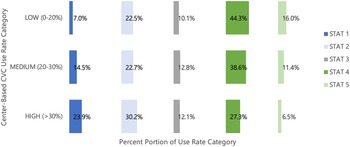
Central venous catheter use (number of central venous catheter lines/number of encounters) between centres varied from 7–46% of acute care cardiology patient encounters (p < 0.001), and there were significant differences in the patient populations in which “low,” “medium,” and “high” use centres (0–20%, 20–30%, and > 30%, respectively), used central venous catheters. Diagnosis of venous thrombus was statistically more likely to occur in centres with “low” use rates, whereas there were no statistical differences for central line-associated bloodstream infection. (Figure 1) Central venous catheter use in single ventricle patients was more likely to occur in centres with overall “low” use rates, whereas two ventricle circulation patients were statistically more likely to possess central venous catheters in centres with overall “high” use rates (p < 0.0001). (Table 3) STAT 4 and STAT 5 patients were statistically more likely to have central venous catheters in place at “low” utilisation sites than “high” utilisation centres, whereas the opposite was found to be true for STAT 1 and STAT 2 patients. (Figure 2) Peripherally inserted central catheter lines were more likely to be used in “low” use rate centres, whereas tunnelled and percutaneous central venous catheters were more likely to be utilised in “high” use rate centres (p < 0.0001). Finally, when juxtaposed with line day/acute care cardiology unit length of stay data, patients who maintained their central venous catheters in place for the duration of their acute care cardiology unit length of stay (line day/acute care cardiology unit length of stay = 1) were more likely to be treated at “low” use centres (p < 0.0001).
Variation in centre central venous catheter use and associated variation in complivations. CVC use rate = # CVCs / # ACCU encounters; complication rate = # complications /# CVCs CVC = central venous catheter; CLABSI = central line-associated bloodstream infection.

Demographics and characteristics by centre central venous catheter use rate category (expressed as CVC lines/total encounters)

Data are presented as n (%) or median (interquartile range).
STAT = Society of Thoracic Surgeons-European Association for Cardio-Thoracic Surgery; PICC= peripherally inserted central catheter; ACCU = acute care cardiology unit; CICU = cardiac intensive care unit.
Length of stay
In this patient population, patients in the “Central Venous Catheter” group had longer length of stay than their “No Central Venous Catheter” counterparts (p < 0.001). This was true when evaluating time both in the ICU (9.1 versus 1.3 days), and the acute care cardiology unit (9.2 versus 3 days). (Table 1)
Discussion
This study represents the first comprehensive assessment of central venous catheter utilisation practices and associated complications in the paediatric acute care cardiology population. Benefitting from a large sample, multi-centre data registry across North America, we demonstrated that central venous catheters are common but with widely variable utilisation, and are associated with complications that are known to increase morbidity and hospital length of stay. Reference Goudie, Dynan, Brady and Rettiganti5,Reference Goudie, Dynan, Brady, Fieldston, Brilli and Walsh9,Reference Marr, McSweeney, Mullen and Kulik19–Reference Waterhouse, Vergales, Conaway and Lee21
Our data show that there is a significant variation in how different populations are cared for with regard to central venous catheter use, which may offer options for initial standardisation within acute care cardiology. Perry and colleagues have previously proposed guidelines for intravenous catheter use in all CHD patients; however, they are not specific to patient needs within the acute care cardiology unit. Reference Perry, Ullman, Aiyagari, Pitts, Jacobs and Cooper22 Notable findings of our work include practice pattern variation regarding patients with increasing STAT category for surgical intervention during hospitalisation. Patients after higher STAT category surgery generally possess more fragile physiology and thus are at increased risk of decompensation. These data demonstrate that these patients trended towards increased likelihood to retain their central venous catheters for over half of the acute care cardiology unit stay. It is notable, however, that in contrast to STAT category 4 patients, there was no difference in lines days per acute care cardiology unit length of stay for the highest risk surgical patients after STAT category 5 procedures. This may be related to potential perceived risk related to indwelling lines in some of these fragile patients, though ultimate reason for earlier removal is unclear. Similarly, patients with surrogates for medical complexity, such as tracheostomy, requirement for continuous infusion, or chronic pulmonary hypertension therapy, were also more likely to retain their central venous catheters for most of their acute care cardiology stay. Further evaluation is required to understand if this identified central venous catheter practice pattern correlates with any increased risk of morbidity or mortality for these higher-risk populations, or in fact provides a safety net for them.
Furthermore, centre-based variation in utilisation revealed slightly more specific practice patterns, showing most pertinently in which patient populations “low” use centres use central line more. When using central venous catheters sparingly (i.e. < 20% of encounters), “low” use centres utilise this mode of access in their highest risk patients, namely, those with single ventricle physiology, and those with higher STAT categories. Such patients have been shown previously to have an increased likelihood of requiring “rapid response” care escalation including the need for invasive procedures and subsequent mortality outside of an ICU setting. Reference Bavare, Rafie, Bastero, Hagan and Checchia23,Reference Kroeger, Morrison and Smith24 Supporting this inference regarding prioritisation of central venous catheters in “sicker” patients, the median cardiac ICU length of stay was found to be significantly longer for patients in the “low” use centres. Such prioritisation is also supported by prior work by Brunetti and colleagues, which demonstrated that longer length of stay during index cardiac ICU admission as well as single ventricle anatomy, were independently associated with need for care escalation (i.e. cardiac ICU readmission) from the acute care cardiology unit. While escalation of care does not universally indicate the need for central venous access, those with unscheduled cardiac ICU readmission have demonstrated increased mortality. Reference Brunetti, Glatz, McCardle, Mott, Ravishankar and Gaynor25 The potential for difficulty obtaining intravenous access in the setting of an acute escalation in care may be a reason why higher-risk patients retain their central lines.
Overall, the rates of central venous catheter complications in this population were low, consistent with findings in the cardiac ICU setting. Reference DiPietro, Gaies and Banerjee1 Venous thrombus was more common than central line-associated bloodstream infection, which may be the result of historically heightened attention towards central line-associated bloodstream infection prevention. Many central venous catheter care bundles focus on line entry frequency, hygiene, dressings, and nursing training, Reference Sahulee, Ramirez, Al-Qaqaa, Chakravarti and McKinstry13,Reference deJonge, Polderman and Gemke26,Reference Ramritu, Halton, Cook, Whitby and Graves27 whereas specific interventions addressing venous thrombus prevention are generally absent. For example, primary preventive anticoagulation strategies are not a documented central venous catheter standard of care due to worries regarding secondary bleeding risks and lack of evidence that such practices prevent morbidity. Reference Clark, Ballester, Whitworth, Raffini and Witmer28,Reference Pelland-Marcotte, Amiri, Avila and Brandao29 It is unknown whether centres with low utilisation rates (< 20%) though higher venous thrombus incidence utilise different prevention or identification practices than higher utilising centres, though it would be an opportunity for study and improvement. Overall, the acute bleeding risks associated with post-operative CHD patients and the need to preserve future vascular access underscore the importance of understanding central venous catheter line use and decreasing line duration via early removal and avoidance strategies to mitigate venous thrombus risk, as has been previously shown in the paediatric cardiac ICU population. Reference DiPietro, Gaies and Banerjee1
Our data demonstrate that central venous catheter utilisation is associated with longer hospital length of stay in the acute care cardiology population. Even if not related to immediate additional morbidity, greater time in the hospital is important as it relates to both cost and mental health. Furthermore, general paediatric evidence reveals that cost is significantly elevated when a patient with a central venous catheter is diagnosed with central line-associated bloodstream infection or venous thrombus. Reference Goudie, Dynan, Brady and Rettiganti5,Reference Goudie, Dynan, Brady, Fieldston, Brilli and Walsh9 In addition, the toll on the patient and family that remains hospitalised on antibiotics or on subcutaneous low molecular weight heparin injections due to such acquired complications is incalculable. The impact on mental health and feelings of wellness should be included when considering this modifiable risk factor. Reference Lisanti, Golfenshtein and Marino7,Reference Molloy, DeWitt and Morell8 Finally, care coordination required for longer-term anticoagulation is not without significant resource utilisation (i.e. pharmacist or anticoagulation teams, follow-up ultrasound evaluations).
This study is limited by its retrospective and registry-based design. While aided by its sample size, all registry data available for evaluation is predetermined by registry definitions and priorities, and not the aims of this study specifically. As an example, this data set is restricted to acute care cardiology unit data only and thus does not account for line days acquired in the ICU, thereby limiting conclusions that can be drawn regarding how total line days may impact centre variation in practice toward line removal. In addition, the diagnosis “venous thrombus” was defined in this population as present when associated with a clinical treatment, as opposed to the identification by examination and/or ultrasound alone. This may underestimate the true incidence of central venous catheter-associated venous thrombus in the acute care cardiology patient population. In addition, many of the studied patients may have been on anti-platelet, and anticoagulation regimen based on their underlying disease, and these data were not assessed relative to the incidence of venous thrombus. As an additional limitation, there is not an opportunity to examine any outcomes or morbidity that may occur in centres which intentionally limit central venous catheter duration. Finally, more granular characterisation of the “low,” “medium,” and “high” use centres relative to their centre volume or total surgical complexity cannot be performed with this data set; our findings discussing central venous catheter utilisation rates and patient complexity are limited to the patients in this cohort, and not necessarily inclusive of all surgical cases at each centre.
Conclusion
This study, the first to examine central venous catheter utilisation practices and associated complications in the acute care cardiology environment, has identified a common clinical practice with unintended variability and associated complications in this at-risk population. These complications have both immediate and prolonged consequences and will most likely continue to exist without the establishment of clear best practices through shared evidence, and eventually, sustained standardisation. There is, therefore, a significant opportunity within the Paediatric Acute Care Cardiology Collaborative to learn from this study and others like it to improve the outcomes in our patient population.
Relationship between STAT category and centre-based CVC utilisation rate. CVC use rate = # CVCs / # ACCU encounters. CVC = central venous catheter; STAT = society of thoracic surgeons-European association for cardiothoracic surgery.

Acknowledgements
We would like to recognise the Paediatric Acute Care Cardiology Collaborative Scientific Review Committee for their support in the development of this study, and the many outstanding Paediatric Acute Care Cardiology Collaborative data champions for their contribution of these registry data. We would also like to recognise all clinical staff, patients, and families across participating Paediatric Acute Care Cardiology Collaborative centres without whom this study would not be possible.
Financial support
This study received no specific grant from any funding agency, commercial, or not-for-profit sectors.
Competing interests
None.



 Open access

