


1. Introduction
Additive manufacturing (AM) provides benefits over conventional manufacturing by enabling the production of components with high geometric complexity, customization, and part consolidation. These opportunities, however, are often not fully realised in industry (Reference Diegel, Nordin and MotteDiegel et al., 2019). Designers and engineers often rely on familiar manufacturing processes, and as long as conventional methods perform sufficiently, there is limited incentive to explore other alternatives (Reference SeepersadSeepersad, 2014). This tendency restricts the exploration of AM capabilities and its application to manufacture products. It is recognised that AM comprises a range of technologies rather than a single process. In this study, the AM process refers to the realistically accessible AM technology within the given industrial context, and it is compared with the most suitable conventional manufacturing alternative.
Decisions on whether to use AM must be made early in the design phase to benefit from the opportunities AM provides (Reference Eddy, Krishnamurty, Grosse and SteudelEddy et al., 2020). However, looking into the industrial practice, such early-phase decisions are often made ad hoc, guided by prior experience and intuition rather than by structured analysis (Reference Ördek and BorgianniÖrdek & Borgianni, 2025). In parallel, a review of the literature shows that few structured methods support designers in determining when to design for AM, and the methods that do exist have limited practical applicability. A key limitation of many methods is that they have been developed in isolation within academia, with little involvement from industry (Reference Gericke, Eckert, Campean, Clarkson, Flening, Isaksson, Kipouros, Kokkolaras, Köhler, Panarotto and WilmsenGericke et al., 2020) and AM related methods are no exception (Reference Hajali, Brahma, Isaksson and MalmqvistHajali et al., 2025).
Existing methods therefore often fail to capture the full range of information required for early decisions on when to design for AM and are rarely developed through active, iterative engagement with intended users. This paper addresses this gap by adopting an iterative co-evolutionary approach in which problem understanding and decision-support development evolve in parallel through interactions with both industrial and academic participants, who provide complementary practical and analytical perspectives. This iterative methodological structure, combining parallel problem exploration and prototype refinement with continuous feedback loops, represents a central contribution of the study. The guiding research question therefore is:
RQ: How can iterative development and testing of a support method deepen understanding of the needs and barriers involved in deciding when to use AM?
To answer this question, Section 2 reviews existing methods for supporting decisions on when to consider AM and identifies gaps in their effectiveness and development. Section 3 describes the research methodology, which is based on iterative development and evaluation with industrial and academic partners. Section 4 presents the identified needs and barriers and provides recommendations for the development of decision support based on these findings. The paper is then concluded in Section 5.
2. Background
To address the research question, Section 2.1 reviews available methods and tools for deciding when to design for AM, examining how they support such decisions, which needs they address and how well they align with practical industry needs, thereby highlighting existing gaps. Section 2.2 then examines the need for co-evolution of problem and solution in the context of this paper.
2.1. Available methods and tools for deciding when to design for AM
Before reviewing existing approaches, two key terms must be defined; Feasibility and Suitability. Feasibility refers to assessing whether a manufacturing process violates production or design requirements, considering resource constraints, process characteristics and availability. Suitability, in contrast, concerns the appropriateness of a manufacturing option in relation to the product and its context, including for instance the functional requirements and production volume. Suitability indicates whether meaningful benefits can be achieved by selecting one manufacturing process over another (Reference Hajali, Brahma, Isaksson and MalmqvistHajali et al., 2025). Current methods and tools that assist decisions on when to design for AM can be divided into the following categories:
Elimination-based methods: These methods start by defining objectives and product requirements and then screening out infeasible material and manufacturing alternatives based on constraints, refining the design as it progresses. Ultimately, the most suitable combination of materials and manufacturing processes is selected. Methods proposed by Reference AshbyAshby (2005) and Reference Swift and BookerSwift & Booker (2013) fall into this category. While such methods are effective in screening unfeasible manufacturing processes, they often lack a structured assessment of suitability (as defined previously) of various manufacturing processes. For example, when both material extrusion and injection moulding are feasible for manufacturing a product, such methods do not explain how the trade-off between the two should be assessed.
Geometry-based methods: This approach evaluates the feasibility of AM by analysing a 3D model of the product, for example, by assessing feature size, support structures and build volume. Examples of methods which fall into this category can be found in Reference Ghiasian, Jaiswal, Rai and LewisGhiasian et al. (2020) and Reference Coatanéa, Nagarajan, Panicker, Prod and MokhtarianCoatanéa et al. (2021). A related group of methods extends the geometry-based assessment by applying various AI techniques, including supervised and unsupervised machine learning (Reference Yang, Page, Zhang and ZhaoYang et al. (2020) and Reference Zhang and ZhaoZhang & Zhao (2022)). Commercial tools such as 3YOURMIND (2025) and SelectAM (2025) also fall within this category. These methods are often efficient but limited in applicability, as they rely on a pre-existing part designs and do not directly assess whether an AM process is suitable, even if it is feasible.
Multi-criteria decision support methods: Selecting a suitable manufacturing process requires considering multiple factors that are often diverse and conflicting. Multi-criteria decision making (MCDM) is a common approach that typically involves three steps: identifying relevant criteria, defining alternative manufacturing methods, and evaluating and ranking these alternatives. Reference Raffaeli, Lettori, Schmidt, Peruzzini and PellicciariRaffaeli et al. (2021) and Reference Algunaid and LiuAlgunaid and Liu (2022) are examples of the application of MCDM in the AM process selection context. These methods enable trade-offs between factors such as lead time, cost and achievable product properties, and are therefore suited for suitability analysis as compared to previously discussed methods which are geared towards feasibility analysis. However, many existing MCDM methods either focus heavily on calculations or offer limited guidance on factor selection. Further, they often give little attention to AM-specific value-adding characteristics such as functional integration, customisation and lightweight design. Their main strength lies in their use in early design, allowing AM suitability analysis before geometry is defined. A more detailed discussion of MCDM-based methods can be found in Reference Hajali, Brahma, Isaksson and MalmqvistHajali et al. (2025).
Methodologically, these approaches are often developed without explicit industry involvement, highlighting one of their important limitations. In terms of content, they typically address either feasibility or suitability but rarely distinguish between the two. Geometry-based methods on the other hand, require detailed designs and therefore cannot support early-stage decisions, while MCDM approaches often miss key AM-specific elements.
Overall, there is a need for a closer investigation of industry needs and practical barriers to ground decision support in real-world requirements. An iterative academia–industry collaboration within the methodology can enable this by allowing the problem and solution to evolve together. This approach enables a deeper investigation of the factors influencing early decisions and helps to ensure that the resulting support is both scientifically grounded and practically relevant.
2.2. Co-evolution of problem and solution
A number of recent research has focused on how design research can create effective industrial impact (Reference CrossCross, 2018). On the one hand, industry is often seen to prioritise solving business-critical problems, while on the other hand, academia seeks to address knowledge gaps and contribute to theory. Successful collaboration therefore depends on establishing shared goals and shared activities rather than transferring finished methods to practice at the end of a project (Reference Sandberg and CrnkovicSandberg & Crnkovic, 2017). In this context, method development benefits from continuous interaction with users, where both the understanding of the problem and the proposed solution evolve together.
Design researchers typically use a portfolio of qualitative and quantitative methods to balance scientific rigour with practical relevance (Reference Mårtensson, Fors, Wallin, Zander and NilssonMårtensson et al., 2016). One widely used approach is the Design Research Methodology (DRM), first developed in the 1990s by Reference Blessing and ChakrabartiBlessing & Chakrabarti (2009) to make design research more systematic and scientifically sound. DRM includes four stages: Research Clarification (goal formulation), Descriptive Study I (deepening the understanding of the current situation), Prescriptive Study (developing design support to bridge the gap), and Descriptive Study II (evaluating the design support). The process is typically described to be iterative and non-linear, and projects may enter at different stages. Despite its intended flexibility, DRM often risks being applied in a linear “waterfall” manner in complex research projects (Reference Panarotto, Isaksson and SöderbergPanarotto et al., 2023).
To emphasise iteration more explicitly, Reference Eckert, Clarkson and StaceyEckert et al. (2003) proposed the eightfold model of design research, which highlights the cyclical relationship between empirical investigation and theorising. This perspective underlines that developing tools and methods is not a one-off activity but a process that matures through repeated evaluation and refinement in realistic contexts.
In parallel, industry has increasingly adopted agile approaches originating in software development, promoting short development cycles and adaptive planning (Reference DouglassDouglass, 2015). Despite the benefits, the application of agile development is still limited in design research and requires further exploration (Reference Panarotto, Isaksson and SöderbergPanarotto et al., 2023).
A longitudinal academia–industry collaboration study by Reference Sandberg and CrnkovicSandberg & Crnkovic (2017) demonstrated that adapting scrum practices over several years strengthened partnerships and improved collaboration outcomes. Building on similar principles, Reference Panarotto, Isaksson and SöderbergPanarotto et al. (2023) introduced Agile Design Research, which proposes dividing research problems into manageable units and conducting a full DRM cycle for each unit at a time. Their work shows that controlled shortcuts, such as using simplified or idealised data early in development, can maintain momentum without undermining scientific rigour.
Both Agile Design Research and Eckert’s framework converge on a common principle: effective design support emerges through iterative cycles conducted in close collaboration with users. Iteration not only refines the proposed artefact but also deepens the understanding of the underlying problem space (Reference Dorst and CrossDorst & Cross, 2001). This mutual maturation of problem framing and solution development characterises a co-evolutionary process rather than a linear transfer of results from academia to industry and provides a strong rationale for adopting an agile, co-evolutionary mindset when investigating needs and barriers and developing decision-support tools, where user interaction is embedded throughout the research process rather than limited to end-stage validation, enabling both the problem definition and the support method to evolve in parallel.
3. Methodology
In line with the eight-fold model of the design research and the Agile Design Research (Reference Eckert, Clarkson and StaceyEckert et al., 2003; Reference Panarotto, Isaksson and SöderbergPanarotto et al., 2023), this research comprises of two main categories; the first category focuses on extensive interaction with industrial partners to understand needs, requirements, and barriers related to early decisions on when to design for AM. The second category involves literature study and interactions with academic researchers to test and mature developed method and further investigate needs and barriers related to decision support. This structure reflects the separation between empirical and theoretical activities and the use of short iterative development and evaluation loops advocated by these models. Although these activities are described separately for clarity, in practice, they were conducted iteratively and fed into each other as illustrated in Figure 1.
Overview of the methodology

Both categories are detailed in Sections 3.1 and 3.2 and contributed complementary perspectives. Interactions with industrial practitioners primarily informed domain-specific needs and requirements while also providing direct feedback on the practical usefulness and usability of emerging prototypes. Interactions with academic participants enabled more controlled evaluation of how the support influenced decision-making in comparable hypothetical scenarios and were particularly effective in identifying usability issues. Together, these interactions supported iterative refinement of both the content and interaction qualities of the decision support.
3.1. Industry-focused interactions
This family of interactions is represented as the grey square located at the bottom of Figure 1. The research originated from an industrial collaboration to investigate how designers decide when to design for AM. First, the existing design and manufacturing processes for selected products were studied. A total of two workshops and eight semi-structured interviews were conducted across two company sites, complemented by three online interviews. The main participants were design engineers, manufacturing engineers, end users, and an innovation manager. These interactions clarified which information is typically collected in early design phases and what different stakeholders require.
Three existing production-line tools were analysed as case objects to assess what data would need to be captured if they were redesigned for AM: a lifting tool, a washing machine basket interior, and a gear protector. Information was gathered through factory visits covered by four semi-structured interviews with design engineers, manufacturing engineers, and end users. The selected parts were redesigned for AM by the research team in collaboration with a company design engineer, then manufactured and evaluated directly on the assembly line. Feedback was collected through three semi-structured interviews with individual end-users. Some parts required further refinement, which led to redesign, reprinting, and reassessment. Details of this stage are reported in Reference Hajali, Mallalieu, Brahma, Panarotto, Isaksson, Stålberg and MalmqvistHajali et al. (2023). These efforts helped in identifying the elements that are necessary to consider in early design, when considering AM as an alternative manufacturing process.
To broaden the perspective beyond a single company, five additional meetings were held with representatives from three large manufacturers, primarily in managerial roles, to understand organisational considerations relevant for the adoption of AM for producing products.
Based on these findings, an initial Excel-based checklist was developed from recurring themes identified in the interviews and the prototype evaluations. The checklist was populated with the critical elements that such a decision-support tool should address, including product function, production volume, time and cost estimation and so on. Two alternative versions were created and evaluated by a design engineer at one of the collaborating companies. The preferred version was refined and subsequently implemented in Python to enable better interactivity. This progress is demonstrated in the pink box in Figure 1. Three meetings with two design engineers and one meeting with a manufacturing engineer were held to explore and evaluate this interface through guided walkthroughs.
Screenshots of the various prototypes evolved through iterative collaboration (A, B, C are related to excel, Figma and Power Apps respectively, as explained in Figure 1). In the figure cm stands for conventional manufacturing

Building on their feedback, a more advanced interface was developed in Figma, incorporating all the identified needs. This version was reviewed individually by two design engineers from two different company sites in three meetings through guided walkthroughs and brief post-session discussions. Throughout this iterative process, continuous feedback cycles ensured alignment with user needs. Insights gathered during this iterative process informed the development of a functional prototype using Microsoft Power Apps. Figure 2 shows a glimpse of the support interface in Power Apps.
3.2. Academic-focused interactions
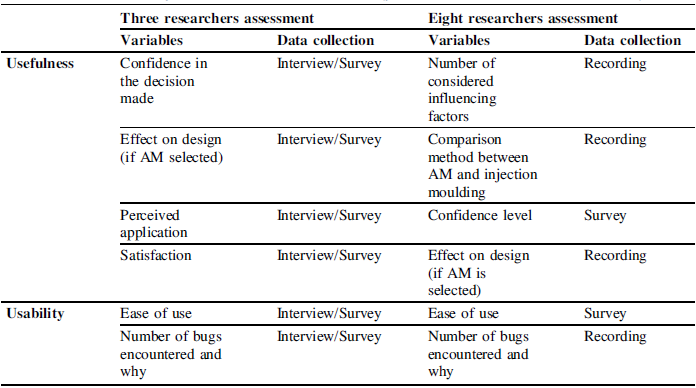
While industrial interactions primarily grounded the content and practical relevance of the support, academic experiments were particularly effective in examining how the prototype influenced reasoning in structured decision-making scenarios and in revealing usability issues. For this purpose, several controlled experiments were conducted with academic researchers in product development and production systems to further understand the needs and systematically evaluate the decision support. Initial testing was carried out internally to verify technical correctness. Subsequently, three academic researchers with prior experience in design methods and intentionally varying levels of knowledge on AM, were asked to test the prototype. The test was carried out using a scenario similar to the industrial case, where a decision regarding the application of AM for the design and manufacture of a lifting tool used in a production line had to be made. After completing the session, they filled out a post-session questionnaire assessing usability and perceived usefulness (see Table 1). Each session took approximately 40 minutes. The results were analysed based on interview notes and questionnaire responses.
In a subsequent stage, two researchers participated in an experiment to determine the suitable manufacturing process for a simplified example, followed by completing a questionnaire after the session. The experiment was not constrained with time and was used to identify usability and technical issues prior to the main evaluation and lasted approximately 3.5 hours. Protocol analysis was used to analyse the recording and the experiment results. These findings were used to refine the prototype further.
The main experiment involved eight researchers working in pairs on the same design problem. Two groups had access to the prototype, while the remaining groups carried out the task without support. All participants completed a questionnaire after the session. They were given up to two hours to complete the exercise. Participants were selected based on their industrial experience and involvement in product design or manufacturing decision-making. The participants on an average had four years of industrial experience, five years of experience in design and three years of experience in design for AM. Protocol analysis was used again to analyse the data from the recordings, questionnaires, and brief post-session interviews (see Table 1). The detailed findings from these evaluations are presented in Section 4.
Usability and usefulness assessments (part of academic-focused interactions)

Between the academic experiments, the prototype was continuously refined based on observed challenges and feedback. The method was also presented in several academic and industrial settings, generating additional input for identifying needs, barriers, and opportunities for improvement. These preliminary academic experiments were intentionally conducted with researchers to identify usefulness and usability issues before broader industrial engagement. Figure 1 illustrates the overall research methodology, showing how industrial interactions contributed to the identification of requirements and continuous prototype feedback. While the academic interactions enabled structured evaluations and comparative testing, together supporting iterative development and maturation of the decision-support method. Throughout the study, literature review activities focusing on design for AM, manufacturing process selection, and early-stage decision-making were continuously conducted, which helped in complementing and enriching the research with necessary theoretical foundations. The identification of key needs, expectations, and barriers were based on iterative qualitative review of interview notes, session recordings, and questionnaire responses, complemented by comparison with existing literature to ensure consistency.
4. Results and discussion
The interactions with multiple stakeholders and the iterative development and testing of the prototype enabled the identification of key needs, expectations, and barriers related to determining when to design for AM. The findings are presented in two parts:
4.1. Needs and expectations
Needs related to AM: A central need identified is to clearly explore how AM can add value to the product. Relevant value-adding characteristics include the possibility of customisation, lattice-based lightweight structures, internal channels, part consolidation, and variations in surface or material structure. These aspects often remain unexplored unless designers explicitly consider them early in the design process.
Needs related to the decision-making process: Another insight from the study is the importance of applying the decision support in the early design phase, before detailed geometry is defined, and explicitly considering AM value-adding characteristics at this stage. When these aspects are overlooked, opportunities such as functional integration, surface customisation, or multi-material combinations often remain undiscovered. Once detailed geometry is established, it may be too late to realise these benefits.
Industrial participants and academic experiment groups agreed that the prototype captured relevant factors, including product-related aspects (functions, requirements), operational factors (production volume, machine and material availability), and AM-technology considerations (machine/material properties and constraints). However, they emphasised the need to also include sustainability, supply chain and market aspects, since, for instance, the technical suitability alone is insufficient if the product does not commercially succeed. This aligns with broader research on the adoption of AM, such as by Reference Mellor, Hao and ZhangMellor et al. (2014). The distinction between feasibility and suitability of AM also emerged to be a critical factor and significantly shaped decision outcomes. Industrial partners also stressed the need for time-efficient and intuitive assessments. While structured methods were valued, overly detailed procedures were viewed as impractical in fast-paced and time-constrained work environments.
Needs related to the decision-support tool: It is important to include several guiding questions or hints in the assessment, since it leads to consideration of aspects that would be otherwise overlooked, particularly for novice AM users. It was recommended by two engineers that the support can include two-levelled assessment: (1) a guided and thorough version for novice AM users, and (2) an automated version for experienced users drawing on historical product data to recommend processes and manufacturing details. They further noted that retrieving such information automatically would reduce manual data entry effort and improve efficiency. Consolidating all necessary information, such as availability of AM machines and material properties, within the prototype was also valued, as such information is typically dispersed and time-consuming to collect. Participants also noted that designers already work with multiple digital tools, raising concerns about “tool fatigue”. It is therefore important to integrate such support tools with the existing digital infrastructure.
Usability-related expectations emerged at both general and interface levels in both industry and academic interactions. At a general level, clarity was considered essential for novice AM users, guiding questions should be clearly formulated and, where possible, supported with examples. In addition, terminologies and definitions must be explicit and unambiguous. Transparency in calculations was also highlighted by the researchers as important to gain trust, although one group showed confidence in LLM-based AI-derived estimates despite limited transparency, suggesting that trust is influenced by additional factors (Reference Kaltenbach and DolgovKaltenbach & Dolgov, 2017).
Concerning the user interface, industrial partners emphasised minimising manual effort through dropdown menus and suggested default values. They showed interest in visualisation such as bar charts and pie charts to demonstrate and analyse the results. Academic participants found it beneficial to add an extra page to summarise all input values and allow users to adjust these parameters to observe how changes influence the outcome.
4.2. Barriers
Barriers related to AM: The findings confirm that AM-related decisions are often ad hoc and based on tacit knowledge, echoing observations by Reference Ördek and BorgianniÖrdek & Borgianni (2025). As one engineer stated, “it is all in my head”. In the academic experiments, comparisons between groups relying on intuition and those using the prototype showed that intuitive decision-making often resulted in several important aspects being missed. In particular, the groups without the prototype tended to overlook a systematic analysis of AM-enabled design opportunities such as lattice-based weight reduction and part consolidation, thereby missing potential benefits.
Similarly, findings from the industrial case indicated that AM is frequently considered only when CM becomes too expensive or slow. This positions AM as a fallback option rather than a proactive alternative. The perception that AM is mainly suited for prototyping, low-volume production, or highly complex parts reinforces this mindset. When a product is not viewed as “complex enough”, AM is rarely considered. These tendencies reflect a narrow interpretation of AM value and underline the need for a more systematic approach.
A creative mindset is essential for identifying AM-enabled opportunities, and this was strongly influenced by prior AM experience. Participants with AM design experience interpreted terminology more easily and explored redesign possibilities more effectively. This represents a barrier that cannot be fully resolved through predefined rules and depends heavily on designers’ creative capacity. Creativity can be supported, but not guaranteed.
Barriers related to the decision-making process: In current industrial practice, customer requirements are defined first, and the manufacturing process is selected afterward. While efficient, this approach limits the exploration of AM-enabled opportunities that customers may value but do not explicitly request. Decisions are often guided by existing solutions that are already known to function adequately, which reduces the likelihood that the suitability of alternative manufacturing processes is explicitly questioned. As a result, potential AM value-adding characteristics may remain unexplored. As also noted by Reference SeepersadSeepersad (2014), designers tend to adhere strongly to familiar designs, making it difficult to explore more suitable alternatives. While there is nothing inherently wrong with relying on tried-and-tested methods, the challenge lies in recognising when it is appropriate to shift to another approach.
Another important finding is the limited use of function-based reasoning in the decision-making process. Assessing the suitability of AM requires analysing the product’s primary functions and requirements rather than focusing solely on existing geometries. However, both industrial observations and academic experiments indicated a strong tendency to anchor decisions in legacy design features. This geometry-driven perspective constrains the exploration of redesign opportunities and may prevent the identification of AM-enabled value.
A similar pattern is reflected in the growing interest in automated algorithms that scan CAD repositories for AM-suitable parts. While such approaches can increase efficiency, they risk reinforcing a focus on existing geometries instead of encouraging functional reinterpretation and redesign. As a result, opportunities linked to latent customer needs, functional optimisation, and broader AM value creation may remain underexplored.
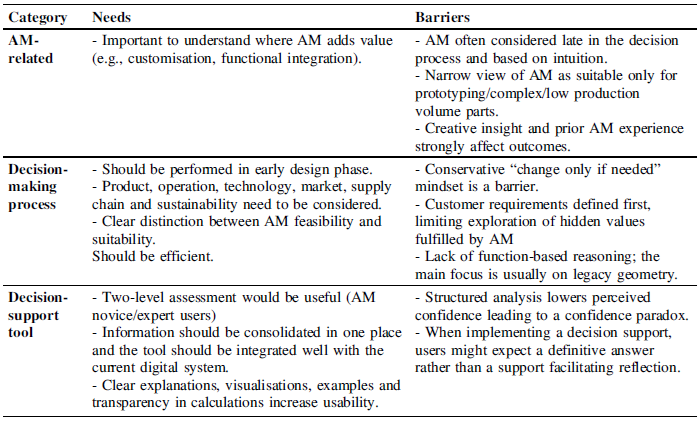
Summary of critical needs and barriers (no one-to-one mapping between the identified needs and barriers)

Barriers related to the decision-support tool: The application of a systematic approach with detailed questions can also trigger a confidence paradox. In the final experiment, groups using the prototype chose to remain with conventional manufacturing, whereas groups relying on intuition selected AM, largely focusing on lead time, cost and order volume. The supported group expressed low confidence in the decision, while the group deciding on intuition expressed high confidence. This reflects a confidence paradox where structured analysis improves decision quality yet reduces perceived decisiveness. This phenomenon has in fact been studied in neuroscience; Reference Zylberberg, Roelfsema and SigmanZylberberg et al. (2014) demonstrated in an experiment with thirty-one participants that confidence was higher for stimuli with lower reliability, despite these being associated with lower accuracy. However, this outcome may have been influenced by the experimental setup and the absence of real contextual information to support decision-making.
An additional barrier concerns users’ expectations that the decision support should produce a single “correct” answer. In the experiment, when suitability percentages for AM and another manufacturing process were close, participants were unable to select a manufacturing process with confidence, focusing on the numerical output rather than the underlying reflection and discussion the prototype was intended to stimulate. This underlines the need to balance analytical structure with interpretive flexibility, as also noted by Reference Chromik, Fincke and ButzChromik et al. (2020). Table 2 summarises the identified needs and barriers related to assessing when to design for AM.
Several usability challenges stemmed from prototype implementation rather than the method itself, highlighting how interface quality influences perceived usefulness and cognitive engagement, as also highlighted by Reference Roszkowska and WachowiczRoszkowska & Wachowicz (2021). Interactive prototypes proved more effective than static materials in eliciting reflection and receiving feedback from practitioners. As the prototype matured, the depth of discussions increased, illustrating the value of sustained iterative engagement rather than one-off evaluations.
The dual-population approach proved valuable, as different participant groups surfaced different categories of insights. Industrial practitioners primarily highlighted content-related aspects such as needs, requirements, and perceived usefulness in real contexts, while academic participants more readily exposed cognitive decision-making patterns and usability issues in controlled scenarios. Together, these perspectives strengthened the robustness of the identified needs and barriers. Academic-focused iterations also help sustain development when access to industrial partners is limited, while contributing analytical depth and structured reasoning that complement practitioner input.
5. Conclusion
Developing effective decision supports requires a deep understanding of the underlying needs and barriers. This is relevant for manufacturing technologies such as AM, as in order to benefit from the opportunities AM offers, products often need to be designed for AM. This requires knowing early in the design process when AM is an appropriate alternative, or not. This understanding can be achieved through an iterative process of data collection, prototype development, and feedback loops that allow both the problem understanding and the solution to evolve together. A key contribution of this work is demonstrating the methodological value of combining industrial and academic iterations, where complementary practical and analytical perspectives strengthen both the relevance and robustness of decision-support development.
Based on this approach, needs and barriers are identified and categorised into three classes: AM-related aspects, the general decision-making process, and the support tool itself. The findings indicate that current decisions are often intuition-driven, constrained by legacy geometries, and characterised by limited function-based reasoning. At the same time, deciding when to design for AM is multifaceted and requires systematic early-phase analysis in which AM value-enabling characteristics are explicitly explored. Based on these insights, recommendations for improving the usefulness and usability of the decision support are provided. As a continuation of this work, the introduced decision support is under further development.



 Open access

