




Introduction
Every winter in the small mountainous district of Nurhak in southeast Turkey, Alevis—a Sufi community characterized by their veneration of Ali (the prophet Muhammad's cousin and son-in-law, and the first Shia imam) as a saint and human incarnation of the divine—gather for a communal oath-taking ceremony. In this music-filled ritual called the ikrar-görgü cemi (gathering for oath-taking and witnessing), local townspeople are given the opportunity to become formally initiated into the Alevi path (yol) by pledging a series of oaths known as ikrar (acknowledgment, word). Meanwhile, previously initiated devotees renew their oaths by passing through görgü (witnessing), in which they are ‘seen’ (görülmek) by the congregation and their behaviour audited. Rather than confessing their faith in a deity, the initiates pledge commitment to a social project involving the cultivation and maintenance of an ideal order: the City of Consensus (Rıza Şehri). The oaths are administered by a ritual officiant known as a dede, baba, or, in the case of female officiants, ana.Footnote 1 The ritual officiant in Nurhak, Dertli Divani Baba, is a licensed deputy of the shrine (dergâh) of the thirteenth-century saint Hacı Bektaş Veli in central Turkey.Footnote 2 Dertli Divani officiates the rite according to a reformed liturgy published by the shrine in 2016, in which the oaths are scripted as follows:
DEDE/BABA/ANA: Do you swear by God to refill what you've spilled, to cheer up whom you've made cry, to make peace with whom you've upset, and to pick up what you've torn down?
INITIATE(S): By God (Allah eyvallah).
DEDE/BABA/ANA: Do you swear by God to be the owners of your hands, tongue, and loins (eline diline beline sahip), to remain faithful to your sustenance, labour, and partner (aşına işine eşine sadık), not to do unto others as you would not have them do unto you, and to be content with your rightful share (hak) and protect everyone's hak as your own?
INITIATE(S): By God.
DEDE/BABA/ANA: Do you swear by God to recognize and not run from the claims (hak) of others absent here, if at some other time and place they bring a claim against you and demand justice (hak talep ederse)?
INITIATE(S): By God.
The script continues with the officiant asking the congregation for their consent to the initiation. If this consent is forthcoming, the officiant then turns to the initiates and asks whether they approve of themselves or if they would like to confess any behaviour or conflict—either publicly before the congregation or privately before one or several elders. Next, another sequence of oaths confirms the initiates’ commitment to regularly attend weekly communal rituals where their oaths are upheld. The rite concludes with the initiates fully prostrating themselves before the officiant, who seals their oaths by patting each one three times on the back with an open palm (pençe)Footnote 3 while incanting, ‘Hak, Muhammad, ya Ali!’
This special issue takes up the problem of ‘oaths of peace’—formal treaties of alliance or community-making solemnized by oaths—between Muslim monotheist and non-monotheist parties over the long arc of Islamic history. Peace, in my colleagues’ contributions, may be interpreted pragmatically in terms of the freedom to follow any religion without persecution by other social groups or by the state, or philosophically in terms of the mutual translatability of various religious doctrines. However, in all their cases it is the harmony between religious communities that is at stake. This article turns this problem of the oath inwards and examines the practices and discourses surrounding oaths of peace given within and thereby constituting a religious community—the ikrar oaths by which Alevis are initiated into their spiritual path and rendered accountable to its norms. In this article, I examine a contemporary revival of this Alevi oath complex, which is a historical product of the same messianic trends in post-Mongol Sufism that shaped the Mughal imperial idea of sulh-i kull or ‘Peace with All’ religions. I argue that the ikrar oaths are paradigmatic examples of ‘post-Islam’ or Islam after the suspension of its scriptural law. I show how Alevis seek to maintain this suspension of monotheismFootnote 4 through repeated ritual practices of animal sacrifice and music, and careful avoidance of standard monotheistic oaths. Focusing on a recent liturgical reform movement led by the currently most prominent Alevi shrine—the shrine of Hacı Bektaş—I demonstrate how the shrine works to maintain Alevis’ suspension of monotheism from within the sociopolitical constraints of secularism, in part by reinterpreting secular constraints in terms of post-Islamic Alevi values, thereby highlighting elective affinities between post-Islam and secularism.
From a Sunni or Shia juridical perspective, the Alevis do not conform to the accepted norm for the central oath of monotheism. They do not declare their loyalty to Allah using the standard shahada. Their oath-swearing mechanism deliberately bypasses the ‘no god but Allah’ declaration, allowing them in theory to accept oaths to other gods—except for the jealous God of biblical monotheism. Moreover, Alevis explicitly set themselves on the path to divinization (Ar. ta'alluh) when they endeavour to follow Ali's divine example and make themselves into ‘perfect humans’ (sing. insan-ı kâmil) or human embodiments of the divinity immanent in the cosmos.Footnote 5 This effort requires of them first a suspension, or at least a bypassing, of scriptural authority. Moin's framework article for this special issue mentions four possible ways of solemnizing oaths of peace with non-monotheists: converting the other party to monotheism (the preferred and, indeed, the only legally sanctioned way in majoritarian scriptural Islam); sheer charisma (suspending monotheism, but only for a moment); accepting sacrifice in lieu of a verbal oath (silently bypassing monotheism); and law (replacing scriptural law with a new messianic law, thus permanently suspending monotheism). The Alevi ikrar rite engages with the last three mechanisms while refusing the notion of conversion. One is initiated to Alevism, not converted to it.
The Alevi ikrar oaths are administered as part of a communal ceremony, described above, which suspends scriptural authority with the help of two key ritual mechanisms. One involves music played on the saz, the Alevis’ ‘stringed Quran’ (telli Kuran), and the other involves animal sacrifice in which the sacrificial lamb stands in for the sacrifice of the initiate's self. The saz is a long-necked lute whose body is equated with the body of Ali. Alevis use the saz to accompany performance of devotional songs in rituals known as cem (gathering) and muhabbet (love/conversation). These musical practices play a central role in Alevi ethical life. For some Alevis, music incorporates them into Alevi networks by affording them positive emotional experiences and relationships, and it can be a sufficiently satisfying pursuit in its own right. For others, music pushes them to give ikrar and thereby sacrifice some of their individual freedom for the sake of a communal ethical project and disciplinary moral order. In contrast to the soothing musical ceremony, the sacrifice achieves its subjectifying effect largely by inducing feelings of anxiety surrounding the social and ethical commitments entailed by the oaths. In short, music and sacrifice are two ritual means by which Alevis mediate and reproduce Ali's sovereign authority to suspend scriptural law. By fostering collective moral sentiment, music and sacrifice support Alevi practices of communal dispute mediation aimed towards the eventual realization of the City of Consensus (Rıza Şehri), a utopian commune whose members achieve human divinity, become perfect humans, and live in complete consensus (rızalık) with one another. In the terms of this special issue, the City of Consensus is an ethical telos of ‘total peace’ (sulh-i kull) or, rather, of ‘total love’ (muhabbet-i kull)—a term derived from Ibn ‘Arabi which, according to the Mughal intellectual Abul Fazl, was the next and final stage after total peace.Footnote 6
Alevis who aspire to this communal ideal today face numerous contradictions. This is because the Alevi path took shape as a total social fact in the historical context of Alevis’ exception from the Ottoman polity, whereas Alevi communities today are integrated (even if incompletely) within a secular pluralist society (Tambar Reference Tambar2014). The intervening process of social transformation—including the founding of the secular national republic in the 1920s and 1930s, extensive rural-urban migration driven by the industrialization of the Anatolian countryside from the 1950s, and the rise of political Islam in Turkey and Europe since the 1990s—resulted in significant erosion of traditional Sufi ritual relationships and their eclipse by a political model of organization grounded in civil society groups (Seufert Reference Seufert, Öncü and Weyland1997; Shankland Reference Shankland2003; Şahin Reference Şahin2005; Sökefeld Reference Sökefeld2008; Walton Reference Walton2017). Hence my impression is that only a small subset of Alevis today have formally taken the oaths of ikrar by going through the initiation rites this article addresses, even though the values embodied in the oaths are widely shared and expressed by Alevis across the entire spectrum of ritual (non-)participation. Meanwhile, the Hacı Bektaş shrine was shut down and confiscated by the Republican state in 1925 and subsequently reopened to the public as a national museum in 1963. Only recently has the shrine re-emerged as an actor reasserting Alevis’ suspension of monotheism—not with acts of sovereign violence (disavowed under secularism) but through persuasion and the negotiation of consensus. In doing so, the shrine interprets the secular value of religious freedom of conscience from within the post-Islamic language of rızalık.
The rest of this article proceeds as follows. First, I outline the historical, mythical, and ethical foundations of Alevis’ messianic suspension of monotheism. Second, I put my fieldwork experience in dialogue with the insights of ethnomusicologists of Alevism to show how music and animal sacrifice share a common function as substitutes for law-suspending sovereign violence. Third, I contrast the Alevi concept of ikrar with a definition of ikrar from sharia jurisprudence in order to demonstrate how Alevis invert and resignify the normative terms and categories of scriptural Islam. Fourth, I illustrate ethnographically how the shrine exercises its authority through its deputies and how deputies must persuade sceptical congregations of the legitimacy of the shrine's reforms. Fifth, I examine the removal from Alevi liturgies of three standard Islamic (monotheistic) oaths—the basmala, takbir, and shahada—and their replacement with post-Islamic oaths. Finally, I elaborate on an ethnographic vignette of an incident of dispute mediation to illustrate how the ikrar oaths are no longer the sole or principal mediator of membership in Alevi communities.
During my fieldwork I participated in four communal oath ceremonies officiated by Dertli Divani in Nurhak, where he has served as a deputy of the Hacı Bektaş shrine since 1989.Footnote 7 While Dertli Divani and other ritual officiants acknowledge that these ceremonies are traditionally closed to ikrar-less individuals, except for the ‘innocent’ (masum) children of initiated devotees, Dertli Divani permitted me and other urban Alevi friends, students, and media personnel to attend in order to learn more about ikrar and experience the ritual at first hand. My participation in these rituals was thoroughly shaped and facilitated by my own experience as a saz-player, which allowed me to integrate quickly into the community and join the other ritual saz-players or zakirs (reciters) in the front circle of the congregation. This article draws on my experiences participating in these rituals as well as in-person and remote interviews.
Permanent suspension of monotheism: Historical, mythical, and ethical foundations
Alevis’ suspension of scriptural monotheism, and the particular mechanism of the ikrar oath complex, owe their conditions of possibility to the same historical event which precipitated the doctrine of sulh-i kull: the Mongol conquests of West and South Asia. While Alevis today are concentrated in the Republic of Turkey and its diaspora, they continue a centuries-old tradition of Alid Sufism and esotericism (Tr. batınilik) which once flourished across Asia Minor, Mesopotamia, and Greater Iran following the thirteenth-century Mongol conquests (Moin Reference Moin2012). Like the Mughal doctrine of sulh-i kull in the Indian subcontinent, the Alevi path is a mature product of the messianic paradigm of religious authority that evolved in post-Mongol Islam, in which charismatic saints and saint-kings could supersede and permanently suspend scriptural law.Footnote 8 More precisely, it is the inverse of the Mughal case: whereas the Mughals needed to solve the problem of how to govern a religiously heterogeneous empire, Alevis needed to resist conversion to doctrinal Islam under the Sunni Ottomans, who declared them heretics and sought to convert them (Imber Reference Imber1979).
Alevism developed as a resolutely communal form of Sufism. The ikrar oath complex afforded linkages between entire ‘master’ (pir, mürşid) lineages and ‘disciple’ (talip) lineages, constituting an expansive, transregional network or ‘chain of being’ which Alevis describe using the phrase ‘hand to hand, hand to God’ (el ele el Hakk'a). Prefigured in messianic uprisings such as the 1239–1240 Baba'i Revolt, this form of ‘communal Sufi affiliations’ (DeWeese Reference DeWeese1996) arose out of the fragmented geopolitical landscape of Anatolia following the Mongols’ destruction of the Seljuk sultanate in 1242 (Karakaya-Stump Reference Karakaya-Stump2019). As Sufis became more socially visible, entire communities began to affiliate with charismatic saints, sometimes supporting them in bids for temporal power. The most striking example of this occurred in 1501 when Shah Isma‘il founded the Safavid empire in Iran with Kizilbash-Alevi support.Footnote 9 This revolution triggered a process of confessional consolidation of imperial Shi‘ism under the Safavids and imperial Sunnism under the Ottomans, whereby both empires secured their sovereignty through exclusion of the Kizilbash-Alevis. Though Kizilbash-Alevi rebellions such as the 1524 Kalender Çelebi rebellion continued in Ottoman territories, these were suppressed and eventually ran out of steam concurrently with the subjugation of the Kizilbash in neighbouring Iran (Babayan Reference Babayan2002). At this historical juncture, Kizilbash-Alevis gave up their aspirations for territorial sovereignty and transformed the figure of the perfect human from an attribute of sacred kingship into a telos of ethical self-cultivation and subject of popular sovereignty embedded in communal networks. In other words, just as Ottoman sharia jurists declared killing Alevis to be an Islamic duty (katli vacip)—thus rendering them homo sacer in philosopher Giorgio Agamben's (Reference Agamben and Heller-Roazen1998) terminology—Alevis recouped sovereign personhood for themselves through the path or yol, an assemblage of rituals thoroughly grounded in Alevis’ state of abandonment from the political realm. The ikrar oath complex was central to this transformation insofar as it undergirds the juridical component of Alevi ritual known as görgü, which traditionally afforded Alevi communities the ability to resolve disputes internally without resorting to the sharia courts of a hostile Ottoman state. Often referred to in contemporary discourses as a ‘folk court’ (halk mahkemesi),Footnote 10 the institution of görgü provided the means for achieving communal consensus and was therefore a necessary technology for the social realization of human divinity (for which consensus was a precondition). In short, the Alevi path as we know it today was thoroughly shaped by Alevis’ political failure vis-à-vis Ottoman and Safavid imperial powers.
Just as Alevis’ suspension of monotheism is grounded in the historical affordances of the Mongol conquests, it is also reproduced through the mythical affordances of Ali's sainthood. Alevis’ suspension of monotheism is lent permanence through its codification and expression in several foundational myths, most notably those of Muhammad's Night Journey or Mi‘raj (Tr. Miraç) and the Assembly of Alast (Tr. Elest Bezmi). Although detailed expositions of the Alevi Mi‘raj can be found in medieval manuscripts known as the Buyruks (Commands), most Alevis’ familiarity with the Mi‘raj story comes from poems called miraçlama. One of the longest poetic forms in Alevi expressive culture, the miraçlama is performed as a central fixture of the weekly cem liturgy (see Figure 1). Members of the congregation re-enact Muhammad's ascension in a manner that explicitly demonstrates not only Muhammad and Ali's divine nature, but their own divinity as well. In fact, the Mi‘raj narrative's climactic scene is none other than a mythical prototype for the cem ritual itself: the ‘Assembly of the Forty’ (Kırklar Bezmi), presided over by Ali and attended by Muhammad as a guest on his return from Heaven (Schubel Reference Schubel, Gruber and Colby2010). Furthermore, key events in the narrative elevate Ali and his sainthood over Muhammad and his prophethood (Oktay-Uslu Reference Oktay-Uslu2020). For instance, when Muhammad encounters a lion blocking his way of ascent to Heaven, he is commanded to put his ring (the symbol of his prophecy) in the lion's mouth.Footnote 11 Muhammad later notices his ring on Ali's finger in the Assembly of the Forty and realizes that the lion was Ali. Meanwhile, Muhammad is initially denied entrance to the Assembly of the Forty until he relinquishes his prophetic epithet. In Schubel's English translation of one of the Buyruk Mi‘raj narratives, the Forty answer Muhammad, ‘There is no room among us for a peygamber [prophet]. Besides, we have no need of a peygamber.’ On the other hand, the Assembly of Alast is a prototype for the ikrar ritual as a whole. Alast (Ar. ‘am I not’) refers to the Quranic myth of the precarnate gathering of souls before God, who asks them, ‘am I not your Lord?’ (alastu bi-rabbikum).Footnote 12 According to the Alevi account of this myth, some of the souls replied negatively (la), whereas they replied affirmatively (illa or beli). Hence Alevis understand each particular instance of the communal oath ceremony as a repeat performance of this original scene of ikrar.
Members of the Nurhak congregation perform the miraçlama during the annual communal oath ceremony. Source: Photo by the author.

Alongside these myths and their ritual re-enactments, the Alevi path routinizes the suspension of monotheism into a blueprint for ethical group-cultivation called the ‘Four Gates and Forty Stations’ (Dört Kapı Kırk Makam). The Four Gates are, in order: scriptural law, mystical path, gnosis, and divine truth (şeriat, tarikat, marifet, and hakikat respectively). Each of the Four Gates corresponds to a stage in one's ethical and spiritual development towards becoming a perfect human, and each Gate is further broken down into ten Stations (makam), or ethical benchmarks, to follow and master. Variations on the Four Gates can be found in many Sufi traditions, although most refrain from espousing a telos of human divinity as explicit as the Alevis’ formulation of the perfect human. Just like the ritual re-enactments of the Mi‘raj (in the miraçlama) and the Assembly of Alast (in the ikrar oaths), the Four Gates are invoked during the communal oath ceremony in a rite called the ‘Four Gates’ Salute’ (Dört Kapı Selamı). Led by a guide (rehber), the initiates take four sequential steps towards the ritual officiant, each representing one of the Four Gates of the path. The initiates repeat this sequence three times: on the first two repetitions, the ritual officiant sends them back to consult with their guide and reconsider their decision, before accepting them the third time around and administering their oaths. The ikrar oaths mark the initiates’ passage between the first and second Gates, whereby they leave behind scriptural law (şeriat) and enter the mystical path (tarikat).
In Turkish, both tarikat and yol mean ‘path’. Alevis tend to use the Arabic-derived tarikat in a more circumscribed, technical sense when referring to the second of the Four Gates or to other Sunni-affiliated Sufi paths. Meanwhile, Alevis imbue the Turkic-derived yol with a deeply felt sense of ethical gravitas and group belonging, using it in an emotionally laden capacity to describe their religious practices and networks, and to distinguish these from the monotheistic ‘religion’ (din) of scriptural Islam. In short, we might say yol differs from tarikat by virtue of the former's specifically post-Islamic resonances.
Maintaining the suspension through rituals of sacrifice and music
Moin's framework article for this special issue reminds us that sovereign violence is necessary in order to suspend the law of scriptural monotheism. Both the Mughal sulh-i kull and the Alevi yol were initially made possible by the sovereign violence wrought across Asia by the Mongols from the thirteenth to the fifteenth centuries. It was this epistemic break that made Ali into a sovereign saint, perfect human, and divinity, thereby providing Alevis with a model for making themselves into the same. However, while sulh-i kull was the law of the land in the Mughal empire and Akbar's sovereignty was more or less uncontested, Alevis practised their rituals covertly within and between two confessional empires for whom imperial subjects’ proper adherence to scriptural law was indeed a concern. As a result, Alevis have always been targets for conversion to scriptural monotheism, meaning that they have needed to repeatedly refuse scripture in order to maintain their messianic order over the long term. Animal sacrifice and musical performance—iterative ritual acts adapted to Alevis’ position as a marginalized religious group—are both means of doing just that. If the abrogation of scriptural law requires sovereign violence, Alevi sacrifice and music translate this violence by either displacing it onto an animal or analogizing it in a musical instrument. Meanwhile, animal sacrifice and musical performance provide morally charged collective representations around which Alevi ethical subject cultivation takes place—especially, but not exclusively, as the basis for negotiating consensus during the görgü proceedings.
Sacrifice is central to the communal oath ceremony or ikrar-görgü cemi—so much so that the latter is often referred to as the ‘sacrifice of unity’ (birlik kurbanı).Footnote 13 In the words of the Hacı Bektaş shrine's spiritual head Veliyettin Hürrem Ulusoy, ‘because the sacrifice is the most fundamental element in the cem ritual . . . cems are more often referred to as “sacrifices” [kurban]’ (Ulusoy Reference Ulusoy and Koçak2014, 34). While the blessing of the sacrificial animal was traditionally performed during the cem itself (often immediately following the görgü), nowadays (and in my own experience) it is performed earlier in the afternoon as one of many preparations for the cem in the evening (Ulusoy Reference Ulusoy and Koçak2014, 45). This gives the sacrificer (kurbancı) sufficient time to slaughter the animal and prepare it, along with cracked wheat (bulgur), for consumption at the cem's conclusion as part of a commensal meal (lokma). According to the dictates of the path, only those who have exchanged consent with the entire congregation can partake in this ‘morsel of consensus’ (rıza lokması), whereby the initiates symbolically consume a portion of their own selves.
When I last attended a communal oath ceremony in January 2020, Dertli Divani was busy in the afternoon paying visits to the sick and offering condolences to grieving families, so his younger brother (also a baba licensed by the Hacı Bektaş shrine) performed the rite in his stead. The sacrificer and his assistants brought the sacrificial animal inside the gathering house (cem evi) to the ritual arena (meydan) before the baba. The baba blessed the animal with a prayer in Turkish (gülbenk) as the sacrificer lifted one of the animal's legs off the ground—an act intended to symbolize the divine unity of the Alevi ‘trinity’ Hak-Muhammad-AliFootnote 14 represented by the remaining three legs. The sacrificer then released the animal to wander freely around the meydan as the zakirs sang a special poem known as a kurban duazı.Footnote 15 Attributed to Şah Hatayi (the Safavid Shah Isma‘il), the poem states that the sacrifice is for Muhammad Ali, the Twelve Imams, and the master (pir) of the tarikat (that is, Hacı Bektaş), and that it is incumbent upon all disciples of the path to participate once a year (senede bir kurban talibin borcu). This implies that Alevi tradition has considered the repetition of sacrificial rituals, along with the annual renewal of oaths, as necessary for maintaining the path's suspension of scriptural monotheism.
Furthermore, the rite of blessing the sacrificial animal is an important means of instilling the proper ethical dispositions among Alevi initiates. Zeynep Ana,Footnote 16 an elderly interlocutor of mine, related to me a story about the first communal oath ceremony Dertli Divani conducted in Nurhak. She fondly remembered how calm the sacrificial lamb was that year as it was anointed and how its docile behaviour poignantly exemplified the way Alevis who give ikrar are supposed to surrender to yol. Her eyes smiling, she recalled how the lamb went around the circle and gave niyaz (greeting, supplication) to every member of the congregation. When I asked Zeynep Ana's daughter Sultan about this experience via WhatsApp, she reflected:
[It was] the first gathering of unity (birlik cemi) Divani Baba did. It was in our house, in the small room. We were in the circle, too. For me it was a very sad scene. [The sacrificial lamb] smelled everyone's face and lied down in the centre of the circle. It didn't take fright, it didn't show an escape reflex. It was as if to say, ‘I'm a traveller of this path with all of you, too.’ But I cried.
The sacrificial animal serves as a striking metaphoric icon of initiates’ submission to the path, as well as an experiential means of marking initiates’ membership in the religious community and inculcating in them the proper ethical habitus while bypassing the shahada. As illustrated in Moin's framework article in this special issue by the example of Mahmud of Ghazni's (d. 1030) acceptance of finger offerings from Hindu vassals in lieu of oaths of conversion, sacrifice could serve as a nonverbal means of bypassing monotheistic oaths when these were either impractical or undesirable. In such transactions, translation across religious boundaries took place via sacred objects that stood in for the body of either the receiver or giver of the oath. It is relevant, then, that Alevis refer to the sacrificial animal as a ‘translator’ (tercüman) of the ikrar-giving initiate's skin (and hence synecdochally, of his or her self).Footnote 17 This association is so fundamental that the ikrar-görgü cemi is also known as a ‘translator sacrifice’ or tercüman kurbanı (Ulusoy Reference Ulusoy and Koçak2014, 34, 37).Footnote 18 Furthermore, this translation is literally embodied at the conclusion of the ritual when initiates consume the sacrificial meat as a sign of their ethical consensus, bodily unity, and collective divinity.
Animal sacrifice is not, however, the most important medium through which contemporary Alevis become subjects of their post-Islamic order. While animal sacrifice marks the annual communal oath ceremony and some other important occasions as special events, music mediates Alevi social relations and ethics both during the oath ceremony and on an everyday basis throughout the year. The importance of the long-necked lute saz in Alevi religious and secular life cannot be overestimated. The saz (meaning ‘instrument’ in Persian) is alternatively called bağlama, a Turkish word derived from the verb bağlamak, ‘to tie or bind’. Ethnomusicologist Ulaş Özdemir suggests that the idea of ‘binding’ relates to traditional Alevi performance practice on the instrument, which makes extensive use of a single left-hand position in which chords are played by using one finger to depress two strings at once (often with the thumb simultaneously depressing the third string).Footnote 19 Furthermore, he notes that the verb bağlamak is also associated with ikrar in expressions such as ‘binding oneself to an oath’ (ikrara bağlanmak) or ‘binding oneself to God’ (özünü Hakk'a bağlamak).Footnote 20 Given such embodied connections between performance practice and oath-taking, it is unsurprising that the communal oath ceremony is accompanied by music from start to finish.Footnote 21 In fact, Özdemir has suggested that the cem ceremony ‘can be defined as a “holistic musical form”’ (Özdemir Reference Özdemir, Weineck and Zimmermann2018, 170)—a claim which parallels Ulusoy's comments above regarding the defining role of sacrifice in the cem.
The saz is also an icon of human divinity—both the physical instrument (the ‘stringed Quran’) and the sounds it produces. The resonator of the instrument represents Ali's body, the neck his sword Zülfikar, and the frets (perde) tied onto the neck (traditionally twelve, although more have been added) the Twelve Imams (Markoff Reference Markoff1986, 48). Just as recognizably iconic is a recurring cadential figure played by the saz between vocal phrases, known by its solfège syllables as ‘fa-sol-la’. This three-note musical figure functions as a sonic icon of the divine unity of the Hak-Muhammad-Ali trinity. Also referred to in some regions as hayal or arenleme (words connoting ‘imagination’), this cadence focuses attention on the poetic text through its repetition and connects texts with one another by virtue of its nearly ubiquitous and rhythmically varied usage throughout the Alevi repertoire (Koerbin Reference Koerbin2011, 196–198; Özdemir Reference Özdemir, Weineck and Zimmermann2018, 169). Its integrating function is particularly salient in the practice of linking together multiple poems (sing. deyiş) in the course of a continuous performance, often taking the form of an üçleme (set of three, trinity) of poems sung back-to-back without pause (note, again, the homology with the üçleme of Hak-Muhammad-Ali). In this cadence, ‘fa’ and ‘sol’ gravitate towards ‘la’, the modal tonic or home-base to which the melody resolves. This ‘la’ chord represents Ali, and the fret on which it is played is called the ‘Shah's fret’ (Şah perdesi) after Ali's royal epithet, shah (king). In modern saz pedagogy and music theory, this ‘la’ chord is also called the ‘decision la’ (karar la).Footnote 22 Not only do karar and ikrar both derive from the same Arabic lexical root (q-r-r), but the ‘decisiveness’ of karar la also resonates alluringly with the idea of Ali's sovereigntyFootnote 23—such that every repetition of the cadence further impresses Ali's sovereignty on the hearts of players and listeners (see Figure 2).
A zakir plays karar la to test the tuning of a saz in preparation for a late-night muhabbet following the communal oath ceremony in Nurhak. Source: Photo by the author.

The saz, then, is not only an icon of Ali, or of the Hak-Muhammad-Ali trinity. It is also an actor which does things through its musical and material affordances, as Eliot Bates (Reference Bates2012) eloquently argues. In more specifically religious terms, the saz and its music are ‘holy relics’ (Özdemir Reference Özdemir, Weineck and Zimmermann2018, 184) capable of bringing Ali's charisma to life and thereby suspending scriptural authority—in part by enacting its own kind of ‘sovereign violence’. This function of the saz is perhaps most strikingly depicted by a statue of sixteenth-century Alevi aşık Pir Sultan Abdal erected in his natal village in Sivas, central Turkey. Known for his rebellion against Ottoman authority and subsequent execution, Pir Sultan defiantly brandishes his saz with both hands held over his head, a stance which compels Bates to reflect that ‘[p]erhaps, to invoke a familiar adage, Pir Sultan Abdal implores us to believe that “the saz is mightier than the sword”’ (Bates Reference Bates2012, 384). While Pir Sultan's iconic posture is popularly, and indeed appropriately, interpreted as a political stance of resistance against imperial oppression, we should also see it (and hear the saz) as a religious instrument of post-Islamic messianism. Over the course of my fieldwork I often heard my Alevi interlocutors refer to their sazes as their ‘weapons’ (silah)—if we were headed somewhere for a muhabbet, they would remind me to ‘bring your weapon’ (silahını al). This language points to the everyday work of refusing monotheism, while reminding us that the authority of monotheism's scriptural order (like that of any form of sovereign power) ultimately relies upon and can be disrupted by sovereign violence. If the saz possesses an ‘immense thing—power’ (Bates Reference Bates2012, 375) for Alevis today, the historical roots of this power lie in the sovereign violence enacted by the Mongols which led to the rise and spread of messianic Alid Sufism.Footnote 24
Oaths of consensus: Humans’ rights and God's share
Unsurprisingly, ikrar in the Alevi context differs from ikrar as it is understood in orthodox Islam. In classical sharia, ikrar is a jurisprudential term referring to a voluntary, irrevocably binding acknowledgment, confession, or recognition of ‘rights’ (haqq) or ‘facts’ which counts as evidence in Islamic law (Müller Reference Müller2008; Linant de Bellefonds Reference Linant de Bellefonds2012). Such ikrars may be given in courtroom settings (for example, those pertaining to marriage, inheritance, or custody), but they also include private acknowledgements pronounced in everyday contexts. İkrar in sharia-based Islam is therefore primarily a dyadic relationship in which one person acknowledges the right or claim of another by giving them an ikrar, which the other either accepts or denies.
Meanwhile, ikrar in the Alevi context almost always refers to the oath given to the path, or yol, and by extension to a community of fellow oath-givers (ikrardaşlar) who promise to maintain consensus in their interpersonal relationships. Taken a step further (and closer to the Mughal context addressed in this volume), it is also an oath given to a king: Ali, the owner of yol. However, whereas the Mughal emperor Akbar personally accepted oaths from his circle of disciples who visited his court (Moin Reference Moin2012), Ali's ‘body’ is distributed in Alevis’ hearts, words, and sazes, and his ‘court’ reconstituted anew in each communal oath ceremony. For instance, during one oath ceremony I attended, Dertli Divani advised the congregation that an initiate's ikrar obliges him or her to submit to the authority of ‘rational perfect humans’ (aklı başında kamil insanlar)—local community leaders who will mediate and decide in the event of a future dispute. In short, Alevis mobilized the ikrar oath in a manner that goes far beyond a dyadic agreement to function as a structural mechanism for organizing an entire transregional society and imbuing it with Ali's divine (and now, popular) sovereignty.Footnote 25 Hence ikrar was both an act of ritually leaving scriptural monotheism behind, as well as a mechanism for surviving as declared heretics in a monotheistic empire.
Traditionally, Alevi ikrar was also connected with marriage, as only married couples could give ikrar. They did so together with a second married couple as their musahip brother and sister, for whose ethical conduct they accepted total responsibility (Karakaya-Stump Reference Karakaya-Stump2019, 16). Hence, if one party committed an infraction, both parties were punished in the juridical proceedings of the cem. Musahip siblinghood is an old ritual institution, the requirements of which are detailed in the Buyruk manuscripts dispatched by the Safavids to their disciples in Anatolia (Karakaya-Stump Reference Karakaya-Stump2019, 239). For those Alevis bound to the Hacı Bektaş shrine, this requirement was abolished around the turn of the twentieth century when the sitting head of the shrine, Veliyettin Çelebi, declared that henceforth taking a musahip would be optional and people could give ikrar as individuals by ‘taking responsibility for their own selves’ (kendi özlerinden sorumlu olmak üzere).Footnote 26 Instead of pairs of musahips as the basic unit of social organization and responsibility structuring the path, everyone who gave ikrar to the path would be connected with one another as ‘siblings of the path’ (yol kardeşleri). This reform acknowledged that social control and reciprocal auditing were no longer possible—or even desirable. Several of my interlocutors who characterized ikrar as an ‘autocontrol mechanism’ (otokontrol mekanizması) explained this in terms of the replacement of liability (kefalet) for others with the need to account for oneself before the congregation. İkrar's present reliance on self-discipline for moral authority is expressed in the oath-taking liturgy by the phrase ‘the hand knows the spot on the body that itches; how do you judge yourself?’ (el gövdede kaşınan yeri bilir; sen kendini nasıl bilirsin?). Spoken by the ritual officiant before administering the oaths, this phrase is used to elicit a confession from the initiate of any social misdeeds the community might have overlooked or not been aware of when giving their consent.
If ikrar is an oath of consensus, then consensus is understood as the satisfactory resolution of the ‘rights of humans’ (Tr. kul hakkı; Ar. huquq al-‘ibad). Scholars of Islamic law have noted the complexity of the Arabic term haqq (Tr. hak), which describes both a party's rightful claim against another party and the latter party's obligation arising from that claim (Emon Reference Emon2006). Whereas in sharia contexts huquq al-‘ibad is located on a continuum with the ‘rights of God’ (huquq Allah), from which both derive their significance, in the traditional Alevi context this distinction dissolves under the premise of human divinity and the total social function of the cem, whereby personal disputes reaching the cem become social problems requiring community-mediated solutions. Hence traditional Alevi legal norms do not distinguish between public interest (secured by huquq Allah or rights of God) and private interest (secured by huquq al-‘ibad or rights of humans)—just as they ultimately negate any distinction between humans and God. All the oaths comprising ikrar are acknowledgements of obligation (hak) and are supposed to be binding, independent of any question of belief. Instead of making a confession of faith in shahada, Alevis make a confession of rights and obligations in ikrar. Likewise, ‘witnessing’ for Alevis is not witnessing to the exclusivity of God and the prophethood of Muhammad (as in the shahada, which literally means ‘bearing witness’ or ‘testimony’), but rather witnessing, testifying, or ‘seeing’ (görgü) to the interpersonal conduct of fellow community members during the annual communal oath ceremony.
The concept of kul hakkı is central to didactic conversations around ethics which take place in Alevi cem ceremonies and muhabbet gatherings. During one communal oath ceremony I attended, spiritual leader Veliyettin Hürrem Ulusoy referred to kul hakkı as the ‘real constitution of our path’ (yolumuzun gerçek anayasası), insisting that ‘everything of ours is built upon kul hakkı’. In another oath ceremony, Dertli Divani drew upon the idea of kul hakkı to situate Alevism vis-à-vis scriptural monotheism:
In Judaism, Christianity, and Islam God says, ‘if you disavow me (inkar), if you defy me I can forgive you if need be, but don't come to me with kul hakkı.’ I've said this time and time again—we've been talking about this for the past 25 years! Our ikrar-görgü cemis are a belief (inanç)Footnote 27 which resolves our claims and obligations (hukuk) vis-à-vis the people we are in communication with during our lifetimes, brings us into peace with our consciences, and brings society into peace with one another. Once we're able to achieve this, there's no need to beg and plead [with God]. Besides, even if you beg, God says he won't be able to forgive you. Whomever you've done something to, whomever you've injured or offended, whomever you've stolen from—go, give them their rightful due (hakkını ver), get their consent (rızalığını al), and if they forgive you that's it, it's taken care of. [wipes hands together twice] There's no need to repent (tövbe) before anyone.
Dertli Divani's exclamation that he has been ‘talking about this for the past 25 years’—the number of years he had been officiating oath ceremonies in Nurhak—points to the difficulty and instability of trying to maintain a post-Islamic order of ‘total peace’ in a broader society where scriptural monotheism is the norm.Footnote 28
Whereas the concept of kul hakkı covers a lot of ethical ground, Alevis use the term hakullah (that is, huquq Allah) in a narrower sense to refer to monetary donations given in exchange for services provided to the path (services which entail the resolution of kul hakkı).Footnote 29 During one oath ceremony, a local Alevi community leader explained hakullah to the congregation by likening it to the fee one pays upon exiting a public bath, thus framing the ritual as one of (moral) hygiene. While hakullah is traditionally collected from congregations by the ritual officiant and subsequently delivered to the shrine, I was also given hakullah on two occasions for my service when I accompanied Dertli Divani on trips in the United Kingdom and Germany. I recall being half asleep in the back seat of a car travelling overnight between muhabbets in Glasgow and central England when, stopped at a petrol station, Dertli Divani handed me several notes and told me it was hakullah to help cover my travel expenses. I initially refused the money, but he insisted it was what yol required. Hakullah is ‘God's share’ because it materially sustains the ritual economy of the path as a whole—an economy in which I also partook.
‘Our words are not ironclad’
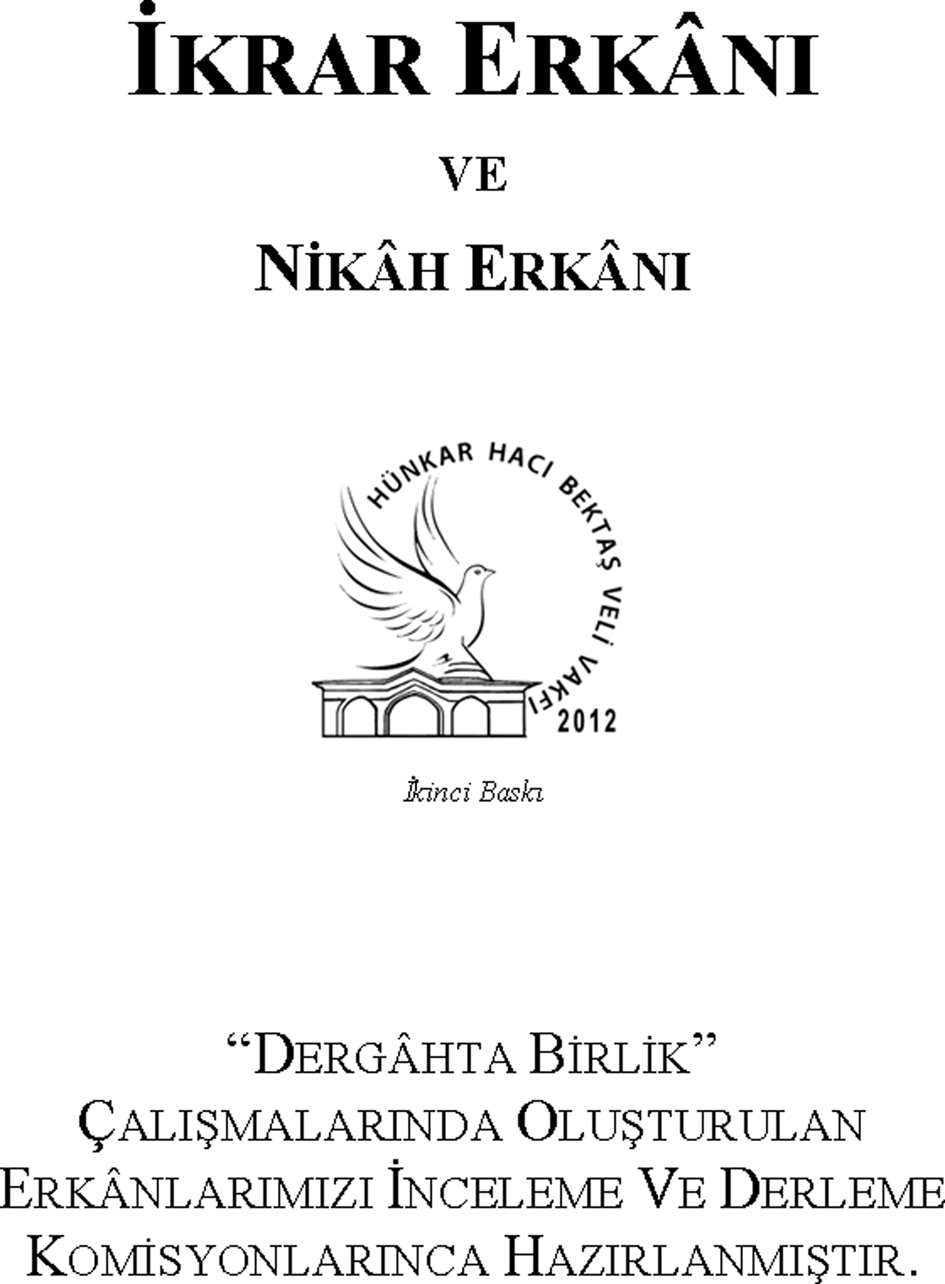
Insofar as Alevis suspend scriptural monotheism, they must always guard against the resurgence of what anthropologists of Islam following Talal Asad (Reference Asad1986) have called Islam's ‘discursive tradition’ grounded in the ‘foundational texts’ of the Quran and Hadith.Footnote 30 Over the past decade, the Hacı Bektaş shrine has taken on a leading role in responding to the threat of religious assimilation with its initiative ‘Unity in the Shrine’ (Dergâh'ta Birlik), which began in 2010 and 2011 with a series of open discussion forums held among local Alevi communities in Turkey and Europe. In accordance with recommendations arising from these forums, the spiritual leaders of the Ulusoy (Çelebi) family officially established the Sovereign Hacı Bektaş Veli Foundation in 2012, framing it as a present-day revival of the shrine's Ottoman-era pious endowment (vakıf). This foundation then convened a commission headed by Veliyettin Hürrem Ulusoy comprising 15–20 Alevi notables, including Dertli Divani, who were tasked with the comprehensive revision of Alevi liturgies (sing. erkân)—particularly those of funerary rites (Özdemir Reference Özdemir, Greve, Özdemir and Motika2020), but also of the communal oath ceremony. In 2016, after three-and-a-half years of deliberation, the Sovereign Hacı Bektaş Veli Foundation Liturgical Research and Collection Commission (Hünkâr Hacı Bektaş Veli Vakfı Erkânları İnceleme ve Derleme Komisyonu) published its revised ikrar liturgy (see Figure 3).Footnote 31 Issued under the authority of the Hacı Bektaş shrine, the new foundation, and the current spiritual co-leaders Veliyettin Hürrem Ulusoy and Safa Ulusoy, this liturgy is authoritative for Alevi communities who profess devotion to this shrine.
Cover page of the second edition of the revised ikrar liturgy. The booklet also includes a marriage liturgy (nikâh erkânı), as marriage is considered a kind of ikrar. The text at the bottom reads ‘prepared by the Liturgical Research and Collection Commissions convened as part of the “Unity in the Shrine” initiative’. Source: Reproduced with the publisher's permission.
I began this article by introducing the language for the central oaths of ikrar as published in the revised liturgy. However, in an oath ceremony I attended in 2015 (before the oaths were standardized), Dertli Divani added two additional phrases which did not appear in the subsequent published liturgy. The first was, ‘Do you swear to view all people equally without respect to race, language, religion, colour, sect, or gender?’ Dertli Divani confirmed my guess that this was inspired by an oft-quoted aphorism attributed to Hacı Bektaş, which states ‘those who do not see the 72 nations as one do not belong to us’ (yetmiş iki millete bir nazarla bakmayan bizden değildir). The second oath he added was, ‘Do you swear that what the saints [erenler] say is hak is hak, and what they say is not-hak [nahak] is not-hak?’ Not finding either of these sentences in the 2016 published liturgy, I asked Dertli Divani if they were discarded in the course of the Commission's deliberations.
He replied that it was not a matter of particular phrases being included or discarded, but rather of sticking to the right style. ‘As long as we use the same language [dil] and style [üslup],’ he explained, ‘we can multiply the words and phrases.’ By ‘language’ and ‘style’, Dertli Divani refers to a register of Turkish glossed as the ‘language of the path’ (yol dili), which is derived from the Turkish and Persian-language Sufi poetic tradition and marked by its emphasis on divine love and sainthood, and its avoidance of monotheistic doctrinal claims. Remaining within the language of the path, the notion of viewing people as equal irrespective of their race, gender, and other markers can be freely added to the oath. However, the assertion that there is no god but Allah cannot be, as that would detract from Ali's sovereignty—and amount to reintroducing monotheism (the Mosaic distinction) at precisely the moment of initiation where Alevis intend to supersede it.
The revised liturgies are therefore closer to being authoritative recommendations than binding legal documents. In their interactions with Alevi congregations, shrine representatives such as Dertli Divani and Veliyettin Hürrem Ulusoy emphasize the voluntariness of the new liturgies by saying ‘our words are not ironclad’ (sözümüz demirin kertiği değildir). This oft-repeated phrase implicitly contrasts Alevis’ approach to ritual language with the typical understanding in scriptural Islam of Quranic language as the immutable word of God. In stating ‘our words are not ironclad’, Dertli Divani and others seek to emphasize consensus as the foundation of religious authority in Alevism, framing this as a positively held value rather than a sociological constraint arising from the conditions of modern secularism. They draw attention to the congruence between consensus, or rızalık, as a specifically Alevi (one might say, post-Islamic) value secured by ikrar, and religious freedom of conscience as a normatively universal secular principle. This is a valuable connection to make for contemporary representatives of the shrine who promote, with varying degrees of urgency, the notion that one must give ikrar in order to legitimately become Alevi. Meanwhile, although the words of the new liturgies may not be ‘ironclad’, monotheistic oaths are clearly rendered taboo in a way that points to the potential limits of the ideal of ‘consensus’.
The ikrar oaths in their latest wording were issued by the Hacı Bektaş shrine by its own sovereign authority. No juridical authority was invoked, and no reference to scripture made. Instead, Dertli Divani emphasized that the liturgies are authoritative because they are a product of ‘common mind’ (ortak akıl), referring to the deliberations of the Liturgical Research and Collection Commission. The mere fact that the oath can be reformulated according to ‘common mind’ is already proof of the suspension of scriptural tradition, even before considering the oath's precise contents. Regarding its contents, the ikrar oath includes no attestation to God's exclusivity (‘no god but God’) in the monotheistic sense conveyed by Jan Assmann's (Reference Assmann and Savage2010) notion of the Mosaic distinction, nor any mention of Muhammad as the Prophet of God. In this sense, no profession of faith is required to give ikrar and enter the path. Or rather, ‘faith’ is understood as personal fidelity (sadakat) to familiar others, as in the phrase ‘we shall remain faithful [sadık] to our sustenance, our labour, and our partner’.
In my fieldwork experience, Alevi community leaders promoting the new liturgies had to repeatedly emphasize and legitimize the authority of the liturgies by explaining how they were issued from the shrine, rather than by personal fiat. In other words, the liturgies derived their authority not from the personal charisma of deputies like Dertli Divani, but from the status of the shrine and the sovereignty of ‘common mind’. Alevi leaders also had to defend the liturgies against other potentially competing sources of textual authority such as the Buyruks, early modern manuscript compilations dispatched by the Safavids to their Kizilbash-Alevi disciples in Ottoman territories (Karakaya-Stump Reference Karakaya-Stump2019).Footnote 32 They did this by emphasizing the authority of the shrine over that of any prior text. At a communal oath ceremony I attended in 2020, an elderly member of the congregation related how he tried to get the congregation on the same page by bringing in a copy of the Buyruk to the gathering house (cem evi) and suggesting that they all read it and shape their beliefs accordingly. ‘If the Republic of Turkey has a constitution, we have a Buyruk of Imam Jafar! In 1997 I brought it here to the cem evi,’ the man explained. Right away, a ritual musician (zakir) and local community leader intervened to direct attention back to the current liturgy. ‘Now we're going to believe in the writings the shrine sent,’ he said. ‘Fine, back then Imam Jafar did a great service, and it survived up until today. But now if we're bound to the shrine, from now on we're going to honour [itibar edeceğiz] the writings the shrine puts out. This is as valid for us as the Buyruk of Imam Jafar.’ The authority of the new liturgy supersedes any previous text. Rationalization is continuous and grounded in the shrine's sovereignty—not in Quranic revelation or even prior Alevi texts like the Buyruk. On the one hand, the liturgical texts are ‘not ironclad’, and ritual officiants in their role as its ‘animators’ can add phrases as they see fit within the genre. On the other hand, ritual officiants’ creativity is limited by their responsibility to the shrine, which must ultimately stand as the ‘principal’ authorizing their words (Goffman Reference Goffman1974). In a secular pluralist society in which the final locus of religious authority is often under dispute, the onus falls on ritual officiants to make this discursive relationship clear to their followers.
During the same ritual, Dertli Divani insisted that the Commission was not inventing anything new or ‘making something up from our own heads’ (kendi kafamızdan bir şey uydurmadık). Rather, he assured the congregation, the liturgy was crafted ‘in light of the discourses and verses of the great bards, minstrels, devotees, and perfect humans of Alevi tradition’ (ulu ozanların, aşıkların, sadıkların ve insan-ı kamillerin söylemleri ve dizeleri ışığında). He emphasized the sovereignty of the Hacı Bektaş shrine and its spiritual leaders (sing. postnişin), promising that he acts under the shrine's authority.
Look, let me state this very clearly. Should the postnişin whose signature (imzası) [he claps his hands on the second syllable of imzası] is on these liturgies say, ‘we're getting rid of these liturgies, it's going to be implemented in such-and-such a way’, we will follow suit (eyvallah deriz). Do you get what I mean? I'm telling you this openly. As long as his signature is on these liturgies, this is our Buyruk of Jafar Sadiq and this is our Quran. That's it. We're going to implement these liturgies. Even if it costs us our life, we're going to implement them. Whenever the postnişins should say, ‘we did something wrong’—if they were to say this—then of course the necessary accounts would be settled within [the shrine]. Henceforth, if a decision emerges to the effect of, ‘okay, let's do it like this instead of like that’—don't worry, we'll be the first to implement that.
Dertli Divani emphasizes the shrine's sovereignty—indicated here by the postnişin's signature—and its authority to suspend scripture. He makes this clear by clapping his hands forcefully on the word ‘signature’ (imza), stressing the signature's importance as the enactment and sign of the shrine's authority. His promise to implement the new liturgies ‘even if it costs us our life’ also demonstrates his deference to the shrine as one of its licensed deputies. The shrine and its deputies parochialize Quranic scripture by denying it the exceptional status of revelation, thereby demoting it to just one historically specific expression of ‘common mind’ (and an old and outdated one at that). While monotheistic religions may claim a separate ontological status for scripture prior to liturgy, opening the latter to periodic reform on the authority of the former's permanence, the Hacı Bektaş shrine's reforms collapse any distinction between the two genres. As Dertli Divani explicitly states, the signature of the shrine's spiritual leader authorizes the liturgies to take the place not only of Quranic scripture, but also of past Alevi treatises like the Buyruks.
Post-Islamic oaths
In the revised liturgy, after the ikrar oaths are verbally administered but before the ritual officiant seals the oaths by patting the prostrated initiates on the back, the latter are asked to affirm their commitment to the Alevi path over and above others. ‘Our path is the path of Hak [God/Truth],’ the officiant recites, speaking for the mute initiates, ‘I washed my hands of the others’ (yolumuz Hak yoludur, gayrilerden el yudum). Given that this phrase might be interpreted as itself a claim to exclusive religious truth—that is, as an instance of the Mosaic distinction—I asked Dertli Divani in an interview to clarify. He explained that the line refers to purifying oneself of ‘other beliefs’ (başka inançlar). When I pressed him further to elaborate on what might count as ‘other beliefs’, he pointed more specifically to those elements of Sunni monotheism which the reforms removed from the liturgy. The shrine may insist that the precise words of the liturgy are not ‘ironclad’, but there are limits to this flexibility—it is of critical importance to the shrine's project that any words indexing monotheism, and especially the standard monotheistic oaths (basmala, takbir, and shahada), are ‘ironed’ out and replaced with post-Islamic oaths.
One spot where monotheistic oaths were removed is the Alevi rite of sacrifice. The Hacı Bektaş shrine used to follow sacrificial rites similar to Sunni custom, including standard Islamic oaths. An outline of the sacrifice and communal oath liturgies originally published by Veliyettin Hürrem Ulusoy in 2005 and 2006 contains both basmala and takbir oaths, presumably reflecting their prevalence in Alevi practice at that time (Ulusoy Reference Ulusoy and Koçak2014, 37–73). A study of Alevi sacrifice from the same period also notes similarities with Sunni practices (Langer Reference Langer, Stavrianopoulou, Michaels and Ambos2008). The Commission removed these and replaced them with post-Islamic oaths. In the revised 2016 liturgy (Hünkâr Hacı Bektaş Veli Vakfı Erkânları İnceleme ve Derleme Komisyonu 2016, 10–12), the takbir ‘Allahu Ekber’ is replaced by the phrase ‘for the love of Hak Muhammad Ali and our Pir the Sovereign Hacı Bektaş Veli, may our sacrifice be accepted’ (Hak Muhammed Ali, Pirimiz Hünkar Hacı Bektaş Veli aşkına kurbanımız kabul ve makbul ola). This emphasizes the fact that the sacrifice is not to the jealous God of biblical monotheism (represented by the takbir), but to the cosmic divinity of Hak Muhammad Ali and this divinity's human embodiment in the saint Hacı Bektaş and his devotees.
Alevis’ rationalization of their sacrificial practices in self-conscious opposition to Sunni (and, more broadly, biblical) norms is in large part a response to their heightened concerns regarding the encroachment of political Islam in the past decade. In a 2015 communal oath ceremony (before the new liturgy was fully established), Dertli Divani pointed out to the congregation that he did not say ‘Allahu Ekber’ during the sacrificial rite:
If you paid attention, before we slaughtered the lamb here we brought it to the meydan. I didn't say Allahu Ekber Allahu Ekber Allahu Ekber. They say Allahu Ekber right before they stab or shoot people and kill them. What does Allahu Ekber mean? Allah is Great, Allah is Great, Allah is Great. What did we say here? We said, ‘to the unity of Hak Muhammad Ali, to the pir-ness of Hünkar Hacı Bektaş Veli, by God’, and we did our services.
Implicit in Dertli Divani's comments is an effort to distance Alevis from the violence wrought by ISIS in neighbouring Iraq and Syria and justified with monotheistic oaths. Given that this violence, and ISIS members themselves, flowed across the porous Turkish border during my research period, these developments were at the forefront of many public discussions among Alevis, lending urgency to reforms like this one.
Another place where monotheistic oaths were replaced with post-Islamic ones is in the semah, a sacred ‘dance’ performed by men and women together, marking the climax of the cem ritual. The most popular semah performed in Nurhak today was given its present form by Dertli Divani on his 2000 album Serçeşme (Fountainhead) (see Figure 4).Footnote 33 Prior to recording and releasing the album, he obtained the Nurhak cem congregation's consent to adapt a new text to the local traditional music. Attributed to the sixteenth-century poet Şahi, the new text clearly narrates the ritual sequence of ikrar, and is also sung with different music in other Bektashi and Sufi congregations in Turkey.Footnote 34 Dertli Divani also modified a short introductory section occurring at the beginning of the semah, one that is particularly striking insofar as it is usually sung without saz accompaniment. Previously, this introduction featured chanting of an Arabic phrase in praise of Muhammad (sallu ala Muhammede teslima), repeated three times and accompanied by prostrations. Dertli Divani removed this phrase and replaced it with the following stanza he wrote himself, to be sung to the same melody. Note that the stanza begins with the oath to Ali, or the Shah (bismişah), which replaces the standard Islamic oath to Allah (bismillah) in Alevi prayers.

Cover of Dertli Divani's album Serçeşme. Source: Reproduced with Divani's permission.

One of the Nurhak zakirs I interviewed noted how well this new prelude fits with the new text by Şahi, emphasizing the fact that the stanza is sung in Turkish as opposed to Arabic, is composed in a poetic, rhyming meter, and presents a fundamental principle of the path: recognition of Adam (that is, perfect humans) as God or Hak. The Liturgical Research and Collection Commission must have agreed, since it decided to incorporate the stanza in a critical moment of the oath-taking liturgy itself. The ritual officiant now recites these verses immediately before sealing initiates’ oaths with the corporeal investiture of his or her palm (pençe).
Perhaps the most striking instance of oath-replacement in the liturgy is in the tevhit, a lively hymn directly following the semah. Tevhit means ‘unity’ (Ar. tawhid), and it is in this hymn that the congregation celebrates their ritual realization of the Sufi cosmological principles of ‘unity of being’ (vahdet-i vücut) and ‘unity of existence’ (vahdet-i mevcut). Shifting to sit on their heels, the entire congregation is encouraged to sing in unison and pat their thighs in time with the music. While Schubel (Reference Schubel, Gruber and Colby2010, 342) notes in his chapter on the Mi‘raj that Alevis sing a version of the shahada—‘there is no god but Allah’ (Hak la illaha ilallah)—as part of their tevhit, this too was revised by the shrine's reforms. The refrain of the tevhit is now sung as follows:

‘Şah illallah’ (Shah except Allah) is not grammatically correct Arabic. Rather, it is a direct undoing of the standard oath of monotheism, ‘there is no god but Allah’. The Alevi shrine simply excises ‘la illaha’ (no god)—the part of the oath that contains the Mosaic distinction, or rejection of other gods—and replaces it with their own post-Islamic stamp: ‘Shah’. Once monotheism is stamped out with the name of Ali, the resulting ungrammatical expression becomes the new, post-Islamic oath.
That the oath is ungrammatical is of little concern to Alevis, most of whom do not understand Arabic.Footnote 35 In our interview, Dertli Divani (who, having grown up in the city of Şanlıurfa on Turkey's southeastern border with Syria, does understand some Arabic) explained the oath in terms of its affirmation of Ali's divinity:
La illaha is Arabic, meaning there is no divinity or object of worship besides Allah. We say Şah illallah illallah. It means Hak is in Ali, manifested in him. Ali is the Shah. Ali is ‘Hak with Hak’ (Hak ile Hak), we say. We believe this, we affirm this. We express a god who is present in Adam, in the human being, rather than a concept of a god that cannot be held with one's hand or seen with one's eyes. Ali is a manifestation of Hak. Hak manifested in Ali. The being of Hak also manifested in Jesus, in Moses, and in Muhammad. Alevis see Ali in that way. That's their perspective.
In his interpretation of the oath, Dertli Divani assimilated the role of prophets (Jesus, Moses, Muhammad) within that of saints or perfect humans—they are akin to Ali but less central to Alevi religious practice. He explained that the Liturgical Research and Collection Commission had encountered many tevhits featuring the formula ‘Şah illallah illallah’ in liturgies they reviewed from various regions of Turkey, particularly those collected from the eastern province of Malatya. This formula appealed to the Commission as a concise expression of Alevi theology. In its function as a post-Islamic oath, Şah illallah illallah is far from being weakened by its ungrammaticality. Rather, it is precisely this that makes the oath so effective as a refusal of monotheism.
Consensus and secularism: From edict to ethic
The precise words used are not the only thing about the ikrar oaths that is not ‘ironclad’. The illocutionary effect of the ritual in the lives of initiates is not ironclad either, although it is certainly intended to be so. Indeed, initiates are warned that the path they are embarking upon is like a ‘shirt of fire’ (ateşten gömlek) and a ‘chickpea of iron’ (demirden leblebi), and if they are not up to the task of wearing fire and chewing iron, then they should turn back while they can.Footnote 36 The ethical rigour of ikrar as an oath of consensus was traditionally secured by a harsh penalty for breaking the oath: social death or excommunication (düşkünlük). Today, excommunication is no longer an effective mechanism of social control because the moral community constituted by ikrar is not the sole or even necessarily most important social support network Alevis rely upon.Footnote 37 Nor can Alevi reformers take for granted that either the rite of sacrifice or the music of the saz will inculcate the proper ethical dispositions around the ideal of social consensus. Dertli Divani must explicitly close the gap between signs (a lamb, the saz) and their ethical interpretants, for instance by advising the congregation that ‘the real sacrifice is the initiates who give ikrar, pass through görgü, and become a musahip; this [animal] is a translation of our skin. Actually, this [animal] came to the ritual arena symbolically, but everyone who gives ikrar must surrender to the path like this living creature's surrender.’ In short, ikrar may represent an abiding ethic, but it is no longer a binding edict.
This destabilization of ikrar is illustrated by an instance of a man who had not given ikrar, yet still sought to draw on the social mechanisms that ikrar ambiguously afforded him as a member of other tangential local networks in Nurhak. During one communal oath ceremony, I observed a dispute between cousins Ali and Mahmut, men in their fifties and seventies respectively, of whom only Ali had given ikrar. Following the cousins’ verbal altercation over the use of firewood from a nearby forest preserve, their case had been brought to an assembly of local elders who had facilitated their reconciliation. However, Mahmut insisted that his case was still undecided—without a clear winner and loser—and should be referred to the communal oath ceremony as a ‘higher court’ (üst mahkeme). Mahmut said he wanted to be judged ‘in the big place’ (büyük yerde) and thus obtain a clear verdict on who was guilty and who was innocent. ‘In the Alevi tradition,’ he said, ‘they determine who's guilty [haksız] and who's innocent [haklı], and they banish the guilty one. Isn't that so, baba? So then if I'm guilty they should banish me, if he's guilty they should banish him.’ Dertli Divani replied sharply, ‘There's no banishing! We don't have the luxury of losing anyone. You're both innocent and you're both guilty.’ When Mahmut still did not relent, Dertli Divani sought to settle the matter expediently by announcing, ‘Ali's guilty, you're innocent; is that enough for you?’ He instructed Ali to kiss the elder Mahmut's hand and Mahmut to embrace Ali as a sign of reconciliation, but Mahmut protested. ‘Come on baba, don't do this to me,’ he pleaded, complaining that it ‘weighed heavily’ (ağır geliyor) on him to make such a gesture of deference. People in the congregation sighed in exasperation as Mahmut awkwardly, gingerly embraced Ali, while Dertli Divani concluded authoritatively, ‘This is what yol requires.’
This episode demonstrates how access to yol and its rituals is no longer clearly mediated by the ikrar oaths (as the measure of inclusion) and excommunication (as the measure of exclusion). When Dertli Divani says ‘there's no banishing!’ (dışlamak yok), he explicitly recognizes that excommunication is no longer a feasible sanction in a secular pluralist society in which Alevis are under constant threat of assimilation to majoritarian scriptural Islam. He also implicitly acknowledges the corollary of this: that ikrar, no longer a binding oath, is demoted from its position as the final determinant of status and rights vis-à-vis the path. Hence Dertli Divani did not dismiss Mahmut's claims out of hand because the latter had not given ikrar. When I asked Ali what authorized Mahmut to nevertheless press his claims, Ali replied that Dertli Divani was obliged to take Mahmut's complaints seriously lest the latter were to spread rumours and bring harm to the path. This points to the fact that the authority of the path and its oaths is circumscribed by competing networks of social influence, such as those centred around the family, economy, and state.
The discrepancy between Ali's and Mahmut's roles in the dispute mediation illustrates the indeterminate nature of ikrar's authority in contemporary Alevism. For Ali, the incident was framed as an ethical test of steadfastness in his ikrar, which, in Dertli Divani's estimation, he passed. In an intimate post-cem gathering in a local elder's home, Dertli Divani commended Ali for acting ‘virtuously’ (erdemli) and ‘like the earth’ (türap) in accepting the blame earlier that evening, framing the event as a major ethical milestone for the latter's journey on the path. ‘Today's events might have been the best lesson of your life,’ he counselled. ‘You finished three, four, five, seven universities today.’ ‘It was a lesson, yes,’ Ali agreed, promising never to renege on his ikrar. Meanwhile, Mahmut does not and cannot hold the same goals as Ali because he does not have ikrar. On the one hand, Mahmut feels and implicitly acknowledges the congregation's and shrine's authority (embracing Ali ‘weighs heavily’ on him). On the other hand, Mahmut does not share the ‘paramount value’ (Robbins Reference Robbins2007) of consensus which structures the görgü ‘court’ as a reconciliation mechanism grounded in the ikrar oaths. Instead he misrecognizes the path as a bureaucratic juridical apparatus and authoritative arbiter of right and wrong to which individuals can have recourse as suits their needs and purposes.
Conclusion
Sulh-i kull was enforced by a bureaucracy loyal to Akbar and authorized by him to use force. Deputies of the Hacı Bektaş shrine have no such power and must instead work to persuade their followers of the connection between the liturgies they perform and the shrine which authorizes them. Deputies like Dertli Divani draw this connection explicitly by explaining to congregations the process by which the liturgies were drafted. They also do so implicitly, for instance in the concluding formula of most Alevi prayers which goes ‘may the tongue be from us and the breath from the Sovereign Hacı Bektaş Veli’ (dil bizden nefes Hünkar Hacı Bektaş Veli'den ola). Note that when it comes to establishing the liturgies’ authority, the legitimacy of deputies like Dertli Divani to represent the shrine per se is not in question. Although the shrine grants licences (sing. icazet) to deputies that permit them to officiate in the rituals of certain communities, I have never seen deputies called upon to prove their legitimacy by producing such a licence. Rather, it is the source of the liturgies’ authority that must be conclusively established. In this sense, the shrine remains important as the actor able to authoritatively suspend monotheism—something it does less in its capacity as a physical sacred space (for a vividly argued example of that, see Taneja Reference Taneja2018), and more as a distant, deterritorialized principal underwriting the liturgies’ authority. As a result, the shrine's suspension of scriptural law applies universally across all Alevi communities associated with it, both in Turkey and the European diaspora.
This article argued that Alevism's relationship with Islam can be clarified by moving beyond intellectual explanations and textual sources—including poetry, despite its central role in Alevi religious practice—and paying close ethnographic attention to the ritual acts in which poetry is embedded and to which it refers. By directing focus to the Alevis’ foundational oaths of ikrar, this article demonstrates that Islamic difference is not only a matter of variations in the shahada—such as the Shia addition of Ali's sainthood (velayet)—but also a question of whether or not one accepts the shahada itself, including the notion of divine unity or tevhit (Ar. tawhid) it encompasses (cf. Oktay-Uslu Reference Oktay-Uslu2020). The oaths of peace which comprise ikrar allow Alevis to bypass the shahada and constitute a post-Islamic community that extends beyond the circumscribed space-time of a physical shrine site. In doing so, these oaths bolster Alevis’ ability to avoid being converted to scriptural Islam. This is why Alevi reformers place so much emphasis on the revival of communal oath rituals—even as they acknowledge the difficulty of maintaining the social orders of consensus these rituals are designed to bring into being.
Competing interests
None.


 Open access

