

Be thou assured, if words be made of breath,
And breath of life, I have no life to breath
What thou hast said to me.
1.1 Introduction
Have you ever wondered, if we didn’t need to inhale and exhale regularly, would we speak without pausing, constructing sentences of infinite length? Would the variations in speech amplitude and fundamental frequency resemble what we observe today? Might our conversational turns become more extended? In exploring these questions, any speaker is likely to acknowledge that their manner of speaking, particularly the rhythmic organization of speech and conversational turns, is significantly influenced by breathing. As briefly outlined in Section 1.2, respiration is a complex physiological system greatly influenced by behavioral and environmental factors. Acquiring the skill of speaking also entails acquiring a particular control over breathing. The rhythm of breathing is significantly molded by speech production, yet the imperative to breathe also exerts a profound influence on speech rhythm at different levels.
The complexity of the influence of breathing on speech becomes even more apparent when one speaks while concurrently performing another motor activity. As indicated by previous research, limb motion may have a specific impact on real-time spoken language. Section 1.3 delves into the repercussions of two distinct forms of limb motion that are prevalent during spoken communication. First, numerous studies have underscored the significance of co-speech gestures in spoken communication, and various pieces of evidence highlight the structuring or influence of these gestures on speech rhythm. Second, speech often occurs during various noncommunicative activities that involve motions of our hands and/or other parts of our body. As such, speech is part of a dynamic sensorimotor system working as a whole. Interactions among various processes occur at neurophysiological, biomechanical, and thus behavioral levels, resulting in coordinated temporal patterns.
Sections 1.4 and 1.5 address the tripartite relationship between speech, breathing, and limb movements. Breathing is indeed a central aspect of limb motion, speech, and, more recently, cognition research. The reciprocal influences between limbs and speech may occur through the respiratory system, as suggested recently. The connections between limb motion’s motor control, physiology, and spoken language present new challenges and perspectives that will also be discussed.
1.2 Speech Breathing: Where Linguistic and Physiological Rhythms Meet
1.2.1 A Brief Description of the Breathing System
Breathing is a gas exchange mechanism between the air and the bloodstream (oxygen in and carbon dioxide out) through a cyclical series of inhalations and exhalations. It is supported by a physiological system involving peripheral organs and a complex neural control that interacts with other behavioral functions (Hoit et al., Reference Hoit, Weismer and Story2021).
Gas exchanges occur in the lungs within the thoracic cavity. Inhalation involves the contraction of intercostal muscles and the diaphragm, expanding lung volume (Figure 1.1A, left). As the lung volume increases, keeping the air quantity constant, negative pressure in the rib cage draws air into the lungs. At rest, exhalation is initiated passively as the relaxation of external intercostal muscles and the diaphragm leads to a reduction in lung volume. During active processes such as speech, additional muscles, including internal intercostal and abdominal muscles, contribute to controlled air expulsion. The larynx, comprising the epiglottis and vocal cords, plays a predominant role in controlling the flow of exhaled air during speech (Hoit et al., Reference Hoit, Weismer and Story2021).
Illustration of breathing process and control
Mechanism of inspiration and expiration phases;
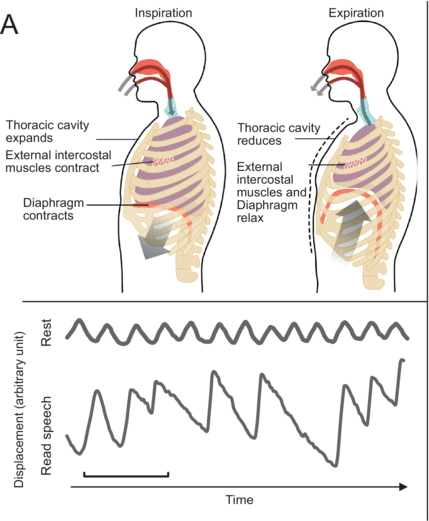
Figure 1.1(A) Long description
Part A: Top. 2 line drawings of the human torso are labeled Inspiration and Expiration, respectively. Left. The labels include thoracic cavity expands, external intercostal muscle contracts and diaphragm contracts. Right. The labels include Thoracic cavity reduces, External intercostal muscles and Diaphragm relax. Bottom: A line graph of displacement versus time plots two fluctuating lines for rest and read speech.
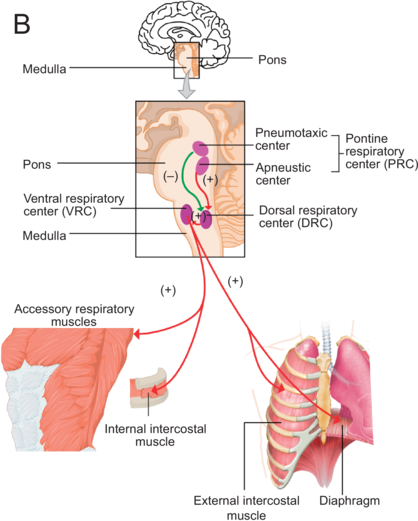
top: Centers of the brain involved in breathing control; (B) bottom: Example of rib cage breathing movement at rest (tidal breathing) and speech breathing (read speech) monitored using inductive plethysmography.
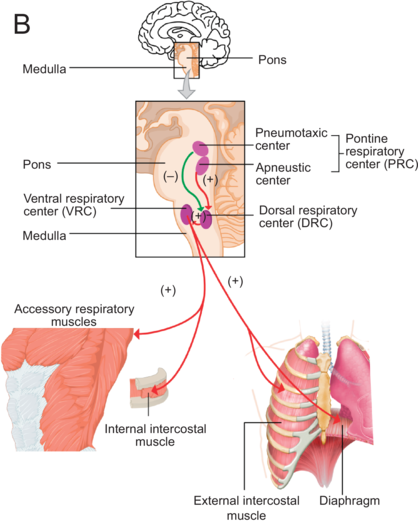
Figure 1.1(B) Long description
Part B: An illustration of a human brain with a rectangular box marking the medulla and pons. The marked region is expanded below to show Pneumotaxic center, Apneustic center, Pontine, respiratory center, Dorsal respirator, Pons, Ventral respiratory center, and medulla. Three arrows originate from the ventral respiratory center and point at the illustrations, including accessory respiratory muscles, internal intercostal muscle and external intercostal muscle and diaphragm.
The control of breathing is influenced by various nervous system structures (Shea, Reference Shea1996; Hoit et al., Reference Hoit, Weismer and Story2021) and governed by metabolic and behavioral needs. Under automatic control, a central pattern generator (CPG) in the brainstem (Figure 1.1B) regulates rhythmic inhalation and exhalation patterns, involving the medullary respiratory center (MRC) and the pontine respiratory center (PRC). During inhalation, the MRC’s dorsal and ventral respiratory centers stimulate the contraction of the diaphragm and of the external intercostal muscles. The ventral center also inhibits muscles for exhalation. Both centers receive information from the PRC that comprises the pneumotaxic and apneustic centers. The PRC sends inhibitory and stimulatory signals to the MRC, regulating the duration and intensity of breathing phases. The CPG communicates with muscles through spinal cord phrenic, intercostal, and abdominal motoneurons. Cortical centers controlling voluntary breathing send messages to the CPG that also receives feedback from peripheral structures, central chemoreceptors, and lung stretch receptors, impacting the regulation of respiration (Del Negro et al., Reference Del Negro, Funk and Feldman2018; Ben-Tal et al., Reference Ben-Tal, Wang and Leite2019).
Subcortical structures and cortical areas associated with various behaviors also significantly impact respiration regulation in humans, rendering breathing sensitive and adaptive to sensory stimuli, emotional responses, and changes in cognitive or physical activity levels. Breathing adapts particularly to behaviors requiring airflow, such as speech sound production, and those increasing muscle oxygenation needs, such as limb movements. The unique link between speech and breathing arises from the animated structures of the vocal tract, shaping inspiratory and respiratory flows into articulated sounds.
1.2.2 Insights into Recording and Analyzing Speech Breathing
Breathing can be monitored using different devices, such as the pneumotachograph, which directly measures the airflow in the respiratory system. Pneumotachographs are commonly employed in medical and physiological research using face masks and have been adapted to record speech breathing (Rothenberg, Reference Rothenberg1977; Ghio and Teston, Reference Ghio and Teston2004). However, speaking with a facial mask is unnatural and alters speech articulation as well as breathing (Shea, Reference Shea1996). Alternative methods, such as inductance plethysmography, record variations in thoracic and abdominal volumes thanks to elastic straps with insulated wires around the speaker’s abdomen and chest. During inhalation and exhalation, the cross-sectional areas of the rib cage and abdomen expand and compress, altering the self-inductance of the coils and the frequency of their oscillation, which is converted into a digital waveform. The shape of the waveform is proportional to the inhaled or exhaled breath volume (see Figure 1.1B). Despite its sensitivity to motion artifacts, inductance plethysmography is suitable for estimating breathing in various tasks, including speech (Caretti et al., Reference Caretti, Pullen, Premo and Kuhlmann1994; Clarenbach et al., Reference Clarenbach, Senn, Brack, Kohler and Bloch2005). It provides displacement data over time and allows the extraction of parameters such as respiratory rate and amplitude. Calibration is necessary for converting amplitude into volumetric units (Banzett et al., Reference Banzett, Mahan, Garner, Brughera and Loring1995; McKenna and Huber, Reference McKenna and Huber2019). The symmetry between inhalation and exhalation durations is a crucial parameter for studying speech breathing, characterized by unique specificities compared to silent breathing at rest or in different activities (Fuchs and Rochet-Capellan, Reference Fuchs and Rochet-Capellan2021).
1.2.3 Speech Breathing as a Multidetermined Rhythm
During speech, the regulation of breathing is intertwined with the planning of speech motor functions, involving a dynamic interaction between the forebrain, particularly cortical structures for speech production, and subcortical structures (Fuchs and Rochet-Capellan, Reference Fuchs and Rochet-Capellan2021). This interaction results in significant alterations in breathing patterns, notably a pronounced asymmetry between rapid inhalation and slow exhalation during speech (see Figure 1.1B). Variability in speech breathing cycles, in terms of duration and volume of air inhaled and exhaled, is influenced by linguistic, cognitive, and interactive factors (Conrad and Schönle, Reference Conrad and Schönle1979; McFarland, Reference McFarland2001; Fuchs and Rochet-Capellan, Reference Fuchs and Rochet-Capellan2021).
For example, in reading and spontaneous speech, inhalation duration and depth correlate with the upcoming utterance’s length, although correlations are smaller in spontaneous speech (Sperry and Klich, Reference Sperry and Klich1992; Winkworth et al., Reference Winkworth, Davis, Ellis and Adams1994, Reference Winkworth, Davis, Adams and Ellis1995; Rochet-Capellan and Fuchs, Reference Rochet-Capellan and Fuchs2013). The flexibility of breathing in adapting to speech demands allows for variability in extemporaneous speech, enabling the expression of communicative cues such as F0 modulation (Fuchs et al., Reference Fuchs, Reichel and Rochet-Capellan2015).
During speech, inhalation phases are coordinated with syntax. Readers tend to breathe predominantly at syntactic boundaries, and the amplitude of the breathing cycle correlates with the type of boundary, such as greater amplitude before a new paragraph than before a new sentence in the same paragraph (Conrad et al., Reference Conrad, Thalacker and Schönle1983). As speech rate increases, the frequency of breathing pauses decreases, defining a “syntactic tempo” observed in both text reading and spontaneous speech (Grosjean and Collins, Reference Grosjean and Collins1979; Rochet-Capellan and Fuchs, Reference Rochet-Capellan and Fuchs2013; Werner et al., Reference Werner, Trouvain and Möbius2022).
In conversation, breathing becomes intricately linked to turn-taking, with partners displaying coordinated breathing at turn-taking events and the shape of breathing cycles specific to conversational events (McFarland, Reference McFarland2001; Rochet-Capellan and Fuchs, Reference Rochet-Capellan and Fuchs2014). Holding one’s breath in a silent breathing cycle may signal intentions related to turn-taking, influencing the perception of speech pauses (Wlodarczak and Heldner, Reference Wlodarczak and Heldner2020). Ultimately, the presence of inbreath noises significantly influences the perception of speech pauses (MacIntyre and Scott, Reference MacIntyre and Scott2022). These noises are influenced by the configuration of the vocal tract, suggesting that breathing may acoustically convey specific information that merits further investigation (Werner et al., Reference Werner, Fuchs and Trouvain2023). This critical information can influence the behavior of a dialogue partner. Moreover, breathing interactions between communicative partners appear to develop early, as observed in mother–infant interactions (McFarland et al., Reference McFarland, Fortin and Polka2020).
The adaptability of the breathing system is crucial to support spoken communication. However, as discussed in Fuchs and Rochet-Capellan (Reference Fuchs and Rochet-Capellan2021), spoken communication is also constrained by the intricate interplay between breathing, cognitive abilities, and lung volume capacity. Consequently, speech breathing is highly individualized, exhibiting significant variations among speakers.
1.2.4 Speech Breathing as a Speaker-Specific Tempo
The exploration of individual breathing characteristics began with an examination of tidal breathing. Dejours noted variations in ventilation characteristics among participants even under identical conditions, leading to the concept of “ventilatory personality” (Dejours, Reference Dejours1966; Shea and Guz, Reference Shea and Guz1992). Consistency in breathing patterns over time was confirmed by Bennchetrit et al. (Reference Bennchetrit, Shea and Dinh1989), with monozygotic twins displaying more similar tidal breathing than random or dizygotic pairs, hinting at potential genetic or physiological influences (Kawakami et al., Reference Kawakami, Yamamoto, Yoshikawa and Shida1984; Shea et al., Reference Shea, Horner, Benchetrit and Guz1990). However, task-specific variations in breathing individuality exist, with stability observed within tasks such as tidal breathing or exercise but not consistently between them (Eisele et al., Reference Eisele, Wuyam and Savourey1992; Besleaga et al., Reference Besleaga, Blum and Briot2016).
Speech breathing is influenced by various speaker-specific parameters. Aging, for example, leads to declines in breathing capacities, affecting speech production, with older adults requiring higher lung volumes for speech initiation (Hoit and Hixon, Reference Hoit and Hixon1987; Sperry and Klich, Reference Sperry and Klich1992; Huber, Reference Huber2008). Factors such as weight, stature, age, sex, developmental processes, or diseases such as Parkinson’s or asthma also impact speech breathing (Hoit and Hixon, Reference Hoit and Hixon1986, Reference Hoit and Hixon1987; Loudon et al., Reference Loudon, Lee and Holcomb1988; Hoit et al., Reference Hoit, Hixon, Watson and Morgan1990; Solomon and Hixon, Reference Solomon and Hixon1993; Boucher and Lalonde, Reference Boucher and Lalonde2015), suggesting that breathing is determined by speaker-specific factors related to both bodily and cognitive constraints.
Despite ample evidence of speaker-specific breathing profiles during speech, recent work by Serré et al. (2020) also highlights individual consistency in speech breathing. They found that while the period of the speech breathing cycle differs among participants, it remains remarkably consistent for the same individual, even during light exercise. This underscores the high variability and specificity of speech breathing in each speaker.
Speech rhythm is also influenced by limb movements co-occurring when speaking. This relation between speech and limb movements may involve breathing, as discussed in Section 1.3.
1.3 The Influence of Limb Movements on Speech Rhythm
Limb movements are ubiquitous in spoken communication. Communicative limb movements, especially those executed with the arms and hands, are intrinsic to human conversation. Gestures accompanying speech, in particular hand gestures, have been extensively studied and exhibit a multilayered relationship with speech (see also Chapter 4 in this volume). At the level of speech production, representational gestures can help lexical access and speech fluency, thereby influencing speech rate and acting as essential pacing cues during conversations. At the sensorimotor level, the coordination between upper-body movements and vocalization is a key step of language development and still observed in adulthood.
1.3.1 Gestures as an Essential Component of Speech Production
Gestures, and especially hand gestures, appear to serve different purposes in spoken communication. The multitude of connections between gestures and speech has sparked numerous studies and hypotheses exploring the interplay between these two systems and their roles in communication and language.
1.3.1.1 Effect of Gestures on Speech Conceptualization
Speech planning and speech fluency are tightly linked. Numerous studies emphasize the supportive role of gestures in accessing lexical items or concepts during speech production (Graham and Heywood, Reference Graham and Heywood1975; Morsella and Krauss, Reference Morsella and Krauss2004; Hostetter et al., Reference Hostetter, Alibali and Kita2007; Hoetjes et al., Reference Hoetjes, Krahmer and Swerts2014; Cravotta et al., Reference Cravotta, Busà and Prieto2019). These studies looked at the effect of gesturing (compared to not being able to gesture) on lexical content, but also on the number of pauses, speech rate, and prosody. The lexical retrieval hypothesis, supported by Krauss (Reference Krauss1998) and Ruiter (Reference Ruiter1998), posits that gestures play a crucial role in lexical access, facilitating access to concepts and words in memory. This theory echoes studies highlighting the neural connections between semantic comprehension of actions and corresponding sensorimotor circuits (Pulvermüller and Fadiga, Reference Pulvermüller and Fadiga2010; Bidet-Ildei et al., Reference Bidet-Ildei, Beauprez and Badets2020). Besides aiding memory retrieval, gestures help organize information for verbal encoding, especially spatio-motoric details (Alibali et al., Reference Alibali, Kita and Young2000; Kita et al., Reference Kita, Alibali and Chu2017). Gestures support the activation of spatio-motoric information and problem-solving in both concrete and abstract thinking, potentially influencing the course of speaking, facilitating novel ideas and affecting discourse orientation. Through this process, gestures influence the packaging of verbal information into clauses. For example, when describing the manner (e.g., rolling) and path (e.g., down) of a motion with two separate gestures, participants tend to produce a two-clause verbal description, while a single gesture leads to a single-clause verbal description (see Kita et al., Reference Kita, Alibali and Chu2017 for references). This role attributed to gestures may have correlates in speech rhythms that require further investigation.
Various hypotheses surround the roles of gestures – whether they serve conceptual or communicative purposes – prompted by the question of whether speech and gestures are distinct or stem from a unified internal representation. Beyond their communicative role, gestures serve pragmatic functions, supporting interpersonal coordination in spoken conversations.
1.3.1.2 Role of Gestures in Conversational Stream
The role of nonverbal communication in dialogue is briefly highlighted here, emphasizing gestures’ contribution to the rhythm of interpersonal verbal exchanges. Gestures serve as visual cues in conversations and convey a variety of information supporting interpersonal convergence and coordination (Holler, Reference Holler2022). They often precede the verbal message or convey additional information without interrupting speech. Specifically, gestures are integral to backchannels and turn-taking processes (Wagner et al., Reference Wagner, Malisz and Kopp2014), which are indispensable for dialogue fluidity and pace. Gestures, and nonverbal communication in general, offer real-time feedback to speakers, aiding in understanding listener processing without disrupting ongoing discourse. This mechanism allows speakers to assess communication success, aiding anticipation of semantic shifts, topic changes, and turn-taking events (Holler and Levinson, Reference Holler and Levinson2019). For instance, Ter Bekke et al. (Reference Ter Bekke, Drijvers and Holler2024) found quicker responses to questions accompanied by iconic gestures. Electroencephalographic studies show that brain responses in dyadic interactions are modulated by the processing of nonverbal cues (Zhang et al., Reference Zhang, Frassinelli, Tuomainen, Skipper and Vigliocco2021). More specifically, beat gestures facilitate semantic processing (Wang and Chu, Reference Wang and Chu2013) and syntactic parsing (Obermeier and Gunter, Reference Obermeier and Gunter2014; Biau et al., Reference Biau, Fromont and Soto‐Faraco2018).
Co-speech gestures significantly influence the timing of spoken communication, affecting thinking, speech production, and conversational tempo. Coordination between speech and co-speech gestures is proposed to be rooted in the conceptual phase, relying on common meaning (McNeill, Reference McNeill1992). Additionally, sensorimotor connections between articulatory and limb control, especially hand and mouth, may underpin coordination between speech and co-speech gestures.
1.3.2 Speech and Co-speech Gestures Acting in Synchrony
Regardless of speech content, sensorimotor connections are at play in the coordination between speech gestures and co-speech gestures. These connections emerge early during development, in the course of speech acquisition. Similar coordination patterns are observed between noncommunicative vocalization and limb movements during adulthood, suggesting that the hand and the mouth share common control mechanisms.
1.3.2.1 Manual and Vocal Development towards Spoken Language
Low-level motor links appear early in ontogenesis and may establish the connection between speech and co-speech gestures (see also Chapter 38). Fetal initiation of facial touching, particularly around the mouth, begins between 12 and 15 weeks of gestation (Gallagher, Reference Gallagher, Bermúdez, Eilan and Marcel1995; Fagard, Reference Fagard2013). At birth, about one-third of hand movements result in hand–mouth contact, with coordination advancing rapidly, especially when the child is hungry (Gallagher, Reference Gallagher, Bermúdez, Eilan and Marcel1995). Rhythmic coupling between limb motion and vocal tract control for vocalization typically begins around six months, serving as a basis for hand-to-mouth coordination development (Iverson and Thelen, Reference Iverson and Thelen1999). In particular, a peak in the frequency of occurrence of rhythmic hand activities, such as rattle shaking, is observed at the onset of canonical babbling (see Iverson and Wozniak, Reference Iverson and Wozniak2007). These concurrent activities also influence each other, with babbling accompanied by hand movements displaying longer syllable lengths than babbling without hand movements (Ejiri and Masataka, Reference Ejiri and Masataka1999). Repetitive entrainments between hand movements and the vocal tract may set the stage for the speech–gesture system’s emergence in the last month of the first year, featuring more controlled gestures such as pointing, followed by spoken words a few weeks later. Gestures play an important role in both lexical and syntactic development and are combined with speech to convey meaning through more and more complex morphosyntax (Iverson and Goldin-Meadow, Reference Iverson and Goldin-Meadow2005; Özçalışkan and Goldin-Meadow, Reference Özçalışkan and Goldin-Meadow2005). Low-level sensorimotor coupling persists in adults, providing insights into the enduring link between co-speech gestures and speech in communication.
1.3.2.2 Speech–Gesture Synchrony: A Somatosensory Phenomenon?
Pointing gestures have been a focal point in the speech–gesture coordination investigation (Levelt et al., Reference Levelt, Richardson and La Heij1985; Rochet-Capellan et al., Reference Rochet-Capellan, Laboissière, Galván and Schwartz2008; Chu and Hagoort, Reference Chu and Hagoort2014). Bidirectional adaptations between speech and pointing gestures have been observed during perturbation of either gestures or speech, preserving their synchronization (Chu and Hagoort, Reference Chu and Hagoort2014). More specifically, Rochet-Capellan et al. (Reference Rochet-Capellan, Laboissière, Galván and Schwartz2008) found that mutual adaptation occurs between speech and pointing gestures, such as to synchronize the lexical stress with the gesture apex and pointing phase. Another type of gestures related to speech prosody are beat gestures. Beat gestures are rhythmic, baton-like gestures that have been shown to modulate prosodic prominence (Krahmer and Swerts, Reference Krahmer and Swerts2007; Pouw et al., Reference Pouw, Harrison and Dixon2020a; see also Section 1.4 of this chapter).
In spontaneous narration, McNeill (Reference McNeill1992) found gestures and speech synchrony to be unaffected by delayed auditory feedback (DAF) but disrupted in scripted situations. These findings align with the Growth Point hypothesis suggesting that synchronization is rooted in the conceptual phase. According to Pouw and Dixon (Reference Pouw and Dixon2019), the coupling between gestures and speech is even more stable under DAF conditions, which suggests that “gesture with its own intrinsic dynamics (and thus different entrainment to DAF) can be utilized to resist DAF in speech production” (p. 27).
Coordination patterns between speech and hand motion have also been found through noncommunicative movements. Studies of spatiotemporal coupling between vocalizations and finger tapping (Kelso et al., Reference Kelso, Tuller, Harris and MacNeilage1983; Parrell et al., Reference Parrell, Goldstein, Lee and Byrd2014; Zelic et al., Reference Zelic, Kim and Davis2015) have found some evidence of hand and mouth being controlled as a single coordinative structure. Their results suggest that the coupling between prosody and hand movements may rely on broad motor control and somatosensory feedback not specific to speech, as it persists during silent speech. Finally, the hand and the mouth seem to be controlled by a common motor command (Gentilucci and Volta, Reference Gentilucci and Volta2008): during the co-occurrence of object picking and vocalizing, the lip aperture and the first formant increase with object size. Further support for this hypothesis comes from neurophysiological findings about Broca’s area, believed to exert control over both the mouth and the hand (Fadiga et al., Reference Fadiga, Craighero and D’Ausilio2009). The sensorimotor connections and common rhythmic patterns between speech and limb movements have been shown to play a key role in speech rehabilitation for patients with Parkinson’s disease and patients with stuttering symptoms (see also Chapter 45).
However, the generalization of synchronization patterns of natural speech with hand movements remains incompletely understood (Parrell et al., Reference Parrell, Goldstein, Lee and Byrd2014). While cognitive processes related to spoken language or motor-level origins for speech–limb coordination are open questions, recent exploration suggests breathing may play a significant role in this coordination.
1.4 Breathing: A Bridge between Speech and Limb Movements
Section 1.2 of this chapter delved into the dual nature of breathing, serving both automatic and voluntary functions, and highlighted its adaptability to diverse mental and physical states. The coordination of breathing with speech involves balancing linguistic, communicative, and physiological factors, where ventilation constraints shape spoken communication rhythms. Simultaneous speech and limb movements introduce complexity, prompting adjustments in breathing and vocalizations. This complexity is evident in physical exercise studies exploring the interplay between speech, breathing, and limb movement. Breathing serves as a shared resource linking speech and body motion, motivating comprehensive empirical and theoretical approaches to understand their interaction. The intricate relationship between speech, breathing, and limb movements fosters various research perspectives, which are briefly outlined in this last section.
1.4.1 Talking and Breathing during Physical Effort
Engaging in physical exercise imposes constraints on breathing via limb movements, creating a unique context for exploring the interaction between speech breathing and limb actions. In the absence of speech during exercise, the breathing cycle is limited by the oxygen requirements of the muscles. The respiratory system dynamically adjusts to meet the escalating demand for oxygen, revealing an intricate interplay between central and peripheral mechanisms (see Shevtsova et al., Reference Shevtsova, Marchenko and Bezdudnaya2019). Behaviorally, the initiation of exercise results in a swift elevation of respiration frequency and tidal volume (Whipp et al., Reference Whipp, Ward, Lamarra, Davis and Wasserman1982). An intriguing question arises: Does this observed pattern persist when individuals converse during exercise?
1.4.1.1 Effect of Exercise on Speech Breathing and Pauses
When speaking during physical exercise, speech breathing must accommodate the heightened oxygenation needs of the body. Unlike speaking at rest, speaking during physical activity involves shorter exhalations, increased airflow during exhaling, and longer, deeper inhalations (Hixon et al., Reference Hixon, Goldman and Mead1973, Reference Hixon, Mead and Goldman1976). Consequently, the syntactic structure of speech undergoes modifications. Baker et al. (Reference Baker, Hipp and Alessio2008) examined the impact of different physical effort intensities in cycling on a reading speech task. They observed an increase in the number of non-syntactic pauses, a reduction in syllable count within breath groups, and an increase in articulation rate. Fuchs et al. (Reference Fuchs, Reichel and Rochet-Capellan2015) found that while engaged in semi-spontaneous speech, individuals exhibited a heightened frequency of breathing when cycling compared to speaking alone. Moreover, this trend became more pronounced with an increased level of biking effort. Trouvain and Truong (Reference Trouvain and Truong2015) investigated reading speech before and after volitional exhaustion on a treadmill. They found that both the duration and the intensity of inbreath segments increase from before to after, and a tendency to observe a higher count of inbreath tokens per second in the post-phase compared to the pre-phase.
1.4.1.2 Effect of Speech on Exercise Breathing
Despite changes in speech organization and in particular pauses induced by physical effort, there is an adaptation in breathing patterns to preserve speech quality. Interestingly, the elevation in ventilation during vocalization is less noticeable, and the respiratory frequency is lower, in comparison to exercising without speaking (Doust and Patrick, Reference Doust and Patrick1981). However, there is a limit to sustaining speech quality when physiological demands reach a certain threshold. In sports studies, the talk test instrumentalized speech during exercise to evaluate and guide exercise training intensity for each individual. The exercise intensity at which individuals initially “experience difficulty speaking comfortably” (utilizing various speech stimuli) serves as a dependable indicator of the ventilatory threshold in healthy individuals (see Foster et al., Reference Foster, Porcari and Ault2018). Recent research indicates that the point at which normal speech can no longer be maintained aligns with the onset of metabolic acidosis during escalating exercise intensity (De Lucca et al., Reference De Lucca, de Oliveira, Foster and Carminatti2021). While sports studies traditionally overlook speech changes induced by physical exertion, recent research in language and cognitive sciences has witnessed a growing interest in investigating these phenomena.
1.4.1.3 Effect of Exercise on Speech Signals
The intricate relationship between speech breathing and physical effort extends to speech acoustics, where parameters change with increased exertion, including a rise in average intensity and fundamental frequency (F0) during biking (Mohler, Reference Mohler1982; Fuchs et al., Reference Fuchs, Reichel and Rochet-Capellan2015; Weston et al., Reference Weston, Fuchs and Rochet-Capellan2020; Serré et al., Reference Serré, Dohen, Fuchs, Gerber and Rochet-Capellan2022) or treadmill tasks (Primov-Fever et al., Reference Primov-Fever, Lidor, Meckel and Amir2013; Trouvain and Truong, Reference Trouvain and Truong2015). Trouvain and Truong proposed that this F0 increase may be attributed to heightened subglottal pressure during physical exertion. Conflicting findings on F0 changes during limb movements and exertion levels highlight significant inter-speaker variability, presenting diverse and sometimes opposing behaviors (Godin and Hansen, Reference Godin and Hansen2008, Reference Godin and Hansen2015; Weston et al., Reference Weston, Fuchs and Rochet-Capellan2020). The relationship between exertion level and F0 in speech is complex. Johannes et al. (Reference Johannes, Wittels and Enne2007) observed that F0 is primarily affected by exercise near exhaustion. These varied outcomes suggest that the impact of physical stress on speech acoustics is neither linear nor constant, emphasizing the need for a detailed examination at smaller scales. Crucial factors include the unique articulation space for each consonant, affecting sensitivity to subglottal pressure fluctuations, and considerable variability in limb movement dynamics influenced by biomechanical mechanisms (Godin and Hansen, Reference Godin and Hansen2011) that may also involve breathing (Pouw et al., Reference Pouw, De Jonge-Hoekstra, Harrison, Paxton and Dixon2020b).
1.4.2 Multilayer Connections between Speech, Breathing, and Limb Movement
Understanding the intricate interplay of speech, breathing, and limb movement is essential to understand their coexistence in facilitating human communication. This involves exploring their contributions across the evolutionary and developmental aspects of spoken language. Previous research indicates the involvement of various factors, including low-level biomechanical as well as physiological and cognitive aspects. Additionally, learning from sensorimotor and social experiences may contribute to shaping the influence of physiological rhythms on communicative ones.
1.4.2.1 A Biomechanical Anchor of Speech–Breathing–Limb Interaction
Pouw et al. (Reference Pouw, Harrison and Dixon2020a, Reference Pouw, De Jonge-Hoekstra, Harrison, Paxton and Dixon2020b) found correlates of arm motions in vocalizations. In particular, when participants imitated a beat gesture in a rhythmic fashion during syllable production or spontaneous speech, the amplitude envelope and F0 increased close to the deceleration peak of the arm movement. The authors introduce the hypothesis of a biomechanical interplay between arm breathing and speech in relation to anatomical constraints between the arms and the breathing system. While moving the arms, thoracic muscles are activated to maintain posture and support limb movements. This activation triggers rib cage displacements, impacting the lungs. When the arms move such as in beat gestures, this induces changes in the respiratory system, leading to an increase in subglottal pressure, and changes in acoustical parameters of co-occurring vocalizations. In line with this idea, Serré et al. (Reference Serré, Dohen, Fuchs, Gerber and Rochet-Capellan2022) observed a correlation between the amplitude envelope of speech acoustic peaks and leg deceleration events during biking, further supporting possible biomechanical interplays involving body movement, breathing, and speech production, not limited to the arms.
Recently, Pouw and Fuchs (Reference Pouw and Fuchs2022) argue that this biomechanical entanglement extends beyond immediate physiological effects, potentially influencing coordinated speech patterns. They propose that this link may have evolutionary significance, contributing to the development of finely tuned vocalizations in species with a diverse coupling of breathing and limb movements, particularly in bipedal species where upper bodies are liberated during locomotion.
However, as much as the biomechanical entanglement of limb, respiratory, and vocal systems can explain the impact of limb movements on speech acoustics, and may contribute to speech and gesture coordination, it can’t account for the entire variability of speech. If speech, breathing, and limb movements obviously share the same physical body substrate, and if motion in one part of this body might spread to others through biomechanical constraints, they also share the same brain as well as sensorimotor and social experiences.
1.4.2.2 The Interplay between Cognitive and Physiological Factors
Distinguishing between the effect of cognitive and physiological factors on speech is not always easy, and hypotheses assuming only one cause often end in a chicken-and-egg loop. For example, in ontogenesis, researchers noted a correlation between the growth of lung capacity and the increasing length of utterances (Bouchet and Lalonde, Reference Boucher and Lalonde2015). However, at the same time, cognitive abilities are also changing. In adulthood, there is no clear evidence that speakers with higher lung capacity are likely to produce longer utterances (Heldner et al., Reference Heldner, Carlsson and Wlodarczak2019). While exploring the involvement of the forebrain in individual tidal breathing patterns, Shea et al. (Reference Shea, Horner, Benchetrit and Guz1990) noted varying cycle shapes among individuals with similar body types and observed diverse body types exhibiting similar cycle shapes. Moreover, motor-respiratory coordination in humans is highly flexible, sensitive to factors such as cognitive effort (Hessler and Amazeen, Reference Hessler and Amazeen2014). New MRC patterns can also be intentionally learned to improve energy consumption during specific physical effort (Hessler and Amazeen, Reference Hessler and Amazeen2014). Furthermore, the modification of speech breathing through learning is evident, as seen in actors and actresses (Master et al., Reference Master, Guzman, Azócar, Muñoz and Bortnem2015). Breathing is also intertwined with cognition, attention processes (Allen et al., Reference Allen, Varga and Heck2023), as well as various behavioral factors related to motor, emotional, physiological, and cognitive processes (Shea, Reference Shea1996; Grassman et al., Reference Grassmann, Vlemincx, Von Leupoldt, Mittelstädt and Van den Bergh2016; Park et al., Reference Park, Barnoud and Trang2020). In this respect, the breathing profiles are markers of ongoing activities of the body and mind as well as speaker specificities and training. The study of the impact of practices such as swimming, free diving, or yoga on breathing during speech and the organization of pauses could bring forth interesting insights regarding the effects of training.
Investigating speech breathing consistency over time and across different limb movements (leg versus arm biking), Serré et al. found that speech breathing cycles are consistent over time and across tasks, despite a significant effect of the limb deceleration on speech acoustics observed in the same dataset (Reference Serré, Dohen, Fuchs, Gerber and Rochet-Capellan2022). The temporal scale of this latter biomechanical aspect is less than a second, while speech breathing cycles take place over three to four seconds on average. The entanglement of these different scales suggests a complex interaction between multilevel rhythms shaping spoken communication (Pouw et al., Reference Pouw, Proksch and Drijvers2021). The emergence of such rhythms might depend on the speaker’s environment and peculiarities such as breathing capacities or spontaneous speech rate, embedded in speech control across individual experience.
1.4.2.3 Breathing as a Bridge Built through Grounded Experiences
Speech, breathing, and limb movements exhibit an interconnected evolution in both phylogenesis and ontogenesis (see also Chapter 7). This coevolution stems from anatomical overlap and connections among the three systems, further supported by the intricate development of peripheral and central nervous systems. This development occurs through concurrent activation in daily communicative experiences from birth. Despite their interdependence, research has predominantly explored speech, breathing, and limb movements separately or in pairs. On the one hand, studies on breathing and limb movements are often driven by sports and physiological approaches, to investigate energy expenditure and expert motor control. On the other hand, fields related to linguistics and cognition focus on the relationship between speech and breathing, neglecting limb movements, with minimal consideration for breathing. As evidenced in this chapter, breathing is a resource intrinsic to speech and limb movements and adapts to speech via utterance planning and to limb movements via afferent connections and chemoreceptors that transmit metabolic needs. Since limb and speech movements frequently co-occur, the brain may have developed specific abilities to control them jointly (Bernstein, Reference Bernstein1967; Latash et al., Reference Latash, Scholz and Schöner2007) and the shape of our evolved behaviors might be strongly determined by physiological factors. Coordinative structures between speech, breathing, and limbs might be learned in a specific way through experiences. Adopting an integrated view of this three-bodies issue might shed light on the complex nature of speech rhythms and their grounding in breathing and body movements.
1.5 Conclusion
The chapter discusses the intertwined relationship between breathing, limb movements, and speech rhythms, drawing on interdisciplinary evidence. It reveals that speech is organized into breath groups, influenced by cognitive, physical, and speaker-specific factors. Limb movements affect speech production by influencing conceptual, executive, and interactive aspects. Recent research suggests biomechanical connections between limb movements and speech acoustics via the respiratory system. This triadic interaction remains understudied, despite its potential significance in understanding creativity and communication. Holistic approaches hold promise for uncovering vital insights into the collaborative work of speech, breathing, and limb movements. However, studying the three-level interaction among complex systems poses challenges, necessitating interdisciplinary methods and expertise. Research perspectives on the interaction between speech, breathing, and limb movements may finally benefit from delving into more ecological as well as longitudinal investigations.
Summary
Research has shown that (1) speech is structured in breath groups, delineated by inhalation pauses aligned with syntactic as well as communicative events; (2) this coordination is yet subject to adaptation based on both cognitive and physical factors as well as speaker-specific influences; and (3) gestures and other limb movements influence speech rhythms by impacting conceptual, executive, and interactive aspects of speech production.
Implications
Speech, breathing, and limb movements exhibit an interconnected evolution in both phylogenesis and ontogenesis. This coevolution stems from anatomical overlap and connections among the three systems, further supported by the intricate development of peripheral and central nervous systems. As such, the brain likely integrates concurrent leg or arm movements into speech planning and speech motor control early on.
Gains
Despite their interdependence, research has predominantly explored speech, breathing, and limb movements separately or in pairs. Adopting an integrated view might shed light on the complex nature of speech rhythms and their grounding in breathing and body movements. Holistic approaches hold promise for uncovering vital insights, leading to more ecological investigations.

 Open access