


Introduction
Although there is no evidence of rampant voter fraud in the United States (Ahlquist, Mayer, and Jackman Reference Ahlquist, Mayer and Jackman2014; Levitt Reference Levitt2007; Minnite Reference Minnite2007), many falsely believed that voter fraud was pivotal in determining the 2020 Presidential Election. The belief that voter fraud led to former President Donald Trump’s 2020 loss was the most common reason cited as responsible for a violent mob storming the Capitol during election certification, aiming to force a stop to this process (United States 2022). While many call it an insurrection and condemn the actions of those who were involved, a segment of the mass public is not only sympathetic to the grievances of the thousands of rioters but also supports the use of force in storming the Capitol on January 6th in pursuit of those grievances (Barreto et al. Reference Barreto2023). However, not all Trump voters supported the insurrection, in fact, a clear majority of Republicans were opposed. Thus, we ask, beyond a sense of loyalty to Trump, what else explains the belief in voter fraud that is associated with support for the January 6, 2021, insurrection?
A burgeoning segment of the literature finds that partisanship and/or ideology are associated with attitudes about the integrity of elections (Clark and Stewart III Reference Clark and Stewart2021; Stewart Reference Stewart2022; Wagoner, Rinella, and Barreto Reference Wagoner, Rinella and Barreto2021). This is prevalent among studies on Trump’s 2016 presidential campaign, where the then-candidate made early claims that the election was “rigged” in favor of his opponent and that undocumented immigrants were casting votes opposing him (McCaskill Reference McCaskill2016; Thomas and Werner Reference Thomas and Werner2017). Scholars claim that elite messaging from co-partisans explains, to an extent, Trump voters’ low confidence in ballot counts prior to his victory (Levy Reference Levy2021; Wagoner, Rinella, and Barreto Reference Wagoner, Rinella and Barreto2021). However, a deeper dive reveals that there are important fundamental racial differences in what drives attitudes about election integrity. Specifically, WhiteFootnote 1 Americans’ concerns are that people who are ineligible to vote are participating in elections, while Black and Latino Americans are concerned that barriers to the ballot box prevent people from their communities from exercising their right to vote (Freeder and Shino Reference Freeder and Shino2023).
Moreover, a strong link between White Americans’ belief in voter fraud and attitudes toward racial/ethnic minority groups has been established in this literature (Appleby and Federico Reference Appleby and Federico2018; Banks and Hicks Reference Banks and Hicks2015; Chouhy, Lehmann, and Singer Reference Chouhy, Lehmann and Singer2023; Udani and Kimball Reference Udani and Kimball2018; Udani, Manion, and Kimball Reference Udani, Manion and Kimball2024; Wilson and Brewer Reference Wilson and Brewer2016). The belief among White Americans that non-White groups more commonly commit crimes has existed since even before Trump’s presidency and is strongly associated with their perceptions about voter fraud (Wilson and Brewer Reference Wilson and Brewer2013; Udani, Manion, and Kimball Reference Udani, Manion and Kimball2024). Further, research looking at measures of racial attitudes among White Americans and support for restrictive voting laws, such as voter ID, shows that the negative stereotypes White Americans hold about racial minorities reinforce their perception that anti-fraud measures like voter ID are necessary (Appleby and Federico Reference Appleby and Federico2018; Banks and Hicks Reference Banks and Hicks2015; Wilson and Brewer Reference Wilson and Brewer2013, Reference Wilson and Brewer2016). For example, Udani, Manion, and Kimball show that White Americans stereotype Blacks, Latinos, and Arabs as criminals and “illegal voters” and that these stereotypical beliefs masked as legitimate concerns of fraud are what motivate support for restrictive voting laws. Banks and Hicks corroborate this claim experimentally and further show that these racist attitudes are especially pronounced when respondents are in an emotional state of fear.
Some scholars attribute the crisis of diminishing trust in elections to elite cues and the role of Donald Trump as the messenger (Arceneaux and Truex Reference Arceneaux and Truex2023; Berlinski et al. Reference Berlinski2023; Clayton et al. Reference Clayton2021; Pennycook and Rand Reference Pennycook and Rand2021). Others posit that the prevalence of messaging that targets racial minority groups and immigrants as the perpetrators of voter fraud is to blame (Masuoka and Junn Reference Masuoka and Junn2013; Morris Reference Morris2024; Smith Reference Smith2017; Udani, Manion, and Kimball Reference Udani, Manion and Kimball2024). We offer an explanation that brings these two bodies of scholarship together in a more parsimonious theory about how racial attitudes among White Americans impact the belief in voter fraud that precipitated the January 6th insurrection, linking this also to support for January 6th itself. In response to the expanded role that racial minority groups played in mainstream American politics in the past, White Americans’ feelings toward out-groups and opposition to minority rights are strongly associated with sympathy for right-wing groups (Parker and Barreto Reference Parker and Barreto2014). While the Tea Party Movement was a reaction to the historical election of the first Black President, Barack Obama, and the unique position he was in to enact policy that would benefit racial minority groups in the United States, an increasingly diversifying nation that is projected to become majority non-White by 2050 (Horowitz et al. Reference Horowitz, Morin and Menasce2019) is the present threat to the balance of power for White Americans today. Simply put, as Parker and Barreto state, this is “change they can’t believe in,” and the result was reactionary conservatives mobilized and took action to challenge the rise of out-groups in American politics.
How fear of other racial groups impacts political attitudes and behavior is well documented in political psychology. The “rigidity of the right” hypothesis posits that certain political fears (e.g., White replacement) are more prevalent among political conservatives and serve as key motivators of their attitudes (Jost et al. Reference Jost, Glaser, Sulloway and Kruglanski2018; Tetlock, Bernzweig, and Gallant Reference Tetlock, Bernzweig and Gallant1985). This relationship between White Americans’ fear of being replaced atop the racial hierarchy by racial minority groups and their political preferences goes back to V.O. Key’s Southern Politics (Reference Key1984), where he argues that the fear of growing Black political power has served as the central organizing principle of southern politics.
Donald Trump’s ability to tap into the grievance among White Americans that they are being left behind and taken advantage of in society today (Davis and Wilson Reference Davis and Wilson2021; Haney-López Reference Haney-López2014; Hochschild Reference Hochschild2018; Metzl Reference Metzl2019) has made him a central figure in promoting White racial anxiety. His message to White Americans sometimes conveys fear related to an impending shift in racial demographics, as racially minoritized groups are a threat to the sociopolitical status of White Americans and are to blame for discernable decreases in the quality of life that White Americans presently experience, compared to what White Americans could expect in the past (Ott and Dickinson Reference Ott and Dickinson2019). This is the glue that links racial attitudes with positions that Trump takes regarding election integrity. In Trump’s failure to secure re-election in 2020, his message became that White Americans’ best hope of improving their position in a diversifying country was illegitimately thwarted by voter fraud, for which racial minority groups are to blame, as those allegations of fraud are unsurprisingly centered in areas where racial minority groups make up a large share of the population (Davis and Wilson Reference Davis and Wilson2023; Morris Reference Morris2023, Reference Morris2024). The imagery of insurrectionists chanting “stop the steal,” Confederate flags in hand, and “Build the Wall” signs elsewhere, moments before storming the Capitol building, illustrates the intersection between racial attitudes and the belief that the election was stolen.
In this article, we argue that White Americans’ racial attitudes are inextricably linked with their attitudes about election integrity and views about the January 6th insurrection. We adopt a measure for attitudes toward racial out-groups that stems from a measure Kinder and Kam (Reference Kinder and Kam2010) use to capture ethnocentrism using feeling thermometers and refer to it as “White racial antipathy.” Our measure captures the tendency among some White Americans to center their own racial in-group and distance themselves from the racial out-groups in their political evaluations. This allows us to examine how these attitudes impact the belief in voter fraud in the 2020 Presidential Election and their support for the January 6th insurrection using publicly available survey data. Importantly, we control for and rule out generalized Trump favorability and Republican partisanship so that we can isolate whether or not there is a unique and independent contribution of White racial antipathy on views toward voter fraud and the insurrection.
Prior studies look at somewhat similar attitudes about January 6th, but they generally rely only on either pre- or post-election data to do so, capturing only a snapshot of these attitudes in time to compare across respondents. One major improvement in our research design is that we use the 2020 American National Election Study (ANES), collected in a pre-election and a post-election wave, to capture attitudinal changes among White Americans regarding election integrity and their association with racial attitudes before and after the results for the 2020 Presidential Election revealed that Trump had lost, allowing us to make stronger inferences. Finally, using data from the 2020 Collaborative Multiracial Post-Election Survey (CMPS), a single snapshot in time, we examine the relationship between White Americans’ racial attitudes and support for the January 6th insurrection across an array of related questions that was fielded post-insurrection.
We find that among White Americans, negative, or “cold,” racial out-group affect relative to in-group affect, which we describe as racial antipathy, is generally associated with lower trust in elections, following the results of the 2020 Presidential Election, and greater support for the January 6th insurrection. First, prior to the results of the 2020 Presidential Election, White Americans with high levels of racial antipathy were more trusting of elections than were White Americans with low levels of racial antipathy. After the results of the election were tabulated and it was revealed that Trump did not secure re-election, trust in elections fell for White Americans with high levels of racial antipathy. Next, we show that there is a strong association between White Americans’ racial antipathy and attitudes about voter fraud and support for January 6th across a battery of post-election questions. These findings hold even after controlling for partisanship, Trump favorability, and other relevant political and demographic factors from the literature. These findings strongly suggest that while White Americans’ attitudes about election integrity and January 6th are correlated with partisanship, racial attitudes offer a deeper dive into what is happening underneath those blanket explanations. Moreover, White Americans’ negative racial attitudes toward racial minority groups, catalyzed by the fear of being replaced that is outlined in White replacement theory (Craig and Richeson Reference Craig and Richeson2014), explain support for January 6th and the grievances of the thousands of rioters who participated in storming the Capitol to stop the certification of the 2020 Presidential Election.
Expectations
The belief in voter fraud has become racialized. As such, racial attitudes predict both the belief that voter fraud is a rampant problem and support for restrictive voting laws aimed at solving voter fraud (Appleby and Federico Reference Appleby and Federico2018; Banks and Hicks Reference Banks and Hicks2015; Chouhy, Lehmann, and Singer Reference Chouhy, Lehmann and Singer2023; Udani and Kimball Reference Udani and Kimball2018; Udani, Manion, and Kimball Reference Udani, Manion and Kimball2024; Wilson and Brewer Reference Wilson and Brewer2016). Several studies attribute this association with racial attitudes (Wilson and Brewer Reference Wilson and Brewer2013, Reference Wilson and Brewer2016), but Banks and Hicks (Reference Banks and Hicks2015) show that fear acts as an important catalyst in activating those racial attitudes. Some White Americans see racial out-groups disproportionately as the perpetrators of voter fraud (Udani, Manion, and Kimball Reference Udani, Manion and Kimball2024). However, absent the expectation that the incumbent president, Donald Trump, would lose the election and that incidences of voter fraud, committed by these racial out-groups, would be pivotal in this loss, we do not expect that racial out-groups activated fear among White Americans. Thus, we do not expect that negative attitudes toward racial out-groups predict distrust in the integrity of elections prior to the 2020 Presidential Election.
In fact, prior to the election, many indicators suggested that Donald Trump would win handily, justifying these expectations. A majority of registered voters emphasized that the most important issue to them in the 2020 Presidential Election was the economy (Atske Reference Atske2020), and gains in the stock market, along with other strong economic indicators (Thorbecke Reference Thorbecke2021), coupled with incumbency advantage (Gelman and King Reference Gelman and King1990), suggested that Trump would be re-elected. Even in the face of most public polls giving Biden the edge, Trump assured his supporters at rallies and in interviews that “we are going to win like never before” (Surma Reference Surma2020). We lay out pre-election expectations for our analysis in H1A (Pre-Election Trust): White Americans with racial antipathy are not distrustful of the integrity of elections prior to the results of the 2020 Presidential Election, compared with White Americans without racial antipathy.
However, after the election results revealed that Trump had failed to secure re-election, instead of conceding the election, he declared that the results were illegitimate and outlined a grandiose conspiracy theory, or “Big Lie,” to his aggrieved supporters, telling them the election was stolen by illegal immigrants, rigged voting machines connected to foreign governments, and dishonest democratic election officials—watering seeds planted during the 2016 election cycle. Accusations of widespread voter fraud and electoral irregularities were largely aimed at either majority-minority cities or geographies with large Latino or Black populations (Phillips Reference Phillips2020), making the lie especially threatening for White Americans (Horowitz et al. Reference Horowitz, Morin and Menasce2019). The racialization of these accusations, paired with the threat that Trump’s loss represents to White Americans who hold beliefs from White replacement theory (M. A. Craig and Richeson Reference Craig and Richeson2014), should catalyze a link between racial attitudes and assessments about the integrity of elections. Our post-election expectation is laid out in H1B (Post-Election Trust): White Americans with racial antipathy are more distrustful of the integrity of elections after the results of the 2020 Presidential Election were revealed. This expectation is not unprecedented. In fact, it is well documented in American politics that trust in elections drops among members of the political party that loses an election and rises when their party wins an election (Anderson and LoTempio Reference Anderson and LoTempio2002; Clarke and Acock Reference Clarke and Acock1989; S. C. Craig et al. Reference Craig2006). In 2020, the extenuating difference is that the losing party’s candidate blamed his loss on rampant voter fraud and made these accusations explicitly racial. This should be most effective among White Americans with racial antipathy.
From the time that news outlets started to call the election for Biden and up until January 6th, when Congress would meet to certify the results of the election, Trump ceaselessly lobbed allegations of voter fraud. Arguing that he was the legitimate winner of the 2020 Presidential Election, he even went so far as to call for his supporters to “stop the steal” (Trump Reference Trump2021). We expect White Americans’ racial attitudes toward racial out-groups to be associated with the belief that the integrity of the election was breached beyond the initial news that Trump lost the election. Therefore, H2 (Voter Fraud was Pivotal): Among White Americans, racial antipathy should be positively associated with the belief that election fraud played an important role in the 2020 Presidential Election. Beyond that, we expect a similar association between those racial attitudes and support for efforts to overturn the election. H3 (Support for Overturning the Election): Among White Americans, racial antipathy should be positively associated with support for political elites’ efforts to block and/or overturn the election results. If White Americans with racial antipathy believe that voter fraud is pivotal and they support efforts to rectify this perceived miscarriage of justice, then it follows logically that they would view favorably almost any action in service of these goals, seeing such actions as an attempt to protect the democratic process. To this end, these racial attitudes should be associated with public opinion on the events of January 6th. We lay out our final three expectations below:
H4A (Riots on J6): Among White Americans, racial antipathy should be negatively associated with the belief that the events of January 6th were an insurrection.
H4B (Trump Incited J6): Among White Americans, racial antipathy should be negatively associated with the belief that Trump was responsible for the January 6th insurrection.
H4C (Blocking Certification in Congress Is Democratic): Among White Americans, racial antipathy should be positively associated with the belief that the Republican members of Congress who tried to stop the election certification were protecting democracy.
Our hypotheses are in line with prior research. When social movements advocate for equal rights for minoritized racial/ethnic groups, they are met with backlash from the dominant racial group (Andrews Reference Andrews2002; Lee Reference Lee2002; Main Reference Main2018; Parker and Barreto Reference Parker and Barreto2014; Weaver Reference Weaver2007). When the issues around these movements become racialized, public opinion on those issues becomes polarized across racial attitudes (Tesler Reference Tesler2016; Tesler and Sears Reference Tesler and Sears2010). In the past, feelings toward racial out-groups and opposition to minority rights among White Americans predict sympathy for the resulting reactionary right-wing groups and movements. While White Americans’ attitudes toward racial out-groups are predictive of opinion across a wide array of issues (Kam and Kinder Reference Kam and Kinder2007, Reference Kam and Kinder2012; Kinder and Kam Reference Kinder and Kam2010), in response to Barack Obama’s historic election to the presidency, these attitudes predicted support for the Tea Party (Parker and Barreto Reference Parker and Barreto2014), a right-wing group aimed at obstructing Obama’s policy agenda (Grunwald Reference Grunwald2016). In the political environment following the 2020 Presidential Election, White Americans who hold negative attitudes toward racial out-groups are most supportive of the January 6th insurrection and subscribe to the White replacement theory (Barreto et al. Reference Barreto2023). Another study finds a link between racial attitudes and opposition to the House Select Committee to Investigate the January 6th Attack on the US Capitol (Davis and Wilson Reference Davis and Wilson2023). The racialized claim that rampant voter fraud illegitimately denied Trump re-election, against the backdrop that White Americans are being replaced in society by the racial out-groups who perpetrated that voter fraud, links White Americans’ negative racial attitudes toward those racial out-groups with their perceptions of voter fraud and their sympathy for those involved in the January 6th insurrection.
Methodology
Measuring Attitudes Toward Racial Out-Groups
Racial attitudes are both central to and causal to many political outcomes (Hutchings and Valentino Reference Hutchings and Valentino2004; Sears and Funk Reference Sears and Funk1999; Tesler Reference Tesler2016; Valentino and Sears Reference Valentino and Sears2005). Where in-group/out-group political competition exists, the preference among White Americans for one’s own racial in-group is sufficiently predictive of the mass attitudes in which we are interested (Kam and Kinder Reference Kam and Kinder2007, Reference Kam and Kinder2012; Kinder and Kam Reference Kinder and Kam2010). For these reasons, we find “ethnocentrism” to be particularly useful for measuring the impact of racial/ethnic in-group centeredness among White Americans on their perceptions of voter fraud and support for the January 6th insurrection.
Ethnocentrism has long been an important concept in other social sciences to describe the tendency for one to view their own group as the center of all things and view other groups with contempt (Bizumic et al. Reference Bizumic, Duckitt, Popadic, Dru and Krauss2009; Brewer Reference Brewer1979; Sumner Reference Sumner2007; Tajfel Reference Tajfel1981). In political science, ethnocentrism has been defined as “the predisposition to divide the world into in-groups and out-groups” and has been credited with predicting candidate choice and support for a wide range of policy issues, including the war on terror, federal spending on border security and negative affect toward immigrants (Kam and Kinder Reference Kam and Kinder2012, p8; Kinder and Kam Reference Kinder and Kam2010). As such, we adopt Kinder and Kam’s (Reference Kinder and Kam2010) alternative measure of ethnocentrism, which uses group evaluative feeling thermometers that allow us to capture what the authors argue to be a subtle sense of superiority among respondents. Because this measure captures White Americans’ affect toward racial out-groups relative to the racial in-group, we refer to this measure as “White racial antipathy.”
Data and Analysis
We use data from two national surveys: the 2020 ANES and the 2020 CMPS. The 2020 ANES conducted a longitudinal pre-election and post-election survey for the 2020 election, ultimately collecting a total of 8,280 pre-election interviews and reinterviewing 7,449 participants for the post-election survey (ANES 2021). The pre-election survey was fielded between August 2020 and November 3, 2020 (election day). The post-election survey was fielded between November 8, 2020, and January 4, 2021, two days before the January 6th insurrection. We subset both the pre-election and post-election surveys to only include self-identified White respondents. To measure racial antipathy, our main independent variable, we rely on a series of racial feeling thermometer questions that ask respondents to rate White, Black, Latino, and Asian people in the post-election survey wave. To create our racial antipathy scale, we calculate the average combined rating for racial minorities and subtract it from the respondent’s rating for White people (Kinder and Kam Reference Kinder and Kam2010). Table A1 in the Appendix provides summary statistics for our ANES racial antipathy measure as described above.
Although the ANES did not collect survey data after the insurrection, it contains useful questions relevant to examining trust in election administration. Two questions stand out in this regard. First is a 1–5 measure of how accurately respondents think votes will be counted in the November election and ranges from “not at all accurately” to “completely accurately.” This question was asked in the pre-election survey wave. The second question was asked in the post-election wave and is a 1–5 measure of how often votes are counted fairly in this country with responses ranging from “never” to “all of the time.” Though “accuracy” and “fairness” are slightly different, both are measuring some type of faith in the American election system. As such, we create a new third measure of how much an individual’s level of trust in elections changed from the pre-election to the post-election wave by subtracting pre-election trust levels from post-election trust levels. Figure 1 is a distribution of change in trust and shows that most respondents gained little to no trust in elections but 14% of respondents in our sample actually decreased in their level of trust. Decreased trust in the electoral process is what ultimately delegitimizes government business (i.e., certifying of votes), thus making our new change in trust variable crucial for explaining a concerning trend in America.
Distribution of change in trust in elections.

The 2020 CMPS was a cross-sectional survey and only interviewed respondents once. A total of 17,556 responses were collected online (Frasure-Yokley et al. Reference Frasure-Yokley2020). Notably, the CMPS was fielded in the months following the January 6th insurrection—April 2021–August 2021. Like the ANES, we subset this dataset to only include White respondents.
To measure racial antipathy in the CMPS, we apply the same strategy from the ANES using slightly different racial feeling thermometer questions. The CMPS asks respondents on a 1–7 scale whether each racial group supports or threatens their vision of American society with responses ranging from “strongly threatens” to “strongly supports.” Like the ANES, we create our measure of racial antipathy by subtracting the average rating of minority groups from the rating of White people. Table A2 in the Appendix provides summary statistics for our CMPS racial antipathy scale as described above. The CMPS has a rich battery of questions about election integrity, January 6th, and efforts to decertify the election results. We utilize four main survey questions as our dependent variables. First, the CMPS directly asks respondents about the degree of fraud that occurred in the 2020 election on a scale of 1–5. This question is slightly different than our ANES dependent variables concerning trust, but we argue that by asking specifically about voter fraud, this CMPS question is a more precise measure of what we are interested in: a subscription to the “The Big Lie” (i.e., that there was rampant voter fraud and that the insurrectionists on January 6th were justified in storming the capitol). The next question we use as a dependent variable concerns Trump’s efforts to overturn the results. The CMPS asks participants about his culpability/right to challenge the results, which is a key part of The Big Lie. We also use a binary question in the CMPS that asks participants to classify January 6th as just a protest that went too far, or an insurrection. Finally, we use a question that asks about members of Congress who attempted to decertify the results. Taken together, these dependent variables address key components of The Big Lie specifically and skepticism of government legitimacy more broadly.
In our models, we include several control variables in addition to our main independent variable of racial affect. Because affect for Donald Trump and Republican partisanship are also likely to predict support for the January 6th insurrection, we include a 0–100 feeling thermometer question on Donald Trump as well as an indicator variable to identify Republican respondents. Additionally, we include measures for Fox News viewership, income, education, age, gender, marital status, and an indicator variable to identify respondents living in a battleground state.Footnote 2 All of our models from the CMPS include the same control variables as those in the ANES models. Due to missing data and nonresponses, our final subsample for the ANES is n = 3,425, and for the CMPS, n = 4,766.
Finally, because we are arguing that fear of racial minorities is one of the key mechanisms underlying White racial antipathy—our main independent variable, we measure the bivariate relationship between White racial antipathy and a question that asks respondents to rate how often they are in fear of racial minorities in Figure A4. We then model this relationship with control variables, where we use White racial antipathy (IV) to predict fear of racial minority groups (DV). Figure A5 shows predicted values from an Ordinary Least Squares (OLS) model, and Figure A6 shows predicted values from an ordered logit model predicting fear. Across all three figures, we document that fear of racial minority groups and White racial antipathy are closely related.
Results
Two things are clear from the results of our models. First, those with higher levels of White racial antipathy became less trusting in the accuracy of the vote count following the news that Trump failed to secure re-election in 2020. Second, our post-election analyses show that across an array of attitudes on the role of voter fraud in the 2020 Presidential Election and events surrounding January 6, those with more White racial antipathy believe voter fraud was pivotal in the election, they are more supportive of Republican-led efforts to overturn the election, and they are more supportive of those who took the capitol building by force in the January 6th insurrection. These results hold controlling for partisanship, Trump favorability, and other competing explanations. In the following models, our outcome variable is scaled between 0 and 1. To compare independent variable effect sizes, coefficients in our models are standardized and can be interpreted as the impact a one standard deviation change in the independent variable has on the outcome variable.
Does Racial Out-Group Affect Impact Beliefs in Election Integrity?
First, we analyze the ANES 2020 to test the relationship between White racial antipathy and attitudes toward the integrity of elections before and after the 2020 Presidential Election was called. We report results from our analyses in Table A3 in the Appendix. In Column 1, we test H1A, that White Americans with high levels of White racial antipathy are not distrustful of the integrity of elections prior to the results of the 2020 Presidential Election, compared with White Americans with low levels of White racial antipathy. Using OLS regression, we model the relationship between racial antipathy and pre-election trust in elections among White Americans. We find that racial out-group affect is positively associated with trust in elections. That is, among White Americans, those who view racial out-groups more negatively in relation to their own in-group are actually more likely to trust the accuracy of the vote count in the upcoming 2020 Presidential Election, supporting H1A. However, following the results of the 2020 Presidential Election, this relationship flips. Column 2 reports results from our OLS regression testing H1B, that White Americans with racial antipathy are more distrustful of the integrity of elections after the results of the 2020 Presidential Election were revealed. Here, we model the relationship between racial antipathy and post-election trust in elections among the same people. We find that trust in the vote count in the 2020 Presidential Election decreases as racial antipathy increases, supporting expectations from H1B.
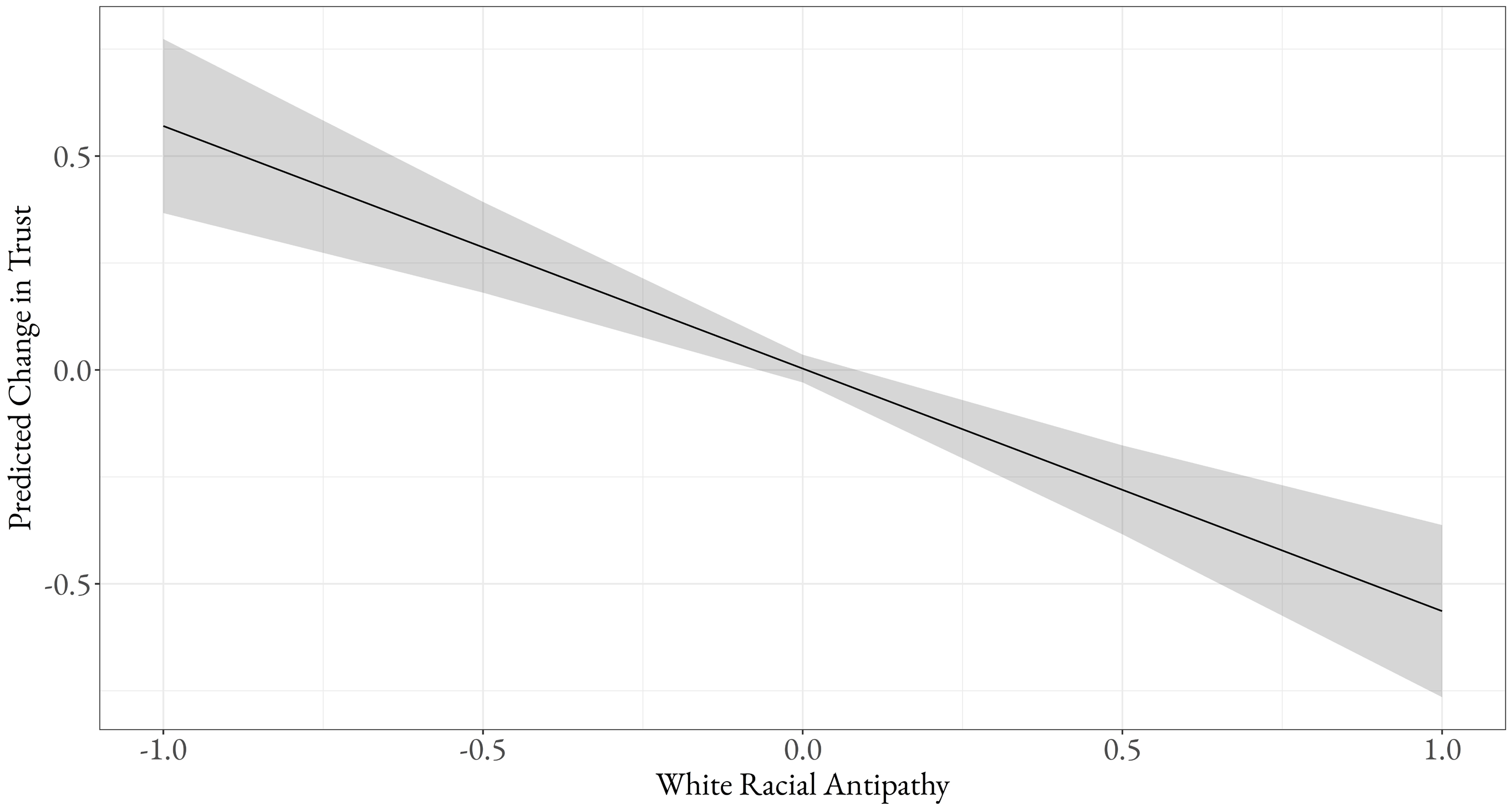
To better understand how trust in the vote count changes between the pre-election and post-election waves, we use an outcome variable measuring change in one’s trust in the vote count across these two periods and report results from a time-series regression in Column 3 of Table A3. We find a predictable decrease in one’s trust in the vote count among those with the highest levels of White racial antipathy. Further, we illustrate this change in attitudes about the vote count at different levels of our racial antipathy variable. In Figure 2, we report predicted values for change in trust on the y-axis (using standard deviations), computed across the range of our outcome variable, the x-axis, with all other variables from the model held fixed at their mean. As White racial antipathy increases across the x-axis from –1 to 1, one’s trust in the vote count drops. Evidence that this decrease in trust is greater for White Americans with racial antipathy provides further support for our expectations from H1B.Footnote 3
Predicted values for change in trust by White racial antipathy.
Next, we turn our analysis to post-election attitudes about electoral integrity among White Americans in the CMPS data. Our outcome variable in this model comes from a question asking respondents about the degree of voter fraud in the presidential election, asked with three different wording variations via a sample split. Although we pool responses from each split sample together for our main model, we model outcomes for each split sample separately and report those results in the same table to validate these results. Responses range from “Yes, there was definitely fraud (1)” to “No, I don’t think there was any fraud (5).” Because response options in this outcome variable are ordered, we employ an ordered logistic regression to measure how White racial antipathy influences belief in election fraud. Results from these analyses are presented in Table A4 in the Appendix. Column 4—“Pooled Model”—presents results that test H2, that White racial antipathy should be positively associated with the belief that election fraud played an important role in the 2020 Presidential Election.
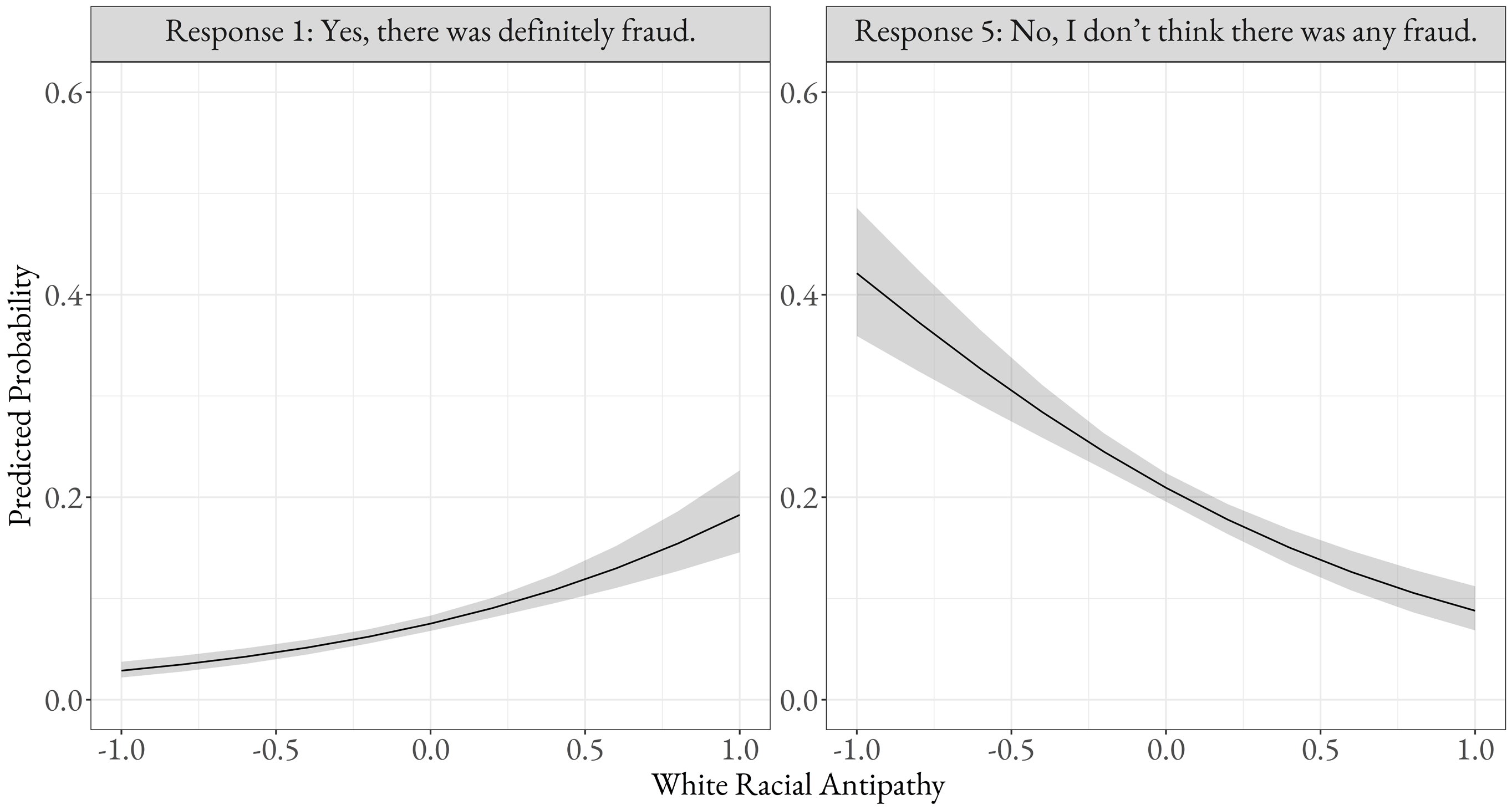
For ease of interpretation, we compute predicted probabilities from this model, holding all other variables from the model fixed at their mean. In Figure 3, we display predicted probabilities from the front and tail-end responses; “Yes, there was definitely fraud (1)” in the first panel and “No, I don’t think there was any fraud (5)” in the second panel.Footnote 4 The x-axis is our measure for White racial antipathy, and the y-axis is the probability that a respondent agrees with that belief about fraud in the 2020 Presidential Election. The left pane predicts the belief that there was voter fraud, and the right pane predicts the belief that there wasn’t any voter fraud at all. In the left pane, as White racial antipathy increases, the probability that a respondent believes there was voter fraud in the 2020 Presidential Election increases. Conversely in the right pane, as White racial antipathy increases, the probability that a respondent believes there wasn’t any voter fraud in the 2020 Presidential Election decreases. The belief that voter fraud is positively associated with racial antipathy among White Americans supports H2.
Predicted probabilities for belief in the degree of voter fraud (high belief vs. low belief).
Beliefs on January 6th
Results are similar when looking at post-insurrection attitudes about the events of January 6th and efforts to overturn the 2020 Presidential Election. Because the CMPS was fielded in the months following the January 6th insurrection, it contains a rich battery of questions that are directly related to it, allowing us to test our hypotheses about the impact of racial antipathy. First, we test H3, that White racial antipathy should be positively associated with support for political elites’ efforts to block and/or overturn the election results. We used a split sampled question that asked half of the respondents about Donald Trump’s efforts to overturn the election by reversing the results in Georgia and the other half of the respondents about Donald Trump’s efforts to overturn the election through litigation. To avoid potential biases that may stem from the legality of the actions Trump takes in each split, we analyze results for the split samples separately.Footnote 5 Because there is no clear order to these responses, we employ multinomial regression and report the results in Table A5 in the Appendix.
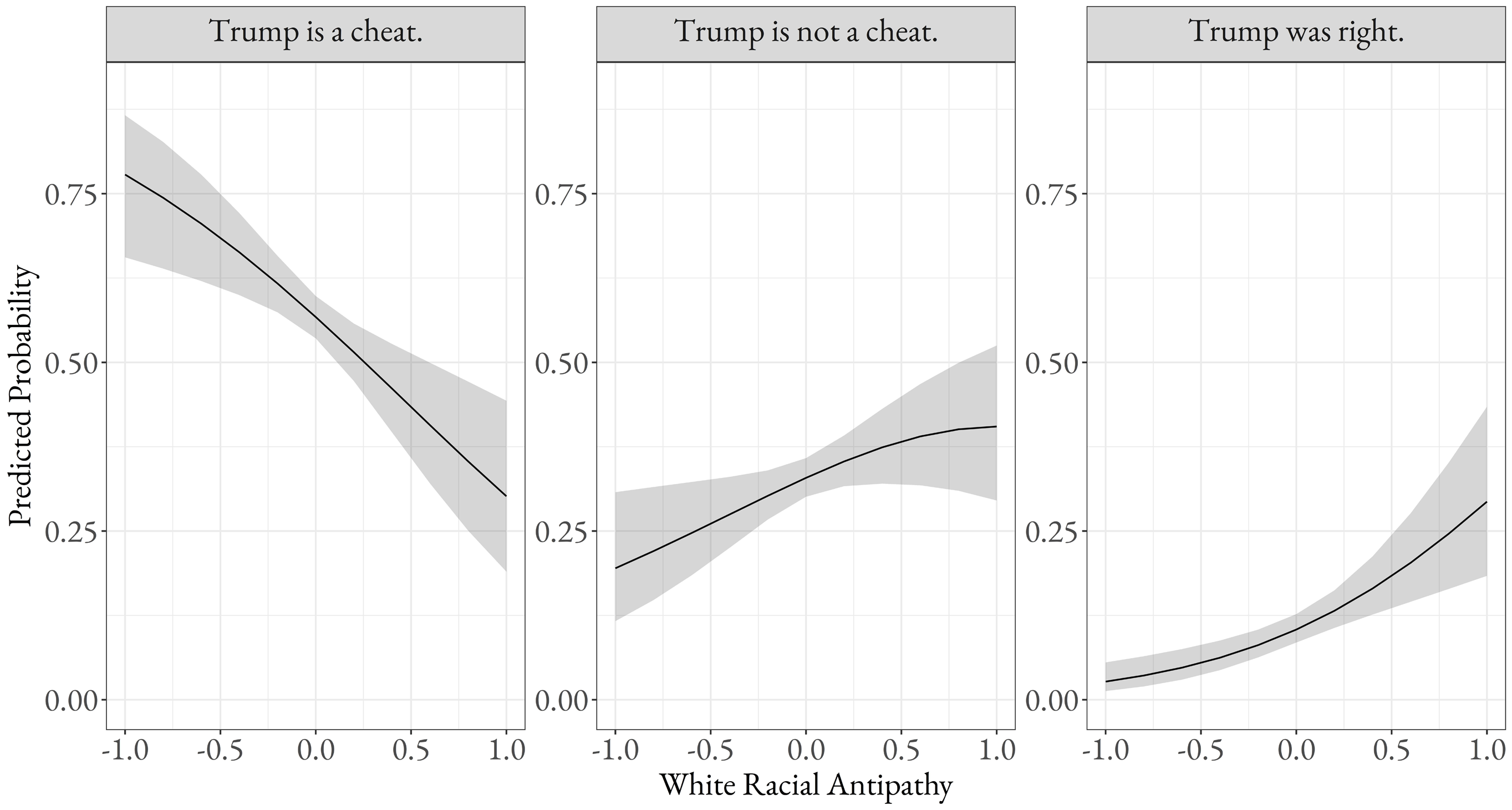
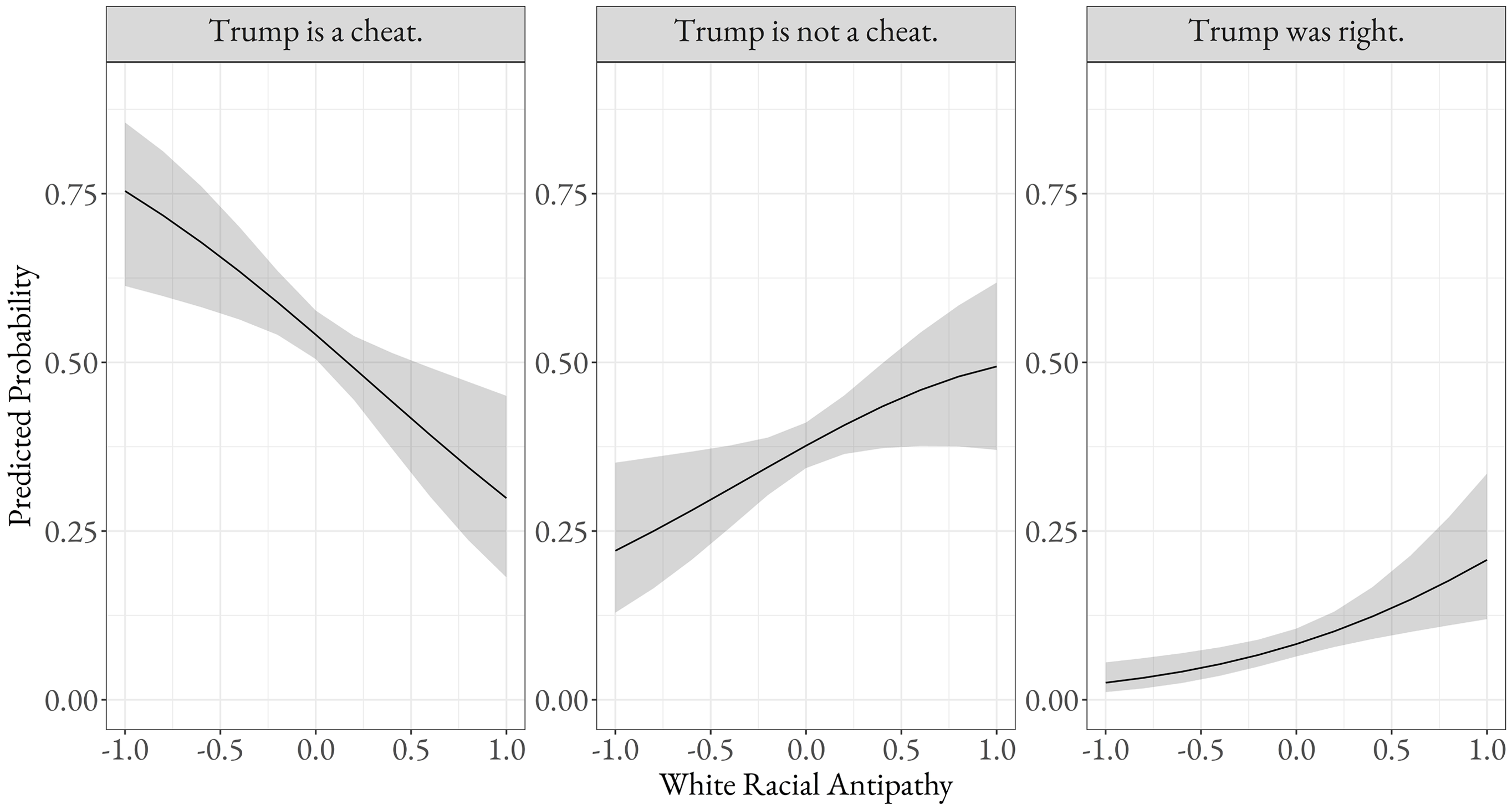
The first split sample was asked a question about Donald Trump’s January 2nd phone call with the Georgia Secretary of State asking for 11,000 more votes to overturn the result in his favor (split A). There were three different response options to this question, with one response option reflecting the belief that Trump knew he had lost and was trying to cheat, another response option reflecting that Trump was not trying to cheat and was acting in good faith, and the third response option reflecting the belief that there really was a fraud and Trump was right to challenge the results. The second split sample was asked a similar question with the same response options. Instead of asking about Georgia specifically, however, it asks about the more than 60 lawsuits that Trump brought forward nationally (split B). To interpret these results, we compute predicted probabilities from these models, again holding all other variables fixed at their mean. Figure 4 shows the association between White racial antipathy and respondents’ beliefs regarding Trump’s phone call to the Secretary of State of Georgia. Figure 5 shows the association between racial antipathy and respondents’ beliefs regarding the 60 lawsuits that Trump filed and several courts’ findings that there was no evidence of fraud. Across both figures, the results are almost identical. As values for White racial antipathy increase, respondents are less likely to believe Trump was cheating (left panel), they are more likely to believe Trump was not trying to cheat (center panel), and they are likelier to believe that Trump’s actions on that phone call were justified (right panel), which confirms H3.
Predicted probabilities for belief that Trump’s efforts were justified (split A).
Next, we examine respondents’ attitudes about the events of January 6th. We start by testing our expectations from H4A: White racial antipathy should be negatively associated with the belief that the events of January 6th were an insurrection. For this test, we use a question that directly asks respondents about the January 6th insurrection. There are only two response options, the first of which characterizes January 6th as “mostly a protest that went too far,” while the second option characterizes January 6th as “a coordinated act of insurrection against the United States.” For this binary response, we treat the response characterizing it as an insurrection as a 0 and the response characterizing it as a protest as a 1. We then employ logistic regression to predict the likelihood that a respondent excuses January 6th as a protest that went too far. We report the results from this analysis as Model 1 in Table A6 in the Appendix. We also compute and plot predicted probabilities based on this model in Figure 6. Both show a strong association between White racial antipathy and the belief that January 6th was simply a protest gone awry. Moving across the x-axis in Figure 6, we see that as racial antipathy increases, respondents are likelier to excuse the insurrection as an out-of-hand protest, supporting H4A.
Predicted probabilities for belief that Trump’s efforts were justified (split B).
Predicted probabilities for belief that January 6 was a protest that went too far.

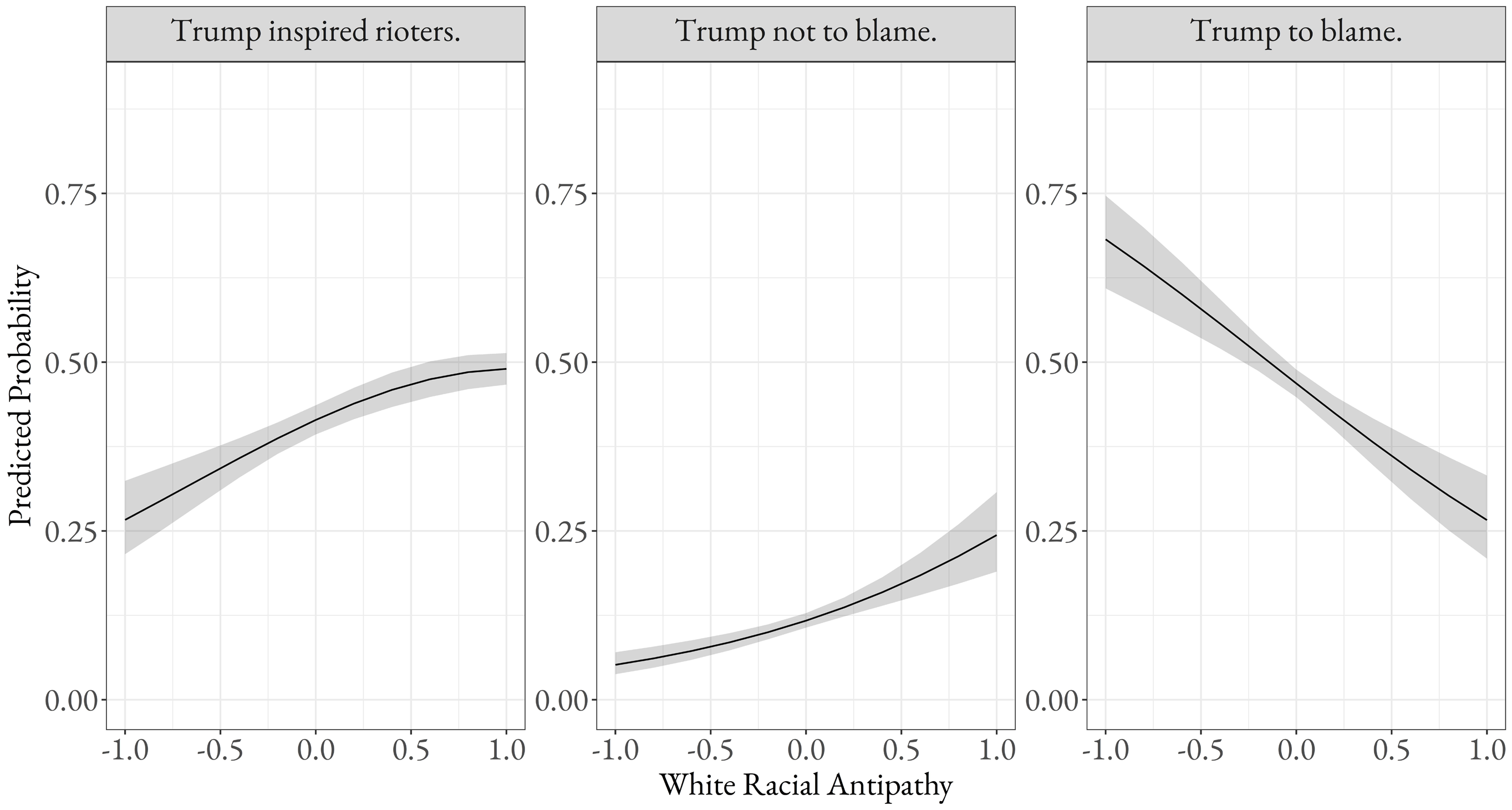
Our fourth model tests H4B: White racial antipathy should be negatively associated with the belief that Trump was responsible for the January 6th insurrection. The question employed asks respondents about the level of blame Donald Trump bears for inciting rioters. There are three response options ranging from “Trump encouraged or incited the attack, he shares blame for what happened (1)” to “Trump had no connection to the rioters, he should not be blamed at all (3).” To predict how much blame respondents assign to Trump, we run an ordered logistic regression and report these results as Model 2 in Table A6. We explore these results as predicted probabilities in Figure 7. The three-panel chart shows that as White racial antipathy increases, respondents are less likely to blame Trump directly (left panel) and are likelier to agree with responses that rid Trump of any indirect blame (center and right panels) supporting H4B.
Predicted probabilities for how much Trump should be blamed for January 6.
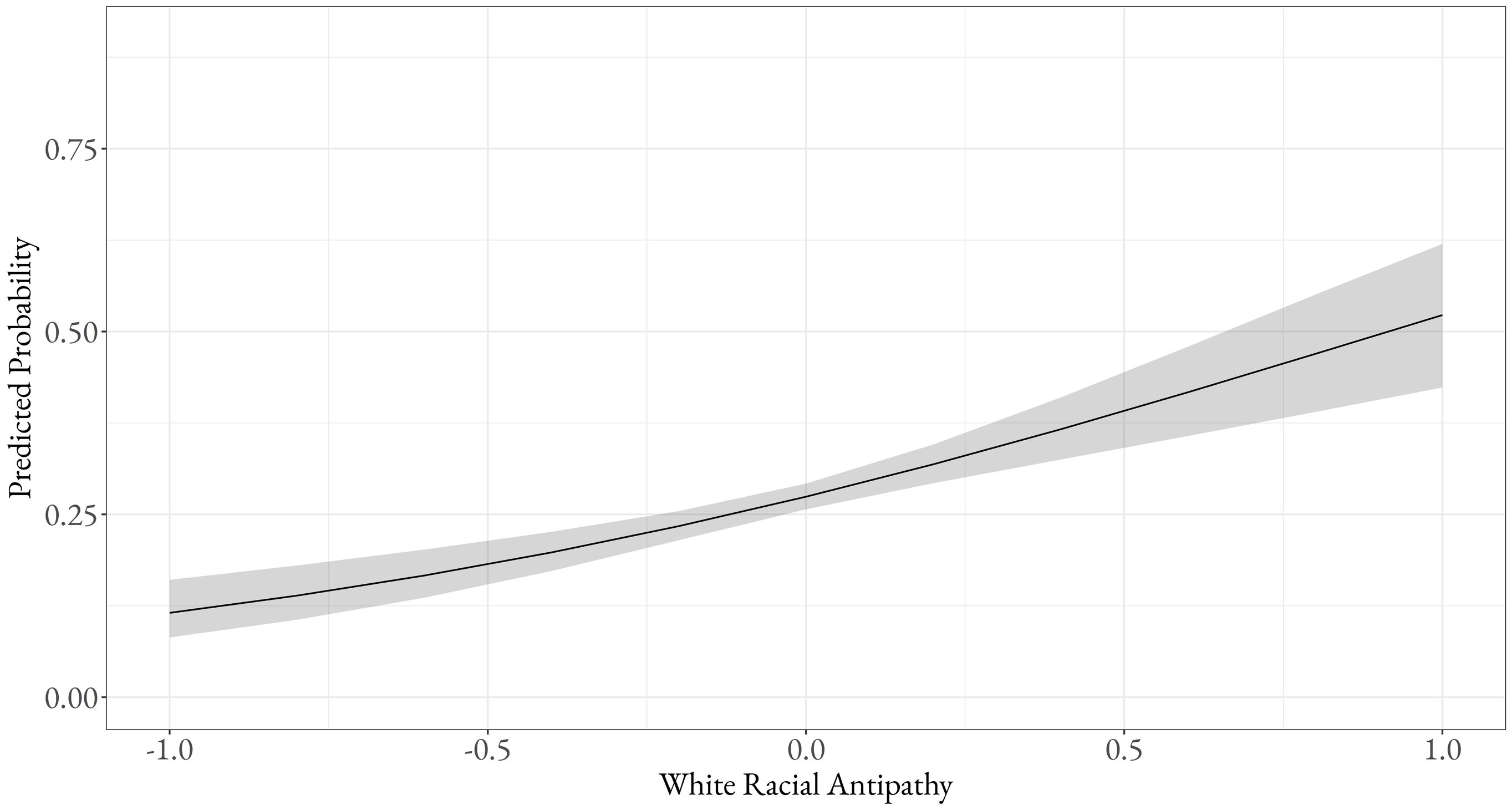
Finally, we test expectations from H4C: White racial antipathy should be positively associated with the belief that the Republican members of Congress who tried to stop the election certification were protecting democracy. In this model, we examine attitudes on the attempt by Republican members of Congress to stop the formal certification of Joe Biden’s victory in the 2020 Presidential Election. There are three response options: the first reflects the belief that these Republican members of Congress were undermining democracy, the second reflects the belief that they were protecting democracy, and the third is “I don’t know.” We omit the “I don’t know” responses and use a logistic regression to assess the impact of White racial antipathy on these attitudes. Results are reported as Model 3 in Table A6, and in Figure 8, we plot predicted probabilities to better interpret those findings. Results indicate support for H4C. Moving across the x-axis, as racial antipathy increases, respondents are more likely to believe that Republican members of Congress were protecting democracy by stopping the formal certification.
Predicted probabilities for belief that efforts to decertify election protects democracy.
Conclusion
In this paper, we present evidence that White Americans’ beliefs in voter fraud and their attitudes about the January 6th insurrection are driven by their racial attitudes toward racial out-groups relative to Whites. Our theory is made stronger by the fact that this relationship persists after controlling for both partisanship and favorability toward Trump, two of the most common competing explanations. Moreover, we have standardized regression coefficients in our model tables to more easily compare effect sizes for these explanatory variables and show that White racial antipathy consistently outperforms partisanship in explaining beliefs in voter fraud and support for January 6th. Using pre-election, post-election, and post-insurrection data, we show that White Americans with negative affect toward racial out-groups are consistently more likely to believe in voter fraud, more likely to justify political elites’ efforts to overturn the election, and more likely to excuse both the actions of political elites who incited the January 6th insurrection and the actions of those who participated in this insurrection.
These findings are in line with recent studies that find a link between racial attitudes and attitudes about January 6th (Barreto et al. Reference Barreto2023; Davis and Wilson Reference Davis and Wilson2023). We employ a measure previously used to capture ethnocentric-adjacent attitudes (Kinder and Kam Reference Kinder and Kam2010) and further validate its utility in measuring White Americans’ attitudes toward racial out-groups beyond the Black–White binary. Additionally, in these analyses, we show that affect for the racial out-group matters beyond racial animus. That is, some White Americans prefer racial out-groups over their racial in-groups, and the fact that such attitudes are negatively associated with beliefs in voter fraud and support for January 6th demonstrates the importance of racial attitudes beyond animus (Chudy Reference Chudy2021, Reference Chudy2024).
Although voter fraud is incredibly rare (Ahlquist, Mayer, and Jackman Reference Ahlquist, Mayer and Jackman2014; Levitt Reference Levitt2007; Minnite Reference Minnite2007), the belief that it was pivotal in the 2020 Presidential Election led many right-winged groups and White nationalists to storm the Capital to stop Congress’s formal certification process (United States 2022). In the months following January 6th, it became clear that there was broad support for those who participated in or incited the insurrection because many people actually sympathized with the insurrectionists’ grievances. One broad explanation is that many White Americans believe that racial out-groups disproportionately commit voter fraud (Udani, Manion, and Kimball Reference Udani, Manion and Kimball2024). However, Davis and Wilson (Reference Davis and Wilson2023) argue that racial resentment shapes White Americans’ belief in the legitimacy of the 2020 Presidential Election, emphasizing the important role that racial attitudes play in explaining support for those who stormed the Capitol. We extend this line of thought and argue that the belief in White Supremacist ideals plays a pivotal role in explaining the perceptions of voter fraud that led to the January 6 insurrection. Among White Americans who see Trump’s loss as illegitimate, ideals from White replacement theory in today’s United States of America justify efforts to overturn the election, even if through an insurrection.
Historically, members of the political party that loses an election are less trusting of elections (Anderson and LoTempio Reference Anderson and LoTempio2002; Clarke and Acock Reference Clarke and Acock1989; S. C. Craig et al. Reference Craig2006). However, our results suggest the emergence of a new dynamic parallel to this in American elections. Prior to the results of the 2020 Presidential Election, while those loyal to Trump were distrustful of elections, White racial antipathy among White Americans is not associated with attitudes challenging the integrity of elections or the belief that election fraud is rampant, all else equal. Following the results of the 2020 Presidential Election, these racial attitudes are positively associated with the belief that the 2020 election was stolen. If a segment of White Americans now see the loss of their candidates in elections as illegitimate, this poses a troubling threat to the democratic process in the United States. Especially if these people are either willing to use force to rectify the injustice they perceive or are permissive to others who choose to incite or participate in another violent insurrection in the future.
Future research can better sort the extent to which these relationships are permanent or an artifact of the 2020 Presidential Election environment. In the past, feelings toward racial out-groups and opposition to minority rights among White Americans have predicted sympathy for reactionary right-wing groups and movements (Parker and Barreto Reference Parker and Barreto2014), suggesting that these attitudes are not new but have simply become more mainstream. It is deeply troubling that issues of election integrity have become so racialized that many White Americans now support unsubstantiated challenges to election results to the extent that they are willing to take up arms against the federal government.
Our analysis offers new insight into the effects of racial attitudes on beliefs in voter fraud. In this paper, we demonstrate that when White Americans center their own in-group in their political evaluations, these attitudes are associated with contemporary beliefs in voter fraud. To this end, racial attitudes shape perceptions of voter fraud. While some policymakers choose to implement restrictive voting laws in response to heightened perceptions of voter fraud, these changes make it harder for eligible voters to cast a ballot and are likelier burden voters of color than they are to burden White voters (Barreto, Nuno, and Sanchez Reference Barreto, Nuno and Sanchez2009; Fraga and Miller Reference Fraga and Miller2018; Herron and Smith Reference Herron and Smith2014; Kuk, Hajnal, and Lajevardi Reference Kuk, Hajnal and Lajevardi2022; Pettigrew Reference Pettigrew2017; Rogowski and Cohen Reference Rogowski and Cohen2014). While restrictive voting laws may address concerns among White Americans, they lead to increased distrust in racial minority communities, where people associate these policies with increased disenfranchisement (Freeder and Shino Reference Freeder and Shino2023). Moreover, election security policies are only effective at combatting perceptions of voter fraud when people perceive that these measures are in place (Coll Reference Coll2024), placing considerable weight again on perceptions and whatever shapes those perceptions. These policy changes fail to address the core problem, but they further elevate racialized perceptions of electoral integrity, which we show lead to support for the January 6th insurrection.
Supplementary material
The supplementary material for this article can be found at https://doi.org/10.1017/rep.2025.9.
Acknowledgements
Authors are listed in reverse alphabetical order, with equal authorship. We thank Lorrie Frasure, Matt Hall, Jane Junn, Angela X. Ocampo, Marcel Roman, Christine Slaughter, Laura Uribe, David Wilson, and the panelists of the January 6 CMPS UCLA Conference for their feedback and guidance, as well as the constructive comments from anonymous reviewers. We also thank Madeline Martinez for organizing the January 6 CMPS conference and coordinating all logistics for this issue. Finally, our work on this project would not be possible without the ongoing support of the UCLA Voting Rights Project.


 Open access

