





Introduction
Access to legal recourse has long been out of reach for ordinary people. A wealth of research spanning public policy, sociology, and law has documented the “access to justice gap” (Sandefur Reference Sandefur2019) amidst “administrative hassle” (Kohler-Hausmann Reference Kohler-Hausmann2013), “administrative burden” (Herd and Moynihan Reference Herd and Moynihan2018), “institutional knots” (Sackett and Lareau Reference Sackett and Lareau2023), and the discretionary power of street-level bureaucrats (Lipsky 1980/2010) in the allocation of public benefits that may create social stratification. In response to these barriers and burdens, policymakers and scholars have debated the merits and costs of implementing automated and algorithmic policy solutions (Levy et al. Reference Levy, Chasalow and Riley2021). Yet, research also suggests how automation can obscure structural inequalities in how laws and policies are formulated (Mooney et al. Reference Mooney, Skog and Lerman2022), obscure flaws in the underlying data (Chien Reference Chien2020), reproduce social stratification by relying on biased data (Barocas and Selbst Reference Barocas and Selbst2016; Stevenson Reference Stevenson2018), or reproduce human discretion and bias when algorithms are applied in practice (Brayne and Christin Reference Brayne and Christin2021). While studies have worked to isolate the data-driven or decision-maker effects on algorithmic fairness and the appropriate use of automated public policy, we lack on-the-ground accounts from those who are directly impacted by automation.
In response, this study takes up the case of automated criminal record expungement and interviews 105 people eligible for this remedy, drawing on their experiences attempting expungement by petition prior to the implementation of automated expungement, as well as their experiences navigating the new policy. The study draws specifically on Herd and Moynihan’s (Reference Herd and Moynihan2018) concept of administrative burden. Administrative burden, characterized by learning costs, psychological costs, and compliance costs, affects whether people can exercise their fundamental rights or access governmental benefits.
In their work, Herd and Moynihan claim succinctly that “burdens matter” (Reference Herd and Moynihan2018, p. 3). Criminal records, too, matter – and in similar ways. Decades of social science research has established the detrimental impact of the “mark” of a criminal record on a host of psychological, social, and institutional outcomes (Corda Reference Corda2023; Pager Reference Pager2008; Uggen and Stewart Reference Uggen and Stewart2014; Uggen et al. Reference Uggen, Vuolo, Lageson, Ruhland and Whitham2014). In that vein, recent efforts to expand the right to expunge one’s criminal record after a requisite waiting period have gained steam (Collateral Consequences Resource Center, n.d.). Unfortunately, expungement has long borne the hallmarks of Herd and Moynihan’s definition of administrative burden: a governmental benefit that “often only reach[es] a fraction of their target population, automatically weakening their effectiveness by shutting out those who fail to negotiate the required procedure” (Reference Herd and Moynihan2018, p. 3).
Our data show how administrative burden functions in both traditional petition-based expungements and in more recent efforts to automate expungements. Petition-based expungements impose significant learning costs to navigate complex eligibility criteria, draft petitions, and attend to multi-step application processes, often with little opportunity to access low-cost legal aid. Compliance costs mark many aspects of the petition process, requiring the expungement-seeker to obtain criminal record information from a multitude of agencies, including police, courts, local jails, and probation offices, and to pay significant filing fees and all court-ordered fines and fees. The process can be slow, confusing, and inaccessible. Wait times in many jurisdictions can exceed many months, creating a significant “time tax.” Once filed, petitions might be challenged by the state or rejected by the court due to technical errors, adding to psychological costs. Once granted, petitioners face the daunting task of ensuring private background check vendors comply with the expungement order and bear ongoing psychological costs every time they encounter commonly used private-sector background screening for employment or housing.
Automated expungement was designed to alleviate these administrative burdens by creating state-initiated processes that shift the burden on government to identify expungement eligible cases and automatically seal those records using algorithmic approaches (Lageson and Corda Reference Lageson and Corda2025). Our interviews, however, demonstrate how both the design and implementation of Clean Slate expungement has created new forms of administrative burden, some of which are particular to the criminal legal context.
First, most eligible individuals do not know their records were sealed, as state Clean Slate laws do not include notice requirements, creating new forms of learning costs. This has held even in states that had implemented Clean Slate several years prior to data collection. Many interviewees were not even aware that Clean Slate laws existed. Second, the limited nature of the laws means that many people’s records are only partially cleared, contributing to the psychological costs associated with continued stigmatization and feelings that unfairness is baked into the narrow opportunities afforded under Clean Slate legislation. Finally, compliance costs are unexpectedly increased in automated systems because the expungement-seeker no longer has the autonomy to file and track a court petition; instead, they must attempt to navigate inaccessible and overburdened state agencies tasked with implementing automated expungement. Our interviewees expressed frustration with knowing little about the status of the state’s efforts to clear records and finding little assistance in obtaining paperwork to “prove” their record had been automatically cleared. Such “proof” was deemed essential for respondents who wanted the state’s affirmation that their record had been expunged, that the court recognized their rehabilitation and life changes, and that the state had extended forgiveness that would help ameliorate collateral consequences.
Background
Administrative burden and automation
Administrative burden refers to the “onerous experiences people encounter when interacting with public services” (Herd et al. Reference Herd, Moynihan and Widman2024, p. 247). These burdens entail three specific costs: learning costs, psychological costs, and compliance costs. Learning costs include the time and effort required to know about a public program and understand one’s eligibility, the nature of the benefit, any conditions they must satisfy, and how to access required systems. Compliance costs include responding to administrators’ discretionary demands or decision-making, providing adequate documentation, and supplying required financial costs. Psychological costs relate to the stigma of accessing a public benefit, the loss of autonomy that may come from administrative surveillance, frustration with learning, compliance, or financial costs, and coping with stress and uncertainty. As they point out, burdens “make the difference as to whether government is experienced as accessible or opaque, simple or bewildering, respectful or antagonistic” (Herd, et al., Reference Herd and Moynihan2018, p. 3). Such views of government are especially crucial in the criminal legal context, where recidivism and crime prevention are deeply rooted in notions of procedural legitimacy and procedural justice (van Hall et al. Reference Hall, Baker, Nieuwbeerta and Dirkzwager2024).
Empirical research on administrative burden has been described as a “nascent but growing body of research [that] surmises that administrative burden raises formidable barriers to accessing public benefits that strain citizen-state interactions” (Barnes Reference Barnes2021: 295). The empirical literature that does exist has continued to test and expand the theory. One systematic review (Halling and Baekgaard Reference Halling and Baekgaard2024) identified 119 articles and working papers that study administrative burdens. This analysis pointed to how the theory has evolved over a decade plus of research, including the rise of more specific assessments of how frontline workers and government communication efforts shape how burdens are experienced and how burdens are tolerated. Relevant to this study, Halling and Baekgaard call for more qualitative research to better explore burdens from the direct perspectives of those who are most impacted (Reference Halling and Baekgaard2024, p. 186).
Existing qualitative studies have examined burdens to accessing public benefits through the Special Supplemental Nutrition Assistance Program for Women, Infants, and Children (WIC), creating “redemption costs,” which are brokered through reliance on third-party agents – a cost that is similarly invoked in Housing Choice Voucher Programs and the Child Care Subsidy (Barnes Reference Barnes2021). Other qualitative work has analyzed administrative burden through homeless services access (Robinson et al. Reference Robinson, Schlesinger, Rosenberg, Blankenship and Keene2024), finding that such burdens may lead to service underutilization and contribute to prolonged homelessness. Other research has extended the theory to examine the coercive nature of burden, for instance, in the child welfare system (Edwards et al. Reference Edwards, Fong, Copeland, Raz and Dettlaff2023), where the state has placed burdens on those who have involuntary contact with a state institution, rather than through voluntarily seeking a public benefit. Here, qualitative research empirically documents how women must navigate substantial learning, compliance, and psychological costs to avoid losing access to the fundamental right of parenting their children.
To reduce administrative burden, governmental processing is experiencing an algorithmic and automated shift (Levy et al. Reference Levy, Chasalow and Riley2021). Automated decision-making has been noted for its potential efficiency (Young et al. Reference Young, Bullock and Lecy2019), but many scholarly accounts have warned that automation reifies existing inequalities and stratification (Eubanks Reference Eubanks2018) or that local governments are ill-equipped to manage and deploy these tools in line with their intended uses (Borry and Getha-Taylor Reference Borry and Getha-Taylor2019; Larsson Reference Larsson2021). Other analyses warn that the complexities of (often local) governmental processes and problems with the underlying data limit the effectiveness of automation (Chien Reference Chien2020; MM Young et al. Reference Young, Martin and Lageson2024a).
Sociological theories of bureaucracy and governance are also at play, wherein the deployment of automated tools may do more to strengthen bureaucratic tendencies rather than decrease them (Newman et al. Reference Newman, Mintrom and O’Neill2022), or simply reinforce administrative burden in ways that disproportionately harms civilians who lack reliable access to technology or understanding of digital processes (Madsen et al. Reference Madsen, Lindgren and Melin2022; Newman et al. Reference Newman, Mintrom and O’Neill2022; Peeters Reference Peeters2023). Yet, some research has pointed to the potential for automation to decrease racialized discretion, for instance, in one study finding that racial disparities in unemployment insurance claim errors decreased after automated tools were implemented (Compton et al. Reference Compton, Young, Bullock and Greer2023). Also central to understanding the role of automation is recognizing the shift from face-to-face government–civilian interaction and decision-making to moving civilians into digital environments in making claims. Studies have described the shift from “street-level bureaucrats to “systems-level bureaucracies” in creating “artificial discretion” (Young et al. Reference Young, Bullock and Lecy2019), where those delegated with policy implementation may have less direct knowledge of the issues they are tasked with addressing, profoundly changing the duties of front-line workers (Breit et al. Reference Breit, Egeland, Løberg and Røhnebæk2021; Jørring Reference Jørring2024).
Much of this work has focused on the allocation of civil governmental benefits and is rooted in public administration research. Research regarding criminal legal system digitalization and automation has focused primarily on how tools are deployed within the system, including risk assessment (Brayne and Christin Reference Brayne and Christin2021; Esthappan Reference Esthappan2024), big data policing (Brayne Reference Brayne2021), and criminal records management (Lageson Reference Lageson2020). Less attention has been paid to the interaction of civil–criminal systems (Young et al. 2024), with the notable exception of monetary sanctions research (Martin et al. Reference Martin, Sykes, Shannon, Edwards and Harris2018). Expungement similarly occupies a space at the nexus of civil governmental benefits (the opportunity to seal a record) and criminal law (the arrest, charge, or conviction produced by state action). As we describe next, expungement offers a specific useful lens for understanding how digital governance impacts administrative burden, particularly when the benefit is directly tied to punishment.
Burden and automation in criminal record expungement
Criminal record expungement, which allows individuals to have their criminal records sealed from public view after meeting certain eligibility criteria, has gained significant traction as a “second chance” policy over the past several decades. As demonstrated by Prescott and Starr (Reference Prescott and Starr2020), expungement can have substantial positive impacts on employment outcomes. However, the traditional petition-based system for obtaining expungement has created a significant “second chance gap” (Chien Reference Chien2020) between those eligible for relief and those who actually receive it; for instance, only about 6.5% of eligible individuals in Michigan receive an expungement within 5 years of becoming eligible (Prescott and Starr Reference Prescott and Starr2020).
This low uptake rate stems from numerous barriers that make the expungement process challenging. Prescott and Starr characterize these barriers as including a lack of information about expungement opportunities, administrative hassle and complex procedures, fees and costs associated with filing, distrust of the criminal justice system, lack of access to legal counsel, and insufficient motivation to pursue expungement. The petition-based process typically requires individuals to navigate complex legal procedures including obtaining certified court records, submitting fingerprints, paying various fees, and appearing for court hearings. In response to these challenges, several states have begun shifting toward automatic expungement through “Clean Slate” initiatives. These laws vary in scope but generally provide for the automatic sealing of certain eligible records without requiring individuals to file petitions. In many ways, automated expungement is the type of policy reform that responds directly to the costs associated with petition-based expungement, as it shifts the administrative burden to the state. Expungement-eligible people no longer need to navigate complex eligibility criteria and application processes, and by and large, are no longer responsible for paying for attorney costs or court-filing fees. In this sense, Clean Slate represents a key policy intervention where automation has been prioritized as a solution to a burdensome administrative process.
Beyond expungement, other researchers have invoked the concept of administrative burden in the criminal legal system through the lenses of entanglements (Halushka Reference Halushka2020) and carceral citizenship (Miller and Stuart Reference Miller and Stuart2017). For instance, Halushka uses ethnography and interviews with 45 formerly incarcerated men to describe the “runaround” men experience while navigating parole, public assistance, transitional housing, and community-based service providers while simultaneously managing “multiple, overlapping entanglement across a fragmented network of bureaucracies” (p. 233), an experience similarly detailed in Reuben Miller’s seminal work Halfway Home (Reference Miller2021). Similarly, Bryan specifically invokes administrative burden theory in a quantitative assessment of welfare program participation by race and legal system experiences, finding that previously incarcerated white Americans engage their rights via more active program participation than people who were never incarcerated (Bryan Reference Bryan2023). Taken together, this research suggests that policy reforms and administrative processes rooted in the particularly racially stratified and punishing criminal legal system may create unique forms of administrative burden.
In this vein, Ray et al. (Reference Ray, Herd and Moynihan2023) have examined racialized burdens as an inequality reproduction mechanism, drawing on examples from immigration, voting, and the social safety net. In these policy contexts, racialized burdens are created through facially neutral rules that simultaneously claim that burdens are a necessary component of public policy. Racialized burdens, the authors conclude, “neatly carry out the ‘how’ in the production of racial inequality while concealing, or providing an alibi for, the ‘why’” (Ray et al. Reference Ray, Herd and Moynihan2023: 139). Subsequent studies have further examined how racialized burdens, in turn, negatively impact people’s beliefs about government, particularly for racial minorities (Bell et al. Reference Bell, Wright and Jeongmin2024). These effects might also be linked to Lerman and Weaver’s theory of avoidance among justice-involved individuals who actively avoid voluntary interactions with government (Lerman and Weaver Reference Lerman and Weaver2014) as a way to understand the low uptake rates of petition-based expungement.
This research suggests that administrative burden may be experienced differently in the criminal legal context, in contrast to the broader governmental benefits context in which the theory is more commonly invoked. More specifically, automatic expungement must attend to the historical racialized inequities of the criminal justice system and the broader context of mass criminalization in which many people report lifelong punishment for a criminal record via public stigmatization and discrimination. Empirical research supports this point. Automated criminal record expungement policy may inadvertently replicate racial inequities; empirical research in California, for instance, has shown that Black residents were less likely to receive a Clean Slate expungement due to racial disparities in criminal case processing and suggests that specific policy amendments to expand eligibility criteria and shorten waiting periods would reduce such inequities (Mooney et al. Reference Mooney, Skog and Lerman2022). Other studies have described the “dirty data” problems that can preclude smooth automated processing of expungements (Chien Reference Chien2020, Reference Chien2025) amidst studies that reveal racialized patterns of poor quality criminal record data that could preclude Clean Slate implementation (McElhattan Reference McElhattan2022).
Desistance theory (Maruna Reference Maruna2012) offers a final theoretical base for understanding how people experience petition-based and automated criminal record expungement. Studies of traditional expungement describe how petitioners invoke narratives of self-reinvention as they seek expungement (Chen and Adams Reference Chen and Adams2019) or see expungement as an instrumental and concrete way to alleviate public stigmatization and employment discrimination (Ispa-Landa and Loeffler Reference Ispa-Landa and Loeffler2016). Successfully expunging a record has shown both material benefits, particularly for employment (Prescott and Starr Reference Prescott and Starr2020; Selbin et al., Reference Selbin, McCrary and Epstein2018), and psychosocial benefits – or what one study described as “the facilitation of cognitive transformation and the affirmation of a new identity” (Adams et al. Reference Adams, Chen and Chapman2017, p. 23). It is yet unclear whether an automated process that does not directly involve the criminal record holder in the expungement process will deliver such benefits or whether automation will create new burdens. This study aims to fill this gap in knowledge.
Research questions
This study asks: (1) What administrative burdens do people face when petitioning the court for criminal record expungement? (2) To what extent has automated expungement reduced the administrative burdens associated with petition-based expungement? (3) In state policy contexts where expungement has been automated and state-initiated, what administrative burdens remain or are created?
Methodology
The data analyzed in this paper were coded from semi-structured interviews conducted for a study on the impact of criminal records and automated record clearance on individuals, families, and communities. This study received IRB approval from three academic institutions. Semi-structured interviews were conducted with expungement-eligible persons in California, New Jersey, Pennsylvania, and Utah between November 2021 and December 2023.
These states were selected because, at the time of the investigation, they had laws that enabled automatic expungement of one or more eligible criminal offenses. Pennsylvania and Utah participants were recruited into the study based on having an expungement-qualifying non-conviction arrest or misdemeanor conviction, reflecting those states’ Clean Slate laws. Pennsylvania passed Clean Slate in 2018 and sealed 35 million records between 2019 and 2020 (Center for American Progress 2020). By the time of data collection, this figure reached 40 million records for over 1.6 million people (Clean Slate Initiative, n.d.(b)). Utah passed Clean Slate in 2019, and by 2024, the judiciary had sealed 400,000 records (though the state experienced delays with the state police databases; see Rasa Legal 2024).
New Jersey and most California interviewees were recruited into the study based on having a cannabis-related offense, because at the time of data collection, those two states had most fully implemented marijuana expungement reform (though both states also have broader record sealing initiatives codified in law). By 2022, New Jersey had sealed over 326,000 cannabis offense records (New Jersey Courts 2022). California interviewees had both cannabis-related and non-conviction/qualifying misdemeanor records. California had nearly completed cannabis expungements by late 2023 as mandated under AB 1793, sealing 90% of cannabis-only records (approximately 206,000 cases; see NORML 2023) alongside the broader sealing of 11 million arrest and conviction records ordered automatically sealed under AB 1076 (Johnson Reference Johnson2023). While dozens of states have passed Clean Slate laws since 2018, we focused data collection in four states that had made the strongest headway in implementation in an effort to capture the experience and effect of automatic expungement on impacted people.
Participants were recruited through three mechanisms: (1) digital study advertisements posted to social media platforms and distributed to listservs related to criminal record and reentry assistance; (2) opt-in panels of participants on Prolific and Amazon’s MTurk platforms; and (3) through direct referrals from research participants. Once expungement-eligible participants learned about our study, they were directed to our study’s website to complete an intake survey. Persons deemed ineligible for the study were thanked for their time and notified that they did not meet the study criteria. Persons who appeared eligible for the study were contacted by a research assistant for further screening. Research assistants contacted potential participants and asked about their criminal record. Those assessed to be eligible for the study (because they had a criminal record that qualified for automatic expungement in their state) were scheduled for an interview.
Interviews were conducted over Zoom and recorded with participants’ consent. Research assistants manually verified automated transcripts to ensure accuracy. We utilized Atlas.Ti to code transcripts using a flexible coding approach (Deterding and Waters Reference Deterding and Waters2021). The research team developed an initial list of codes based on the study’s research questions and interview questions. Two members of the research team independently coded each interview transcript line-by-line and updated thematic concepts that emerged from interview transcripts were discussed at the team’s weekly meetings. These conversations enabled us to refine our list of codes by adding new codes and merging those that referenced the same topic. As the list was refined, interview transcripts that were coded early in the process were re-coded to ensure they comported with the updated codebook. Once coding was complete, thematic memos were developed to explore the relationships between dominant codes and to frame analysis and writing.Footnote 1 Table 1 describes sample characteristics.
Sample characteristics (N = 105)

a Includes seven ARDs (Accelerated Rehabilitative Disposition) in Pennsylvania, which is a pre-trial intervention program that automatically seals a record after successfully completing a probationary period.
Findings
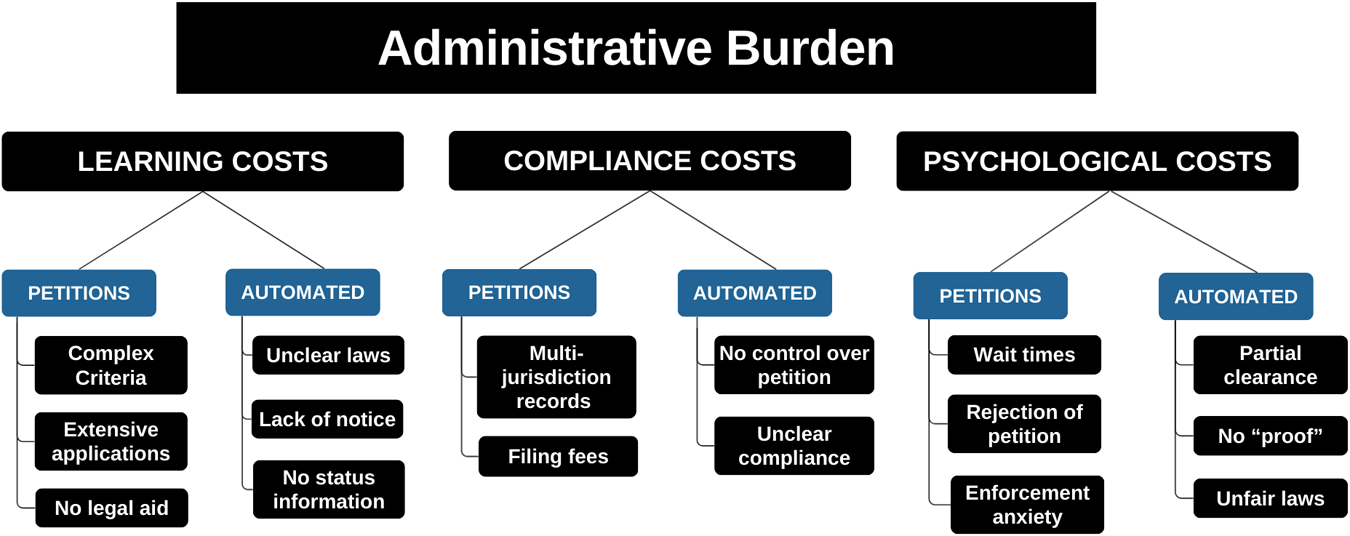
Interview findings are organized into three sections: (1) administrative burden in petition-based expungement schemes, (2) the perceived benefits of automating expungement, and (3) administrative burden in automatic expungement. Within each theme, we further detail the learning, compliance, and psychological costs associated with each expungement approach. Figure 1 describes the coding scheme and organization of results.
Depiction of interview themes across petition-based and automated record sealing policy contexts.

Petition-based expungement
Learning costs: eligibility requirements, extensive applications, and little legal aid
Expungement laws are notoriously complex in terms of waiting periods, eligible offenses, and whether a state will reject a petition based on a person’s entire criminal history outside the expungable offense. Just getting started was overwhelming for many interviewees. For instance, Mark, a 26-year-old white man from New Jersey, said that when he looked up the expungement law,
it confused me, because you look through like paragraphs and paragraphs on different things, and … at least to my interpretation, nothing really seemed to fit in my situation. So I heard about it and just looked online. And it just confused me to be honest, that’s, that’s really all I can say.
Jason, a 28-year-old white man from Utah, also looked into filing a petition upon learning he was eligible for expungement but said, “whenever I’ve looked at that it’s been a way of looking pretty daunting. It can be expensive.” Another participant from Utah, Daniel, a 44-year-old white man, told us “I just did some internet searches for expungement. Seeing if there’s any online sources to help fill out the paperwork, you know, any anything that was out there. And there wasn’t, it was, it was pretty, pretty bleak.” Brandon, a 36-year-old white man, whose record contained convictions from Utah (where he no longer lives), made a similar point: “it’s like, I have to call this person because they said, Oh, you need to do this paperwork. And if it’s in this court, or it was overwhelming, it wasn’t a straightforward process. And then it was like, do I need to have an attorney represent me? Can I self-represent? Can I do it in absentia, because I’m not going back to Utah. And it’s like, okay, you know, none of this information was very clear.” Ava, a 30-year-old Asian woman in Pennsylvania, noted, “like you really are in a system that you’re not familiar with. I think the law is very complicated, it’s very, very, very hard to figure out like all of the whatever like your statutes involve, they’re really complicated. I don’t know, it’s, it’s hard for someone who has no familiarity with this to like, figure out and navigate them on their own. And that’s essentially what we’re being asked to do.”
Other participants who began the process found the eligibility criteria very difficult to navigate. Michael, a 53-year-old white man from California, said he faced challenges: “trying to decipher what charges are on the criminal record. And because I had a lot of ‘failure to appears’ in court and things like that. And it really, it wasn’t, an average person wouldn’t be able to look at that and say, Okay, I need to take care of this one, this one and this one, it’s a big muddy mess.” When trying to seek help in understanding if he was eligible, Mark from New Jersey could not figure out what to do with his completed paperwork: “I never actually tried to do anything because I was trying to figure out, you know, what paperwork do I need? Where do I file this? You know, who do I contact and I did actually contact the court, and then the court itself that I went to, and then they were not very helpful.”
For those participants who were able to navigate eligibility criteria, the petition filing process itself was onerous. Laurie, a 32-year-old white woman in California, told us that she had gotten to the point of accessing all of the required forms but had given up, noting that, “I downloaded all the paperwork that was on there, like all the forms that needed to be filled out. I wasn’t too sure. It’s kind of confusing, because there’s all sorts of different paperwork. I didn’t know which ones I needed. So I was just going to print them all. And go to the courthouse, and maybe they could tell me, but yeah, that’s as far as I got.” John, a 47-year-old Black man in New Jersey, accessed the forms, but received no guidance as to where and how to file them. “What is unclear is what I have to do,” he said. “The forms–I’ve never filled out those particular forms, but I’m not illiterate, I can do that. It is more about, where do I have to go and what do I have to do in order to get my expungement.”
The prospect of navigating the system while unfamiliar with legal terminology was confusing or intimidating to several interviewees. Armando, a 48-year-old indigenous Central American and Latino man in California, described “the confusion of it, because, you know, dealing with the courts, it’s like, it’s like a separate language. You know, it’s confusing for people that aren’t lawyers, or that aren’t privy to the inner workings of, you know, the justice system and whatnot.” Clara, a 31-year-old Asian woman in Pennsylvania, summarized her experience as: “I didn’t end up really talking to anyone in depth about it. So everything that I knew about it, just was literally coming from Google.” Selina, a 28-year-old white woman in Utah, said, “I actually started the process on my own. I printed out the forms, and I started filling them out. And I’m like, oh my gosh, this is so much like, I don’t even know how to word this, you know?”
Many people could not navigate the pro se process nor could they find an attorney willing to help them at a reasonable rate. Marco, a 39-year-old Latino man in California, said he never pursued expungement, even though “I just been kind of curious and like, oh okay, you know, it’s, it’s like, we’ll get to it, we’ll get to it.” Marco said he also occasionally heard about legal aid expungement clinics, but they were typically held on weekends when he was unable to attend: “They’re like, sometimes I miss the date or I’m like, oh my God, like I had a four hour window and it’s like, damn, I should have made it.” Similarly, Sharon, a 57-year-old white woman in Utah, was unable to access the limited legal aid available: “And I don’t live in Salt Lake City or nearby, otherwise, I could just walk into a clinic or something, and talk to somebody because they have those, you know, from what I understand. You go talk to somebody about it. I’m in southern Utah, I don’t want to drive three and a half hours north, I don’t have the funds to do that right now, with the gas.” Ava, a 30-year-old Asian woman in Pennsylvania, faced similar access issues: “I did take off work for that. So that was also frustrating because they only offer the clinics during work hours. It was like a Tuesday.” Later in the interview, she noted that the clinic “was not offered every semester. And there’s also just limited resources, like these clinics are really small, they don’t take everybody and some people, they defer you to a future clinic if they don’t have capacity for you in the current clinic. So it’s just kind of a game of, like a time bomb.”
Selina, a 28-year-old white woman in Utah, said she “didn’t really have like an advocate, or I didn’t really, you know, know what to expect or, you know, there’s not really any coaching or like, and they there’s not even like, there’s not really a process.” Michael, a 53-year-old white man from California, noted that getting access to the required paperwork was an issue “if you don’t have access to a computer. Yeah, there’s nothing you could do…I don’t think that your record is something you can access on your own. I think you need an attorney to actually get that for you. So, and I guess that’s a big barrier for a lot of people who can’t afford an attorney to get that information for them to even begin the process.” Gino, a 32-year-old Italian American white man in California, noted that “you have to have the lawyer to have them, you know, petition the court to get it removed. And then also, there’s money, obviously, you know, lawyers aren’t free.” Victor, a 30-year-old Latino man in California, felt as if an attorney was necessary, but not affordable: “I thought that I had to hire my own lawyers and all that stuff. So like, I knew there was a way, but I really thought it was almost impossible.” Jack, a 30-year-old white man in Pennsylvania, reached out to an attorney who quoted him $500 for the service. “It just felt like,” he said, “I don’t know, is my comfort really worth five hundred dollars? Probably not.”
Compliance costs: multi-jurisdictional records collection & filing fees
To submit a petition, people seeking an expungement must collect all records of their criminal history information, which can mean visits and phone calls to a multitude of agencies, including police, courts, local jails, and probation offices. Armando in California went through “the process of getting certified copies of each of my convictions from each of the counties. And I have three counties that I have to deal with around that. And so that’s traveling to the counties making sure that my records are there, getting letters from the old records that they’ve already destroyed, because now they have the system where after 20 years, they destroy your records.” Abigail, a 42-year-old white woman in Utah, similarly noted, “they were like, you gotta go to the FBI office at this place, get your fingerprints, you got to pull every, you know, go to this court, that court, this court, get all of these documents.”
Locating the records took time, energy, and money. Amelia, a 44-year-old white woman in Utah, described tracking down court cases and submitting fee waiver applications for nine different court cases that were all eligible for expungement: “I had to take off the time for work to do that, drive out to you know, an hour away to a court that I haven’t seen in years and sit there and plead my case.” Gerardo, a 42-year-old Latino man in Utah, said it took: “I mean, days. Yeah. This was over several days. You know, I’d leave work and go to, I’d work a day and then I’d leave work, go to the courthouse that day and then the next day I’d go after work and go to a different courthouse. Ah, I had to go to my girlfriend’s work to be able to print off everything and fill out all that paperwork and have copies–two copies of everything. One for me, one for them. Yeah, and all that stuff. So, yeah, it was, it was, I would say, days.”
Petition-based expungement is costly. Brenda, a 42-year-old white woman in Utah, described “so many hoops to jump through just filling out this paperwork going in, you know, it’s so much paperwork to fill out going into the sheriff’s office to get copies of the arrest report. And, then I think, first, I had to get approval through the BCI. Is that what it’s called, the Bureau of Criminal Investigation? So I had to wait on that. I mean, you know, and there were fees. All along the way. There were fees at the sheriff’s office, there were fees with the BCI.” Jackie in Utah (a 53-year-old white woman) summarized the process as “Too hard and too much money. So I couldn’t get any further than that.… Not really, I know that. When I looked it up, it seemed like it was going to be really hard. And so that just kind of stopped me right there.” Gerardo described his experience: “I looked into it years ago. And it was just–I had a lower paying job, and there was no way to afford to go through the whole process of it.”
Some participants were surprised they were required to pay expungement filing fees even for a case that was dismissed. Fees range by county even within the same state, but generally, Pennsylvania charges $150–200 for an expungement petition, Utah charges $135, New Jersey charges $52.50, and California ranges by county from no fee to $120 for a felony conviction petition. Hannah, a 39-year-old white woman in Utah, noted, “it was after I won the case, and I was talking to the receptionist at the attorney’s office and she’s like, Yeah, [the expungement] costs this much. Like at first, I was told that it would just, they would just expunge it for me. And then later on, which was kind of unsettling for my attorney, but anyway, they told me that I would have to pay for it. And it’s this big, huge, long process. And I was like, Oh my gosh, never mind. Like I was already out so much money.” Daniel from Utah said he decided not to petition due to costs: “’cause you have to pay for each individual one, plus the filing fee, plus the record check. It was just like, they just kept on stacking everything up on everything it was. It was kind of ridiculous.”
Psychological costs: wait times and rejection
Participants described the psychological burdens of waiting for responses from the various agencies who must review and can object to the petition, waiting for judges to rule on the petition, and then waiting again for agencies to actually seal the information. Clara in Pennsylvania described it as:
it just felt lengthy, it felt like, I used this word before, but it’s kind of like you’re going for this gamble, where it’s going to take a long time. It’s not something that gets resolved within a week, it can take like, half a year to get resolved. In terms of like when, when you first start going through this process of expungement, to when the case wraps up. So it can take a long time. And those months can be very nerve wracking, like you’re just wondering, like, is this going to work? Like, are there going to be any questions? Am I going to have to do anything else? Is there going to be any follow up? That can be really scary. It’s like nerve wracking.
Norah, a 55-year-old white woman from Utah, discussed how the stress of the waiting periods was exacerbated by the requirement to interact with the criminal justice agencies who were aware she was seeking an expungement:
it’s been a three year process, basically, a long process. It’s a fairly long process. Yeah. And it’s exhausting. It’s embarrassing, because, like, when you call these places are, you know, I did have to drop some things, you have to deliver the certificates to the prosecuting office, you have to deliver them to the jail, you have to, I mean, some of them, I couldn’t deliver by hand. But, and they just look at you like, another criminal, you know, they don’t treat you well.
For those who successfully petitioned the court for an expungement, waiting was central to the process. Armando in California said, “it was about a year’s worth of work.” Vinnie, a 47-year-old Black man in California said, “I started in early 2017. And it was done by 2020.” Ava in Pennsylvania had to complete a waiting period and then wait for a legal aid clinic to work with her schedule: “it was two years later that I actually was able to participate in the clinic. So the law students helped to like file the expungement and then after that, it took like another half year to work on the petition. And so I think it was probably like close to three years later that it was actually cleared.”
A second psychological cost reported by participants related to rejection of their petition. An expungement petition might be challenged by the state (such as the prosecutor’s office or the state police) or be rejected from the court due to technical errors. Melony, a 39-year-old white woman in Utah, told us that in 2010 she was denied after attempting twice to petition for expungement: “And they denied me both times because I have three misdemeanors. I know I have the paperwork somewhere of why they denied me. But it didn’t make sense to me because, okay, I have a retail theft, unlicensed dogs and fishing without a license. They’re all lower-end misdemeanors like B or C’s, but somebody, I was reading about it, and somebody with a sexual offense, is able to expunge their record, but I can’t expunge mine, because of simple mistakes that were made 14 years ago.” Gerardo from Utah faced objections to his petition:
there was a mistake on my end… So I filled out the paperwork on most of them well enough to be sufficient enough for them to, to clear them. But the two that they’re objecting to, they went into depth about how I didn’t fill it out correctly. Like I was supposed to say that how I’m not a danger to society. And instead, I just put on why I’ve been trying to do this, and what I’ve done to change my life, and, you know, the end game of doing all this and how it could help me in the future. But they wanted to know how I’m not a danger to the public. And that’s what one of their big main sticking points on their objection.
Finally, participants who successfully petitioned for an expungement remained concerned about whether background check companies or other sources of public records information would also delete their record. Pam, a 48-year-old, Black New Jersey resident expressed her concern as: “I’m worried about what the record is going to be used for. And who can find the record of said expungement? And how is it going to be cleared? Is it going to be totally cleared? Nobody can ever like, is it going to be wider? Or is it going to be hidden, but some people can access it? I just want to know how authentic it’s going to be. And if there are any side effects, or later concerns, I’d like to know that as well.”
Donna, a 70-year-old white woman in Pennsylvania expunged a dismissed arrest using an attorney but remained uncertain as to what the expungement meant in practice: “[My lawyer] filed an expungement–that word, an ugly word. But he filed expungement papers so that this never came out in the open. You know, it was–I don’t know, erased, expunged? I don’t know what they do exactly. Did they tear up the papers? At that time? They had papers, I guess? I don’t know. Do they erase the record? I don’t know what they do.”
Given these hurdles and uncertainties, some participants reported that the process was not worth the outcome. Clara from Pennsylvania, who was able to get her record sealed, said:
I felt like it was a pain in the butt to do. And if I hadn’t been as motivated as I was, because I just knew this is something that I had to do, in terms of my career goals, like I, this absolutely could not be on my record. But it was very stressful, it’s expensive. It also takes a long time to do. I think there’s a lot of drop off points for someone who doesn’t necessarily need it, or doesn’t fully understand how their job prospects can be impacted by a charge. So I think, like I said, there’s a lot of drop-off points. Like there’s many points that I would have dropped off myself, if I didn’t need it.
Jason, a 32-year-old Black man from New Jersey, said he didn’t know if paying for an attorney to ensure the petition was filed properly and then enforced was worth the cost if he remained unsure of the benefit. “I don’t want to pay no lawyer and then they can’t, you know, I’m saying like, they don’t, they don’t deliver,” he said. “Money is money. So I will just take the hand that I was dealt.”
Automation advantages
While automatic expungement policy had been implemented in all four study sites with hundreds of thousands of records sealed by the time of data collection, we learned that many interviewees, all eligible for expungement, had never heard of the policy. Recall that we recruited participants based on their eligible criminal record, rather than sampling on knowledge that their record had been automatically sealed. This meant that even those who may have received the benefit may not be aware, as state automatic expungement schemes do not notify people that their records have been sealed. Other participants had learned of the new policies through local media or community organizations but remained unsure whether their record had been sealed or if the state had begun implementation or completed the process.
Yet, participants reported broad support for automated criminal record expungement processes over petition-based systems, citing the numerous barriers inherent in manual application procedures, highlighting the accessibility benefits, the removal of financial barriers, and expressing positive surprise that the state was willing to take on this task. As Alonzo, a 40-year-old Black man in California, summarized it, “I ain’t mad if I would have had to just press submit, you know.” Charlene, a 59-year old white Pennsylvania resident, had a similar sentiment, noting that Clean Slate represented “that Pennsylvania can do a better job for everybody to navigate them, you know, through the process and not have to go through the expense that, I mean, when you say Clean Slate law, I think it should be for everybody, you know, and accessible for everybody. And easy for everybody.” Danny, a 37-year-old Latino Californian, who works in local government, said he was:
kind of surprised that they sort of automated everything like that. Pleasantly surprised. Just because, yeah, I mean, we’ve all tried to, like, we know, every year filing our taxes isn’t like, they don’t make it easy for us. I know, being on the state side, like it’s very inefficient. And like, I just, I know how things work. So just the fact that even if they’re to tell people, ‘Hey, just fill out some paperwork,’ and, you know, it’s gone. I still think maybe like, a third of the people, or two thirds of the people wouldn’t even do it just because they would, they would be intimidated, you know? How many forms do I have to fill out, is it gonna be super complicated? And so, yeah, I mean the fact that they automatically do that is super cool.
However, even though Danny expressed support for the idea of automated expungement, he also noted, “I kind of wish that maybe they, like, sent me like an email or something or gotten in touch with me somehow. Like hey just to let you know, we did this. That way that I know.” This sentiment was repeatedly described by participants who learned, sometimes through our interview, that their record had been sealed without their knowledge, inadvertently creating what we describe as “automated administrative burden.”
Automated administrative burden
Automated expungement is a relatively new policy (by the time of the interviews, Clean Slate had been in existence for 2–4 years in our study states), and as such, many participants were unfamiliar or unsure whether their record had been impacted, though based on study eligibility criteria, it was very likely that it had. These uncertainties relate to the key elements of administrative burden, but in an overlapping and, at times, emotionally taxing manner. Many participants reported a frustration that while the state had prosecuted and punished them for a prior criminal act, the state was unwilling to clearly remove the mark of the criminal record. For some, the automated policy’s eligibility requirements were just as confusing as petition-based expungement criteria, except that the criteria felt more hidden because they were no longer actively engaging with eligibility parameters by petitioning. As Randy, a 51-year-old white woman from Utah, described it, policymakers need to “make it a little bit more layman. Like, dumb it down for some of us. People don’t even understand what Clean Slate is.” Similarly, Mariana, a 41-year-old Latino woman from California, said, “I’m unfamiliar with what the process is. How would I start awareness of it? Just like, how do people even know when it would kick in?” Without access to a court process or official notice that their record had been sealed, interviewees were skeptical that the government was truly coming through on the promise of Clean Slate.
Coping with state unresponsiveness
Many participants were confused and frustrated by the lack of notice they received about their record status. As Nathaniel, a 50-year-old Latino New Jersey resident, described the policy, “Its benefits, obviously, your record is clean. The drawback is we don’t know if it’s clean enough. So they could have at least mailed me a letter to my last address letting me know my charges have been cleared or this is still on your record, you can pursue this by doing this, this and this, go to ‘WW-dot.’ And there needs to be more communication from the state.” Abigail, a 42-year-old white woman from Utah, similarly said, “I don’t like how they don’t give you an update automatically. I feel like, if you have reached out to have an update, I would really like to see them, you know, even if it’s a mass email sent out like, your name was in this batch. You know what I mean? And I’m thinking, you know, everybody’s not going to reach out to put their name on there. So even if you did it for the ones that were interested, like, that would be really nice. You know?” Brandon, in Utah, described how it would be difficult to “move on with his life” without a concrete understanding of whether his record had been expunged,
there’s no communication of where we are in the process, you know, what letter of the alphabet are we on? Or what date range are we in? Or, you know, give me something instead of ‘stay tuned for updates.’ Like, am I going to be told that it’s like, from July to now, has it been done? How do I know that it’s been done? Right?.. there’s no clarity about what the process is. Or how do I go about making sure that I am included? Did I get passed over or forgotten? And there’s no communication from anyone, you know, other than here’s your case number, which happened very expeditiously. But the rest, it’s like, we’ll get back to you or we don’t know. And it’s like, well, you know, I’m kind of trying to move on with my life. And this is, this is information I need to know.
Mark, a 26-year-old, white New Jersey resident, summarized this confusion as, “I just feel like there’s a lot of layers of communication. And not a lot of that information ends up getting down to the people who need it. It doesn’t feel accessible.” Mark expressed a desire to advance his work in the pharmaceutical field but was pausing his efforts to find higher level employment in this sector while he waited to learn the status of his record. In his interview, we asked: “so, it sounds like you want to like make sure that the record is actually expunged and then you’re going to open up your job search even more,” to which Mark responded, “Exactly, yeah, because if I can avoid saying that even happened, I definitely want to.”
Other interviewees expressed a similar sentiment, which they were unable to truly move on with their life while their record remained in a liminal state of simultaneously potentially publicly available and potentially sealed. Donna, who is 70, white and lives in Pennsylvania, described this as: “the people should know though, the people should know it. It changes your life to know that you have a clean slate. It really does. …But it’s good to know, I don’t know. A person has to know, has to be made aware somehow.” Emma, a 39-year-old white woman from Pennsylvania, expressed a similar idea: “I think it’d be really good to make an effort to try to even send a notice, you know, like, just to like, hey…we’ve done something awesome for you that, you know, could change literally change your life. Because it’s somebody who doesn’t know, they really can’t, you know, in my mindset, I just don’t do stuff, because I know I’m going to get turned down. So, if I don’t know that that barrier has been lifted, you know, I’m just going to proceed like it’s there. So, if people don’t know it, it can’t really help them.”
Inaccessible compliance
Automation is designed to alleviate compliance requirements. Yet, respondents said that compliance costs may be unexpectedly increased in automated systems because the expungement-seeker no longer has the autonomy to file and track a court petition; instead they must attempt to navigate inaccessible and overburdened state agencies tasked with implementing automated expungement. For some, this meant researching publicly available state court databases and assuming a record was cleared if it no longer appeared. Cory, who is a 29-year-old mixed race man in New Jersey, said: “I didn’t receive anything saying that they upgraded my record in the state system, I had to figure that out myself by continuously checking my name and seeing if anything popped up. And eventually, you know, it went away. So, I assumed that, you know, it was removed from the state system.”
Daniel, a 44-year-old white man in Utah, said that “nobody knows whether their record’s expunged unless they check. I mean, if they’re going to do it, they should make the attempt to notify people. So you know, it’s done.” Daniel went on to describe his process of continually calling the local court to see if his and his wife’s records had been sealed, but finding little concrete information: “I had my wife call, like, six months ago, to check on hers because she has a tobacco ticket and a paraphernalia charge. And I’m like, ‘Oh, yours should be done.’ And she called. No, nothing. And I’m pretty sure that the majority of the people in the state … that do qualify, are probably just getting ignored. And there’s nothing automatic about this process in any way.”
Nicholas (42, male, and white), from Utah, reported a similar process of investigating the process on his own:
We went in and tried to like look them up. And they we couldn’t find them. I was a little surprised about it. But we’ve had, we’ve had some friends, like I said, we’re pretty involved in a lot of people that are going through this. And some people have had theirs taken care of already. And then other people haven’t. There’s no like rhyme or reason behind it. It’s not like alphabetical, or only people with class A’s or only people with class C’s or infractions only or whatever. It was just like completely random. So we weren’t sure what was the protocol for it…I don’t really understand the process of it.
Rachel, a 27-year-old white woman from Utah, summarized this as, “it’s like, I don’t know, this whole Clean Slate thing has been really slow going. Like, I feel like it’s taking forever to get any answers on how they plan to accomplish this.” Andrew, a 22-year-old, Black New Jersey resident, expressed confusion as to how the automated process would unfold:
How long it would take, or how long it could take… I definitely was kind of confused on how exactly how the process was just going to go in general, when it came to, you know, like selecting, you know, going through, finding the people who fit into that category, and then just, you know, clearing the record, I was sort of confused on how that whole process was going to go, or if it was going to be a sort of, like a, a larger wipe at once, or, you know, individual process. So I was kind of confused on that, because then that was going to let me know, you know, possibly how long it was going to take.
Laurie (32, a white woman from California) said, “I think it’s confusing. Like they’re not telling anybody or who is eligible. Is it just people from California? Or is it everybody? Also, when are they going to start doing this? And how long is it going to take? Is everything going to be off my record? Or? Like, how many things are going to come out? I don’t know. I want to know all about it but I feel like I haven’t gotten much information.” In this sense, reliance on automated systems that are unclear or potentially ineffective may actually decrease governmental legitimacy and increase mistrust.
To some participants, the promise of automation overshadowed the lack of control they felt in the process. Brandon, a 36-year-old white male from Utah, expressed frustration over how long the process was taking: “And it’s like, well, I don’t understand why it takes a year to process all of these like, you go, Okay, anyone with this case number and enter. … like, there has to be a Google search function in your case records. Like, if you can find my case that quickly, you can hit the delete key that quickly.”
Gerardo, 42-year-old Latino man from Utah, who had been closely following the rollout of automatic expungement in the state called the process “flawed,” asking:
why can’t they implement something that says, you know, where you’re at in the system. Something. Just any kind of info. There’s nothing unless you’re doing it on your own. You’re not getting any info I’ve done everything on my own. So who knows what happens? They said that this was supposed to be done. Nothing’s off my record. Even stuff that was supposed to be removed was not off my record. They told me that, ‘Oh, it’ll just drop off. You wait and see.’
The stress of uncertainty
Though designed to ameliorate the strain of filing court petitions, many respondents reported new feelings of stress and uncertainty within automation. While part of this was rooted in the opacity of the process itself, as noted, respondents also felt unsure whether or not the state would adequately complete the expungement. They worried about having a partially cleared record, as the automated policies were limited to particularly low-level offenses, and they worried that even if a record was sealed by the state, it would still show up again somewhere else.
These psychological stressors highlight the unique policy environment of providing a “benefit” within a system that also punishes. As Marlon, a 59-year-old Black man from California described it, “as far as sealed permanently, everybody that I know they still think that you know it’s still out there somewhere.” Pam, a 48-year-old Black woman from New Jersey, expressed similar skepticism and mistrust: “I’ve just been wondering if it would have any, if there is, and what if – just what if later, it’s gonna reappear, when I actually have thought of it’s been all over. Or when there’s a change of government. And it’s going to come back? And just, you know, be back into our lives again?”
Mark from New Jersey remained unsure if it was worth attempting to advance professionally if his sealed record were to become revealed. He admitted that he thought about looking for work in a field less likely to be concerned with his record: “I find myself just wanting to settle for something. And somebody that’s not going to ask me about this, even though I’m not entirely certain if it was expunged automatically or not yet, because I see so much mixed info about that, too. I feel like it might almost be intentionally confusing, but then at the same time, the court system is, you know, inherently confusing.”
Taken together, these findings reveal that automation, while eliminating some traditional administrative burdens, may inadvertently create new and less visible forms of burden that are particularly acute in the criminal justice context. These burdens may translate into behavioral changes (or the lack thereof), specifically related to leveraging the newly “clean” record in a search for improved employment opportunities, housing options, or engagement with other institutions, like volunteering or going to school. The lack of transparency, communication, and individual agency in automated systems left many participants feeling frustrated and uncertain, despite the theoretical advantages of automation they also identified. Rather than experiencing relief and closure, participants found themselves trapped in a state of liminal uncertainty – unable to confirm whether their records had been cleared and without a process available to address delays or errors. This paradox highlights how the promise of technological efficiency can mask deeper issues of governmental accountability and procedural justice, ultimately undermining the very goals that automated expungement was designed to achieve.
Discussion
This study aims to apply administrative burden theory to two policy contexts designed to address the stigma and discrimination of a criminal record: petition-based and automated criminal record expungement. Our interviewees, having experience with both types of expungement, highlight how automation may reduce some administrative costs while creating new ones. In particular, respondents described the emotional and psychological toll of automated policies that were also inaccessible and even further out of the control of the person seeking the benefit. Animating the background for respondents was the sense that their criminal record was a relic of a punishment already paid, and that an expungement would solidify the completion of the sentence. State-sponsored expungement promised to expedite this journey, but unfortunately, left many respondents feeling out of the loop. Automating forgiveness, in the eyes of the participants, often did little to remedy the discrimination and harms of a record that had plagued their life. And while petition-based expungements create administrative hurdles, these hurdles were sometimes seen as “proof” of being deserving of the state’s forgiveness.
More generally, our study sheds light on the usefulness of administrative burden theory for understanding the sociolegal implications of whether and how civilians can (and cannot) access governmental services. As the case of criminal record expungement demonstrates, advances in technology have created avenues for automation to help reduce burdens. In many ways, this is a welcome shift of burdens from the person seeking governmental assistance to the state. Interviewees consistently described petition-based expungement as overwhelmingly complex, with legal terminology and multi-step processes that were virtually impossible to navigate without professional assistance. The scarcity of affordable legal aid meant that many eligible individuals abandoned their efforts entirely, creating a significant barrier between eligibility and actual relief.
Criminal record expungement clearly stands to benefit from automation, replacing onerous and inaccessible petition-based processes that very few eligible people could access. For instance, the burden of collecting certified records from multiple agencies created substantial time, travel, and financial costs. Participants described the petition process as emotionally draining, with extensive waiting periods creating ongoing anxiety and uncertainty. The possibility of rejection, even for statutorily eligible cases, added to the psychological burden and deterred many from attempting the process. Even successful petitioners remained concerned about whether private background check companies would comply with expungement orders, creating lasting uncertainty about the effectiveness of their relief.
Automation is very well poised to address this specific set of burdens. Many participants learned about Clean Slate through our interview and expressed surprise and support for the notion. Many also recognized that automation could eliminate the prohibitive costs and complexity that had prevented them from pursuing petition-based relief. This enthusiasm was particularly strong among participants who had previously abandoned attempts to petition for expungement. They understood that shifting the burden to the state could democratize access to expungement in ways that petition-based systems could not. This recognition aligned with the policy goals of Clean Slate legislation to address the low uptake rates of traditional expungement. Such a burden shift represented, to some interviewees, a meaningful change in the relationship between the individual and the criminal justice system. Rather than requiring an individual to prove worthiness, the state now carries an affirmative obligation to provide relief. However, participants also noted that this shift created new dependencies on state agencies to follow through on these promises. Other research shows that eligible people remain unaware of the policy and its potential benefits; survey research conducted in Pennsylvania and Utah (two of our study sites) showed that 67% and 71% of eligible respondents, respectively, had never heard of Clean Slate (Clean Slate Initiative, n.d.(a)). This likely limits the intended effect.
Along those lines, our study shows how automation carries its own set of burdens, complicating the balancing test policymakers must consider when implementing a technologically driven solution. Automation brought forth new learning costs, particularly due to lack of notification, as eligible individuals had no way of knowing whether their records had been cleared without conducting their own research. Automation also surfaced compliance costs when trying to obtain information from overburdened and often unresponsive state agencies. Participants lost the autonomy to track their own cases and instead had to rely on checking court databases or calling agencies for updates that were rarely available. This transformation of compliance costs was particularly challenging for participants who preferred having control over their own cases. Automation also extended persistent psychological costs. The opacity of automated systems meant participants remained uncertain about whether the state would follow through. Some expressed skepticism about the permanence and completeness of the automated process, worrying that records might reappear or that only partial relief would be provided. This uncertainty prevented many participants from fully benefiting from the policy, as they continued to approach employment and housing applications with the assumption that their records remained intact and accessible.
In many ways, the sometimes uneven implementation of Clean Slate policy mirrors participant concerns. Though states have passed automated expungement in earnest, implementation barriers have plagued several states. Connecticut (not one of our study sites) faced a nearly 2-year delay in implementation due to data problems and Utah paused its Clean Slate law in 2024 (after the conclusion of our data collection) to attend to data processing backlogs (Chien Reference Chien2025). An empirical analysis of fidelity to Pennsylvania’s Clean Slate law found that four public court portals were reporting over 200,000 charges that ought to have been sealed from public view (Greiner et al. Reference Greiner, Stubenberg and Danser2025), implying that even if we knew an interviewee was eligible for Clean Slate, their record may still appear online in governmental databases. Yet, while a bumpy rollout may drive psychological burdens, the lack of notification or “proof” of an automatic expungement has been a consistent feature in Clean Slate policy design. Delayed or incomplete implementation can carry real material and emotional consequences for individuals who proceed with applications under the assumption that their records have been cleared, only to discover that they have not. This can also erode affected individuals’ trust in governmental institutions.
We close by identifying the concrete theoretical contributions and policy implications of this work. First, we aim to expand administrative burden theory to the context of automated and algorithmic governance with the important distinction of noting how the criminal legal context creates a specific set of burdens. Here, participants are not seeking new benefits but rather state recognition that their punishment is complete. The emotional and symbolic dimensions of this process are more complex than traditional benefit-seeking, as participants reported a desire for both practical relief and psychological closure from the state that initially punished them.
Relatedly, this work emphasizes the need to recognize the racialization of burden (Ray et al. Reference Ray, Herd and Moynihan2023). Participants’ experiences suggest that automated systems may reproduce inequities through biased data quality and partial implementation. Automating processes within existing criminal justice data frameworks, which research has shown to contain racialized errors and inconsistencies (McElhattan Reference McElhattan2021; Mooney et al. Reference Mooney, Skog and Lerman2022), means that automation may systematically exclude certain populations from relief. These findings also show how automated policies may perpetuate or exacerbate inequalities, where those with more resources, technological knowledge, or legal assistance may be better able to understand and leverage the benefits of their expungement. Finally, Clean Slate raises unique psychological dynamics as the same state that imposed punishment later provides relief from its consequences. Participants struggled with trust and skepticism about state promises of relief, particularly given their previous negative experiences with criminal justice agencies. This transition requires not just procedural changes but also attention to the relational and emotional dimensions of state-citizen interactions in the criminal justice context.
Second, this study contributes to theories of automated governance more generally. Petition-based expungements relied on the responsiveness and work of street-level bureaucrats, whereas automated expungement relies on systems-level bureaucracy (Young et al. 2024). Not only does this change the criminal record holder’s relationship with the state, but also fundamentally shifts the work of court personnel and law enforcement administrators toward data management, rather than service provision. Additionally, while this study did not focus extensively on digital access issues, automation can create new barriers for individuals with limited technology skills or internet access. The requirement to check online databases or navigate digital communication with state agencies may then create new forms of exclusion.
Third, the findings illustrate how desistance theory might be leveraged to better understand the automation of criminal justice policy. Prior research on petition-based expungements has highlighted how the process of being granted an expungement provides key psychological benefits (Adams et al. Reference Adams, Chen and Chapman2017; Chen and Adams Reference Chen and Adams2019). Here too, participants valued the active process of petitioning for expungement to demonstrate their rehabilitation and receive formal recognition from the state of their changed circumstances. The petition process, despite its burdens, provided opportunities for narrative construction and identity transformation that automated systems could not replicate. Though burdensome, the procedural aspects of a court petition may bring some psychological benefit. The act of successfully navigating the petition process also served as both evidence of and catalyst for personal transformation among participants who had obtained traditional expungements. Participants emphasized the importance of receiving clear, official recognition from the state that their criminal justice involvement was resolved and that they had successfully completed their obligations. Automated systems that failed to provide such recognition left participants feeling incomplete.
Finally, the study raises several clear directions for policy reform. In both petition-based and automated contexts, states should prioritize the simplification of eligibility requirements, improve the availability of information, reduce “legalese,” increase resources around legal aid, improve public information about the status of eligible records, and better notify recipients. Given the multitude of agencies that maintain copies of criminal records, states should concretely understand the legal and pragmatic avenues available to either notify people of their expungement or offer a clear pathway for people to confirm the expungement has occurred. Automated relief, as a systems-level approach, will likely only achieve its intended benefits (such as increased workforce participation) if recipients are aware of the policy, can easily track the status of their case, and leverage the expunged record accordingly. Other policy improvements might include providing opt-in notification systems, documentation services that allow a recipient to furnish an official record of the expungement for future use, and a centralized and accessible appeals process for those who believe they were wrongfully denied relief or whose cases were processed incorrectly.
In conclusion, while automated expungement has the potential to dramatically expand access to record relief by shifting administrative responsibilities from individuals to the state, its current form has created new forms of learning, compliance, and psychological costs that could potentially undermine policy effectiveness. The criminal justice context also presents unique challenges for automation due to the involuntary nature of system contact, existing trust deficits, and the high stakes of procedural fairness for institutional legitimacy. Accordingly, states engaging in automated governance might center information availability by design, requiring transparency, notice, and accountability mechanisms. Only through such careful design can automation fulfill its promise of reducing administrative burden while maintaining procedural justice and institutional legitimacy.
Acknowledgements
The authors are grateful to Joanna Wahmhoff, Sam Campos, Chisomaga Nlemigbo, Maile Belnap, Rachel Stattion, Eva Gonzalez, Desaray Castellanos Ordonez, Deirdre Crawford, Raven Lewis, and Carolina R. Caliman for their invaluable research assistance. The authors are also grateful to Karin Martin, Becky Sandefur, Tanina Rostain, Amy Widman, and participants at the Northeastern School of Law Junior Scholars Conference, Law and Society Association annual meeting, and the Civil Access to Justice Roundtable at Vanderbilt University for their helpful commentary on earlier drafts.
Funding Statement
This research received funding from the Clean Slate Initiative/New Venture Fund.
Conflicts of interest
The authors declare no conflicts of interest.


 Open access

