


Introduction
In 2022, Spain faced multiple challenges related to the implementation of the National Recovery and Resilience Plan (NRRP). With a potential allocation of €70 billion, Spain was the largest grants’ beneficiary of the European Union's (EU) Recovery and Resilience Facility. The conditionality regime attached to this unprecedented redistributive instrument involved pressure to adopt reforms and to launch transformative investments in the country.
Despite a clear roadmap of milestones and targets and a tight time frame to achieve them, efficient implementation remains the hardest part of the process in 2022 mainly due to the administrative burdens stemming from the practical implementation of the Plan.
The country's political agenda was also characterized by tensions between the coalition government partners, the Socialist Party (Partido Socialista Obrero Español, PSOE), and United We Can (Unidas Podemos, UP), regarding the approval of key sensitive laws in Parliament, such as the law to reform the Criminal Code to eliminate the crime of sedition or the law of “only yes means yes,” which abolished the distinction between sexual abuse and aggression (rape) and made explicit consent the key element to judge sexual crimes. There were also discrepancies related to the aid to Ukraine, as UP initially rejected support in the form of military weapons. Nevertheless, these disagreements remained as internal tensions and did not lead to government crises.
At the same time, it is worth mentioning the internal crisis suffered by the main opposition party, the People's Party (Partido Popular, PP), which involved the renewal of its leadership in the figure of the president of the Galician region, Alberto Núñez Feijóo.
The challenges in international politics were marked by the consequences of Russia's invasion of Ukraine, the holding of the 30th North Atlantic Treaty Organisation (NATO) Summit in Madrid, and the complex relations with Morocco. Throughout the year, economic indicators showed peak inflation caused by high energy costs, which forced the government to implement a battery of measures to help families and businesses.
Election report
In 2022, no legislative elections took place in Spain.
Regional elections
During 2022, two regional elections took place in Spain in the two biggest regions: Castile and Leon and Andalusia, the latter being the most important in terms of demographic weight. In both cases, the election results and the subsequent forming of the respective governments had an impact on the dynamics of national politics.
On 13 February , the PP won the Castile and Leon parliamentary elections with 31.4 per cent of the votes, obtaining 31 out of 81 seats (two more than in the 2019 elections). It was followed by PSOE, with 30.1 per cent of the votes and 28 seats (losing seven, compared to 2019), and Vox with 17.6 per cent of the votes and 13 seats (12 more than in 2019). Citizens (Ciudadanos, Cs), which had won 12 seats in 2019 and was in the government, won only one seat. A single seat also went to UP, which lost one seat. Several small regional political parties obtained a higher number of seats than in 2019, thus further fragmenting the chamber: the Leonese People's Union (Unión del Pueblo Leonés), with three seats, Soria Now (Soria Ya), with three seats, and For Ávila (Por Ávila), with one seat. As a consequence, the PP and Vox reached a coalition government agreement. This was the first coalition government in the country composed of the two right-wing parliamentary parties.
In Andalusia, after several weeks of speculation about an early election, the president Juan Manuel Moreno Bonilla (PP), dissolved the regional Parliament on Monday, 25 April, due to the instability caused by the fallout with Vox (the government's parliamentary ally), which rejected the 2022 budget. The lack of parliamentary support for the regional budget from PSOE, UP for Andalusia and the Mixed Group—composed of former Members of Parliament (MP) of Forward Andalusia (Adelante Andalucía) and Vox—left the PP-Cs regional government in a minority, with 47 seats out of 109 in the Andalusian chamber. This led to a snap election (the fourth in the history of the region) barely five months before the end of the 11th Parliament's legal mandate.
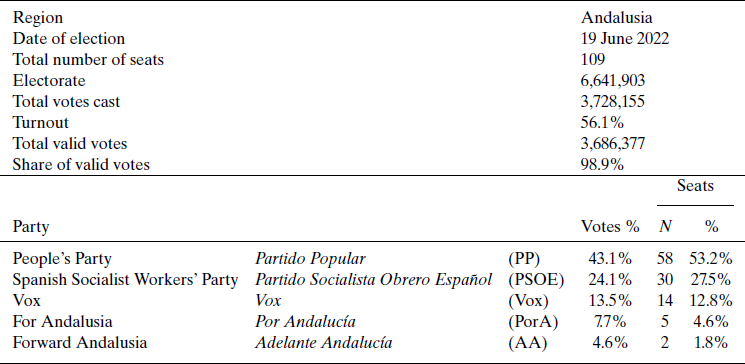
With a 58.4 per cent turnout, the PP won 58 seats, three above the majority. For its part, the PSOE remained at great distance with 30 seats. Vox won 14 seats, two more than in 2018. The Andalusian assembly was completed with the five representatives of For Andalusia (Por Andalucía) and the two representatives of Forward Andalusia, both parties being splits of UP. Finally, the party that suffered the biggest electoral defeat was Cs, which did not obtain any seats despite being the third political force, with 21 seats, in 2018.
Data on the results of the regional elections in Andalusia in 2022 can be found in Table 1.
Results of regional (Andalusia) elections in Spain in 2022

Source: Regional Government of Andalusia, Junta de Andalucía, 2022.
Cabinet report
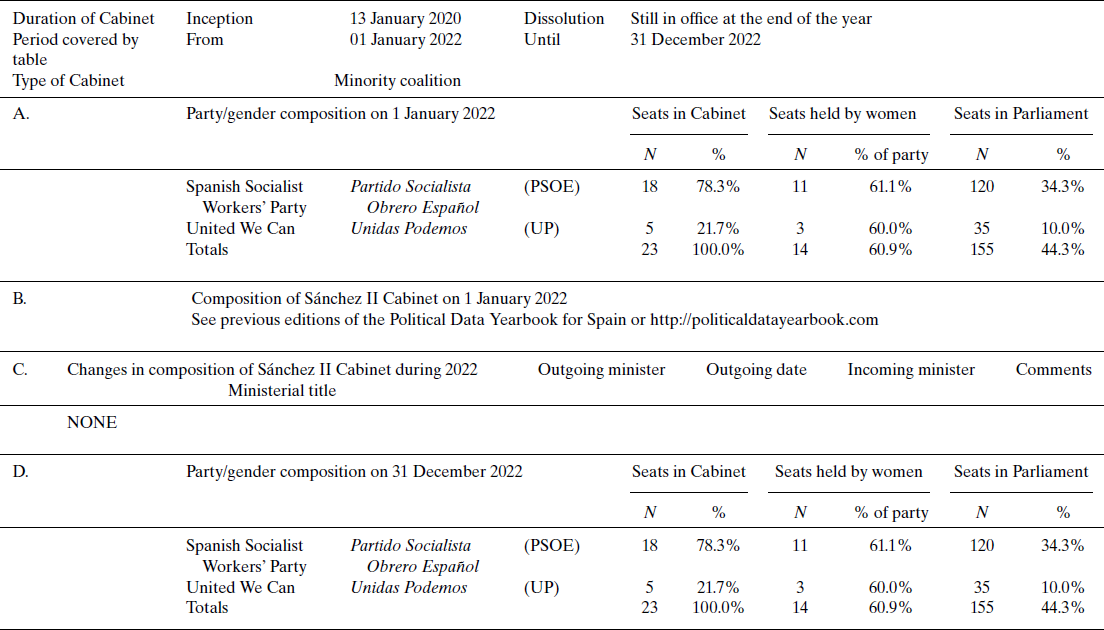
In 2022, there were no changes in the Cabinet composition in Spain. Data on the composition in 2022, with the last changes in 2021, can be found in Table 2.

Parliament report
In 2022, the Parliament approved a total of 73 laws. Of these, 57 per cent (42 laws) derived from the implementation of EU laws such as the Audiovisual Communication Services Directive of 2018, the Directive establishing a single railway area for the EU, the Regulation governing the new European Union Agency for Criminal Judicial Cooperation (Eurojust), and the Regulation containing the rules to be applied by Member States when designing their strategic plans to adapt to the new Common Agricultural Policy. In line with EU policy, throughout the year, the Spanish Parliament also approved several packages of measures (via laws and Royal Decree-Laws) aimed at alleviating the social, economic, and energy consequences of the war in Ukraine.
The first key piece of legislation approved by Congress was the Royal Decree-Law reforming the labor market, which included policy changes agreed between the government, the main trade unions, and the business organizations. The main objective of the new legislation was to lay the foundations for a labor market in line with European standards as regards levels of temporary employment, which were well above average in Spain. The text also aimed at complying with both government and EU commitments toward a fairer and more inclusive post-coronavirus disease (Covid-19) recovery in labor matters. After an extremely tense voting session, the decree-law was passed by the Congress of Deputies. Tellingly, some government partners voted against it, while other parliamentary groups voted in favor. Two MPs from Unión del Pueblo Navarro (Union of the Navarrese People) disobeyed their party and voted against it. In the end, the vote was only won by the government because an MP from PP voted in favor by mistake. Without that error, the government would have lost the vote.
Three laws received particular attention from the public during the legislature: the Law on the Comprehensive Guarantee of Sexual Freedom, better known as the “only yes means yes” law; the Law on Democratic Memory; and the Law on the reform of the Criminal Code. The first law removed the distinction between sexual abuse and aggression (rape) and regulated the need for express consent in sexual relations; this law caused a strong division between government ministers of PSOE and UP. The Law on Democratic Memory is based on the principles of truth, justice, reparation, and guarantee of non-repetition; it expressly reclaims the Transition period and the defense of democratic values, and for the first time condemns the military coup of July 1936 and Franco's dictatorship. At the end of the year, the parliamentary groups of PSOE and UP jointly presented to the Congress of Deputies the bill on the reform of the Penal Code to eliminate the crime of sedition and replace it with the crime of aggravated public disorder. The bill was voted on in Congress, in a roll call vote, and approved with a majority of 187 MPs.
Legislative initiatives endorsed as a result of the transposition into Spanish law of European regulations and directives included laws including areas such as waste and contaminated soil, telecommunications, road transport workers, financial information for investigating criminal offences, equal treatment and non-discrimination, insolvency law and commercial courts, law for the creation and growth of companies, gaming regulation, and the mortgage loan market. Other approved regulations derived from recommendations, guidelines, programs, or initiatives issued by EU institutions in the field of vulnerable consumers’ protection, drought in the agricultural sector, the security of 5G communications, professional training, the electricity market, building rehabilitation, temporality in the health services, energy saving and efficiency, the transitional reduction of the value added tax (VAT) on fuels, and the protection of energy and gas consumers.
Finally, in December, the budget for 2023 was presented by the Ministry of Finance and Civil Service and received the backing of 10 political groups, representing 188 seats: PSOE, UP, ERC, PNV, Bildu, PDeCAT, Más País, CC, Compromís, and Cantabrian Regionalist Party (Partido Regionalista de Cantabria). This is the third budget of the coalition government and, foreseeably, also the last, as the timetable for processing any 2024 budget will coincide with the mandatory dissolution of Parliament and the election campaign of 2023.
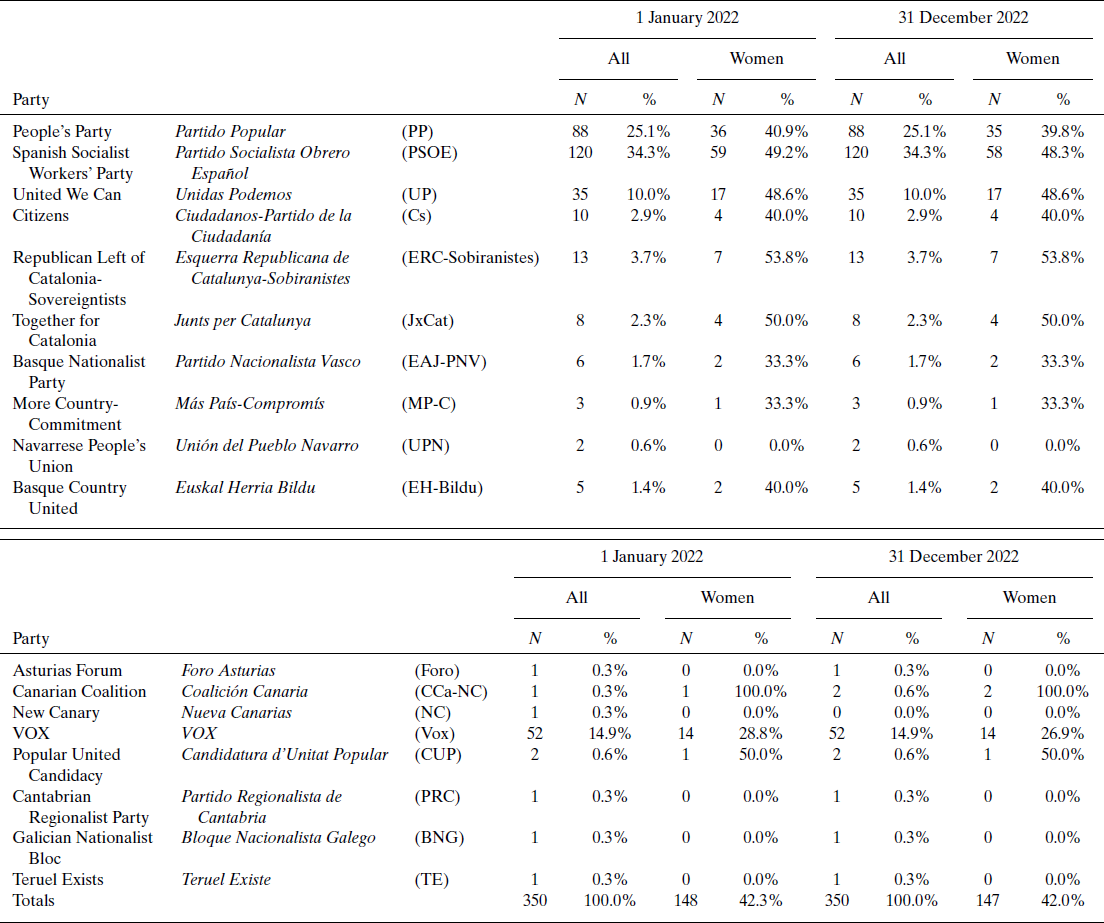
Data on the composition of the lower house of Parliament can be found in Table 3.
Party and gender composition of the lower house of the Parliament (Congreso de los Diputados) in Spain in 2022

Notes:
1. MP Alberto Rodríguez (UP) was barred from holding public office on 22 October 2021 due to a judicial sentence; UP has left this seat empty since then. MP María del Carmen Pita Cárdenes left UP on 24 March 2022 but not her seat in the lower house; since then, she belongs to the Mixed Parliamentary Group (Grupo Mixto) in this house.
2. MP Pablo Cambronero left Cs on 17 March 2021 but not his seat in the lower house. Since then, he belongs to the Mixed Parliamentary Group (Grupo Mixto) in this house.
3. Due to the pre-electoral agreement between CC and NC in Las Palmas, MP Pedro Quevedo (NC) left his seat on 1 July 2022. He was replaced by María Fernández (CC). This leaves CC with two seats, as of this date, and NC with none.
Political party report
The most significant change within political parties took place within the main opposition party, the PP, between the elections of Castile and Leon and Andalusia, and entailed the replacement of its president and party leader, Pablo Casado, by Alberto Núñez Feijóo. Following the elections in Castile and Leon on 14 February, which renewed the PP's parliamentary majority but fell short of expectations, the party went through a deep internal crisis. The leadership of Pablo Casado was called into question, mainly by the regional president of the Autonomous Community of Madrid, Isabel Díaz Ayuso, in view of the low performance of the PP in national polls and the aforementioned regional elections of Castile and Leon. Amid public accusations of spying and corruption involving face-mask purchases, many voices within the party asked for an extraordinary party congress. They also insinuated that Pablo Casado should resign and Alberto Núñez Feijóo, a moderate leader and president of the Autonomous Community of Galicia since 2009, should take a step forward to pacify the party and put an end to the Casado–Ayuso competition.
After days of uncertainty and several resignations, including that of the secretary-general, Teodoro García Egea, Pablo Casado decided to step down as party leader. He continued as party president, although with almost no public appearances, until the party's extraordinary congress in Seville on 2 April, when Núñez Feijóo was unanimously elected as the new president. Feijóo resigned as president of Galicia, being replaced by Alfonso Rueda, and was thereafter appointed as a senator by the Galician Parliament, thus turning the upper house into the head-on clash arena between President Sánchez and the new head of the opposition, Núñez Feijóo.
After this crisis, the PP successfully managed its internal differences, and actually polls suggested that the new leadership could win the general election in 2023. The party's majority in Andalusia two months later, on 19 June, seemed to confirm this new trend.
Data on party changes in 2022 can be found in Table 4.

Institutional change report
In 2022, the institutional crisis worsened in relation to the judicial appointments to the General Council of the Judiciary (CGPJ)—pending since December 2018 due to the lack of agreement between PSOE and PP—and the Constitutional Court (TC)—pending since June 2012, as the CGPJ was not able to reach an agreement regarding the appointment of two new judges to the TC. The latter crisis was resolved in December 2022. The law was reformed (LO 8/2022) to give the power to appoint two constitutional judges back to the CGPJ—this prerogative had been eliminated in 2021 to prevent appointments by an acting CGPJ. In December 2022, the CGPJ appointed two judges who, along with the two judges appointed by the government in November, took office in January 2023. In relation to the deadlock on the CGPJ turnover, the European Commission's report on the rule of law in 2022 called for an immediate solution and then for a reform of the appointment system established in the Organic Law on the Judiciary in order to allow judges to elect one part of the members of the CGPJ. However, no progress was made on either of these two aspects in 2022.
On the other hand, in July Reference Delgado2022, the Attorney General of Spain, Dolores Delgado, resigned for health reasons and was replaced by Álvaro García Ortiz, Chief Attorney of the Technical Secretariat of the Attorney General of Spain's office. Finally, it is also worth mentioning the appointment of Elena Sánchez as president of the General Council of RTVE, the national public radio and television broadcaster, after the resignation of José Manuel Pérez Tornero, who lasted just 18 months in office due to disagreements with the Board of Administration of RTVE.
Issues in national politics
In 2022, the implementation of the Spanish NRRP ranked at the top of the political agenda. It combines both reforms and investment targets and is structured along four main lines—green transformation, digital transformation, social and territorial cohesion, and gender equality. The reforms mainly address bottlenecks to lasting and sustainable growth, while investments are targeted to accelerate recovery and economic change via strategic projects, the so-called PERTE (Strategic Projects for Recovery and Economic Transformation), which constitute a new public–private partnership instrument. Broadly speaking, the plan intends to improve the transition toward a more sustainable low-carbon and climate-resilient economy, to maximize the benefits of the digital transformation, and to ensure social cohesion. Moreover, it aims at enhancing connectivity within the country, boosting labor market performance, the innovation capacity of the economy, and making public spending more efficient and sustainable.
On another hand, 2022 was characterized by the worsening of the institutional conflict to allow a timely turnover on constitutional bodies; the extraordinary congress of the PP to solve the sudden and unexpected fall of its president, Pablo Casado, as a result of his fierce rivalry with Isabel Díaz Ayuso; and the adoption of two laws that created deep concern among the public.
Regarding the new laws, the reform of the Criminal Code to eliminate sedition was interpreted by many as a way to assuage the Catalan secessionist leaders’ judiciary situation, and thus to please pro-independence parties, such as Republican Left of Catalonia (Esquerra Republicana de Catalunya, ERC), upon which the parliamentary majority of the government depends, as well as the UP part of the coalition government. Second, the Law on the Comprehensive Guarantee of Sexual Freedom was included in the electoral manifesto of the UP and thereafter in the coalition government agreement. This law, which was passed by the Congress with 205 votes in favor, 141 votes against, and three abstentions, abolished the distinction between sexual abuse and aggression (rape), making express consent the key to judging all sexual crimes, which affected the principle of proportionality of penalties. The rationale for this law was ending the differentiation between abuse and aggression after the sentence for the case of La Manada, an episode of gang rape of a young woman during the 2016 Sanfermines festival that was determined by the Courts to be sexual abuse rather than rape, thereby unleashing a wave of public criticism.
On another topic, the Spanish economy grew by around 5.5 per cent in 2022. However, behind this number lay a declining trend of falling consumption, raw materials shortages, tightening of financial conditions, the subsequent rising financial burden on companies and households, and a sharp increase in inflation, which, at 10.2 per cent, reached its highest peak since 1985. All this pushed the government to adopt a battery of measures to help companies and households, including €16 billion in direct aid and soft loans, an increase in the minimum living wage, a cap on regulated gas prices until the end of 2023, a rebate of 20 euro cents per liter on the price of oil, a reduction in VAT on natural gas bills from 21 per cent to 5 per cent, and mortgage relief measures such as extending loan repayments for more than one million households.
Energy security risks emerging from the war on Ukraine were relatively low because Spain has limited dependence on Russian gas, a well-developed liquefied natural gas infrastructure and alternative energy sources. However, the introduction of the so-called “Iberian exception” allowed Spain and Portugal to artificially reduce wholesale electricity prices by capping the price of gas used for electricity generation.
Employment figures exceeded pre-pandemic levels. The 2021 labor market reform contributed to increasing permanent employment, but the unemployment rate was still high at 12.5 per cent (almost double the eurozone average), albeit down from 15 per cent a year earlier and 24 per cent in 2012, following the global financial crisis.
Last, if the regional elections of Catalonia in 2021 can be considered the final chapter of the independentist bid in Catalonia that began in 2012, 2022 was the epilogue, with the end of the coalition between the two main pro-independence parties, ERC and Junts, in the Catalan government. For the first time since 2010, Junts (or its predecessors) is no longer part of the Catalan government. After several disputes with ERC, on 7 October, Junts had held an internal ballot to consult its party members on whether they should stay in the government. A total of 55.73 per cent of party members voted in favor of leaving the government. A few days later, Catalan President Pere Aragonès formed a new Cabinet, replacing Junts ministers (consellers) with independents. This opened a new chapter in Catalan politics, with Junts in the opposition, ERC in a minority single-party government (33 out of 135 seats), and the increasing importance of the Socialists’ Party of Catalonia (Partit dels Socialistes de Catalunya, PSC-PSOE) to reach a majority in the Catalan Parliament (PSC-PSOE was the party with the most votes in the 2021 Catalan elections). At the national level ERC, with its 13 seats in the Congress, has been a rather close parliamentary ally of the Spanish government in key laws, including the budget.
Barely one month after Junts left the Catalan government, the Spanish government proposed an express reform of the Criminal Code to eliminate the crime of sedition and modify the crime of embezzlement. This reform clearly benefitted several pro-independence Catalan politicians since their eventual sentences would be reduced. These reforms were controversial because of their celerity, their timing (in 2023 Spain will hold local, regional, and national elections), and the potential unpredicted consequences of such a fast reform of the Criminal Code. The PP, Vox, and Cs harshly criticized the reform and the speed with which it was passed by Congress before 2023. There was indeed almost no time to debate or discuss the implications of this reform, and in less than a month, the Congress, on 15 December (and the Senate on 22 December), had approved the reform, with 184 votes in favor.


 Open access

