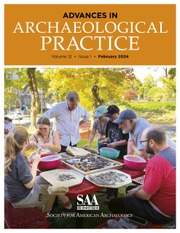


A HISTORICAL PERSPECTIVE ON ARCHAEOLOGICAL CURATION AND COLLECTIONS CARE
Archaeological curation and collections management play crucial roles in the process of archaeology. Yet, they are often secondary concerns of many field archaeologists, if considered at all. This may be especially true for a generation of archaeologists who are nearing retirement, in part because many were never trained to think about curation. In places where the archaeological permitting process does not require a repository agreement in advance of fieldwork, archaeologists rarely factor in curation before fieldwork in the context of their research design and project budgeting (Childs and Benden Reference Childs and Benden2017; Majewski Reference Majewski2010; Sonderman Reference Sonderman and Terry Childs2004). In general, collections care has also been overlooked or absent in most academic curricula (Benden Reference Benden, Terry Childs and Warner2019; Meister Reference Meister2019; see also Baerreis Reference Baerreis, Mandelbaum, Lasker and Albert1963; Majewski Reference Majewski2009). The lack of such training contributes to the curation crisis and runs counter to established ethical standards of the discipline (e.g., Society for American Archaeology's Principles of Archaeological Ethics).
For decades, a small but vocal group of archaeologists have recognized and written prolifically about American archaeology's curation crisis (e.g., Bustard Reference Bustard2000; Childs Reference Childs1995, Reference Childs2004, Reference Childs, Agnew and Bridgland2006, Reference Childs2010, Reference Childs, Smith and Murray2011; Ford Reference Ford1977; GAO 1987; Lindsay et al. Reference Lindsay, Williams-Dean and Haas1979, Reference Lindsay, Williams-Dean and Haas1980; Marquardt Reference Marquardt1977; Marquardt et al. Reference Marquardt, Montet-White and Scholtz1982; Milanich Reference Milanich2005; Sullivan and Childs Reference Sullivan and Terry Childs2003; Thompson Reference Thompson, Raymond2000; Trimble and Meyers Reference Trimble and Meyers1991). More recently, others have argued that the discipline is in the midst of a digital curation crisis that is not receiving enough of the professional community's attention (see Eiteljorg Reference Eiteljorg and Terry Childs2004; Kintigh and Altschul Reference Kintigh and Altschul2010; Sullivan and Childs Reference Sullivan and Terry Childs2003:37–38; Witze Reference Witze2019). These crises extend to nearly every corner of the globe and are primarily focused on the lack of adequate and secure repositoryFootnote 1 space to appropriately care for archaeological collectionsFootnote 2 long-term; a shortage of trained, professional staff with formal training experience in both curatorial practices and field excavation and who understand the value of making collections accessible; funding deficiencies for long-term preservation; failure to determine ownership and identify where collections are physically curated; and closures of repositories and cultural resource management (CRM) firms.
These problems are further conveyed through staggering statistics presented in “A Public Trust at Risk: The Heritage Health Index Report on the State of America's Collections,” the first comprehensive survey that detailed the conditions and preservation needs of cultural heritage collections in the United States. The report states that over 50% of archaeological collections are in unknown condition and the same amount (50%) of repositories do not have a written long-range plan for collections care (Heritage Preservation Inc. 2005).
While this thematic issue isn't a survey of the curation crisis, it addresses many of its component concerns and provides an updated review of collections care and management; it also contemplates how to improve accessibility and use. Practical solutions are outlined for those who work as collections or lab managers, curators, et cetera. Of equal importance is the guidance it aims to provide archaeologists whose job duties focus on teaching, research, fieldwork, management, or compliance. In short, this issue outlines how collections care specialists can encourage other archaeological stakeholders (e.g., those working in government, tribal, academic, or CRM environments) to become better stewards of the collections they create and analyze. It provides valuable information for archaeological practitioners who work in different sectors and covers a variety of topics that relate to collections preservation, access, and use.
Since the initial 1970s publications that identified deficiencies in stewardship and preservation, much progress has been made. For the first time, passage of legislation such as the Native American Graves Protection and Repatriation Act (NAGPRA) and 36 CFR Part 79 (the Curation of Federally-owned and Administered Archaeological Collections) mandated clearly defined standards for collections care and management. Organizations such as the American Alliance of Museums (AAM), the Society for the Preservation of Natural History Collections, and the American Institute for Conservation have established standards for preventive conservation (practices that slow the deterioration of cultural heritage; see Meister Reference Meister2019) and identified safe materials to use in storage and exhibition (e.g., Bachmann Reference Bachmann1992; Buck and Gilmore Reference Buck and Gilmore2010; Hatchfield Reference Hatchfield2007; Odegaard et al. Reference Odegaard and Sadongei2005; Rose et al. Reference Rose, Hawks and Genoways2009).
Our colleagues who work in the museum field have made many positive contributions to archaeological curation and collections management. For instance, most museums have an established collections management policy (a written document that addresses stewardship responsibilities), which outlines the scope of curated collections, describes how they are cared for and made accessible, and identifies who is responsible for carrying out different aspects of the policy (see Malaro and DeAngelis Reference Malaro and DeAngelis2012). Museum personnel have improved environmental conditions in storage and displays as well as access to both physical and digital collections. For nearly 50 years, the AAM accreditation program has specified a process for museums, through self-assessment and peer review, to demonstrate excellence in standards and professional practices, including collections stewardship (AAM 2019). Although less than 10% of museums that curate archaeological collections are accredited, those that have succeeded represent the gold standard of distinction and credibility among both professionals and the general public. Undoubtedly, the archaeological repository community would benefit from a comparable accreditation program. While the museum field has made significant strides in its ability to care for archaeological collections, it faces many of the same challenges as other types of repositories: shortages in trained professional staff and in adequate funding for collections care.
Within archaeology specifically, collections management training opportunities are on the rise. Nearly two decades ago, S. Terry Childs and Eileen Corcoran (Reference Childs and Corcoran2000) developed Managing Archaeological Collections, an online certified course accessible to and beneficial for anyone who works in or studies cultural heritage. More recently, the Society for American Archaeology launched a series of online seminars in 2013. Some, such as Danielle M. Benden's Archaeological Curation, Orphaned Collections, and Teaching Curation seminars; Francis McManamon and Leigh Anne Ellison's Digital Data Management course; and Michael “Sonny” Trimble's seminar on the Mandatory Center of Expertise for the Curation and Management of Archaeological Collections and the Veterans Curation Program have provided certified, professional development opportunities for practitioners who work in all sectors (SAA 2019a). In academia, a handful of anthropology programs now offer collections management courses, although often not as a required part of the curriculum (Benden Reference Benden, Terry Childs and Warner2019; Sonderman Reference Sonderman2018). While there is still much more work to be done in terms of educational opportunities, a new generation of archaeologists has begun to recognize the importance of and need to develop practical skills in these areas and understand collections care and management as integral to, not separate from, the archaeological process.
SPECIALIZATION, DATA MANAGEMENT, AND CURATION
The discipline of archaeology has become so specialized that most archaeologists are involved with just one stage of a project (e.g., administration, fieldwork, laboratory analyses, etc.). Archaeological collection managers and curators are tasked with all aspects of proper care and management of both existing and new collections that enter the repository. They are expected to be proficient in a number of tasks ranging from the development of pre-fieldwork stipulations (e.g., permitting and curation agreements) to the specification of fieldwork procedures; protecting to digitizing collections; managing databases to facilitating research; developing departmental policy to planning exhibitions; understanding the interests of the public, Native American and descendant communities, researchers, and land managing agencies; and other topics that are addressed and negotiated almost daily (Sullivan and Childs Reference Sullivan, Terry Childs, Terry Childs and Warner2019). Furthermore, standards in collections care evolve as methods and innovations are continually being tested and improved. Yet, technological advances happen so quickly that it is difficult to keep up-to-date.
Managing data has become a herculean task. The advent of CRM was a game changer in terms of the sheer volume of archaeological projects undertaken and associated collections produced (see Sullivan and Childs Reference Sullivan and Terry Childs2003). This is further compounded with the amount of born-digital material that now makes up a major part of the archaeological record (Richards Reference Richards2017). Finding the physical collections (artifacts and associated records, including born-digital and hard copies), synthesizing the data in a meaningful way, and effectively disseminating the results is challenging, time-consuming, and expensive (Schlanger et al. Reference Schlanger, Wilshusen and Roberts2015). Contextual data is often lacking in the associated records (e.g., field forms, maps, or photos [King Reference King, Sebastian and Lipe2009; King and Samford Reference King and Samford2019; Voss Reference Voss2012]). Problems with the preservation of contextual data exist, in part, because few archaeologists are formally trained in the practices of creating a meaningful archive that effectively informs future researchers, especially archaeologists who reexamine existing repository collections (Bauer-Clapp and Kirakosian Reference Bauer-Clapp and Kirakosian2017; Merriman and Swain Reference Merriman and Swain1999; Vogt-O'Connor Reference Vogt-O'Connor1999; see also Schiappacasse Reference Schiappacasse2019). Digital repositories such as the Digital Archaeological Record in the United States and the Archaeology Data Service in the United Kingdom provide archaeologists with a mechanism for ensuring that associated records in digital form are appropriately preserved, migrated, and cared for by trained digital curators and made available to a variety of stakeholders now and in the future.
Specialization and managing an increasingly large amount of data have directly affected archaeological collections care. The demands on the personnel who manage collections coupled with fewer financial resources to accomplish a daunting list of tasks are untenable and in direct conflict with our ability to practice responsibly and according to the ethical standards outlined by the Society for American Archaeology and the Register of Professional Archaeologists (SAA 2019b; RPA 2019).
IN THIS ISSUE
This issue brings together specialists who care for, manage, and use existing collections and implement creative solutions for tackling common conundrums that currently play out in repositories across the globe. Three major themes are explored: (1) how all archaeological practitioners can benefit from becoming informed about what occurs in other parts of the archaeological cycle in which they do not specialize; (2) curation considerations at every stage of an archaeological project, including pre-field budgeting, field conservation and stabilization techniques, and preparing collections for the repository; and (3) managing digital data, making collections accessible for research, exhibition, and education, and collaborating with descendant communities.
The following articles address collections care and management before, during, and after fieldwork, as well as throughout the “life” of collections in the repository; collections accessibility and use are also explored. Nicolette Meister (Reference Meister2019) provides a practical, introductory guide to preventive conservation and a description of the agents of deterioration: the primary threats to collections. Meister calls for a holistic, integrated approach that incorporates hands-on training across disciplines so that future archaeologists—whether they generate, research, and/or care for collections—“understand their stewardship responsibilities” (Meister Reference Meister2019). She draws attention to the different ways we think about collections: researchers tend to value contextual relationships first, while collections personnel primarily emphasize preservation needs. These are important considerations as we work together as users, managers, and stewards of the same collections.
Amanda Roberts Thompson and her colleagues (Reference Thompson, Thompson, Kappers, Schenk and Williams2019) at the University of Georgia's Laboratory of Archaeology highlight the challenges associated with effective preservation and oversight of legacy collections. A fire in the repository provided an opportunity to reevaluate curatorial standards and improve the contextual relationships between the physical collections and associated records (both paper and digital versions). Michelle Knoll and A. Carver-Kubik (Reference Knoll and Carver-Kubik2019) offer solutions for the preservation of digital photographic prints. The authors encourage field archaeologists and collections personnel to communicate during the pre-field planning stage of an archaeological project. In doing so, principal investigators become familiar with repository submission guidelines and better understand how the decisions they make in the field directly impact the long-term care and preservation of photographs in the repository. Knoll and Carver-Kubik also offer recommendations for collections managers who care for photographs in legacy collections.
The article by Glenna Nielsen-Grimm and Robyn Haynie (Reference Nielsen-Grimm and Haynie2019) discusses object stabilization, preventive care, and conservation considerations before, during, and after fieldwork. The authors underscore the importance of communication between collections personnel (including conservators) and field archaeologists early on in a project. They call on collections personnel to serve as a resource for field archaeologists who may need advice about in-field preservation methods and preparing collections for the repository (e.g., how to number and pack artifacts). Nancy Odegaard (Reference Odegaard2019) reviews the use of pesticides on legacy collections. She explains how to create a pesticide history and mitigate the effects of pesticides to reduce health hazards in the repository and before repatriation.
The other articles examine collections access and use and emphasize the variability in priorities among those who create, care for, and use collections. The needs and interests of these different groups—curators, collections managers, researchers, descendant communities, the general public—are distinct. Patricia Emerson and Nancy Hoffman (Reference Emerson and Hoffman2019) consider the differing needs of stakeholders as they outline the technical, social, and political challenges associated with managing collections. Using the implementation of a new collections management software system (CMS) at the Minnesota Historical Society as a case study, they highlight the importance of consistency, accuracy, and interoperability of datasets and describe the development of CMS content standards to facilitate object retrieval and ensure reliability of query results. Emerson and Hoffman emphasize the importance of consultation with descendant communities and incorporation of tribal input and concerns regarding access to and management of sensitive data. Julia King and Patricia Samford (Reference King and Samford2019) describe the policies and practices implemented by the Maryland Archaeological Conservation Laboratory to enhance the research value of collections and make them accessible. The authors examine what repository personnel can do to preserve artifacts and their contextual relationships and, with input from researchers, prioritize collections significance and identify those with the highest research potential.
Paola A. Schiappacasse (Reference Schiappacasse2019) offers her view from Puerto Rico, where she actively engages students in projects that include elements of both research and collections care. Schiappacasse explores the importance of university departments and museums working together, training students to use existing collections as they develop research questions. She also provides tips for locating existing collections, which can be a challenging task for any number of stakeholders. John Hansen (Reference Hansen2019) draws on his experience as a collections manager at the American Museum of Natural History to argue that a database is always a work in progress, requiring consistent maintenance by trained personnel. It is also a useful tool for researchers, descendant communities, and the general public. Hansen emphasizes that during the database creation process, it is crucial to understand the various potential end users and their needs, which can be very different.
Sheila Goff and colleagues (Reference Goff, Chapoose, Cook and Voirol2019) discuss their collaboration on the development of meaningful exhibitions between History Colorado and Native peoples. The article underscores the challenges and rewards of museums and descendant communities working together to provide accurate interpretations of the past.
WHAT THE FUTURE HOLDS: THE CALL FOR A CURATION ETHIC
The discipline of archaeology has made significant strides in collections care and management. The articles in this issue are a testament to that fact. But there is more work to be done. Childs and others (e.g., Childs Reference Childs, Agnew and Bridgland2006, Reference Childs, Smith and Murray2011; Childs and Benden Reference Childs and Benden2017; Childs and Warner Reference Childs and Warner2019; Sullivan and Childs Reference Sullivan and Terry Childs2003) have clearly outlined actions that would make for a more sustainable archaeological practice: curation considerations at every stage of an archaeological project. This begins with pre-field planning (budgeting, research design phase) and continues through the “life” of the collections in the repository. This includes (1) the call for more collections care training in undergraduate and graduate anthropology programs (whether that be developing new, stand-alone courses or integrating curation concepts into existing curricula) so that emerging professionals gain practical skills needed to be competitive in the job market, especially because the majority of American archaeologists will find employment outside academia (Jenks Reference Jenks2014); (2) standards for deaccessioning; (3) the development of a national repository accreditation program to validate credibility and provide a measure of how well an institution meets current curation standards (something that could easily be modeled after AAM's museum accreditation program); (4) the importance of identifying ownership of new and existing collections; (5) making collections accessible; and (6) engaging descendant communities in collaborative decision-making processes.
Nearly 45 years have passed since William Lipe published A Conservation Model for American Archaeology in which, among other things, he called for “public education, involvement of archaeologists in land use planning, and establishment of archaeological preserves” (Lipe Reference Lipe1974:213). Much of what Lipe encouraged is now encoded in SAA's Principles of Archaeological Ethics (e.g., stewardship, accountability, public education and outreach, dissemination of data, and preservation of sites, collections, and records (Lynott Reference Lynott1997; SAA 2019b). Childs (Reference Childs2004) and colleagues further described these ethical considerations as they relate to curation in Our Collective Responsibility: The Ethics and Practice of Archaeological Collections Stewardship. As we reflect on our way forward, we recognize that the building blocks of sustainable archaeological practice are readily available. We call for a “curation ethic in archaeology”—comparable to Teresita Majewski's (Reference Majewski, Terry Childs and Warner2019) “collections management ethos”—where curation is encoded in a national mandate and a required part of curriculum and professional development. What would this look like in practice? Below, we outline suggestions for implementing a curation ethic across sectors.
Academia
• Encourage and permit students to utilize existing collections for theses and dissertations. While it is necessary for students to gain sufficient fieldwork training, it is not imperative that they create new collections as part of their dissertations and theses. This will require a cultural shift in the academy that has historically given the gold star to fieldwork. In the words of King (Reference King2016), let's consider a “dig less, catalog more” approach when sites are not threatened.
• Train students in the practical skills of pre-field planning including budgeting for curation, in-field conservation needs, and preparing collections according to repository submission guidelines. This includes the objects as well as paper and digital records generated as part of an archaeological project.
• Require that students complete a collections management class as part of their overall coursework. If one is not part of existing curriculum, consider developing a stand-alone course. If that is not possible, integrate curation principles into existing classes. Many guides and templates are freely available so that faculty can adapt proven successful models (see Benden Reference Benden, Terry Childs and Warner2019). Integrating collections stewardship into academic coursework is supported by SAA's “Seven Principles for Teaching Archaeology in the Twenty-First Century” (SAA 2019c).
Government
• Develop a national repository accreditation program with dedicated grant funding and oversight. Such a program may be modeled after AAM's accreditation or existing statewide repository initiatives (e.g., Texas Historical Commission's Curatorial Facility Certification). Like NAGPRA, a national archaeological repository program should have an established review board, administrative power, and funding resources to facilitate compliance with the federal regulations, in this case, 36 CFR 79.
• Mandate that curation is included in project budgets, which requires that managers understand why curation is important. We must call out the need for more collections management focused training. This should extend to granting agencies (e.g., National Science Foundation [NSF]) who have the authority to stipulate that grantees include curation funding. Furthermore, federal and state agencies as well as granting institutions could do more in terms of providing financial support for legacy collections rehabilitation. There are some programs (e.g., Department of the Interior Cultural and Scientific Collections Fund or state historical funds) that have funded or currently fund this work, but more opportunities like these are critical. The NSF Anthropology Division used to fund systematic anthropological collections grants. When the program was discontinued, members of the SAA Committee on Museums, Collections, and Curation wrote a white paper urging NSF to reinstate the program (Lyons et al. Reference Lyons, Terry Childs, Sullivan, Trimble and Whittington2012), but that has not occurred.
• Consider collections consolidation into regional repositories. Based on the concept of “bulk purchasing,” where the unit cost is lowered when the purchase quantity is increased, regional centers may be more sustainable for agencies who struggle with fluctuating annual budgets and limited funds to cover annual curation fees. In theory, regional centers that curate large quantities of materials may provide reduced collections management fees while still maintaining dedicated, trained staff for collections care.
• Finalize the deaccessioning regulations and establish significance criteria for determining long-term research value of collections.
Cultural Resource Management
• Budget for curation in the pre-field planning stages of an archaeological project (see Majewski Reference Majewski2010, Reference Majewski, Terry Childs and Warner2019). The CRM industry is competitive, and the bottom line can be important in the bidding process. Project managers must consider the long-term needs of the collections they excavate and budget appropriately. If federal agencies mandated curation as part of the undertaking bid process, and state and local governments followed this model, this would keep curation from being a pawn in competitive budgets and even the playing field among companies. Principle investigators should inform land developers and private property owners that curation is a professional responsibility. Richards (Reference Richards2017:230) recently wrote that “most countries, including both the United Kingdom and the United States, follow the principle that ‘the polluter pays’; that is, those funding the development should also pay for any archaeological work deemed necessary.”
• Clarify ownership and curation stewardship responsibilities before a project begins and codify stakeholder roles in writing.
• Communicate with all stakeholders—descendant communities, repository personnel, agencies, developers, private property owners—early on in the project.
• In-house, CRM firms should establish a workflow that considers curation as a requirement of any project. Field archaeologists should understand and appreciate what lab personnel do to prepare collections for curation and vice versa. Regularly scheduled training sessions and coordinated workflow procedures would facilitate this. Effective leadership within the CRM industry can establish a workplace culture that values curation.
Repository Personnel
• Create submission standards for collections depositors and make them easily accessible. Clearly written user guides and in-person trainings are beneficial for all: depositors, the collections, repository staff, et cetera.
• Provide uncomplicated directions about how to obtain access to collections for many end users: descendant communities, researchers, agencies, and the general public.
• Serve as a resource for field archaeologists who seek advice about preservation needs in the field and during repository preparation.
• Collaborate meaningfully with descendant communities on projects such as cocurated exhibits, developing care and handling policies, and identifying and controlling access to culturally sensitive objects.
• Coordinate with agency personnel on the long-term care and management of federal collections.
Many of these suggestions are not new. In fact, our colleagues (e.g., Childs, Marquardt, Majewski, Sullivan, and Trimble) have advocated for them for decades. While this list may not be novel, the tools and guidelines for implementing them are. Benden (Reference Benden, Terry Childs and Warner2019) recently created an updated list of resources to carry out many of these tasks. The list is maintained by SAA at https://tinyurl.com/y3ararsw. Web links will be regularly updated and additional resources added as they become available so that the usefulness of the document is maintained over time.
Above all, we must collaborate and communicate with each other more effectively and engage SAA and other organizations (e.g., Society for Historical Archaeology, American Cultural Resources Association, etc.) in lobbying efforts to support these initiatives. The discipline of archaeology can and should connect the blocks to build a practice that is collaborative and holistic in its approach, one where a curation ethic is an integral part, with everyone working together.
Acknowledgments
We are grateful to Michelle Knoll for her fortitude and partnership as co-guest editor and cochair of the 2017 Society for American Archaeology symposium on innovative collections care approaches in the repository. That session, entitled “Archaeological Collections Care for the Collections Specialist: Current Topics and Innovative Trends in the Repository,” was the spark for preparing this set of articles. We also thank the authors who shared their expertise and creative approaches to the numerous challenges associated with caring for, preserving, and curating archaeological collections. We appreciate the thoughtful commentary and suggestions from the anonymous reviewers. We are grateful to Robert “Ernie” Boszhardt who provided valuable feedback on earlier versions of this manuscript. Thanks also to the Advances in Archaeological Practice team for shepherding us through the editorial process. Finally, we thank Paola Schiappacasse for translating our abstract into Spanish.
Data Availability Statement
No original data were presented in this article.


