Preface: Loss and the Life of Anne Shakespeare
The surviving archival materials related to Anne Shakespeare are scant.Footnote 1 Her epitaph in Holy Trinity Church in Stratford-upon-Avon (the subject of this Element) tells us that she died on 6 August 1623 at the age of sixty-seven. From this, we can infer that she was born in 1556, though no documentary records remain for her birth. Her Shottery family home of Hewlands, now Anne Hathaway’s Cottage, survives, but we do not know when Anne lived there, for how long, or under what circumstances.Footnote 2 Her father’s will of 1581 names her as ‘Agnes’, and the 1601 will of the Hathaway family shepherd, Thomas Whittington, refers to ‘Anne Shaxpere wyffe unto Mr Wyyam Shaxspere’ and entrusts her with money ‘for the poore people of Stratford’ in her ‘hand’.Footnote 3 Anne’s epitaph also names her as the ‘wife of William Shakespeare’, and two documents related to her marriage survive: the marriage licence and the marriage bond, both from November 1582. In Shakespeare’s will of 1616, as ‘my wyf’, she is given ‘my second best bed with the furniture’, and the parish register of Stratford-upon-Avon for her burial lists her as ‘Mrs. Shakspeare’. The aforelisted items provide an incomplete picture of the life of Anne Shakespeare, and we cannot assume that this is a full account of all the documents related to her that may once have existed, or that her life has been adequately captured in documentary form. Further, several of these surviving documents have been fetishized, particularly Shakespeare’s will, to the point of dominating depictions of Anne that have endured for centuries but are built on piecemeal evidence.
Another complication to Anne’s incomplete archive is the fact that all of these documents have come to light at staggered times over the last four centuries. Anne’s epitaph was the earliest recorded piece of evidence about her life, with a transcription first appearing as early as July of 1634 in the manuscript notes of William Dugdale.Footnote 4 Shakespeare’s will was discovered in 1747, the marriage licence bond in 1836, and the registry entry for the marriage in 1880. Matthew Steggle has recently made a persuasive case for an additional document that locates Anne Shakespeare with her husband in London around 1599–1603 and may offer evidence of her literacy (as discussed later in this Element). Steggle’s account of the provenance of this letter fragment illustrates how precarious the evidence about early modern subjects, especially women, can be and how easily it can become lost. The fragment of a letter addressed to ‘Mrs Shakspaire’ was bound in another book printed by Stratfordian and Londoner Richard Field likely from 1608. It somehow ended up near the Welsh border in Lady Hawkins’ School in Kington, Herefordshire, where it remained until 1978, when it was donated to Hereford Cathedral Library. The fragment was first discovered during cataloguing in 1978 by Honorary Cathedral Librarian F. C. Morgan, who had just turned 100. Morgan published a brief (and posthumous) account of the letter in Notes and Queries, with the cryptic title of ‘Honorificabilitudinitatibus’, which gives no indication of the subject of the piece, perhaps explaining the lack of scholarly attention it has received.Footnote 5 Only through Steggle’s reassessment of this document has its potential significance been brought to light, and along with it, a reminder of the instability of the archive related to Anne Shakespeare.Footnote 6
Other than the items listed earlier, no other papers connected to Anne Shakespeare have been identified to date – no diary, books, correspondence, or legal cases. That does not mean that such items never existed, and absence of evidence is not necessarily negative evidence. In fact, one account (discussed in more depth later in this Element) suggests that there were books and other papers in New Place, Anne’s home in Stratford-upon-Avon from 1597 to 1623, which were seized in 1637 and which may have provided a fuller picture of her life. Incomplete surviving evidence does not mean that her story cannot be told, though it is important not to construct her life story based only on the materials that survive about her without acknowledging what has been lost or never recorded in the first place.Footnote 7 There are many aspects of Anne Shakespeare’s life for which we have no documentary evidence, so any narrative about her life must rely on an incomplete archive. The results have often been seemingly authoritative accounts that are actually built on shaky ground.
So how does one go about telling the stories of historical figures for whom we have an incomplete archive, and for whom any life narrative relies on fragmentary evidence? One option is not to tell the story at all, given that conjecture, hypothetical scenarios, and suggestive ideas have to be used out of necessity, in order to fill in the gaps. Another option is to refuse to enhance surviving factual information, but then these lives – mainly of women – remain stagnant, trapped in the narrow matrix of extant documents in the mode of ‘cabbage that has been reboiled a thousand times’, as Daniel Wyttenbach put it.Footnote 8 Or, even worse, the lives of women become subservient to whatever narrative best serves their male counterparts. This has been the case with Anne Shakespeare, whose life has frequently been entrenched in prejudicial, misogynist narratives that have ossified into facts in order to make particular arguments about Shakespeare.
The absence of evidence about Anne’s life has usually not worked in her favour, for reasons I have outlined elsewhere, and in both fictional works and biographies (sometimes one and the same) she has often occupied a stereotypically negative role as a predatory older woman who entrapped a young Shakespeare.Footnote 9 The version of Anne Shakespeare as both a shrew and a mistake is deeply entrenched, and a few instances should suffice. Frank Harris, in his 1910 book The Women of Shakespeare, describes Anne as a ‘jealous scolding shrew wife’ to whom Shakespeare ‘crept home to Stratford’ to die, and who should be jettisoned to ‘the lowest hell of jealousy, rage and humiliation’.Footnote 10 The Anne that James Joyce creates in Book 9 of Ulysses is a haunting portrait of an elderly, haggard Anne even more lurid than in Harris’s version: ‘And in New Place a slack dishonoured body that once was comely, once as sweet, as fresh as cinnamon, now her leaves falling, all bare, frighted of the narrow grave and unforgiven.’ She is ‘the ugliest doxy in all Warwickshire’ and ‘a boldfaced Stratford wench who tumbles in a cornfield a lover younger than herself’.Footnote 11 Likewise, Anthony Burgess’s Anne in his 1964 novel Nothing Like the Sun, is a wife for whom Shakespeare felt ‘hatred … like black vomit’ and ‘a great rage which justifies murder’, a ‘groaning old croan [going] about her housewifely tasks, busying herself with the making of sick man’s broth’ who would ‘sit scratching her spent loins through her kirtle, mumbling her book’.Footnote 12 More recently, primarily in a chapter entitled ‘Wooing, Wedding, and Repenting’, Stephen Greenblatt unambiguously proclaims in his biography Will in the World: How Shakespeare Became Shakespeare (2004, reissued in 2016) that Shakespeare wanted to abandon his ‘disastrous mistake’ of a wife; he was ‘dragged to the altar’ for a marriage that was ‘doomed from the start’; he viewed Anne with ‘contempt’ and ‘sour anger’; and had a ‘strange ineradicable distaste for her that he felt deep within him’. Though this Shakespeare feared the charnel house, claims Greenblatt, ‘he may have feared still more that one day his grave would be opened to let in the body of Anne Shakespeare’.Footnote 13 This influential denigration of Anne has circulated for twenty years and remains widely available in print.Footnote 14 Yet this ‘Anne’ is only possible if one uses selective evidence and ignores the subject of this Element – Anne Shakespeare’s epitaph – which Greenblatt dismisses as a ‘strange inscription’.Footnote 15
In scholarly discussions of her life, Anne’s epitaph has been significantly underplayed. Most accounts of Anne are found within biographies of Shakespeare, where she is conscripted to serve a role in his life story.Footnote 16 Further, biographies of Shakespeare rarely extend past his death in 1616, which has resulted in much greater emphasis on the biographical pieces of Anne’s life during Shakespeare’s lifetime – the courtship, marriage, and Shakespeare’s will – and very little mention of the life she led after he died and, of course, her epitaph.Footnote 17 Katherine Duncan-Jones sees Anne as part of Shakespeare’s ‘sowing wild oats’ and the outlet for his ‘uncontrollable surges of testosterone’, with no mention of her epitaph, perhaps understandably given her depiction.Footnote 18 Jonathan Bate likewise omits Anne’s epitaph from his biography Soul of the Age: A Biography of the Mind of William Shakespeare (2009), focusing instead on Anne’s role in the Shakespeare marriage.Footnote 19 René Weis contends that both William and Anne were unfaithful, and includes a brief mention of her epitaph as a reaction to Shakespeare’s adultery, from her daughters who ‘obviously adored her and probably suspected that she had suffered from their father’s infidelities and prolonged absences in London’.Footnote 20 Two more recent biographies, by Lois Potter and Paul Menzer, only briefly mention Anne’s epitaph.Footnote 21 The most detailed discussion of Anne’s epitaph to date is not in a work about Anne or in a biography, but rather in Benjamin Roland Lewis’s 1940 collection of Shakespeare-related documents. Lewis provides a detailed transcription and brief analysis of content, referring to the epitaph as a testimony that ‘speaks directly and intimately as of a heartbroken daughter to a departed loved mother’.Footnote 22
The only full-length biography of Anne is Germaine Greer’s Shakespeare’s Wife (2007). As her title suggests, Greer’s focus is on Anne’s role as a wife, and the epitaph only makes a few brief appearances. Greer provides a translation of the Latin section but includes no extended analysis or commentary on the content.Footnote 23 My biographical chapter on Anne in The Shakespeare Circle (2016) sets out the array of surviving facts about her, with a section on her epitaph and a brief analysis of the content. Lena Cowen Orlin gives Anne’s epitaph attention in The Private Life of William Shakespeare (2021), focusing mainly on possible dating inaccuracies related to her birth year, which the epitaph helps to establish.Footnote 24 Only in 2021 did Anne receive her own entry (including a section dedicated to her epitaph) in the Oxford Dictionary of National Biography, where previously she had been subsumed under Shakespeare’s entry.Footnote 25 Until now, no full-length study of Anne’s epitaph has existed, let alone told the story of her life through its text and contexts.
This Element puts Anne Shakespeare’s epitaph centre stage for the first time and explores what we might be able to learn by looking closely at the material conditions, the personal connections, and the literary networks behind the epitaph’s creation, and using these newly illuminated interrelations to interpret her life. I attempt to reconstruct the circumstances that led to the planning, creation, and production of Anne’s epitaph, based on common practice, similar surviving historical documents, and creative but plausible ways to flesh out historical details. Anne’s epitaph is particularly important for adding new emphasis to Anne as a mother, a role that her daughters deliberately chose as the ‘Anne’ they wanted to immortalize for posterity. This maternal ‘Anne’ complements facets of her life that have been explored by other scholars, including Anne as a businesswoman by Lena Cowen Orlin, and Anne as a cohabitant with her husband, sharing business and social acquaintances in London, by Matthew Steggle.Footnote 26
My approach employs a speculative methodology, drawing from innovative Shakespeare studies, to examine the potential ramifications associated with the material conditions of Anne’s epitaph. Orlin uses a methodology of cognate lives to suggest missing archival documents in her Shakespeare Quarterly article ‘Anne by Indirection’, where the life of Elizabeth Quiney provides a possible context for Anne Shakespeare and is used to suggest missing archival documents. Likewise, in The Private Life of William Shakespeare, Orlin relies on parallel lives to offer analogies that might help explain biographical cruxes where further details are missing. Similarly, Geoffrey Marsh, in Living With Shakespeare uses parishioners in St. Helen’s Bishopsgate to provide context for some of the individuals whose lives may have intersected with Shakespeare’s own, but for which there is no documentary evidence of direct connections. Marsh describes his method as putting ‘some probable flesh on the bare bones of events largely based on fragmentary official records’. Paul Edmondson and Stanley Wells, editors of The Shakespeare Circle, underline the need to imaginatively go ‘beyond narrowly documented evidence’ in order to open up new possibilities about lives for which an incomplete archive survives.Footnote 27 Roslyn L. Knutson, David McInnis, and Matthew Steggle’s collection Loss and the Literary Culture of Shakespeare’s Time offers an additional methodological model for how to responsibly carry out work when ‘lostness in a plurality of forms’ permeates the field.Footnote 28
In Anne Shakespeare’s Epitaph, I offer a way to rewrite Anne’s maternal history through a ‘Shakespearean text’ that I will suggest originates from the Shakespeare women, and that was also linked to social networks that situate Anne and her legacy in a new context, one related to but also distinct from her husband. In so doing, I imagine lost archival documents that may have once existed, in order to increase the possible footprint of Anne Shakespeare’s life. I offer multiple interpretations and scenarios for the stories that these documents might tell, with as much transparency as possible in terms of likelihood and responsible disclosure of tentative evidence. Particularly in the last section of this Element, I resist the urge to tell a single narrative about how Anne’s life came to be commemorated in her epitaph, choosing instead to offer multiple scenarios, many of which have an equal probability of being ‘true’. I hope my deliberate reluctance to make a definitive pronouncement where there is insufficient and fragmentary evidence will encourage others to think outside the box, to hold multiple ‘Annes’ in their imaginations at once, and to avoid imposing a single narrative on a life where multiple possibilities are equally plausible.
Introduction: Anne Shakespeare’s Epitaph
Among all funeral honours Epitaphes have alwaies bene most respective, for in them love was shewed to the deceased, memory was continued to posterity, friends were comforted, and the reader put in mind of humane frailty.
Nestled on the banks of the River Avon in the medieval market town of Stratford-upon-Avon, Holy Trinity Church occupies a site that has been a place of worship since the ninth century. As the oldest building in Stratford, the present structure dates from 1210 and attracts thousands of tourists, mainly to pay homage to the most famous resident of the town – William Shakespeare – who is buried there on the chancel steps. Built in the late 1400s, the chancel is the most sacred part of the church, and the first grave on the north end of chancel steps is not that of William Shakespeare, but rather, his wife Anne Shakespeare. The epitaph on Anne’s memorial brass plaque, honouring her in original Latin poetry as a beloved mother and ‘so great a gift’, has been there for nearly 400 years. It has remained in place just steps from where Anne worshiped with her family and where her three children were baptized, and not far from where she buried her only son Hamnet in the churchyard in 1596. Anne’s grave occupies the place where she bade farewell to her famous husband seven years before her own death, and would have returned to honour his memory, possibly thinking about her own mortality and when she would occupy the empty space reserved for her next to his grave.
Anne Shakespeare’s brass epitaph has weathered the footsteps of thousands of pilgrims seeking out her husband’s grave and monument, many of whom often stood on her grave for the best view. It survived the conflict of the English Civil War in Stratford; it outlasted Anne’s home of New Place, destroyed in 1759, where she spent the last quarter-century of her life; it has endured longer than the church’s charnel house (torn down in 1800) that Shakespeare warned against in the curse on his grave. Anne’s epitaph was there when American Delia Bacon travelled to Stratford in 1856, planning to break into Shakespeare’s grave to find the secrets to his supposed collaborative authorship. It was there when the fifty-six suffragettes visited Holy Trinity Church in 1913 before holding a public meeting in Rother Market. It was there when 40 local soldiers married in the church between 1917 and 1918, and when Stratford’s mothers and widows buried the 235 soldiers lost in the Great War. Anne’s epitaph was there when a German reconnaissance plane flew over Stratford-upon-Avon in July 1940, photographing potential targets including the bridges over the River Avon. It was there when another set of mothers and widows mourned the sons of Stratford who did not return from that war and are commemorated nearby in the church. It was there in 2022 when carvings of Anne and William Shakespeare were added to the north transept window and when novelist Maggie O’Farrell dedicated two rowan trees to Anne’s twin children in the churchyard. Nearly 400 years of social upheaval, war, baptisms, marriages, funerals, and the foot traffic of thousands of tourists and local parishioners, have left nary a mark on Anne’s grave. Its ‘characters of brass’ have withstood ‘the tooth of time’ and the ‘razure of oblivion’, as one notable contemporary put it.Footnote 29
Anne’s epitaph, likely planned by her two daughters (as I discuss later), was created from the most permanent material available – commemorative brass – in hopes that their praise of her as a mother would outlast generations and serve as an inspiration in a prominent part of the parish church, perhaps inspired by their father’s verses in Sonnet 81:
While Anne’s epitaph itself ‘still lives’ in pristine condition, its content has not been readily available to visitors, visible for the most part only in the outline of a brass plaque on a stone slab between the grave and monument of her famous husband. After the altar rail was moved in front of the Shakespeare graves in the nineteenth century, it became even more difficult to decipher Anne’s epitaph, since the wording would be upside down for viewers who now had to stand behind the altar rail, and the Latin section was untranslated.Footnote 30 An English translation was not publicly accessible at Holy Trinity in any permanent display until the spring of 2023, when a loose laminated sheet was made available for visitors.Footnote 31 This epitaph is the most reliable piece of evidence about Anne’s life, and its relative obscurity has had a substantial effect on her afterlife, enabling a long history of dismissal and erasure of the important maternal role she played in the Shakespeare family and in her community.
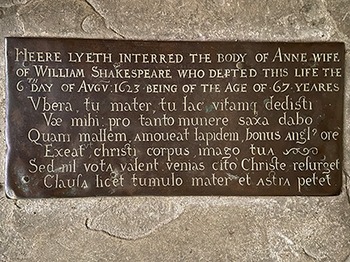
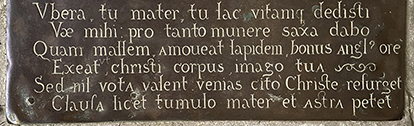
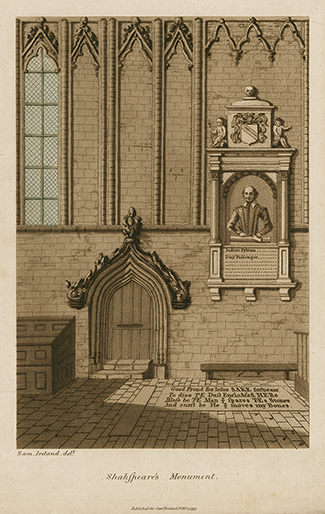
Anne’s is the only Shakespeare family grave commemorated with a memorial brass.Footnote 32 It features an English section of basic biographical information, and a Latin section of original poetry eulogizing her as a beloved mother and ‘so great a gift’ (Figure 1). In translation, the Latin part reads:
As a memorial designed to carry ‘the story of someone’s past far into the future’, the ‘story’ of Anne immortalized on her epitaph has been suppressed and even, in some cases, erased from history.Footnote 34 Throughout the seventeenth and eighteenth centuries, Holy Trinity was the top destination for tourists in Stratford, but no visitor other than William Dugdale (discussed in more detail later in this Element) remarked on Anne’s grave.Footnote 35 John Dowdall, in a letter to a Mr. Southwell dated 10 April 1693, remarks on Shakespeare’s monument and transcribes its inscription as well as the curse on Shakespeare’s grave, but does not mention Anne’s epitaph.Footnote 36 Likewise, William Hall in 1694 copied Shakespeare’s epitaph and commented on his monument in a letter to his friend Edward Thwaites, likely standing on Anne’s grave in order to see it from the best angle, since the altar rail was behind the Shakespeare family graves at the time.Footnote 37 Hall makes no mention of Anne’s brass epitaph which was also there. When actor Thomas Betterton visited Holy Trinity Church to look at parish documents for Nicholas Rowe’s 1709 biography, he would have seen Anne’s epitaph, but Rowe’s biography does not include any information that Betterton could have gleaned from Anne’s grave. Within a hundred years of her death, the details of Anne’s life recorded on her epitaph had already receded from view, even though the record of her as a beloved mother remained in its original place.
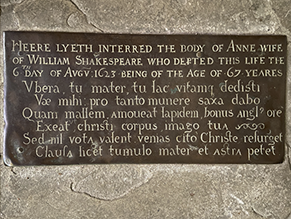
Anne Shakespeare’s epitaph, Holy Trinity Church, Stratford-upon-Avon (author’s own photo)
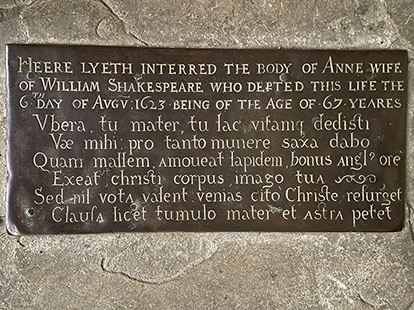
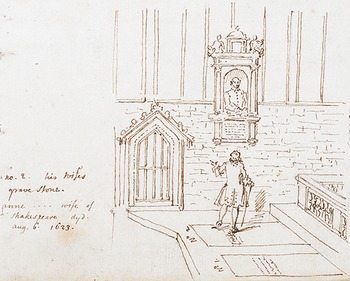
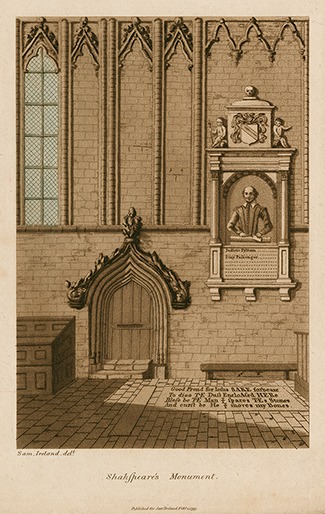
Early illustrators of Holy Trinity Church were similarly dismissive of Anne’s epitaph. The engraver George Vertue replaced Anne’s epitaph in his 1737 sketch of the Holy Trinity chancel with the single word ‘wife’ (Figure 2) and depicted a figure standing on Anne’s grave to get a better view of Shakespeare’s monument. By 1795, Samuel Ireland erased Anne’s grave entirely in his drawing of ‘Shakspeare’s Monument’, supplanting it with an enlarged rotated version of Shakespeare’s grave (Figure 3).
George Vertue’s sketch of the Shakespeare monument, 1737.
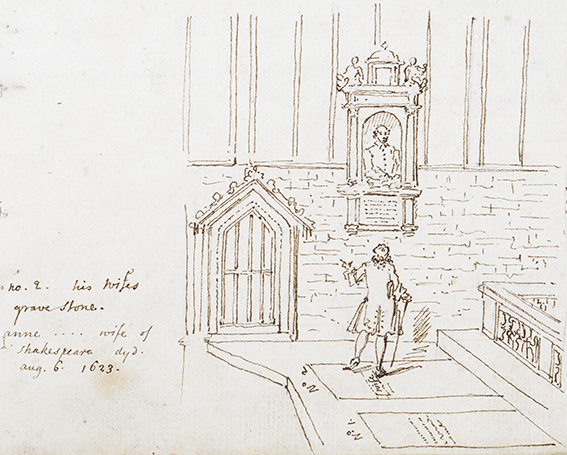
‘Shakspeare’s Monument’, from Samuel Ireland, Picturesque Views on the Upper, or Warwickshire Avon, 1795.
These early omissions and erasures of Anne’s epitaph parallel the ways she has frequently been imagined in her afterlife, by both biographers and other writers seeking to create a particular ‘Shakespeare’ by manipulating the few surviving details of Anne’s life, as if her only purpose was to shed light on her famous husband. Most of these ill-founded narratives emerge from neglect of her epitaph, from misreadings of the ‘second best bed’ bequest in Shakespeare’s will, from the age difference between the Shakespeares, and from a desire to create an urban-based libertine Shakespeare rather than a happily married domestic father of three children from Warwickshire. One of the earliest commentators on Anne’s epitaph, editor Edmond Malone, recorded the English text on the plaque (published posthumously in 1821), and then declared, ‘after this inscription follow six Latin verses not worth preserving’.Footnote 38 Malone’s Shakespeare-centric bias has contributed to long-standing neglect of a fundamental piece of evidence about Anne. By expunging a key passage of Anne’s epitaph, Malone’s denigration marks a persistent history of misogynist accounts of her life. Biographers and writers, driven by desire for a particular version of ‘Shakespeare’, have often ignored or obscured Anne’s daughters’ poetic immortalization of her.
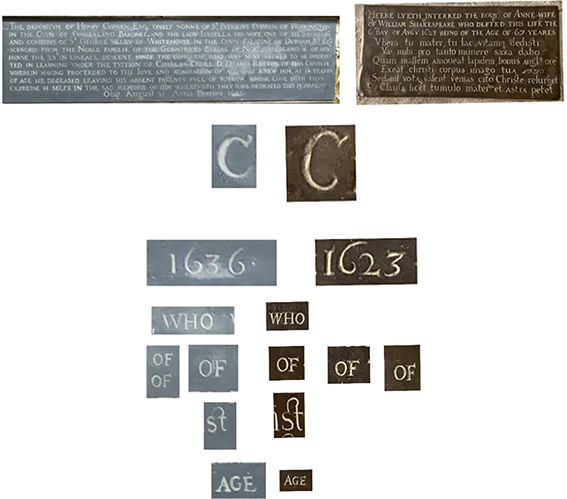
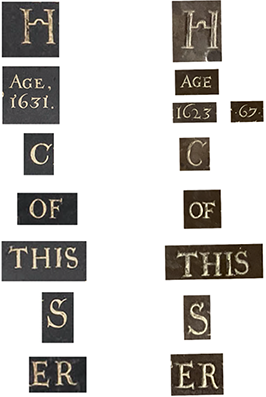
In Anne Shakespeare’s Epitaph, I propose new readings both of the content of Anne Shakespeare’s epitaph and of the material conditions that produced it – how it was made, why it was created, and by whom – in order to give this key piece of evidence new prominence in Anne’s story. I begin by showing that Anne Shakespeare’s death was not given short shrift with a pro forma boilerplate marker from a local hack engraver, for a woman who was best forgotten. On the contrary, her family (namely her daughters Susanna and Judith) honoured her as ‘so great a gift’ by paying for a burial on the chancel steps, the ‘liturgical heart’ of Holy Trinity Church;Footnote 39 composing original Latin poetry; and, as I suggest later, commissioning one of the most prominent London engravers to memorialize her in the more permanent form of brass. These were acts of remembrance that went well beyond the basics of minimal commemorative practices. I offer new evidence about the identity of the engraver of Anne’s epitaph, linking her in new ways to the literary world of London, and I suggest several possible scenarios for how the Shakespeare family came to memorialize this beloved wife, mother, grandmother, and woman. Anne Shakespeare’s Epitaph thus reinscribes the importance that this memorial held when it was commissioned, created, and put into place in what Peter Sherlock calls a ‘living site of memory’.Footnote 40 In doing so, this study suggests a much richer potential life for Anne by reclaiming the epitaph as an important ‘Shakespearean text’ from the Shakespeare family women, largely hidden in plain sight for nearly 400 years.Footnote 41
This Element isn’t merely about a forgotten brass plaque in a Warwickshire parish church. It is also a story about how Anne Shakespeare, wife to one of history’s most famous men, was enduringly memorialized not as a wife but instead as a mother by her own daughters, Susanna Shakespeare Hall and Judith Shakespeare Quiney, who were both mothers at the time. This Element explores the legacy of that maternal memorial through generations of dismissal and suppression. In what we would recognize as a feminist statement, Susanna and Judith boldly asserted the significance of motherhood on a par with their iconic father’s literary legacy.
1 In the Shadow of the Bard: The Dating and Location of Anne Shakespeare’s Epitaph
Both the date and the location of Anne’s epitaph can offer clues about her life. As I will argue, the epitaph was created within roughly a decade of her death and installed in a space that would have been notable in her community. Anne Shakespeare died at age sixty-seven on 6 August 1623, was named in the parish register of Stratford-upon-Avon as ‘Mrs. Shakspeare’, and was buried on 8 August in a well-chosen and significant location.Footnote 42 Her grave is positioned in the shadow of Shakespeare’s funerary monument (on the north wall of the chancel) and next to his grave, on his left side. When Anne died, Shakespeare’s grave and his wall monument would have already been in place; Leonard Digges refers to ‘thy Stratford moniment’ in his dedication to the 1623 First Folio.Footnote 43 Because Anne’s grave is placed between Shakespeare’s grave and his monument, it is likely that the space to Shakespeare’s left (as was tradition) was reserved for Anne before Shakespeare was buried; otherwise, it would have made more sense for his grave to be next to his monument rather than separated by the burial space for Anne.Footnote 44 The graves of Anne and William Shakespeare are shallower than the other three family graves on the chancel steps, which also suggests that they may have been planned together as a unit.Footnote 45
Anne was the first family member to be interred after Shakespeare, and the location of her grave established the chancel steps as a family burial plot rather than simply the site of Shakespeare’s grave (Figure 4). As Erica Carrick Utsi and Kevin Colls point out, ‘[T]he fact that the Shakespeare graves exist in an unbroken line is not merely a reflection of William Shakespeare’s investment in Chancel privileges in 1605 but also implies immense and enduring respect for him and for his family’.Footnote 46 The most desirable place for burial in a church was near the altar, and the chancel would have been the most expensive burial space.Footnote 47 Recent archaeological research has discovered that the Shakespeare graves are a series of simple shallow graves rather than a family vault, with the graves of Anne and William the most shallow. Their burials are in shrouds rather than coffins, which may either be due to economics (coffined burials were more expensive) or to conserve space on the chancel steps for future family burials, since coffined burials took up more space.Footnote 48
The Shakespeare Family Graves (Anne Shakespeare, William Shakespeare, Thomas Nash, John Hall, Susanna Shakespeare Hall), Holy Trinity Church, Stratford-upon-Avon (author’s own photo)
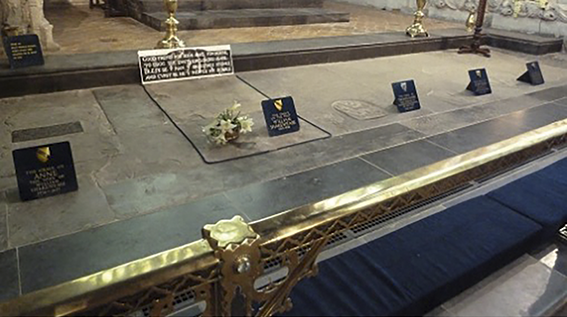
The chancel has often been thought of as a burial space which tithe holders like Shakespeare would have merited, but Robert Bearman points out that ‘burial in the chancel can hardly be regarded as an honour or a right attached to an interest in the tithes but simply evidence of a willingness to pay the necessary fees’.Footnote 49 The reason Anne Shakespeare had a chancel burial in the ‘most prestigious’ part of the church is because her family was willing to pay a higher fee for a significant burial place.Footnote 50
Following Anne’s burial, the subsequent chancel burials for the Shakespeare family were Susanna Shakespeare Hall’s husband John Hall (d.1635); Thomas Nash (d.1647), the first husband of Susanna and John Hall’s daughter Elizabeth; and Susanna Shakespeare Hall (d.1649), though the ordering of the Shakespeare family graves on the chancel steps does not correspond to the chronological order of burial.Footnote 51 The absence of Judith Shakespeare Quiney from the chancel burial space has been the subject of much speculation, but Orlin persuasively argues that Judith ‘may have been the keeper of the family flame’ and that by 1662 no family members were left to memorialize her, over a dozen years after the death of her older sister.Footnote 52
No will for Anne Shakespeare is known to have survived, but if Anne made a will, it may have clarified whether her chancel burial was planned by Shakespeare, was a result of her own request, or was initiated by her surviving family members.Footnote 53 One account, from 1693, seventy years after Anne’s death, and told by a clerk ‘above 80 years old’, relates that Shakespeare’s ‘wife and daughters did earnestly desire to be laid in the same grave with him’.Footnote 54 Could this ‘desire’ have been expressed in a will or other written document that no longer survives? However the Shakespeare family graves came about, their placement at the chancel would have been ‘a striking reminder of power, continuity, and cohesion’, a point that would have been reinforced as subsequent family members were buried alongside William and Anne Shakespeare.Footnote 55
A prominent chancel burial like Anne Shakespeare’s was desirable not only because of its proximity to sacred space, but also because it would be noticed by the clergy.Footnote 56 An epitaph from St Edmund’s Church, Kingsbridge, Devon, for Robert Phillips (d. 1793), placed near the chancel door, underscores the distance of his grave to the altar:
The location of a burial within the church demonstrated social status, and a premium location within the chancel testified to the importance of the deceased.Footnote 57 In Holy Trinity Church specifically, Robert Bearman explains that the ‘desire for visual commemoration within the parish church had been taken up by affluent members of a rising middle class’, such as the Shakespeare family.Footnote 58
Not only would a prominent grave position secure perpetual visibility, the disruption involved in making the grave itself would also serve as a public announcement of a notable death. Most indoor burials consisted of shallow graves with slabs flush to the floor, like William and Anne Shakespeare’s, but indoor burials were nevertheless messy and the ‘constant upheaval of floors’ would have created a floor that ‘would have progressively degenerated into a patchwork of materials, forever sinking and uneven’.Footnote 59 Examples survive of complaints about unfinished or open graves in churches, including one in 1629 at All’s Saints in King’s Lynn, ‘for breaking the pavement in the church for graves and not covering it again’.Footnote 60 The usual process for affixing a brass like Anne’s would have been to cut an indent in the stone slab to the exact size of the brass plate so that the plate would be level with the floor, and then attach the plate to the slab with a system of riveting which involved running molten lead underneath the brass plate to secure the rivets (visible in Figure 1). It is a process that would have been loud and disruptive, and best accomplished outside of the church.Footnote 61 In most cases, fixing a brass to a stone slab was carried out in the engraver’s workshop, and delivery was part of the contract, but the expense ‘restricted the practice to the wealthiest families’.Footnote 62 Stone slabs were sent ‘in great quantity’ to brass engravers in London (see Section 4).Footnote 63 These were likely the logistics involved in preparing Anne’s grave. Suffice it to say, the installation of Anne’s epitaph would have disrupted the community at Holy Trinity. Given the prominent position of her grave on the chancel steps, that part of the church would have been disturbed with the ‘presence of workmen’s tools and open tombs’, and the process and placement of her grave would have been apparent to her community.Footnote 64
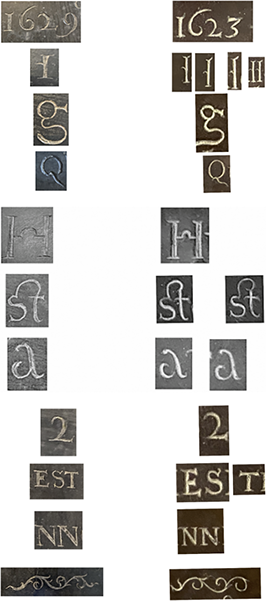
Anne was buried on 8 August 1623, and her brass epitaph was put into place at the latest by 1634, since it is recorded for the first time in a transcription of antiquarian William Dugdale’s manuscript notes for July of that year.Footnote 65 Within this time frame, numerous community members who personally knew Anne (as well as family members) would have been alive to witness her burial and the subsequent installation of her epitaph. Epitaphs were often installed for an anniversary of the death of the commemorated person, along with a customary family gathering, which would make August of 1633 a likely end point.Footnote 66 While memorials were usually added within two years of death, it was not uncommon for a longer period to elapse between the date of death and the commemoration. Other works by the same engraver as Anne’s epitaph (such as Katherine Gildredge, discussed in Section 4) had a gap of longer than a year between death and completion of a memorial. Furthermore, the end of the apprenticeship period for the engraver of Anne’s epitaph makes a date from the late 1620s through 1633 a likely time frame.Footnote 67 It is possible that the brass plaque replaced an incised slab, but there is no evidence to substantiate this, and it would not make sense for the family to pay for two forms of memorialization (both an incised slab and an engraved brass).
The Shakespeare family could have delayed installing Anne’s epitaph until several years after her death for a variety of reasons.Footnote 68 It may have taken longer to secure an engraver of the calibre necessary to honour Anne (see Section 4). Although families usually maintained relationships with engravers, Nicholas Johnson, the sculptor of Shakespeare’s monument, had retired by 1621 and died in 1624. No records survive to indicate who paid for Anne’s brass plaque, but the financial difficulties of her daughter Susanna Hall and her husband John may have contributed to the delay. According to Orlin, as executors of Shakespeare’s will, the Halls had to pay out ‘the enormous amount of nearly £229 – well more than double what Shakespeare’s properties brought in each year – within the space of twelve months’. The Halls had to sell Shakespeare’s tithe rights, and Susanna’s financial troubles continued even after the death of her husband.Footnote 69
Another reason for the possible delay is that the chancel area of Holy Trinity Church was in a state of disrepair around the time of Anne’s death in 1623. In 1618, the churchwardens complained that ‘our chancel is ruinous and out of repayre’, and the Vestry Minute-Book includes regular comments about money needed for church repairs.Footnote 70 The Shakespeare family may have wanted to wait until the chancel had been repaired, even if that took much longer than they may have anticipated. The chancel area was closed off from the rest of the church from 1618 until 1641, and the rood screen was placed across the chancel entrance until 1835.Footnote 71 As late as 1837, the chancel was described as having ‘a broken, noxious and wet floor, with foundation walls gradually mouldering with the green damp from neglected drainage – timbers mildewing and rotting – limewashed walls – a flat plastered ceiling; and the whole presenting a scene of tasteless patchwork and miserable economy’.Footnote 72 Parish clerk Thomas Kite reports that, after the 1844 restoration, the Shakespeare graves were ‘carefully covered with boards and a trap door constructed immediately over the Grave of Shakespeare which could be easily raised for visitors to see the Stone and read the Inscription’.Footnote 73 This of course would have made Anne’s grave completely inaccessible in the later nineteenth century, so any visitors to the church would likely be unaware of the chancel graves other than Shakespeare’s.
In addition to the disrepair of the chancel area of the church, the decade following Anne’s death was a period of high tension in the town between zealous Puritan Thomas Wilson, who became vicar of Holy Trinity in May of 1619, and the more moderate Stratford Town Corporation. Wilson’s 1619 arrival was heralded by a group of rioters outside the church, chanting that if they could ‘catch the said Thomas Wilson, they would flay him and dispatch him of his life’, as well as ‘cut off his pocky and burnt member’, and ‘pull, drag, and haul him out of the church’.Footnote 74 Wilson’s supporters locked him in the chancel for protection. His stipend was increased from £20 to £40 and then to £60 starting in 1623, and the churchwardens levied the parish large sums from 1619 until 1628, between £20 and £50 per year, for the repair of the church.Footnote 75 The Shakespeare family may have wanted to wait for a calmer time to commemorate Anne, and Ann Hughes notes that ‘a more settled Stratford was emerging by the later 1620s’.Footnote 76 This may have been misguided, though, because in July of 1629 Wilson stopped preaching a weekday sermon and his stipend was reduced from £60 to £40. In the 1630s, Wilson was ‘the main instigator of trouble’, one who ‘adopted a highly controversial ministerial stance’, using the church as his ‘personal stage’ to denounce ‘prominent and respected corporation figures’ in his sermons.Footnote 77
It is unclear what role Anne’s son-in-law John Hall played in the creation of her epitaph, but his close relationship with vicar Thomas Wilson could have helped or hindered its progress, depending on Wilson’s level of support.Footnote 78 Hall was a staunch supporter of Wilson throughout the period that Anne’s memorial was created and put into place. In 1629, John Hall commissioned a carved pulpit for the church, and in 1633 he supported Wilson’s case for an increase in salary.Footnote 79 In April of 1633 Hall was involved in a dispute about a pew Wilson had granted to John and Susanna Hall, and Thomas and Elizabeth Nash, ‘for a kneeling place for hearinge divine service and Sermons’.Footnote 80 The placement of pews ‘reflected the social hierarchy within the parish’, and Hall went so far as to seek confirmation of his family pew from the Bishop of Worcester, John Thornborough, which he was awarded in 1635.Footnote 81 Hall joined the Corporation in 1632, perhaps to serve as an ally for Wilson, but this lasted barely over a year; he was expelled on 9 October 1633 ‘for wilful breach of orders, sundry other misdemeanours and continual disturbances’.Footnote 82 In June of 1635 Hall claimed he had paid for a new pulpit and that he and Thomas Nash contributed to repairs of the church.Footnote 83 Perhaps these repairs were related to an upcoming commemoration of Anne Shakespeare.
It is clear then that when William Dugdale visited Holy Trinity Church on 9 July 1634 (according to his manuscript notes) and transcribed the text on Anne’s plaque, things were not exactly in order. By June of 1635, Wilson was suspended for a variety of offenses, including
refusing to visit the sick, for walking in the Church during prayers, for holding Conventicles, for particularising some of his parishioners in his sermons, for profaning the chapel ‘by sufferinge his children to playe at Bale and other sportes therein and his servauntes to hange clothes to drye in it, and his pigges and poultrie to lye and feed in it’ and for sitting on the pulpit stairs to prevent his assistant, Mr. Trapp, from preaching a funeral sermon by request, the said Thomas Wilson being suspended for three months.Footnote 84
Still, Thomas Wilson and John Hall remained supportive of each other; when Hall died in November 1635, he was described in the burial register as ‘medicus peritissimus (a most skilled doctor)’, likely a ‘testimony to his local reputation’ and to his ‘close relationship’ with Wilson.Footnote 85 At some point during Wilson’s tenure, Anne Shakespeare’s epitaph was installed, and given Anne’s son-in-law John Hall’s relationship to Wilson, the vicar likely was supportive of this commemoration. According to Charlotte Carmichael Stopes, Wilson probably officiated at Anne’s funeral which would have included a sermon with a eulogy in her honour.Footnote 86 Among the many documents related to Anne Shakespeare that no longer survive, the absence of the text of the funeral eulogy that Wilson likely preached in honour of Anne, is particularly lamentable, as it would have offered additional insight into her character and reputation within her community. Similarly, since Anne’s epitaph was likely in place within a decade of her death, the lack of surviving responses from local friends and neighbours who knew Anne personally is equally regrettable.
2 Materializing Memory: The Production of Anne Shakespeare’s Epitaph
The material conditions involved in commemorating Anne Shakespeare tell the story of a woman whose survivors sought to memorialize her in the most permanent and meaningful way possible. As well as paying for a chancel burial, Anne’s family devoted significant effort to preserving her legacy by creating an original Latin text for her epitaph and having it engraved on a commemorative brass plaque. The Halls had moved back into New Place after Shakespeare’s death, which suggests a close-knit family who would have mourned Anne’s death along with many others who knew her personally.
Around the time of Anne’s death, early modern England experienced what Scott L. Newstok has called ‘epitaphic saturation’ and a ‘preoccupation with this form of memorialization’. As the ‘oldest of all genres’, the epitaph was both a respected poetic form and a ‘shorthand summatio[n]’ of a life.Footnote 87 The seventeenth-century vogue for composing and collecting epitaphs is apparent from many popular printed histories, from William Camden’s Remains (1605) to John Stow’s A Survey of London (1598–1633) to John Weever’s Ancient Funeral Monuments (1631).Footnote 88
Epitaphs may have had particular significance to the Shakespeare family. Tradition has it that Shakespeare wrote his own epitaph, with its famous curse to prevent his remains from being moved to the nearby charnel house that occupied the north side of Holy Trinity Church until 1800.Footnote 89 Other epitaphs have been attributed to Shakespeare, most famously that of his friend John Combe, which Shakespeare was reported to have ‘wright this att his request while hee was yett living’.Footnote 90 Shakespeare himself mentions epitaphs more frequently in his plays and poems than any other contemporary playwright.Footnote 91 The word ‘epitaph’ appears in his work seventeen times, often as evidence of sincere emotion, including Leonato’s directive to Claudio to ‘Hang her an epitaph upon her tomb’, Friar Francis’s description of ‘mournful epitaphs’ hung ‘on your family’s old monument’ (Much Ado 5.1 and 4.1), and Antonio’s wish that Bassanio could ‘live still and write mine epitaph’ (Merchant of Venice 4.1). Epitaphs are also linked to memorialization for posterity, as Prince Hal refers to Hotspur being ‘remember’d in thy epitaph’ (1 Henry IV 5.4), Belarius warns of the danger of ‘a slanderous epitaph’ (Cymbeline 3.3), Hamlet notes the damage of a ‘bad epitaph’ (2.2), and Richard II declares, ‘Let’s talk of graves, of worms, and epitaphs’ (3.2). Sonnet 81 even has an eerie resonance with Anne’s epitaph, in its opening lines of one lover outlasting the other: ‘Or I shall live your epitaph to make,/Or you survive when I in earth am rotten.’ The speaker offers, ‘your monument shall be my gentle verse’ which shall outlast ‘when all the breathers of this world are dead’.Footnote 92 When the Shakespeare family decided how best to memorialize Anne, the connotations of the epitaph as a sincere expression of emotion and a way to create an enduring legacy would have come to mind, as would the use of verse to immortalize a subject. However, as William N. West points out, even though there is a long history of the ‘surprising durability of verse’ dating back to ancient Greece, ‘to name a poem as an enduring inscription does not make it so’, and the choice of brass was as crucial to the survival of Anne’s epitaph as was the verse itself.Footnote 93
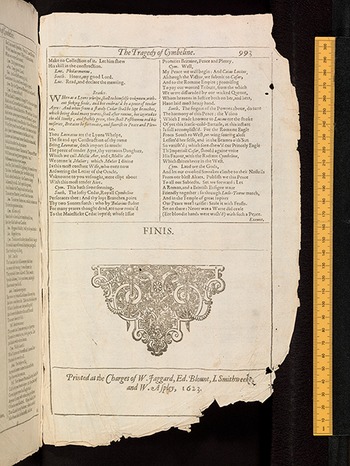
The selection of brass, as opposed to stone, as the material substrate for Anne’s epitaph might have held particular significance for the Shakespeare family. Ben Jonson’s verses ‘To the Reader’ in the 1623 First Folio, which appear on the page facing the Droeshout engraving of Shakespeare (Figure 5), were likely composed around the same time as Anne’s death. There, Jonson refers to being ‘writ in brasse’ as the second-best way to immortalize his fellow poet, after the plays printed in the book. Shakespeare himself, in Sonnet 107, similarly posits poetry as the only ‘monument’ that endures longer than the strong material of ‘tyrants’ crests and tombs of brass’.
Opening spread of Shakespeare’s First Folio.
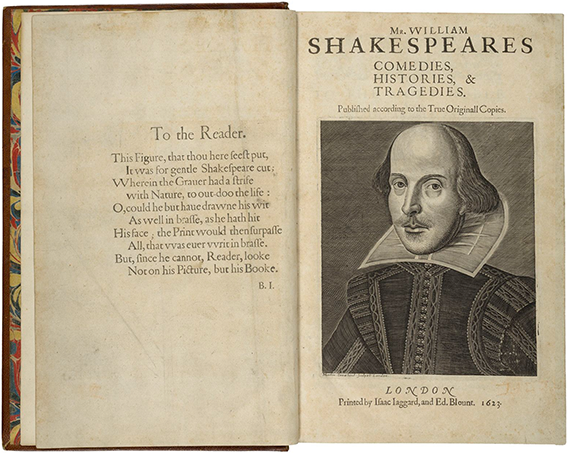
Shakespeare uses brass multiple times in his plays and poems to signify a lasting tribute, one that could outlast stone.Footnote 94 Henry V employs the image of graves with ‘witness’ that will ‘live in brass’ (4.3) as an inspirational legacy. Griffith in Henry VIII refers to ‘Men’s evil manners’ which ‘live in brass’ (4.2), and Duke Vincentio in Measure for Measure describes ‘characters of brass’ which offer ‘A forted residence ’gainst the tooth of time/And razure of oblivion’ (5.1). Richard II describes brass as ‘impregnable’ (3.2.), and Sonnet 64 refers to ‘brass’ as an ‘eternal slave to mortal rage’, a defence against decay and ruin. Titus Andronicus, when he commits to his course of revenge, calls for ‘a leaf of brass’ where ‘with a gad of steel will [he] write these words’ in order to preserve his legacy (4.1). The longevity of a poem ‘writ in brasse’ would not have escaped any reader of Shakespeare’s works, including his family members.
In this context, the choice of brass instead of stone may signal the desire of the Shakespeare family to create a permanent monument to their matriarch, as both a testimony to her life and an inspiration for the future, a ‘posthumous influence over the living’.Footnote 95 The main reason that Anne’s epitaph has survived in relatively unspoiled condition is the fact that her family chose to commemorate her in the more durable form of brass as opposed to an incised slab, the more common form in the Midlands.Footnote 96 The graves of all the other Shakespeare family members buried at the chancel of Holy Trinity Church offer a case in point about the longevity of brass: their incised stone slabs had to be recut in 1844 because their lettering had become almost illegible.Footnote 97
The fact that Anne’s brass epitaph has survived intact further suggests that her grave was cared for by her survivors. Many of the brasses that survived the 1640s faced dereliction from ‘dishonesty, carelessness, and apathy of the proper guardians of them’, and some were even melted down to make church bells or chandeliers, or sold.Footnote 98 John Weever feared just such decay, and warned in his Ancient Funerall Monuments (1631) that inscriptions ‘are broken downe, and utterly almost ruinated, their brasen Inscriptions erazed, torne away, and pilfered, by which inhumane, deformidable act, the honourable memory of many vertuous and noble persons deceased, is extinguished’.Footnote 99
The use of brass as a commemorative material would have had additional significance for graves within Holy Trinity Church. Brasses were rare in Warwickshire; a total of just ninety-one brasses have been recorded, only thirty-seven of which date from 1600 to 1710.Footnote 100 Brasses were also rare at Holy Trinity at the time of Anne’s death. Records survive for only three: one for Agnes Paget (d.1489), mistress of the Guild of the Holy Cross for eleven years; one for Frances Smith (d.1625) in the north aisle; and one or more (now lost) affixed to the tomb of Dean Thomas Balsall, who served as dean of the college and vicar of the church from 1466 to 1491 and was responsible for building the chancel in the 1480s.Footnote 101 The top of Balsall’s tomb still contains the indentations for the missing brasses, which no longer survive.Footnote 102 Anne’s grave is next to Dean Balsall’s chest tomb (see Figure 6), and the fact that both were commemorated with brass within steps of each other would not have escaped notice by visitors to the church, and perhaps encouraged Anne’s family to take special care to preserve her brass, given that Balsall’s brass had likely disappeared by the time of Anne’s death.
Anne Shakespeare’s grave (bottom left) and the chest tomb of Dean Thomas Balsall (top left), Holy Trinity Church, Stratford-upon-Avon (author’s own photo)
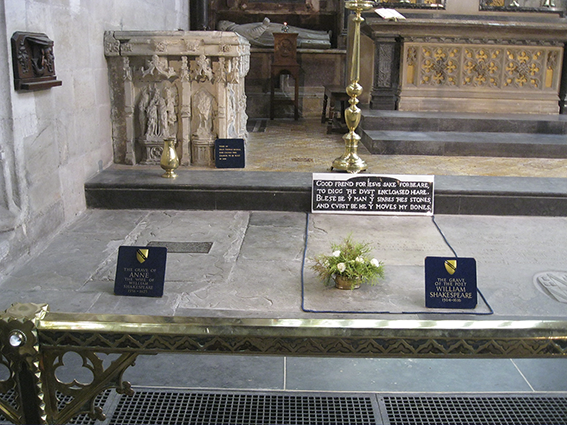
The exact cost of a memorial brass like Anne’s is difficult to ascertain. The account book for Nicholas Stone (1586–1647) contains an entry for the memorial to Cecilia Puckering (c.1636) in St. Mary’s Church, Warwickshire – a slab in the chancel floor with three brass plates of lesser quality than Anne’s – which cost well over £10, including procuring, squaring, and smoothing the grave stone; obtaining the brass; cutting the inscriptions into the brass; riveting the brass to the stone; and gilding the brass letters.Footnote 103 Although Anne’s grave would have been slightly cheaper with only one brass plate, £10 is still a significant cost, given that, in 1630, John Hall’s possessions were only valued at £40 a year.Footnote 104 Paying to commemorate Anne in this way was not an insignificant expense.
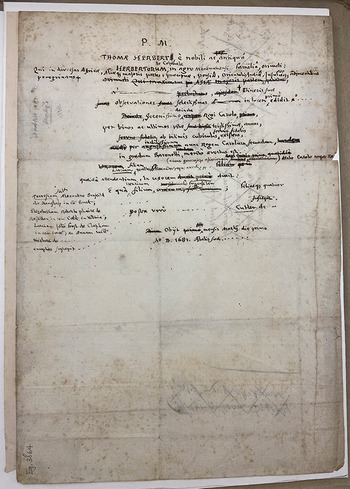
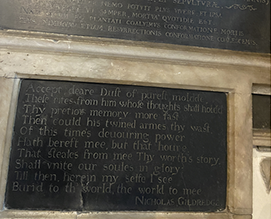
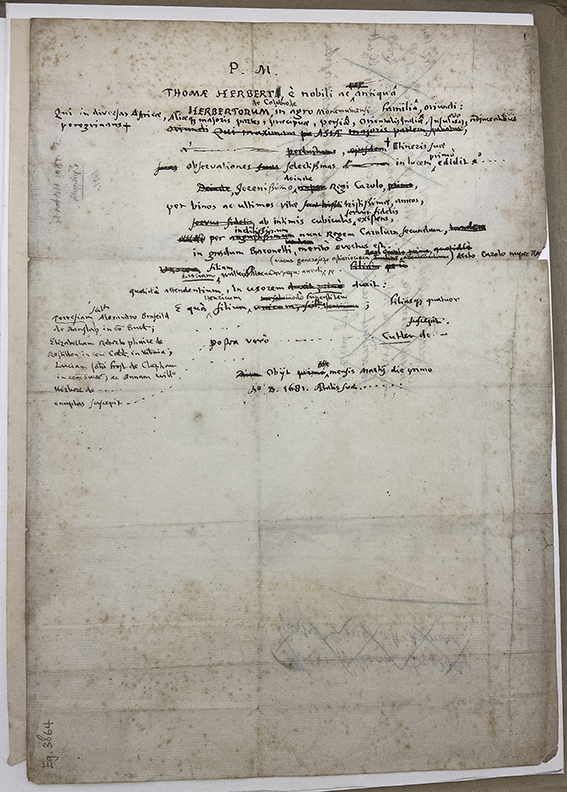
In addition to funding a chancel burial and a brass plate, Anne’s family also would have provided the text of the epitaph, including the original Latin poetry, to the engraver in advance, as discussed in the next section.Footnote 105 Although no records remain for any of the Shakespeare graves, surviving documentation for other contemporary memorials suggests the process that would have occurred for Anne’s commemoration.Footnote 106 The plan for a similar epitaph (Figure 7) for Thomas Herbert (d. 1681) survives in the British Library, where engraver Thomas Stanton was provided with the Latin text and layout for the epitaph, on a scale that resembles Anne Shakespeare’s. Among the many other missing documents related to Anne Shakespeare, one especially laments the loss of the written manuscript text of Anne’s epitaph with its potential traces of authorship.
Plan for epitaph of Thomas Herbert (d.1681), St. Crux, York, by Thomas Stanton, British Library Eg 3864 627H
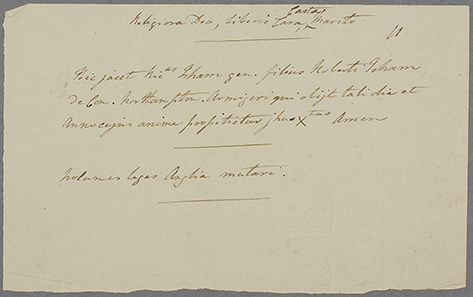
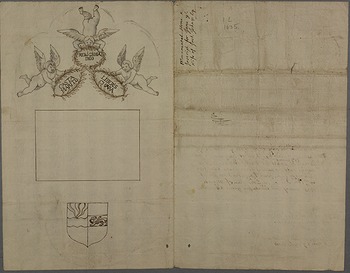
A second set of records from Thomas Stanton, for the engraved slab for Jane Isham (d.1639), offers further evidence of the lost documents that would have once existed to plan Anne Shakespeare’s epitaph. Figure 8 shows the Latin section along with the inscription ‘Religiosa Deo, Casta Marito, Liberis Chara’, [‘Pious to God, Virtuous to her Husband, Dear to her Children’]. Figure 9 contains the English portion, as well as the details about the engraver, ‘Thomas Stanton by St. Andrews Church in Holborn Ston[e] Cutter’ and the size of the slab, ‘Ston[e] is to be 6 foote 9 inches long 2 foote & 9 inches broad’. Figure 10 shows the overall layout. Similar documents would have been produced as part of the planning process for Anne’s epitaph, especially since the contents of the Latin portion of the epitaph were deeply personal and unique rather than deriving from a simple boilerplate text.
Plan for Jane Isham’s engraving by Thomas Stanton, All Saints, Lamport, Northants, MS Northants, County Record Office IL 1635, Northamptonshire Archives
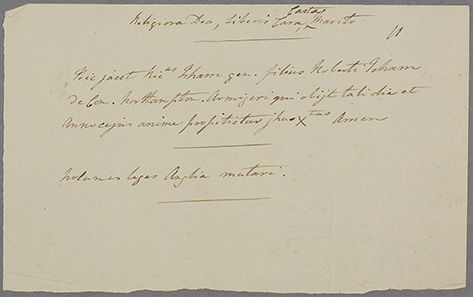
Plan for Jane Isham’s engraving by Thomas Stanton, All Saints, Lamport, Northants, MS Northants, County Record Office IL 1635, Northamptonshire Archives
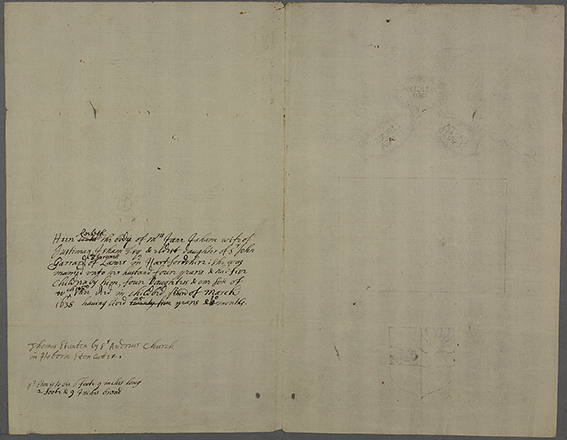
Plan for Jane Isham’s engraving by Thomas Stanton, All Saints, Lamport, Northants, MS Northants, County Record Office IL 1635, Northamptonshire Archives
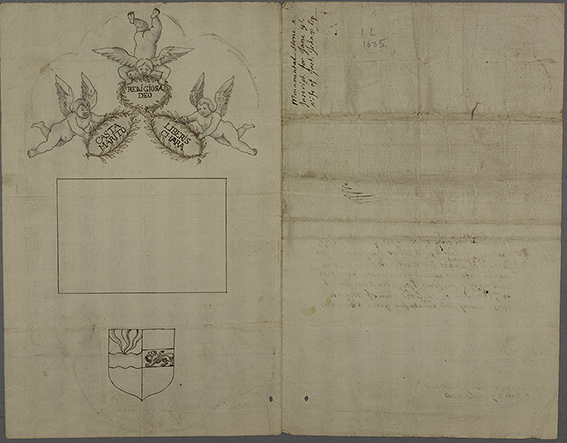
Even if lost archival documents resembling Figures 7–10 were to surface with details about who paid for Anne’s epitaph along with the written epitaph in an identifiable hand, such texts still would still not provide definitive proof about authorship of the inscription, particularly the original Latin verses. The content of Anne’s epitaph raises questions of authorship, and in the following section I will address both topics in tandem, laying out the likelihood of Anne’s daughters as the ‘authors’ and originators of her epitaph. If we entertain the possibility that Susanna and Judith wrote Anne’s epitaph it would be the only surviving ‘Shakespearean’ text written by women, and a significant testimony to her maternal role.Footnote 107
3 Memorializing the Maternal: Creating the Content of Anne Shakespeare’s Epitaph
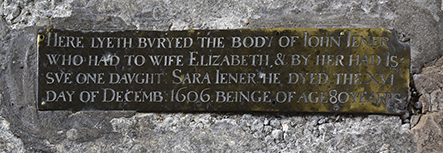
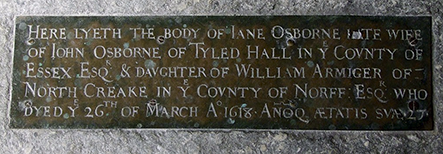
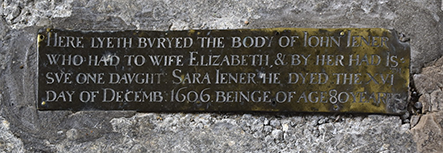
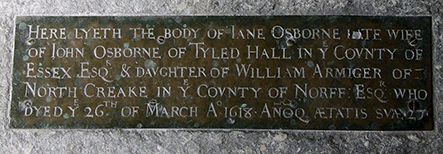
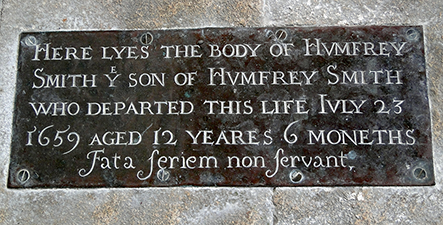
So far, I have argued that the material contexts surrounding the creation of Anne Shakespeare’s epitaph – a costly chancel burial and a commemorative brass plaque – point to a more expensive tribute than was necessary, but one that was fitting for her important role in her family and in her community. The content of her epitaph is equally significant and extends far beyond the basic text on an early modern grave, which would have been a slab incised with birth and death dates.Footnote 108 The top section of the epitaph (Figure 11, cropped for effect), written in English and inscribed in Roman capitals, positions Anne as the wife of William Shakespeare: ‘Heere lyeth interred the body of Anne wife of William Shakespeare, who dep[ar]ted this life the 6th day of Aug[ust] 1623, being of the age of 67 yeares.’Footnote 109 This is a standard formula, replicated on countless brass plaques of the period, such as the examples pictured in Figures 12–14.Footnote 110
Anne Shakespeare’s epitaph, Holy Trinity Church, Stratford-upon-Avon, cropped (author’s own photo)

Epitaph of John Jener, All Saints Church, Laxfield, Suffolk, https://creativecommons.org/licenses/by/2.0/
Epitaph of Jane Osborne, Saint Withburga Church, Holkham, Norfolk, image courtesy of John Vigar
Epitaph of Humfrey Smith, Church of St. Peter, Farmington, Gloucestershire, image courtesy of Rex Harris
‘Here lyeth’, the most common opening phrasing for an epitaph, has several layers of meaning.Footnote 111 ‘Here’ refers to the physical location of Anne’s body, underneath the brass plaque. This was not the case for every burial, but recent archaeological work has verified that Anne’s grave is actually underneath the stone with her brass plaque.Footnote 112 ‘Here’ also calls attention to the important location of her burial, nestled between Shakespeare’s monument on the north wall, his grave, and chancel founder Dean Thomas Balsall’s tomb.Footnote 113 ‘Here’ also highlights the location of the chancel steps, emphasizing the importance of a premiere burial space for Anne. The identification of Anne as ‘wife of William Shakespeare’ (the only place in the epitaph where Shakespeare is mentioned) establishes her family lineage and her relationship as his wife, in contrast to the sparse inscription on his grave, featuring only a curse but no name or other personal details.
The key bottom section (Figure 15, cropped for effect), in upper and lower script lettering in Latin – dismissed by Stephen Greenblatt as a ‘strange inscription’ and by Edmond Malone as ‘not worth preserving’ – is the most reliable and significant evidence that survives about Anne, well beyond the minimal section in English (Figure 11). The fact that this custom verse was composed and included on the plaque in the first place opens up new narratives about her role in the family.
Anne Shakespeare’s epitaph, Holy Trinity Church, Stratford-upon-Avon, cropped (author’s own photo)
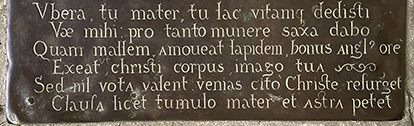
In line with contemporary practice, the Shakespeare family would have provided this text to the engraver when the commission for the brass plaque was set up, as noted in Section 2 and shown in Figures 7–10.
I suggest that the contents of the epitaph were deliberately designed to commemorate Anne as a mother, virtuous woman, and important member of her community.Footnote 114 It has sometimes been argued that since the Latin section of Anne’s epitaph is written in a singular voice, it can only represent one of her daughters (Susanna), but the use of first person would have been standard for a commemorative poem of this type and does not necessarily imply a singular authorship.Footnote 115 Thus, while Judith has rarely been credited with authorship, there seems no reason to omit her based on the use of first person.
Although Anne’s epitaph is addressed from a child to a mother, it has most often been attributed to a man on Susanna and Judith’s behalf, largely due to the need to be able to compose original Latin poetry. Susanna’s husband John Hall has been the most common candidate. He was formally educated at Cambridge (BA and MA) and kept his medical records in Latin, and his own epitaph is also in Latin.Footnote 116 Another suggested author is Thomas Greene, who along with his wife Lettice lodged with the Shakespeares for at least eight years; Greene has been called ‘the ablest man in town’ next to Shakespeare and John Hall; and was also ‘something of a poet who wrote Latin verses in his diary’.Footnote 117 Vicar Thomas Wilson had both the education and motivation to compose an epitaph for the mother of one of his most ardent supporters; he was said to be ‘a very good Scholar, and was the son of a very grave conformable doctor of divinity’.Footnote 118 While it is certainly possible that one of these men translated Susanna and Judith’s sentiments into Latin, several factors contribute to a strong case for the Shakespeare women as the authors.
First, the epitaph’s striking originality implies that it was created specifically for Anne. Even after reading hundreds of epitaphs, I have yet to encounter one that resembles Anne’s, and a search on EEBO-TCP for key phrases revealed no similar texts.Footnote 119 The epitaph derives from no traceable source nor is it a series of strung-together recognizable classical tags that one might expect from a commissioned local poet. Furthermore, the poem omits the conventional praises of female virtue and faith. In Victoria Moul’s estimation, Anne’s epitaph ‘has certainly been written for her, either by or in consultation with her daughters’.Footnote 120
The original content of Anne’s epitaph is an especially crucial and reliable piece of evidence about her life because the conventions of epitaphic writing involved a degree of expected truth. Richard Brathwaite described epitaphs in 1619 as a way to ‘manifest the sincerity of our loves, in erecting monuments over the dead, which might preserve their memory, and confirm our affections in their deaths’.Footnote 121 As John Bowden put it in his later work The Epitaph-Writer (1791), the ‘chief Design of an Epitaph is to record and commend the Virtues of the Person on whose Tombstone it is written, and to excite the Reader to imitate them’.Footnote 122 As a literary form labelled as ‘the upholder of sincerity’, an epitaph can often offer an especially accurate portrayal of the person commemorated.Footnote 123 The uniqueness of Anne’s epitaph combined with the generic expectations of sincerity suggest that her daughters composed original poetry as a testament to their personal expressions of bereavement at her death, and that the epitaph is an exceptional expression of Anne’s specific place in her family. In fact, the sentiments in the epitaph correspond to what G.W. Pigman describes as the second stage of mourning, a yearning that ‘can last for months, sometimes years’, where the ‘bereaved behaves as if the dead could be recovered’ and ‘the bereaved intensely longs for and is preoccupied with the dead’.Footnote 124 Written from a child to a mother, Anne’s epitaph is a profoundly personal tribute to her and a testimony of her daughters’ grief. As Peter Ross puts it, the ‘formality and finality’ of commemorative conventions take ‘all the mess of grief and loss and reduc[e] it to something that can be said with hammer and chisel’.Footnote 125 By looking at the contents of Anne’s epitaph, we may be able to recover some details about her life that her daughters wanted to memorialize in this succinct format.
One obvious question is whether Susanna and Judith could have had the education possible to compose the original Latin verse. The Latin in Anne’s epitaph is grammatically correct but syntactically awkward. The meter used, elegiac couplets, was the first type of verse taught to boys, and would not require extensive training to master. The lack of grammatical errors implies someone with reasonable experience of reading and writing Latin, but who may not read or write Latin verse on a regular basis. Based on these characteristics, the epitaph author(s) likely would have had at least a few years of grammar school or its home equivalent and that the quality of the Latin could be compatible with female authorship.Footnote 126
No direct evidence survives of Susanna or Judith learning Latin or demonstrating their knowledge of Latin, but there are plenty of examples of early modern women attaining Latin literacy through education in the household, which was ‘an important place of learning, teaching, reading, and copying’, for both English and Latin texts.Footnote 127 Danielle Clarke concurs that most early modern women who were literate would have learned to read at home rather than in school. In the domestic space, women, most famously Queen Elizabeth I, even translated texts.Footnote 128 Surviving evidence from a 1598 deposition does indicate that there were opportunities for female education in Stratford as early as 1575, and it is tempting to think that the Shakespeare women – Anne and her two daughters – may have attended the school.Footnote 129 According to one account, the number of women with a reading knowledge of Latin has been underestimated, based on the number of surviving Latin exercises by girls and Latin poems addressed to women.Footnote 130
The Shakespeare women share many of the factors that Holt N. Parker has identified as increasing the likelihood of female Latinity, including being Protestant; and having a brother, a humanist father, or parents who ‘believed in the moral value of humanitas’.Footnote 131 It is not unrealistic to imagine that Shakespeare’s own daughters had extensive command of written language, perhaps extending to their ability to write an epitaph in Latin, along the lines of some of the women in Shakespeare’s works who display various types of literacy.Footnote 132 Lady Macbeth is first depicted reading a letter from Macbeth, and while sleepwalking she will ‘unlock her closet, take forth paper, fold it, write upon’t, yet all this while in a most fast sleep’ (5.1.3–7). Maria in Twelfth Night is an accomplished linguist who can read and write (and even mimic the handwriting of another); and Viola remarks that she has ‘taken great pains to con’ a speech that ‘is excellently well penn’d’ (1.5.153–55). Beatrice composes sonnets ‘writ’ by her own hand in Much Ado About Nothing, and Bianca in The Taming of the Shrew can translate Latin. Shakespeare’s daughters may have learned Latin from him, since some women were able to read and write verse in Latin and English ‘simply because their fathers thought them educable’.Footnote 133 Hamnet Shakespeare offers another conduit for the possible education of Susanna and Judith, since girls were often educated alongside boys in a household.Footnote 134 The epitaph on Susanna’s grave, describing her as ‘witty above her sex’, offers support for her learning, as does her 1639 signature, described by Rosalyn Sklar as ‘clear and confident’.Footnote 135 A grave for Judith no longer survives to provide similar evidence, unfortunately.
Lost documentary evidence from New Place also has the potential to shed light on the literacy and literary activity of the Shakespeare women. In 1637, not long after Anne’s epitaph was put in place, Baldwin Brooks, later bailiff of Stratford, broke into New Place. He did ‘violently and forceablie to breake open the house in Stratford’ and ‘then and there breake open the Doores and studdy of the said howse, and Rashlye [did] seise uppon and take Divers bookes boxes Deskes moneyes bonds bills and other goods of greate value as well w[hich] were of the said John Halls’. Susanna Hall and Thomas Nash attested that they did not know what was taken, since ‘they had not then taken a full viewe survey or note of the personal estate of the said John Hall deceased’.Footnote 136 Even though the items are described as belonging to the ‘personal estate of the said John Hall’, the libraries of women were often ‘incorporated into their husbands’ holdings during their lifetimes’.Footnote 137 The missing books, bonds, and bills could have been part of what William H. Sherman calls a ‘matriarchive’, where women used household printed books to ‘store and circulate individual and collective records’, including ‘culinary, spiritual, familial, financial, intellectual, medical, and even meteorological information’.Footnote 138 These lost household papers may have contained the ‘traces and absences’ of texts attesting to the literacy of the Shakespeare women.Footnote 139
The lost materials from New Place, especially the household papers, may have also offered links between female literacy and the experience of motherhood – a significant feature of the content in Anne’s epitaph. Elizabeth Mazzola has argued that motherhood itself was a type of female literacy, involving ‘retaining and reproduction of written knowledge’ from mothers’ advice books and motherhood stories.Footnote 140 Dorothy Clegge, for example, annotated a copy of William Gouge’s Of Domestical Duties (1634) with her signature, a table of her family history, cross-references to Gouge’s other works, and a list of her books.Footnote 141 If the Shakespeare women engaged in this type of textual practice at New Place, it is possible that books could have been incorporated into John Hall’s library, confiscated in 1637, and to date, lost to history. The documents taken in this raid offer tantalizing possibilities.
The specific content of Anne’s epitaph, particularly the Latin poetry, offers even more persuasive connections to the Shakespeare women and to female authorship. The boldly striking opening words of the Latin section, ‘vbera’ (‘breast[s]’) and ‘mater’ (‘mother’), eulogize Anne as a breastfeeding mother who gave ‘milk and life’, a tribute that would have signalled both Anne’s achievements as a mother and her devoutness. The practice of breastfeeding was considered a ‘testimony of love’ and an example of the ‘admirable work of God’s providence’, according to William Gouge in his 1622 Of Domestical Duties, which was reprinted at least a dozen times in the seventeenth century. John Dod and Robert Cleaver in A Godly Form of Household Government (1598; 1621) describe a good mother as one who ‘nurse[d] her owne children’. Elizabeth Clinton in 1622 put it more bluntly: breastmilk comes from ‘direct providence of God’.Footnote 142 As Marylynn Salmon remarks, ‘a nursing mother represented selfless devotion to early modern men and women, for in feeding her child she gave, quite literally, of herself’.Footnote 143 Breastfeeding, Salmon notes, was ‘a symbol for divine love’ and ‘represented God’s gift of grace coming through his churches and ministers’.Footnote 144 Susanna and Judith’s decision to foreground Anne as a breastfeeding mother was a way to underline her piety as well as the spiritual care and guidance that she provided for her family.
Further, breastfeeding was thought to evoke a stronger mother–child bond than wet-nursing. Gouge attested that ‘together with the milk passeth some smacke of the affection and disposition of the mother: which maketh mothers to love such children best as they have given sucke onto; yea and oft times such children as have sucked their mothers breasts, love their mothers best’. Children who were wet-nursed, in contrast, would ‘love those nurses all the days of their life’, even though, as wet-nursing advocates pointed out, the mother’s fertility increased when she did not breastfeed.Footnote 145 Laura Gowing has argued that breastfeeding was ‘emblematic of virtuous maternity’ which was ‘the ultimate feminine role’.Footnote 146 The reference to Anne as a breastfeeding mother thus served as a shorthand to characterize her as a virtuous and dutiful mother and, in the words of one historian, ‘the epitome of the good mother’.Footnote 147 Both Susanna and Judith were mothers at the time of Anne’s death, and their elevation of motherhood in Latin poetry on the chancel steps of their parish church and in brass would surely have been personally significant.
Commemorating Anne as a breastfeeding mother was also a way to call attention to her maternal moral heritage, since it was believed that ‘a mother’s virtuous character is transmitted to her children through her breast milk.’Footnote 148 Numerous scholars have argued that breastfeeding, as a ‘spiritual vocation’ of ‘beloved duty and dutiful love’, was both ‘a sign of a mother’s selflessness and sacrifice’ and, in its empowerment of women, a ‘potential disruption of patriarchal order’.Footnote 149 Donna C. Woodford points out that due to the belief that a child received spiritual nourishment from nursing, the practice gave the nursing mother or wet-nurse ‘a tremendous power over the shaping of the child’.Footnote 150 It is hard to imagine a male author like John Hall or Thomas Wilson eulogizing Anne with the unique references to breastfeeding and maternal virtue, without the influence or direction of Susanna and Judith.
In addition to using breastfeeding as a way to exemplify Anne’s power as a mother, the epitaph also contains multiple Biblical resonances. The theme of giving recurs, with ‘gave’ twice in the first two lines (‘dedisti’ and ‘dabo’), and the description of Anne as ‘so great a gift’ (‘pro tanto munere’) echoes Ephesians 4:7 (‘But unto every one of us is given grace, according to the measure, of the gift of Christ’) and Romans 6:23 (‘For the wages of sin is death; but the gift of God is eternal life, through Jesus Christ our Lord’).Footnote 151 Lines 2–3 of the Latin section also recall verses from Matthew 7:9 (‘Or what man is there of you, whom if his son asks for bread, will he give him a stone?’), Matthew 28:2 (‘And behold, there was a great earthquake; for an angel of the Lord descended from heaven, and came and rolled away the stone, and sat upon it’), and Mark 16:3 (‘And they asked each other, “Who will roll the one away from the entrance of the tomb?”’). Even though the epitaph has no direct source, it contains several biblical echoes that align Anne’s personal qualities with a Christian tradition of charity, giving, and resurrection.
The last four lines of the Latin verse offer a more direct comparison between Anne and the central Christian image of resurrection, even comparing her ‘form’ (‘imago’, which could also be translated as ‘spirit’ or ‘likeness’) to the body of Christ (‘Christi corpus’).Footnote 152 The specific placement of Anne Shakespeare’s grave, between the grave and monument of her husband and the tomb of Dean Thomas Balsall (see Figure 6), provides another context for the resurrection image in the epitaph. In addition to the connection between Anne’s brass and the brasses that once existed on top of Balsall’s tomb, Balsall’s memorial was designed as an Easter Sepulchre and originally featured scenes from the Passion (damaged in the sixteenth century), including one of the Entombment and one of the Resurrection.Footnote 153 Balsall was also commemorated in a window inscription, ‘Thomas Balshall, Doctor of Divinity, reedifyed this quier and dyed anno 1491’, recorded by Dugdale in 1656, which the Shakespeare family certainly would have known.Footnote 154 Remains of medieval stained glass in Holy Trinity depicting the Resurrection and Ascension may also have resonated with the content of Anne’s epitaph.Footnote 155 Balsall’s tomb had been in place since his death in 1491 and would have been a central feature for any visitor to Holy Trinity Church, including the Shakespeare family. Along with the missing brass inlays on top of Balsall’s tomb that could have called to mind Anne’s brass epitaph, so too would the Resurrection imagery in Anne’s epitaph and the carving of the same scene mere feet away. Like the misericords in Holy Trinity (also from Balsall’s time) that have been suggested as an influence on Shakespeare’s work, so too would Balsall’s tomb iconography have affected how Anne Shakespeare was memorialized, with the Resurrection imagery in her epitaph connecting her to an important church figure.Footnote 156
It is also possible that Anne herself had a hand in how she was immortalized. Lady Jane Cornwallis Bacon (d.1659) planned her own monument with sculptor Thomas Stanton, and other contemporaries composed their own epitaphs or gave directions for the contents of a brass engraving.Footnote 157 Elizabeth Cooke Hoby Russell also wrote several funerary inscriptions for her male relatives, including neo-Latin elegies and epitaphs.Footnote 158 Within Holy Trinity, Joyce Clopton also had a hand in her own commemoration, and in the memorial to her waiting gentlewoman Amy Smith (d. 1626). Although no will or other personal papers directly connected to Anne Shakespeare survive, it is doubtful that she would have disagreed with this celebration of her achievements as a pious mother, in the liturgical heart of the church.Footnote 159
If Susanna and Judith were indeed responsible for the composition of Anne’s epitaph, then the choice of Latin would also have been theirs. The decision to eulogize Anne in Latin rather than in English raises many questions, especially since Latin would have restricted the ability of many to read the content. George Puttenham described the function of epitaphs in 1589 as designed ‘for the passerby to peruse and judge upon’, but this presumes that they can read the epitaph in the first place.Footnote 160 Although few readers in this period would have been able to read Latin, it would have been a way to further validate motherhood as worthy of commemoration on the chancel steps and to craft a more permanent memorial.Footnote 161 William N. West has observed that writing in Latin or Greek, as opposed to English, signalled a desire to evoke a more lasting work, and Margaret W. Ferguson points out that Latin had ‘considerable cultural capital’.Footnote 162 Latin ‘connoted learning’ and would only be decipherable to ‘literate observers’, which had been the case persistently until 2023 when an English translation was made available.Footnote 163 Commemorating Anne as a mother in Latin, a language with ‘a far greater prestige in this period than any vernacular, let alone English’, points to Susanna and Judith’s clear intent to elevate the concept of maternity, even if it meant fewer people could read the inscription.Footnote 164 The opportunity to create a written testimony to both motherhood and to their personal grief may have even offered ‘a means of authorizing and empowering women’s speech’, as Patricia Phillippy describes it.Footnote 165 Perhaps Susanna and Judith were playfully invoking the phrase on their father’s monument, to ‘read if thou canst’ (as well as the Latin on his monument) while making an implicit argument about their own linguistic abilities and about the value of motherhood.Footnote 166
Remarkably, the original Latin section makes no reference to Shakespeare, nor does it describe Anne as a wife. In the poetry likely composed fully or in part by her daughters, Anne is free of the long-standing focus on Shakespeare that has conditioned most of her afterlife and instead is honoured for her own accomplishments as a life-giving mother and a pious woman. Echoing Gail Kern Paster’s view that narratives about birth and nurture are inscribed ‘within and about the available discourses of power’, Anne’s epitaph exemplifies the potential power of the female maternal body.Footnote 167 In fact, Adrian Wilson argues that ‘the ceremony of childbirth represented a successful form of women’s resistance to masculine authority and power’.Footnote 168 By focusing on motherhood as worthy of commemoration, Anne’s daughters also engaged in a potentially subversive act by highlighting ‘what qualities society should value and accordingly preserve in its collective memory’.Footnote 169 The epitaph is thus a remarkable testament to the life-giving and nurturing maternal body, positioned between the tomb of a pivotal church father (Dean Thomas Balsall) and the grave and monument of Stratford’s most famous literary and biological father (William Shakespeare).
Attributing Anne’s epitaph to her daughters Susanna and Judith has several implications. As the surviving women of the family, Susanna and Judith would have taken part in the physical preparation of Anne’s body for burial. Her funeral would have been followed by a meal for mourners at her home of New Place, a further reminder of her position within her community and of the familial loss. As Gail Horst-Warhaft puts it, the traditional mourning process gave women ‘potential authority over the rites of death’, and Susanna and Judith’s oversight of their mother’s funeral preparations could have extended to authoring her epitaph.Footnote 170 After all, brass epitaphs were designed both to memorialize ‘the character and achievements of the commemorated’, and to ‘stimulate the thought of the passer-by’ and ‘aid in the contemplation and discipline of the commemorated’,Footnote 171 underlining the sentiment that ‘personal relationships do not cease at death’.Footnote 172 The Shakespeare family women may have taken inspiration from Anne’s epitaph: Susanna when she buried her husband John Hall in 1635; Judith when she buried both of her other two sons – 19-year old Thomas and 21-year-old Richard – in 1639; and Elizabeth when she buried her first husband Thomas Nash in 1647, her own mother two years later. It is likely that we will never know for certain if Susanna and Judith were the ones who actually put pen to paper and composed the Latin verses on their own, or if they were part of the ‘rich culture of Latinity’ among early modern women, but the choices informing the text of Anne’s epitaph – eulogizing her as a beloved mother in Latin and in brass – reflect the relationship between mother and daughters and thus belong to Susanna and Judith.Footnote 173 It remains a remarkable feat that Anne’s daughters (who were themselves mothers) were invested in preserving her image as a mother, rather than as Shakespeare’s wife. Though the ‘real’ Anne Shakespeare remains elusive, the ‘Anne’ preserved on her epitaph likely offers the truest version we can now access, given the conventions of epitaph writing and the epitaph’s proximity to her death.
4 Beyond the Words: The Engraver of Anne Shakespeare’s Epitaph
In the last section of this Element, I make a case that the creator of Anne’s epitaph was a London-based engraver, whose networks offer further possible connections between Anne and the London literary world and thus expand her potential reach beyond the local confines of Stratford-upon-Avon. London workshops dominated the production of brass until the middle of the seventeenth century, ‘turn[ing] out enormous numbers of brasses consisting simply of a small rectangular inscription plate laid across the middle of the stone’ exactly like Anne’s.Footnote 174 Most London-made brasses were also set into stone in the workshop. Herbert Druitt observes that London engravers ‘supplied the greater number of brasses’, because ‘provincial engravers, as a rule, show inferior workmanship’.Footnote 175 According to contemporary practice, a brass epitaph like Anne’s would probably have been produced in London rather than locally in Warwickshire. As part of their desire to memorialize Anne in a significant and important format, her family enlisted a top-notch engraver rather than someone who was local (and presumably second-rate). In what follows, I set out the case for the prominent London sculptor Edward Marshall as the likely engraver of Anne’s epitaph, suggest several scenarios for how this commemoration of Anne could have come about, and underscore the implications of this new discovery, which offers tantalizing links between Anne and the printing and literary world of London.
Edward Marshall (1597/8–1675) was a distinguished London sculptor and mason with a long career, spanning the 1620s through the 1660s. He has been described as ‘one of the best known sculptors of his time’ and was on friendly terms with many literary figures, including Michael Drayton, John Aubrey, Francis Quarles, Ben Jonson, and John Smethwick, the latter a member of the syndicate of publishers who financed the printing of the First Folio.Footnote 176 In addition to creating church monuments, monumental brasses, and masonry, Marshall was appointed Master Mason to the Crown from 1660 until his death in 1675 and was involved in rebuilding houses destroyed in the Great Fire of 1666. His various projects included the portico at The Vyne, Hampshire in 1654; Northumberland House in the Strand, London (1655–57); and Gunnersbury House in Middlesex (1658), as well as monuments to Michael Drayton, Inigo Jones, and the Earl of Totnes, among many others. His workshop sent monuments as far as Yorkshire.Footnote 177 Marshall had a prosperous and successful career; in 1662 he was assessed for 12 hearths, when the average property in nearby Fleet Street had 7.5 hearths.Footnote 178
Sometime around 1629 Marshall moved from the parish of St. Martin in the Fields, Westminster, to the parish of St Dunstan in the West, and then to Pink’s Alley near Fetter Lane.Footnote 179 In the parish rate books for 1628–29, he was living in Three Leg Alley just east of Fetter Lane and had a ‘shopp’ near St. Dunstan in the West Church, where he was an active parishioner throughout his lifetime.Footnote 180 The Marshall family has a monument in St. Dunstan’s, and Marshall himself was buried there on 14 December 1675.
Marshall was especially well-known as a prolific producer of brasses, described by Sally Badham as ‘the most noted seventeenth-century brass engraver’.Footnote 181 Brasses provided regular work for engravers, who often did both brass engravings and stone carvings.Footnote 182 In March of 1627, Sir Edward Dering recorded a payment to ‘master Marshall’ of £2 ‘for tombe worke in brasse’, and in December of that year to ‘master Marshall the tombe cutters boy’ and to ‘master Marshall ye tombe cutter for worke for me’.Footnote 183 In 1643–44, the churchwardens of St. Dunstan’s paid Edward Marshall ‘stone Cutter for altering ye inscriptions in Brasse upon Div[e]rs grave stones’.Footnote 184 His brass to Sir Edward and Elizabeth Filmer in St Peter and St. Paul, East Sutton, completed between 1629 and 1638, has been called ‘one of the finest brasses of the seventeenth century’, and C.B. Newham writes that Marshall ‘could also supply brasses to clients when needed’.Footnote 185 Anne Shakespeare’s brass would have been part of this output.
Marshall’s career can help date Anne Shakespeare’s epitaph more accurately. As an apprentice to John Clarke, Marshall probably worked on building Lincoln’s Inn chapel, just behind St Dunstan’s churchyard.Footnote 186 Marshall completed his apprenticeship in January of 1626/27, married in June of 1627, and by 1628/29 had taken over a shop in St. Dunstan’s churchyard vacated by another sculptor, Francis Grigs.Footnote 187 Since Anne’s epitaph was in place no later than 1634 (when Dugdale reproduces it in his manuscript notes), a logical time frame for its creation would be after 1626/7 when Marshall finished his apprenticeship and established his workshop, and before 1634, likely by August, as it would have been customary to install a brass to commemorate the anniversary of Anne’s death.Footnote 188
A brass like Anne’s would typically not be signed, so the only way to confirm attribution of the engraver is to examine similarities between the style of engraving, particularly of letter formation, since each engraver’s workshop had their own individual lettering style and characteristics (much like individual handwriting), in part because of the precision required to create a monumental brass.Footnote 189 As Jon Bayliss notes, for engravers, ‘the design of the lettering and the layout’ were ‘integral parts of the whole’, so ‘lettering can be used to identify individual masters of workshops who were in control of every aspect of their products’.Footnote 190 Malcolm Norris agrees that each workshop had ‘particular idiosyncrasies and conventions’ especially for ‘the arrangement and lettering of inscriptions’.Footnote 191
It is important to note that because brass engravings are done by hand, minor differences occur, and (as with handwriting) identical engravings are nearly impossible to produce.Footnote 192 Nevertheless, surviving visual evidence offers a convincing case for Edward Marshall’s work. Anne’s epitaph (Figure 16) has the following distinctive features:
1. The decorative ‘H’ used in the first letter of line 1
2. The numbers ‘162’ in line 3
3. The letter ‘Q’ that begins line 6
4. The ‘st’ ligature in lines 4, 7, 8, and 9
5. The lower case ‘g’ in lines 6 and 7
6. The decorative flourish at the end of line 7
7. The mixture of Roman capitals and script lettering, one for lines 1–3 and a separate one for lines 4–9
8. The lower case ‘l’ with a side flourish, in lines 4, 6, 8, and 9
9. The lower case ‘a’ in lines 4–9
10. The lower case ‘s’ with a flourish at both ends of the letter in lines 5, 6, 7, and 8
11. The connected ‘HE’ in lines 2 and 3
12. Capital letters ‘C’, ‘G’, and ‘S’ with an upward-curving hook in lines 2, 3, 8, and 9.
Anne Shakespeare’s epitaph, Holy Trinity Church, Stratford-upon-Avon (author’s own photo)
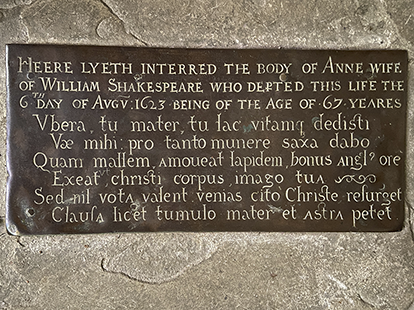
The ‘C’, ‘G’, and ‘S’ are particularly characteristic of Marshall’s work.Footnote 193 Likewise, the decorative ‘H’ also features in Marshall’s monument to Michael Drayton (discussed later in this section) and his 1641 brass for John Pen in Holy Trinity Church, Penn, Buckinghamshire.Footnote 194 The mixture of Roman capitals and script lettering appears in Marshall’s monument to Richard Braham at St. John the Baptist, Windsor; his brass to Archbishop Harsnett at Chigwell, Essex; his engraving on Sir Edward Filmer, wife and children, 1629, in East Sutton, Kent; and his 1653 monument to the Verney family at All Saints, Middle Claydon, among others.Footnote 195
A detailed comparison of Anne’s epitaph with numerous documented and signed engravings created by Marshall offers compelling evidence for Marshall as the engraver of Anne’s brass. The most notable point of comparison is Marshall’s signed monument to Katherine Gildredge and her two children (Figures 17–19), in St. Mary’s Church, Eastbourne. The monument is engraved on a slate panel and dates from 1635/36, just after the time period of Anne Shakespeare’s epitaph (Figure 20).Footnote 196
Katherine Gildredge’s monument, St. Mary’s Church, Eastbourne, Sussex (author’s own photos)
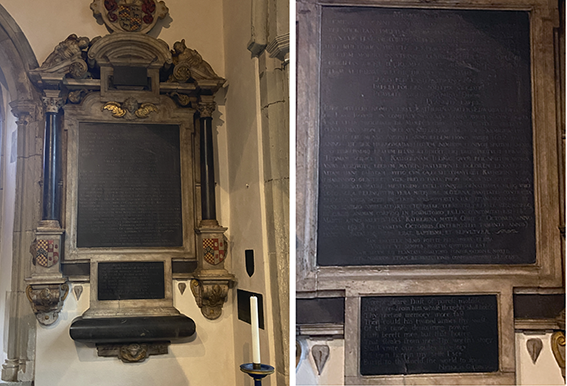
(left) Katherine Gildredge’s monument, St. Mary’s Church, Eastbourne, Sussex (author’s own photo);
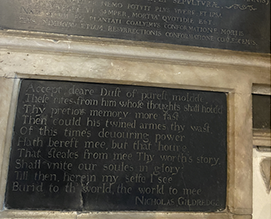
(right) Anne Shakespeare’s epitaph, Holy Trinity Church, Stratford-upon-Avon (author’s own photo)
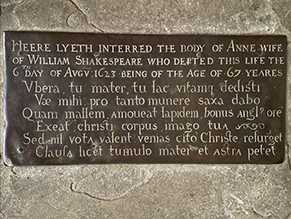
Katherine Gildredge’s monument and Anne Shakespeare’s epitaph (Figures 19 and 20) share almost all of Marshall’s characteristics: the mixture of the same two letterform styles (reversed in Gildredge’s engraving, with Roman capitals for English and script lettering for Latin); the numbers ‘162’; the lowercase letter ‘l’ with a side flourish; the lowercase ‘g’; the upper case ‘Q’; the decorative uppercase ‘H’; the ‘st’ ligature; the lowercase ‘a’; the number ‘2’; the combination of ‘EST’; the double ‘N’; and the decorative flourish to finish a line (see Figure 21).
Side-by-side comparison of Katherine Gildredge’s monument (left) and Anne Shakespeare’s epitaph on the right (author’s own photo)
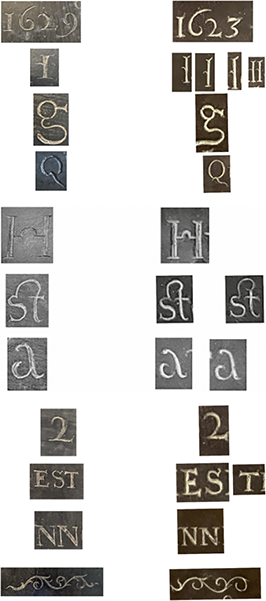
A second signed monument by Marshall, to Henry Curwen from 1638, in St. Mary’s, Amersham, also shares Marshall’s characteristic mixture of lettering, as well as the hooked ‘C’; the numbers 1, 6, and 3; the word ‘WHO’; the word ‘OF’; the ligatured ‘st’; and the word ‘AGE’ (see Figure 22).
Side-by-side comparison of Henry Curwen’s monument (left) and Anne Shakespeare’s epitaph (right), Henry Curwen monument courtesy of Carolyn Gifford, https://creativecommons.org/licenses/by-nc/4.0/
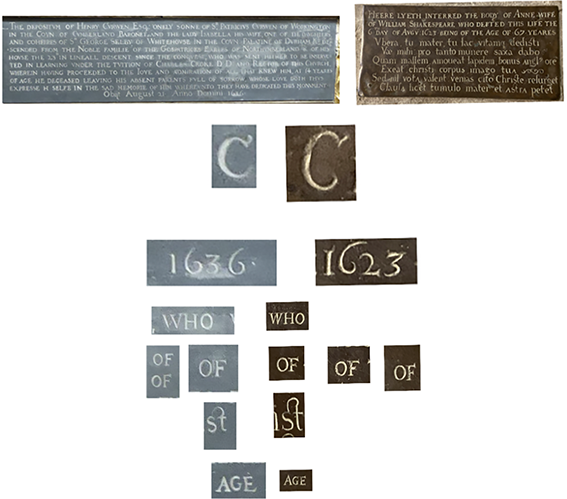
The 1631 documented monument to Michael Drayton in Poet’s Corner, Westminster Abbey (Figure 23) shares several features with the epitaph of Anne Shakespeare, notably the characteristic decorative ‘H’ used in line 1 of Anne’s epitaph and in Katherine Gildredge’s monument, as well as the uppercase ‘AGE’; the numbers 1,6, and 3; the characteristic ‘C’ with a hook; the uppercase word ‘OF’; the uppercase word ‘THIS’; the characteristic ‘S’ with a hook; and the uppercase letters ‘ER’ (Figure 24).Footnote 197
Monument to Michael Drayton, Westminster Abbey, © Dean and Chapter of Westminster
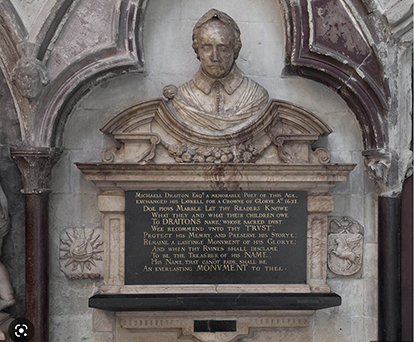
Side by side comparison of Michael Drayton’s monument (left) and Anne Shakespeare’s epitaph (right)
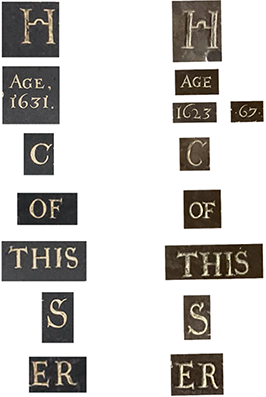
Figure 25 displays additional visual and letterform evidence comparing Anne’s epitaph to five of Marshall’s engravings.Footnote 198 Even with the uneven nature of photographic evidence, expected minor differences due to hand engraving, and the various conditions of these engravings in terms of their preservation (or lack of), the visual evidence supports the case for Marshall as the engraver for Anne Shakespeare’s brass.
Table of comparisons between Marshall’s engravings.
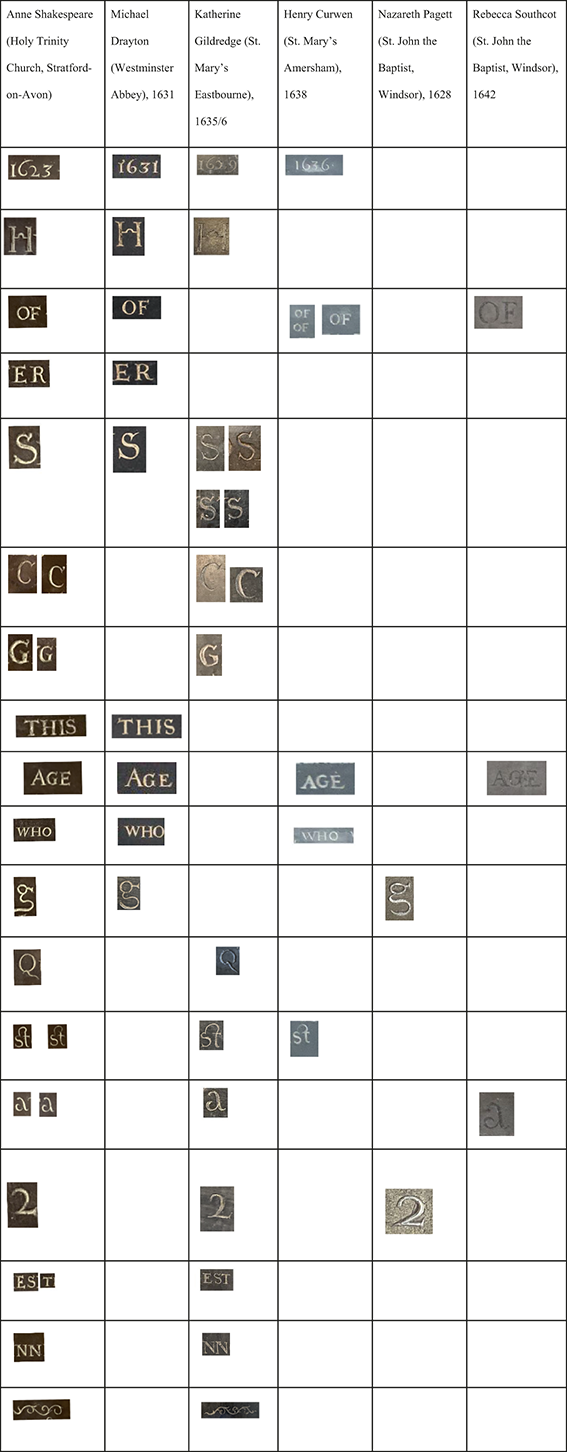
5 The Epitaph’s Geography: Possible London and Stratford-upon-Avon Networks
In this final section, I put forward several possible scenarios that could explain how the Shakespeare family connected with London engraver Edward Marshall, drawing on the various social and literary connections of the Shakespeares and of Marshall.Footnote 199 Given the contemporary practice of securing such commissions through personal relationships and peer recommendations, it is unlikely that Anne Shakespeare’s family would have approached Marshall without some form of personal connection.Footnote 200 It was common for families to use the same engraver for multiple memorials. However, Nicholas Johnson, the sculptor of Shakespeare’s monument, had retired by 1621 and died in 1624, so the Shakespeare family would have needed to find another engraver.Footnote 201 The Halls travelled back and forth to London regularly, including one trip that Susanna Hall made to London in April 1624 with her daughter Elizabeth, the year after Anne’s death.Footnote 202 It is possible that one purpose of this trip was to plan Anne’s epitaph.
It is worth pointing out that we cannot completely rule out a London poet as the author of Anne’s epitaph instead of her daughters, no matter how unlikely, especially since Edward Marshall was well-connected with numerous literary figures of the day.Footnote 203 For example, Marshall used verses from Francis Quarles for Michael Drayton’s monument; John Aubrey records: ‘Mr Marshall the Stone-cutter of Fetter-lane, also told me, that these verses [on Drayton’s monument] were made by Mr. Francis Quarles, who was his great Friend’.Footnote 204 As an active parishioner at St. Dunstan’s, Marshall would also have known the poet John Donne, who was appointed vicar at St. Dunstan’s in March of 1624 and served until his death in 1631, and who composed epitaphs, including one for his own wife. Writer James Howell left specific directions for Marshall in his will, specifying a brass and a Latin epitaph:
I Desire my body may be carried decently in a hearse: And buried in the Middle Temple Church as privately as can be Att the ffoote of the next great Piller this side the little Quier where I have directed Mr Marshall to sett up a large Black Marble with a Brasse Picture of mine in the Middle with my Armes and a Latin Epitaph.Footnote 205
Howell leaves no instructions for who among Marshall’s circle would write his epitaph but seemed to trust that Marshall would take care of it. While it is possible that the verses for Anne’s epitaph came from a London poet unconnected to the Shakespeares, the personal nature of the epitaph and its lack of recognizable conventional classical tags make this scenario highly improbable.
If we follow the line of argument that Anne’s epitaph was a personal tribute, and one that could most likely only be written by someone who knew her and/or knew her family, there are several possible scenarios which might explain how Marshall (based in London) connected with the Shakespeare family (based in Warwickshire). Each option I outline extends the personal and social connections of Anne and her daughters beyond the bounds of Stratford-upon-Avon, building on Matthew Steggle’s contention that Anne was much more engaged in Shakespeare’s social networks than has been previously thought.
Scenario 1 Marshall and the Shakespeares in Stratford-upon-Avon
It may not have even been necessary for the Shakespeare family to leave Stratford-upon-Avon in order to connect with Edward Marshall, since he was working in Holy Trinity Church in the early 1630s on the elaborate monument to the Earl of Totnes (Figure 26), recorded by Dugdale as by ‘Mr Marshall in Fetter-lane’, and described by the Stratford antiquarian Robert Wheler as ‘a magnificent monument’.Footnote 206 George Carew became Earl of Totnes in February 1625/26 and died in March 1629. The extended Shakespeare family was linked to George Carew in the 1620s, via Susanna and John Hall’s possession and inheritance of the Clopton lands in Old Stratford.Footnote 207 According to Orlin, the Totnes monument was built in 1630, when Joyce Carew had repairs done on the Clopton chest tomb in the Clopton Chapel.Footnote 208 Though the Totnes monument would likely have been completed in London and then moved to Stratford, it is possible that Marshall met the Shakespeare family while installing the monument in Stratford. Orlin suggests just such a scenario for Shakespeare and Nicholas Johnson, where Shakespeare could have ‘met the tomb-maker for his old friend [John Combe] in Holy Trinity Church’.Footnote 209 Members of the Shakespeare family may have approached Edward Marshall on site and commissioned Anne’s brass epitaph in person, or they could have seen his handiwork in Stratford and contacted him at a later date. Either option suggests a desire to enlist a highly qualified engraver to memorialize Anne, one who had recently been employed by the most prominent family in the area. Like the connections between Anne’s epitaph and Dean Balsall’s tomb, linking Anne’s epitaph to Marshall’s work for the prominent Clopton family would have been another way to underline Anne’s social position in Stratford.
Totnes monument to George and Joyce Carew, Holy Trinity Church, Stratford-upon-Avon, c.1630 (author’s own photo)
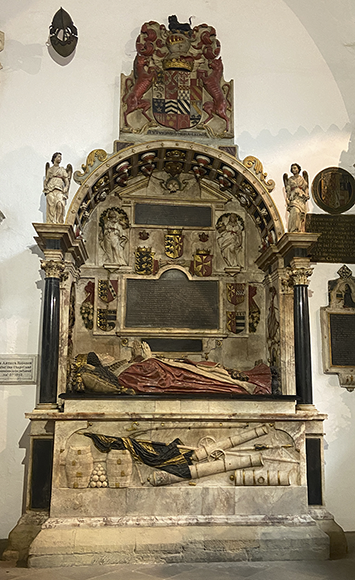
Scenario 2 A Mutual Acquaintance: Michael Drayton, Edward Marshall, and the Shakespeares
Michael Drayton had close connections with the Shakespeare family in Stratford-upon-Avon, and with Edward Marshall in the London literary community. Between Anne’s death in 1623 and Drayton’s in 1631, could he have served as an intermediary between the two parties? Such a relationship would suggest a widespread respect for Anne Shakespeare among mutual friends in her husband’s literary and social circle. When Marshall created Drayton’s monument in Westminster Abbey, he would have known Drayton personally since they were close neighbours as well as fellow parishioners at St. Dunstan’s. According to John Aubrey, Drayton ‘lived at the bay-windowe house next the East-end of St. Dunstans Church in Fleetstreet’ (Figure 27) very close to Marshall’s workshop on Fetter Lane; the geography of London around St. Dunstan’s is still remarkably similar to the Agas map in Figure 27.Footnote 210
‘Plan of London (circa 1560 to 1570)’, in Agas Map of London 1561 (1633) British History Online https://www.british-history.ac.uk/no-series/london-map-agas/1561/map
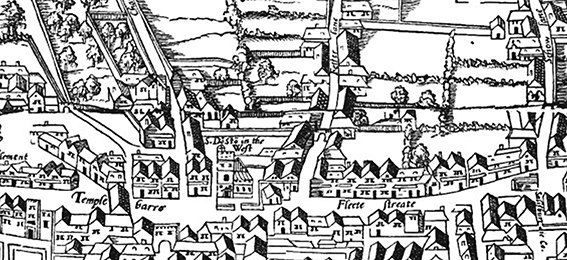
Aubrey records that the Countess of Dorset ‘gave [Drayton’s] monument. This Mr. Marshall (the stone-Cutter) who made it, told me so’.Footnote 211 Drayton was a sociable figure, described as ‘of an honest life and upright conversation’, and he had many connections in the same social circles as Marshall. The antiquary William Fulman recorded that Drayton died ‘not rich; but so well beloved, that the Gentlemen of the Four Innes of Court and others of note about the Town, attended his body to Westminster, reaching in order by two and two, from his Lodging almost to Standbridge’.Footnote 212
Drayton and Shakespeare probably knew each other through a social network of friends from Stratford at Middle Temple and may have even shared poetry in manuscript.Footnote 213 The Inns of Court were connected with the St. Dunstan’s literary community, and two of the printers at St. Dunstan’s, Nicholas Ling and John Smethwick, printed works by both Drayton and Shakespeare. Six of Drayton’s 25 known plays (of which only one is preserved) are connected to Shakespeare’s work, and it has been suggested that he ‘modeled himself on Shakespeare in part because of their shared background’.Footnote 214 Even after Shakespeare’s death, Drayton continued his connections with Shakespeare’s works and with the Shakespeare family. He almost certainly owned a copy of the First Folio, since, according to Andrew Hadfield, he made closer reference to Shakespeare’s works after 1623.Footnote 215 Drayton probably bought his Folio at St. Dunstan’s, where some of his own works were printed, and his strong ties to the St. Dunstan’s community could easily have led to the production of Anne’s epitaph on behalf of his Stratford friends.
As well as being a close friend of Edward Marshall, Drayton also had several personal and professional connections to the Shakespeare family. Both Drayton and Shakespeare were from Warwickshire, born in the 1560s, and like many Stratfordians in London, both maintained their Warwickshire ties throughout their lifetimes. According to one account, Stratfordians in London ‘would have found it difficult to escape the dense social networks which characterize small-town life’, including ‘a fairly efficient network of Stratford gossip in London’.Footnote 216 Susan Brock describes Drayton’s Stratford-upon-Avon life as ‘part of a social circle which overlapped with Shakespeare’s’ and notes that Drayton ‘visited for some months every summer to rest and to write’.Footnote 217 Paul Edmondson and Stanley Wells note that Drayton’s ties with the Rainsford family in the nearby village of Clifford Chambers ‘suggest that both he and Shakespeare may often have been in the area at the same time, possibly discussing their work with each other’.Footnote 218 In his Poly-Olbion (1612), Drayton referred to ‘deere Cliffords seat (the place of health and sport)/Which many a time hath been the Muses quiet Port’. If Stratford vicar John Ward’s apocryphal account of Shakespeare’s death is to be believed, ‘Shakespeare, Drayton, and Ben Jonson had a merry meeting and it seems drank too hard, for Shakespeare died of a fever there contracted’.Footnote 219 Even though Ward’s account of Shakespeare’s death is impossible to verify, there is a grain of truth to the friendship and social connections between Drayton and Shakespeare, making it possible that Drayton also knew Anne personally. Drayton’s relationships with the Shakespeare family were extensive; he was a patient of Anne’s son-in-law John Hall, who described him as ‘an excellent Poet’, and he thus likely knew Susanna Hall.Footnote 220 Linking Drayton to the production of Anne’s epitaph broadens our understanding of Anne’s potential ties to the London literary sphere and hints at a more expansive network beyond Stratford that may have extended throughout her lifetime.
Scenario 3 Anne’s Lodgers and the London Legal World: Thomas and Lettice Greene
Thomas and Lettice Greene lived with the Shakespeares at New Place in Stratford from roughly 1603 to 1610/11, and had close personal relationships with the Shakespeare family, as well as professional and literary connections in both London and Stratford-upon-Avon. In his diary, Thomas referred to himself as Shakespeare’s ‘cosin’, evidence of a close relationship rather than kinship; Lettice had perhaps an even closer relationship with Anne.Footnote 221 Thomas Greene was Shakespeare and Drayton’s closest acquaintance at Middle Temple, and Middle Templar Sir Henry Rainsford was also on friendly terms with Greene, Drayton, Shakespeare, and John Hall.Footnote 222 Anne and her daughters were likely connected with all of them.
While there is no direct evidence to connect the Greenes with Edward Marshall, they often circulated with many of the same acquaintances. Thomas Greene spent a large portion of his professional career in Stratford-upon-Avon but maintained his connections with the Inns of Court and with the literary community there throughout his lifetime. Greene entered Middle Temple in 1595, and Paul Edmondson speculates that he may have even seen the first recorded performance of Shakespeare’s Twelfth Night in February 1602 at Middle Temple.Footnote 223 In 1602 Greene was called to the bar, and by 1603, he had moved to Stratford. It may have been Shakespeare’s connections with the Inns of Court that brought Greene to Stratford.Footnote 224 He served as town clerk until his resignation in 1617, the year after Shakespeare’s death, when the Greenes moved to Bristol. By the 1620s Greene had resumed activity at Middle Temple, within the time frame that Anne’s epitaph was created.Footnote 225
The Greenes were well connected with many of the Shakespeares’ relatives and associates in Stratford. Along with Shakespeare’s lawyer Francis Collins, Greene witnessed Thomas Combe’s will in 1608, and Collins would later take over from Greene as town clerk in 1617. In 1611, Lettice Greene, Thomas Greene, and Judith Shakespeare Quiney served as witnesses for Elizabeth Quiney’s sale of a house in Wood Street. Greene was a fellow trustee with John Hall in 1613 for Richard Lane, and Thomas Greene’s brother John was a lawyer of Clement’s Inn and a trustee of the Blackfriars Gatehouse in 1618, acting on behalf of Susanna Hall. Thomas Greene served with Anne’s kinsman Richard Hathaway on the Stratford Council from 1615 until 1619.Footnote 226 It is clear that the Greenes’ connections to the wider Shakespeare family were far more extensive than those of typical lodgers.
Further, Anne Shakespeare and Lettice Greene’s lives would have intersected closely in the eight years they both lived at New Place, from 1603 (the year the Greenes probably married) until 1610/11, paying rent which Anne likely collected.Footnote 227 As Paul Edmondson points out, New Place had ‘plenty of space for Greene and his family, and it can easily be imagined that they lodged very comfortably in perhaps a set of two or three rooms that formed part of one of the wings’.Footnote 228 In September 1609, Thomas Greene wrote that he ‘mighte stay another yere’ at New Place, which suggests a positive experience. The Greenes had moved nearby to their own lodging of St. Mary’s by June 1611 but maintained ties with the Shakespeares, witnessing the sale of a property by Elizabeth Quiney (along with Judith Shakespeare) in December of that year. The Greene’s daughter Elizabeth was born the following June 1612, likely named after Susanna and John Hall’s four-year-old daughter Elizabeth.
When the Greenes lived at New Place, the women – Anne, her daughters Susanna and Judith, Lettice Greene, and perhaps Anne’s mother-in-law Mary Arden Shakespeare – would have experienced several key life moments in the same household, including births, weddings, and deaths. As a mother of three, Anne Shakespeare likely offered counsel and advice on childbirth and motherhood. Her epitaph’s eulogy as a beloved mother may reflect not only her own experience, but also her support of her daughters and other community women, in what Adrian Wilson calls the ‘ceremony of childbirth’.Footnote 229 For most early modern women, childbirth was ‘one of the ways in which women were embedded in their families and communities’, a social occasion for women to bond in a community without men, and a ritual that was both female and collective.Footnote 230
Seventeenth-century surgeon Robert Barret recommended that the birthroom should include the midwife along with ‘some sober, wise Women, among her Neighbours, such as have gone through the like hazard before’.Footnote 231 Married women who were experienced in childbirth took part in other women’s childbirths, and the communal experience would have extended through the subsequent month-long lying-in period, when ‘the women who attended the birth would stay for “good cheer” and would return periodically with others for gossiping and good fellowship’.Footnote 232 The anonymous satirical pamphlet The Batchelars Banquet (1603) describes a scene of female sociability where ‘every day after her lying down will sundry dames visit her, which are her neighbours, her kinswomen, or other her special acquaintance’.Footnote 233 As Adrian Wilson describes it, ‘the collective ritual of childbirth was an integral part of a wider women’s culture’, and the rituals of childbirth and lying-in were ‘effectively universal’ among married mothers.Footnote 234
Several babies were born to the women at New Place under Anne’s watch, and the women in residence there – Anne, Lettice Greene, Susanna Shakespeare, and Judith Shakespeare – would have engaged in the female collective rituals connected to the birth process. The first baby born in New Place was Lettice Greene’s daughter Anne in March 1604 (baptized on 18 March). The fact that Lettice likely named her child after Anne Shakespeare suggests that Anne’s New Place was a supportive environment for her.Footnote 235 As women of the household, both Susanna (age twenty-one) and Judith (age nineteen) may have prepared the traditional drink of mother’s caudle or darkened the room and prepared candles.Footnote 236 The Shakespeare women at New Place would have been the first visitors to Lettice during her lying-in period, when the ‘celebratory, collective female character of the birth was continued into the process of lying-in’, and they would have been the ones to accompany Lettice (along with her midwife) to church at the end of the lying-in period.Footnote 237 The Shakespeares could have been the godparents or sponsors for baby Anne at her baptism ceremony in Holy Trinity Church.Footnote 238 This would explain Thomas Greene’s frequent references to Shakespeare as his ‘cosin’, a close relationship that could also entail serving as a godparent.
As a woman who had experienced maternal grief, Anne Shakespeare could also have been a source of comfort for Lettice Greene when she buried her unnamed infant child on 3 August 1606, just ten years after Anne experienced the loss of her only son Hamnet in 1596, and again in March of 1610 when the Greenes had another infant daughter who did not survive. Avra Kouffman comments that women often felt the loss of a child was ‘a measure of God’s justice’, and were ‘plagued with guilt and shame’, and Anne might have sympathized with the guilt that Lettice may have felt.Footnote 239 The following year, in 1607, Lettice would have been part of the more celebratory household preparations for the marriage of Susanna Shakespeare to John Hall in June.
In 1608, both Lettice Greene and Susanna Hall gave birth to children at New Place. Lettice’s son, appropriately named William, was baptized on 17 January, and Susanna’s daughter Elizabeth was baptized a month later on 21 February.Footnote 240 Lettice and Susanna would have experienced their pregnancies in tandem, and their young children would have grown up together in New Place. They may even have used the same midwife. The female community at New Place when William and Elizabeth were born in early 1608 would also have included Anne’s mother-in-law Mary Arden Shakespeare, who would die later that year in September. It is logical to think that Anne’s maternal role was formative to some degree for all of the women who resided in New Place.
Lettice Greene may have learned more than the skills of motherhood from Anne Shakespeare. St. Mary’s, the Greenes’ home, was described in 1617 as having a ‘brewing furnace and a brewhouse, as well as some land’.Footnote 241 Since Anne likely ran the brewing business at New Place, it stands to reason that she would have been the one to instruct Lettice in the practice of ale brewing.Footnote 242 There is a high probability that Lettice Greene was literate; when she signed the property deed for Elizabeth Quiney, she used an italic hand and her ‘ink distribution is even and her hand confident’.Footnote 243 She could also apparently read. In January 1614, William Chandler wrote to Thomas Greene at Middle Temple, ‘I would intreate you if you have not the note of Remembrance that you tooke concerninge Mr Combe and other busyness at London all ready, then I would intreete you to Right downe to my mother greene that shee may send you the note up to you in the next retorne of the carrier.’Footnote 244 Hannah Lilley points out that Lettice could read her husband’s ‘fiendishly tricky cursive handwriting’ and could ‘navigate her husband’s working space to the point of locating a particular document’. She was thus also entrusted with her husband’s business dealings at Middle Temple and at Stratford.Footnote 245 The next year, in 1615, Lettice provided key information to her husband related to the Welcome enclosures: Greene writes that ‘at night at my Commyng home my wif told me yt was sayd while we were as at the Assises’.Footnote 246 Did Lettice Greene, a literate and trusted woman, help contribute to the memorialization of a key maternal figure in her life?
The fact that the Greenes maintained ties with the Halls, who would also have been living in New Place until 1613 when they moved to Hall’s Croft, increases the likelihood of a sustained familial relationship. In 1614, a local enclosure dispute brought Greene together with Shakespeare and John Hall. When Greene sold his house in Stratford in 1617, part of the money was delivered ‘to mr Hall at Newplace’.Footnote 247 The Greenes’ time at Stratford must have been a positive experience since Greene referred to his time in Stratford as his ‘golden days’ in a letter of May 1617.Footnote 248 When Anne Shakespeare died in 1623, Thomas and Lettice Greene would have been in a position to connect the Shakespeares with the Inns of Court community, the St. Dunstan’s literary circles, and possibly Edward Marshall. Lettice may have even advised Susanna and Judith on the depiction of Anne as a beloved mother who expressed her spirituality through her ‘duty’ of breastfeeding.
Another compelling point in favour of the Greenes’ role in Anne’s epitaph is the eight-line Latin poem Thomas Greene wrote in his diary from December 1614, when his wife Lettice was about to give birth. Greene’s poem includes a familiar ars moriendi theme: ‘Death is certain, uncertain the day, the hour known to none; think therefore any day to be thy last.’Footnote 249 In his will of 1641, Greene referred to his wife as ‘so good a woman’, and he clearly valued her role as a wife and mother.Footnote 250 Could this maternal respect have contributed to the maternal accolades in Anne’s epitaph?
One final connection between the Greenes, the Shakespeares, and the London literary world is through Michael Drayton. Thomas Greene knew Michael Drayton from Middle Temple and the two had several literary connections.Footnote 251 Greene dedicated a poem to Drayton, which appeared in Drayton’s 1603 collection The Barron’s Wars. Drayton and Greene also had a mutual friend in Henry Rainsford, who Greene knew from Middle Temple and Drayton knew from Clifford Chambers.Footnote 252 The scenario I have presented in this section posits a network of relationships that links the extended Shakespeare family with their Stratford connections and with the wider literary community through Thomas and Lettice Greene, and these ties may have facilitated the memorial of a beloved maternal figure and friend.
Scenario 4 St. Dunstan in the West’s Literary Sphere: A Context for Anne Shakespeare’s Epitaph
One of the most intriguing options for how Anne and her family became associated with Edward Marshall is through the literary community of St. Dunstan in the West and its neighbouring legal district. The location of Marshall’s shop and the surrounding community connected with the publication of Shakespeare’s texts suggest a close connection between the Shakespeare family in Stratford and the London literary world. Edward Marshall’s shop was located in the heart of the St. Dunstan’s publishing community, and Marshall had close friendships with many of the printers and booksellers there, most of whom were also active parishioners.Footnote 253 In 1629, a surveyor recorded a list of shops in the churchyard of St. Dunstan’s (Figure 28), which provides a snapshot of St. Dunstan’s around the time that Anne Shakespeare’s epitaph was created.Footnote 254
The name of Francis Grigg is crossed out, since Marshall took over his shop that year. A second survey the following year in 1630 (Figure 29) lists a similar array of shops.
The other six shops listed were occupied by bookselling publishers connected with Shakespeare’s works, putting Marshall’s shop in the heart of what Ben Higgins has called ‘the home of Shakespeare publishing’ in the late 1620s and 1630s and nicknamed by R.C. Bald as ‘little St. Paul’s’.Footnote 255 St. Dunstan’s continued to be a key site for the printing of Shakespeare’s texts as late as the 1640s; John Benson published his 1640 edition of Shakespeare’s Poems from his shop ‘in St. Dunstans Church-yard’. Figure 30 shows a later layout of St. Dunstan’s along Fleet Street, which probably resembled the shops in the earlier seventeenth century.
1629 Scavengers’ rate assessments, St. Dunstan’s Churchyard, London Archives, by permission of the Guild Vicar and Churchwardens of St. Dunstan-in-the-West.
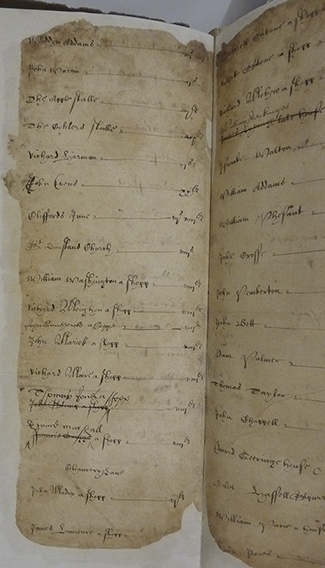
1630 Scavengers’ rate assessments, St. Dunstan’s Churchyard, London Archives, by permission of the Guild Vicar and Churchwardens of St. Dunstan-in-the-West.
William Henry Toms, c. 1700–c. 1750, The Southeast Prospect of the Church of St. Dunstan in the West, 1737, Engraving, Yale Center for British Art, Paul Mellon Collection, B1977.14.15927.
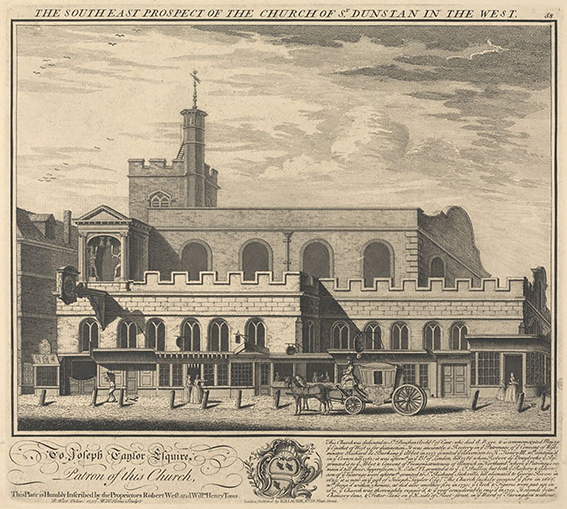
According to Marta Straznicky, even passers-by would know the wares of a shop, since they would have had ‘a stall out front or a hinged board projecting from the wall where books could be displayed’.Footnote 256 As someone who would have passed by these shops on a regular basis, Edward Marshall could scarcely avoid the Shakespearean wares of his fellow tenants. A closer look at the booksellers’ shops and the books that would have been for sale at St. Dunstan’s underlines the likelihood that Marshall would have known the Shakespeare name.
Richard Meighen, the publisher of Ben Jonson’s 1616 Folio, owned two bookshops, one in the churchyard of St. Dunstan’s and the other opposite Middle Temple gate, and is listed in both scavengers’ rate assessments for 1629 and 1630 (Figures 28 and 29). Meighen was one of the financiers of the 1632 Shakespeare Folio, along with William Aspley, Robert Allot, Richard Hawkins, and John Smethwick, another of the St. Dunstan’s stationers. Meighen sold the second edition of the Shakespeare Folio in 1632 and the 1630 quarto of The Merry Wives of Windsor (Figure 31) from his shop next to the gate to Middle Temple, where his directive was to ‘sell books for students of the law’.Footnote 257 The proximity of Meighen’s shop in particular, and the whole literary community of St. Dunstan’s to the Inns of Court, may have given him close connections with people like Thomas Greene, who circulated between London and Stratford.Footnote 258
The Merry Wives of Windsor (1630), title page to the third quarto, A1 recto, Folger Shakespeare Library STC 22301
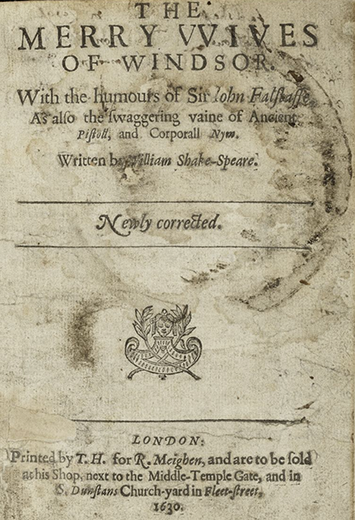
John Marriott, a bookseller whose shop was also listed on both scavengers’ rate assessments, was a close friend of Edward Marshall. Marriott described the ‘marbler’ Marshall in his will of November 1660 as ‘my assured loving and most kind friend’, bequeathing him 20s to ‘buy him a ring to weare in memory of his poore friend’, and 20s more to Marshall’s wife ‘to buy her a small ringe in memorie of their love and great kindness which I have constantly received from them, for which I pray God to blesse them and there children’.Footnote 259 In addition to the close proximity of their businesses, Marriott lived in the parish of St. Dunstan’s in the West all of his life. He had a shop on Fleet Street near Fetter Lane, at the sign of the White Flower-de-Luce, and probably took over John Smethwick’s shop ‘under the dial’ when Smethwick died in 1641.Footnote 260 Marriott held several offices in the Stationers’ Company and was the publisher from 1618 for the Royal College of Physicians, and later for a number of authors. He published John Donne’s 1633 Poems, and 16 editions of poet Francis Quarles’s work, from 1629 until 1644; Quarles, as we have seen, was also a friend of Marshall’s.Footnote 261 Marriott published the second part of Michael Drayton’s Poly-Olbion in 1622, with John Grismand. As a publisher of Drayton, Marriott could have enlisted his close friend Marshall to commemorate Anne for their mutual friend Michael Drayton.
A third St. Dunstan’s publisher, John Smethwick, offers another avenue for connecting the Shakespeare family networks to the London literary milieu. Smethwick was a long-standing bookseller and publisher of Shakespeare’s writing. He is listed in the colophon of the First Folio (Figure 32) and held the publishing rights to four Shakespeare plays: Romeo and Juliet, Hamlet, Love’s Labour’s Lost (Figure 33), and The Taming of the Shrew (Figure 34). Ben Higgins describes Smethwick as ‘the most significant stakeholder with whom the Folio syndicate had to negotiate when it came to assembling the volume in the early 1620s’ (Figures 33 and 34).Footnote 262 From his shop ‘under the Dial’ of the clock at St. Dunstan’s, Smethwick played a major role in the distribution of Shakespeare’s plays through the 1630s, and was involved in the publication of the second Folio in 1632 (Figure 35), making him a key figure connected to the Shakespeares.Footnote 263 Chris Laoutaris speculates that Smethwick ‘would have provided a list of contacts in the St Dunstan’s vicinity which may have proved helpful in the negotiations for the Folio’s plays’. He also catered to the law students at the Inns of Court and ‘arranged copies on his own shelves’ of the First Folio ‘where they could attract the legal set who worked or studied at the nearby Inns of Court and the area’s other legal institutions’.Footnote 264 Did Smethwick’s display of the Shakespeare Folio catch the eye of Thomas Greene, who had returned to the Inns of Court by the 1620s, may have heard of the recent death of Anne Shakespeare, and sought out an esteemed engraver to commemorate her for her family?
William Shakespeare, Mr. William Shakespeares comedies, histories, & tragedies. London: Printed by Isaac Jaggard and Edward Blount for William Jaggard et al., 1623 (sig. bbb6r), Bodleian Library, Arch. G c.7 (CC BY)
Title page to the 1631 quarto of Love’s Labour’s Lost, A1 recto, Folger Shakespeare Library
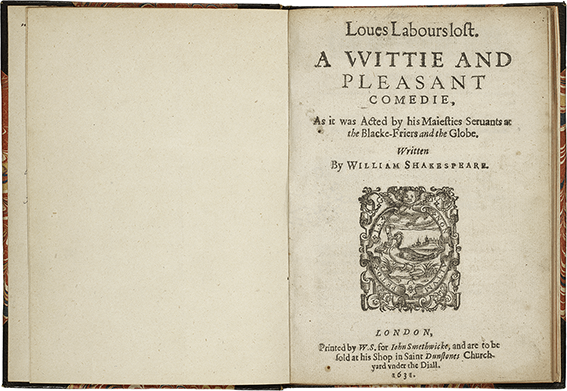
Title page to the 1631 quarto of A Wittie and Pleasant Comedie Called The Taming of the Shrew, A1 recto, Folger Shakespeare Library
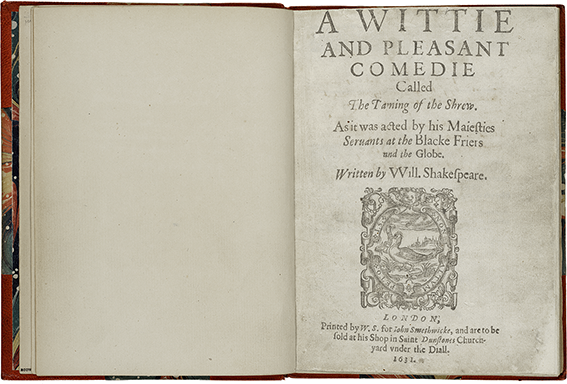
William Shakespeare, Mr. William Shakespeare’s Comedies, Histories, and Tragedies. London: Printed by Thomas Cotes, for John Smethwicke, 1632, A2 recto, Folger Shakespeare Library
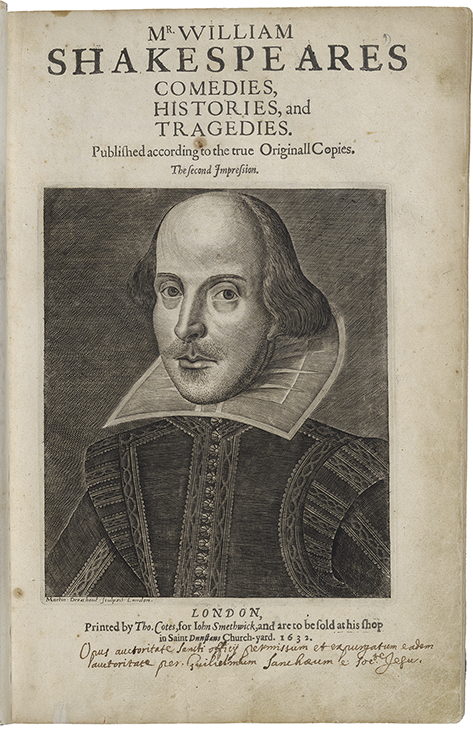
Smethwick knew Edward Marshall, not only because of the close proximity of their shops, but also as fellow active parishioners at St Dunstan’s. Smethwick was elected constable in 1619, became a junior churchwarden in 1627 and a senior churchwarden in 1628, which entitled him to a new pew in the chancel, for which he paid the vicar 6 s. 8 d.Footnote 265 When Edward Marshall moved to the parish of St Dunstan’s in late 1628 or early 1629, John Smethwick would have been the parish churchwarden, having just paid John Donne to preach an Easter sermon there in 1628.Footnote 266 Smethwick also knew Michael Drayton as fellow parishioners at St. Dunstan’s, and was the publisher for several of his works, including his 1619 folio. Did the close-knit web of Smethwick, Drayton, and Marshall relate to the commission of Anne’s epitaph? The plausibility of such connections increases significantly given Matthew Steggle’s recent persuasive argument that William and Anne Shakespeare shared both a London residence (likely around 1599–1603) and social and business networks.Footnote 267
Around the time of Anne’s death, the Shakespeare name would have been familiar to several other booksellers in the area who sold his works. William Jaggard’s shop was at the east end of St. Dunstan’s churchyard, and his brother John was a bookseller on Fleet Street near St. Dunstan’s. William Jaggard died in November 1623 and his business was taken over by his son Isaac, who became printer to the City upon his father’s death.Footnote 268 Further evidence suggests a close friendship between the Jaggards and John Smethwick. Chris Laoutaris remarks that Smethwick and John Jaggard became particularly close due to their work in the parish of St. Dunstan’s, and both families both baptized children and buried loved ones in the church, so ‘the two families were closely affiliated’.Footnote 269 Ben Higgins has pointed out similarly that Smethwick was close to the Jaggard family because they shared parish duties – both Smethwick and John Jaggard served as parish constables in 1619 and 1620.Footnote 270 Two more booksellers, William Sheares and Richard Hawkins, had shops just outside of St. Dunstan’s, at Serjeant’s Inn, nearby to where Marshall later moved at Whitefriars stairs. Sheares sold the 1632 quarto of I Henry IV and Hawkins sold the 1630 quarto of Othello.
Situated amidst the hub of Shakespeare publishing, Edward Marshall must have recognized the Shakespeare name when he received the commission for Anne’s epitaph. The intricate web of relationships between the printers and booksellers of Shakespeare’s texts at St Dunstan’s, the connections of Greene and Drayton to the area and to the Shakespeare family, and Marshall’s central location within this network, strongly suggest a more long-standing relationship between the Shakespeares and the London literary scene.
Scenario 5 A Convivial Connection to Anne’s Epitaph: Ben Jonson, Edward Marshall and the Devil Tavern
Readers will recall the posthumous anecdote from Stratford vicar John Ward discussed earlier, that Ben Jonson and Michael Drayton held a ‘merry meeting’ just before Shakespeare’s death in Stratford. I have suggested that both Drayton and Jonson may have known Anne from such encounters (provided they are more than apocryphal). Through Edward Marshall, it is possible to link Jonson and Drayton to a wider literary network that maintained ties to the extended Shakespeare family well after Shakespeare’s death. One of the landmarks of the neighbourhood surrounding St. Dunstan in the West was the Devil Tavern, located between Middle Temple Lane and Temple Bar, where Ben Jonson regularly gathered in the 1620s with the ‘Tribe of Ben’, including Michael Drayton, Robert Herrick, Richard Brome, Thomas Randolph, and James Howell, among others.Footnote 271 Their favoured location was the Apollo Club room on the second floor, which had a musician’s gallery, wall hangings, a seat for Ben Jonson, and a bust of Apollo.Footnote 272 Drayton pays homage to the Apollo Club room in his 1619 ode ‘The Sacrifice to Apollo’.Footnote 273 An inscription of 30 November 1620 in a copy of Drayton’s Poems from 1619, given to Richard Butcher ‘by the authors hande’, further links Drayton to the space: ‘Written at the Devell/& St Dunston in the/poets hall called Apollo’. In his inscription, Butcher refers to spending 10 shillings at the command of Drayton ‘In sack & smoke to cheare his merry muse’.Footnote 274 Jonson praised Drayton in his tribute to Drayton’s 1627 folio as the writer of ‘pure, and perfect Poesy’ and it has been suggested that Jonson later wrote the epitaph for Drayton’s monument in Westminster.Footnote 275
Edward Marshall possibly carved the bust of Apollo in the Devil Tavern, due to the proximity of his shop to the space and to his friendship with many of the frequenters of the Devil, including Michael Drayton and James Howell, whose monuments Marshall created.Footnote 276 A further connection between Marshall and Jonson is the famous Latin tavern code Leges Convivales that Jonson wrote for their meetings, which was ‘engraved in gold letters on a marble tablet over the mantelpiece’.Footnote 277 In a letter of 19 June 1624, John Chamberlain wrote to Sir Dudley Carleton, ‘I send here certain Leges convivales of Ben Johnsons made for a faire roome or chamber lately built at the tavern or signe of the divell and St. Dunstan by Temple-barre: they be reasonable goode and not improper for such a place’.Footnote 278 If Marshall was responsible for the bust of Apollo, it seems likely that he also engraved Jonson’s tavern code on the marble tablet, linking him more closely to Jonson in the decades after Shakespeare’s death.
It is compelling to think that Anne Shakespeare might have been part of the literary and social networks of her husband through one or more of the scenarios that I have outlined. Given Marshall’s many connections to numerous friends of the Shakespeare family and his shop’s proximity to the heart of Shakespeare publishing, it is plausible that his production of Anne’s memorial stemmed from these long-standing links between the Shakespeare family – not just William Shakespeare – to literary London.
Conclusion: Expanding the World of Anne Shakespeare
If we connect Anne Shakespeare to the literary world of early modern London, what might that tell us about her? For one, such connections might link her to the production of the 1623 Folio.Footnote 279 The King’s Men travelled to Stratford in the summer of 1622, a year before Anne’s death, and they may have visited Anne, perhaps in search of Shakespeare’s papers to use as copy texts. As a close colleague and friend of Shakespeare (one of three beneficiaries from the King’s Men in Shakespeare’s will), John Heminges may have even known Anne. It is possible that the commemoration of Anne in a plaque likely engraved by Edward Marshall stemmed from long-standing personal relationships between Anne and the literary and theatrical personnel who may have visited her in 1622 to obtain Shakespeare’s manuscripts, and that the production of her epitaph may have been connected to her role in the Folio.Footnote 280 The production of Anne’s epitaph by Edward Marshall, ‘writ in brass’, as Ben Jonson’s Folio poem describes the printed portrait of her husband, may have been a further tribute, organized not only by family, but also by personal friends of her family.
However Anne Shakespeare’s epitaph came to be produced by Edward Marshall, it seems clear that Marshall would have known exactly who he was commemorating when he began to engrave the lines ‘Heere lyeth interred the body of Anne wife of William Shakespeare’, a beloved mother and ‘so great a gift’ to her community. Until further evidence comes to light, it is impossible to say which of the scenarios I have outlined is the most likely one, but each provides a broader picture of Anne Shakespeare, one that extends her reach beyond Stratford and connects her much more closely to the literary world of seventeenth-century London. The networks of production for her epitaph suggest that those connections endured even in her later years, and that her daughters had multiple avenues to pursue when they sought to commemorate her.
***
The year 2023 was the 400th anniversary both of the First Folio and of the death of Anne Shakespeare. In January of that year, I visited her grave in Stratford-upon-Avon to take photos for this project. In an empty church (and with special permission), I was able to see the minute traces of Edward Marshall’s carving to make permanent the tribute from her daughters Susanna and Judith and to imagine the power that their words would have held when immortalizing their mother so long ago in the shadows of the wall monument to their father, as if he were looking on, as he still is. A few days later, I travelled to Eastbourne on a bitterly cold and rainy day to see Katherine Gildredge’s monument in a deserted St Mary the Virgin Church. The lower quarter of the monument is just about eye level, making it easy to photograph the bottom part and even to trace the engraving with my own fingers. Marshall’s signature is still visible at the bottom of that monument. When seen in person, it is obvious that these two commemorations are a match and were engraved by the same hand. It was a profoundly moving experience for me, having travelled across the ocean from Minnesota, to see these two engravings within the space of a few days. Both are commemorations of mothers, separated by only a few years in life but by 200 miles in distance, one in the Midlands and the other in East Sussex on the south coast, now united by the knowledge of their common engraver.
It is especially poignant to see Edward Marshall’s own monument to his three young children, which I now visit every time I am in London. It is located in the old St. Dunstan in the West Burial Ground, just off of Bream’s Buildings, a space frequently encroached upon by construction works and new development, and increasingly ‘being worn away from memory’ and ‘scoured blank by time’.Footnote 281 Barely legible are the names and dates of Marshall’s three children who all died around the time of Anne Shakespeare’s epitaph – his second son Samuel, who died at age 2 in May 1631; his eldest daughter Anne who died at age 1 in June 1635; and his third son Nicholas, who died in December 1635, age 5. I wonder if Marshall was grieving his own young children as he carried out the memorial to express the grief of Anne’s daughters.
In honour of the 400th anniversary of Anne Shakespeare’s death in 2023, a number of initiatives brought Anne to the fore of Shakespeare commemorations as a woman in her own right. The publication of the first poetry anthology for Anne – Anne-thology: Poems Re-Presenting Anne Shakespeare (edited by Paul Edmondson, Aaron Kent, Chris Laoutaris, and myself) – centred Anne in a series of sixty-seven newly commissioned poems, one for each year of her life. Additionally this collection for the first time brought together the historical poetry related to Anne, including William Henry Ireland’s 1796 ‘Verses to Anne Hathaway’, Mathilde Blind’s 1894 sonnets in honour of Anne written while she was in residence in Stratford-upon-Avon, and Charles Dibdin’s ‘A Love Dittie’, with the commonly repeated refrain, ‘She hath a way,/Anne Hathaway’. For the first time, Anne’s epitaph was printed with Susanna Shakespeare Hall and Judith Shakespeare Quiney listed as the authors. The Shakespeare Birthplace Trust sponsored a competition among students at Shakespeare’s school, King Edward VI school, to set an English translation of Anne’s epitaph to music. The winning anthem, composed by student Ariana Pethard, premiered at the Shakespeare’s Birthday weekend service on 23 April 2023, when Paul Edmondson delivered a sermon for Anne as part of the celebrations of her famous husband’s birthday. On Sunday, 6 August 2023, 400 years to the date of Anne’s death, I delivered the first sermon in her honour at Holy Trinity Church, just steps from the epitaph that is the subject of this Element. There has been a sermon in honour of Shakespeare delivered at Holy Trinity every year since the nineteenth century, but until 2023, never an annual sermon in honour of Anne.
As I complete this Element to reanimate the maternal ‘Anne’ that her daughters almost certainly had a hand in immortalizing, her epitaph endures, steadfastly testifying across time to the shared human experiences of grief, motherhood, and strength, deeply embedded in a space where Anne herself once knew both hope and anguish, joy and grief. Susanna and Judith could scarcely have foreseen the centuries of misogyny that Anne would face in her afterlife, ranging from the dismissal of the beautiful original Latin poetry as ‘six lines not worth remembering’, to her denigration as a ‘disastrous mistake’ of a wife in a prominent twenty-first-century biography. Even so, it is gratifying that the choices Susanna and Judith made 400 years ago – employing a top sculptor, using brass, opting for a chancel burial, and crafting a Latin epitaph – will continue to immortalize the ‘gift’ of their mother.
Appendix: An Edition of Anne Shakespeare’s Epitaph
Heere lyeth interred the body of Anne wife of William Shakespeare, who dep[ar]ted this life the 6th day of Aug[ust] 1623, being of the age of 67 yeares.
The opening line in the English section, ‘Heere lyeth’, was the most conventional way to begin an epitaph. It signals not only the place of Anne’s body, but also the significance of the location.
1. Vbera is a bold opening to the epitaph, but the reference to Anne as a breastfeeding mother links her to a long tradition of virtuous and pious women.
2. ‘Woe is me’: Simon Watney points out that ‘explicitly Puritan epitaphs rarely include references to tears or personal sorrow of any kind’ and had ‘prevailing Puritan hostility to any displays of mourning that could be deemed to be intercessions on behalf of the faithful departed, and hence in Puritan terms superstitious’ (‘Sky Aspiring Pyramids’, 111). The motif of Anne as a gift recurs in lines 1 and 2 with repetition of ‘dedisti’ and ‘dabo’.
3. Line 3 is rendered ‘bonus angelus orem’: Dugdale and Chambers also read this as ‘orem’.
3–4. Victoria Moul has pointed out the thematic focus on the alteration/contrast between the subjunctive in lines 3–4 (what I wish would happen but won’t) vs the future indicative (what will happen), which juxtaposes the fantasy of Anne coming back to life now vs. the reality of faith in the final resurrection.
4. The added superscript ‘vt’ is in the original and Victoria Moul suggested that this was likely a mistake of Edward Marshall’s rather than in the original, since it is a basic error which is not compatible with the level of Latinity in the piece as a whole.
5–6. ‘Rise again’: The final image of Anne’s epitaph is the central Christian theme of resurrection, though ‘et astra petet’ does not explicitly refer to heaven.
6. ‘Tumulo’ also appears in John Hall’s Latin epitaph. See ‘His Daughter Susanna Hall’, 79–80.
Acknowledgements
This Element began as an invited talk for the 2023 Shakespeare’s Birthday conference at the Shakespeare Institute, organized by Paul Edmondson. I am grateful to him for the opportunity to sketch out an initial version of the argument which I have expanded here. Many other people helped refine my argument and aided my thinking about the significance of Anne’s epitaph, including Sheila Cavanagh, Ailsa Grant Ferguson, Ewan Fernie, Chris Laoutaris, Laurie Maguire, Nabil Matar, Andrew Scheil, Tiffany Stern, and John Watkins. Ben Higgins generously shared material from his work on printer John Smethwick, as well as copies of the scavengers’ rate assessments. Victoria Moul offered expert advice on the Latin translation and transcription, as well as the context for early modern Latin. Ian Stone kindly shared his book on the history of the masons. In making the arguments in this Element, I offer special thanks to Robert Bearman for his expertise on the Shakespeare graves; to Lena Cowen Orlin, whose magisterial work The Private Life of William Shakespeare (Oxford: Oxford University Press, 2021) opened multiple avenues for further research; and to the expert on engravers in this period, Adam White, who generously reviewed my evidence about Anne’s epitaph and agreed with my conclusions regarding the engraver Edward Marshall. Matthew Steggle and Laurie Maguire read earlier drafts of this project and offered solidarity as well as important forthcoming work, as did Marlin Blaine. The series editors, Claire Bourne and Rory Loughnane, as well as Emily Hockley, have been incredible champions of the project from the start. I am grateful to the anonymous readers for the press for their support and encouragement.
Visual components are crucial to my argument in this Element, and several people have been essential in helping me to procure photographs and other illustrations. Paul Edmondson helped with photographs of Anne’s epitaph and the Totnes monument in Holy Trinity Church. Mike Bailey gave me a personal tour of St John the Baptist Church in Windsor and provided extensive photographic evidence from Edward Marshall’s monuments there. John Vigar kindly shared photographs, and Anne Eastbury at St Mary the Virgin, Eastbourne, provided access to Katherine Gildredge’s monument.
This Element is dedicated to Paul Edmondson and to Sir Stanley Wells, whose enduring friendship and unwavering support over the years have been ‘so great a gift’.
Claire M. L. Bourne
The Pennsylvania State University
Claire M. L. Bourne is Associate Professor of English at The Pennsylvania State University. She is author of Typographies of Performance in Early Modern England (Oxford University Press 2020) and editor of the collection Shakespeare / Text (Bloomsbury 2021). She has published extensively on early modern book design and reading practices in venues such as PBSA, ELR, Shakespeare, and numerous edited collections. She is also co-author (with Jason Scott-Warren) of an article attributing the annotations in the Free Library of Philadelphia’s copy of the Shakespeare First Folio to John Milton. She has edited Fletcher and Massinger’s The Sea Voyage for the Routledge Anthology of Early Modern Drama (2020) and is working on an edition of Henry the Sixth, Part 1 for the Arden Shakespeare, Fourth Series.
Rory Loughnane
University of Kent
Rory Loughnane is Reader in Early Modern Studies and Co-director of the Centre for Medieval and Early Modern Studies at the University of Kent. He is the author or editor of nine books and has published widely on Shakespeare and textual studies. In his role as Associate Editor of the New Oxford Shakespeare, he has edited more than ten of Shakespeare’s plays, and co-authored with Gary Taylor a book-length study about the ‘Canon and Chronology’ of Shakespeare’s works. He is a General Editor of the forthcoming Oxford Marlowe edition, a Series Editor of Studies in Early Modern Authorship (Routledge), a General Editor of the CADRE database (cadredb.net), and a General Editor of The Revels Plays series (Manchester University Press).
Advisory Board
Patricia Akhimie
The Folger Institute
Terri Bourus
Florida State University
Dennis Britton
University of British Columbia
Miles P. Grier
Queen’s College, City University of New York
Chiaki Hanabusa
Keio University
Sujata Iyengar
University of Georgia
Jason Scott-Warren
University of Cambridge
M. J. Kidnie
University of Western Ontario
Zachary Lesser
University of Pennsylvania
Tara L. Lyons
Illinois State University
Joyce MacDonald
University of Kentucky
Laurie Maguire
Magdalen College, University of Oxford
David McInnis
University of Melbourne
Iolanda Plescia
Sapienza – University of Rome
Alan Stewart
Columbia University
About the Series
Cambridge Elements in Shakespeare and Text offers a platform for original scholarship about the creation, circulation, reception, remaking, use, performance, teaching, and translation of the Shakespearean text across time and place. The series seeks to publish research that challenges–and pushes beyond–the conventional parameters of Shakespeare and textual studies.