

Mastitis is the most prevalent disease among Swedish dairy cows, and the most frequently isolated pathogen is Staphylococcus aureus. Data from the Mastitis Laboratory at the Swedish Veterinary Agency (SVA) revealed the presence of S. aureus in 27% of the milk samples examined for clinical mastitis during the years 2013–2018 (Duse et al., Reference Duse, Persson-Waller and Pedersen2021). A study conducted in Sweden during 2008–2009 showed that S. aureus was present in 19% of milk samples from chronically infected udder quarters (Persson et al., Reference Persson, Nyman and Gronlund-Andersson2011). Staphylococcus aureus is a highly contagious udder pathogen, and even isolates that are sensitive to penicillin often respond poorly to treatment, leading to chronic infections often with high or undulating SCCs. A recent meta-analysis highlights that antibiotic resistance in S. aureus isolated from bovine milk is becoming a concern (Molineri et al., Reference Molineri, Camussone, Zbrun, Suarez Archilla, Cristiani, Neder, Calvinho and Signorini2021). Currently, preventive measures such as culling of chronically infected individuals, grouping of animals and health programmes as first described by Neave et al. (Reference Neave, Dodd, Kingwill and Westgarth1969), are used together with optimization of milking techniques to prevent S. aureus infections in Swedish herds.
A search for effective vaccines against bovine mastitis in general and against S. aureus-caused mastitis in particular has continued for a long time (see Rainard et al., Reference Rainard, Gilbert, Germon and Foucras2021 for review). The difficulty of producing an efficient vaccine against mastitis has been shown in field trials (Hoedemaker et al., Reference Hoedemaker, Korff, Edler, Emmert and Bleckmann2001; Freick et al., Reference Freick, Frank, Steinert, Hamedy, Passarge and Sobiraj2016) and is summarized in a meta-analysis including almost 10 000 cows, where prevention of clinical mastitis failed (Mata et al., Reference Mata, Jesus, Pinto and Mata2023). Since 2009, Startvac has been available on the European market as a vaccine against mammary gland infection caused by Escherichia coli and S. aureus (EMA, 2009). During scientific evaluations of Startvac, some groups have found positive outcomes on the studied mammary health parameters (Schukken et al., Reference Schukken, Bronzo, Locatelli, Pollera, Rota, Casula, Testa, Scaccabarozzi, March, Zalduendo, Guix and Moroni2014; Bradley et al., Reference Bradley, Breen, Payne, White and Green2015; Piepers et al., Reference Piepers, Prenafeta, Verbeke, De Visscher, March and De Vliegher2017), while other groups have not (Landin et al., Reference Landin, Mork, Larsson and Waller2015).
Quillaja saponin-based adjuvants have been used in human and veterinary medicine for many years. A new technique for incorporating viral antigens in micelles formed by Quil A, cholesterol and phospholipids was described 40 years ago (Morein et al., Reference Morein, Sundquist, Höglund, Dalsgaard and Osterhaus1984). Since then, this formulation of immunostimulating complexes (ISCOMs) has been streamlined into adjuvant formulations consisting of the matrix of ISCOMs combined with various antigens (Morein and Bengtsson, Reference Morein and Bengtsson1999). ISCOM matrix has previously been tried together with lysed S. aureus bacteria and recombinant proteins for the vaccination of dairy cows. Regardless of whether lysed bacteria or recombinant proteins were used, the animals developed both IgG1 and IgG2 antibodies (Camussone et al., Reference Camussone, Pujato, Renna, Veaute, Morein, Marcipar and Calvinho2014a, Reference Camussone, Veaute, Pujato, Morein, Marcipar and Calvinho2014b) to S. aureus antigens. Third-generation ISCOMs, G3 nanoparticles, have been formulated during the last decade and shown to induce a balanced Th1/Th2 type of immune response in mice (van de Sandt et al., Reference van de Sandt, Kreijtz, Geelhoed-Mieras, Vogelzang-van Trierum, Nieuwkoop, van de Vijver, Fouchier, Osterhaus, Morein and Rimmelzwaan2014; Hjertner et al., Reference Hjertner, Bengtsson, Morein, Paulie and Fossum2018) and, in combination with the diterpene steviol glycoside, induce murine CD8+ T cell activity (van de Sandt et al., Reference van de Sandt, Kreijtz, Geelhoed-Mieras, Vogelzang-van Trierum, Nieuwkoop, van de Vijver, Fouchier, Osterhaus, Morein and Rimmelzwaan2014). In the present study, G3 nanoparticles (NanoQuil) were formulated with S. aureus antigens into an experimental vaccine.
The aim of the present study was to evaluate the efficacy of this experimental vaccine formulation against S. aureus-induced mastitis in a herd with documented problems. For ethical reasons and to decrease the risk of bias due to a lowered infectious pressure in a non-vaccinated group, all lactating animals were recruited and vaccinated with either the experimental vaccine or a commercial control vaccine (Startvac). The primary outcome variables were SCC and milk yield in the two vaccinated groups, with the hypothesis that the experimental vaccine would be superior.
Materials and methods
Experimental vaccine and permit
The experimental vaccine against S. aureus-induced mastitis was elaborated by Bror Morein (Savacc AB, Uppsala, Sweden). The vaccine was formulated with NanoQuil adjuvant (NanoQuil, Croda Pharma A/S, Fredrikslund, Denmark) and disintegrated, formalin-fixed S. aureus bacteria as antigen. The S. aureus strains belong to cluster CC133 (CP8) and were selected due to their genetic capability to express 16 known virulence factors. Cultivation, fixation and disintegration of bacteria, as well as vaccine manufacturing, were performed by Ripac-Labor (Ripac-Labor GmbH, Potsdam, Germany). The Swedish Medical Products Agency approved the vaccine to be used on 120 animals in a clinical phase II/III trial with record number 5.1-3030-101586. The Regional Animal Experiment Ethics Committee approved the animal experiment with record number A33-2020.
The herd
The herd (Röbäcksdalens dairy research facility, Swedish Livestock Research Centre), located in the northern parts of Sweden, consisted of on average 115 lactating dairy cows. The cows were of the Swedish Red Breed and were kept in a free-stall barn. Calvings were distributed continuously over the year, and recruitment heifers were brought up on the farm. The barn was divided into two sections, with one half insulated and the other half not. Lactating cows, dry cows and heifers were kept in free stalls with cubicles bedded with wood shavings and cleaned two times per day; calves and close-up dry cows were kept in a free stall bedded with straw. The cows were milked twice daily using cluster milking machines (SAC, S. A. Christensen & Co Ltd, Kolding, Denmark) in a milking parlour pit, with daily recording of milk yield. Service and maintenance of the milking equipment were according to the manufacturer's instructions. The milking routine consisted of drying the teats with a moist cotton cloth (washed at 90°C between milkings) and attachment of the milking cluster 1–2 minutes later. Post-milking treatment consisted of spraying the teats with an iodine-based teat spray (Veloucid, Ecolab AB, Älvsjö, Sweden). Selective dry cow treatment was given to cows with an elevated SCC for more than three monthly test milkings and a confirmed bacterial diagnosis. The cows were given a standard diet comprising ad libitum silage and an individual concentrate ration to meet the individual milk requirements. The herd is managed as a commercial herd, although belonging to the Swedish University of Agricultural Sciences, implying that experiments are regularly performed in the herd.
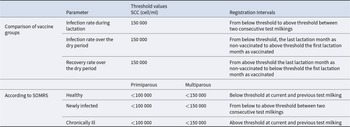
The herd was enrolled in the Swedish Official Milk Recording Scheme (SOMRS, Växa Sverige, Stockholm, Sweden) and had monthly registrations of milk yield, SCC and milk composition. Apart from containing detailed information on individual milk production and udder health, SOMRS also compiles the farms’ herd udder health information, identifying the cows as ‘healthy,’ ‘unhealthy’ or ‘chronically ill’. For the herd udder health compilation, different cut-off values for SCC are used to relate to the parity of the cow. To be considered healthy, a primiparous cow should have an SCC below 100 000 cells/ml in the monthly milk recordings; a primiparous cow with an SCC above 100 000 cells/ml is consequently considered non-healthy. The corresponding cut-off value between healthy and unhealthy for multiparous cows is 150 000 cells/ml. In the SOMRS herd udder health compilation, a cow is considered healthy if she, in the current and previous test milking, had an SCC below the threshold. Furthermore, a cow is considered chronically ill if she has an SCC above the threshold in the current and previous test milking and is considered newly infected if she has gone from below to over the threshold between two test milkings. For comparisons of the vaccine groups, the rate of new infections (infection rate) during lactation was calculated in a similar manner as the SOMRS compilation, using the same definition and a threshold value of 150 000 cells/ml for all lactations. ‘Infection rate’ and ‘recovery rate’ over the dry period were calculated from the last lactation month as non-vaccinated to the first lactation month as vaccinated, using the same SCC threshold. These criteria are summarized in Table 1.
Definitions of variables used to describe udder health

Table 1 Long description
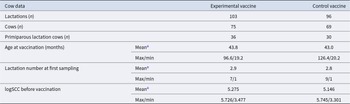
The table presents data on cows involved in a study comparing experimental and control vaccines. It includes the number of lactations and cows, with 103 lactations and 75 cows in the experimental group, and 96 lactations and 69 cows in the control group. The mean age at vaccination is similar between groups, 43.8 months for the experimental and 43.0 months for the control. The mean lactation number at first sampling is 2.9 for the experimental group and 2.8 for the control. LogSCC values before vaccination are also comparable, with means of 5.275 and 5.146, respectively. Maximum and minimum values for age, lactation number, and logSCC are provided, showing slight variations between groups. The data suggests no significant differences between the vaccine groups in these parameters.
A local veterinarian made monthly to bi-monthly herd visits as part of the enrolment in conditional drug use (Vilkorad Läkemedelsanvändning, ViLA). The ViLa regulations require that a milk sample be collected and analysed by a veterinarian, a laboratory or an equivalent method for bacteriological analysis (SJVFS 2023:21) before antibiotics are given to cows with mastitis. Consequently, mastitic milk samples were analysed either at the SVA or with an in-house bacterial classifier (Bacticam, Agricam, Linköping, Sweden).
During the 12 months before the experimental start, the cows in the herd produced on average 9217 kg of milk/cow/year with 4.5% fat and 3.8% protein; the mean SCC was 183 000 cells/ml. During the same period, 51 milk samples from clinical or sub-clinical mastitis cases were collected for bacterial diagnosis; seven of these samples had growth of S. aureus. Other pathogens detected were Streptococci (n = 5), non-aureus Staphylococci (NAS, n = 5), Corynebacterium (n = 4), Lactococci and Klebsiella (n = 2). A large proportion of the milk samples had either no growth or growth of a mixed flora. No vaccine against mastitis was used at the farm before the experimental start.
Experimental setup
Every second animal was given either the experimental or the control vaccine before calving. The animals were assigned based on the last digit in the individual ear number; even ear numbers received the control vaccine, and odd ear numbers received the experimental vaccine. The experimental design and continuous calving allowed for balanced groups with low impact of confounders. The sample size of the vaccinated groups was calculated using the formula for statistical superiority design (Zhong, Reference Zhong2009), using somatic cells as the determining factor. This parameter was chosen to calculate the sample size because the number of clinical mastitis cases was expected to be low. To achieve a statistical power of 80% and a confidence level of 95%, it was necessary to use data from 98 lactations in each group to detect a mean SCC difference of 20 000 cells/ml between the two groups. However, due to the uncertainty in response, 120 lactations per group were aimed for.
Vaccination
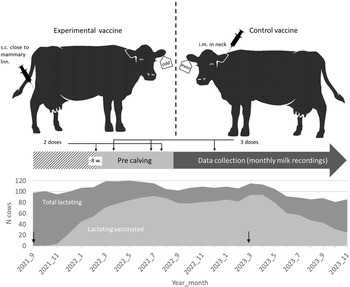
All pregnant animals in the herd were recruited to the study and were vaccinated according to the manufacturer’s instructions. Animals in the test treatment group received two doses of the experimental vaccine subcutaneously in the region of the mammary lymph node 60 and 11 days before expected calving. Animals in the control group received three doses of the control vaccine (Startvac, Hipra, Amer, Spain) intramuscularly in the neck region 45 and 17 days before expected calving and 63 days after dose 2. Startvac will, according to the manufacturer, reduce the incidence of clinical and sub-clinical mastitis caused by coliforms, coagulase-negative Staphylococci and S. aureus (EMA, 2009). Vaccines were given on Tuesdays, generating a span of ±3 days from the manufacturer’s instructions. Animals were observed visually, and adverse effects (e.g. swelling, lethargy, inappetence) were recorded for up to 3 days after every vaccination.
Activity data of the animals was automatically recorded (Velos, cow collars, [Nedap] SAC, Kolding, Denmark) and used by barn staff for confirmation of adverse effects. During the period from August 2022 to February 2023, data from the Velos program were retrieved for vaccinated cows. Activity warnings (i.e. alterations in rumination time, eating time or time inactive) registered in the program were compared between vaccination groups. A schematic illustration of the experimental setup and vaccine coverage is presented in Fig. 1.
Schematic illustration of the experimental setup, vaccination regimes and lactating animals in the herd over the experimental period.

Figure 1 Long description
The illustration shows two cows, one receiving an experimental vaccine and the other a control vaccine. The experimental vaccine is administered subcutaneously near the mammary lymph node, while the control vaccine is given intramuscularly in the neck. The experimental group receives two doses and the control group receives three doses. Below the illustration, a timeline indicates pre-calving and data collection phases, with monthly milk recordings. A graph displays the number of lactating cows and those vaccinated from 2021 to 2023, with the x-axis labeled 'Year_month' and the y-axis labeled 'N cows'. The graph shows fluctuations in the total number of lactating cows and those vaccinated over time.
Data and statistics
Individual cow data (breed, lactation number, age, calving dates, culling date) and monthly milk recording data (milk yield, SCC, milk composition) were collected from SOMRS. Milk bacteriological test results were either collected from the bacterial classifier (Bacticam) data programme or from SOMRS (bacterial analyses conducted at SVA). Vaccination date and adverse effects were registered by the herd staff on paper and transferred to Microsoft Excel. Animal activity after vaccination was registered in the Velos data program. Data from the various input resources were transferred to Microsoft Excel and concatenated in R (R Core Team, 2021). SCC was transformed using the natural logarithm before statistical analyses. Descriptive analysis and univariate tests (i.e. t-test, chi-square test) examining differences between groups were performed using Microsoft Excel and PAST (Hammer et al., Reference Hammer, Harper and Ryan2001).
For milk yield and SCC, linear mixed-effects models were fitted using the ‘nlme’ package (Pinheiro et al., Reference Pinheiro, Bates and Team2025) in R. In both models, cow was included as a random intercept, and vaccine, lactation month and proportion of vaccinated animals were included as fixed effects. In the model for SCC, milk yield was additionally included as a fixed covariate. Lactation month (monthly SOMRS milk recordings over the lactation period) was treated as a categorical factor with 10 time points, allowing for non-linear effects of time on the response. The interactions between vaccine and lactation month and between vaccine and proportion of vaccinated animals were also included. To account for the time-series structure of the data, an autoregressive process of order 1 (AR(1)) was assumed for the error term. The linear mixed-effects model was followed by an analysis of variance (‘anova’ in base R, R Core Team, 2021) for statistical comparison of the fixed effects and interactions. The differences in milk yield and SCC between vaccination groups and per lactation months were analysed through least-square means analysis (‘emmeans,’ Lenth et al., Reference Lenth, Banfai, Bolker, Buerkner, Giné-Vázquez, Herve, Jung, Love, Miguez, Piaskowski, Riebl and Singmann2025). The fit of the linear regression models was evaluated by visual inspection of plots of standardized residuals vs predicted values, and Q–Q plot of standardized residuals. Statistical significance was set at the level P < 0.05.
Results
Vaccine coverage
Vaccination started in September 2021, and pre-calving vaccination continued for 18 months (until February 2023), data were collected for an additional 9 months (until November 2023). During the period when pre-calving vaccination occurred, a total of 251 calves were born in the herd. A total of 34 animals were excluded from the study for various reasons: 5 cows were included in a pilot study, 3 cows aborted, 3 cows received the wrong vaccine, 4 cows had rumen fistulae and 19 cows could not be vaccinated due to summer pasture. During the 19 months from February 2022 until September 2023, more than 50% of the lactating cows in the herd were vaccinated with any vaccine, and the highest vaccine coverage was 84%.
In total, data from 199 lactations were available from 144 animals. Animals vaccinated with the experimental vaccine contributed 103 lactations, and control animals contributed 96 lactations. The age and lactation number at first dose and first sampling did not differ significantly between the experimental group and the control group (t-test), nor did the geometric mean SCC in the last sampling before vaccination. Animals in the experimental group and the control group were, on average, 43.8 and 43.0 months old, and the average lactation number was 2.9 and 2.8, respectively (Table 2).
Descriptive cow data on animals included in the study
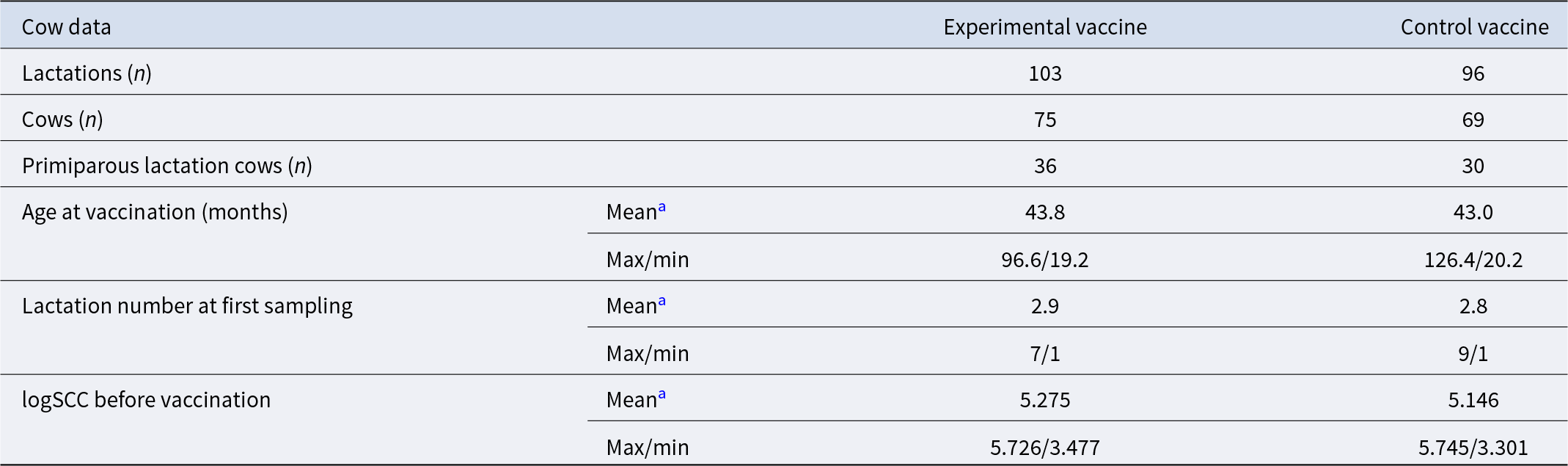
Table 2 Long description
The table provides definitions for variables related to udder health, focusing on infection and recovery rates during lactation and dry periods. It uses a somatic cell count (SCC) threshold of 150,000 cells/ml to categorize health status. For infection rate during lactation, the transition from below to above this threshold is noted between two consecutive milkings. Infection rate and recovery rate over the dry period is measured from the last lactation month as non-vaccinated to the first lactation month as vaccinated, and cathegorised according to change related to threshold. Health status is further categorized by cow type: primiparous and multiparous, with different SCC thresholds for being healthy, newly infected, or chronically ill. The table highlights the importance of monitoring SCC levels to assess udder health effectively.
a Value did not differ significantly between vaccine groups in t-test.
Adverse effects
A total of 498 vaccine doses were administered. Visual inspection and observations of local side effects were recorded for 458 (92%) of the injections. Swelling at the site of vaccination was observed after 76% of the injections with the experimental vaccine (146 out of 191). In most cases (122 out of 146 injections), the swelling was not larger than 7 cm in diameter. Twenty-four per cent of the injections with the experimental vaccine did not cause any adverse effects. Swelling at the site of injection was observed after one vaccination with the control vaccine. One injection with the control vaccine and three injections with the experimental vaccine caused a decreased well-being (e.g. lethargy, inappetence) of the vaccinated animal according to barn staff registrations.
During the time period when Velos program data were retrieved, 41 animals were vaccinated with the experimental vaccine (73 administered doses), and 46 animals were vaccinated with the control vaccine (115 doses). Activity warnings influenced by calving within 3 days of vaccination were excluded (n = 6). A warning in activity data was recorded after 13 injections in the experimental group (19%) and after 21 injections in the control group (18%).
Milk yield and SCC
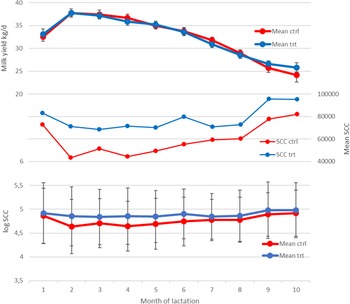
Monthly milk yield and SCC were followed for 10 months of lactation (Fig. 2). For the milk yield, lactation month and proportion of vaccinated cows had a significant effect (P < 0.001) in the linear mixed-effects model, but not the vaccine (P = 0.286), and there were no interaction effects. There were no significant differences in milk yield between the two vaccination groups for any month. For the SCC, both groups had mean SCCs below 100 000 cells/ml during the whole study period. The mean SCC for animals receiving the experimental vaccine was numerically higher throughout the study period, and the difference was significant in lactation months 2 and 4 (P < 0.05). In the linear mixed-effects model, vaccine (P = 0.034), lactation month (P < 0.001), milk yield (P < 0.001) and proportion of vaccinated cows (P = 0.001) had a significant effect on the cell count, but there were no significant interaction effects. Complete statistics for milk yield and SCC are presented in the Supplementary Material.
Milk yield and logarithmic somatic cell count (logSCC) per lactation month for cows vaccinated with the experimental (n = 103 lactations) or the control (n = 96 lactations) vaccine. Standard deviation is displayed as error bars (trt = experimental vaccine, ctrl = control vaccine). Non-logarithmic mean SCC inserted in the middle for clarity.
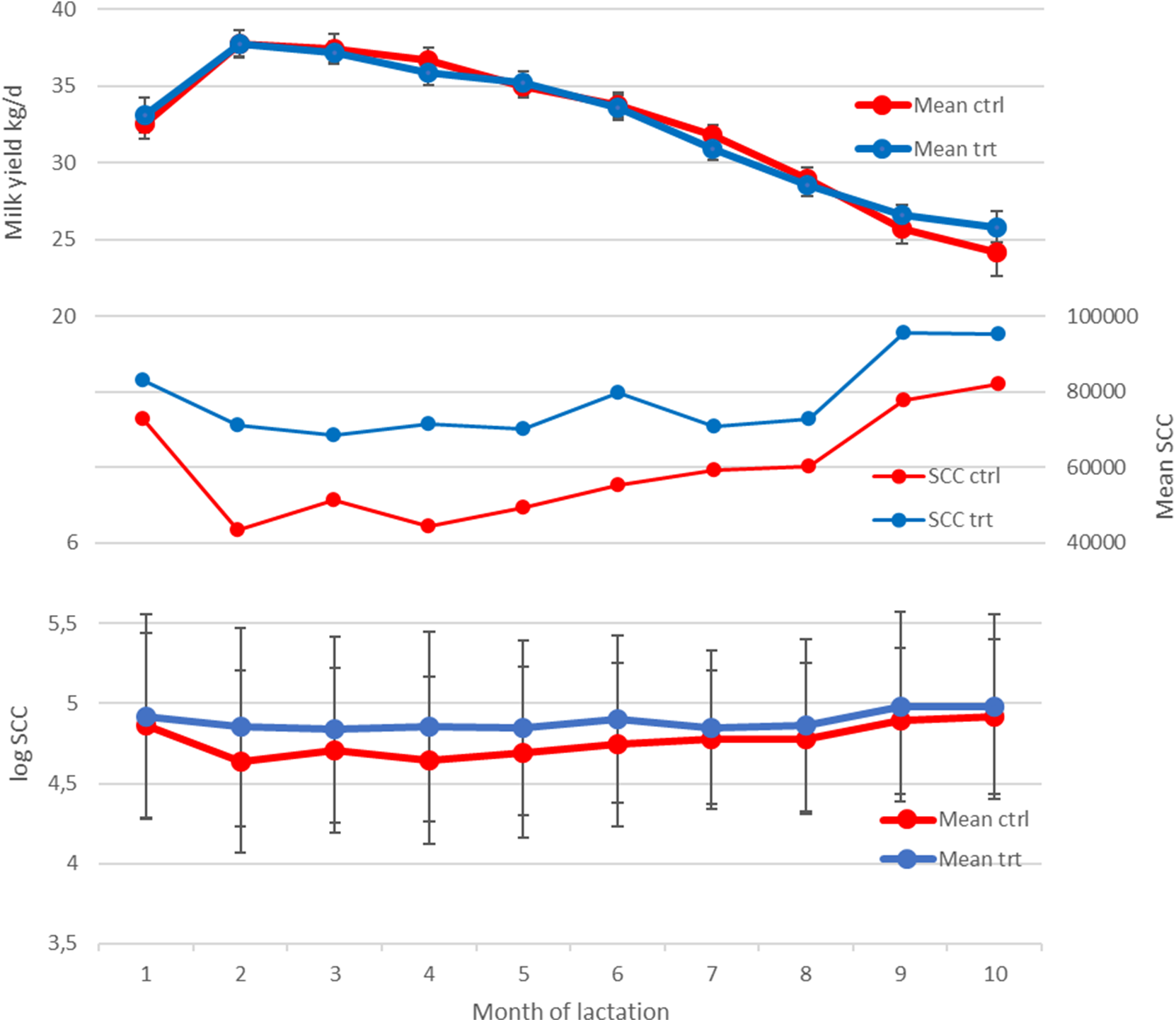
Figure 2 Long description
The first graph shows milk yield in kilograms per day on the y-axis, ranging from 20 to 40, against the month of lactation on the x-axis, from 1 to 10. Two lines represent mean values for control and experimental groups, with the control group starting at around 35 and decreasing to about 25, while the experimental group starts slightly lower and follows a similar trend. The second graph displays mean somatic cell count on the y-axis, ranging from 40,000 to 100,000, against the month of lactation on the x-axis. The control group starts at approx. 75 000 and the experimental group slightly above 80000. Both groups have a stable SCC for 8 months that increase in lactation month 9 and 10. The third graph shows logarithmic somatic cell count on the y-axis, ranging from 3.5 to 5.5, against the month of lactation on the x-axis. Both groups show similar trends with slight fluctuations and error bars are present for standard deviation.
Infection rates
A new infection during lactation was defined as an increase in SCC from below 150 000 cells/ml to over 150 000 cells/ml between 2 lactation months. For the experimental vaccine, data from 789 lactation months were available, giving 686 possible measurements, and the new infection rate was calculated to be 9.6%. For the control vaccine, data from 777 lactation months were available (681 measurements), and the new infection rate for this group was 8.4%. The difference in infection rate was not significant in a chi-square test (χ2(1, N = 1367) = 0.653, P = 0.42).
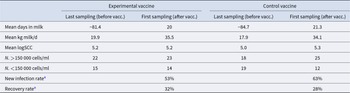
During the dry period, the new infection rate was calculated similarly to that during lactation. Cows with a SCC below the threshold of 150 000 cells/ml in the last lactation month before drying off and above the threshold in the first lactation month after calving were classified as newly infected. Cows with a SCC above the threshold of 150 000 cells/ml in the last lactation month before drying off and below the threshold in the first lactation month after calving were classified as recovered. Dry cow treatment was not given to any cow included in the comparison. For both vaccine groups, data from 37 animals were available, with the new infection rate for the experimental vaccine being 53% and for the control vaccine 63% (Table 3). The difference was not significant in a chi-square test (χ2(1, N = 34) = 0.334, P = 0.56). The recovery rate during the dry period was 32% for the experimental vaccine and 28% for the control vaccine (Table 3), not significant in a chi-square test (χ2(1, N = 40) = 0.077, P = 0.78).
Descriptive production data, new infection rate and recovery rate over the dry period for multiparous cows in a comparative vaccination study
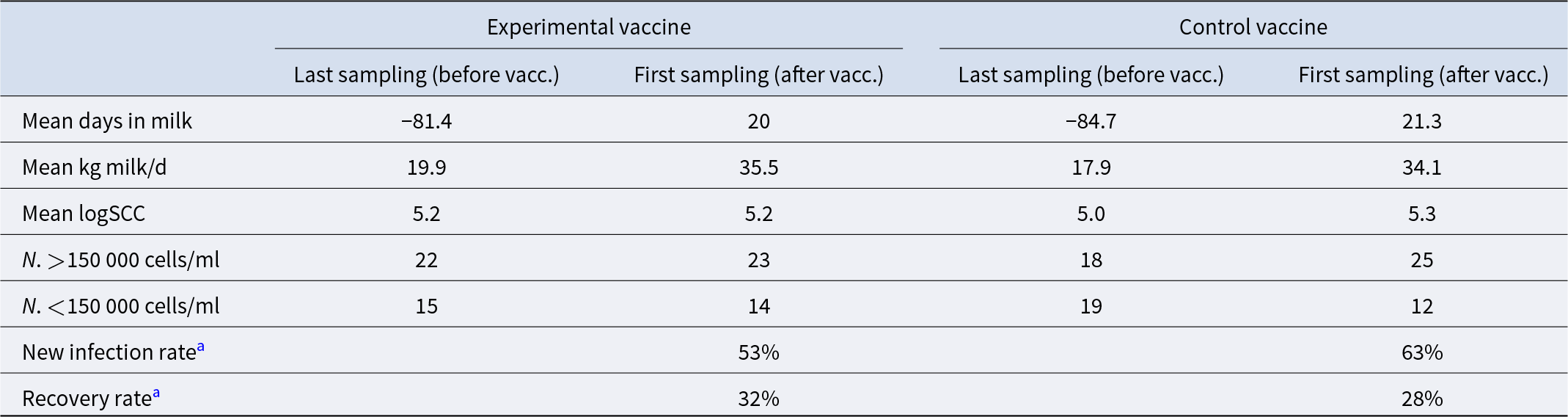
Table 3 Long description
The table compares production data and infection metrics for multiparous cows in a vaccination study, focusing on the dry period before and after vaccination. Key findings include a lower new infection rate in the experimental vaccine group (53%) compared to the control group (63%) after vaccination. Both groups showed similar recovery rates, with the experimental group at 32% and the control group at 28%. Mean milk production increased in both groups after vaccination, from 19.9 to 35.5 kg/day in the experimental group and from 17.9 to 34.1 kg/day in the control group. Mean logSCC remained stable in the experimental group and slightly increased in the control group. The number of cows with cell counts above 150,000 cells/ml increased in both groups after vaccination.
Note: Data for the dry period during which the animals were first vaccinated is used.
a Value did not differ significantly between vaccine groups in chi-square test.
Bacteriological sampling
Bacteriological sampling was based on herd requirements as specified in the materials and methods section. During the 19-month period when more than 50% of the lactating animals were vaccinated, 56 milk samples were collected from clinically and sub-clinically infected animals and subjected to bacteriological examination. Out of all samples, 13 showed growth of S. aureus. Out of these, five milk samples were obtained from cows vaccinated with the experimental vaccine, four from cows vaccinated with the control vaccine and four from unvaccinated cows. Compared with the period before the experiment, the sampling frequency was in a similar range (51 samples during the 12 preceding months). The prevalence of S. aureus-positive milk samples was higher (23%) during the experimental period compared to the 12 preceding months (14%). Other bacteria that were identified during the 19-month period were: streptococci (n = 15), NAS (n = 2), mixed flora (n = 9), Corynebacterium bovis (n = 5), Gram-negative bacteria (n = 7) and other (n = 5).
Herd udder health
Despite the increased prevalence of S. aureus-positive milk samples during the experimental period, the herd udder health improved according to data compiled by SOMRS (Table 4). Before the experiment, the herd had a 3-month average SCC of 271 000 cells/ml, 6 months after the pre-calving vaccination ended, the corresponding figure was 156 000 cells/ml. During the same period, the proportion of chronically infected animals decreased from 32% to 17%, the proportion of healthy animals increased from 49% to 67% and the new infection rate decreased from 19% to 10%.
Herd udder health metrics over the experimental period

Table 4 Long description
The table presents herd udder health metrics over three years, focusing on milk yield, somatic cell count (SCC), and cow health status. Milk yield per cow per year rose from 9,217 kg in Sept 2021 to 10,918 kg in Sept 2023. Concurrently, SCC, an indicator of milk quality, decreased from 271,000 to 156,000 cells/ml, suggesting improved udder health. The percentage of healthy cows increased from 49% to 67%, while chronically ill cows decreased from 32% to 17%. Newly infected cows also declined from 19% to 10%. Vaccine coverage peaked at 80% in Sept 2022 and dropped to 56% by Sept 2023. These trends indicate overall improvements in herd health and milk quality, The drop in vaccine coverage is expected due to seized vaccination and does not warrant furhter investigations.
Data are compiled from the Swedish Official Milk Recording Scheme (SOMRS), and a 3-month rolling average to the date indicated in the table is presented together with percentages of lactating cows that were vaccinated (with either of the two vaccines).
Discussion
The study design implied that all animals should be vaccinated with the experimental or the control vaccine. However, for various reasons, the entire herd was not covered, and at most 84% of the lactating cows were vaccinated. Complete vaccine coverage can be difficult to obtain with pre-calving vaccination protocols, and the present result is in accordance with a previous study (Landin et al., Reference Landin, Mork, Larsson and Waller2015), reporting that 174 out of 930 cows were excluded from data analyses, partly due to missed or wrongly vaccinated animals. The difficulty of adhering to a strict vaccination protocol with doses given at specific time points based on calving is recognized, and a rolling vaccination protocol where cows are vaccinated every 90 days has been suggested and evaluated (Bradley et al., Reference Bradley, Breen, Payne, White and Green2015). In the present study, however, both the experimental and control vaccines were given as two doses before expected calving, and the control vaccine as an additional dose after calving.
In addition to the difference in vaccine doses, the adjuvant and the route of vaccination also differed, the experimental vaccine being injected subcutaneously in the mammary lymph node region and the control vaccine intramuscularly in the neck region. Furthermore, the experimental vaccine only contained antigen from S. aureus, whereas the control vaccine was composed of antigens from both S. aureus and E. coli. A considerably higher number of local swelling reactions were recorded in the skin of the mammary gland than in the neck. The level of local reactions was higher than expected and higher than previously reported with a similar adjuvant (Camussone et al., Reference Camussone, Veaute, Pujato, Morein, Marcipar and Calvinho2014b). The local reactions declined with time, and only three animals injected with the experimental vaccine showed signs of decreased well-being compared to one animal receiving the control vaccine. The difference in observed local reactions could be attributed to the site of injection, as the skin close to the mammary lymph node is loose and inflammatory responses will be displayed more clearly compared to an intramuscular injection in the neck region. Despite the difference in local reactions, the proportion of activity warnings recorded in Velos program after administering vaccine doses were similar for both groups.
In the vaccine comparisons using monthly milk recording data, the milk yield did not differ significantly due to vaccine, but some differences in the SCCs were recorded. When a similar experimental setup with comparison of two different vaccines was used (Freick et al., Reference Freick, Frank, Steinert, Hamedy, Passarge and Sobiraj2016; Tashakkori et al., Reference Tashakkori, Khoramian, Farhoodi Moghadam, Heidarpour, Mashayekhi and Farzaneh2020), no overall differences were identified between the vaccination groups. In accordance, difficulties of demonstrating efficacy of mastitis vaccines have recently been pointed out in a meta-analysis (Mata et al., Reference Mata, Jesus, Pinto and Mata2023). In the present study, the mean SCC value was numerically higher in cows receiving the experimental vaccine during all lactation months and significantly different during two out of 10 lactation months, affecting the overall ANOVA. However, the lack of interaction with the percentage vaccinated and the non-consistent pattern of SCC difference hamper the interpretation. Several factors can impact the SCC, and while the experimental design accounted for animal age and parity, the udder health in lactations preceding the experiment was not considered in the study design.
All milk samples that were routinely collected in the herd were, according to the ViLa regulations, subjected to bacteriological assessment and determination of S. aureus prevalence. Implementation of vaccination did not reduce the number or frequency of S. aureus positive milk samples, in spite of implied herd udder health improvement. A stable prevalence of S. aureus positive milk samples was observed by Schukken et al. (Reference Schukken, Bronzo, Locatelli, Pollera, Rota, Casula, Testa, Scaccabarozzi, March, Zalduendo, Guix and Moroni2014) in one of the two herds when vaccination against S. aureus was introduced, whereas the prevalence of S. aureus decreased in the other herd; in that study, culling policy was a contributing factor to the reduced prevalence of S. aureus. In this study, S. aureus was only responsible for a small portion of the identified bacteria, and several species of Streptococcus including S. uberis and S. dysgalactiae, as well as Klebsiella, Trueperella pyogenes, Corynebacterium and E. coli, were among the pathogens identified in the milk samples. Thus, it is not unlikely that E. coli and other bacteria affected the SCC, and this would have had a greater impact on the group immunized with the monovalent experimental vaccine compared to the multivalent control vaccine.
The analysis of the compiled SOMRS data showed that there was a general and consistent improvement in udder health over the study period. It is notable that on the herd level, the proportion of animals considered to be chronically infected reduced from 32% before the vaccination trial to 17% six months after the programme ended. The observed infection rate, which did not differ between vaccines, is in line with the infection rate presented in the SOMRS compilation at the end of the experimental period. Udder health is a multifactorial trait and is affected by numerous management-related factors in a herd. It can thus not be excluded that management factors other than the vaccination against S. aureus mastitis contributed to the herd udder health status. Furthermore, from the available data, it is not possible to assign the indicated improvement of general udder health in the herd to either of the two vaccines used. However, the new infection rate during the dry period was numerically lower for those given the experimental vaccine. During this period, which also includes infections that occur during calving, the recovery rate tended to be improved for cows vaccinated with the experimental vaccine, although not significantly. Quillaja formulations like ISCOMs, Matrix and NanoQuil (G3) are known to balance the immune response into Th1/Th2, promoting a cell-mediated immunity with cytotoxic T-cells (van de Sandt et al., Reference van de Sandt, Kreijtz, Geelhoed-Mieras, Vogelzang-van Trierum, Nieuwkoop, van de Vijver, Fouchier, Osterhaus, Morein and Rimmelzwaan2014; Hjertner et al., Reference Hjertner, Bengtsson, Morein, Paulie and Fossum2018). Such an immune response is needed to resolve infections with intracellular pathogens, whereas antibody responses are most important in protection against extracellular pathogens. It is possible that the immune response induced by the NanoQuil vaccine contributed to the improved recovery rate and reduction in chronic infections that were noted during the dry period. Further research on Quillaja saponin-based vaccines as tools to be used to improve the udder health during the dry period and reduce the need for dry cow antibiotics is warranted.
In this comparative vaccination study, there were no differences observed in milk yield and only minor differences in SCC between the vaccine groups, even though the herd udder health considerably improved during the experiment. The vaccinations did not affect the number or frequency of S. aureus-positive milk samples from pre-trial values. The new infection rate, measured as an increase in SCC, did not differ between the two vaccine groups, although cows vaccinated with the experimental vaccine showed a numerically lower new infection rate during the dry period.
Supplementary material
The supplementary material for this article can be found at https://doi.org/10.1017/S0022029926102428.
Acknowledgements
This project was made possible through the actions of Bror Morein, whom we deeply acknowledge. He developed the NanoQuil adjuvant (Patent No. WO 2013/051994), the vaccine and had a crucial role in the project. Apart from Bror Morein and the financial contributors, we would like to acknowledge the staff at Rödbäcksdalen Research Station who handled the practicalities, especially Reija Danielsson, Jennie Burman, Juana Chagas, Sofie Liedgren and Mårten Hetta. Sigrid Agenäs is acknowledged for her early contributions and planning of the study.
Funding statement
This project was funded through donations from the foundation Seydlitz MP Bolagen, the Swedish innovation agency Vinnova through grant 2017-04166 and Savacc AB.
Competing interests
The authors declare no conflicts of interest.
Author contributions
All authors contributed to the planning of the experiment. J.D. was the principal investigator of the trial, collected and analysed the data and wrote the first manuscript. C.F. and C.L. contributed to the evaluation of results, planning and work on the manuscript. All authors read and approved the final manuscript.
Data availability
Data have been deposited in the Swedish National Data Service (snd.se) and can be accessed upon request through https://doi.org/10.5878/tgfd-cf92.
Ethics approval
The Swedish Medical Products Agency approved the experimental vaccine to be used on 120 animals in a clinical trial with record number 5.1-3030-101586. The Regional Animal Experiment Ethics Committee approved the animal experiment with record number A33-2020.



 Open access

