

1. Introduction
The deformation history in the northern Appalachians (southern New England through Atlantic Canada) during the Carboniferous is associated mainly with the docking and adjustment of the Meguma terrane to composite Laurentia along the Minas Fault Zone (MFZ) (Murphy et al. Reference Murphy, Waldron, Kontak, Pe-Piper and Piper2011; van Staal & Barr, Reference van Staal and Barr2012; Park et al. Reference Park, Treat, Barr, White, Miller, Reynolds and Hamilton2014; Waldron et al. Reference Waldron, Barr, Park, White and Hibbard2015; Park & Hinds, Reference Park and Hinds2020). This Carboniferous-Permian (330–260 Ma) deformation, also referred to as the Alleghanian orogeny, constitutes the final stage of oceanic closure by the collision of Africa with composite Laurentia to form the supercontinent Pangea (Hatcher, Reference Hatcher2002). Late Paleozoic magmatism is well known and widespread in the southern Appalachians, where over 60 Alleghanian plutons have been documented in contrast to very limited magmatism in the northern segment of the orogen (Samson et al. Reference Samson, Coler and Speer1995; Speer & Hoff, Reference Speer and Hoff1997; Hatcher, Reference Hatcher2005; Hibbard et al. Reference Hibbard, van Staal and Miller2007a, Reference Hibbard, van Staal and Rankin2010). The nearest Alleghanian intrusions to the Cape Spencer area are the Bank German pluton (Pe-Piper & Jansa, Reference Pe-Piper and Jansa1999; Pe-Piper et al. Reference Pe-Piper, Kamo and McCall2010), in the southwestern end of the Scotian Shelf, approximately 30 km southwest of Yarmouth, Nova Scotia (Canada), and the Sebago batholith and granitic pegmatites from New England (USA) (Tomascak et al. Reference Tomascak, Krogstad and Walker1996a, Reference Tomascak, Krogstad and Walker1996b, Reference Tomascak, Krogstad and Walker1998). The Alleghanian orogeny, in the context of the Canadian Appalachians, is palpable by major strike-slip movements along the MFZ (Murphy & Keppie, Reference Murphy and Keppie1998; Murphy et al. Reference Murphy, Waldron, Kontak, Pe-Piper and Piper2011; Waldron et al. Reference Waldron, Barr, Park, White and Hibbard2015) and localized thermal and magmatic events restricted to or in the periphery of shear zones (Kontak et al. Reference Kontak, Ansdell and Archibald2000, Reference Kontak, Archibald, Creaser and Heaman2008; MacHattie & O’Reilly, Reference MacHattie and O’Reilly2008; Pe-Piper et al. Reference Pe-Piper, Kamo and McCall2010, Reference Pe-Piper, Piper, McFarlane, Sangster, Zhang and Boucher2018). In this context, a group of leucocratic dykes have been described as intruding on the rocks in the Cape Spencer area and they also crosscut the deformational fabrics of the host rocks (Warner, Reference Warner1985; Nance, Reference Nance1986; Nance & Warner, Reference Nance and Warner1986), although have not been comprehensively studied. These bodies constitute an opportunity to provide an upper age constraint to the fabrics related to the deformation episode and the gold mineralization event (Watters, Reference Watters1993; Richard, Reference Richard2005) linked to these ductile to brittle fabrics. A lower constraint is already given by the age of the youngest unit affected by this deformation, i.e. the Lancaster Formation, which is considered Bashkirian (Park & Hinds, Reference Park and Hinds2020). In this study, the petrographical, whole-rock geochemical, U-Pb zircon and monazite geochronological characteristics, and Nd-Hf isotopic composition of the leucocratic dykes outcropping in the Cape Spencer area in southern New Brunswick, are presented to provide constraints on their petrogenesis and significance within the geological framework of the northern Appalachians and its tectonomagmatic evolution during the Alleghanian orogeny.
2. Geological overview
2.a. Regional geology
The northern Appalachians (Figure 1) developed through a long-term process of accretion and collision of peri-Laurentian and peri-Gondwanan (Ganderia, Avalonia, and Meguma) terranes to the Laurentian continental margin during the closure of the Iapetus and Rheic oceans between the late Cambrian and the Permian (Hibbard et al. Reference Hibbard, van Staal and Rankin2007b; van Staal, Reference van Staal2007; Hatcher, Reference Hatcher2010; Waldron et al., Reference Waldron, Schofield and Murphy2019). The Alleghanian orogeny includes all the events related to the collision/amalgamation of composite Laurentia with Gondwana (Hatcher, Reference Hatcher2010; van Staal & Barr, Reference van Staal and Barr2012); this collision, in the northern Appalachians, was dominated by dextral-strike-slip motion along the MFZ (Murphy et al. Reference Murphy, Waldron, Kontak, Pe-Piper and Piper2011). However, the effects of the Alleghanian orogeny are not restricted to the MFZ, with Alleghanian deformation through fault movement documented in the Gaspé Peninsula of Quebec (Jutras et al. Reference Jutras, Prichonnet and McCutcheon2003), Ar-Ar resetting around 270–300 Ma in shear zones in the southern Meguma terrane and associated offshore plutons (Reynolds et al. Reference Reynolds, Pe-Piper and Piper2012), in addition to shear zones formation (∼320 Ma) north of Yarmouth (Culshaw & Reynolds, Reference Culshaw and Reynolds1997).
Simplified lithotectonic division of the northern Appalachians. CCHF: Caledonia-Clover Hill Fault. MFZ: Minas Fault Zone. BVBL: Baie Verte Brompton Line. ML: Mekwe’jit Line (formerly Red Indian Line; RIL). SB: Sebago Batholith. SMB: South Mountain Batholith. Modified after van Staal et al. (Reference van Staal, Barr, Waldron, Schofield, Zagorevski and White2021).

The Caledonia-Clover Hill Fault in New Brunswick marks the boundary between Ganderia and Avalonia (Park et al. Reference Park, Treat, Barr, White, Miller, Reynolds and Hamilton2014; Waldron et al. Reference Waldron, Barr, Park, White and Hibbard2015). Avalonia describes a distinctive group of Neoproterozoic, arc-related, volcano-sedimentary sequences and plutonic rocks (Kerr et al., Reference Kerr, Jenner and Fryer1995; van Staal, Reference van Staal2007). The Caledonia terrane, i.e. a segment of Avalonia in southern New Brunswick, includes three Cryogenian to Ediacaran volcanic-sedimentary sequences and comagmatic intrusions (Pollock et al. Reference Pollock, Barr, van Rooyen and White2022; Waldron et al. Reference Waldron, McCausland, Barr, Schofield, Reusch and Wu2022), the recently recognized ca. 690 Ma Lumsden Group, the ca. 630–615 Ma Broad River Group and the ca. 560–550 Ma Coldbrook Group (Barr & White, Reference Barr and White1996a, Reference Barr and White1996b, Reference Barr and White1999; Barr et al. Reference Barr, van Rooyen, Miller, White and Johnson2019; Barr et al. Reference Barr, Johnson, Dunning, White, Park, Wälle and Langille2020; Johnson & Rossiter, Reference Johnson and Rossiter2022) (Figure 2(a)). These sequences are overlain by Cambrian to Early Ordovician sedimentary rocks of the Saint John Group, and several other Carboniferous and Triassic successions (Tanoli & Pickerill, Reference Tanoli and Pickerill1988; Landing, Reference Landing1996; Fyffe et al. Reference Fyffe, Johnson and van Staal2011). The Lumsden Group is characterized by chert and tuffaceous siltstone, intermediate crystal and lithic tuff, felsic volcanic rocks and associated plutons (Johnson & Rossiter, Reference Johnson and Rossiter2022). The Broad River Group includes intermediate and felsic crystal lithic tuff, mafic and felsic flows and associated plutons, tuffaceous sedimentary rocks, arkosic sandstone and conglomerate that have experienced regional metamorphism to greenschist facies along with ductile deformation (Barr & White, Reference Barr and White1996a). The Coldbrook Group consists of a first group of dacitic and rhyolitic flows and tuffs, and a second group of basaltic and rhyolitic units along with coarse clastic sedimentary rocks and comagmatic plutons, considered to be less deformed and metamorphosed than the Broad River Group (Barr & White, Reference Barr and White1999). The petrological characteristics of the igneous components of both the Lumsden and Broad River groups suggest an origin in a continental margin subduction zone, whereas the Coldbrook Group, because of its bimodal nature, is thought to have formed during extension after cessation of continental arc magmatism (Barr & White, Reference Barr and White1999; Pollock et al. Reference Pollock, Barr, van Rooyen and White2022).
(a) Simplified geological map of the Caledonia Highlands. Modified from Barr and White (Reference Barr and White1999). (b) Local geology of the Cape Spencer area. Modified from Watters (Reference Watters1993) and the bedrock geological compilation of the Cape Spencer area, maps National Topographic Series 21H/04 and 21H/05 (2004).

The MFZ marks the boundaries between Avalonia and the Meguma terrane (Williams, Reference Williams1979; Murphy et al. Reference Murphy, Waldron, Kontak, Pe-Piper and Piper2011). The Meguma terrane, the most outboard of the Appalachian terranes in Canada, derived from the West African craton (Clarke & Halliday, Reference Clarke and Halliday1985; Waldron et al. Reference Waldron, White, Barr, Simonetti and Heaman2009; White & Barr, Reference White and Barr2010; White et al. Reference White, Barr and Linnemann2018), constitutes a succession of Cambrian-Ordovician turbiditic sediments of the Goldenville and Halifax groups and mid to late Devonian granitoids that include the South Mountain Batholith (Clarke et al. Reference Clarke, MacDonald and Tate1997, Reference Clarke, MacDonald and Erdmann2004; White, Reference White2010).
2.b. Local geology
The Cape Spencer area is located 15 km southeast of Saint John, New Brunswick, within the Caledonia terrane, representing a segment of Avalonia in southern New Brunswick (Barr et al. Reference Barr, Johnson, Dunning, White, Park, Wälle and Langille2020). The Cape Spencer area presents polyphase fold-and-thrust style deformation of the rock units (Nance & Warner, Reference Nance and Warner1986; Nance, Reference Nance1987) and is centred along the Millican Lake Fault, a NE-SW striking fault (Figure 2(b)). The lithological units present in the area include mainly mafic volcanic rocks and a lesser amount of felsic volcanic rocks of the Coldbrook Group, and rocks of the Millican Lake Granite, a name used to refer to a group of highly sheared intrusions consisting of granite, granodiorite and leucogranite with a U-Pb (zircon) age of 623 ± 2 Ma (Watters, Reference Watters1993). These units commonly share thrust-faulted contacts with the purple/grey siltstone, slate, coarse-grained polymictic conglomerate and granite-cobble conglomerate of the Cape Spencer Formation (Watters, Reference Watters1993; Barr & White, Reference Barr and White1999). Given the unclear relationship between the Cape Spencer Formation and the Millican Lake Granite, the age of the former remains ambiguous. However, Barr and White (Reference Barr and White1999) included it in the Broad River Group based on the similarity of some components shared by the clastic units.
The reddish-brown quartz-pebble conglomerate, medium-grained sandstone and shale of the Balls Lake Formation (Visean-Serpukhovian) are faulted against both the underlying Cape Spencer Formation and the overlying grey quartzose sandstone and siltstone, shale and conglomerate of the Lancaster Formation (Bashkirian) (Watters, Reference Watters1993; Park & Hinds, Reference Park and Hinds2020). The West Beach Formation includes intensely deformed basalt with grey shale and siltstone interbeds (Park et al. Reference Park, Treat, Barr, White, Miller, Reynolds and Hamilton2014).
Watters (Reference Watters1993) described the presence of two main deformation phases in the Cape Spencer area: an early deformation D1, produced folds (F1), verging to the NW with a pressure-solution cleavage (S1) dipping to the SE-SSE. The succeeding phase of deformation, D2, produced conjugate SE- and NW-dipping thrust faults and a late minor set of folds (F2), overturned to the SE-SSE with a cleavage (S2) dipping to the NW-NNW that crenulates S1. The area is dominated by thrusts and reverse faults associated with the F1 folds and S1 cleavage, in addition to NW-dipping reverse faults offsetting both the F1 folds and associated thrusts (Nance, Reference Nance1986; Watters, Reference Watters1993). The overprinting relationships of folds and cleavage, including reversed overprinting geometries, suggest near-contemporaneous events (Park & Hinds, Reference Park and Hinds2020). Gold mineralization occurs along strongly faulted and sheared lithological contacts between the Millican Lake Granite and the Cape Spencer Formation within pyrite-rich portions of illitized (illite-carbonate ± quartz ± pyrite ± specularite) zones (Ruitenberg, Reference Ruitenberg1995) localized along D2 thrust faults and folds. The gold is associated with quartz ± carbonate ± plagioclase ± sulphide (pyrite, chalcopyrite) ± specularite veins that vary from several millimetres to several decimetres in width that parallel the folded S1 cleavage and (or) the S2 cleavage (Watters, Reference Watters1993). The deformational fabrics associated with gold mineralization are crosscut by aplitic sill-like masses and smaller dykes, and are the focus of this study (Warner, Reference Warner1985; Nance, Reference Nance1986).
3. Material and methods
3.a. Sampling and element analyses
Ten representative samples of the dykes were selected for petrological and geochemical analyses around the Cape Spencer area, following detailed field investigations and sample collection. Polished thin sections of the rocks were prepared at the University of New Brunswick. The geochemical analyses were performed on fresh and representative samples by Activation Labs (Actlabs) in Ancaster, Ontario that were crushed and split to 0.5 kg, then pulped in a ceramic mill. They were then analysed using lithium borate fusion inductively coupled plasma-optical emission spectrometry (ICP-OES) and mass spectrometry (ICP-MS) for major- and trace-element analyses, respectively. Analytical uncertainties using these techniques are less than 1%. Elements such as Au, As, Br, Cr, Ir, Sc, Se and Sb were analyzed by Instrumental Neutron Activation Analysis. Quality assurance and quality control procedures, including the use of blanks, duplicates and standards, were maintained to obtain precise and accurate results.
3.b. LA-ICP-MS in situ zircon and monazite geochronology
In situ zircon and monazite U-Pb geochronology were performed on standard polished thin sections (thickness of 30 μm and 120 μm) at the University of New Brunswick. Analyses were performed using a Resonetics S-155-LR 193 nm ArF (excimer) laser ablation system coupled to an Agilent 8900 ‘triple quad’ ICP-MS. The ablation work was supported by scanning electron microscope-backscattered electron imaging obtained at the UNB Microscopy and Microanalysis Facility with a JEOL LSM-6400 Scanning Electron Microscope using an accelerating voltage of 15 kV and 1 nA current. Images were acquired using a Digiscan II controlled by Gatan Digital Micrograph software. The monazite standards GSC8153, and 44 069 were used for calibration (GSC8153) and verifying accuracy of unknowns. All analyses comprised 30s of background analysis prior to 30s of sample ablation. The laser produced shallow (<3 μm) 8 μm diameter pits using 3 Hz pulse rate and laser fluence of 3 J/cm2. The zircon standards FC-1 and Plesovice were used for calibration and to check accuracy. The laser produced shallow 10–19 μm diameter pits using 3 Hz pulse rate and laser fluence of 3 J/cm2. Analyses were processed with Iolite v3.7.
3.c. Whole-rock Sm-Nd and Lu-Hf-isotope analysis
Four powdered samples of the dykes were prepared and measured in the Isotope Geochronology and Geochemistry Research Centre (IGGRC) at Carleton University. Rock powders were doped with a 148Nd-149Sm mixed spike before they were dissolved in mixed concentrated HF and HNO3. The sample digests were also sequentially dissolved in 7M HNO3 and in 6M HCl and were evaporated to dryness. Sample residues were then taken up in 2 ml 3M HCl and loaded onto prepacked 2 ml LN-resin columns (50 to 100 µm, Eichrom Technologies, LLC, USA). The columns were first washed with 15 ml 3M HCl and wash solutions were collected (containing other elements including Sr, light and middle rare elements (REEs)). The columns were then washed with 20 ml 6M HCl to remove Yb and Lu completely. Hf was finally eluted with 4 ml of 2M HF after Ti was eluted with 10 to 20 ml 4ML HCl + 0.5% H2O2.
Wash solutions from Hf columns were evaporated to dryness and the residues were dissolved in 1.5 ml of 2.5 M HCl and loaded onto 14-ml Bio-Rad borosilicate glass chromatography columns containing 3.0 ml of Bio-Rad AG50W-X8 cation exchange resin. Columns were washed with 16 ml of 2.5 M HCl before Sr was eluted with 7 ml of 2.5 M HCl. Columns were washed with 3.5 ml of 6M HCl before REEs were eluted using 9 ml of 6M HCl. REE fractions were dissolved in 0.26M HCl and loaded onto 2 ml prepacked Ln resin columns (50 to 100 µm, Eichrom Technologies, LLC, USA). Nd was eluted using 0.26M HCl, followed by Sm elution using 0.5M HCl. Nd-isotope ratios were measured using IGGRC’s Thermo-Finnigan Neptune MC-ICP-MS. Nd and Hf isotopic ratios were normalized against 146Nd/144Nd = 0.7219 and 179Hf/177Hf = 0.7325, respectively. 143Nd/144Nd ratios were also normalized to JNdi-1 average value 0.512100 measured by IGGRC’s Thermo-Finnigan Triton TIMS.
The average values of reference materials for a period of five months covering this analysis session are NBS987 87Sr/86Sr = 0.710240 ± 0.000019 (2SD, n = 38), JNdi-1 143Nd/144Nd = 0.512095 ± 0.000014 (2SD, n = 65), JMC475 176Hf/177Hf = 0.282164 ± 0.000014 (n = 8). In the last four years, the USGS rock standards’ average values are BCR-2 87Sr/86Sr =0.705000 ± 0.000027 (n = 37), 143Nd/144Nd=0.512625 ± 0.000008 (n = 14), 176Hf/177Hf = 0.282869 ± 0.000016 (n = 5); and BHVO-2 87Sr/86Sr=0.703485 ± 0.00004 (n = 3), 143Nd/144Nd = 0.512974 ± 0.000011 (n = 6), 176Hf/177Hf = 0.283113 ± 0.000004 (n = 3). The total procedure blanks were <50 pg for Nd and <70 pg for Hf. The Sm/Nd column procedures were also described in Cousens (Reference Cousens1996) and Hf columns in Yang et al. (Reference Yang, Zhang, Chu, Xie and Wu2010).
4. Results
4.a. Petrography of dykes
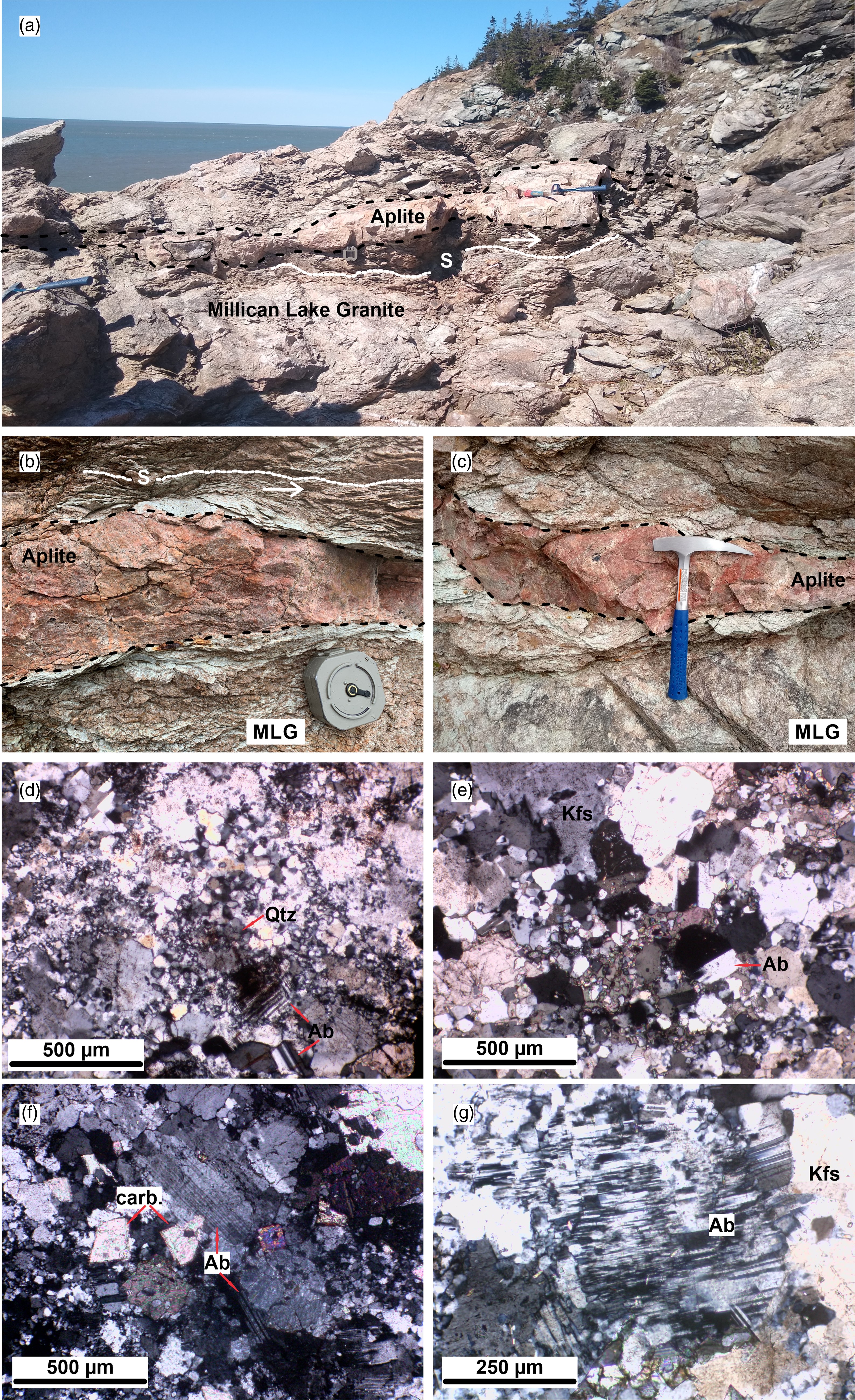
Leucocratic non-foliated dykes, with thickness varying between 10 cm and 50 cm, occur both parallel to and crosscut the foliation in the host rocks, i.e. the Millican Lake Granite and the Cape Spencer Formation, and exhibit a secondary earthy hematization that results in a pinkish red colouration (Figure 3(a)). The leucocratic dykes are exposed on the northern coast of the Bay of Fundy, around Cape Spencer and have also been identified inland in drill core. These low-angle (5–30°) sill-like bodies exhibit high variability in their attitude and vary from fine-grained to typically very fine-grained sugary aplites with sharp contacts (Figure 3(b) and c). Based on their mineral assemblage, these dykes are classified into albitites. Albite (50–90%) and quartz (5–40%) are the principal components of these dykes (Figure 3(d) and (e)); carbonate (1–5%) (Figure 3(f)) and K-feldspar (1–5%) constitute the second most important components. Accessory minerals include specularite, pyrite, zircon and monazite. The albite (An content less than 10%) is normally subhedral, with the development of twin lamellae and Carlsbad twins; chess-board albite also occurs (Figure 3(g)), characterized by a dense array of narrow discontinuous albite lamellae. These albites (0.1 to 0.5 mm) occur with clear and colourless rhomb carbonates (0.05 to 0.3 mm). X-ray diffraction patterns for the rhomb carbonate indicate that this is mostly ankerite. K-feldspar is a minor phase and is found as subhedral to anhedral plates, or as relics in albite in association with anhedral quartz crystals; the diameters of the quartz and K-feldspar crystals vary from 0.02 to 0.5 mm. Both albite and quartz host small inclusions of carbonate.
Field photographs and polished thin section photomicrographs of the aplitic textured leucogranitic dykes in the Cape Spencer area. (a) Aplitic dyke intruding the Millican Lake Granite following its foliation (S). (b) Aplitic dyke exhibiting its characteristic pinkish-red colouration in sharp contact with the host rock. (c) Specularite in aplitic dyke. (d) Tonalitic dyke (XPL). (e) Albitite dyke (XPL). (f) Carbonates with albite. (g) Chess-board albite. Qtz: quartz, Carb.: carbonate, Ab: albite, Kfs: K-feldspar.
4.b. Major- and trace-elements characteristics
Chemical discrimination by means of the multi-cationic diagram from De la Roche et al. (Reference De la Roche, Leterrier, Grandclaude and Marchal1980) results in samples forming a continuous spectrum from nepheline syenite to granite fields (Figure 4(a)), despite the samples having few K-feldspar and evident low K2O contents, reflecting the ultrasodic composition of these dykes. All samples are metaluminous (A/CNK = 0.74–0.96), except for AP-08 (A/CNK = 1.10) (Figure 4(b)).
(a) R1-R2 multi-cationic classification diagram (De la Roche et al. Reference De la Roche, Leterrier, Grandclaude and Marchal1980). (b) Chemical composition – Shand index plot. Fields are from Maniar and Piccoli (Reference Maniar and Piccoli1989); A/CNK = Al2O3/(CaO + Na2O + K2O), A/NK = Al2O3/(Na2O + K2O), in moles.

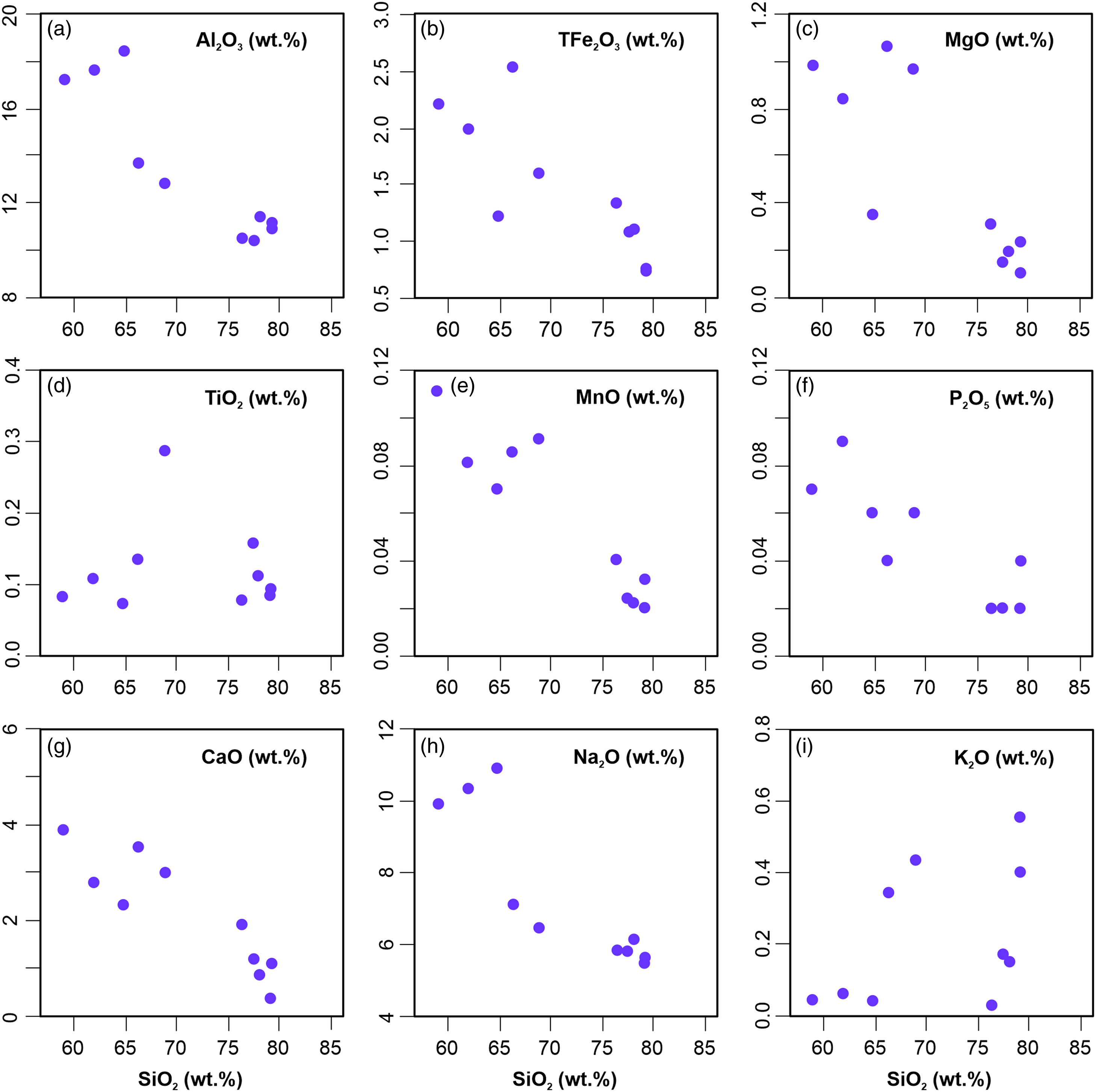
Major element concentration data for the dykes are provided in Table 1. The felsic dykes have a wide range of chemical compositions, with SiO2 = 58.94 – 79.24 wt.%, Al2O3 = 10.50 – 18.50 wt.%, Na2O = 5.50 – 10.89 wt.% and CaO = 0.38 – 3.88 wt.%. In general, most major oxides are negatively correlated with SiO2, except for K2O and TiO2 (Figure 5).
Major element concentrations (wt.%) for the dykes studied. LOI = loss on ignition

Representative Harker diagrams for the dykes showing variations of selected elements (versus SiO2).
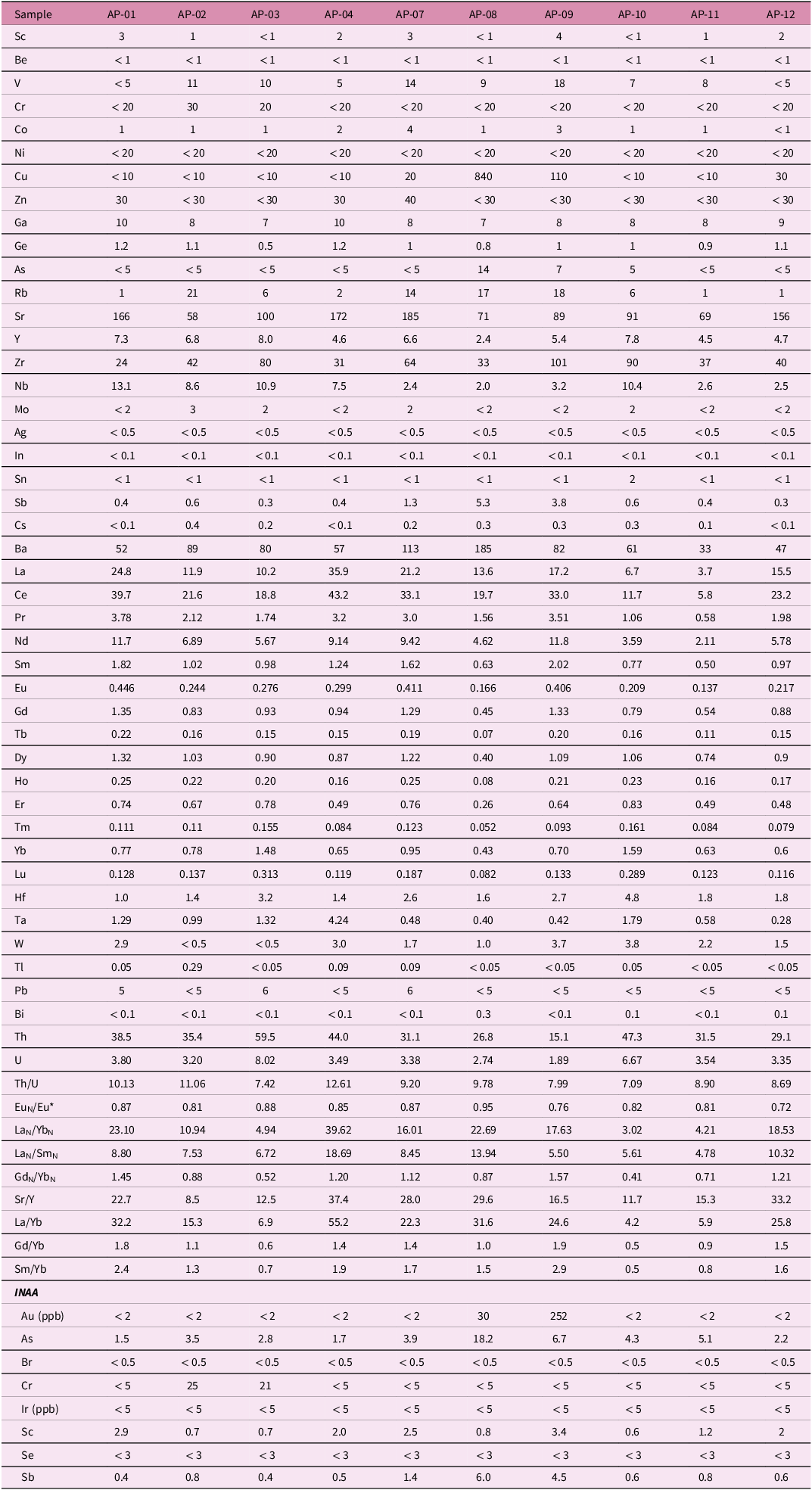
The trace-element compositions for the Cape Spencer dykes are provided in Table 2. Primitive-mantle normalized (Sun & McDonough, Reference Sun and McDonough1989) spider diagrams (Figure 6(a)) show enrichment in Th and U and depletion in high field strength elements (HFSEs: Nb, P, and Ti). Taken collectively, the abundances of large-ion lithophile elements (LILEs: Cs, Rb, Ba, and Sr) are low relative to the average crustal values from Taylor & McLennan (Reference Taylor and McLennan1995) [Cs (≤0.4 ppm), Rb (≤21 ppm), Ba(≤185 ppm), and Sr (≤172 ppm)]. Chondrite-normalized REE patterns show similar negatively sloping rare earth elements, moderately to slight light rare element enrichment (LaN/SmN = 4.8–18.7), slightly positive heavy REE slopes (GdN/YbN = 0.4–1.4) and variable (LaN/YbN) ratios [REE, (La/Yb)N = 3.02–39.62, where N indicates chondrite normalized with values from Sun & McDonough (Reference Sun and McDonough1989)]. Europium anomalies are slightly negative for all aplitic samples [(EuN/Eu*) = 0.72–0.95, where Eu* = √(SmN x GdN)] (Figure 6(b); Table 1).
Trace elements compositions (ppm) for the dykes studied
(a) Primitive-mantle normalized trace-element diagram. (b) Chondrite-normalized rare earth element diagram. Normalization factor after Sun & McDonough (Reference Sun and McDonough1989).

The Nb/Ta ratios (Figure 7(a)) are much lower than primitive mantle and mantle-derived melts, including both mid-ocean ridge basalts and ocean island basalts (avg. Nb/Ta = 17.5 ± 2; Green, Reference Green1995) and the Earth’s mantle (Nb/Ta ∼ 16; Pfänder et al. Reference Pfänder, Münker, Stracke and Mezger2007; Arevalo & McDonough, Reference Arevalo and McDonough2010); the ratios are also lower than in the average continental crust, i.e. Nb/Ta ∼ 11 (Taylor & McLennan, Reference Taylor and McLennan1985, Reference Taylor and McLennan1995; Green, Reference Green1995; Rudnick & Gao, Reference Rudnick and Gao2014). Some of the samples plot below Nb/Ta ∼ 5, a ratio suggested to represent a threshold between purely magmatic systems (Nb/Ta > 5) and magmatic-hydrothermal systems (Nb/Ta < 5) (Ballouard et al. Reference Ballouard, Poujol, Boulvais, Branquet, Tartèse and Vigneresse2016). Zr/Hf ratios are lower than the range 33–40, which includes values of both chondrites and crust defined by Jochum et al. (Reference Jochum, Seufert, Spettel and Palme1986). Magmatic affinity was also determined using the parameters of Ross & Bédard (Reference Ross and Bédard2009) (Figure 7(b)); dykes plot in the calc-alkaline magmatic affinity field, an indication of mixing of different magma sources consistent with subduction zone magmas where the breakdown of hydrous minerals occurs resulting in the liberation of aqueous solutions (Kelley & Cottrell, Reference Kelley and Cottrell2009; Zheng, Reference Zheng2019; Vermeesch & Pease, Reference Vermeesch and Pease2021).
Trace element-based discrimination diagrams. (a) Nb/Ta vs. Zr/Hf diagram. Primitive mantle data are from McDonough & Sun (Reference McDonough and SS1995) and continental crust data are from Taylor & McLennan (Reference Taylor and McLennan1985). (b) Th/Yb vs. Zr/Y diagram for discrimination of magmatic affinities. Modified from Ross & Bédard (Reference Ross and Bédard2009).

On tectonomagmatic discrimination diagrams (Whalen & Hildebrand, Reference Whalen and Hildebrand2019), the dykes fall within the slab failure field of the Nb vs. Y and Ta vs. Yb diagrams (Figure 8(a) and (b)). In the Rb vs. Y + Nb and Rb vs. Ta + Yb diagrams (not shown), most samples plot in the arc field; however, there are some samples plotting in the slab failure field or close to the boundary, resulting from the relative mobility of Rb. However, when using the fields from Reference Pearce, Harris and TindlePearce et al. (1984), samples plot in the volcanic-arc granite (VAG) field, except in the case of the Ta vs. Yb where there is spread of data from the VAG field into the syn-collision granite field, probably reflecting fractionation and crustal contamination, as this classification scheme tends to reflect magmatic sources rather than tectonic setting (Pearce, Reference Pearce1996; Förster et al. Reference Förster, Tischendorf and Trumbull1997). The use of other discriminators (Hildebrand & Whalen, Reference Hildebrand and Whalen2014) (not shown), such as Sr/Y, La/Yb and Sm/Yb, results in samples plotting in both fields, whereas Gd/Yb results in all samples plotting in the arc field. All the samples have an alumina saturation index of less than 1.1 and SiO2 concentration between 58.9 and 79.24 wt.%, exceeding the limit of 70 wt.% under which these discrimination diagrams are valid (Hildebrand & Whalen, Reference Hildebrand and Whalen2017); however, there is no correlation in samples with high SiO2 being plotted on a specific field.
Tectonomagmatic discrimination diagrams for dykes samples from the Cape Spencer area (Whalen & Hildebrand, Reference Whalen and Hildebrand2019). (a) Nb vs. Y. (b) Ta vs. Yb. Fields in grey are from Pearce et al. (Reference Pearce, Harris and Tindle1984).

4.c. Geochronology
Regardless of the attempts to avoid ablating fractures or inclusions while at the same time targeting specific domains so the effects of mixing could be controlled, samples display a dispersion of U-Pb data related to recent Pb-loss, common-Pb incorporation and inheritance. Zircons in these aplite samples are, for the most part, anhedral very fine grains up to 45–50 μm in size; these grains exhibit radiation damage (Figure 9(a)–(c)), elevated U (2000 – 94 000 ppm) and Th (500 – 45 000 ppm) concentrations, extensive microfracturing and to a large extent lack oscillatory zoning. Monazite within the dykes occurs as subhedral to anhedral very fine grains up to 25–30 μm in size that locally exhibit faint patchy zoning that resembles an outermost domain and a core (Figure 9(d)–(f)).
Scanning electron microscope-backscattered electron imaging of zircons (a–c) and monazites (d–f). (a–c) Metamictic zircons showing massive radiation damage. (d) Subhedral monazite displaying patching zoning (dotted black line). (e) fractured homogeneous subhedral monazite. (f) Subhedral rounded monazite displaying patchy zoning (dotted black line). Light blue circles correspond to spot locations (8 μm for monazite).

Zircon grains were analyzed (Supplementary Table S1) with the resulting data exhibiting significant common-Pb contamination necessitating correction to all ablated spots (common-Pb corrected using the measured 204Pb). Despite the correction, most spots are usually discordant (Figure 10(a)), which indicates a small residual 204Pb component below the instrument’s detection limit. The relative probability plot suggests most of the spots correspond to inherited material dating back to ca. 650 Ma (Figure 10(b)). There are two young populations, a small cluster around 275 Ma and an older group around 350 Ma, when plotting the data on a Wetherill Concordia diagram. Considering both the high degree of metamictization in zircon and textural setting that prevents the identification of rims, cores or zoning, the best estimate for the zircon crystallization age is based on a weighted mean 206Pb/238U age of 273.4 ± 4.2 Ma (MSWD = 1.03; n = 4), for the youngest cluster (Figure 10(d)), whereas the older group is 348.5 ± 3.1 Ma (MSWD = 0.53; n = 5), also based on a weighted mean 206Pb/238U age (Figure 10(c)).
LA-ICP-MS results of U-Pb zircon geochronology of samples from Cape Spencer. (a) Wetherill Concordia diagram for all data. (b) Relative probability plot and age histograms for zircon U − Pb ages. Bin width is approximately 20 Ma. (c) Weighted mean plot of 206Pb/238U ages for the older population. (d) Weighted mean plot of 206Pb/238U ages for the youngest population. Error bars are 2σ.

Monazite grains were analyzed using an 8 μm crater size (Supplementary Table S2), considering the small size of most grains; it was not possible to measure 204Pb, although it is present considering the Pb/U ratios. The results show a spread of data interpreted as the mixing between two different age domains. Assuming all samples are cogenetic and using 207Pb/206Pb based on a terrestrial model, it is possible to perform an anchored (207Pb/206Pb = 0.85 ± 0.01) Tera-Wasserburg regression, an age of 273.7 ± 1.3 Ma (MSWD = 0.29; n = 3) corresponding to the youngest end-member age population is determined (Figure 11(a)). A lower intercept age of 273.2 ± 9.2 (MSWD = 2.2) is obtained when plotting the monazite data on a conventional Concordia diagram (Figure 11(b)).
LA-ICP-MS results of U-Pb monazite geochronology of aplitic samples from Cape Spencer. (a) Tera-Wasserburg Concordia diagram for all data. The grey dashed line indicates a free regression through the data resulting in a nonviable low common 207Pb/206Pb intercept. (b) Conventional Concordia diagram for all data indicating a not anchored lower intercept at 273.2 ± 9.2 Ma.

4.d. Whole-rock Hf-Nd isotopes
The (176Hf/177Hf)i ratios in the Cape Spencer dykes samples range from 0.282561 to 0.282585, based on an age of 274 Ma, with εHf values in the range from -1.8 to -1.0, calculated at the same age (Table 3). The initial (143Nd/144Nd) i ratios observed in four samples from this study range from 0.511785 to 0.511993, based on an age of 274 Ma, with εNd values in the range from −9.7 to −5.7, calculated at the same age, and TDM values of 1.3–1.6 Ga (Table 3).
Nd and Hf isotopic data for the dykes from Cape Spencer

Note: Age correction for (143Nd/144Nd)i, (176Hf/177Hf)i, εNd, and εHf is 274 Ma. TDM was calculated using a linear evolution for a mantle separated from the chondritic uniform reservoir at 4.55 Ga with a present-day epsilon value of +10.
5. Discussion
5.a. Petrogenesis
The Cape Spencer dykes can be classified as albitites, based on their modal mineralogy, with high Na2O (av. 7.36) and low K2O/Na2O (av. 0.04), average molar A/CNK of 0.85 and A/NK of 1.11 (Figure 4(b)). Their metaluminous affinity, zircon content (24–101 ppm) and decreasing P2O5 with increasing SiO2 are characteristics of low-temperature I-type granitoids (Chappell & White, Reference Chappell and White2001; Chappell et al. Reference Chappell, White, Williams and Wyborn2004). The lack of parallel fabrics and the presence of replacement textures in the dykes indicate that the albitization process, in which K-feldspar was consumed, was of internal origin, i.e. autometasomatism, rather than metamorphism as the host rocks show no indication of alteration by a later event. There is a large range in loss on ignition, up to almost 5 wt.%, and it directly correlates with CaO, which indicates the suppression of An-content and crystallization of primary carbonate minerals (cf. Holloway, Reference Holloway1976). The primary nature of the (rhomb) carbonates is supported by the presence of inclusions in quartz and albite and the occurrence of single crystals. Although considered rare, the presence and crystallization of carbonates from granitic melts are constrained to pressures above 3 kbar (Swanson, Reference Swanson1979; Audétat et al. Reference Audétat, Pettke and Dolejš2004).
These dykes also reflect depletion in Nb, P and Ti, but enrichment in Cs, U and Th, which are typical features of magmas originating in a subduction zone (Taylor & McLennan, Reference Taylor and McLennan1985; Hofmann, Reference Hofmann1988; Bea et al. Reference Bea, Mazhari, Montero, Amini and Ghalamghash2011). In general, the Caledonia terrane plutons (ca. 630 -615 Ma) associated with the Broad River Group share most of these characteristics (Whalen et al. Reference Whalen, Jenner, Currie, Barr, Longstaffe and Hegner1994; Barr & White, Reference Barr and White1996b). Slab failure-related rocks derived through deep mantle processes that, for the most part, include partial melting of the upper portion of the torn slab (Hildebrand & Whalen, Reference Hildebrand and Whalen2014, Reference Hildebrand and Whalen2017; Whalen & Hildebrand, Reference Whalen and Hildebrand2019); the use of immobile element geochemical discriminators (Whalen & Hildebrand, Reference Whalen and Hildebrand2019) resulted in data plotting in both the slab failure and arc-related fields.
Overall, the low Nb/Ta ratios of these dykes constitute an intracrustal differentiation feature (Tang et al. Reference Tang, Lee, Chen, Erdman, Costin and Jiang2019; Ballouard et al. Reference Ballouard, Massuyeau, Elburg, Tappe, Viljoen and Brandenburg2020) and the low Zr/Hf ratios are characteristic of highly evolved magmatic rocks that have been derived through selective partial melting, then through fractional crystallization combined with hydrothermal interaction with released magmatic fluids (autometasomatic) (Bau, Reference Bau1996; Tartèse & Boulvais, Reference Tartèse and Boulvais2010). The Th and U averages in the Cape Spencer dykes are 35.8 ppm and 4.0 ppm, respectively. The Th/U ratios vary from 7.42 to 12.61, higher than the Th/U ∼ 4 accepted for both the crustal and mantle domains (Artemieva et al. Reference Artemieva, Thybo, Jakobsen, Sørensen and Nielsen2017; Wipperfurth et al. Reference Wipperfurth, Guo, Šrámek and McDonough2018), although it is known that Th/U ratios vary greatly in felsic rocks between 1 and 10 (Hasterok et al. Reference Hasterok, Gard and Webb2018), and that for some I-type granitoids, both Th and U contents increase with differentiation (Champion & Chappell, Reference Champion and Chappell1992; Villaseca et al. Reference Villaseca, Barbero and Rogers1998). These high Th/U ratios had to be, for the most part, inherited from the source and probably further enhanced by fractional crystallization and/or magma mixing (Scharfenberg et al. Reference Scharfenberg, Regelous and Wall2019). The slightly negative Eu-anomalies (EuN/Eu* = 0.72–0.95) may indicate early fractionation of primary plagioclase associated with a reduced melt.
5.b. Estimation of liquidus temperature
Temperatures of the magmas of these dykes are estimated using zircon, monazite and apatite solubility models. Considering the major element concentrations, the low Zr concentrations in the dykes yielded zircon saturation temperatures (TZircSat) of approximately 590–738 °C (average = 670 °C) [calculations using the formula of Watson & Harrison (Reference Watson and Harrison1983)]. It must be stated that TZircSat was calibrated for rocks with whole-rock compositions ranging from M = 0.9 – 1.9 (Watson & Harrison, Reference Watson and Harrison1983). This M value [M = (Na + K + 2Ca)/(Al.Si)] is a compositional parameter calculated by obtaining the molar amounts of each component, renormalizing and finally obtaining the ratio (Boehnke et al. Reference Boehnke, Watson, Trail, Harrison and Schmitt2013); M is essentially controlled by the silica content of the melt (Siégel et al. Reference Siégel, Bryan, Allen and Gust2018), i.e., the lower the silica content of the melt the higher the value of the M parameter, resulting in decreasing TZircSat for granitic magmas that are produced by fractional crystallization of mafic magmas (Harrison et al. Reference Harrison, Watson and Aikman2007). AP-01, AP-04, AP-07, AP-09 and AP-12 have M values of 1.9 – 2.4. The textural consistency of these dykes suggests rapid crystallization from a residual melt, with the consequent quenching in response to a rapid pressure drop. The dykes from Cape Spencer can be considered inheritance-rich intrusions. Although they constitute late segregated melts, the TZircSat should indicate an upper limit on the magma temperature and, therefore, a useful estimate of the initial magma temperature at the source (Miller et al. Reference Miller, McDowell and Mapes2003). The average TZircSat and the low concentrations of zirconium reinforce the classification of these dykes as true low-temperature melts (Brown, Reference Brown2013), as there is no indication of sequestration of zircon (Bea, Reference Bea1996). Monazite-saturation geothermometry (Montel, Reference Montel1993), using the bulk REE composition (∑REEi = La+Ce+Pr+Nd+Sm+Gd) to represent the melt composition and assuming 3 wt.% H2O content yields temperatures (TMonazite) of 562–690 °C. Some of the TMonazite values are higher than TZircSat values, suggesting the presence of additional REE-bearing phases.
5.c. Emplacement age and relation to gold mineralization
The dykes have an age of 273.7 ± 1.3 Ma based on U-Pb dating of monazite and constitute the youngest Alleghanian magmatic event in southern New Brunswick to this date. Because of the metamict nature of the zircon grains, an independent constraint was necessary to evaluate the meaning of the altered zircon ages. In this study, coexisting monazite geochronology supports the ∼274 Ma age from the altered zircons as the crystallization age. This age is also younger than the Ar-Ar ages (276.6 ± 0.9 and 283.7 ± 0.8 Ma) obtained by Watters (Reference Watters1993) on illites defining the fabrics associated with gold mineralization. Most aplitic dyke samples analyzed in this study contain low Au (<2 ppb), As (≤5.1 ppm), and Sb (≤1.8 ppm). Only samples AP-08 and AP-09 contain values above the detection limit for Au: 30 ppb and 252 ppb, respectively, and contain higher amounts of As (18.2 ppm and 6.7 ppm) and Sb (6.0 ppm and 4.5 ppm). Furthermore, low values of Ag (<0.5 ppm), Cu (<10 ppm), Pb (≤8 ppm), Sn (<2 ppm), W (≤3.8 ppm) and Mo (≤3 ppm) are consistent with the idea that there is no genetic link between the dykes and the gold mineralizing event in the Cape Spencer area.
It can be argued that the two clusters of zircon ages represent: 1) a phase of sodic metasomatism along the MFZ resulting in highly albitized granites and albite+quartz veins (the aplites of this study) around 350 Ma; 2) later fluid flow related to young hydrothermal zircon and monazite around 275 Ma. Examples of the former option are the intrusion (ca. 362–350 Ma) of granites and related dykes into the Tournaisian Horton Group (Dunning et al. Reference Dunning, Barr, Giles, McGregor, Pe-Piper and Piper2002; Koukouvelas et al. Reference Koukouvelas, Pe-Piper and Piper2002; Malay et al. Reference Malay, Braid, Archibald and McFarlane2023), and sodic alteration in the Cobequid Shear Zone dated by riebeckite (∼355 ± 4 Ma) (Pe-Piper et al. Reference Pe-Piper, Piper, McFarlane, Sangster, Zhang and Boucher2018). Regarding the younger cluster, several indications could be used to interpret the 275 Ma cluster as having recorded a hydrothermal event in the region. Firstly, 40Ar-39Ar ages (∼327 Ma) reflect fluid flow coeval with dextral shear along the Avalonia-Meguma boundary (Murphy & Collins, Reference Murphy and Collins2008). Secondly, hydrothermal veins containing allanite and pyrite (∼320–310 Ma) cut the Horton Group (Pe-Piper et al. Reference Pe-Piper, Piper, McFarlane, Sangster, Zhang and Boucher2018). Thirdly, hydrothermal mineralization associated with Zr-F-rich fluid complexes produced two zircon populations at ∼318 Ma and ∼309 Ma at Debert Lake, Nova Scotia (Ersay et al., Reference Ersay, Greenough, Larson and Dostal2022), in the context of the presence of fluorine to transport Zr (Rb-Sr on illite: 300 ± 6 Ma, associated to Pb-Zn and barite mineralization) in the Cobequid Shear Zone, Nova Scotia (Pe-Piper & Piper, Reference Pe-Piper and Piper2021; Ravenhurst et al. Reference Ravenhurst, Reynolds, Zentilli, Krueger and Blenkinsop1989). Nonetheless, the already established magmatic origin of these dykes rules out the possibility of the obtained age to represent a hydrothermal event similar to those just mentioned. Additionally, these dykes display sharp contacts with their host rocks, without alteration haloes. There is no further evidence of ongoing hydrothermal activity affecting the host rocks after the event responsible for the ductile to brittle fabrics related to gold mineralization with cooling ages of ∼277 Ma (Watters, Reference Watters1993).
5.d. Isotopic signature
Previous studies in the Caledonia terrane and Avalonia mainly focused on whole-rock Sm-Nd of volcanic and plutonic rocks (Whalen et al. Reference Whalen, Jenner, Currie, Barr, Longstaffe and Hegner1994; Samson et al. Reference Samson, Barr and White2000); therefore, there are few studies involving the use of Lu-Hf-isotope data. Available Lu-Hf analyses from Avalonia rocks are restricted to limited published in situ Lu-Hf-isotope data (Willner et al. Reference Willner, Barr, Gerdes, Massonne and White2013; Pollock et al. Reference Pollock, Sylvester and Barr2015, Reference Pollock, Barr, van Rooyen and White2022). The first study including in situ zircon Lu-Hf data from Avalonia in New Brunswick, i.e. the Caledonia terrane, showed a range of εHf (+4.3 to +7.8) for samples from the Broad River Group and comagmatic plutons and εHf values between +2.1 to +8.5 for the Coldbrook Group and comagmatic plutons; these data were interpreted to show mixing of juvenile and mantle-derived magma, in addition to other crustal sources with variable Hf isotopic compositions (Pollock et al. Reference Pollock, Barr, van Rooyen and White2022). Bickerton et al. (Reference Bickerton, Kontak, Murphy, Kellett, Samson, Marsh, Dunning and Stern2022) concluded that the zircon ε(-2.99 to +1.68) signatures from the SMB indicated a metasomatized mantle source followed by contamination of both rocks of an underlying Avalonian terrane and metasedimentary rocks of the Meguma terrane. The narrow range of negative εHf values of the dykes lies on a Hf evolution trajectory typical to rocks of the South Mountain Batholith (Meguma Terrane), the Broad River Group and the Coldbrook Group (Caledonia terrane) (Figure 12(a)). The vertical trajectory in the plot of the Cape Spencer samples implies significant recycling of an evolved crustal component.
(a) Hf-isotope evolution of εHf against age for the Cape Spencer dykes (this study). The evolutionary arrays for 1000 Ma and 1600 Ma crust with average upper crustal 176Lu/177Hf values of 0.015 (Griffin et al. Reference Griffin, Wang, Jackson, Pearson, O’Reilly, Xu and Zhou2002). Depleted mantle evolution curve from Griffin et al. (Reference Griffin, Pearson, Belousova, Jackson, van Achterbergh, O’Reilly and Shee2000). Hf-zircon analyses from the South Mountain Batholith (Bickerton et al. Reference Bickerton, Kontak, Murphy, Kellett, Samson, Marsh, Dunning and Stern2022) and the Caledonia terrane (Pollock et al. Reference Pollock, Barr, van Rooyen and White2022) are also shown. (b) Nd-isotope evolution of εNd against age for the Cape Spencer dykes (this study). Additional εNd data are from the Sebago Batholith and granitic pegmatites from the Topsham area (Tomascak et al. Reference Tomascak, Krogstad and Walker1996a, Reference Tomascak, Krogstad and Walker1998), the German Bank Pluton (Pe-Piper & Jansa, Reference Pe-Piper and Jansa1999; Pe-Piper et al. Reference Pe-Piper, Kamo and McCall2010), the South Mountain Batholith (Clarke et al. Reference Clarke, Halliday and Hamilton1988, Reference Clarke, MacDonald and Erdmann2004; Erdmann et al. Reference Erdmann, Jamieson and MacDonald2009; MacDonald & Clarke, Reference MacDonald and Clarke2017), Devonian Plutons (Whalen et al. Reference Whalen, Jenner, Currie, Barr, Longstaffe and Hegner1994, Reference Whalen, Fyffe, Longstaffe and Jenner1996; Mohammadi et al. Reference Mohammadi, Lentz, McFarlane and Cousens2020), Silurian Plutons (Whalen et al. Reference Whalen, Jenner, Currie, Barr, Longstaffe and Hegner1994) and the Caledonia terrane (Samson et al. Reference Samson, Barr and White2000; Whalen et al. Reference Whalen, Jenner, Currie, Barr, Longstaffe and Hegner1994). Field (green-shaded) for Avalonia from Nance & Murphy (Reference Nance and Murphy1996). Depleted mantle evolution curve from DePaolo (Reference DePaolo1981).

The εNd values for the Cape Spencer dykes plot outside the envelope for crustal-derived Avalonian rocks (Figure 12(b)), thought to be the result of repeated melting events with a common basement source (Nance & Murphy, Reference Nance and Murphy1996; Murphy & Nance, Reference Murphy and Nance2002), in contrast to the Devonian and Silurian plutons of southern New Brunswick and the Neoproterozoic intrusions in the Caledonia terrane. The dykes also show a stronger negative Nd isotopic composition than the Sebago Batholith and its associated leucogranites and aplites and the granitic pegmatites from the Topsham area (Maine, USA). These granitic pegmatites have crystallization ages ca. 270–273 Ma (Tomascak et al. Reference Tomascak, Krogstad and Walker1996b, Reference Tomascak, Krogstad and Walker1998), virtually the same ages as the Cape Spencer dykes, and therefore emplaced during the Alleghanian orogeny (Bradley et al. Reference Bradley, Shea, Buchwaldt, Bowring, Benowitz, O’Sullivan and McCauley2016). A couple of samples from Cape Spencer lie on hypothetical growth lines to a segment of the most negative εNd values of the SBM; a compilation of relevant Nd isotopic work on rocks from the South Mountain Batholith (Clarke et al. Reference Clarke, Halliday and Hamilton1988, Reference Clarke, MacDonald and Erdmann2004; Erdmann et al. Reference Erdmann, Jamieson and MacDonald2009; MacDonald & Clarke, Reference MacDonald and Clarke2017) reveals a large variation in εNd(380 Ma) with most data concentrated in the -7 to +0.1 range. Clarke et al. (Reference Clarke, Halliday and Hamilton1988) indicated, based on his Nd isotopic data, that the SBM had been generated by either melting of deep metasedimentary crustal material or by mixing of crustal materials with mantle-derived magma. The low εNd values (εNd(300 Ma) = −12.6 to −8.6) of the German Bank Pluton, more negative than those from the dykes, are comparable with Meguma metasedimentary rocks, indicating assimilation of sediments derived from the basement beneath the southwestern Scotian Shelf (Pe-Piper & Jansa, Reference Pe-Piper and Jansa1999). Pe-Piper et al. (Reference Pe-Piper, Kamo and McCall2010) interpreted the resulting isotopic signature in addition to the Paleoproterozoic model ages as a derivation of mixing magma of mantle origin with lower crustal melts.
5.e. Tectonic significance
In the northern Appalachians, the dextral-oblique Alleghanian collision between Laurentia and Gondwana (Hatcher, Reference Hatcher2002; Murphy et al. Reference Murphy, Waldron, Kontak, Pe-Piper and Piper2011; Waldron et al. Reference Waldron, Barr, Park, White and Hibbard2015, Reference Waldron, Schofield and Murphy2019) had started by at least 330 Ma and continued into the middle Permian, i.e. ca. 260 Ma (Nance & Linnemann, Reference Nance and Linnemann2008; Nance et al. Reference Nance, Gutiérrez-Alonso, Keppie, Linnemann, Murphy, Quesada, Strachan and Woodcock2012; van Staal & Barr, Reference van Staal and Barr2012). Although limited, Alleghanian orogenesis in the United States section of the northern Appalachians included high-grade metamorphism and associated magmatism that took place in the late Pennsylvanian and early Permian (Tomascak et al. Reference Tomascak, Krogstad and Walker1996a, Reference Tomascak, Krogstad and Walker1996b; Walsh et al. Reference Walsh, Aleinikoff and Wintsch2007). In the Canadian section of the northern Appalachians, Alleghanian magmatism is restricted to the German Bank Pluton (Pe-Piper et al. Reference Pe-Piper, Kamo and McCall2010; van Staal & Barr, Reference van Staal and Barr2012).
The input of mantle-derived material has already been described for the German Bank Pluton (Pe-Piper et al. Reference Pe-Piper, Kamo and McCall2010) and the South Mountain Batholith (Bickerton et al. Reference Bickerton, Kontak, Murphy, Kellett, Samson, Marsh, Dunning and Stern2022). From the Hf-Nd-isotope analyses, there is no indication of the involvement or mixing of mantle material for the Cape Spencer dykes, as those strong negative Nd values and the negative Hf values point to assimilation and reworking of old crust instead of a juvenile source.
Isotopic data from the Cape Spencer aplitic textured leucogranitic dykes show compositional ranges of whole-rock εNd(274 Ma) values from −9.7 to −5.7, εHf(274 Ma) from −1.8 to −1.0 and whole-rock Nd model ages (TDM) from 1.3 to 1.6 Ga. These isotopic characteristics suggest that the dykes are derived from the crystalline residuum of the magmas resulting from the partial melting of crustal source rocks that, while ascending, became contaminated with Meguma metasedimentary rocks and/or Avalonian sedimentary rocks. Continued subduction of the Rheic Ocean displaying an ongoing zipper-style closure derived in the Alleghanian collision of Gondwana with the Appalachian part of Laurentia (Kroner et al. Reference Kroner, Stephan and Romer2022); this process could have led to partial melting of the underthrust Avalonian basement, currently extending 50 km south of the surface suture (Pe-Piper & Jansa, Reference Pe-Piper and Jansa1999), under Meguma. Melt emplacement would be confined to favourable channels as faults, in this case, the MFZ with continued dextral-strike-slip motion during the Pennsylvanian-Permian (Murphy et al. Reference Murphy, Waldron, Kontak, Pe-Piper and Piper2011; Waldron et al. Reference Waldron, Barr, Park, White and Hibbard2015). With such an active environment, the fracturing of solid rocks will allow the extraction or ascent of evolved low T, carbonate-bearing granitic melt by the movement of the silicic parental melt.
6. Conclusions
The low T leucogranitic dykes show major and trace elements similar to those of I-type granitoids, although they exhibit evidence of autometasomatic albitization, but have igneous calcite. These dykes have an age of 273.7 ± 1.3 Ma, based on U-Pb dating of monazite and constitute the youngest magmatic event in southern New Brunswick to this date. The emplacement of these dykes provides a lower age constraint for the gold mineralization in the area, as they crosscut the various deformation fabrics of the host rocks to which gold deposition is related.
Nd-Hf isotopic signatures do not suggest the input of mantle-derived material for the dykes from the Cape Spencer area; instead, they point towards partial melting of a crustal source with assimilation of Meguma metasedimentary rocks and/or Avalonian sedimentary rocks. Important geodynamic events occurred during the Alleghanian orogeny with the continued subduction of the Rheic Ocean under composite Laurentia that provided the heat supply and material sources for these partial melts to form and ascend and be emplaced as aplitic dykes quenched due to depressurization associated with emplacement. The activation of deep crustal faults in response to the strike-slip motion that was taking place along the MFZ could have provided the means for the ascent of these low-T crustal melts.
Supplementary material
To view supplementary material for this article, please visit https://doi.org/10.1017/S0016756824000141
Acknowledgements
We want to thank Brandon Boucher (UNB) for assistance with LA-ICP-MS analysis. Dr. Shuangquan Zhang (Carleton University) is thanked for the help and supervision of Nd-Hf isotopic measurements. SEM work and BSE imaging were carried out with the help of Dr. Douglas Hall and Steven R. Cogswell (UNB). The authors acknowledge Dr. Georgia Pe-Piper and two anonymous reviewers for the meticulous and constructive reviews of the manuscript.
Financial support
Project was variably funded by the New Brunswick Department of Natural Resources and Energy Development and New Brunswick Innovation Foundation.
Competing interests
The authors declare none.


 Open access

