


7.1 Introduction
The Colombian Government signed a Peace Agreement with the Fuerzas Armadas Revolucionarias de Colombia (FARC)Footnote 1 guerrilla group on 26 November 2016 to end a civil war after more than fifty years of internal conflict. The Peace Agreement contains six chapters intended to create the necessary transformations to find a stable and lasting peace with the FARC. These chapters include obligations that the state agreed on with the rebels, some of which require enacting new general and specific agricultural policies that demand profound reforms of the existing domestic policies. The first chapter of the Peace Agreement contains a Comprehensive Rural Reform (CRR), which is expected ‘[to] contribute to the structural transformation of the rural areas, closing the gaps between the countryside and the city and creating conditions of well-being and good living for the rural population’ (Colombian Government FARC-EP 2016, p. 7). It also includes ‘the obligation to progressively realise the human right to healthy, nutritional and culturally appropriate food’ or in other words, the progressive realisation of the ‘right to food’ (ibid., p. 32). Thus, the Peace Agreement adopted a specific principled approach regarding the development of the rural economy, emphasising the importance of reciprocity, cooperation, and solidarity in the resulting trade relationships (Ministerio de Agricultura y Desarrollo Rural 2022, p. 16) and providing obligations that aim to ensure food security (Colombian Government FARC-EP 2016).Footnote 2 Such an approach potentially stands in contrast to a long-standing economic rationale underlying the creation of the World Trade Organization (WTO) and preferential trade agreements (PTAs) that are based on principles such as progressive trade liberalisation (Baggaley Reference Baggaley1998).Footnote 3
International trade rules have generally imposed obligations on states related to agricultural policies. As a result, ‘policy space’ to regulate domestic food production to adopt social policies has some restrictions. In ongoing discussions on how trade is a means to guarantee food security worldwide,Footnote 4 the UN Special Rapporteur on the Right to Food has pointed out that the WTO’s Agreement on Agriculture (AoA) (WTO 1995a) created more obstacles to trade by allowing a concentration on certain firms and preventing farmers from participating fairly and effectively with their goods (Fakhri Reference Fakhri2020, par. 27–31). For instance, specific instruments such as market access concessions (AoA, Art. 4) and safety and quality regulations can be used for protectionist purposes, creating barriers for member states to fulfil their right to food (Hawkes and Plahe Reference Hawkes and Plahe2013). In other words, trade regulations such as Article 4.2 potentially limit states’ policy space to revert tariff reductions that affect the food market to guarantee the right to food. Also, measures such as the European Green Deal create new barriers to some agricultural exports from the Global South.Footnote 5 Thus, as we will explain, trade agreements are compatible with the rural reform established with the FARC in the Peace Agreement.
One of the main aims of the CRR is to identify different alternatives to international trade at local, regional, and national levels, based on the concept of rural territory as a socio-historical context in which the communities play a leading role in the definition of the development and improvement of their living conditions (Colombian Government FARC-EP 2016). The CRR’s main aim is to guarantee the right to food for local communities through the development of a rural economy (market) according to the particular needs of the population that inhabit such communities. Under the definition of Rurality it is implied that it is only possible to guarantee the right to food with ‘rural development’ (CISAN 2022, p. 28) which focuses on production and supply within regions creating a high enough food self-sufficiency. This might go beyond food security understanding used for trade purposes in the AoA, as will be explained below.
This chapter examines the limits that international trade law – in particular, the WTO legal framework and PTAs – could create to uphold the right to food in the process of implementation of the Peace Agreement. It also addresses the degree to which Colombia can use its ‘policy space’ in light of its international commitments to achieve/strengthen the right to food of its people. In the end, we conclude that the rural reform plan included in the Peace Agreement is compatible with international trade agreements and such treaties do not hinder that plan.
The first section focuses on how international trade law policies are linked with food security and tend to collide with the right to food. Second, we describe the Peace Agreement structure and explain the scope for guaranteeing food security and food sovereignty. The third section specifies how the Peace Agreement enshrines the right to food as an objective. The following section reviews the obligations established in the WTO Agreement on Agriculture and in PTAs in the context of the Colombian post-conflict. Finally, we conclude that implementing the Peace Agreement Policies regarding the right to food falls under Colombia’s policy space as provided by international trade agreements.
7.2 The Right to Food and Trade Law Policies
The right to food is recognised as ‘the fundamental right of everyone to be free from hunger’Footnote 6 under Article 11 of the International Covenant on Economic, Social, and Cultural Rights. Other human rights treaties have adopted this concept also,Footnote 7 which the jurisprudenceFootnote 8 and doctrine have developed. The Special Rapporteur on the right to food has defined the right to food following a more sociological perspective inherent to our life in society:
It is the right for everyone to celebrate life through their meals with each other in communion. One of the most important ways that a community defines itself is through what, how, when and with whom they eat. Communities are made through shared holidays, memories, recipes, palates and manners of eating. Through these food practices, people create their social and political institutions.
The right to food is relevant to our societies, yet it might be negatively impacted by trade regulations at the international and domestic levels. At the same time, trade regulations also help to satisfy all kinds of human needs, including those concerning food supply. For instance, trade might help uphold the right to food in countries with limited domestic agriculture production where food supply relies mostly on imports. In other cases, trade may affect the right to food when domestic food prices increasingly depend on the global food market, which in turn negatively affects the local production of food (FAO 2010, p. 22).
It is important to note that the Agreement on Agriculture does not refer to the right to food but to food security (AoA, Preamble and Art. 20). The WTO Committee on Agriculture has defined itFootnote 9 following the 1996 Rome Declaration on World Food Security as: ‘… when all people, at all times, have physical and economic access to sufficient, safe and nutritious food to meet their dietary needs and food preferences for an active and healthy life’ (FAO 1996). In this way, trade is considered a fundamental tool for achieving food security (Ibid.)Footnote 10 because the trading system allows for the ‘policy space’ to establish food policies as part of the right to development.Footnote 11 In that sense, even though international trade rules (within the scope of the WTO and PTAs) are not focused on enhancing the right to food but on food security, pursuing the right to food through local policies is not forbidden as long as these comply with the trade disciplines and commitments provided in the agreements.
The concept of food security is embodied in the AoA. Even though it is only mentioned in the preamble of the referred Agreement,Footnote 12 it is a pillar of the obligation to continue negotiations, as provided in Article 20. c (non-trade concerns).Footnote 13 Colombian PTAs do not mention food security or the right to food. However, PTAs generally preserve the Parties’ ability to safeguard public welfare, and they were built ‘on their respective rights and obligations under the Marrakesh Agreement Establishing the World Trade Organization and agreements to which they are both parties’.Footnote 14
Recently, there has been a growing interest on the part of the WTO regarding the food security of its members. Indeed, for the organisation, it is fundamental to address how international trade could help to solve problems of scarcity and distribution, especially when the world is going through a food crisis worsened by the Covid-19 pandemic and current international conflicts.Footnote 15 Nevertheless, according to the Special Rapporteur on the right to food, the WTO system puts several limitations on fulfilling this right.Footnote 16 A fundamental limitation is that the AoA aims to enhance trade among its members rather than addressing their particular food needs (Yigzaw Reference Yigzaw2015, p. 175–176; Fakhri Reference Fakhri2020, par. 23). In the existing international trade legal framework (WTO and PTAs), the rights of companies and traders are privileged over the rights of consumers and small-scale farmers. It enhances privileged firms by keeping and safeguarding the interests of those who have the power within the food production chain (Fakhri Reference Fakhri2020, par. 27–28) instead of people’s needs.
The international discussion about this potential collision of rights also needs to consider access and input legitimacy issues, and that all voices are heard. For example, during the Conference of the Parties (COP) 26 in Glasgow, the Director General of the WTO, Ngozi Okonjo-Iweala, highlighted the importance of trade in addressing issues such as climate change and the food crisis (WTO 2021d). However, during the same meeting, only big corporations were invited to participate (Barret Reference Barret2021; James et al. Reference James2021), without any consideration of how these firms can influence the public policies adopted by the states on how to address the food crisis or climate change (even though the Conference of the Parties (COP) was fundamentally about the latter). Other international organisations may play a role in this debate. Margulis has recently documented that interventions by four different UN organisations – the Food and Agriculture Organization (FAO), the World Food Programme (WFP), the Office of the High Commissioner for Human Rights (OHCHR), and the Special Rapporteur on the Right to Food (SRRTF) – had an important role in agricultural trade liberalisation (Margulis Reference Margulis2023).
Regardless of the criticism, states are legally obliged to consider the AoA, other WTO Agreements, and PTAs when adopting suitable trade regulations that fulfil their food needs and must identify the policy space within these rules. According to FAO, although states count on policy space to guarantee food security, they need to use it more effectively (Matthews Reference Matthews2015). In that sense, FAO has affirmed that: ‘WTO rules are not intended to restrict the policy objectives of its members with respect to food and agriculture, but rather to discipline the use of policy measures which have adverse spillover effects on other countries. It is often possible to pursue policy objectives with instruments which are not restricted under WTO disciplines (Matthews Reference Matthews2015, p. 5)’.
Even though the right to food is not explicitly set in WTO rules and PTAs, the call for food security is provided, for example, in the preamble of these agreements, which with the evolution of the concept should reflect the understanding of this right as a whole. The definition of food security has been enriched since the 1970s (FAO 2002); it used to be limited to guaranteeing food access to a particular population. Nowadays, it also requires availability and is linked to concepts such as food sovereignty, food democracy, and, indeed, the right to food. The evolution of the idea of food security has opened the door to include all these elements in trade policies when necessary.
Under those considerations, national policies that aim for food security must guarantee the right to food and comply with the WTO legal framework (particularly the AoA), which aims to avoid market and trade distortions. There must be a proper balance to achieve both goals. With this purpose in mind, recently, the WTO adopted the Ministerial Declaration on the Emergency Response to Food Insecurity, which recognises the right of member states to adopt measures to increase food security considering their impact on the whole market and under the Organization’s legal framework (WTO 2022).Footnote 17
7.3 The Peace Agreement Scope
The main problems for the rural population in Colombia recognised in the Peace Agreement are, among others, the extreme land concentration, which emphasises the inequality in access to property rights that causes polarised social structures (Guereña Reference Guereña2016, p.10), food insecurity, deep gender inequality, and several marketing barriers that affect the commercialisation of their products (CISAN 2022, p. 12), which have to be solved to achieve a lasting peace. Because of the conflict, the economic development of several countryside zones has stagnated for a long time. Therefore, the Colombian state needs to change the economic conditions of people living in depressed rural areas and must implement strong policy measures to solve the food insecurity and marketing barriers that agricultural production faces, such as transportation and logistics problems arising from years of abandonment of disputed territories that have hindered production and marketing of agricultural products within Colombia and their exports.
There is a correlation between states’ exposure to internal conflicts and the deterioration of their food security due to direct war effects, such as violence, insecurity, and displacement (Abebe Reference Abebe2021), as the Special Rapporteur on the right to food concluded in his report on ‘Conflict and the right to food’. The report gave ‘an account of how different forms of violence in food systems harm people and generate the conditions that lead to human rights violations’ (Fakhri Reference Fakhri2022) and how violence makes more people poor, vulnerable, and marginalised (Ibid., par 3).
The armed confrontation in Colombia has been a conflict over land (Reyes Reference Reyes2016) in rural areas. According to the Unified Registry of Victims (‘Registro Único de Víctimas’ – RUV), there are approximately 8,219,403 victims of forced displacement due to events that occurred from 1985 to 31 December 2021 (Unidad para las Víctimas 2022). Peasants and farmers left rural areas in significant numbers, worsening economic production in such zones. Therefore, reforming rural areas is a crucial aspect of the Peace Agreement in Colombia. By granting access and usage rights to land, along with providing the necessary resources to cultivate it effectively, it is possible to address the root causes of the conflict in Colombia and pave the way for its resolution. The CRR is expected to contribute to the rural areas’ structural transformation, ‘closing the gaps between the countryside and the city and creating conditions of well-being and good living for the rural population’ (Colombian Government FARC-EP 2016, p. 7). The CRR has four pillars (Colombian Government FARC-EP 2016):
Pillar 1: A quantitative and qualitative land use and access increase.
Pillar 2: Establishing special development programmes with a regional perspective.
Pillar 3: The development of national plans to reduce poverty and extreme poverty in the countryside, centred on increasing productivity and consolidating the transition from an informal to a formal rural labour market (Ministerio de Agricultura y Desarrollo Rural 2019). This pillar recognises the fundamental economic role of the peasant, the family, and the community in rural development.
Pillar 4: Food and nutritional security are at the centre of the entire effort to transform the countryside. This pillar acknowledges the significance of recognising the advantages of improved nutrition in rural areas, where agricultural production has increased.
Hence, this reform is crucial for the transition to peace, as ‘recovery from conflict and its effects is not only about raising agricultural production and productivity – availability of food – but also about increased access to food’ (Flores Reference Flores2004, p. 16). In that regard, the Peace Agreement has provided a cross-cutting adoption of the food policy objectives through a system for the progressive realisation of the right to food conceived by the Agreement, specifically, the National Plans described above. It means that all the measures under the Peace Agreement related to the right to food must follow these policies. It is stated: ‘It is necessary to ensure that all national plans comply in a cross-cutting manner with the objectives of the proposed food and nutrition policy, through a system that articulates them in the territories’ (Colombian Government FARC-EP 2016, Point 1.3.4).
The following presents an analysis of one of the plans developed from pillar 3 of the Agreement. We aim to explore one of the most significant measures related to the right to food, which has been implemented thus far within the framework of the Peace Agreement.
7.4 Right to Food Measures under the Peace Agreement that May Be Related to Trade
7.4.1 The National Rural Plan of the System for the Progressive Guarantee of the Right to Food (SGPDA)
The social and economic situation of the rural population in Colombia is worrying. Besides the abovementioned high concentration of land ownership, other main problems are the low labour remuneration and the difficulties in income generation. In addition, the lack of adequate infrastructure, poor agricultural modernisation (lack of modern farm techniques), insufficient access to credit, barriers to commercialisation, limited development of science and technology, and the consequences of the armed conflict have generated a substantial gap in this segment of the population (CISAN 2022).
As mentioned, the Peace Agreement’s third pillar called for developing national plans to reduce poverty in the countryside. That led to the formation of the National Rural Plan of the System for the Progressive Guarantee of the Right to Food (SGPDA)Footnote 18 as a fundamental tool for transforming the territories. Its principal aim is to promote the well-being of the population living in the country’s rural and dispersed areas (CISAN 2022; Ministerio de Agricultura y Desarrollo Rural, Ministerio de Comercio, Industria y Turismo, Ministerio de Salud y Protección Social 2022). The Intersectoral Commission on Food and Nutritional Security heads the implementation and monitoring of the SGPDA. This is the highest governing authority for food and nutritional security in Colombia.
The Commission is composed of the Minister of Agriculture, the Minister of Health, the Minister of Commerce, the Minister of Education, the Minister of Environment, the Minister of Housing, the Minister of Equality and Equity, the Director of the National Planning Department, the Director of the Administrative Department for Social Prosperity, the Director of the Colombian Institute of Family Welfare (or their delegates), the Director of the Administrative Department of the Presidency of the Republic, and a member of the Colombian Association of Nutrition Faculties (Decree Law 264 of 2023, Ministry of Agriculture and Rural Development).
The SGPDA is in line with the Mission for the Transformation of the Colombian Countryside,Footnote 19 whose findings identified the main obstacles to the commercialisation processes of agricultural products as: ‘the lack of appropriate institutions, the lack of infrastructure, the lack of standards and adoption of good practices, the abuse of dominant positions in certain parts of the supply chains, and the lack of information’ (DNP 2016). This Mission is an initiative of the National Government created in 2015, intending to formulate concrete public policies for the Colombian countryside over the next twenty years (MTC 2015). Like the Peace Agreement, this initiative embraces a comprehensive and multisectoral approach to rural development, extending beyond agriculture and livestock.
The SGPDA recognises food security as a fundamental human right, and it is considered the focal point of the entire effort to transform the Colombian countryside by strengthening local and regional markets and creating strategies against hunger. The SGPDA has three main objectives (Ministerio de Agricultura y Desarrollo Rural 2022):
1. To create a system that allows the implementation of the human right to food in rural areas by strengthening the coordination between government entities and citizens.
2. To ensure families’ and communities’ adequate food availability and accessibility.
3. To improve production and commercialisation conditions by promoting and consolidating local and regional markets and supporting agroecological practices.
This plan is effective until 2031 and aims to achieve its goals by implementing actions that consider both territorial and individual approaches. These actions are designed to reduce poverty, enhance community participation, and foster coordinated efforts across various territorial areas to support sustainable social development.
1. Territorial approach: The formulation and implementation of this plan have prioritised territories profoundly affected by the internal Colombian conflict; 170 municipalities, grouped into sixteen sub-regions, were prioritised (Colombian Government FARC-EP 2016).
2. Individual approach: The formulation and implementation of this plan prioritise peasant and rural communities with a gender and ethnic approach (CISAN 2022).
Furthermore, community-based participation is a constitutive and cross-cutting element in the right-based approach (CISAN 2022). Thus, a bottom-up participatory planning process must be applied for its formulation and implementation. This means that its performance must incorporate the food systems and methods traditionally developed by rural communities.
7.4.2 Implemented Measures within the SGPDA
Within the SGPDA, nine national plansFootnote 20 were established to ensure the three components of the right to food that have been developed from international instrumentsFootnote 21:
i. Availability: The possibility for individuals to feed themselves, either directly by exploiting the productive land or other natural sources of food or through well-functioning distribution, processing, and marketing systems that can move food from the place of production to where it is needed, according to demand (United Nations Committee on Economic, Social and Cultural Rights 1999).
ii. Access: Ensure physical and economic access to food. The first implies that food should be accessible to everyone by removing geographical and infrastructural barriers, particularly those affecting vulnerable groups (CISAN 2022). The second means that the food costs to maintain an adequate diet should not be so excessive that it may compromise the ability to fulfil other essential personal or family needs (United Nations Committee on Economic, Social and Cultural Rights 1999).
iii. Adequacy: It means that food should meet each person’s dietary needs, considering their age, living conditions, health, ethnic differences, occupation, gender, and socio-cultural context (Office of the United Nations High Commissioner for Human Rights 2010).
These national plans are directly connected with the Peace Agreement’s CRR. According to the latter, food policy in rural areas is based on creating welfare conditions through implementing national plans for comprehensive reform to overcome poverty and close rural-urban gaps (Table 7.1) (Colombian Government CSIVI 2017, p. 30).
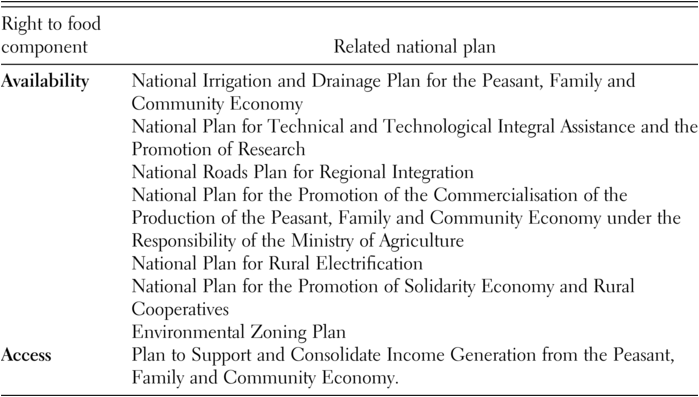
The Colombian Government started implementing these national plans between 2020 and 2021 through resolutions (norms/standards issued by government institutions), establishing specific measures to be adopted at the national and regional levels. They are financed mainly with resources from the Colombian state’s general budget.
These plans aim to transform the agricultural economy at its core, requiring local communities to define and shape the process. According to the Colombian Ministry of Agriculture, excessive intermediation in the agricultural chain has impacted the marketing conditions of peasant, family, and community economies, coupled with small traders’ low associative capacity and vertical integration. In Colombia, peasant, family, and community products have low insertion levels in local, regional, and national value chains (Ministerio de Agricultura y Desarrollo Rural 2019). Therefore, these policies acknowledge the need to build supportive intermediary channels that strengthen short marketing channels (farmers’ markets) as an option to reduce excessive intermediation. Through these plans, the Peace Agreement looks for the recognition and inclusion of a traditional peasant economy at local, regional, and national levels. Hence, these plans look to strengthen institutional initiatives for production chains and ‘short marketing circuits’.
Short marketing circuits represent a trade model focused on the direct sale of products, minimising intermediation. The end consumer acts as the buyer, acquiring locally produced goods. Concurrently, production chains seek to establish connections between local businesses and agro-industrial companies to supply raw materials (Ministerio de Agricultura y Desarrollo Rural 2019). They are centred around selling fresh or seasonal products such as fruits and vegetables. There is little or no intermediation between producers and consumers because they are generally close, so the sale price is lower (FAO et al. 2018).
In addition, such models provide for the co-financing of projects through productive alliances and commercial infrastructures such as marketplaces, create public–private partnerships, promote those products through a national brand, and provide technical assistance. These plans grant a central role to the participation of rural families and communities, encouraging the development and strengthening of new public policy management modalities grounded in acknowledging diverse population groups, safeguarding national production, and coordinating various economic and social sectors.
The following sections will explore if these national plans and the Peace Agreement’s CRR are compatible with Colombian international trade obligations, in particular under the WTO Agreement on Agriculture. We will also identify whether they provide enough policy space to implement the peace agreement measures related to the right to food.
7.5 WTO – Agreement on Agriculture
7.5.1 Obligation to Notify Domestic Support Measures under the Peace Agreement
The AoA does not prohibit domestic support of agriculture but regulates these measures to establish a fair and market-oriented agricultural trading system. Information sharing between trading partners is expected to play an essential role in levelling the playing field and supporting inclusive trade (WTO 2018). Regarding domestic agricultural support measures, WTO members have agreed to reduce the level of support (van den Bossche and Zdouc Reference Van den Bossche and Zdouc2022, p. 956). For that purpose, they must notify domestic support measures and new or modified exempt measures (G/AG/2 and G/AG/2/Add.1), including their total Aggregate Measurement of Support (AMS).Footnote 22 A member shall be considered to comply with its domestic support reduction commitments in any year in which its domestic support in favour of agricultural producers expressed in terms of current total AMS does not exceed the corresponding annual or final bound commitment level specified in the member’s schedule (AoA, Art. 6.3).
All national support measures favouring agricultural producers must be notified and are subject to the WTO rules and those of the AoA. Under the general multilateral legal framework of the WTO, there is a process of examination of the extent to which the country must notify trade measures and if they are compatible with the treaty obligations or whether exception regimes are applicable. This is part of the transparency principle enshrined in the WTO as an integral aspect of the system. According to the WTO, ‘agricultural trade had been a major element in global development, and multilateralism and [the] WTO had been playing an important role in ensuring the transparency and predictability of the system’ (WTO 2018, p. 5).
Notifications must follow the specific commitments in each member’s schedule (WTO 1995b, 1995c, 1996). Domestic support commitments must be notified annually (AoA, Art. 18.2). However, for new or modified domestic measures, notification requirements are ad hoc, meaning they are due only when a specific measure is introduced or about to be introduced (AoA, Art. 18.3).
The tendency of non-submission of notifications or the long delays in the submission by developing countries indicates the technical difficulties in compiling their notification (Konandreas and Mermigkas Reference Konandreas and Mermigkas2014). It is also a reflection of a policy choice related to ambiguities in the interpretation and meaning of the elements of the domestic support obligations, especially that of the calculation of the AMS. Regarding measures Colombia has been taking and will need to take under the Peace Agreement, not all measures are needed to be notified; thus, it must be determined which measures Colombia should notify the WTO about.
On 1 June 2021, Colombia notified the WTO of all the domestic support measures implemented under the Peace Agreement, even those that do not have a trade impact or are based on non-trade objectives. It also notified the WTO of the total AMSs and the measures exempt from the reduction commitment under Articles 18.2 and 18.3 of the AoA. Among the measures exempted from the reduction commitment, Colombia included those related to the Special and Differential Treatment and Development Programs (AoA, Art. 15). In this regard, the Colombian Government issued a general note establishing: ‘Following the signing on 24 November 2016 of the Peace Agreement with the FARC, Colombia increased budgets to implement programs for the substitution of illicit crops’ (G/AG/N/COL/73). Colombia reiterated the same note for 2018, 2019, and 2020 (G/AG/N/COL/74, G/AG/N/COL/75, G/AG/N/COL/76).
Even if the notification obligation under WTO Agreements is not applicable, Colombia stated that it might be necessary to notify some measures implementing the Peace Agreement. Even though that agreement does not provide for export- or import-directed measures, the SGPDA sets guidelines to adopt measures for protecting and encouraging national production through internal support measures with a territorial and personal approach. This is an explicit domestic support measure that might be notified. Under the considerations mentioned, the following section will examine whether the measures implemented under the SGPDA are framed under the category exceptions that Colombia should notify, or if there are other applicable exemptions under the AoA. The parameters that Colombia should comply with when implementing future measures related to the SGPDA will also be considered.
7.5.2 Exemption from the Reduction Commitments
Figure 7.1 illustrates the rules outlined in the WTO Agreement on Agriculture by which states may identify in which cases domestic support measures in favour of agricultural producers are or are not subject to reduction commitments.

Domestic support measures in agriculture are defined by the WTO Glossary Term, as ‘any domestic subsidy or other measure which acts to maintain producer prices at levels above those prevailing in international trade; direct payments to producers, including deficiency payments, and input and marketing cost reduction measures available only for agricultural production’. They are commonly classified as non-tariff measures, defined as ‘all policy interventions other than tariffs that can potentially affect the quantities and the prices of internationally traded goods’ (UNCTAD 2010). Despite the absence of trade objectives, international trade can be influenced by non-tariff measures from domestic regulations that address market failures, such as information asymmetries or negative externalities (UNCTAD 2019).
These measures may have no or minimal distortive effect on trade or have trade-distorting effects. Therefore, some domestic support-exempted categories exist in the so-called ‘blue box’ and ‘green box’ measures. The ‘blue box’ measures are direct payments under production-limiting programmes not subject to the commitment to reduce domestic support as long as they comply with the requirements enshrined in Paragraph 5 of Article 6 of the Agriculture Agreement.Footnote 23 The measures that do not distort trade or, at most, cause minimal distortion, qualify as ‘green box’ measures. They can be increased without any financial limitation as long as they comply with the below-mentioned requirements. All green box measures for which exemption is claimed must comply with two general criteria: (i) government-funded (not by charging consumers higher prices); (ii) not including price support to producers or transfers from consumers; and (iii) comply with policy-specific criteria depending on the type of measureFootnote 24 (AoA Annex 2).
The programmes tend to be not targeted at particular products and include direct income supports for farmers unrelated to current production levels or prices. They could also be environmental protection and regional development programmes (WTO n.d.2). Developing countries have additional special treatment related to governmental stockholding programmes for food security and subsidised food prices for poor urban and rural populations. This exemption covers programmes not targeted at products and includes direct income support for farmers decoupled from current production levels or prices (AoA, Annex 2 Nos. 3–4.).
If the domestic support measures do not fit into any AoA-exempted categories, they must comply with the minimis percentage to be exempted from the reduction commitments agreed upon by the WTO members. Following the AoA rules, minimal domestic support by any state members is allowed for product-specific or non-product-specific. This threshold for developing members is 10 per cent of the total value of production of a basic agricultural product during the relevant year for product-specific, and 10 per cent of the value of that member’s total agricultural output for non-product specific for developing countries (AoA, Art. 6, para. 4).
All domestic support measures favouring agricultural producers that do not fit into the exempt categories nor comply with the minimum support level, fall into the so-called ‘amber box’Footnote 25 and are subject to the total AMS reduction commitments.
The above AoA rules provide the legal framework to develop and implement the right to food through the domestic support measures provided in the Colombian Peace Agreement. Even though that agreement and its programmes on food security and the right to food fall under the ‘non-trade’ concern measures concept, the issued regulation for implementing the Peace Agreement (the SGPDA) might raise questions on its potential trade impacts.
Colombian Peace Agreement’s measures satisfy the requirements to qualify as ‘green box’ measures.
First, the SGPDA complies with the general requirement of being government-funded. Colombia’s General Budget is the primary source of the SGPDA, complemented by the territorial sources. The funding and participation for the implementation of the Peace Agreement are divided into (1) the General Budget of the Nation 36 per cent; (2) the General System of ParticipationFootnote 26 29.2 per cent; (3) the General System of RoyaltiesFootnote 27 15.2 per cent; (4) own resources of the territorial entities 4.3 per cent; (5) non-repayable international cooperation fundsFootnote 28 8.9 per cent; and (6) resources from the private sector 6.4 per cent (Colombian Government CSIVI 2017, p. 217). None are directed at a single region, product, or peasant community. CRR will receive most of the funding of this investment with an 85.4 per cent share of the total Peace Agreement investment (Colombian Government CSIVI 2017, p. 213). In implementing the Peace Agreement, the National General Budget has targeted different kinds of investments in the agricultural sector and rural development (Colombian Government CSIVI 2017). For example, the General System of Participation has financed access to safe drinking water and basic sanitation, and the General System of Royalties is a supplementary source of the territorial entities (Colombian Government CSIVI 2017, p. 221).
Second, the SGPDA and associated national plans also comply with the requirement not to provide direct price support for products. These are non-trade measures as they pursue social and development objectives and do not provide for export- or import-directed measures. Instead, they focus on protecting and encouraging national production through internal support measures guided by the territorial and personal approach. The income and technical support for farmers, the preferential treatment to women and ethnic communities, and the fair-trade standards included in the plans are not related to current production levels or prices of the products either.
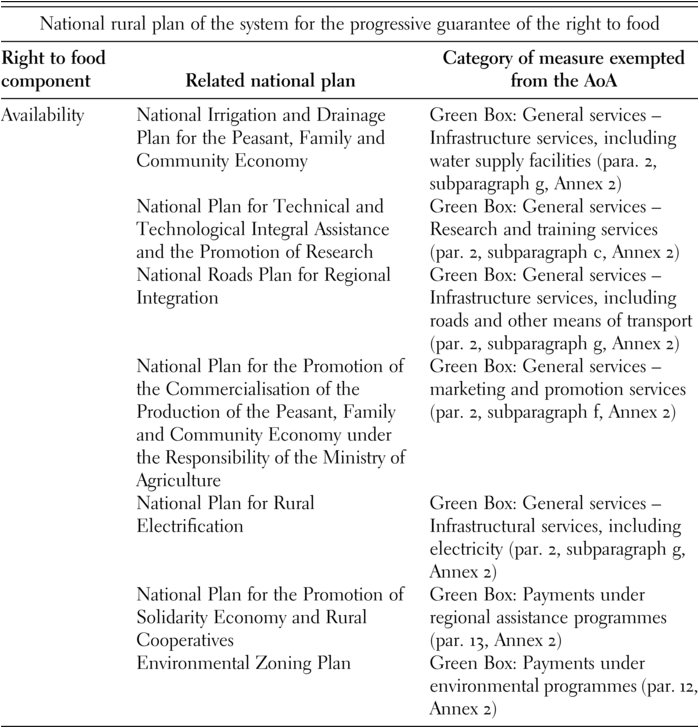
Third, regarding the policy-specific criteria, we identified the type of measure exempted under Annex 2 of the AoA that applies to each of the national plans related to the food policies provided in the Peace Agreement:
As indicated in Table 7.2, the aforementioned national plans are within the scope of paragraphs 2, 12, and 13 of Annex 2 of AoA, establishing the basis for exemption from the reduction commitments. Policies in the general service category involve support in relation to programmes which provide services or benefits to the rural community; the plans placed in this category were designed to grant general benefits for peasants in rural communities related to infrastructure, training, and access to basic services. Particularly, the National Plan for the Promotion of a Solidarity EconomyFootnote 29 has supported public policies to ensure the bargaining power of the peasants, such as the creation of programmes with technical assistance to support the creation of organisations (Ministerio del Trabajo 2020a), which provides preferential treatment to women and indigenous communities but is not directed at the prices of products.
The National Plan for the Promotion of CommercializationFootnote 30 also strengthens institutional initiatives for short marketing circuits, creating public–private partnerships, and promoting products through a national trademark. Technical assistance and the articulation of family farms with agro-industrial companies (private or public) to provide raw materials are also included (Ministerio de Agricultura y Desarrollo Rural 2019). Its main objective is to promote the integration of the Peasant, Family, and Community Economy (ECFC) in local, regional, and national value chains through alternative marketing schemes and eliminating information asymmetries. The National Plan complements this with technical and technological integral assistance and the promotion of research for agricultural production.
Additionally, the National Plan for the Promotion of Solidarity Economy and Rural Cooperative is exempted by the ‘Payments under regional assistance programs’ category, following AoA Annex 2 (13), because (i) it is limited to producers in disadvantaged regions, clearly identifiable by the territorial approach of the Peace Agreement; (ii) its support does not condition the type or volume of production, on the contrary, it is based on ensuring the bargaining power of the peasants through organisations to become part of the production chain and; (iii) the measures are available to all the producers but grant some specific support to women and ethnic communities.
Finally, the Environmental Zoning Plan is also exempted by the ‘Payments under environmental programs’ following AoA Annex 2 (12) because it is an environmental management instrument for territorial planning and administration. It is a guideline for decisions made by local and regional authorities (Ministerio de Ambiente y Desarrollo Sostenible 2021), and it is subject to the government’s environmental programmes.
In sum, following the policy-specific criteria and conditions set out in Annex 2 of the AoA, these plans fully comply with WTO rules; thus, they are within Colombia’s policy space to regulate.
In addition to measures covered by the Green Box, two other categories of domestic support measures derived from the Peace Agreement are exempt from reduction commitments under the AoA: specific development measures in developing countries and certain direct payments under production-limiting programmes (Art. 6.2 and 6.5 of the AoA). The notification made by Colombia to the WTO Committee on Agriculture for the period 2017 to 2020 (WTO 2021a, 2021b, 2021c, 2023), after the Peace Agreement was signed, follows Article 6.2 of the AoA, which allows measures taken by developing country members to encourage diversification from growing illicit narcotic crops since Colombia created budgets to implement programmes for the substitution of illicit crops. The aforementioned national plans represent the public policies that the Colombian state aims to implement to ensure the right to food within the framework of the Peace Agreement. Generally, the measures included in those plans are not direct subsidies to export but development policies to alleviate poverty in rural areas.
Due to the mandatory bottom-up participatory planning process under the SGPDA, Colombia should incorporate an appropriate institutional mechanism that integrates all decisions to be taken within the framework of these national plans to identify future measures that must be notified to the WTO Committee on Agriculture and must comply with the reduction commitments.
There should be no significant challenges to implementing the SGPDA under the scope of Annex 2 of the AoA, as long as it does not involve product-specific support. If Colombia, as a WTO developing country member, wants to introduce a product-specific policy within the implementation of the Peace Agreement, one path to being exempted from the reduction commitments would be using the de minimis criteria provided in the AoA. But in some cases, the de minimis criteria may not be adequate for pursuing specific food policy objectives. In the Bali Ministerial Conference, the G33 claimed that ‘agriculture in developing countries is not a commercial operation but is carried out mainly by small-scale and resource-poor farmers with no other source of livelihood’ (Konandreas and Mermigkas Reference Konandreas and Mermigkas2014).
7.6 Conclusions
At first glance, the international trading system does not seem to restrict agricultural policies designed to enhance social and economic livelihood of marginalised communities. However, should those policies be directed to export goods, legal limitations could potentially arise. Thus, programmes to implement the Colombian Peace Agreement related to the right to food, particularly those that aim to guarantee food security of peasants, count with a broad policy space under international trade law. In particular, the AoA does not constitute an obstacle to a farming and food policy in the process of implementing the commitments under the Peace Agreement.
Thus, it is crucial to closely monitor the alignment of regulatory measures in the upcoming years with the framework granted by the AoA. The right to food-related measures under the Peace Agreement will be in force until 2031 and might gain a certain complexity in time as they aim to strengthen the rural economy. Therefore, there is a possibility that implementing the Peace Agreement in the future will require measures that are not under the scope of the AoA, resulting in measures that may conflict with this agreement, other rules in WTO law, or similar ones included in PTAs. Protective measures, such as increasing tariffs, import limitations, and or restrictions on some products, for instance, could be implemented to aid emerging domestic industries competing with bound importers.
In this respect, government officials need to be careful when issuing any regulation related to the right to food under the Peace Agreement and the trade law policies to avoid the breach of either substantive obligations, such as discrimination, or procedural obligations, such as failing to notify a measure. By adhering to these responsibilities, officials can prevent potential trade disputes.
The Peace Agreement is a chance for Colombian society to build a more equalitarian society, enhancing affected communities and allowing them to benefit from the whole economic system. But the spectre of the international trading system (WTO Agreements and PTAs) should not be overlooked in implementing this particular aspect of the Peace Agreement.
The Peace Agreement has imposed on the Colombian Government the task of enacting policies which pose changes in the national economic system as it is obliged to include rural communities in the whole agricultural production chain. It is to be seen if giving land, empowering farmers to produce, transform their products, and add value beyond production for their success will allow them in the future to export to foreign markets.


 Open access