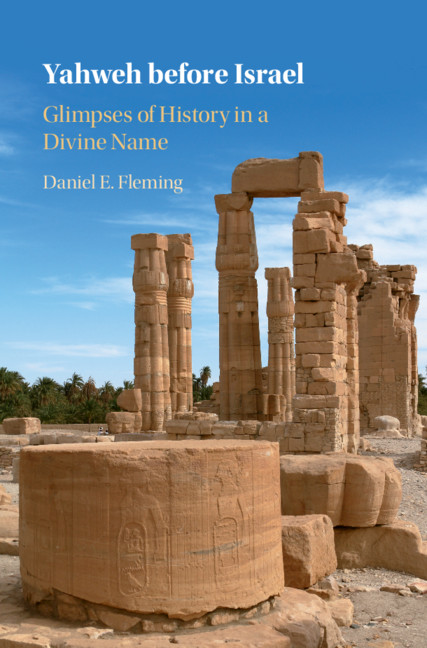

Yahweh is the proper name of the biblical God. His early character is central to understanding the foundations of Jewish, Christian, and Islamic monotheism. As a deity, the name appears only in connection with the peoples of the Hebrew Bible, but long before Israel, the name is found in an Egyptian list as one group in the land of tent-dwellers, the Shasu. This is the starting-point for Daniel E. Fleming's sharply new approach to the god Yahweh. In his analysis, the Bible's 'people of Yahweh' serve as a clue to how one of the Bronze Age herding peoples of the inland Levant gave its name to a deity, initially outside of any relationship to Israel. For 150 years, the dominant paradigm for Yahweh's origin has envisioned borrowing from peoples of the desert south of Israel. Fleming argues in contrast that Yahweh was not taken from outsiders. Rather, this divine name is evidence for the diverse background of Israel itself.
‘Fleming’s thesis certainly strikes out on its own within debate about the Midianite hypothesis and the origins of Yahweh, but I think it often makes more judicious and careful use of the data, particularly in its interrogation of the Egyptian inscriptions at Soleb and ‘Amarah West. There is a degree of speculation involved that is inevitable with trying to take steps into the dark … but I would argue Fleming’s volume asks more interesting questions that have the potential to contribute to a more robust and productive engagement with what few data are available to us.’
Daniel O. McClellan Source: Journal of the American Academy of Religion
Loading metrics...
* Views captured on Cambridge Core between #date#. This data will be updated every 24 hours.
Usage data cannot currently be displayed.
This section outlines the accessibility features of this content - including support for screen readers, full keyboard navigation and high-contrast display options. This may not be relevant for you.
Accessibility compliance for the HTML of this book is currently unknown and may be updated in the future.
