

Introduction
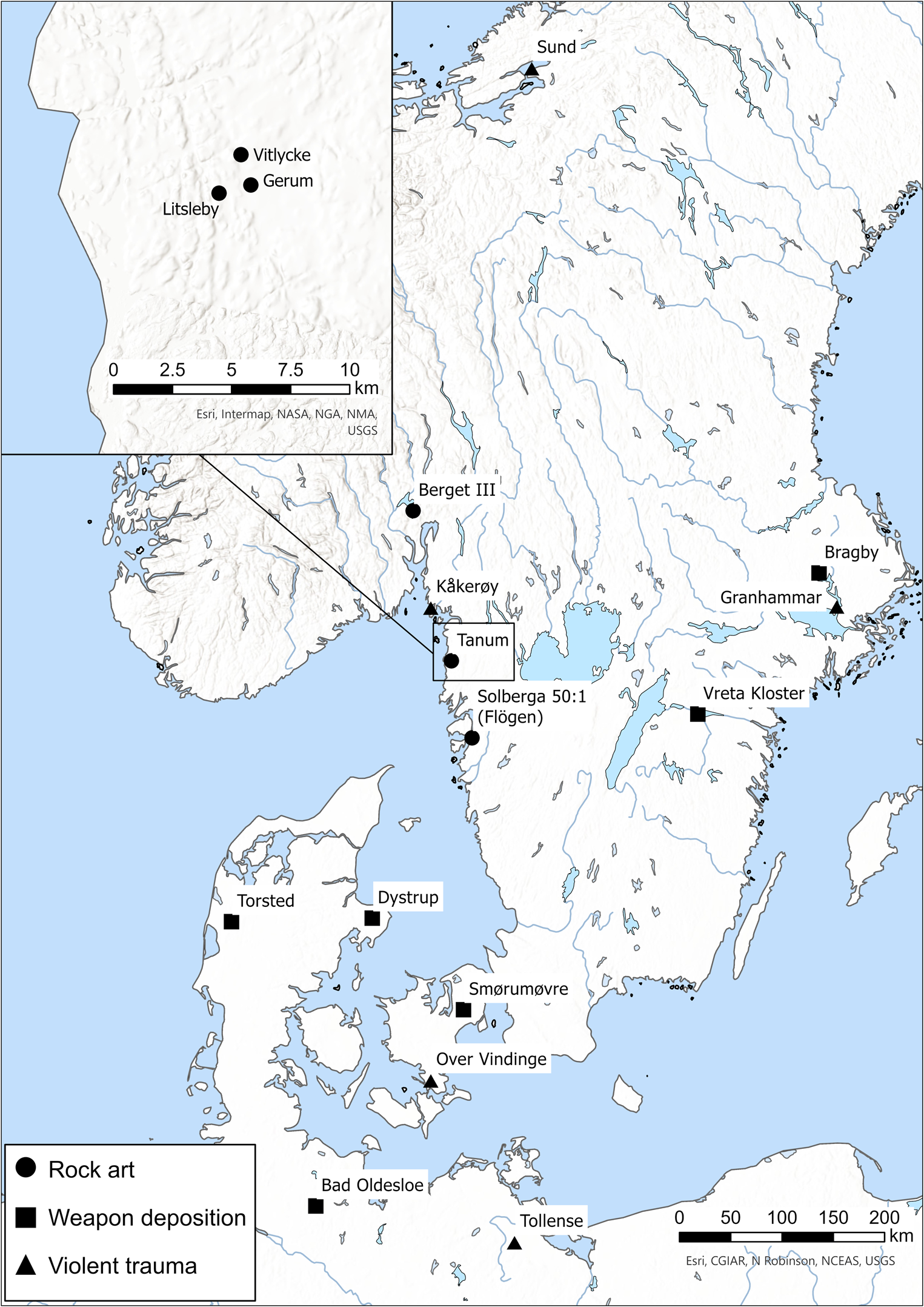
Warriors are one of the most recognized groups of the European Bronze Age, along with associated concepts of warrior ideal, ideology, and other related features (Harrison, Reference Harrison2004; Harding, Reference Harding2007; Molloy & Horn, Reference Molloy, Horn, Fagan, Fibiger, Hudson and Trundle2020). Warriors may have formed a social elite that ruled local communities, especially in southern Scandinavia, northern Germany, and to a lesser degree the Netherlands and Poland (Figure 1). The scale of their social power is debated, and several models have been proposed, including chiefdoms (Earle, Reference Earle1987, Reference Earle1989), a decentralized system of rulership (Kristiansen, Reference Kristiansen, Kohring and Wynne-Jones2007, Reference Kristiansen, Price and Feinman2010), heads of extended families (Bunnefeld, Reference Bunnefeld, Horn and Kristiansen2018), or flatter hierarchies (Brück & Fontijn, Reference Brück, Fontijn, Fokkens and Harding2013; Kienlin, Reference Kienlin and Kienlin2015). From the material evidence in hoards, burials, and rock art, it seems that warriors played an important role in Bronze Age societies regardless of how social rule was organized.
Map of sites discussed.
Over the past decades, new discoveries have added to our understanding of the role of warriors. They were important agents in networks including metal exchange, and they undertook and organized journeys by land and sea (Kristiansen & Suchowska-Ducke, Reference Kristiansen and Suchowska-Ducke2015; Ling et al., Reference Ling, Earle and Kristiansen2018b). The presence of toiletry instruments in warrior burials shows a special concern with grooming the body and the ‘warrior's beauty’ (Treherne, Reference Treherne1995; Frieman et al., Reference Frieman, Brück, Rebay-Salisbury, Bergerbrant, Montón Subías and Sofaer2017). Perhaps warriors thought of themselves as distinct from other members of their community, which would have been emphasized by weapons training promoting specific body techniques and images (Malafouris, Reference Malafouris, Borić and Robb2008; Warnier, Reference Warnier2011). This awareness, along with a distinct look and responsibility in society, may have led to the formation of special social groups such as Männerbünde, or other forms of association that secured their social position by keeping access to knowledge limited (Vandkilde, Reference Vandkilde and Ralph2013; Ling et al., Reference Ling, Chacon, Chacon, Dolfini, Crellin, Horn and Uckelmann2018a), for example about maritime navigation, meaning of specific rock art motifs, the use of weaponry, etc.
An aspect that may hamper the study of Bronze Age warfare is that warfare and warriors are often portrayed as relatively unproblematic for past societies (Vandkilde, Reference Vandkilde and Ralph2013; Horn & Kristiansen, Reference Horn, Kristiansen, Horn and Kristiansen2018; Molloy & Horn, Reference Molloy, Horn, Fagan, Fibiger, Hudson and Trundle2020). It seems that everyone engaged in warfare, and then simply went back to normal life. Sometimes the warriors’ ambiguous position as ‘boundary-crossers’ is recognized (Vandkilde, Reference Vandkilde2011; Horn, Reference Horn, Glørstad, Tsigaridas Glørstad and Melheim2016) but what this meant for local communities is rarely developed. Here, I propose that returning warriors and fighters may have posed a threat to their own societies and examine how local communities coped with this internal social problem. To achieve this, I review the physical and pictorial evidence for warfare and violence during the Nordic Bronze Age (NBA hereafter) and discuss who the enemies that were chiefly fought may have been. The reality of bloodshed, primarily against neighbouring communities, is then used to elaborate on why warriors posed an internal social threat. Finally, based on the deposition of weaponry, rock art, and ethnographic material, I argue that NBA societies made considerable efforts to cope with the reintegration of returning warriors into their communities.
Practising Warfare
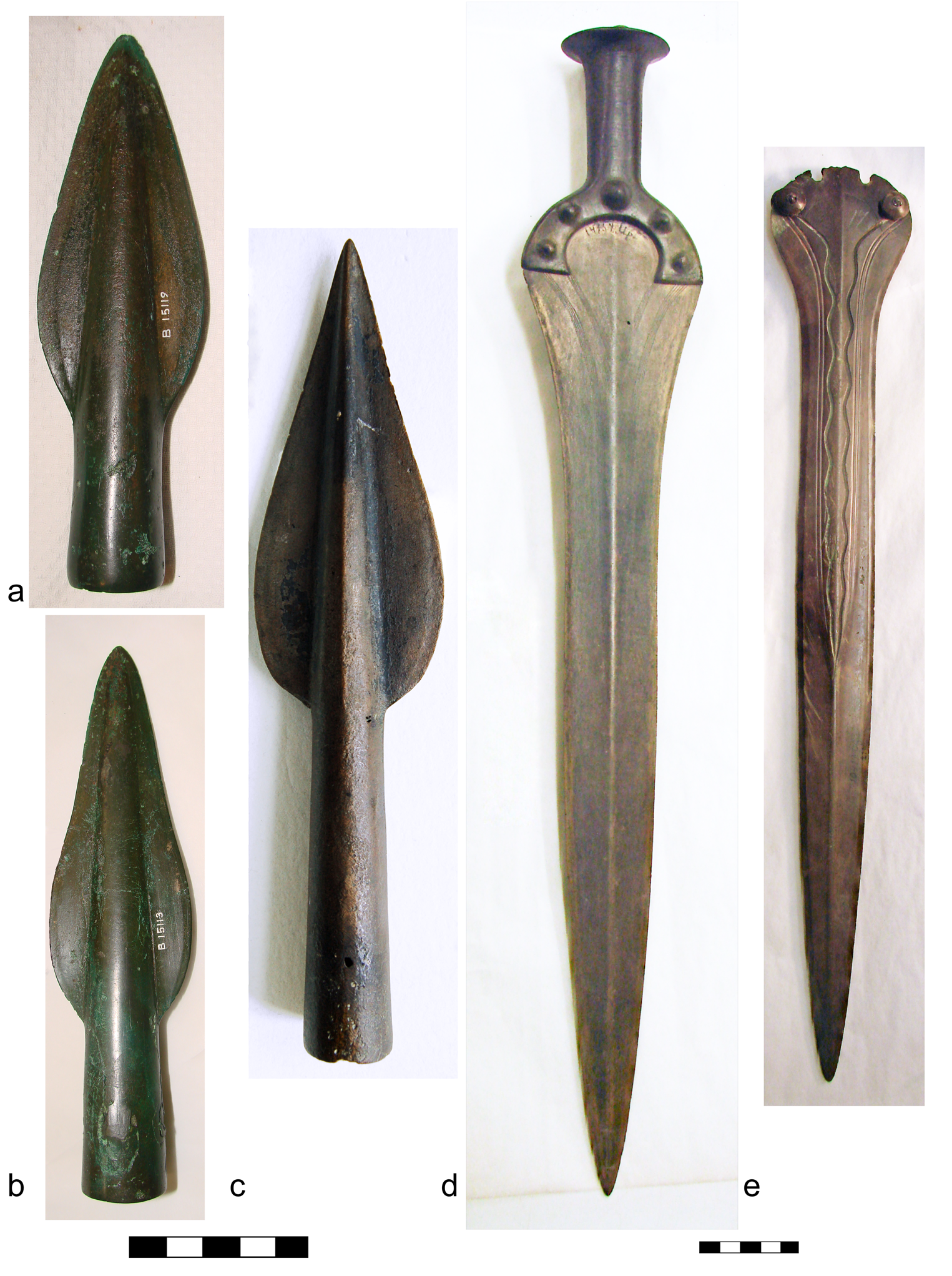
For the NBA, warfare is now generally accepted as a social practice (Horn & Kristiansen, Reference Horn, Kristiansen, Horn and Kristiansen2018). It seems prudent, however, to summarize the evidence for such a statement to give a sense of the scale of warfare and the depth of individual engagement in such pursuits. This can also help us understand that physical violence was the basis for individual identities and social power. During the NBA, new forms of specialized metal weapons emerged (Vandkilde, Reference Vandkilde1996), i.e. swords and spears (Figure 2). Spears existed in flint during the Neolithic, so the true innovation of the Bronze Age was the sword (Figure 2 d–e), which remained an important fighting tool and the dominant status symbol for over three millennia after its introduction into Europe (Molloy & Horn, Reference Molloy, Horn, Fagan, Fibiger, Hudson and Trundle2020 with references).
a–b) Early Bronze Age spears from Torsted (Denmark, NM K B15118.19); c) Late Bronze Age spear from Bad Oldesloh (Germany, LMSH KS923); d) Early Bronze Age full-hilted sword from Bragby (Sweden, SHM 14759); e) Early Bronze Age sword from Vreta Kloster (Sweden, SHM 10419:211).
Bronze has properties that allow it to deform plastically to relieve stress caused by impacts, and damage to bronze survives better because it is less prone to corrosion than iron (Dolfini & Crellin, Reference Dolfini and Crellin2016; Horn & Holstein, Reference Horn and von Holstein2017). Numerous instances of damage indicating combat have been recognized on Early Bronze Age swords and spears (e.g. Kristiansen, Reference Kristiansen1984, Reference Kristiansen2002; Horn, Reference Horn2013; Bunnefeld, Reference Bunnefeld2016; Horn & Karck, Reference Horn and Karck2019). This includes V-notches on cutting edges caused by other blades, or U-notches which could have been cause by being hit with axes, or by blows against handles, bones, or the rims of shields (Gentile & van Gijn, Reference Gentile and van Gijn2019; Hermann et al., Reference Hermann, Dolfini, Crellin, Wang and Uckelmann2020). Furthermore, evidence of repairs indicates that weapons were kept in a combat-ready state, suggesting frequent violent engagements. Few Late NBA weapons have been analysed to the same degree, which makes any interpretations of Late Bronze Age warfare and weapon use in Scandinavia problematic.
Victims of violence are known from several sites, mostly dating to the Early Bronze Age (Table 1). In Over-Vindinge (Denmark), a 50–60-year-old man was found in a stone cist with a broken spear tip, dated to the earliest Bronze Age (1600–1500 bc), embedded in his pelvis (Kjær, Reference Kjær1912). The skull of a malnourished man from Kråkerøy (Østfold, Norway) showed evidence that he was killed by sword blows to the head and neck during the Early NBA (Holck, Reference Holck1987). In Granhammar (Västra Ryd, Uppland, Sweden) the remains of a man were discovered on an old seabed of Lake Mälaren (a bay during the Bronze Age). Isotope analysis suggests that he may have come from Scania; he was killed around 800 cal. bc by several blows to the head and forearm, perhaps while on a boat (Lindström, Reference Lindström2009).
Summary of documented Nordic Bronze Age victims of violence.
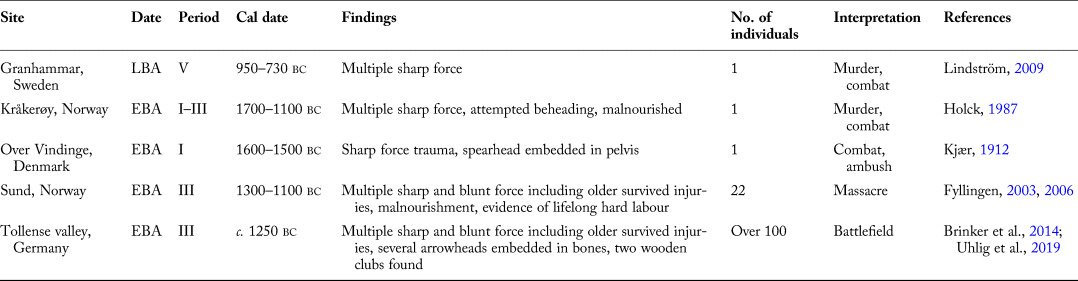
Other than these individuals, evidence of combat-related violence on a larger scale includes Sund (Norway), where the remains of twenty-two massacred children, women, and men were buried. In addition to violent trauma, indications of life-long hard labour and malnutrition suggest that they belonged to a lower class or were slaves (Fyllingen, Reference Fyllingen2003, Reference Fyllingen, Otto, Thrane and Vandkilde2006). Lastly, in the well-known battlefield in the Tollense valley (Mecklenburg, Germany), some 140 individuals have been discovered so far, of which 5–7 per cent showed trauma, some of which were old injuries, implying that the deceased were accustomed to conflict (Brinker et al., Reference Brinker, Flohr, Hauenstein, Piek, Mittlmeier, Orschiedt, Jantzen, Orschiedt, Piek and Terberger2014; Uhlig et al., Reference Uhlig, Krüger, Lidke, Jantzen, Lorenz and Ialongo2019). It is important to remember that all 140 individuals died in the battle, even though most show no traces of violence.
Warfare and violence thus appear to have been regular occurrences during the NBA, involving a high risk of severe injury and death. This in turn suggests that in each local community there may have been several individuals who were accustomed to carrying out such bloodshed and who were perhaps frequently engaged in such highly stressful activities. Within a dispersed settlement pattern and unstable social organization, especially during the Early NBA (Kristiansen, Reference Kristiansen, Kohring and Wynne-Jones2007, Reference Kristiansen, Price and Feinman2010), this potentially created a volatile atmosphere in which fighting prowess may have been directly translated into social power, as discussed below.
Picturing Warfare
While the actions detectable in use-wear on objects or trauma to individuals were intentional, the formation and form of damage were the outcome of mechanical actions. Rock art, by contrast, was the product of thoughts and concepts about the objects, living beings, and events depicted, which makes it an excellent source for studying how people in the past perceived violence. In addition to 20,000 or more boats, depictions of over 6000 humans and objects including weapons are known in northern rock art. Rock art is not simply a representation of prehistoric life but subject to numerous filters including ideology and religious beliefs. Important aspects of daily life like houses or pottery are missing and others, such as agriculture, are found in only a few scenes. Furthermore, it must be kept in mind that these figures might be altered over time, and that what we are able to observe and analyse with quantitative methods represents the latest stage of these images. That means what we interpret may only have been valid at a particular point in time (Horn & Potter, Reference Horn and Potter2018).
To analyse representations of violent combat in rock art, over 4000 human figures were selected from the most recent documentation available in the Swedish Rock Art Research Archive's (SHFA) database. Heavily damaged or otherwise unclear images were excluded, resulting in a sample of 3742 human figures. Among these, 977 can be identified as male from their primary sexual organs. By comparison with rock art from other areas in the world (Hays-Gilpin, Reference Hays-Gilpin2004), thirty-two figures can be identified as female based on various markers including indications of larger breasts, birthing scenes, and other elements (Horn, Reference Horn, Bergerbrant and Wessman2017).
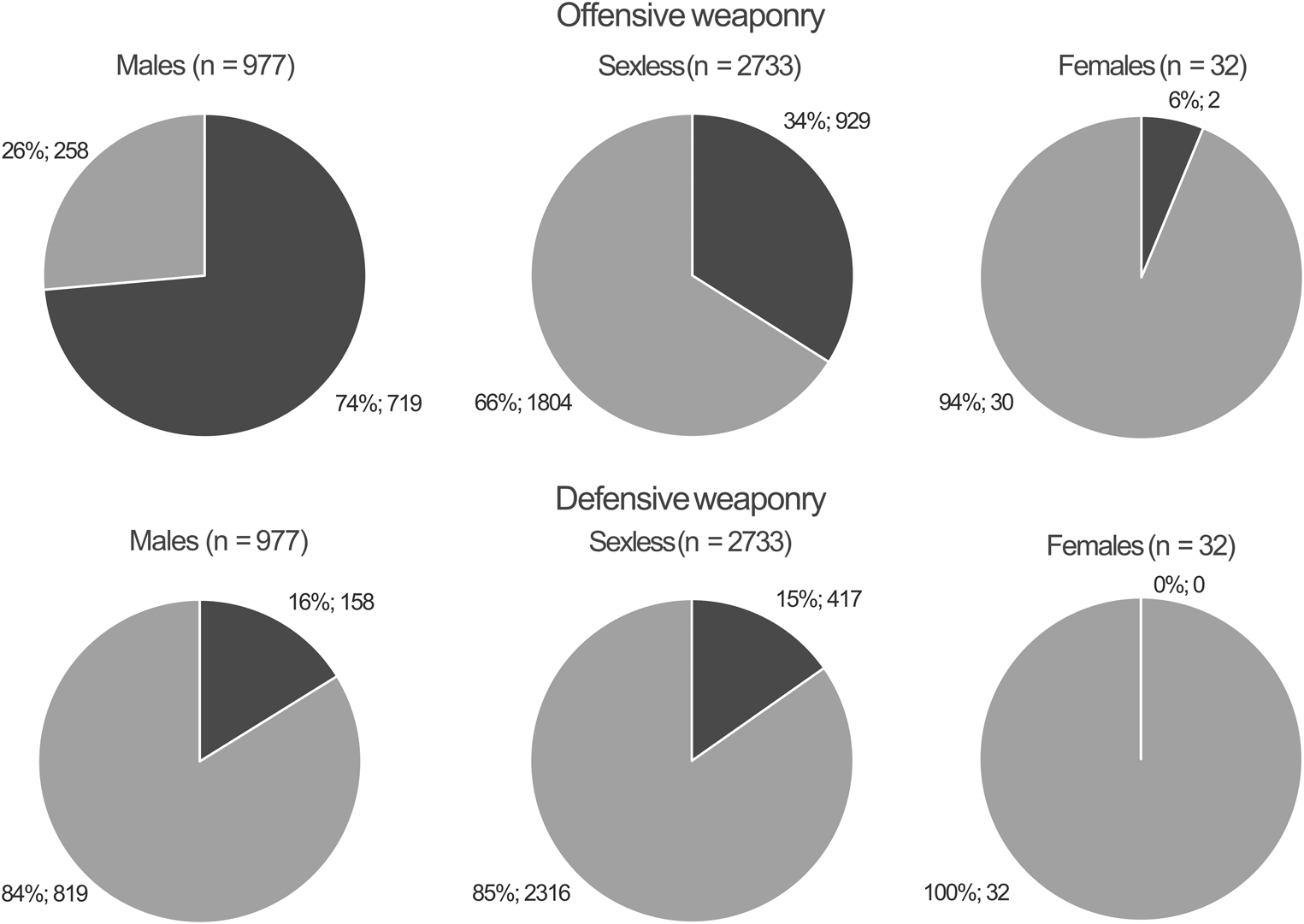
A simple statistical analysis reveals a sexed pattern involving weaponry and human figures (Figure 3). Among the 1650 figures with offensive weapons, 74 per cent of all the males carry one, 34 per cent of all the sexless figures have a weapon, and only 6 per cent of the females are depicted with weaponry. Defensive weapons were associated with only 575 figures, of which 226 additionally had an offensive weapon. Most of the figures with defensive weapons were sexless (417), while 158 were male; none were female. In other words, only 15 and 16 per cent of all male and sexless figures had a defensive weapon.
Relative frequencies of offensive and defensive weaponry by sex categories among anthropomorphic figures in Scandinavian rock art. Dark grey: weapon present, light grey: weapon absent.
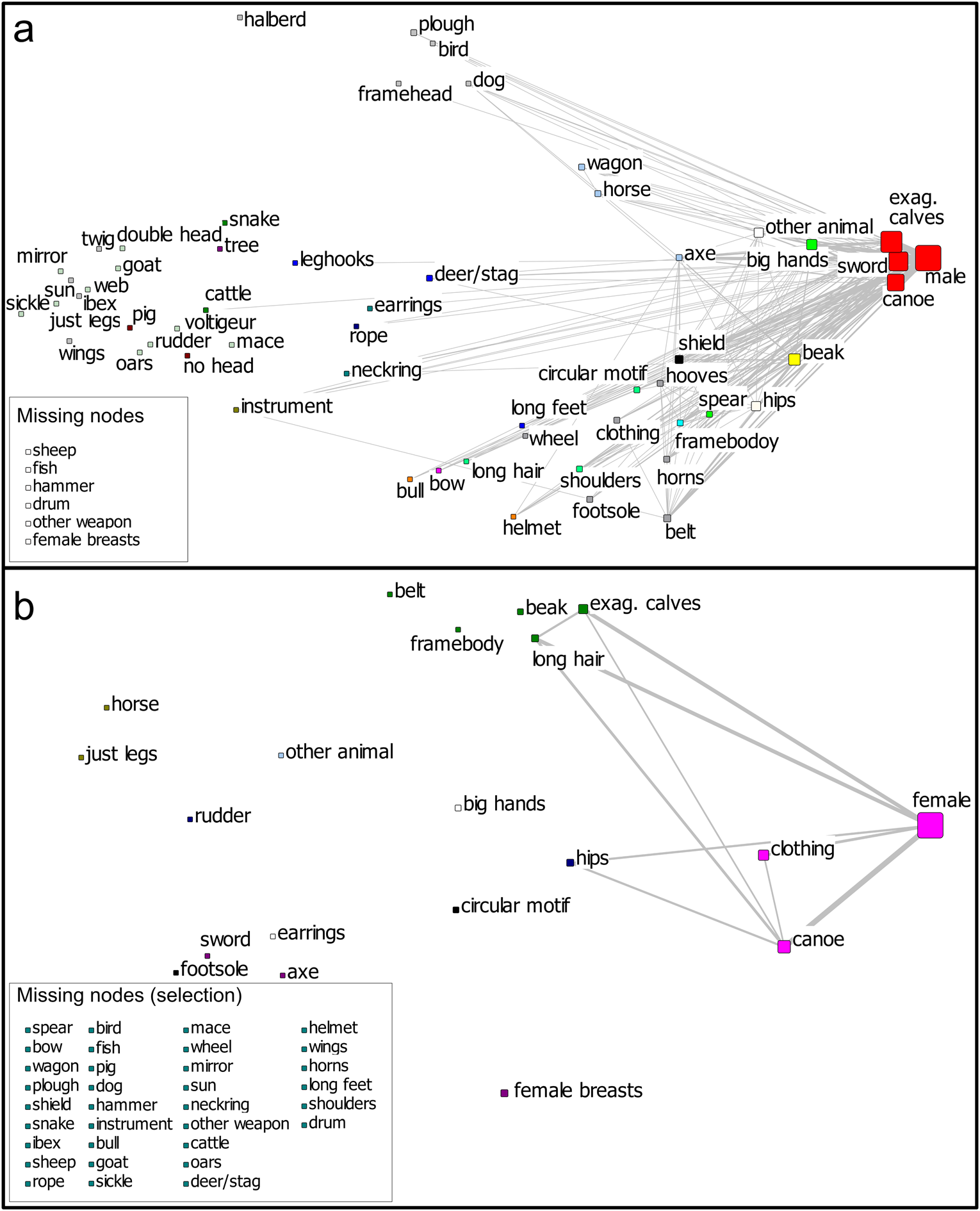
To explore this pattern further, an undirected social ego-network analysis was undertaken for the male and female categories (based on the figures’ attributes from the documentations in the SHFA) using UCINET 6.721. Network analysis is ideally suited to investigate multi-relational aspects such as social roles and identities based on material, as proposed by Blake (Reference Blake2014) and Felding et al. (Reference Felding, Reiter, Frei and Vandkilde2020). The method allows for a better visualization of complex connections compared to purely numerical representations or other statistical methods (Scott, Reference Scott2013). The principal component layout was chosen, but ties below 2 (features only connected by two figures or fewer) were not displayed to improve clarity. The node size displays the calculated betweenness centrality measure, illustrating how important this node was in binding other features into the network. The hi-clus algorithm was used to colour the nodes. The number of intended clusters was entered, letting the software choose them primarily on the number of connections (ties). For networks with a higher number of nodes, it was possible to identify more clusters, for networks with fewer nodes, lower numbers yielded better results (Scott, Reference Scott2013).
Male figures were closely tied to depictions of exaggerated calves, swords, and boats. Other weapons such as spears, axes, and shields were less frequent but still well-represented (Figure 4a). Female and male figures could not be differentiated absolutely, but by degree. Exaggerated calves and boats were also among the strongest features in the female network. Swords, while not absent, were much less strongly tied into the network and long hair was a more important node. Other weapons were entirely missing (Figure 4b). A similar differentiation between feminine and masculine is also documented in the Bronze Age burial record (Reiter et al., Reference Reiter, Frei, Nørgaard and Kaul2019; Felding et al., Reference Felding, Reiter, Frei and Vandkilde2020).
Ego-network analysis for sexed figures (a: male; b: female). Principal component analysis layout showing ties (ties with a strength below 2 omitted). The nodes’ size displays the betweenness and their colour is assigned by the hi-clus algorithm (male: 20; female: 8).
In sum, the numerous weapons (Thrane, Reference Thrane, Otto, Thrane and Vandkilde2006; Horn, Reference Horn, Glørstad, Tsigaridas Glørstad and Melheim2016) found in mostly male burials (Felding et al., Reference Felding, Reiter, Frei and Vandkilde2020), the combat traces, and the predominantly male victims, especially in clear combat situations (Brinker et al., Reference Brinker, Flohr, Hauenstein, Piek, Mittlmeier, Orschiedt, Jantzen, Orschiedt, Piek and Terberger2014), indicate that warfare and combat were important factors determining social position and self-identity in a predominantly male domain. The overwhelming presence of male warriors in rock art may signify that warfare and combat were socially sanctioned expressions of mostly male violence. It is also possible that violent acts other than combat were represented in rock art. Male genitals-weapons hybrids can be found in scenes of intercourse as well as killing. Against the backdrop of bloodshed inflicted by such weapons, scenes which combine weapons and violence with male sexuality could plausibly be interpreted as conceptualizations of male sexualized violence (Figure 5) (Horn, Reference Horn, Dolfini, Crellin, Horn and Uckelmann2018) as known from cross-cultural studies (Seifert, Reference Seifert1996). That such violence was not only directed against women (O'Mochain, Reference O'Mochain2018) may also find a parallel in rock art where such scenes can involve hetero- and homosexual interaction, as well as animals.
Scenes potentially showing sexualized violence. a) A warrior with erect penis stabs a sexless figure with a sword or spear (Tanum 158:1); b) Scene depicting various forms of sexual intercourse involving armed figures, and a figure with a raised spear in a fighting position (Kville 182:1).
It seems likely that warriors during the NBA were not ‘clean’ heroic fighters as sometimes portrayed (see critique by Kienlin, Reference Kienlin and Kienlin2015), but capable of various severe acts of violence to subdue adversaries. Openly carrying weapons was possibly frequent and normalized, judging by their ubiquity in rock art and high frequency in burials. Public display and brandishing of weaponry is also a feature of most warrior societies throughout history (O'Connell, Reference O'Connell1989). Violence was likely not commonly rejected, and was perhaps even celebrated. In such an environment any violent means could have been employed against more vulnerable groups to win internal political struggles.
Adversaries: Intruders or Neighbours?
The battle in the Tollense valley and other events in the thirteenth century bc have been linked to the emerging Urnfield culture (Jantzen et al., Reference Jantzen, Brinker, Orschiedt, Heinemeier, Piek and Hauenstein2011). Such violent upheavals may have been reactions to new beliefs and ideologies that clashed with local customs (Harding, Reference Harding, Horn and Kristiansen2018). Isotopic evidence in the Tollense valley indicates that a portion of the combatants came from relatively far away (Price et al., Reference Price, Frei, Brinker, Lidke, Terberger and Frei2019). In the following, however, the possibility that a substantial amount of violent conflict was local and intra-cultural in nature is put forward in a review of rock art and other evidence dating to the NBA.
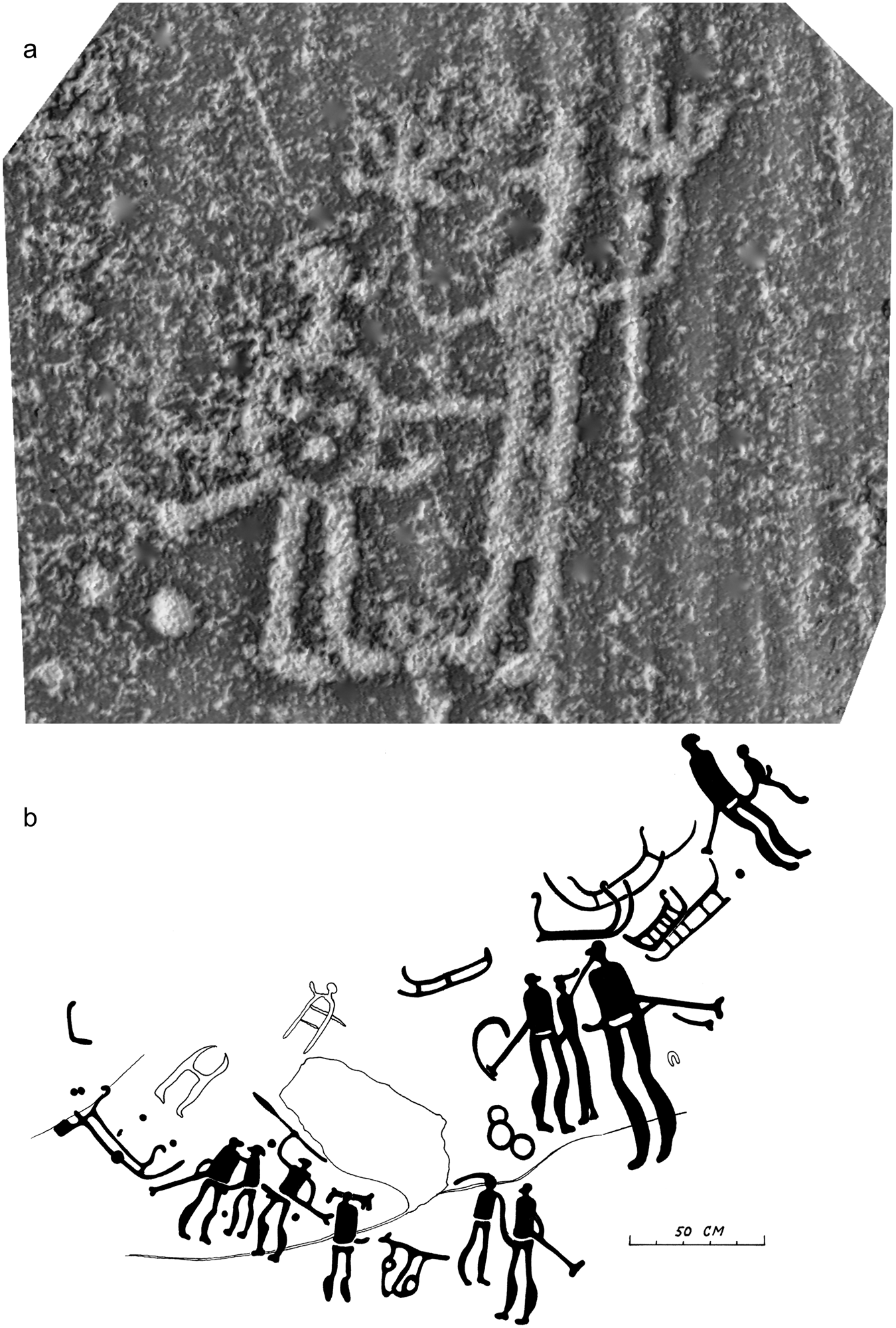
In the fighting scenes, the combatants always have identical weapons, and their bodies are similarly depicted (Figures 6–7). On the Vitlycke panel in Tanum, Sweden, where a fight takes place across a boundary symbolized by a long row of cupmarks, the warriors are identical (Figure 6). This could be a commonly accepted way of conceptualizing warriors, foreign or local, and integrating them into local understanding, as for example in the so-called Contact rock art in Australia (Frieman & May, Reference Frieman and May2019). However, there is other evidence that a considerable degree of violent action was conducted within the NBA cultural sphere and that this is reflected in rock art. The only close combat weapon recovered in situ is that of a spear embedded in the body of a man at Over-Vindinge, described above. It was of a local type, as was probably also the axe that killed the man in Granhammar (Lindström, Reference Lindström2009). Even the massacre in Sund could plausibly be the outcome of local raiding (Fyllingen, Reference Fyllingen2003, Reference Fyllingen, Otto, Thrane and Vandkilde2006), maybe linked to slaving (Ling et al., Reference Ling, Chacon, Chacon, Dolfini, Crellin, Horn and Uckelmann2018a). This may suggest that the depicted combatants in rock art were not cultural ‘strangers’ to each other.
Scene showing three or four warriors with similar bodies and equipment in a fight across a border depicted by a row of cupmarks at Vitlycke (Tanum 1:1).
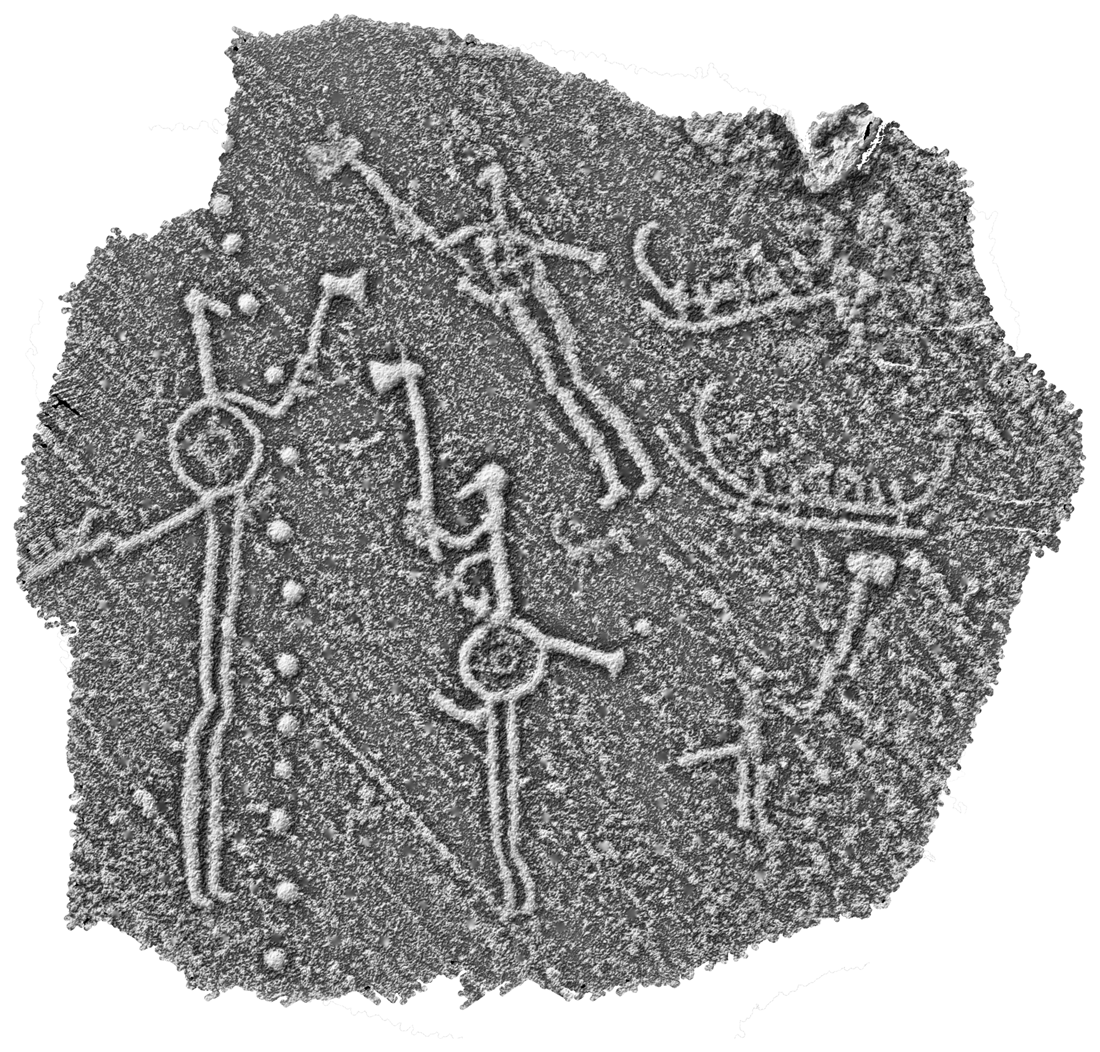
Fighting scenes. a) Warriors with spears and two boats, Massleberg (Skee 614:1); b) Warriors on horseback armed with shields and spears, Litsleby (Tanum 72:1). Photograph of Massleberg by permission of Wilhelm Otnes.
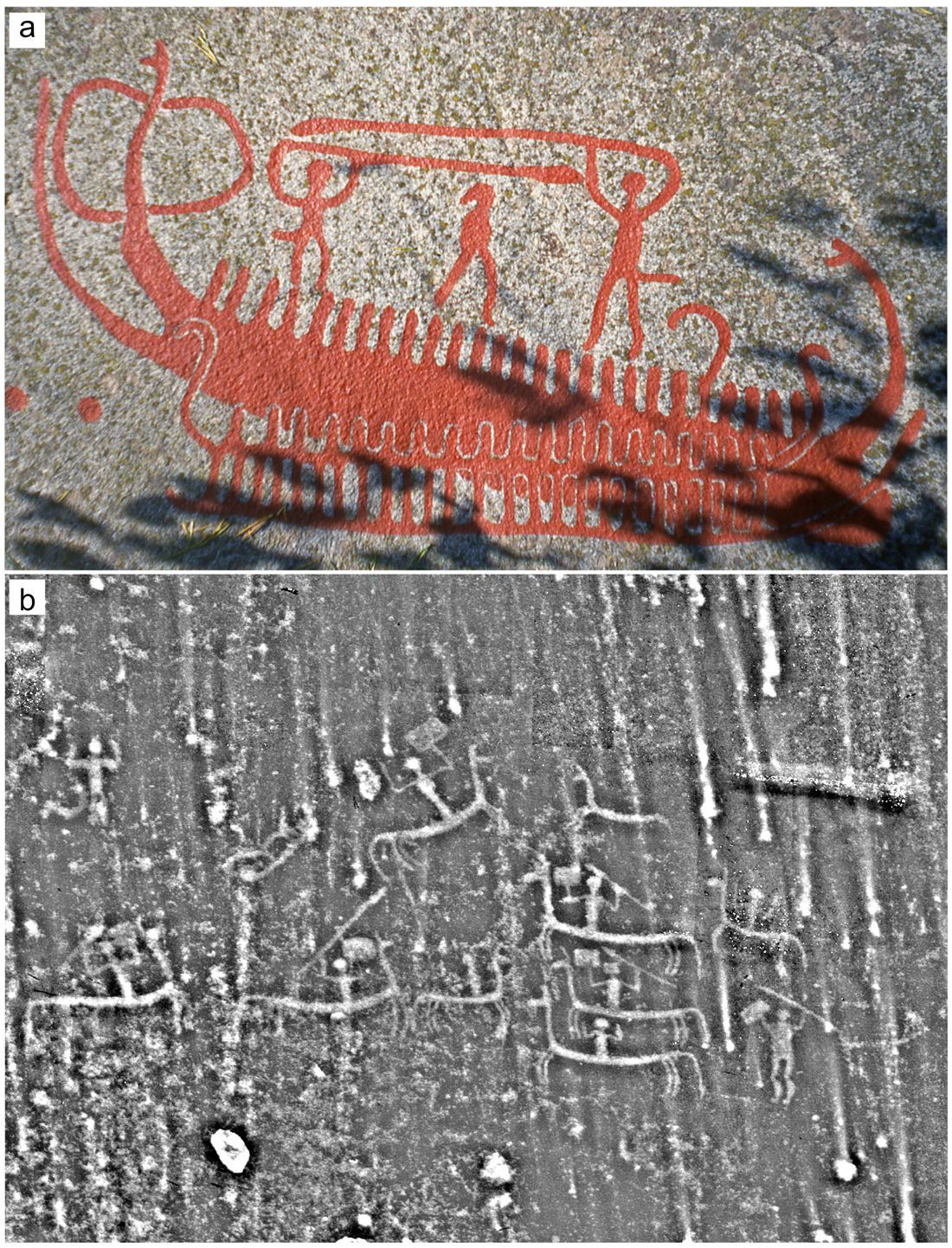
Warriors and combat scenes are frequently shown next to or even on boats (Figure 7a). These vessels seldom show any significant differences, but frequently minor variations. Even scenes that do not directly relate to the tradition of depicting maritime warriors follow this trend, for example the horse battle scene from Litsleby (Tanum) which may date to the very end of the Bronze Age. While the warriors are in two groups fighting each other, they are all depicted identically and use the same equipment (Figure 7b). In summary, everything seems to fit within the general Scandinavian sphere (Ling, Reference Ling2014) and can be interpreted as violence between culturally similar local communities rather than as pressure of culturally different intruders from, for example, Central Europe. If correct, one could further advance that warriors had no qualms about using violence against people within their own cultural, ideological, social, and economic sphere.
Why Were Warriors a Challenge for Local Societies?
Warriors were boundary-crossers (Vandkilde, Reference Vandkilde2011), crossing actual boundaries between groups or fighting over such boundaries, as illustrated in the Vitlycke carvings. A further dimension, however, is that they entered the realm of death by bringing death to others, and risked dying themselves. Thus, local societies could not count them among the living until they returned. Warriors were, like Schrödinger's cat, in a realm between life and death, since neither state could be independently verified by those at home (see Horn, Reference Horn, Glørstad, Tsigaridas Glørstad and Melheim2016). This state, and the fighters’ close contact with death, made warriors liminal agents, and hence dangerous as they risked polluting their communities with death when they returned (Turner, Reference Turner1969). Thus, many societies may have had an ambivalent relationship to their warriors, both venerating them and seeing them as uncanny and potentially threatening (van Gennep, Reference van Gennep1960; Turner, Reference Turner1969; Horn, Reference Horn, Uckelmann and Mödlinger2011; Ling & Cornell, Reference Ling, Cornell, Chacon and Mendoza2017; Mörtz, Reference Mörtz, Horn and Kristiansen2018).
Perhaps the threat was not just a perceived spiritual threat. Fighting prowess may have been one of the criteria that determined social status in NBA societies (Horn & Kristiansen, Reference Horn, Kristiansen, Horn and Kristiansen2018). Fighters or warbands returning from a successful raid in a state of arousal could have used their kudos and battle readiness to challenge the local power structure, attempting to overthrow local rulers; modern-day warlords, for example, can gain power in this way (Vinci, Reference Vinci2007). Returning fighters could be especially dangerous because, by the very fact that they returned, they demonstrated that they were more powerful than any authority that had remained at home. Even if local rulers joined in the violent interactions, they could have been outdone by individuals with greater fighting prowess, bravery, or who were simply more effective at killing. Thus, the status of the latter could have increased to the point of posing a challenge, especially to weaker local powers; this may have occasionally created a violent internal struggle involving bloodshed and threatening social cohesion. Such destabilizing confrontations, especially by younger successful fighters, have been observed in several societies (Flannery & Joyce, Reference Flannery and Joyce2012) and recognized as having been present in the NBA (Childe, Reference Childe1945; Earle, Reference Earle2002; Kristiansen, Reference Kristiansen, Price and Feinman2010).
Such social upheavals are dangerous, especially for smaller societies, not only because they may fracture local groups into smaller units, but also because the original aim, i.e. taking power, may have escalated. Following Weierstall and colleagues (Weierstall & Elbert, Reference Weierstall and Elbert2011; Weierstall et al., Reference Weierstall, Hinsberger, Kaminer, Holtzhausen, Madikane and Elbert2013 with references), lust for violence does not necessarily decline; instead, appetitive aggression causes the lust for violence to increase as acts of aggression are perpetrated, especially in environments in which violence was not generally denounced as a social ill. The NBA may even have been a time when violence against others was celebrated, with warriors presented as an ideal for new generations. Massacres like Sund or the potential overkill in Granhammar described above may be seen in this context. The risk to social cohesion may have been highest when warriors returned in a state of heightened aggression to their communities; as the latter may have looked identical to the groups they had been fighting and been weakened by the absence of people capable of combat. In the social environment of the NBA, in which the capacity to exert violence could be translated directly into status and political power, successful returning warriors could perhaps obtain enough support from those travelling with them to subvert and seize control of their own communities.
In this hypothetical scenario, warriors could be a spiritual threat as liminal agents as well as a concrete physical danger. To deal with this danger, local societies may have developed social mechanisms, such as cleansing rituals documented ethnographically (van Gennep, Reference van Gennep1960; Turner, Reference Turner1969) involving material culture, images, customs, and rites of passage. In the following, I propose that weapon depositions and rock art could have played a role in such rituals during the NBA.
Weapon Depositions
The sacrifice of weaponry was a social device used to deal with warfare, combat, and aspects linked to warriors, especially if weapons bore traces of combat damage, as suggested by Bradley (Reference Bradley1990). Weapon sacrifices could represent rites of passage allowing people to transition from warriors into other social roles. This relinquishing of weaponry may have taken place in burials or other liminal spaces (Fontijn, Reference Fontijn, Parker Pearson and Thorpe2005; Horn, Reference Horn, Glørstad, Tsigaridas Glørstad and Melheim2016) and may have involved the deliberate destruction of weapons (Horn, Reference Horn, Uckelmann and Mödlinger2011; Rau & von Carnap-Bornheim, Reference Rau, von Carnap-Bornheim, Beck, Geuenich and Steuer2011; Mörtz, Reference Mörtz, Horn and Kristiansen2018; Horn & Karck, Reference Horn and Karck2019; Knight, Reference Knight2021, Reference Knight2022). In northern Europe, hoards, single depositions, and burials are often closely related to navigable waterways, isthmuses, fjords, and bays. The distance is often less than 20 km, i.e. a day's walk from the coast. If such rituals reflect practice and their location is relevant, they were perhaps connected to warfare, combat, and violence with a modus operandi driven by maritime mobility and inland waterways. Thus, the concept of maritime warriors, or in larger depositions even entire warbands of sea-going warriors (Randsborg, Reference Randsborg1995; Ling & Cornell, Reference Ling, Cornell, Chacon and Mendoza2017), could be enshrined in these sacrifices.
Recognizing multi-layered rituals including the ‘killing’ of weapons requires detailed information. Such evidence is difficult to obtain for many older finds and without proper excavation. There are, however, some instances in which the context indicates that weapons were ritually ‘killed’ during the deposition. Worsaae (Reference Worsaae1853) describes the spearhead hoard from Smørumøvre as tightly packed in the ground of a former lake (Winther Johannsen, Reference Winther Johannsen, Suchowska-Ducke, Scott Reiter and Vandkilde2015). This may indicate that the objects were originally wrapped and perhaps deposited without shafts. The hoard from Torsted in Jutland, consisting of forty spearheads and seven flanged axes deposited between 1800/1700 and 1600 bc in a small stone construction (Becker, Reference Becker1964), provides better documentation. From the small size of the structure, it is apparent that none of the objects were hafted when deposited. As Nebelsick (Reference Nebelsick and Pare2000) has pointed out, removing a haft represents a deliberate destruction; thus, the objects from Torsted and perhaps Smørumøvre were sacrificed, being non-functional, i.e. ‘dead’. This is supported by the observation that a significant number of spears in Torsted, but also swords in the Dystrup hoard (also in Jutland), had their tips snapped off or were otherwise damaged (Horn, Reference Horn2013). The impression that the weapons were ‘dead’ is strengthened by the way the Torsted stone construction resembles contemporary stone cist burials, in turn suggesting a direct link between warriors and the realm of the dead during the Bronze Age.
The buried and killed weapons may have stood for the warriors’ identity and the threat they posed to their home communities, allowing them to shed this persona symbolically and reintegrate into their communities. Such transition and cleansing rituals for fighters are known ethnographically and from archaeological work on Copper Age halberds in Europe and weapons of the British Late Bronze Age (van Gennep, Reference van Gennep1960; Flannery & Joyce, Reference Flannery and Joyce2012; Horn, Reference Horn, Uckelmann and Mödlinger2011; Mörtz, Reference Mörtz, Horn and Kristiansen2018).
Rock, Metal, and Water
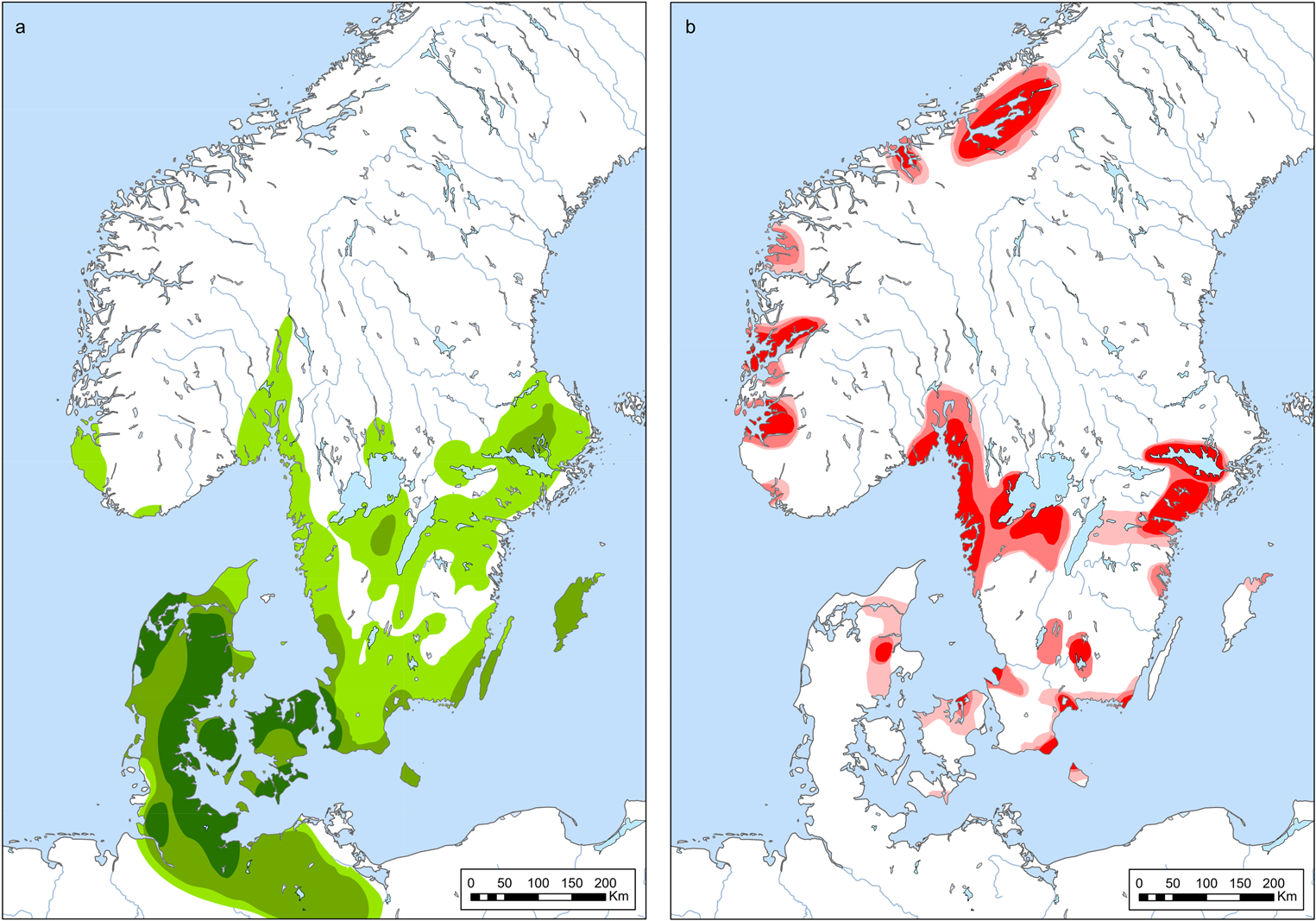
Rock art may partly serve a similar function in keeping the most threatening aspects of returning fighters at bay and promoting social cohesion. The distribution of NBA metalwork and rock art reveals that regions with numerous finds of metalwork are poorer in rock art, and regions with rock art, while frequently depicting weapons in detail, often lack metalwork depositions (Figure 8). Both share a closeness to fjords, bays, and islands. Swedish inland rock art is most densely distributed along an axis running from Bohuslän to Mälardalen following large rivers and the Vänern and Vättern lakes (Nimura et al., Reference Nimura, Skoglund and Bradley2020). The rock art's relationship to bodies of water is even closer than that of metalwork, as some examples below illustrate.
a) Density of Nordic Bronze Age metalwork based on published large catalogues (Broholm, Reference Broholm1943; Badou, Reference Badou1960; Oldeberg, Reference Oldeberg1974; Aner & Kersten, Reference Aner and Kersten1974–2017; Schmidt, Reference Schmidt1993; Thrane, Reference Thrane2004; Maraszek, Reference Maraszek2006; Endrigkeit, Reference Endrigkeit2010; Engedal, Reference Engedal2010) and databases (https://www.unimus.no; https://www.kringla.nu). b) Density of Nordic Bronze Age rock art (after Nimura, Reference Nimura2015).
A panel in Gerum (Tanum) depicts at least ninety-five boats, forty-three anthropomorphic figures, twenty-eight animals, sixteen footprints or shoeprints, and 187 cupmarks (Horn & Potter, Reference Horn and Potter2019). Through the rise of the Scandinavian landmass the panel became available for carving during the Bronze Age (Påsse, Reference Påsse and Persson2003; Ling, Reference Ling2014) and more stone emerged as time went on. Carving may have started as soon as the rock surface became accessible. Its location and orientation meant that rainwater flowed evenly down the panel into the fjord and water from the fjord frequently washed over the carved areas (Ling, Reference Ling2014; for a similar situation in Nämforsen, see Goldhahn, Reference Goldhahn2002). Possibly some of the images were carved directly from a boat.
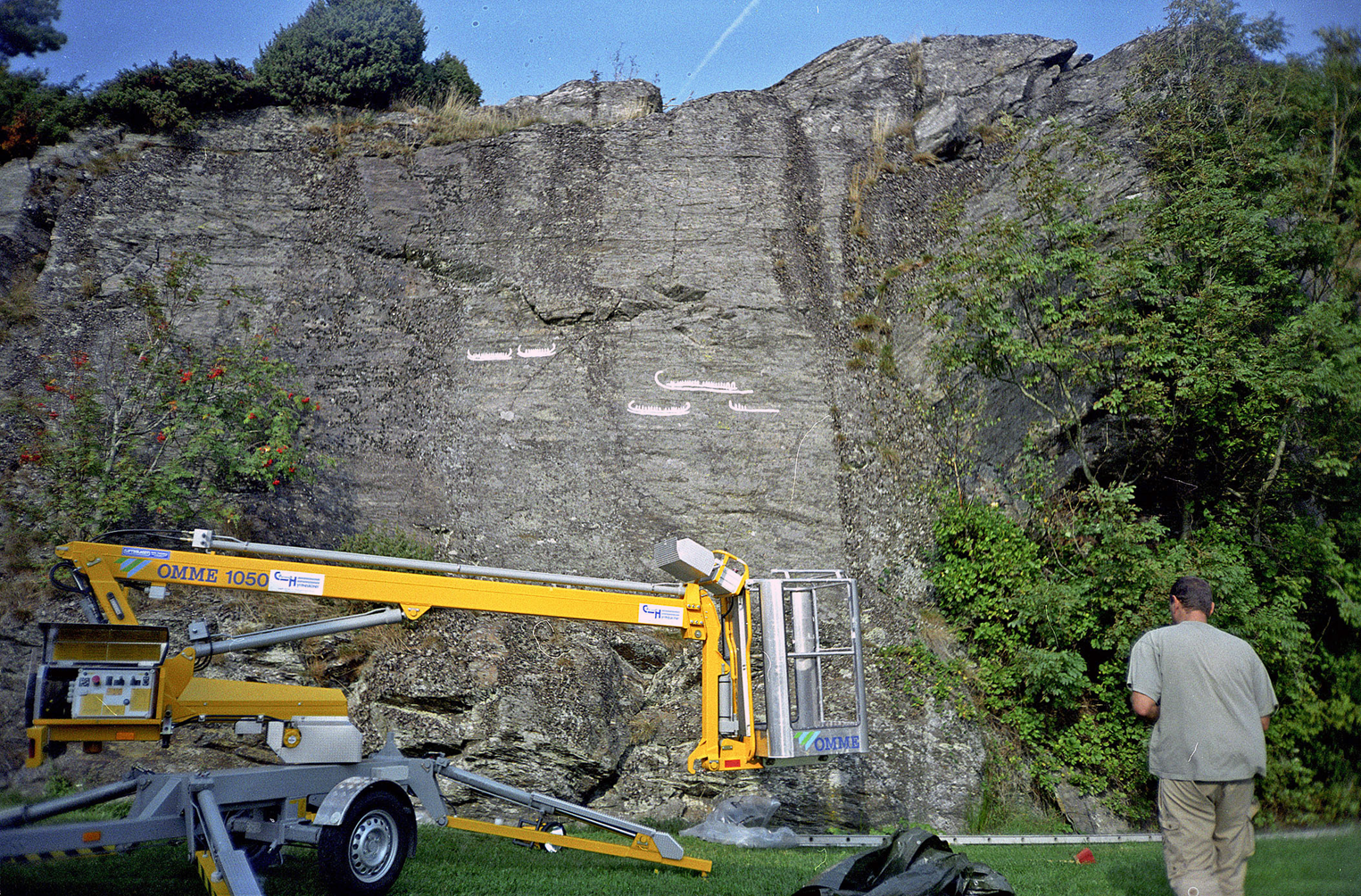
That engravings were made directly from boats is evident at the site of Berget III in the Tyrifjorden-Randsfjorden (Norway). Two boats dating to the earliest phase of the NBA were depicted on a cliff located today some 1.7–1.8 m asl. When the images of the boats were carved, the level of the water was just below them (Østmo, Reference Østmo1990). A similar situation exists in Flögen (Solberga, Sweden) where several boats with dates ranging from the Early Bronze Age to the transition to the Late Bronze Age are depicted along with a bull on a cliff between 12.51 and 11.66 m asl (Figure 9). The sea was just below the engravings when they were made (Ling & Bengtsson, Reference Ling, Bengtsson, Barndon, Innselset, Kristoffersen and Lødøen2006). In both cases, it is highly likely that the images were made from a boat or while standing on frozen water in winter.
Panel at Flögen (Solberga 50:1) and surroundings. Photograph by permission of Lasse Bengtsson.
A summary viewshed analysis of the rock art in Bohuslän demonstrates a focus on the local sphere. The images were closely related to the Bronze Age coast, but it was not possible for people standing at the panels to see the open sea (Figure 10). Instead, their view was directed to the inner seascape overlooking fjords, straits, and bays. This also meant that the images could not be seen from the open sea, only by people leaving or arriving in Bohuslän. Thus, they were directed toward the inner sphere.
Summary viewshed analysis of rock art sites in western Sweden (graphics by Rich Potter).
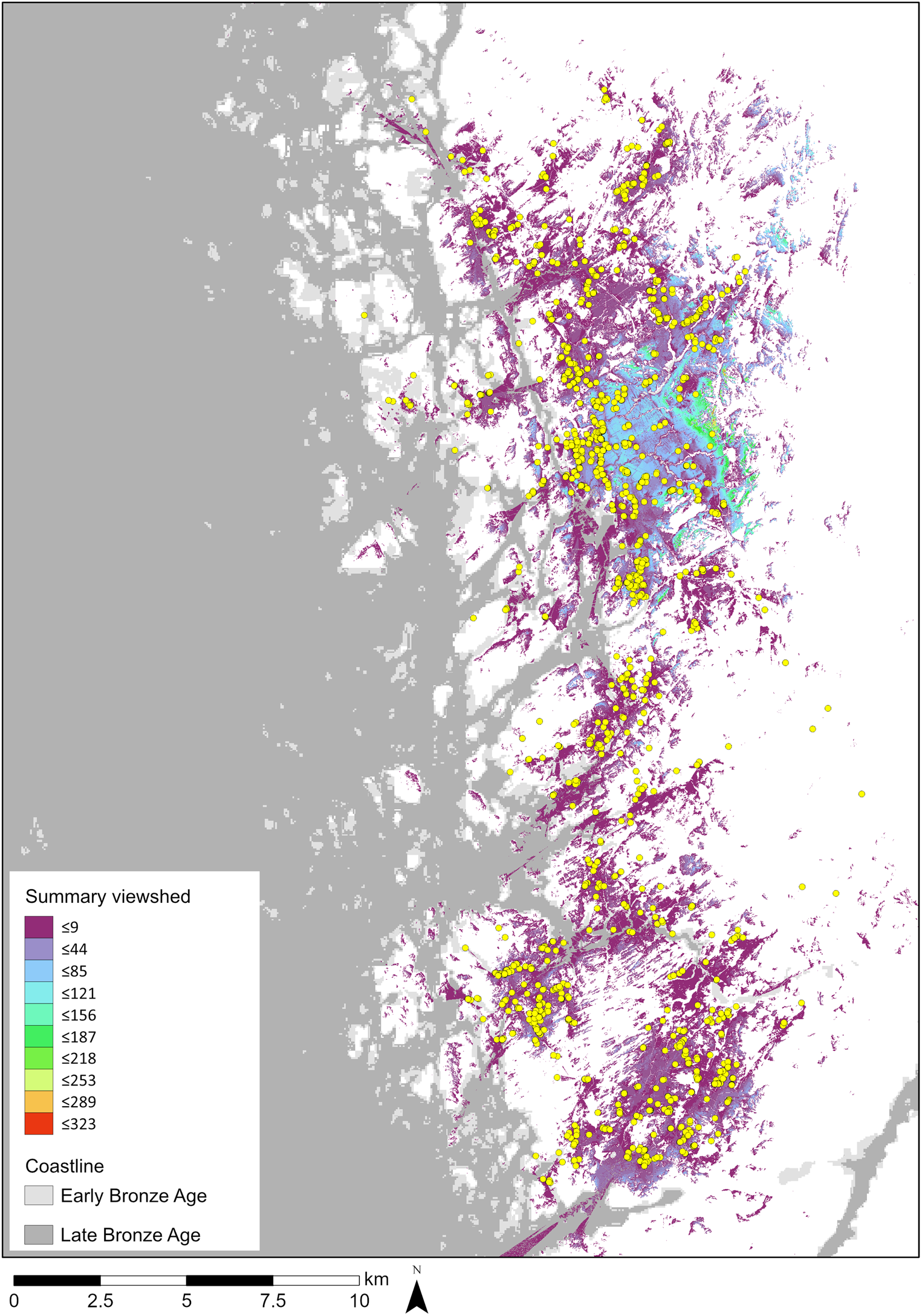
Changes in burial customs from inhumations to cremations during the Early to Late Bronze Age may reflect another aspect of the relationship between warriors and rock art and metalwork. Cremation brought a decrease in the number of grave goods, including weaponry. Previously, warriors were inhumed in stone cists and oak coffins in barrows and stone cairns, often on the top of hills close to the coast visible from sea and land (Artelius, Reference Artelius1998). In rock art regions like Tanum, these burials were often directly above rock art panels; although weapons were fewer in that region, the rock art may have served as a substitute for putting real weapons in the graves (Gerdin, Reference Gerdin1994). The location of the Tanum burials does not contradict the idea that the rock art was directed towards the inner sphere, because burials may represent deceased warriors as maritime actors in the act of departing or arriving. This makes it even more relevant that the rock art is exclusively oriented towards the inner sphere (Figure 10), perhaps geared towards arrival and internal social aspects.
The grave goods in other regions were highly varied and include different types of swords, razors, double buttons, and other objects, especially in rich warrior burials. Conversely, human depictions dating to the Early NBA were frequently schematic and any weapons with these motifs were merely indicated. However, the depiction of weapons in their own right (i.e., not accompanying a human figure) are naturalistic, and such weapons were reworked throughout the NBA, often having a human figure added to them (Horn & Potter, Reference Horn and Potter2018). For example, at Listeby in Tanum, the latest boat, overlain by the image of a large spearman, dates to the NBA Period III (1300–1100 bc), implying that the spearman could have been carved during this final period of the Early Bronze Age (Bertilsson, Reference Bertilsson and Troletti2015).
With the emergence of cremations, grave goods became less varied, burials were topographically inconspicuous—being located on slopes or were invisible as secondary burials in barrows—and they became much smaller. The prominent individuals in Early NBA burials seem to disappear during the Late Bronze Age. A wider spectrum of the population appears in burials but this may also have anonymized the deceased, perhaps defining ancestors as a group rather than individuals (Artelius, Reference Artelius1998). Conspicuously, this process begins late in Period III (1300–1100 bc), when very detailed warrior images begin to emerge, peaking during Period V (950–730/720 bc) (Fredell, Reference Fredell2003).
I interpret this as the warrior ideal still being conceptualized and presented as an ideal, with rock art becoming more important than burials to communicate this. Of course, petroglyphs may have served other purposes, such as conveying common social narratives about warriors, heroes, and myths (Ranta, Reference Ranta2016; Ranta et al., Reference Ranta, Skoglund, Rédei and Persson2019). The various relationships between rock art and metalwork indicate that they may have played a role in rituals concerned with warfare and warriors in different media (Bradley, Reference Bradley, Skoglund, Ling and Bertilsson2015). In this case, the social narratives that rock art illustrates may have been used, like weapon sacrifices, to allow fighters to transition back into their communities by emphasizing their proper role in society (Horn, Reference Horn, Hansen and Krause2019; Ranta et al., Reference Ranta, Skoglund, Rédei and Persson2019).
Conclusion
Rock art reproduced the ideal of maritime warriors (Ling & Toreld, Reference Ling, Toreld, Horn and Kristiansen2018). Its location at the point of departure and arrival of their journeys, its orientation towards the inner sphere, and its ritual link with metalwork may have been used to allow warriors to transition between their role as liminal agents, such as fighters or raiders, and their role as social characters, i.e. warriors. Possibly the location of rock art, as well as episodes of reworking, could be linked to the time it was made, i.e. the departure or arrival of seaborne warriors. Such journeys are often discussed in the scope of long-distance travel which were very important. However, local journeys to raid inner-Scandinavian communities would have been no less dangerous. Since shorter distances were involved, combat arousal would have had less of a chance to subside, which may have posed a greater threat than a crew of warriors returning from a long-distance journey. This may have involved important individuals like the organizers and leaders of the journey, as recent ethnological work suggests (Ling et al., Reference Ling, Chacon and Chacon2021). On such occasions, narratives may have played a part in rituals. This may tie in with the observed retroactive changes and updates depicted in rock art, since their most important purpose may have been to support a social narrative. Oral traditions handed down through generations change over time (Vansina, Reference Vansina1985; Bradley, Reference Bradley2002) just as the material world of those telling the stories changed. To keep the images and narratives relevant, it may have been necessary to modify and update details in line with the changing contemporary world.
Weapon sacrifices and the ritual retelling of social narratives perhaps took place in liminal zones, such as the points of arrival of returning fighters, that would have allowed for time to pass and diminish their arousal. The projection of violence and brutality onto weapons and images could have enabled them to separate these aspects from their social personas. Furthermore, orientation towards the inner sphere and the idealized conceptualization of maritime warriors may have reminded fighters of their social role, emphasizing the need to maintain social cohesion. This may have been important to avoid internal conflict in settings where constantly shifting alliances meant that social power could be gained by exercising violence, making it possible to deal with the ambivalence of agents of violence at the centre of the social structure of NBA societies.
Acknowledgements
The research from which this article draws was financed by the Swedish Research Council within the ‘Modelling Bronze Age Societies in Southern Scandinavia’ project (grant no. 2020-01097) and the Riksbankens Jubileumsfond programme ‘Maritime Encounters – A Counterpoint to the Dominant Terrestrial Narrative of European Prehistory’ (grant no. M21-0018). I would like to thank the three anonymous reviewers and editors for their constructive input. My gratitude also extends to Rich Potter for checking my original text. All errors remain my own.
Supplementary Material
To view supplementary material for this article, please visit https://doi.org/10.1017/eaa.2022.26.


 Open access

