

Introduction
Fathers’ use of parenting leavesFootnote 1 is regarded as an important issue on the path to equality and wellbeing in families. Fathers tend to use more leave when it is a non-transferrable individual entitlement, long enough, and relatively well compensated for (Duvander et al., Reference Duvander, Eydal, Moss, Duvander and Koslowski2019; O’Brien, Reference O’Brien2009). Indeed, many changes to parenting leave policies in Europe have introduced and increased the non-transferrable father’s quotas (Duvander et al., Reference Duvander, Eydal, Moss, Duvander and Koslowski2019; Ellingsaeter, Reference Ellingsæter2014; Haataja, Reference Haataja2009) to encourage fathers’ leave-taking. Such reforms have generally increased quota usage (Duvander & Johansson, Reference Duvander and Johansson2012; Ma et al., Reference Ma, Andersson, Duvander and Evertsson2020) and are associated with positive effects on families, including better labour market outcomes for mothers (Dunatchik & Özcan, Reference Dunatchik and Özcan2021), higher school performance (Cools et al., Reference Cools, Fiva and Kirkebøen2015), higher probability of having another child (Duvander et al., Reference Duvander, Eydal, Moss, Duvander and Koslowski2019), lower risk of parental separation (Olafsson & Steingrimsdottir, Reference Olafsson and Steingrimsdottir2020; Petts et al., Reference Petts, Carlson and Knoester2020), and closer relationships between fathers and children (Haas & Hwang, Reference Haas and Hwang2008).
As an EU directive (2019/1168) expanding parental leave in all member states (setting a minimum non-transferable entitlement of two months) only came into force in mid-2022, most literature on leave and its effects comes from Nordic countries, considered world leaders in reducing disparities in parents’ work-care balance (Duvander et al., Reference Duvander, Eydal, Moss, Duvander and Koslowski2019; Karu & Tremblay, Reference Karu and Tremblay2018). Despite this, Nordic mothers still use most parenting leave entitlements (Brandth & Kvande, Reference Brandth and Kvande2020, Duvander et al., Reference Duvander, Eydal, Moss, Duvander and Koslowski2019; Eerola et al., Reference Eerola, Lammi-Taskula, O’Brien, Hietamäki and Räikkönen2019; Haas & Hwang, Reference Haas and Hwang2019). Parental freedom-of-choice (in practice, of the mother) was long emphasised over gender equality in Finland, with fathers’ share of leave lower than in most Nordic countries (Eydal & Rostgaard, Reference Eydal, Rostgaard, Daly and Pfau-Effinger2023; Hiilamo & Kangas, Reference Hiilamo and Kangas2009); while most employed fathers took paternity leave around birth, ∼54% of fathers to children born 2013–2015 refrained from taking father’s quota (Saarikallio-Torp & Miettinen, Reference Saarikallio-Torp and Miettinen2021).
Research exploring predictors of fathers’ leave-taking has focused on paternal and family characteristics (Eydal & Rostgaard, Reference Eydal and Rostgaard2014; Ma et al., Reference Ma, Andersson, Duvander and Evertsson2020; Trappe, Reference Trappe, Rusconi and Wimbauer2013) or on leave entitlements and country differences therein (Bartova & Keizer, Reference Bartova, Keizer, Nieuwenhuis and Van Lancker2020; Dearing, Reference Dearing2016; Eydal & Rostgaard, Reference Eydal, Rostgaard, Daly and Pfau-Effinger2023). Most fathers taking leave are, however, employed, and the workplace context is factored into decision-making (see e.g., Eerola et al., Reference Eerola, Lammi-Taskula, O’Brien, Hietamäki and Räikkönen2019): workplaces can both support or suppress fathers’ leave uptake (den Dulk et al., Reference den Dulk, Peters and Poutsma2012; Närvi & Salmi, Reference Närvi and Salmi2019). Previous studies show that superiors’ and colleagues’ attitudes, expectations, and previous use of leave influence fathers’ leave decisions (Bygren & Duvander, Reference Bygren and Duvander2006; Carlsson & Reshid, Reference Carlsson and Reshid2022; Dahl et al., Reference Dahl, Løken and Mogstad2014; Haas & Hwang, Reference Haas and Hwang2019), but leave usage also varies by industry and sector (Geisler & Kreyenfeld, Reference Geisler and Kreyenfeld2019; Saarikallio-Torp & Haataja, Reference Saarikallio-Torp, Haataja, Haataja and Airio2016) and type of employment contract (Geisler & Kreyenfeld, Reference Geisler and Kreyenfeld2019). Yet, these findings typically rely on qualitative interviews (e.g. Haas & Hwang, Reference Haas and Hwang2019) or survey data with small samples, which do not allow for modelling workplace contexts adequately (e.g. Geisler & Kreyenfeld, Reference Geisler and Kreyenfeld2019; Närvi & Salmi, Reference Närvi and Salmi2019; but see Eriksson et al., Reference Eriksson, Billingsley and Brandén2022). Even the few large-scale quantitative studies that exist (Bygren & Duvander, Reference Bygren and Duvander2006; Valentova et al., Reference Valentova2024) focus on descriptive associations between workplace characteristics and fathers’ leave uptake.
This article focuses on variation in fathers’ parental leave uptake across Finnish private-sector workplaces, examining how different workplace structural characteristics are associated with fathers’ use of quota, leave intended to be taken without the mother (though this is not necessarily the case in practice: see Kinnunen et al. Reference Kinnunen, Lammi-Taskula, Miettinen, Närvi and Saarikallio-Torp2024). There are several explanations for such variation in leave uptake. European labour markets, particularly that of Finland, are strongly gender segregated, with women working in lower-paying occupations and in the public sector and men working in higher-paying occupations and in the private sector. This might influence workplaces differently in terms of how acceptable career breaks for child-rearing are perceived (Hook et al., Reference Hook, Li, Paek and Cotter2023) and explains why men working in female-dominated occupations take more leave (Närvi & Salmi, Reference Närvi and Salmi2019; Saarikallio-Torp & Haataja, Reference Saarikallio-Torp, Haataja, Haataja and Airio2016). On the other hand, workplaces with a higher share of highly-educated men, with generally more positive views about fathers’ caregiving than lower-educated men (Boehnke, Reference Boehnke2011; Sullivan, Reference Sullivan2010), could be more supportive of care-related work interruptions (Eriksson et al. Reference Eriksson, Billingsley and Brandén2022).
Empirically, we examined employed first-time fathers of children born in Finland 2013–2017 using near-full population employee-employer register data with reliable and detailed information on private-sector workplaces and families. Deepening knowledge of associations between fathers’ leave use and the measurable structural aspects of workplaces and identifying contexts which support or suppress the leave uptake are crucial to ensure equal freedom of choice for parents and for adequate policy recommendations.
Finnish context
Nordic family policies have long focused on promoting gender equality via providing both parents the right to paid work and care for their young children (Duvander et al., Reference Duvander, Eydal, Moss, Duvander and Koslowski2019; Huttunen & Eerola, Reference Huttunen, Eerola, Adler and Lenz2016). Despite Finland introducing paid paternity leave in the late 1970s and shareable parental leave soon after (Huttunen & Eerola, Reference Huttunen, Eerola, Adler and Lenz2016), development of individual parental rights to fathers was slower than in Nordic counterparts, and, apart from birth-related paternity leave, fathers’ uptake of parental leave has been lower too (Duvander et al, Reference Duvander, Eydal, Moss, Duvander and Koslowski2019).
The first non-transferrable father’s quota was introduced in 2003, initially as a bonus leave conditional on maternal consent to refrain from sharable parental leave. It took until 2013 for fathers to gain an independent right to a quota of parental leave, which increased and equalised the use of paternal leave entitlements (Saarikallio-Torp & Miettinen, Reference Saarikallio-Torp and Miettinen2021). In 2013–2022, Finnish fathers were entitled to 9 weeks of paternity leave: three weeks (18 paid days; Sundays excluded) together with the mother, usually taken soon after the birth, and six weeks of quota leave after the sharable parental leave period until the child turned two (intended to be taken without the mother). Eligibility to paternity leave had no requirements regarding employment or income, but until 2017 only fathers coresiding or married with the mother were eligible. Employed fathers’ parenting leave days were income-compensated at 70% up to a threshold (approximately equivalent to Finnish median income), with lower compensation for income above that. Low income/unemployed parents received a minimum flat-rate allowance. In this time period, mothers were entitled to 18 weeks of maternity leave, while 43 weeks were sharable (however, mainly taken by mothers). Finland also provides parents with home-care-allowance, a flat-rate cash-for-care benefit paid after earnings-related parental leave until the child’s third birthday. This benefit is often argued to support longer career breaks among mothers and to strengthen mothers’ roles as care givers.
Overall, the number of non-transferable paternity leave weeks was lower in Finland than in most other Nordic countries. While Finland was (and remains) the only Nordic country without a payment ceiling, the allowance covered a lower percentage of income, and supplementation by collective agreement with employers is also more limited (Koslowski et al., Reference Koslowski, Blum, Dobrotić, Kaufman and Moss2021). Aside from the first three weeks of father leave, parents could not receive parental leave allowance simultaneously, and the Finnish system is often described as less flexible than e.g. the Swedish one (Duvander et al., Reference Duvander, Eydal, Moss, Duvander and Koslowski2019); a mother using home-care-allowance may also act as a barrier to leave uptake (Kinnunen et al., Reference Kinnunen, Lammi-Taskula, Miettinen, Närvi and Saarikallio-Torp2024).
During our study period, ∼75% of fathers and 85% of employed fathers took leave, and ∼45% of fathers and 50% of employed fathers used father’s quota (authors’ calculations). Though the share of payments going to fathers has been growing, leave use remains gendered: ∼89% of all parenting leave days were paid to mothers in 2019 (KELA, 2020). Finland introduced a gender-equal parental leave reform in mid-2022, granting both (custodial) parents an independent right to 6.4 months of parental leave, including 16 non-transferrable weeks (plus 6.5 weeks of pregnancy leave to the pregnant parent). Initial statistics suggest that the reform has considerably increased fathers’ quota use, but data to analyse the implications exhaustively is not yet available.
Note here that uptake per se is not focused upon (see Helske et al., Reference Helske and Helske2024; Saarikallio-Torp & Miettinen, Reference Saarikallio-Torp and Miettinen2021). Instead, analyses assess uptake of quota leave (taking over three weeks of leave) across private-sector workplaces. The majority of employed Finnish men work in the private sector. Though wage structures are less compressed than in the public sector, collective bargaining between employers and employee unions sets wage structures and employer contributions to benefits (e.g. days of parental leave paid in full by employers vs partial State compensation; for fathers, typically 1–2 weeks, rarely beyond 3-week paternity leave; Kinnunen et al., Reference Kinnunen, Lammi-Taskula, Miettinen, Närvi and Saarikallio-Torp2024).
The demographics of fathers’ use of parental leave
Fathers’ active participation in parenting has increased over time, as leave policies have changed and norms and attitudes towards fathers’ role in childcare have modernised (Doucet, Reference Doucet2006; Ranson, Reference Ranson2015). Men’s traditional role as primary breadwinners and ‘secondary caregivers’ is closely related to attitudes towards paternal leaves, with men’s gendered (traditional) perceptions about their parental responsibilities being related to lower leave-taking in general (Närvi & Salmi, Reference Närvi and Salmi2019). Gendered preferences tend to be more prevalent among fathers with low socio-economic status, while high socio-economic status fathers more often adopt the new fatherhood ideal, which promotes active involvement in childcare (Smith, Reference Smith, Maltby, Kennett and Rummery2008). Higher-educated/-earning men take parental leave more often than fathers with lower education/earnings (Eriksson, Reference Eriksson2018; Eydal & Rostgaard, Reference Eydal and Rostgaard2014; Helske, et al., Reference Helske and Helske2024; Ma et al., Reference Ma, Andersson, Duvander and Evertsson2020; Saarikallio-Torp & Miettinen, Reference Saarikallio-Torp and Miettinen2021; Trappe, Reference Trappe, Rusconi and Wimbauer2013).
Previous studies show that fathers’ leave uptake is also patterned by the mothers’ educational level, work situation, and earnings (Duvander et al., Reference Duvander, Mussino and Tervola2021; Geisler & Kreyenfeld, Reference Geisler and Kreyenfeld2019; Lappegård, Reference Lappegård2008; Miettinen & Saarikallio-Torp, Reference Miettinen and Saarikallio-Torp2020; Närvi & Salmi, Reference Närvi and Salmi2019; Saarikallio-Torp & Haataja, Reference Saarikallio-Torp, Haataja, Haataja and Airio2016; Trappe, Reference Trappe, Rusconi and Wimbauer2013; Valentova Reference Valentova2024). According to surveys, expected loss of earnings and family economic situation are among the most common barriers to taking leave (Eerola et al., Reference Eerola, Lammi-Taskula, O’Brien, Hietamäki and Räikkönen2019; Kaufman, Reference Kaufman2018; Kinnunen et al., Reference Kinnunen, Lammi-Taskula, Miettinen, Närvi and Saarikallio-Torp2024). On average, men have higher salaries than women, and thus greater expected negative impacts on family finances if on leave; in the Nordics, fathers’ leave usage is generally higher when couples earn relatively equally, or when the mother earns more (Duvander et al., Reference Duvander, Mussino and Tervola2021; Lappegård, Reference Lappegård2008).
Theoretical framework and hypotheses
Norms and practices at the workplace can encourage or discourage employed fathers’ use of leave (Brandth & Kvande, Reference Brandth and Kvande2019; Ginja et al., Reference Ginja, Karimi and Xiao2023). This study focuses on structural workplace characteristics that have been suggested to directly or indirectly influence usage of paternal leave entitlements.
Workplaces are not gender-neutral sites: perceptions of femininity and masculinity are part of practices, interactions, and norms at workplaces (Acker, Reference Acker1990). Workplaces typically favour employees who show commitment by working long hours and being available for unexpected tasks. This ‘ideal worker’, however, is implicitly masculine, as the strong devotion to work relies on a (female) spouse performing unpaid care work (Acker, Reference Acker1990). By taking time off for child-rearing, parents signal that they prioritise family over work, violating the ‘ideal worker’ norm (Haas & Hwang, Reference Haas and Hwang2019; Williams, Reference Williams2010). This violation can be particularly strong for men, as it also defies gender expectations: earlier research shows fathers are penalised more than mothers for the same duration of leave (Evertsson et al., Reference Evertsson2016; Weisshaar, Reference Weisshaar2018). Two features of gendered workplaces – gender composition and degree of gender inequality – are most relevant for understanding whether leave uptake is at odds with workplace practices and norms.
First, working environments with a higher share of women are likely more accustomed to leave uptake, with more experience in re-organising tasks during an employee’s parental leave, and possibly more explicit practices encouraging fathers’ leave uptake (see Haas & Hwang, Reference Haas and Hwang2019). The ideal worker norm might also be less salient when the representation of women is high e.g. working overtime is more common in male-dominated occupations (Cha, Reference Cha2013; Leuze & Strauß, Reference Leuze and Strauß2016). Fathers in male-dominated workplaces are also less likely to use quota leave (Närvi & Salmi, Reference Närvi and Salmi2019), whereas fathers’ leave uptake is higher in education, social work, and health care, i.e. fields with typically high female-representation (Saarikallio-Torp & Haataja, Reference Saarikallio-Torp, Haataja, Haataja and Airio2016).
Second, qualitative research highlights that even in countries where fathers’ uptake is high, such as Sweden, fathers adjust their behaviour in relation to the workplace and reflect on the extent to which work interruptions deviate from the norm (Haas & Hwang, Reference Haas and Hwang2019). Expectations of gender-typed behaviour might be stronger in environments with pronounced gender differences in power. Specifically, workplaces favouring men might sanction fathers who prioritise childrearing stronger, viewing them as ‘less of a man’ (Williams et al., Reference Williams, Blair-Loy and Berdahl2013). Taken together, it is hypothesised that:
H1 Fathers working in workplaces with a higher share of women and a smaller gender wage gap are more likely to use fathers’ quota than those in workplaces with a higher share of men and larger gender wage gap.
Employees further their career advancement by being present and available at work (Närvi & Salmi, Reference Närvi and Salmi2019). Workplace competition reinforces the ideal worker norm: in highly competitive environments, employers might place fathers who interrupt work below competitors in the job hierarchy (Johnsen et al., Reference Johnsen, Ku and Salvanes2024) and offer these fathers fewer promotion prospects or wage rises due to signalling lower work commitment (Evertsson, Reference Evertsson2016; Weisshaar, Reference Weisshaar2018). Fathers may refrain from quota leave if they anticipate that absence will prompt a negative response at work. Therefore:
H2.1 Fathers in workplaces with more within-occupation job competition are less likely to make use of the father’s quota than those in workplaces with less within-occupation competition.
Even in competitive environments, the standing of the father relative to co-workers is likely to affect the decision to use quota leave. Fathers earning more than co-workers might be less sensitive to competition, as they already have secured their position in the workplace hierarchy. High-status men typically have more bargaining power in the organisation, indicating that they are less likely to fear career disadvantages following leave (Morosow & Cooke, Reference Morosow and Cooke2022). Low earning men, in turn, might fear that career interruptions hamper job security (Williams et al., Reference Williams, Blair-Loy and Berdahl2013). Conversely, being at the top in the workplace hierarchy also means that the father potentially has more to lose by taking leave (Evertsson, Reference Evertsson2016). Therefore, two competing hypotheses are formulated:
H2.2 Having a higher relative income than colleagues in more competitive environments makes taking the father’s quota a) more likely or b) less likely.
While the higher uptake of parental leave among tertiary-educated fathers is well-documented, this educational gradient could also reflect the workplace context. Tertiary-educated fathers, generally, display more gender-egalitarian views and emphasise fathers’ caregiving responsibilities (Boehnke, Reference Boehnke2011; Sullivan, Reference Sullivan2010). Workplaces with a high share of highly educated men may be more supportive of fathers’ family-related work interruptions; Eriksson et al. (Reference Eriksson, Billingsley and Brandén2022) show that selection into workplaces play a crucial role in understanding fathers’ leave length, as differences by education are small once workplaces are accounted for.
What remains unclear is whether norms and behaviour related to leave-taking among highly-educated fathers set an example for others that ‘spills-over’ to lower-educated colleagues. Previous research shows that a peer’s uptake of leave increases leave length among male co-workers (Carlsson & Reshid, Reference Carlsson and Reshid2022; Helske et al., Reference Helske and Helske2024). From the ideal worker norm perspective, workplaces with a higher share of tertiary-educated men may foster a culture that challenges the ideal worker norm and embraces the new fatherhood ideal where fathers’ caregiving responsibilities are normalised (Balan et al., Reference Balan, van den Brink and Benschop2023; Kaufman & Uhlenberg, Reference Kaufman and Uhlenberg2000). For fathers with lower education levels, who may otherwise be more susceptible to traditional masculinity and ideal worker norms, exposure to such a workplace could weaken the ideal worker norm and make them more likely to use more parental leave. Therefore, the assumption is that:
H3 The educational level of the workplace is more likely to matter for fathers with basic or secondary education than for tertiary-educated fathers. Specifically, fathers having only basic or secondary education are more likely to use quota leave in workplaces with a high share of tertiary-educated men, compared to their counterparts in workplaces with a lower share of tertiary-educated men.
Methods
Data
Register data used in this study come from administrative registers provided by Statistics Finland, the Social Insurance Institution of Finland (KELA), and the Finnish Institute for Health and Welfare (THL). Statistics Finland’s Structure of Earnings Statistics was used for calculating wage-based workplace characteristics. See Supplementary for further details on registers. Data selection was done with the data.table package v1.14.10 (Barrett et al., Reference Barrett, Dowle and Srinivasan2023) in R v4.3.1 (R Core Team, 2023). All data are pseudonymised and usage is in accordance with relevant legislation; research use of this register data is permitted without requiring informed consent, and no micro-data is identifiable from the results presented in this article.
The focus of this article is on employed men (excluding entrepreneurs) who became first-time fathers between 2013 and 2017 (initially n = 88,052), had complete information for all variables in the models, were in the private sector, and were partnered with the biological mother for at least 15 months after birth (see Table S1). The years 2013–2017 were selected so that all included fathers would be under the same leave regime and have completed paternity leave data. First time fathers were selected as they have no previous leave experience; those who took quota leave before may do so again even if workplace characteristics would typically deter quota uptake (or vice versa). A partnership of 15 months was assumed as a fair balance between three issues: (1) non-residential fathers did not have eligibility to leave before 2017; (2) the majority of fathers start their quota leave within this time (∼65%; Miettinen & Saarikallio-Torp, Reference Miettinen and Saarikallio-Torp2020); (3) excluding all couples that separated before 2 years introduces more sample bias as risk of early separation is higher among low-educated families. Substantive conclusions do not differ if we include fathers who separated before 15 months. The child for whom the father had taken leave also needed to be born in Finland, as birth dates for children born outside of Finland were not available. Some migrant fathers were excluded based on recorded education and time of arrival in/return to Finland (see Supplementary). Only private sector workers were selected due to missingness in employment information for most public sector workers, preventing reliable and accurate assignment of individuals to workplaces; any results would likely be unrepresentative of the public sector situation, and could/should not be trusted. Our final sample comprised 24,964 first-time fathers (28.4% of employed first-time fathers; 34.2% of private sector first-time fathers) from 8597 different workplaces for the birth years 2013–2017.
Variables
Our dependent variable, took father’s quota (binary: 1 if taking >18 days, otherwise 0; threshold based on paternity leave concurrent with mother vs quota leave), was based on the number of parenting leave days taken by a father.
Workplace was set as the establishment (particular workplace) ID. Workplace characteristics were calculated for 2013–2018 together to standardise within workplaces. The year 2018 was taken as the end point as fathers with children born mid-2017 onwards could not have taken quota leave in 2017. Wage dispersion, gender pay gap, and relative income were all capped at the 1st and 99th percentiles to reduce the influence of extreme outliers and aid in model convergence.
Sex ratio (H1) was categorised into female-dominated (∼0–40% male; 16.2% first-time fathers/16.4% sample fathers), balanced (41–60% male; 13.3% first-time fathers/14.4% sample fathers), and male-dominated (61–100% male; 70.5% first-time fathers/69.2% sample fathers), as the effect may be non-linear. See Supplementary for 5-level sex ratio robustness check.
Gender pay gap (H1) was the mean male hourly pay minus the mean female hourly pay, all divided by the mean male hourly pay; this necessitated dropping all-male workplaces (5.3%). Median gender wage gap was 0.11 (i.e. women earn 11% less than men; 25th percentile: 0.04; 75th percentile: 0.17). The focus was on hourly wages, as they do not reflect working hours (see also Morosow & Cooke, Reference Morosow and Cooke2022).
Wage dispersion (H2.1; H2.2) was used to measure competitiveness in the workplace (in line with several previous studies, e.g. Johnsen et al., Reference Johnsen, Ku and Salvanes2024 on fathers’ leave uptake and earnings), as a greater spread is assumed to reflect the extent to which firms incentivize effort (Laezar & Rosen, Reference Lazear and Rosen1981). We calculated the coefficient of variation (dividing the hourly wage standard deviation by mean hourly wage) to capture how wages spread in a given workplace. The whole-workplace wage dispersion, however, may measure e.g. a greater diversity of occupations rather than competition. Therefore, the coefficient of variation was calculated for each occupation in the workplace separately (i.e. for individuals working in the same workplace and same 5-digit occupation; results are not changed using a 3-digit classification that more broadly categorises occupations). Values closer to zero indicate lower variation in wages within that occupation, with occupation classified following the national Classification of Occupations 2010 (based on ISCO–08). Median wage dispersion was 0.16 (25th percentile: 0.12; 75th percentile: 0.22).
Education level (H3) was the proportion of employees who had tertiary degrees. See Supplementary for robustness checks using mean education time and proportion who had completed a matriculation exam.
Number of employees was the log of the average number of employees in a workplace. Median workplace size was 100 employees (25th percentile: 35; 75th percentile: 303).
Father characteristics were included both as relevant to our hypotheses and as controls. Father age in years (linear and quadratic, scaled and mean-centred). Father education (H3) was the highest educational level attained: basic (compulsory schooling only; 6%), general upper secondary (12%), vocational upper secondary (34.4%), lower tertiary (bachelors or equivalent; 27.7%), master’s (or equivalent; 19.4%), and doctorate (0.5%). Relative income (H2.2) was the father’s wage divided by the median wage of the workplace across the study period; 1 indicates the father earned the median wage, while lower or higher values represent earning less or more than the median wage, respectively. While father income would account for differences in uptake across the wage distribution, it was not included here as interest was in the total effect of education, not the effect of education net of income. See Supplementary for results including this variable.
As fathers’ leave uptake reflects the family context, partnership characteristics were also accounted for. Partner contribution to household finances was the proportion of the household income earned by the partner. Partner age difference was the difference in age in years between the father and partner. Partner education difference was the number of levels the father and their partner differ in education; negative indicates the partner is more highly-educated, while positive indicates the opposite.
Statistical analysis
Whether fathers took quota leave was modelled as a Bernoulli (logit link) generalised linear mixed-effects model, implemented within a Bayesian framework with brms v2.20.4 (Bürkner, Reference Bürkner2017). All covariates had weakly informative priors of Normal(0,2), with default brms priors for the intercept and workplace. The model ran across four chains (2500 iterations per chain, of which 500 were warm-up).
As well as the singular variables relevant to the hypotheses, log number of employees was included as a fixed effect, alongside four interactions: gender wage gap by categorical sex ratio, wage dispersion by categorical sex ratio, wage dispersion by relative income (H2.2), and father education and workplace education level (cross-level; H3). In addition to workplace-level variables, individual-level controls of father age (scaled; both linear and quadratic included), partner contribution to household, education and (scaled) age difference between father and partner were also added to the full model. Workplace was included as a random effect to account for unobserved characteristics.
Meaningfulness of interactions was tested with leave-one-out cross-validation (Vehtari et al., Reference Vehtari, Gelman and Gabry2017). Expected log predictive densities (ELPD) for the full model and models without each interaction term were compared; ΔELPD under 4 indicates an interaction would not increase predictive accuracy. Two types of 95% intervals were calculated: highest density intervals (HDI; all points within interval have a higher probability than those outside) and equal-tailed intervals (ETI) (see Makowski et al., Reference Makowski, Ben-Shachar, Chen and Lüdecke2019a) with bayestestR v0.13.2 (Makowski et al., Reference Makowski, Ben-Shachar and Lüdecke2019b). HDIs are predominantly reported in this article: though HDIs and ETIs differ little with symmetrical posterior distributions, ETIs for skewed distributions may include values that are less probable than those outside of the interval. Probability of direction (PD) represents the percentage of the posterior distribution that shares same direction as the median, and indicates effect existence (Makowski et al., Reference Makowski, Ben-Shachar, Chen and Lüdecke2019a); values strongly correlate with frequentist p-values (e.g. 97.5% ≈ p = 0.05).
Results
Of employed (non-entrepreneurial) first time fathers (2013–2017), 13.7% took no leave, whereas only 4.3% of sample fathers took no leave. Quota uptake in the sample was also higher than for employed first time fathers (64.9% cf. 53%). See Supplementary for Bayesian summary statistics for model parameters and findings of bivariate linear probability models.
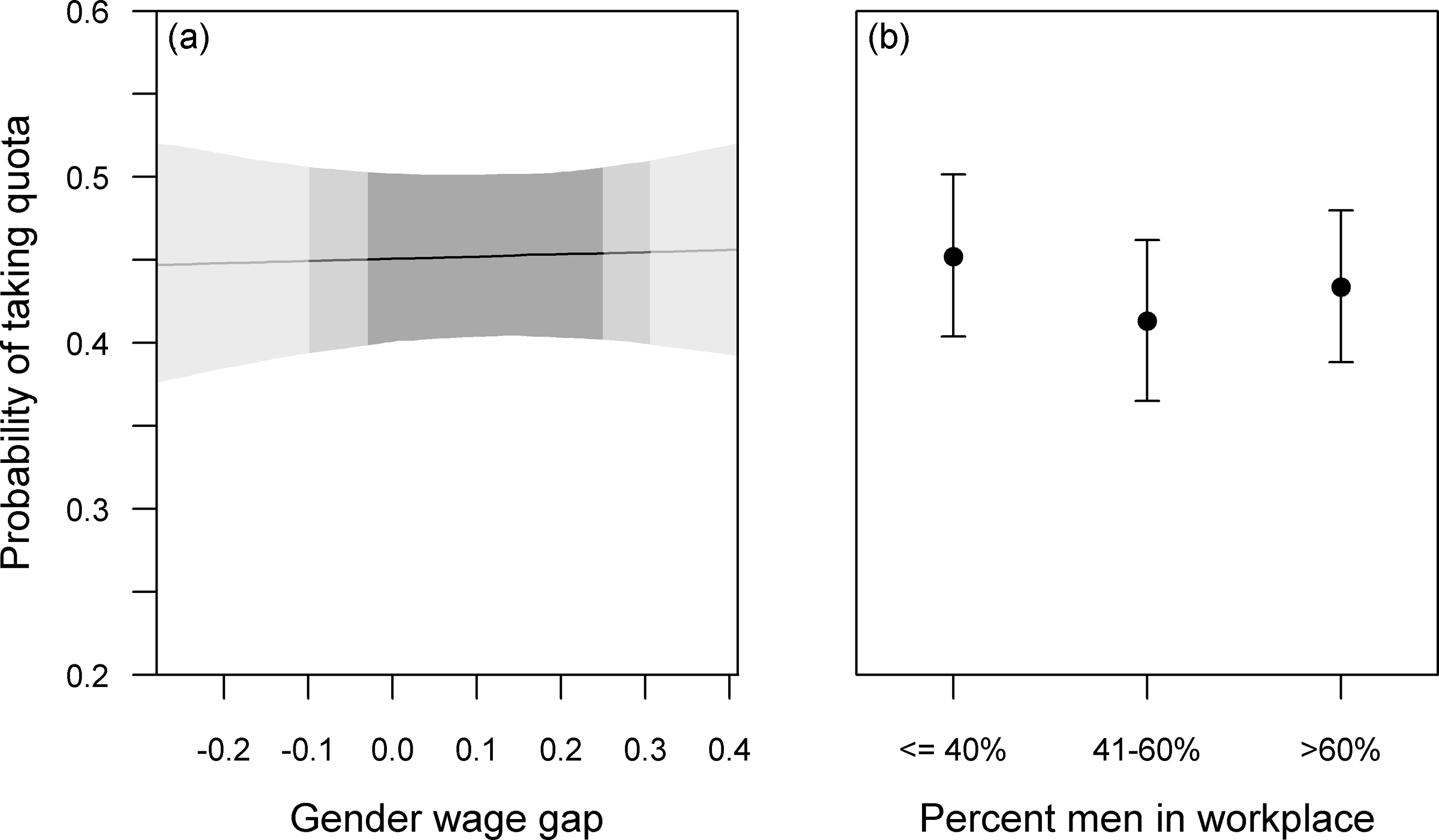
It was hypothesised that gendered workplaces (H1) may be important in quota uptake, as fathers’ own gender perceptions have been found to be important for leave uptake. First, fathers working in male-dominated workplaces use slightly less quota, but this difference is fully explained by fathers’ differing education levels. In the final model, no meaningful differences in father’s quota uptake between female- and male-dominated workplaces were found (PD = 61.7%, median = 0.03, 95% HDI [−0.15, 0.19]; Figure 1a), nor between female-dominated and balanced sex ratio workplaces (PD = 52.2%, median = −0.06, 95% HDI [−0.23, 0.19]). Second, the association of workplace gender wage gap and father’s quota uptake was investigated. An increasing gender wage gap was associated in a bivariate analysis with increasing usage of father’s quota, though this association disappeared with inclusion of fathers’ education levels, with no effect in the final model either (PD = 56.8%, median = 0.05, 95% HDI [−0.49, 0.63]; Figure 1b]). The interaction of gender wage gap and sex ratio was also examined, as more strongly gendered workplaces may differ from workplaces where men and women work in more similar positions. The association between gender wage gap and quota uptake was found to be smaller in male-dominated workplaces, but this difference was mostly accounted for by fathers’ education levels and the rest by other father and partner characteristics and workplace size. In the final model, there was no meaningful interaction between the two (ΔELPD = 0.4 ± 1.4).
a) Conditional effect of gender wage gap. Lightest shading indicates the conditional effect across all values, with darkening shades indicating the regions where 5–95% and 10–90% of values of gender wage gap fell. b) Conditional effects of sex ratio, representing (from left to right) ≤ 40% male, 41–60% male, and 61–100*% male workplaces. *Fully male workplaces were not included in this model due to the inclusion of gender wage gap.

Wage dispersion (H2.1), a proxy for competitiveness of the workplace, was associated with quota use in that fathers in more competitive workplaces used more quota. This difference was mainly explained by fathers’ education levels: fathers with high education tended to work in more competitive workplaces. In the final model, however, it was unlikely to have any effect (PD = 90.7%, median = 0.81, 95% HDI [−0.37, 1.99]) (Figure 2a). The association between competitiveness and uptake was hypothesised to vary by the father’s position in the workplace wage distribution. Generally, there was no association between competitiveness and relative income, even absent of fathers’ education levels. Neither direction of H2.2 was supported in the final model, with no meaningful interaction (ΔELPD = 0 ± 0.9; probability of being positive 79.8%). Similarly, there was no meaningful interaction between wage dispersion and sex ratio, even without any additional covariates (final model ΔELPD = −2.1 ± 1.8).
a) Conditional effect of wage dispersion. b) Conditional effect of the proportion of tertiary educated in the workplace by father education. Lightest shading indicates the conditional effect across all 1–99% of values, with darkening shades indicating the regions where 5–95% and 10–90% of values of the proportion fell. Line type indicates the education level of fathers: solid for only compulsory education, dashed for vocational upper secondary, dash-dotted for matriculation, dotted for bachelor’s, long dashed for master’s, long dash-short dashed for doctorate. Conditional effects of wage dispersion interaction with relative income not shown as the lines and intervals overlap practically 1:1.

Finally, fathers’ individual education and the workplace education level was assumed to interact, with a greater proportion of tertiary-educated individuals in a workplace increasing the probability of taking father’s quota for fathers with lower educational attainment. While the interaction was questionably meaningful due to uncertainty (ΔELPD = −7.6 ± 4.5), the levels of the interaction were not in the direction hypothesised: an increasing proportion of tertiary-educated workers increased probability of quota uptake, but only for tertiary-educated fathers (basic: PD = 72.2%, median = −0.019, 95% HDI [−0.79, 0.46]; vocational: PD = 83.8%, median = 0.34, 95% HDI [−0.31, 1.04]; matriculation: PD = 87.5%, median = 0.42, 95% HDI [−0.30, 1.09]; lower tertiary: PD = 99.6%, median = 0.94, 95% HDI [0.28, 1.60]; master’s: PD = 99.8%, median = 1.03, 95% HDI [0.33, 1.72]; doctorate: PD = 91.4%, median = 1.16, 95% HDI [−0.38, 2.94]; Figure 2b). Going from the 10th to 90th percentile in the workplace education level, the probability of taking quota was 9.8 ppts [6.8, 12.8] higher for those with a lower tertiary degree, and 7.5 ppts [4.6, 10.7] for those with a master’s degree. Contrary to expectations, this suggests that the probability of taking quota for highly-educated fathers decreases with employment in workplaces with low proportions of tertiary-educated coworkers. In closer examination (Table S7), quota use was indeed lower mainly in the lowest-educated workplaces – contexts where the highly-educated employee was likely more difficult to replace.
Discussion
Across Europe, countries have introduced or expanded parenting leave entitlements. Parenting leave taken by fathers has been shown to have various potential short- and long-term implications for families (Cools et al., Reference Cools, Fiva and Kirkebøen2015; Dunatchik & Özcan, Reference Dunatchik and Özcan2021; Duvander et al., Reference Duvander, Eydal, Moss, Duvander and Koslowski2019; Schober, Reference Schober2014). As such, understanding influences on father leave-taking decisions is vital for identifying whether policy interventions to increase uptake are possible, and where those interventions should be targeted. Here, workplace-level structural characteristics of employed fathers in the private sector were investigated, as most Finnish fathers are taking parental leave from the private-sector workplace context. Using a multilevel Bayesian approach allowed us to model the workplace-level, which is not the case in the existing literature in regards to fathers’ parental leaves. While uptake is generally high, far fewer fathers take more than the three-week paternity leave that can be taken while the mother is on leave (roughly half of first-time fathers in 2013–2017 used at least some of their independent quota).
Though Finnish law ensures all parents have the right to take leave, taking more leave than just the days concurrent with the mother may be viewed as a signal of shifting future work-life priorities (Evertsson, Reference Evertsson2016; Morosow & Cooke, Reference Morosow and Cooke2022; Weisshaar, Reference Weisshaar2018). Violating the masculine ideal worker norm (Haas & Hwang, Reference Haas and Hwang2019; Williams, Reference Williams2010) may result in penalties for men viewed as less committed to their work, even under progressive systems (Evertsson, Reference Evertsson2016; Morosow & Cooke, Reference Morosow and Cooke2022). Workplaces with a female-dominated workforce may be better structured around accommodating leave for employees as this is an accepted (and expected) norm for women to take leave. Theoretically, this may lower the threshold for fathers to take quota leave, as longer leaves are more normalised in such workplaces. Even though workplaces differed by gendered structures and fathers’ quota use, and contrary to our expectation and previous research in the Nordic context (Bygren & Duvander, Reference Bygren and Duvander2006; Närvi & Salmi, Reference Närvi and Salmi2019), we found no association between sex ratio and uptake of father’s quota after accounting for the sorting of fathers into workplaces. Similarly, greater gender equality (proxied with gender wage gap) was found not to be associated with father’s quota uptake net of father and partner characteristics. Lack of association between father’s quota uptake and gendered structures (H1) could occur for a number of reasons. Less experience over organising employees’ parental leave may not be a significant barrier that would manifest differently in male-dominated workplaces. On the other hand, workplaces structured to facilitate mothers taking leave may not necessarily extend this to fathers (Eriksson et al., Reference Eriksson, Billingsley and Brandén2022), and leave-taking norms of women would therefore have no bearing on leave-taking of men. Men and women may also operate in different occupations and jobs within some of these workplaces. In other words, the ‘ideal worker’ norm (Williams, Reference Williams2010; Williams et al., Reference Williams, Blair-Loy and Berdahl2013) for men would not differ by the extent the workplace is gendered. Given the lack of association between quota uptake and gendered structures found here, it is unlikely that reducing high gender segregation in workplaces would influence paternal leave-taking.
Competitiveness, as proxied by within-occupation wage dispersion, was hypothesised to be associated with the likelihood to take the quota (H2.1), as fathers in highly competitive environments might refrain from taking leave due to concerns about falling behind colleagues (Johnsen et al., Reference Johnsen, Ku and Salvanes2024). However, after accounting for fathers’ sorting into workplaces, we found no association between wage dispersion and fathers’ quota usage. Additionally, we expected that a father’s relative income within the occupation would matter more in highly competitive contexts (H2.2). High-status fathers might either feel secure enough to take leave or, conversely, might have more to lose in terms of career progression (Eversson, Reference Evertsson2016; Johnsen et al., Reference Johnsen, Ku and Salvanes2024). However, neither of these options were supported by the data. It does not appear, therefore, that risks of losing ‘advantage’ or falling further ‘behind’ in competitive workplaces factor into decisions for taking father’s quota. In the Finnish setting, where the earnings structure generally is more compressed, it appears that neither competitiveness in the working environment nor relative position in the workplace act as (dis)incentives for fathers overall.
The educational level of fathers is consistently shown to be important for the propensity to take leave (e.g. Eriksson et al., Reference Eriksson, Billingsley and Brandén2022), with more education typically associated with longer periods of leave. Education level can also affect workplace peer effects in leave-taking (Carlsson & Reshid, Reference Carlsson and Reshid2022; Helske et al., Reference Helske and Helske2024), but it is unclear based on previous research whether a workplace’s wider educational structure might factor into paternal leave decisions. Workplace education level was found to be associated with a higher probability of taking the father’s quota (H3), but only for fathers with Bachelor’s or Master’s degrees. As the average tertiary-educated father works in an establishment with a fairly high proportion of other tertiary-educated colleagues, this result could mean that working with less educated colleagues suppresses fathers’ uptake of quota leave (see Table S7). A possible reason is that higher-educated men may be in supervisory positions or otherwise not easily replaceable in these organisations and therefore may feel like it would be more difficult to take leave (Samtleben et al., Reference Samtleben, Bringmann, Bünning and Hipp2019). Contrary to expectations, lower-educated fathers were not more likely to take leave in highly-educated environments. Why might workplace education level not affect those with lower-education in the same way? If workplace hierarchies and interactions are structured by education and position within the workplace, lower-educated fathers are likely working in different occupations and are thus less affected by the new ‘environmental norm’ upheld by tertiary-educated fathers – new practices do not seem to ‘trickle down’ (vertical contagion). As suggested by Helske et al. (Reference Helske and Helske2024), normative change may instead require seeing examples within one’s own occupational peer group (horizontal contagion).
In this article, numerous workplace structural characteristics and how they are associated with the uptake of fathers’ quota in the private-sector in Finland were investigated. It may well be the case that the workplace characteristics and associations – or lack thereof – identified here are not generalisable across workplaces as a whole, and instead should be limited to being representative of the private sector in Finland (and even then, small workplaces and certain industries were underrepresented). As uptake differs between sectors (Saarikallio-Torp & Haataja, Reference Saarikallio-Torp, Haataja, Haataja and Airio2016), workplace characteristics may associate differently with father’s quota usage in the public sector (see Table S8 and accompanying material in the Supplementary). Unfortunately, these hypothesised associations are not possible at present to assess with any degree of certainty due to missingness of key workplace identifiers in the administrative registers. Regardless, understanding contextual factors behind leave-taking is an important step towards causal analysis techniques that enable deeper understanding of individual leave decisions. As fathers’ parental leaves are generally linked to many favourable family and societal outcomes, further investigating these patterns within a causal framework may allow better targeting of policy or other interventions at groups not taking leave or only taking short leaves. These results suggest that while workplaces likely have a role in individual leave-taking decisions, overall workplace-level structural factors are not the main contributing factor to these decisions. More likely, specific circumstances experienced by fathers within the workplace are the most important workplace-derived influences on fathers’ leave-taking, e.g. peer fathers set an example and demonstrate the workplace consequences of quota use (Helske et al. Reference Helske and Helske2024), a supportive direct manager could help assuage fathers’ fears over employer response (Eerola et al. Reference Eerola, Lammi-Taskula, O’Brien, Hietamäki and Räikkönen2019; Närvi & Salmi Reference Närvi and Salmi2019), or the exact nature of the work may make leave-taking more or less desirable (Eerola et al. Reference Eerola, Lammi-Taskula, O’Brien, Hietamäki and Räikkönen2019; Närvi & Salmi Reference Närvi and Salmi2019).
Supplementary material
The supplementary material for this article can be found at https://doi.org/10.1017/S0047279426101287
Acknowledgements
We thank Statistics Finland and THL for providing access to the data (decisions TK/2182/07.03.00/2024 and THL/3141/6.02.00/2022). This research was supported by the INVEST Research Flagship Centre.
Funding statement
This research was funded by the Research Council of Finland (decision numbers: 345546, 331816, 350480, 363415, 370868) and its Strategic Research Council (decision numbers: 364371, 364374).
Competing interests
The authors declare none.
Data availability statement
Data are confidential and require a licence from Statistics Finland and THL to access for research purposes. Specifics on the exact datasets used can be found in the annotated R code.
Author contributions
All authors conceptualised the study, interpreted results, and wrote the paper. SNC prepared data and conducted analyses with input from all authors.


 Open access

