




Introduction
In June 1838, five temple dancers accompanied by three musicians embarked on a tour of Europe from which there is no evidence they ever returned.Footnote 1 These five dancers formed part of the first Indian temple dance troupe, from Perumal Temple in Thiruvendipuram, Pondicherry, which was then a part of French India, to travel to Europe. They performed in France, England, and later Germany, Austria, and Belgium. As figures of considerable public interest, the dancers generated significant attention from the British press, leaving an archival trace that invites critical examination of their representation and reception.
In this article, on one hand I argue that these dancers were transformed into bayadères through the 1838 tour—a European hegemonic construct that shaped Indian women as both sexual property and morally debauched. On the other hand, I suggest that analysing archival newspaper articles on the dancers from the 1838 tour reveals an undercurrent of archival resistance left behind by these dancers who refused the totalising European narrative of the bayadère that positioned them as sexually deviant or morally corrupt. And further, this resistance also upsets and complicates the dominant caste appropriation and embodiment of the temple dancers’ practice as Indian classical dance.Footnote 2 Temple dance communities were traditionally understood as being mixed-caste,Footnote 3 and they were therefore suspect within a caste-based society that sought to present the temple dancers’ art as rarefied, pure culture.
From the thirteenth century onwards, European travel writing constructed the Indian temple dancer as an erotic figure. The Venetian traveller Marco Polo’s descriptions of Indian temple dancers are one of the first recorded instances of fetishising the European gaze. The descriptions ranged from observations of the dancers’ nakedness, their firm flesh, and the shape of their breasts. Subsequent traveller’s accounts similarly fetishised the temple dancer.Footnote 4 This sexualisation and fetishisation of the Indian temple dancers eventually constructed the figure of the European bayadère.
The term bayadère, used to refer to Indian temple dancers, is an eighteenth-century European invention. It derives from the Portuguese bailhadera (female dancer) and was first popularised in French by the botanist Pierre Sonnerat, who used it in his travel writings.Footnote 5 When his work was translated into English and German in the 1780s, it gained widespread influence, so much so that many nineteenth-century writers mistakenly believed bayadère was an Indian term.Footnote 6 From that point on, Europeans commonly referred to Indian temple dancers as bayadères. The term gained further traction through its use in European ballads, operas, ballets, and plays, embedding it firmly in the Western cultural imagination.
Emerging in tandem with the expansion of European imperialism, the figure of the bayadère is best understood as a racialised cultural construct, produced through orientalist modes of representation that both exoticised and subordinated non-European femininity within the broader epistemologies of colonial power. The feminist and postcolonial studies scholar Sara Mills writes that the term ‘racialisation’ enables us to see the colonial context as one where a variety of processes were at work, which resulted in material practices.Footnote 7 Racialisation speaks to the idea that race is not a fixed category but instead is manufactured through historical, social, and political processes. The travelling dancers of the 1838 tour did not find themselves in the midst of a genuine opportunity for the British and their Indian visitors to ‘meet, greet, and learn about each other’.Footnote 8 Rather, the writing generated around them operated as what Mary Louise Pratt calls a ‘contact zone’,Footnote 9 a space of colonial encounter marked by power imbalances, such as race, within the heart of the empire, in England.
In her seminal work, Imperial Eyes: Travel Writing and Transculturation, Pratt argues that European travel writing on non-European regions played a key role in constructing an imperial order, fostering a sense of ownership, entitlement, and familiarity among European audiences while positioning non-Europeans as aberrations to be studied, thus placing Europeans at the top of created hierarchies.Footnote 10 Pratt’s concept of the ‘contact zone’ describes social spaces where cultures meet under highly asymmetrical power dynamics, such as colonialism or slavery, where previously separated subjects coexist.Footnote 11 Building on this, Inderpal Grewal situates contact zones not only in colonial peripheries but also within the colonial metropolis, viewing them as omnipresent discursive spaces that shape and regulate narratives of cultural encounters.Footnote 12 The Indian temple dancers, arriving on the back of centuries of travel writing and burgeoning newspaper attention, are caught within this contact zone.
In the context of the 1838 tour, archival evidence reveals the discursive and material violence faced by the Indian dancers. Discursive violence involves processes and practices, such as linguistic and circulatory means, that script groups in ways that contradict their self-definition, while material violence refers to the material circumstances that compelled the dancers’ participation regardless of their consent. These violences left traces in the newspaper archives of the countries they travelled through.
To understand public sentiment at the time, I examine discursive and material violence during the British tour as evidenced in newspapers and periodicals. These sources are doubly important when one recognises how pervasive print culture was in that period. Literature studies scholar Priti Joshi writes that the number of newspapers and periodicals during the nineteenth century in Britain was colossal, with over 73,000 distinct titles published, with more people reading newspapers and periodicals than books at the time.Footnote 13 And so, it is not surprising that the press would have played a considerable role in influencing and shaping public opinion in 1838, moulding the perception and reception of the temple dancers, that would then circulate even amongst the less readerly.
During the tour, posters and newspapers incessantly advertised the dancers as the ‘real’ bayadères, presumably contrasting them with their fictive representations in the ballet. Or perhaps these advertisements were urging audiences to compare the dancers to accounts in travel writing. Either way, in emphasising that there was a ‘real’ bayadère, such posters naturalised the socially created or constructed figure of the European bayadère. In other words, by presenting these Indian temple dancers as ‘real’ bayadères, the British theatres reinscribed and reified the myths and false representations around Indian dancers. In the next section, I provide background on why the dancers first came to France and how the construction of the ‘real’ bayadère out of the Indian temple dancer was imperative to maintain the colonial order for both France and Britain.
Background and context
The temple dancers and musicians arrived in Bordeaux on 24 July 1838. The dancers and accompanying troupe were part of the Perumal Temple in Thiruvendipuram, Pondicherry. Pondicherry was a French colony, though insignificant when compared to Britain’s colonial enterprise in India. Jyoti Mohan, a historian of colonial South Asia, argues that as the French state failed to build an empire in the subcontinent, French intellectuals constructed a substitute: an India of their own built through scholarship and imagination.Footnote 14 Perhaps this is why the French critic Theophile Gautier writes of the dancers:
For India, wild and remote as it is, cannot dispense with the opinion of Paris. It is imperative that Paris should pass judgement on its devadasis, and India should know what impression the priestess-dancers Amany, Saoundiroun and Ramgoun will make alongside the sisters Elssler and Noblet.Footnote 15
Gautier suggests that India cannot know its own dancers without translation from Paris. In other words, the bayadère is the true representation of the Indian temple dancers. Within this context, it is not a coincidence that it was a Frenchman, E. C. Tardivel, who arranged and procured the dancers for a tour to France and other parts of Europe. Tardivel was bringing the colony to the metropole, carting dancers and musicians from one of France’s colonial outposts and presenting them as curiosities for both the entertainment and education of French society. Following their success in France, a theatre manager named Frederick Yates went to great lengths to procure the dancers for the Adelphi Theatre in London.
Theatre studies scholar Jane Moody writes that in the 1830s, the Adelphi ‘marketed itself as a theatre of metropolitan flash, vulgarity and low life’, and that Yates was one of London’s most celebrated ‘low comedians’.Footnote 16 She adds that the audiences ‘contributed to this atmosphere of general vulgarity’. In this scenario, Yates’s reputation suggests that dancers were hired since he viewed them as fit for this ‘metropolitan economy of pleasure’,Footnote 17 viewing their foreignness as exotic titillation, while simultaneously feeding the British audiences’ growing interest in Britain’s colonial outposts.
The theatre and related venues of popular spectacle allowed Europeans to see and experience the political empire their countries were building across the world. In Britain, exhibitions, military reenactments, pictorial spectacles, and conventional dramas brought the empire and its people to the metropole. For many nineteenth-century Britons, such performances were their only contact with the people and lands under British dominion. And it was India, ‘the jewel in Britain’s imperial crown’, that the stage most frequently invoked.Footnote 18 In 1838, Europe was also at the midpoint of the romantic ballet years. The tragic lovelorn bayadère was one of the new characters of this period performed by dancers like Marie Taglioni and Fanny Essler.Footnote 19 The opera Les Bayadères (1810) and the ballet Le Dieu et la Bayadère (1830) had both emerged in France by the time.Footnote 20
Additionally, this period also saw the emergence of human zoos, where living people of colour were displayed for the enjoyment and ‘education’ of white audiences. Performers may have believed they were simply showcasing their cultural traditions, but many audience members perceived such performances as a display of a primitive, unenlightened, or dying culture.Footnote 21 Non-European women were also grotesquely sexualised and fetishised in the colonial period. This fetishisation of the non-European female body is most violently seen in the figure of Sarah Bartmann,Footnote 22 where exhibitors accepted payment from audiences waiting to see her hypersexualised body.Footnote 23 As the anthropologist Kalpana Ram notes, this gaze directed at gender relations and the status of women, has been central to sustaining the existential distance between colonial states and the societies it sought to dominate.Footnote 24 In the case of the temple dancers of the 1838 tour, European commentators portrayed the dancers as reflective of the moral character of people of India and evocative of a primitive society that needed European rule.
Audiences were eager to see what they hoped would be the real bayadère. Through publicity posters and newspaper articles, audiences were convinced that the figure of the bayadère they had consumed through performance, literature, and travel writing was not a cultural trope. Instead, the bayadère described a real, verified phenomenon of which the visiting Indian temple dancers were proof. Having only experienced fictional retellings and representations of the empire, the French and British audiences were interested in the opportunity for a first-hand encounter with the bayadère.
Prior scholarship on the 1838 tour
Literature about the 1838 tour has construed the interaction between the dancers and their European audiences as neutral cultural encounters. Joep Bor’s pioneering essay that first drew scholarly attention to the 1838 tour suggests ‘few articles have … an allusion to what Edward Said calls “an almost uniform association between the Orient and [licentious] sex” in his famous book Orientalism’.Footnote 25 This gap marks the first pattern in scholarship: a hesitance to fully apply Said’s orientalist binary, or an outright rejection of it as overly simplistic. For example, the Victorian studies scholar Molly Englehardt critiques Said’s ‘binary of difference that elides the ambivalent relationship between the coloniser and the colonised’,Footnote 26 arguing that the 1838 tour disrupted orientalist binaries rather than reinforced them. Yet, such views often downplay the structural dynamics that upheld colonial hierarchies.
Second, scholars elevate sympathetic European commentators to suggest that the orientalist and racist readings of the bayadère were merely poor commentary or cultural misunderstanding. For example, Bor argues that temple dancers were respected for their art by some parts of the European populace. He substantiates this claim by focusing on a Dutchman named Jacob Haafner, whose love affair with a temple dancer is documented in his writing. By referring to Haafner in particular, Bor portrays other travelogues as cultural misunderstandings where hearsay was presented as eyewitness or firsthand accounts.Footnote 27 In dismissing other travelogues as documenting hearsay, Bor does not pay enough attention to why travelogues, especially in the colonial period, may have been invested in the continued depiction of Indian dancers as promiscuous or sexually available women. However, referring to sympathetic European commentators does not undercut the systemic nature of orientalism. Amanda Lee critiques this tendency by highlighting how the dancer Amany was objectified in Gautier’s 1838 review, described in terms of exotic animals and her clothing, reducing her to a sexualised object.Footnote 28 Lee argues that even favourable portrayals reinforced orientalist frameworks by defining the Indian dancer through Western ideals of beauty and modesty.
A third scholarly tendency is to frame the tour as a cultural dialogue. Molly Engelhardt suggests that the arrival of the temple dancers from India interrupted the imagined production of the bayadère through ballet performances and forced a renegotiation of what grace and elegance meant, as well as European femininity.Footnote 29 Tizianna Leucci notes that after the 1838 tour Gautier would intentionally evoke the Indian dancer Amany when reviewing the performance of the bayadère figure on various stages.Footnote 30 Yet Lee rebuts this when she argues that the definitive original Indian dancer that Gautier tries to capture in his reviews does not in fact, exist at all.Footnote 31 Lee argues that European formulations of the Indian dancer remain reductionist even if their intention is sympathetic. In other words, the ‘real’ Indian dancer remained a construction of the Western gaze; translated and retranslated to fit European imaginaries.
Some scholars, like Engelhardt, see these performances as fostering intercultural encounters and describe the 1838 tour as one where ‘the opportunities afforded the British and the Indian visitors to meet, greet, and learn about each other’.Footnote 32 Engelhardt reads this interaction as ‘a reminder of the superficiality of the colonised/coloniser binary’, as well as ‘the heterogeneity of the imperial encounter’.Footnote 33 Such readings do not account for how Indian dancers are racialised figures used to indict an entire people and culture by Europeans. For example, it is unlikely that white European ballerinas, regardless of the characters they were playing on stage, were ever called savage. Yet, in November 1838, one comes across a French commentator in the Journal des Debats who labeled Amany as ‘la sauvage’,Footnote 34 a term that while applied to various ‘wild women’, also encoded racial and civilisational hierarchies. Sauvage as a noun can refer to people from primitive or uncivilised societies. Such language underscores the dancers’ dehumanisation and the limited space for genuine cultural reciprocity.
Finally, there is debate over the dancers’ agency. Some scholars, like Avanthi Meduri, argue that the dancers creatively adapted their art to engage European audiences.Footnote 35 Yet there’s little evidence of voluntary innovation. Their dances were inserted into plays like The Widow of Malabar Footnote 36 or novelty shows like A Race for Rarity,Footnote 37 reducing their art to spectacle or publicity gimmick. Performances were altered, fragmented, and reshaped for colonial consumption. But there is scant evidence that the temple dancers were interested in such an innovation.
This literature often marginalises the overwhelming sexualisation of the dancers and downplays the power dynamics between the dancers and those organising, narrating, and consuming their performances. My own research, grounded in British newspaper archives, challenges these tendencies. I argue that the 1838 tour was not a neutral cultural exchange but an event shaped by coercion, racial and sexual objectification, and colonial power.
Kidnapped, attacked, seized: the beginnings of the 1838 tour
Earlier studies have been quick to suggest that the arrival of the Indian temple dancers redrew the lines between the Europeans and non-Europeans and initiated a cultural dialogue. However, no studies have delved into how these dancers left Pondicherry for Europe. While it was Tardivel who brought the dancers to Europe, the invitation he extended to them was far from respectful and considerate. Indeed, to the contrary, the dancers arrived in Europe owing to circumstances they could not control, which Tardivel shaped into existence.
Evidence repeated in newspaper accounts stress that the troupe did not come to Europe of their own accord. In the Morning Post on 5 September 1838, dated as a dispatch from Paris on 20 August 1838, the writer asks, ‘But after all, was it fair for M Tardivel to kidnap these poor creatures and bring them to Europe.’Footnote 38 On 4 November 1838, The Operative writes, ‘We meet a man who for the sordid love for gain, has snatched from their native soil and climate … four helpless women and a child and these, for a very trifle, he exhibits, like monkeys of the Zoological Garden’.Footnote 39 I draw attention to the words ‘kidnap’ and ‘snatch’ to venture that these words form not just a turn of phrase but encapsulate the relationship between the white European director and the Indian troupe, which allows little to no consent or agency for the dancers and musicians. The English studies scholar Warren Cariou recounts how some of these performers at human zoos were abducted and kept virtually imprisoned in their performance enclosures.Footnote 40 Thus, the idea that Tardivel might have kidnapped the dancers is realistic.
The evidence that Tardivel used force is not only limited to words that can be explained away as turns of phrases: Tardivel filed a lawsuit against the leader of the dance troupe to get the dancers to Europe. A letter published on 1 October 1838 in the World of Fashion and Continental Feuilletons Footnote 41 reports: ‘I have learnt that the utmost difficulty was presented in obtaining the permission of their superior to their visiting Europe. A lawsuit, which there was every prospect of her losing, decided her to consent, and to accompany them herself.’Footnote 42 Based on this information, one of the dancers in this troupe was vehemently opposed to this trip. This objecting dancer was Tille Amal, the oldest. It was only in the face of legal duress that she acceded to Tardivel’s touring proposition. Likely seeing no other way of protecting the dancers in her care, she decided to join the troupe. The fact that Tardivel filed a lawsuit, most likely in a colonial court that might not have stood by the dancers’ apprehensions or outright dissent, points to the intense pressure placed on the dance troupe. This is how Tardivel obtained ‘a good and proper agreement’Footnote 43 that bound the dancers to his tour. This fragment stands alone as evidence of a lawsuit. The newspaper articles repeatedly describe Tille Amal as having a dour, serious expression. Her look is ‘grave and penetrating’, reports The Mirror of Literature, Amusement, and Instruction on 12 October 1838.Footnote 44 Understood in the light of her unwillingness and the disregard of her wishes by Tardivel, one can read her expression as a continued resistance to her forceful dislocation to Europe.
Thus, the archive offers evidence of intense social anxieties that the dancers may have been brought to Europe against their will and subjected to legally harassment. Such evidence makes suspect the belief that this tour was a cultural encounter of any kind. In effect, the dancers arrived here as live objects of imperial and colonial conquest. The dancers’ presence offered European citizens an opportunity to marvel at the reach and variety of empires, all the while maintaining adequate distance from the corrupting influences of the colonial other. The troupe’s return was marked by more distress and ambiguity.
The return: rumours and the ambiguous end of the 1838 tour
On 5 October 1839, a year after their trip to England, both the Hereford Times and Leeds Times reported that the dancers, having returned to Bordeaux from their various tours around Europe, wanted to go home. ‘Strongly possessed with the desire to return to India’, they enquired on ‘whether there was a ship about to sail to Pondicherry’.Footnote 45 The newspapers’ continued concern with the return of the Indian dancers to Pondicherry points to the strong impression and interest evoked by the 1838 tour. That the dancers expressed an option of returning might even suggest that no real kidnapping took place. However, as late as 27 February 1840, the periodical Friend of India reported that the dancers were performing in Berlin to wide acclaim.Footnote 46 This was beyond the eighteen-month contract that Tardivel had supposedly brought them on. The extension of their tour also suggests that the dancers probably had little say in their return, even in the presence of a legal contract.
Dance scholar Prarthana Purkayastha states that many natives who travelled as human exhibits lost their lives and never made it back to their homelands.Footnote 47 This tour occurs around the same time period as the human exhibits or zoos, so it is likely that a similar fate befell members of the 1838 troupe and they never returned to India. In a French newspaper article, thirty years later in 1867, there is a passing reference to Amany when the writer of the piece allegedly meets another woman with the same name.
It was Amany the Indian. She bore the same name as this ravishing bayadère whose beauty and melancholy we all admired, thirty years ago, at the Variety Theatre … and who went to London to die of despair and love. Poor girl! We had separated her from her beloved to show her to the Europeans as an object of curiosity, and relieved of our gaze, she no longer wanted to return to her beautiful homeland: she committed suicide.Footnote 48
The mention of the Indian dancers thirty years after their appearance in France, certainly attests to the novelty and lasting impression left by their performances. The writer is self-reflective, recognising that the dancers were presented largely as an object of curiosity for the European gaze. The newspaper article doesn’t reveal the writer’s identity, nor does it give his connection to Amany. Its reference to Amany’s suicide is the last trace of the dancers from the 1838 tour. Before this tragic end, the troupe undoubtedly encountered numerous other situations that left them uncomfortable and unhappy.Footnote 49 Some of these situations were recorded in the newspaper archives.
Far from a cultural misunderstanding: repeated sexualisation of the Indian dancer
In this section, I respond to the idea that the sexualisation of the Indian temple dancer is a cultural misunderstanding. Digital nineteenth-century newspaper archives reveal themes that pertain to the dancers being objectified, having their clothing habits scrutinised, and being framed as nymphs and coquettes. These descriptions place emphasis on the dancers’ departure from European tastes and habits.
Various newspaper articles express anxiety about the clothes worn by the dancers, emphasising their distinction from supposedly superior European habits. On 5 September 1838, the Morning Post lets the reader know that the dancers’ ‘costume underwent … considerable veiling before they were presented to royalty’.Footnote 50 Another review repeats that even in England ‘the Hindoo shawl has been little modified to adapt it to European propriety; it is more chaste’.Footnote 51 Their busts and clothing are the subject of much debate in a variety of newspapers.
As soon as they arrived in London, readers were told that the dancers wore ‘a thin robe of white muslin, which scarcely covered the bosom’.Footnote 52 Even as The Satirist mocks men attending the dancers’ show in hopes of a titillating spectacle, the descriptions focus on the dancers’ busts, reporting that ‘nothing can be more beautiful than the partial view of their bronzed and polished bosom’,Footnote 53 which is so smooth that it ‘might be taken for a satin corset’.Footnote 54 Readers are informed that the dancers preserve the shape of their breasts by enclosing them in ‘a pair of hollow cups of cases made of a very light wood, exactly fitted to them and buckled at the back’.Footnote 55 This, of course, is not the last time that readers are directed towards the dancer’s busts. The Hereford Times carries a similar description about the ‘hollow cups’.Footnote 56 Perhaps even this obsession traces back to Marco Polo, who had written that the temple dancers’ ‘breasts do not hang down but always remain stiff and erect’.Footnote 57
The sexualisation extends beyond remarks about their bodies, with articles portraying the dancers as nymphs and coquettes to emphasise their supposed wantonness. ‘These nymphs are five in number’Footnote 58 begins a Parisian assessment. It is important to note that the term ‘nymph’ is a mythical archetype of wild, unrestrained sexuality.Footnote 59 While nymphs are represented as both sexually aggressive as well as chaste and shy beings in myth, the focus remains on correlating the nymph to her sexuality.Footnote 60 And so it is unsurprising that the dancers and their dance are also described as coquettish.
In the eighteenth century, coquettes referred to vain young women who defied dominant codes of sexual conduct by encouraging several suitors at once.Footnote 61 More simply, these words best translate into English as ‘flirt’ or ‘flirtatious’. The World of Fashion published this dispatch from Bordeaux on 1 October 1838: ‘The character of the dance is varied—grotesque, amatory, mocking and always coquettish’Footnote 62 to corroborate this nymph-like quality of the dancers. No matter what they do, the review seems to suggest, the dancers cannot shrug off their coquettish nature.
Even their eye movements, intrinsic to various Indian dance and theatre forms, are reduced to coquetry. The Examiner reports that Soundiron’s eyes ‘dart forth looks that are enough to turn the brain of a saint’.Footnote 63 And there can be no doubt that ‘all the coquettes in Paris will be taking lessons from Soundiron’.Footnote 64 So great is her skill that ‘she will be a professor of the first water of the art of the language of the eyes’. The dancers’ eyes allegedly ‘roll in rapture’ and ‘their glances shoot right to the midriff’.Footnote 65 Thus, even movements derived from their specific artistic practice is reduced to evidence of their amorous and wanton nature.
Through these examples, I argue against the logic that the depiction of Indian temple dancers as eroticised and sexualised was a matter of cultural misunderstanding. Instead, the newspaper articles presented the dancers as consciously distinct from British society. Clearly, ‘Hindoo beauty and Hindoo grace are things so different from our notion of either’.Footnote 66 This distinction was a means to elevate and present European habits as more civilised and respectable, as the comment to the ‘Hindoo shawl’ not meeting the benchmark of ‘European propriety’ demonstrates. As literature scholar David Spurr notes, members that belong to the coloniser’s class ‘will insist on their radical difference from the colonised as a way of legitimising their own position in the colonial community’.Footnote 67 Thus the eroticisation and sexualisation racialise the Indian dancers as inferior to British society and culture.
Even as the temple dancers were constructed in the image of the European bayadère, I suggest that their archival images found in the newspapers offer a fertile but overlooked site of resistance to such a hegemonic co-optation.
Finding agency, reading images
In this section, I suggest that newspaper illustrations from the 1838 tour function as a site of archival resistance to the dancers’ transformation into the European bayadère. I discuss the role of illustrations of the dancers in the newspapers and what they might tell us. Nineteenth-century journalistic engravers working for newspapers were usually instructed to copy pre-existing images. For the purposes of this article, however, I choose not to go into the history of the specific mechanisms of image-making, an investigation that lies beyond my expertise and is better suited to the discipline of art history. Instead, I read these images of the dancers in the newspapers as a mode of archival witnessing of a particularly racialised and sexualised gaze around the dancers.
The need for illustrations in the Victorian periodical press was critical to the history of British visual art in documenting India for the metropole. These forms of image-making were concerned in part with fixing the meaning of the subject being portrayed. The illustrations of the dancers carried in the newspapers were a product of these phenomena and their allied impulse to designate and fix meaning about the colonial subject.
Design historian Gerry Beegan says that in the nineteenth century the press and its images were inextricably linked to the Victorian urban experience. The city was understood to be a place of vision, concerned with the art of observation. This meant that there existed a sustained interest in ‘reading’ appearances. This interest was cultivated by the dissemination of various pseudoscientific disciplines like phrenology, physiognomy, as well as the rise of anthropology, and visual classification. Narrative and incident paintings that were concerned with gesture and with ‘types’ enjoyed great popularity.Footnote 68 The nineteenth-century writer Mason Jackson writes that the birth of the Illustrated London News in 1842 occurred because its founder noticed that ‘when the Observer and the Weekly Chronicle contained engravings, there was a much larger demand for those papers than when they were without illustrations’.Footnote 69 Also, many periodicals believed in the necessity of the visual as a means of engaging with newly or barely literate readers.Footnote 70
From the eighteenth century onwards, there was also an interest in bringing the colony back to the metropole through images and illustrations. The memory of times spent in India as well as an impression of its peoples and surroundings needed to be brought to Britain both for display and for showing to family members and friends at home.Footnote 71 These images were meant to make India familiar to British audiences but also ended up shaping the way India was perceived. The representations of India, its people, and its landscapes by British artists were primarily tailored to align with the politico-social conventions of Britain, incorporating elements of Indian culture and life only when they fit British standards.Footnote 72 The temple dancer or the nautch girl was also part of the visual culture around the empire. British artists like Tilly Kettle, for example, painted Indian dancers in the late eighteenth century.Footnote 73 Additionally, travel writing, as in the case of Pierre Sonnerat, also contained hand-drawn images of temple dancers. Numerous examples of colonial visual culture in India from 1770 to 1870 include depictions of dancers alongside sovereigns in assemblies of power. Johan Zoffany painted Warren Hastings Meeting Prince Jawan Bakht in Moonlight with a Nautch, and Frederick Christian Lewis engraved The Nautch, or Entertainment Given by the Rajah Chundoo Lal to General James Stuart Fraser, Resident at the Court of Hyderabad.Footnote 74
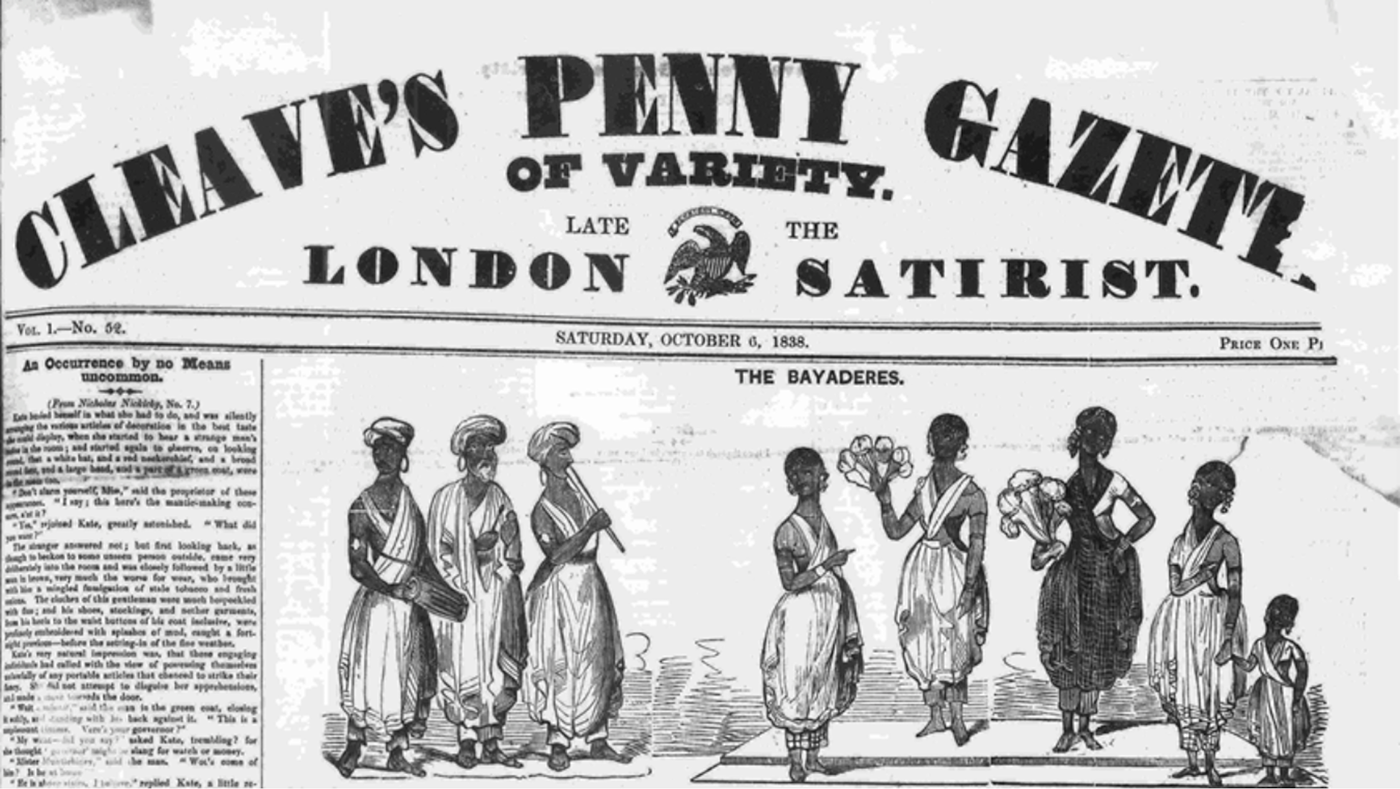
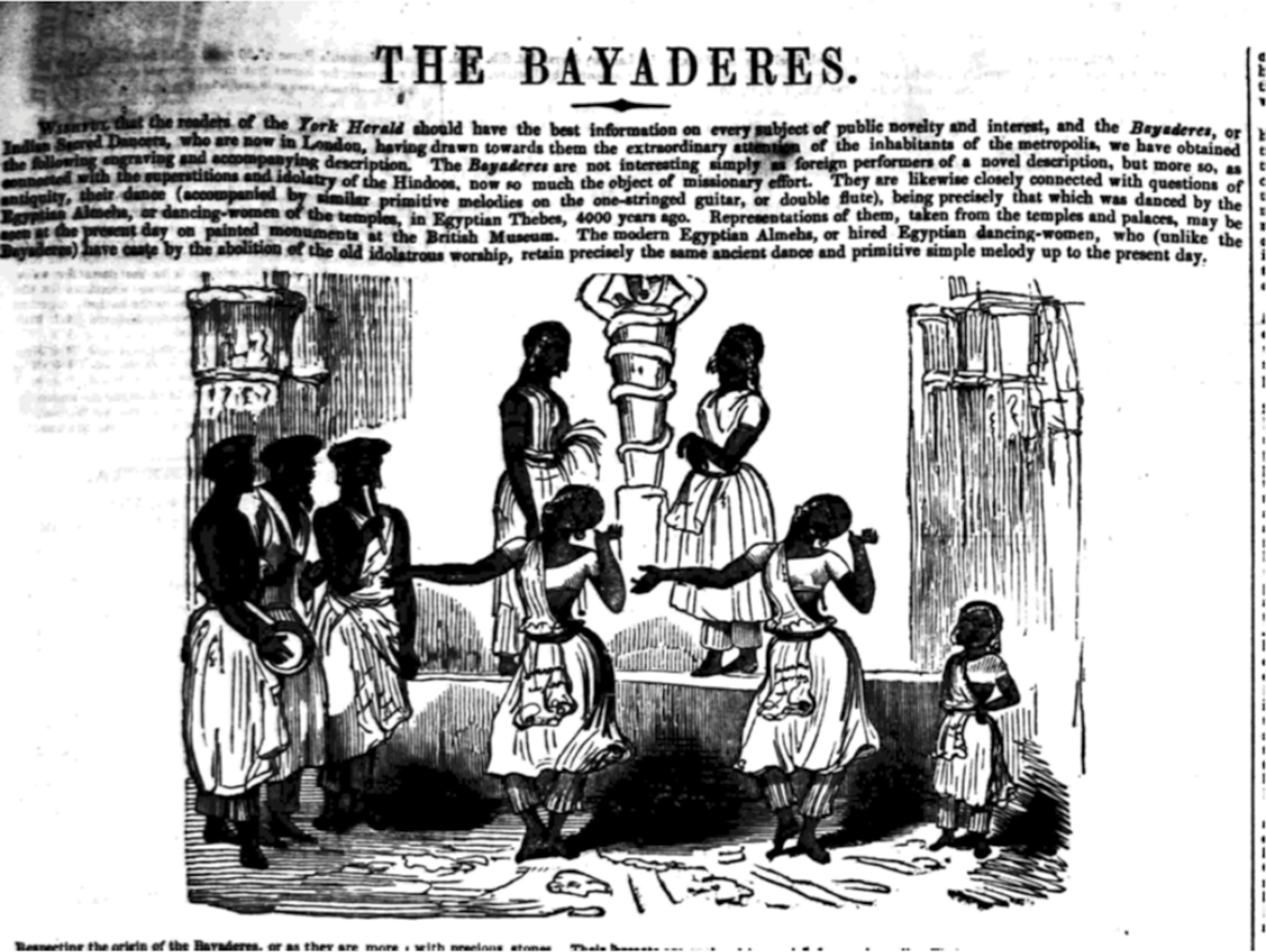
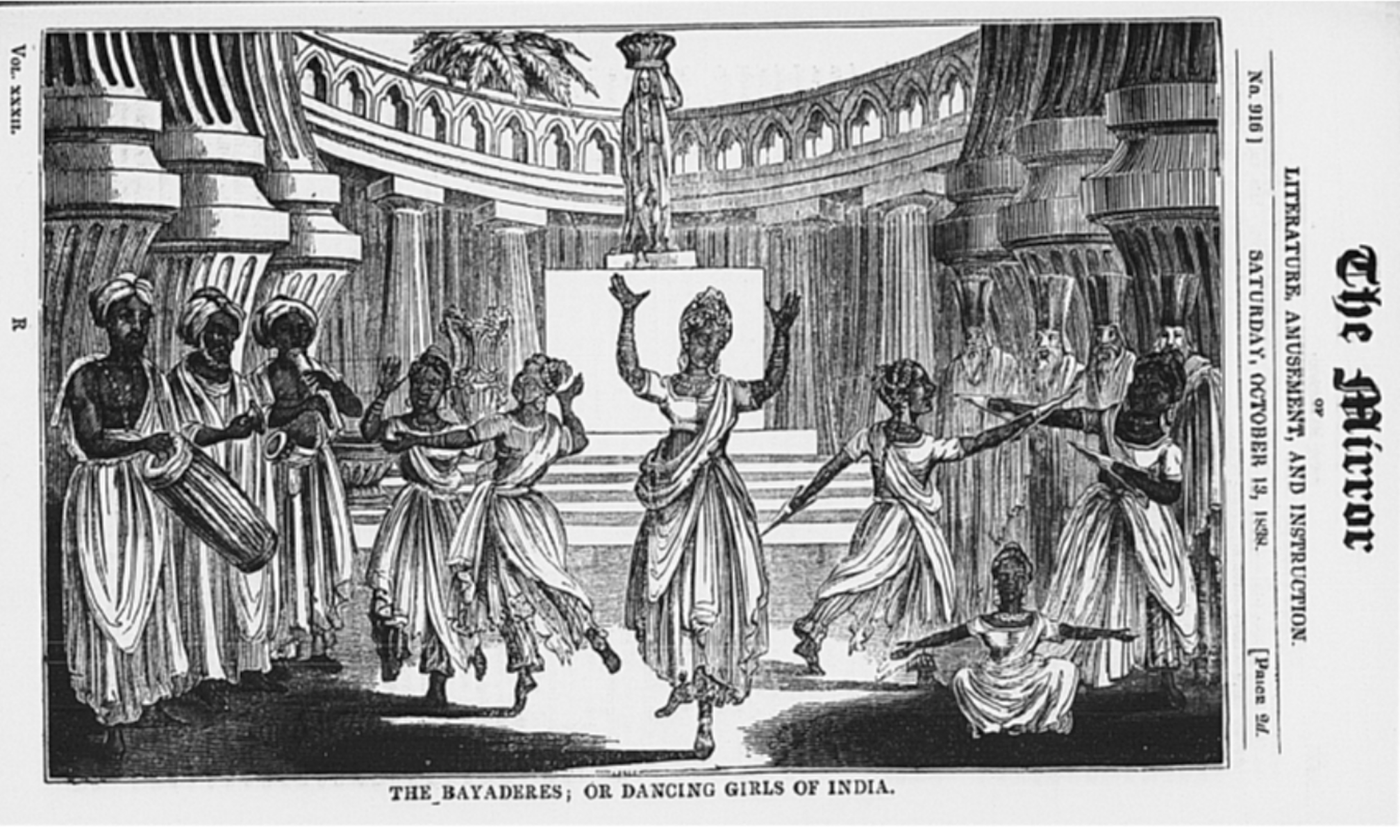
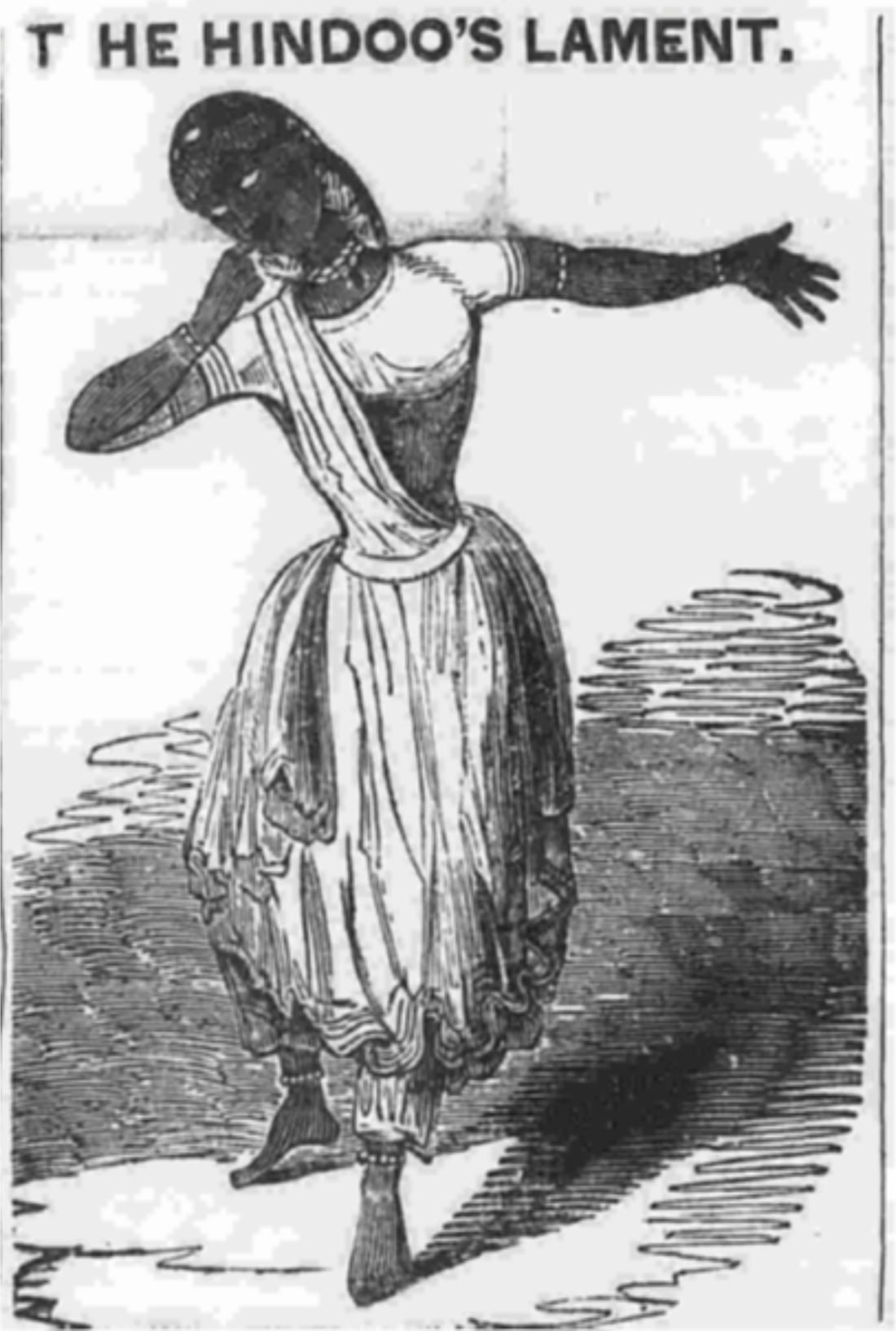
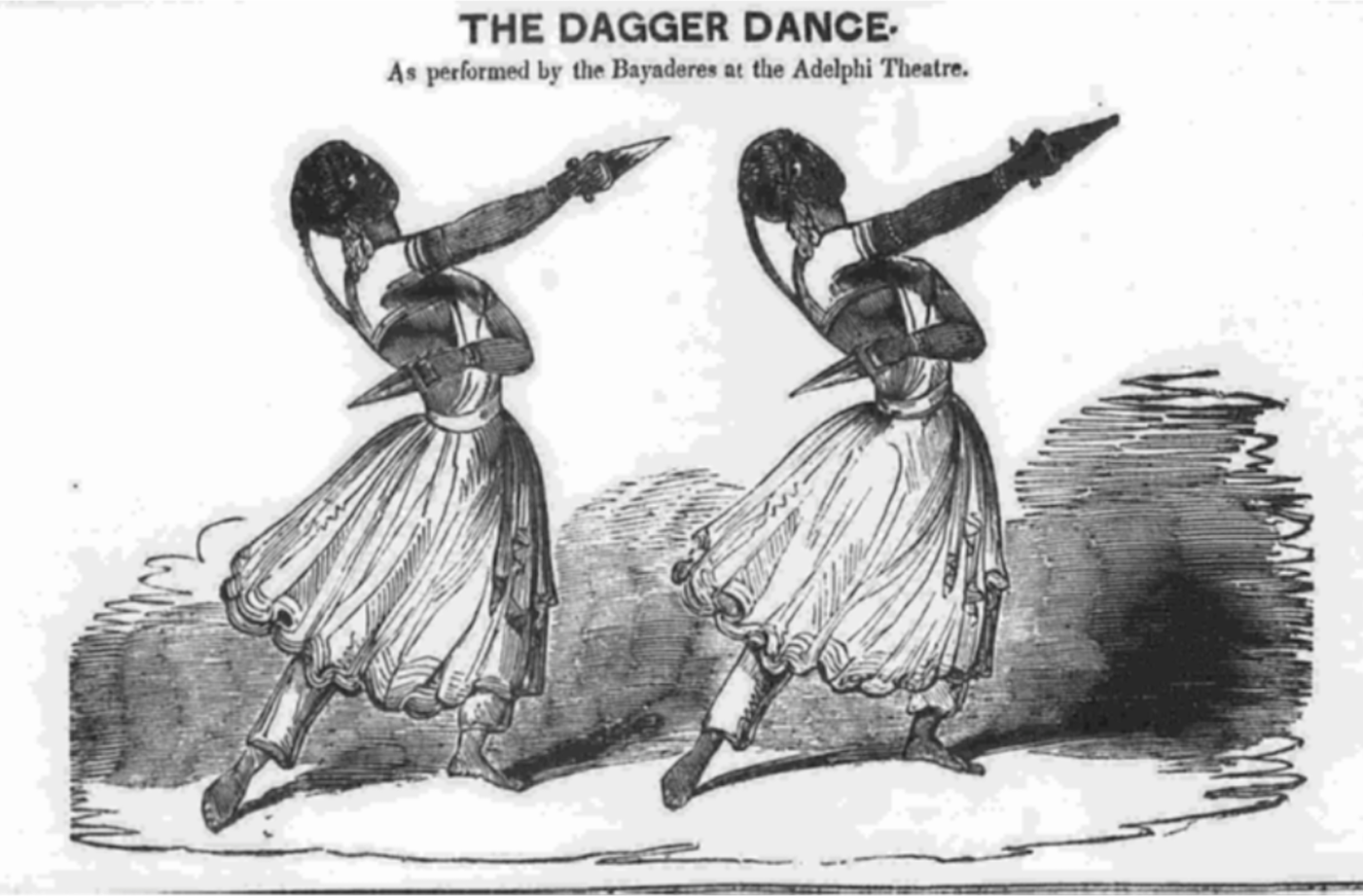
I found five illustrations of the dancers in four newspapers (Figures 1–6). These illustrations most often accompanied the text on the dancers. As a stand-alone object of analysis, I am interested in the visual similarity between the images that show the entire troupe. Some readers may prefer the interpretation that journalistic engravers were instructed to copy pre-existing images. The picture the engraver was instructed to use may have been an original but was most likely a copy.
Image of the bayadère tour. Source: Cleave’s Penny Gazette of Variety, 1838.

Figure 1 Long description
The image features an illustration from Cleave's Penny Gazette of Variety, dated Saturday, October 6, 1838. The title 'The Bayaderes' is prominently displayed above a group of dancers. The dancers are depicted in various poses, wearing traditional attire. The newspaper's title is shown at the top, with additional text columns visible on the left side of the image.
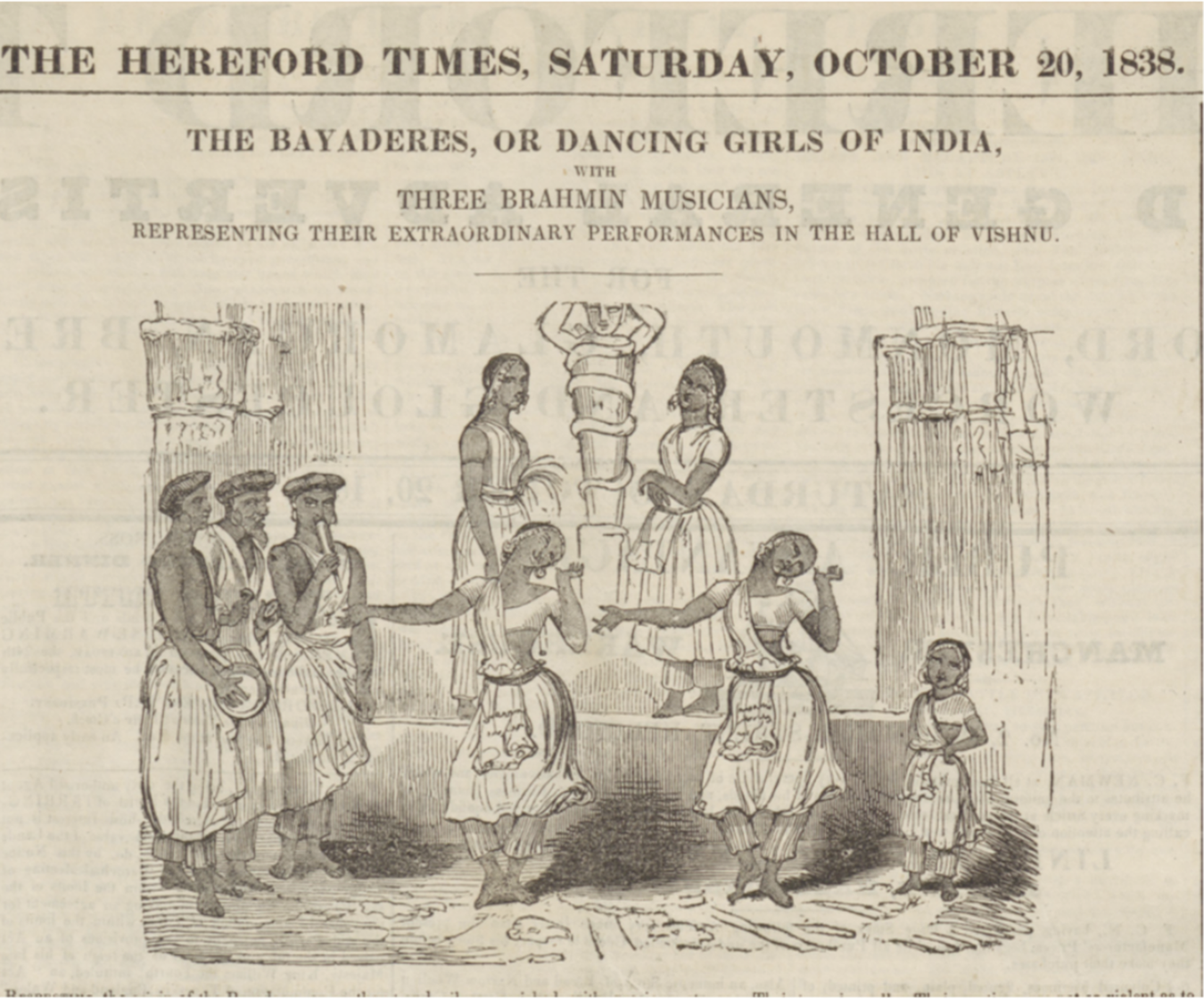
Image of the bayadères. Source: Hereford Times, 1838.
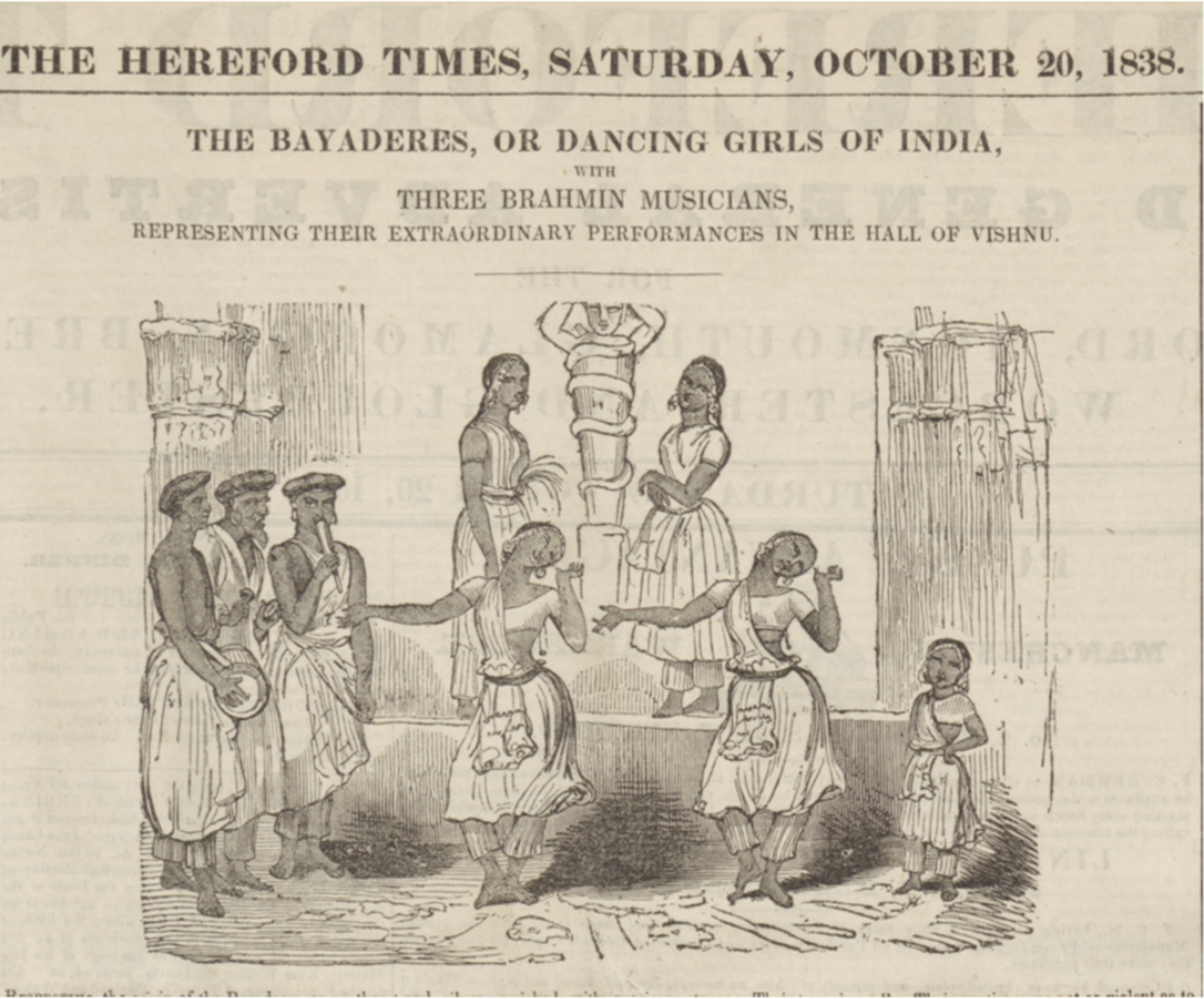
Figure 2 Long description
An illustration from The Hereford Times dated Saturday, October 20, 1838, depicts a group of dancing girls from India, referred to as bayaderes, performing alongside three Brahmin musicians. The scene is set in a hall, with the dancers positioned in various poses, some with raised arms and others in mid-step. The musicians are standing to the left, playing instruments. Architectural elements like columns and drapery are visible in the background, suggesting an indoor setting. The text above the image provides the date and describes the performers as representing extraordinary performances in the hall of Vishnu.
Image of the bayadères. Source: York Herald, 1838.

Figure 3 Long description
The illustration depicts seven women and one child in traditional attire, engaged in a dance. The central figure is elevated on a platform, surrounded by other women who appear to be dancing or gesturing. The women are wearing skirts and tops, with some having sashes or decorative elements. The child stands to the right, observing the scene. Architectural elements, including columns and structures, are visible in the background, providing a setting that suggests a cultural or ceremonial event.
Image of the bayadères. Source: The Mirror of Literature, Amusement, and Instruction, 1838.

Figure 4 Long description
The illustration depicts nine women dancing in a circular formation within an ornate architectural setting. The women are dressed in traditional attire, with flowing garments and headpieces. They are positioned around a central platform, where one woman stands with her arms raised. The background features columns and arches, adding to the grandeur of the scene. The text on the right reads 'The Mirror' and 'The Bayadères, or Dancing Girls of India.'.
Image of ‘The Hindoo’s Lament’ by a bayadère, 1838. Source: Nineteenth Century British Periodicals.

Figure 5 Long description
She is wearing a flowing dress with a sash and jewelry. Her right arm is raised and her left arm is bent, with her hand near her face. The background features a textured pattern, suggesting movement or emotion.
Image of ‘The Dagger Dance’ by two bayadères, 1838. Source: Nineteenth Century British Periodicals.

Figure 6 Long description
Two dancers are depicted performing 'The Dagger Dance' at the Adelphi Theatre. They are holding daggers in their right hands, with their left arms extended backward. Both dancers are wearing traditional attire, including flowing skirts and fitted tops. Their posture is dynamic, suggesting movement and grace. The background features shaded areas, adding depth to the illustration. The text above reads 'THE DAGGER DANCE: As performed by the Bayaderes at the Adelphi Theatre.'.
These images consistently show the musicians on the left side and the dancers on the right. The oldest musician, with the beard, is placed in the centre of the three musicians. Veydoun, the six-year-old, always appears on the extreme right. The waists of the dancers are always visible. In some images, parts of their breasts are also made visible. It is possible that the same artist drew these images, or that an original image was reproduced with slight variations for different newspapers. Tille Amal is always shown as slightly different from the other three adult dancers either by way of clothing or height, signalling her superiority. The images communicate the same visual details that the text contains. They augment the work that the text does.
However, illustration as a process of documentation is also one that allows for resistance. John Cooper, writing on colonial visual culture and dance suggests that ‘pictures of dancers produced figures of disruption within the compositional matrices of picturesque colonial visual culture’.Footnote 75 For Cooper, ‘images that might otherwise have appeared to arrest the movement of historical events into illustrative descriptions of organised control’ are disrupted by the potential of movement contained in the image of the dancer.Footnote 76 And so I also offer this contradictory position that visual images, with their scope for interpretation, left the most room for the dancers’ agency to emerge.
I would like to add here that my assessment of the dancers also emerges from my own position as an Indian classical dancer and critical dance studies scholar. Had I not trained in kuchipudiFootnote 77 and watched countless bharatanatyam performances, I might have paid no attention to how the arms and fingers of the dancers appeared in the newspaper illustrations. Further, had I not known of critical dance scholars on Indian classical dance, I might not have come to the same conclusions. Scholars have written about the appropriation of regional dance traditions into classical dance traditions from the time of Indian independence.Footnote 78 They have commented upon dominant caste reformers disenfranchising temple dancers from their performance practice in the first half of the twentieth centuryFootnote 79 and have shown how the nationalist movement impacted the construction of Indian classical dance.Footnote 80
I suggest that the languid arms and fuzzy fingers of the dancers in the illustrations are signals of archival resistance in two possible ways. In making this claim, I am reminded of Ann Laura Stoler’s idea that colonial archives are not merely records or accounts of what has happened; instead, ‘they are records of uncertainty and doubt in how people imagined they could and might make the rubrics of rule correspond to a changing imperial world’.Footnote 81 These illustrations, I suggest, are evidence of the uncertainty that runs through the colonial records.
The first resistance to the colonial control exerted by the image is in the fuzzy fingers. The wood engraving, even with its penchant for detail, does not capture the intricate finger positions, or mudras, of the dancers. The fact that this minute but most central feature of the dancers’ art escapes the artist, to me, upsets the entirety of the endeavour in translating the dancer into the bayadère. Her fingers remain untranslatable, and this marks her distance and refusal to be transformed into the bayadère the English public expects. The second resistance I contend is in the languidness of the arms of the dancers in most of the pictures. Except in the picture where they are holding knives, which would necessarily require them to tense their arms so as not to injure themselves, their arms seem disinterested and indifferent. I say this because in modern-day renditions of bharatanatyam, which is the appropriated classical form performed by predominantly dominant caste women, the hands are held with more vigour.
There can be two possible reasons for the indolence exhibited by the arms. The first is that the dancers performed half-heartedly. Their resistance and agency lay in performing because they had to, and not because they wished to. In this case, their loose hand gestures and arm positions can be seen as a site that demonstrates their limited but visible agency. The second is an indictment of their treatment at the hands of Yates and Tardivel. Forced to perform in clothing suited to tropical weather, at a time when it was winter in Britain, and unsure of the food they had access to, it is likely that they became physically too weak to perform. Descriptions of the Indian dancers referred to their bare feet, their exposed waists, the sheerness of the fabric that covered their bodies. The writers of these articles never question the comfort or protection of such outfits. October to December marks the onset of winter in England, and there is no mention of how their clothing is inadequate for the climate.
In accounts from both France and England, we have references to the food habits of the dancers. One is meant to be a humorous account with Amany refusing food offered to them by dropping it in the musicians’ instrument bags.Footnote 82 In another instance, the reader is told that the dancers ‘mortify their appetites to a greater extent than Europeans could credit’.Footnote 83 This mortification is in reference to an incident where they passed the butcher’s shop and seeing the meat all hung together ‘they positively refrained all together from … feeding’.Footnote 84 Such a predicament might offer insight into the idea that the troupe found it difficult to find food that they were familiar with, and so they ate very little. Over months with little access to familiar food, they may have become too physically weak to carry out their movements with adequate vivacity.
And finally, there is yet another way to understand the dancers’ arms. These languorous arms could also have been the intended physical vocabulary of the dance. In other words, such relaxed movements could have been the way temple dancers performed. In performance studies scholar Davesh Soneji’s description of the hereditary temple dancers, he writes that, ‘loose limbs, footwork, and mudras, or unstructured improvisation … are the aspects of devadası performance that were and continue to be configured as “in bad taste”’.Footnote 85 And so, today, the languor of the arms might seem askance to me, as a modern-day dominant caste dancer of a classical dance style. In this scenario, I suggest also that these images become a response to today’s acrobatic and almost martial bharatanatyam and allied classical dances. Dominant caste dancers subscribe to a rigid technique where the arms are held to accentuate the geometry or technique of the dance-form. In rejecting the softer, more pliant arms of the hereditary dancer, the dominant caste dancer creates a visible physical distinction between them. The archival resistance of the temple dancers then also speaks to the contemporary classical dancer of today, reminding them of their community’s relative absence to often total absence from modern stages. In these ways, the visuals of the temple dancers offer possibilities for interpretation that go beyond the way the temple dancers find themselves racialised and othered in the newspaper text.
Conclusion
As Indian temple dancers made their way from colony to metropole, prior travel writing and contemporaneous newspaper reportage conjured them into the fictitious yet ‘real’ bayadère. In this article, I have attempted to speak to the agency or lack thereof of travelling female performers from the nineteenth century. As I demonstrate, even the desire to travel was not of their choosing: Tardivel legally coerced them into submitting to the tour. The dancers landed in a discursive framework dealt to them as colonial racialised subjects of an imperial order. Their performance was slotted into theatrical plays and variety shows. Their artistic practice was read as sexual and morally suspect; their bodies and clothing described repeatedly in vivid detail, their aesthetic codes sexualised as in the case of eye movements, and their character read as flirtatious.
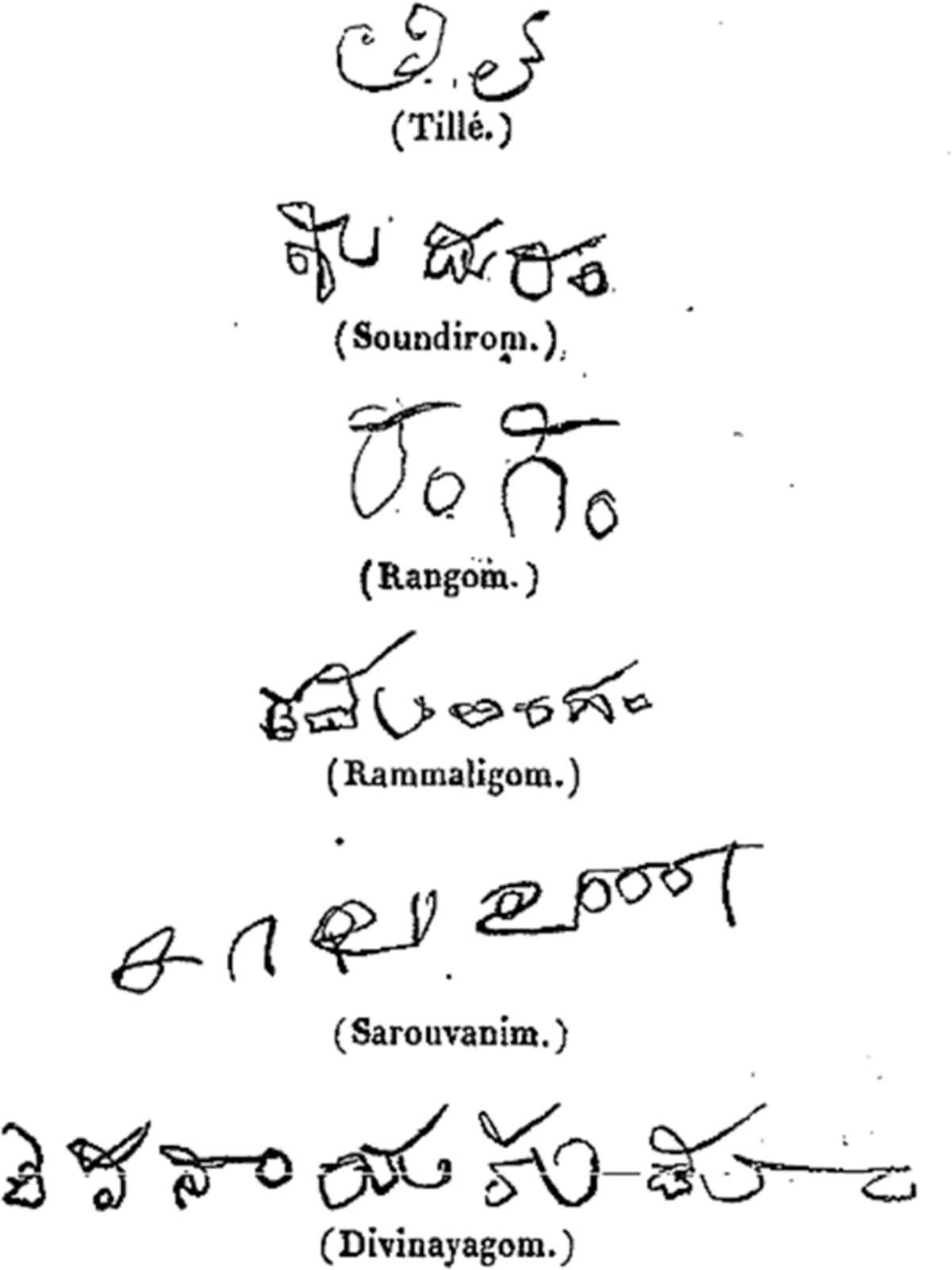
And yet, the archive offers sites for reading the dancers’ resistance. I have sought to demonstrate where I could find their agency in the archive, as in the grave countenance of Tille Amal and in the fuzzy fingers and languid arms. One even knows that they could write and were writing while in London. As noted in one newspaper report, ‘they all write the language of their country … and are written by them with much precision and neatness’.Footnote 86 There is proof of their writing in the signatures collected by a French magazine (Figure 7). Even Veydoun, the six-year-old, was apparently being taught to write by Ramalingam, the oldest musician.Footnote 87 What were the dancers writing? Were these diaries? Letters? Essays? The archive so far has yielded little.
Signatures of the bayadères, 1838. Source: Gallica Digital Archive.

Figure 7 Long description
The image displays signatures of six individuals, each accompanied by a name in parentheses. The names are Tillé, Soundirom, Rangom, Ramaligom, Sarouvanim and Divinayagom. Each signature is distinct, showcasing different handwriting styles. The names are written below each signature, providing identification for each individual.
The Examiner on 12 August 1838 recounts an interesting encounter between these ‘real’ bayadères and the ones in ballet.Footnote 88 The dancers were taken to watch Le Dieu et La Bayadère, apparently put on specifically for their entertainment. The temple dancers are described as considering French ballet to be licentious and especially cannot stand the pirouettes. The oldest in the troupe is documented as covering her eyes when the others mimicked what they had seen at the theatre. In this example, I have found one of the few accounts of how the temple dancers in the 1838 tour perceived the world around them, rather than merely being the object of observations. While I have no doubt of their fortitude and individual agency, the systemic power structures through which colonialism operated leaves little avenue to recover how they lived their lives through their own cultural frameworks.
Their role as travelling performers was circumscribed by power equations that tilted heavily against them. Their circulation made them coquettes. It made them black, dark, brown, and deep-coloured women who were defined by their position as subjects of the colonial project. In this scenario, the reading of archival images offers new stories and histories. On reading carefully, one finds traces of their continued resistance left behind in the archives, even as their lives were lost to, and cut off from, the place they once called home.
Conflicts of interest
None.

 Open access

