


A number of recent epidemiological surveys have reported on mental health in relation to sexual orientation. These studies have all compared a combined homosexual/bisexual group with heterosexuals. The most consistent finding has been that there is a higher prevalence of suicidal ideation and suicide attempts in homosexual/bisexual adolescents (Reference DuRant, Krowebuk and SinalDuRant et al, 1998; Reference Faulkner and CranstonFaulkner & Cranston, 1998; Reference Remafedi, French and StoryRemafedi et al, 1998; Garofalo et al, Reference Garofalo, Wolf and Kessel1998, Reference Garofalo, Wolf and Kessel1999) and in homosexual/bisexual adults (Reference Bagley and TremblayBagley & Tremblay, 1997; Reference Fergusson, Horwood and BeautraisFergussonet al, 1999; Reference Herrell, Goldberg and TrueHerrellet al, 1999; Reference Cochran and MaysCochran & Mays, 2000a ; Reference Gilman, Cochran and MaysGilman et al, 2001). Studies of mental disorders in relation to sexual orientation also mainly show a higher prevalence of anxiety, mood disorders and substance use disorders in homosexual/bisexual people (Reference Fergusson, Horwood and BeautraisFergussonet al, 1999; Cochran & Mays, Reference Cochran and Mays2000a ,Reference Cochran and Mays b ; Reference Gilman, Cochran and MaysGilman et al, 2001; Reference Gruskin, Hart and GordonGruskin et al, 2001; Reference Sandfort, de Graaf and BijlSandfort et al, 2001). An important limitation of these studies is that they have not distinguished homosexual from bisexual participants. The social circumstances of the two groups may be different (Reference FriedmanFriedman, 1999) and having neither a clear heterosexual nor homosexual orientation could be associated with greater psychological distress. The aim of the present study is to examine, in a community sample, whether both bisexual and homosexual orientations involve an increased risk of mental health problems. The issue is examined in two age groups, 20-24 and 40-44 years, to see whether having a minority sexual orientation is associated with greater psychological distress in younger adulthood where longterm partnerships and social roles are being established.
METHOD
Participants
The sample came from the PATH Through Life Project, which interviewed 20— to 24-year olds in 1999 and early 2000 and 40— to 44-year-olds in 2000 or early 2001, as part of the first wave of a 20-year longitudinal study of adult mental health. Participants had to be in their respective age group on 1 January 1999 (for 20— to 24-year-olds) or 2000 (for 40— to 44-year-olds). The sampling frames were the electoral rolls for Canberra and Queanbeyan, Australia. Because the Australian Electoral Commission would only release decade age ranges for research purposes, we wrote to 12 414 persons recorded as aged 20-29 years on the Electoral Roll and asked for participation of those aged 20-24 years. Out of these, 5058 were found to be out of the required age range, 1061 were known to have moved out of the area, 2190 could not be found, 1701 refused and 2404 were interviewed. The participation rate of those who were found and who were in the required age range was 58.6%. Similarly, for the 40— to 44-year-olds, 9033 persons were sent letters, 4222 were out of the required age range, 280 had moved, 612 could not be found, 1389 refused and 2530 were interviewed (64.6% of those found and in the age range).
Questionnaire
Participants were asked to complete a questionnaire that covered socio-demographic characteristics, anxiety and depression, substance use, cognitive function, well-being, physical health, health habits, use of health services, personality, coping, early-life psychosocial risk factors, current psychosocial risk factors and nutrition. This was done under the supervision of a professional interviewer. Some basic physical tests also were carried out (e.g. blood pressure, grip strength, visual acuity, lung functioning) and the participants were asked to provide a cheek swab from which DNA could be extracted. The components of the questionnaire relevant to the present paper are described below.
Sexual orientation was assessed by the question ‘Would you currently consider yourself to be predominantly: heterosexual, homosexual, bisexual, don't know’. As described below, this question was answered privately on a palmtop computer, with the interviewer not seeing the response.
Anxiety and depression symptoms were assessed by the Goldberg et al (Reference Goldberg, Bridges and Duncan-Jones1988) anxiety and depression scales, which give scores of 0-9 for number of symptoms of anxiety and depression. Alcohol misuse was assessed by the Alcohol Use Disorders Identification Test (AUDIT), which gives scores of 0-40 (Reference Saunders, Aasland and BaborSaunders et al, 1993). Suicidality was measured by a five-item scale of suicidal thoughts and actions over the past year (Reference Lindelow, Hardy and RodgersLindelow et al, 1997). Emotional well-being was measured with the Positive and Negative Affect Scales (PANAS), which give scores of 10-50 (Reference Watson, Clark and TellegrenWatson et al, 1988). Physical health was measured by the Physical Component Summary of the SF-12, which is scaled to have a mean of 50 and a standard deviation of 10, with higher scores reflecting better physical health (Reference Ware, Kosinski and KellerWare et al, 1996).
Social support was assessed by a questionnaire that has sub-scales measuring positive support from family (range 0-6), negative support from family (0-9), positive support from friends (0-6) and negative support from friends (0-9) (Reference Schuster, Kessler and AseltineSchuster et al, 1990). The social support questionnaire also has scales for partner support, but these were not used in the present analyses because many of the 20— to 24-year-olds did not have a partner. Current adverse life events were assessed using the List of Threatening Experiences, which asks about 12 adverse life events over the previous 6 months (Reference Brugha, Bebbington and TennantBrugha et al, 1985). Owing to a programming error, current life event data were not collected on participants aged 40— to 44 years who did not have a partner.
Childhood adversity was measured by an 18-point scale covering lack of affection from mother and father, drinking or drug use by mother or father, nervous or emotional trouble or depression in mother or father, conflict in the household, divorce or separation of parents and ten different types of parental mistreatment. This scale was constructed by the authors based on an earlier scale (Reference Jorm, Rodgers and JacombJorm et al, 1999).
Socio-economic status was indicated by education and financial problems. Education was measured by years of completed full-time education. People with financial problems replied ‘Sometimes’ or ‘Often’ to the question ‘Have you or your family had to go without things you really needed in the last year because you were short of money?’.
Survey procedure
Persons selected at random from the electoral roll were sent a letter informing them about the survey and saying that an interviewer would contact them soon to see whether they wanted to participate. If a person agreed to participate, the interviewer arranged to meet him or her at some convenient location, usually the participant's home or the Centre for Mental Health Research. Most of the interview was self-completed on a Hewlett-Packard 620LX palmtop personal computer using the Surveycraft software (version 8.0.81; Surveycraft Pty Ltd, Australia) for computer-assisted personal interviewing. However, testing by the interviewer was required for the physical tests, some of the cognitive tests and the cheek swab. Ethical approval for this study was given by the Australian National University Human Research Ethics Committee.
Statistical analysis
Regression models were used to investigate differences in mental health according to sexual orientation. Continuous dependent variables were analysed using multiple linear regression, variables that had highly skewed counts were analysed using negative binomial regression and dichotomous variables were analysed using logistic regression. Predictor variables included sexual orientation (dummy coded with heterosexual as the reference category), age group and gender for the initial modelling. Interaction terms were examined by using likelihood ratio tests to compare models and were retained if significant at the P<0.05 level. To facilitate the interpretation of significant differences between sexual orientation groups, marginal means and their 95% confidence intervals were estimated and a Wald test was used for pairwise comparisons. Covariates known to be risk factors for mental health problems were each examined in the same manner and their marginal means compared. Models incorporating the risk factors into the prediction of mental health problems then were developed following the same procedures. Analyses were conducted using SPSS-10 and Stata-7 for Windows.
RESULTS
Answers to the question on sexual orientation were available from 2331 persons aged 20-24 years and 2493 persons aged 40-44 years, with 78 reporting themselves as homosexual and 71 as bisexual. The prevalence of homosexual orientation at age 20-24 years was 1.0% (95% CI 0.4-1.6) in men and 1.8% (95% CI 1.0-2.6) in women, whereas at age 40-44 years it was 1.6% (95% CI 0.9-2.3) in men and 2.0% (95% CI 1.2-2.8) in women. The prevalence of bisexual orientation at age 20-24 years was 1.8% (95% CI 1.0-2.6) in men and 2.7% (95% CI 1.8-3.6) in women, whereas at age 40-44 years it was 0.8% (95% CI 0.3-1.3) in men and 0.8% (95% CI 0.3-1.3) in women. Thus, bisexuality was more common than homosexuality in the younger cohort, whereas the opposite was true of the middle-aged cohort.
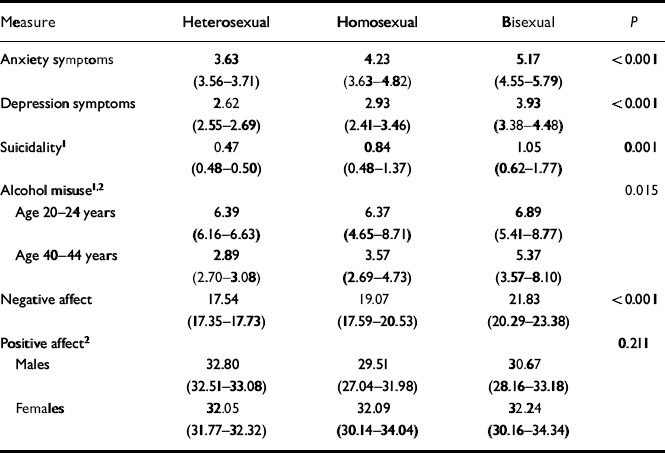
The estimated marginal means of the mental health and well-being measures for the different sexual orientation groups, adjusted for age and gender, are shown in Table 1. Interaction terms between age and gender were retained for all models. The interaction between sexual orientation and age group was significant and so retained in the model for alcohol misuse, and the interaction of sexual orientation and gender was significant for positive affect. No three-way interaction terms were significant. There were significant differences between the sexual orientation groups on all measures of mental health, but not on positive affect. For measures showing a significant difference across the groups there was a similar pattern: the bisexual group had significantly poorer mental health than the homosexual group, except for suicidality. In turn, the homosexual group had significantly poorer mental health than the heterosexual group for anxiety, depression, suicidality and negative affect.
Estimated marginal means (and 95% Cl) on mental health and emotional well-being measures for heterosexual, homosexual and bisexual participants, adjusting for age and gender
| Measure | Heterosexual | Homosexual | Bisexual | P |
|---|---|---|---|---|
| Anxiety symptoms | 3.63 (3.56-3.71) | 4.23 (3.63-4.82) | 5.17 (4.55-5.79) | <0.001 |
| Depression symptoms | 2.62 (2.55-2.69) | 2.93 (2.41-3.46) | 3.93 (3.38-4.48) | <0.001 |
| Suicidality1 | 0.47 (0.48-0.50) | 0.84 (0.48-1.37) | 1.05 (0.62-1.77) | 0.001 |
| Alcohol misuse1,2 | 0.015 | |||
| Age 20-24 years | 6.39 (6.16-6.63) | 6.37 (4.65-8.71) | 6.89 (5.41-8.77) | |
| Age 40-44 years | 2.89 (2.70-3.08) | 3.57 (2.69-4.73) | 5.37 (3.57-8.10) | |
| Negative affect | 17.54 (17.35-17.73) | 19.07 (17.59-20.53) | 21.83 (20.29-23.38) | <0.001 |
| Positive affect2 | 0.211 | |||
| Males | 32.80 (32.51-33.08) | 29.51 (27.04-31.98) | 30.67 (28.16-33.18) | |
| Females | 32.05 (31.77-32.32) | 32.09 (30.14-34.04) | 32.24 (30.16-34.34) |
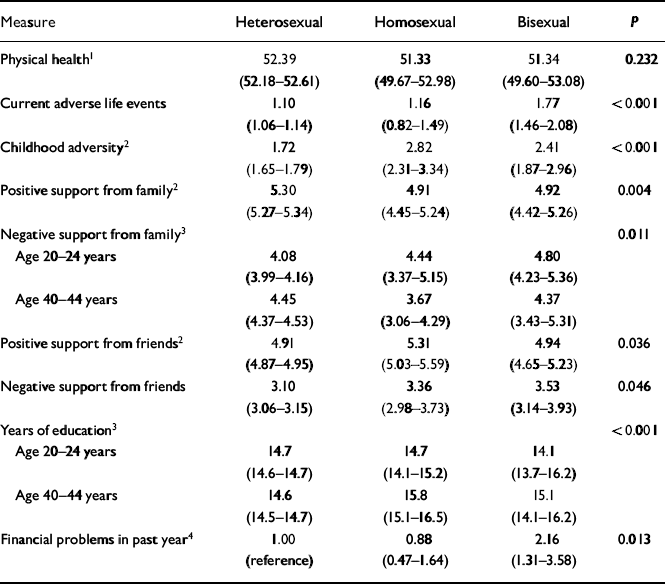
Regression models also were developed for the risk factors for worse mental health. The only significant interaction effects were a sexual orientation-by-age interaction for negative support from family and for years of education, and a gender-by-age interaction for positive support from friends. Table 2 shows the results. Pairwise comparisons showed that, compared with the heterosexual group, the bisexual group had more childhood adversity, more current adverse life events, less positive support from family, more negative support from friends, more years of education (40— to 44-year-olds) and more often had financial difficulties. The bisexual group also had more adverse life events and more often had financial difficulties than the homosexual group. When the homosexual group was compared with the heterosexual group, they had more childhood adversity, less positive support from family and more years of education (40— to 44-year-olds).
Estimated marginal means (and 95% Cl) on risk factor measures for heterosexual, homosexual and bisexual participants, adjusting for age and gender
| Measure | Heterosexual | Homosexual | Bisexual | P |
|---|---|---|---|---|
| Physical health1 | 52.39 (52.18-52.61) | 51.33 (49.67-52.98) | 51.34 (49.60-53.08) | 0.232 |
| Current adverse life events | 1.10 (1.06-1.14) | 1.16 (0.82-1.49) | 1.77 (1.46-2.08) | <0.001 |
| Childhood adversity2 | 1.72 (1.65-1.79) | 2.82 (2.31-3.34) | 2.41 (1.87-2.96) | <0.001 |
| Positive support from family2 | 5.30 (5.27-5.34) | 4.91 (4.45-5.24) | 4.92 (4.42-5.26) | 0.004 |
| Negative support from family3 | 0.011 | |||
| Age 20-24 years | 4.08 (3.99-4.16) | 4.44 (3.37-5.15) | 4.80 (4.23-5.36) | |
| Age 40-44 years | 4.45 (4.37-4.53) | 3.67 (3.06-4.29) | 4.37 (3.43-5.31) | |
| Positive support from friends2 | 4.91 (4.87-4.95) | 5.31 (5.03-5.59) | 4.94 (4.65-5.23) | 0.036 |
| Negative support from friends | 3.10 (3.06-3.15) | 3.36 (2.98-3.73) | 3.53 (3.14-3.93) | 0.046 |
| Years of education3 | <0.001 | |||
| Age 20-24 years | 14.7 (14.6-14.7) | 14.7 (14.1-15.2) | 14.1 (13.7-16.2) | |
| Age 40-44 years | 14.6 (14.5-14.7) | 15.8 (15.1-16.5) | 15.1 (14.1-16.2) | |
| Financial problems in past year4 | 1.00 (reference) | 0.88 (0.47-1.64) | 2.16 (1.31-3.58) | 0.013 |
Risk factors for poorer mental health were entered into the regressions to see whether they could explain the mental health differences between the sexual orientation groups. A similar pattern emerged in that differences between the three groups remained significant for all mental health measures except alcohol misuse. Pairwise comparisons, however, revealed that, except for suicidality, the differences between the homosexual and heterosexual groups were no longer significant, whereas the differences between the bisexual and other groups remained significant and of similar magnitude. For suicidality, there was no significant difference between homosexuals and bisexuals, but both were significantly different from heterosexuals.
To get a better understanding of the nature of the childhood adversity reported by homosexual and bisexual participants, an exploratory analysis was carried out on individual items of the childhood adversity scale. For most items, the endorsement rate was too low to permit meaningful analysis, so the analysis was restricted to items endorsed by at least 10% of participants. Logistic regression analysis showed that the homosexual group more often reported emotional trouble in the mother or father, substance misuse in the father and conflict in the home. The only significant difference for the bisexual group was for emotional trouble in the mother.
DISCUSSION
Mental health of bisexual participants
The present study shows that bisexual orientation is associated with worse mental health than heterosexual orientation on a range of measures of psychological distress, with the homosexual group falling between the other two. Previous studies may have overstated the risk of mental health problems for homosexuals by grouping them together with bisexuals. The reason for the worse mental health of the bisexual group is not clear. Although they had a higher level of several risk factors, these factors could not account entirely for the differences. It is possible that having neither a clear heterosexual nor homosexual orientation is an important stressor, in addition to the social pressures of having a different sexual orientation to the majority.
Mental health of homosexual participants
The homosexual group also tended to have worse mental health compared with the heterosexual group, which was most evident on the measure of suicidality. This finding confirms earlier studies showing a higher risk for suicidal ideation and suicide attempts in homosexual individuals. In contrast to the bisexual group, the worse mental health of the homosexual group could be explained in terms of associated risk factors for all measures except suicidality.
Prevalence of sexual orientations
The prevalence of homosexuality and bisexuality combined was 2.7% for young men, 4.5% for young women, 2.4% for middle-aged men and 2.7% for middle-aged women. Most other mental health surveys have found rates of around 1.5-3%, despite variation in the method of assessing sexual orientation (Reference Fergusson, Horwood and BeautraisFergusson et al, 1999; Reference Herrell, Goldberg and TrueHerrell et al, 1999; Cochran & Mays, Reference Cochran and Mays2000a ,Reference Cochran and Mays b ; Reference Sandfort, de Graaf and BijlSandfort et al, 2001), although higher rates have been reported (Reference Bagley and TremblayBagley & Tremblay, 1997). The higher prevalence of homosexual or bisexual orientation in young women in the present study is unusual and contrasts with other studies, which generally report a higher prevalence in men. However, this finding is consistent with the results of a recent British survey that found that women aged 16-24 years reported a higher prevalence of recent homosexual partners than did men of the same age, whereas men reported a higher prevalence at ages 25-34 and 35-44 years (Reference Johnson, Mercer and ErensJohnson et al, 2001). This survey also found a strong increase in reports by women of homosexual partners compared with a similar survey carried out 10 years earlier, suggesting a greater willingness by women to engage in or report homosexual relationships.
Another notable trend in our data was that bisexuality was more common than homosexuality in the younger adults, whereas the opposite was true of the middle-aged group. It is possible that bisexual identification becomes less common with age as uncertainties about sexual orientation become resolved. However, because these are different cohorts rather than a longitudinally followed sample, it is impossible to be sure of developmental trends.
Limitations
The present study has several limitations that must be acknowledged. First, it is not clear how the respondents interpreted the single question used to assess sexual orientation (e.g. in terms of fantasy or current behaviour) or whether the terms ‘heterosexual’, ‘homosexual’ and ‘bisexual’ were always understood correctly. Second, the participation rate was not high, which may have introduced unknown biases in the sample. Third, HIV status was not assessed, although there were no differences on a global measure of physical health that would reflect any major health problems. Fourth, some potentially important risk factors, such as feelings of stigma or experiences of discrimination, were not measured. These factors were not covered because the data came from a general mental health survey that was not specifically designed to investigate differences associated with sexual orientation. Finally, because this is a cross-sectional study, it is impossible to know whether the greater exposure to risk factors in the bisexual group is a cause or consequence of bisexual orientation.
Despite these limitations, the study is the first to show the importance of distinguishing bisexuals from homosexuals in researching mental health.
Clinical Implications and Limitations
CLINICAL IMPLICATIONS
-
• Bisexual individuals are a high-risk group for mental health problems and suicidal ideas and actions.
-
• Although homosexuals tend to have poorer mental health than heterosexuals, the extent of their mental health problems may have been exaggerated by previous studies that grouped them with bisexuals.
-
• Adverse experiences in childhood, current adverse life events, poorer social support and financial problems are important risk factors for mental health problems in bisexuals.
LIMITATIONS
-
• Sexual orientation was assessed by a single question that may have been interpreted differently by various respondents.
-
• The response rate was only 58.6% in 20— to 24-year-olds and 64.6% in 40— to 44-year-olds.
-
• Because the survey was not specifically designed to investigate issues related to sexual orientation, important variables such as HIV status, stigma and discrimination were not assessed.
Acknowledgements
We thank Karen Maxwell and the team of interviewers from the Centre for Mental Health Research for their assistance with this study.




eLetters
No eLetters have been published for this article.