

Introduction
Transitioning to a circular economy is widely promoted as a strategy for simultaneously addressing environmental and economic issues by establishing a more sustainable production-consumption system (Wasserbaur, Sakao & Milios, Reference Wasserbaur, Sakao and Milios2022). While sustainability is largely used as an umbrella term for the responsible and efficient use of finite resources to minimize environmental impact, a circular economy builds on this by reintegrating products back into the supply chain after use, rather than disposing of them as waste (Nikolaou, Jones & Stefanakis, Reference Nikolaou, Jones and Stefanakis2021). Specific definitions of circular economy vary; however, they coalesce around designing out waste, keeping materials in use and extending the useful life of products through reuse, repurposing, and recycling (Geissdoerfer, Santa‐Maria, Kirchherr & Pelzeter, Reference Geissdoerfer, Santa‐Maria, Kirchherr and Pelzeter2022; Wasserbaur et al., Reference Wasserbaur, Sakao and Milios2022). For economies to transition toward circularity, firms must transform their business models in accordance with these circular principles.
Yet firms have been slow to make this transition (Bocken, Olivetti, Cullen, Potting & Lifset, Reference Bocken, Olivetti, Cullen, Potting and Lifset2017; OECD, 2019), creating a fundamental structural tension: circular economy principles require systemic redesign and business model transformation, yet firm behavior remains largely incremental. Rather than fundamentally rethinking value creation, delivery, and capture around circular principles, most firms pursue operational improvements – waste reduction, efficiency gains, recycling – that preserve the underlying logic of linear business models (Geissdoerfer, Pieroni, Pigosso & Soufani, Reference Geissdoerfer, Pieroni, Pigosso and Soufani2020). This incremental-transformational gap is particularly acute for established small-to-medium-sized enterprises (SMEs), which comprise over 95% of all companies in OECD countries (OECD, 2019). Despite their economic significance, SMEs face distinct capability constraints in resources, knowledge, and organizational capacity. Unlike large corporations, which can dedicate substantial resources to systemic redesign, SMEs must navigate this transition with limited financial, human, and knowledge capital – making the shift from incremental improvement to transformational redesign especially difficult to bridge.
Circular economy scholarship has predominantly examined two contexts: resource-rich large firms capable of investing in transformation (Burger & Luke, Reference Burger and Luke2017; Karneyeva & Wüstenhagen, Reference Karneyeva and Wüstenhagen2017), and circular startups designed from inception around regenerative principles (Christensen, Wells & Cipcigan, Reference Christensen, Wells and Cipcigan2012; Li, Zhan, de Jong & Lukszo, Reference Li, Zhan, de Jong and Lukszo2016). Large organizations have slack resources, institutional capacity, and the ability to absorb costs and risks associated with business model innovation (Nohria & Gulati, Reference Nohria and Gulati1996). Circular startups, unburdened by legacy systems, can build circular principles into their business models (Khanna, Kuik & Ban, Reference Khanna, Kuik and Ban2025). Yet neither context speaks to the reality facing the majority of firms: established SMEs that must transform entrenched linear business models from within, under precisely the capability constraints that make such transformation most difficult (Bandeira, Ferasso & Tortaro, Reference Bandeira, Ferasso and Tortaro2025).
Recognizing these challenges, governments have deployed interventions to support SME circular transitions – through grants, technical assistance, partnerships, and regulatory frameworks (Ellen MacArthur Foundation, 2015; Wasserbaur et al., Reference Wasserbaur, Sakao and Milios2022). Yet how such programs interact with the transition dynamics facing established SMEs remains underexplored. We address this gap by analyzing seven government policy initiatives spanning 2013–2024 in Queensland, Australia, combined with interviews with 15 experts whose advisory, consultancy, and research roles afford field-level knowledge of SME circular engagement. Expert informants are well positioned to look beyond individual firm experience and identify the systemic dynamics, enabling conditions, and patterns of firm response that shape how SMEs engage with circular economy transformation across programs and sectors. We ask: why does the transition toward circular business model transformation (CBMT) in SMEs stall at incremental adaptation, and under what conditions can government initiatives facilitate a shift toward transformational change?
Our analysis uncovers three interconnected dimensions that explain why SMEs often engage in incremental adaption and enablers that can unlock progress toward circularity: (1) transition friction that creates barriers to CBMT; (2) path dependency that drives firms toward operational efficiency improvements that preserve linear business model logic rather than transforming it; and (3) structural enablers that are needed to support the shift from incremental adaptation to transformational circularity. Together, these dimensions illuminate misalignment between the firm-level constraints that reinforce incremental change and the systemic change that CBMT requires. By developing a framework of these transition dynamics, we contribute to circular economy scholarship by going beyond corroborating prior research regarding barriers to circularity and prevailing minimization strategies to point to the nexus where government intervention can facilitate transformational change.
Literature review
Circular business models transformation
Circular business models (CBMs) represent a fundamental departure from linear ‘take-make-dispose’ logic, requiring firms to reconceptualize value creation, delivery, and capture around regenerative principles (Geissdoerfer et al., Reference Geissdoerfer, Pieroni, Pigosso and Soufani2020). Rather than merely ‘greening’ existing operations with sustainability initiatives, CBMs integrate circular economy principles – the ‘3Rs’ of reducing resource use, reusing products, and recycling waste materials – into the core business model (Frishammar & Parida, Reference Frishammar and Parida2019). Geissdoerfer et al. (Reference Geissdoerfer, Pieroni, Pigosso and Soufani2020) categorize CBM strategies into four types: cycling, whereby materials and energy are recycled through reuse, remanufacture, and refurbishment; extending, whereby product lifespan is extended through design, maintenance, and repair; intensifying, whereby product use is intensified through sharing or service models; and dematerializing, whereby products are substituted by service-based or software solutions without material hardware.
However, achieving such a transformation strategy, as described by Geissdoerfer et al. (Reference Geissdoerfer, Pieroni, Pigosso and Soufani2020) above requires changing the ‘value logic’ of the business model – a shift in value proposition, value creation, value delivery, and value capture (Geissdoerfer et al., Reference Geissdoerfer, Pieroni, Pigosso and Soufani2020). This value logic extends to incorporate the firm’s ‘value network,’ reflecting the importance of collaboration with external stakeholders as a key driver of CBMT (Shafer, Smith & Linder, Reference Shafer, Smith and Linder2005). Most companies do not emerge with CBMs at inception; instead, CBMT efforts are typically undertaken retrospectively, in order to make use of government initiatives designed to facilitate circularity or in response to shifts in consumer patterns (Abdelkafi & Täuscher, Reference Abdelkafi and Täuscher2016). Yet despite widespread CE discourse, evidence suggests SMEs pursue incremental rather than transformational approaches (Ahmadov et al., Reference Ahmadov, Durst, Gerstlberger and Kraut2023).
Constraints and challenges to circular transformation
Prior research has documented substantial firm-level resource constraints inhibiting CBMT, particularly for SMEs. Lack of capital and technical capabilities are cited as two of the most pressing barriers to circular transition (Ormazabal, Prieto-Sandoval, Puga-Leal & Jaca, Reference Ormazabal, Prieto-Sandoval, Puga-Leal and Jaca2018; Rizos et al., Reference Rizos, Behrens, Van der Gaast, Hofman, Ioannou, Kafyeke and Topi2016). Circular transition requires a slew of new activities such as product development, establishing distribution channels and implementing waste capture mechanisms, requiring upfront and indirect capital costs and new technologies, which can be difficult for SMEs to meet (Rizos et al., Reference Rizos, Behrens, Van der Gaast, Hofman, Ioannou, Kafyeke and Topi2016). SMEs experience temporal challenges in circular transitions such as long product development cycles and unclear market acceptance timelines creating uncertainty in linear to circular transition (Shi et al., Reference Shi, Peng, Liu and Zhong2008). Commonly, SMEs do not have specialized expertise; staff tend to be more generalized across the business and hence knowledge gaps about the viability and profitability of circular approaches arise and subsequently inhibit circular transition (Ormazabal et al., Reference Ormazabal, Prieto-Sandoval, Puga-Leal and Jaca2018).
Government policies and initiatives such as funding, training, taxation, and laws and regulations play an important role in circular transition. While governments can and do provide crucial financial and policy support through grants, rewards, financial aid, subsidies that reduce financial pressures for SMEs willing to undertake circular transition, such support can be slow to implement and fail to consider SMEs’ on-the-ground experience in circular transition (Tan, Tan & Ramakrishna, Reference Tan, Tan and Ramakrishna2022). Issues such as inconsistent legislation across jurisdictions, weak environmental targets, low raw material prices and minimal resource taxes mean firms may prefer cheap virgin materials over recycled materials as environmental costs are not reflected in product prices thus making it difficult for SMEs to operate profitably following circular transition (Rizos et al., Reference Rizos, Behrens, Van der Gaast, Hofman, Ioannou, Kafyeke and Topi2016). Furthermore, government policies and initiatives often focus on incremental efficiency gains and punitive measures for waste and pollution transgressions rather than facilitating complex circular transition (Kok, Wurpel & Ten Wolde, Reference Kok, Wurpel and Ten Wolde2013; Tan et al., Reference Tan, Tan and Ramakrishna2022).
To overcome resource constraints and policy gaps, collaboration within the value chain assists circular transition because firms rarely have ‘agency over all stages of the material life cycle’ (Miller et al., Reference Miller, Patala and Ovaska2025, p. 228). However, historically, firms have been reluctant to engage in necessary multi-stakeholder collaboration (Geissdoerfer, Morioka, de Carvalho & Evans, Reference Geissdoerfer, Morioka, de Carvalho and Evans2018; Tura et al., Reference Tura, Hanski, Ahola, Ståhle, Piiparinen and Valkokari2019) due to risks associated with sharing knowledge, data, and intellectual property (Feldman et al., Reference Feldman, Seligmann, King, Flynn, Shelley, Helwig and Burey2024; Guldmann & Huulgaard, Reference Guldmann and Huulgaard2020). Firms further report that establishing new collaborations is time-consuming and at times, fraught with uncertainty thus reducing their appeal (Guldmann & Huulgaard, Reference Guldmann and Huulgaard2020; Miller et al., 2025). Collaboration can be hampered by a lack of suitable actors in the value chain and entrenched financial and legal systems that may not be congruent with binding agreements within a circular business model (Vermunt, Negro, Verweij, Kuppens & Hekkert, Reference Vermunt, Negro, Verweij, Kuppens and Hekkert2019).
Given these firm-level constraints, policy gaps, and barriers to collaboration, SMEs instead pursue incremental low-risk sustainability initiatives over fundamental business model transformation. SMEs, in particular, gravitate toward cycling and efficiency gains – waste minimization, energy reduction, recycling – that can be implemented within existing organizational routines and resources, and require minimal external coordination and collaboration (D’Amato, Veijonaho & Toppinen, Reference D’Amato, Veijonaho and Toppinen2020; Ormazabal et al., Reference Ormazabal, Prieto-Sandoval, Puga-Leal and Jaca2018). This pattern reflects a ‘path dependency’ where established firms follow proven routines, favor changes that preserve core capabilities, and avoid disruptions to supplier relationships or customer expectations (Schreyögg & sydow, Reference Schreyögg and Sydow2011). SMEs operate within ecosystems optimized for linear efficiency (Korhonen, Honkasalo & Seppälä, Reference Korhonen, Honkasalo and Seppälä2018) that reward incremental improvements making the transition toward circularity challenging.
Bridging the incremental-transformation gap
Moving beyond incremental improvements toward CBMT requires initiatives that address the barriers underpinning incremental adaptation; many such interventions are based on collaborative relationships (Danvers, Robertson & Zutshi, Reference Danvers, Robertson and Zutshi2023). Collaboration is essential because circular models cannot be achieved in isolation but depend on coordination among entities within networks of firms (Geissdoerfer et al., Reference Geissdoerfer, Santa‐Maria, Kirchherr and Pelzeter2022; Guldmann & Huulgaard, Reference Guldmann and Huulgaard2020). Studies have repeatedly concluded that lack of collaboration constitutes a significant hurdle for companies to develop their value networks, particularly for firms with less mature supply chains (Geissdoerfer et al., Reference Geissdoerfer, Santa‐Maria, Kirchherr and Pelzeter2022; Guldmann & Huulgaard, Reference Guldmann and Huulgaard2020).
Government initiatives can address these coordination failures through multiple mechanisms: setting targets and regulatory frameworks; changing public procurement to favor circular suppliers; creating collaboration platforms that facilitate multi-stakeholder partnerships; providing financial or technical support to offset experimentation costs; and fixing market and regulatory failures that disadvantage circular pioneers (Ellen MacArthur Foundation, 2015; Wasserbaur et al., Reference Wasserbaur, Sakao and Milios2022). Research identifies demand-pull programs (stimulating consumption of circular products), production-side programs (supporting firms’ transition efforts), and technology-push instruments (encouraging enabling technologies) (Arranz & Arroyabe, Reference Arranz and Arroyabe2023; Ren & Albrecht, Reference Ren and Albrecht2023).
Research methodology
Research design
We relied on a combination of expert interviews and analysis of government initiatives to investigate the transition dynamics that shape SMEs’ engagement with circular economy transformation, and how government initiatives address these dynamics. These two data sources served complementary purposes: documentary analysis of government initiatives afforded a detailed understanding of program design, scope, and intended outcomes, providing time-authentic and backward-looking data (Zilber & Meyer, Reference Zilber and Meyer2022); expert interviews provided field-level insight into the barriers, enabling conditions, and patterns of firm response that shape SME circular engagement. Drawing on both sources in a complementary design enabled us to cross-reference expert accounts with the documented design and outcomes of policy initiatives, while also allowing each data source to illuminate different facets of the phenomenon. Data were collected continuously until saturation was reached, yielding rich and in-depth insights into a wide range of field-level phenomena (Rajasinghe, Aluthgama-Baduge & Mulholland, Reference Rajasinghe, Aluthgama-Baduge and Mulholland2021; Zilber & Meyer, Reference Zilber and Meyer2022).
Data collection
For secondary data we collected documents covering intervention programs for circular economy in the state of Queensland, Australia, sourcing these via official websites to ensure authenticity and reliability (Cassell & Symon, Reference Cassell and Symon2012). It is important to note that while the initiatives form part of a circular economy approach and as illuminated in the data analysis, these initiatives involve a mix of the 3Rs and different CBM strategies of cycling, extending, intensifying and dematerializing. Most documents were sourced from the Department of Environment, Science and Innovation, while others were sourced from government-linked organizations such as Containers Exchange (see https://containerexchange.com.au/). The documents we analyzed included action plans, annual reports, policies, regulations, strategies, reports, guidelines, factsheets, and webpages. To guide our scoping and analysis of these secondary data and identify intervention programs aimed at encouraging and supporting CBMT in SMEs, we referred to the following definition of circular economy developed by Geissdoerfer, Savaget, Bocken and Hultink (Reference Geissdoerfer, Savaget, Bocken and Hultink2017, p. 759):
[Circular economy is] a regenerative system in which resource input and waste, emission, and energy leakage are minimised by slowing, closing, and narrowing material and energy loops. This can be achieved through long-lasting design, maintenance, repair, reuse, remanufacturing, refurbishing, and recycling.
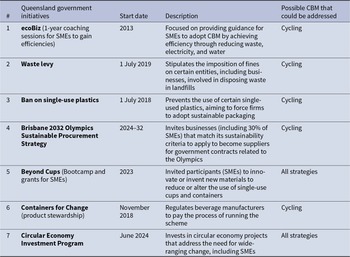
As outlined in Table 1, we identified seven relevant initiatives undertaken by the Queensland Government between 2013 and 2024 targeted at promoting circular economy in for-profit SMEs across various industries.
Summary of policy initiatives in Queensland
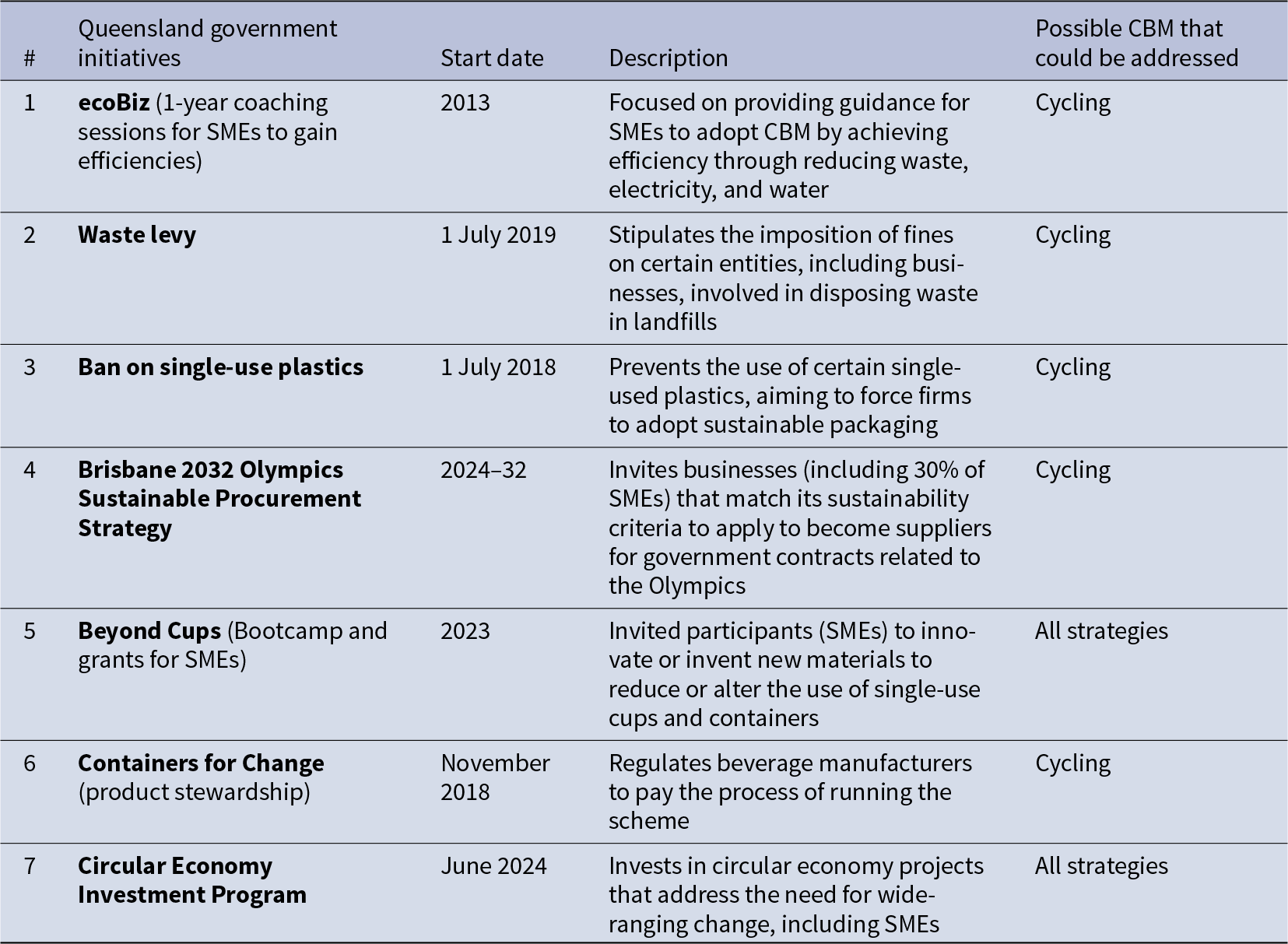
Table 1 Long description
The table lists seven Queensland government initiatives, their start dates, brief descriptions, and which circular business model focus they may address. Start dates range from 2013 to June 2024, with most initiatives beginning from 2018 onward. Five initiatives are tagged as addressing “Cycling”: ecoBiz, the waste levy, the ban on single-use plastics, Containers for Change, and the Brisbane 2032 Olympics Sustainable Procurement Strategy. Two initiatives are tagged as addressing “All strategies”: Beyond Cups and the Circular Economy Investment Program. The initiatives mix regulatory measures (levy, bans, stewardship requirements) with support and market-shaping programs (coaching, grants, investment, and procurement opportunities). The “possible CBM” column indicates a potential alignment rather than a confirmed outcome for each initiative.
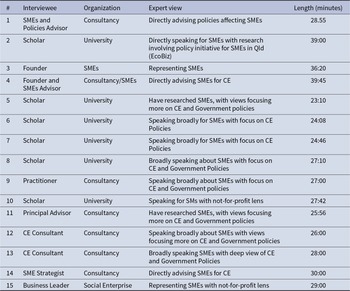
For the semi-structured interviews that we conducted to gain deeper insights into the phenomenon (Gioia, Corley & Hamilton, Reference Gioia, Corley and Hamilton2013; Rajasinghe et al., Reference Rajasinghe, Aluthgama-Baduge and Mulholland2021), we carefully selected interviewees through purposive and snowballing sampling processes based on informants’ knowledge or experience of circular economy initiatives for SMEs (Zilber & Meyer, Reference Zilber and Meyer2022). As shown in Table 2, our final sample included industry-facing academics, consultants, and business leaders based in Southeast Queensland. Interviews were conducted face-to-face or on Zoom and audio recorded with the interviewee’s permission. Audio recordings were transcribed verbatim for coding and analysis using Nvivo. The interview questions were tailored to the relevant experiences of the interviewees, with some standardized questions and probes included to maintain a focus on the topic while allowing for in-depth responses. We continued with the interviews until we reached saturation, with later interviews reinforcing existing themes rather than introducing new themes.
List of expert interviewees
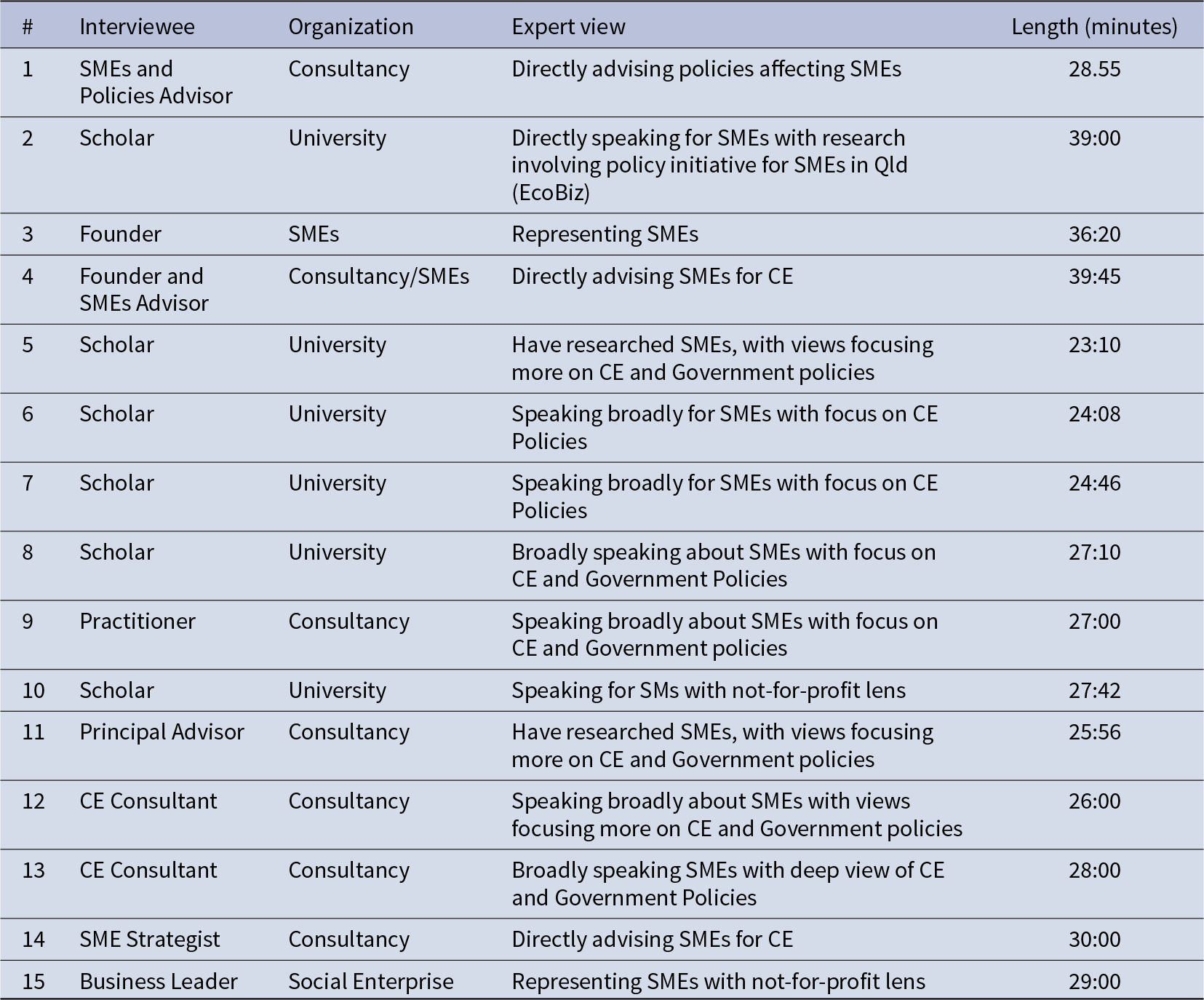
Table 2 Long description
The table lists 15 expert interviewees with their role, organization type, stated perspective on SMEs, and interview length in minutes. Organization types are mainly universities and consultancies, with additional representation from SMEs and one social enterprise. Most interviewees describe a focus on circular economy and government policy, either advising SMEs directly or speaking broadly from research and practice. Several scholars and consultants explicitly frame their views around circular economy policies, while two entries use a not-for-profit lens. Interview durations range from about 23 minutes to just under 40 minutes, with the shortest around 23 minutes and the longest at 39 minutes and 45 seconds. Many interviews cluster in the mid to high twenties and around half an hour. Lengths are reported in mixed formats, so comparisons should be treated as approximate.
Data analysis
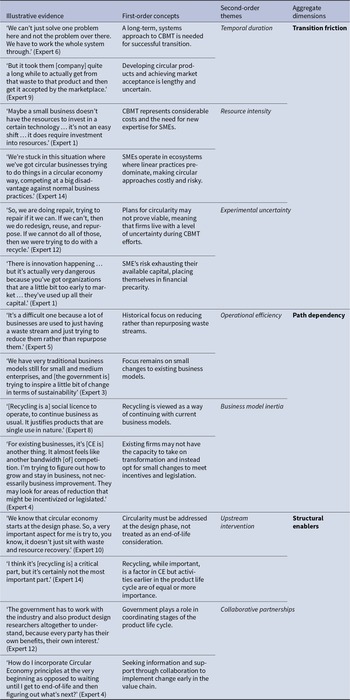
We applied different analytical techniques to the two types of data. In our first step of data analysis we familiarized ourselves with the expert interviews, noting recurring themes including the challenges SMEs face in circular transition, the relative ease of implementing sustainable versus circular practices, and the time and resources required to incorporate circular principles. In our second step, we developed descriptive first-order codes that captured the substance of participant accounts; examples include ‘long-term approach needed’, ‘requires experimentation’, ‘incremental improvement’, and ‘requires collaboration’. We then worked iteratively with these codes to identify second-order themes that captured the dynamics shaping SME circular engagement – including barriers, firm responses, and enabling conditions. In our third step, we organized our second-order themes into aggregate dimensions that focused on why firms find it difficult to transition toward circularity – Transition Friction; why they get stuck optimizing linear business models – Path Dependency; and what can unlock change – Structural Enablers. The author team continued to discuss the emerging findings, coding second-order themes and aggregate dimensions until consensus was reached. Table 3 summarizes this data structure.
CBMT: transition dynamics
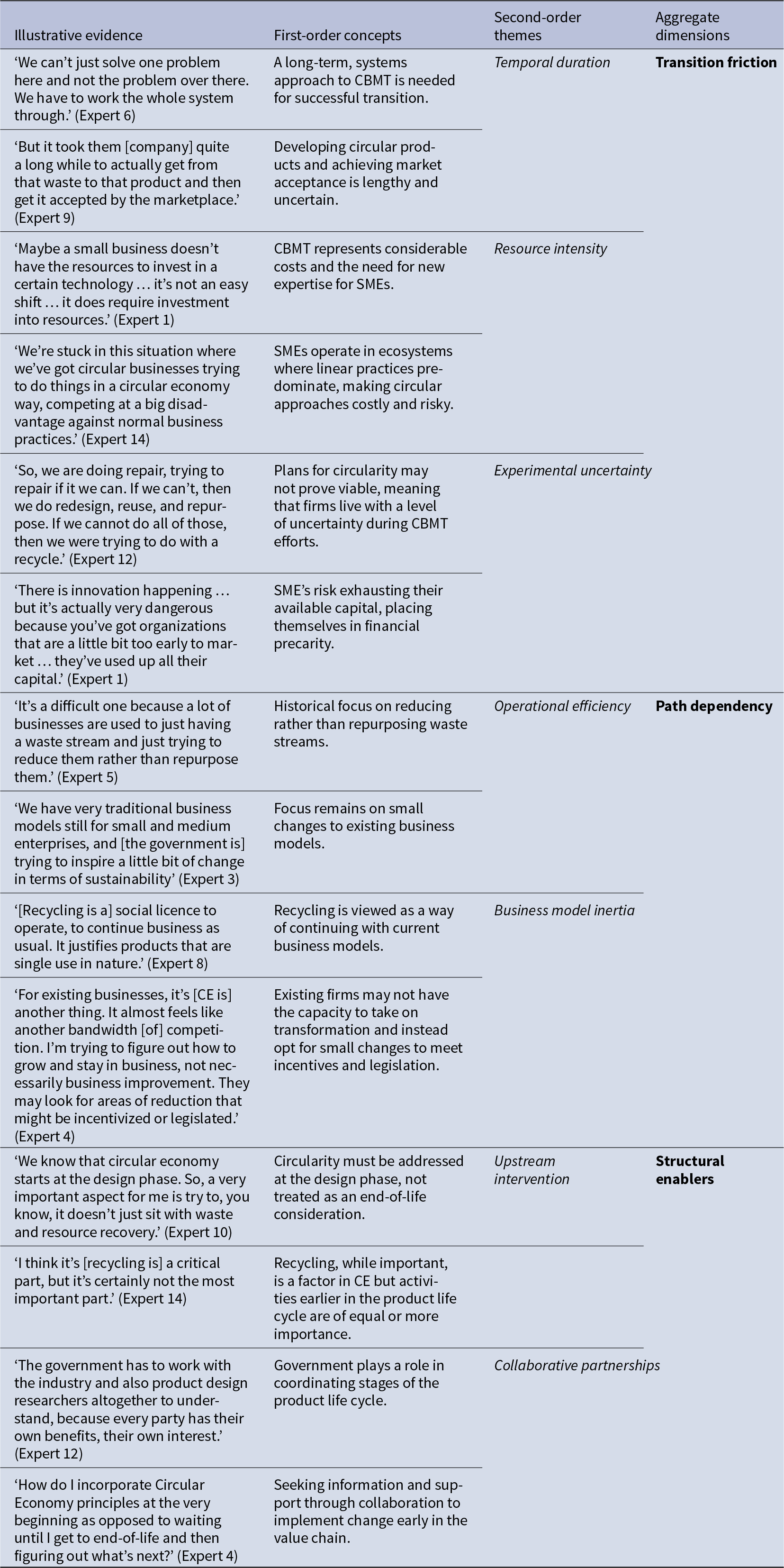
Table 3 Long description
The table organizes expert interview quotes into first-order concepts, second-order themes, and two aggregate dimensions describing dynamics in shifting small and medium enterprises toward circular business models. Under “Transition friction,” experts emphasize that change requires a long-term, whole-system approach, that developing circular products and gaining market acceptance can take a long time, and that small firms often lack money and expertise for needed investments. It also highlights experimental uncertainty, where repair, redesign, reuse, repurpose, and recycling plans may fail, and being early to market can drain capital and create financial precarity. Under “Path dependency,” experts describe operational and business model inertia: firms are accustomed to reducing waste rather than repurposing it, make only incremental sustainability changes, and may treat recycling as permission to continue business as usual. Under “Structural enablers,” experts stress upstream intervention, arguing circularity should start at design rather than focusing only on end-of-life, and that recycling is important but not the main lever. The table also points to collaborative partnerships, with government coordinating with industry and design researchers and firms seeking support to implement circular principles earlier in the value chain. The entries are qualitative and illustrative, so they summarize perceived barriers and enablers rather than measuring frequency or magnitude.
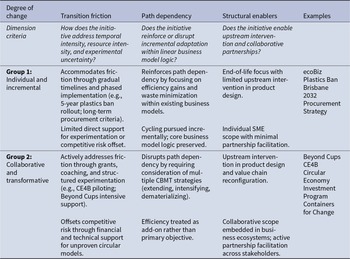
With an understanding of the transition dynamics identified through the expert interviews, we turned to the seven policy initiatives. To familiarize ourselves with the initiatives, we drew on Geissdoerfer et al.’s (Reference Geissdoerfer, Pieroni, Pigosso and Soufani2020) framework to identify which combination of CBMT strategies each initiative targeted (cycling, extending, intensifying, and dematerializing). We then analyzed the initiatives against the transition dynamics identified in the expert data, examining the extent to which each initiative addressed the barriers, path dependencies, and enabling conditions our framework identifies. Through this process, we classified the initiatives into two groups: Group 1 initiatives that are primarily individual and incremental, and Group 2 initiatives that are collaborative and transformative. This classification is summarized in Table 4.
Government initiatives classified by transition dynamics
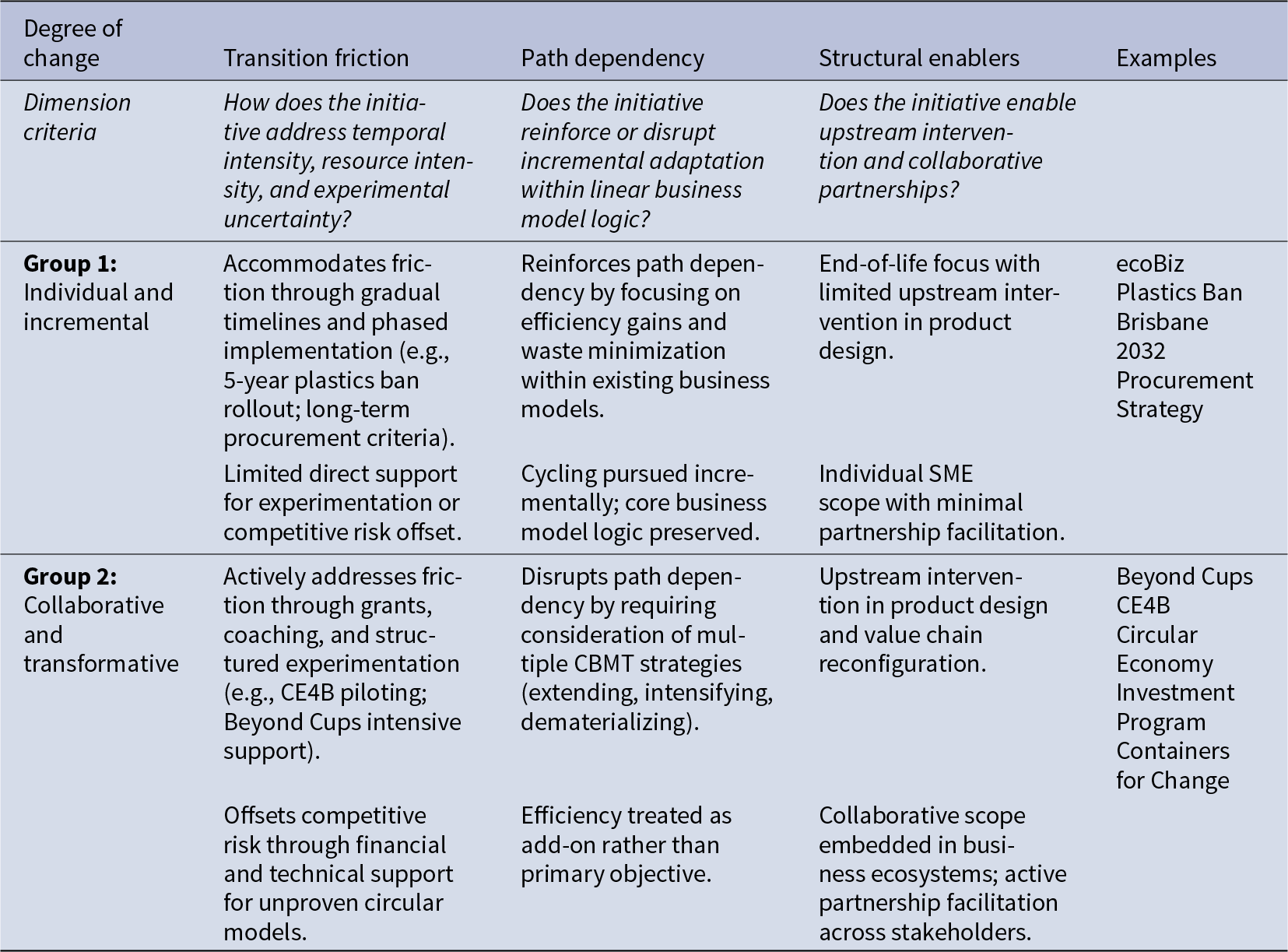
Table 4 Long description
The table classifies government initiatives into two groups using four criteria: degree of change, transition friction, path dependency, and structural enablers, with example programs listed. Group 1, described as individual and incremental, manages friction through gradual timelines and phased implementation, with limited direct support for experimentation or competitive risk. These initiatives tend to reinforce existing business model logic by emphasizing efficiency gains and waste minimization, and they focus on end-of-life actions with limited upstream influence on product design. Examples include ecoBiz, a plastics ban rollout in Brisbane to 2032, and a procurement strategy. Group 2, described as collaborative and transformative, addresses friction through grants, coaching, and structured piloting, and it offsets competitive risk for unproven circular approaches. This group aims to disrupt path dependency by requiring consideration of multiple circular business model strategies and enabling upstream intervention and value chain reconfiguration. Examples include Beyond Cups, CE4B, the Circular Economy Investment Program, and Containers for Change. Interpretation note: the categories summarize typical design features and may not capture variation within each named initiative.
Results
Our analysis of expert interviews and government initiatives reveals three interconnected dimensions of transition dynamics shaping SME engagement with CBMT: transition friction, path dependency, and structural enablers (see Table 3). Together, these dimensions illuminate why firms default to incremental approaches and what conditions may support a shift toward transformational circularity. To examine how government initiatives interact with these dimensions, we classified the seven initiatives into two groups (see Table 4): Group 1 initiatives are individual and incremental, focusing on cycling and waste minimization within existing business model logic; Group 2 initiatives are collaborative and transformative, incorporating multiple CBMT strategies including product design and partnership facilitation and we analyzed how they address the transition dimensions identified. Below we present each dimension, integrating evidence from both data sources.
Dimension 1: Transition friction
Transition friction captures the systemic challenge that established SMEs encounter when attempting to move beyond incremental sustainability measures toward CBMT. Unlike the operational adjustments involved in waste minimization or efficiency improvements, circular transformation requires sustained investment, tolerance for uncertainty, and engagement with unfamiliar markets and stakeholders – all under conditions where the costs are immediate and the returns are distant and uncertain. Our analysis identifies three transition frictions that create barriers to CBMT: temporal duration, resource intensity, and experimental uncertainty.
Temporal duration
There was notable consensus among experts that due to systemic challenges SMEs approach circular transition as a gradual process, often starting with sustainability measures such as minimizing energy usage and waste. From an operational perspective, experts acknowledged that waste minimization strategies are far easier for SMEs to implement than complex circular economy initiatives as they can be implemented by making small changes to current operations. Expert 3 noted ‘They’re taking small steps in those companies to first start taking on the concept of sustainability,’ while Expert 7 explained ‘It’s a whole lot of small steps that add up to sustainability and also circularity.’
Government initiatives we studied likewise emphasized sustainability measures as a first step with time needed to make a series of changes toward circularity. The Queensland Government’s 2024–32 Procurement Strategy for Brisbane 2032 affords SMEs extensive time to meet sustainability criteria, including emission reductions (Department of Energy and Public Works, 2023). Reflecting on this initiative, Expert 4 noted that the procurement strategy could expedite CBMT by encouraging firms to become more circular long-term, while Expert 1 agreed it would induce gradual ‘increased consideration’ of CBMT.
Experts further elaborated on why CBMT takes time. Expert 9 emphasized that developing circular products and achieving market acceptance can be a lengthy process. Additionally, experts explained how CBMT may require a different asset base to support a circular approach to manufacturing, recovery and reuse of products. ‘To change that whole concept, that’s a really difficult thing to do, because you have to then really look at a different type of business models for their businesses because they will be owning a lot of more assets, they need to work on getting the products to last longer and all of that, but it takes time to do that’ (Expert 10). Furthermore, experts highlighted that circularity requires in-depth knowledge of the firm’s value chain and thus a long-term approach to transformation is needed. ‘You’ve got to understand what your waste stream is before you can even understand what value it can bring. So they tend to be long-term projects’ (Expert 5).
Given the needs of SMEs regarding circular product development, market acceptance, changing asset bases and value chain knowledge, experts believe the slow pace of government programs is appropriate to support the needs of CBMT within SMEs. ‘I think they [government] sort of just take a fine line of gradually making changes that aren’t too significant at any point in time. So, it’s not to negatively influence business’ (Expert 7).
Resource intensity
Experts emphasized that SMEs may see limited opportunities for benefits from the considerable costs incurred in undertaking CBMT. ‘This step into the new way of doing things with circular economy, sustainability. … It does represent a cost’ (Expert 1). Expert 1 further noted these costs can mean it is ‘very dangerous’ for firms to ‘go circular’ without sufficient scaffolding. This danger arises, according to Expert 14, because SMEs ‘are stuck’ in a business ecosystem where linear practices predominate, making it disadvantageous and ‘costly’ to pursue CBMT. The current absence of clear benefits means government has a role in providing support to ‘rebalance the system’.
Other experts discussed the non-financial costs such as the time and resources needed to establish the networks and relationships required for CBMT. Circular transition requires system-wide transition, which is complex and thus requires collaboration with stakeholders. ‘It is a system, dynamic, focused model. So, it is not just you’re going to engage with, let’s say, product design, different people you’re going to involve … [includes] product designers, policymakers, the users and manufacturers. You have to work with all different stakeholders together. That’s why it’s complicated, because this is a systems problem’ (Expert 12).
Experimental uncertainty
Experts argued that circular experimentation is more complex than making relatively simple swaps to reduce environmental impact; circularity requires experimentation, often without a guarantee of success. ‘There’s probably a lot more research, trialing, and experimentation that needs to go into circular economy projects, where you have to come up with the idea first of all and then validate that idea – versus just switching to renewables or reporting on your emissions and ESG targets and things like that. They’re much easier’ (Expert 5). Experts highlighted challenges ensuing from experimentation needs, including sufficient time to investigate through trial-and-error how value can be harnessed from end-of-life materials (Expert 5) and the need to draw on networks and stakeholders. ‘This is an iterative process. … because you’re not existing in a vacuum, you’re actually existing within an ecosystem. Things that are changing around you are going to necessitate change and adjustments to here … A lot of businesses aren’t good with change’ (Expert 4).
Experimentation for circularity, with its inherent highs and lows, requires considerable tolerance for change. The CE4B program reflects this in providing training and piloting for SMEs (Maher, Yarnold & Pushpamali, Reference Maher, Yarnold and Pushpamali2023). CE4B conducted experimentation trials in textiles, organics, and construction. By tailoring CBMT to sectors, this project provided valuable lessons in feasible value-harnessing approaches. The project highlighted challenges including scaling difficulties. In textiles, for example, Australia currently lacks commercial spinning facilities needed for closed-loop supply chains, impeding broader CBMT adoption (Maher et al., Reference Maher, Yarnold and Pushpamali2023).
Dimension 2: Path dependency
Path dependency captures a self-reinforcing logic through which SMEs default to adaptations that preserve rather than transform their existing business models. Where transition friction captures the demands of circular transition, path dependency explains why firms struggle to meet those demands. Path dependency operates through firms’ active pursuit of efficiency gains and sustainability measures that, while rational, progressively deepen their commitment to their existing business model logic. The result is that SMEs become increasingly optimized for sustainability practices within their existing models, rather than moving toward a fundamentally different one. Incremental improvements generate visible gains and reinforce existing routines, making steps toward transformation comparatively less attractive. Critically, this dynamic is not solely firm-driven. Many of the government initiatives designed to broadly support a transition toward sustainability and circular adaptation reinforce incremental adaptation by incentivizing efficiency improvements and waste minimization rather than business model transformation. Our analysis identifies two interrelated ways through which this dynamic operates – operational efficiency and business model inertia (Table 3).
Operational efficiency
We found most government initiatives tailored to SMEs were aimed at helping firms reduce waste, water, plastic, and energy usage within their existing businesses. (Such initiatives are categorized as Group 1; see Table 4.) Consistent with their emphasis on gradual approaches, some experts appreciated government focus on minimization as a first step.
EcoBiz (Group 1 initiative) was described by experts as an exemplary coordinating mechanism facilitating multiple initiatives implementing feasible minimization strategies. According to Expert 1, ecoBiz offered SMEs a ‘personalized journey’ to harness opportunities from cycling and minimization. Documentary data confirm profitability and feasibility, showing ecoBiz helped 92 SMEs gain AU$7.4 million in savings by reducing waste, energy, and water (Hales, Edwards, Liyanaarachchi, Caldera & Dalmau, Reference Hales, Edwards, Liyanaarachchi, Caldera and Dalmau2020). Similar emphasis appears in the Brisbane 2032 Sustainable Procurement Strategy with eligibility criteria including renewable energy, waste reduction, recycling, and plastics substitution (Queensland Government, 2023c). The Queensland Government’s 2018 single-use plastics ban has been implemented gradually over 5 years (2022–26), with additional plastic types banned at each stage (Queensland Government, 2023d). While the single-use plastic ban is a hard law, this waste minimization strategy has been structured to allow incremental adaptation.
Experts explained why minimization strategies are appropriate to, and supported by, SMEs. Expert 5 noted certain waste streams are particularly difficult for SMEs to repurpose profitably, so an emphasis on minimizing waste creation is an appropriate measure. ‘It’s much easier to support initiatives that can be called sustainable rather than circular because there are some waste streams that are very difficult to turn into a producer to reuse’ (Expert 5). Expert 3 elaborated that waste reduction offers a feasible strategy to remain efficient and profitable while experimenting with repurposing methods.
Expert 4 concurs that SMEs favor waste minimization and improved efficiency. ‘So much of it was about waste reduction. It wasn’t about transforming business models, [rather] it was very much a sort of tackling the end of life, how to minimize waste, or create incentives to minimize waste and what to do at the end’ (Expert 4). Yet while experts recognized minimization as a pragmatic starting point, concerns emerged about whether this approach leads to meaningful business model change.
Business model inertia
However, while minimization helps SMEs harness efficiency gains, improvements that do not close the resource loop fall short of CBMT (Geissdoerfer et al., Reference Geissdoerfer, Pieroni, Pigosso and Soufani2020). Many experts acknowledged concerns about this limitation and the ‘easy’ approach of prioritizing efficiency gains. Expert 15 expressed: ‘Increasing efficiency will be the easiest thing for general businesses [SMEs] to do because they don’t need to change much. They don’t need to buy new equipment or whatever. […] If they don’t want to take big risks, they’ll say efficiency is important.’ Expert 6 further explained that changes to business models are resource and knowledge intensive, and therefore businesses look for minimization strategies within existing efficiency pathways rather than transformation to achieve circularity. “I think a lot of companies don’t quite know where to start. And so therefore they take the path of least resistance. [For example] ‘We’ll try to make our packaging more recyclable’ (Expert 6). Core products and services remain the same, with production organized linearly. Such minimization strategies manage product end-of-life and rely on external recycling systems for efficiency gains without altering how the firm creates, delivers, or captures value.
Given that SMEs tend to respond to waste minimization incentives in this way, sustainability efforts are frequently fragmented and implemented in isolation. As Expert 4 observed: ‘I think they’re [SMEs] making choices without understanding how it all actually fits together. So, I’ve reduced my electricity usage [and] waste. Does that mean I’m circular? So, I don’t think they’re connecting those initiatives back to their own business model. I think they’re connecting those initiatives to just their operating, how they operate as a business, not how they build and grow and sustain their business.’
Structural constraints within SMEs compound this inertia. Employees generally hold broad, non-specialist roles and sustainability or circularity expertise is rarely institutionalized: ‘Many people working in SMEs have to be generalists, so you’ve got to be able to do a little bit of everything. [In SMEs] You don’t have a dedicated sustainability person. Usually, a lot of people wear a lot of hats so it’s more difficult’ (Expert 14). Without dedicated expertise, individual sustainability initiatives remain isolated operational improvements rather than components of a coherent business model strategy.
Dimension 3: Structural enablers
Structural enablers captures the external conditions required to disrupt the self-reinforcing cycle of transition friction and path dependency described above. Where the first two dimensions illuminate why SMEs become trapped in incremental adaptation, this dimension identifies what experts suggest is needed to shift firms toward transformational engagement. The key insight from our expert data is that this shift cannot be achieved by individual firms acting alone – it requires changes to the structural conditions within which firms operate. Specifically, experts emphasized the need to move circular intervention upstream from end-of-life waste management toward product design and value chain reconfiguration, and the need for collaborative infrastructure that enables the multi-stakeholder coordination individual SMEs cannot orchestrate. Our analysis identifies two such enablers: upstream intervention and collaborative partnerships. While we present these as distinct enablers, in practice they are mutually reinforcing: upstream intervention in product design typically requires the collaborative partnerships that individual SMEs cannot build alone.
Upstream intervention
Experts consistently emphasized that meaningful circular transition begins at the design phase rather than at end of life. As Expert 10 argued: ‘We know that circular economy starts at the design phase. So, a very important aspect for me is it doesn’t just sit with waste and resource recovery.’ Expert 1 reinforced this point, arguing that recycling is ideally treated as a contingency after utilizing all ‘value points’ through CBMT strategies, while Expert 14 noted this is why recycling sits ‘right down the bottom’ of the 5 R hierarchy. Expert 8 was more critical, arguing that an end-of-life focus is fundamentally insufficient: ‘A lot of people think it’s about recycling only and that recycling will solve our problems. Unfortunately, recycling […] is a broken system. Waste will always outpace any collection and processing efforts based on the current linear system.’ The implication across these accounts is that initiatives addressing only downstream waste management – however well-designed – cannot enable the business model transformation that circularity requires.
More recent Queensland Government initiatives reflect a shift beyond these limitations, adopting more comprehensive approaches that intervene at earlier value chain stages. Beyond Cups (Table 1) exemplifies this upstream orientation. Unlike Group 1 initiatives that address waste after it is created, Beyond Cups intervenes at the product design stage – the point at which circular value is determined. The initiative was designed to encourage innovators to produce new materials and transform business models with the ultimate goal of closing waste and energy usage loops (Queensland Government, 2023e). Beyond Cups supported SMEs to engage with multiple CBMT strategies: reusing products for long-lasting use, adopting sharing models, improving material recyclability, and using software and technology to reduce plastic usage (Queensland Government, 2023e). The initiative offered grants and intensive coaching to help SMEs implement these ideas. For example, Beyond Cups supported Cercle to implement a model intensifying reusable cup use, enabling ‘people to use specially-designed cups and drop them off at Drop Pods from where they are collected, washed and placed back to be reused’ (Queensland Government, 2023b; www.cercle.com.au). By starting at product design and working through to delivery and recovery, the initiative demonstrates how upstream intervention can address extending, intensifying, and dematerializing strategies rather than cycling alone.
The ongoing Circular Economy Investment Program (Table 1), launched June 2024, represents the most comprehensive initiative we reviewed. The Program invests specifically in projects offering ‘large-scale and system-focused’ results (Department of Environment Science and Innovation, 2024a), with focus areas covering multiple CBMT strategies including sharing platforms, extending product and material useful life, and changing product ownership models into service or software models (Department of Environment Science and Innovation, 2024a). Its emphasis on system-level outcomes rather than individual firm efficiency distinguishes it from Group 1 initiatives and reflects the upstream, multi-strategy orientation that experts identified as necessary for transformational change.
Collaborative partnerships
Experts identified a significant gap in the facilitation of collaborative relationships needed for CBMT. Expert 11 observed ‘there is certainly a gap in the facilitation of those collaborations that are required’, while Expert 7 noted SMEs struggle to build necessary CBMT partnerships without the ‘contacts and networks’ that government can facilitate. Expert 3 emphasized that government needs a more active role in partnership facilitation and product design: ‘They’re [the government] just nudging the small and medium enterprises to engage in sustainability. Because if they want, then they need to develop partnerships. [Also], how do we design your product? […] make sure your products have a longer lifespan, […] and measure the lifespan?’ Expert 9 pointed to a specific coordination challenge, noting that ‘non-standard products’ require facilitation and approval, making it currently ‘quite difficult’ to market circular products without institutional support. Across these accounts, experts observed that the multi-stakeholder coordination CBMT demands – spanning product designers, policymakers, manufacturers, and end users – exceeds what individual SMEs can orchestrate from their own networks and resources.
Several Group 2 initiatives demonstrate how government can address this collaboration gap. Containers for Change specifically addressed the need for a collective cycling strategy for beverage containers, including supporting large-scale resource-recovery projects led by third-party not-for-profit organization Containers Exchange (Queensland Government, 2023a). While its primary mechanism is a container deposit scheme – a cycling activity that shares characteristics with Group 1 initiatives – Containers for Change also facilitated comprehensive partnerships among beverage industry stakeholders, supporting collaboration across multiple SMEs and enabling a coordinated approach that no single firm could have achieved independently. In Expert 1’s view, the initiative reflects a growing policy emphasis on ‘product stewardship’ whereby firms ‘have a responsibility for the end of life of products’ they manufacture. Expert 13 noted signs of this trend: ‘We’re getting to see little bits with product shifts, product stewardship schemes and extended product responsibility, the schemes [Containers for Change] where we’re starting to see that coming through now.’
Experts observed that this shift toward product stewardship underscores a broader point: changing product design is typically only feasible through collaboration and new partnerships, yet experts noted that many SMEs lack the experience, skills, and resources for this complex coordination task. As Expert 12 emphasized, government, industry, designers, and other stakeholders need to work together, sharing multiple perspectives on the feasibility of newly designed products and services. Nonetheless, experts acknowledged the inherent difficulty for governments in identifying the most promising partnership-facilitating investments: ‘The challenge for government’, said Expert 1, ‘is where they invest their money and how they piece these pieces together’.
Discussion
Our analysis set out to understand why the transition toward CBMT in SMEs stalls at incremental adaptation, and under what conditions government initiatives can facilitate a shift toward transformational change. Drawing on expert accounts and analysis of seven government initiatives to develop a framework of three interconnected transition dynamics – transition friction, path dependency, and structural enablers (Table 3) that together address both parts of our research question. Expert accounts reveal that the stalling reflects the systemic challenges that SMEs encounter when attempting to adopt initiatives that go beyond waste minimization and resource reduction. Our analysis revealed a tension where well-intentioned government initiatives designed to support circularity can reinforce incremental adaptation by incentivizing efficiency improvements within existing business models rather than enabling the structural conditions for transformation.
Identification of transition dynamics
Our findings on extended time horizons and the resource intensity associated with circular transition corroborate prior research documenting temporal challenges (Shi et al., Reference Shi, Peng, Liu and Zhong2008) and resource constraints (Ormazabal et al., Reference Ormazabal, Prieto-Sandoval, Puga-Leal and Jaca2018; Rizos et al., Reference Rizos, Behrens, Van der Gaast, Hofman, Ioannou, Kafyeke and Topi2016) as significant barriers to CBMT. However, our framework extends these findings by showing that these barriers coupled with initiatives to adopt sustainability practices do not only deter transformation but actively channel firms toward incrementalism. The small steps approach of first encouraging sustainability practices can lead to the optimization of existing linear business models that make it harder to take the bigger and more radical step needed for CBMT.
The second dimension, Path Dependency, captures how sustainability measures that enhance operational efficiency and waste minimization preserve core business model logic (Schreyögg & sydow, Reference Schreyögg and Sydow2011). As the literature has observed, SMEs gravitate toward cycling and efficiency gains that can be implemented within existing organizational routines and require minimal external coordination (D’Amato et al., Reference D’Amato, Veijonaho and Toppinen2020; Ormazabal et al., Reference Ormazabal, Prieto-Sandoval, Puga-Leal and Jaca2018). We show that it is the combination of transition friction and path dependency that makes optimizing within existing business model logic the rational choice; efficiency-focused initiatives are easier to design, implement, and measure; they generate visible outcomes that demonstrate policy effectiveness; and they align with SME preferences for low-risk, familiar changes. The tension is that this rational policy design inadvertently reinforces the incrementalism it aims to overcome. Our third dimension, Structural Enablers captures strategies through which the value logic can be changed through intervention, breaking the optimization of an existing approach.
The incremental-transformational gap
Our second contribution concerns the role of government initiatives in this framework. Prior research has observed that government policies often focus on incremental efficiency gains and punitive measures for waste and pollution transgressions rather than facilitating complex circular transition (Kok et al., Reference Kok, Wurpel and Ten Wolde2013; Tan et al., Reference Tan, Tan and Ramakrishna2022). Our analysis reveals how these policies can reinforce incremental adaptation. We show this conceptually in Fig. 1.
Conceptual framework – transition dynamics shaping SME circular business model transformation.
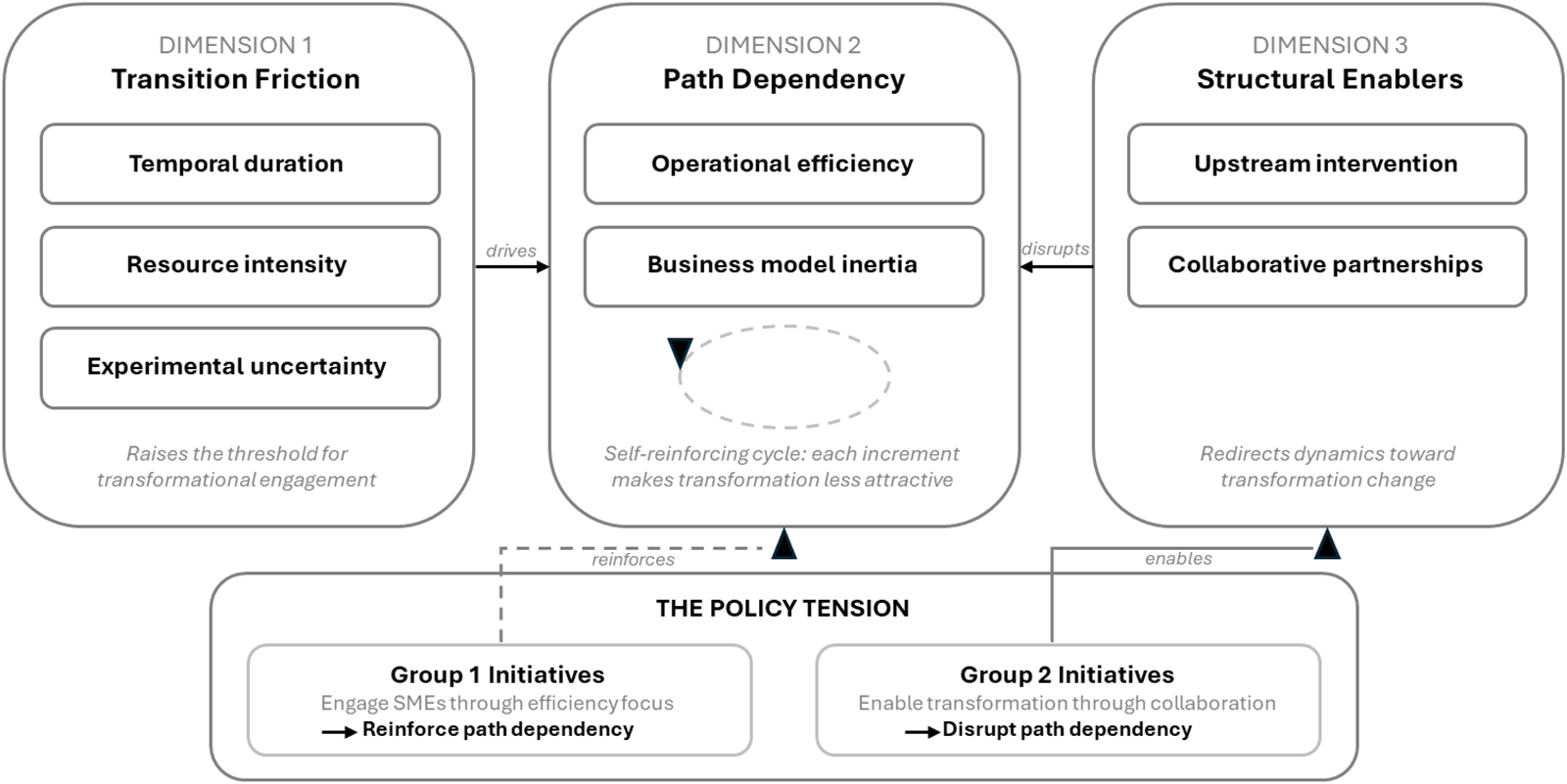
Figure 1 Long description
The diagram presents three dimensions related to transition dynamics. Dimension 1 is Transition Friction, which includes temporal duration, resource intensity and experimental uncertainty. It raises the threshold for transformation agreement. Dimension 2 is Path Dependency, featuring operational efficiency and business model inertia. It is self-reinforcing, making transformation less attractive. Dimension 3 is Structural Enablers, consisting of upstream intervention and collaborative partnerships, redirecting dynamics toward transformation change. Below these dimensions is a section labeled 'The Policy Tension,' divided into Group 1 Initiatives and Group 2 Initiatives. Group 1 Initiatives engage SMEs through efficiency focus, reinforcing path dependency. Group 2 Initiatives enable transformation through collaboration, disrupting path dependency. Arrows indicate the flow and connection between these elements, highlighting the tension between maintaining efficiency and enabling transformation.
The phased or small-steps approach of many of the Group 1 initiatives help reduce transition friction while simultaneously deepening path dependency. By incentivizing efficiency improvements and waste minimization within existing business models, SMEs continue to operate with a linear logic rather than transforming toward a circular logic. The policy initiatives in Group 2 incorporated multiple CBMT strategies, facilitating collaborative infrastructure and enabling upstream intervention in product design, illustrating structural enablers directly. Group 2 initiatives disrupt rather than reinforce path dependency by requiring SMEs to engage with product design, multi-stakeholder coordination, and value chain reconfiguration. The incremental-transformational gap brings to the foreground the tension between encouraging sustainability practices that can be implemented within an SME’s current business model logic and enabling the more fundamental changes needed for CBMT.
A framework for policy initiative categorization
The framework developed in Table 4 to analyze the different government initiatives according to which transition dynamics they address (see Table 4) offers a lens through which initiatives can be analyzed to understand how they will impact existing business models, the ease of their implementation and the extent to which they enable CBMT. Group 1 initiatives focus on individual circularity aspects like recycling, facilitating incremental approaches with limited business model transformation – ultimately a ‘business-as-usual approach’ (Geissdoerfer et al., Reference Geissdoerfer, Pieroni, Pigosso and Soufani2020). These initiatives encourage SMEs to adopt gradual sustainability measures based on minimizing resource usage without incorporating other CBMT strategies. They typically prioritize recycling, enabling SMEs to act without altering supplier/customer relationships or redesigning products. This corresponds with prior findings noting that while partnerships are the main CBMT challenge for SMEs (D’Amato et al., Reference D’Amato, Veijonaho and Toppinen2020; Sohal & De Vass, Reference Sohal and De Vass2022), government support for enabling collaboration remains lacking (Geissdoerfer et al., Reference Geissdoerfer, Santa‐Maria, Kirchherr and Pelzeter2022; Guldmann & Huulgaard, Reference Guldmann and Huulgaard2020).
By contrast, Group 2 initiatives are collaborative and transformative, facilitating greater CBMT (Geissdoerfer et al., Reference Geissdoerfer, Pieroni, Pigosso and Soufani2020). In these initiatives, recycling is a final step achieving aggregate resource reduction and closed-loop goals (Geissdoerfer et al., Reference Geissdoerfer, Savaget, Bocken and Hultink2017). Group 2 initiatives address Dimension 3 (Structural Enablers): they facilitate collaborative infrastructure and enable upstream intervention in product design. These reflect a systemic approach taking account of multiple stakeholders working collaboratively to realize CBMT as a process embedded within business ecosystems beyond any single firm (Geissdoerfer et al., Reference Geissdoerfer, Pieroni, Pigosso and Soufani2020).
Practical and policy implications
Our findings point to a tension between encouraging sustainability measures and optimizing within existing business models and the more challenging change of transforming business models toward circularity. While sustainability focused initiatives are important for moving toward sustainability targets, minimizing resource use and maximizing recycling efforts within existing business models, SMEs could also consider engaging with collaborative programs that facilitate systemic rather than individual change in the pursuit of circularity.
Dimension 3 of our framework, structural enablers, suggests that the most effective government role in circular transition may not be direct firm support (grants, technical assistance) but rather the creation of collaborative infrastructure. Government initiatives that facilitate partnerships, coordinate value chain actors, and create the conditions under which firms can collectively address barriers that no individual SME can overcome alone represent a shift from firm-level intervention to ecosystem-level intervention.
For governments to better facilitate circular transition for SMEs through ecosystem-level collaborative infrastructure, we suggest that policy design and subsequent initiatives account for the self-reinforcing dynamics and enabling conditions our framework identifies. Doing so will empower SMEs to move their circularity efforts beyond reinforcing efficiency within existing business models and avoid deepening path dependency. Furthermore, such policy design requires attention to upstream intervention to address broader systemic barriers rather than individual firm resource gaps.
Future research and limitations
Our findings yield nuanced insights into the relationship between sustainability and circularity. On one hand, our study finds government initiatives predominantly focus on sustainability measures as part of a broader circular economy approach. The extent to which initial minimization and recycling strategies lead SMEs to undertake more substantial CBMT over time is an important avenue for future research. Our framework suggests this depends on whether initiatives provide only efficiency incentives (reinforcing incremental equilibrium) or also address collaborative infrastructure and upstream intervention needs (enabling transformational breakthrough). Future research should examine longitudinal trajectories: under what conditions do firms progress from Group 1 to Group 2 engagement? While our study examined policy initiatives and elicited expert feedback on government policy roles in supporting CBMT, future research could usefully capture perspectives of SMEs directly affected by government initiatives to ascertain the extent to which these firms adopt sustainable and/or circular strategies in response to government incentives. While we restricted our analysis to Queensland, other regions dominated by SMEs with government driving initiatives toward circularity are likely to face a similar tension between supporting firms to adopt circular practices.
Conclusion
This study developed a framework explaining transition dynamics that shape SME engagement with CBMT to explain the incremental-transformational gap. Drawing on expert interviews and analysis of seven Queensland Government initiatives, we moved beyond prior research on why established, resource-constrained SMEs become trapped in incremental sustainability practices despite circular economy requiring transformation to explain what systemic conditions enable breakthrough to transformational circularity. Our framework comprises three interconnected dimensions. First, transition friction creates formidable barriers through temporal duration, resource intensity, and experimental uncertainty. Second, path dependency and incremental adaptation drive firms toward operational efficiency improvements that preserve linear business model logic. Third, systemic enablers – collaborative infrastructure and upstream intervention – are required to unlock transformational circularity.
AI Declaration
AI was used to assist with copyediting of the manuscript.


 Open access

