


1. Introduction
The drive for sustainability is ubiquitous in many facets of society at present, not least in the design of next generation large complex engineered systems. Sustainability goals from the International Civil Aviation Organisation (ICAO) (Reference Mithal and RutherfordMithal & Rutherford, 2023) and the International Air Transport Association (IATA, 2023) with regards the achievement of net zero aviation by 2050 reflect this wider societal drive for sustainability in the aviation sector. In addition, sustainability goals are driving the demand for variety in sectors such as aviation. For instance, consider the diversification of aircraft propulsion systems needed to achieve the goal of net zero for a range aircraft types and mission profiles.
Demand for variety in design has previously been satiated with economic efficiency through the adoption of a product family design approach, where a product family can be defined as, “a group of related products that share common features, components, and subsystems: and satisfy a range of market niches.” (Reference Simpson, Maier and MistreeSimpson et al., 2001), who also consider the common components and or subsystems that underpin the product family to be the product platform. This simple definition of a product family is presented schematically below (Figure 1).
Ultimately, the allure of adopting a product family design approach can be attributed to the desire to satisfy as many market segments as possible whilst expending as few resources as possible. Such an approach enables the satisfaction of demanded variety whilst capitalising on the purported benefits of commonality across product family variants, such as economies of scale, increased market share, and reduced production and maintenance costs due to familiarity.
Despite the reported benefits, success is not a guarantee that comes with the adoption of a product family design approach. Additional design complexity can be experienced when trying to implement a product family that shares components, whilst too much commonality in the interest of cost can result in a lack of differentiation and subsequent cannibalization of product variants. In addition to the examples of successful product family design solutions presented above there are also examples of not so successful attempts at product family design implementation.
Simple product family design schematic (Reference Gonzalez-ZugastiGonzalez-Zugasti, 2000)

In the academic literature product families and their corresponding design approaches are broadly categorised as being modular or scale based (Reference Han, Li, Wang, Ding and QinHan et al., 2020). Modular product family variants satisfy varying functional requirements through the re-use of common modules and the substitution of alternative modules. Whilst scale-based product families are comprised of product family variants with the same functional requirements operating at different levels of performance, achieved through the stretching or shrinking of variable parameters. Thomas et al. (Reference Thomas, Autio and Gann2014) state that the modular product family dominates the product family design literature, and although the principles of scaling in product families are important, in the interest of providing the link between modularity and systems engineering, at this point only the fundamental paradigm of modular product family design is considered. The substitution of alternative modules across product family variants in the interest of satisfying varying functional requirements relies heavily on the decomposition of the system into modules such that the internal interactions within a module are high, whilst the interactions between separate modules are minimal (Reference Liu, Wong and LeeLiu et al., 2010). Considering this paradigm of decomposition, modular product family design approaches can be considered as reductionist.
Traditionally, Systems Engineering has been the most prevalent design methodology for the design of complex engineered systems (Reference Bloebaum, Collopy and HazelriggBloebaum et al., 2012). Interestingly, one of the fundamentals of Systems Engineering, alongside it being requirements driven, is its reductionist nature. This reductionist nature of systems engineering is manifested in the practice of breaking down the top-level system into manageable chunks or subsystems (Reference Price, Early, Curran, Benard and RaghunathanPrice et al., 2006), in the expectation that the aggregation of these subsystem's behaviour will equate to the desired top-level system behaviour. The reductionist nature and reliance on requirements to drive the traditional systems engineering approach are evident in Figure 2, which provides an illustration of the underlaying framework of systems engineering that facilitates design teams to move from requirements definition to design synthesis. The left side of the V-Model is concerned with system development, from requirements definition to concept identification. The decomposition of the top-level system is key to the left side as indicated by the green arrow, whilst the definition of verification for the top-level system also occurs during initial requirements definition, as indicated by the red arrow connecting system development and realisation.
Despite the prominence of systems engineering in the design of large complex engineered systems, there has been little advancement in the fundamentals of the approach since its establishment, whilst the complexity and technology levels of the products to which it is applied have increased exponentially. The experience of ever-increasing cost and schedule overruns in sectors such as aerospace has been attributed to the continued application of traditional systems engineering approaches by Bloebaum & McGowan, Reference Bloebaum and McGowan2012) and (Reference CollopyCollopy, 2007). Two of the prominent concerns with the continued application of systems engineering are also the previously described fundamentals, i.e. the reliance on the satisfaction of conflicting design requirements and the nature of reductionism. The requirements driven nature, namely the need to satisfy a multitude of design requirements to produce a satisfactory design solution, firstly can result in a highly constrained design space within which designers from a range of disciplines must operate. Secondly, even when a design fulfils all requirements and is deemed to be satisfactory, the approach lacks the ability to objectively declare this solution as the 'best' possible design (Reference Cheung, Scanlan, Wong, Forrester, Eres, Collopy and BricenoCheung et al, 2012). Moreover, the reductionist nature of systems engineering is a key issue since the aggregation of the behaviour of many subsystems can be difficult to predict and can result in unanticipated or undesired emergent behaviours. In addition to these more recently expressed concerns with reductionist approaches, Collopy (Reference Collopy1996) has also previously expressed concerns with approaches underpinned by reductionism, notably that they can result in instances of design isolation. Collopy (Reference Collopy1996) presents an example where two designers making decisions on their respective subsystem designs in the belief that they are in the best interest of the top-level system create a net loss to the top-level system. The disparity in time between these works show that concerns with reductionist approaches are not standalone occurrences, but rather something that has been arrived at by several researchers in the domain of complex system design.
Systems engineering V-model (Adapted from Walden (Reference Walden2023))

Ultimately, these perceived issues with systems engineering have led to a view that the application of systems engineering to complex systems such as aircraft is not fit for purpose, as the processes “do not work as intended” (Reference Bloebaum, Collopy and HazelriggBloebaum et al., 2012). Hence, the emergence of Value-Driven Design (VDD) as a proposed enhancement of the systems engineering process. VDD is defined as “an improved design process that uses requirements flexibility, formal optimisation and a mathematical value model to balance performance, cost, schedule, and other measures important to the stakeholders to produce the best possible outcome” (Reference Cheung, Scanlan and WiseallCheung et al., 2009). The crux of the perceived enhancement on traditional systems engineering provided by VDD is the shift from a requirements to value, notably the flow down of requirements to the flow down of a single value objective function. In essence this provides designers with the ability to seek and select the 'best design', as opposed to one that simply fulfils all requirements. This shift is perhaps best explained using Figure 3.
Comparing flow down of requirements with objective function flow down (Reference Cheung, Scanlan, Wong, Forrester, Eres, Collopy and BricenoCheung et al., 2012)

There are two key points conveyed by Figure 3 which represent the enhancement on SE provided by VDD. Firstly, in a requirements driven approach, any design within the 'allowed designs' space is deemed satisfactory and there is no objective way to differentiate multiple designs within this space as better or worse using requirements. Hence, all designs with a service life greater than 20,000 hours and a weight less than 3kg are 'equally good'. Secondly, in accordance with requirements driven approaches such as systems engineering design point A is 'better' than design point B as point B's service life falls just short of the defined service life requirement, despite that fact design point B is a third of the weight. As such, design point B would be disregarded in a requirements approach, resulting in a missed opportunity in terms of realising a design with increased value. The adoption of an approach that relies on a single value objective function, such as VDD, provides designers across a range of disciplines and subsystems to work towards a common goal, and hence make decisions which yield the most value in the top-level system in an objective, transparent, and repeatable manner, as indicated by the right-hand image in Figure 3.
Although VDD has received significant research attention to date, most of this research is concerned with the application of VDD to single products. This is reflected in the view from Jung et al. (Reference Jung, Simpson and Bloebaum2021) that “the use of VDD for product family design is an open area for research”. Furthermore, despite the research on VDD to date there is still much to be done in the realm of VDD, with Bertoni et al. (Reference Bertoni, Bertoni and Hakki2019) stating that “clearer grand challenges, together with simple cases and demonstrators are needed for better communication and dissemination, demonstrating the ability of VDD to solve actual problems”.
The limited academic literature concerned with the application of VDD for the design of product families includes Tetik (Reference Tetik2016), Jung et al. (Reference Jung, Simpson and Bloebaum2021) and Jung et al. (Reference Jung, Simpson and Bloebaum2017). Considering the most recent of these works, Jung et al. (Reference Jung, Simpson and Bloebaum2021) present a comparative study of the design of a family of five front-loaded washing machines. A traditional multi-disciplinary optimisation (MDO) approach adopts a performance deviation and a product family penalty function as objective functions, in keeping with the fundamental trade-off in product family design between commonality and performance. The VDD approach to which the MDO approach is compared adopts net-present value (NPV) as its objective function. The key result from this study are shown in Figure 4. These results indicate that although MDO approaches enable the maximisation of commonality of performance, the most valuable solution is not easily identifiable. Whilst when a VDD approach is adopted the most valuable solution is easily identifiable, thus demonstrating the ability of VDD to address the limitation present in traditional approaches.
Scatter plot for MDO approach (left) & scatter plot for VDD approach (right)

Although the work of Jung et al. (Reference Jung, Simpson and Bloebaum2021) has demonstrated the capability of a VDD approach against traditional MDO for product family design, the work ultimately identifies the most valuable product family design solution within a constrained design space. This is contrary to one of the prevalent paradigms of VDD: looking for value beyond a design space overly constrained by requirements. Hence there is an opportunity to build on this existing work, a sentiment echoed by Jung et al. (Reference Jung, Simpson and Bloebaum2021) who state that, “the use of VDD for product family design is an open area for research”.
The remainder of this paper will present the Integrated VDD Approach, which has been formulated to add new capabilities in the application of VDD to product families. The focus of the results and discussion section will be on the identification of 'break points' to aid multidisciplinary objective decision making early in the design process. Example results will include the identification of the most valuable common wingspan across three conventionally powered aircraft, and the identification of the additional system mass that would render an accelerated schedule of development to facilitate the early electrification of an initially conventionally powered aircraft futile in comparison to a nominal electrification strategy.
2. The integrated VDD approach
A high-level depiction of the Integrated VDD is presented in Figure 5. Per the fundamental paradigm of VDD, the approach adopts a single value objective function which encapsulates all the costs and revenues of involved stakeholders to evaluate any product family design. Additionally, the Integrated VDD approach also novelly integrates a constraint management metric alongside the single value objective function and holistic technical architecture.
The integrated VDD approach

Per Figure 5 the components that comprise the Integrated VDD Approach are a single value objective function, a product family technical architecture and a constraint management metric. The single value objective function provides the basis for evaluation of product family design solution. Surplus Value (SV) is adopted in this work as the single value objective function. Identified by Bertoni et al. (Reference Bertoni, Bertoni and Hakki2019) as one of the two most common monetary value objective functions in academic literature, the fundamentally accepted definition of SV is the difference between the reservation price and all the costs incurred. In the context of an industrial product such as an aircraft, where the product is acquired by an operator to generate revenue, the costs and revenues of all stakeholders can be considered to determine a SV that is the used to evaluate the 'goodness' of a design in monetary terms. Equation 1 presents the expression that determines the SV at product family level, which the results of this paper are founded, and is simply the aggregation of the SV of each product family variant at the product level. Equation 2 determines the SV at the product variant level which considers things such as the number of aircraft in operation (N a/c ), revenue from passengers and cargo (R P&C ), operating costs per flight (C OP ), and manufacturing costs (C M ). Equation 2 is driven by the parameters of the corresponding product family variant, both those common amongst variant products and those unique to specific variants. Increased commonality of design parameters between product variants results in savings in manufacturing to capture the learning curve affect and in development costs to represent in initial capital investment.
 $$V_{S_{Family} } = \mathop \sum \nolimits V{_{S_{Variant \;i}} } $$
 $$V_S = r_p N_{a/c} [r_c F_y (R_{P\& C} - C_{OP} - C_{D\& C} - C_E ) - C_M - C_{DISP} ] - C_D $$
The technical architecture is defined by Price et al. (2006) as “A set of rules that govern the interconnection and interdependence of the elements of a system.” Although this definition is cited from a paper concerned with the design of a single product, the premise can be extended to the design of a product family. Price et al. (Reference Price, Early, Curran, Benard and Raghunathan2006) are concerned with addressing the issue of reductionism leading to unexpected emergent behaviour by adopting the technical architecture to identify analysis driven interfaces. As discussed, the underpinning premise of reductionism is shared by both traditional systems engineering and the dominant product family design approach, i.e. modularity, and has been cited as a key reason for the cost and schedule overruns experienced as traditional systems engineering continues to be applied. Hence, the paradigm of the technical architecture is adopted in this work to provide a holistic representation of the variant products that comprise the product family, as opposed to the reductionist representation adopted in modularity.
The adoption of a technical architecture enables the identification of interactions and interfaces across a product family. However, it is not only the identification of these interactions and interfaces that is important, but the quantification of the impact that a change to some parameter or subsystem may cause at these analysis driven interfaces. Thus, a metric is required to quantify this impact. All parameters and systems are subject to constraints; hence the constraint management metric provides an indication of the parameter states relative to any physical or technological constraints. The impact factor is adopted as a constraint management metric, expressed mathematically in Equation 3, where I N is the impact factor, X N is the current parameter state, X 1N is the lower bound of constraint N, and is the upper bound of constraint N. An exceedance of an impact value of 1 indicates the violation of the upper constraint, whilst an impact factor less than zero is indicative of a violation of the lower bound of the constraint.
 $$I_N = {{x_N - x_{1N} } \over {x_{2N} - x_{1N} }}$$
The interactions between these components are key to enabling the identification of the most valuable and viable product family. By being based on the same parameters, the single value objective function is driven by the technical architecture, hence facilitating the assessment of how a change in parameter in any product family variant will affect the overall value of the product family, whether this is a change to a common or a unique design parameter at the product variant level. This is key to the exploration of the design space, enabling the use of gradients that indicate how the perturbation of some parameter will influence value to drive the design toward the maximum value solution. The utilisation of the constraint management metric is a key component of the Integrated VDD Approach since it provides an enhancement on the previous work concerned with the application of VDD to product family design that is akin to solving an optimisation problem in a constrained design space. Not only does the constraint management metric provide the ability to identify constraint violation and risk of constraint violation, but alongside a single value objective function it provides designers with the ability to identify how violated constraints influence the overall value of the product family, be that in a positive or negative manner. This supports the paradigm of looking beyond a constrained design space in search of value, and subsequently allows the determination of how potentially valuable designs may be viably achieved through requirements relaxation or technology development. This gives designers a clear view of how to drive design and development to achieve the most valuable and viable product family design. The following section presents results emanating from the application of the Integrated VDD approach in two separate product family design studies.
3. Identyfing 'break points' early in product family design
This section presents the results of the application of a design principle formulated based on an observation made during an initial exploratory study. This initial exploratory study was concerned with identifying the implications off applying a VDD approach to the design of product families. The design principle of note is concerned with how the identification of 'break points' across a product family design early in the design process can aid multidisciplinary design teams in making objective decisions that maximise the value of a product family. The first study discussed is the application of this principle to the design of a conventionally powered aircraft product family which share a common powerplant, whilst the second study is centred the application of the principle to the electrification of an initially conventionally powered airframe. These design studies and associated modelling activities were based on discussions with an industrial partner and are representative of the type of design problems that are being faced in reality.
3.1. Conventional aircraft product family design study
This study is concerned with the design of a conventionally powered aircraft product family with a common fuel capacity that shares the same powerplant and trades off range with passenger carrying capability by stretching or shrinking the fuselage. This is a common strategy that has been adopted in commercial aviation. As well as the shared powerplant, it is assumed that all three aircraft product variants that comprise the product family share a common wing and empennage.
As alluded to in Section 2, global product family SV gradients were used to determine which parameter, when perturbed, will have the greatest positive effect on the product family SV. Parameters such as wing sweep, wing area and horizontal stabiliser span were investigated. However, it was a perturbation in the wingspan across the product family variants that returned the greatest global product family SV gradient, hence indicating that an increase in wingspan would yield the greatest positive change in SV. This is intuitive from the perspective of aerodynamicists working on the airframe. To rationalise this the modelling assumptions in the design study must be presented. When increasing the wingspan, due to modelling constraints, the wing area was held constant, hence leading to an increase in the aspect ratio of the wing. Thus, an increase in wingspan, and consequentially the aspect ratio, will result in a more aerodynamically efficient wing that will reduce the required fuel and hence operating costs. The fact that this is intuitive, and moreover desirable, from the perspective of the aerodynamics team is relevant, as it may not be so for other disciplines involved in the design. Larger wingspans necessitate a greater level of structural performance, and whilst the mass of the required fuel is decreasing, the additional structural mass could result in a net increase in the Maximum Take-Off Weight (MTOW) that creates a requirement for increased thrust production from the powerplants. Such an increases in thrust could have implications for the engine manufacturer, including the ability to utilise the same powerplant on all aircraft product family variants.
Per the global product family SV gradients generated, an increase in the wingspan across all product family variants is adopted to improve the product family SV by the greatest amount. Figure 6 demonstrates how the 'break point' design principle is applied using the Integrated VDD Approach to identify the most valuable perturbation in wingspan, thus supporting objective transdisciplinary design decision making.
The primary y-axis in Figure 6 conveys the deviation in product family SV, operating costs, fuel costs, and maintenance costs from their respective baseline values due to an increase in wingspan across all product family variants on the advice of the global product family SV gradient for wingspan. The secondary y-axis conveys the impact factor for the required sea-level static thrust (SLST) relative to the upper thrust limit of the common powerplant. Note that the upper thrust limit is represented by the solid red line. An exceedance of this upper thrust limit will incur cost penalties associated with operating an engine outside of its defined thrust range such as engine development costs, engine manufacturing costs and engine maintenance costs. This is reflective of how increased levels of thrust translate to higher engine temperatures, that may necessitate the use of an advanced material or more frequent maintenance intervals.
Identification of 'break point' in product family SV associated with an increase in wingspan

The key point conveyed by Figure 6 is the divergence of the orange and purple lines, the fuel costs and operating costs, being symptomatic of the exceedance of the upper thrust limit in the aircraft product family variant 3 at a normalised wingspan value of 1.2. The exceedance of this upper thrust limit induces a sharp rise in maintenance, and consequentially operating costs, despite the continued decrease of fuel costs attributable to the increased aerodynamic performance of the wing. Considering this, the 'break point' can be said to occur at a normalised wingspan of 1.15, as this point returns the greatest increase in product family SV for a positive perturbation of the wingspan.
This simple demonstration has significant implications when considering the interdisciplinary nature and complexity of aircraft product family design. As discussed, from the perspective of an aerodynamics team, the continued increase in wingspan being conducive to a continued decrease in fuel cost may support an already potentially biased view that maximising the aerodynamic efficiency of the aircraft product family variants will maximise the value of the product family. However, by considering the impact that the maximisation of the aerodynamic performance of the wing has on the powerplant being used by all three aircraft variants facilitates the identification of the 'break point', beyond which increased aerodynamic performance does not increase the product family SV. The visibility provided by the impact factor is a key component of the Integrated VDD Approach. In the absence of such a metric, the single value objective function alone would provide the ability to identify when there is a negative value response to a parameter change, but the impact factor provides the ability to identify what is it that is causing this negative response. This not only leads to the identification of a sweet spot for imposing commonality across product family variants, and the avoidance of the net loss scenarios associated with reductionist approaches described by Collopy (Reference Collopy1996), but it also allows multidisciplinary teams to come together with a focal point for transdisciplinary trade studies and problem-solving activities, hence encouraging collaboration and a holistic approach to the design of the product family.
3.2. Electrification of a conventionally powered airframe
This study explores the introduction of electric propulsion onto an existing airframe, with particular focus on evaluating the pursuit of an accelerated schedule for the electrification of the aircraft against a nominal electrification strategy. Considering this the product family is comprised of an initially conventionally powered aircraft product variant, and a latterly electrically powered aircraft product variant that shares the same airframe. The application of the design principle associated with the identification of the 'break point' is again demonstrated, further illustrating the usefulness and versatility of the Integrated VDD Approach for the design of product families. The airframe being considered for electrification in this study is a turbo-prop regional airline, akin to an ATR 72-500.
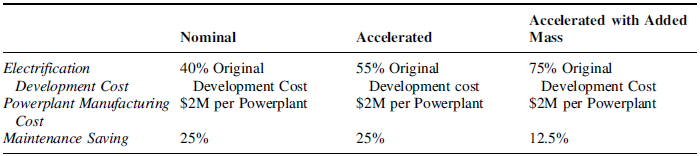
Table 1 presents the assumptions for the electrification strategies under consideration. The terminology of nominal and accelerated electrification strategies refers to the anticipated battery specific energy development associated with such strategies, where the underlaying premise is the nominal strategy will take longer to achieve viable electrification, but will cost less, whilst the accelerated strategy will cost more but will facilitate earlier electrification. Furthermore, the consideration of a scenario where there are some other implications, such as an additional system mass, associated with the pursuit of an accelerated electrification strategy could result in the identification of the point at which the pursuit of this accelerated strategy may become less valuable than nominal electrification is explored. This could also be interpreted as the 'break point' in value.
Assumptions for alternative electrification strategies

In addition to the assumptions presented in Table 1, the consideration of the additional mass of a cooling, or some other system, to facilitate the accelerated strategy has other implications, particularly regarding the viable cut in point for electrification. The consideration of additional system mass means that there is a reduction in the battery mass that can be utilised. Because of the reduction in battery mass, the required battery specific energy to complete the desired mission will be greater, hence the overall result of this is a delay in the cut in point for viable electrification. Figure 7 graphically illustrates the identification of the 'break point' where the additional system mass associated with the pursuit of the accelerated electrification strategy renders it futile from a value perspective in comparison to the nominal electrification.
Identification of product family SV break point for accelerated electrification strategy considering potential of additional system mass

The primary y-axis in Figure 7 measures the total product family SV, whilst the secondary y-axis measures the impact factor for the additional system mass being considered when an accelerated electrification strategy is pursued. The key message being conveyed by Figure 7 is the ability to identify what additional system mass renders the pursuit of the accelerated electrification strategy futile in comparison to the nominal electrification strategy, i.e. the SV 'break point'. Considering the solid blue line that is representing the total product family SV of the accelerated electrification strategies, it is observable that as the additional system mass considered increases, the product family SV decreases. The reasons for this have been described above. Since the nominal electrification strategy has been deemed insusceptible to additional system mass, it remains constant as the additional system mass is increased along the x-axis, depicted by the solid grey line.
The SV 'break point' where these solid lines meet can be said to occur at an additional system mass of approximately 1060kg. this enables the determination of the absolute value of the upper limit of additional system mass, using which an impact factor for additional system mass can be computed. This impact factor for the additional system mass is represented by the dashed green line. The point at which this dashed green line exceeds the red dashed line representing the upper limit of the additional system mass then corresponds to the SV 'break point'.
The significance of providing designers with the ability to objectively identify the SV 'break point' where the additional system mass required to facilitate the pursuit of an accelerated electrification strategy renders the pursuit futile is rooted in enabling objective decisions to be made regarding whether it is possible to avoid this additional system mass. In addition to this, if the requirement of additional system mass to facilitate something such as an accelerated electrification strategy is not known at the point in time the decision is being made, then the impact factor can be used as a continuous monitoring tool relative to any additional weight that may arise as the design develops. This could enable design teams not only to make objectively good design decisions, but also to monitor potentially risky decisions that have been made in the interest of value and identify whether a strategy should be aborted before it is too late to resolve from a cost and schedule perspective, or whether a new technology may provide mitigation.
This simple study has further demonstrated the versatility of the Integrated VDD Approach for the design pf product families, and more pointedly has further shown the usefulness of the design principle associated with the identification of 'break points' early in the design process to facilitate objectively good design decision making.
4. Discussion
This paper presents an approach that on builds the currently limited body of work associated with the application of VDD to the design of product families. Additionally, by investigating and demonstrating the implications of the application of an Integrated VDD Approach to the design of product families this work inherently contributes to the dissemination of VDD called for by Bertoni et al. (Reference Bertoni, Bertoni and Hakki2019). A key component of the Integrated VDD Approach that goes beyond the existing literature is the inclusion of a constraint management metric alongside a value objective function. There are several reasons why the inclusion of this metric provides an augmentation to existing works, notably that of Jung et al. (Reference Jung, Simpson and Bloebaum2021). Firstly, existing literature does not consider where design solutions reside relative to the constraints which the optimisation is bound by, as such, design solutions that appear most valuable at the conceptual design stage could prove to be problematic as higher fidelity models are introduced during future product development phases. Hence the novel inclusion of the constraint management metric at the conceptual stage provides the ability to identify such issues as early as possible. Additionally, by providing visibility across disciplines it can be determined not only how the design of a subsystem will influence the top level system value, but also how it may influence other areas of the design, thus fostering a more holistic design approach from all disciplines that leads to the avoidance of design isolation and the occurrence of the net loss scenarios described by Collopy (Reference Collopy1996) that are associated with requirements driven, reductionist approaches. Furthermore, the current approaches such as Jung et al. (Reference Jung, Simpson and Bloebaum2021) are concerned with identifying the most valuable design solution in a constrained design space, whereas the Integrated VDD Approach facilitates exploration of an unconstrained design space whilst also providing the designer with information on what technology or other development is required to achieve design viability via the constraint management metric.
The design studies presented in this paper have focused on the application of the Integrated VDD Approach to identify SV 'break points' in the product family design problems. The identification of these 'break points' across two different aircraft product family design problems, i.e. the design of a conventionally powered aircraft product family and the electrification of an initially conventionally powered airframe, has demonstrated the usefulness and versatility of the approach in supporting objective decision making across all involved disciplines through the determination of product specific insights. The potential industrial contribution of such an approach with regards the push for sustainability is tangible when the demand for variety and litany of potentially promising technologies that will be proposed is considered. The temptation to pursue technologies that show early promise from the perspective of achieving the desired performance gains will be prominent, but the ability to objectively proceed with, or pull the reins on, a development program due to its value prospects would be highly beneficial for designers. Although the claims made in this paper come from observations made in design studies informed by discussion with experts from industrial partners to simulate issues being faced in the real world, the lack of empirical evidence and application to a real-world design case is one of the things that could make implementation of the approach difficult in practice. This is particularly true of industries where design decisions made early in the process have such high stakes. In future work, it would be highly beneficial to apply the Integrated VDD Approach to a known real world-design problem to allow quantitative comparison with existing approaches to such problems. Else, the provision of the Integrated VDD Approach to a third party for application to a product family design problem, and the subsequent gathering of feedback could provide valuable learning and provide empirical evidence. Either of these further applications of the Integrated VDD Approach could go a long way to both substantiating the claims made in this work to date, whilst also overcoming the challenge of disseminating the usefulness of the approach, hence encouraging further implementation. In terms of the academic contribution of this work, the identification of the presence of break points across a product family is not something that the author of this work has encountered in the review of academic literature.




 Open access

