


Carried Away
I begin this study of eighteenth-century refusals of gravitas with Eliza Haywood’s 1736 Adventures of Eovaai, Princess of Ijaveo, a text in which things keep getting carried away. I do not just mean that Haywood’s romance is formally digressive or inclined to take its humor “too far,” though these are some of its predominant attributes. I mean that in the story, things, and people, are recurrently carried off by winged beings.
It’s quite funny, and deliberately so: a tactic for puncturing the confident progress of solemn, exegetical reading with genuinely puzzling, or arresting, or simply far-fetched narrative turns that suddenly eclipse the question, “What does this mean?” with the more urgent one, “What is going on?”Footnote 1 or even the less eloquent one, “Whaaaa?”Footnote 2 Eovaai herself, early in the narrative, models the extreme disorientation that small yet unexpected occurrences can provoke. When the family “Jewel” of divine origins, which protects Eovaai physically and metaphysically from “the most malevolent Aspects of the Stars,” slips from her fingers,
in that instant, a little Bird that, unregarded by her, had been all this while hopping about her Feet, snatch’d it in his Beak, and taking wing, immediately bore out of sight the sacred Prize. In vain her Eyes pursued the Track in the Air, as far as she was able! in vain her Tongue, in screaming Accents, invoked the Powers that ruled her Birth.… With her Lamentations she could not restrain herself from mingling Repinings: Since so much depended on keeping that fatal Jewel, said she, why was it entrusted to one of my weak Sex? Why was it not rather enclos’d in a brazen Tower, guarded by fiery Dragons, and inaccessible to all the Efforts of Man, or Beast, or Fiend? – Why suffer so silly, so inconsiderable an Animal, to prophane the hallowed Relique?Footnote 3
The passage’s grammatical ambiguity allows “so silly, so inconsiderable an Animal” to refer either to Eovaai, as “one of [her] weak Sex” incapable of protecting the jewel, or to the “little Bird” who makes off with it. Both creatures “profane” the sacred dignity of the jewel by holding it close to their own diminutive ways of being: in place of the fixed, phallic grandeur of a “brazen Tower,” the triviality, capriciousness, and flightiness embodied by women and songbirds alike. This analogy is later made literal when Eovaai is temporarily transformed into a “beautiful white Pigeon” – in oriental tales, it is not uncommon for people to turn into birds. Haywood turns to the genre precisely for what its unabashed fancifulness affords, namely the kind of funny turn a story can take when literally anything is possible. While Eovaai wrestles with the confounding situation of having her fate so absurdly diverted, we readers must reckon with what it means to be carried along by a story so gleefully contrived and willfully implausible. What happens when silliness itself becomes brazen?
Not long after the bird absconds with her jewel, and her once flourishing and peaceful kingdom descends into gory chaos, Eovaai is herself unexpectedly carried away, in a passage that introduces the imaginative vocabulary I think with in this chapter:
[W]hen casting her Eyes on the unclouded Sky, she beheld at a great distance a small black Spot, which coming nearer by degrees, and extending itself as it approached, at length took the Form of a Body, part Fowl, part Fish. From the enormous sides were stretched out Wings of a prodigious Size, underneath which, instead of Feet, grew Fins, reaching to a Tail, in Shape and Breadth like that of the Leviathan. Head it had none, at least that was discernible; for just above the Neck was placed a Globe of bluish Fire, which, to the astonish’d Eovaai, seem’d one huge tremendous Eye. But small was the Time allowed her for Examination, had the Terror she was in permitted her to make any: The dreadful Apparition came just over her, and she could only know thus much, that she perceived a thick Vapour enter the Room, which immediately inveloping her, she felt herself taken from the Place.
What is going on? Readers of Haywood’s time would have recognized in this “leviathan” a caricature of Robert Walpole’s political power; as Eovaai learns, the creature is a “Spirit” conjured by the villainous wizard Ochihatou, who plays Walpole in the novel’s political satire.Footnote 4 And it is possible, as many readings have shown, to ground this entire fanciful narrative with the ballast of English political history, to tether each leap of fancy to a “real-world” coordinate.Footnote 5 But, as Ros Ballaster has shown, Eovaai’s satire itself gets carried away to the point of losing the thread that would secure it to any kind of stable historical or ethical ground. The tale lampoons not only Walpole’s aggrandized political power but, more broadly, the epistemological postures of every prominent field of British knowledge and public participation, from republican politics to natural philosophy to world history and even to the literary genres of romance and satirical allegory that she herself adopts. “Eovaai’s conservative politics of sexual and social economy,” Ballaster writes, “is frequently undercut by anarchic and perverse comic energies.… Put simply, readers are encouraged to snigger not only at her satiric targets, but at the allegorical seriousness of satire itself.”Footnote 6 The tale refuses, in other words, to let any interpretive framework or narrative governing structure be taken completely seriously. Haywood mobilizes the oriental tale’s commitment to the ludicrous – what Srinivas Aravamudan calls its “fictitious overkill”Footnote 7 – to push literary satire to unstable heights.
By inviting us to consider where “anarchic and perverse comic energies” might take us, should we allow ourselves to be carried away by them, Haywood’s novel is not merely playing with comic form but actively theorizing unseriousness as an epistemological and political approach to the world. In doing so, it anticipates more recent theoretical work by Lauren Berlant, Jack Halberstam, and others interested in what Berlant calls “the counterpolitics of the silly object”: the trivial thing’s refusal to rise to the status of relevance, or the ludicrous conceit’s refusal to come down to earth, in a world in which both abstract value and the realities of practical life are defined on oppressive terms.Footnote 8 Aravamudan identifies Eovaai’s counterpolitics, for example, in its defiant cosmopolitanism in an age of gathering nationalism, locating this defiance precisely in the tale’s gleeful flouting of emergent codes of fictional realism that increasingly correspond to British readers’ sense of what is likely or possible in the world in general.Footnote 9 Part of what Halberstam has coined the “silly archive,”Footnote 10 eighteenth-century fictions like Eovaai lean into absurdity in order to disrupt the discursive reification of new, and harmful, world orders enacted by the representational modes of realism, history, empiricism, and geography.
To argue, as I do, that Eovaai theorizes unseriousness by thinking with and through silly material, is not at all to suggest that Haywood is not worth “taking seriously” as a writer. It is important to state this fact unequivocally, because Haywood’s relative prominence in the current canon of eighteenth-century British fiction is the hard-won result of an entire generation of feminist literary scholars’ efforts to show, argue, and insist that Haywood was one of the most significant writers of the early eighteenth century, an author who combined formal dexterity, political acumen, and practical genius in navigating an emergent popular print market. These critical efforts have been pitted against centuries of misogynist canon-formation that sustained the hostility Haywood experienced in her own lifetime, captured for posterity by Pope’s famously vicious attack on her as a disgraced, cow-like “Juno” in The Dunciad (Reference Pope1728). In the introduction to The Passionate Fictions of Eliza Haywood (2000), edited by Kirsten T. Saxton and Rebecca P. Bocchicchio, Saxton notes that “by the time of her death, Haywood’s amatory fiction had become seen as an embarrassing sin of youth, atoned for by her later works,” which were considered more morally grounded.Footnote 11 Literary history, until too recently, has tended to recognize the bulk of Haywood’s output as immature, salacious, and/or commercially shrewd. In turn, the feminist intervention staged by works like The Passionate Fictions, Ballaster’s Seductive Forms (1998), and Kathryn R. King’s A Political Biography of Eliza Haywood (2012) threw urgent energy into demonstrating that even Haywood’s most defamed works made significant cultural contributions, whether literary, intellectual, or political. The Haywood who emerges from this body of criticism is cutting, self-aware, hyper-literate in a variety of popular idioms, and politically rigorous in ways that can be mapped, unexpectedly, across her diverse body of fictions. As King writes, “Haywood is rightly admired for her penetrating if somewhat cynical analyses of the skills needed by women to survive in a world that favours men in virtually every way. It is satisfying to discover that in addition she worked out for herself a vision of women’s productive role in national public life more richly imagined than I could have predicted before beginning this study.”Footnote 12
These vital studies have recuperated Haywood for twenty-first-century readers by painstakingly rendering her legible according to the still-dominant paradigms of literary value and political coherence. It is only because of the gains made by this body of scholarship, and the dignity they have afforded Haywood as an author, that I, prompted by Ballaster’s and Aravamudan’s insistence that Eovaai refuses the formal coherence of either satire or nationalism, can suggest that it’s time to turn our attention back to the less legible aspects of Haywood’s work – to take her refusal of Enlightenment seriousness itself seriously. At the same time that her fiction sustains the experiments, strategies, and political stances that feminist scholars have traced, it also sustains a less productive, more “chaotic” energy, as Ballaster points out, that it is often difficult to reconcile to historical or political exegesis. It is in this more undisciplined region of Haywood’s writing that I find its most dynamic theoretical work – an eighteenth-century contribution to what Halberstam, drawing on Stuart Hall, calls “low theory”: “a theoretical model that flies below the radar, that is assembled from eccentric texts and examples and that refuses to confirm the hierarchies of knowing that maintain the high in high theory.”Footnote 13
Where feminist literary criticism has endowed Haywood with the authorial dignity that is long overdue, it is now time for queer theory to help us appreciate the extent to which Haywood also taps into the transformative potential of what lies beyond the bounds of dignity or ideological recuperation. This move is inspired by work like Catherine Ingrassia’s “‘Queering’ Eliza Haywood,” which calls boldly for readers to stop retreating from the same-sex intimacies that abound, in various forms, in Haywood’s fictions,Footnote 14 and in the final section of this chapter I do attempt to draw out the sapphic imagination I find in Eovaai. Yet my aim here is not to weave Haywood into a literary history of sexuality but instead to illuminate her contribution to a genealogy of critical theory, a kind of writing and thinking “queer” in its determination to think at the edges of cultural legibility. To read Eovaai with an openness to being carried away by its least explicable details is to approach it as theory rather than political allegory. Unlike allegory, critical theory operates most potently when it refuses resolution, using its notoriously frustrating maneuvers of digression, leaping off, counterintuition, and “overthinking” to bother open conceptual space where it has not yet been imagined. In its courageous approach of the illegible without intent to discipline it into legibility – in its willingness to learn from the incomprehensible on its own baffling terms – critical theory perpetually risks becoming absurd by the measures of Enlightenment reason. As Jordan Stein insists, “seriousness is an attempt to guard against the queer material of which theory is made – that big, difficult idea which always threatens to turn into a puddle of soft and ridiculous goo.”Footnote 15 The affect of seriousness that continues to dominate professional knowledge practices – and which Haywood overtly mocks in Eovaai’s parody of scholarly footnotes created by an intergenerational “cabal” of male experts – is, Stein writes, a defensive posture adopted by academics “to secure themselves against [theory’s] volatility.” Nevertheless, “theory’s volatility persists.” Silliness names this capacity of unbridled theory and outlandish fictions alike to explode what we take for reality into something unfathomable, yet nevertheless imaginable. Haywood encourages us to recognize that while, ideologically, this intervention is akin to the havoc threatened by a winged leviathan, pragmatically, it tends to arrive in the humble form of little birds, cute or annoying or perhaps entirely unnoticed, until the moment they suddenly do the unthinkable.
Affective Risks
In its more satiric register, Eovaai’s sense of humor is volatile but not without specific targets. It is aimed in particular at new manifestations of masculine authority asserting themselves in early eighteenth-century Europe: not only the Whig political leadership headed by Walpole, but also the style and structure of an emergent form of writing about the world at large, what Benjamin Schmidt calls “exotic geography.”Footnote 16 The late seventeenth and early eighteenth century, Schmidt argues, witnessed a proliferation of “textual, visual, and material objects” designed to present “the world as distinctly ‘agreeable’ and thus accommodating in various ways,” at the same time that it addressed “a singular European spectator, or consumer, of this world” unmarked by national, political, or religious affiliation.Footnote 17 This “seemingly neutral, or at least apolitical, approach to the affairs of the non-European world” that represented that world as a wondrous and charming “intermingled hodgepodge of exotic peoples, places, and things” thus produced the category of European reader as a mystified persona who has curiosity and preferences but no cultural bias, peculiarity, or agenda in their studied consumption of the exotic world – in other words, a liberal subject.Footnote 18
As Edward Said demonstrated in Orientalism (1979), forms of eighteenth-century exotic geography persist not only in Western subjects’ determined misperception of people and places considered “non-Western” in ways that reproduce Western power, but also in the enduring posture of liberal impartiality in Western scholarly authority over all “subject matter.” “The determining impingement on most knowledge produced in the contemporary West,” Said writes, “is that it be nonpolitical, that is, scholarly, academic, impartial, above partisan or small-minded doctrinal belief.” This “general liberal consensus that ‘true’ knowledge is fundamentally nonpolitical (and conversely, that overtly political knowledge is not ‘true’ knowledge) obscures the highly if obscurely organized political circumstances obtaining when knowledge is produced.”Footnote 19 As I have argued elsewhere, the political circumstances of orientalism that Said delineates in his study did not yet obtain in any organized way in early eighteenth-century Britain.Footnote 20 Yet, then as now, the studied cultivation of a “seemingly apolitical” mode of intellectual engagement did serve to mystify the material political conditions – namely, the intensification of European colonial projects including the transatlantic trade in enslaved African peoples that financed expansion – in which the liberal gaze found cultural purchase. In the marketing of early eighteenth-century exotic geography, we find an early version of what Sianne Ngai has coined the “merely interesting”: an aesthetic judgment that functions to ascribe
value to that which seems to differ, in a yet-to-be conceptualized way, from a general expectation or norm whose exact concept may itself be missing at the moment of judgment. Moreover, regardless of the particular objects and situations to which it is ascribed, the judgment always seems underpinned by a calm, if not necessarily weak, affective intensity whose minimalism is somehow understood to secure its link to ratiocinative cognition and to lubricate the formation of social ties.Footnote 21
In other words, finding things “interesting,” the modus operandi of the liberal intellectual, is a way of projecting particularity onto the objects that fall under one’s gaze without ever having to account for one’s own particularities, though they constitute the “norm” by which the object is deemed noteworthy for its minor, undisruptive distinctness. The dispassionate affect associated with this mode of reasoned engagement is part of the academic strategy to “know” the world without being, oneself, “knowable” – without making oneself fully present as a fellow occupant of the material world, which renders one vulnerable to becoming a “merely interesting” exotic specimen to someone else.
Haywood made herself vulnerable in just this way by her eschewal of the “weak” affects of Enlightenment reason in favor of the intense moods of aristocratic passion, as evidenced by literary criticism’s long-standing misogynist dismissal of her “amatory” style except, perhaps, as a historical curiosity. Said’s and Ngai’s critique of the dispassionate (what Ngai calls “cool”)Footnote 22 posture of Western interest in things helps us see how Haywood’s style is not merely risqué but risky, in the sense of venturing thought and judgment from a subject position imagined to be fully embodied, libidinally attached to others, and materially situated in a specific social arrangement. Her insistence on thinking through the desiring body in her writing is precisely what compels Pope to abject her from literary history in the form of a bovine “Juno of majestic size”:Footnote 23 In the economy of masculine taste and reason, the only kind of embodiment compatible with thought is the body as dispassionate sensor for gathering information. Haywood’s characters, more akin to Gramscian organic intellectuals, think on the ground, in the moment, on their feet and with every other part of themselves; they remain viscerally connected to the worlds they try to navigate, and this attachment compels them to venture more vexed, less ideologically “lubricated” forms of social relation.
Haywood does not use this mode of thinking to develop a critique of imperialism. But, as Aravamudan has shown, she does approach the emergent economy of nationalist realism – which weds Whiggish politics to liberal knowledge practices, within the steady atmosphere of low affective intensity – with decided irreverence. “Haywood’s fiction trumps novelistic realism,” he writes, “by resisting the imposition of national-realist boundaries while finding ingenious ways of revivifying transcultural allegory.”Footnote 24 If the novel sought to contain the nation as a coherent and self-referential knowledge system, one that afforded a supposedly detached perspective on the rest of the world, then Eovaai’s send-up of the boundaries and distinctions that structured this knowledge system placed English fiction back in a vaster, messier global scene of interacting ways of knowing. So placed, what becomes startlingly legible under Haywood’s pen is the peculiar, even funny, way that learned men, authorized by a deliberately impoverished epistemological order, approach the world as an object of knowledge.
Adopting the adjacent genre of oriental romance to cast a sidelong glance at exotic geography, Eovaai mobilizes the uninhibited levity and inventiveness of this mode of fiction to expose the starkly limited range of male experts – both intellectual and affective, which for Haywood are one and the same – as itself laughable. Where Said’s critique of orientalism revealed how Western expertise disavows its own status as the exercise of a specific geopolitical regional power, Haywood’s oriental tale reveals how masculinity similarly disavows its own particularity as an episteme in the emergence of Enlightenment liberalism. The European reader’s erasure of his own tracks in the vast, multitudinous, endlessly interesting world he consumes is structurally consistent, Haywood shows us, with how phallogocentrism allows the particularity of the phallus to evade scrutiny by rendering itself ubiquitous in the legible world of “other things.” To expose the fiction of liberal impartiality, one must expose the logical instrument with and through which the scholar thinks.
And this is why, when Haywood decides to let Eovaai (and Eovaai) get truly carried away, she does so via an elaborate penis joke.
The Fascinum
Head it had none, at least that was discernible; for just above the Neck was placed a Globe of bluish Fire, which, to the astonish’d Eovaai, seem’d one huge tremendous Eye.
Unlike the bird, the chimera that carries Eovaai off is presented as neither little nor silly; on the contrary, though at first it appears “small” as an effect of distance, it soon reveals itself to be “enormous,” “prodigious,” nothing less than “astonishing.” Amid the creaturely embellishments of tail and wings, feather and fins, this hypnotic beast is a thing that, in place of a head, has “one huge tremendous Eye.”
It is a giant flying penis.
I know it is a giant flying penis, because every time I have delivered this reading aloud to an audience, simply leaning the energy of my voice knowingly into Haywood’s words, the audience has laughed, signaling that it “gets it,” that it sees what I see, namely, a flying penis. I’m recognizing our shared laughter as a way of knowing – a mode of mutual understanding modeled in part on the form of the joke, but without the joke’s finality of resolution. Identifying Haywood’s chimera as a flying penis does not, in fact, make the whole bewildering tale fall into place as satire or allegory; it makes it stranger, funnier, and more, not less, open to wayward interpretation. In this context, our laughter signals the activation of a non-exegetical hermeneutics that prompts us to respond to the presence of potential meaning before particular meanings make themselves knowable in any certain way.
Eovaai does not laugh herself at the appearance of this creature, but her response validates our sense of what seems to be, as it were, in the air. The “astonish’d Eovaai” is fixed by the “tremendous eye” in a posture of fascination, enacting a scene of cognitive arrest that can be traced back to classical epistemologies and cosmologies.Footnote 25 According to William Smith’s 1842 Dictionary of Greek and Roman Antiquities, the Latin root fascinum refers to a form of “enchantment” associated with “the ὀφθαλμὸς βάσκανος, or evil eye,” which “was supposed to injure children particularly, but sometimes cattle also.”Footnote 26 But fascinum also refers to that which wards off the evil eye: the phallic amulets that ancient Romans “hung round the necks of children” to protect them from bewitchment.Footnote 27 Both of these things arguably have, in place of a head, “one huge tremendous eye,” and the myth of the evil eye countered by the fascinum pits one eye against another, establishing a phallic feedback loop in which competing subjects engage in a battle of gazes, trying to stave off their own objectification (the maiming or killing of their subjectivity) by being more violently fascinating than the other.
Yet the dynamic of fascination confuses the fear and aggression of such struggle with powers of desire and attraction. At stake is not simply one’s life but one’s distinctness from the other as a perceiving being; the evil eye presents the possibility of one’s being absorbed into another(’s) way of seeing. In his monumental study of human affects, Affect Imagery Consciousness (1962–91), Silvan Tomkins devotes an entire section to the evil eye as a long-standing and wide-ranging “Expression of the Taboo on Interocular Intimacy.”Footnote 28 Tomkins notes that “the taboo on mutual looking is reinforced by its specific linkage with sexuality. To the extent to which there are taboos on the free expression of sexuality, mutual looking, which is an important part of sexual exploration and contagion, also comes under taboo.”Footnote 29 The erotics of “mutual looking” presents a problem for empiricism because it disrupts the premise that seeing is a dispassionate one-way exercise across a safe and stable distance between subject and object. Maurice Blanchot writes:
Seeing presupposes distance, decisiveness which separates, the power to stay out of contact and in contact avoid confusion. Seeing means that this separation has nevertheless become an encounter. But what happens when what you see, although at a distance, seems to touch you with a gripping contact, when the manner of seeing is a kind of touch, when seeing is contact at a distance? What happens when what is seen imposes itself upon the gaze, as if the gaze were seized, put in touch with the appearance? What happens is not an active contact, not the initiative and action which there still is in real touching. Rather, the gaze gets taken in, absorbed by an immobile movement and a depthless deep. What is given us by this contact at a distance is the image, and fascination is passion for the image.Footnote 30
Seeing’s slippage into tactile experience is a reminder that the organs of perception are part of an entire, vibrant body, one in perpetual contact with the world around it and that remains present and active in acts of perception and thought whether the subject acknowledges them or not. The eye that stares back is “evil” because it teases out the passions, the body’s “mind of its own.”
The patriarchal insistence on subjective distance as a condition of personal agency informs the multiple stories that gender fascination as a feminine threat to masculine life. It is not women who disrupt patriarchy, but the ever-present possibility that “women” and “men” may prove indistinct from one another because phallic power operates in funny ways in any material body. Medusa, for example, famously embodies the evil eye as the monstrous female phallus disavowed by patriarchal order: to look at her is to be turned instantly to stone. A figure of terror for classical masculinity, Medusa’s effect on men is also undeniably funny when read from the perspective of one with less to lose in the distortion of phallic order. Her head of snakes presents a profusion of unruly phalli, each with a life, and eyes, of its own, a wriggling nest of gazes that refuse to be consolidated into a unified perspective. Medusa is a she, but also, like the hydra she resembles, a they. Under their diffuse yet irresistible gaze, the male individual responds with such instantaneous and overwhelming sexual energy that the phallic order of his own body becomes fatally disarrayed, his entire being transformed to a pathetically singular erect object.
Roland Barthes captures the funniness of this classic horror story in his autobiographical meditation on the human body’s capacity for fragmentation. In Roland Barthes by Roland Barthes, he describes saving a rib that he had had removed:
For a long time I kept this fragment of myself in a drawer, a kind of body penis analogous to the end of a rib chop, not knowing quite what to do with it, not daring to get rid of it lest I do some harm to my person, though it was utterly useless to me shut up in a desk among such “precious” objects as old keys, a schoolboy report card, my Grandmother B.’s mother-of-pearl dance program and pink taffeta card case.Footnote 31
I can think of no better description of what Medusa threatens to make of a man than “a kind of body penis.” Barthes helps us appreciate why the exaggerated phallic response Medusa compels is so upsetting: The “body penis” is a small thing after all, a piece of something whose connection to personhood is spectral and uncertain, a diminutive “precious” artifact of a fantasy of selfhood. Tomkins notes that the evil eye is understood to be “capable of being redirected against its owner”;Footnote 32 in just this way, in Medusa’s presence the phallic force of masculine desire rebounds onto the subject, transforming him into a sexual object “utterly useless” to himself. What is exposed is the narcissistic economy of phallocentric desire, and the threat it poses to its own power. The dynamic of suspense in the mythological scene of mutual fascination is a way of staving off the logical conclusion of the male subject’s preoccupation with his own phallic embodiment, which is to bring the phallus back to the level of the body, to recognize oneself as merely “a kind of body penis” channeling forces beyond one’s conscious control, and to experience oneself in the voracious eyes of one’s own desire, one humble specimen of eroticized flesh among many. Under Medusa’s gaze, in other words, men are reduced to sex toys, and they simply don’t know what to do with themselves.
In eighteenth-century Britain, the emergence of antiquarian collections and museums helped recuperate the phallic toy as part of masculine subjectivity and authority. The relic of Barthes’s rib resonates with the mounting interest among upper-class male scholars in eighteenth-century England with the ancient worship of Priapus and its attendant artifacts. In 1781, Sir William Hamilton, royal ambassador to the court of Naples, wrote to Joseph Banks, president of the Royal Society, “I have actually discovered the Cult of Priapus in its full vigour, as in the days of the Greeks & Romans, at Isernia in Abruzzo.” He offers to send “a faithfull description of the annual fete of St. Cosmo’s great Toe, (for so the Phallus is here called, tho’ it is precisely the same thing).”Footnote 33 Like Barthes, the men of the Royal Society rely on a distinct sense of humor to keep their masculine wit and intellect limber on the subject of phallic artifacts; as Katharina Boehm explains, “Unpublished letters exchanged between Hamilton and Banks indicate that the cult quickly became an in-joke” between them, as Hamilton’s findings were integrated into an “antiquarian culture that was built on homosocial bonds of friendship and patronage.”Footnote 34 Hamilton ends one such letter wishing Banks “that your Great Toe & your purse may never fail you.”Footnote 35 In an excerpt from their correspondence included in Richard Payne Knight’s An Account of the Remains of the Worship of Priapus (1786), Hamilton promises to “deposit the authentic proofs” of cult “in the British Museum,” namely, “a specimen of each of the Ex-voti of wax,” the wax phalli, Saint Cosmo’s “Great Toes.” In the meantime, however, Hamilton offers “the following account, which, I flatter myself, will amuse you for the present, and may in future serve to illustrate those proofs.”Footnote 36 By the time Payne Knight’s volume came out, the Great Toes had indeed been deposited in the relatively young British Museum, and the book presents a full-page image of them as its frontispiece, for the combined amusement and edification of the reader.Footnote 37
More reminiscent of the flying phallus in Eovaai, however, are the images that serve as the headpiece to Hamilton’s letter in the Account (Figure 1.1). Giancarlo Carabelli describes them:
The central one is a Greek sculpture of a human torso surmounted by a cock’s head with a large penis in place of a beak, bearing the inscription “Sotor cosmou” (“Saviour of the world”).… On the left is a bird-phallus suspended from a chain and happily flying through a country landscape; this object was already in the British Museum in Knight’s time. On the right is a pendant, with a large ring, which has “mano in fica” on the left, a penis with a scrotum in the centre, and an erect penis on the right.Footnote 38
In his letter, Hamilton explains that the “mano in fica” is the manual gesture of “a hand clinched, with the point of the thumb thrust betwixt the index and middle finger” which “was probably an emblem of consummation,” with the fingers representing the vulva and the thumb the penis.Footnote 39 The figure of this gesture is the “modern Amulet most in vogue” Hamilton reports; others, similarly evoking the vulva via other natural objects, include the “shell” and the “half-moon.”Footnote 40 Compared with the frontispiece’s heap of wax dildos, amusingly likened to a pile of severed toes, the fascinum in the headpiece displays the chaotic, hybrid, and animate embodiment of a Medusa or Haywood’s chimera. Unlike the uncanny fragments of manhood that serve as dormant, collectible “body penises,” the amulets worn by women and children appropriate the penis away from the masculine human body, adding wings, making it a beak, giving it a tail or an arm or a penis that is a fist that is a vulva and a thumb that is a penis (that is a toe?), even giving it another penis, like a second snake sprouting from Medusa’s head.
Headpiece illustration, Richard Payne Knight, The Worship of Priapus, Reference Knight1786.
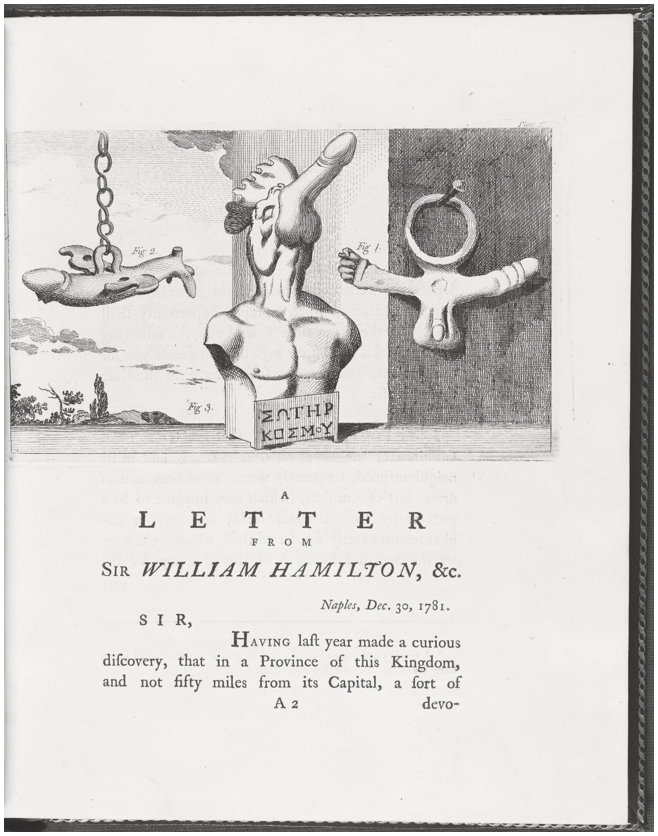
The unrestrained formal hybridity of these figures is connected to a similarly fluid sense of wordplay, the double meaning of “cock” providing one instance of the logic that merges penises and birds in the cultural imagination. While the pun on “cock” refers to male birds and phallic genitals, the formal slippage of meaning itself, and the attendant insinuation of the animal into the human, sends the whole apparatus into the realm of feminine animacy, where meaning proliferates in defiance of, and at the expense of, patriarchal authority. Carabelli notes that “in Greek art the bird-phallus usually appears together with female figures … and is interpreted as the representation of female heterosexual desire satisfied without the intervention of men.”Footnote 41 “The phallus,” he continues, “is the only human part that is represented as endowed with independent life.” The wayward life of stolen penises continues to be associated with both birds and monstrously self-oriented women into the medieval and early modern periods. As Moira Smith has shown, Heinrich Kramer’s 1487 Malleus Maleficarum, whose procedures for prosecuting witches played a foundational role in the gruesome “witch hunts” of the fifteenth and sixteenth centuries, includes mention of a “nest of stolen penises” that has perplexed historians:
In the midst of a serious discussion about the sexual crimes of witches, there appears a story about how witches commonly steal men’s penises and keep them alive in birds’ nests. When one victim of penis theft tries to choose a big one for himself, the witch tells him he can’t have it because it belongs to the village priest.… The motif of a nest of living phalli appears to be a historical dead end – a cultural hapax legomenon that appears once here and nowhere else in the cultural record. Accordingly, critics have often interpreted it as the author’s hysterical fantasy.Footnote 42
As Smith’s article amply demonstrates, where the historian encounters a “dead end,” the folklorist attuned to multiple modes of cultural proliferation over unidirectional histories of ideas finds a wealth of resonant tales, images, and fantasies. Kramer, she writes,
makes it clear that the stolen members are kept alive in a birds’ nest (nidus avium), where they eat oats or feed (vel avenam vel pabulum). In other words, the castrated-yet-living penises are described as some type of baby bird. As strange as this image appears, the association between penises and birds is widespread in Western folk speech, joke lore, and art.Footnote 43
The metamorphic forms of fascinum sustain a relationship between wordplay and wayward liveliness. As the “body penis” becomes independently animate, migrating away from phallic, humanist orders of being, it refigures castration as a kind of liberation and an opportunity for reanimation. These strange baby birds gesture to the possibility of thriving in a wholly different, barely conceivable semiotic environment, and this fantasy has continued to bother Western patriarchy since classical antiquity.
The nest of living stolen penises is, of course, also an imagistic rhyme for Medusa’s infamous head of snakes. The fascinum’s irreverent way with meaning is imagined as both flighty and wiggly, often simultaneously. In addition to troubling the boundaries of classical humanism, these restless dynamics distort the organizing frameworks of natural history. One expression of the “bird-phallus” in France and England since the twelfth century is the cockatrice, a serpentine bird closely related to, sometimes conflated with, the ancient basilisk. Tracing the association of the evil eye with serpents back to Pliny, Tomkins reports:
The belief in the basilisk and its power continued through the Middle Ages and became confused with an animal called the cockatrice, which had wings, a long tail, a cock’s comb, and a deadly eye, and was said to be incubated by a toad from the egg of an elderly cock. Sir Thomas Browne dismissed the cockatrice but believed in the danger from the eye of the serpent, the basilisk. In Brazil there is a legend of a bird that could kill anything it beheld.Footnote 44
The cockatrice, despite the syntactical prominence of “cock” in its name, serves by the seventeenth century as a popular term of reproach or abuse for women, particularly sex workers.Footnote 45 This is not to say that it is necessarily understood to be “female.” Its provenance as the offspring of a “cock’s egg,” incubated not by its own kind but by a toad, indicates that the cockatrice, like the fascinum, represents the possibility of a living being flouting the taxonomies of phallocentric order and the binary arrangements of sex. As a creature in the mythological pantheon, the cockatrice’s overriding characteristic seems to be that it is born of categorical confusion. Laurence A. Breiner opens his genealogy of the cockatrice with a passage from Pliny, ostensibly about the crocodile, but in which the reptile is somewhat upstaged by the fateful intrusion of a “little bird”:
After his dinner of fish, [the crocodile] always falls asleep on the shore with his mouth full. A little bird (called the trochilos there [in Egypt] but king-of-birds in Italy) pesters him to open his mouth so that it can feed. It jumps in and cleans out the mouth first, then the teeth and the inner throat as well, while the crocodile yawns as wide as possible for the pleasure of this scratching. The ichneumon watches for the crocodile to fall asleep in his indolence, so that it can dart down the open gullet like a javelin and gnaw out the belly.Footnote 46
Breiner locates the origin of the cockatrice not in the crocodile, but in the semantic ambiguity of the creatures that conspire to undo the crocodile – the “trochilos” and the “ichneumon” – and their relation to each other. According to Aristotle and Plutarch, the ichneumon is not a bird or a reptile but a mongoose-like mammal, yet due to ambiguity in the Greek name enhudris, which could mean either “otter” or “water snake” and was latinized by Pliny as enhydris, “the ichneumon came to be conceived by some writers as aquatic, amphibian, or even a fish.” The instability of the predatory ichneumon’s identity extends, for Breiner, to the little bird as well, which might be read not as a separate creature at all but the same animal, “distorted” into another form through repetitions of storytelling. “There is some possibility that Pliny is telling the same story twice,” he writes, “that the tale of the ichneumon is the story of the trochilos distorted beyond recognition and reaching Pliny by another route. Whether or not that is the case, the story was told over and over again through the Middle Ages and the Renaissance with bewildering variations.”Footnote 47
T. H. White, in his translation of a medieval bestiary under the title The Book of Beasts (Reference White1960), locates the cockatrice even more forcefully within a realm of “confusion” irreconcilable to “natural history” by relegating its convoluted narrative to a long footnote in his discussion of the basilisk. According to White, it was around the late fourteenth century “that the endless confusions of etymology began to interfere with natural history”:
The medieval philologist had no inhibitions about mixing languages, and for him the basili-coc might just as well have been a King Cock as a King Cobra.… Unfortunately, the word Cocodrillus (the crocodile) also sounded a little like cock and cockatrice, while there was a bird called a Trochilus which entered the jaws of crocodiles to pick their teeth, and perhaps this was a cock bird too. The etymological tangle was further exasperated by physical coincidences, e.g. between the mongoose which killed the basilisk and the hydrus which killed the crocodile; also between the combs of cocks, the crests of some serpents and the dorsal fins of some fish. For the Serra (q.v.) had been swept into the maelstrom by now. The fact is that translation and identification were responsible for the muddle, and grammar had bred the cockatrice.Footnote 48
White’s footnote, which I’ve quoted only in part, provides a wonderful example of how a dyspeptic attempt to contain “unrigorous” material away from the “serious” content of scholarly knowledge winds up biting its own tail – a contortion, incidentally, for which the cockatrice was famous.Footnote 49 White removes the “muddle” introduced by the cockatrice to a footnote, but in his effort to drive home just how “exasperating” the case of the cockatrice is, White allows the text of the footnote to swell with more and more instances of confusion, coincidence, and illogical resemblances, until it overwhelms the “proper” content of the page. The cockatrice leads White into a digression that, like Freud looping repeatedly through the red-light district as he tries to cut an innocent and straightforward path through an Italian town, finds him caught in the circular logic of his own intellectual desire.Footnote 50 The object that fascinates, by refusing to submit to objectification and classification, short-circuits the flow of empiricist inquiry, generating instead the experience Freud called the uncanny. In Blanchot’s words,
The look … finds, in what makes it possible, the power that neutralizes it, neither suspending nor arresting it, but on the contrary preventing it from ever finishing, cutting it off from any beginning, making of it a neutral, directionless gleam which will not go out, yet does not clarify – the gaze turned back upon itself and closed in a circle.Footnote 51
As I discuss in more detail below, in Eovaai Haywood exploits the tendency of obdurate scholarly footnotes to tip into the realm of the ludicrous. For now, I simply want to emphasize that it is precisely what White finds exasperating about the profusion of “cock birds” in Western cultures – the fact that they are everywhere and nowhere, that they are both overdetermined and indeterminate – that attracts Haywood to the fascinum. Both creatures are generated by the cultural forces of bewildering variation in language and in substance alike: the capacity of one thing to be many things, whether over time, or from one sentence to the next, or, like Haywood’s chimera, all in one fell swoop.
The fascinum is, as White says of the cockatrice, a creature of inadvertent grammatical turns. It springs forth from glitches in cultural logic – moments of uncanny repetition, looping, multiplicity, reflexivity – like a relentless joke that patriarchal discourse continually plays on itself. To borrow from Freud, these uncanny creatures are generated by patriarchy’s own repetition compulsions. They expose the insufficiency of phallic epistemologies to grapple, to their own satisfaction, with the fullness of the world they approach as an object of knowledge. Ackbar Abbas argues that critical theory would do well to depart from philosophy’s mistrust of the fascinating, its loyalty to the unrisky affect of the “interesting,” if it intends to think its way out of Western humanism’s conceptual cul-de-sacs. He writes,
The interesting is always associated with the intelligible, and it does not go beyond the limits of the intelligible. Beyond the limits lies either boredom or deception.… By contrast, the fascinating is, to be sure, not simply the unintelligible; rather, it is that which the intelligible forecloses.… [A]ccess [to that beyond intelligibility] is provided by means of the enigma, which is as different from the puzzle as the fascinating is from the interesting. The puzzle, we expect, will at some time clarify and become readable. By contrast, the enigma has the deceptive, oxymoronic quality of being always clear and illegible at the same time, like the figure of music.Footnote 52
Haywood allows Eovaai precisely this experience. The chimera is sent to her as an instrument of Ochihatou’s deception, but as fascinum it envelops her in a song of transport that suspends the tyrannical binary logic of truth versus falsity:
The dreadful Apparition came just over her, and she could only know thus much, that she perceived a thick Vapour enter the Room, which immediately inveloping her, she felt herself taken from the Place, and presently after heard the Wings of her aerial Carriage sing with the Rapidity of its Flight.Footnote 53
Eovaai’s astonishment and our laughter are both elicited by the song of the fascinum’s flight. Abbas describes fascination as “a paracritical mode of attention”: “neither knowledge nor ignorance,” but “an enigmatic relation to what we do not know, a response to other imaginaries, other musics, other strange gods.”Footnote 54 They are both modes of being drawn to, even attached to, that which does not submit to the understanding. They express the activation of the sensory being’s other intellects.
The wings of the fascinum are funny not in the sense of comedy or satire, but more viscerally, as embodied supplements that reveal the “intelligible” object’s unexpected capacity for levity, diversion, and transformation. This kind of funniness is not at all distinct from what Tomkins calls the “negative affects” of fear and bewilderment; it is funny precisely because it merges negative affect irreverently with the positive affects of joy, pleasure, and attraction. The wings carry the phallus away from its own purpose. No longer a brazen tower defending cultural order, it has become the silly animal that absconds with meaning. The fascinum amulet disrupts phallocentric fascination by exposing the phallic object’s own vulnerability to being made silly – reduced to a trinket, like the Barthesian “body penis,” but also repurposed as a vehicle of theoretical departures. If this object makes you laugh, you are being carried by the fascinum’s anti-phallic theoretical intervention whether you understand it in those terms or not.
Anamorphic Vision
One of the reasons funniness – in the form of the silly, the flighty, the unserious – is policed so intensely in scholarly discourse is because laughter’s volatile energy is a site of enormous political potential. Hélène Cixous famously insists that laughter’s intrusion upon the staid affects of patriarchal discourse awakens one’s capacity to think counter-phallicly. Her essay “The Laugh of the Medusa” transforms Medusa’s body from an exaggerated plethora of evil eyes – the multiplicitous being as murderous counter-subject – to the vibrant body that laughs infectiously, eliminating the distance between subjects not by annihilating the other’s subjectivity but by overwhelming it, enfolding it into her own. Learning to laugh specifically at the fear of castration – the very notion that Medusa’s undulating, multiheaded presence is some kind of threat – is crucial to generating discourse focused on vibrancy and connection rather than on death and severity. “Too bad for them if they fall apart upon discovering … that the mother doesn’t have one,” Cixous quips. “But isn’t this fear convenient for them? Wouldn’t the worst be, isn’t the worst, in truth, that women aren’t castrated …? You only have to look at the Medusa straight on to see her. And she’s not deadly. She’s beautiful and she’s laughing.”Footnote 55 The laughing Medusa doesn’t paralyze you; she moves you; she takes you away with her.
Although Haywood’s fascinum doesn’t make Eovaai laugh, it does transport her in a way that stages a similar epistemological intervention:
The dreadful Apparition came just over her, and she could only know thus much, that she perceived a thick Vapour enter the Room, which immediately inveloping her, she felt herself taken from the Place, and presently after heard the Wings of her aerial Carriage sing with the Rapidity of its Flight; then the Fins and Tail lash among Waves, as forcing a Passage through mighty Waters; but the swift Transition gave her no room for Thought, till on a sudden every thing was hush, she found her Feet on Earth, and her Eyes had liberty to look abroad. She turned herself about in search of the Machine, in which she had been conveyed; but the hideous Phantom vanished in the Instant she was set down, nor could she perceive the least Traces of her Journey, any more than form any Conjecture into what Part of the World she had been thus miraculously transported.Footnote 56
Among all the sensual details included in this passage, one fairly simple thing is happening: The chimera moves Eovaai from a point A to a point B. A simple act of transport, so swift it eludes contemplation: She was there; now she is here. And yet this act of being so moved is nothing less than “miraculous.” There is an allegory here for the transformative potential of laughter on perception: how it can erupt unexpectedly, and suspend thought, and deposit you, only a moment later, in a place in which everything seems different. By inviting (or daring?) us to laugh at the fascinum, Haywood prompts us to recognize this laughter as an actual, embodied movement that enables us to see otherwise.
By the time Haywood was writing, early modern painters had been experimenting for two centuries with how perception is affected by how the subject moves around. One of the most dramatic methods was the device of anamorphosis: a mode of distorting images so that, in order to become recognizable as objects, they must be seen from an oblique angle, compelling the viewer to physically move themself in relation to the painting. Jacques Lacan, in his seminars on the gaze, turned to the famous example in Holbein’s The Ambassadors (1533) to consider how this particular way of looking toys with phallocentric modes of perception. Considering the funny detail in the painting’s foreground – “What is this strange, suspended, oblique object in the foreground in front of these two figures?” he asks – Lacan describes it as a “phallic … object,” “depicted in a flying position in the foreground of this picture.” Viewed directly in this “flying,” “tilted” form, what this object is, “you cannot know.” But when you turn away, “thus escaping the fascination of the picture,” he explains, and view it from the side, the strange, indecipherable detail appears as a human skull, “making visible for us … the subject as annihilated – annihilated in the form that is, strictly speaking, the imaged embodiment … of castration.”Footnote 57 Holbein choreographs a perceptual trick that rewards the subject who plays along with a reveal akin to the punchline of a joke. Stephen Greenblatt observes that “for all the grimness of its imagery, [the distorted skull] is itself an invitation to the viewer to play.” But, Greenblatt emphasizes, this playfulness tends not in the least toward frivolity. Holbein’s anamorphosis, like the other imperialist arts of mapping and measurement depicted in the painting, is “the elegant play of distinguished and serious men … not conceived … as an escape from the serious, but as a mode of civility.”Footnote 58 As Olivia Smith has argued, whatever pleasures The Ambassadors extends to the viewer, including the pleasure of discovering the open secret of one’s own mortality, Holbein presents them not as diversion but as a form of play that carefully circuits back to enhance emergent fields of European masculine knowledge and the empire-building projects they generated. An in-joke among curious men, the anamorphic skull that emerges from, in Smith’s words, the “muddled, bony mass” in the painting’s foreground does not annihilate the viewer’s subjectivity at all, but maps out an expanded field in which it may flex its way of seeing.Footnote 59 This exercise poses no risk whatsoever to phallic order: The whole notion that castration means annihilation is, of course, a phallocentric fantasy.
In short, the resolution of The Ambassadors’s anamorphosis wrangles the mysterious flying phallus back to the grim reality of What Men Know. In place of an otherworldly phantasm, an empirical reminder that imperial aspiration is basically a death project – a reminder that doesn’t thwart that project in the least. Haywood, however, refuses to rein in the fascinum. She launches it, and her heroine with it. When Eovaai arrives in her new position, far from resolving into something comprehensible, the winged apparition disappears completely, leaving Eovaai in an utterly unfamiliar place. Instead of resolving the anamorphosis, Haywood considers the epistemological possibilities of leaning into it – of wanting to know where that phallic thing in its “flying position” might take us. Cixous inherits Haywood’s yearning for flight; this is why what she calls l’écriture feminine parodies phallic authority rather than trying to appropriate its staid register. In its “laughing” mode, this kind of theory is precisely a “send-up” of the whole apparatus of phallic order:
Flying is woman’s gesture – flying in language and making it fly.… It’s no accident that voler has a double meaning, that it plays on each of them and thus throws off the agents of sense. It’s no accident: women take after birds and robbers just as robbers take after women and birds.… What woman hasn’t flown/stolen?Footnote 60
The phallic imagination, like Holbein’s viewer, has only two modes: The subject can perceive itself either as powerful over something else or as annihilated. Yet winged beings refuse to shuffle back and forth between these discrete positions. The Cixousian send-up is an affectively inflated version of deconstruction, the theoretical style/method associated with Jacques Derrida that draws on the conceptual flight lines thrumming within language to keep meaning moving in wayward directions, without ever landing definitively in a declaration of authority that might be undercut by the strike of a counter-authority.Footnote 61 The flight of fancy is an irreverent refusal to accept that meaning pivots around only a single pole of reference, the Derridean “phallogocenter.” Derrida’s germinal writings were always committed to silliness as a mode of counterpolitics: Poststructuralism’s “theft” of meaning from economies of “proper” signification by exploding grammatical possibilities “has never been a question of opposing … any center to any other center,” Derrida insists. “It is not a question of returning writing to its rights, its superiority or its dignity.”Footnote 62 Cixous’s vision of liberatory writing takes off from this refusal of dignity. Locating laughter at the heart of a poststructuralist feminist praxis, she shows that when the phallus is flown/stolen away from this symbolic economy, in losing the capacity to define power, it becomes newly volatile as selfhood is returned to the movable substance of the body.
The winged phallus is emancipated from the annihilating economy of subject and object, in other words, by being humiliated back into the visceral, material world. We tend not to think of humiliation as liberating, especially with regard to this particular thing. It requires an openness to both an erotics and an episteme of flaccidity. Lacan compares the distorted skull of The Ambassadors to “Dali’s soft watches”;Footnote 63 Dali, writing about anamorphosis himself, considered how its distortions allowed “the finest articulations of crustaceans and armor [to] take on the vague, dubious and amoeboid contours of the most deliquescent medusas and soft watches.”Footnote 64 Driving the point home, Allen S. Weiss, discussing these lines from Dali, emphasizes that the anamorphic forms of Medusa and Dali’s watches alike are both “detumescent phallic objects.”Footnote 65 Cixous’s reanimation of these “detumescent” forms in the vibrant figure of the laughing Medusa reminds us that the humiliation of embodiment within a phallic economy can be funny without being annihilating, in fact, quite the opposite: Deriving from the same root, hum, meaning ground, it returns the human to itself, a supple creature of humus and humors, in whom life and death merge as an expression of fecundity. Derrida once quipped that phallogocentrism perpetuates itself by presenting itself to theory as “an enormous and old root that must … be accounted for,”Footnote 66 but the softening world of the anamorphic refers us to a literal, organic site of human origins where roots, of whatever dimensions, make no such demands, merging instead with the mollescent world of soil. I am thinking here of Robin Wall Kimmerer’s description of how, by learning to think with her fingers in the humus of the forest, she encounters lessons from “the humility of Spruce roots.”Footnote 67 Not being accounted for releases the phallus into a world of decentered reciprocity where it is finally allowed to stop being everyone’s problem.
It is the startling intrusion of detumescence in Renaissance painting that, for Lacan, demands creative resolution: Anamorphosis reminds him, he says, of “the effect of an erection,” and instructs us to “imagine a tattoo traced on the sexual organ ad hoc in the state of repose and assuming its, if I may say so, developed form in another state” in order to understand The Ambassadors’s mechanics of signification.Footnote 68 But Cixous, like Haywood before her, is attempting an aesthetic that eschews such “development” toward recognizable, presupposed ends. The chimera that appears to Eovaai, an astonishing phantasm all wings and fins and vapor and water sounds, is akin to the tattooed organ in its more humble state: A curl of inscrutable flesh in motion, it is the unfixed thing that could be all the other things that the resolution of anamorphosis forecloses. The fascinum’s capacity for multidirectional movement is one and the same as its potential for semiotic proliferation.
In fact, the fascinum reappears in myriad chimeric forms in medieval visual and material cultures, not always with wings but sometimes with arms, legs, and tails. These headless, phallic creatures intermingle with equally animate vulvar counterparts, all inhabiting a world where penises tend to appear in clusters and all genitals live and interact independent of human subjects. Nicola McDonald’s overview of the existing archive of “ambulant genitals” in secular badges of the late Middle Ages is itself nothing short of fascinating:
the corpus includes vulvas on stilts and ladders, both winged and crowned, vulva pilgrims complete with pilgrim staff and rosary (variously provided with a phallus-topped rod, phallic epaulettes, and a triple phallus crown), a diverse collection of exhibitionist women (reminiscent of the sheela-na-gig), megaphallic beasts and wild men, plus phallus-crewed boats, phallic barbecues (where the roasted member is either basted by two female cooks or grilled over a reclining vulva), various hooded phalluses, phallus-filled purses and an extraordinary phallus-crowned vulva carried on a litter by three ceremonially dressed phalluses, an elaborately detailed vignette that seems, inescapably, to mimic popular Marian processions.Footnote 69
McDonald attributes the relative dearth of scholarship on this astonishing material archive, and especially on British examples, to a combination of, on one hand, “academic prudery, as well as pervasive, if unspoken, social regulations about what kinds of subject matter can be legitimately and publicly discussed,” and, on the other, “the lexical and semantic challenge inherent in the articulation of the obscene, especially when it emerges from a still dimly understood past.”Footnote 70 The obscene artifact of the past poses a specific challenge to historiography because of its funniness – its challenge to academic decorum, its arresting quality, and the specific way it arrests the contemporary viewer without explaining itself. The obliqueness of its meaning is intertwined with the uncertainty of the affect in which it operates. McDonald notes of the essay collection Medieval Obscenities, “Most of the authors agree that the obscene is designed to shock, either intellectually or sensually, but there is less consensus on the effects of that shock: fear, laughter, awe or excitement.”Footnote 71 The “shock” of the obscene seems to be at odds with the modes of attention that yield scholarly knowledge: “Faced with a vulva on horseback, for instance, our ability to analyse its function and meaning is severely impeded by our real difficulty in finding an appropriate vocabulary with which to discuss it, let alone one that might accurately reflect the kind of discursive – or visual – register in which (we can only imagine) it was originally understood.”Footnote 72 Scholarly discourse falters upon objects it deems pornographic, but also upon objects that compel the laughter of unknowing. As Ben Reiss puts it, in an inoculating disclaimer to his serious reading of the more “pious” significations of these images, “Of course, a vulva dressed as a person is funny in any language, culture, or age.”Footnote 73 Within academic idioms, this funniness jettisons the object out of the historiographical frame that presents it as a knowable object. This, too, is a version of unresolved anamorphosis: The obscene badge does not provide the conceptual framework that would allow us to decode it and determine its meaning, and, unlike Holbein’s painting, in its invitation “to play,” it doesn’t include any contextual clues about the rules, nature, or imagined outcome of the game.
The problems McDonald points to in medieval scholarship call attention to the techniques humanities disciplines in general have deployed to defend themselves against the destabilizing appearance of unaccountable flying objects and other funny things. Emerging from a dream-like semiotics of generative flaccidity, the fascinum agitates the forms and structures of disciplinarity itself, refusing the standards of “rigor” by which scholarship is measured, the “straightness” by which sexuality is channeled into (re)productive order, the “growing up” that weds personhood to progressive movement to individuated development. “Graphic representations of sexual organs,” McDonald writes,
human as well as animal and usually in contorted, ludic or aggressive poses, alongside suggestively displayed bums and anal orifices, are reasonably familiar to both professional and amateur medievalists from the manuscript marginalia and church architecture that are reproduced in popular and serious publications.… Yet, despite the reassuring strangeness of the in-your-face medieval body, few commentators are finally content to leave that strangeness unchecked. Modern viewers peeping voyeuristically at the “eye-popping” antics of a pen-and-ink bum-licker (itself reduced to head and hindquarters) sketched in the margins of a fourteenth-century collection of saints’ lives (and reproduced in a glossy British Library paperback on medieval monsters) are assured that although such drolleries resist easy interpretation, they can best be understood as counter exempla, teaching the medieval viewer that mortal flesh, grotesque and sinful, demands strict regulation. In short, while medieval obscenities are enthusiastically invoked – and often with palpable relish for their surplus energies – their disruptive potential is quickly quelled: by the neat categories of interpretive order, the locked doors of glass cabinets, and sometimes even outright denial.Footnote 74
The academic impulse to “check” strangeness can be traced back to the Enlightenment fields of knowledge production like exotic geography and world history, genres at which, as I show in the following section, Haywood took deliberate aim. McDonald’s description of how the “contorted” figures of medieval culture are managed in order to prevent them from disrupting either the dominant narratives of Western progress or the dominant affects of intellectual “interest,” professional or amateur, reveals multiple patriarchal disciplinary tactics. They include the inoculating nod to the lewd and ludic, by which funniness is acknowledged and summarily dismissed as “not the point”; the application of interpretive and material apparatuses – the critical lens of Christian morality, the high-quality print reproduction, the exclusive library cabinet – that wrangle the images back to epistemologies, architectures, and tactile economies of seriousness; and outright erasure, the simple refusal to see what confronts you, because it cannot be reconciled to the world as you currently understand it.
It is worth attuning ourselves to such disciplinary techniques because they are related to a set of interpretive maneuvers that aim to counter disciplinary power, but nevertheless reproduce some of its dynamics, arranging strange material into configurations that generate conventional scholarly value. For example, the poststructuralist impulse to unsettle Western metaphysics by amplifying the inherent lexical and semantic instabilities of all cultural articulations, for all the success of its epistemological interventions, proved easily recuperable for an institutional economy based on the cultural capital of “high theory.” Feminist writers like Cixous, Luce Irigaray, and Julia Kristeva defiantly pushed poststructuralism’s critical vocabulary into regions seemingly anathema to institutional dignity, namely, feminine embodiment in its most chaotic, irreverent, and abject forms. Yet, in their reproduction of poststructuralism’s near-exclusive focus on European knowledge traditions, even this defiant body of theory enables its flights of fancy by remaining closely within the fixed interpretive boundaries of whiteness.
Whiteness has been carried forward through intervention after intervention in the field of institutionally recognized (“high”) theory, the enduring phallus that authorizes an ever-expanding range of permissible “play” under the sign of scholarship. Readers who engage this work – who enjoy it, learn from it, even love it – without the benefit of whiteness are familiar with the experience of running up against the boundaries of the field of white play: when the text is suddenly incapable of taking you with it, when you are no longer laughing with it. It is, in my own experience, a sinking feeling. I arrive at it each time in “The Laugh of the Medusa” when Cixous’s flight leads her to experiment with African “blackness” as a metaphor for (white) women’s subjectivity. In an excruciating passage that I will not reproduce here, she toys audaciously with “incarceration” and “Apartheid” as analogies for how metaphysics has attempted to contain “women,” arriving breathlessly at the declaration: “we are black and we are beautiful.”Footnote 75
It must be said: “we” are not.
It is telling that the essay’s primary antidisciplinary move – its insurgent insistence on thinking in and through the material of the body – is precisely what must be suspended in order for Cixous to indulge these racist figurations. Blackness is introduced not as a particular form of embodiment, produced through the historical exercise of particularly violent forms of discipline including enslavement, displacement, incarceration, and apartheid, but as a metaphor – a metaphysical device for the white philosopher to think with. And the “I” of the essay must also suspend the materiality of her own embodiment in order to indulge the abstract fantasy that she, and whatever “we” she belongs to, is “black.” In these sentences, the laughing Medusa momentarily seeks shelter in the phallic racial landscape that authorizes the sublimation of bodies into white wordplay. Only under the symbolic order of white supremacy can the white body be experienced as a racially neutral site of such discursive freedom.Footnote 76 Such retreats back into the fold of power illustrate how easily bold attempts to “think otherwise” can slip into familiar patterns of appropriation. Cixous defines “woman” by “her capacity to depropriate unselfishly,” but because she does not account for whiteness’s urge to appropriate, she does not sufficiently divest “woman” of phallic authority.Footnote 77
What methods must we adopt to respond more fully to the fascinum’s invitation to give ourselves over, completely, before attempting to take knowledge from the experience? What might medieval obscenities teach us if left “unchecked” by the scholarly impulse toward dignity? Is there a potential epistemological method carried in their “ludic” material? Dorothy Kim has argued that books like the thirteenth-century Egerton Hours, which confronts the reader at one point with two full-frontal comparative “penis shots,” should be approached not as texts but as a “racialized sensorium” of sight and touch.Footnote 78 Only by “moving from the linguistic turn to the material turn,” she insists, specifically by putting manuscript analysis in conversation with “feminist materialism, postcolonial theory, and critical race theory,” can our readings activate the eroticized, tactile logic by which Jewishness was produced as racial difference in the illuminated pages of the book. Reading the image of the penis, Kim writes:
It is a tiny image, and particularly astonishing because of the painstaking process of applying gold-leaf to a manuscript image. In order to put gold leaf onto a vellum page, one must use appropriate glue (gesso, fish-eye glue, malt) and then lay the leaf on top of the section one wishes covered. In order to make the gold adhere to the glue, the practice was to lean close and blow hot air onto the vellum page to promote adherence. So, I finish here by leaving the reader with a mental image of this “blow job” as it were, in which the male William of Devon illuminator places the gold leaf onto the two markers of Jewishness and blows hot and heavy. Once the book is complete, imagine the female reader getting intensely close to this image and also blowing her own hot breath onto the page to be able to contemplate her entangled devotion/desire. Standard haptic devotion meant that devotional reading involved slow digestion, tactile touching, kissing, licking, rubbing manuscript images on manuscript pages. The Egerton Hours exemplifies a racially eroticized tactile and visual effect of desire.Footnote 79
People who know from positions of nonwhiteness, queerness, poverty, and disability know, in defiance of Cartesian dualism, that the entire body is a thinking organism. These knowledge communities, whose ways of knowing and being have themselves been received within the academy as anamorphic problems in need of disciplinary resolution, are the best equipped to envision how we might learn to read texts and objects in ways that, to draw on Sara Ahmed, are “out of line” in their refusal to occupy the epistemological position from which anamorphosis is disciplined into recognizable shape.Footnote 80 The unresolved anamorphosis of the phallus in flight is a version of the “queer slant” Ahmed locates in Merleau-Ponty’s phenomenology, which reimagines “visibility” as a fully enfleshed mode of relation between sentient creatures and the material world to which they belong. By refusing to move to the side of The Ambassadors, or to push the funny thing to the side of our inquiry, we adopt “queer orientations” that “don’t line up” and “by seeing the world ‘slantwise’ allow other objects to come into view.”Footnote 81 Ahmed’s “queer phenomenology” is one way of imagining the hermeneutic possibilities of reorienting ourselves to the very concept and experience of knowledge, so that when the fascinum arrives, we are, in Derrida’s words, “ready to not be ready,”Footnote 82 limber and pliable enough to be carried along new flight lines of thought and desire.
Haywood imagines the vibrancy of this world in the figure of the shape-shifting leviathan that calls for, and envelops, Eovaai. This moment of overtaking and aerial transport presents Eovaai at her most vulnerable – she is, after all, being abducted by an adversary. But if we suspend Ouchihatou’s plot against her for the moment, and resist Lacan’s insistence that the function of the fascinum is to assume its “developed form” pointing straight to the agency, and pleasure, of the phallic subject of political history, we might perceive a counterpolitics emerging in the relation between Eovaai and the “apparition” itself. In this moment, it is just her and the fascinating thing. Despite Ouchihatou’s designs, this thing does not ultimately serve as a vehicle for her ruin. Instead, it initiates her into the state of being raised in body and subsequently left alone to think from where she has landed.
The chimera carries Eovaai away not only from the familiar, though now war-torn, region of her kingdom, but also from the ways of knowing and being that have been instilled in her in the interest of making her an effective and enlightened ruler. Eovaai’s name, we are told, means “The Delight of the Eye” (55n1), yet her father, the king Eojaeu, goes to great lengths to ensure that she neither imagines nor experiences herself as a beautiful object.
To this end, he suffer’d her to converse but little with her own Sex, and strictly forbad those of the other, to mention Beauty, or any Endowment of the Body, as things deserving Praise; the Virtues of the Mind were what he labour’d to inculcate, and therefore took all possible care to render amiable to her. Pride and Avarice he taught her to detest from her most early Years, as Vices the most shameful in a crown’d Head.
The king provides his daughter with a Lockean education designed to produce the kind of liberal intellect exercised in fields like eighteenth-century history and geography, a subjectivity that locates itself in mind instead of body, and a way of knowing that understands the body as a sensory instrument rather than a site of sensual experience or thinking matter. From Haywood’s political perspective, this stark departure from the traditional recognition of royal embodiment constitutes a failure on the part of the king; in order to rule, Eovaai must understand the “endowment of the body,” and must present herself as “the delight of the eye” to her subjects – not as a woman, but as a queen. Deprived of an education befitting her status, Eovaai comes to think in and through her body via the intervention of the fascinum, a flamboyantly artificial narrative device that removes her from the domain of empirical knowledge but also from the episteme of royal blood and pageantry.
When Eovaai, overwhelmed by the apparition’s “vapour,” “felt herself taken from the Place … the swift Transition gave her no room for Thought, till on a sudden every thing was hush, she found her Feet on Earth, and her Eyes had liberty to look abroad.” Only by an implausible flight of fancy does Eovaai become grounded in a new position that affords her “liberty to look abroad.” Her transport and landing activate a more expansive gaze, one that begins in the sensation of “feet on earth” before unfurling to the “eyes”: the embodied person, by perceiving itself as a body in a place, is able to perceive everything else.Footnote 83 From feet to eyes, Eovaai’s flesh has been reconstituted on this particular patch of earth as what Maurice Merleau-Ponty calls “a seer.”Footnote 84 She arrives as fascinum herself, perhaps: her head, the seat of both the empirical intellect and the sovereign authority so painstakingly cultivated by her education, replaced with “one enormous eye,” her entire enfleshed being awakened to the sensorium of the world of which she is part. Released momentarily from the phallic economy of subjects and objects, Eovaai has not entered into competition with the giant animate eye that approaches her but has been moved by it into a strange epistemological position from which her being is not distinct from its being. No longer an object of delight for another’s eye, Eovaai embodies the delight the eye/I takes in itself as it experiences itself as part of Merleau-Ponty’s “flesh of the world”:
my body is made of the same flesh as the world (it is a perceived), and moreover … this flesh of my body is shared by the world, the world reflects it, encroaches upon it and it encroaches upon the world … [The perceiving body] touches itself, sees itself. The touching itself, seeing itself of the body … is not an act, it is a being at (être à). To touch oneself, to see oneself, accordingly, is not to apprehend oneself as an ob-ject, it is to be open to oneself.Footnote 85
Eovaai arrives via fascinum open to new modes of pleasure that are indistinguishable from new ways of knowing. What might she see from this position?
It is significant, here, that Eovaai’s flesh is constituted in Haywood’s romance as royal above any Enlightenment categories of being, including gender and race. She is not “orientalized” in the Saidian sense, in accordance with imperialist taxonomies that find their contemporary shape in the nineteenth century, but is instead a device of Aravamudan’s “Enlightenment orientalism,” in which markers of the orient are used to think around the edges of emergent categories of liberal ideology. Her flesh thus presents theoretical possibilities more resonant with Merleau-Ponty’s “flesh of the world” than with Hortense Spillers’s “flesh and blood,” where, in Spillers’s words, “flesh is the concentration of ‘ethnicity’ that contemporary critical discourses neither acknowledge nor discourse away.”Footnote 86 I hope to show, however, that because we cannot think about, in, or through the flesh apart from the histories of violent racialization and gendering that Spillers and others discuss, Eovaai prompts us to reflect on ideological assemblages Haywood could not have imagined, by asking us to imagine our own flights back to positions of embodied knowing.
To be taken by such funny arrivals without a will to discipline, as Haywood dramatizes, is not to be fixed in the metaphysical limbo of phallocentric subjectivity, the position from which one exercises knowledge over the world in a futile bid against one’s own mortality. Rather, it is to be transported to abjected versions of oneself that are not differentiated from the world at large, where one’s authority over the world – one’s understanding of it – finds no purchase. There one finds the dissolution of, among other patriarchal fantasies, the mythical “biological female body” touted ad nauseam in virulent anti-trans rhetorics, the racialized body that upholds the experience of whiteness as freedom, and the individuated person, physically organized according to fixed specifications, as the organizing unit of meaningful being. In place of such castrating fantasies, the fascinum takes us to a body not encoded by biology or race or any other imperialist taxonomy, a hybrid body in which one experiences oneself as made of some assemblage of components congealed out of the same earth as all other living creatures, the soaring body of scales and tails and missing heads and blue fire, of sovereign vulvas and dicks by the bushel – in short, the human body as made of the same order of “queer material” as theory or fiction, with its own volatility, its own potential for epistemological volition.
The Reading Medusa
Haywood wrote in a literary environment overrun with dicks. As Raymond Stephanson has shown, early eighteenth-century British print culture was a site where the Restoration’s bawdy preoccupation with actual penises as instruments of political power was reinvented as a series of potent tropes for male literary inventiveness in a commercial economy. Penises proliferate in representation as a new generation of poets grapple with what they mean:
The Enlightenment penis, one might say, is significantly present in cultural representations of male genitalia, and not removed peremptorily from the site of symbolic formation – as in current academic approaches – to some invisible place detached from the phallus, or simplistically resituated in a visible but negative category of male failure such as impotence. Of course, hard and soft yards could signify opposite conditions about male capability, with hardened members a synecdoche for male power and limp pizzle the satirized plight of fumbler or premature ejaculator, but penis and phallus were not always separated in this fashion, and indeed often linked as a variable process representative of some aspect of male embodiment in time.Footnote 87
I imagine it must have been exhausting in many ways for a writer like Haywood – a target for the misogyny inevitably churned out by a culture of insecure, self-obsessed masculinity – to navigate this fraught professional field. Yet Eovaai shows that she was also perceptive of how funny it could be, the way writers put the penis through such varied and repeated contortions in a bid to capture the phallus in verse. The “Enlightenment penis” is in a moment of cultural transition, and as it renegotiates its relationship to the phallus in the public arena of print, it is vulnerable to becoming quite silly.
Under the sign of the fascinum, Haywood’s oriental romance amplifies the silliness of how communities of men vie and collaborate in new genres of writing to affirm their authority over the world. The biggest dick in Eovaai is, unequivocally, Ochihatou. He is truly menacing, equipped with supernatural powers thanks to (yes) a potent magic wand, and presenting a constant threat to Eovaai in his intertwined determinations to either seduce or rape her and to take her kingdom. Yet Haywood uses a combination of the excessive, phantasmagoric style of the oriental tale and the pedantic affect of scholarly commentary to push his phallic ambitions into the realm of absurdity. In his final attempt to assault her, as Eovaai prays to the “divine Aiou” for deliverance from his lust, a footnote intervenes: “The Commentator observes, that either Ijaveo must be a very warm Climate, or Ochihatou of an uncommon constitution, to retain the Fury of his amorous desires, considering the Position he was in” (151). This is a very funny footnote. It arrives in one of the recurrent moments when Eovaai is extremely vulnerable, the moments of “sexual peril,” Tita Chico notes, “in which all she is is a body … subject to the erotic control and abuse of [Ochihatou].”Footnote 88 The humor of the footnote – delivered in the deadpan register of the scholarly “Commentator” – deflates the affect of peril by pointing to the implausibility of anyone, even a wizard, keeping it up for the duration of this convoluted narrative. The affective disruption for the reader is matched by sudden intervention in Eovaai’s situation: When the reader’s eye returns to the body of the text from the footnote below, it finds the following:
In speaking these words [her appeal to Aiou], [Eovaai] seem’d inspired by the Power to whom they were address’d, she sprung a second time from the Arms of Ochihatou, in spite of his superior strength; and seeing the dreadful Wand, the Instrument of his Mischiefs, lying on the Grass, she ran to it, snatch’d it up, and broke it in sunder before his Face.
The quip arriving from the bottom margin of the page conspires with narratorial intervention to break the spell of Ochihatou’s phallic power. Not long after Eovaai snaps his wand, the tale unceremoniously dispenses with him by having him run into a tree, which “dash’d out his Brains” (153).
It is in the text’s footnotes themselves, however, that Eovaai subjects male-dominated print discourse to sustained emasculating pressure.Footnote 89 Eovaai’s narrative is framed by a mock-scholarly apparatus that conjures a global, multigenerational community of learned men who mediate and comment upon the content of her adventures. The main voice here is the “Translator,” identified on the 1736 title page as “the Son of a Mandarin, residing in London,” who has translated this account from Chinese into English for the first time. In his preface, the Translator identifies the tale of Eovaai as one of twenty-one histories of the “pre-Adamitical” world written by an unknown “Historian” of that time, which eventually came into the possession of an ancient Chinese Emperor. Of “the most Eminent Philosophers of all Nations” in his time, this emperor compiled a Cabal of the top seventy scholars to translate these histories from the obsolete “Language of Nature” into Chinese. Eovaai is reportedly one of three histories that were translated before the death of the Emperor and the dispersal of the Cabal (50–51). Throughout the text, footnotes from the Translator comment not only upon the narrative but also upon previous layers of commentary. Some of these contributions are attributed to the Cabal that produced the Chinese translation. Others are attributed to the “Commentator,” introduced as “the learned Commentator on the Chinese Translation” (52), who may or may not be a member of the Cabal, and “the judicious Hahehihotu,” who at some point produced his own multivolume “Remarks on this History” (64), and whose name belies the staid “judiciousness” of his reputation with a phonetic eruption of laughter.Footnote 90 The Translator mentions in the preface, “I brought with me [to England] a very correct Copy of that which is esteem’d the best” (51), implying that there are multiple editions of varying quality in existence, and an accretion of annotations and interpretations over time.
A second order of narrative is sustained in the footnotes: a fictional scholarly history, which consists largely of this intergenerational cadre of experts quibbling over details in the story that push the limits of their understanding. The Translator, for example, while he sometimes passes along the Commentator’s observations merely as points of information,Footnote 91 often calls his predecessor’s interpretations into question. When Eovaai, under Ochihatou’s initial attentions, shows signs of feminine vanity, rather than reproduce the Commentator’s observations on the episode, the Translator notes, “This passage gives the Commentator an Opportunity of exerting his usual Severity: He makes a long dissertation, to prove Vanity is so much a Part of Woman, that tho’ Precepts of Education may prevent its Appearance for a time, it will sooner or later burst into a Blaze; and often on the most trifling Encouragement” (73). In fact, it is the Commentator’s “severity” toward women that occasions most of the Translator’s arguments with him; in another note regarding women’s vanity, the Translator asserts:
The Commentator will needs have it, that these Words imply a Vanity, or kind of Self-sufficiency in Eovaai; and infers from thence, that it’s an Error to trust Women with too much Learning; as the Brain in that Sex being of a very delicate Texture, renders them, for the most part, incapable of making solid Reflections, or comparing the little they can possibly arrive at the knowledge of, with the Infinity of what is beyond their reach. But as old a Man, and as rigid a Philosopher as he was, I am apt to think he wou’d have spared this part of his Animadversions, had he been honour’d with the Acquaintance of some European Ladies.
The joke sustained in the footnotes is that the male scholars’ exercise of knowledge upon Eovaai and her story – their efforts to render it legible as a “historical” text – continually exposes “the Infinity of what is beyond their reach.” In combination with the comic dynamic of the scholarly quibbling, the exposure of the limited extent of their knowledge transforms the authorizing space of the footnote into a kind of nest of squirming baby phalli.
Their expertise falters in particular upon the issue of women’s sexual feelings. In her first encounter with Ochihatou following her transport to the kingdom of Hypotofa, which he holds in his thrall through dark magic, Eovaai is taken in by his charms and allows herself to be seduced in a shady bower:
his eager Hands were second to his Sight, and travell’d over all; while she, in gentle Sighs and faultering Accents, confessed she received a Pleasure not inferior to that she gave. There wanted so little of her Ruin, that one can only say, it was not quite compleated; but the Prevention of it being brought about by other Events, no less worthy of Remark, we must quit her and Hypotofa for a while.
If the reader is left in suspense by this sudden anticlimax, so too is Eovaai herself. When the narrative returns to her, we find her suffering the torments of fierce sexual frustration: “Those warm Inclinations which the Behaviour of Ochihatou had raised, demanded Gratification; she languished for his return, and was beginning to feel such Emotions, as might very well deserve the Name of painful” (93). The male experts are simply mystified by this detail. The footnote reads:
The Cabal were at a loss for the Author’s Meaning in this Expression; and having consulted the Ladies about it, were assured by them that the Sex is wholly free from any Inquietudes of that Nature. As it would be unmannerly to doubt their Veracity in this Point, we must either believe it Malice in the Historian, or that the Women of those times were of Constitutions very different from the present.
Haywood is mocking not only men’s ignorance of women’s desire, but also the way men consult women’s knowledge, when they deign to acknowledge its existence at all. The notion of the Cabal of translators “consulting the Ladies” about the bodily sensations described in this passage is itself hilarious. Clueless ethnographers inquiring into some of the most basic but also precious knowledge of a particular community of people, the Cabal’s ignorance is exposed as an effect of their disregard for their “subjects” as full human beings (either none of them has ever encountered a woman before or they have never considered women’s feelings and experiences as something that matters), and their silly question receives the answer it deserves: a simple refusal to play along.
The Translator himself reproduces the distorted results of unknowingly biased empirical inquiry: By assuming the women consulted by the Cabal must be telling the truth because it “would be unmannerly” not to, he allows gendered protocols of social conduct – by which communications between women and men are strictly policed – to produce information that is misread as empirical truth. Collectively, the experts who operate in the footnotes are exposed as unaware of the realities of a world beyond the tiny purview of their own experience, and equally ignorant of how their own embodied positions in the world condition how they know anything at all. The irony of the suggestion that “Malice in the Historian” led him to make up these feelings to misrepresent women is that, comparatively, the methodological incompetence of scholars who do not account for gendered relationality in their epistemologies is a much more consistent source of misogyny in knowledge discourses than outright malice.
Of course, as Haywood knew as well as anyone, ignorance and malice are far from mutually exclusive. In her discussion of Haywood as satirist, Ballaster shows how Haywood exposes “the misogynist underpinnings of the aesthetics deployed by the masculinist satires that she imitates.”Footnote 92 In Eovaai, she exposes just as effectively the misogynist structures of empirical inquiry and the scholarly disciplines organized around it. Haywood’s own “yard of wit” is forcefully sustained through the device of footnotes, which allows her to inhabit the textual space from which men exercise epistemological power over women in order to amplify their failures. To the extent that Haywood emerges from her writing legible as an eighteenth-century satirist, vying gallantly among the wits, her writing can be said to appropriate phallic authority. Yet, as Ballaster shows, her writing insists on doing so much more, rendering her satire as convoluted as it is potent. Like Cixous sending up Western philosophy, Haywood crawls into the skin of “world history” and makes it move in untoward ways, reinvigorating it with disruptive energies rather than annihilating it.
Consider Eovaai’s reader, for the moment, not as a disembodied intellect but as “one enormous eye” encountering the text. The device of footnotes makes for restless reading, guiding the eye in multiple directions across the field of the page, not just back and forth in the progressive movement of the narrative but also up and down, over the threshold of narrative coherence and into the “fringe” territory of the paratext. Gérard Genette describes this site as “‘an undecided zone’ between the inside and the outside, itself without rigorous limits, either towards the interior (the text) or towards the exterior (the discourse of the world on the text).”Footnote 93 It is a zone, he writes, “not just of transition, but of transaction.”Footnote 94 That textual authority should be constituted in this marginal region of the page “without rigorous limits” renders the entire field of meaning uncanny, dependent as it is on the ambivalence of “inside” and “outside,” on the possibility of their overlap. The page in this sense calls to mind Merleau-Ponty’s description of the eye’s encounter with the visible world as a “fold”: the sensual encounter of body and world “makes me follow with my eyes the movements and the contours of the things themselves, this magical relation, this pact between them and me according to which I lend them my body in order that they inscribe upon it and give me their resemblance, this fold, this central cavity of the visible which is my vision.”Footnote 95
In the context of eighteenth-century aesthetics, Haywood’s page agitates the reader’s eye in a way similar to the “Medusa effect” that Mary Sheriff locates in rococo painting.Footnote 96 “Like the serpentine line at once convex and concave,” Sheriff writes, “the figure of Medusa embodied opposition: the curve of desire and the counter curve of revulsion undulated through her representations. Medusa was neither one (beautiful/desirable) nor the other (terrifying/revolting), but both at the same time.”Footnote 97 Exemplified in works like Jean-Marc Nattier’s Perseus Turning Phineas to Stone with the Head of Medusa (1718), the Medusan aesthetic “maintains a palpable tension between establishing the principle action as a clear focal point (as in classical French painting theory) and distracting attention from that focal point by dispersing visual information over the entire field.”Footnote 98 As a result, the “rigor” of symbolic and allegorical semiotics encoded in traditions of heroic masculinity is sent into disorienting motion. “Notice … how Medusa’s hardening power becomes the composition’s central movement – a serpentine movement,” Sheriff urges. “Medusa’s power invested in both head and image spreads like a miasma, affecting animate and inanimate materials alike.”Footnote 99 Such an aesthetic trains the eye to be in perpetual motion, following lines in unexpected directions in order to experience the transformation of one thing into another, fantasy into phenomenon, vapor into text, inside into outside, fiction into truth into fiction. The anamorphic shape in the foreground of Holbein’s painting has become an entire way of seeing, but without the existence of any singular position from which the image’s mysterious movement may be resolved into a definitive point of arrival.
By turning the function of footnotes inside out, using the space designated for the consolidation of masculine authority over “content” to instead disperse that authority, to send it up without designating a place for it to land, Haywood’s text similarly prompts the embodied experience, both physiological and epistemological, of sweeping one’s eyes all over the page without finding a center of authority into which it may settle. Stylistically, the Medusa effect of Eovaai has primarily been identified, though not to my knowledge by that name, in its adoption of oriental romance, a literary genre whose swooping storylines, digressive and internestled narrative structure, and ostentatiously phantasmagoric content share much in common with rococo styles in art and architecture. I conclude this section by taking it in a different direction, however, to consider how the fascinum’s training of the eye lends itself to liberatory reading practices. It engenders a restless way of seeing – one that is materially situated but not metaphysically fixed. This mode of perception presents a vital alternative to white feminism’s appropriation of phallic perspectives in the name of “reclaiming” power.
Sapphic Study
One detail in Eovaai that has inspired sustained critical commentary is the princess’s magical telescope. When Eovaai finds herself suffering the pains of unresolved arousal, she is visited by a glorious genie who gives her a “sacred Telescope,” telling her that “all Delusions of the Ypres [malevolent spirits] vanish” when observed through the spyglass, “nor even can they themselves, invisible as they are to human Sight, escape detection by the Eye that looks through this” (94). This wondrous technology indeed saves Eovaai from a disgraceful fall to Ochihatou’s ambition: Observing him through it, she finds him repulsive as well as “encompassed with a thousand hideous Forms” – the Ypres who operate through him – and her physical yearnings dissolve. Chico points out that Eovaai is able to make use of the telescope as an instrument of knowledge because, not in spite, of her embodiment, offering a model of the “immodest witness” that unmasks masculinist claims to empirical objectivity by refusing to take the sensual, not merely sensory, body out of scientific ways of knowing.Footnote 100 In this way, the telescope marks a particular turn in Eovaai’s education, ushering the thinking matter of her newly awakened flesh into an empiricist episteme whereby the right perspective reveals the singular truth of things in a world of deception. Bidding Eovaai to keep the telescope with her, the genie explains,
Things in this World are so little what they appear … that you will have sufficient Occasion to make use of it, with People of all Professions and Degrees: By this alone you can be able to distinguish the Hypocrite from the Saint, the Betrayer of his Country from the Patriot, the Fool from the Politician, the Libertine from the Priest, the Coward from the Brave, or the Foe from the pretended Friend: By this alone you can be preserv’d from falling the Victim of Deceit, which waits in every Shape, and every State, to lure the Unwary to Perdition.
Eovaai does live in a world in which such deceptions pose a grave and constant threat to her well-being and her life. Chico is therefore unquestionably right that there is a “powerfully feminist rejoinder” to misogynist ways of knowing, particularly Enlightenment sciences, in Eovaai’s appropriation of the instrument of truth. From behind the lens, she is able to see through the ideological distortions by which men lay exclusive rights to objective reason, and so navigate the treacherous world they have created without coming to harm.
Yet, placed within the undulating folds of the tale’s more Medusan dynamics, this fantasy of empirical demystification sits uneasily. Haywood’s text is anything but a straightforward spyglass; as I have argued, rather than enabling a straight look at anything, it sends critical perspective flying all over, inviting the reader to take pleasure in not understanding quite where it has landed. Do we need a telescope of our own, to straighten this twisted fiction into properly interpretable shape? Traditionally, literary criticism has offered precisely this kind of apparatus, but Eovaai, in its mockery of learned commentary, has made those kinds of postures ludicrous. Ultimately, the text endorses neither the telescope’s clarity nor the oriental romance’s fictionality as the “truer” way of knowing. Instead, it sends us vacillating between them, in a serpentine dynamic, each calling for the other, and each calling the other into question.
It is important that we recognize how Haywood places the telescope in conversation with the fascinum in order to avoid reproducing phallic orders of power as we seek to navigate them ourselves. As Christopher Loar has argued, as much as the telescope ensures Eovaai’s survival, it does so in the manner of a “quasi-colonial” civilizing technology that upholds a liberal political order premised on both the political fiction of the rational individual and the material violences of colonization.Footnote 101 Restoration comedies such as Aphra Behn’s The Emperor of the Moon (1687) ensured that the phallic connotations of the telescope would not go unrecognized;Footnote 102 in Eovaai, the telescope is akin to an epistemological weapon that, like the depictions of actual military weaponry Loar points to in the tale’s heroic drama, “underscores the patriarchal content of pastoral tropes and acknowledges the alarming dependence of the new rational woman on masculine violence.”Footnote 103 Anyone who has followed the ongoing efforts of the Mauna Kea Hui land defenders against the construction of the Thirty Meter Telescope on their sacred site knows the telescope’s historical complicity in colonizing projects sustained to this day in the name of Enlightenment science.Footnote 104 We cannot be satisfied by such violence; we must let the text’s refusals of certainty and resolution guide our restless, desiring eye to whatever else it allows us to yearn for.
Insofar as it upholds colonialist ways of knowing, the telescope in Eovaai is an example of what Audre Lorde calls “the master’s tools” – those instruments that, she famously declares, “will never dismantle the master’s house.”Footnote 105 “They may allow us temporarily to beat him at his own game,” she writes, “but they will never enable us to bring about genuine change. And this fact is only threatening to those women who still define the master’s house as their only source of support.”Footnote 106 Of course, neither Eovaai nor Haywood can fairly be said to want what Lorde means by “genuine change”: One a princess struggling to restore her kingdom to its former glory under her father’s reign, the other a staunch royalist, they are both characterized by their fierce determination to restore the “father’s house” to a state worthy, in King’s words, of “women of spirit and intelligence.”Footnote 107 Yet despite Haywood’s own political investments, which shine through Eovaai in so many ways, I believe the text does contain departure points for other political imaginaries, even offering an inadvertent glimpse of how the patriarchal edifice might, one day, come down.
The most moving moment in the entire tale, for me, is a tiny moment, one that might easily pass unremarked if not for its funniness. It occurs midway through the episode in which Eovaai meets Atamadoul, a woman whom Ochihatou has cruelly transformed into a monkey as punishment for deceiving him. At the beginning of this encounter, Eovaai experiences a fascination with Atamadoul no less intense than that provoked by the chimera:
a Monkey which was fastened by a Chain to one Corner of the Room, and was before unnoticed by her, leap’d suddenly against the Wall, and having pulled down a Tablet, came and presented it to her between its Paws. The Oddness of this Action made her a little recover the Power of Reflection, and perceiving the Creature pointed to some Words engraven on it, and at the same time put itself into a Posture more expressively beseeching, than could be accounted for, in an Animal void of Reason; she could not help believing there was some extraordinary Mystery couch’d under this seeming Accident; and examining the Characters, and endeavouring, if possible, to comprehend their Meaning, she repeated them three times over; which she had no sooner done, than, to her inexpressible Amazement, she saw before her, instead of the Monkey, a Woman, of a very graceful Appearance, tho’ pretty far advanced in Years. This sudden and strange Transformation deprived her for a Moment of the use of more than half her Faculties; she was all Eyes, and those were fixed rather in a stupid than enquiring state.
Atamadoul is not a comic character, and her story is, frankly, upsetting. Once in human form, she tells Eovaai her history: The First Woman of the Bedchamber to a lovely princess, she fell in love with Ochihatou when he courted her mistress, and when he conspired to abduct the princess, Atamadoul substituted herself in the princess’s place, driven by her compulsion to be near him. When she is discovered, he rains misogynist abuse upon her, and, not content simply to turn her into a monkey as “a lasting Monument of thy own Shame,” he chains her to his bed to force her to witness in unabated envy his seductions of other women, and makes a cruel sport of occasionally unleashing “a very ugly and over-grown Baboon” to sexually assault her, “very near taking an entire Possession of me” (124–32). As a character, Atamadoul troubles feminist readings of Eovaai. Not only does her tale seem to uphold the misogynist ageism that makes her and her desires, in Ochihatou’s estimation, “loathsome” (130), but it also depicts her as motivated primarily by undeterred longing for the person so outrageously and inhumanely cruel to her. The text is arguably as cruel to her as Ochihatou is.
Nevertheless, Atamadoul is instrumental in Eovaai’s escape from Ochihatou’s palace, and their conspiracy engenders a brief moment of intimacy unlike any other in the whole of the text. Devising another bed-trick plot by which she will substitute herself for Eovaai when Ochihatou returns, Atamadoul teaches Eovaai how to say the magic words that transform her:
In brief then, said Atamadoul, shewing her the Tablet a second time, behold these Characters.… These on the Top are to Transform, those at the Bottom to Reform.… Eovaai examined carefully the Characters, but to be more perfect in her Instructions, repeated them various times, and as often as she did so, converted the Woman into a Monkey, and the Monkey into a Woman. Having made sufficient Trial of the force of these Words, Atamadoul resumed her Corner, and fell to gnawing her Chain, as she was wont; and the Princess of Ijaveo set down to consider in what terms she should deceive Ochihatou into an Opinion, that she had quitted all Thoughts of opposing his Desires.
There is a welcome dose of levity, in the midst of this fraught episode, in the image of Atamadoul flickering back and forth between monkey and woman as Eovaai pragmatically applies herself to learning the techniques of both reformation and transformation. And on the wings of this levity, I feel the atmosphere shift in the scene, registering the presence of new possibility. Despite the fact that each woman participates in this plan to serve her own, independent purposes, the moment of cooperative collaboration is nevertheless an instance of what Sue Lanser calls “the sapphic” – figurations of “female same-sex affiliation” that function as “a testing ground for modernity’s limit points.”Footnote 108 The narrative convergence of the two women’s stories, and the overlapping of their independent desires into a problem that can be worked on as part of a merged effort, figures a relationality unmatched elsewhere in the story. Their shared practice in the arts of transformation may be funny in its whimsicality, but it is also earnestly moving: a scene of sapphic study, where knowledge is shared and exercised in the safety of solitude, the absence of the “master,” with one woman trying her mouth around the unfamiliar forms of words she has never before uttered, and the other, under the force of those words, pulsing anamorphically between human and animal, animate matter held in motion by the rhythm of the other’s incantation.
It is in this fleeting vision of intimate study that I see Eovaai flirting with the kind of radical desire that has animated Black feminisms. The sapphic yearning is an intellectual desire as much as an embodied, sexual, or social one. When Lorde takes white feminists to task for their complacent aspiration to rise to power within the patriarchal house of academia, she points explicitly to the erasure of Black lesbian thought as a tactic for preventing a true refusal of phallic arrangements of thought and relationality. “For women,” she writes,
the need and desire to nurture each other is not pathological but redemptive, and it is within that knowledge that our real power is rediscovered. It is this real connection which is so feared by a patriarchal world.… Interdependency between women is the way to a freedom which allows the I to be, not in order to be used, but in order to be creative. This is a difference between the passive be and the active being.Footnote 109
There is no allegory of liberation in the narrative of Eovaai, a tale bent on reforming and restoring the “crowned head.” But there is radical promise in its recurrent fantasy of the vulnerable and fascinated “eye” that does, indeed, tend in its unknowing yearning toward active ways of being. When the sight of Atamadoul emerging out of the animal makes Eovaai “all Eyes,” we see the phallogocentric “I” exploding into the multiple eyes of Medusa; the princess’s intellect gives way to another mode of attachment to the being it beholds, “fixed rather in a stupid than enquiring state.” The term “stupid” is returned here from the now prevalent sense of “non-intelligent” – a meaning that has flourished in imperialist eugenics discourses that police the singularity of the “I” by violently abjecting non-conforming intelligences – to the specific meaning, active in Haywood’s time, of being “dazed or stunned by surprise.”Footnote 110 The OED notes that this usage is “very common in Dryden,” citing the example from his 1697 translation of the Aeneid in which, at the sight of the huntress Camilla,
For Atamadoul to appear to Eovaai as fascinum, a being who, in her morphological changeability, is an example of “active being” of a kind Eovaai has never before witnessed, shows how sending the phallus into embodied flight does not merely carry us away from disciplinary structures but may carry us to one another, to forms of intimacy that we didn’t know we needed.
Haywood’s tale allows us to linger a bit with the sapphic potential of this episode. When the substitution has been made and Ochihatou sets about vigorously fucking Atamadoul, Eovaai finds the “strange emotions” of erotic alertness stir her whole body, with all the experience it carries, into awareness:
[The] Princess had all this time a strange Flutter about her Heart, occasion’d by vastly different Emotions: Those of her late Fright; those those of her Joy, for having escaped so imminent a Danger, were neither of them yet quieted; but she had others also more difficult to repel. – The tumultuous Pleasures she found the amorous Pair were involved in, the Fierceness of their Bliss alarmed Nature (for Nature will be Nature still) and shot unusual Thrillings thro’ every Vein.
There is an echo, here, of Haywood’s earlier experiments with sapphic storytelling. Lanser discusses the relationship between Dalinda and Philecta in The Masqueraders, or Fatal Curiosity (1724), in which Dalinda relates to her friend the sex she has had with the rake Dorimenus, taking as much pleasure in the “delicious Representation” she gives to Philecta as she did in fucking Dorimenus. “Here,” writes Lanser, “we have a sapphic supplement that turns sex between a man and a women into sex ‘between women’ at the level of discourse.”Footnote 112 The “unusual Thrillings” that Eovaai experiences through voyeurism similarly refigure sex between a man and a woman into sex between women: having been made “all Eyes” by the first sight of Atamadoul, seeing is a full-body experience for Eovaai. She is wide open, a body dilating. Watching in this mode, she takes Atamadoul into her as fully as flesh can.
Ochihatou and Atamadoul illustrate one kind of coupling, one inextricable in this narrative from deceit, war, and unrelenting violence against women. But Eovaai and Atamadoul illustrate another kind, one practiced through voice and eye, which are shown to be as enmeshed in the human creature’s potential for transformative experience as any other part of the body. Eovaai makes this sapphic dream possible but does not endorse it. As soon as the “unusual Thrillings” flood Eovaai’s “every vein,” the text calls upon the phallic authority of the telescope to puncture her erotic fascination:
Happy it was for her, that she bethought herself of the Perspective given her by Halafamai.… She no sooner look’d through it, than instead of the smiling Loves she expected to have seen, she beheld two frightful and mishapen Specters, hovering over the Heads of Ochihatou and Atamadoul, and pouring upon them Phials of sulphurous Fire; while a thousand other no less dreadful to sight, stood round the Couch, and with obscene and antic Postures animated their polluted Joys. Sick to the Soul, and quite confounded with the horrid Prospect, she put her Glass again into her Pocket, and bless’d the Darkness which defended her from so shocking a Scene.
The telescope does its work as an instrument of truth: the desires that have driven Ochihatou and Atamadoul into this embrace are indeed dark. In seeing through the mystique of phallic violence as desirable, Eovaai does indeed escape the enthrallment to misogyny depicted in Atamadoul. But what the glass cannot show her is that what pollutes their joys is patriarchal power itself. It cannot reveal this truth to her, because its epistemological coherence is contingent on the erasure of that power as a material condition. The phallus has no eye; it cannot see itself.
What might we learn to see by being carried by the fascinum of Eovaai and Atamadoul’s intimacy, this mysterious unresolved form I have placed in the foreground of the text? As I have argued, the anti-phallic refusal that flickers into view in moments of queer fascination can be nurtured into new epistemological formations by placing such moments in conversation with sapphic ways of knowing. In addition to Ingrassia and Lanser, Terry Castle, Lisa L. Moore, Caroline Gonda, Katherine Binhammer, Fiona Brideoake, Krista Paquin, and Freya Gowrley, for example, have provided numerous examples of women thinking, living, and being together through modes of intimacy that patriarchal epistemologies render difficult to discern.Footnote 113 This body of scholarship shows that simply adopting multiple “critical perspectives” is not sufficient for bringing the fullness of existing and potential knowledge relations into view. Sapphic ways of knowing, like Terry Castle’s “apparitional lesbian,” often hide in plain sight, unencrypted yet illegible as sites of “serious” intellectual practice. In the context of academia, I suspect these knowledge bonds go undiscerned not because they refuse to fully disclose themselves but because they exercise knowledge with the full, chaotic, embodied intensity of any quotidian episode in an eighteenth-century oriental romance.
I have nurtured this thought over many years of attending to Caroline Gonda’s research on the relationship between Anne Damer and Mary Berry, an intimacy exercised through, in Damer’s words, “our shared commitment to our studies” of Latin and Greek.Footnote 114 Caroline is one of the funniest people I know, and her scholarship gives me chills, and every paper I’ve ever seen her deliver on this topic (among others) has also made me cry. Literally every one. As a mentor as well as researcher of sapphic study, Gonda has taught me that being unexpectedly moved, whether to laughter or to tears or to breathless epiphany, is a more reliable marker of transformative knowledge encounters than dispassionate replications of the kind of ideas touted as “groundbreaking.” If we could hold all scholarship to this standard – that it compel us to risk giving ourselves over to it, that we approach it with every capacity of the creaturely bodymind alert and ready to not be ready – academia might become a different kind of house, one in which less earth is broken and more knowledge communities find ground on which to thrive.
I believe texts like Eovaai have the potential to carry us even beyond the ideas flickering in their seams. The frontispiece to the 1741 edition (Figure 1.2) is an illustration of the scene when the little bird makes off with Eovaai’s jewel. In classical posture in the right-hand foreground of the image, Eovaai is seated oriented to the right, but she twists in a serpentine curve to watch the bird in its flight toward the upper left-hand corner. There, the storm that arrives in the story as soon as the bird departs is visualized in a bizarre series of jagged arrows pointing every which way, including one whose zigzag ultimately points right at the bird. This unsubtle device ensures that the viewer’s eye, echoing Eovaai’s, is carried to and by the creature in flight.
Frontispiece to the 1741 edition of The Unfortunate Princess.
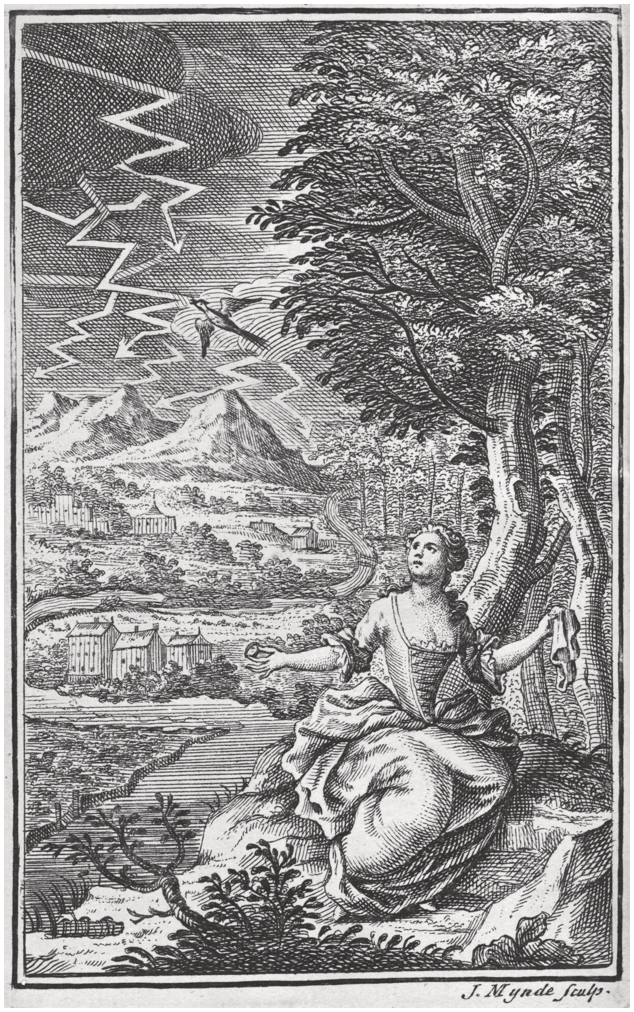
This image reminds me of another paper that once held me riveted, by Carolyn Davis, then a PhD student completing a dissertation on forms of “imagined intimacy” in transatlantic eighteenth-century literature. The paper, presented at the 2015 meeting of the Canadian Society for Eighteenth-Century Studies in Vancouver, was on the friendship between Phillis Wheatley and Scipio Moorhead, and on the ways of reading that we must cultivate in order to perceive this relationship more clearly than historical research has made possible. The “kinds of encounters” that constituted such relationships, Davis writes, “might not be visible in the historical record, but these small moments make up the affective imaginary of friendship. Thus, I am less concerned with whether this friendship existed in a more tangible fashion, and I am instead asking what it might mean if such a friendship did occur.”Footnote 115 Davis offers a reading of the portrait of Wheatley that appears as the frontispiece to the published collection of her poems, a portrait conventionally attributed to Moorhead, though the idea that the engraving “began as a pencil-drawn portrait done by Scipio Moorehead continues to circulate within academic writing despite no clear origination point.” Having made this observation, rather than bring historicist discipline to bear on the uncertainty of the archive, Davis allows the uncertainty of archival evidence to animate a different way of thinking into the material at hand: “I too am taken,” she writes, “with the idea of a fellow black artist creating a visual representation of Wheatley that continues to provide access to the black imaginary of her poetry.”Footnote 116 Focusing in particular on the trajectory of Wheatley’s gaze, which, like Eovaai’s in her frontispiece, is directed toward the upper left corner of the image, Davis takes us with her, via imagined forms, to show us what the portrait knows:
With the friendship of Phillis Wheatley and Scipio Moorhead, and his original drawing of this portrait, at the forefront of my reading, the image provides insight into Wheatley’s affective creative spirit.… To Scipio Moorhead she is a friend of the heart, and with him she would gladly spend eternity creating art and exploring the universe. Despite the words establishing ownership and that “restrict the extent of her gaze,” the portrait subject’s gaze feels unconfined and introspective; she is immersed in the heady space of creative imagination. Perhaps SM drew this portrait while she wrote her own everlasting textual portrait of their friendship, and in this moment when she looked up and inward for inspiration, he immortalized the black friendship that was visible to those with eyes to see.Footnote 117
I will confess that when I heard this reading presented at the conference, my heart fluttered. In its wake, more seemed possible – in reading practices, in eighteenth-century scholarship, in friendship as a way of knowing and of being.
In July 2020, as I like so many academics had tried to work in the isolated conditions compelled by COVID-19, and as militarized police forces continued to intensify their violent response to Black Lives Matter protests across North America, Davis published a guest blog post excoriating universities for their sustaining of anti-Black racism.Footnote 118 “White supremacy is the lifeblood of academia,” she writes, “and I learned that the hard way.” The piece concludes,
Until this country’s mostly white tenured faculty recognize and relinquish the white supremacist power they hold over so many futures, academia will never be a home for black, indigenous, and other POC to flourish. I truly believe that much of academia’s racism is because so many of the people in it see race as a theoretical exercise. Academia is, at best, a roomful of people with delusions of grandeur. It neither serves nor deserves us.Footnote 119
One of the lessons of Davis’s refusal to continue to work in an institution animated by such toxic blood is that, if we wish to carry academia forward in some form, we must refuse to reproduce it as an institution that teaches anything “the hard way.” Learning can be difficult without being cruel, without being organized through economies of annihilation. We are creatures of complex intellect: We can plunge into the challenge of thinking at our limits and experience struggle and joy interwoven. But it requires wholly new ways of imagining our relationships and responsibilities to each other and to the world we think in and through – ones that require deliberate, sustained divestments of power that we have been trained by the profession to desire, to hoard, and to exercise over others.
It has been nearly a quarter century since Hortense Spillers wrote of the racist disciplining of flesh into forms of cultural value:
dominant symbolic activity, the ruling episteme that releases the dynamics of naming and valuation, remains grounded in the originating metaphors of captivity and mutilation so that it is as if neither time nor history, nor historiography and its topics, shows movement, as the human subject is “murdered” over and over again by the passions of a bloodless and anonymous archaism, showing itself in endless disguise. Faulkner’s young Chick Mallison in The Mansion calls “it” by other names – “the ancient subterrene atavistic fear.…” And I would call it the Great Long National Shame. But people do not talk like that anymore – it is “embarrassing,” just as the retrieval of mutilated female bodies will likely be “backward” for some people. Neither the shameface of the embarrassed, nor the not-looking-back of the self-assured is of much interest to us, and will not help at all if rigor is our dream.Footnote 120
We have not yet overturned the economy of academic dignity that allows the atrocities of racism and other cruel epistemes to masquerade as reason. It takes an immense amount of courage to risk not being taken seriously in academic settings; it takes an immense amount of courage to walk away from dominant sites of knowledge work when they show themselves incapable of thinking with us on just terms. But I am arguing that these are precisely the risks we need to take if we want our work to matter. We who have been “professionalized” in order to make sure our scholarly work reproduces institutional value, even as those institutions continue to extract that work on dehumanizing terms – and particularly those of us who have benefited from forms of racialized, economic, gendered, and other material forms of imperialist privilege – must learn to go gloriously, anamorphically flaccid if we are to make ourselves useful to the urgent liberation projects of, in Christina Sharpe’s words, “becoming undisciplined.”Footnote 121 We must learn to speak in tongues that distort the killing conceptual logics of colonial patriarchal power. We must learn to listen differently and to be intelligible to one another first and foremost, even when it sounds silly to the corrupt wizards so desperate to be in charge.
The fascinum moves us in this direction. Liberal hermeneutics have encouraged us to read in modes of “identification,” to look for versions of ourselves in the figures that appear to us in text. The fascinum disrupts that reproduction of the subject that is always also a disciplining of the strange. A text like Eovaai can be read otherwise than as an allegory for a particular subject formation, or for subject formation at all; we can learn to think with it in defiance of rigor, to be carried by the ways of thinking it renders imaginable to unpredictable arrivals. Laughter and other responses to the funny are a crucial aspect of the embodied syntax of thought in flight; they indicate our readiness to be stolen away from oppressive grammars, to be reoriented into unforeseen kinships with others, to find unscripted pleasure in overscripted conditions, to make and be given to differently meaningful movements.
***
When our attention is taken by something funny, the substance of our selfhood is signaling its readiness for something else. Eovaai and the other eighteenth-century texts I read in the parts that follow are all part of the discursive ether in which, lashing through by tail and by fin, we might train ourselves to imagine that elsewhere, and the rearrangements of power, relation, and value we must make to move ourselves there together.
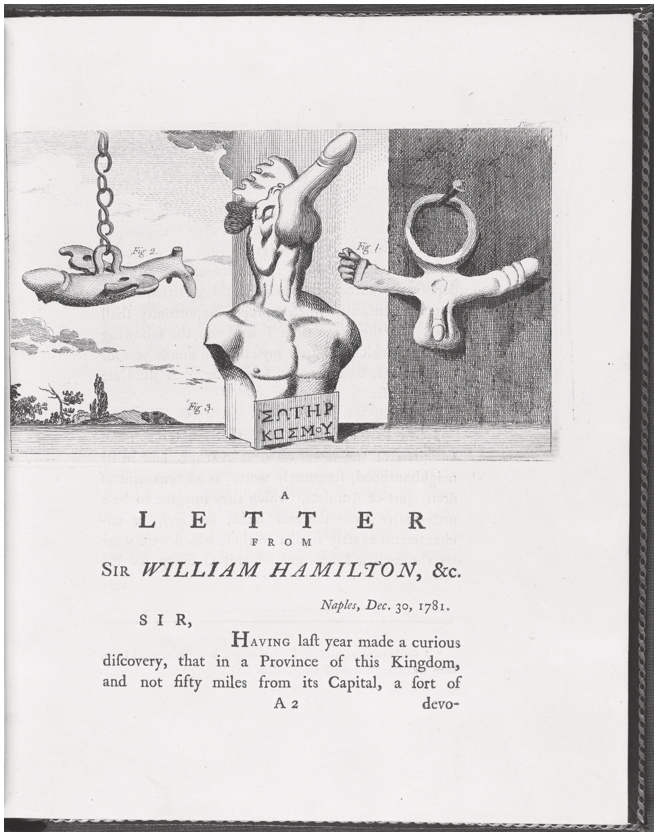
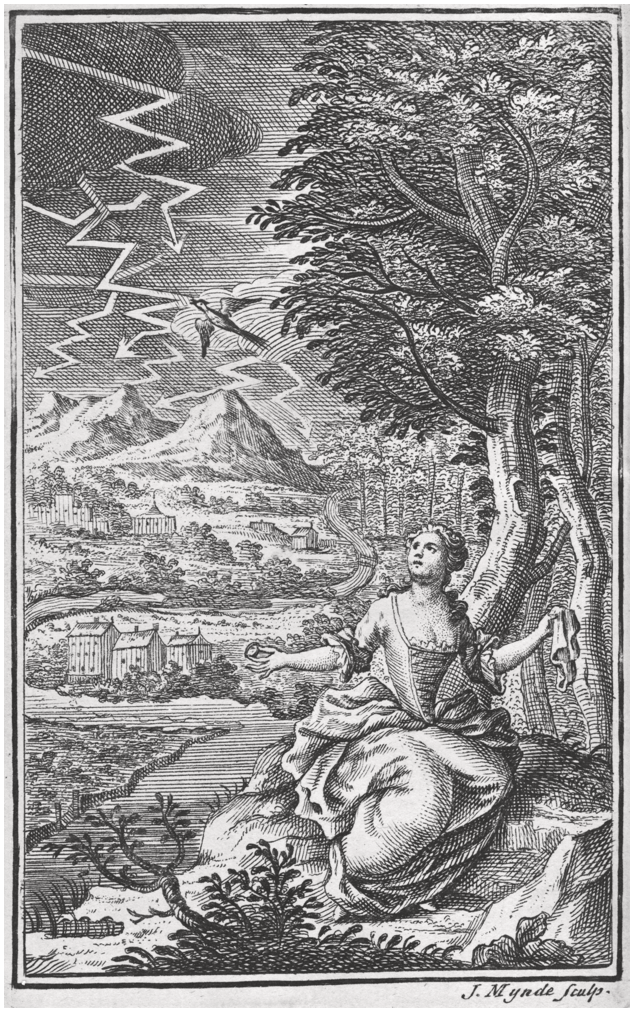

 Open access