

The world is grappling with the acute respiratory disease (coronavirus disease 2019 [COVID-19]) pandemic caused by the SARS-CoV-2 novel coronavirus that has systematically devastated individual lives, healthcare systems, and global economies. Since its reported origin in Wuhan, China, in December 2019, the number of recorded COVID-19 cases has risen exponentially to encompass almost every single country and continent. At the time of writing (September 2021), the World Health Organization registers over 200 million confirmed cases of COVID-19 and over 4 million deaths. To date, the highest number of confirmed cases has been recorded in the United States, closely followed by India, Brazil, and Russia (World Health Organization, 2021).
In addition to the staggering loss of lives, this pandemic is disrupting organizational practices in unimaginable ways (Stephens et al., Reference Stephens, Jahn, Fox, Charoensap-Kelly, Mitra, Sutton and Meisenbach2020). With state-imposed social-distancing guidelines and lockdown measures (Gershman, Reference Gershman2020), businesses have quickly pivoted to teleworking, temporarily or permanently closing, and providing amenities to keep employees healthy, while striving to still meet the needs of consumers and other stakeholders (Kniffin et al., Reference Kniffin, Narayanan, Anseel, Antonakis, Ashford, Bakker and Vugt2021). Employees have been challenged to adapt to these new organizational structures, as they struggle to balance their regular work routine with anxiety about the pandemic, caring for loved ones, and personal health and wellness (Kocjan, Kavčič, & Avsec, Reference Kocjan, Kavčič and Avsec2021; Xiong et al., Reference Xiong, Lipsitz, Nasri, Lui, Gill, Phan and McIntyre2020). These stressful demands have impacted employee well-being, job productivity, and relational satisfaction at work, all of which constitute the focus of this study.
Previous research has suggested that an organization's capacity to build resilience and successfully manage crises depends largely on its ability to capitalize on employee resilience (Näswall, Kuntz, Hodliffe, & Malinen, Reference Näswall, Kuntz, Hodliffe and Malinen2013). By examining employees' experiences during this massive global upheaval, this study is apt to test the robustness of existing resilience constructs and known relationships. Many COVID-19 studies in organizational settings focused on work performance (e.g., Aguiar-Quintana, Nguyen, Araujo-Cabrera, & Sanabria-Díaz, Reference Aguiar-Quintana, Nguyen, Araujo-Cabrera and Sanabria-Díaz2021; Fischer, Reade, & Schmal, Reference Fischer, Reade and Schmal2021; Feng & Savani, Reference Feng and Savani2020) and only a few explored employee relationships (e.g., Bulińska-Stangrecka and Bagieńska, Reference Bulińska-Stangrecka and Bagieńska2021). Thorough searches on Google Scholar and relevant electronic databases (i.e., Academic Search Complete, Business Source Complete, Communication Source, EconLit, PsycInfo, and Vocational and Career Collection) using such keywords as resilience, COVID-19, productivity, workgroup satisfaction, and similar terms revealed only a few studies that empirically examined the impact of resilience on both task outcomes (i.e., productivity) and relationship outcomes (i.e., satisfaction with coworkers) of employees across countries during the early days of the pandemic (e.g., Prochazka et al., Reference Prochazka, Scheel, Pirozek, Kratochvil, Civilotti, Bollo and Maran2020). In addition, results on the association between personality traits and mental health during the pandemic are currently inconclusive (Wijngaards, Sisouw de Zilwa, & Burger, Reference Wijngaards, Sisouw de Zilwa and Burger2020). Ungar (Reference Ungar2013, Reference Ungar2017) also noted that much of the research on resilience is grounded in a Western-centric value system that often ignores cultural dimensions and called for an incorporation of culture into resilience research. Hence, this study examines the direct and indirect effects of resilience on both productivity and workplace relational satisfaction through the mediating role of well-being during the early stages of the COVID-19 pandemic. We also investigate how the effect of employee resilience is moderated (i.e., dampened or amplified) by personality type and culture when controlling for organizational variables (i.e., job rank, employment duration, and organizational size) and individual demographics (i.e., age, gender, and education). In doing so, we address calls for organizational researchers to help individuals and organizations mitigate and manage adverse impacts of COVID-19 on psychological well-being as well as task and relational dimensions of organizational outcomes (Kniffin et al., Reference Kniffin, Narayanan, Anseel, Antonakis, Ashford, Bakker and Vugt2021; Stephens et al., Reference Stephens, Jahn, Fox, Charoensap-Kelly, Mitra, Sutton and Meisenbach2020).
Considering recent negative economic trends coupled with predictions of a long-term global recession from COVID-19, this research is poised to provide organizational leaders with valuable insight into how best to support different employee personality types, ensure employees' psychological well-being, maintain or boost productivity, and promote enduring positive workplace relationships. Drawing on social cognitive theory (SCT), we adopt a cross-cultural examination by contrasting three different countries (i.e., the United States, Croatia, and Thailand) to understand how employees from these cultures responded to workplace disruptions at the onset of the pandemic, while also contributing new insight into the employee resilience literature. We now outline the theoretical framework for this research.
Social cognitive theory and employee resilience
Resilience, broadly defined as positive adaptation in the face of adversity (Fleming & Ledogar, Reference Fleming and Ledogar2008), first received scholarly attention in the 1970s when developmental and clinical psychologists examined why some children were harmfully affected by adverse experiences whereas others thrived despite them (e.g., Garmezy, Reference Garmezy1971). Within the organizational context, researchers have studied resilience mainly as: (1) an individual trait or capacity and (2) a process (Cheng, King, & Oswald, Reference Cheng, King and Oswald2020). Although the former regards resilience as an individual characteristic leading to positive responses to adversity (Smith, Dalen, Wiggins, Tooley, Christopher, & Bernard, Reference Smith, Dalen, Wiggins, Tooley, Christopher and Bernard2008), the latter focuses on the dynamic processes under which resilience develops and evolves (McLarnon & Rothstein, Reference McLarnon and Rothstein2013). Organizational researchers have also examined resilience at various levels of analysis including employee resilience, team resilience, and organizational resilience (Hartmann, Weiss, Newman, & Hoegl, Reference Hartmann, Weiss, Newman and Hoegl2020). In this study, we focus on employee resilience and regard it as a state-like developable individual capacity (Luthans, Avolio, Avey, & Norman, Reference Luthans, Avolio, Avey and Norman2007) that is simultaneously influenced by internal (i.e., personality) and external factors (i.e., cultural contexts) (Herrenkohl, Reference Herrenkohl2013; Näswall et al., Reference Näswall, Kuntz, Hodliffe and Malinen2013). In line with Smith et al. (Reference Smith, Dalen, Wiggins, Tooley, Christopher and Bernard2008), we define resilience as the ability to bounce back in the face or wake of adversity and focus on how individual employees' ability to withstand challenges shapes their organizational experience during the COVID-19 pandemic.
This view of resilience aligns with SCT which explains psychosocial functioning in terms of the dynamic, reciprocal, and continuous relationships between personal factors, environmental influences, and behavior (Bandura, Reference Bandura1988). All three elements interact with and upon one another to determine behavior (Bandura, Reference Bandura, Smelser and Baltes2001). A linchpin of SCT is the concept of self-efficacy or one's belief in one's own ability to persevere or accomplish goals across challenging situations (Lightsey, Reference Lightsey2006). Researchers have acknowledged the close connection between self-efficacy and resilience (Lightsey, Reference Lightsey2006; Milaković, Reference Milaković2021; Ojo, Fawehinmi, & Yusliza, Reference Ojo, Fawehinmi and Yusliza2021; Schwarzer & Warner, Reference Schwarzer, Warner, Prince-Embury and Saklofske2013) and suggested that a generalized belief in one's self-efficacy is a central component of resilience and posttraumatic growth (Hamill, Reference Hamill2003; Lightsey, Reference Lightsey2006; Schwarzer & Warner, Reference Schwarzer, Warner, Prince-Embury and Saklofske2013). Furthermore, Bandura (Reference Bandura1988) argues that SCT provides guidelines for equipping people with a resilient sense of efficacy that promotes their psychological well-being and personal accomplishments. Hence, SCT can serve as a helpful framework for examining resilience in the workplace (Hartmann et al., Reference Hartmann, Weiss, Newman and Hoegl2020; Lightsey, Reference Lightsey2006). In the context of COVID-19, it is likely that employees' resilience would interact with their personality and culture to shape their psychological well-being which, in turn, predict their task and relational outcomes at work.
It has been theorized that resilient individuals have a repertoire of promotive personal resources (e.g., self-efficacy, optimism, and emotional regulation) or environmental resources (e.g., organizational practices and social support) that they utilize to manage and ultimately transcend adverse events (Hartmann et al., Reference Hartmann, Weiss, Newman and Hoegl2020; Youssef & Luthans, Reference Youssef and Luthans2007). Resilient employees possess characteristics such as enthusiasm, hope, a high degree of autonomy, self-awareness, flexibility and adaptability, a sense of confidence, and the ability to find meaning from challenging situations (Ojo, Fawehinmi, & Yusliza, Reference Ojo, Fawehinmi and Yusliza2021; Parker, Jimmieson, Walsh, & Loakes, Reference Parker, Jimmieson, Walsh and Loakes2015). Empirical research has found positive relationships between employee resilience and work happiness, job satisfaction (Youssef & Luthans, Reference Youssef and Luthans2007), job performance (Luthans et al., Reference Luthans, Avolio, Avey and Norman2007), and work engagement (Mache, Vitzthum, Wanke, David, Klapp, & Danzer, Reference Mache, Vitzthum, Wanke, David, Klapp and Danzer2014). Employee resilience has also been linked with fewer interpersonal counterproductive work behaviors and lower emotional exhaustion (Shoss, Jiang, & Probst, Reference Shoss, Jiang and Probst2018). Evidently, resilience is vital for coping with stress and staying in balance amid the multifaceted challenges presented by COVID-19 (Vinkers et al., Reference Vinkers, van Amelsvoort, Bisson, Branchi, Cryan, Domschke and van der Wee2020).
Well-being, productivity, and relational satisfaction during COVID-19
During the onset of the COVID-19 pandemic in 2020, many were suddenly forced to work from home, quickly adapt to new platforms and technologies, and balance work–life responsibilities (Ojo, Fawehinmi, & Yusliza, Reference Ojo, Fawehinmi and Yusliza2021). Some even confronted impending decreases in work hours and job termination (Mojtahedi et al., Reference Mojtahedi, Dagnall, Denovan, Clough, Hull, Canning and Papageorgiou2021). All these drastic workplace changes increased emotional stress and concerns for the health and safety of loved ones as well as oneself (Kocjan, Kavčič, & Avsec, Reference Kocjan, Kavčič and Avsec2021; Xiong et al., Reference Xiong, Lipsitz, Nasri, Lui, Gill, Phan and McIntyre2020). Previous research has suggested stressors such as these are likely to lower employee well-being (Mojtahedi et al., Reference Mojtahedi, Dagnall, Denovan, Clough, Hull, Canning and Papageorgiou2021; Zacher & Rudolph, Reference Zacher and Rudolph2021), and in turn decrease job productivity (Toscano & Zappalà, Reference Toscano and Zappalà2020) and strain workplace relationships (Kaushik & Guleria, Reference Kaushik and Guleria2020). Against this backdrop, this study focuses on three outcome variables pertinent to workers worldwide during the early days of the COVID-19 pandemic: psychological well-being, productivity, and relational satisfaction at work (Galanti, Guidetti, Mazzei, Zappalà, & Toscano, Reference Galanti, Guidetti, Mazzei, Zappalà and Toscano2021; Kaushik & Guleria, Reference Kaushik and Guleria2020; Kniffin et al., Reference Kniffin, Narayanan, Anseel, Antonakis, Ashford, Bakker and Vugt2021).
In this study, psychological well-being is defined as one's levels of positive affective states, functioning, and quality of life (Topp, Østergaard, Søndergaard, & Bech, Reference Topp, Østergaard, Søndergaard and Bech2015; Winefield, Gill, Taylor, & Pilkington, Reference Winefield, Gill, Taylor and Pilkington2012). The impact of COVID-19 on employee well-being has been well-documented with multiple studies reporting an increase in employees' anxiety, depression, and stress compared to the pre-pandemic era (Labrague & De los Santos, Reference Labrague and De los Santos2020; Mojtahedi et al., Reference Mojtahedi, Dagnall, Denovan, Clough, Hull, Canning and Papageorgiou2021; Zacher & Rudolph, Reference Zacher and Rudolph2021).
Productivity refers to one's ability to concentrate and accomplish work (Koopman et al., Reference Koopman, Pelletier, Murray, Sharda, Berger, Turpin and Bendel2002). Previous research has indicated that, during lockdowns, women reported lower work productivity compared to men due to increased housework and childcare (Feng & Savani, Reference Feng and Savani2020). Also, Galanti et al. (Reference Galanti, Guidetti, Mazzei, Zappalà and Toscano2021) found that employees' family–work conflict and social isolation were negatively associated, while self-leadership and autonomy were positively related, with work from home productivity. A recent study found that soccer players – among the fittest individuals – faced a substantial and persistent drop in their work performance by 5% after an infection with COVID-19 and this negative effect seems to create spillovers on team performance. The researchers suggest that COVID-19 is likely to remain an important, long-term impact on productivity (Fischer, Reade, & Schmal, Reference Fischer, Reade and Schmal2021).
Relational satisfaction at work concerns how content or satisfied one is with workplace social relationships (Cammann, Fichman, Jenkins, & Klesh, Reference Cammann, Fichman, Jenkins, Klesh, Seashore, Lawler, Mirvis and Cammann1983). Positive relations at work are characterized by high-quality interactions between coworkers and contribute to job satisfaction (Bulińska-Stangrecka & Bagieńska, Reference Bulińska-Stangrecka and Bagieńska2021), organizational commitment (Lee, Teng, & Chen, Reference Lee, Teng and Chen2015), organizational citizenship behavior (Lam & Lau, Reference Lam and Lau2012), employee motivation, and intention to stay (Basford & Offermann, Reference Basford and Offermann2012), to name a few. With the increase in remote working, job stress, and limited social connections caused by the pandemic (Bulińska-Stangrecka & Bagieńska, Reference Bulińska-Stangrecka and Bagieńska2021), it is likely that employees face more communication barriers (e.g., lack of feedback or work-related information), experience workplace loneliness (Çolak & Çetin, Reference Çolak and Çetin2021; Lam & Lau, Reference Lam and Lau2012), and feel less satisfied with their work groups (Andel, Shen, & Arvan, Reference Andel, Shen and Arvan2021; Venkataramani, Labianca, & Grosser, Reference Venkataramani, Labianca and Grosser2013).
Taken together, employees' decreased well-being, lowered productivity, and unsatisfactory workplace relationships can negatively impact team collaboration and eventually organizations' bottom line (Donald, Taylor, Johnson, Cooper, Cartwright, & Robertson, Reference Donald, Taylor, Johnson, Cooper, Cartwright and Robertson2005; Harter, Schmidt, & Keyes, Reference Harter, Schmidt, Keyes, Keyes and Haidt2003; Lam & Lau, Reference Lam and Lau2012). Consequently, it is critical to identify factors that can promote positive mental health at work while also maintaining productivity and satisfactory workplace relationships during this global crisis. Previous research has shown that resilience is positively related to employee well-being (Britt, Shen, Sinclair, Grossman, & Klieger, Reference Britt, Shen, Sinclair, Grossman and Klieger2016) and buffers employees from negative experiences, enabling them to maintain high levels of motivation and productivity despite disruptions (Hartmann et al., Reference Hartmann, Weiss, Newman and Hoegl2020). Resilient individuals are also able to maintain a positive outlook and boost morale, which can facilitate the collective coping process (Tugade & Fredrickson, Reference Tugade and Fredrickson2004) and promote relational health (Afifi, Merrill, & Davis, Reference Afifi, Merrill and Davis2016). We, therefore, pose:
Hypothesis 1: Employee resilience will be positively associated with (a) psychological well-being, (b) productivity, and (c) relational satisfaction at work during the COVID-19 pandemic.
In addition to the direct effect of resilience on productivity and relational satisfaction, this study will also examine the indirect effect of resilience through the mediating role of well-being. Rodrigues (Reference Rodrigues2019) reported that work engagement, as a positive construct of well-being, mediated the relationship between resilience and performance. Similarly, well-being has been associated with productivity (Koopman et al., Reference Koopman, Pelletier, Murray, Sharda, Berger, Turpin and Bendel2002) and positive social interaction at work (Stoll, Michaelson, & Seaford, Reference Stoll, Michaelson and Seaford2012). Therefore, we postulate that resilience will boost psychological well-being which, in turn, will positively predict workplace productivity and relational satisfaction with coworkers. Hence:
Hypothesis 2: Psychological well-being will mediate the relationship between employee resilience and (a) productivity, and (b) relational satisfaction at work during the COVID-19 pandemic.
Personality
Although personality traits are inherent in an individual's nature and can be difficult to change, studies have shown that they can impact how individuals adapt to episodic and ongoing stress alike (Löckenhoff, Terracciano, Patriciu, Eaton, & Costa, Reference Löckenhoff, Terracciano, Patriciu, Eaton and Costa2009), including their well-being at work (Zeidner, Hadar, Matthews, & Roberts, Reference Zeidner, Hadar, Matthews and Roberts2013), resilience during stressful events (Carver & Connor-Smith, Reference Carver and Connor-Smith2010), job performance (Hurtz & Donovan, Reference Hurtz and Donovan2000), and the development of interpersonal relationships at work (Hough & Furnham, Reference Hough, Furnham, Borman, Ilgen and Klimoski2003). Goldberg (Reference Goldberg1990) suggests that personality comprises five dimensions, namely: extraversion (being talkative and outgoing), agreeableness (being sympathetic and warm), neuroticism (being short-tempered and unstable), conscientiousness (being organized and prompt), and openness to experience (being creative and curious). This study considers one of these personality dimensions that has a well-established connection with an individual's resilience following a traumatic event: extraversion (Judge, Higgins, Thoresen, & Barrick, Reference Judge, Higgins, Thoresen and Barrick1999).
According to Jung (Reference Jung1971), extraversion and introversion are the major orientations of personality. An individual's extraversion–introversion preference is determined by the way in which they direct their general interest; with extraverts focusing on the external and introverts focusing on the internal. Extraversion is characterized by excitability, sociability, talkativeness, assertiveness, and high amounts of emotional expressiveness (Power & Pluess, Reference Power and Pluess2015). People who are high in extraversion tend to seek out social stimulation and opportunities to engage with others. On the contrary, those who are low in extraversion (or introverted) tend to be more reserved and less involved in social situations (Condon & Ruth-Sahd, Reference Condon and Ruth-Sahd2013).
Previous examinations on the relationship between extraversion and mental health during COVID-19 have reported conflicting findings. For example, Nikčević, Marino, Kolubinski, Leach, and Spada (Reference Nikčević, Marino, Kolubinski, Leach and Spada2021) found that extraversion was linked with decreased anxiety whereas Kocjan, Kavčič, and Avsec (Reference Kocjan, Kavčič and Avsec2021) and Zacher and Rudolph (Reference Zacher and Rudolph2021) reported extraversion was linked with increased stress. Also, Wijngaards, Sisouw de Zilwa, and Burger (Reference Wijngaards, Sisouw de Zilwa and Burger2020) suggested that introverts fare better than extroverts when living with governments' imposed stringent measures. These inconclusive findings may be attributable to the exceptional circumstances of the pandemic and the stringent measures (e.g., lockdowns and social distancing) imposed to curb the spread of the virus (Kocjan, Kavčič, & Avsec, Reference Kocjan, Kavčič and Avsec2021). Also, research on the relationship between personality and work productivity during COVID-19 is still limited (Günaydin, Reference Günaydin2021). Similarly, we have yet to understand if or to what extent satisfaction with workplace relationships varies by personality type during the early days of the pandemic (Biron, Peretz, & Turgeman-Lupo, Reference Biron, Peretz and Turgeman-Lupo2020; Kaushik & Guleria, Reference Kaushik and Guleria2020).
From the SCT perspective, personality may influence how individuals assess their efficacy (or resilience) which would then determine their behavior (Hartmann et al., Reference Hartmann, Weiss, Newman and Hoegl2020; Lightsey, Reference Lightsey2006). Researchers have identified several traits of extraversion that can predict an individual's behavior. For instance, extraverted individuals experience more positive emotions (Watson & Clark, Reference Watson and Clark1992). They also tend to be more assertive, dominant, and ambitious, and are generally perceived as more successful leaders (Zopiatis & Constanti, Reference Zopiatis and Constanti2012). Their tendency to reappraise and reframe problems in a positive light when faced with stress (Carver & Connor-Smith, Reference Carver and Connor-Smith2010) protects extraverts from experiencing burnout (Bakker, Van der Zee, Lewig, & Dollard, Reference Bakker, Van der Zee, Lewig and Dollard2006). High levels of extraversion have been linked to post-traumatic growth among emergency service workers (Shakespeare-Finch, Gow, & Smith, Reference Shakespeare-Finch, Gow and Smith2005), and extraverted women also display resilience that enables them to pursue career advancement (Khalid & Sekiguchi, Reference Khalid and Sekiguchi2019). Additionally, extraverted managers are more likely to display agency-related characteristics (e.g., assertiveness, activity, ambition, and persuasiveness) and thus perform better than introverted managers (Minbashian, Bright, & Bird, Reference Minbashian, Bright and Bird2009). Because they tend to be social and bold in nature, extraverted individuals form and maintain interpersonal relationships at work, and perceive those relationships to be of higher quality (Kalish & Robins, Reference Kalish and Robins2006). Following these past studies, we hypothesize:
Hypothesis 3: Extraverted individuals will report higher levels of (a) well-being, (b) productivity, and (c) relational satisfaction at work during the COVID-19 pandemic.
Interactive effects of resilience, personality, and culture
An individual's unique adaptation to a traumatic event is an interaction between personality and the trauma context (Saakvitne, Tennen, & Affleck, Reference Saakvitne, Tennen and Affleck1998). According to SCT, ‘employees are producers of their personality, behavior, and environment, yet at the same time are products of it’ (Hartmann et al., Reference Hartmann, Weiss, Newman and Hoegl2020, p. 946). Therefore, an investigation of employee resilience as a developable capacity must necessarily also consider how personality and cultural factors might moderate the impact of resilience. Since extraversion is closely linked to positive reappraisal, which then fosters resilience, it is likely that extraverted employees with high resilience will exhibit greater well-being (Carver & Connor-Smith, Reference Carver and Connor-Smith2010), productivity (Minbashian, Bright, & Bird, Reference Minbashian, Bright and Bird2009), and relational satisfaction compared to introverted employees (Kalish & Robins, Reference Kalish and Robins2006). The moderating effect of culture is also highly likely given the strong relationships between specific cultural dimensions and resilience. For example, employees with high horizontal collectivism values were found to be more resilient to workplace incivility, while those with high horizontal individualism values displayed less resilience (Welbourne, Gangadharan, & Sariol, Reference Welbourne, Gangadharan and Sariol2015). Also, previous research has shown that collectivistic orientations are positively associated with employee well-being (Brougham & Haar, Reference Brougham and Haar2013; Rego & Cunha, Reference Rego and Cunha2009), productivity (Papamarcos, Latshaw, & Watson, Reference Papamarcos, Latshaw and Watson2007; Tjosvold, Law, & Sun, Reference Tjosvold, Law and Sun2003), and satisfaction at work (Hui, Yee, & Eastman, Reference Hui, Yee and Eastman1995). To examine how cultural differences might moderate the effect of employee resilience during the COVID-19 pandemic, we strategically selected the United States, Croatia, and Thailand for the following reasons.
First, the three countries hold different cultural values (Hofstede, Reference Hofstede1980). Based on Hofstede's cultural dimensions model, the United States generally scores much lower on power distance and much higher on individualism than both Croatia and Thailand. Most US organizations prioritize competition, achievement, and success reflecting high masculinity. By comparison, Croatia and Thailand are more collectivistic societies with higher power distance and uncertainty avoidance. Croatians and Thais generally tend to prioritize caring for others and loyalty to one's community, accepting hierarchical structures, and following orders. Furthermore, Croatia and Thailand are typically described as more feminine cultures, meaning that employees tend to favor both team solidarity and the overall well-being of their work lives, as well as leisure time and flexible schedules (Hofstede Insights., 2020).
Second, each of these countries has displayed a markedly different response to the COVID-19 pandemic using a different disease control measure. As of April 1, 2020, Croatia scored 96.30, Thailand scored 68.06, and the United States scored 72.69 on the COVID-19 Government Response Stringency Index which measures the variation in governments' response to COVID-19 based on public policies such as workplace closures, travel bans, cancellation of public events, stay-at-home orders, etc. on a 0–100 scale (Hale et al., Reference Hale, Angrist, Goldszmidt, Kira, Petherick, Phillips and Tatlow2021). These government responses play a role in mental health as a large-scale survey covering 58 countries at the onset of the COVID-19 pandemic revealed that citizens' perception of an insufficient public and government response was associated with lower mental well-being (Fetzer et al., Reference Fetzer, Witte, Hensel, Jachimowicz, Haushofer, Ivchenko and Yoeli2020). Also, the United States currently registers the highest number of positive cases and COVID-19 deaths (World Health Organization, 2021). By comparison, Croatia and Thailand were more successful in ‘flattening the curve’ (Stevis-Gridneff, Reference Stevis-Gridneff2020).
A third factor that enabled selecting these particular countries is that two authors hail from these countries and therefore had access to research participants in Croatia and Thailand. These three countries collectively present distinct regional snapshots of employee experiences during COVID-19 across three continents. Aligned with SCT's proposition that human behavior is determined by personal and environmental factors, it is likely that the effect of employees' resilience on positive outcomes will be moderated or vary by their culture and personality type. Therefore, we propose a hypothesized model shown in Figure 1:
Hypothesis 4: During the COVID-19 pandemic, culture will moderate the indirect effect of resilience on (a) productivity and (b) relational satisfaction at work through the mediating role of psychological well-being.
Hypothesis 5: During the COVID-19 pandemic, personality type will moderate the indirect effect of resilience on (a) productivity and (b) relational satisfaction at work through the mediating role of psychological well-being.
Hypothesized model.

Control variables: job rank, employment duration, organizational size, and demographic variables
Previous research has suggested a positive impact of job titles on productivity (Martinez, Laird, Martin, & Ferris, Reference Martinez, Laird, Martin and Ferris2008) and job satisfaction (Al-Zoubi, Reference Al-Zoubi2012). Additionally, some argue that job tenure is associated with better job performance because employees gained more tacit knowledge about how to perform their jobs effectively over time (Schmidt, Hunter, & Outerbridge, Reference Schmidt, Hunter and Outerbridge1986). Furthermore, research (New Economics Foundation., 2014) suggests that individuals within smaller organizations report higher levels of well-being at work than those working for larger organizations. Moreover, previous studies examining the impact of COVID-19 on mental health found a positive relationship between age and subjective well-being (Kocjan, Kavčič, & Avsec, Reference Kocjan, Kavčič and Avsec2021; Xiong et al., Reference Xiong, Lipsitz, Nasri, Lui, Gill, Phan and McIntyre2020). Women also reported higher levels of mental health problems compared to men (Kocjan, Kavčič, & Avsec, Reference Kocjan, Kavčič and Avsec2021; Plomecka et al., Reference Plomecka, Gobbi, Neckels, Radziński, Skórko, Lazerri and Jawaid2020; Rossi et al., Reference Rossi, Socci, Talevi, Mensi, Niolu, Pacitti and Di Lorenzo2020; Xiong et al., Reference Xiong, Lipsitz, Nasri, Lui, Gill, Phan and McIntyre2020) and the participants with higher levels of education reported higher subjective well-being compared to those with lower education (Kocjan, Kavčič, & Avsec, Reference Kocjan, Kavčič and Avsec2021). These findings suggest that job rank, employment duration, organizational size, age, gender, and education may influence our dependent variables (DVs). Therefore, we will account for these organizational and demographic variables to assess more accurately how much variance in productivity and relational satisfaction is attributable to resilience and well-being, as well as all interactions.
Method
Participants
This is part of a larger international research project about the impact of the COVID-19 pandemic on various aspects of life. The data reported in this paper concern workplace settings and include a total of 832 participants from the United States (n = 321), Croatia (n = 265), and Thailand (n = 246). Participants were working adults with a full-time or part-time job and held various job positions ranging from entry-level to company ownership at small to large organizations from various industries. Within the US sample, approximately 82% of participants self-identified as Caucasian, 4% as Black/African American, 3% as Asian, 2% as Hispanic/Latino, 6% as multiracial, and the remainder (2%) did not identify their ethnicity. All other demographic characteristics are detailed in Table 1.
Demographic Characteristics (N = 832)
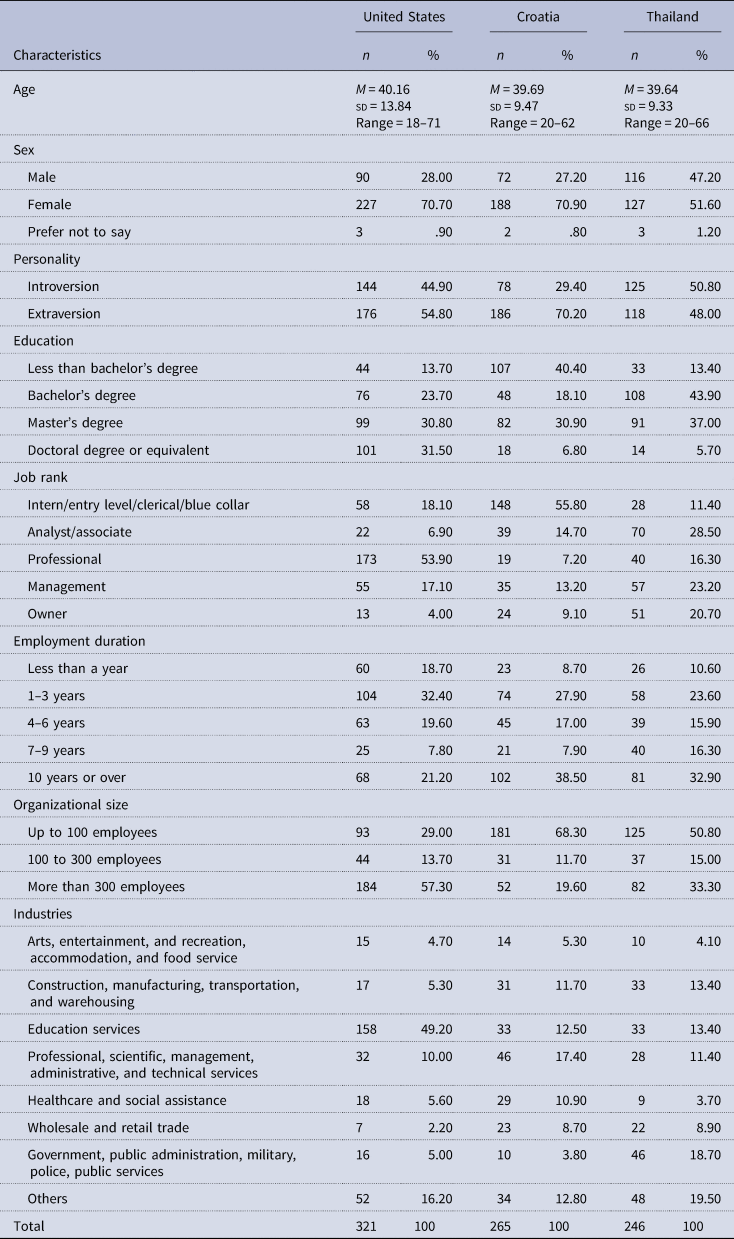
Note: Some variables do not add up to 100% due to missing data.
Procedures
Following Institutional Review Board approval, participants were recruited using convenience and snowball/network sampling. Recruitment channels included personal email invitations, social media platforms (LinkedIn, Reddit, Facebook groups dealing with COVID-19 as well as Facebook ads), and public listservs of professional organizations. Potential participants were asked to complete an online questionnaire and forward it to coworkers. No incentive was provided for participation. Questionnaires were administered in English, Croatian, and Thai. The Croatian and Thai questionnaires were translated by two of the authors and cross-verified by other native Croatian and Thai speakers, respectively, to ensure translational integrity and linguistic equivalence. Data were collected in April and May 2020.
Confirmatory factor invariance analysis (CFIA)
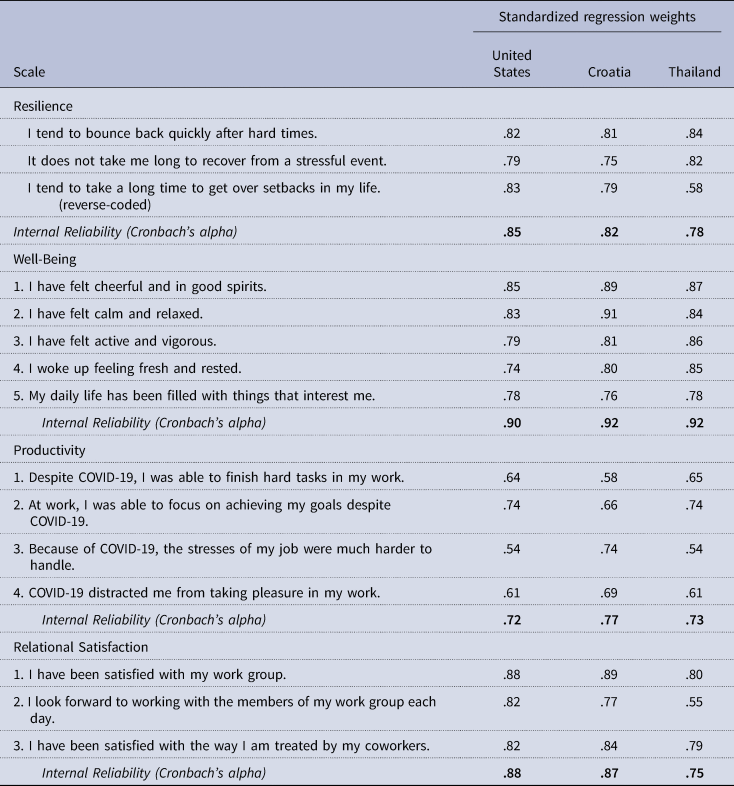
An initial CFIA was conducted using SPSS AMOS 26 to ensure the validity of the focal measures and assess whether the measurement model – comprising resilience, well-being, productivity, and relational satisfaction – could viably be applied to all three cultures. The result indicated that the measurement weights model was significantly different from the unconstrained model, and five scale items (two from the productivity scale and three from the resilience scale) had significantly unequal standardized regression weights across the three samples. This suggested that participants from the three cultures had interpreted those five items differently. Therefore, these items were removed and another CFIA was performed. The revised model fit the data well. The unconstrained model was statistically significant (χ2 = 441.914, df = 252, p < .000, TLI = .960, CFI = .978, RMSEA = .031, SRMR = .039) and no significance was found between the unconstrained model and the measurement weights model, χ2Diff = 30.975, df = 22, p = .097. All scale items were also significant and had acceptable to robust standardized regression weights ranging from .54 to .91 (Stevens, Reference Stevens2012) and acceptable Cronbach's alpha reliability ranging from .72 to .92 (Taber, Reference Taber2018). The final scales (see Table 2) included the following.
Standardized regression weights for confirmatory factor analysis and internal reliabilities of all scales by culture
Measures
The questions used for this paper included multiple-choice questions concerning personal and work demographics and Likert-type scales to measure the variables of interest.
Resilience
Three items from Smith et al.'s (Reference Smith, Dalen, Wiggins, Tooley, Christopher and Bernard2008) unidimensional Brief Resilience Scale (BRS) were used to measure participants' ability to bounce back or recover from stressful events. The BRS is a widely used resilience scale (ranging from strongly disagree [1] to strongly agree [5]) with strong psychometric ratings (Windle, Bennett, & Noyes, Reference Windle, Bennett and Noyes2011). It includes items reflecting behavioral persistence which, following recent research, may be the most relevant to the construct of resilience (Cheng, King, & Oswald, Reference Cheng, King and Oswald2020).
Well-being
The 5-item World Health Organization Well-Being Index (WHO-5) was employed (World Health Organization, 1998). The WHO-5 is among the most widely used questionnaires to assess subjective psychological well-being and is applicable across disciplines (Topp et al., Reference Topp, Østergaard, Søndergaard and Bech2015). The original WHO-5 prompts participants to rate how well each of the five statements (ranging from at no time [1] to all of the time [6]) applies to them within the past 14 days. In this study, we asked participants to consider a full month prior to completing the questionnaire to better capture their well-being during the early stages of the COVID-19 lockdown.
Productivity
A modified version of the Stanford Presenteeism Scale (SPS-6; Koopman et al., Reference Koopman, Pelletier, Murray, Sharda, Berger, Turpin and Bendel2002) was used to assess participants' level of productivity during the early stages of the pandemic. Participants indicated their level of agreement (from strongly disagree [1] to strongly agree [5]) with four statements concerning their work experiences in the month prior to completing the questionnaire. The SPS-6 has demonstrated excellent psychometric characteristics (Koopman et al., Reference Koopman, Pelletier, Murray, Sharda, Berger, Turpin and Bendel2002) and a high degree of reliability and validity suitable for measuring productivity in a diverse employee population (Turpin et al., Reference Turpin, Ozminkowski, Sharda, Collins, Berger, Billotti and Nicholson2004). The scale captured the ability to avoid distractions and complete work despite health problems. For this study, the phrase ‘my [health problem]’ in each item was replaced with ‘COVID-19.’
Relational satisfaction
Relational satisfaction was measured using a modified version of Cammann et al.'s (Reference Cammann, Fichman, Jenkins, Klesh, Seashore, Lawler, Mirvis and Cammann1983) satisfaction with workgroup subscale from the Michigan Organizational Assessment Questionnaire. Previous research using this scale reported high internal reliability (e.g., Venkataramani, Labianca, and Grosser, Reference Venkataramani, Labianca and Grosser2013). Participants indicated their level of agreement (from strongly disagree [1] to strongly agree [5]) with three statements about how they felt toward coworkers in the month prior to completing the questionnaire.
Personality type
Two extraversion items were adapted from Gosling, Rentfrow, and Swann's (Reference Gosling, Rentfrow and Swann2003) widely used 10-Item Personality Inventory (TIPI). However, due to an error in survey design, the personality question was formatted as a multiple-choice rather than the original Likert scale. Participants responded to the question, ‘How well do the following statements describe your personality? I see myself as someone who is…’ by self-identifying as either ‘outgoing/social’ (i.e., extravert) or ‘reserved’ (i.e., introvert). This measurement of extraversion as a binary rather than continuous variable posed a limitation to the findings which will be later discussed.
Data analysis
To test the hypotheses, a series of moderated mediation analyses were performed using Hayes’ (Reference Hayes2017) PROCESS macro version 3.5. Two moderated mediation analyses were run using model 10 with 5,000 bootstrap samples and 95% confidence intervals (CIs). In the first analysis, resilience was specified as the independent variable; well-being as the mediator; culture and personality as the moderators; productivity as the DV; and job rank, employment duration, organizational size, age, gender, and education (dummy-coded) as the covariates. The second analysis followed the same procedure, except that relational satisfaction was specified as the DV. In both analyses, the ‘indicator’ coding system was first used for culture, which created two comparison groups: (1) Croatia versus United States and (2) Thailand versus United States. Then, the ‘Helmert’ coding system was used which compared: (1) Croatia and Thailand versus United States and (2) Thailand versus Croatia.
Results
This study was conducted during the early stages of the COVID-19 pandemic. It examined the direct and indirect effects of resilience on productivity and relational satisfaction through well-being when moderated by personality and culture and accounting for job rank, employment duration, organizational size, age, gender, and education. Descriptive statistics and correlation coefficients of continuous variables are shown in Table 3.
Means, standard deviations, and intercorrelations among continuous variables by culture and personality type
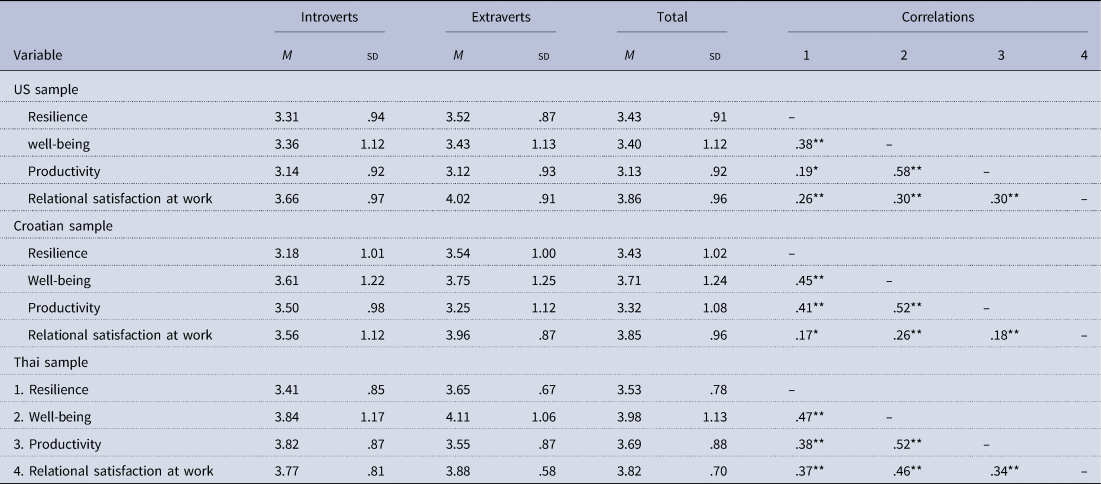
*p < .01, **p < .001.
Hypotheses 1 and 2: direct and indirect effects of resilience
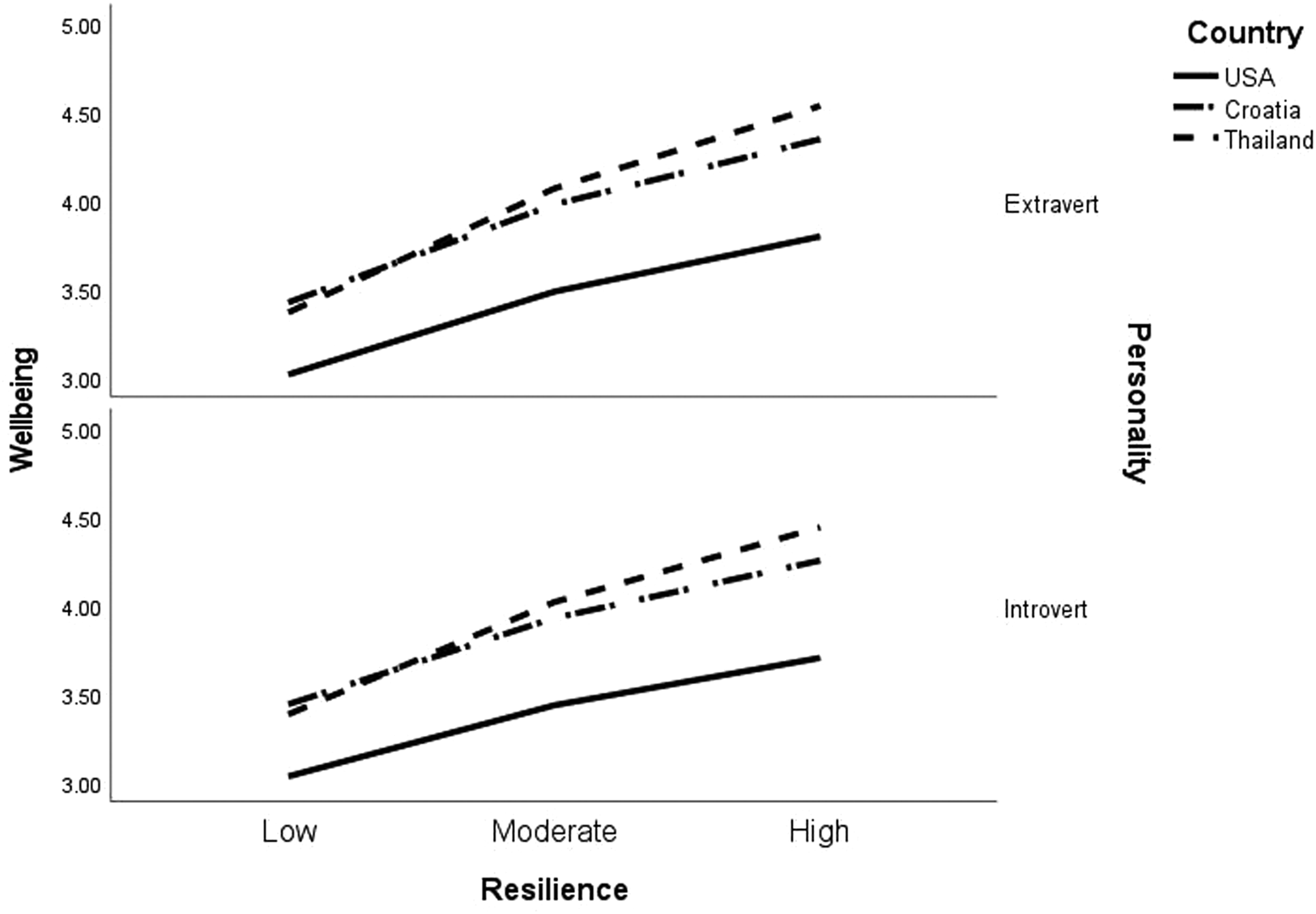
Hypothesis 1 postulated a positive, direct effect of employee resilience on well-being (hypothesis 1a), productivity (hypothesis 1b), and relational satisfaction (hypothesis 1c). Controlling for the influence of other predictors and the interaction effects in the model (see Table 4), resilience significantly and positively predicted well-being (indicator: b = .41, Helmert: b = .51 at p < .001), thus supporting hypothesis 1a. Of note, the effects of resilience on well-being had the same pattern across all three countries and two personality types (i.e., the higher resilience and the higher well-being) (see Figure 2). Also, resilience was found to positively predict productivity, but only with a small effect size (b = .13, p = .02) through the Helmert coding system (i.e., comparing Croatia and Thailand collectively against the United States, and comparing Thailand against Croatia). No significance (b = .01, p = .82) was found for the relationship between resilience and productivity when the indicator coding was used (i.e., comparing Croatia and Thailand individually against the United States). Hence, hypothesis 1b was only partially supported. Finally, resilience positively predicted relational satisfaction (indicator: b = .201, Helmert: b = .168) both at p < .001, therefore hypothesis 1c was supported.
The conditional effect of resilience on well-being by country and personality type.
Unstandardized direct and covariate effects on well-being, productivity, and relational satisfaction

CR, Croatia; TH, Thailand; USA, United States.
Notes: All predictors were examined simultaneously controlling for the influence of one another. Resilience had two sets of values due to the use of two coding systems to form different cultural comparison groups.
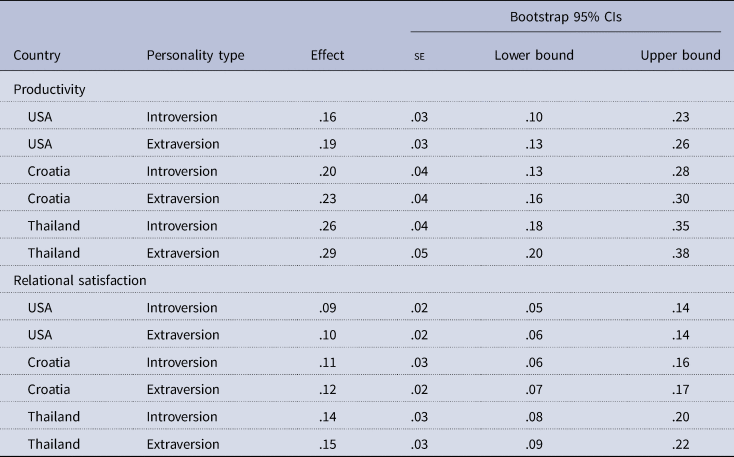
Hypothesis 2 concerned the mediating effect of well-being between employee resilience and productivity (hypothesis 2a) and relational satisfaction (hypothesis 2b), respectively. The results (Table 4) showed well-being positively predicted both productivity (b = .41, p < .001) and relational satisfaction (b = .22, p < .001). To determine the indirect effect of resilience through well-being, a simple mediation analysis (PROCESS Model 4) was first conducted. The unstandardized indirect effect of resilience on productivity through the mediating role of well-being was .25 (boot se = .02, 95% boot CI = [20, 30]), F(2, 793) = 185.84, p < .001, r 2 = .32). The unstandardized indirect effect of resilience on relational satisfaction through the mediating role of well-being was .11 (boot se = .02, 95% boot CI = [07, 16]), F(2, 798) = 50.99, p < .001, r 2 = .11). Additionally, the moderated mediation model consistently revealed well-being exerted a significant mediating effect in the relationship between resilience and productivity, as well as relational satisfaction, regardless of country or personality type (Table 5). This was evidenced by the fact that bootstrap 95% CIs of all conditional indirect effects did not include zero. These results indicated that, across countries and personality types, employees' resilience increased their psychological well-being which, in turn, increased their productivity and relational satisfaction. Therefore, both hypotheses 2a and 2b were supported.
Conditional unstandardized indirect effect of resilience on productivity and satisfaction through well-being
Hypothesis 3: direct effects of personality
We predicted that extraverted participants would report higher levels of well-being (hypothesis 3a), productivity (hypothesis 3b), and relational satisfaction (hypothesis 3c) than introverted participants during the pandemic. A simple regression analysis revealed a significant positive association of low effect size between extraversion and well-being (b = .17, β = .07, p = .04, r 2 = .005). However, this direct effect did not hold in the moderated mediation model where all other variables were accounted for (b = .04, p = .642) (see Table 4). Thus, hypothesis 3a was not supported. Moreover, extraverted participants were reportedly .22 units less productive (b = −.22, p < .001) but .26 units more satisfied with their relationships at work than introverted participants (b = .26, p < .001). These results were consistent in both a simple regression model and moderated mediation model, hence rejecting hypothesis 3b but supporting hypothesis 3c.
Hypotheses 4 and 5: moderating effects of personality and culture
We postulated that culture (hypothesis 4) and personality type (hypothesis 5) would moderate the indirect effects of resilience on productivity (a) and relational satisfaction (b) through the mediating role of well-being. In other words, the impacts of employee resilience on productivity and relational satisfaction through well-being might be strengthened or weakened by culture and/or personality type. The results (Table 4) revealed the direct (main) effects of culture on well-being, productivity, and relational satisfaction. Both Croatian and Thai workers reported a higher level of well-being (Croatians: b = .47, p < .001; Thais: b = .53, p < .001) and productivity (Croatians: b = .22, p = .009; Thais: b = .37, p < .001) than US workers. Furthermore, when examining the Croatian and Thai samples collectively against the US sample, the Croatian and Thai samples reported .50 units (p < .001) higher level of well-being and .29 units (p < .001) higher level of productivity than the US sample. No difference was found in the relational satisfaction score among the three countries.
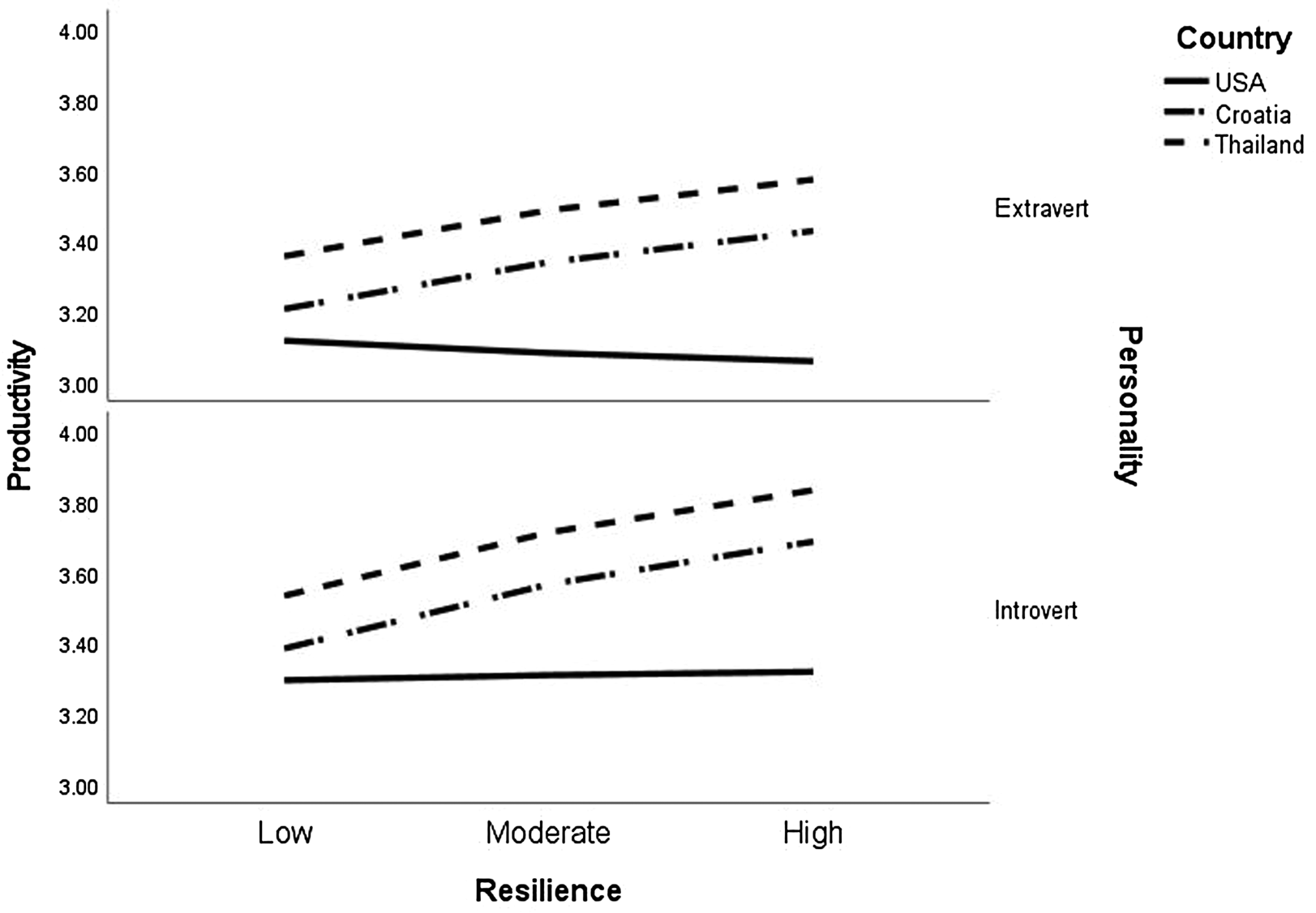
Furthermore, there was a significant interaction between resilience and culture on productivity but not on relational satisfaction. The addition of the resilience–culture interaction significantly increased the variance in productivity by .007 units (F(2, 704) = 3.17, p = .04, r 2 change = .007). This effect was the strongest among Croatian and Thai workers, regardless of personality type (see Table 6). As Figure 3 illustrates, the productivity level of Croatian and Thai workers increased as their perceived resilience increased. However, among US workers, productivity remained at a lower level compared to the other two countries, regardless of the level of personal resilience. Moreover, a partial moderated mediation was found for culture. Regardless of personality, the indirect effect of resilience on productivity and relational satisfaction through well-being is the stronger among Thais compared to US Americans. These results supported hypothesis 4a and rejected hypothesis 4b.
The conditional effect of resilience on productivity by country and personality type.
Unstandardized interaction effects and conditional effects of resilience by culture and personality
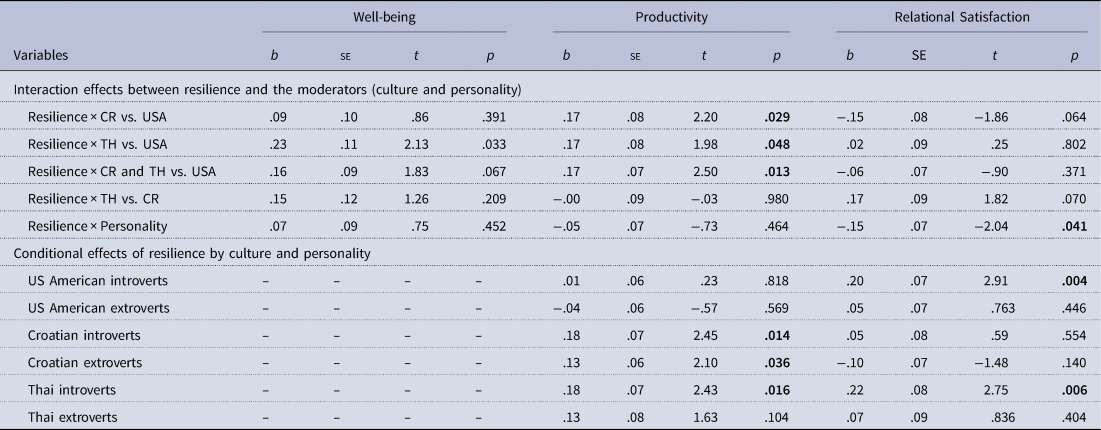
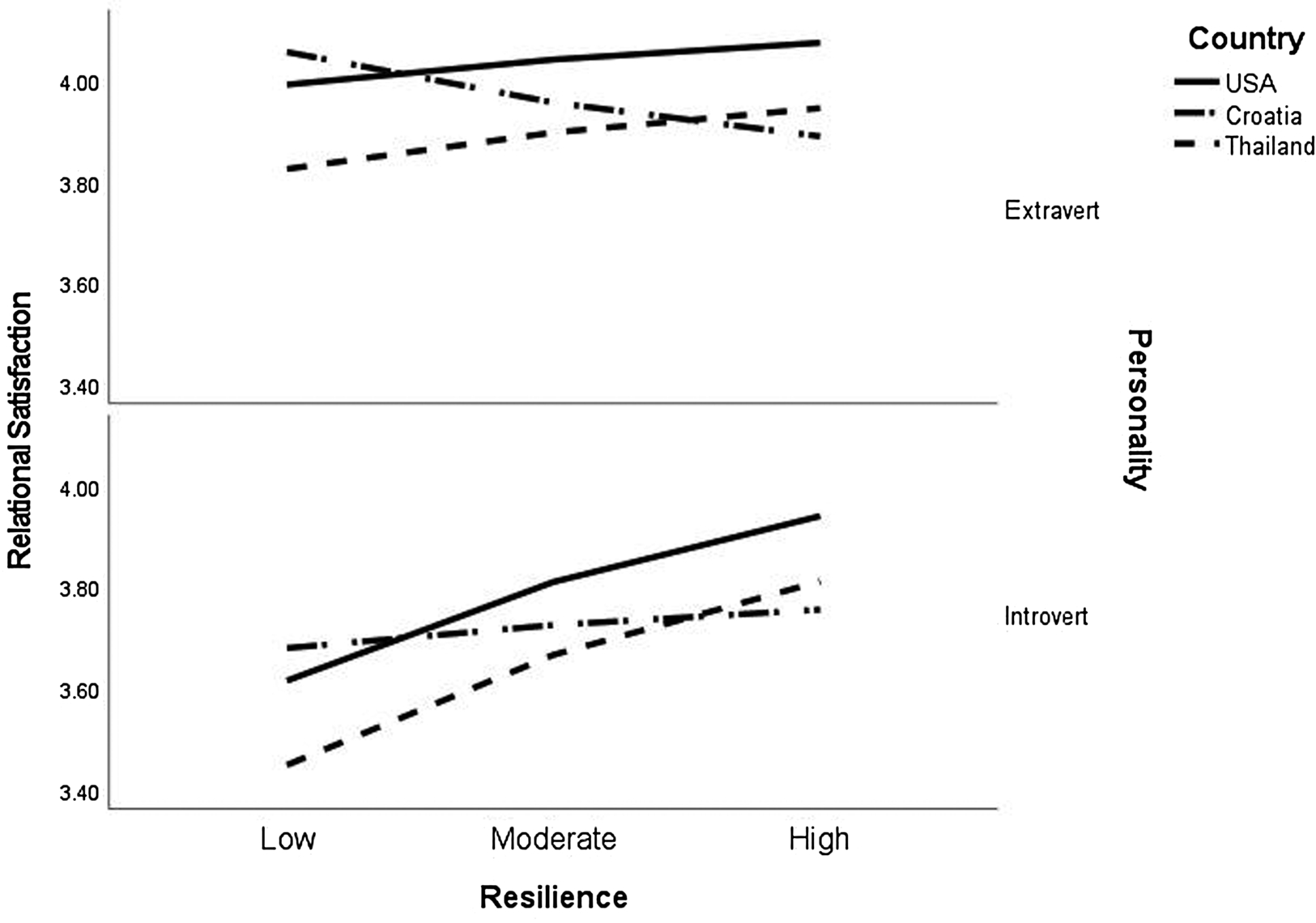
Moreover, there was a significant interaction between resilience and personality on relational satisfaction but not on productivity. The addition of the resilience and personality interaction significantly increased the variance in relational satisfaction by .005 units (F(1, 708) = 4.18, p = .04, r2 change = .005). The addition of both personality and culture together also significantly increased the variance by .012 units (F(3, 708) = 3.48, p = .02, r2 change = .012). The effects of resilience on relational satisfaction were most prominent among introverted US workers and introverted Thai workers (see Table 6). As Figure 4 illustrates, the relational satisfaction of the US and Thai introverts increased progressively as their self-perceived resilience increased. As reported above, introverts were less satisfied with their relationships at work compared to extraverts. These moderating results suggested that, at least for the United States and Thailand, introverted workers with higher resilience fared better than introverted workers with lower resilience in terms of maintaining satisfactory workplace relationships during the COVID-19 pandemic. These results rejected hypothesis 5a but supported hypothesis 5b.
The conditional effect of resilience on relational satisfaction by country and personality type.
Covariate effects
The above analyses partialed out the influence of job rank, employment duration, organizational size, age, gender, and education to provide a more accurate understanding of the impact of the main predictors on the outcome variables. The results revealed that none of the organizational factors was associated with well-being. Organizational size positively predicted productivity such that those working in larger organizations (measured by the number of employees) were likely to be more productive (b = .11, p = .001) compared to those in smaller organizations. On the contrary, employment duration negatively predicted both productivity (b = −.08, p = .002) and relational satisfaction (b = −.09, p = .001), such that those with longer tenure tended to be less productive and less satisfied with their coworkers compared to those with shorter tenure. Additionally, age was positively associated with all DVs: well-being (b = .01, p = .001), productivity (b = .007, p = .026), and relational satisfaction (b = .009, p = .005). Finally, education positively predicted productivity such that participants with a bachelor's degree (b = .18, p = .04) or above (b = .17, p = .05) reported higher productivity compared to those with less than college education.
Discussion
‘Resilience – for both individuals and organizations – will be an essential attribute as we move through this crisis and into the future,’ writes Ignatius (Reference Ignatius2020, p. 8) in the July–August 2020 edition of Harvard Business Review, and this study supports his observation. First, across the three cultures and two personality types (extraversion vs. introversion), employee resilience was positively and strongly associated with psychological well-being which, together, predicted productivity by 32% and relational satisfaction by 11%. This result suggests that during the early stages of the pandemic, those with the ability to withstand and quickly recover from this highly stressful and disruptive event were able to maintain a positive mental state which promoted their productivity and positive regard toward their coworkers. This finding corroborates studies that suggest resilience buffers employees from negative experiences, enabling them to remain productive and optimistic despite disruption (e.g., Hartmann et al., Reference Hartmann, Weiss, Newman and Hoegl2020; Kocjan, Kavčič, & Avsec, Reference Kocjan, Kavčič and Avsec2021; Tugade & Fredrickson, Reference Tugade and Fredrickson2004).
Additionally, the results highlight the significant mediating effect of well-being in the relationship between resilience and productivity and relational satisfaction, respectively. This result is consistent with previous studies indicating that employee well-being was associated with higher productivity and more positive relationships at work (Donald et al., Reference Donald, Taylor, Johnson, Cooper, Cartwright and Robertson2005; Harter, Schmidt, & Keyes, Reference Harter, Schmidt, Keyes, Keyes and Haidt2003; Koopman et al., Reference Koopman, Pelletier, Murray, Sharda, Berger, Turpin and Bendel2002; Stoll, Michaelson, & Seaford, Reference Stoll, Michaelson and Seaford2012). Interestingly, although resilience predicted an increase in relational satisfaction both directly and indirectly, resilience only indirectly predicts productivity through the intervening effect of well-being.
Another intriguing finding about well-being in our data is the insignificant relationship between personality and well-being. Although our simple regression analysis revealed a positive relationship of small effect size between extraversion and well-being, this relationship did not hold when all other variables were accounted for in the moderated mediation model. This finding indicates that the effect of personality on mental health is likely very small and dissipates when other variables are accounted for. This may explain the conflicting results on the relationship between personality traits and mental health in recent COVID-19 studies (Kocjan, Kavčič, & Avsec, Reference Kocjan, Kavčič and Avsec2021; Nikčević et al., Reference Nikčević, Marino, Kolubinski, Leach and Spada2021; Wijngaards, Sisouw de Zilwa, & Burger, Reference Wijngaards, Sisouw de Zilwa and Burger2020; Zacher & Rudolph, Reference Zacher and Rudolph2021). Wijngaards, Sisouw de Zilwa, and Burger (Reference Wijngaards, Sisouw de Zilwa and Burger2020) surveyed 93,125 participants across 47 countries using the original TIPI scale (Gosling, Rentfrow, & Swann, Reference Gosling, Rentfrow and Swann2003) for measuring extraversion and reported that extraversion is negatively related to depressive symptoms but with only a small effect size. When examining the moderating effect of extraversion in the relationship between stringent measures and depressive symptoms, they found that introverts responded more positively to stringent protective measures (e.g., social distancing and limited face-to-face interaction) and fared substantially better than extroverts. It may be the case that, in the context of COVID-19, personality has a limited impact on psychological well-being and the effect found intersects with or fades away when other factors are simultaneously examined. Our data indicated that personal resilience, age, and country were stronger predictors of psychological well-being than personality.
Nonetheless, our results suggest that employee personality does play a role in the levels of productivity and relational satisfaction during the early days of the pandemic. Unlike previous findings that extraverted employees fare better than introverts in times of stress (e.g., Bakker et al., Reference Bakker, Van der Zee, Lewig and Dollard2006; Carver & Connor-Smith, Reference Carver and Connor-Smith2010), extraverts in this study were reportedly less productive but more satisfied with their coworkers than introverts. These results may be explained by Carver and Connor-Smith's (Reference Carver and Connor-Smith2010) notion that personality predicts dispositional coping better than it predicts responses to specific stressors, and an individual's response to a stressor may be strongly influenced by the event type and stressor controllability. The lower levels of productivity among extraverted participants in this study may be due to the unique characteristics of the COVID-19 pandemic and governments' protective measures (Kocjan, Kavčič, & Avsec, Reference Kocjan, Kavčič and Avsec2021; Wijngaards, Sisouw de Zilwa, & Burger, Reference Wijngaards, Sisouw de Zilwa and Burger2020). It is likely that many employees had little control over working conditions during COVID-19, and this may adversely impact those who enjoy personal interaction. For extraverts, the lack of interaction might hinder their overall energy levels and productivity whereas, for introverts, the enforced quarantine and stay-at-home orders might afford them a preferable work environment free of distractions and interruptions (Jung, Reference Jung1971). Furthermore, extraverts' lower level of productivity compared to introverts was consistent with O'Neill, Hambley, Greidanus, MacDonnell, and Kline's (Reference O'Neill, Hambley, Greidanus, MacDonnell and Kline2009) research finding that those who are more sociable and relationship-oriented tended to report lower ratings on indices of telework performance.
On the contrary, misunderstandings and conflicts can easily occur in remote work environments (Hinds & Mortensen, Reference Hinds and Mortensen2005). Virtual team members would need to communicate more spontaneously and informally to maintain a meaningful interpersonal connection and smooth collaboration with one another (Hinds & Mortensen, Reference Hinds and Mortensen2005). With their general tendency to be less assertive and socially engaged (Condon & Ruth-Sahd, Reference Condon and Ruth-Sahd2013), introverts may feel more detached from and less satisfied with their coworkers compared to extraverts who tend to be more talkative and have a more positive outlook on relationships (Hough & Furnham, Reference Hough, Furnham, Borman, Ilgen and Klimoski2003). This may explain why introverts scored higher on productivity but lower on relational satisfaction compared to extroverts in our data. Interestingly, we uncovered an interaction between personality and resilience, namely that resilience dampened the negative effects of introversion on relational satisfaction. Although extraverted workers at any resilience level reported higher levels of relational satisfaction, introverted workers with higher resilience were also likely to be satisfied with their coworkers compared to those with lower resilience. This interactive effect between resilience and personality was particularly pronounced among introverted Thai and US workers. It may be the case that introverted employees with higher resilience possessed a higher degree of flexibility and adaptability which allowed them to engage more with their coworkers (Shoss, Jiang, & Probst, Reference Shoss, Jiang and Probst2018), experience more positive emotions (Tugade & Fredrickson, Reference Tugade and Fredrickson2004), and maintain their relational health (Afifi, Merrill, & Davis, Reference Afifi, Merrill and Davis2016).
Moreover, we found both direct and moderating effects of culture on the outcome variables. Among the three countries, Thai workers significantly reported the highest level of productivity. Thai and Croatian workers also reported a significantly higher level of well-being than US workers. This pattern may be explained by the devastating impact of COVID-19 in the United States, which has likely taken a debilitating toll on its citizens' psychological well-being and productivity (Czeisler, Lane, & Petrosky, Reference Czeisler, Lane, Petrosky, Wiley, Christensen, Najai and Rajaratnam2020). This result may also reflect collectivism in Croatian and Thai cultures in which everyone is expected to take responsibility for fellow members of their organization. Also, as members of feminine cultures, Croatian and Thai employees tend to prioritize quality of life and well-being of others more than individual needs or achievements (Hofstede Insights., 2020). Perhaps, these group-oriented values helped Croatian and Thai workers sustain their psychological well-being (Brougham & Haar, Reference Brougham and Haar2013; Rego & Cunha, Reference Rego and Cunha2009) and productivity level (Papamarcos, Latshaw, & Watson, Reference Papamarcos, Latshaw and Watson2007; Tjosvold, Law, & Sun, Reference Tjosvold, Law and Sun2003) in the early days of the pandemic compared to the individual-oriented values commonly present in the United States. Another intriguing finding is the moderating effect of culture in the relationship between resilience and productivity. The positive effects of resilience on productivity were strongest among Croatian and Thai workers, despite the fact that participants from the three countries in this sample were not different at their average level of personal resilience (F(2, 542.69) = 1.53, p = .218). On the contrary, we found no differences in the relational satisfaction score among the three countries. However, the indirect effect of resilience on productivity and relational satisfaction through well-being is stronger among Thais compared to US Americans. Overall, these findings support the person-environment perspective of resilience (Herrenkohl, Reference Herrenkohl2013) and SCT's assertion that an individual's behavioral outcome is determined by a dynamic interaction between personal and environmental factors (Bandura, Reference Bandura1988). Our results have shown that the positive effect of employee resilience is not equal across countries but increases or decreases by contextual factors, the intervening role of well-being, and the type of outcome (i.e., task or relational) being measured. Possibly, a resilient employee in an individualistic country with a higher number of COVID-19 cases may not withstand a crisis as well as a resilient employee in a collectivist country with fewer cases. Future research is needed to clarify this finding.
Contributions to the resilience literature
A recurring problem in resilience research is that employees are examined without ensuring whether they were actually exposed to adversity that would influence adaptation (Britt et al., Reference Britt, Shen, Sinclair, Grossman and Klieger2016). The current study examined the participants' resilience while they were exposed to the challenges posed by COVID-19 and thus were able to test the robustness of employee resilience in relation to mental health and other organizational variables. The results of this study also supported the conceptualization of resilience as a multilevel construct (Herrenkohl, Reference Herrenkohl2013) and SCT (Bandura, Reference Bandura1988) by demonstrating that personal resilience intersects with personality and culture to predict positive workplace outcomes. Although several studies have investigated the impact of COVID-19 on mental health (e.g., Xiong et al., Reference Xiong, Lipsitz, Nasri, Lui, Gill, Phan and McIntyre2020) and the role of resilience and/or personality traits on individual responses to the pandemic (e.g., Kocjan, Kavčič, & Avsec, Reference Kocjan, Kavčič and Avsec2021; Wijngaards, Sisouw de Zilwa, & Burger, Reference Wijngaards, Sisouw de Zilwa and Burger2020; Zacher & Rudolph, Reference Zacher and Rudolph2021), to the best of our knowledge this is the first study that examined the interplay among employee resilience, well-being, and productivity as well as relational satisfaction across different personalities and countries during this global health crisis. Importantly, the results highlight a significant mediating role of well-being in the relationship between resilience and workplace outcomes across cultures. Notably, resilience directly predicts a relational outcome (i.e., satisfaction with coworkers) but only indirectly predicts a task outcome (i.e., productivity) through the intervening effect of well-being. This finding suggests that employees' personal capacity to swiftly bounce back and recover from the pandemic (i.e., their resilience) alone may help them maintain positive interactions with coworkers but is not sufficient to help them maintain their productivity at a desirable level. With the multitude of challenges posed by the pandemic, employees' well-being is ever more crucial for them to be able to accomplish work (Harter, Schmidt, & Keyes, Reference Harter, Schmidt, Keyes, Keyes and Haidt2003; Kniffin et al., Reference Kniffin, Narayanan, Anseel, Antonakis, Ashford, Bakker and Vugt2021; Koopman et al., Reference Koopman, Pelletier, Murray, Sharda, Berger, Turpin and Bendel2002). Hence, organizations should provide resources and supportive policies that promote both resilience and well-being among their employees.
Practical implications
This study provides several pragmatic suggestions for organizational leaders during times of crisis. Our results show that, regardless of culture, well-being mediates the relationship between resilience and productivity, and resilience and relational satisfaction at work. Organizations should, therefore, promote resilience and well-being in the workplace culture during times of crisis. The drastic pivot toward online platforms and cloud-based workflow across many sectors during COVID-19 can create frustration, anxiety, and increased stress among employees who are struggling to meet pre-pandemic productivity levels. Recognizing this, the Centers for Disease Control and Prevention (2020) has published resources to build resilience and manage job stress during the pandemic, including communicating openly about how the pandemic is affecting work and causing stress across organizational levels, and how this stress can be resolved. Organizations should also encourage employees to practice self-care such as exercising, taking walks, or gardening which have been found to correlate with increased positive affect and play a protective role in relation to well-being during the pandemic (Lades, Laffan, Daly, & Delaney, Reference Lades, Laffan, Daly and Delaney2020; Plomecka et al., Reference Plomecka, Gobbi, Neckels, Radziński, Skórko, Lazerri and Jawaid2020). Management could also promote their employees' resilience by giving them the flexibility to spend quality time with their loved ones and providing adequate support for their work (e.g., information technology services or work-from-home resources) (Ojo, Fawehinmi, & Yusliza, Reference Ojo, Fawehinmi and Yusliza2021).
Simultaneously, supervisors should consider how employees' personality types dictate varying needs, productivity levels, and overall relational satisfaction. For example, extraverted employees might benefit from frequent virtual team meetings, whereas introverts might benefit from occasional one-on-one meetings. As both extraverts and introverts ultimately have an innate need for human connection (Baumeister & Leary, Reference Baumeister and Leary1995) and virtual communication tools are necessary during the remote work mode, it is also important to encourage employees to use technology mindfully to stay in touch and exchange social support (Garfin, Reference Garfin2020). Furthermore, leaders should also explore avenues to cultivate resilience among employees that account for cultural differences. Several evidence-based intervention programs are available that aim at fostering resilience and helping employees across cultures cope positively with stressful circumstances (e.g., Joyce, Shand, Lal, Mott, Bryant, & Harvey, Reference Joyce, Shand, Lal, Mott, Bryant and Harvey2019; Raghavan & Sandanapitchai, Reference Raghavan and Sandanapitchai2019; Robertson, Cooper, Sarkar, & Curran, Reference Robertson, Cooper, Sarkar and Curran2015). Nevertheless, this resilience/well-being program may not always be feasible. As our results suggest, small businesses might be more adversely affected by the pandemic in terms of productivity than larger businesses, which may be due to the lack of necessary technologies or resources to fulfill job duties during this crisis (Bartik, Bertrand, Cullen, Glaeser, Luca, & Stanton, Reference Bartik, Bertrand, Cullen, Glaeser, Luca and Stanton2020; Papadopoulos, Baltas, & Balta, Reference Papadopoulos, Baltas and Balta2020). In these cases, organizations can partner with community resources to boost personal resilience among employees and ensure that they feel valued and supported (Fletcher & Sarkar, Reference Fletcher and Sarkar2013).
Limitations
This study has certain limitations that bear consideration. First, the convenience and virtual snowball sampling did not give us the control over who the participants shared the survey with, which limited our ability to compare potential differences due to recruitment channels. Also, the cross-sectional nature of the survey data, collected in the early days of the pandemic, did not allow us to test whether the effect of resilience, well-being, and personality changed over the course of several waves of the pandemic (Zacher & Rudolph, Reference Zacher and Rudolph2021). For instance, Thailand did well in managing the spread of the virus in earlier waves (the time of our data collection) but is currently facing a sharp spike of cases.
Moreover, by considering resilience as a personal attribute, we did not directly assess why some participants were more resilient and coped more effectively than others (Britt et al., Reference Britt, Shen, Sinclair, Grossman and Klieger2016). Specifically, we were unable to identify whether the resilience levels found in our participants were due to their personal resources (e.g., self-efficacy, optimism, and emotional regulation) or environmental resources (e.g., support from supervisors, friends, family, and national governments) (Hartmann et al., Reference Hartmann, Weiss, Newman and Hoegl2020; Ojo, Fawehinmi, & Yusliza, Reference Ojo, Fawehinmi and Yusliza2021).
Next, this study examined only one dimension of personality and, due to a design error as previously mentioned, measured it as a dichotomous variable (i.e., extraversion vs. introversion). Thus, this research did not capture the potentially varying degree of extraversion or introversion in the participants or other aspects of their personality (e.g., conscientiousness or openness to experience). Although our results regarding personality effects were similar to those from previous COVID studies (e.g., Kocjan, Kavčič, & Avsec, Reference Kocjan, Kavčič and Avsec2021; Wijngaards, Sisouw de Zilwa, & Burger, Reference Wijngaards, Sisouw de Zilwa and Burger2020; Zacher & Rudolph, Reference Zacher and Rudolph2021), research has shown that people are not either an extravert or an introvert but usually score relatively low or relatively high along a continuum and most people score somewhere between the two extremes (McCrae & Costa, Reference McCrae and Costa1985). Therefore, although the binary measurement of extraversion allowed us to examine this dominant personality dimension (Judge et al., Reference Judge, Higgins, Thoresen and Barrick1999; Jung, Reference Jung1971) in relationship with other study variables, the present findings on personality should be treated as preliminary and interpreted carefully. Finally, we did not measure individualism/collectivism at the individual level. Considering that cultural variables might be malleable to priming and other contextual factors, it is possible that the pandemic might have made people more community-minded or, at the other end, self-oriented. We should, therefore, take this into account when interpreting the results of the current study.
Directions for future research
This study of personal resilience, well-being, productivity, and workplace relationships in the early stages of a prolonged crisis provides several opportunities for future research. Considering government protective measures as well as organizational policies have changed through the several waves of the pandemic, a longitudinal study covering more recent data is needed to test our hypotheses. Using the lens of cognitive appraisal theory (Lazarus, Reference Lazarus1991), such a study could capture how people reappraise and cope with the adversity of the pandemic as the situation evolves (Zacher & Rudolph, Reference Zacher and Rudolph2021). Another option is to investigate the dynamic resilience processes in which employees adapt to this particular crisis, return to their previous levels of functioning, or transform into a better, new normal organizational life over time (Buzzanell & Houston, Reference Buzzanell and Houston2018). In doing so, researchers can explore the extent to which organizational members' collective sensemaking or storytelling, via socially distanced meetings or social media channels, may shape organizational adaptation (Buzzanell, Reference Buzzanell2018). Furthermore, future studies can examine other personality dimensions and measure them as continuous variables to assess the moderating effects of personality traits more fully in the relationship between employee resilience and workplace outcomes during a crisis. Additionally, it is possible that individuals in some of the countries we studied experienced a similar health pandemic before (e.g., MERS-CoV; Bukhari et al., Reference Bukhari, Temsah, Aleyadhy, Alrabiaa, Alhboob, Jamal and Binsaeed2016) and may not have perceived the COVID-19 pandemic as harmful as participants from countries that did not face such a crisis. However, we did not measure participants' appraisals or earlier similar stressors that might impact their coping process. Cognitive appraisal theory argues that the relationship between stressful events and immediate or long-term outcomes can be influenced by the individuals' cognitive appraisal of the situation (e.g., whether the pandemic is threatening or to what extent one has control over it) and coping strategies (e.g., emotion-oriented or problem-oriented) (Folkman, Reference Folkman1984; Folkman, Lazarus, Dunkel-Schetter, DeLongis, & Gruen, Reference Folkman, Lazarus, Dunkel-Schetter, DeLongis and Gruen1986). Hence, future research should explore the role of prior stressors and generalized or situational appraisals in the relationship between resilience, well-being, and organizational outcomes. Finally, it would also behoove organizational researchers to investigate the extent to which organizations that have successfully weathered past crises – particularly with regard to employee and organizational resilience – were able to translate their previous success into an effective response to COVID-19 (Eaddy, Reference Eaddy2021).
Supplementary material
The supplementary material for this article can be found at https://doi.org/10.1017/jmo.2021.58
Financial support
The authors received no financial support for the research, authorship, and/or publication of this article.
Piyawan Charoensap-Kelly, Ph.D., is an Assistant Professor of Organizational Communication at Southern Methodist University. Her research interests include conflict management, crisis communication, identity management, and training and development in interpersonal, organizational, and intercultural settings. Her recent research has been published in the International Journal of Conflict Management, Management Communication Quarterly, and Business and Professional Communication Quarterly.
Pavica Sheldon, Ph.D., is a Professor & Chair of Communication at the University of South Alabama. She is an author of three books: Social Media: Principles and Applications, Scripts and Communication for Relationships, and The Dark Side of Social Media. She has published over 50 peer-reviewed articles and book chapters.
Mary Grace Antony, Ph.D., is an Associate Faculty of Communication Studies at Edmonds College. Her research examines intercultural communication, globalization, new media discourse, and audience analysis. She has published her research in reputable journals including the Journal of International and Intercultural Communication, New Media & Society, and Frontiers: Health Communication.
Laura Provenzani, M.A., is an Outreach Communication Specialist at the University of Alabama in Huntsville. She holds two Bachelor's degrees, Elementary Education and Art Studio and a Master's degree in Professional Communication from UAH. Her professional expertise and research interests include intercultural communication and social media usage.


 Open access

