


1. Introduction
The ongoing digital transformation has significantly shaped the development and use of Digital Twins (DT) and related digital concepts. Originally designed for the virtual representation of products and processes, these technologies enable valuable interaction between the physical and digital worlds, unlocking new potential for product development (Reference Tao, Zhang, Liu and NeeTao, Zhang, et al., 2019). In this context, digital technologies play a crucial role by allowing different scenarios to be tested through simulation. This not only reduces costs but also shortens development time and improves product quality (Reference Jones, Snider, Nassehi, Yon and HicksJones et al., 2020; Reference Tao, Cheng, Qi, Zhang, Zhang and SuiTao et al., 2018). However, these benefits come with considerable development effort. Building and maintaining a DT requires substantial resources and financial investment. To ensure the economic viability of a DT, its value must therefore be maximized throughout the entire product lifecycle to offset the initial development costs (Reference Stauss, Wolniak, Tergeist, Wurst and LachmayerStauss, Wolniak, et al., 2025).
Therefore, each lifecycle phase should be viewed in the holistic context of the product life cycle. Since product development is one of the emerging life cycle phases in relation to the DT (Reference Lo, Chen and ZhongLo et al., 2021), this leads to the central research question of this article: What potentials and challenges arise from the use of the DT throughout the product lifecycle with regard to product development?
The concept of the DT was introduced by Michael Grieves in 2002 and first formally named by NASA in 2012, where it was described as an integrated multiphysics, multiscale, probabilistic simulation of an as-built vehicle or system (Reference Glaessgen and StargelGlaessgen & Stargel, 2012; Reference GrievesGrieves, 2023). Since then, numerous developments and interpretations have emerged, resulting in the absence of a universally accepted definition of the DT (Reference Stauss, Wawer, Wurst, Hamlaoui, Gooran Orimi and LachmayerStauss, Wawer, et al., 2025).
In this work, the definition proposed by Stark is adopted, as the DT differs significantly from a digital model in this definition, but doesn’t require a bi-directional connection (Reference Stark, Damerau, Chatti and TolioStark & Damerau, 2019; Reference Stauss, Wawer, Wurst, Hamlaoui, Gooran Orimi and LachmayerStauss, Wawer, et al., 2025). Stark defines the DT as a digital representation of an active, unique product or unique product-service system that comprises its selected characteristics, properties, conditions, and behaviours by means of models, information, and data within a single or even across multiple life cycle phases.
According to this definition, the DT consists of a Digital Master, a Digital Shadow, and the connection between them (see Figure 1).
DT concept according to Stark, adapted from Reference Stauss, Wolniak, Tergeist, Wurst and LachmayerStauss, Wolniak, et al. (2025)

The Digital Shadow provides a sufficient representation to describe the state of the entity in an abstract and time-dependent manner. It is based on operational and usage data collected from the product in the field and stored in a database. In contrast, the Digital Master comprises digital models such as CAD data or simulation models that describe the product. When data from the Digital Shadow is incorporated into the models or comparable elements of the Digital Master, the result is a meaningful link between both components.
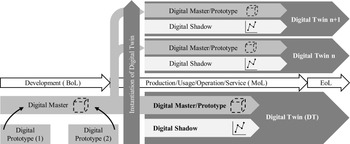
Stark’s definition differs from other interpretations in one essential aspect. It requires the existence of an active product as the basis for a DT, whereas other definitions already consider a digital object with the intention of becoming a product to be a DT (Reference Stauss, Wawer, Wurst, Hamlaoui, Gooran Orimi and LachmayerStauss, Wawer, et al., 2025). This distinction leads to the DT being viewed in its individual components throughout the product life cycle (see Figure 2).
Definition of the DT along the PLC (Reference Stark, Anderl, Thoben and WartzackStark et al., 2020)

To answer the above-mentioned research question, a systematic literature review (SLR) is carried out. First Section 2 outlines the methodological approach. Section 3 presents the results, which are then discussed in Section 4, including a critical evaluation and the outlook.
2. Methodology
To address the research question, an SLR is conducted in this work following the method proposed by Kitchenham and Charter kit (Reference KitchenhamKitchenham, 2007). This approach is well established and ensures a structured and reproducible process. The procedure is divided into three main steps: Planning the Review, Conducting the Review, and Reporting the Review.
A central task in the planning phase is the formulation of the research question. In this study, this was done using the PICOC method (Reference Petticrew and RobertsPetticrew & Roberts, 2012), which both facilitates the design of the search strategy and supports the systematic derivation of relevant keywords. Based on the identified keywords, a search string was created and iteratively refined until the following control sources appeared in the search results, because they are highly relevant to the research topic: Reference Lehner, Padovano, Zehetner and HackenbergLehner et al. (2024); Reference Lo, Chen and ZhongLo et al. (2021); Reference Tao, Cheng, Qi, Zhang, Zhang and SuiTao et al. (2018); Reference Tong, Bao and TaoTong et al. (2024).
The final search string used for the SLR is:
(“digital twin“ OR “digital model“ OR “digital shadow“ OR “digital master“ OR “virtual twin”) AND (“product develop*” OR “product design*”) AND (“lifecycle” OR “life cycle” OR “PLC” OR “life-cycle”)
Scopus and Web of Science were selected as literature databases because they are among the largest internationally recognized databases and offer search functionalities that ensure reproducible research. Only peer-reviewed articles in English were considered, published after 2014 (reflecting a significant increase in research activity from 2014 onward (Reference Liu, Fang, Dong and XuLiu et al., 2021)), and either available as open access or accessible through the university’s institutional license.
After removing duplicates between the two databases, 175 papers remained (search conducted on 15.04.2025). These papers were first screened based on their titles, followed by an abstract screening to assess their relevance to the research question. This process reduced the selection to 39 articles. Finally, a full-text screening was conducted, and papers were excluded if the DT appeared only marginally or did not contribute to answering the research question. The final dataset thus comprised 30 papers, see Figure 3.
Search results and reason for exclusion

From these remaining articles, data extraction was carried out, covering both formal aspects (such as title, author, and country) and content-related aspects. On the content level, the extraction focused on identifying the digital concepts referenced by the authors using their own terminology, as well as the challenges and potential benefits associated with using the DT in product development. Both explicit and implicit arguments were captured in the analysis. To structure the diverse formulations of potentials and challenges, a categorization was then carried out, with categories emerging from the data rather than being predefined. The characteristics were systematically reviewed and grouped according to thematic similarities. The result is a clustering consisting of main and subcategories. An assignment of the individual studies to the respective subcategories was carried out after the categorization process. Lastly, the created main categories were mapped to the components of the DT according to Stark’s definition, based on the capabilities of the components, respectively, where the challenge arises.
3. Results
The results are divided into four sections. First, section 3.1 examines the terminology used in the articles. Sections 3.1 and 3.2 address the potentials and challenges of the DT covered in the articles examined. In section 3.4, the potentials and challenges are finally assigned to the components of the DT and a connection is established between the challenges and potentials.
3.1. Digital concepts referenced
The analysis examined which digital concepts were mentioned in the reviewed articles. The terminology used by the respective authors was recorded, meaning that the term Digital Twin does not necessarily correspond to the definition adopted in this work according to Stark. Figure 4 presents the frequency of the various terms that appeared at least twice within the texts.
Frequencies of references to digital concepts in the examined literature

The results show that terms such as Digital Shadow or Digital Master are rarely used explicitly. However, many of the other studies describe concepts that closely resemble these elements as defined by Stark, though they employ different terminology. In addition, terms like Cyber-Physical Systems (CPS) and Model-Based Systems Engineering (MBSE) occasionally appear as methodological or technological foundations on which the concept of the DT can be built. Beyond these, the reviewed literature includes numerous additional concepts that are not listed here, as they appear only once or under unique, author-specific designations.
3.2. Potentials
A review of the extracted potentials resulted in four main categories (P1–P4), which were further divided into subcategories based on their specific characteristics. The frequency distribution of these categories is shown in Figure 5. Model- and data-based decision support and validation (P1) is the most prominent main category, which includes contributions describing the potential of DTs for improved assessment, verification, and planning during development. The subcategory Uniform structured database for informed decision-making (P1-1) appears most often overall. Here, the DT is described as a central repository that collects, organizes, and filters large volumes of data across all lifecycle phases (Reference Tao, Sui, Liu, Qi, Zhang, Song, Guo, Lu and NeeTao, Sui, et al., 2019; Reference Tong, Bao and TaoTong et al., 2024). This repository prevents loss of data, which can critically impact the quality of following product generations (Reference Lehner, Padovano, Zehetner and HackenbergLehner et al., 2024) and enhances decision-making through access to a broad range of information (Reference Smeets, Öztürk and LiebichSmeets et al., 2023). Furthermore, coupling the data infrastructure with AI- or ML-based analytical models can further increase its value for product development by providing decision support (Reference Lo, Chen and ZhongLo et al., 2021; Reference Niu, Wang and QinNiu et al., 2022; Reference Tao, Sui, Liu, Qi, Zhang, Song, Guo, Lu and NeeTao, Sui, et al., 2019). Several studies also highlight the potential to integrate sustainability and cost–benefit considerations more easily through such a centralized data foundation (Reference Dickopf, Forte, Weber, Stürmer and MuggeoDickopf et al., 2023). Another frequently mentioned subcategory is Efficient simulation and validation of models (P1-2). By integrating relevant data generated during the product life cycle into the models, the product development process becomes more efficient and the validation accuracy increases (Reference Smeets, Öztürk and LiebichSmeets et al., 2023). Another central field of potential is represented by the main category Knowledge gained from real product data (P2). This category relates to the collection of product-relevant data from other lifecycle phases to enable targeted analyses and derive new insights for product development.
The most frequently mentioned subcategory within this field is the Derivation of development-relevant aspects from real usage contexts (P2-1). Many studies demonstrate how historical usage data can be used to support targeted improvements in future product generations (Reference Gu, Zhang and QiuGu et al., 2021; Reference Li, Wang, Rong and WeiLi et al., 2022). This data typically consists of field data, often collected through sensors, providing information such as load profiles or usage patterns (Reference Arnemann, Winter, Quernheim and SchleichArnemann et al., 2023; Reference Gu, Zhang and QiuGu et al., 2021). The resulting insights can be applied, for example, to lifetime analysis, component design, or requirement definition (Reference Dickopf, Forte, Weber, Stürmer and MuggeoDickopf et al., 2023; Reference Honcak, Wooley, Combemale, Wimmer, Chechik and EgyedHoncak & Wooley, 2024; Reference Lim, Zheng, Chen and HuangLim et al., 2020). Such insights also support efficiency and idea generation in early development phases through a more efficient derivation of customer requirements based on usage data (Reference Smeets, Öztürk and LiebichSmeets et al., 2023).
Categorization and frequency of potentials

The third and fourth main categories were mentioned less frequently. Improved collaboration and transparency (P3) groups aspects related to information exchange and communication among different stakeholders throughout the product lifecycle. Efficiency improvement in virtual product development (P4) includes contributions addressing the reduction of development effort through digital processes.
3.3. Challenges
Analogous to the analysis of potentials, the challenges identified in the literature were also categorized to structure the extracted data, resulting in five overarching categories (C1–C5). The frequency distribution of the different subcategories is shown in Figure 6.
Categorization and frequency of challenges

The main category, Data quality and data management (C1), represents by far the most frequently mentioned group of challenges. The studies consistently show that the usefulness and reliability of the DT depend heavily on access to high-quality and consistent data. The subcategory Insufficient or inconsistent data quality (C1-1) stands out as the single most commonly cited challenge. Many studies note inaccurate or error-prone data (Reference He and MaoHe & Mao, 2023; Reference Li, Wang, Rong and WeiLi et al., 2022; Reference Niu, Wang and QinNiu et al., 2022), often caused by sensor positioning or measurement errors (Reference Lo, Chen and ZhongLo et al., 2021). These uncertainties directly affect the reliability of the DT and related concepts, as well as their role in supporting virtual validation processes during development (Reference Honcak, Wooley, Combemale, Wimmer, Chechik and EgyedHoncak & Wooley, 2024). In addition, it is pointed out that information from product planning or production often lacks a usable structure and which limits its application (Reference Niu, Wang and QinNiu et al., 2022). In highly dynamic production environments, the informative value of such data is further reduced (Reference Yildiz, Møller, Bilberg and RaskYildiz et al., 2021). Overall, these findings underline that the quality and consistency of the integrated data are decisive factors for the effective use of the DT (Reference Tao, Sui, Liu, Qi, Zhang, Song, Guo, Lu and NeeTao, Sui, et al., 2019).
The second main category, Technical complexity and system limitations (C2), comprises challenges related to the practical implementation and integration of DTs and related concepts. About half of the studies identify Missing or unreliable interfaces (C2-1). Several works point out that relevant information, such as product or sensor data, is often distributed across departments or systems without suitable interfaces to integrate them (Reference Cao, Wang and LuCao et al., 2020; Reference He and MaoHe & Mao, 2023). These issues include insufficient convergence between the Digital Master and Digital Shadow (Reference Tao, Cheng, Qi, Zhang, Zhang and SuiTao et al., 2018), as well as problems in field data transfer or synchronization between virtual and physical models (Reference Schleich, Anwer, Mathieu and WartzackSchleich et al., 2017), which can occur, for example, in manufacturing or measurement processes (Reference Jones, Nassehi, Snider, Gopsill, Rosso, Real, Goudswaard and HicksJones et al., 2021).
Economic and operational barriers (C3) include challenges arising from the significant effort, cost, and organizational constraints associated with the implementation of DTs in product development. Uncertainty in cost–benefit evaluation (C3-1) is mentioned most often. Many studies stress that suitable frameworks are often lacking to determine the required level of model detail (fidelity) reliably (Reference Kober, Algan, Fette and WulfsbergKober et al., 2023). As a result, models tend to be either overly complex, making their benefits disproportionate to their cost, or too simplistic, preventing the full potential of the DT from being realized (Reference Kober, Algan, Fette and WulfsbergKober et al., 2023; Reference Lehner, Padovano, Zehetner and HackenbergLehner et al., 2024).
The main category, Data security and risks (C4), summarizes challenges related to the handling of sensitive data within the context of DTs.
Lack of methodological foundations (C5) is the last category, which addresses methodological deficiencies in the development and application of DTs. Nearly one-third of the reviewed studies highlight the Lack of standardized concepts for data usage across life cycle phases (C5-1).
3.4. Allocation of the categories to the digital twin
Following the categorization of the extracted contents, the identified potentials and challenges are mapped to the central components of the DT, based on the capabilities of the components, respectively, where the challenge arises. Furthermore, the interrelations between the potentials and challenges are highlighted through connections in the form of lines. However, this established connection does not exclude the influence of other categories and serves only to emphasize a strong relation. The mapping is essential, as the full realization of each potential depends on overcoming the corresponding challenges. Figure 7 visualizes the mapping to the components of the DT as well as the interrelations between challenges and potentials. The size of each circle corresponds to the relative number of subcategories assigned within the respective main category, highlighting the differences in their prominence. Additionaly the assigned sub-categories are shown.
Allocation of the categories to the components of the DT

Figure 7 Long description
Panel A: A diagram showing the Digital Master with potentials P1 and P4 connected to challenges C1, C2, and C5. The connections are labeled with numbers indicating sub-categories. Panel B: A diagram depicting the Linkage with potential P1 connected to challenges C1, C2, and C5, also labeled with sub-categories. Panel C: A diagram illustrating the Digital Shadow with potentials P1 and P2 connected to challenges C1, C2, C4, and C5, labeled with sub-categories.
The Digital Master enables Model- and data-based decision support and validation (P1) as well as Efficiency improvement in virtual product development (P4). These potentials primarily arise from precise simulations, automated validation processes, and the reuse of digital models. In contrast, major challenges stem from Technical complexity and system limitations (C2), such as the high effort required for model maintenance and the limited transferability of models, which restrict sustainable use. Furthermore, Data quality and data management issues (C1) directly affect P1 and P4, as they determine the reliability and accuracy of model results. In addition, the lack of Methodological foundations (C5)—particularly the absence of validation and model-evolution methods—acts as a structural barrier to the scalability of the Digital Master and therefore connects to P1 and P4.
The Digital Shadow plays a central role in the Model- and data based decision support and validation (P1), as it is the core for the Uniform structured database for informed decision-making (P1-1), enabling a systematic collection and processing of operational, usage, and production data. Similarly, it is essential for the Knowledge generation from real product data (P2) and forms the data-driven foundation for feedback into the Digital Master. However, its effective use is limited by Data quality and data management issues (C1), such as incomplete or inaccessible data, inconsistent formats, and large data volumes. Additional constraints arise from Technical complexity and system limitations (C2), Data security and risks (C4), which impede cross-domain data exchange. Moreover, the Lack of standardized concepts for data usage across life cycle phases (C5-1) further complicates the integration of Digital Shadow information into development processes.
The interface between the Digital Master and Digital Shadow represents the connecting element and is critical for realizing the combined potentials of both components. Their coupling enables a unified data foundation and iterative improvement processes within product development (P1-1, P1-4). At the same time, several key challenges converge here: Missing or unreliable interfaces (C2-1), partly due to a Lack of standards for interfaces and system integration (C5-2), and the high effort required for Processing and storage of large data volumes (C1-2). These factors limit the bidirectional connection between the data and model domains and thus directly influence the overall effectiveness of the DT architecture.
As the Economic and operational challenges (C3) and Improved collaboration and transparency (P5) relate to the DT as a whole, they were not assigned to individual DT components and are therefore not shown in Figure 7.
4. Discussion
The most frequently mentioned advantages, Uniform structured database for decision-making (P1-1) in particular and the Knowledge gained from real product data (P2) in general, are primarily associated with the Digital Shadow. The same applies to the most frequently cited challenge Data quality and data management (C1). Consequently, research efforts should focus especially on data management and methods to improve and ensure data quality in order to fully unlock the potential of the Digital Shadow. At the same time, the value of the Digital Master also profits from improved data quality and data management. While simulation models are indeed valuable even when based on idealized boundary conditions and artificial data, they reach their full potential only when combined with historical field data that allow the simulation of real operating conditions. The fact that this potential (P1-5) is mentioned so rarely indicates that the interaction between the Digital Master and the Digital Shadow is still underutilized in the context of product development. To enhance the use of historical field data in simulation, it’s crucial to focus on the interfaces (C2-1) that facilitate these interactions. The results therefore suggest that the Digital Shadow component, and especially its interface with the Digital Master, should be prioritized to maximize the overall potential of the DT.
Although this study contributes to a better understanding of the various potentials and challenges of the DTs components, certain limitations remain. Since both implicit and explicit potentials and challenges were derived, there is an inherent degree of interpretation that introduces subjectivity. An analysis conducted by other researchers might therefore yield different sets of potentials and challenges.
Also, the formation of categories inevitably involves a certain degree of subjectivity, as thematic clustering depends on the interpretation of textual content, and overlaps or blurred boundaries between categories cannot always be avoided. Alternative categorizations could lead to different emphases or groupings. Moreover, the frequency with which specific topics appear in the reviewed literature does not necessarily reflect their actual significance but may instead be influenced by current research trends or publication bias. Similarly, the mapping between potentials and challenges represents a conceptual abstraction of complex interdependencies. Those challenges can impact multiple potentials simultaneously, therefore this allocation simplifies these relationships for analytical clarity.
5. Conclusion and outlook
This study examines the potentials and challenges of the DT in the context of product development through an SLR. The literature retrieved using the search string was filtered by formal criteria and assessed for relevance to the research question, resulting in a final sample of 30 publications. Identified potentials and challenges were clustered, and the individual articles were assigned to the respective categories. Furthermore, the identified potentials and challenges were mapped to the key components of the DT, and interrelations between them were established.
The findings indicate that the central potential of Digital Twins in product development is currently seen in model- and data-based decision support, particularly through the establishment of a uniform and structured data basis that enables informed decision-making. At the same time, data quality and data management emerge as the most critical challenges, with insufficient or inconsistent data quality being a fundamental limitation. This close dependency highlights that the value of data-driven decision support is inherently constrained by the reliability and consistency of the underlying data.
By categorizing and mapping the identified potentials and challenges, this work provides a structured overview of the current state of research and highlights key strengths and weaknesses of the DT components. This perspective supports a more targeted addressing of the identified challenges and, in turn, the more effective utilization of DT potentials in product development.
In future work, the individual subcategories and their contents require closer examination to gain a clearer understanding of the causes and possible solutions. For example, insufficient or inconsistent data quality can have different causes and require a tailored approach to address each one. Addressing each challenge with a suitable solution should lead to better applicability of the DT, ultimately resulting in higher value. Furthermore, methods should be developed to enhance the connection between the Digital Master and Digital Shadow in the product development phase. This would enable the structured integration of Digital Shadow information into the development of subsequent product generations.



 Open access

