

Introduction
The latter-day history of southern African San foragers is a traumatic one. In an era when even ‘benevolent’ colonial ideologies remained innately expansionist (King Reference King2015), it suited the projects of Empire to classify forager societies as residuals of humanity's primordial state (Gordon Reference Gordon1992). Emerging ‘scientific’ formulations of race (Coombes Reference Coombes1994, 9) assessed these societies to fall short of the ‘criteria of humanity’ (Hitchcock Reference Hitchcock2015, 263), minimizing their legal and philosophical status (Dolin Reference Dolin2013) and justifying their exclusion from moral injunctions on violence and killing. The destruction that followed is a matter of record (Adhikari Reference Adhikari2010; Anthing Reference Anthing1863; Gordon & Douglas Reference Gordon and Douglas2000).
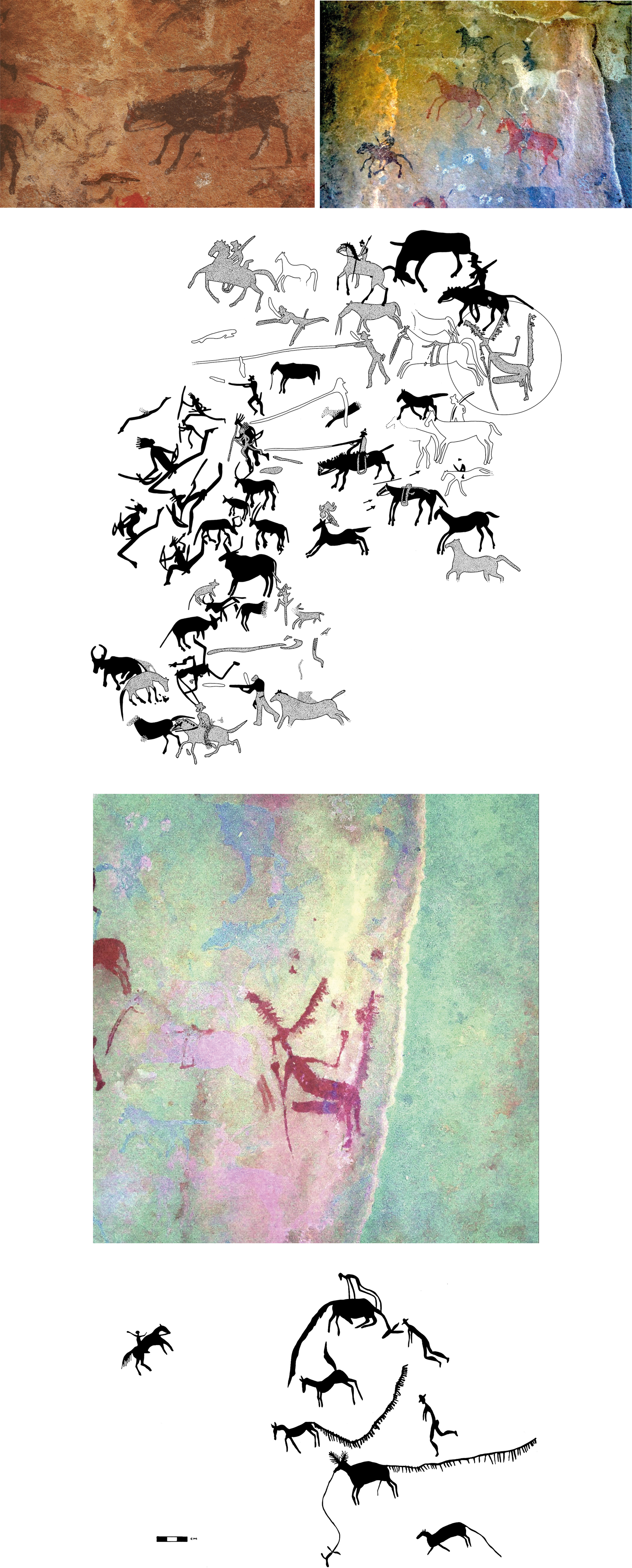
Yet ‘“wholesale extermination” does not exhaust the range of interactions that existed between hunter-gatherers and colonial agents’ (McGranaghan Reference McGranaghan2012, 112), nor does a model of violence as exclusively that of colonizer upon colonized represent regional dynamics (King & Challis Reference King and Challis2017). An insurgency was cultivated with forager roots (Wright Reference Wright1971), incorporating escaped slaves, refugees and others from across the subcontinent (Challis Reference Challis, Deacon and Skotnes2014). Taking up the newly arrived technologies of horse and gun, these heterogeneous bands engaged in prolonged raiding campaigns against colonial presence and influence. In the process, they redeployed a millennia-old rock-art tradition as a record of their presence, beliefs, identity and exploits (Challis Reference Challis2012). Conflict is common in these images (see Figures 1a, b, c), including references to irregular warfare, mixed material culture and hybridized symbologies (Figs 1d, e)—alongside hints that there was, nonetheless, an apocalypse under way (Ouzman & Loubser Reference Ouzman and Loubser2000).
(opposite). Detail of images of conflict at Underberg, South Africa (a, b, above). Although this has been previously represented as the colonial slaughter of southern African foragers, on closer inspection they depict combat between far more heterogeneous actors (c, below)—some with horses and guns (right), others with bows and arrows (left). If we look to the figure with the feathered headdress and horse's tail indicated in (c) (see also Figure 1d), we see a ‘war doctor’ (see Challis Reference Challis, David and McNiven2018) involved in the depicted event. (Photographs 1a, b: S. Challis; 1c: courtesy Rock Art Research Institute.)
Figure 1d. Detail of the ‘war doctor’ (Challis Reference Challis, David and McNiven2018) at Underberg, including ritual paraphernalia and bleeding nose, common to such depictions. (Photograph: S. Challis.)
Figure 1e. In a combination of colonial-era and ‘traditional’ San motifs, horses and brimmed hats appear alongside somatically distorted humans, a human figure emerging from a dying horse, and probable entoptic ‘streamers’, indicating the practice of ritual altered states of consciousness. Underberg, South Africa. (Image: courtesy Rock Art Research Institute.)
Even without colonial-era justifications, insurgencies destabilize the definition of ‘combatant’ beyond what it describes in uniformed combat (Kiras Reference Kiras, Baylis, Wirtz and Gray2019, 184). Colonial authorities compounded this, implicating forager identities en bloc with raiders, which rationalized not only indiscriminate force but campaigns of express depopulation (Penn Reference Penn2005, 116–19). In a glimpse of the Apartheid era to come, southern Africa was assessed to have a ‘native problem’ (Dubow Reference Dubow2006, 177–8), its populations forced under racialized systems of control and its landscapes tangled in barbed wire and occupational bureaucracy (Netz Reference Netz2004; Roche Reference Roche2008).
The resulting strife resembles brushfire conflicts of the late colonial, early independence and modern periods (Arndt Reference Arndt2010). As with latter-day examples, occupiers rarely reached the roots of resistance, more often succeeding in ‘mowing the grass’. ‘Yet for the insurgent the grass is nonetheless mowed’ (Ucko Reference Ucko2022, 5), an individual cost that is easily missed behind broader accounts of resistance and conquest. Indeed, as resistance increasingly took the form of acute, horse-borne gunpowder raids, these incursions met a ruthless occupation with little incentive to record the opposing perspective.
Few prisoners were taken, and horrific injury was common. Trauma, in all its guises, was rife. In the indigenous rock-art archive of the Maloti-Drakensberg, we view these experiences from the mind's eye of these insurgent societies, subverting the erstwhile dominant colonial account (Paterson Reference Paterson, Oland, Hart and Frink2012, 70). The testimonies of San informants—such as the Bleek-Lloyd Archive (Bleek & Lloyd Reference Bleek and Lloyd1911; Hollmann Reference Hollmann2004)—are artefacts of trauma themselves, recorded from prisoners and displaced refugees of the colonial frontier, under an ethnological paradigm built on primordialist underpinnings (Dubow Reference Dubow1995, 79; Wessels Reference Wessels2008).
These testimonies power interpretive models that have discovered symbolic meanings in the art beyond what it appears to depict (inter alia Lewis-Williams Reference Lewis-Williams1980; Reference Lewis-Williams1992). We believe that there is an as yet unrecognized dimension of this, however, particularly in images of conflict. Post-traumatic stress disorder (PTSD) is key to understanding the images’ affective dimensions (de Luna Reference de Luna2013), reflecting the artists’ experiences, their states and anatomies of mind. PTSD would have been a preoccupation of these societies, experiencing a profound struggle to survive, and is a phenomenon that offers insight into how they made images of conflict work for them.
PTSD develops in individuals who have been exposed to death, serious injury, sexual violence, or the threat of any of these to the self or others. This exposure was aptly described in the third edition of the Diagnostic and Statistical Manual [1980, hereafter DSM] as one ‘which lies [so] outside the normal pattern of human experience [that it] would clearly cause suffering in virtually everyone’. The resulting psychiatric disturbances cause ‘impairment in social, occupational, or other important areas of functioning’ (APA 2022, 302–3). We discuss these disturbances in detail, considering them to be commonplace in latter-day forager societies, systematically traumatized by their own forays into hostile territories and collective histories of conflict. Contemporary research into trauma amongst diverse refugee populations provides comparative data, suggesting that violent dispersal and fracturing of social institutions, which often characterizes the refugee experience (George Reference George2010), renders these populations acutely vulnerable to PTSD (Crumlish & O'Rourke Reference Crumlish and O'Rourke2010, 237; also Sack et al. Reference Sack, Seeley and Clarke1997).
We examine the vulnerabilities and symptom expressions of the insurgent communities of the Maloti-Drakensberg, drawing on culturally specific theories of disease to understand their responses to the generalizable neuropathologies brought about by traumatic experiences. PTSD's systemic dysfunctions would be readily explained by San aetiology, in which disease has social parameters (McGranaghan Reference McGranaghan2012, 204, 450), and is characterized by antisocial behaviour, with violent conduct being the severest expression (Guenther Reference Guenther1999, 37). PTSD comes about as a result of a violent event, and its symptoms compromise an individual's social capacities, exactly as this idiom anticipates. Accordingly, the disorder would classify as a disease, spurring affected communities to turn to their conventional route of healing through ritual trance (Katz Reference Katz1982; Lee & Marshall Reference Lee and Marshall1984, 103). PTSD has its own visionary components—nightmares, flashbacks and re-experience—the result of dysregulation of brain regions responsible for context interpretation, fear memory and emotional processing (see below). This would form part of a feedback loop resulting in the vivid, ‘realistic’ intrusion of traumatic experiences into ritual altered states of consciousness (ASCs), especially those intended to heal the corresponding social symptoms.
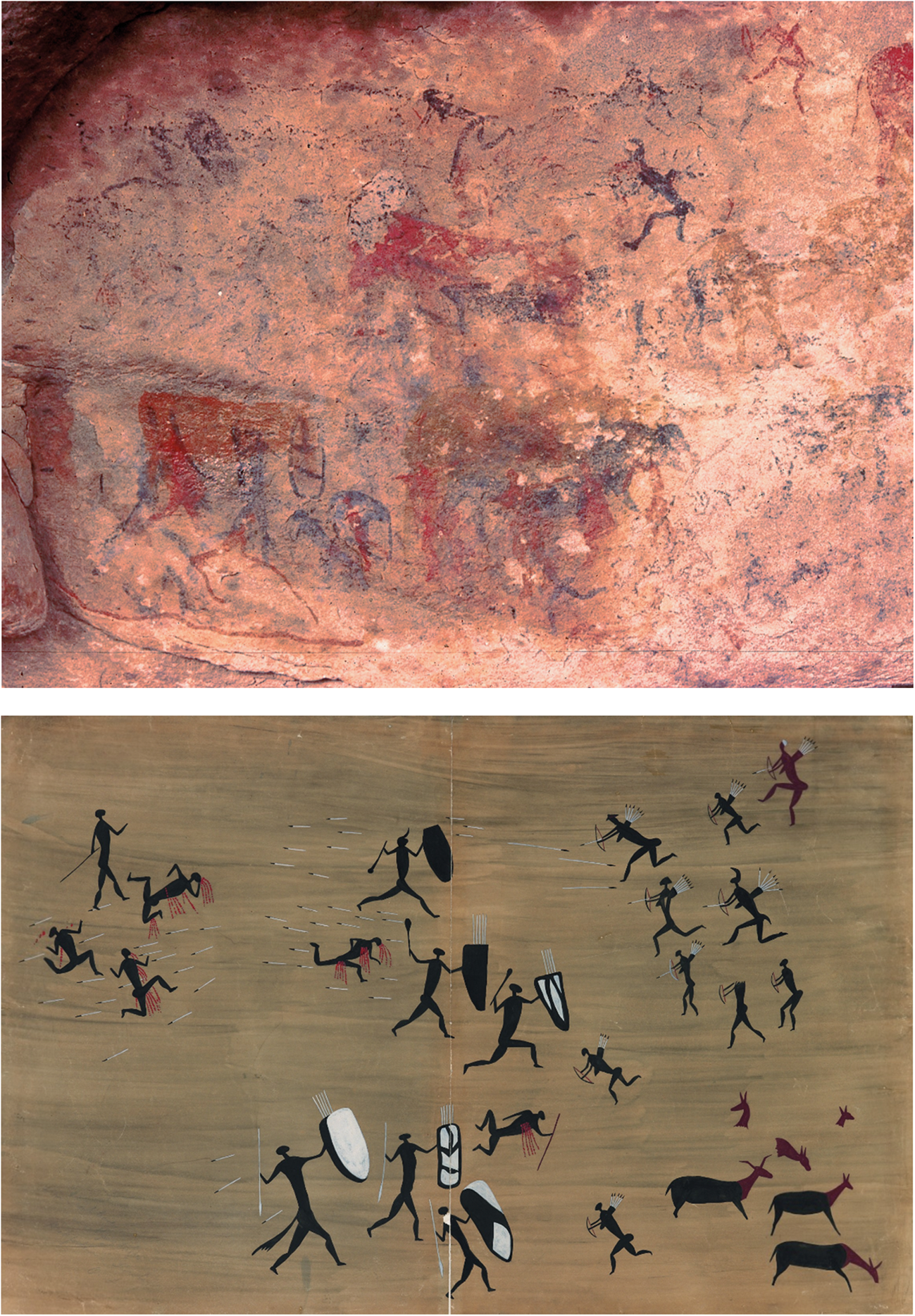
PTSD in this way offers insight into the art, and frames it as a tool for sense-making and recovery. Images of conflict are not simple, representational accounts of historic record, but nor are they exclusively euphemisms of spiritual warfare (as in Campbell Reference Campbell1986; cf. Challis Reference Challis, Deacon and Skotnes2014; Sinclair Thomson & Challis Reference Sinclair Thomson and Challis2020; Fig. 2). The artists were not passive—just as they resisted violent incursion through force of arms, they employed art and ritual, often hybrid or combined, to contextualise their experiences, leveraging the labile mental state offered by ASCs to mitigate the impacts of PTSD. These adaptations permit us to view these people and their experiences through a contextualizing lens of trauma, ‘transforming how we understand … developments to which we already attach great explanatory power’ (de Luna Reference de Luna2013, 125 in King Reference King2019, 16).
Images of a violent encounter. The part-animal figures are therianthropes, being partly animal, a common euphemism for bodily transformations experienced during ASCs. These figures reference their identities through the animals they have partly transformed into (cf. Skinner & Challis Reference Skinner and Challis2022), their use of spears and their adornment with large, hooped earrings. These markers of their identities, and the violent transmissions of energy they make through their spears, are integral to understanding the context of the image. Chris Hani District, Eastern Cape, South Africa. (Copy: George Stow: see Stow & Bleek Reference Stow and Bleek1930; photograph: S. Challis.)

Post-Traumatic Stress Disorder
PTSD is a culturally subjective experience which rests upon generalisable neuroanatomical pathologies. It develops in the aftermath of a traumatic event—a stressor which abnormally encodes itself into the structure of a patient's life, coming disproportionately to define their perspective (Berntsen & Rubin Reference Berntsen and Rubin2007; see below), and undermining their ability to process the normal course of experience.
PTSD's physiological dimensions are complex and interconnected. It brings about severe, chronic stress, and is marked by sustained release of inflammation-causing cytokines in the brain, changes in local cellular metabolism, immune function, neuro-endocrine dysregulation, inter alia (summarized in Sherin & Nemeroff Reference Sherin and Nemeroff2011). Although the involved causal relationships are somewhat uncertain, these are somewhere between cause and consequence of progressive damage within the central nervous system (Aliev et al. Reference Aliev, Beeraka and Nikolenko2020, 2–3).
There are corresponding structural abnormalities of certain brain areas (Yehuda Reference Yehuda2002, 108), notably of the hippocampus, a limbic structure critical to memory processing and stress regulation (Malta et al. Reference Malta, Dörfel, Rohleder and Werner2006), and of the amygdala, responsible for behavioural regulation (Dolan Reference Dolan2007), particularly as it relates to fear, and the evaluation and memory of stressful stimuli (Harnett et al. Reference Harnett, Goodman and Knight2020). This is integral to the symptoms that emerge; brain areas involved in processing memory of the stressor, and placing contextual limits on its ‘reach’ within one's life, exhibit pathologies in patients with PTSD.
These areas have been the extensive subject of neuroimaging studies (e.g. Ben-Zion et al. Reference Ben-Zion, Korem and Spiller2022; Harnett et al. Reference Harnett, Goodman and Knight2020; Hedges & Woon Reference Hedges and Woon2007), which demonstrate reductions in hippocampus and amygdala volumes in patients with PTSD, relative to control populations. Lower subregion volumes may not necessarily indicate PTSD-induced atrophy; reduction does not progress over time, nor is it proportional to the magnitude of the stressor (in the hippocampus: Ben-Zion et al. Reference Ben-Zion, Korem and Spiller2022; in the amygdala: Morey et al. Reference Morey, Gold and LaBar2012). Rather, such reductions may indicate intrinsic vulnerabilities (see vulnerability hypothesis in Ben-Zion et al. Reference Ben-Zion, Korem and Spiller2022) or comorbidities (Ahmed-Leitao et al. Reference Ahmed-Leitao, Spies, van den Heuvel and Seedat2016, 38). In either event, there is an inverse relationship between subregion volumes and PTSD severity (Ben-Zion et al. Reference Ben-Zion, Korem and Spiller2022: 666–7; cf. Zheng et al. Reference Zheng, Garrett and Sun2021, 7–8). Smaller volumes correspond with more severe progressions, suggesting that disruption or reduction in the functions of these areas underwrites PTSD symptoms (Woon & Hedges Reference Woon and Hedges2009; Yehuda Reference Yehuda2002, 110).
Symptoms and underlying biology
In therapeutic contexts, PTSD symptoms class into four categories (Table 1): intrusion, the re-experience of traumatic events; avoidance, the compulsion to avoid references or recollections of these events; cognition, the impairment of cognitive capacities and mood; arousal, the irregular manifestation of wakefulness or reactivity.
Symptoms and diagnostic criteria of PTSD described in the DSM-V-TR (APA 2022: 302–4).

Some expressions overlap those observed in patients with traumatic brain injury (Sherin & Nemeroff Reference Sherin and Nemeroff2011, 264); in effect, PTSD neuropathologies are physical correlates for psychological trauma. Measurable changes in the brain ‘signify an indelible sensory imprint of a maladaptively processed experience’ which impairs cognitive and emotional capacities (Sherin & Nemeroff Reference Sherin and Nemeroff2011, 274). Thereafter, symptoms reflect the roles of affected neurological substrates—there are causal relationships between the architecture of these brain areas and PTSD symptomatology (Zheng et al. Reference Zheng, Garrett and Sun2021, 7).
Ordinarily, ‘the hippocampus is critical for context conditioning’ (Sherin & Nemeroff Reference Sherin and Nemeroff2011, 274), permitting ‘normal’ reading of social situations. Hippocampal pathologies compromise the memory processes that inform new assessments (Knox Reference Knox2003, 227), interfering with realistic assessments of threats or fearful imagery and compromising judgements of mundane experience. This leads to an inability to tell safety from danger, bringing about a persistently fearful disposition, inappropriate startle responses, irritability and social withdrawal.
The amygdala is a key to the acquisition, storage and conditioning of fear memories (Ehrlich et al. Reference Ehrlich, Humeau, Grenier, Giocchi, Herry and Lüthi2009) and influences fear learning in the hippocampus (McGaugh Reference McGaugh2004). Dysregulation of its functions leads to ‘enhanced encoding of [the] traumatic memory and [a] lack of inhibition of memory retrieval’, triggering decontextualized re-experiencing of the event (Sherin & Nemeroff Reference Sherin and Nemeroff2011, 274). This includes intrusive recollections and flashbacks, detrimental to normal function in their own right, but which through repetition further define the context that a patient reads into events around them.
These regional pathologies undermine an individual's ability to engage in the flow of social life, to read the occurrences around them with appropriate context, and induce behavioural disruptions that alienate them from their communities. In the small, fluid groupings of San societies, a premium was placed on cohesion, exchange relationships and interdependence (McGranaghan Reference McGranaghan2012, 184–6; Wiessner Reference Wiessner2005)—patterns which PTSD would greatly disrupt. However, before we turn to detailed ethnographic assessment, we consider PTSD as a diagnostic construct, its history and applicability to this context.
The social and historical context of PTSD
The aforementioned pathologies are neuroanatomical, stemming from a maladaptive response to a traumatic experience. As the International Classification of Diseases (ICD-11: WHO 2019, 6B40) describes, PTSD also has culture-related features. Stressors have differing meanings, symptoms vary in their salience and net risk evolves depending on cultural attitudes towards traumatic experiences and resulting symptoms.
The moral status of traumatic events influences the onset and magnitude of PTSD. The perception that violence is justifiable leads to it being less impactful—a perception which is culturally mediated (Zefferman & Mathew Reference Zefferman and Mathew2021, 7). Conversely, ‘perpetrating, failing to prevent, or bearing witness to acts that transgress deeply held moral beliefs and expectations’ (Litz et al. Reference Litz, Stein, Delaney, Lebowitz, Nash, Silva and Maguen2009, 697) has demonstrably negative impacts on PTSD prognosis (Fontana et al. Reference Fontana, Rosenheck and Brett1992; Yehuda et al. Reference Yehuda, Southwick and Giller1992). Particularly injurious are events that clash with one's fundamental assumptions and cultural values, such as that the world is benevolent, that the self has value, or that social contracts hold (Litz et al. Reference Litz, Stein, Delaney, Lebowitz, Nash, Silva and Maguen2009, 698–9). PTSD is thus ‘the product not of trauma in itself but of trauma and culture acting together’ (Bracken Reference Bracken2001, 742; Kienzler Reference Kienzler2008, 223).
Given that the weight of PTSD research, and its definition, have come about in the context of war trauma amongst military personnel from industrialized societies (Gersons & Carlier Reference Gersons and Carlier1992; Marmar et al. Reference Marmar, Schlenger and Henn-Haase2015), there is reason to be cautious when applying the disorder—particularly as discrete criteria—to diverse populations. Moreover, standardized categorization is ever a pyrrhic endeavour; the DSM and ICD cluster symptoms for clinical utility rather than because PTSD is an organically bounded occurrence, which may thus induce ‘category errors’ that occlude cultural syndromes (Hinton & Lewis-Fernández Reference Hinton and Lewis-Fernández2011).
Is PTSD itself a culture-bound syndrome? Clinical criteria reflect common neuroanatomical pathologies through the lens of observable symptoms, complicated by the need systematically to describe a ‘constellation’ of complex interactions (Aliev et al. Reference Aliev, Beeraka and Nikolenko2020; Sherin & Nemeroff Reference Sherin and Nemeroff2011). The varied range of expressions and diagnoses are mediated by cultural attitudes and perceptions of trauma and individuals affected by it (Zefferman & Mathew Reference Zefferman and Mathew2021). However, while culture renders PTSD relatively stochastic, it is not culture bound (Yehuda et al. Reference Yehuda, Hoge and McFarlane2015). DSM-defined PTSD is “diagnosable in diverse cultures around the world” (Hinton & Lewis-Fernández Reference Hinton and Lewis-Fernández2011, 787), and international surveys conducted by the WHO (in 20 countries: Liu et al. Reference Liu, Petukhova and Sampson2017; in 24 countries: Kessler et al. Reference Kessler, Aguilar-Gaxiola and Alonso2017) point to a globally pervasive phenomenon. This is demonstrable even if its expressions and vulnerabilities vary (Atwoli et al. Reference Atwoli, Stein, Koenen and McLaughlin2015).
Rather, it should be unsurprising that a generalized diagnosis could be consistent while localized expressions differ. Neuroimaging can reliably infer PTSD in patients (Aliev et al. Reference Aliev, Beeraka and Nikolenko2020, 3), indicating tangible, consistent effects on the brain. However, as affected regions are integral to regulating socialization and perception of context, the disease has a highly cultural filter. We not only recognize this but consider it a focal point of our analysis. PTSD is relevant in our specific context, tempered by the knowledge we should engage specific ethnographic models to understand the responses of diverse individuals and communities (Manson Reference Manson1997), establishing relevant ‘idioms of distress’ (Kaiser et al. Reference Kaiser, Haroz, Kohrt, Bolton, Bass and Hinton2015) with which to understand them.
The San idiom of distress
We begin with an eye to the extensive overlaps between distress and disease in this context. In a now-famous distinction, Leon Eisenberg (Reference Eisenberg1977, 11) observed that ‘patients suffer “illnesses” [while] physicians diagnose and treat “diseases”’, and ‘so defined, [the two] do not stand in a one-to-one relationship’. Eisenberg explicitly recognizes that this disparity is not inevitable, but rather the product of Western notions of discrete medical authority and the intellectual heritage of Cartesian dualism.
By contrast, forager aetiologies and PTSD blur such a distinction. Straightforwardly materialistic disease is accorded social and ontological dimensions in subcontinental forager belief systems (Katz Reference Katz1982, 52–5; Lewis-Williams Reference Lewis-Williams1992, 56–7; McGranaghan Reference McGranaghan2012, 166–7, 204). Similarly, PTSD is notable for the mutually defining character of its phenomenological and physiological qualities (Litz et al. Reference Litz, Stein, Delaney, Lebowitz, Nash, Silva and Maguen2009, 697). It is a disease of social and cognitive faculties, with observable impacts on neural substrates, brought about by an event that falls along a spectrum of moral and bodily injury.
In San aetiology, there are mechanistic connections between disease and social action. Disease is not discretely medicalized, but assessed among a range of maladies caused by ‘harm's things’ (Lewis-Williams Reference Lewis-Williams1980, 471; 1992, 57) getting into the flesh (see |gwaiҙn, v. ‘to get into the flesh, take possession of’: Bleek Reference Bleek1956, 285; McGranaghan Reference McGranaghan2015, 276–7; Skinner Reference Skinner2017, 159). Although ‘harm's things’ are not finely described, a euphemism for them is as ‘arrows of sickness’ (Lewis-Williams Reference Lewis-Williams1998, 94; McGranaghan Reference McGranaghan2012, 204, 222–3), mirroring foragers’ own use of poisoned arrows as a technology (McGranaghan Reference McGranaghan2012, 204; Wiessner 1983, 260–62; with latter-day parallels in spears and bullets: Sinclair Thomson & Challis Reference Sinclair Thomson and Challis2017). They are a transfer of harmful energy, bearing lasting consequences for one's internal biology (see Figure 3). Another cause of disease is dust (LL.V.20.5537–5546, 5557;Footnote 1 ‘that “earth/dust” is not a “good/friendly” thing’: LL.V.20.5542), often of the kind raised in anger (e.g. LL.V.20.5537). This choking manifestation of rage is assessed as a concentration of harmful influence (Skinner Reference Skinner2017, 83), and a ‘mechanism whereby ill-intentioned individuals could cause sickness’ (McGranaghan Reference McGranaghan2012, 143).
Images of conflict, depicting numerous transfers of violent energy through arrows and thrown spears; the transmission of disease. Shield shapes, adornments and weapons act partly as references to the identities they have ‘taken on’, resulting in horns. Xhariep District, Free State, South Africa. (Photograph: courtesy Rock Art Research Institute; copy: George Stow: see Stow & Bleek Reference Stow and Bleek1930.)

Integral to both is that they are media of transmission. Disease does not manifest organically but is brought about by others—other humans (often shamans, ‘people who come to shoot … with magic arrows’: Bleek Reference Bleek1956, 363–4; Lewis-Williams Reference Lewis-Williams1992, 57), non-humans (often ‘wild’ animals: McGranaghan & Challis Reference McGranaghan and Challis2016, 587; e.g. LL.VIII.15.7263’) or liminal entities that stretch these classifications (such as spirits of the dead: see |nu-ka-!k'e in Skinner Reference Skinner2017, 80–82). In common is that significant aspects of their value systems have been corrupted, rendering them monstrous (McGranaghan Reference McGranaghan2014a).
This is stereotyped as the ‘different person’, defined by anger and ‘inappropriately directed or unregulated violence […] antithetical to [San] notions of propriety’ (McGranaghan Reference McGranaghan2014b, 678). They are as predators are to prey, especially when their conduct rises to the level of doing harm. Lions are a stereotypical example of ‘different’ persons on the landscape (see ǁkeǁke, lit. ‘beasts of prey’: Bleek Reference Bleek1956, 571; McGranaghan Reference McGranaghan2014a, 10; 2014b, 674–5), inclined to gluttony, fighting and murder.
By imitating the conduct of lions, a perpetrator of violence takes on the characteristic behaviours of beastly creatures, manifesting the corresponding personal properties (discussion in Skinner & Challis Reference Skinner and Challis2022). Different communities—communities of such others—are idiomatically associated with violence, to the degree that they appear as primordial antagonists in mythic narratives (McGranaghan Reference McGranaghan2014b, 678–9; Skinner Reference Skinner2017, 67–9). Building on the continuity between violent activities and sickness, these different communities are also the source of disease.
They are socially and materially distant, having ‘lost their thinking strings’ (viz. their ability to understand: LL.VIII.26.8310’); a loss which is the mechanistic cause of their violent dispositions. They make compulsive, violent transfers of energy through arrows or dust, and the problematic aspects of their identities travel within (McGranaghan Reference McGranaghan2012, 204). It is a defining behaviour of a ‘stranger’ to ‘shoot at people’ (McGranaghan Reference McGranaghan2014b, 678) and these arrows carry who and what it was to have fired the arrow in the first place (McGranaghan Reference McGranaghan2012, 222–3; Skinner Reference Skinner2017, 82). This is the nature of ‘harm's things’, which then ‘get into the skin’, causing disease (Fig. 4).
Images of violent transfers of energy, ‘getting into the skin’. Xhariep District, Free State, South Africa. (Photograph: courtesy Rock Art Research Institute; copy: George Stow: see Stow & Bleek Reference Stow and Bleek1930.)
This confers particular significance on violent events, and offers a glimpse of the idiomatic assessment of PTSD. Following a violent experience, it would be reasonable to expect affected persons to be sick, given the infectious nature of violent conduct, the illness-inducing properties of violent material culture and the literally and idiomatically hazardous behaviours of communities defined by violence. One who was hitherto not ‘different’, but participated in violence themselves, would indicate that they were sick in this way, having ‘caught’ some of the problematic inclinations/identities of different persons.
Defining symptoms of PTSD conform surprisingly well to this assessment. One readily apparent category is that of avoidance behaviours: the compulsion to avoid references to a traumatic stressor, or moments that evoke or resemble it (criteria C: APA 2022, 303). DSM criteria and forager idiom equivalently expect one to be ‘frightful’ when confronted with references to a violent occurrence; ‘skittish’, as a wild animal would be when incorrectly approached (McGranaghan & Challis Reference McGranaghan and Challis2016, 586). Violent events hang over affected individuals, because exposure to violence is also an exposure to a range of moral, social and epidemiological hazards. Avoidance behaviours confirm the anticipated causal link; the event that one avoids, in this symptomatic sense, is the origin of one's emerging disease.
PTSD is characterized by event centrality; the traumatic event comes to define how an individual understands themselves and the world (Berntsen & Rubin Reference Berntsen and Rubin2007). Underlying hippocampal (viz. context-processing, above) dysregulation manifests a perception that social compacts have been broken, and that safety is an illusion. One's mood is darkened by this outlook; positive emotions move out of reach, while negative emotional states (anger, fear and guilt) intensify.
One is estranged from others, as part of a feedback loop in which negative emotions generated within regions of the amygdala, inadequately processed by other brain regions, compound one's isolation and maladaptive conduct (Dean & Keshavan Reference Dean and Keshavan2017). This worsens context perception and mood, in a process that behaviourally and phenomenologically resembles chronic depression (Zefferman & Mathew Reference Zefferman and Mathew2021). Affected persons become defined by detachment and loss of interest in socially significant events which, alongside other cognitive disturbances (see criteria D: APA 2022, 303), form the basis of a highly cross-cultural idiom of distress: ‘thinking too much’ (Kaiser et al. Reference Kaiser, Haroz, Kohrt, Bolton, Bass and Hinton2015, 173–4).
San aetiology explicitly anticipates this loss of social faculties. Described as one's ‘thoughts going astray’ (LL.V.23.5871), or being ‘closed off’ (‘His … thinking channels … were those that were closed’: LL.II.30.2754), the intrusions of ‘harm's things’ compromise an affected person's ability to regulate their behaviour (LL.II.14.1317). This culminates as an open desire to cause harm, conforming to wider congruences between violent conduct, disease and alterity (McGranaghan Reference McGranaghan2012, 174; Reference McGranaghan2014a, 6, 10).
Patterns of psychological arousal and reactivity are interrupted by PTSD (criteria E: APA 2022, 303), solidifying this idiomatic diagnosis. This includes exaggerated vigilance and startle responses, disturbances of sleep, socialization and concentration. To be startle-prone has a particular place in forager idiom. As elsewhere, hunting is a central rhetorical tool and euphemism for many aspects of forager society and cosmos (Biesele Reference Biesele1993). The skittishness of an antelope—its being difficult to hunt on account of its nervousness (McGranaghan & Challis Reference McGranaghan and Challis2016, 586)—indicates a negative social disposition (Skinner & Challis Reference Skinner and Challis2022). A skittish thing is ‘fright-ful’, ‘spoiled’, ‘wild’ and likely to be aggressive, the implications best seen in the contrast with ‘notions of “stillness” [which were] opposed not only to movement, but also to violence: the antithesis of the patient, still man was someone who became “quickly angry”’ (McGranaghan & Challis Reference McGranaghan and Challis2016, 586).
Appropriately, this predicts the balance of symptoms: irritability, unprovoked and violent outbursts and self-destructive behaviour (APA 2022, 303). Avoidance ties a specific violent event to the emerging symptoms, while cognitive interruptions compromise an individual's ability to engage the social institutions that might offer a resolution. Dysregulation of arousal presents a confrontational aspect of this socio-neurological disorder, and resolves it as a disease in San aetiology. It conforms to the basis of cause (infection by identity), transmission (through violent means and material culture) and symptom (antisocial/violent conduct).
Just as relevant idioms of distress and disease accommodate PTSD symptom progression, they have a mechanism to achieve treatment and rehabilitation—ritual trance. In this, similarities between San aetiology and Western modelling of traumatic syndromes continue to accumulate. The visionary experience of an ASC, ritually employed to heal disease, significantly resembles the intrusive symptoms of PTSD (criteria B; APA 2022, 302–3), offering an opportunity to reframe the stressor and symptoms through the labile neurological states it brings about.
Symptom and treatment in a visionary religion
PTSD symptoms precipitate an ‘ongoing disruption of social relationships and typical channels of reconciliation’ that might resolve underlying moral injuries (Kaiser et al. Reference Kaiser, Haroz, Kohrt, Bolton, Bass and Hinton2015, 176). Affected persons ‘“cannot resume the normal course of their lives” because these symptoms disrupt the fundamental interior narrative [they] continually construct for, and about, themselves [and] which will not sustain integrated notions of self, society, culture, or world’ (Robinett Reference Roche2008, 297).
San social and ritual life contains a counterbalance to this chaotic influence. Ritual trance is central to social organization and cosmological contextualization (Biesele Reference Biesele1993, 70–74; Guenther Reference Guenther1999, 81). Communities facing sickness or social disruption may embark upon a trance dance; using hyperventilation and repetitive exertion, several shamans work together to induce in themselves a hallucinatory ASC (Katz Reference Katz1982). Within this visionary state, they ritually defeat the antagonistic agencies whose identities have contaminated affected individuals. ‘Snoring’ or ‘sucking’ away the sickness during trance, healers are thought to produce miniature arrows or even lions—the illness-causing entities they have removed (Low Reference Low2007, S84). The cure illustrates the cause, giving PTSD's erstwhile fractured structure a vivid and immediately fathomable cause: perhaps more importantly, a cause that can be pulled out at the root.
This relationship between perceived cause and the information presented in visionary states extends from the neural frameworks involved. ASCs present artefacts of the optical and neurological systems to the conscious frame (Diederich et al. Reference Diederich, Goetz, Stebbins, Collerton, Mosimann and Perry2015, 295–6). Normally, ‘activity in the visual system is inhibited so that [perception] can correlate with the external environment’ (Froese Reference Froese2015) rather than the internal one. A degree of functional connectivity between the visual cortex (which serves processing of visual stimuli), the hippocampus (which serves processing of context) and the amygdala (which serves emotional experience and memory retrieval) is integral to normal conscious experience. It allows mood, memory and contextual information to influence interpretation of what is observed (Cosmelli et al. Reference Cosmelli, David, Lachaux, Martinerie, Garnero, Renault and Varela2004; Sergent & Dehaene Reference Sergent and Dehaene2004).
However, during visual hallucinations these areas hyperconnect, communicating ‘too efficiently with each other’, retrieving and reactivating ‘visual memories, arguably the raw material of [visual hallucinations]’ (Ford et al. Reference Ford, Palzes and Roach2015, 229). Emotional content is processed within visual frameworks, illustrated by the influence of the amygdala on ASCs. Its emotive processing biases negatively as a result of its role in fear responses (Ehrlich et al. Reference Ehrlich, Humeau, Grenier, Giocchi, Herry and Lüthi2009), accounting for the generally fearful character of hallucinatory experiences (Ford et al. Reference Ford, Palzes and Roach2015, 224). During ASCs, mood independently influences the processing of visual stimuli and entoptic artefacts into recognizable symbols (Siegel Reference Siegel1977, 136 in Lewis-Williams & Dowson Reference Lewis-Williams and Dowson1988, 204; Siegel & Jarvik Reference Siegel, Jarvik, Siegel and Jarvik1975, 111), suggesting that this process works both ways.
The hippocampus and amygdala are involved in this matrix of heightened connectivity, and are also notable sites of dysregulation in PTSD. Persistently negative context-processing feeds uninhibited recall of fear memories, deepening one's negative mood, leading to further uninhibited recall and fearful expectation.
In this respect, PTSD neuropathology replicates some phenomenological characteristics of ASCs. PTSD's intrusive symptoms (criteria B; APA 2022, 302–3) include intense memories and dreams; moments in which one feels the event to be recurring, and uncontrollable physiological reactions that mimic fear-responses that arose during the event itself. These experiences impart a ‘strong … sense of “nowness” or of the event occurring in the present’, which may be dissociative to the point that one cannot distinguish between symptom and reality (Brewin Reference Brewin2015, 1–2). Brain areas that process emotion, context and (fear) memory have enhanced connectivity with the areas that process visual stimuli, changing what is seen—and how it is seen—to meet a distorted perspective.
This describes the phenomenology of ASCs amongst affected groups. Normally, trance imageries are granted significance by their religious contexts (Froese et al. Reference Froese, Woodward and Ikegami2013, 208); trance represents practical access to the background mechanisms of the universe, its contents construed within a combined cosmological (Lewis-Williams & Dowson Reference Lewis-Williams and Dowson1988) and socio-cognitive sense-making process (cf. Torrance & Froese Reference Torrance and Froese2011). San aetiology understands ‘harm's things’ to be the mechanistic source of disease, and thus during healing trances, this interaction of context and perception leads to the anticipated conclusion: the experience of withdrawing arrows from the sick. With PTSD, this would not stop there—traumatic stressors occur at a nexus of disease, alterity and violence, driving the expectation that they were the cause of an observable disease. The amygdala, which processes hallucinations and construes them into known symbols and meanings, defaults to fearful interpretations. Hippocampal dysregulation solidifies the violent event as the defining context of one's experience. Uninhibited recall of the event itself, and the dynamic connection of memory substrates and emotive processing to the visual centre, draw the violent moment into focus with a vividness indistinguishable from reality.
In a visionary religion, visionary symptoms have pronounced significance. Dreams and nightmares, for example, compare directly to trance (Lewis-Williams 1987). One may do in dreams what one does in altered states (e.g. LL.II.6.625), and they are channels of important—if ambiguously framed—cosmological information (McGranaghan Reference McGranaghan2012, 198). Nightmares are a violent expression of this (Bleek Reference Bleek1935, 26–7; Katz Reference Katz1982, 218–19), conveying dangerous occurrences to come (LL.V.15.5110–5111, 5131–5140; ‘thy head's scars’ in LL.II.9.978–985). PTSD-instigated nightmares would make repeated intrusions alongside both waking and ASC re-experiences, equating the event to the imageries experienced in trance.
Somatoform dissociation (Hart et al. Reference Hart, van Dijke, van Son and Steele2000) is another intrusive symptom of PTSD, manifesting as a loss of normal bodily sensation and a disordering of sensory inputs. This is a waking phenomenon, unlike dreams and nightmares, yet draws another parallel to somatic aspects of trance experience. ‘All of the senses, not just the visual, hallucinate’ in trance (Blundell Reference Blundell1998, 5); neurological feedbacks generate sensations of travelling underwater or underground, of flying into the sky, or being distorted beyond normal bodily limits (Lewis-Williams Reference Lewis-Williams1986, 173–6; Fig. 5; cf. Fig. 1e, above).
Human figures undergoing somatic distortions. (left) Underberg, KwaZulu Natal, South Africa. (Photograph: S. Challis); (right) Thabo Mofutsanyana District, Free State, South Africa. (Redrawing: courtesy Rock Art Research Institute).

These visual and somatic symptoms give PTSD a clear phenomenological parallel to the central ritual of forager life. Trance and PTSD-invoked re-experiences have significant nonvisual sensory depth (Campbell & Germain Reference Campbell and Germain2016, 75), making both seem ‘more real than real’ (Blundell Reference Blundell1998, 5). The San idiom of distress is thus innately cosmological. PTSD's affective and behavioural outcomes accord closely with idiomatic understandings of violence and the origins of disease, reinforced as the raw matter of ASC hallucinations is construed according to a context progressively defined by a violent event. As affected individuals and their communities navigate the mechanistic layers of the cosmos in dreams and trance, seeking the root of their personal and collective sicknesses, the traumatic stressor would vividly present itself.
To paint in a favourable light
Understanding this interplay between recollection, context processing and visual cognition, we assess the outcomes of ritual re-experience. The context of trance is not only that of an access point to the mechanistic aspects of the universe, but also one of treatment, undertaken to resolve issues of personal and collective health. Contemporary research observes that visionary experiences may uniquely be able to shape PTSD treatment and recovery (Krediet et al. Reference Krediet, Bostoen, Breeksema, van Schagen, Passie and Vermetten2020). The contemporary route involves psychoactive drugs rather than hyperventilation, although there is reason to equate these experiences (Froese et al. Reference Froese, Guzmán and Guzmán-Dávalos2016; pace Helvenston & Bahn Reference Helvenston and Bahn2006). In any event, the mechanisms are not as important as the visionary element; it is the subjective experience of ASCs that accounts for their therapeutic potential (Yaden & Griffiths Reference Yaden and Griffiths2021).
This may be because of the reflexive nature of recollection during ASCs. Generally, remembering is not passive; memories are reactivated during retrieval, becoming temporarily unstable, needing to be reconsolidated to remain in storage (experimental example in Nader et al. Reference Nader, Schafe and LeDoux2000; see Janak & Tye Reference Janak and Tye2015, 287). Mechanistically, the proteins that form the substrate of memory degrade during recall, and need to be resynthesized (Kandel et al. Reference Kandel, Dudai and Mayford2014, 168, 172–3). During reconsolidation, corresponding memories become amenable to change (Nader et al. Reference Nader, Schafe and LeDoux2000). Put another way, one does not remember only by taking the book off the shelf, reading it and then placing it back, but by rewriting the text as one reads it.
The hyperconnectivity that makes ASCs so emotionally charged also permits them the potential to ‘rewrite’ memories they call into view. Centres of memory- and context-processing have heightened interactions with visual centres, presenting the memory and its associated emotions in vivid detail. The San ritual context, in turn, connects individual human experiences to their cosmological origins. On one hand, trauma sufficient to catalyse PTSD may be such that it rises to a ‘“speechless terror [an] experience [that] cannot be organised on a linguistic level” and thus becomes not only inaccessible but also unrepresentable’ (Robinett Reference Robinett2007, 290). On the other, ASCs visually superimpose belief and personal experience, in a context intended to heal, repair and reconnect. Memories of the violent event become labile, able to have their character revised and implications reframed.
As an interpretive tool, PTSD achieves two main outcomes. First, it offers a novel lens on depictions of violence, monstrosity and horror (e.g. Fig. 6). As we have seen, violent acts and material culture have aetiological significance. Diseases stem from media of interpersonal transgress of identity—such as arrows—which transfer destructive energy and problematic personal properties. The art uses external features (physiology, behaviour) to illuminate interior states (psychology, disposition; see Skinner & Challis Reference Skinner and Challis2022), a compositional logic that embeds a range of ‘affective dimensions’ within individual images. Accordingly, it is a violent act that is depicted, but also more than the event. To reproduce is to (re)interpret—to take an event's fractured or inaccessible dimensions and choose how and with what symbols best represent it: symbols, which, in turn, are legible to us for their significance in the relevant idioms.
Images at Phuthing 11, Eastern Cape, South Africa. Among diagnostic images of trance (therianthropes, ‘bent-over’ postures, somatic distortions), monstrous figures and violent acts are depicted. In the centre, a figure aims a bow directly at another nearby, and bows and arrows occur throughout, with figures in several places in different stages of drawing or brandishing their weapons. A few arrow wounds (‘harm's things’) are visible. Emaciated and stretched humanoid figures occur alongside these violent references, characterized by distorted features and misshapen limbs. On the fringes, pale entities intrude, themselves bearing references to predatory identities, manifesting canine features. (Tracing: S. Challis, redrawn by Kiah Johnson.)

The second outcome is a destabilization of the relatively exclusive spiritual frame of the art. Shamanic heuristics have come into use alongside a substantive rejection of the art as a record of historic events (e.g. Lewis-Williams Reference Lewis-Williams1980, 472–4; discussion in Skinner & Challis Reference Skinner and Challis2022). Using PTSD to explore certain forms and motives behind image-making, it is worth selectively assessing the implied ‘location’ of depicted occurrences. PTSD manifests subjectively real, event-centric intrusions into both waking life and ritual trances, compounding existing phenomenological and idiomatic equivalences. We suggest that art that descends from ritual practices, even as conventionally interpreted, would include veridical references to events of record. Hallucinations would include lucid, biographical tableaux amid abstract symbologies. Indeed, even those abstract elements should be considered as historic commentaries in their own right.
The art stands at the convergence of expressive and interpretive exercises, as people collected themselves after a stressful and transformative experience, making sense of what they had seen. The fluidity of memory following this experience speaks to the power of rendering it in paint after the fact. Image and experience are framed by their cosmological contexts, but by rendering them alongside other rock-art images, they now relate to a longer history of collective experience and sense-making. This is memory consolidation in itself; just as protein substrates are resynthesized and memories reconstituted, so does artistic representation recompose a traumatic event within a renewed context.
Conclusion: the narrative frame of ritual experiences
Many forager and raider societies which resisted colonial intrusion survive only as ‘fleeting references in the … catalogue of annoyances’ quashed in the nineteenth century (Challis Reference Challis2012, 266). Much is being done to remedy this (discussion in Skinner Reference Skinner2021, 238–9), recognizing indigenous archives that still have great insight to offer. Rock art of the southern African subcontinent is one such archive, although it needs new tools to unlock meanings beyond those already isolated within the forms of San religious life.
Forager societies have long been subjected to racialized, violent systems of control, forcibly displaced and cut off from the support networks they had developed over the longer term (Challis & Sinclair Thomson Reference Challis and Sinclair Thomson2022). They left a record of their presence and experiences in the rock art of the Maloti-Drakensberg; a record that speaks to historic moments, alongside the visionary ritual activities already fundamental to interpretation. We recognize this in images of conflict and use them as a case study to illustrate the interpretive potential of PTSD.
PTSD follows in the aftermath of traumatic stress, which would have been common in contact and conflict. It is a culturally subjective experience of generalizable pathologies—a subjectivity that comes into play at the start. Traumatic events which transgress one's defining beliefs about the world are far more injurious than those which are valorous or necessary. It is a moral injury, intimately connected to cultural attitudes, with measurable neuroanatomical consequences.
The stressor leaves a deep sensory imprint, dysfunctionally processed, with little inhibition on when it will be recalled. Through repeated intrusions, it overwhelmingly defines an affected person's life, rendering them unable to assess objectively the context of their experiences, a result of predisposing and consequential dysregulations of brain areas which process emotion, context and fear memory. The precise relationship between substrate and symptom remains complex. Affected brain areas are integral to regulating socialization and emotion, and processing context—culturally mediated behaviours affected by generalizable neuropathologies.
DSM-defined diagnoses are possible in a variety of cultural settings, with the caveat that their parameters will vary. Therefore, it is necessary to model specific idioms of distress to understand localized occurrences of PTSD. In San aetiology, violence and disease are explicitly connected; to be sick is to have been exposed to a violent transfer of energy, the mechanism made clear in an illustrative comparison to poisoned arrows. This transmission carries aspects of a perpetrator's violence-prone identity, which ‘get into the skin’ (Fig. 4), and there cause disease. Affected individuals ‘lose their thinking strings’, and become unable to integrate into the normal flow of social life.
PTSD's event-centricity confirms the San model of disease causality. Affected persons re-experience the traumatic stressor in sleep and waking, their disease taking shape around intrusions and avoidances of an event that would be infectious by its nature. It would be the normal course of treatment, for such a sickness, to embark upon a curative trance, and in that visionary state remove the ‘harm's things’ causing the disease.
The perceived contents of ASCs mirror participants’ moods and anticipations. Hyperconnectivity between emotive, visual and context-processing centres leads one to parse the raw material of hallucinations according to what one is conditioned to see. As there would be an expected link between disease, distress and violence, the traumatic event would reveal itself as the source of sickness during trance, possessing a vivid, probably dissociative character that accords with the disinhibition of fear memory recall in persons with PTSD.
These intrusions are reasonably interpreted as dreams and nightmares are: as shifts of frame into the mechanistic layers of the universe. Such frame-shifts are already the conventional reference matter for rock-art interpretation—images are part depiction of, part reference to, altered state experiences. Building on this established methodology, we would at a minimum expect to glimpse expressions of, and references to, historic events in conflict imagery. Images of conflict are not exclusively of spiritual warfare, any more than images of ‘hunting’ depict wholly prosaic subsistence behaviours.
Indeed, as Matthias Guenther asks (Reference Guenther2020, 258), can there be such a thing as ‘prosaic hunting’ in a world whose material, social and cosmological dimensions are closely entwined? We ask similarly if there can be wholly ‘religious’ ASCs, when these experiences emerge at intersections of personal experience and biographic narrative. The ‘”spirit world” had relevance precisely because it manifested in day-to-day life’ (McGranaghan Reference McGranaghan2012, 202); similarly, the ‘real world’ manifests in trance, and forms the basis of its symbolic repertoire.
PTSD is not required in all interpretations; rather, it demonstrates that even abstract, ritualized artforms have historic, momentary influences. PTSD provides grounding to pursue practical histories within what might otherwise appear to be a ritual–religious archive, allowing us to view images of conflict as idiomatic processes of recovery and contextualization. The art offered the artists an opportunity to leverage the labile states of their memories, symbolically reconsolidating individual and collective perceptions of an event. This speaks to the information density of the artform, containing not only representative qualities of events, but how they were seen, and how they were intended to be seen. For now, looking to images of conflict, we should expect not only the historically ‘real’, nor only the religious, but the combined moment and mind-state of someone experiencing something that was in dire need of making sense.


 Open access

